EP4335579A1 - Verfahren zum schleifen der zahnflanke eines zahnradwerkstücks und zahnradschleifmaschine - Google Patents
Verfahren zum schleifen der zahnflanke eines zahnradwerkstücks und zahnradschleifmaschine Download PDFInfo
- Publication number
- EP4335579A1 EP4335579A1 EP23754997.7A EP23754997A EP4335579A1 EP 4335579 A1 EP4335579 A1 EP 4335579A1 EP 23754997 A EP23754997 A EP 23754997A EP 4335579 A1 EP4335579 A1 EP 4335579A1
- Authority
- EP
- European Patent Office
- Prior art keywords
- gear
- coolant
- gear workpiece
- grinding
- workpiece
- Prior art date
- Legal status (The legal status is an assumption and is not a legal conclusion. Google has not performed a legal analysis and makes no representation as to the accuracy of the status listed.)
- Pending
Links
Images




Classifications
-
- B—PERFORMING OPERATIONS; TRANSPORTING
- B23—MACHINE TOOLS; METAL-WORKING NOT OTHERWISE PROVIDED FOR
- B23F—MAKING GEARS OR TOOTHED RACKS
- B23F5/00—Making straight gear teeth involving moving a tool relatively to a workpiece with a rolling-off or an enveloping motion with respect to the gear teeth to be made
- B23F5/02—Making straight gear teeth involving moving a tool relatively to a workpiece with a rolling-off or an enveloping motion with respect to the gear teeth to be made by grinding
- B23F5/04—Making straight gear teeth involving moving a tool relatively to a workpiece with a rolling-off or an enveloping motion with respect to the gear teeth to be made by grinding the tool being a grinding worm
-
- B—PERFORMING OPERATIONS; TRANSPORTING
- B23—MACHINE TOOLS; METAL-WORKING NOT OTHERWISE PROVIDED FOR
- B23F—MAKING GEARS OR TOOTHED RACKS
- B23F23/00—Accessories or equipment combined with or arranged in, or specially designed to form part of, gear-cutting machines
- B23F23/12—Other devices, e.g. tool holders; Checking devices for controlling workpieces in machines for manufacturing gear teeth
-
- B—PERFORMING OPERATIONS; TRANSPORTING
- B23—MACHINE TOOLS; METAL-WORKING NOT OTHERWISE PROVIDED FOR
- B23Q—DETAILS, COMPONENTS, OR ACCESSORIES FOR MACHINE TOOLS, e.g. ARRANGEMENTS FOR COPYING OR CONTROLLING; MACHINE TOOLS IN GENERAL CHARACTERISED BY THE CONSTRUCTION OF PARTICULAR DETAILS OR COMPONENTS; COMBINATIONS OR ASSOCIATIONS OF METAL-WORKING MACHINES, NOT DIRECTED TO A PARTICULAR RESULT
- B23Q11/00—Accessories fitted to machine tools for keeping tools or parts of the machine in good working condition or for cooling work; Safety devices specially combined with or arranged in, or specially adapted for use in connection with, machine tools
- B23Q11/10—Arrangements for cooling or lubricating tools or work
-
- B—PERFORMING OPERATIONS; TRANSPORTING
- B24—GRINDING; POLISHING
- B24B—MACHINES, DEVICES, OR PROCESSES FOR GRINDING OR POLISHING; DRESSING OR CONDITIONING OF ABRADING SURFACES; FEEDING OF GRINDING, POLISHING, OR LAPPING AGENTS
- B24B19/00—Single-purpose machines or devices for particular grinding operations not covered by any other main group
- B24B19/009—Single-purpose machines or devices for particular grinding operations not covered by any other main group for grinding profiled workpieces using a profiled grinding tool
-
- B—PERFORMING OPERATIONS; TRANSPORTING
- B24—GRINDING; POLISHING
- B24B—MACHINES, DEVICES, OR PROCESSES FOR GRINDING OR POLISHING; DRESSING OR CONDITIONING OF ABRADING SURFACES; FEEDING OF GRINDING, POLISHING, OR LAPPING AGENTS
- B24B19/00—Single-purpose machines or devices for particular grinding operations not covered by any other main group
- B24B19/02—Single-purpose machines or devices for particular grinding operations not covered by any other main group for grinding grooves, e.g. on shafts, in casings, in tubes, homokinetic joint elements
- B24B19/022—Single-purpose machines or devices for particular grinding operations not covered by any other main group for grinding grooves, e.g. on shafts, in casings, in tubes, homokinetic joint elements for helicoidal grooves
-
- B—PERFORMING OPERATIONS; TRANSPORTING
- B24—GRINDING; POLISHING
- B24B—MACHINES, DEVICES, OR PROCESSES FOR GRINDING OR POLISHING; DRESSING OR CONDITIONING OF ABRADING SURFACES; FEEDING OF GRINDING, POLISHING, OR LAPPING AGENTS
- B24B55/00—Safety devices for grinding or polishing machines; Accessories fitted to grinding or polishing machines for keeping tools or parts of the machine in good working condition
- B24B55/02—Equipment for cooling the grinding surfaces, e.g. devices for feeding coolant
Definitions
- the present disclosure relates to a grinding method for grinding tooth surfaces of a gear workpiece using a threaded grindstone (hereinafter referred to as a grindstone tool) that has an outer circumferential surface including a grinding thread.
- the present disclosure also relates to a gear grinding machine on which the grinding method is performed.
- a grindstone tool and the gear workpiece are rotated in a state in which a thread on the outer circumferential surface of the grindstone tool is meshed with the teeth of the gear workpiece, which have been cut by a hobbing machine or the like.
- the rotation in the meshed state allows tooth surfaces of the gear workpiece to be ground by the thread of the grindstone tool.
- the grinding improves the surface roughness of the tooth surfaces of the gear workpiece.
- coolant is supplied to the outer circumferential surface of the grindstone tool from above in the axial direction of the gear workpiece as disclosed in Patent Literature 1 and Patent Literature 2.
- the coolant follows rotation of the grindstone tool to reach a meshing portion between the gear workpiece and the grindstone tool.
- the amount of the coolant supplied to the meshing portion per unit time is conventionally increased. In other words, even if a relatively large amount of the coolant is uselessly scattered around the gear workpiece, a sufficient amount of the coolant is supplied to the meshing portion between the grindstone tool and the gear workpiece.
- the conventional mechanism of supplying coolant to the gear grinding machine processes a relatively large amount of the coolant and is thus accordingly increased in size. This increases the size of the entire gear grinding machine, necessitating a larger installation area within the factory.
- An aspect of the present disclosure provides a grinding method for grinding a tooth surface of a gear workpiece using a gear grinding machine.
- the gear grinding machine includes a grindstone tool having an outer circumference that includes a grinding thread.
- the grinding method includes grinding the tooth surface by rotating the grindstone tool and the gear workpiece in a state in which the thread is meshed with teeth of the gear workpiece, and supplying coolant toward the tooth surface from a trailing side in a rotation direction of the gear workpiece through a space between the gear workpiece and the grindstone tool, the space being located on a meshing start side of a meshing portion between the thread and the teeth.
- a gear grinding machine that includes a grindstone tool having an outer circumference that includes a grinding thread, and a coolant discharge member having a tip that includes a discharge port that discharges coolant.
- the gear grinding machine is configured to grind a tooth surface of the gear workpiece by rotating the grindstone tool and the gear workpiece in a state in which the thread is meshed with teeth of the gear workpiece and supply the coolant from the discharge port to a meshing portion between the thread and the teeth.
- the discharge port is located on a meshing start side of the meshing portion between the thread and the teeth, the discharge port being configured to supply coolant toward the tooth surface from a trailing side in a rotation direction of the gear workpiece through a space between the gear workpiece and the grindstone tool.
- Coolant is supplied from the trailing side in the rotation direction of the gear workpiece to the tooth surfaces of the gear workpiece through a space on the meshing side between the teeth of the gear workpiece and the thread of the grindstone tool.
- the coolant is drawn into the meshing portion by the rotation of the gear workpiece and the movement of the thread in the axial direction of the grindstone tool, which is caused by the rotation of the grindstone tool.
- This reduces the amount of the coolant scattered around the gear workpiece of the coolant.
- the amount of the coolant supplied is relatively small, a sufficient amount of coolant is supplied to the meshing portion. Consequently, lubrication, cooling, chip discharge, and the like are effectively performed. Since the amount is the coolant supplied is reduced, the output of a driving motor used to supply coolant is relatively small and a coolant cooling apparatus is relatively small. This reduces the size of the coolant supply mechanism of the gear grinding machine.
- the gear workpiece in which its tooth surfaces are ground is a spur gear having straight teeth that are external teeth.
- a gear grinding machine 3 includes a grinding mechanism 1 and a coolant supply mechanism 2.
- the grinding mechanism 1 has a grinding function.
- the coolant supply mechanism 2 supplies coolant 100 (refer to Fig. 3 ) to the grinding mechanism 1.
- the coolant 100 that has been supplied to the grinding mechanism 1 from the coolant supply mechanism 2 to grind the gear workpiece is collected and filtered by the coolant supply mechanism 2.
- the temperature of the coolant 100 is adjusted so that the coolant 100 is supplied to the grinding mechanism 1 again. In this manner, the coolant 100 is circulated within the gear grinding machine 3.
- a column 12 is arranged on a machine base 11 of the grinding mechanism 1 of the gear grinding machine 3.
- the column 12 is moved in a X-axis direction of Fig. 1 by a motor (not shown).
- the column 12 supports a lifting table 15 that is moved up and down in a Z-axis direction, which is the vertical direction, by a motor 14.
- the lifting table 15 supports a rotation table 16.
- a motor 13 rotates the rotation table 16 about the axis of the X-axis direction to change the position of the rotation table 16.
- the rotation table 16 supports a support table 17 that can be moved by a motor 20 in a Y-axis direction of Fig. 1 .
- the support table 17 supports a grindstone driving motor 18.
- the output shaft of the grindstone driving motor 18 forms a grindstone shaft 19.
- a grindstone tool 21 is mounted on the grindstone shaft 19.
- the outer circumferential surface of the grindstone tool 21 has a grinding thread 24.
- the grindstone tool 21 is rotated about the grindstone shaft 19. Further, when the rotation table 16 is rotated about the axis in the X-direction, the angle of the grindstone shaft 19 with respect to the X-axis direction is adjusted.
- the machine base 11 includes a workpiece shaft 22 that is rotated about the axis in the Z-axis direction by a motor (not shown).
- a gear workpiece 23 is supported at the upper end of the workpiece shaft 22.
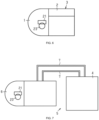
- Figs. 2 and 3 illustrates a state in which the column 12 is moved backward in the X-axis direction and the grindstone tool 21 is separated from the gear workpiece 23.
- a coolant discharge member 31 is arranged on a meshing start side of the meshing portion between the grindstone tool 21 and the gear workpiece 23.
- the coolant 100 is discharged from the discharge port 32 at the tip of the coolant discharge member 31 and supplied to the meshing portion.
- the discharge port 32 is located on the meshing start side of the meshing portion between the thread 24 of the grindstone tool 21 and the teeth 26 of the gear workpiece 23 and on the trailing side of the meshing portion in the rotation direction of the gear workpiece 23.
- the discharge port 32 is located on the outer circumferential side of the gear workpiece 23.
- the discharge port 32 is located at least partially at the same position as a plane of rotation for the gear workpiece 23, that is, at the height of the gear workpiece 23.
- the height of the gear workpiece 23 refers to the position of the gear workpiece 23 in a direction in which an axis ⁇ of the gear workpiece 23 extends.
- the discharge port 32 is located at least partially at the same position as the gear workpiece 23 in the direction in which the axis ⁇ of the gear workpiece 23 extends.
- a space 101 between the gear workpiece 23 and the grindstone tool 21 located on the meshing start side opens toward the trailing side in the rotation direction of the gear workpiece 23 and narrows toward the meshing portion.
- the discharge port 32 is located relatively close to and opposed to the space 101.
- the discharge port 32 is directed to the tooth surfaces 27 on the trailing side in the rotation direction of one or more teeth 26 that are respectively located in the thread grooves 29 of the grindstone tool 21.
- the tooth surfaces 27 on the trailing side in the rotation direction are tooth surfaces 27 oriented in a direction opposite to the rotation direction of the gear workpiece 23.
- the coolant 100 from the discharge port 32 is supplied to the tooth surfaces 27 on the trailing side of the teeth 26 located in the thread grooves 29 of the gear workpiece 23 in the rotation direction.
- the gear workpiece 23 is meshed with the grindstone tool 21.
- the angle of the grindstone tool 21 is adjusted about the X-axis depending on the lead angle of the thread 24.
- the grindstone tool 21 is rotated in the direction of arrow 103, and the gear workpiece 23 is rotated in the direction of arrow 104.
- the grindstone tool 21 is rotated in a direction in which the thread 24 enters a tooth groove 28 of the gear workpiece 23 from above.
- the coolant 100 which is circulated between the coolant supply mechanism 2 and the grinding mechanism 1, is discharged from the discharge port 32.
- the discharged coolant 100 is supplied to the tooth surfaces 27 of the teeth 26 in the thread grooves 29 through the space 101, which is located on the meshing start side of the meshing portion between the grindstone tool 21 and the gear workpiece 23.
- the discharged coolant 100 is supplied toward the meshing portion from the trailing side in the rotation direction of the gear workpiece 23 at the same height as the gear workpiece 23.
- the coolant 100 supplied toward the tooth surfaces 27 is drawn into the entire meshing part between the grindstone tool 21 and the gear workpiece 23, due to the rotation of the gear workpiece 23 and the movement of the thread 24 of the grindstone tool 21 in the direction in which the axis ⁇ extends.
- the movement of the thread 24 refers to the movement of the thread 24 in the direction of the axis ⁇ by helical rotation of the thread 24 caused by the rotation of the grindstone tool 21.
- the coolant 100 is used to lubricate and cool sliding portions between the thread surfaces 25 of the thread 24 and the tooth surfaces 27 of the teeth 26 at the meshing portion and to discharge chips.
- the grindstone tool 21 is raised and lowered by elevating the lifting table 15 such that uniform grinding is performed over the entire tooth width of the gear workpiece 23. Since the discharge port 32 follows this elevation, the coolant 100 is uniformly supplied to the entire tooth surfaces 27.
- the rotation of the gear workpiece 23 and the grindstone tool 21 draws the coolant 100 into the meshing portion from the outer circumferential side of the gear workpiece 23 through the meshing start side.
- a relatively small amount of the coolant 100 is scattered around. Accordingly, even when the discharge amount of the coolant 100 is relatively small, a sufficient amount of the coolant 100 is supplied to the meshing portion for lubrication, cooling, and chip discharge. This significantly reduces the amount of the coolant 100 used.
- the circumferential speed of the tooth 26 is not greatly different from the speed at which the coolant 100 is supplied to the tooth surface 27. Most preferably, these speeds are equal to each other.
- a conventional method for supplying the coolant 100 in the axial direction of the gear workpiece 23 and the method used in the embodiment were performed under the same grinding condition. Then, the amount of coolant supply that results in equal grinding accuracy of the obtained tooth surfaces 27 was measured. Also, the power consumption in that case was measured.
- the supply amount of the coolant 100 necessary for achieving the same grinding accuracy in the conventional method and the method of the embodiment on the above condition is as follows.
- the method of the embodiment allows the supply amount of the coolant 100 to be set to one-fourth of that of the conventional method.
- Fig. 5 illustrates the measured power consumption in the gear grinding machine of the present embodiment and the conventional gear grinding machine during the grinding under the above condition. As evident from Fig. 5 , the power consumption in the gear grinding machine of the embodiment is reduced by about 65 percent compared to the conventional gear grinding machine.
- the gear workpiece 23 is a spur gear and includes straight teeth 26 that are inclined with respect to the axis ⁇ of the gear workpiece 23.
- the rotation of the rotation table 16 causes the angle of the grindstone tool 21 to be adjusted with respect to the X-axis depending on the inclination angles of the straight teeth 26.
- the rotation of the rotation table 16 causes the discharge port 32 to incline in correspondence with the grindstone tool 21. That is, the discharge port 32 is inclined with respect to the axis of the gear workpiece 23 so as to be inclined in the same direction as the inclination direction of the tooth surfaces 27 of the straight teeth 26 from the position of the outer circumferential surface of the gear workpiece 23.
- the rotation of the gear workpiece 23 and the grindstone tool 21 allows the coolant 100 to be effectively drawn into the meshing portion between the grindstone tool 21 and the gear workpiece 23.
- the discharge port 32 of the coolant discharge member 31 is shaped in conformance with the rotation trajectory of the addendum circle of the gear workpiece 23 (i.e., the movement trajectory of the tip of each tooth 26). That is, an arcuate portion 321 is formed at the upper edge and the lower edge of the discharge port 32. The arcuate portion 321 extends along the rotation trajectory of the addendum circle without coming into contact with the top lands of the gear workpiece 23.
- the tip of the discharge port 32 includes a contact avoidance portion 35.
- the contact avoidance portion 35 is spaced apart from the outer circumferential surface of the grindstone tool 21 and extends in the direction of the axis ⁇ . This prevents the grindstone tool 21 from contacting the coolant discharge member 31.
- the distance between the space 101 and the discharge port 32 is reduced. This further reduces the amount of scattering of the coolant 100 to portions other than the meshing portion. As a result, the amount of the coolant 100 supplied to the meshing portion is further increased accordingly.
- the third embodiment provides the advantages of the first embodiment more effectively.
- the discharge port 32 for the coolant 100 may include apertures. This allows the coolant 100 to be ejected in a shower-like manner.
- Microbubbles or ultra-fine bubbles may be mixed in the coolant 100. This improves the cooling effect of the coolant 100 and thus allows chips to be removed more smoothly.
- the coolant 100 may be supplied through the space 101 from a position diagonally above the gear workpiece 23 to the tooth surfaces 27 on the trailing side in the rotation direction of the teeth 26 located in the thread grooves 29 of the gear workpiece 23.
- the gear workpiece 23 and the grindstone tool 21 may be arranged such that the axis ⁇ of the gear workpiece 23 extends in the lateral direction (for example, X-axis direction).
- the gear workpiece may have inner teeth.
- the grindstone tool used in this case is a barrel-shaped member having an inclined axis with respect to the axis of the gear workpiece.
- the discharge port of the coolant discharge member is located inside the gear workpiece at a position relatively close to the space between the grindstone tool and the gear workpiece at the meshing start side between the grindstone tool and the gear workpiece.
- the discharge port is oriented toward the teeth surface located on the trailing side in the rotation direction of the teeth of the gear workpiece.
Landscapes
- Engineering & Computer Science (AREA)
- Mechanical Engineering (AREA)
- Grinding-Machine Dressing And Accessory Apparatuses (AREA)
Applications Claiming Priority (2)
| Application Number | Priority Date | Filing Date | Title |
|---|---|---|---|
| JP2022023999 | 2022-02-18 | ||
| PCT/JP2023/005527 WO2023157932A1 (ja) | 2022-02-18 | 2023-02-16 | 歯車ワークの歯面の研削方法及び歯車研削盤 |
Publications (2)
| Publication Number | Publication Date |
|---|---|
| EP4335579A1 true EP4335579A1 (de) | 2024-03-13 |
| EP4335579A4 EP4335579A4 (de) | 2025-05-07 |
Family
ID=87578437
Family Applications (1)
| Application Number | Title | Priority Date | Filing Date |
|---|---|---|---|
| EP23754997.7A Pending EP4335579A4 (de) | 2022-02-18 | 2023-02-16 | Verfahren zum schleifen der zahnflanke eines zahnradwerkstücks und zahnradschleifmaschine |
Country Status (6)
| Country | Link |
|---|---|
| US (1) | US20240316665A1 (de) |
| EP (1) | EP4335579A4 (de) |
| JP (1) | JP7646265B2 (de) |
| KR (1) | KR20240153304A (de) |
| CN (1) | CN117580667A (de) |
| WO (1) | WO2023157932A1 (de) |
Family Cites Families (6)
| Publication number | Priority date | Publication date | Assignee | Title |
|---|---|---|---|---|
| JP5621699B2 (ja) * | 2011-04-12 | 2014-11-12 | トヨタ自動車株式会社 | 歯車潤滑装置 |
| EP3006150B2 (de) * | 2013-05-31 | 2022-10-05 | Toyota Motor Hokkaido, Inc. | Kontinuierliches wälzschleifverfahren eines zahnrads |
| JP5897100B2 (ja) | 2014-12-04 | 2016-03-30 | 三菱重工業株式会社 | 歯車研削盤 |
| JP5955429B1 (ja) | 2015-03-06 | 2016-07-20 | トヨタ自動車北海道株式会社 | 連続創成式歯車研削方法 |
| DE102018131041A1 (de) * | 2017-12-12 | 2019-06-13 | Liebherr-Verzahntechnik Gmbh | Verfahren zur Verzahnbearbeitung eines Werkstücks und Verzahnmaschine |
| DE102019101027A1 (de) * | 2019-01-16 | 2020-07-16 | Klingelnberg Gmbh | Vorrichtung und Verfahren zum Prüfen und/oder Messen von Zahnrädern |
-
2023
- 2023-02-16 US US18/577,909 patent/US20240316665A1/en active Pending
- 2023-02-16 CN CN202380012721.1A patent/CN117580667A/zh active Pending
- 2023-02-16 WO PCT/JP2023/005527 patent/WO2023157932A1/ja not_active Ceased
- 2023-02-16 KR KR1020247000481A patent/KR20240153304A/ko active Pending
- 2023-02-16 JP JP2024501437A patent/JP7646265B2/ja active Active
- 2023-02-16 EP EP23754997.7A patent/EP4335579A4/de active Pending
Also Published As
| Publication number | Publication date |
|---|---|
| CN117580667A (zh) | 2024-02-20 |
| JP7646265B2 (ja) | 2025-03-17 |
| JPWO2023157932A1 (de) | 2023-08-24 |
| KR20240153304A (ko) | 2024-10-22 |
| WO2023157932A1 (ja) | 2023-08-24 |
| EP4335579A4 (de) | 2025-05-07 |
| US20240316665A1 (en) | 2024-09-26 |
Similar Documents
| Publication | Publication Date | Title |
|---|---|---|
| US10618125B2 (en) | Gear cutting tool, gear machining device, and gear machining method | |
| CN102256735B (zh) | 用于制造齿部的机床和方法 | |
| US20200391313A1 (en) | Chamfering tool, chamfering system, gear-cutting machine and method for chamfering toothings | |
| EP4335579A1 (de) | Verfahren zum schleifen der zahnflanke eines zahnradwerkstücks und zahnradschleifmaschine | |
| CN114850584B (zh) | 一种蜗杆砂轮磨齿机 | |
| CN113059240A (zh) | 一种内螺纹精密磨削方法 | |
| CN119260409A (zh) | 一种机械零部件加工用钻孔装置 | |
| CN217016813U (zh) | 一种用于磨料生产的研磨机 | |
| EP4045218B1 (de) | Kühlmittelabgabeanordnung und verfahren zur herstellung eines zahnrades unter verwendung eines zahnradschneidwerkzeugs und einer haltekühlmutter | |
| CN211305094U (zh) | 一种利用伞齿轮加工深孔螺纹的机构 | |
| CN220761280U (zh) | 内冷单牙螺纹铣刀及刀具 | |
| CN209664824U (zh) | 一种用于数控车床的移动安装底座 | |
| CN210524025U (zh) | 渐开线细长花键轴铣床 | |
| JP7439403B2 (ja) | 砥石による研削加工方法 | |
| CN112809471A (zh) | 一种直内孔高光洁度研磨方法 | |
| CN218050675U (zh) | 滚齿机同步去毛刺装置 | |
| JPH10113867A (ja) | かき取り工具と加工片の間の共同動作領域に冷却潤滑剤を供給する方法及び装置 | |
| CN110076396B (zh) | 一种大导程螺纹的加工工艺 | |
| CN213380283U (zh) | 一种机床用回转工作台机构 | |
| US20230398619A1 (en) | Near zero degrees cross-axis angle gear cutter and method of gear cutting using such a tool | |
| TW202449641A (zh) | 切削刀具之設計方法 | |
| JP2017127947A (ja) | ホブ | |
| CN116394145B (zh) | 一种带有引流槽的螺纹梳刀力流变抛光钝化装置及方法 | |
| CN112917376B (zh) | 一种直孔内孔高光洁度研磨机 | |
| CN215942607U (zh) | 一种提高齿轮表面粗糙度的桶型砂轮 |
Legal Events
| Date | Code | Title | Description |
|---|---|---|---|
| STAA | Information on the status of an ep patent application or granted ep patent |
Free format text: STATUS: THE INTERNATIONAL PUBLICATION HAS BEEN MADE |
|
| PUAI | Public reference made under article 153(3) epc to a published international application that has entered the european phase |
Free format text: ORIGINAL CODE: 0009012 |
|
| STAA | Information on the status of an ep patent application or granted ep patent |
Free format text: STATUS: REQUEST FOR EXAMINATION WAS MADE |
|
| 17P | Request for examination filed |
Effective date: 20231206 |
|
| AK | Designated contracting states |
Kind code of ref document: A1 Designated state(s): AL AT BE BG CH CY CZ DE DK EE ES FI FR GB GR HR HU IE IS IT LI LT LU LV MC ME MK MT NL NO PL PT RO RS SE SI SK SM TR |
|
| A4 | Supplementary search report drawn up and despatched |
Effective date: 20250409 |
|
| RIC1 | Information provided on ipc code assigned before grant |
Ipc: B24B 55/02 20060101ALI20250403BHEP Ipc: B24B 19/02 20060101ALI20250403BHEP Ipc: B24B 19/00 20060101ALI20250403BHEP Ipc: B23Q 11/10 20060101ALI20250403BHEP Ipc: B23F 23/12 20060101ALI20250403BHEP Ipc: B23F 5/04 20060101AFI20250403BHEP |
|
| DAV | Request for validation of the european patent (deleted) | ||
| DAX | Request for extension of the european patent (deleted) |