EP4335767A1 - Dispositif d'étiquetage - Google Patents
Dispositif d'étiquetage Download PDFInfo
- Publication number
- EP4335767A1 EP4335767A1 EP23189255.5A EP23189255A EP4335767A1 EP 4335767 A1 EP4335767 A1 EP 4335767A1 EP 23189255 A EP23189255 A EP 23189255A EP 4335767 A1 EP4335767 A1 EP 4335767A1
- Authority
- EP
- European Patent Office
- Prior art keywords
- glue
- labels
- monitoring
- sensor
- labeling
- Prior art date
- Legal status (The legal status is an assumption and is not a legal conclusion. Google has not performed a legal analysis and makes no representation as to the accuracy of the status listed.)
- Pending
Links
- 238000002372 labelling Methods 0.000 title claims abstract description 82
- 239000003292 glue Substances 0.000 claims abstract description 117
- 238000012544 monitoring process Methods 0.000 claims abstract description 40
- 230000001105 regulatory effect Effects 0.000 claims abstract description 38
- 238000013473 artificial intelligence Methods 0.000 claims abstract description 37
- 238000004026 adhesive bonding Methods 0.000 claims abstract description 19
- 238000010380 label transfer Methods 0.000 claims abstract description 7
- 239000000203 mixture Substances 0.000 claims description 15
- 238000013528 artificial neural network Methods 0.000 claims description 14
- 238000000034 method Methods 0.000 claims description 12
- 238000013527 convolutional neural network Methods 0.000 claims description 6
- 239000002245 particle Substances 0.000 claims description 6
- 230000000306 recurrent effect Effects 0.000 claims description 6
- 238000004140 cleaning Methods 0.000 claims description 5
- 230000007613 environmental effect Effects 0.000 claims description 3
- 230000006978 adaptation Effects 0.000 abstract description 2
- 238000004519 manufacturing process Methods 0.000 description 5
- 238000012546 transfer Methods 0.000 description 5
- 235000013361 beverage Nutrition 0.000 description 4
- 230000000875 corresponding effect Effects 0.000 description 4
- 238000007689 inspection Methods 0.000 description 4
- 239000000463 material Substances 0.000 description 4
- 239000004033 plastic Substances 0.000 description 4
- 229920003023 plastic Polymers 0.000 description 4
- 230000001276 controlling effect Effects 0.000 description 3
- 239000011521 glass Substances 0.000 description 3
- 229920000139 polyethylene terephthalate Polymers 0.000 description 3
- 239000005020 polyethylene terephthalate Substances 0.000 description 3
- 238000005096 rolling process Methods 0.000 description 3
- 239000004831 Hot glue Substances 0.000 description 2
- 238000003848 UV Light-Curing Methods 0.000 description 2
- 239000000853 adhesive Substances 0.000 description 2
- 230000001070 adhesive effect Effects 0.000 description 2
- 238000000071 blow moulding Methods 0.000 description 2
- 230000001680 brushing effect Effects 0.000 description 2
- 238000013461 design Methods 0.000 description 2
- 238000011161 development Methods 0.000 description 2
- 230000018109 developmental process Effects 0.000 description 2
- 230000010354 integration Effects 0.000 description 2
- 235000021056 liquid food Nutrition 0.000 description 2
- -1 polyethylene terephthalate Polymers 0.000 description 2
- 238000001228 spectrum Methods 0.000 description 2
- 239000007921 spray Substances 0.000 description 2
- 239000004743 Polypropylene Substances 0.000 description 1
- 239000000654 additive Substances 0.000 description 1
- 230000033228 biological regulation Effects 0.000 description 1
- 238000003763 carbonization Methods 0.000 description 1
- 239000005018 casein Substances 0.000 description 1
- BECPQYXYKAMYBN-UHFFFAOYSA-N casein, tech. Chemical compound NCCCCC(C(O)=O)N=C(O)C(CC(O)=O)N=C(O)C(CCC(O)=N)N=C(O)C(CC(C)C)N=C(O)C(CCC(O)=O)N=C(O)C(CC(O)=O)N=C(O)C(CCC(O)=O)N=C(O)C(C(C)O)N=C(O)C(CCC(O)=N)N=C(O)C(CCC(O)=N)N=C(O)C(CCC(O)=N)N=C(O)C(CCC(O)=O)N=C(O)C(CCC(O)=O)N=C(O)C(COP(O)(O)=O)N=C(O)C(CCC(O)=N)N=C(O)C(N)CC1=CC=CC=C1 BECPQYXYKAMYBN-UHFFFAOYSA-N 0.000 description 1
- 235000021240 caseins Nutrition 0.000 description 1
- 235000019504 cigarettes Nutrition 0.000 description 1
- 238000011109 contamination Methods 0.000 description 1
- 230000002596 correlated effect Effects 0.000 description 1
- 239000002537 cosmetic Substances 0.000 description 1
- 238000001723 curing Methods 0.000 description 1
- 230000007423 decrease Effects 0.000 description 1
- 238000013135 deep learning Methods 0.000 description 1
- 239000006185 dispersion Substances 0.000 description 1
- 238000009826 distribution Methods 0.000 description 1
- 239000012530 fluid Substances 0.000 description 1
- 238000010438 heat treatment Methods 0.000 description 1
- 230000003993 interaction Effects 0.000 description 1
- 239000007788 liquid Substances 0.000 description 1
- 239000010687 lubricating oil Substances 0.000 description 1
- 238000010801 machine learning Methods 0.000 description 1
- 230000007257 malfunction Effects 0.000 description 1
- 239000011159 matrix material Substances 0.000 description 1
- 230000001537 neural effect Effects 0.000 description 1
- 239000011368 organic material Substances 0.000 description 1
- 238000004806 packaging method and process Methods 0.000 description 1
- 238000009928 pasteurization Methods 0.000 description 1
- 229920001155 polypropylene Polymers 0.000 description 1
- 238000012545 processing Methods 0.000 description 1
- 230000005855 radiation Effects 0.000 description 1
- 235000021055 solid food Nutrition 0.000 description 1
- 238000005507 spraying Methods 0.000 description 1
- 238000003860 storage Methods 0.000 description 1
- 238000013024 troubleshooting Methods 0.000 description 1
- 239000013598 vector Substances 0.000 description 1
- 239000002699 waste material Substances 0.000 description 1
- XLYOFNOQVPJJNP-UHFFFAOYSA-N water Substances O XLYOFNOQVPJJNP-UHFFFAOYSA-N 0.000 description 1
Images
Classifications
-
- B—PERFORMING OPERATIONS; TRANSPORTING
- B65—CONVEYING; PACKING; STORING; HANDLING THIN OR FILAMENTARY MATERIAL
- B65C—LABELLING OR TAGGING MACHINES, APPARATUS, OR PROCESSES
- B65C9/00—Details of labelling machines or apparatus
- B65C9/20—Gluing the labels or articles
- B65C9/22—Gluing the labels or articles by wetting, e.g. by applying liquid glue or a liquid to a dry glue coating
- B65C9/2204—Gluing the labels or articles by wetting, e.g. by applying liquid glue or a liquid to a dry glue coating using spraying means
- B65C9/2213—Applying the liquid on the label
-
- B—PERFORMING OPERATIONS; TRANSPORTING
- B65—CONVEYING; PACKING; STORING; HANDLING THIN OR FILAMENTARY MATERIAL
- B65C—LABELLING OR TAGGING MACHINES, APPARATUS, OR PROCESSES
- B65C9/00—Details of labelling machines or apparatus
- B65C9/20—Gluing the labels or articles
- B65C9/22—Gluing the labels or articles by wetting, e.g. by applying liquid glue or a liquid to a dry glue coating
- B65C9/2204—Gluing the labels or articles by wetting, e.g. by applying liquid glue or a liquid to a dry glue coating using spraying means
-
- B—PERFORMING OPERATIONS; TRANSPORTING
- B65—CONVEYING; PACKING; STORING; HANDLING THIN OR FILAMENTARY MATERIAL
- B65C—LABELLING OR TAGGING MACHINES, APPARATUS, OR PROCESSES
- B65C9/00—Details of labelling machines or apparatus
- B65C9/40—Controls; Safety devices
-
- B—PERFORMING OPERATIONS; TRANSPORTING
- B65—CONVEYING; PACKING; STORING; HANDLING THIN OR FILAMENTARY MATERIAL
- B65C—LABELLING OR TAGGING MACHINES, APPARATUS, OR PROCESSES
- B65C9/00—Details of labelling machines or apparatus
- B65C9/40—Controls; Safety devices
- B65C2009/402—Controls; Safety devices for detecting properties or defects of labels
Definitions
- the present invention relates to a labeling device for labeling objects, such as containers, in which relevant operating parameters are set based on sensor data.
- containers such as bottles, cans, etc. are treated in several successive process steps.
- the process steps are generally carried out in separate treatment stations, which can be put together, for example, as modules of a common system concept.
- a container treatment system for glass bottles or plastic bottles for example made of polyethylene terephthalate (PET), polypropylene (PEP), etc., can, for example, have a blow molding device, filling device, carbonization device, closing device, labeling device, packaging device, cleaning device, pasteurization device, inspection device, etc. as a separate, modular design Include treatment stations.
- the individual treatment stations which carry out successive process steps, are generally connected in series, with one or more transport devices taking over the transport of the containers from the treatment stations to the respective downstream treatment stations.
- labels are continuously applied to continuously supplied articles, containers or packages of containers at high performance.
- the containers can be glass bottles, plastic bottles, in particular PET bottles, cans or can-like containers or containers made from pulp or the like, which contain liquid or solid food, medical or cosmetic products, hygiene products or the like are filled.
- the labeling device generally comprises a labeling unit that is often of modular design.
- Such labeling units for labeling machines, in particular for labeling machines of a rotating type, for labeling bottles or similar containers with labels, in particular those made of paper, using cold glue are known in the prior art.
- Such units basically comprise at least one pallet or glue segment carrier that can be driven around a vertical axis of the unit, also referred to as a pallet carousel, on which several label pallets or glue segments each forming at least one label holder or support surface are provided.
- the pallets or glue segments are each designed to be pivotable in a controlled manner about their own pivot axis.
- the pallets or glue segments are first moved past a gluing station to create a glue application on their label support surface and then past a label delivery station with each revolution of the carousel, with one label being taken over at a time.
- the glued labels are each transferred, for example, by a gripping cylinder to the containers moving past the labeling unit.
- the present invention is based on the object of providing a labeling device suitable for integration into fully automated systems, which reliably enables high-quality labeling of objects.
- Spray systems from the cigarette industry are suitable as a spray head for applying the glue; the application can be done both vertically (from top to bottom) and horizontally (from left to right or right to left) - the vertical application (from top to bottom) may be preferred because the vectors of all the forces add up ideally and the process This means it runs more robustly because less dirt can build up on the nozzle.
- the control and/or regulating device with artificial intelligence is designed to receive the sensor data from the sensor system and to fully automatically and digitally control and/or regulate the setting and adaptation of operating parameters of the operation of the labeling device on the basis of this sensor data.
- the operation of the labeling device may include transporting the objects with the transport device, dispensing labels by the label supply device, transferring labels by the label transfer device and applying glue to the labels by the gluing device.
- Operating parameters include in particular those that relate to the glue (such as the amount administered, composition, positioning/arrangement of the glue dots/traces or the glue pattern on the labels) and those that relate to the labels (such as positioning on the objects, pressure through brushing/rolling).
- UV curing glue the performance of UV lamps/LED lamps used for glue curing can be an operating parameter.
- the regulation of the UV power can be fully automated.
- the control and/or regulating device can be equipped with artificial Intelligence can regulate the UV lamps/LED intensity upwards, for example.
- the lamp spectrum can also be continuously monitored in order to be able to determine in good time, for example, when the lifespan of the lamp/LED is nearing the end or the spectrum is shifting.
- the control and/or regulating device with artificial intelligence can be trained to directly initiate measures to change certain operating parameters when certain errors are detected; However, it can continue to learn (“on-the-fly”), particularly during operation of the labeling device.
- the sensor system takes over the monitoring and, if necessary, recording of all operational and quality-relevant parameters as well as in particular an outgoing goods inspection, the feedback of which to the control and/or regulating device with artificial intelligence allows it to learn during operation and to optimize the operational process, thereby in particular downtime can be kept low and the quality of labeling can be increased compared to the state of the art. Time-consuming and costly manual services can be reduced to a minimum. Provisioning processes for consumer goods can be initiated automatically and “just in time”. In addition, in the fully automatic operation of the labeling device, the amount of consumables used, such as the glue required for labeling, can be optimized as required, and waste of material can thus be avoided.
- a labeling device provided in this way can be operated fully automatically and can be easily integrated as a module into a fully automated system, for example a fully automated system for beverage production.
- the labeling device according to the invention can thus be provided as part of a machine block together with further components, such as a stretch blow molding machine for producing containers and/or a filling machine for filling the containers and/or a closing machine for closing the filled containers. It is understood that at least the machines for filling, closing and labeling included in a machine block are attached to a common machine frame and/or that their machine frames can be connected to one another in a mechanically stationary manner for production operations, for example by screwing, clamping or the like.
- the machine frames can be composed of several modules, assembly platforms or the like that can be firmly connected to one another for individual machines, treatment devices and/or transfer stars of the machine block.
- a container transfer between the individual machines of the machine block is possible in a space-saving and precise manner using transfer stars, such as inlet stars and outlet stars, screw conveyors or the like.
- the labeling device can include a central drive in the form of a motor unit, for example a servo motor, which drives the label transfer device.
- the central drive can thus drive a pallet carousel that can be driven about an axis of rotation and has at least one pallet that can be pivoted by the central drive and is designed to accept labels provided by the label supply unit.
- the pallet carousel and the one or more pallets can be designed to place the labels directly onto the containers to be labeled without play, without the need for an additional gripping cylinder for labeling.
- the one or more pallets can each be designed as vacuum pallets with a plurality of suction openings or suction cups on the support surface of the vacuum pallet for holding the labels.
- the labels are held by a vacuum generated by a vacuum supply unit during their movement on the pallet carousel after removal from the label supply device until they are handed over to the containers to be labeled.
- One or more pallets can be moved via roller levers with rollers (cam rollers), with each pallet being assigned a roller lever and the rollers running in a control cam.
- the roller levers are connected to pallet shafts for driving the pallets via the central drive.
- the control cam is designed, for example, as a (guide) cam groove or rail above or below the pallet carousel in or on a corresponding fixed control cam plate.
- the gluing device of the labeling device can comprise a large number of glue nozzles, in particular individually controllable ones, by means of which a variable glue pattern can be printed on glue application surfaces of the labels.
- a gluing device that uses the inkjet process (Gluejet/GlueLite process)
- the labels can be glued quickly, reliably and variably. For example, wet glue is sprayed onto the labels in the gluing device, the glued labels are fed to the objects to be labeled by the label transfer device and pressed onto the objects using a sponge.
- the operating parameters that are to be monitored by the sensor system and (pre)set and adjusted by the control and/or regulating device with artificial intelligence can include parameters for the gluing device, which include the quantity, the pattern (lines, points, distances, arrangement , etc.) and the composition of the glue applied to the labels, and which can be changed by the control and / or regulating device with artificial intelligence in accordance with a subset of the sensor data.
- the optimized use of glue is particularly important.
- the composition of the glue plays a particularly important role here. For example, if a labeling that does not meet the established quality criteria is detected at an outgoing goods inspection included in the sensor system, the control and/or regulating device with artificial intelligence can in particular cause a change in the composition of the glue used for labeling.
- the use of artificial intelligence is essential for the complex, fully automated operation of the labeling device.
- the control and/or regulating device with artificial intelligence of the labeling device can be designed for machine learning.
- the control and/or regulating device with artificial intelligence of the labeling device comprises at least one transformer and/or an artificial neural network, in particular one of a deep (learning) neural network, multilayer perceptron, convolutional neural network and Recurrent neural network.
- the deep (learning) neural network is characterized by a number of hidden layers. Deep learning enables a machine to independently improve its skills and make decisions without human intervention by extracting and classifying patterns from existing data and information. The insights gained can in turn be correlated with data and linked in a broader context.
- the machine is able to make decisions based on the connections.
- the information links are given certain weights. If decisions are confirmed, their weighting increases; if they are revised, the weighting decreases.
- the multilayer perceptron is a relatively simple, robust neural network in which all nodes are fully connected.
- the convolutional neural network is based on convolutions instead of matrix multiplication.
- the recurrent neural network allows feedback from one neural layer to a previous one.
- a Transformer has neither a convolutional neural network nor a recurrent neural network, but is based on the concept of self-attention. However, the transformer can work together with a convolutional neural network or a recurrent neural network.
- the sensor system is indispensable for the labeling device according to the invention, since the control and/or regulating device with artificial intelligence cannot control/regulate fully automated operation of the labeling device without the sensor data supplied by the sensor system could.
- the sensor system includes first sensor units for monitoring parameters related to the glue and second sensor units for monitoring parameters related to the labels.
- the sensor system of the labeling device can include: third sensor units for monitoring temperatures of elements of the labeling device, fourth sensor units for monitoring pump printing (for example printing from glue pumps or vacuum pumps), fifth sensor units for monitoring consumables (such as glue, additives, lubricating oils or cleaning fluids) , sixth sensor units for monitoring cleaning processes, and seventh sensor units for monitoring environmental parameters (for example ambient pressure, temperature or humidity or contamination).
- control and/or regulating device with artificial intelligence controls/regulates operating parameters in accordance with the material and the surface quality of the objects to be labeled.
- Information about the material and the surface quality of the objects to be labeled can be entered separately into the control and/or regulating device with artificial intelligence and/or obtained via corresponding additional sensor units.
- the first sensor units for monitoring parameters related to the glue can include a sensor unit for monitoring the composition of the glue. Furthermore, they can have a sensor unit for monitoring the amount of glue applied to the labels, a sensor unit for monitoring the viscosity of the glue, a sensor unit for monitoring the particle size of particles of the glue, a sensor unit for monitoring the temperature of the glue and a sensor unit for monitoring the Sample of glue applied to the labels.
- the second sensor units for monitoring parameters related to the labels can include a sensor unit for monitoring the adhesion of the labels to the objects and a sensor unit for monitoring the positioning of the labels on the objects and thus serve/contribute to outgoing goods inspection. Furthermore, the second sensor units can include filling status sensors for (label magazines) of the label supply device, wherein the control and/or regulating device with artificial intelligence can be designed in particular for controlling/regulating an automatic change of removal between different magazines, whereby comparatively small magazines are used and /or continuous operation even in the event of a magazine malfunction can be maintained by automatically switching to a functioning magazine.
- sensor units can be designed to be at least partially logically and/or physically integrated. Temperature sensors, pressure sensors and image recording devices can be used as suitable for the sensor units. Information about a wide variety of sensor data can be suitably provided to a user via image display devices.
- the labeling device provided here is suitable for easy integration into a fully automated system for beverage production.
- a fully automated system for beverage production with the labeling device according to one of the examples described above is therefore also provided here.
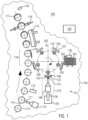
- Figure 1 shows a labeling device with a control and/or regulating device with artificial intelligence and a sensor system according to an embodiment of the present invention.
- the present invention provides a labeling device for labeling objects, for example containers such as bottles or cans or containers, which enables fully automated and digitalized operation by providing a control and / or regulating device with artificial intelligence and a sensor system that exchanges data with it the labeling device allowed.
- Figure 1 An exemplary embodiment of such a fully automated labeling device according to the invention is shown in Figure 1 shown in top view.
- Labeling device 100 shown comprises a transport device 114 designed as a container table, along which objects to be labeled (hereinafter containers as an example) 113 or containers rotate on a curved path on a variety of holders (not shown) that can rotate around themselves.
- a pretreatment unit 112 can be provided, which prepares the containers 113 to be labeled for labeling by cleaning the container surfaces to be labeled, pre-moistening 111 or a blow-off, a heating and/or radiation and/or plasma and/or corona -submits to treatment.
- a sensor unit 110 can be provided, which monitors the condition of the surface to be labeled, e.g. B. smooth, rough, etc., and / or environmental conditions, such as.
- the sensor unit 110 is shown by way of example as part of a comprehensive sensor system 150 for monitoring operating and quality parameters.
- the sensor system 150 includes a large number of other sensor units (see description below), not all of which are described in detail for reasons of clarity Figure 1 are shown.
- a rolling unit 115 and/or a brushing unit 116 can be provided in the wake of the labeling position 118 in order to completely apply and press on the label 120 placed on the container.
- the fit of the labels 120 on the finished labeled containers 117 can be checked using a sensor unit 135.
- the containers 117 provided with the labels 120 are then transferred to a subsequent treatment station, for example a filling station for filling the containers 117 with a liquid food.
- the labeling device 100 further comprises a labeling unit 10.
- the labeling unit 10 comprises a transfer device 103 designed as a pallet carousel with at least one pallet 104 - 106.
- the pallet carousel 103 has a plurality of pallets 104 - 106 rotating around an axis of rotation of the pallet carousel 103, which in turn are pivotable are formed around their own, eccentrically mounted pivot axes 119.
- the pallets have a support surface 123 on their outward-facing side, which can be large enough to accommodate a variety of different label formats.
- the initially unloaded pallet 104 is guided past a label supply unit 101 in the form of a label box arranged on the periphery of the pallet carousel 103 during its rotation around the axis of rotation of the pallet carousel 103 and is pivoted in such a way that the support surface 123 of the pallet holds the frontmost label presented with the image side 102 takes over from the label box 101.
- the pallets 104 - 106 are designed as vacuum pallets, this transfer can also be carried out without prior gluing of the support surface 123 reliably possible.
- the label box 101 can be designed to be switchable via a pneumatic cylinder 130.
- a label can be taken over from the label supply unit 101 by a pallet 104 using negative pressure using a plurality of suction openings in the pallet 104.
- the pallet 104 is supplied with negative pressure via a vacuum system.
- the vacuum system may include a vacuum pump, a side channel blower, a venturi nozzle or a Coanda nozzle.
- the vacuum system can be designed to be controllable in such a way that the pallet 104 can be subjected to negative pressure depending on the position of the pallet 104 in circulation around the pallet carousel 103.
- the labels 102 are provided with their image side facing forward, they also come to rest with their image side on the support surface 123 of the pallet 105.
- the glue application surface 122 of the labels 107 transported by the pallets 105 and 106 points away from the support surface of the respective pallet.
- the glue application surface of the label 107 which thus faces outwards, can therefore be attached to the orbit of the pallets 104 - 106, i.e. H.
- Gluing device 124 arranged on the circumference of the pallet carousel 103 can be glued directly onto the pallet.
- the gluing device 124 can work using the inkjet process.
- the gluing device 124 can have a plurality of controllable glue nozzles, which are arranged with respect to the orbit of the back of the label transported by the pallet in such a way that the glue to be applied is sprayed onto its glue application surface as the label passes by. This can be done, for example, by applying glue point by point or line by line.
- the applied dots or lines eventually widen to form glue surfaces, which allow the label to adhere securely to the container surface.
- the glue nozzles can work in particular according to the inkjet principle, with one or more rows of glue nozzles aligned perpendicular to the direction of movement of the glue application surface being specifically activated in order to achieve a desired glue pattern, ie a desired dosage and distribution of the applied glue, on the glue application surface.
- the gluing device 124 could be provided for the flat gluing of the glue application surface 122 of the label 107 using a gluing roller.
- the glued egg chains or the glue applied to the labels can be checked with a sensor unit 109.
- a glue printer 108 When using a glue printer 108, cold glue is sprayed directly onto the glue application surface 122 from a large number of glue nozzles in the form of a glue jet 121.
- the glue application surface 122 is preferably guided past the openings of the glue nozzles at a constant distance by rotating and pivoting the pallet 106.
- the glue nozzles for example according to the DoD principle (drop-on-demand)
- an almost arbitrary glue pattern can be printed onto the glue application surface 122 in superimposition with the pallet movement.
- the exact amount of cold glue required can be printed on, so that there is no need for glue to return.
- Glue is supplied in a controlled manner via a glue supply line 128 in the required quantity from a deformable storage device 129.
- Low-viscosity glues glues with a viscosity between 20 and 80,000 or 150,000 mPa s and casein or dispersion glues with an optimal processing temperature between 18 ° can be used as glue C and 34 °C can be used. It may be necessary to control the temperature of the glue or the glue system to around 35-45 °C as the nozzle heats up over time.
- the glue pattern can migrate as the nozzle system/head heats up. This can be prevented by maintaining constant temperature control (complete system including pump, nozzle system, glue supply, lines, etc.).
- the temperature can also be set to lower or higher °C values if necessary.
- the cold glue is applied to the outward-facing glue application surface 122, no gripper cylinder is required to place the now glued labels 107 onto the containers 113 to be labeled. Instead, the labels are placed directly from the pallets 104 - 106 onto the containers 113 that are guided past the labeling position 118 and are wound onto them by rotating the holders of the container table 114. For this purpose, the pallets are guided past the container surfaces and pivoted in such a way that the labels carried are rolled onto the container surfaces in combination with the rotational movement of the containers and their rotation around the container table.
- hot glue is printed onto the labels 120 using a corresponding alternative glue printer.
- the rotational movements of the pallets 104 - 106 and the holders of the container table 114 can be controlled by means of controllable drives (not in Figure 1 shown) can be controlled via the control and / or regulating device with artificial intelligence 140 of the labeling device 100.
- the pivoting movements of the pallets 104 - 106 can be controlled and/or regulated via appropriate control cams and rolling levers using the control and/or regulating device with artificial intelligence 140.
- the vacuum supply and the operation of the glue nozzles can be controlled/regulated via the control and/or regulating device with artificial intelligence 140.
- Labeling device 100 shown can have more than one labeling unit 10.
- it can have a labeling unit 10, which is aligned essentially horizontally, and a further labeling unit, which is inclined relative to the horizontal, for simultaneous or successive labeling of different areas of one and the same container.
- the control and/or regulating device with artificial intelligence 140 includes, for example, one Transformers and/or trainable neural networks.
- one or more deep (learning) neural networks, multilayer perceptrons, convolutional neural networks and/or recurrent neural networks can be used, which receive data as input data based on sensor data supplied by the sensor units of the sensor system 150 be won. Output data from these neural networks are used in control instructions to set and adapt operating parameters.
- the transformer can be used to classify errors and perform error analysis and troubleshooting based on this classification.
- the plurality of sensor units may include first sensor units for monitoring parameters related to the glue (for example, comprising the sensor unit 109) and second sensor units for monitoring parameters related to the labels 120 (for example, comprising the sensor unit 135).
- the first sensor units can thus determine the composition of the glue, the amount of glue applied to the labels, the viscosity of the glue, the particle size of particles of the glue, the temperature of the glue and the pattern of the glue applied to the labels (for example partially with the help of Cameras and / or photoelectric sensor units) are monitored, and these parameters (and / or possibly further operating parameters) can be set and changed accordingly by the control and / or regulating device with artificial intelligence 140 based on the data supplied by the first sensor units.
- glue volume of a print head can depend on one of a sensor unit of the first Sensor units detected glue pressure in the print head can be varied to compensate for pressure fluctuations.
- the second sensor units can be used to monitor the adhesion of the labels 120 to the containers 113 and the positioning of the labels 120 to the containers 113 (for example using cameras and/or photoelectric sensor units). Operating parameters that influence the adhesion and positioning of the labels 120 on the containers 113 can be set and changed accordingly by the control and/or regulating device with artificial intelligence 140 based on the data supplied by the second sensor units.
- the control and / or regulating device with artificial intelligence 140 can use a different composition of the glue to be applied to the labels 120 cause, for example in the case of a two-component glue, a changed mixture of the two components.
- the open-loop and/or closed-loop control device with artificial intelligence 140 can determine, based on corresponding data supplied by other sensor units, whether the glue nozzle heads are working properly (for example, are not clogged). , whether the temperature of the glue or the print head is within tolerable limits, whether the vacuum supply to the pallets is carried out correctly, whether the vacuum pump and the glue pump work with prints within tolerable limits, whether the composition of the glue should be changed, etc.
- Such data can be among other things, using appropriate temperature or pressure sensors.
- the control and/or regulating device with artificial intelligence 140 can then, in accordance with the error analysis, change one of the monitored parameters, for example, or change the composition of the glue or the printed image applied or the amount of glue applied per label 120 or the composition of the glue applied Change the contact pressure of the labels 120 on the containers 113. Any change in operating parameters can occur fully automatically during ongoing operation of the labeling device 100.
- control and/or regulating device with artificial intelligence 140 of the labeling device 100 can react fully automatically to any batch change, for example the change in the type of containers 113 to be labeled or the type of labels 120 used to label the containers 113.
- the control and/or regulating device with artificial intelligence 140 can decide that When changing a label, less glue is now required and accordingly the amount of glue used for labeling the containers 113 can be reduced, which means that glue consumption can be optimized, or the glue composition can be varied, if necessary in order to reduce the amount of glue required.
- the required application amount of glue and its composition are not checked, so that glue is often wasted.
Landscapes
- Labeling Devices (AREA)
Applications Claiming Priority (1)
| Application Number | Priority Date | Filing Date | Title |
|---|---|---|---|
| DE102022123019.8A DE102022123019A1 (de) | 2022-09-09 | 2022-09-09 | Etikettiervorrichtung |
Publications (1)
| Publication Number | Publication Date |
|---|---|
| EP4335767A1 true EP4335767A1 (fr) | 2024-03-13 |
Family
ID=87554806
Family Applications (1)
| Application Number | Title | Priority Date | Filing Date |
|---|---|---|---|
| EP23189255.5A Pending EP4335767A1 (fr) | 2022-09-09 | 2023-08-02 | Dispositif d'étiquetage |
Country Status (4)
| Country | Link |
|---|---|
| US (1) | US20240083618A1 (fr) |
| EP (1) | EP4335767A1 (fr) |
| CN (1) | CN117682201A (fr) |
| DE (1) | DE102022123019A1 (fr) |
Citations (8)
| Publication number | Priority date | Publication date | Assignee | Title |
|---|---|---|---|---|
| US4279687A (en) * | 1978-09-01 | 1981-07-21 | Jagenberg-Werke Ag | Labeling station with glueing means for bottles or the like |
| JP2014125217A (ja) * | 2012-12-25 | 2014-07-07 | Asahi Breweries Ltd | ラベラー |
| CN107226250A (zh) * | 2017-06-30 | 2017-10-03 | 浙江隆昂机电设备有限公司 | 烟包税票机 |
| US20180186492A1 (en) * | 2015-06-30 | 2018-07-05 | Krones Ag | Apparatus and method for labeling containers |
| CN111392169A (zh) * | 2019-01-03 | 2020-07-10 | 青岛融都机械有限公司 | 全自动热熔胶贴标机 |
| US20200230639A1 (en) * | 2017-08-24 | 2020-07-23 | Khs Gmbh | Method for controlling the amount of an adhesive to be applied to a substrate |
| DE102020101845A1 (de) * | 2020-01-27 | 2021-07-29 | Krones Aktiengesellschaft | Verfahren zum Aufspritzen von Kaltleim auf Paletten für Etiketten und Etikettieraggregat für Behälter |
| DE102020130531A1 (de) * | 2020-11-19 | 2022-05-19 | Krones Ag | Vorrichtung und Verfahren zum Beleimen von Etiketten für Behälter und Etikettiermaschine |
Family Cites Families (5)
| Publication number | Priority date | Publication date | Assignee | Title |
|---|---|---|---|---|
| DE102019126947A1 (de) | 2019-10-08 | 2021-04-08 | Krones Aktiengesellschaft | Verfahren zum Betreiben einer Behältnisbehandlungsanlage und Behältnisbehandlungsanlage mit optimierten Parametern |
| DE102020111674A1 (de) | 2020-04-29 | 2021-11-04 | Krones Aktiengesellschaft | Behälterbehandlungsmaschine und Verfahren zum Überwachen des Betriebs einer Behälterbehandlungsmaschine |
| US11383874B2 (en) * | 2020-09-30 | 2022-07-12 | TE Connectivity Services Gmbh | Robotic labeling system and method of labeling packages |
| DE102020129829B4 (de) | 2020-11-12 | 2025-03-06 | Espera-Werke Gmbh | Verfahren für den Betrieb eines Etikettiersystems |
| DE102021112484A1 (de) * | 2021-05-12 | 2022-11-17 | Krones Aktiengesellschaft | Etikettiermaschine und Verfahren zum Konfigurieren einer Etikettiermaschine |
-
2022
- 2022-09-09 DE DE102022123019.8A patent/DE102022123019A1/de active Pending
-
2023
- 2023-08-02 EP EP23189255.5A patent/EP4335767A1/fr active Pending
- 2023-09-05 CN CN202311135866.9A patent/CN117682201A/zh active Pending
- 2023-09-07 US US18/463,220 patent/US20240083618A1/en active Pending
Patent Citations (8)
| Publication number | Priority date | Publication date | Assignee | Title |
|---|---|---|---|---|
| US4279687A (en) * | 1978-09-01 | 1981-07-21 | Jagenberg-Werke Ag | Labeling station with glueing means for bottles or the like |
| JP2014125217A (ja) * | 2012-12-25 | 2014-07-07 | Asahi Breweries Ltd | ラベラー |
| US20180186492A1 (en) * | 2015-06-30 | 2018-07-05 | Krones Ag | Apparatus and method for labeling containers |
| CN107226250A (zh) * | 2017-06-30 | 2017-10-03 | 浙江隆昂机电设备有限公司 | 烟包税票机 |
| US20200230639A1 (en) * | 2017-08-24 | 2020-07-23 | Khs Gmbh | Method for controlling the amount of an adhesive to be applied to a substrate |
| CN111392169A (zh) * | 2019-01-03 | 2020-07-10 | 青岛融都机械有限公司 | 全自动热熔胶贴标机 |
| DE102020101845A1 (de) * | 2020-01-27 | 2021-07-29 | Krones Aktiengesellschaft | Verfahren zum Aufspritzen von Kaltleim auf Paletten für Etiketten und Etikettieraggregat für Behälter |
| DE102020130531A1 (de) * | 2020-11-19 | 2022-05-19 | Krones Ag | Vorrichtung und Verfahren zum Beleimen von Etiketten für Behälter und Etikettiermaschine |
Also Published As
| Publication number | Publication date |
|---|---|
| CN117682201A (zh) | 2024-03-12 |
| US20240083618A1 (en) | 2024-03-14 |
| DE102022123019A1 (de) | 2024-03-14 |
Similar Documents
| Publication | Publication Date | Title |
|---|---|---|
| DE68929534T2 (de) | Anbringen eines Etikettmehrschichtenverbunds an einen Behälter | |
| EP3317192B1 (fr) | Rouleau d'encollage avec zone de collage limité | |
| EP3317189B1 (fr) | Dispositif et procédé pour étiqueter des récipients | |
| EP3317190A1 (fr) | Dispositif et procédé pour étiqueter des récipients | |
| EP3858750B1 (fr) | Dispositif et procédé de marquage des conteneurs | |
| DE102008049241A1 (de) | Vorrichtung zum Aufbringen jeweils eines Mehrfachdrucks auf Packmittel | |
| DE69811683T2 (de) | Applikation von substanzen auf eine verpackung | |
| DE69305593T2 (de) | Maschine für Offsetdruck von flachen Gegenständen, insbesondere für Compact Discs | |
| WO2009112160A1 (fr) | Machine d'impression linéaire à structure modulaire pour l'impression de corps creux par différents procédés d'impression | |
| EP2616346A1 (fr) | Procédé et dispositif d'étiquetage de bouteilles | |
| DE19824846A1 (de) | Anlage zum Abfüllen von flüssigem Füllgut | |
| EP3334607A1 (fr) | Machine de traitement de contenants et procédé d'impression de contenants | |
| WO2009071237A1 (fr) | Procédé d'étiquetage de récipients et poste d'étiquetage | |
| DE19735070C2 (de) | Anlage zum Erstellen blattartiger Druckerzeugnisse | |
| EP4337545A1 (fr) | Machine d'étiquetage et procédé pour configurer une machine d'étiquetage | |
| DE102016225323A1 (de) | Verfahren und Direktdruckmaschine zur Bedruckung von kreisrunden Behältern mit einem Direktdruck | |
| CH717313A2 (de) | Vorrichtung zur Entnahme eines ausgestanzten Teils aus einer Stanzvorrichtung. | |
| EP4335767A1 (fr) | Dispositif d'étiquetage | |
| EP3099580B1 (fr) | Procédé et dispositif pour former des unités d'emballage | |
| WO2022058052A1 (fr) | Imprimante à colle pour étiqueteuse | |
| WO1999048690A1 (fr) | Procede et dispositif pour le recouvrement de feuilles, et mise en oeuvre du procede | |
| EP3689761B1 (fr) | Dispositif et procédé de manipulation et / ou d'emballage d'articles | |
| EP4214128A1 (fr) | Ensemble d'étiquetage de faible hauteur globale | |
| WO2025103885A1 (fr) | Appareil d'étiquetage pour transférer une image d'étiquette et une couche adhésive sur des récipients | |
| DE102024106959A1 (de) | Vorrichtung zum Erzeugen von Behältern |
Legal Events
| Date | Code | Title | Description |
|---|---|---|---|
| PUAI | Public reference made under article 153(3) epc to a published international application that has entered the european phase |
Free format text: ORIGINAL CODE: 0009012 |
|
| STAA | Information on the status of an ep patent application or granted ep patent |
Free format text: STATUS: THE APPLICATION HAS BEEN PUBLISHED |
|
| AK | Designated contracting states |
Kind code of ref document: A1 Designated state(s): AL AT BE BG CH CY CZ DE DK EE ES FI FR GB GR HR HU IE IS IT LI LT LU LV MC ME MK MT NL NO PL PT RO RS SE SI SK SM TR |
|
| STAA | Information on the status of an ep patent application or granted ep patent |
Free format text: STATUS: REQUEST FOR EXAMINATION WAS MADE |
|
| 17P | Request for examination filed |
Effective date: 20240910 |
|
| RBV | Designated contracting states (corrected) |
Designated state(s): AL AT BE BG CH CY CZ DE DK EE ES FI FR GB GR HR HU IE IS IT LI LT LU LV MC ME MK MT NL NO PL PT RO RS SE SI SK SM TR |