EP4335835A1 - Verfahren und system zur herstellung eines mikronährstoffdüngers - Google Patents
Verfahren und system zur herstellung eines mikronährstoffdüngers Download PDFInfo
- Publication number
- EP4335835A1 EP4335835A1 EP23461648.0A EP23461648A EP4335835A1 EP 4335835 A1 EP4335835 A1 EP 4335835A1 EP 23461648 A EP23461648 A EP 23461648A EP 4335835 A1 EP4335835 A1 EP 4335835A1
- Authority
- EP
- European Patent Office
- Prior art keywords
- biomass
- micronutrient
- solution
- module
- dosing
- Prior art date
- Legal status (The legal status is an assumption and is not a legal conclusion. Google has not performed a legal analysis and makes no representation as to the accuracy of the status listed.)
- Pending
Links
Images
Classifications
-
- C—CHEMISTRY; METALLURGY
- C05—FERTILISERS; MANUFACTURE THEREOF
- C05F—ORGANIC FERTILISERS NOT COVERED BY SUBCLASSES C05B, C05C, e.g. FERTILISERS FROM WASTE OR REFUSE
- C05F5/00—Fertilisers from distillery wastes, molasses, vinasses, sugar plant or similar wastes or residues, e.g. from waste originating from industrial processing of raw material of agricultural origin or derived products thereof
- C05F5/006—Waste from chemical processing of material, e.g. diestillation, roasting, cooking
-
- C—CHEMISTRY; METALLURGY
- C05—FERTILISERS; MANUFACTURE THEREOF
- C05D—INORGANIC FERTILISERS NOT COVERED BY SUBCLASSES C05B, C05C; FERTILISERS PRODUCING CARBON DIOXIDE
- C05D9/00—Other inorganic fertilisers
- C05D9/02—Other inorganic fertilisers containing trace elements
-
- C—CHEMISTRY; METALLURGY
- C05—FERTILISERS; MANUFACTURE THEREOF
- C05F—ORGANIC FERTILISERS NOT COVERED BY SUBCLASSES C05B, C05C, e.g. FERTILISERS FROM WASTE OR REFUSE
- C05F5/00—Fertilisers from distillery wastes, molasses, vinasses, sugar plant or similar wastes or residues, e.g. from waste originating from industrial processing of raw material of agricultural origin or derived products thereof
- C05F5/002—Solid waste from mechanical processing of material, e.g. seed coats, olive pits, almond shells, fruit residue, rice hulls
-
- C—CHEMISTRY; METALLURGY
- C05—FERTILISERS; MANUFACTURE THEREOF
- C05G—MIXTURES OF FERTILISERS COVERED INDIVIDUALLY BY DIFFERENT SUBCLASSES OF CLASS C05; MIXTURES OF ONE OR MORE FERTILISERS WITH MATERIALS NOT HAVING A SPECIFIC FERTILISING ACTIVITY, e.g. PESTICIDES, SOIL-CONDITIONERS, WETTING AGENTS; FERTILISERS CHARACTERISED BY THEIR FORM
- C05G1/00—Mixtures of fertilisers belonging individually to different subclasses of C05
-
- C—CHEMISTRY; METALLURGY
- C05—FERTILISERS; MANUFACTURE THEREOF
- C05G—MIXTURES OF FERTILISERS COVERED INDIVIDUALLY BY DIFFERENT SUBCLASSES OF CLASS C05; MIXTURES OF ONE OR MORE FERTILISERS WITH MATERIALS NOT HAVING A SPECIFIC FERTILISING ACTIVITY, e.g. PESTICIDES, SOIL-CONDITIONERS, WETTING AGENTS; FERTILISERS CHARACTERISED BY THEIR FORM
- C05G3/00—Mixtures of one or more fertilisers with additives not having a specially fertilising activity
-
- C—CHEMISTRY; METALLURGY
- C05—FERTILISERS; MANUFACTURE THEREOF
- C05G—MIXTURES OF FERTILISERS COVERED INDIVIDUALLY BY DIFFERENT SUBCLASSES OF CLASS C05; MIXTURES OF ONE OR MORE FERTILISERS WITH MATERIALS NOT HAVING A SPECIFIC FERTILISING ACTIVITY, e.g. PESTICIDES, SOIL-CONDITIONERS, WETTING AGENTS; FERTILISERS CHARACTERISED BY THEIR FORM
- C05G5/00—Fertilisers characterised by their form
- C05G5/40—Fertilisers incorporated into a matrix
Definitions
- the subject of the invention is a waste-free method for producing micronutrient fertilizer with high bioavailability of nutrients and a system for implementing the method for producing micronutrient fertilizer.
- a method for producing fertilizer based on biomass, such as berry seeds, microalgae or mushroom substrate, enriched with Cu(II), Mn(II) and Zn(II) ions in the sorption process is known from the Polish patent PL225939 .
- the content of micronutrients in the product which can be used alone or combined with a NPK fertilizer, is: 12-40 mg/g Cu, 3-12 mg/g Mn and 5-35 mg/g Zn.
- the patent application WO2013123032A1 presents a method for producing a fertilizer product from microalgae enriched with both macro- (N, P, K, S, Ca, Mg) and microelements (Zn, Fe, Cu, Mn, B, Mo, Cl).
- the salt solution and microalgae ( Chlorella or Spirulina ) are incubated to absorb fertilizer nutrients and incorporate them into metabolic pathways.
- a method for producing biochar enriched with iron ions is known from the US patent application US20210395159 , where the ratio of Fe(III) to Fe(II) ions in the material ranges from 5:1 to 10:1.
- Biomass, in the form of corn straw, is enriched with iron ions, and then subjected to pyrolysis in an oxidizing environment.
- the obtained biochar is then enriched with phosphorus by soaking the material in a solution of potassium dihydrogen phosphate at a temperature of 18°C to 28°C and is intended for use as a fertilizer with a slow release of phosphorus.
- the described methods are based on the ability of functional groups located on the biomass surface to bind micronutrient cations - zinc (Zn(II)), copper (Cu(II)), manganese (Mn(II)), chromium (Cr(III) ), iron (Fe(II)), or magnesium (Mg(II)) [ Michalak, I., Godlewska, K., Marycz, K., 2019. Biomass Enriched with Minerals via Biosorption Process as a Potential Ingredient of Horse Feed. Waste and Biomass Valorization 10, 3403-3418 ].
- Micronutrient fertilizers are intended for fertilizing plants, their proper nutrition and biofortification of edible plant parts with biologically important micronutrients [ Izydorczyk G., Sienkiewicz-Cholewa U., Baslady ⁇ ska S., Kocek D., Mironiuk M., Chojnacka K., 2020. New environmentally friendly bio-based micronutrient fertilizer by biosorption: From laboratory studies to the field. Sci. Total Environ. 710, 136061].
- Waste Biomas Valorization 10, 925-931 compared to plants fertilized with mineral salts.
- biosorption is carried out using the immersion method, where the biomass is immersed in a solution of micronutrients.
- this method is time-consuming and generates waste in the form of post-sorption solution.
- the aim of the invention is to solve the problem of waste-free production of micronutrient fertilizers with high bioavailability without generating additional waste streams and to provide a system for producing micronutrient fertilizers with optimal bioavailability of elements.
- the essence of the invention is a method for producing micronutrient fertilizers based on a material of biological origin selected from the group consisting of currant seeds, press cakes, rapeseed meal, soybean meal or waste after supercritical CO 2 extraction of alfalfa and goldenrod, and combinations thereof, in the biosorption process in which the biomass is intensively sprayed with an aerosol of a solution of sulphate salts of trace elements, containing Cu(II) ions at a concentration of 500 to 30,000 mg/L, Mn(II) at a concentration of 500 to 30,000 mg/L and Zn(II) at a concentration of 500 to 30,000 mg/L, with a pH in the range from 3.0 to 6.0 .
- the biomass is sprayed with the aerosol of trace element salts, generated at a pressure of 0.5 to 5 bar, in amounts of 0.001 L/kg to 0.8 L/kg.
- the biomass is enriched in Fe ions by spraying with an aerosol of a solution of iron sulphate salt with a pH of 3.0 to 4.5, containing Fe(II) ions at a concentration of 500 to 30,000 mg/L, in an amount of 0.001 L/kg to 0.8 L/kg.
- the biomass enriched in Fe(II) ions is stabilized with ascorbic acid at a concentration of 0.1 to 20 mg/L, as a preservative, protecting Fe(II) ions against oxidation to Fe(III).
- the subject of the invention is also a system for producing micronutrient fertilizer via biosorption process, by spraying the biomass with an aerosol of a micronutrient salt solution.
- the system is equipped with dosing and feeding devices for biosorption substrates, cooperating with the aerosol generating module, wherein the module for dosing and feeding the micronutrient solution comprises a tank with a mixer, connected to an aerosol generating module via a flow meter that controls the flow rate of the micronutrient solution pumped by a pump.
- the module for dosing and feeding the biomass to be sorbed comprises an impact weigher from which the biomass is introduced to the beginning of the ribbon conveyor, preferably with a conveying speed of 0.1 m/min up to 5 m/min and a width from 0.5 m to 2 m, above which there are preferably four spray nozzles, to which a solution of micronutrients is fed through a pipeline connected to the flow meter, simultaneously with compressed spraying air pumped in the spray module from a compressor through a pipeline to the nozzles.
- a receiver for the enriched biomass is at the end of the ribbon conveyor.
- the system for producing micronutrient fertilizer via biosorption process in which a dynamic biomass suspension is sprayed with micronutrient salts by an aerosol, comprises a fluidized bed column to which the module for dosing and feeding of the micronutrient solution and the aerosol generating module are connected.
- the fluidized bed column is provided with an opening for biomass loading and for receiving the biosorption product, as well as with a fluidizer assembly for fluidizing the biomass.
- the fluidizer assembly for maintaining the biomass in a fluidized state is equipped with a fan connected via a pipeline provided with a valve with a heater from which, through a flow meter with a manometer, air is introduced into the fluidized bed column, from which the air is removed through an outlet conduit.
- the module for dosing and feeding of the micronutrient solution comprises a tank with the micronutrient salt solution, from which it is supplied via a hose using a pump to the spray nozzle located in the fluidized bed column.
- the aerosol generating module comprises a compressor from which compressed spraying air is pumped through a pressure hose, through a pressure and flow control valve and a rotameter, to the spray nozzle located in the fluidized bed column.
- micronutrient fertilizer of the invention consisting in spraying dry or moist biomass, guarantees optimal binding of micronutrient ions to the functional groups of the biomass, especially carboxyl groups.
- the advantage of the method is spraying a solution of micronutrients containing several components at the same time, which are bound to the biomass surface in the expected ratio. Due to the ion exchange and surface precipitation occurring during the process, the competition of micronutrient ions between each other is eliminated, which significantly increases the efficiency of the process while reducing costs.
- Biosorption carried out using the method of the invention provides the complete use of the enrichment solution to bind functional groups with micronutrient ions, which makes the method cheaper, more efficient and waste-free compared to the previously used methods that generate waste post-process solutions from biomass enrichment, containing metal ions.
- Micronutrient fertilizers obtained using the method of the invention are also characterized by a slow release of micronutrients via desorption, thanks to which the micronutrients are constantly available to plants, resulting in their proper nutrition.
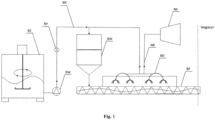
- Fig. 1 shows a system for implementing the method for producing micronutrient fertilizer
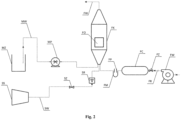
- Fig. 2 shows a variant of the system for implementing the method for producing micronutrient fertilizer.
- a solution of trace elements is prepared from sulphate salts dissolved in distilled water, containing 15,000 mg/L Cu(II), 15,000 mg/L Mn(II) and 15,000 mg/L Zn(II) at pH 5.0. Then, using an aerosol generating device at a pressure of up to 3 atmospheres, 3 L of the solution is sprayed per 100 kg of blackcurrant seeds placed in a 1 cm thick layer on an impermeable geotextile. The prepared fertilizer is air dried.
- the preparation contains trace elements in the following amounts: Cu 1100 mg/kg, Zn 1000 mg/kg, Mn 1100 mg/kg.
- the content of toxic elements does not exceed the values regulated in fertilizer law: As ( ⁇ 40 mg/kg), Pb ( ⁇ 120 mg/kg), Cd ( ⁇ 3 mg/kg), Hg ( ⁇ 1 mg/kg).
- the obtained formulation is used for wheat cultivation at a dose of 400 kg/ha.
- the result is an increased absorption of micronutrients by approximately 5% and a yield approximately 7% higher than for a reference product.
- a solution of trace elements is prepared from sulphate salts dissolved in distilled water, containing 15,000 mg/L Cu(II), 15,000 mg/L Mn(II) and 15,000 mg/L Zn(II) at pH 5.0 and in parallel, a sulphate salt solution containing 15,000 mg/L Fe(II) at pH 4.5 is prepared. Then, using an aerosol generating device at a pressure of up to 3 atmospheres, 3 L of the solutions containing Cu(II), Mn(II) and Zn(II) ions and Fe(II) ions, is sprayed per 100 kg of ground poppy heads placed in a 1 cm thick layer on an impermeable geotextile.
- the prepared fertilizer is air dried.
- the preparation contains trace elements in the following amounts: Cu 900 mg/kg, Zn 1000 mg/kg, Mn 1000 mg/kg, Fe 900 mg/L.
- the content of toxic elements does not exceed the values regulated in fertilizer law: As ( ⁇ 40 mg/kg), Pb ( ⁇ 120 mg/kg), Cd ( ⁇ 3 mg/kg), Hg ( ⁇ 1 mg/kg).
- the obtained formulation is used for rapeseed cultivation at a dose of 280 kg/ha. The result is an increased absorption of micronutrients by approximately 8% and a yield approximately 10% higher than for a reference product.
- the system for producing micronutrient fertilizer via biosorption process, by spraying biomass with an aerosol of sulphate salt solution shown in Fig. 1 , comprises a module for dosing and feeding of the micronutrient solution, which includes a tank with a mixer (RZ), connected to the aerosol generating module via a flowmeter (RP), controlling the flow rate of the solution with micronutrients, pumped using a centrifugal pump (RW).
- a module for dosing and feeding of the micronutrient solution which includes a tank with a mixer (RZ), connected to the aerosol generating module via a flowmeter (RP), controlling the flow rate of the solution with micronutrients, pumped using a centrifugal pump (RW).
- the system comprises a module for dosing and feeding of the biomass subject to sorption, which includes an impact weigher (BW), from which the biomass is introduced to the beginning of a ribbon conveyor (BP), with a length of 2 to 20 m, above which at a distance of 1 m four nozzles (BD) are located, at intervals of 0.1 to 1 m, to which the micronutrient solution is fed through a pipeline (BR) connected to a flow meter (RP) simultaneously with compressed spraying air pumped from the compressor (NS) through a pipeline (NR) to the nozzles (BD), belonging to the spray module.
- BW impact weigher
- a method for producing the micronutrient fertilizer is implemented in the system, in which 200 kg of a mixture of crushed rapeseed and soybean meal, weighed on the impact weigher (BW), is continuously dosed onto the ribbon conveyor (BP).
- BW impact weigher
- ascorbic acid, stabilizing Fe(II) ions is fed at a flow rate from 0.1 L/min to 5 L/min, to the spray nozzles (BD), using a peristaltic pump (RW) from a tank with a mixer (RZ) through a steel pipeline (BR) through a flow meter (RP).
- RW peristaltic pump
- the air spraying the solution is pumped by a compressor (NS) through a steel pipeline (NR) to the outer part of the nozzles (BD).
- the produced aerosol of the sulphate salt solution of trace elements is sprayed on the biomass during transport to the storage building on the ribbon conveyor (BP) that is 2 m wide, at a conveying speed of 5 m/min.
- the enriched material is collected at the end of the ribbon conveyor (BP).
- the preparation contains trace elements in the following amounts: Cu 900 mg/kg, Zn 900 mg/kg, Mn 1000 mg/kg, Fe 800 mg/L.
- the content of toxic elements does not exceed the values regulated in fertilizer law: As ( ⁇ 40 mg/kg), Pb ( ⁇ 120 mg/kg), Cd ( ⁇ 3 mg/kg), Hg ( ⁇ 1 mg/kg).
- the obtained formulation is used for spinach cultivation at a dose of 300 kg/ha. The result is an increased absorption of micronutrients by approximately 5% and a yield approximately 6% higher than for a reference product.
- the system for producing micronutrient fertilizer in a variant of the invention comprises a fluidized bed column (FK) with a biomass fluidization unit and an opening (FO) for biomass loading and for receiving the biosorption product.
- the fluidizer assembly for maintaining the biomass in a fluidized state is equipped with a fan (FW), connected via a steel pipeline (FR) provided with a valve (FZ) with a three-stage heater, acting as a preheater (FP), from which, through an orifice flow meter (FP) with a pressure gauge filled with water (FM), air is introduced into the fluidized bed column (FK), from which the air is removed through an outlet conduit (FW1).
- the module for dosing and feeding of the micronutrient solution comprises a tank (MZ) with the micronutrient solution, from which it is supplied via a silicone hose (MW) using a peristaltic pump (MP) to the spray nozzle located in the fluidized bed column (FK).
- the aerosol generating module comprises a compressor (SS), from which compressed spraying air is pumped through a pressure hose (SW), a pressure and flow control valve (SZ) and a rotameter (SR) to the spray nozzle located in the column (FK).
- a method for producing the micronutrient fertilizer is implemented in the system, in which a mixture of waste from supercritical CO 2 extraction of alfalfa and goldenrod in an amount of 0.5 kg with a constant initial humidity of 3% is poured through the opening (FO) into the fluidized bed column (FK).
- the fan (FW) is activated, connected via the steel pipeline (FR) provided with the valve (FZ) enabling the regulation of the air flow rate, with the three-stage heater (FP), from which air, with a volume flow rate of 0.013 m 3 /s and a temperature of 40°C, is introduced into the lower part of the fluidized bed column (FK) through the orifice flow meter (FP) with a water-filled manometer (FM).
- the air is removed from the fluidized bed column (FK) through the outlet conduit (FW1) outside the building.
- the micronutrient solution containing: 15,000 mg/L Cu(II), 15,000 mg/L Zn(II), 15 000 mg/L Mn(II) and 15,000 mg/L Fe(II), with the addition of 0.8% wt./wt. ascorbic acid, stabilizing Fe(II) ions is delivered with a mass flow rate of 1.33 ⁇ 10 -7 kg/m 3 to the spray nozzle located in the fluidized bed column (FK).
- the obtained fertilizer contains trace elements in the following amounts: Cu 1200 mg/kg, Zn 1100 mg/kg, Mn 1000 mg/kg, Fe 1200 mg/L.
- the content of toxic elements does not exceed the values regulated in fertilizer law: As ( ⁇ 40 mg/kg), Pb ( ⁇ 120 mg/kg), Cd ( ⁇ 3 mg/kg), Hg ( ⁇ 1 mg/kg).
- the obtained formulation is used for rapeseed cultivation at a dose of 350 kg/ha. The result is an increased absorption of micronutrients by approximately 7% and a yield approximately 4% higher than a reference product.
Landscapes
- Chemical & Material Sciences (AREA)
- Organic Chemistry (AREA)
- Life Sciences & Earth Sciences (AREA)
- Engineering & Computer Science (AREA)
- Pest Control & Pesticides (AREA)
- Botany (AREA)
- Environmental & Geological Engineering (AREA)
- Chemical Kinetics & Catalysis (AREA)
- Inorganic Chemistry (AREA)
- Mechanical Engineering (AREA)
- Fertilizers (AREA)
Applications Claiming Priority (1)
| Application Number | Priority Date | Filing Date | Title |
|---|---|---|---|
| PL442220A PL442220A1 (pl) | 2022-09-07 | 2022-09-07 | Sposób i układ do wytwarzania nawozu mikroelementowego |
Publications (1)
| Publication Number | Publication Date |
|---|---|
| EP4335835A1 true EP4335835A1 (de) | 2024-03-13 |
Family
ID=88647290
Family Applications (1)
| Application Number | Title | Priority Date | Filing Date |
|---|---|---|---|
| EP23461648.0A Pending EP4335835A1 (de) | 2022-09-07 | 2023-09-07 | Verfahren und system zur herstellung eines mikronährstoffdüngers |
Country Status (2)
| Country | Link |
|---|---|
| EP (1) | EP4335835A1 (de) |
| PL (1) | PL442220A1 (de) |
Citations (7)
| Publication number | Priority date | Publication date | Assignee | Title |
|---|---|---|---|---|
| US4019890A (en) * | 1973-12-28 | 1977-04-26 | Chissoasahi Fertilizer Co., Ltd. | Method for producing coated fertilizer |
| PL225939A1 (de) | 1978-07-24 | 1981-10-02 | Merck & Co Inc | |
| WO1995015218A2 (en) * | 1993-12-02 | 1995-06-08 | Finnfeeds International Ltd. | Spraying apparatus |
| US6322606B1 (en) * | 1997-03-26 | 2001-11-27 | Central Glass Company, Limited | Coated granular fertilizer and method for producing same |
| WO2013123032A1 (en) | 2012-02-13 | 2013-08-22 | Heliae Development Llc | Microalgae enriched with trace minerals |
| WO2021163526A1 (en) * | 2020-02-14 | 2021-08-19 | BiOWiSH Technologies, Inc. | Apparatus, systems, and methods for spray coating bacterial mixture onto fertilizer particles |
| US20210395159A1 (en) | 2020-06-17 | 2021-12-23 | Iowa State University Research Foundation, Inc. | Biochar product, its use in fertilizers, and methods of making the biochar |
Family Cites Families (4)
| Publication number | Priority date | Publication date | Assignee | Title |
|---|---|---|---|---|
| PL225939B1 (pl) * | 2014-03-26 | 2017-06-30 | Politechnika Wroclawska | Sposob biofortyfikowania w mikroelementy roslin zywieniowych |
| PL231929B1 (pl) * | 2014-03-26 | 2019-04-30 | Politechnika Wroclawska | Sposób wytwarzania mikroelementowych komponentów nawozowych oraz mikroelementowe komponenty nawozowe |
| PL418000A1 (pl) * | 2016-07-19 | 2018-01-29 | Politechnika Wrocławska | Instalacja do wzbogacania biomasy w mikroelementy metodą biosorpcji |
| CN108341718A (zh) * | 2018-04-04 | 2018-07-31 | 刘长美 | 一种生物质和微量元素复合型叶面喷施肥及其制作方法 |
-
2022
- 2022-09-07 PL PL442220A patent/PL442220A1/pl unknown
-
2023
- 2023-09-07 EP EP23461648.0A patent/EP4335835A1/de active Pending
Patent Citations (7)
| Publication number | Priority date | Publication date | Assignee | Title |
|---|---|---|---|---|
| US4019890A (en) * | 1973-12-28 | 1977-04-26 | Chissoasahi Fertilizer Co., Ltd. | Method for producing coated fertilizer |
| PL225939A1 (de) | 1978-07-24 | 1981-10-02 | Merck & Co Inc | |
| WO1995015218A2 (en) * | 1993-12-02 | 1995-06-08 | Finnfeeds International Ltd. | Spraying apparatus |
| US6322606B1 (en) * | 1997-03-26 | 2001-11-27 | Central Glass Company, Limited | Coated granular fertilizer and method for producing same |
| WO2013123032A1 (en) | 2012-02-13 | 2013-08-22 | Heliae Development Llc | Microalgae enriched with trace minerals |
| WO2021163526A1 (en) * | 2020-02-14 | 2021-08-19 | BiOWiSH Technologies, Inc. | Apparatus, systems, and methods for spray coating bacterial mixture onto fertilizer particles |
| US20210395159A1 (en) | 2020-06-17 | 2021-12-23 | Iowa State University Research Foundation, Inc. | Biochar product, its use in fertilizers, and methods of making the biochar |
Non-Patent Citations (10)
| Title |
|---|
| IVA FILKOVA ET AL: "Industrial Spray Drying Systems", 8 November 2006, HANDBOOK OF INDUSTRIAL DRYING,, PAGE(S) 215 - 256, XP009134051 * |
| IZYDORCZYK GSIENKIEWICZ-CHOLEWA UBASLADYNSKA SKOCEK DMIRONIUK MCHOJNACKA K: "New environmentally friendly bio-based micronutrient fertilizer by biosorption: From laboratory studies to the field", SCI. TOTAL ENVIRON, vol. 710, 2020, pages 136061 |
| IZYDORCZYK, GCHOJNACKA KKOCEK DLIGAS, BWITEK KROWIAK: "Technologia wytwarzania nawozow mikro-elementowych na bazie lucerny i nawloci", PRZEM. CHEM, vol. 97, 2018, pages 1764 - 1768 |
| MICHALAK, I., CHOJNACKA, K., DOBRZANSKI, Z., GORECKI, H., ZIELINSKA, A., KORCZYNSKI, M., OPALINSKI, S.: "Effect of macro algae enriched with microelements on egg quality parameters and mineral content of eggs, eggshell, blood, feathers and droppings", J. ANIM. PHYSIOL. ANIM. NUTR. (BERL), vol. 95, pages 374 - 387 |
| MICHALAK, IGODLEWSKA, KMARYCZ, K: "Biomass Enriched with Minerals via Biosorption Process as a Potential Ingredient of Horse Feed", WASTE AND BIOMASS VALORIZATION, vol. 10, 2019, pages 3403 - 3418, XP036904693, DOI: 10.1007/s12649-018-0351-5 |
| SAMORAJ MATEUSZ ET AL: "Valorization of Biomass into Micronutrient Fertilizers", WASTE AND BIOMASS VALORIZATION, SPRINGER NETHERLANDS, NL, vol. 10, no. 4, 13 October 2017 (2017-10-13), pages 925 - 931, XP036729314, ISSN: 1877-2641, [retrieved on 20171013], DOI: 10.1007/S12649-017-0108-6 * |
| SAMORAJ MTUHY LCHOJNACKA, K: "Valorization of biomass into micronutrient fertilizers", WASTE BIOMAS VALORIZATION, vol. 10, 2017, pages 925 - 931, XP036729314, DOI: 10.1007/s12649-017-0108-6 |
| SKRZYPCZAK DAWID ET AL: "Tannery waste-derived biochar as a carrier of micronutrients essential to plants", CHEMOSPHERE, PERGAMON PRESS, OXFORD, GB, vol. 294, 24 January 2022 (2022-01-24), XP086978516, ISSN: 0045-6535, [retrieved on 20220124], DOI: 10.1016/J.CHEMOSPHERE.2022.133720 * |
| WITKOWSKA Z ET AL: "Production of dietary feed supplements enriched in microelements in a pilot plant biosorption system", INTERNATIONAL JOURNAL OF ENVIRONMENTAL SCIENCE AND TECHNOLOGY, CENTER FOR ENVIRONMENT AND ENERGY RESEARCH AND STUDIES (C E E R S), IR, vol. 13, no. 4, 24 February 2016 (2016-02-24), pages 1089 - 1098, XP035799029, ISSN: 1735-1472, [retrieved on 20160224], DOI: 10.1007/S13762-016-0945-Z * |
| WITKOWSKA, ZCHOJNACKA, KKORCZYNSKI, MSWINIARSKA, MSAEID, A.OPALINSKI, SDOBRZANSKI, Z: "Soybean meal enriched with microelements by biosorption - A new biological feed supplement for laying hens. Part I. Performance and egg traits", FOOD CHEM, 2014, pages 151 |
Also Published As
| Publication number | Publication date |
|---|---|
| PL442220A1 (pl) | 2024-03-11 |
Similar Documents
| Publication | Publication Date | Title |
|---|---|---|
| KR100335528B1 (ko) | 음식물 쓰레기등의 유기질 폐기물을 이용한 유기질 비료 및 그 제조방법 | |
| CN102001898B (zh) | 腐植酸钾型复合肥及其配制方法 | |
| CN105085062B (zh) | 一种水稻专用分蘖肥及其制备与应用方法 | |
| CN102627514A (zh) | 一种抗土壤酸化有机肥添加剂及其制备方法 | |
| CN107021837A (zh) | 一种活土松壤复合肥料及其制备方法 | |
| CN103420732B (zh) | 一种多功能缓控释肥料 | |
| CN115124376A (zh) | 一种复合生物肥料及其制备方法 | |
| CN107935740A (zh) | 一种大樱桃专用生物质炭基肥及其制备方法 | |
| CN108101653A (zh) | 一种叶菜类蔬菜专用生物质炭基肥及其制备方法 | |
| CN105218233A (zh) | 提高甘蔗糖分的复合肥及其生产方法 | |
| CN101486611A (zh) | 高塔喷浆造粒腐植酸有机无机复合肥及其生产工艺 | |
| CN101125778A (zh) | 一种复合肥料 | |
| Salwa et al. | Amelioration productivity of sandy soil by using amino acids, sulphur and micronutrients for sesame production | |
| CN103130566B (zh) | 一种设施黄瓜专用可控缓释bb肥及其制备方法 | |
| El-Aila et al. | Response of spinach plants to nanoparticles fertilizer and foliar application of iron | |
| EP4335835A1 (de) | Verfahren und system zur herstellung eines mikronährstoffdüngers | |
| CN103086807B (zh) | 一种防治土传病害的掺混肥料及其制备方法 | |
| CN112708424A (zh) | 土壤改良剂及土壤改良方法 | |
| CN105036996B (zh) | 一种玉米专用双膜双控缓释肥及其制备方法 | |
| CN115716764B (zh) | 一种硫包裹中微量元素芯的生态肥料及其制备方法 | |
| CN103739388B (zh) | 一种熔体造粒硝基功能性番茄专用肥及其制备方法 | |
| CN102674935B (zh) | 一种高效超浓度氯基复合肥及其生产方法 | |
| CN105461478A (zh) | 一种生物碳基复合多元肥的制作方法 | |
| CN108658661A (zh) | 提高光合作用的环保型包膜肥料及其制备方法 | |
| El-Kamar | Evaluation of some Soil Conditioners on some Properties of Salt Affected Soil and Wheat Productivity and Quality. |
Legal Events
| Date | Code | Title | Description |
|---|---|---|---|
| PUAI | Public reference made under article 153(3) epc to a published international application that has entered the european phase |
Free format text: ORIGINAL CODE: 0009012 |
|
| STAA | Information on the status of an ep patent application or granted ep patent |
Free format text: STATUS: THE APPLICATION HAS BEEN PUBLISHED |
|
| AK | Designated contracting states |
Kind code of ref document: A1 Designated state(s): AL AT BE BG CH CY CZ DE DK EE ES FI FR GB GR HR HU IE IS IT LI LT LU LV MC ME MK MT NL NO PL PT RO RS SE SI SK SM TR |
|
| STAA | Information on the status of an ep patent application or granted ep patent |
Free format text: STATUS: REQUEST FOR EXAMINATION WAS MADE |
|
| 17P | Request for examination filed |
Effective date: 20240913 |
|
| RBV | Designated contracting states (corrected) |
Designated state(s): AL AT BE BG CH CY CZ DE DK EE ES FI FR GB GR HR HU IE IS IT LI LT LU LV MC ME MK MT NL NO PL PT RO RS SE SI SK SM TR |
|
| STAA | Information on the status of an ep patent application or granted ep patent |
Free format text: STATUS: EXAMINATION IS IN PROGRESS |
|
| 17Q | First examination report despatched |
Effective date: 20250905 |