EP4335855A1 - Composé hétérocyclique, dispositif électroluminescent organique le comprenant et composition de diagnostic comprenant le composé hétérocyclique - Google Patents
Composé hétérocyclique, dispositif électroluminescent organique le comprenant et composition de diagnostic comprenant le composé hétérocyclique Download PDFInfo
- Publication number
- EP4335855A1 EP4335855A1 EP23193479.5A EP23193479A EP4335855A1 EP 4335855 A1 EP4335855 A1 EP 4335855A1 EP 23193479 A EP23193479 A EP 23193479A EP 4335855 A1 EP4335855 A1 EP 4335855A1
- Authority
- EP
- European Patent Office
- Prior art keywords
- group
- substituted
- unsubstituted
- salt
- heterocyclic compound
- Prior art date
- Legal status (The legal status is an assumption and is not a legal conclusion. Google has not performed a legal analysis and makes no representation as to the accuracy of the status listed.)
- Granted
Links
Images


Classifications
-
- C—CHEMISTRY; METALLURGY
- C07—ORGANIC CHEMISTRY
- C07F—ACYCLIC, CARBOCYCLIC OR HETEROCYCLIC COMPOUNDS CONTAINING ELEMENTS OTHER THAN CARBON, HYDROGEN, HALOGEN, OXYGEN, NITROGEN, SULFUR, SELENIUM OR TELLURIUM
- C07F5/00—Compounds containing elements of Groups 3 or 13 of the Periodic Table
- C07F5/02—Boron compounds
- C07F5/027—Organoboranes and organoborohydrides
-
- C—CHEMISTRY; METALLURGY
- C07—ORGANIC CHEMISTRY
- C07F—ACYCLIC, CARBOCYCLIC OR HETEROCYCLIC COMPOUNDS CONTAINING ELEMENTS OTHER THAN CARBON, HYDROGEN, HALOGEN, OXYGEN, NITROGEN, SULFUR, SELENIUM OR TELLURIUM
- C07F5/00—Compounds containing elements of Groups 3 or 13 of the Periodic Table
- C07F5/02—Boron compounds
-
- C—CHEMISTRY; METALLURGY
- C09—DYES; PAINTS; POLISHES; NATURAL RESINS; ADHESIVES; COMPOSITIONS NOT OTHERWISE PROVIDED FOR; APPLICATIONS OF MATERIALS NOT OTHERWISE PROVIDED FOR
- C09K—MATERIALS FOR MISCELLANEOUS APPLICATIONS, NOT PROVIDED FOR ELSEWHERE
- C09K11/00—Luminescent materials, e.g. electroluminescent or chemiluminescent
- C09K11/06—Luminescent materials, e.g. electroluminescent or chemiluminescent containing organic luminescent materials
-
- G—PHYSICS
- G01—MEASURING; TESTING
- G01N—INVESTIGATING OR ANALYSING MATERIALS BY DETERMINING THEIR CHEMICAL OR PHYSICAL PROPERTIES
- G01N33/00—Investigating or analysing materials by specific methods not covered by groups G01N1/00 - G01N31/00
- G01N33/48—Biological material, e.g. blood, urine; Haemocytometers
- G01N33/50—Chemical analysis of biological material, e.g. blood, urine; Testing involving biospecific ligand binding methods; Immunological testing
-
- H—ELECTRICITY
- H10—SEMICONDUCTOR DEVICES; ELECTRIC SOLID-STATE DEVICES NOT OTHERWISE PROVIDED FOR
- H10K—ORGANIC ELECTRIC SOLID-STATE DEVICES
- H10K50/00—Organic light-emitting devices
- H10K50/10—OLEDs or polymer light-emitting diodes [PLED]
- H10K50/11—OLEDs or polymer light-emitting diodes [PLED] characterised by the electroluminescent [EL] layers
- H10K50/12—OLEDs or polymer light-emitting diodes [PLED] characterised by the electroluminescent [EL] layers comprising dopants
-
- H—ELECTRICITY
- H10—SEMICONDUCTOR DEVICES; ELECTRIC SOLID-STATE DEVICES NOT OTHERWISE PROVIDED FOR
- H10K—ORGANIC ELECTRIC SOLID-STATE DEVICES
- H10K50/00—Organic light-emitting devices
- H10K50/10—OLEDs or polymer light-emitting diodes [PLED]
- H10K50/11—OLEDs or polymer light-emitting diodes [PLED] characterised by the electroluminescent [EL] layers
- H10K50/12—OLEDs or polymer light-emitting diodes [PLED] characterised by the electroluminescent [EL] layers comprising dopants
- H10K50/121—OLEDs or polymer light-emitting diodes [PLED] characterised by the electroluminescent [EL] layers comprising dopants for assisting energy transfer, e.g. sensitization
-
- H—ELECTRICITY
- H10—SEMICONDUCTOR DEVICES; ELECTRIC SOLID-STATE DEVICES NOT OTHERWISE PROVIDED FOR
- H10K—ORGANIC ELECTRIC SOLID-STATE DEVICES
- H10K85/00—Organic materials used in the body or electrodes of devices covered by this subclass
- H10K85/60—Organic compounds having low molecular weight
- H10K85/615—Polycyclic condensed aromatic hydrocarbons, e.g. anthracene
-
- H—ELECTRICITY
- H10—SEMICONDUCTOR DEVICES; ELECTRIC SOLID-STATE DEVICES NOT OTHERWISE PROVIDED FOR
- H10K—ORGANIC ELECTRIC SOLID-STATE DEVICES
- H10K85/00—Organic materials used in the body or electrodes of devices covered by this subclass
- H10K85/60—Organic compounds having low molecular weight
- H10K85/649—Aromatic compounds comprising a hetero atom
- H10K85/657—Polycyclic condensed heteroaromatic hydrocarbons
- H10K85/6572—Polycyclic condensed heteroaromatic hydrocarbons comprising only nitrogen in the heteroaromatic polycondensed ring system, e.g. phenanthroline or carbazole
-
- H—ELECTRICITY
- H10—SEMICONDUCTOR DEVICES; ELECTRIC SOLID-STATE DEVICES NOT OTHERWISE PROVIDED FOR
- H10K—ORGANIC ELECTRIC SOLID-STATE DEVICES
- H10K85/00—Organic materials used in the body or electrodes of devices covered by this subclass
- H10K85/60—Organic compounds having low molecular weight
- H10K85/649—Aromatic compounds comprising a hetero atom
- H10K85/657—Polycyclic condensed heteroaromatic hydrocarbons
- H10K85/6574—Polycyclic condensed heteroaromatic hydrocarbons comprising only oxygen in the heteroaromatic polycondensed ring system, e.g. cumarine dyes
-
- H—ELECTRICITY
- H10—SEMICONDUCTOR DEVICES; ELECTRIC SOLID-STATE DEVICES NOT OTHERWISE PROVIDED FOR
- H10K—ORGANIC ELECTRIC SOLID-STATE DEVICES
- H10K85/00—Organic materials used in the body or electrodes of devices covered by this subclass
- H10K85/60—Organic compounds having low molecular weight
- H10K85/658—Organoboranes
-
- C—CHEMISTRY; METALLURGY
- C09—DYES; PAINTS; POLISHES; NATURAL RESINS; ADHESIVES; COMPOSITIONS NOT OTHERWISE PROVIDED FOR; APPLICATIONS OF MATERIALS NOT OTHERWISE PROVIDED FOR
- C09K—MATERIALS FOR MISCELLANEOUS APPLICATIONS, NOT PROVIDED FOR ELSEWHERE
- C09K2211/00—Chemical nature of organic luminescent or tenebrescent compounds
- C09K2211/10—Non-macromolecular compounds
- C09K2211/1003—Carbocyclic compounds
- C09K2211/1011—Condensed systems
-
- C—CHEMISTRY; METALLURGY
- C09—DYES; PAINTS; POLISHES; NATURAL RESINS; ADHESIVES; COMPOSITIONS NOT OTHERWISE PROVIDED FOR; APPLICATIONS OF MATERIALS NOT OTHERWISE PROVIDED FOR
- C09K—MATERIALS FOR MISCELLANEOUS APPLICATIONS, NOT PROVIDED FOR ELSEWHERE
- C09K2211/00—Chemical nature of organic luminescent or tenebrescent compounds
- C09K2211/10—Non-macromolecular compounds
- C09K2211/1018—Heterocyclic compounds
- C09K2211/1025—Heterocyclic compounds characterised by ligands
- C09K2211/1029—Heterocyclic compounds characterised by ligands containing one nitrogen atom as the heteroatom
-
- C—CHEMISTRY; METALLURGY
- C09—DYES; PAINTS; POLISHES; NATURAL RESINS; ADHESIVES; COMPOSITIONS NOT OTHERWISE PROVIDED FOR; APPLICATIONS OF MATERIALS NOT OTHERWISE PROVIDED FOR
- C09K—MATERIALS FOR MISCELLANEOUS APPLICATIONS, NOT PROVIDED FOR ELSEWHERE
- C09K2211/00—Chemical nature of organic luminescent or tenebrescent compounds
- C09K2211/10—Non-macromolecular compounds
- C09K2211/1018—Heterocyclic compounds
- C09K2211/1025—Heterocyclic compounds characterised by ligands
- C09K2211/1044—Heterocyclic compounds characterised by ligands containing two nitrogen atoms as heteroatoms
- C09K2211/1055—Heterocyclic compounds characterised by ligands containing two nitrogen atoms as heteroatoms with other heteroatoms
-
- C—CHEMISTRY; METALLURGY
- C09—DYES; PAINTS; POLISHES; NATURAL RESINS; ADHESIVES; COMPOSITIONS NOT OTHERWISE PROVIDED FOR; APPLICATIONS OF MATERIALS NOT OTHERWISE PROVIDED FOR
- C09K—MATERIALS FOR MISCELLANEOUS APPLICATIONS, NOT PROVIDED FOR ELSEWHERE
- C09K2211/00—Chemical nature of organic luminescent or tenebrescent compounds
- C09K2211/10—Non-macromolecular compounds
- C09K2211/1018—Heterocyclic compounds
- C09K2211/1025—Heterocyclic compounds characterised by ligands
- C09K2211/1074—Heterocyclic compounds characterised by ligands containing more than three nitrogen atoms as heteroatoms
-
- C—CHEMISTRY; METALLURGY
- C09—DYES; PAINTS; POLISHES; NATURAL RESINS; ADHESIVES; COMPOSITIONS NOT OTHERWISE PROVIDED FOR; APPLICATIONS OF MATERIALS NOT OTHERWISE PROVIDED FOR
- C09K—MATERIALS FOR MISCELLANEOUS APPLICATIONS, NOT PROVIDED FOR ELSEWHERE
- C09K2211/00—Chemical nature of organic luminescent or tenebrescent compounds
- C09K2211/10—Non-macromolecular compounds
- C09K2211/1018—Heterocyclic compounds
- C09K2211/1025—Heterocyclic compounds characterised by ligands
- C09K2211/1088—Heterocyclic compounds characterised by ligands containing oxygen as the only heteroatom
-
- H—ELECTRICITY
- H10—SEMICONDUCTOR DEVICES; ELECTRIC SOLID-STATE DEVICES NOT OTHERWISE PROVIDED FOR
- H10K—ORGANIC ELECTRIC SOLID-STATE DEVICES
- H10K2101/00—Properties of the organic materials covered by group H10K85/00
- H10K2101/20—Delayed fluorescence emission
-
- H—ELECTRICITY
- H10—SEMICONDUCTOR DEVICES; ELECTRIC SOLID-STATE DEVICES NOT OTHERWISE PROVIDED FOR
- H10K—ORGANIC ELECTRIC SOLID-STATE DEVICES
- H10K50/00—Organic light-emitting devices
- H10K50/10—OLEDs or polymer light-emitting diodes [PLED]
- H10K50/11—OLEDs or polymer light-emitting diodes [PLED] characterised by the electroluminescent [EL] layers
Definitions
- the disclosure relates to a heterocyclic compound, an organic light-emitting device including the same, and a diagnostic composition including the heterocyclic compound.
- Organic light-emitting devices are self-emissive devices, which have improved characteristics in terms of viewing angles, response time, luminance, driving voltage, and response speed, and produce full-color images.
- An organic light-emitting device may include an anode, a cathode, and an organic layer that is located between the anode and the cathode and includes an emission layer.
- a hole transport region may be arranged between the anode and the emission layer, and an electron transport region may be arranged between the emission layer and the cathode. Holes provided from the anode move toward the emission layer through the hole transport region, and electrons provided from the cathode move toward the emission layer through the electron transport region. The holes and the electrons recombine in the emission layer to produce excitons. These excitons transition from an excited state to the ground state to thereby generate light.
- heterocyclic compound an organic light-emitting device including the same, and a diagnostic composition including the heterocyclic compound.
- an organic light-emitting device includes the heterocyclic compound.
- a diagnostic composition includes the heterocyclic compound.
- relative terms such as “lower” or “bottom” and “upper” or “top,” may be used herein to describe one element's relationship to another element as illustrated in the Figures. It will be understood that relative terms are intended to encompass different orientations of the device in addition to the orientation depicted in the Figures. For example, if the device in one of the figures is turned over, elements described as being on the “lower” side of other elements would then be oriented on “upper” sides of the other elements. The exemplary term “lower,” can therefore, encompasses both an orientation of “lower” and “upper,” depending on the particular orientation of the figure.
- Exemplary embodiments are described herein with reference to cross section illustrations that are schematic illustrations of idealized embodiments. As such, variations from the shapes of the illustrations as a result, for example, of manufacturing techniques and/or tolerances, are to be expected. Thus, embodiments described herein should not be construed as limited to the particular shapes of regions as illustrated herein but are to include deviations in shapes that result, for example, from manufacturing. For example, a region illustrated or described as flat may, typically, have rough and/or nonlinear features. Moreover, sharp angles that are illustrated may be rounded Thus, the regions illustrated in the figures are schematic in nature and their shapes are not intended to illustrate the precise shape of a region and are not intended to limit the scope of the present claims.
- Y 1 may be B, N, or P.
- Y 1 may be B.
- X 1 and X 2 may each independently be a single bond, O, S, Se, N[(CY 5 )-Ar 2 ], N(R 1 ), C(R 1 )(R 2 ), or Si(R 1 )(R 2 ).
- k1 may be 0 or 1.
- CY 1 and CY 3 are not linked to each other via X 1 .
- k2 may be 0 or 1.
- CY 1 and CY 2 are not linked to each other via X 2 .
- the sum of k1 and k2 may be greater than or equal to 1.
- At least one of k1 and k2 may be 1.
- CY 1 to CY 3 may each independently a C 5 -C 30 carbocyclic group or a substituted or unsubstituted C 1 -C 30 heterocyclic group.
- CY 1 to CY 3 may each independently be i) a first ring, ii) a second ring, iii) a condensed ring in which two or more first rings are condensed with each other, iv) a condensed ring in which two or more second rings are condensed with each other, or v) a condensed ring in which at least one first ring is condensed with at least one second ring.
- the first ring may be a cyclopentane group, a cyclopentadiene group, a furan group, a thiophene group, a pyrrole group, a silole group, an indene group, a benzofuran group, a benzothiophene group, an indole group, a benzosilole group, an oxazole group, an isoxazole group, an oxadiazole group, an isoxadiazole group, an oxatriazole group, an isoxatriazole group, a thiazole group, an isothiazole group, a thiadiazole group, an isothiadiazole group, a thiatriazole group, an isothiatriazole group, a pyrazole group, an imidazole group, a triazole group, a tetrazole group, an azasilole group, a diazasil
- CY 1 to CY 3 may each independently be a C 6 -C 30 aromatic carbocyclic group or a C 1 -C 30 aromatic heterocyclic group.
- CY 1 to CY 3 may each independently be a benzene group, a naphthalene group, an anthracene group, a phenanthrene group, a triphenylene group, a pyrene group, a chrysene group, a 1,2,3,4-tetrahydronaphthalene group, a benzothiophene group, a benzofuran group, an indole group, an indene group, a benzosilole group, a benzoborole group, a benzophosphole group, a benzoselenophene group, a benzogermole group, a dibenzothiophene group, a dibenzofuran group, a carbazole group, a fluorene group, a dibenzosilole group, a dibenzoborole group, a dibenzophosphole group, a dibenzoselenophene group, a dibenzoger
- CY 1 to CY 3 may each independently be a benzene group, a naphthalene group, a phenanthrene group, a pyridine group, a pyrimidine group, a quinoline group, an isoquinoline group, a phthalazine group, a naphthyridine group, a quinoxaline group, or a quinazoline group.
- CY 4 and CY 5 may each independently be a C 5 -C 30 carbocyclic group that is unsubstituted or substituted with at least one R 40 or a C 1 -C 30 heterocyclic group that is unsubstituted or substituted with at least one R 40 .
- CY 4 and CY 5 may each independently be a benzene group, a naphthalene group, an anthracene group, a phenanthrene group, a triphenylene group, a pyrene group, a chrysene group, a 1,2,3,4-tetrahydronaphthalene group, a benzothiophene group, a benzofuran group, an indole group, an indene group, a benzosilole group, a benzoborole group, a benzophosphole group, a benzoselenophene group, a benzogermole group, a dibenzothiophene group, a dibenzofuran group, a carbazole group, a fluorene group, a dibenzosilole group, a dibenzoborole group, a dibenzophosphole group, a dibenzoselenophene group, a dibenzoger
- CY 4 and CY 5 may each independently be a benzene group, a naphthalene group, a phenanthrene group, a pyridine group, a pyrimidine group, a quinoline group, an isoquinoline group, a phthalazine group, a naphthyridine group, a quinoxaline group, or a quinazoline group, each unsubstituted or substituted with at least one R 40 .
- CY 4 and CY 5 may each independently be a benzene group that is unsubstituted or substituted with at least one R 40 .
- CY 4 and CY 5 may each independently be of Formulae 4-1 to 4-3: wherein, in Formulae 4-1 to 4-3,
- Ar 1 and Ar 2 may each independently be a group represented by Formula 2.
- L 1 may be a single bond, a substituted or unsubstituted C 5 -C 30 carbocyclic group or a substituted or unsubstituted C 1 -C 30 heterocyclic group.
- L 1 may be a single bond.
- a1 may be 1, 2, or 3.
- a1 may be 1.
- CY 10 may be a C 3 -C 10 non-aromatic carbocyclic group or a C 1 -C 10 non-aromatic heterocyclic group.
- CY 10 may be a cyclopentane group, a cyclohexane group, a cycloheptane group, a cyclopentene group, a cyclohexene group, or a cycloheptene group.
- * may indicate a binding site to a neighboring atom.
- Ar 1 and Ar 2 may each independently be a group represented by Formula 2A or 2B. wherein, in Formulae 2A and 2B,
- Ar 1 and Ar 2 may each independently be a group represented by one of Formulae 5-1 to 5-4: wherein, in Formulae 5-1 to 5-4,
- Ar 1 and Ar 2 may each independently be a group represented by one of Formulae 5-11 to 5-26: wherein, in Formulae 5-11 to 5-26, * may indicate a binding site to a neighboring atom.
- Ar 1 and Ar 2 may have the same structure.
- Ar 1 and Ar 2 may have different structures.
- R 1 , R 2 , R 10 , R 20 , R 30 , and R 40 may each independently be a group represented by Formula 2, hydrogen, deuterium, -F, -Cl, -Br, -I, -SF 5 , a hydroxyl group, a cyano group, a nitro group, an amidino group, a hydrazino group, a hydrazono group, a substituted or unsubstituted C 1 -C 60 alkyl group, a substituted or unsubstituted C 2 -C 60 alkenyl group, a substituted or unsubstituted C 2 -C 60 alkynyl group, a substituted or unsubstituted C 1 -C 60 alkoxy group, a substituted or unsubstituted C 3 -C 10 cycloalkyl group, a substituted or unsubstituted C 1 -C 10 heterocycloalkyl group, a substituted or
- R 50 and R 60 may each independently be hydrogen, deuterium, - F, -Cl, -Br, -I, -SFs, a hydroxyl group, a cyano group, a nitro group, an amidino group, a hydrazino group, a hydrazono group, a substituted or unsubstituted C 1 -C 60 alkyl group, a substituted or unsubstituted C 2 -C 60 alkenyl group, a substituted or unsubstituted C 2 -C 60 alkynyl group, a substituted or unsubstituted C 1 -C 60 alkoxy group, a substituted or unsubstituted C 3 -C 10 cycloalkyl group, a substituted or unsubstituted C 1 -C 10 heterocycloalkyl group, a substituted or unsubstituted C 3 -C 10 cycloalkenyl group, a substituted or
- X 31 may be a single bond, O, S, N(R 301 ), or C(R 301 )(R 302 ).
- k31 may be 0 or 1.
- CY 31 and CY 32 may each independently be a C 5 -C 30 carbocyclic group or a C 1 -C 30 heterocyclic group.
- CY 31 and CY 32 may each independently be a benzene group, a naphthalene group, a 1,2,3,4-tetrahydronaphthalene group, a thiophene group, a furan group, a pyrrole group, a cyclopentadiene group, a silole group, a benzothiophene group, a benzofuran group, an indole group, an indene group, a benzosilole group, a dibenzothiophene group, a dibenzofuran group, a carbazole group, a fluorene group, or a dibenzosilole group.
- L 30 may be a single bond, a substituted or unsubstituted C 5 -C 30 carbocyclic group, or a substituted or unsubstituted C 1 -C 30 heterocyclic group.
- a30 may be 0, 1, 2, or 3.
- a30 may be 0 or 1.
- R 301 , R 302 , R 310 , and R 320 may each independently be hydrogen, deuterium, -F, -Cl, -Br, -I, -SFs, a hydroxyl group, a cyano group, a nitro group, an amidino group, a hydrazino group, a hydrazono group, a carboxylic acid group or a salt thereof, a sulfonic acid group or a salt thereof, a phosphoric acid group or a salt thereof, a substituted or unsubstituted C 1 -C 60 alkyl group, a substituted or unsubstituted C 2 -C 60 alkenyl group, a substituted or unsubstituted C 2 -C 60 alkynyl group, a substituted or unsubstituted C 1 -C 60 alkoxy group, a substituted or unsubstituted C 3 -C 10 cycloalkyl group
- R 301 , R 302 , R 310 , and R 320 may each independently be:
- R 301 , R 302 , R 310 , and R 320 may each independently be hydrogen, deuterium, a methyl group, an ethyl group, an n-propyl group, an iso-propyl group, an n-butyl group, an isobutyl group, a sec-butyl group, a tert-butyl group, an n-pentyl group, an isopentyl group, a 2-methylbutyl group, a sec-pentyl group, a tert-pentyl group, a neo-pentyl group, a 3-pentyl group, a 3-methyl-2-butyl group, a phenyl group, a biphenyl group, a C 1 -C 20 alkylphenyl group, or a naphthyl group.
- b310 and b320 may each independently be 1, 2, 3, 4, 5, 6, 7, or 8.
- R 1 , R 2 , R 10 , R 20 , R 30 , and R 40 may each independently be: a group represented by Formula 2, a group represented by Formula 3, hydrogen, deuterium, -F, -Cl, -Br, -I, a hydroxyl group, a cyano group, a nitro group, an amino group, an amidino group, a hydrazine group, a hydrazone group, a carboxylic acid group or a salt thereof, a sulfonic acid group or a salt thereof, a phosphoric acid group or a salt thereof, -SF 5 , a C 1 -C 20 alkyl group, or a C 1 -C 20 alkoxy group;
- R 50 and R 60 may each independently be: a group represented by Formula 3, hydrogen, deuterium, -F, -Cl, -Br, -I, a hydroxyl group, a cyano group, a nitro group, an amino group, an amidino group, a hydrazine group, a hydrazone group, a carboxylic acid group or a salt thereof, a sulfonic acid group or a salt thereof, a phosphoric acid group or a salt thereof, -SFs, a C 1 -C 20 alkyl group, or a C 1 -C 20 alkoxy group;
- R 1 , R 2 , R 10 , R 20 , R 30 , and R 40 may each independently be:
- R 50 and R 60 may each independently be:
- At least one instance of R 10 may be a group represented by Formula 3.
- At least one instance of R 20 may be a group represented by Formula 3.
- At least one instance of R 30 may be a group represented by Formula 3.
- At least one instance of R 10 , at least one instance of R 20 , and at least one instance of R 30 may be a group represented by Formula 3. In an embodiment, one of R 30 may be a group represented by Formula 3.
- b10, b20, b30, b40, and b60 may each independently be 1, 2, 3, 4, 5, 6, 7, or 8.
- b50 may be 1, 2, or 3.
- a group represented by Formula 3 may be a group represented by one of Formulae 3-1 to 3-3: wherein, in Formulae 3-1 to 3-3,
- the heterocyclic compound may be represented by Formula 1A or 1B: wherein, in Formulae 1A and 1B,
- the heterocyclic compound may be represented by one of Formulae 11-1 to 11-9: wherein, in Formulae 11-1 to 11-9,
- At least one of R 11 to R 14 may be a group represented by Formula 3.
- At least one of R 21 to R 24 may be a group represented by Formula 3.
- At least one of R 31 to R 33 may be a group represented by Formula 3.
- At least one of R 11 to R 14 , at least one of R 21 to R 24 , and at least one of R 31 to R 33 may be a group represented by Formula 3.
- the heterocyclic compound may have a symmetric structure or an asymmetric structure.
- the heterocyclic compound may have a symmetric structure.
- the heterocyclic compound may have an asymmetric structure.
- a symmetric structure means that when is drawn down the middle of the structure (i.e., through the B and center of the CY 3 ring Formula I), each side is the same.
- Compound 1 has a symmetric structure
- Compound 25 has an asymmetric structure.
- Q 1 to Q 3 , Q 11 to Q 13 , Q 21 to Q 23 , and Q 31 to Q 33 may each independently be: hydrogen; deuterium; -F; -Cl; -Br; -I; a hydroxyl group; a cyano group; a nitro group; an amidino group; a hydrazine group; a hydrazone group; a carboxylic acid or a salt thereof; a sulfonic acid or a salt thereof; a phosphoric acid or a salt thereof; a C 1 -C 60 alkyl group that is unsubstituted or substituted with deuterium, a C 1 -C 60 alkyl group, a C 6 -C 60 aryl group, or any combination thereof; a C 2 -C 60 alkenyl group; a C 2 -C 60 alkynyl group; a C 1 -C 60 alkoxy group; a C 3 -C 10 cycloalkyl group;
- Q 1 to Q 3 , Q 11 to Q 13 , Q 21 to Q 23 , and Q 31 to Q 33 may each independently be:
- the heterocyclic compound may be at least one of Compounds 1 to 792, but embodiments are not limited thereto:
- the heterocyclic compound represented by Formula 1 satisfies the structure of Formula 1 described above, and includes a structure in which a group represented by Formula 2 is substituted in ring CY 4 of Formula 1. Due to this structure, the heterocyclic compound represented by Formula 1 has excellent luminescent characteristics, and in particular, may implement deep blue light emission having a short wavelength.
- the heterocyclic compound that satisfies the structure as described above may have high oscillator strength (f), and thus, when the heterocyclic compound is applied to an electronic device, efficiency of the electronic device may increase.
- the heterocyclic compound since the heterocyclic compound includes a substituent having a bulky structure represented by Formula 2 as described above, the heterocyclic compound may have a high S 1 energy level and a high photoalignment. Accordingly, when the heterocyclic compound is used as a luminescent material, Dexter energy transfer is suppressed and excellent lifespan characteristics may be exhibited.
- an electronic device for example, an organic light-emitting device, including the heterocyclic compound represented by Formula 1 may have high efficiency and long lifespan.
- HOMO occupied molecular orbital
- LUMO lowest unoccupied molecular orbital
- S 1 energy level S 1 energy level
- T 1 energy level oscillator strength (f) of some of the heterocyclic compounds represented by Formula 1 were evaluated using the Gaussian 09 program with the molecular structure optimization obtained by B3LYP-based density functional theory (DFT), and results thereof are shown in Table 1.
- DFT density functional theory
- the heterocyclic compound represented by Formula 1 has electric characteristics suitable for use as a dopant (for example, an emitter or a sensitizer) in an electronic device, for example, an organic light-emitting device.
- a dopant for example, an emitter or a sensitizer
- the heterocyclic compound has a deep HOMO value and a significantly high f value, as compared to Compounds A to D as comparative compounds.
- a full width at half maximum (FWHM) of an emission peak of an emission spectrum or an electroluminescence (EL) spectrum of the heterocyclic compound may be 60 nm or less.
- an FWHM of an emission peak of an emission spectrum or an EL spectrum of the heterocyclic compound may be 5 nm to 50 nm, 7 nm to 40 nm, or 10 nm to 30 nm.
- a synthesis method of the heterocyclic compound represented by Formula 1 may be recognized by those skilled in the art with reference to the following Synthesis Examples.
- a method of identifying a structure of the heterocyclic compound represented by Formula 1 is not particularly limited.
- the structure of the heterocyclic compound may be identified by a known method (for example, nuclear magnetic resonance (NMR) or liquid chromatography-mass spectrometry (LC-MS)).
- NMR nuclear magnetic resonance
- LC-MS liquid chromatography-mass spectrometry
- an organic light-emitting device includes the heterocyclic compound.
- the organic light-emitting device may include: a first electrode; a second electrode; and an organic layer arranged between the first electrode and the second electrode and including an emission layer, and the organic layer may include the heterocyclic compound represented by Formula 1.
- the emission layer may include the heterocyclic compound.
- the emission layer may include a host and an emitter, and the emitter may include the heterocyclic compound.
- an amount of the host in the emission layer, may be greater than an amount of the heterocyclic compound based on the weight.
- the emission layer may further include a sensitizer.
- the sensitizer may include a phosphorescent compound, a delayed fluorescence compound, or any combination thereof.
- the host, the emitter, and the sensitizer are each the same as described in the present specification.
- the organic light-emitting device includes the emission layer including the heterocyclic compound represented by Formula 1 as described above, the organic light-emitting device may have a relatively narrow FWHM of an emission peak of an EL spectrum, excellent efficiency, and excellent lifespan characteristics.
- the heterocyclic compound may act as a dopant (for example, an emitter or a sensitizer) in the emission layer, and the emission layer may further include a host (in other words, in the emission layer, an amount of the heterocyclic compound represented by Formula 1 may be less than an amount of the host).
- a dopant for example, an emitter or a sensitizer
- the emission layer may further include a host (in other words, in the emission layer, an amount of the heterocyclic compound represented by Formula 1 may be less than an amount of the host).
- the emission layer may emit blue light.
- the emission layer may emit blue light having a maximum emission wavelength of about 410 nm to about 490 nm.
- (emission layer) includes at least one heterocyclic compound may be to mean that the (emission layer) may include one kind of heterocyclic compound represented by Formula 1 or two or more different kinds of heterocyclic compounds, each represented by Formula 1.
- the emission layer may include, as the heterocyclic compound, only Compound 1.
- Compound 1 may be included in the emission layer of the organic light-emitting device.
- the emission layer may include, as the heterocyclic compound, Compound 1 and Compound 2.
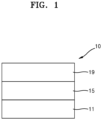
- FIG. 1 is a schematic cross-sectional view of an organic light-emitting device 10 according to an embodiment.
- FIG. 1 a structure and manufacturing method of an organic light-emitting device according to an embodiment are described as follows.
- the organic light-emitting device 10 includes a first electrode 11, a second electrode 19 facing the first electrode 11, and an organic layer 15 between the first electrode 11 and the second electrode 19.
- the organic layer 15 includes an emission layer, a hole transport region may be arranged between the first electrode 11 and the emission layer, and an electron transport region may be arranged between the emission layer and the second electrode 19.
- a substrate may be additionally disposed under the first electrode 11 or on the second electrode 19.
- the substrate may be a conventional substrate used in organic light-emitting devices, e.g., a glass substrate or a transparent plastic substrate, each having excellent mechanical strength, thermal stability, transparency, surface smoothness, ease of handling, and water repellency.
- the first electrode 11 may be produced by depositing or sputtering, onto the substrate, a material for forming the first electrode 11.
- the first electrode 11 may be an anode.
- the material for forming the first electrode 11 may be selected from materials with a high work function for easy hole injection.
- the first electrode 11 may be a reflective electrode, a semi-transmissive electrode, or a transmissive electrode.
- a material for forming the first electrode 11 may be indium tin oxide (ITO), indium zinc oxide (IZO), tin oxide (SnO 2 ), zinc oxide (ZnO), or any combination thereof, but embodiments are not limited thereto.
- the first electrode 11 when the first electrode 11 is a semi-transmissive electrode or a reflective electrode, as a material for forming the first electrode 11, at least one of magnesium (Mg), silver (Ag), aluminum (Al), aluminum-lithium (Al-Li), calcium (Ca), magnesium-indium (Mg-In), magnesium-silver (Mg-Ag), or any combination thereof may be used, but embodiments are not limited thereto.
- the first electrode 11 may have a single-layered structure or a multilayer structure including a plurality of layers.
- the emission layer may include the heterocyclic compound.
- a thickness of the emission layer may be in a range of about 100 ⁇ to about 1,000 ⁇ , for example, about 200 ⁇ to about 600 ⁇ . When the thickness of the emission layer is within the range, excellent light-emission characteristics may be obtained without a substantial increase in driving voltage.
- the heterocyclic compound may be a fluorescent emitter.
- the emission layer may further include a host (hereinafter, referred to as 'Host A', and Host A may not be identical to the heterocyclic compound).
- Host A may be understood by referring to the description of a host material described below, but embodiments are not limited thereto.
- Host A may be a fluorescent host.
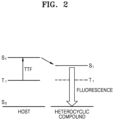
- Singlet excitons are formed in Host A in the emission layer, and the singlet excitons formed in Host A are transferred to a fluorescent emitter through Förster energy transfer (or, Förster resonance energy transfer (FRET)).
- Förster energy transfer or, Förster resonance energy transfer (FRET)
- a proportion of the singlet excitons formed in Host A may be only 25 %, and thus, 75 % of triplet excitons formed in Host A may be fused to each other to be converted into singlet excitons.
- efficiency of the organic light-emitting device may be further improved.
- the efficiency of the organic light-emitting device may be further improved using a triplet-triplet fusion (TTF) mechanism.
- TTF triplet-triplet fusion
- a proportion of emission components emitted from the heterocyclic compound may be greater than or equal to 80 %, for example, greater than or equal to 90 %.
- a proportion of emission components emitted from the heterocyclic compound may be greater than or equal to 95 %.
- the heterocyclic compound may emit fluorescence, and the host may not emit light.
- an amount of the heterocyclic compound may be about 50 parts by weight or less, for example, about 30 parts by weight or less, about 10 parts by weight or less, or about 1 part by weight to about 5 parts by weight, based on 100 parts by weight of the emission layer, and an amount of Host A in the emission layer may be about 50 parts by weight or greater, for example, about 70 parts by weight or greater, about 90 parts by weight or greater, or about 95 part by weight to about 99 parts by weight, based on 100 parts by weight of the emission layer, but embodiments are not limited thereto.
- the emission layer further includes Host A
- Host A and the heterocyclic compound may satisfy Condition A: E H A S 1 > E S 1 wherein, in Condition A,
- E(H A ) S1 and E S1 are evaluated using the DFT method of the Gaussian program, wherein structure optimization is performed at B3LYP/6-31G(d,p) level.
- the heterocyclic compound may be a delayed fluorescence emitter.
- the emission layer may further include a host (hereinafter, referred to as 'Host B', and Host B is not identical to the heterocyclic compound).
- Host B may be understood by referring to the description of a host material described below, but embodiments are not limited thereto.
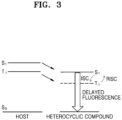
- 25 % of singlet excitons formed in Host B in the emission layer are transferred to a delayed fluorescence emitter through FRET.
- 75 % of triplet excitons formed in Host B in the emission layer are transferred to a delayed fluorescence emitter through Dexter energy transfer.
- At least a portion of energy of a singlet state of the delayed fluorescence emitter may be transferred to a triplet state by intersystem crossing (ISC).
- the energy transferred to the triplet state of the delayed fluorescence emitter may be transferred to the singlet state by reverse intersystem crossing (RISC).
- a proportion of emission components emitted from the heterocyclic compound may be greater than or equal to 80 %, for example, greater than or equal to 90 %.
- a proportion of emission components emitted from the heterocyclic compound may be greater than or equal to 95 %.
- the heterocyclic compound may emit fluorescence and/or delayed fluorescence
- the emission components of the heterocyclic compound may be a total of prompt emission components of the heterocyclic compound and delayed fluorescence components by RISC of the heterocyclic compound.
- Host B may not emit light.
- an amount of the heterocyclic compound when the emission layer further includes Host B, in addition to the heterocyclic compound, an amount of the heterocyclic compound may be about 50 parts by weight or less, for example, about 30 parts by weight or less, based on 100 parts by weight of the emission layer, and an amount of Host B in the emission layer may be about 50 parts by weight or greater, for example, about 70 parts by weight or greater, based on 100 parts by weight of the emission layer, but embodiments are not limited thereto.
- the emission layer further includes Host B
- Host B and the heterocyclic compound may satisfy Condition B: E H B S 1 > E S 1 wherein, in Condition B,
- E(H B ) S1 and E S1 are evaluated using the DFT method of the Gaussian program, wherein structure optimization is performed at B3LYP/6-31G(d,p) level.
- the heterocyclic compound may be used as a fluorescent emitter, and the emission layer may further include a sensitizer, for example, a delayed fluorescence sensitizer.
- the emission layer may further include a host (hereinafter, referred to as 'Host C', and Host C is not identical to the heterocyclic compound and the sensitizer) and a sensitizer (hereinafter, referred to as 'Sensitizer A', and Sensitizer A is not identical to Host C and the heterocyclic compound).
- Host C and Sensitizer A may respectively be understood by referring to the descriptions of a host material and a sensitizer material described below, but embodiments are not limited thereto.
- a proportion of emission components of the heterocyclic compound may be greater than or equal to 80 %, for example, greater than or equal to 90 % (or for example, greater than or equal to 95 %).
- the heterocyclic compound may emit fluorescence.
- Host C and Sensitizer A may not each emit light.
- Singlet and triplet excitons are formed in Host C in the emission layer, and the singlet and triplet excitons formed in Host C may be transferred to Sensitizer A and then to the heterocyclic compound through FRET. 25 % of the singlet excitons are formed in Host C and are transferred to Sensitizer A through FRET, and 75 % of the triplet excitons are formed in Host C and energy thereof is transferred to a singlet state and triplet state of Sensitizer A. At least a portion of energy of the singlet state of Sensitizer A may be transferred to the triplet state by ISC. The energy transferred to the triplet state of Sensitizer A is transferred to the singlet state by RISC, and then, the singlet state energy of Sensitizer A is transferred to the heterocyclic compound through FRET.
- the organic light-emitting device having improved efficiency may be obtained.
- lifespan characteristics of the organic light-emitting device may be improved.
- the emission layer further includes Host C and Sensitizer A
- Host C, Sensitizer A and the heterocyclic compound may satisfy Condition C-1 and/or C-2: S 1 H C ⁇ S 1 S A S 1 S A ⁇ S 1 HC wherein, in Conditions C-1 and C-2,
- the heterocyclic compound may be used as a fluorescent emitter, and the emission layer may further include a sensitizer, for example, a phosphorescent sensitizer.
- the emission layer may further include a host (hereinafter, referred to as 'Host D', and Host D is not identical to the heterocyclic compound and the sensitizer) and a sensitizer (hereinafter, referred to as 'Sensitizer B', and Sensitizer B is not identical to Host D and the heterocyclic compound).
- Host D and Sensitizer B may respectively be understood by referring to the descriptions of a host material and a sensitizer material described below, but embodiments are not limited thereto.
- a proportion of emission components of the heterocyclic compound may be greater than or equal to 80 %, for example, greater than or equal to 90 % (or for example, greater than or equal to 95 %).
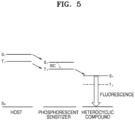
- the heterocyclic compound may emit fluorescence.
- Host D and Sensitizer B may not each emit light.
- energy transfer according to an embodiment is described as follows. 75 % of triplet excitons are formed in Host D in the emission layer and are transferred to Sensitizer B through Dexter energy transfer, and 25 % of singlet excitons are formed in Host D and energy thereof is transferred to a singlet state and triplet state of Sensitizer B. The energy transferred to the singlet state of Sensitizer B is transferred to the triplet state by ISC, and then, the triplet energy of Sensitizer B is transferred to the heterocyclic compound through FRET.
- the organic light-emitting device having improved efficiency may be obtained.
- lifespan characteristics of the organic light-emitting device may be improved.
- the emission layer further includes Host D and Sensitizer B
- Host D, Sensitizer B, and the heterocyclic compound may satisfy Condition D-1 and/or D-2: T 1 H D ⁇ T 1 S B S 1 S B ⁇ S 1 HC wherein, in Conditions D-1 and D-2,
- T 1 (H D ), T 1 (S B ), and S 1 (HC) are evaluated using the DFT method of the Gaussian program, wherein structure optimization is performed at B3LYP/6-31G(d,p) level.
- an amount of Sensitizer B in the emission layer may be about 5 wt% to about 50 wt%, for example, about 10 wt% to about 30 wt%.
- an amount of Sensitizer B in the emission layer may be about 5 wt% to about 50 wt%, for example, about 10 wt% to about 30 wt%.
- effective energy transfer in the emission layer may be achieved.
- the organic light-emitting device may have high efficiency and long lifespan.
- an amount of the heterocyclic compound in the emission layer may be about 0.01 wt% to about 15 wt%, for example, about 0.05 wt% to about 3 wt%, but embodiments are not limited thereto.
- the heterocyclic compound may further satisfy Condition 5: 0 ⁇ s ⁇ T decay HC ⁇ 5 ⁇ s wherein, in Condition 5, T decay (HC) indicates a decay time of the heterocyclic compound.
- the decay time of the heterocyclic compound is a value calculated from a time-resolved photoluminescence (TRPL) spectrum at room temperature of a film (hereinafter, referred to as "Film (HC)”) having a thickness of about 40 nm, which is obtained by vacuum-codepositing the host and the heterocyclic compound included in the emission layer on a quartz substrate at a weight ratio of 90:10 at a vacuum pressure of 10 -7 torr.
- TRPL time-resolved photoluminescence
- the heterocyclic compound may be used as a delayed fluorescence emitter, and the emission layer may further include a sensitizer, for example, a delayed fluorescence sensitizer.
- the emission layer may further include a host (hereinafter, referred to as 'Host E', and Host E is not identical to the heterocyclic compound and a sensitizer) and a sensitizer (hereinafter, referred to as 'Sensitizer C', and Sensitizer C is not identical to Host E and the heterocyclic compound).
- Host E and Sensitizer C may respectively be understood by referring to the description of a host material and a sensitizer material described below, but embodiments are not limited thereto.
- a proportion of emission components of the heterocyclic compound may be greater than or equal to about 80 %, for example, greater than or equal to about 90 % (or for example, greater than or equal to about 95 %).
- the heterocyclic compound may emit fluorescence and/or delayed fluorescence.
- Host E and Sensitizer C may not each emit light.
- the heterocyclic compound emits fluorescence and/or delayed fluorescence
- the emission components of the heterocyclic compound are a total of prompt emission components of the heterocyclic compound and delayed fluorescence components of the heterocyclic compound by RISC.
- Sensitizer C the energy of the triplet state formed in Sensitizer C is reversely transferred to Host E (triplet exciton distributing (TED)), and then transferred to the heterocyclic compound to emit light through RISC.
- Host E triplet exciton distributing
- the organic light-emitting device having improved efficiency may be obtained.
- lifespan characteristics of the organic light-emitting device may be improved.
- the emission layer further includes Host E and Sensitizer C
- Host E, Sensitizer C, and the heterocyclic compound may satisfy Condition E-1, E-2, and/or E-3: S 1 H E ⁇ S 1 S C S 1 S C ⁇ S 1 HC T 1 S C ⁇ T 1 HC wherein, in Conditions E-1, E-2, and E-3,
- T 1 (S C ) indicates a lowest excited triplet energy level of Sensitizer C
- T 1 (HC) indicates a lowest excited triplet energy level of the heterocyclic compound.
- S 1 (H E ), S 1 (S C ), S 1 (HC), T 1 (S C ), and T 1 (HC) are evaluated using the DFT method of the Gaussian program, wherein structure optimization is performed at B3LYP/6-31G(d,p) level.
- an amount of Sensitizer C in the emission layer may be about 5 wt% to about 50 wt%, for example, about 10 wt% to about 30 wt%.
- an amount of Sensitizer C in the emission layer may be about 5 wt% to about 50 wt%, for example, about 10 wt% to about 30 wt%.
- effective energy transfer in the emission layer may be achieved.
- the organic light-emitting device may have high efficiency and long lifespan.
- an amount of the heterocyclic compound in the emission layer may be about 0.01 wt% to about 15 wt%, for example, about 0.05 wt% to about 3 wt%, but embodiments are not limited thereto.
- the host may not include a metal atom.
- the host may include at least one compound of a fluorene-containing compound, a carbazole-containing compound, a dibenzofuran-containing compound, a dibenzothiophene-containing compound, an indenocarbazole-containing compound, an indolocarbazole-containing compound, a benzofurocarbazole-containing compound, a benzothienocarbazole-containing compound, an acridine-containing compound, a dihydroacridine-containing compound, a triindolobenzene-containing compound, a pyridine-containing compound, a pyrimidine-containing compound, a triazine-containing compound, a silicon-containing compound, a cyano group-containing compound, a phosphine oxide-containing compound, a sulfoxide-containing compound, a sulfonyl-containing compound, or any combination thereof.
- a fluorene-containing compound a carbazole-containing compound, a dibenzofuran
- the host may be a compound including at least one carbazole ring and at least one cyano group, or a phosphine oxide-containing compound.
- the host may consist of one kind of host.
- the one kind of host may be a bipolar host, an electron-transporting host, or a hole-transporting host, which will be described later.
- the host may be a mixture of two or more different kinds of hosts.
- the host may be a mixture of an electron-transporting host and a hole-transporting host, a mixture of two different kinds of electron-transporting hosts, or a mixture of two different kinds of hole-transporting hosts.
- the electron-transporting host and the hole-transporting host may respectively be the same as those described below.
- the host may include an electron-transporting host including at least one electron-transporting moiety and a hole-transporting host that does not include an electron-transporting moiety.
- the electron-transporting moiety used herein may be a cyano group, a ⁇ electron-deficient nitrogen-containing cyclic group, a group represented by one of the following Formulae, or a combination thereof: wherein, in Formulae, *, *', and *" may each indicate a binding site to any neighboring atom.
- the electron-transporting host in the emission layer may include at least one of a cyano group, a ⁇ electron-deficient nitrogen-containing cyclic group, or a combination thereof.
- the electron-transporting host in the emission layer may include at least one cyano group.
- the electron-transporting host in the emission layer may include at least one cyano group and at least one ⁇ electron-deficient nitrogen-containing cyclic group.
- the host may include an electron-transporting host and a hole-transporting host, wherein the electron-transporting host may include at least one ⁇ electron-deficient nitrogen-free cyclic group and at least one electron-transporting moiety, and the hole-transporting host may include at least one ⁇ electron-deficient nitrogen-free cyclic group and may not include an electron-transporting moiety.
- the ⁇ electron-deficient nitrogen-free cyclic group may be: a benzene group, a heptalene group, an indene group, a naphthalene group, an azulene group, an indacene group, an acenaphthylene group, a fluorene group, a spiro-bifluorene group, a benzofluorene group, a dibenzofluorene group, a phenalene group, a phenanthrene group, an anthracene group, a fluoranthene group, a triphenylene group, a pyrene group, a chrysene group, a naphthacene group, a picene group, a perylene group, a pentacene group, a hexacene group, a pentaphene group, a rubicene group, a coronene group, an ovalene
- a weight ratio of the electron-transporting host and the hole-transporting host may be 1:9 to 9:1, for example, 2:8 to 8:2, for example, 4:6 to 6:4, for example, 5:5.
- a balance of hole and electron transport in the emission layer may be achieved.
- the host may include at least one of TPBi, TBADN, ADN (also referred to as "DNA”), CBP, CDBP, TCP, mCP, Compound H50, Compound H51, or any combination thereof:
- the host may further include a compound represented by Formula 301: wherein, in Formula 301, Ar 111 and Ar 112 may each independently be:
- Ar 113 to Ar 116 in Formula 301 may each independently be:
- the designations g, h, i, and j in Formula 301 may each independently be an integer from 0 to 4, and may be, for example, 0, 1, or 2.
- Ar 113 to Ar 116 may each independently be:
- the host may include a compound represented by Formula 302:
- Ar 122 to Ar 125 in Formula 302 are the same as described in detail in connection with Ar 113 in Formula 301.
- Ar 126 and Ar 127 in Formula 302 may each independently be a C 1 -C 10 alkyl group (for example, a methyl group, an ethyl group, or a propyl group).
- k and l in Formula 302 may each independently be an integer from 0 to 4.
- k and l may be 0, 1, or 2.
- the host may include at least one of Compounds H1 to H25:
- the host may consist of one kind of compound.
- the one kind of compound may be a first material (hole-transporting host), a second material (electron-transporting host) as described above, or any combination thereof.
- the host may include two or more kinds of compounds.
- the host may include two or more different kinds of hole-transporting hosts, or two or more different kinds of electron-transporting hosts, or a combination of at least one hole-transporting host and at least one electron-transporting host.
- the emitter includes the heterocyclic compound.
- the sensitizer may include a phosphorescent compound.
- the phosphorescent compound may include an organometallic compound including at least one metal.
- the organometallic compound may include: at least one transition metal (M 11 ); and an organic ligand (L 11 ), wherein L 11 and M 11 may form one cyclometalated ring, two cyclometalated rings, three cyclometalated rings, or four cyclometalated rings.
- M 11 transition metal
- L 11 organic ligand
- the organometallic compound may be represented by Formula 101:
- the transition metal may be platinum (Pt), palladium (Pd), gold (Au), iridium (Ir), osmium (Os), titanium (Ti), zirconium (Zr), hafnium (Hf), europium (Eu), terbium (Tb), thulium (Tm), or rhodium (Rh).
- the sensitizer may include a delayed fluorescence compound.
- the delayed fluorescence compound may be represented by Formula 101 or 102. wherein, in Formulae 101 and 102,
- R 201 may be hydrogen, deuterium, -F, -Cl, -Br, -I, -SF 5 , a hydroxyl group, a cyano group, a nitro group, an amidino group, a hydrazino group, a hydrazono group, a substituted or unsubstituted C 1 -C 60 alkyl group, a substituted or unsubstituted C 2 -C 60 alkenyl group, a substituted or unsubstituted C 2 -C 60 alkynyl group, a substituted or unsubstituted C 1 -C 60 alkoxy group, a substituted or unsubstituted C 3 -C 10 cycloalkyl group, a substituted or unsubstituted C 1 -C 10 heterocycloalkyl group, a substituted or unsubstituted C 3 -C 10 cycloalkenyl group, a substituted or unsubsti
- a 21 may be a substituted or unsubstituted ⁇ electron-deficient nitrogen-free cyclic group.
- the ⁇ electron-deficient nitrogen-free cyclic group may be: a benzene group, a heptalene group, an indene group, a naphthalene group, an azulene group, an indacene group, an acenaphthylene group, a fluorene group, a spiro-bifluorene group, a benzofluorene group, a dibenzofluorene group, a phenalene group, a phenanthrene group, an anthracene group, a fluoranthene group, a triphenylene group, a pyrene group, a chrysene group, a naphthacene group, a picene group, a perylene group, a pentacene group, a hexacene group, a pentaphene group, a rubicene group, a coronene group, an ovalen
- D 21 may be: -F, a cyano group, or a ⁇ electron-deficient nitrogen-containing cyclic group;
- the ⁇ electron-deficient nitrogen-free cyclic group is the same as described above.
- an amount of the sensitizer may be greater than an amount of the emitter.
- a volume ratio of the sensitizer and the emitter may be about 30:0.1 to about 10:3, or about 10:0.1 to about 20:5.
- a weight ratio of the sensitizer and the emitter may be about 10:0.1 to about 20:5.
- a volume ratio of the host and the sensitizer in the organic layer may be about 60:40 to about 95:5 or about 70:30 to about 90:10.
- a weight ratio of the host and the sensitizer may be about 60:40 to about 95:5.
- the organic light-emitting device may have improved emission efficiency and/or lifespan characteristics.
- FIG. 1 is a schematic cross-sectional view of the organic light-emitting device 10 according to an embodiment.
- the organic light-emitting device 10 includes a first electrode 11, an organic layer 15, and a second electrode 19, which are sequentially stacked.
- a substrate may be additionally disposed under the first electrode 11 or on the second electrode 19.
- any substrate that is used in organic light-emitting devices available in the art may be used, and for example, a glass substrate or a transparent plastic substrate, each having excellent mechanical strength, thermal stability, transparency, surface smoothness, ease of handling, and water resistance, may be used.
- the first electrode 11 may be formed by depositing or sputtering, for example, onto the substrate, a material for forming the first electrode 11.
- the first electrode 11 may be an anode.
- the material for forming the first electrode 11 may be a material with a high work function for easy hole injection.
- the first electrode 11 may be a reflective electrode, a semi-transmissive electrode, or a transmissive electrode.
- the material for forming the first electrode 11 may be indium tin oxide (ITO), indium zinc oxide (IZO), tin oxide (SnO 2 ), or zinc oxide (ZnO).
- the material for forming the first electrode 11 may be metal, such as magnesium (Mg), aluminum (Al), aluminum-lithium (Al-Li), calcium (Ca), magnesium-indium (Mg-In), or magnesium-silver (Mg-Ag).
- metal such as magnesium (Mg), aluminum (Al), aluminum-lithium (Al-Li), calcium (Ca), magnesium-indium (Mg-In), or magnesium-silver (Mg-Ag).
- the first electrode 11 may have a single-layered structure or a multilayer structure including two or more layers.
- the first electrode 11 may have a three-layered structure of ITO/Ag/ITO, but embodiments are not limited thereto.
- the organic layer 15 is disposed above the first electrode 11.
- the organic layer 15 may include a hole transport region, an emission layer, or an electron transport region.
- the hole transport region may be between the first electrode 11 and the emission layer.
- the hole transport region may include a hole injection layer, a hole transport layer, an electron blocking layer, a buffer layer, or any combination thereof.
- the hole transport region may include only either a hole injection layer or a hole transport layer.
- the hole transport region may have a hole injection layer/hole transport layer structure, a hole injection layer/hole transport layer/electron blocking layer structure, or a hole injection layer/a first hole transport layer/a second hole transport layer/an electron blocking layer structure, wherein, for each structure, respective layers are sequentially stacked in this stated order from the first electrode 11.
- the hole injection layer may be formed on the first electrode 11 using one or more suitable methods, for example, vacuum deposition, spin coating, casting, and/or Langmuir-Blodgett (LB) deposition.
- suitable methods for example, vacuum deposition, spin coating, casting, and/or Langmuir-Blodgett (LB) deposition.
- the deposition condition may vary according to a compound used as a material to form the hole injection layer, and the structure and thermal characteristics of the hole injection layer.
- the deposition condition may include a deposition temperature of about 100 °C to about 500 °C, a vacuum pressure of about 10 -8 torr to about 10 -3 torr, and a deposition rate of about 0.01 ⁇ /sec to about 100 ⁇ /sec.
- the deposition condition are not limited thereto.
- the coating condition may vary according to a compound used as a material to form the hole injection layer, and the structure and thermal characteristics of the hole injection layer.
- the coating condition may include a coating speed of about 2,000 rpm to about 5,000 rpm, and a heat treatment temperature of about 80 °C to about 200 °C for removing a solvent after coating.
- the coating condition are not limited thereto.
- the conditions for forming the hole transport layer and the electron blocking layer may be the same as the conditions for forming the hole injection layer.
- the hole transport region may include at least one of m-MTDATA, TDATA, 2-TNATA, NPB, ⁇ -NPB, TPD, spiro-TPD, spiro-NPB, methylated NPB, TAPC, HMTPD, 4,4',4"-tris(N-carbazolyl)triphenylamine (TCTA), polyaniline/dodecylbenzenesulfonic acid (PANI/DBSA), poly(3,4-ethylenedioxythiophene)/poly(4-styrenesulfonate)
- TCTA 4,4',4"-tris(N-carbazolyl)triphenylamine
- PANI/DBSA polyaniline/dodecylbenzenesulfonic acid
- PANI/DBSA poly(3,4-ethylenedioxythiophene)/poly(4-styrenesulfonate)
- PEDOT/PSS polyaniline/camphor sulfonic acid
- PANI/CSA polyaniline/poly(4-styrenesulfonate)
- a compound represented by Formula 201 a compound represented by Formula 202, or any combination thereof: wherein, in Formula 201, Ar 101 and Ar 102 may each independently be:
- xa and xb may each independently be an integer from 0 to 5, may each independently be or 0, 1, or 2.
- xa may be 1 and xb may be 0, but xa and xb are not limited thereto.
- R 101 to R 108 , R 111 to R 119 , and R 121 to R 124 may each independently be:
- R 109 may be:
- the compound represented by Formula 201 may be represented by Formula 201A, but embodiments are not limited thereto: wherein, in Formula 201A, R 101 , R 111 , R 112 , and R 109 are each the same as described above.
- the compound represented by Formula 201 and the compound represented by Formula 202 may include Compounds HT1 to HT20, but embodiments are not limited thereto:
- a thickness of the hole transport region may be about 100 ⁇ to about 10,000 ⁇ , for example, about 100 ⁇ to about 1,000 ⁇ .
- a thickness of the hole injection layer may be about 100 ⁇ to about 10,000 ⁇ , for example, about 100 ⁇ to about 1,000 ⁇
- a thickness of the hole transport layer may be about 50 ⁇ to about 2,000 ⁇ , for example, about 100 ⁇ to about 1,500 ⁇ .
- the hole transport region may further include, in addition to these materials, a charge-generation material for the improvement of conductive properties.
- the charge-generation material may be homogeneously or non-homogeneously dispersed in the hole transport region.
- the charge-generation material may be, for example, a p-dopant.
- the p-dopant may be one of a quinone derivative, a metal oxide, and a cyano group-containing compound, but embodiments are not limited thereto.
- examples of the p-dopant are: a quinone derivative, such as tetracyanoquinonedimethane (TCNQ) and 2,3,5,6-tetrafluoro-tetracyano-1,4-benzoquinonedimethane (F4-TCNQ); a metal oxide, such as a tungsten oxide or a molybdenum oxide; or a cyano group-containing compound, such as Compound HT-D1 or F12, but embodiments are not limited thereto:
- a quinone derivative such as tetracyanoquinonedimethane (TCNQ) and 2,3,5,6-tetrafluoro-tetracyano-1,4-benzoquinonedimethane (F4-TCNQ)
- a metal oxide such as a tungsten oxide or a molybdenum oxide
- a cyano group-containing compound such as Compound HT-D1 or F12
- the hole transport region may include a buffer layer.
- the buffer layer may compensate for an optical resonance distance according to a wavelength of light emitted from the emission layer, and thus, efficiency of the organic light-emitting device may be improved.
- a material for the electron blocking layer may be selected from materials for the hole transport region described above and materials for a host described above.
- the material for the electron blocking layer is not limited thereto.
- examples of a material for the electron blocking layer may include mCP described below.
- an emission layer may be formed on the hole transport region using vacuum deposition, spin coating, casting, LB deposition, or the like.
- the deposition condition and the coating condition may vary according to a compound used as a material to form the emission layer, but the deposition condition and the coating condition may be similar to those applied in forming the hole injection layer.
- the emission layer may be patterned into a red emission layer, a green emission layer, and a blue emission layer.
- the emission layer has a structure in which a red emission layer, a green emission layer, and/or a blue emission layer are stacked, and thus, may emit white light, and various modifications may be made.
- an amount of the dopant may be about 0.01 parts by weight to about 15 parts by weight based on 100 parts by weight of the host, but embodiments are not limited thereto.
- a thickness of the emission layer may be about 100 ⁇ to about 1,000 ⁇ , for example, about 200 ⁇ to about 600 ⁇ . When the thickness of the emission layer is within the range, excellent light-emission characteristics may be obtained without a substantial increase in driving voltage.
- an electron transport region may be disposed above the emission layer.
- the electron transport region may include a hole blocking layer, an electron transport layer, an electron injection layer, or a combination thereof.
- the electron transport region may have a hole blocking layer/electron transport layer/electron injection layer structure or an electron transport layer/electron injection layer structure, but embodiments are not limited thereto.
- the electron transport layer may have a single-layered structure or a multilayer structure including two or more different materials.
- Conditions for forming the hole blocking layer, the electron transport layer, and the electron injection layer which constitute the electron transport region may be understood by referring to the conditions for forming the hole injection layer.
- the hole blocking layer may include, for example, at least one of BCP, Bphen, BAlq, or any combination thereof, but embodiments are not limited thereto:
- a thickness of the hole blocking layer may be about 20 ⁇ to about 1,000 ⁇ , for example, about 30 ⁇ to about 300 ⁇ . When the thickness of the hole blocking layer is within the range as described above, excellent hole blocking characteristics may be obtained without a substantial increase in driving voltage.
- the electron transport layer may include at least one of BCP, Bphen, Alq 3 , BAlq, TAZ, NTAZ, or any combination thereof:
- the electron transport layer may include at least one of Compounds ET1 to ET25, but embodiments are not limited thereto:
- a thickness of the electron transport layer may be about 100 ⁇ to about 1,000 ⁇ , for example, about 150 ⁇ to about 500 ⁇ . When the thickness of the electron transport layer is within the range as described above, satisfactory electron transporting characteristics may be obtained without a substantial increase in driving voltage.
- the electron transport layer may include a metal-containing material in addition to the material as described above.
- the metal-containing material may include a Li complex.
- the Li complex may include, for example, Compound ET-D1 (lithium quinolate, LiQ) or ET-D2:
- the electron transport region may include an electron injection layer that facilitates injection of electrons from the second electrode 19 thereinto.
- the electron injection layer may include LiF, NaCl, CsF, Li 2 O, BaO, or a combination thereof.
- a thickness of the electron injection layer may be about 1 ⁇ to about 100 ⁇ , for example, about 3 ⁇ to about 90 ⁇ . When the thickness of the electron injection layer is within the range as described above, satisfactory electron injection characteristics may be obtained without a substantial increase in driving voltage.
- the second electrode 19 is disposed above the organic layer 15.
- the second electrode 19 may be a cathode.
- a material for forming the second electrode 19 may include a metal, an alloy, an electrically conductive compound, or a combination thereof, which have a relatively low work function.
- lithium (Li), magnesium (Mg), aluminum (Al), aluminum-lithium (Al-Li), calcium (Ca), magnesium-indium (Mg-In), or magnesium-silver (Mg-Ag) may be used as the material for forming the second electrode 19.
- a transmissive formed using ITO or IZO may be used as the second electrode 19 in order to manufacture a top-emission type light-emitting device,
- the organic light-emitting device has been described with reference to FIG. 1 , but embodiments are not limited thereto.
- an electronic apparatus including the organic light-emitting device.
- the electronic apparatus may further include a thin-film transistor in addition to the organic light-emitting device as described above.
- the thin-film transistor may include a source electrode, a drain electrode, and an activation layer, wherein any one of the source electrode and the drain electrode may be electrically connected to one of the first electrode and the second electrode of the organic light-emitting device.
- a diagnostic composition including the heterocyclic compound represented by Formula 1.
- the diagnostic composition may include at least one heterocyclic compound represented by Formula 1.
- the heterocyclic compound represented by Formula 1 provides high emission efficiency, and accordingly, the diagnostic composition including the heterocyclic compound may have high diagnostic efficiency.
- the diagnostic composition may be used in various applications including a diagnosis kit, a diagnosis reagent, a biosensor, and a biomarker.
- the C 1 -C 60 alkyl group as used herein refers to a linear or branched saturated aliphatic hydrocarbon monovalent group having 1 to 60 carbon atoms, and examples thereof include a methyl group, an ethyl group, a propyl group, an isobutyl group, a sec-butyl group, a tert-butyl group, a pentyl group, an isoamyl group, and a hexyl group.
- the C 1 -C 60 alkylene group as used herein refers to a divalent group having the same structure as the C 1 -C 60 alkyl group.
- Examples of the C 1 -C 60 alkyl group, the C 1 -C 20 alkyl group, and/or the C 1 -C 10 alkyl group as used herein may include a methyl group, an ethyl group, an n-propyl group, an isopropyl group, an n-butyl group, a sec-butyl group, an isobutyl group, a tert-butyl group, an n-pentyl group, a tert-pentyl group, a neopentyl group, an isopentyl group, a sec-pentyl group, a 3-pentyl group, a sec-isopentyl group, an n-hexyl group, an isohexyl group, a sec-hexyl group, a tert-hexyl group, an n-heptyl group, an isoheptyl group, a sec-heptyl group
- the C 1 -C 60 alkoxy group used herein refers to a monovalent group represented by -OA 101 (wherein A 101 is the C 1 -C 60 alkyl group), and examples thereof include a methoxy group, an ethoxy group, and an isopropyloxy group.
- Examples of the C 1 -C 60 alkoxy group, the C 1 -C 20 alkoxy group, or the C 1 -C 10 alkoxy group as used herein may include a methoxy group, an ethoxy group, a propoxy group, a butoxy group, and a pentoxy group.
- the C 2 -C 60 alkenyl group as used herein has a structure including at least one carbon-carbon double bond in the middle or at the terminus of the C 2 -C 60 alkyl group, and examples thereof include an ethenyl group, a propenyl group, and a butenyl group.
- the C 2 -C 60 alkenylene group as used herein refers to a divalent group having the same structure as the C 2 -C 60 alkenyl group.
- the C 2 -C 60 alkynyl group as used herein has a structure including at least one carbon-carbon triple bond in the middle or at the terminus of the C 2 -C 60 alkyl group, and examples thereof include an ethynyl group and a propynyl group.
- the C 2 -C 60 alkynylene group as used herein refers to a divalent group having the same structure as the C 2 -C 60 alkynyl group.
- the C 3 -C 10 cycloalkyl group as used herein refers to a monovalent saturated hydrocarbon cyclic group having 3 to 10 carbon atoms, and examples thereof include a cyclopropyl group, a cyclobutyl group, a cyclopentyl group, a cyclohexyl group, and a cycloheptyl group.
- the C 3 -C 10 cycloalkylene group as used herein refers to a divalent group having the same structure as the C 3 -C 10 cycloalkyl group.
- the C 3 -C 10 cycloalkyl group as used herein may include a cyclopropyl group, a cyclobutyl group, a cyclopentyl group, a cyclohexyl group, a cycloheptyl group, a cyclooctyl group, an adamantanyl group, a bicyclo[1.1.1]pentyl group, a bicyclo[2.1.1]hexyl group, a bicyclo[2.2.1]heptyl group (norbornanyl group), a bicyclo[2.2.2]octyl group, and the like.
- the C 1 -C 10 heterocycloalkyl group as used herein refers to a monovalent saturated cyclic group having at least one heteroatom, for example, N, O, P, Si, B, Ti, S, Se, Te, Ge, or any combination thereof as a ring-forming atom and 1 to 10 carbon atoms, and examples thereof include a tetrahydrofuranyl group and a tetrahydrothiophenyl group.
- the C 1 -C 10 heterocycloalkylene group as used herein refers to a divalent group having the same structure as the C 1 -C 10 heterocycloalkyl group.
- Examples of the C 1 -C 10 heterocycloalkyl group as used herein may include a silolanyl group, a silinanyl group, a tetrahydrofuranyl group, a tetrahydro-2H-pyranyl group, and a tetrahydrothiophenyl group.
- the C 3 -C 10 cycloalkenyl group as used herein refers to a monovalent cyclic group that has 3 to 10 carbon atoms, at least one carbon-carbon double bond in its ring, and no aromaticity, and examples thereof include a cyclopentenyl group, a cyclohexenyl group, and a cycloheptenyl group.
- the C 3 -C 10 cycloalkenylene group as used herein refers to a divalent group having the same structure as the C 3 -C 10 cycloalkenyl group.
- the C 1 -C 10 heterocycloalkenyl group as used herein refers to a monovalent cyclic group that has at least one hetero atom, for example, N, O, P, Si, B, Ti, S, Se, Te, Ge, or any combination thereof as a ring-forming atom, 2 to 10 carbon atoms, and at least one carbon-carbon double bond in its ring.
- Examples of the C 1 -C 10 heterocycloalkenyl group include a 2,3-dihydrofuranyl group and a 2,3-dihydrothiophenyl group.
- the C 2 -C 10 heterocycloalkenylene group as used herein refers to a divalent group having the same structure as the C 2 -C 10 heterocycloalkenyl group.
- the C 6 -C 60 aryl group as used herein refers to a monovalent group having a carbocyclic aromatic system having 6 to 60 carbon atoms
- the C 6 -C 60 arylene group as used herein refers to a divalent group having a carbocyclic aromatic system having 6 to 60 carbon atoms.
- Examples of the C 6 -C 60 aryl group include a phenyl group, a naphthyl group, an anthracenyl group, a phenanthrenyl group, a pyrenyl group, and a chrysenyl group.
- the C 6 -C 60 aryl group and the C 6 -C 60 arylene group each include two or more rings, the two or more rings may be fused to each other.
- the C 7 -C 60 alkylaryl group as used herein refers to a C 6 -C 60 aryl group that is substituted with at least one C 1 -C 60 alkyl group.
- the C 1 -C 60 heteroaryl group as used herein refers to a monovalent group having a cyclic aromatic system that has at least one heteroatom, for example, N, O, P, Si, B, Ti, S, Se, Te, Ge, or any combination thereof as a ring-forming atom, and 1 to 60 carbon atoms.
- the C 1 -C 60 heteroarylene group as used herein refers to a divalent group having a carbocyclic aromatic system that has at least one heteroatom, for example, N, O, P, Si, B, Ti, S, Se, Te, Ge, or any combination thereof as a ring-forming atom, and 1 to 60 carbon atoms.
- Examples of the C 1 -C 60 heteroaryl group include a pyridinyl group, a pyrimidinyl group, a pyrazinyl group, a pyridazinyl group, a triazinyl group, a quinolinyl group, and an isoquinolinyl group.
- the C 6 -C 60 heteroaryl group and the C 6 -C 60 heteroarylene group each include two or more rings, the two or more rings may be fused to each other.
- the C 2 -C 60 alkylheteroaryl group as used herein refers to a C 1 -C 60 heteroaryl group that is substituted with at least one C 1 -C 60 alkyl group.
- the C 6 -C 60 aryloxy group as used herein indicates -OA 102 (wherein A 102 is the C 6 -C 60 aryl group), and the C 6 -C 60 arylthio group as used herein indicates -SA 103 (wherein A 103 is the C 6 -C 60 aryl group).
- the C 1 -C 60 heteroaryloxy group used herein indicates -OA 104 (wherein A 104 is a C 1 -C 60 heteroaryl group), and the C 1 -C 60 heteroarylthio group indicates -SA 105 (wherein A 105 is the C 1 -C 60 heteroaryl group).
- the monovalent non-aromatic condensed polycyclic group as used herein refers to a monovalent group having two or more rings condensed with each other, only carbon atoms (for example, having 8 to 60 carbon atoms) as ring-forming atoms, and no aromaticity in its molecular structure when considered as a whole.
- Examples of the monovalent non-aromatic condensed polycyclic group include a fluorenyl group.
- the divalent non-aromatic condensed polycyclic group as used herein refers to a divalent group having the same structure as a monovalent non-aromatic condensed polycyclic group.
- the monovalent non-aromatic condensed heteropolycyclic group as used herein refers to a monovalent group having two or more rings condensed with each other, a heteroatom, for example, N, O, P, Si, B, Ti, S, Se, Te, Ge, or any combination thereof, other than carbon atoms (for example, having 2 to 60 carbon atoms), as a ring-forming atom, and no aromaticity in its molecular structure when considered as a whole.
- Examples of the monovalent non-aromatic condensed heteropolycyclic group include a carbazolyl group.
- the divalent non-aromatic condensed heteropolycyclic group as used herein refers to a divalent group having the same structure as a monovalent non-aromatic condensed heteropolycyclic group.
- the C 5 -C 30 carbocyclic group as used herein refers to a saturated or unsaturated cyclic group having, as a ring-forming atom, 5 to 30 carbon atoms only.
- the C 5 -C 30 carbocyclic group may be a monocyclic group or a polycyclic group.
- Examples of the "C 5 -C 30 carbocyclic group (that is unsubstituted or substituted with at least one R 1a )" may include an adamantane group, a norbornene group, a bicyclo[1.1.1]pentane group, a bicyclo[2.1.1]hexane group, a bicyclo[2.2.1]heptane group (norbornane group), a bicyclo[2.2.2]octane group, a cyclopentane group, a cyclohexane group, a cyclohexene group, a benzene group, a naphthalene group, an anthracene group, a phenanthrene group, a triphenylene group, a pyrene group, a chrysene group, a 1,2,3,4-tetrahydronaphthalene group, a cyclopentadiene group, a silole group,
- the C 1 -C 30 heterocyclic group as used herein refers to a saturated or unsaturated cyclic group having at least one heteroatom, for example, N, O, Si, P, B, Ti, S, Se, Te, Ge, or any combination thereof, other than 1 to 30 carbon atoms, as a ring-forming atom.
- the C 1 -C 30 heterocyclic group may be a monocyclic group or a polycyclic group.
- Examples of the "C 1 -C 30 heterocyclic group (that is unsubstituted or substituted with at least one R 1a )" may include a thiophene group, a furan group, a pyrrole group, a silole group, a borole group, a phosphole group, a selenophene group, a germole group, a benzothiophene group, a benzofuran group, an indole group, an indene group, a benzosilole group, a benzoborole group, a benzophosphole group, a benzoselenophene group, a benzogermole group, a dibenzothiophene group, a dibenzofuran group, a carbazole group, a dibenzosilole group, a dibenzoborole group, a dibenzophosphole group, a dibenzoselenophene group, a dibenzogermol
- TMS represents *-Si(CH 3 ) 3
- TMG represents *-Ge(CH 3 ) 3 .
- the number of carbons in each group that is substituted excludes the number of carbons in the substituent.
- a C 1 -C 60 alkyl group can be substituted with a C 1 -C 60 alkyl group.
- the total number of carbons included in the C 1 -C 60 alkyl group substituted with the C 1 -C 60 alkyl group is not limited to 60 carbons.
- more than one C 1 -C 60 alkyl substituent may be present on the C 1 -C 60 alkyl group. This definition is not limited to the C 1 -C 60 alkyl group and applies to all substituted groups that recite a carbon range.
- An ITO glass substrate was cut to a size of 50 mm x 50 mm x 0.5 mm and then, sonicated in acetone isopropyl alcohol and pure water, each for 15 minutes, and then, cleaned by exposure to UV ozone for 30 minutes.
- HAT-CN was deposited on the ITO electrode (anode) on the glass substrate to form a hole injection layer having a thickness of 100 ⁇
- NPB was deposited on the hole injection layer to form a first hole transport layer having a thickness of 500 ⁇
- TCTA was deposited on the first hole transport layer to form a second hole transport layer having a thickness of 50 ⁇
- mCP was deposited on the second hole transport layer to form an electron blocking layer having a thickness of 50 ⁇ .
- a first host (H16), a second host (H25), and an emitter (Compound 1) were co-deposited on the electron blocking layer to form an emission layer having a thickness of 400 ⁇ .
- the first host and the second host were mixed at a ratio of 60:40, and the emitter was adjusted to be 3 wt% based on the total weight of the first host, the second host, and the emitter.
- DBFPO was deposited on the emission layer to form a hole blocking layer having a thickness of 100 ⁇ , and DBFPO and LiQ were co-deposited thereon at a weight ratio of 5:5 to form an electron transport layer having a thickness of 300 ⁇ , LiQ was deposited on the electron transport layer to form an electron injection layer having a thickness of 10 ⁇ , and then Al was deposited on the electron injection layer to form a cathode having a thickness of 1,000 ⁇ , thereby completing the manufacture of an organic light-emitting device.
- Organic light-emitting devices were manufactured in the same manner as in Example 1, except that compounds shown in Table 2 were each used instead of the emitter in forming the emission layer.
- the lifespan T 95 (at 1,200 cd/m 2 , hr) FWHM (nm) of EL spectrum, and external quantum efficiency (EQE, %) of the organic light-emitting devices manufactured in Example 1 and Comparative Examples 1 and 2 were measured and evaluated using a current-voltage meter (Keithley 2400) and a luminance meter (Minolta Cs-1000A).
- the lifespan T 95 (at 1,200 cd/m 2 , hr) is a time taken for the luminance of the organic light-emitting devices to reduce from initial luminance of 100% to 95% thereof.
- the organic light-emitting device according to an embodiment had excellent emission efficiency, FWHM, and lifespan characteristics.
- the organic light-emitting device of Example 1 had higher external quantum efficiency, narrower FWHM, and significantly longer lifespan than those of the organic light-emitting devices of Comparative Examples 1 and 2.
- a heterocyclic compound has excellent luminescent characteristics and charge mobility characteristics, and thus, an electronic device, for example, an organic light-emitting device, including the heterocyclic compound may have low driving voltage, high efficiency, and long lifespan characteristics. Therefore, a high-quality organic light-emitting device may be implemented using the heterocyclic compound.
Landscapes
- Chemical & Material Sciences (AREA)
- Engineering & Computer Science (AREA)
- Physics & Mathematics (AREA)
- Materials Engineering (AREA)
- Organic Chemistry (AREA)
- Spectroscopy & Molecular Physics (AREA)
- Optics & Photonics (AREA)
- Life Sciences & Earth Sciences (AREA)
- Health & Medical Sciences (AREA)
- Hematology (AREA)
- Urology & Nephrology (AREA)
- Molecular Biology (AREA)
- Immunology (AREA)
- Biomedical Technology (AREA)
- Food Science & Technology (AREA)
- Analytical Chemistry (AREA)
- Biochemistry (AREA)
- General Health & Medical Sciences (AREA)
- General Physics & Mathematics (AREA)
- Pathology (AREA)
- Medicinal Chemistry (AREA)
- Microbiology (AREA)
- Cell Biology (AREA)
- Biotechnology (AREA)
- Electroluminescent Light Sources (AREA)
- Inorganic Chemistry (AREA)
Applications Claiming Priority (1)
| Application Number | Priority Date | Filing Date | Title |
|---|---|---|---|
| KR1020220108725A KR20240030113A (ko) | 2022-08-29 | 2022-08-29 | 헤테로시클릭 화합물, 이를 포함한 유기 발광 소자 및 진단용 조성물 |
Publications (2)
| Publication Number | Publication Date |
|---|---|
| EP4335855A1 true EP4335855A1 (fr) | 2024-03-13 |
| EP4335855B1 EP4335855B1 (fr) | 2025-06-04 |
Family
ID=87845486
Family Applications (1)
| Application Number | Title | Priority Date | Filing Date |
|---|---|---|---|
| EP23193479.5A Active EP4335855B1 (fr) | 2022-08-29 | 2023-08-25 | Composé hétérocyclique, dispositif électroluminescent organique le comprenant et composition de diagnostic comprenant le composé hétérocyclique |
Country Status (4)
| Country | Link |
|---|---|
| US (1) | US20240116955A1 (fr) |
| EP (1) | EP4335855B1 (fr) |
| KR (1) | KR20240030113A (fr) |
| CN (1) | CN117624205A (fr) |
Citations (2)
| Publication number | Priority date | Publication date | Assignee | Title |
|---|---|---|---|---|
| CN114369108A (zh) * | 2020-10-15 | 2022-04-19 | 学校法人关西学院 | 多环芳香族化合物、有机器件用材料、有机电致发光元件、显示装置及照明装置 |
| KR20220073182A (ko) * | 2020-11-26 | 2022-06-03 | 주식회사 엘지화학 | 화합물 및 이를 포함하는 유기 발광 소자 |
-
2022
- 2022-08-29 KR KR1020220108725A patent/KR20240030113A/ko active Pending
-
2023
- 2023-08-25 EP EP23193479.5A patent/EP4335855B1/fr active Active
- 2023-08-28 US US18/456,826 patent/US20240116955A1/en active Pending
- 2023-08-29 CN CN202311101320.1A patent/CN117624205A/zh active Pending
Patent Citations (2)
| Publication number | Priority date | Publication date | Assignee | Title |
|---|---|---|---|---|
| CN114369108A (zh) * | 2020-10-15 | 2022-04-19 | 学校法人关西学院 | 多环芳香族化合物、有机器件用材料、有机电致发光元件、显示装置及照明装置 |
| KR20220073182A (ko) * | 2020-11-26 | 2022-06-03 | 주식회사 엘지화학 | 화합물 및 이를 포함하는 유기 발광 소자 |
Also Published As
| Publication number | Publication date |
|---|---|
| CN117624205A (zh) | 2024-03-01 |
| KR20240030113A (ko) | 2024-03-07 |
| US20240116955A1 (en) | 2024-04-11 |
| EP4335855B1 (fr) | 2025-06-04 |
Similar Documents
| Publication | Publication Date | Title |
|---|---|---|
| EP3715437B1 (fr) | Composition et dispositif électroluminescent organique le comprenant | |
| EP3715436B1 (fr) | Composition et dispositif électroluminescent organique la comprenant | |
| EP3263569A1 (fr) | Composé cyclique condensé, composition le comprenant, et dispositif électroluminescent organique comprenant ce composé cyclique condensé | |
| EP3859812B1 (fr) | Dispositif électroluminescent organique | |
| EP3750898A1 (fr) | Composé organométallique, dispositif électroluminescent organique le comprenant et composition de diagnostic comprenant le composé organométallique | |
| EP3705483A1 (fr) | Composé organométallique, dispositif électroluminescent organique le comprenant et appareil électronique comprenant le dispositif électroluminescent organique | |
| EP4119633B1 (fr) | Composé organométallique et dispositif organique électroluminescent incluant un composé organométallique | |
| EP3943499A2 (fr) | Composé organométallique, dispositif électroluminescent organique le comprenant et appareil électronique comprenant le dispositif électroluminescent organique | |
| US20200308205A1 (en) | Organometallic compound, organic light-emitting device including the same, and electronic apparatus including the organic light-emitting device | |
| EP3750899A1 (fr) | Composé organométallique, dispositif électroluminescent organique le comprenant et composition de diagnostic contenant le composé organométallique | |
| EP4120381A1 (fr) | Dispositif électroluminescent organique | |
| EP4141012B1 (fr) | Composé hétérocyclique, dispositif électroluminescent organique le comprenant et appareil électronique comprenant le dispositif électroluminescent organique | |
| EP3715352B1 (fr) | Composé organométallique, dispositif électroluminescent organique le comprenant et appareil électronique comprenant le dispositif électroluminescent organique | |
| KR20210065868A (ko) | 유기금속 화합물, 이를 포함한 유기 발광 소자 및 상기 유기 발광 소자를 포함한 전자 장치 | |
| EP3909964B1 (fr) | Composé organométallique, dispositif électroluminescent organique le comprenant et appareil électronique comprenant le dispositif électroluminescent organique | |
| US20250221308A1 (en) | Heterocyclic compound and organic light-emitting device and electronic apparatus including the same | |
| KR20250106681A (ko) | 헤테로시클릭 화합물, 이를 포함한 유기 발광 소자 및 전자 장치 | |
| EP3957625A1 (fr) | Composé amine et dispositif électroluminescent organique le comprenant | |
| EP4335855B1 (fr) | Composé hétérocyclique, dispositif électroluminescent organique le comprenant et composition de diagnostic comprenant le composé hétérocyclique | |
| EP4711374A2 (fr) | Composé organométallique et dispositif électroluminescent organique le comprenant | |
| EP4692099A2 (fr) | Composé organométallique, dispositif électroluminescent organique comprenant le composé organométallique et appareil électronique comprenant le dispositif électroluminescent organique | |
| EP4527845A1 (fr) | Composé organométallique, dispositif électroluminescent organique le comprenant et appareil électronique comprenant le dispositif électroluminescent organique | |
| EP4306612B1 (fr) | Composé hétérocyclique, dispositif électroluminescent organique le comprenant et appareil électronique comprenant le dispositif électroluminescent organique | |
| US20240373662A1 (en) | Heterocyclic compound, organic light-emitting device including the same, and electronic apparatus including the organic light-emitting device | |
| US20260123173A1 (en) | Condensed cyclic compound, organic light-emitting device including the same, and electronic apparatus including organic light-emitting device |
Legal Events
| Date | Code | Title | Description |
|---|---|---|---|
| PUAI | Public reference made under article 153(3) epc to a published international application that has entered the european phase |
Free format text: ORIGINAL CODE: 0009012 |
|
| STAA | Information on the status of an ep patent application or granted ep patent |
Free format text: STATUS: THE APPLICATION HAS BEEN PUBLISHED |
|
| AK | Designated contracting states |
Kind code of ref document: A1 Designated state(s): AL AT BE BG CH CY CZ DE DK EE ES FI FR GB GR HR HU IE IS IT LI LT LU LV MC ME MK MT NL NO PL PT RO RS SE SI SK SM TR |
|
| STAA | Information on the status of an ep patent application or granted ep patent |
Free format text: STATUS: REQUEST FOR EXAMINATION WAS MADE |
|
| 17P | Request for examination filed |
Effective date: 20240328 |
|
| RBV | Designated contracting states (corrected) |
Designated state(s): AL AT BE BG CH CY CZ DE DK EE ES FI FR GB GR HR HU IE IS IT LI LT LU LV MC ME MK MT NL NO PL PT RO RS SE SI SK SM TR |
|
| P01 | Opt-out of the competence of the unified patent court (upc) registered |
Effective date: 20240530 |
|
| GRAP | Despatch of communication of intention to grant a patent |
Free format text: ORIGINAL CODE: EPIDOSNIGR1 |
|
| STAA | Information on the status of an ep patent application or granted ep patent |
Free format text: STATUS: GRANT OF PATENT IS INTENDED |
|
| INTG | Intention to grant announced |
Effective date: 20250116 |
|
| GRAS | Grant fee paid |
Free format text: ORIGINAL CODE: EPIDOSNIGR3 |
|
| GRAA | (expected) grant |
Free format text: ORIGINAL CODE: 0009210 |
|
| STAA | Information on the status of an ep patent application or granted ep patent |
Free format text: STATUS: THE PATENT HAS BEEN GRANTED |
|
| AK | Designated contracting states |
Kind code of ref document: B1 Designated state(s): AL AT BE BG CH CY CZ DE DK EE ES FI FR GB GR HR HU IE IS IT LI LT LU LV MC ME MK MT NL NO PL PT RO RS SE SI SK SM TR |
|
| REG | Reference to a national code |
Ref country code: GB Ref legal event code: FG4D |
|
| REG | Reference to a national code |
Ref country code: CH Ref legal event code: EP |
|
| REG | Reference to a national code |
Ref country code: DE Ref legal event code: R096 Ref document number: 602023003813 Country of ref document: DE |
|
| REG | Reference to a national code |
Ref country code: IE Ref legal event code: FG4D |
|
| REG | Reference to a national code |
Ref country code: NL Ref legal event code: MP Effective date: 20250604 Ref country code: CH Ref legal event code: W10 Free format text: ST27 STATUS EVENT CODE: U-0-0-W10-W00 (AS PROVIDED BY THE NATIONAL OFFICE) Effective date: 20251008 |
|
| PG25 | Lapsed in a contracting state [announced via postgrant information from national office to epo] |
Ref country code: ES Free format text: LAPSE BECAUSE OF FAILURE TO SUBMIT A TRANSLATION OF THE DESCRIPTION OR TO PAY THE FEE WITHIN THE PRESCRIBED TIME-LIMIT Effective date: 20250604 Ref country code: FI Free format text: LAPSE BECAUSE OF FAILURE TO SUBMIT A TRANSLATION OF THE DESCRIPTION OR TO PAY THE FEE WITHIN THE PRESCRIBED TIME-LIMIT Effective date: 20250604 |
|
| PGFP | Annual fee paid to national office [announced via postgrant information from national office to epo] |
Ref country code: DE Payment date: 20250708 Year of fee payment: 3 |
|
| REG | Reference to a national code |
Ref country code: LT Ref legal event code: MG9D |
|
| PG25 | Lapsed in a contracting state [announced via postgrant information from national office to epo] |
Ref country code: GR Free format text: LAPSE BECAUSE OF FAILURE TO SUBMIT A TRANSLATION OF THE DESCRIPTION OR TO PAY THE FEE WITHIN THE PRESCRIBED TIME-LIMIT Effective date: 20250905 Ref country code: NO Free format text: LAPSE BECAUSE OF FAILURE TO SUBMIT A TRANSLATION OF THE DESCRIPTION OR TO PAY THE FEE WITHIN THE PRESCRIBED TIME-LIMIT Effective date: 20250904 |
|
| PG25 | Lapsed in a contracting state [announced via postgrant information from national office to epo] |
Ref country code: PL Free format text: LAPSE BECAUSE OF FAILURE TO SUBMIT A TRANSLATION OF THE DESCRIPTION OR TO PAY THE FEE WITHIN THE PRESCRIBED TIME-LIMIT Effective date: 20250604 |
|
| PG25 | Lapsed in a contracting state [announced via postgrant information from national office to epo] |
Ref country code: BG Free format text: LAPSE BECAUSE OF FAILURE TO SUBMIT A TRANSLATION OF THE DESCRIPTION OR TO PAY THE FEE WITHIN THE PRESCRIBED TIME-LIMIT Effective date: 20250604 |
|
| PG25 | Lapsed in a contracting state [announced via postgrant information from national office to epo] |
Ref country code: HR Free format text: LAPSE BECAUSE OF FAILURE TO SUBMIT A TRANSLATION OF THE DESCRIPTION OR TO PAY THE FEE WITHIN THE PRESCRIBED TIME-LIMIT Effective date: 20250604 |
|
| PGFP | Annual fee paid to national office [announced via postgrant information from national office to epo] |
Ref country code: AT Payment date: 20251020 Year of fee payment: 3 Ref country code: FR Payment date: 20250708 Year of fee payment: 3 |
|
| PG25 | Lapsed in a contracting state [announced via postgrant information from national office to epo] |
Ref country code: RS Free format text: LAPSE BECAUSE OF FAILURE TO SUBMIT A TRANSLATION OF THE DESCRIPTION OR TO PAY THE FEE WITHIN THE PRESCRIBED TIME-LIMIT Effective date: 20250904 |
|
| REG | Reference to a national code |
Ref country code: GB Ref legal event code: 732E Free format text: REGISTERED BETWEEN 20250925 AND 20251001 |
|
| PG25 | Lapsed in a contracting state [announced via postgrant information from national office to epo] |
Ref country code: LV Free format text: LAPSE BECAUSE OF FAILURE TO SUBMIT A TRANSLATION OF THE DESCRIPTION OR TO PAY THE FEE WITHIN THE PRESCRIBED TIME-LIMIT Effective date: 20250604 |
|
| RAP2 | Party data changed (patent owner data changed or rights of a patent transferred) |
Owner name: SAMSUNG DISPLAY CO., LTD. |
|
| PG25 | Lapsed in a contracting state [announced via postgrant information from national office to epo] |
Ref country code: NL Free format text: LAPSE BECAUSE OF FAILURE TO SUBMIT A TRANSLATION OF THE DESCRIPTION OR TO PAY THE FEE WITHIN THE PRESCRIBED TIME-LIMIT Effective date: 20250604 |
|
| PG25 | Lapsed in a contracting state [announced via postgrant information from national office to epo] |
Ref country code: PT Free format text: LAPSE BECAUSE OF FAILURE TO SUBMIT A TRANSLATION OF THE DESCRIPTION OR TO PAY THE FEE WITHIN THE PRESCRIBED TIME-LIMIT Effective date: 20251006 |
|
| REG | Reference to a national code |
Ref country code: AT Ref legal event code: MK05 Ref document number: 1800279 Country of ref document: AT Kind code of ref document: T Effective date: 20250604 |
|
| PG25 | Lapsed in a contracting state [announced via postgrant information from national office to epo] |
Ref country code: IS Free format text: LAPSE BECAUSE OF FAILURE TO SUBMIT A TRANSLATION OF THE DESCRIPTION OR TO PAY THE FEE WITHIN THE PRESCRIBED TIME-LIMIT Effective date: 20251004 |
|
| PG25 | Lapsed in a contracting state [announced via postgrant information from national office to epo] |
Ref country code: AT Free format text: LAPSE BECAUSE OF FAILURE TO SUBMIT A TRANSLATION OF THE DESCRIPTION OR TO PAY THE FEE WITHIN THE PRESCRIBED TIME-LIMIT Effective date: 20250604 Ref country code: SM Free format text: LAPSE BECAUSE OF FAILURE TO SUBMIT A TRANSLATION OF THE DESCRIPTION OR TO PAY THE FEE WITHIN THE PRESCRIBED TIME-LIMIT Effective date: 20250604 |
|
| PG25 | Lapsed in a contracting state [announced via postgrant information from national office to epo] |
Ref country code: CZ Free format text: LAPSE BECAUSE OF FAILURE TO SUBMIT A TRANSLATION OF THE DESCRIPTION OR TO PAY THE FEE WITHIN THE PRESCRIBED TIME-LIMIT Effective date: 20250604 |
|
| PG25 | Lapsed in a contracting state [announced via postgrant information from national office to epo] |
Ref country code: EE Free format text: LAPSE BECAUSE OF FAILURE TO SUBMIT A TRANSLATION OF THE DESCRIPTION OR TO PAY THE FEE WITHIN THE PRESCRIBED TIME-LIMIT Effective date: 20250604 |
|
| PG25 | Lapsed in a contracting state [announced via postgrant information from national office to epo] |
Ref country code: SK Free format text: LAPSE BECAUSE OF FAILURE TO SUBMIT A TRANSLATION OF THE DESCRIPTION OR TO PAY THE FEE WITHIN THE PRESCRIBED TIME-LIMIT Effective date: 20250604 |
|
| PG25 | Lapsed in a contracting state [announced via postgrant information from national office to epo] |
Ref country code: IT Free format text: LAPSE BECAUSE OF FAILURE TO SUBMIT A TRANSLATION OF THE DESCRIPTION OR TO PAY THE FEE WITHIN THE PRESCRIBED TIME-LIMIT Effective date: 20250604 |
|
| REG | Reference to a national code |
Ref country code: DE Ref legal event code: R097 Ref document number: 602023003813 Country of ref document: DE |
|
| PG25 | Lapsed in a contracting state [announced via postgrant information from national office to epo] |
Ref country code: RO Free format text: LAPSE BECAUSE OF FAILURE TO SUBMIT A TRANSLATION OF THE DESCRIPTION OR TO PAY THE FEE WITHIN THE PRESCRIBED TIME-LIMIT Effective date: 20250604 |
|
| PG25 | Lapsed in a contracting state [announced via postgrant information from national office to epo] |
Ref country code: MC Free format text: LAPSE BECAUSE OF FAILURE TO SUBMIT A TRANSLATION OF THE DESCRIPTION OR TO PAY THE FEE WITHIN THE PRESCRIBED TIME-LIMIT Effective date: 20250604 |
|
| PLBE | No opposition filed within time limit |
Free format text: ORIGINAL CODE: 0009261 |
|
| STAA | Information on the status of an ep patent application or granted ep patent |
Free format text: STATUS: NO OPPOSITION FILED WITHIN TIME LIMIT |
|
| PG25 | Lapsed in a contracting state [announced via postgrant information from national office to epo] |
Ref country code: DK Free format text: LAPSE BECAUSE OF FAILURE TO SUBMIT A TRANSLATION OF THE DESCRIPTION OR TO PAY THE FEE WITHIN THE PRESCRIBED TIME-LIMIT Effective date: 20250604 |
|
| PG25 | Lapsed in a contracting state [announced via postgrant information from national office to epo] |
Ref country code: LU Free format text: LAPSE BECAUSE OF NON-PAYMENT OF DUE FEES Effective date: 20250825 |
|
| REG | Reference to a national code |
Ref country code: CH Ref legal event code: L10 Free format text: ST27 STATUS EVENT CODE: U-0-0-L10-L00 (AS PROVIDED BY THE NATIONAL OFFICE) Effective date: 20260416 |