EP4335938A1 - Verfahren zur herstellung eines kornorientierten elektromagnetischen stahlblechs - Google Patents
Verfahren zur herstellung eines kornorientierten elektromagnetischen stahlblechs Download PDFInfo
- Publication number
- EP4335938A1 EP4335938A1 EP22811430.2A EP22811430A EP4335938A1 EP 4335938 A1 EP4335938 A1 EP 4335938A1 EP 22811430 A EP22811430 A EP 22811430A EP 4335938 A1 EP4335938 A1 EP 4335938A1
- Authority
- EP
- European Patent Office
- Prior art keywords
- less
- annealing
- rolling
- sheet
- hot
- Prior art date
- Legal status (The legal status is an assumption and is not a legal conclusion. Google has not performed a legal analysis and makes no representation as to the accuracy of the status listed.)
- Pending
Links
Images



Classifications
-
- H—ELECTRICITY
- H01—ELECTRIC ELEMENTS
- H01F—MAGNETS; INDUCTANCES; TRANSFORMERS; SELECTION OF MATERIALS FOR THEIR MAGNETIC PROPERTIES
- H01F1/00—Magnets or magnetic bodies characterised by the magnetic materials therefor; Selection of materials for their magnetic properties
- H01F1/01—Magnets or magnetic bodies characterised by the magnetic materials therefor; Selection of materials for their magnetic properties of inorganic materials
- H01F1/03—Magnets or magnetic bodies characterised by the magnetic materials therefor; Selection of materials for their magnetic properties of inorganic materials characterised by their coercivity
- H01F1/12—Magnets or magnetic bodies characterised by the magnetic materials therefor; Selection of materials for their magnetic properties of inorganic materials characterised by their coercivity of soft-magnetic materials
- H01F1/14—Magnets or magnetic bodies characterised by the magnetic materials therefor; Selection of materials for their magnetic properties of inorganic materials characterised by their coercivity of soft-magnetic materials metals or alloys
- H01F1/147—Alloys characterised by their composition
- H01F1/14766—Fe-Si based alloys
- H01F1/14791—Fe-Si-Al based alloys, e.g. Sendust
-
- C—CHEMISTRY; METALLURGY
- C21—METALLURGY OF IRON
- C21D—MODIFYING THE PHYSICAL STRUCTURE OF FERROUS METALS; GENERAL DEVICES FOR HEAT TREATMENT OF FERROUS OR NON-FERROUS METALS OR ALLOYS; MAKING METAL MALLEABLE, e.g. BY DECARBURISATION OR TEMPERING
- C21D1/00—General methods or devices for heat treatment, e.g. annealing, hardening, quenching or tempering
- C21D1/74—Methods of treatment in inert gas, controlled atmosphere, vacuum or pulverulent material
-
- C—CHEMISTRY; METALLURGY
- C21—METALLURGY OF IRON
- C21D—MODIFYING THE PHYSICAL STRUCTURE OF FERROUS METALS; GENERAL DEVICES FOR HEAT TREATMENT OF FERROUS OR NON-FERROUS METALS OR ALLOYS; MAKING METAL MALLEABLE, e.g. BY DECARBURISATION OR TEMPERING
- C21D1/00—General methods or devices for heat treatment, e.g. annealing, hardening, quenching or tempering
- C21D1/74—Methods of treatment in inert gas, controlled atmosphere, vacuum or pulverulent material
- C21D1/76—Adjusting the composition of the atmosphere
-
- C—CHEMISTRY; METALLURGY
- C21—METALLURGY OF IRON
- C21D—MODIFYING THE PHYSICAL STRUCTURE OF FERROUS METALS; GENERAL DEVICES FOR HEAT TREATMENT OF FERROUS OR NON-FERROUS METALS OR ALLOYS; MAKING METAL MALLEABLE, e.g. BY DECARBURISATION OR TEMPERING
- C21D6/00—Heat treatment of ferrous alloys
- C21D6/001—Heat treatment of ferrous alloys containing Ni
-
- C—CHEMISTRY; METALLURGY
- C21—METALLURGY OF IRON
- C21D—MODIFYING THE PHYSICAL STRUCTURE OF FERROUS METALS; GENERAL DEVICES FOR HEAT TREATMENT OF FERROUS OR NON-FERROUS METALS OR ALLOYS; MAKING METAL MALLEABLE, e.g. BY DECARBURISATION OR TEMPERING
- C21D6/00—Heat treatment of ferrous alloys
- C21D6/002—Heat treatment of ferrous alloys containing Cr
-
- C—CHEMISTRY; METALLURGY
- C21—METALLURGY OF IRON
- C21D—MODIFYING THE PHYSICAL STRUCTURE OF FERROUS METALS; GENERAL DEVICES FOR HEAT TREATMENT OF FERROUS OR NON-FERROUS METALS OR ALLOYS; MAKING METAL MALLEABLE, e.g. BY DECARBURISATION OR TEMPERING
- C21D6/00—Heat treatment of ferrous alloys
- C21D6/005—Heat treatment of ferrous alloys containing Mn
-
- C—CHEMISTRY; METALLURGY
- C21—METALLURGY OF IRON
- C21D—MODIFYING THE PHYSICAL STRUCTURE OF FERROUS METALS; GENERAL DEVICES FOR HEAT TREATMENT OF FERROUS OR NON-FERROUS METALS OR ALLOYS; MAKING METAL MALLEABLE, e.g. BY DECARBURISATION OR TEMPERING
- C21D6/00—Heat treatment of ferrous alloys
- C21D6/007—Heat treatment of ferrous alloys containing Co
-
- C—CHEMISTRY; METALLURGY
- C21—METALLURGY OF IRON
- C21D—MODIFYING THE PHYSICAL STRUCTURE OF FERROUS METALS; GENERAL DEVICES FOR HEAT TREATMENT OF FERROUS OR NON-FERROUS METALS OR ALLOYS; MAKING METAL MALLEABLE, e.g. BY DECARBURISATION OR TEMPERING
- C21D6/00—Heat treatment of ferrous alloys
- C21D6/008—Heat treatment of ferrous alloys containing Si
-
- C—CHEMISTRY; METALLURGY
- C21—METALLURGY OF IRON
- C21D—MODIFYING THE PHYSICAL STRUCTURE OF FERROUS METALS; GENERAL DEVICES FOR HEAT TREATMENT OF FERROUS OR NON-FERROUS METALS OR ALLOYS; MAKING METAL MALLEABLE, e.g. BY DECARBURISATION OR TEMPERING
- C21D8/00—Modifying the physical properties of ferrous metals or ferrous alloys by deformation combined with, or followed by, heat treatment
- C21D8/12—Modifying the physical properties of ferrous metals or ferrous alloys by deformation combined with, or followed by, heat treatment during manufacturing of articles with special electromagnetic properties
- C21D8/1216—Modifying the physical properties of ferrous metals or ferrous alloys by deformation combined with, or followed by, heat treatment during manufacturing of articles with special electromagnetic properties characterised by the working steps
- C21D8/1222—Hot rolling
-
- C—CHEMISTRY; METALLURGY
- C21—METALLURGY OF IRON
- C21D—MODIFYING THE PHYSICAL STRUCTURE OF FERROUS METALS; GENERAL DEVICES FOR HEAT TREATMENT OF FERROUS OR NON-FERROUS METALS OR ALLOYS; MAKING METAL MALLEABLE, e.g. BY DECARBURISATION OR TEMPERING
- C21D8/00—Modifying the physical properties of ferrous metals or ferrous alloys by deformation combined with, or followed by, heat treatment
- C21D8/12—Modifying the physical properties of ferrous metals or ferrous alloys by deformation combined with, or followed by, heat treatment during manufacturing of articles with special electromagnetic properties
- C21D8/1216—Modifying the physical properties of ferrous metals or ferrous alloys by deformation combined with, or followed by, heat treatment during manufacturing of articles with special electromagnetic properties characterised by the working steps
- C21D8/1233—Cold rolling
-
- C—CHEMISTRY; METALLURGY
- C21—METALLURGY OF IRON
- C21D—MODIFYING THE PHYSICAL STRUCTURE OF FERROUS METALS; GENERAL DEVICES FOR HEAT TREATMENT OF FERROUS OR NON-FERROUS METALS OR ALLOYS; MAKING METAL MALLEABLE, e.g. BY DECARBURISATION OR TEMPERING
- C21D8/00—Modifying the physical properties of ferrous metals or ferrous alloys by deformation combined with, or followed by, heat treatment
- C21D8/12—Modifying the physical properties of ferrous metals or ferrous alloys by deformation combined with, or followed by, heat treatment during manufacturing of articles with special electromagnetic properties
- C21D8/1244—Modifying the physical properties of ferrous metals or ferrous alloys by deformation combined with, or followed by, heat treatment during manufacturing of articles with special electromagnetic properties characterised by the heat treatment
- C21D8/1255—Modifying the physical properties of ferrous metals or ferrous alloys by deformation combined with, or followed by, heat treatment during manufacturing of articles with special electromagnetic properties characterised by the heat treatment with diffusion of elements, e.g. decarburising, nitriding
-
- C—CHEMISTRY; METALLURGY
- C21—METALLURGY OF IRON
- C21D—MODIFYING THE PHYSICAL STRUCTURE OF FERROUS METALS; GENERAL DEVICES FOR HEAT TREATMENT OF FERROUS OR NON-FERROUS METALS OR ALLOYS; MAKING METAL MALLEABLE, e.g. BY DECARBURISATION OR TEMPERING
- C21D8/00—Modifying the physical properties of ferrous metals or ferrous alloys by deformation combined with, or followed by, heat treatment
- C21D8/12—Modifying the physical properties of ferrous metals or ferrous alloys by deformation combined with, or followed by, heat treatment during manufacturing of articles with special electromagnetic properties
- C21D8/1244—Modifying the physical properties of ferrous metals or ferrous alloys by deformation combined with, or followed by, heat treatment during manufacturing of articles with special electromagnetic properties characterised by the heat treatment
- C21D8/1261—Modifying the physical properties of ferrous metals or ferrous alloys by deformation combined with, or followed by, heat treatment during manufacturing of articles with special electromagnetic properties characterised by the heat treatment following hot rolling
-
- C—CHEMISTRY; METALLURGY
- C21—METALLURGY OF IRON
- C21D—MODIFYING THE PHYSICAL STRUCTURE OF FERROUS METALS; GENERAL DEVICES FOR HEAT TREATMENT OF FERROUS OR NON-FERROUS METALS OR ALLOYS; MAKING METAL MALLEABLE, e.g. BY DECARBURISATION OR TEMPERING
- C21D8/00—Modifying the physical properties of ferrous metals or ferrous alloys by deformation combined with, or followed by, heat treatment
- C21D8/12—Modifying the physical properties of ferrous metals or ferrous alloys by deformation combined with, or followed by, heat treatment during manufacturing of articles with special electromagnetic properties
- C21D8/1244—Modifying the physical properties of ferrous metals or ferrous alloys by deformation combined with, or followed by, heat treatment during manufacturing of articles with special electromagnetic properties characterised by the heat treatment
- C21D8/1266—Modifying the physical properties of ferrous metals or ferrous alloys by deformation combined with, or followed by, heat treatment during manufacturing of articles with special electromagnetic properties characterised by the heat treatment between cold rolling steps
-
- C—CHEMISTRY; METALLURGY
- C21—METALLURGY OF IRON
- C21D—MODIFYING THE PHYSICAL STRUCTURE OF FERROUS METALS; GENERAL DEVICES FOR HEAT TREATMENT OF FERROUS OR NON-FERROUS METALS OR ALLOYS; MAKING METAL MALLEABLE, e.g. BY DECARBURISATION OR TEMPERING
- C21D8/00—Modifying the physical properties of ferrous metals or ferrous alloys by deformation combined with, or followed by, heat treatment
- C21D8/12—Modifying the physical properties of ferrous metals or ferrous alloys by deformation combined with, or followed by, heat treatment during manufacturing of articles with special electromagnetic properties
- C21D8/1244—Modifying the physical properties of ferrous metals or ferrous alloys by deformation combined with, or followed by, heat treatment during manufacturing of articles with special electromagnetic properties characterised by the heat treatment
- C21D8/1272—Final recrystallisation annealing
-
- C—CHEMISTRY; METALLURGY
- C21—METALLURGY OF IRON
- C21D—MODIFYING THE PHYSICAL STRUCTURE OF FERROUS METALS; GENERAL DEVICES FOR HEAT TREATMENT OF FERROUS OR NON-FERROUS METALS OR ALLOYS; MAKING METAL MALLEABLE, e.g. BY DECARBURISATION OR TEMPERING
- C21D8/00—Modifying the physical properties of ferrous metals or ferrous alloys by deformation combined with, or followed by, heat treatment
- C21D8/12—Modifying the physical properties of ferrous metals or ferrous alloys by deformation combined with, or followed by, heat treatment during manufacturing of articles with special electromagnetic properties
- C21D8/1277—Modifying the physical properties of ferrous metals or ferrous alloys by deformation combined with, or followed by, heat treatment during manufacturing of articles with special electromagnetic properties involving a particular surface treatment
- C21D8/1283—Application of a separating or insulating coating
-
- C—CHEMISTRY; METALLURGY
- C21—METALLURGY OF IRON
- C21D—MODIFYING THE PHYSICAL STRUCTURE OF FERROUS METALS; GENERAL DEVICES FOR HEAT TREATMENT OF FERROUS OR NON-FERROUS METALS OR ALLOYS; MAKING METAL MALLEABLE, e.g. BY DECARBURISATION OR TEMPERING
- C21D9/00—Heat treatment, e.g. annealing, hardening, quenching or tempering, adapted for particular articles; Furnaces therefor
- C21D9/46—Heat treatment, e.g. annealing, hardening, quenching or tempering, adapted for particular articles; Furnaces therefor for sheet metals
-
- C—CHEMISTRY; METALLURGY
- C22—METALLURGY; FERROUS OR NON-FERROUS ALLOYS; TREATMENT OF ALLOYS OR NON-FERROUS METALS
- C22C—ALLOYS
- C22C38/00—Ferrous alloys, e.g. steel alloys
- C22C38/001—Ferrous alloys, e.g. steel alloys containing N
-
- C—CHEMISTRY; METALLURGY
- C22—METALLURGY; FERROUS OR NON-FERROUS ALLOYS; TREATMENT OF ALLOYS OR NON-FERROUS METALS
- C22C—ALLOYS
- C22C38/00—Ferrous alloys, e.g. steel alloys
- C22C38/002—Ferrous alloys, e.g. steel alloys containing In, Mg, or other elements not provided for in one single group C22C38/001 - C22C38/60
-
- C—CHEMISTRY; METALLURGY
- C22—METALLURGY; FERROUS OR NON-FERROUS ALLOYS; TREATMENT OF ALLOYS OR NON-FERROUS METALS
- C22C—ALLOYS
- C22C38/00—Ferrous alloys, e.g. steel alloys
- C22C38/008—Ferrous alloys, e.g. steel alloys containing tin
-
- C—CHEMISTRY; METALLURGY
- C22—METALLURGY; FERROUS OR NON-FERROUS ALLOYS; TREATMENT OF ALLOYS OR NON-FERROUS METALS
- C22C—ALLOYS
- C22C38/00—Ferrous alloys, e.g. steel alloys
- C22C38/02—Ferrous alloys, e.g. steel alloys containing silicon
-
- C—CHEMISTRY; METALLURGY
- C22—METALLURGY; FERROUS OR NON-FERROUS ALLOYS; TREATMENT OF ALLOYS OR NON-FERROUS METALS
- C22C—ALLOYS
- C22C38/00—Ferrous alloys, e.g. steel alloys
- C22C38/04—Ferrous alloys, e.g. steel alloys containing manganese
-
- C—CHEMISTRY; METALLURGY
- C22—METALLURGY; FERROUS OR NON-FERROUS ALLOYS; TREATMENT OF ALLOYS OR NON-FERROUS METALS
- C22C—ALLOYS
- C22C38/00—Ferrous alloys, e.g. steel alloys
- C22C38/06—Ferrous alloys, e.g. steel alloys containing aluminium
-
- C—CHEMISTRY; METALLURGY
- C22—METALLURGY; FERROUS OR NON-FERROUS ALLOYS; TREATMENT OF ALLOYS OR NON-FERROUS METALS
- C22C—ALLOYS
- C22C38/00—Ferrous alloys, e.g. steel alloys
- C22C38/08—Ferrous alloys, e.g. steel alloys containing nickel
-
- C—CHEMISTRY; METALLURGY
- C22—METALLURGY; FERROUS OR NON-FERROUS ALLOYS; TREATMENT OF ALLOYS OR NON-FERROUS METALS
- C22C—ALLOYS
- C22C38/00—Ferrous alloys, e.g. steel alloys
- C22C38/10—Ferrous alloys, e.g. steel alloys containing cobalt
-
- C—CHEMISTRY; METALLURGY
- C22—METALLURGY; FERROUS OR NON-FERROUS ALLOYS; TREATMENT OF ALLOYS OR NON-FERROUS METALS
- C22C—ALLOYS
- C22C38/00—Ferrous alloys, e.g. steel alloys
- C22C38/12—Ferrous alloys, e.g. steel alloys containing tungsten, tantalum, molybdenum, vanadium, or niobium
-
- C—CHEMISTRY; METALLURGY
- C22—METALLURGY; FERROUS OR NON-FERROUS ALLOYS; TREATMENT OF ALLOYS OR NON-FERROUS METALS
- C22C—ALLOYS
- C22C38/00—Ferrous alloys, e.g. steel alloys
- C22C38/14—Ferrous alloys, e.g. steel alloys containing titanium or zirconium
-
- C—CHEMISTRY; METALLURGY
- C22—METALLURGY; FERROUS OR NON-FERROUS ALLOYS; TREATMENT OF ALLOYS OR NON-FERROUS METALS
- C22C—ALLOYS
- C22C38/00—Ferrous alloys, e.g. steel alloys
- C22C38/16—Ferrous alloys, e.g. steel alloys containing copper
-
- C—CHEMISTRY; METALLURGY
- C22—METALLURGY; FERROUS OR NON-FERROUS ALLOYS; TREATMENT OF ALLOYS OR NON-FERROUS METALS
- C22C—ALLOYS
- C22C38/00—Ferrous alloys, e.g. steel alloys
- C22C38/18—Ferrous alloys, e.g. steel alloys containing chromium
- C22C38/20—Ferrous alloys, e.g. steel alloys containing chromium with copper
-
- C—CHEMISTRY; METALLURGY
- C22—METALLURGY; FERROUS OR NON-FERROUS ALLOYS; TREATMENT OF ALLOYS OR NON-FERROUS METALS
- C22C—ALLOYS
- C22C38/00—Ferrous alloys, e.g. steel alloys
- C22C38/18—Ferrous alloys, e.g. steel alloys containing chromium
- C22C38/24—Ferrous alloys, e.g. steel alloys containing chromium with vanadium
-
- C—CHEMISTRY; METALLURGY
- C22—METALLURGY; FERROUS OR NON-FERROUS ALLOYS; TREATMENT OF ALLOYS OR NON-FERROUS METALS
- C22C—ALLOYS
- C22C38/00—Ferrous alloys, e.g. steel alloys
- C22C38/18—Ferrous alloys, e.g. steel alloys containing chromium
- C22C38/26—Ferrous alloys, e.g. steel alloys containing chromium with niobium or tantalum
-
- C—CHEMISTRY; METALLURGY
- C22—METALLURGY; FERROUS OR NON-FERROUS ALLOYS; TREATMENT OF ALLOYS OR NON-FERROUS METALS
- C22C—ALLOYS
- C22C38/00—Ferrous alloys, e.g. steel alloys
- C22C38/18—Ferrous alloys, e.g. steel alloys containing chromium
- C22C38/28—Ferrous alloys, e.g. steel alloys containing chromium with titanium or zirconium
-
- C—CHEMISTRY; METALLURGY
- C22—METALLURGY; FERROUS OR NON-FERROUS ALLOYS; TREATMENT OF ALLOYS OR NON-FERROUS METALS
- C22C—ALLOYS
- C22C38/00—Ferrous alloys, e.g. steel alloys
- C22C38/18—Ferrous alloys, e.g. steel alloys containing chromium
- C22C38/34—Ferrous alloys, e.g. steel alloys containing chromium with more than 1.5% by weight of silicon
-
- C—CHEMISTRY; METALLURGY
- C22—METALLURGY; FERROUS OR NON-FERROUS ALLOYS; TREATMENT OF ALLOYS OR NON-FERROUS METALS
- C22C—ALLOYS
- C22C38/00—Ferrous alloys, e.g. steel alloys
- C22C38/60—Ferrous alloys, e.g. steel alloys containing lead, selenium, tellurium, or antimony, or more than 0.04% by weight of sulfur
-
- H—ELECTRICITY
- H01—ELECTRIC ELEMENTS
- H01F—MAGNETS; INDUCTANCES; TRANSFORMERS; SELECTION OF MATERIALS FOR THEIR MAGNETIC PROPERTIES
- H01F1/00—Magnets or magnetic bodies characterised by the magnetic materials therefor; Selection of materials for their magnetic properties
- H01F1/01—Magnets or magnetic bodies characterised by the magnetic materials therefor; Selection of materials for their magnetic properties of inorganic materials
- H01F1/03—Magnets or magnetic bodies characterised by the magnetic materials therefor; Selection of materials for their magnetic properties of inorganic materials characterised by their coercivity
- H01F1/12—Magnets or magnetic bodies characterised by the magnetic materials therefor; Selection of materials for their magnetic properties of inorganic materials characterised by their coercivity of soft-magnetic materials
- H01F1/14—Magnets or magnetic bodies characterised by the magnetic materials therefor; Selection of materials for their magnetic properties of inorganic materials characterised by their coercivity of soft-magnetic materials metals or alloys
- H01F1/147—Alloys characterised by their composition
-
- H—ELECTRICITY
- H01—ELECTRIC ELEMENTS
- H01F—MAGNETS; INDUCTANCES; TRANSFORMERS; SELECTION OF MATERIALS FOR THEIR MAGNETIC PROPERTIES
- H01F1/00—Magnets or magnetic bodies characterised by the magnetic materials therefor; Selection of materials for their magnetic properties
- H01F1/01—Magnets or magnetic bodies characterised by the magnetic materials therefor; Selection of materials for their magnetic properties of inorganic materials
- H01F1/03—Magnets or magnetic bodies characterised by the magnetic materials therefor; Selection of materials for their magnetic properties of inorganic materials characterised by their coercivity
- H01F1/12—Magnets or magnetic bodies characterised by the magnetic materials therefor; Selection of materials for their magnetic properties of inorganic materials characterised by their coercivity of soft-magnetic materials
- H01F1/14—Magnets or magnetic bodies characterised by the magnetic materials therefor; Selection of materials for their magnetic properties of inorganic materials characterised by their coercivity of soft-magnetic materials metals or alloys
- H01F1/16—Magnets or magnetic bodies characterised by the magnetic materials therefor; Selection of materials for their magnetic properties of inorganic materials characterised by their coercivity of soft-magnetic materials metals or alloys in the form of sheets
-
- C—CHEMISTRY; METALLURGY
- C21—METALLURGY OF IRON
- C21D—MODIFYING THE PHYSICAL STRUCTURE OF FERROUS METALS; GENERAL DEVICES FOR HEAT TREATMENT OF FERROUS OR NON-FERROUS METALS OR ALLOYS; MAKING METAL MALLEABLE, e.g. BY DECARBURISATION OR TEMPERING
- C21D2201/00—Treatment for obtaining particular effects
- C21D2201/05—Grain orientation
-
- C—CHEMISTRY; METALLURGY
- C22—METALLURGY; FERROUS OR NON-FERROUS ALLOYS; TREATMENT OF ALLOYS OR NON-FERROUS METALS
- C22C—ALLOYS
- C22C2202/00—Physical properties
- C22C2202/02—Magnetic
-
- Y—GENERAL TAGGING OF NEW TECHNOLOGICAL DEVELOPMENTS; GENERAL TAGGING OF CROSS-SECTIONAL TECHNOLOGIES SPANNING OVER SEVERAL SECTIONS OF THE IPC; TECHNICAL SUBJECTS COVERED BY FORMER USPC CROSS-REFERENCE ART COLLECTIONS [XRACs] AND DIGESTS
- Y02—TECHNOLOGIES OR APPLICATIONS FOR MITIGATION OR ADAPTATION AGAINST CLIMATE CHANGE
- Y02P—CLIMATE CHANGE MITIGATION TECHNOLOGIES IN THE PRODUCTION OR PROCESSING OF GOODS
- Y02P10/00—Technologies related to metal processing
- Y02P10/20—Recycling
Definitions
- This disclosure relates to a method of producing a grain-oriented electrical steel sheet suitably used for iron core materials of small transformers that undergo rounding.
- Electrical steel sheets are widely used as iron cores in transformers, motors, and other components. Electrical steel sheets are broadly classified into grain-oriented electrical steel sheets and non-oriented electrical steel sheets. Grain-oriented electrical steel sheets are characterized by having a texture in which the ⁇ 001> orientation, which is an easy magnetization axis of iron, is highly aligned with the rolling direction of the steel sheets. Such a texture is formed by causing secondary recrystallization in final annealing.
- the secondary recrystallization refers to a phenomenon in which crystal grains in the ⁇ 110 ⁇ 001> orientation, so-called Goss orientation, are preferentially grown into giant grains by using grain boundary energy.
- a typical technique for producing such secondary recrystallization is to use a precipitate called inhibitor.
- a method using AlN and MnS described in JP S40-15644 B (PTL 1) and a method using MnS and MnSe described in JP S51-13469 B (PTL 2) are known and industrially put to use. These methods using inhibitors are useful for stable development of secondary recrystallized grains. In these methods, for the purpose of fine particle distribution of the inhibitors into the steel, it is necessary to perform slab heating at high temperatures of 1300 °C or higher to cause solid dissolution of the inhibitor components once.
- One example of applications of electrical steel sheets is to round them into cylindrical shapes as illustrated in FIG. 1 , and then gradually change the rounding diameter and stack them in the radial direction to make an iron core.
- the direction of excitation is one direction, up and down in FIG. 1 . Accordingly, the use of grain-oriented electrical steel sheets can be expected to provide superior characteristics compared to the use of non-oriented electrical steel sheets.
- the present inventors have studied the conditions for secondary recrystallization to address the above issues, and have succeeded in improving the processing accuracy after rounding by making the secondary recrystallized grains finer.
- the present disclosure has been successfully achieved starting from experiments to be described below.
- each steel sheet was subjected to decarburization annealing at 820 °C for 120 seconds, with 55 % H 2 + 45 % N 2 and a dew point of 65 °C.
- an annealing separator containing 90 mass% or more of MgO was applied to the steel sheet surface, and then each steel sheet was subjected to final annealing in which it was held at 1200 °C for 5 hours.
- the atmosphere during the final annealing was an N 2 atmosphere up to 900 °C during heating, an H 2 atmosphere during the period in which the temperature was raised from 900 °C to 1230 °C, held at 1230 °C, and lowered down to 1000 °C after the end of holding, and an Ar atmosphere during the subsequent cooling.
- the average heating rate in the temperature range from 50 °C to 1000 °C was set at 20 °C/h
- the average heating rate in the temperature range from 1000 °C to 1150 °C was set at 15 °C/h
- the average heating rate in the temperature range from 1150 °C to 1200 °C was set at 10 °C/h.
- magnetic flux density B 8 (magnetic flux density at a magnetizing force of 800 A/m) was measured by the method prescribed in JIS C2550-1(2011).
- a 60-mm-square-sample was cut from each obtained steel sheet and rounded using a twin roller processing machine having an iron roller of 20 mm in diameter and a urethane roll of 300 mm in diameter.
- the direction of rounding was orthogonal to the rolling direction (i.e., the sheet transverse direction). In other words, each sample was rounded to form a circular arc in the direction orthogonal to the rolling direction.
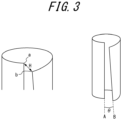
- the processing accuracy of each rounded sample was evaluated using the two parameters H and ⁇ illustrated in FIG. 3 . As seen from FIG.
- H denotes the distance between the corners a and b of each sample to be butted together
- ⁇ denotes the angle between the two butted sides A and B.
- FIG. 4 illustrates the relationship between the maximum arrival temperatures T1 and T2 in the first and second cycles of cold rolling. As seen from FIG.
- Steel slabs with a chemical composition consisting of C: 0.055 %, Si: 3.20 %, Mn: 0.05 %, S: 0.012 %, Al: 0.032 %, and N: 0.0065 %, with the balance being Fe and inevitable impurities were each reheated at a temperature of 1400 °C, and then subjected to hot rolling to obtain hot-rolled sheets having various thicknesses from 0.6 mm to 3.5 mm. Then, the hot-rolled sheets were subjected to pickling to remove scale, followed by hot-rolled sheet annealing at 1000 °C for 30 seconds. Subsequently, the steel sheets were subjected to the first cycle of cold rolling to various thicknesses from 0.35 mm to 2.2 mm.
- the sheet temperature was controlled at 70 °C by changing the rolling speed and coolant flow rate. Then, the steel sheets were subjected to intermediate annealing at 1050 °C for 150 seconds, and then subjected to the second cycle of cold rolling to a thickness of 0.23 mm. At this point, the sheet temperature was controlled at 220 °C by changing the rolling speed and coolant flow rate. In addition, each steel sheet was subjected to decarburization annealing at 850 °C for 120 seconds, with 55 % H 2 + 45 % N 2 and a dew point of 63 °C.
- an annealing separator containing 90 mass% or more of MgO was applied to the steel sheet surface, and then each steel sheet was subjected to final annealing in which it was held at 1200 °C for 5 hours in an H 2 atmosphere.
- the average heating rate in the temperature range from 50 °C to 1000 °C was set at 25 °C/h
- the average heating rate in the temperature range from 1000 °C to 1150 °C was set at 16 °C/h
- the average heating rate in the temperature range from 1150 °C to 1200 °C was set at 10 °C/h.
- magnetic flux density B 8 (magnetic flux density at a magnetizing force of 800 A/m) was measured by the method prescribed in JIS C2550-1(2011).
- a 60-mm-square-sample was cut from each obtained steel sheet and rounded using a twin roller processing machine having an iron roller of 20 mm in diameter and a urethane roll of 300 mm in diameter.
- the direction of rounding was orthogonal to the rolling direction (i.e., the sheet transverse direction). In other words, each sample was rounded to form a circular arc in the direction orthogonal to the rolling direction.
- the processing accuracy of each rounded sample was evaluated using the two parameters H and ⁇ illustrated in FIG. 3 . As seen from FIG.
- H denotes the distance between the corners a and b of each sample to be butted together
- ⁇ denotes the angle between the two butted sides A and B.
- FIG. 5 illustrates the relationship between the total rolling reduction in the first cycle of cold rolling and the total rolling reduction in the second cycle of cold rolling. As seen from FIG.
- the steel sheets were subjected to intermediate annealing at 1025 °C for 80 seconds, and then subjected to the second cycle of cold rolling to a thickness of 0.23 mm.
- the sheet temperature was controlled at 300 °C by changing the rolling speed and coolant flow rate.
- each steel sheet was subjected to decarburization annealing at 840 °C for 80 seconds, with 50 % H 2 + 50 % N 2 and a dew point of 60 °C.
- an annealing separator containing 90 mass% or more of MgO was applied to the steel sheet surface, and then each steel sheet was subjected to final annealing in which it was held at 1200 °C for 10 hours in an H 2 atmosphere.
- the average heating rate in the temperature range from 50 °C to 1000°C, denoted by H1 was changed in various ways.
- the average heating rate in the temperature range from 1000 °C to 1150 °C was set at 5 °C/h.
- magnetic flux density B 8 (magnetic flux density at a magnetizing force of 800 A/m) was measured by the method prescribed in JIS C2550-1(2011).
- a 60-mm-square-sample was cut from each obtained steel sheet and rounded using a twin roller processing machine having an iron roller of 20 mm in diameter and a urethane roll of 300 mm in diameter.
- the direction of rounding was orthogonal to the rolling direction (i.e., the sheet transverse direction). In other words, each sample was rounded to form a circular arc in the direction orthogonal to the rolling direction.
- the processing accuracy of each rounded sample was evaluated in the same way as in Experiment 1 described above.
- FIG. 6 illustrates the relationship between the evaluation results and the average heating rates H1 and H2 in the final annealing. As seen from FIG. 6 , it was revealed that the rounding shape was good when the average heating rate H1 from 50 °C to 1000 °C was at least 1.1 times higher than the average heating rate H2 from 1000 °C to 1150 °C and in the range of 5 °C/h to 40 °C/h.
- rounding is a type of plastic working and is considered to be crystal orientation dependent.
- the degree of processing may vary slightly from grain to grain because of slight misorientation in each crystal grain. This difference in the degree of processing is thought to be absorbed by the grain boundaries, which allow for some strain accumulation. In other words, if there are few grain boundaries, the grain boundaries cannot absorb the difference in the degree of processing between crystal grains, resulting in distortion of the steel sheet and inferior processing accuracy. In contrast, if there are many grain boundaries, the difference can be absorbed and the processing accuracy is expected to be good.
- One is to increase the number of crystal grains that are the source of secondary recrystallization, i.e., those with Goss orientation, before performing final annealing, and the other is to control the final annealing conditions so that secondary recrystallization occurs simultaneously and from all locations in final annealing.
- controlling the maximum arrival temperatures in the two cold rolling cycles and the reduction ratio in each cold rolling cycle to a predetermined range corresponds to the former, while specifying the average heating rate during the final annealing corresponds to the latter.
- the present inventors newly found that by properly controlling the maximum arrival temperatures in the first and second cycles of cold rolling and the reduction ratio in each cycle of cold rolling, and by properly controlling the average heating rate during the final annealing, the secondary recrystallized grains can be effectively refined and the processing accuracy of rounding can be improved.
- the present disclosure is based on these discoveries.
- the present disclosure provides a grain-oriented electrical steel sheet with good processing accuracy in rounding while maintaining iron loss properties, and a method of producing the same.
- the chemical composition of the steel material (steel slab) of the grain-oriented electrical steel sheet is not particularly limited in the present disclosure, the following describes desirable ranges of the chemical composition.
- the indications of "%” and “ppm” regarding components are “mass%” and “mass ppm,” respectively, unless otherwise noted.
- the C content is 0.100 % or less.
- the C content is 0.010 % or more and 0.100 % or less.
- the C content is preferably 0.025 % or more, and more preferably 0.035 % or more.
- the C content is preferably 0.085 % or less, and more preferably 0.060 % or less.
- Si 2.00 % or more and 5.00 % or less
- Si is an element necessary to increase the specific resistance of steel and reduce iron loss, but a Si content below 2.00 % is ineffective. On the other hand, if the content exceeds 5.00 %, the workability of the steel deteriorates and rolling becomes difficult. Therefore, the Si content is 2.00 % or more and 5.00 % or less.
- the Si content is preferably 2.90 % or more, and more preferably 3.10 % or more.
- the Si content is preferably 3.70 % or less, and more preferably 3.55 % or less.
- Mn 0.01 % or more and 0.50 % or less
- Mn is an element necessary to obtain good hot workability, but a Mn content below 0.01% is ineffective. On the other hand, if the content exceeds 0.50 %, the magnetic flux density of the product sheet decreases. Therefore, the Mn content is 0.01 % or more and 0.50 % or less.
- the Mn content is preferably 0.03 % or more, and more preferably 0.06 % or more.
- the Mn content is preferably 0.25 % or less, and more preferably 0.15 % or less.
- Al 0.010 % or more and 0.040 % or less
- N 0.0030 % or more and 0.0120 % or less
- Al and N form AlN, which is an inhibitor.
- an Al content below 0.010 % or a N content below 0.0030 % does not fully demonstrate the effect.
- the Al content is 0.010 % or more and 0.040 % or less and the N content is 0.0030 % or more and 0.0120 % or less.
- the Al content is preferably 0.013 % or more, and more preferably 0.017 % or more.
- the Al content is preferably 0.033 % or less, and more preferably 0.029 % or less.
- the N content is preferably 0.0039 % or more, and more preferably 0.0050 % or more.
- the N content is preferably 0.0113 % or less, and more preferably 0.0100 % or less.
- One or both of S and Se 0.005 % or more and 0.100 % or less in total S and Se combine with Mn to form MnS and MnSe, which are inhibitors.
- a total content of S and Se below 0.005 % does not fully demonstrate the effect.
- the total content is 0.005 % or more and 0.100 % or less.
- the total content is preferably 0.010 % or more, and more preferably 0.020 % or more.
- the total content is preferably 0.055 % or less, and more preferably 0.040 % or less.
- At least one selected from the group consisting of the following can be added alone or in combination: Ni: 0 % or more and 1.50 % or less, Cr: 0 % or more and 0.50 % or less, Cu: 0 % or more and 0.50 % or less, P: 0 % or more and 0.50 % or less, Sb: 0 % or more and 0.50 % or less, Sn: 0 % or more and 0.50 % or less, Bi: 0 % or more and 0.50 % or less, Mo: 0 % or more and 0.50 % or less, B: 0 ppm or more and 25 ppm or less, Nb: 0 % or more and 0.020 % or less, V: 0 % or more and 0.010 % or less, and Zr: 0 % or more and 0.10 % or less.
- the added amount of each element is less than the corresponding lower limit, the effect of improving magnetic properties is poor, and when it exceeds the corresponding upper limit, the development of secondary recrystallized grains is suppressed and magnetic properties deteriorate.
- Co 0 % or more and 0.050 % or less and Pb: 0 % or more and 0.0100 % or less may be added for the purpose of reducing the angle between two butted sides A and B among the indicators of rounding workability. Below the aforementioned lower limits, the angle reducing effect will not be obtained, and above the aforementioned upper limits, magnetic properties may deteriorate. In terms of preferred lower limits, it is preferable to add one or both of Co in an amount of 0.002 % or more and Pb in an amount of 0.0001 % or more.
- Steel material with the above components may be produced as a slab by the usual ingot casting or continuous casting, or as a thin slab or thinner cast steel with a thickness of 100 mm or less by direct casting.
- the slab or thin slab or thinner cast steel as the steel material is reheated in a usual manner and then hot rolled, it may be subjected to hot rolling just after casting without heating.
- the above reheating temperature is desirably 1300 °C or higher to cause solid dissolution of the inhibitor components.
- the coiling temperature in the hot rolling is preferably set to 400 °C or higher. From the same viewpoint, the coiling temperature in the hot rolling is preferably set to 750 °C or lower. The coiling temperature is more preferably 500 °C or higher. The coiling temperature is more preferably 700 °C or lower.
- the temperature conditions and coiling temperature in the hot rolling are based on the surface temperature of the steel sheet immediately before coiling.
- hot-rolled sheet annealing may be performed if necessary.
- the microstructure can be homogenized and the variation in magnetic properties can be reduced.
- the hot-rolled sheet annealing conditions preferably include holding the sheet sheet in the temperature range from 800 °C to 1250 °C for at least 5 seconds.
- the holding temperature is more preferably 900 °C or higher.
- the holding temperature is more preferably 1150 °C or lower.
- the holding time is preferably 10 seconds or more. In this holding temperature range, the holding time is preferably 180 seconds or less.
- cooling after the holding is performed with an average cooling rate of preferably 5 °C/s or higher in the temperature range from 800 °C to 350 °C.
- the average cooling rate in this temperature range is preferably 100 °C/s or lower. It is more preferably 15 °C/s or higher. It is more preferably 45 °C/s or lower.
- the maximum arrival temperatures T1 and T2 satisfy the relations of 20 °C ⁇ T1 ⁇ 120 °C and 100 °C ⁇ T2 ⁇ 250 °C, respectively.
- the total rolling reductions R1 and R2 satisfy the relations of 20 % ⁇ R1 ⁇ 35 % and 60 % ⁇ R2 ⁇ 92 %, respectively.
- the maximum arrival temperatures T1 and T2 in the cold rolling may be controlled by, for example, using the heat generated by the rolling process, heating before rolling, or cooling with coolant or lubricant.
- the temperature conditions and average cooling rate during the cold rolling and intermediate annealing are based on the surface temperature of the steel sheet.
- the intermediate annealing in the cold rolling preferably includes holding in the temperature range from 800 °C and 1250 °C for at least 5 seconds. That is, if the holding temperature is below 900 °C, recrystallized grains become finer and the amount of Goss nuclei in the primary recrystallization microstructure decreases, which may deteriorate the magnetic properties. On the other hand, if the holding temperature exceeds 1250 °C, rapid growth and decomposition of inhibitors may occur, resulting in degradation of magnetic properties.
- the average cooling rate in the temperature range from 800 °C to 350 °C is preferably 5 °C/s or higher.
- the average cooling rate in this temperature range is preferably 100 °C/s or lower. It is more preferably 15 °C/s or higher. It is more preferably 45 °C/s or lower.
- the steel sheet is preferably degreased to remove the rolling oil originating from the previous step. After the intermediate annealing, it is preferable to remove scale from the steel sheet surface. For the scale removal, known methods may be followed, such as using heated acid or mechanically removing scale.
- the cold-rolled steel sheet is subjected to decarburization annealing. Before that, however, it is preferable to clean the steel sheet surface by degreasing, pickling, or other process.
- the decarburization annealing it is preferable that the cold-rolled steel sheet be held in the temperature range from 750 °C to 950 °C for at least 10 seconds, that the atmospheric gas contain H 2 and N 2 , and that the decarburization annealing is performed partially or entirely in a wet atmosphere with a dew point of 20 °C or higher and 80 °C or lower.
- the holding temperature is more preferably 800 °C or higher.
- the holding temperature is more preferably 900 °C or lower.
- the dew point is more preferably 40 °C or higher. In this temperature range, the dew point is more preferably 70 °C or lower.
- the temperature conditions in the decarburization annealing are based on the surface temperature of the steel sheet.
- this setup causes reduction of sub-scale on the outermost surface layer, which is advantageous for formation of a forsterite film in the final annealing.
- an annealing separator is applied to the front and back surfaces of the decarburization-annealed sheet before performing final annealing.
- the annealing separator may be a known annealing separator.
- an annealing separator that is mainly composed of MgO be applied to the surfaces of the decarburization-annealed sheet at a weight of at least 2.5 g/m 2 per surface.
- the phrase "mainly composed of MgO" means that the MgO content in the annealing separator is 60 % or more in terms of solid content.
- the content of MgO in the annealing separator is preferably 80 % or more in terms of solid content.
- the method of applying the annealing separator to the surface of the decarburization-annealed sheet is not limited, and any known methods may be followed.
- the annealing separator may be applied to the surface of the decarburization-annealed sheet in slurry form, or in dry form by electrostatic coating.
- the annealing separator in slurry form is preferably held at a constant temperature to prevent viscosity increase.
- the constant temperature is preferably 5 °C or higher.
- the constant temperature is preferably 30 °C or lower.
- the annealing separator in slurry form is preferably separated into two tanks, one for preparation and the other for application.
- final annealing can be performed to develop secondary recrystallized grains and form a forsterite film.
- coils are annealed in an upended state because the final annealing takes a long time. It is preferable to wrap a band or other means around the coil before subjection to the final annealing to prevent the outer winding of the upended coil from unraveling.
- an average heating rate (°C/h) in a temperature range from 1000 °C to (maximum arrival temperature - 50 °C), denoted by H2 satisfy the relations of H1 ⁇ 1.1 ⁇ H2 and 5 ⁇ H1 ⁇ 40.
- the following relations are satisfied: H1 ⁇ 1.2 ⁇ H2 and 10 ⁇ H1 ⁇ 30.
- the temperature conditions and average heating rate in the final annealing are based on the temperature of the steel sheet at the position in the middle of the innermost and outermost layers of the upended steel sheet coil on the surface where the upended steel sheet coil touches the annealing furnace floor.
- the steel sheet be held at a temperature range from 1100 °C to 1300 °C for at least 3 hours, and an atmosphere containing H 2 be introduced partially or entirely within the temperature range of 1000 °C or higher.
- the maximum arrival temperature in the final annealing is preferably 1150 °C or higher. It is preferably 1300 °C or lower. After the final annealing, washing, brushing, or pickling is useful to remove the attached annealing separator. It is effective to further perform flattening annealing to adjust the shape, for iron loss reduction.
- the coating is preferably a coating that can add tension to the steel sheet to reduce iron loss.
- a coating solution may be applied prior to flattening annealing and baked in the flattening annealing. It is also preferable to apply a tension coating applying method with a binder, or a method that allows inorganic materials to be deposited as a coating on the surface layer of the steel sheet through physical vapor deposition or chemical vapor deposition, because it may provide excellent coating adhesion and significant iron loss reduction effects.
- Steel slabs with a chemical composition consisting of C: 0.030 %, Si: 3.66 %, Mn: 0.07 %, S: 0.005 %, Se: 0.013 %, Al: 0.016 %, and N: 0.0055 %, with the balance being Fe and inevitable impurities were each reheated at a temperature of 1430 °C, and then subjected to hot rolling including six passes of rough rolling from 1200 °C and nine passes of finish rolling from 1100 °C, to thereby obtain hot-rolled sheets having various thicknesses from 0.85 mm to 2.70 mm.
- the coiling temperature was set at 575 °C.
- the hot-rolled sheets were subjected to pickling to remove scale, followed by hot-rolled sheet annealing at 1000 °C for 100 seconds.
- the average cooling rate in the temperature range from 800 °C to 350 °C in the hot-rolled sheet annealing was set at 45 °C/s.
- the steel sheets were subjected to the first cycle of cold rolling to various thicknesses from 0.45 mm to 1.90 mm.
- the rolling reduction R1 in this first cycle of cold rolling is listed in Table 1.
- the sheet temperature was controlled by changing the rolling speed and coolant flow rate, and the maximum arrival temperature T1 was changed in various ways as listed in Table 1.
- the steel sheets were subjected to intermediate annealing at 1050 °C for 100 seconds.
- the average cooling rate in the temperature range from 800 °C to 350 °C in the intermediate annealing was set at 25 °C/s.
- the second cycle of cold rolling was performed to finish each steel sheet to a thickness of 0.23 mm.
- the rolling reduction R2 in this case is listed in Table 1.
- the sheet temperature was controlled by changing the rolling speed and coolant flow rate, and the maximum arrival temperature T2 was changed in various ways as listed in Table 1.
- each cold-rolled sheet was subjected to decarburization annealing at 820 °C for 120 seconds, with 55 % H 2 + 45 % N 2 and a dew point of 65 °C. Then, an annealing separator containing 90 mass% or more of MgO was applied to the steel sheet surface, and then each steel sheet was subjected to final annealing in which it was held at 1200 °C for 5 hours.
- the atmosphere during the final annealing was an N 2 atmosphere up to 900 °C during heating, an H 2 atmosphere during the period in which the temperature was raised from 900 °C to 1200 °C, held at 1200 °C, and lowered down to 1000 °C after the end of holding, and an Ar atmosphere during the subsequent cooling.
- the average heating rate H1 in the temperature range from 50 °C to 1000 °C and the average heating rate H2 in the temperature range from 1000 °C to 1150 °C were changed in various ways as listed in Table 1, while the average heating rate in the temperature range from 1150 °C to 1200 °C was set at 10°C/h.
- the magnetic flux density B 8 of each grain-oriented electrical steel sheet thus obtained was evaluated in accordance with JIS C2550-1 (2011). The results are listed in Table 1. A magnetic flux density of 1.900 T or higher was considered to have excellent magnetic properties.
- a 60-mm-square-sample was cut from each obtained steel sheet and rounded using a twin roller processing machine having an iron roller of 20 mm in diameter and a urethane roll of 300 mm in diameter.
- the direction of rounding was orthogonal to the rolling direction (i.e., the sheet transverse direction).
- each sample was rounded to form a circular arc in the direction orthogonal to the rolling direction.
- the processing accuracy of each rounded sample was evaluated using the two parameters H and ⁇ illustrated in FIG. 3 . If the parameters are within the range of 1.8 mm to 3.0 mm for H and 0° to 2.5° for ⁇ , respectively, the sample is considered acceptable.
- Table 1 As seen from the table, it is clear that those steel sheets produced under the conditions within the scope of the present disclosure have good magnetic flux density and good processing accuracy of rounding.
- Steel slab with a chemical composition consisting of the components listed in Table 2 with the balance being Fe and inevitable impurities were each reheated to a temperature of 1425 °C, and then subjected to hot rolling including four passes of rough rolling from 1270 °C and five passes of finishing rolling from 1050 °C, to thereby obtain hot-rolled sheets having a thickness of 2.4 mm.
- the coiling temperature was set at 615 °C.
- the steel sheets were subjected to pickling to remove scale, followed by hot-rolled sheet annealing at 1035 °C for 20 seconds.
- the average cooling rate in the temperature range from 800 °C to 350 °C in the hot-rolled sheet annealing was set at 30 °C/s.
- the thickness was reduced to 1.6 mm by the first cycle of cold rolling (rolling reduction R1: 33.3 %), where the maximum arrival temperature T1 in the rolling was set at 50 °C by controlling the coolant flow rate.
- intermediate annealing was performed at 1050 °C for 100 seconds, with the average cooling rate in the temperature range from 800 °C to 350 °C set at 40 °C/s.
- the thickness was reduced to 0.23 mm by the second cycle of cold rolling (rolling reduction R2: 85.6 %).
- the maximum arrival temperature T2 in the rolling was set at 220 °C by controlling the rolling speed and coolant flow rate.
- T1, T2, R1, and R2 satisfy the formulas (1) to (4).
- each cold-rolled sheet was further subjected to decarburization annealing including the earlier and later stages; in the earlier stage at 820 °C for 120 seconds, with 55 % H 2 + 45 % N 2 and a dew point of 65 °C, and in the later stage at 840 °C for 30 seconds, with 55 % H 2 + 45 % N 2 and a dew point of 15 °C.
- an annealing separator containing 85 mass% or more of MgO was applied to the steel sheet surface, and then each steel sheet was subjected to final annealing in which it was held at 1200 °C for 12 hours.
- the atmosphere during the final annealing was an N 2 atmosphere up to 900 °C during heating, an H 2 atmosphere during the period from the temperature rise from 900 °C to 1200 °C until the end of holding at 1200 °C, and an Ar atmosphere during the subsequent cooling.
- the average heating rate H1 in the temperature range from 50 °C to 1000 °C was set at 28 °C/h
- the average heating rate in the temperature range from 1000 °C to 1150 °C was set at 18 °C/h
- the average hating rate in the temperature range from 1150 °C to 1200 °C was set at 8 °C/h.
- H1 and H2 satisfy the formulas (5) and (6).
- the magnetic flux density B 8 of each grain-oriented electrical steel sheet thus obtained was evaluated in accordance with JIS C2550-1 (2011). The results are listed in Table 2.
- a magnetic flux density of 1.900 T or higher was considered to have excellent magnetic properties.
- a 60-mm-square-sample was cut from each obtained steel sheet and rounded using a twin roller processing machine having an iron roller of 20 mm in diameter and a urethane roll of 300 mm in diameter.
- the direction of rounding was orthogonal to the rolling direction (i.e., the sheet transverse direction). In other words, each sample was rounded to form a circular arc in the direction orthogonal to the rolling direction.
- the processing accuracy of each rounded sample was evaluated using the two parameters H and ⁇ illustrated in FIG. 3 .
Landscapes
- Chemical & Material Sciences (AREA)
- Engineering & Computer Science (AREA)
- Materials Engineering (AREA)
- Mechanical Engineering (AREA)
- Metallurgy (AREA)
- Organic Chemistry (AREA)
- Physics & Mathematics (AREA)
- Thermal Sciences (AREA)
- Crystallography & Structural Chemistry (AREA)
- Electromagnetism (AREA)
- Manufacturing & Machinery (AREA)
- Dispersion Chemistry (AREA)
- Power Engineering (AREA)
- Manufacturing Of Steel Electrode Plates (AREA)
- Soft Magnetic Materials (AREA)
Applications Claiming Priority (2)
| Application Number | Priority Date | Filing Date | Title |
|---|---|---|---|
| JP2021090686 | 2021-05-28 | ||
| PCT/JP2022/021835 WO2022250162A1 (ja) | 2021-05-28 | 2022-05-27 | 方向性電磁鋼板の製造方法 |
Publications (2)
| Publication Number | Publication Date |
|---|---|
| EP4335938A1 true EP4335938A1 (de) | 2024-03-13 |
| EP4335938A4 EP4335938A4 (de) | 2024-10-30 |
Family
ID=84228386
Family Applications (1)
| Application Number | Title | Priority Date | Filing Date |
|---|---|---|---|
| EP22811430.2A Pending EP4335938A4 (de) | 2021-05-28 | 2022-05-27 | Verfahren zur herstellung eines kornorientierten elektromagnetischen stahlblechs |
Country Status (6)
| Country | Link |
|---|---|
| US (1) | US20240249863A1 (de) |
| EP (1) | EP4335938A4 (de) |
| JP (1) | JP7517472B2 (de) |
| KR (1) | KR20240006635A (de) |
| CN (1) | CN117396618A (de) |
| WO (1) | WO2022250162A1 (de) |
Families Citing this family (3)
| Publication number | Priority date | Publication date | Assignee | Title |
|---|---|---|---|---|
| EP4621080A4 (de) * | 2023-02-01 | 2026-03-04 | Jfe Steel Corp | Verfahren zur herstellung eines kornorientierten elektrischen stahlblechs |
| JP7772288B1 (ja) * | 2024-05-14 | 2025-11-18 | Jfeスチール株式会社 | 方向性電磁鋼板の製造方法 |
| WO2025239047A1 (ja) * | 2024-05-14 | 2025-11-20 | Jfeスチール株式会社 | 方向性電磁鋼板の製造方法 |
Family Cites Families (15)
| Publication number | Priority date | Publication date | Assignee | Title |
|---|---|---|---|---|
| DE1252220B (de) | 1963-04-05 | 1968-04-25 | ||
| JPS5113469B2 (de) | 1972-10-13 | 1976-04-28 | ||
| JPH05113469A (ja) | 1991-10-22 | 1993-05-07 | Seiko Epson Corp | 半導体装置 |
| JP3314844B2 (ja) * | 1995-04-07 | 2002-08-19 | 新日本製鐵株式会社 | 磁気特性と被膜性状の優れた一方向性電磁鋼板の製造方法 |
| US5885371A (en) * | 1996-10-11 | 1999-03-23 | Kawasaki Steel Corporation | Method of producing grain-oriented magnetic steel sheet |
| KR100440994B1 (ko) * | 1996-10-21 | 2004-10-21 | 제이에프이 스틸 가부시키가이샤 | 방향성전자강판및그제조방법 |
| JP3707268B2 (ja) | 1998-10-28 | 2005-10-19 | Jfeスチール株式会社 | 方向性電磁鋼板の製造方法 |
| JP4205816B2 (ja) * | 1999-08-11 | 2009-01-07 | 新日本製鐵株式会社 | 磁束密度の高い一方向性電磁鋼板の製造方法 |
| JP4015644B2 (ja) | 2004-05-31 | 2007-11-28 | 株式会社ソニー・コンピュータエンタテインメント | 画像処理装置及び画像処理方法 |
| JP2006274405A (ja) * | 2005-03-30 | 2006-10-12 | Jfe Steel Kk | 高磁束密度方向性電磁鋼板の製造方法 |
| JP2007262436A (ja) * | 2006-03-27 | 2007-10-11 | Jfe Steel Kk | 方向性電磁鋼板の製造方法 |
| JP2008156693A (ja) * | 2006-12-22 | 2008-07-10 | Nippon Steel Corp | 良好な皮膜を有する磁気特性の優れた方向性電磁鋼板の製造方法 |
| JP5991484B2 (ja) * | 2011-12-06 | 2016-09-14 | Jfeスチール株式会社 | 低鉄損方向性電磁鋼板の製造方法 |
| RU2740749C1 (ru) * | 2018-01-25 | 2021-01-20 | Ниппон Стил Корпорейшн | Лист из электротехнической стали с ориентированной зеренной структурой |
| RU2767365C1 (ru) * | 2019-01-16 | 2022-03-17 | Ниппон Стил Корпорейшн | Способ изготовления листа электротехнической стали с ориентированной зеренной структурой |
-
2022
- 2022-05-27 CN CN202280038074.7A patent/CN117396618A/zh active Pending
- 2022-05-27 US US18/561,412 patent/US20240249863A1/en active Pending
- 2022-05-27 JP JP2022572796A patent/JP7517472B2/ja active Active
- 2022-05-27 WO PCT/JP2022/021835 patent/WO2022250162A1/ja not_active Ceased
- 2022-05-27 EP EP22811430.2A patent/EP4335938A4/de active Pending
- 2022-05-27 KR KR1020237042449A patent/KR20240006635A/ko active Pending
Also Published As
| Publication number | Publication date |
|---|---|
| JPWO2022250162A1 (de) | 2022-12-01 |
| US20240249863A1 (en) | 2024-07-25 |
| KR20240006635A (ko) | 2024-01-15 |
| CN117396618A (zh) | 2024-01-12 |
| EP4335938A4 (de) | 2024-10-30 |
| WO2022250162A1 (ja) | 2022-12-01 |
| JP7517472B2 (ja) | 2024-07-17 |
Similar Documents
| Publication | Publication Date | Title |
|---|---|---|
| JP5854233B2 (ja) | 方向性電磁鋼板の製造方法 | |
| EP2880190B1 (de) | Verfahren zur herstellung von kornorientiertem siliciumstahlblech, kornorientiertem elektrostahlblech und verwendung davon | |
| EP2644716B1 (de) | Verfahren zur herstellung eines kornorientierten elektromagnetischen stahlblechs | |
| EP3214188B1 (de) | Herstellungsverfahren für kornorientierte elektromagnetische stahlbleche | |
| EP4335938A1 (de) | Verfahren zur herstellung eines kornorientierten elektromagnetischen stahlblechs | |
| EP3530770B1 (de) | Warmgewalztes stahlblech zur herstellung von elektroblechen und verfahren zur herstellung davon | |
| CN102197149A (zh) | 方向性电磁钢板的制造方法 | |
| EP4455332A1 (de) | Nichtorientiertes elektrostahlblech und verfahren zur herstellung davon | |
| JP6432671B2 (ja) | 方向性電磁鋼板の製造方法 | |
| EP4339306A1 (de) | Verfahren zur herstellung eines kornorientierten elektrischen stahlblechs | |
| JP4811390B2 (ja) | 二方向性電磁鋼板 | |
| JP5754115B2 (ja) | 方向性電磁鋼板およびその製造方法 | |
| JP5712626B2 (ja) | 方向性電磁鋼板の製造方法 | |
| KR20230159874A (ko) | 방향성 전자 강판의 제조 방법 | |
| KR20230159875A (ko) | 방향성 전자 강판의 제조 방법 | |
| JP7287584B2 (ja) | 方向性電磁鋼板の製造方法 | |
| CN116940695A (zh) | 取向性电磁钢板的制造方法和取向性电磁钢板用热轧钢板 | |
| JP7255761B1 (ja) | 方向性電磁鋼板の製造方法 | |
| EP4335937A1 (de) | Verfahren zur herstellung eines kornorientierten elektrischen stahlblechs | |
| JP7816665B1 (ja) | 方向性電磁鋼板の製造方法 | |
| US20250163551A1 (en) | Method of producing grain-oriented electrical steel sheet | |
| JP2014173103A (ja) | 方向性電磁鋼板の製造方法 | |
| EP4335936A1 (de) | Verfahren zur herstellung eines kornorientierten elektromagnetischen stahlblechs | |
| WO2025243810A1 (ja) | 方向性電磁鋼板の製造方法 | |
| WO2025203984A1 (ja) | 方向性電磁鋼板の製造方法 |
Legal Events
| Date | Code | Title | Description |
|---|---|---|---|
| STAA | Information on the status of an ep patent application or granted ep patent |
Free format text: STATUS: THE INTERNATIONAL PUBLICATION HAS BEEN MADE |
|
| PUAI | Public reference made under article 153(3) epc to a published international application that has entered the european phase |
Free format text: ORIGINAL CODE: 0009012 |
|
| STAA | Information on the status of an ep patent application or granted ep patent |
Free format text: STATUS: REQUEST FOR EXAMINATION WAS MADE |
|
| 17P | Request for examination filed |
Effective date: 20231207 |
|
| AK | Designated contracting states |
Kind code of ref document: A1 Designated state(s): AL AT BE BG CH CY CZ DE DK EE ES FI FR GB GR HR HU IE IS IT LI LT LU LV MC MK MT NL NO PL PT RO RS SE SI SK SM TR |
|
| DAV | Request for validation of the european patent (deleted) | ||
| DAX | Request for extension of the european patent (deleted) | ||
| A4 | Supplementary search report drawn up and despatched |
Effective date: 20241001 |
|
| RIC1 | Information provided on ipc code assigned before grant |
Ipc: H01F 1/16 20060101ALI20240925BHEP Ipc: H01F 1/147 20060101ALI20240925BHEP Ipc: C22C 38/60 20060101ALI20240925BHEP Ipc: C22C 38/06 20060101ALI20240925BHEP Ipc: C22C 38/04 20060101ALI20240925BHEP Ipc: C22C 38/02 20060101ALI20240925BHEP Ipc: C22C 38/00 20060101ALI20240925BHEP Ipc: C21D 9/46 20060101ALI20240925BHEP Ipc: C21D 6/00 20060101ALI20240925BHEP Ipc: C21D 1/76 20060101ALI20240925BHEP Ipc: C21D 8/12 20060101AFI20240925BHEP |