EP4336413A1 - Système et procédé de classification de données sensibles à l'aide d'un apprentissage semi-supervisé fédéré - Google Patents
Système et procédé de classification de données sensibles à l'aide d'un apprentissage semi-supervisé fédéré Download PDFInfo
- Publication number
- EP4336413A1 EP4336413A1 EP23192307.9A EP23192307A EP4336413A1 EP 4336413 A1 EP4336413 A1 EP 4336413A1 EP 23192307 A EP23192307 A EP 23192307A EP 4336413 A1 EP4336413 A1 EP 4336413A1
- Authority
- EP
- European Patent Office
- Prior art keywords
- model
- dataset
- local
- data
- training
- Prior art date
- Legal status (The legal status is an assumption and is not a legal conclusion. Google has not performed a legal analysis and makes no representation as to the accuracy of the status listed.)
- Pending
Links
Images












Classifications
-
- G—PHYSICS
- G06—COMPUTING OR CALCULATING; COUNTING
- G06N—COMPUTING ARRANGEMENTS BASED ON SPECIFIC COMPUTATIONAL MODELS
- G06N3/00—Computing arrangements based on biological models
- G06N3/02—Neural networks
- G06N3/08—Learning methods
- G06N3/098—Distributed learning, e.g. federated learning
-
- G—PHYSICS
- G06—COMPUTING OR CALCULATING; COUNTING
- G06N—COMPUTING ARRANGEMENTS BASED ON SPECIFIC COMPUTATIONAL MODELS
- G06N3/00—Computing arrangements based on biological models
- G06N3/02—Neural networks
- G06N3/08—Learning methods
- G06N3/0895—Weakly supervised learning, e.g. semi-supervised or self-supervised learning
-
- G—PHYSICS
- G06—COMPUTING OR CALCULATING; COUNTING
- G06N—COMPUTING ARRANGEMENTS BASED ON SPECIFIC COMPUTATIONAL MODELS
- G06N3/00—Computing arrangements based on biological models
- G06N3/02—Neural networks
- G06N3/04—Architecture, e.g. interconnection topology
- G06N3/044—Recurrent networks, e.g. Hopfield networks
-
- G—PHYSICS
- G06—COMPUTING OR CALCULATING; COUNTING
- G06N—COMPUTING ARRANGEMENTS BASED ON SPECIFIC COMPUTATIONAL MODELS
- G06N3/00—Computing arrangements based on biological models
- G06N3/02—Neural networks
- G06N3/04—Architecture, e.g. interconnection topology
- G06N3/045—Combinations of networks
- G06N3/0455—Auto-encoder networks; Encoder-decoder networks
-
- G—PHYSICS
- G06—COMPUTING OR CALCULATING; COUNTING
- G06N—COMPUTING ARRANGEMENTS BASED ON SPECIFIC COMPUTATIONAL MODELS
- G06N3/00—Computing arrangements based on biological models
- G06N3/02—Neural networks
- G06N3/04—Architecture, e.g. interconnection topology
- G06N3/0464—Convolutional networks [CNN, ConvNet]
-
- G—PHYSICS
- G06—COMPUTING OR CALCULATING; COUNTING
- G06N—COMPUTING ARRANGEMENTS BASED ON SPECIFIC COMPUTATIONAL MODELS
- G06N3/00—Computing arrangements based on biological models
- G06N3/02—Neural networks
- G06N3/08—Learning methods
- G06N3/096—Transfer learning
Definitions
- the disclosure herein generally relates to classification of sensitive data, and, more particularly, to system and method for classification of sensitive data using federated semi-supervised learning.
- Security classification of data is a complex task and depends on the context under which the data is shared, used, and processed. Such classification is usually derived from the data, and not intuitive to the user working on that data, thus dictating the requirement for an automated security classification tool. All sensitive documents have same architecture and technology stack, from a security classification perspective, and these are entirely different as one of them is customer-confidential and the other is a public document. For an enterprise, it is important that they safeguard the customer-confidential data as any breach may lead to a violation of the non-disclosure agreement thus resulting in monetary and reputation loss.
- Deep learning has widespread applications in various fields, such as entertainment, visual recognition, language understanding, autonomous vehicles, and healthcare. Human level performance in such applications are due to the availability of a large amount of data. However, getting a large amount of data could be difficult and may not always be possible. It is primarily due to end user data privacy concerns and geography based data protection regulations that impose strict rules on how data is stored, shared, and used. Privacy concerns lead to creation of data in silos at end-user devices. Such an accumulation of data is not conducive to conventional deep learning techniques that require training data at a central location and with full access. However, keeping data in a central place has the inherent risk of data being compromised and misused.
- a system for classification of sensitive data using federated semi-supervised learning includes extracting a training dataset from one or more data sources and the training dataset are pre-processed into a machine readable form based on associated data type.
- the training dataset comprises a labeled dataset and an unlabeled dataset.
- a federated semi-supervised learning model is trained based on model contrastive and distillation learning to classify sensitive data from the unlabeled dataset.
- the federated semi-supervised learning model comprises a server and a set of participating clients.
- the federated semi-supervised learning model is trained by fetching a federated learning plan comprising a first set of distinctive attributes corresponding to the set of local models and a second set of distinctive attributes corresponding to the global model.
- Each local model and the global model includes at least one of a projection layer, a classification layer, and a base encoder.
- the set of local models are trained at the set of participating clients with respective unlabeled dataset by using the first set of distinctive attributes associated with the federated learning plan and communicating the plurality of trained local models to the server.
- the global model is trained with the set of local models of each participating client with respective labeled dataset on the server by using the second set of distinctive attributes associated with the federated learning plan and communicating the trained global model with each participating client.
- the system classifies sensitive data from a user query received as input using the federated semi-supervised learning model and reclassify the sensitive data from the user query based on a feedback provided by the user if the data classification is erroneous.
- a method for classification of sensitive data using federated semi-supervised learning includes extracting a training dataset from one or more data sources and the training dataset are pre-processed into a machine readable form based on associated data type.
- the training dataset comprises a labeled dataset and an unlabeled dataset.
- a federated semi-supervised learning model is trained based on model contrastive and distillation learning to classify sensitive data from the unlabeled dataset.
- the federated semi-supervised learning model comprises a server and a set of participating clients.
- the federated semi-supervised learning model is trained by fetching a federated learning plan comprising a first set of distinctive attributes corresponding to the set of local models and a second set of distinctive attributes corresponding to the global model.
- Each local model and the global model includes at least one of a projection layer, a classification layer, and a base encoder.
- the set of local models are trained at the set of participating clients with respective unlabeled dataset by using the first set of distinctive attributes associated with the federated learning plan and communicating the plurality of trained local models to the server.
- the global model is trained with the set of local models of each participating client with respective labeled dataset on the server by using the second set of distinctive attributes associated with the federated learning plan and communicating the trained global model with each participating client.
- the method classifies sensitive data from a user query received as input using the federated semi-supervised learning model and reclassify the sensitive data from the user query based on a feedback provided by the user if the data classification is erroneous.
- a non-transitory computer readable medium for extracting a training dataset from one or more data sources and the training dataset are pre-processed into a machine readable form based on associated data type.
- the training dataset comprises a labeled dataset and an unlabeled dataset.
- a federated semi-supervised learning model is trained based on model contrastive and distillation learning to classify sensitive data from the unlabeled dataset.
- the federated semi-supervised learning model comprises a server and a set of participating clients.
- the federated semi-supervised learning model is trained by fetching a federated learning plan comprising a first set of distinctive attributes corresponding to the set of local models and a second set of distinctive attributes corresponding to the global model.
- Each local model and the global model includes at least one of a projection layer, a classification layer, and a base encoder. Further, the set of local models are trained at the set of participating clients with respective unlabeled dataset by using the first set of distinctive attributes associated with the federated learning plan and communicating the plurality of trained local models to the server. Then, the global model is trained with the set of local models of each participating client with respective labeled dataset on the server by using the second set of distinctive attributes associated with the federated learning plan and communicating the trained global model with each participating client. Further, the method classifies sensitive data from a user query received as input using the federated semi-supervised learning model and reclassify the sensitive data from the user query based on a feedback provided by the user if the data classification is erroneous.
- Embodiments herein provide a method and system for classification of sensitive data using federated semi-supervised learning.
- the system may be alternatively referred as a sensitive data classification system 100.
- Federated learning has emerged as a privacy-preserving technique to learn one or more machine learning (ML) models without requiring users to share their data.
- ML machine learning
- FSSL federated semi-supervised learning
- data augmentation is not well defined for prevalent domains like text and graphs.
- non-IID non-independent and identically distributed
- the method of the present disclosure provides technical solution where users do not have domain expertise or incentives to label data on their device, and where the server has limited access to some labeled data that is annotated by experts using a Federated Semi-Supervised Learning (FSSL) based sensitive data classification system.
- FSSL Federated Semi-Supervised Learning
- consistency regularization shows good performance in the federated semi-supervised learning (FSSL) for the vision domain, it requires data augmentation to be well defined.
- data augmentation is not so straightforward, and changing few words can impact the meaning of sentence.
- the method implemented by the present disclosure addresses the problem of data augmentation in FSSL with the data augmentation-free semi-supervised federated learning approach.
- the method implemented by the present disclosure employs a model contrastive loss and a distillation loss on the unlabeled dataset to learn generalized representation and supervised cross-entropy loss on the server side for supervised learning.
- the system 100 is a data augmentation-free framework for federated semi-supervised learning that learns data representation based on computing a model contrastive loss and a distillation loss while training a set of local models.
- the method implemented by the present disclosure and its systems described herein are based on model contrastive and distillation learning which does not require data augmentation, thus making it easy to adapt to different domains.
- the method is further evaluated on image and text datasets to show the robustness towards non-IID data. The results have been validated by varying data imbalance across users and the number of labeled instances on the server.
- the disclosed system is further explained with the method as described in conjunction with FIG. 1 to FIG.7D below.
- FIG. 1 through FIG.7D where similar reference characters denote corresponding features consistently throughout the figures, there are shown preferred embodiments and these embodiments are described in the context of the following exemplary system and/or method.
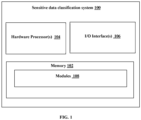
- FIG.1 illustrates an exemplary block diagram of a system (may be alternatively referred as a federated semi-supervised learning based sensitive data classification system) to classify sensitive data, in accordance with some embodiments of the present disclosure.
- the batch processing system 100 includes processor (s) 104, communication interface (s), alternatively referred as or input/output (I/O) interface(s) 106, and one or more data storage devices or memory 102 operatively coupled to the processor (s) 104.
- the system 100, with the processor(s) is configured to execute functions of one or more functional blocks of the system 100.
- the processor (s) 104 can be one or more hardware processors 104.
- the one or more hardware processors 104 can be implemented as one or more microprocessors, microcomputers, microcontrollers, digital signal processors, central processing units, state machines, logic circuitries, and/or any devices that manipulate signals based on operational instructions.
- the processor(s) 104 is configured to fetch and execute computer-readable instructions stored in the memory.
- the system 100 can be implemented in a variety of computing systems, such as laptop computers, notebooks, hand-held devices, workstations, mainframe computers, servers, a network cloud, and the like.
- the I/O interface(s) 106 can include a variety of software and hardware interfaces, for example, a web interface, a graphical user interface, and the like and can facilitate multiple communications within a wide variety of networks N/W and protocol types, including wired networks, for example, LAN, cable, etc., and wireless networks, such as WLAN, cellular, or satellite.
- the I/O interface (s) 106 can include one or more ports for connecting a number of devices (nodes) of the system 100 to one another or to another server.
- the memory 102 may include any computer-readable medium known in the art including, for example, volatile memory, such as static random-access memory (SRAM) and dynamic random-access memory (DRAM), and/or non-volatile memory, such as read only memory (ROM), erasable programmable ROM, flash memories, hard disks, optical disks, and magnetic tapes.
- volatile memory such as static random-access memory (SRAM) and dynamic random-access memory (DRAM)
- non-volatile memory such as read only memory (ROM), erasable programmable ROM, flash memories, hard disks, optical disks, and magnetic tapes.
- ROM read only memory
- erasable programmable ROM erasable programmable ROM
- flash memories hard disks
- optical disks optical disks
- magnetic tapes magnetic tapes.
- the memory 102 may comprise information pertaining to input(s)/output(s) of each step performed by the processor(s) 104 of the system 100 and methods of the present disclosure. Functions of
- FIG.2A and FIG.2B illustrates an exemplary client-server architecture to classify sensitive data from the user query with feedback mechanism using the federated learning based sensitive data classification framework, in accordance with some embodiments of the present disclosure.
- the system 100 comprises a set of participating clients 200 and a server 240. Data communication between the server 240 and each participating client 200 is facilitated via one or more data links connecting the components to each other.
- the client manager 216 of FIG.2A includes at least one participating client 200.
- each participating client 200 comprises a data store 202, a data manager 204, a federated learning plan 206, a local model 208, a global model 210, a resource monitor 212, relevant data 214, and a prevention and reporting engine 234.
- the local model 208 includes a classification layer, a base encoder, and a projection head.
- the global model 210 includes a classification layer, a base encoder, and a projection head. The local model 208 and the global model 210 interact with the server 240 to process queries reported by each client 200.
- the server 240 of FIG.2B comprises a model aggregator 218, a global model 210, a fine tuner 222, a labeled data engine 220, a test data engine 230, the federated learning (FL) plan 206, a resource monitor 212, a risk report generator 224 which generates one or more risk reports, a global model performance analyzer 226, a client manager 216, and a human expert.
- the global model 210 of the server 240 includes a classification layer, a base encoder, and a projection head.
- the main task of the communication is to transfer information between each of the participating client 200 and the server 240.
- the information may include model weights or gradients of weights, a local training procedure, a data filtering mechanism, client's system performance statistics, and thereof which is further stored in the federated learning plan 206.
- the server 240 generally transfers the global model weights, the local model training procedures, and the data filtering rules, whereas each client 200 generally transfers local model weights, the local model performance, and the system performance statistics, including any other important information.
- the method handles the underlying network communication such as socket programming, serialization, port establishment, serialized data transmission, and thereof.
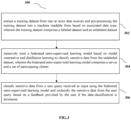
- FIG.3 illustrates an exemplary flow diagram of a method to classify sensitive data from the user query, in accordance with some embodiments of the present disclosure.
- the system 100 comprises one or more data storage devices or the memory 102 operatively coupled to the processor(s) 104 and is configured to store instructions for execution of steps of the method 300 by the processor(s) or one or more hardware processors 104.
- the steps of the method 300 of the present disclosure will now be explained with reference to the components or blocks of the system 100 as depicted in FIG.1 and FIG.2 , and the steps of flow diagram as depicted in FIG.3 .
- process steps, method steps, techniques or the like may be described in a sequential order, such processes, methods, and techniques may be configured to work in alternate orders. In other words, any sequence or order of steps that may be described does not necessarily indicate a requirement that the steps to be performed in that order.
- the steps of processes described herein may be performed in any order practical. Further, some steps may be performed simultaneously.
- the one or more hardware processors 104 extract an input dataset from one or more data sources and pre-process the training dataset into a machine readable form based on associated data type, wherein the training dataset comprises a labeled dataset and an unlabeled dataset.
- the data store 202 receives the training dataset as input and feeds into the data manager 204 to train a federated semi-supervised learning model (FSSL) to classify sensitive data from the unlabeled dataset.
- FSSL federated semi-supervised learning model
- the data manager 204 of the system 100 performs data extraction which helps to remove data that is unrelated for the training as unrelated data.
- the main task of the data extraction module is to gather data from multiple sources that are useful for training. The collected data is then preprocessed in the data manager 204.
- the data manager 204 performs data extraction with a filtering mechanism to decide which type of data needs to be extracted.
- the instruction for filtering is provided by the administrator of the project. These filtering instructions are sent to all participants of the federated learning. For example, simple filtering could be selecting data with the ".pdf”, “.txt” or selecting data with “.png”, “.jpg”, and other extensions for a training procedure. More complex instructions include giving a few templates and selecting data that lies within pre-defined or dynamically calculated boundaries in a data representation space.
- the data manager 204 also performs the data type conversion as the machine learning model takes numerical inputs.
- Data in the image domain is generally stored in a numerical format, whereas text, graphs, and other kind of data need to be converted into a numeric data type.
- the working of the pre-processor differs.
- pre-processing consist of data normalization, rotation, flip, shear, crop, augmentation, color, and contrast transformations, and thereof. Performing these transformations on image data help to increase the size of dataset. These transformations are feasible in the image domain because they do not change the overall semantics of the images.
- the system negates the need for data augmentation and applies data normalization in the pre-processing step.
- pre-processing includes 1) data cleaning steps like stop word removing, lemmatizing, stemming, 2) tokenization, 3) vectorization, and thereof.
- the local model 208 among the set of local models of the participating client 200 processes only unlabeled data because of the lack of domain expertise or lack of incentives. This makes it challenging to train the local model in the absence of any supervision.
- the system 100 utilizes the global model 210 to guide the training in two ways. One is to learn an intermediate representation of data, and the other is to learn the output representation on clients.
- the local model 208 is trained on each client which processes the data into batches.
- the one or more hardware processors 104 train a federated semi-supervised learning (FSSL) model iteratively based on model contrastive learning to classify sensitive data from the unlabeled dataset, wherein the federated semi-supervised learning model comprises a server and a set of participating clients.
- the client manager 216 on the server 240 selects a subset of total clients and shares the global model and federated learning plan with them.
- the federated learning (FL) plan 206 contains local model training instructions such as one or more epochs, a batch size, and other hyperparameters, one or more data filtering instructions, and thereof.
- the data manager 204 on each participating client 200 having the relevant data engine 214 selects relevant data for training. Data representation is learned on the unlabelled data selected by the data manager.
- the federated learning plan 206 is utilized to perform communication between the global model 210 of the server 240 and with the global model 210 of at least one participating client 200, and communication between each local model 208 among the set of local models within each participating client 200.
- Federated learning collaboratively learns a global prediction model without exchanging end-user data.
- K be the number of clients 200 collaborating in the learning process and R be the number of training rounds.
- the server first randomly selects m clients ( m ⁇ K ) and sends a global model ⁇ g to them.
- N ⁇ N k . This procedure is repeated for R number of rounds or until convergence.
- clients 200 have unlabelled data on their device whereas server has some labelled data curated by experts.
- the federated learning (FL) plan is fetched from the data manager 204 to perform model training.
- the FL plan 206 comprises a first set of distinctive attributes corresponding to the set of local models and a second set of distinctive attributes corresponding to the global model, wherein each local model 208 and the global model 210 includes at least one of a projection layer, a classification layer, and a base encoder.
- the set of local models at the set of participating clients are trained with respective unlabeled dataset based on the first set of distinctive attributes by obtaining the first set of distinctive attributes and initializing the set of local models with one or more weights. Losses occurred while training the set of local models are minimized by computing a cumulative loss based on determining a model contrastive loss and a distillation loss.
- the model contrastive loss (refer equation 1 and equation 2) is computed at each participating client when trained with the unlabeled dataset by considering the outputs of projection layer at current step and previous step.
- the distillation loss is computed by considering the outputs of classification layer of at least one of the local model and the global model.
- each local model 208 is updated with the cumulative loss function when at least one of the global model constraints are not updated and updating the one or more weights of the set of local models.
- relevant information communication occurs between each client 200 and the server 240.
- the communicated information contains model weights, labels, logits, and thereof.
- the method of the present disclosure has all the necessary information is bundled within the FL Plan 206.
- Human expert on the server 240 designs a revised federated Learning Plan (FL Plan).
- the revised FL plan 206 contains instructions related to the global model 210 training on the server 200 and local model 208 training on the client 200.
- the FL plan 206 contains specific values for the number of training epochs, batch size, and other hyperparameters.
- the FL plan 206 for the client 200 training also contains one or more data filtering instructions. These data filtering instructions are then passed to the data manager 204 for selecting the relevant data. The complexity of data filtering instructions depends on the task at hand.
- the FL plan 206 contains potential information that is needed for system improvement.
- the client-server architecture can be tailored according to the client's resource specification during the first instance of participation in the training and sent back to the client during the next round of training with the help of the FL Plan 206.
- the model architecture-related information consists of the type of architecture to be used for example convolutional neural network, recurrent neural network, transformers, number of hidden layers and neurons, and thereof.
- self-supervised learning methods such as simple framework for contrastive learning and visual representation (SimCLR) and bootstrap your own latent (BYOL), have shown good results in learning generalized data representations from unlabeled data in the vision domain.
- SICR contrastive learning and visual representation
- BYOL bootstrap your own latent
- the client 200 architecture of the system 100 is the self-supervised contrastive learning, wherein the projection head is added on top of a base encoder to compare the representations of two images in the projection space.
- the local model 208 and the global model 210 in the method of the present disclosure consists of three components: a base encoder, a projection head, and a classification layer. Let p ⁇ ( • ) be the output of the projection head, and f ⁇ ( • ) be the output of the classification layer.
- Each local model 208 training learns a high-dimensional representation of the local data as the client has only unlabeled data. In the absence of labeled data, there is no way to guide a local training toward good data representation.
- the model contrastive loss is used to guide the local model 208 training and to learn generalized data representation.
- Let q g r represent the output of the projection head of the global model at round r .
- ⁇ denotes a temperature parameter, which regulates the amount of information in a distribution.
- the global model's knowledge of the classification layer is utilized because global model weights get updated on the labeled dataset D s .
- Equation 4 represents the loss function which is minimized with respect to the local model parameters only.
- Global model parameters are not updated during local model training.
- the process of not updating the global model is known as a stop-gradient operation. It has been noted that for contrastive learning, the stop-gradient operation is essential, and its removal leads to representation collapse. Similarly, the stop-gradient operation is also important in federated learning, especially when parameters are shared between two models.
- the global model 210 is trained with the set of local models 208 of each participating client 200 with respective labeled dataset on the server 240 based on the second set of distinctive attributes. Initially the second set of distinctive attributes are obtained, and the global model is initialized with one or more weights. The global model 210 is initialized and at least one of the participating client is randomly selected. Further, a cross-entropy loss of the global model 210 is computed from the labeled dataset for every epoch and the global model is updated based on the cross-entropy loss. Table 3 describes the overall federated training procedure of the global model at the server.
- the local model is trained by using supervised cross-entropy loss on the labeled data D s .
- update ⁇ g for only one epoch As the amount of labeled data is small, updating ⁇ g for a large number of epochs could lead to model overfitting.
- the global model 210 tends to forget the knowledge learned from clients by updating ⁇ g for a large epoch. For these reasons, update ⁇ g for only one epoch.
- Table 2 - Server Training Require Labeled dataset for server D s , number of clients k , number of rounds R , global model learning rate ⁇ g , temperature ⁇ , epochs for global model training E g Ensure : Global model ⁇ g Input: labeled dataset D s , number of rounds R , epochs for global model training Eg .
- the one or more hardware processors 104 classify sensitive data from a user query received as input using the federated semi-supervised learning model and reclassify the sensitive data from the user query based on a feedback provided by the user if the data classification is erroneous.
- the classification layer of the global model performs the output to assign a label to data instances. It is not viable to utilize major compute resources of clients and so processes data into batches at the time of inference.
- the classification layer suggests top-k labels that are most appropriate for a particular data instance.
- k is an integer number, so top-1 would mean the label for which the model has the highest confidence.
- the value of k can be set either by clients or the server. Also, to process large data instances that cannot fit into a memory or that exceed the input length of the model and process them into chunks wherever possible.
- the preventive-reporting module 234 of the client 200 processes the output of the machine learning model that classifies the data into an appropriate class.
- the system of the present disclosure can be used to train a model for classifying data into security-related class.
- the properly labeled data would be helpful for data leak protection (DLP) solutions to apply appropriate security policy thus restricting the inappropriate data movement within and outside of the enterprise.
- DLP data leak protection
- Clients can report the incorrect classification of the data suggested by the system. These reports are sent to the server.
- the experts e.g., domain expert, subject matter expert
- FIG.4 illustrates an exemplary enterprise scenario having labels at server using the system of FIG.1 , according to some embodiments of the present disclosure.
- the enterprise usually handles data from multiple entities in parallel. These entities may consist of customers, vendors, partners, and employees. Similarly, the data may consist of intellectual property (IP), business processes, customer contracts, pricing, or personal information of the entity.
- IP intellectual property
- Sensitive data at the business level is safeguarded by signing a non-disclosure agreement (NDA) with the enterprise, whereas personal data usage, storage, and processing are dictated by data privacy regulations. Any unexpected breach of the NDA or privacy regulations could lead to monetary loss (in the form of legal penalties), loss of business, and loss of reputation. Therefore, projects within a typical enterprise are isolated from each other as an avoidance measure. From information security perspective, isolation of data is problematic as enterprise will not have any insight about the sensitivity and kind of data being processed by each project.
- NDA non-disclosure agreement
- Bloated security control inventory as the enterprise has to deploy similar security controls on all the devices (e.g., client devices) even if many of them do not have any sensitive data. This, in turn, increases the expenditure. In the event of a data breach, inability to assess the extent of the loss within the time frame specified. Higher false positives from security controls for stopping data exfiltration, as they will predominately use a rule or heuristic-based implementation.
- the client Device has data for multiple entities, for example, employees, customers, and vendors.
- an employee from the human resources department has the personal data of other employees on their device/system (e.g., computer system).
- a business relationship manager has data from various projects for prioritization and alignment with technology for maximum return on investment.
- data privacy and confidentiality issues can be generalized to other departments in the enterprise.
- the device/system e.g., computer system
- the system of FIG. 1 considers a semi-honest setting, that is, participants are honest-but-curious. This implies that the participants do not deviate from the expected benign behavior. However, they may try to learn more information than allowed by analyzing the input and output and their internal state.
- the method addresses the privacy issue by using federated semi-supervised learning with labels-at-server. In this setup, an agent is deployed on each device that learns a local model and shares it with an aggregating server. The customer's sensitive data never leaves the project group, so the NDA or any privacy regulation is not violated.
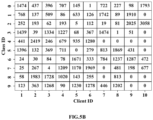
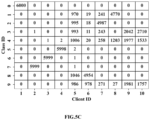
- FIG.5A through FIG.5C illustrate an identical data distribution (IID) and non-independent identical data (non-IID) distribution from a Fashion-modified national institute standard technology (MNIST) dataset across ten clients with different values of alpha using the system of FIG. 1 , according to some embodiments of the present disclosure.
- FIG.5A illustrates the IID and non-IID data distribution for the Fashion-MNIST dataset across ten clients with different values of alpha ( ⁇ ). Smaller value of ⁇ produces more imbalanced data distribution that is, clients may not have samples for all classes, and the number of samples for a class differs too.
- the technique of the present disclosure is compared with existing prior arts with Canadian institute for advanced research (CIFAR-10) and Fashion-MNIST datasets.
- the existing techniques in FSSL randomly distributes the data between clients to get an imbalanced dataset.
- the Dirichlet distribution ( ⁇ ) is used to get non-IID data distribution among clients. It is noted that the data distribution will be more imbalanced for the smaller values of alpha ( ⁇ ).
- visualization of data distribution is shown for the Fashion-MNIST dataset. Further, experiments are conducted with various choices of ⁇ ⁇ ⁇ 0.5, 0.1, 0.01 ⁇ .
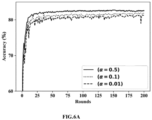
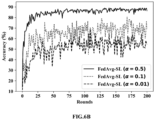
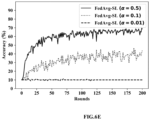
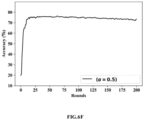
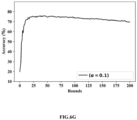
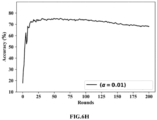
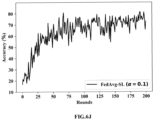
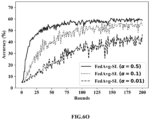
- FIG.6A through FIG.6O illustrates graphical representation of accuracy between the sensitive data classification framework and conventional datasets using the system of FIG.1 , according to some embodiments of the present disclosure.
- the graphical representation provides accuracy comparison between bedframe and FedAvg-SL for ⁇ ⁇ ⁇ 0.5, 0.1, 0.01 ⁇ on four datasets.
- the FedAvg-SL may be alternatively referred as federated average supervised learning model.
- the effect of data imbalance is important to verify the model performance for various data imbalance scenarios.
- the labeled and unlabeled datasets are created by the proposed data split strategy.
- FIG.6A through FIG.6O provides accuracy comparison between the method of the present disclosure and the baseline (FedAvg-SL) on four datasets.
- the lines in the plot indicate mean accuracy, computed over three random runs of experiments. It can be observed in fluctuations for the accuracy increase for the baseline (FedAvg-SL) with the increase in data imbalance (that is, decreasing ⁇ ) for all the datasets.
- the method implemented by the system 100 is robust to data imbalance with negligible change in accuracy. It should be noted that the FedAvg-SL requires that all data on a client device be labeled.
- ⁇ 0.5, 0.1 and 0.01.
- For the FiveAbstractsGroup dataset set the lower bound accuracy for the global model as 68.96 ⁇ 1.378. This is the accuracy of the Server-SL based baseline on the FiveAbstractsGroup dataset.
- the method and FedAvg-SL outperform the Server-SL by achieving an accuracy of 76.55 ⁇ 0.849.
- Y c was set to 500 for CIFAR-10 as per the experimental setup of FedMatch.
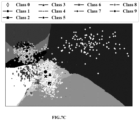
- FIG.7A through 7D illustrates a global model representation for local model training performed with different loss functions using the system of FIG. 1 , according to some embodiments of the present disclosure.
- FIG.8A illustrates principal component analysis of the global model Representation, where (a) and (b) represent local training with L d loss and L d + L c losses, respectively, for five Abstracts Group dataset. Similarly, (c) and (d) are for Fashion-MNIST dataset. Class ID denotes the numerical values assigned to class names.
- the loss function for local model training on the client consists of a model contrastive loss L c (Equation 2) and a distillation loss L d (Equation 3). The system analyzed the effect of both of these loss functions on model performance and representation learning. Further, final loss L k for local model training to L c or L d but not both (Equation 4).
- the experimentation setting for the analysis is as follows where,
- the outputs of the projection head to extract the representations To analyze the goodness of global model representation, and its representation ability on clients' training data.
- the global model learns a better representation of data when local model training consists of both distillation and model contrastive loss. This can be inferred from the distinguishable cluster formations, where the ablation study shows the importance and effect of both the losses in local model training.
- the embodiments of present disclosure herein address unresolved problem of classification of sensitive data.
- the embodiment thus provides system and method for classification of sensitive data using federated semi-supervised learning.
- the embodiments herein further provide classification of security data for better security posture for enterprise with the type of data spread on various devices.
- the method of the present disclosure addresses the issue of non-IID data on clients.
- Such computer-readable storage means contain program-code means for implementation of one or more steps of the method, when the program runs on a server or mobile device or any suitable programmable device.
- the hardware device can be any kind of device which can be programmed including e.g., any kind of computer like a server or a personal computer, or the like, or any combination thereof.
- the device may also include means which could be e.g., hardware means like e.g., an application-specific integrated circuit (ASIC), a field-programmable gate array (FPGA), or a combination of hardware and software means, e.g., an ASIC and an FPGA, or at least one microprocessor and at least one memory with software processing components located therein.
- the means can include both hardware means, and software means.
- the method embodiments described herein could be implemented in hardware and software.
- the device may also include software means. Alternatively, the embodiments may be implemented on different hardware devices, e.g., using a plurality of CPUs.
- the embodiments herein can comprise hardware and software elements.
- the embodiments that are implemented in software include but are not limited to, firmware, resident software, microcode, etc.
- the functions performed by various components described herein may be implemented in other components or combinations of other components.
- a computer-usable or computer readable medium can be any apparatus that can comprise, store, communicate, propagate, or transport the program for use by or in connection with the instruction execution system, apparatus, or device.
- a computer-readable storage medium refers to any type of physical memory on which information or data readable by a processor may be stored.
- a computer-readable storage medium may store instructions for execution by one or more processors, including instructions for causing the processor(s) to perform steps or stages consistent with the embodiments described herein.
- the term "computer-readable medium” should be understood to include tangible items and exclude carrier waves and transient signals, i.e., be non-transitory. Examples include random access memory (RAM), read-only memory (ROM), volatile memory, nonvolatile memory, hard drives, CD ROMs, DVDs, flash drives, disks, and any other known physical storage media.
Landscapes
- Engineering & Computer Science (AREA)
- Theoretical Computer Science (AREA)
- Physics & Mathematics (AREA)
- Data Mining & Analysis (AREA)
- General Health & Medical Sciences (AREA)
- Biomedical Technology (AREA)
- Biophysics (AREA)
- Computational Linguistics (AREA)
- Life Sciences & Earth Sciences (AREA)
- Evolutionary Computation (AREA)
- Artificial Intelligence (AREA)
- Molecular Biology (AREA)
- Computing Systems (AREA)
- General Engineering & Computer Science (AREA)
- General Physics & Mathematics (AREA)
- Mathematical Physics (AREA)
- Software Systems (AREA)
- Health & Medical Sciences (AREA)
- Information Retrieval, Db Structures And Fs Structures Therefor (AREA)
Applications Claiming Priority (1)
| Application Number | Priority Date | Filing Date | Title |
|---|---|---|---|
| IN202221050218 | 2022-09-02 |
Publications (1)
| Publication Number | Publication Date |
|---|---|
| EP4336413A1 true EP4336413A1 (fr) | 2024-03-13 |
Family
ID=87760509
Family Applications (1)
| Application Number | Title | Priority Date | Filing Date |
|---|---|---|---|
| EP23192307.9A Pending EP4336413A1 (fr) | 2022-09-02 | 2023-08-21 | Système et procédé de classification de données sensibles à l'aide d'un apprentissage semi-supervisé fédéré |
Country Status (2)
| Country | Link |
|---|---|
| US (1) | US20240086718A1 (fr) |
| EP (1) | EP4336413A1 (fr) |
Cited By (2)
| Publication number | Priority date | Publication date | Assignee | Title |
|---|---|---|---|---|
| CN119026006A (zh) * | 2024-08-08 | 2024-11-26 | 北京邮电大学 | 一种基于特征蒸馏和类原型的联邦类增量学习方法 |
| CN120508883A (zh) * | 2025-07-21 | 2025-08-19 | 浙江大学 | 基于域不变文本表征及域内全局先验的个性化联邦学习方法及系统 |
Families Citing this family (8)
| Publication number | Priority date | Publication date | Assignee | Title |
|---|---|---|---|---|
| US12361690B2 (en) * | 2021-12-08 | 2025-07-15 | The Hong Kong University Of Science And Technology | Random sampling consensus federated semi-supervised learning |
| CN118520398B (zh) * | 2024-05-27 | 2024-12-13 | 南京理工大学 | 基于双对比联邦半监督学习的旋转机械设备故障诊断方法 |
| CN118471479B (zh) * | 2024-05-30 | 2025-12-26 | 中山大学 | 一种基于区块链的健康数据联邦学习方法与系统 |
| CN119578512B (zh) * | 2024-11-26 | 2026-03-20 | 重庆邮电大学 | 一种基于客户端自知识蒸馏的个性化联邦学习实现方法 |
| CN119272845B (zh) * | 2024-12-06 | 2025-04-25 | 南京邮电大学 | 一种用于工业异构设备的对比双焦点知识蒸馏联邦学习方法 |
| CN119537956A (zh) * | 2025-01-21 | 2025-02-28 | 中国铁道科学研究院集团有限公司电子计算技术研究所 | 一种基于半监督联邦学习的铁路内部数据流通共享方法 |
| CN120196451B (zh) * | 2025-05-26 | 2025-08-12 | 湖南科技大学 | 一种基于批次的并行拆分联邦学习方法 |
| CN120672560B (zh) * | 2025-06-10 | 2026-03-24 | 北京南山同行科技有限公司 | 一种大数据可视化交互展示方法和系统 |
Citations (2)
| Publication number | Priority date | Publication date | Assignee | Title |
|---|---|---|---|---|
| EP3940604A1 (fr) * | 2020-07-09 | 2022-01-19 | Nokia Technologies Oy | Apprentissage machine étudiant/enseignant fédéré |
| US20220270590A1 (en) * | 2020-07-20 | 2022-08-25 | Google Llc | Unsupervised federated learning of machine learning model layers |
Family Cites Families (3)
| Publication number | Priority date | Publication date | Assignee | Title |
|---|---|---|---|---|
| US11017317B2 (en) * | 2017-12-27 | 2021-05-25 | X Development Llc | Evaluating robot learning |
| US20220343139A1 (en) * | 2021-04-15 | 2022-10-27 | Peyman PASSBAN | Methods and systems for training a neural network model for mixed domain and multi-domain tasks |
| US11989199B2 (en) * | 2021-09-08 | 2024-05-21 | International Business Machines Corporation | Optimizing flow of data within ETL data processing pipeline |
-
2023
- 2023-08-18 US US18/235,504 patent/US20240086718A1/en active Pending
- 2023-08-21 EP EP23192307.9A patent/EP4336413A1/fr active Pending
Patent Citations (2)
| Publication number | Priority date | Publication date | Assignee | Title |
|---|---|---|---|---|
| EP3940604A1 (fr) * | 2020-07-09 | 2022-01-19 | Nokia Technologies Oy | Apprentissage machine étudiant/enseignant fédéré |
| US20220270590A1 (en) * | 2020-07-20 | 2022-08-25 | Google Llc | Unsupervised federated learning of machine learning model layers |
Cited By (2)
| Publication number | Priority date | Publication date | Assignee | Title |
|---|---|---|---|---|
| CN119026006A (zh) * | 2024-08-08 | 2024-11-26 | 北京邮电大学 | 一种基于特征蒸馏和类原型的联邦类增量学习方法 |
| CN120508883A (zh) * | 2025-07-21 | 2025-08-19 | 浙江大学 | 基于域不变文本表征及域内全局先验的个性化联邦学习方法及系统 |
Also Published As
| Publication number | Publication date |
|---|---|
| US20240086718A1 (en) | 2024-03-14 |
Similar Documents
| Publication | Publication Date | Title |
|---|---|---|
| EP4336413A1 (fr) | Système et procédé de classification de données sensibles à l'aide d'un apprentissage semi-supervisé fédéré | |
| Hu et al. | An overview of implementing security and privacy in federated learning | |
| US20190132224A1 (en) | Systems and methods for identifying and mitigating outlier network activity | |
| US20190244122A1 (en) | Explainable artificial intelligence | |
| US20160292248A1 (en) | Methods, systems, and articles of manufacture for the management and identification of causal knowledge | |
| Zhao et al. | RETRACTED: Fuzzy integrated rough set theory situation feature extraction of network security | |
| CN112990281A (zh) | 异常投标识别模型训练方法、异常投标识别方法及装置 | |
| US20160283876A1 (en) | System and method for providing automomous contextual information life cycle management | |
| Sola et al. | Cloud Database Security: Integrating Deep Learning and Machine Learning for Threat Detection and Prevention: 0 | |
| Wu et al. | Risk Assessment Framework for Data Leakage Prevention Using Machine Learning Techniques | |
| Yan et al. | Balancing similarity and complementarity for federated learning | |
| JP2022003517A (ja) | 機密情報を保護するための画像由来識別ドキュメントの検出 | |
| Bradley et al. | The generation of visually credible adversarial examples with genetic algorithms | |
| Feldman et al. | A methodology for quantifying the effect of missing data on decision quality in classification problems | |
| Zheng et al. | SecureFogDL: a federated Transformer framework for secure and intelligent fog computing in healthcare IoT | |
| US10289633B1 (en) | Integrating compliance and analytic environments through data lake cross currents | |
| US11531830B2 (en) | Synthetic rare class generation by preserving morphological identity | |
| Roth et al. | Overview of real-world applications of federated learning with NVIDIA FLARE | |
| CN121326303A (zh) | 一种基于ai技术的软件系统智能开发方法及系统 | |
| Vuursteen | Optimal private and communication constraint distributed goodness-of-fit testing for discrete distributions in the large sample regime | |
| CN119443232B (zh) | 一种安全领域智能问答系统构建方法及智能问答系统 | |
| Keswani et al. | Auditing for Diversity Using Representative Examples | |
| Wendler et al. | Qualitative comparative analysis in information systems and Wirtschaftsinformatik | |
| SAS Institute Inc. | Machine Learning with SAS Viya | |
| US12423638B2 (en) | Method and system for generation of impact analysis specification document for a change request |
Legal Events
| Date | Code | Title | Description |
|---|---|---|---|
| PUAI | Public reference made under article 153(3) epc to a published international application that has entered the european phase |
Free format text: ORIGINAL CODE: 0009012 |
|
| STAA | Information on the status of an ep patent application or granted ep patent |
Free format text: STATUS: THE APPLICATION HAS BEEN PUBLISHED |
|
| AK | Designated contracting states |
Kind code of ref document: A1 Designated state(s): AL AT BE BG CH CY CZ DE DK EE ES FI FR GB GR HR HU IE IS IT LI LT LU LV MC ME MK MT NL NO PL PT RO RS SE SI SK SM TR |
|
| STAA | Information on the status of an ep patent application or granted ep patent |
Free format text: STATUS: REQUEST FOR EXAMINATION WAS MADE |
|
| 17P | Request for examination filed |
Effective date: 20240712 |
|
| RBV | Designated contracting states (corrected) |
Designated state(s): AL AT BE BG CH CY CZ DE DK EE ES FI FR GB GR HR HU IE IS IT LI LT LU LV MC ME MK MT NL NO PL PT RO RS SE SI SK SM TR |