EP4336500A2 - Verfahren, codierer und decodierer zur linearen prädiktiven codierung und decodierung von tonsignalen beim übergang zwischen rahmen mit verschiedenen abtastraten - Google Patents
Verfahren, codierer und decodierer zur linearen prädiktiven codierung und decodierung von tonsignalen beim übergang zwischen rahmen mit verschiedenen abtastraten Download PDFInfo
- Publication number
- EP4336500A2 EP4336500A2 EP24153530.1A EP24153530A EP4336500A2 EP 4336500 A2 EP4336500 A2 EP 4336500A2 EP 24153530 A EP24153530 A EP 24153530A EP 4336500 A2 EP4336500 A2 EP 4336500A2
- Authority
- EP
- European Patent Office
- Prior art keywords
- sampling rate
- internal sampling
- power spectrum
- synthesis filter
- filter
- Prior art date
- Legal status (The legal status is an assumption and is not a legal conclusion. Google has not performed a legal analysis and makes no representation as to the accuracy of the status listed.)
- Granted
Links
Images



Classifications
-
- G—PHYSICS
- G10—MUSICAL INSTRUMENTS; ACOUSTICS
- G10L—SPEECH ANALYSIS TECHNIQUES OR SPEECH SYNTHESIS; SPEECH RECOGNITION; SPEECH OR VOICE PROCESSING TECHNIQUES; SPEECH OR AUDIO CODING OR DECODING
- G10L19/00—Speech or audio signals analysis-synthesis techniques for redundancy reduction, e.g. in vocoders; Coding or decoding of speech or audio signals, using source filter models or psychoacoustic analysis
- G10L19/04—Speech or audio signals analysis-synthesis techniques for redundancy reduction, e.g. in vocoders; Coding or decoding of speech or audio signals, using source filter models or psychoacoustic analysis using predictive techniques
- G10L19/06—Determination or coding of the spectral characteristics, e.g. of the short-term prediction coefficients
-
- G—PHYSICS
- G10—MUSICAL INSTRUMENTS; ACOUSTICS
- G10L—SPEECH ANALYSIS TECHNIQUES OR SPEECH SYNTHESIS; SPEECH RECOGNITION; SPEECH OR VOICE PROCESSING TECHNIQUES; SPEECH OR AUDIO CODING OR DECODING
- G10L19/00—Speech or audio signals analysis-synthesis techniques for redundancy reduction, e.g. in vocoders; Coding or decoding of speech or audio signals, using source filter models or psychoacoustic analysis
- G10L19/04—Speech or audio signals analysis-synthesis techniques for redundancy reduction, e.g. in vocoders; Coding or decoding of speech or audio signals, using source filter models or psychoacoustic analysis using predictive techniques
- G10L19/08—Determination or coding of the excitation function; Determination or coding of the long-term prediction parameters
- G10L19/12—Determination or coding of the excitation function; Determination or coding of the long-term prediction parameters the excitation function being a code excitation, e.g. in code excited linear prediction [CELP] vocoders
-
- G—PHYSICS
- G10—MUSICAL INSTRUMENTS; ACOUSTICS
- G10L—SPEECH ANALYSIS TECHNIQUES OR SPEECH SYNTHESIS; SPEECH RECOGNITION; SPEECH OR VOICE PROCESSING TECHNIQUES; SPEECH OR AUDIO CODING OR DECODING
- G10L19/00—Speech or audio signals analysis-synthesis techniques for redundancy reduction, e.g. in vocoders; Coding or decoding of speech or audio signals, using source filter models or psychoacoustic analysis
- G10L19/04—Speech or audio signals analysis-synthesis techniques for redundancy reduction, e.g. in vocoders; Coding or decoding of speech or audio signals, using source filter models or psychoacoustic analysis using predictive techniques
- G10L19/16—Vocoder architecture
- G10L19/167—Audio streaming, i.e. formatting and decoding of an encoded audio signal representation into a data stream for transmission or storage purposes
-
- G—PHYSICS
- G10—MUSICAL INSTRUMENTS; ACOUSTICS
- G10L—SPEECH ANALYSIS TECHNIQUES OR SPEECH SYNTHESIS; SPEECH RECOGNITION; SPEECH OR VOICE PROCESSING TECHNIQUES; SPEECH OR AUDIO CODING OR DECODING
- G10L19/00—Speech or audio signals analysis-synthesis techniques for redundancy reduction, e.g. in vocoders; Coding or decoding of speech or audio signals, using source filter models or psychoacoustic analysis
- G10L19/04—Speech or audio signals analysis-synthesis techniques for redundancy reduction, e.g. in vocoders; Coding or decoding of speech or audio signals, using source filter models or psychoacoustic analysis using predictive techniques
- G10L19/16—Vocoder architecture
- G10L19/173—Transcoding, i.e. converting between two coded representations avoiding cascaded coding-decoding
-
- G—PHYSICS
- G10—MUSICAL INSTRUMENTS; ACOUSTICS
- G10L—SPEECH ANALYSIS TECHNIQUES OR SPEECH SYNTHESIS; SPEECH RECOGNITION; SPEECH OR VOICE PROCESSING TECHNIQUES; SPEECH OR AUDIO CODING OR DECODING
- G10L19/00—Speech or audio signals analysis-synthesis techniques for redundancy reduction, e.g. in vocoders; Coding or decoding of speech or audio signals, using source filter models or psychoacoustic analysis
- G10L19/04—Speech or audio signals analysis-synthesis techniques for redundancy reduction, e.g. in vocoders; Coding or decoding of speech or audio signals, using source filter models or psychoacoustic analysis using predictive techniques
- G10L19/16—Vocoder architecture
- G10L19/18—Vocoders using multiple modes
- G10L19/24—Variable rate codecs, e.g. for generating different qualities using a scalable representation such as hierarchical encoding or layered encoding
-
- G—PHYSICS
- G10—MUSICAL INSTRUMENTS; ACOUSTICS
- G10L—SPEECH ANALYSIS TECHNIQUES OR SPEECH SYNTHESIS; SPEECH RECOGNITION; SPEECH OR VOICE PROCESSING TECHNIQUES; SPEECH OR AUDIO CODING OR DECODING
- G10L19/00—Speech or audio signals analysis-synthesis techniques for redundancy reduction, e.g. in vocoders; Coding or decoding of speech or audio signals, using source filter models or psychoacoustic analysis
- G10L19/04—Speech or audio signals analysis-synthesis techniques for redundancy reduction, e.g. in vocoders; Coding or decoding of speech or audio signals, using source filter models or psychoacoustic analysis using predictive techniques
- G10L19/26—Pre-filtering or post-filtering
-
- G—PHYSICS
- G10—MUSICAL INSTRUMENTS; ACOUSTICS
- G10L—SPEECH ANALYSIS TECHNIQUES OR SPEECH SYNTHESIS; SPEECH RECOGNITION; SPEECH OR VOICE PROCESSING TECHNIQUES; SPEECH OR AUDIO CODING OR DECODING
- G10L25/00—Speech or voice analysis techniques not restricted to a single one of groups G10L15/00 - G10L21/00
- G10L25/03—Speech or voice analysis techniques not restricted to a single one of groups G10L15/00 - G10L21/00 characterised by the type of extracted parameters
- G10L25/06—Speech or voice analysis techniques not restricted to a single one of groups G10L15/00 - G10L21/00 characterised by the type of extracted parameters the extracted parameters being correlation coefficients
-
- G—PHYSICS
- G10—MUSICAL INSTRUMENTS; ACOUSTICS
- G10L—SPEECH ANALYSIS TECHNIQUES OR SPEECH SYNTHESIS; SPEECH RECOGNITION; SPEECH OR VOICE PROCESSING TECHNIQUES; SPEECH OR AUDIO CODING OR DECODING
- G10L19/00—Speech or audio signals analysis-synthesis techniques for redundancy reduction, e.g. in vocoders; Coding or decoding of speech or audio signals, using source filter models or psychoacoustic analysis
- G10L19/04—Speech or audio signals analysis-synthesis techniques for redundancy reduction, e.g. in vocoders; Coding or decoding of speech or audio signals, using source filter models or psychoacoustic analysis using predictive techniques
- G10L19/06—Determination or coding of the spectral characteristics, e.g. of the short-term prediction coefficients
- G10L19/07—Line spectrum pair [LSP] vocoders
-
- G—PHYSICS
- G10—MUSICAL INSTRUMENTS; ACOUSTICS
- G10L—SPEECH ANALYSIS TECHNIQUES OR SPEECH SYNTHESIS; SPEECH RECOGNITION; SPEECH OR VOICE PROCESSING TECHNIQUES; SPEECH OR AUDIO CODING OR DECODING
- G10L19/00—Speech or audio signals analysis-synthesis techniques for redundancy reduction, e.g. in vocoders; Coding or decoding of speech or audio signals, using source filter models or psychoacoustic analysis
- G10L2019/0001—Codebooks
- G10L2019/0002—Codebook adaptations
-
- G—PHYSICS
- G10—MUSICAL INSTRUMENTS; ACOUSTICS
- G10L—SPEECH ANALYSIS TECHNIQUES OR SPEECH SYNTHESIS; SPEECH RECOGNITION; SPEECH OR VOICE PROCESSING TECHNIQUES; SPEECH OR AUDIO CODING OR DECODING
- G10L19/00—Speech or audio signals analysis-synthesis techniques for redundancy reduction, e.g. in vocoders; Coding or decoding of speech or audio signals, using source filter models or psychoacoustic analysis
- G10L2019/0001—Codebooks
- G10L2019/0004—Design or structure of the codebook
-
- G—PHYSICS
- G10—MUSICAL INSTRUMENTS; ACOUSTICS
- G10L—SPEECH ANALYSIS TECHNIQUES OR SPEECH SYNTHESIS; SPEECH RECOGNITION; SPEECH OR VOICE PROCESSING TECHNIQUES; SPEECH OR AUDIO CODING OR DECODING
- G10L19/00—Speech or audio signals analysis-synthesis techniques for redundancy reduction, e.g. in vocoders; Coding or decoding of speech or audio signals, using source filter models or psychoacoustic analysis
- G10L2019/0001—Codebooks
- G10L2019/0016—Codebook for LPC parameters
-
- G—PHYSICS
- G10—MUSICAL INSTRUMENTS; ACOUSTICS
- G10L—SPEECH ANALYSIS TECHNIQUES OR SPEECH SYNTHESIS; SPEECH RECOGNITION; SPEECH OR VOICE PROCESSING TECHNIQUES; SPEECH OR AUDIO CODING OR DECODING
- G10L21/00—Speech or voice signal processing techniques to produce another audible or non-audible signal, e.g. visual or tactile, in order to modify its quality or its intelligibility
- G10L21/02—Speech enhancement, e.g. noise reduction or echo cancellation
- G10L21/038—Speech enhancement, e.g. noise reduction or echo cancellation using band spreading techniques
Definitions
- the present disclosure relates to the field of sound coding. More specifically, the present disclosure relates to methods, an encoder and a decoder for linear predictive encoding and decoding of sound signals upon transition between frames having different sampling rates.
- a speech encoder converts a speech signal into a digital bit stream that is transmitted over a communication channel (or stored in a storage medium).
- the speech signal is digitized (sampled and quantized with usually 16-bits per sample) and the speech encoder has the role of representing these digital samples with a smaller number of bits while maintaining a good subjective speech quality.
- the speech decoder or synthesizer operates on the transmitted or stored bit stream and converts it back to a sound signal.
- CELP Code Excited Linear Prediction
- the sampled speech signal is processed in successive blocks of L samples usually called frames where L is some predetermined number (corresponding to 10-30 ms of speech).
- L some predetermined number (corresponding to 10-30 ms of speech).
- an LP Linear Prediction
- An excitation signal is determined in each subframe, which usually comprises two components: one from the past excitation (also called pitch contribution or adaptive codebook) and the other from an innovative codebook (also called fixed codebook).
- This excitation signal is transmitted and used at the decoder as the input of the LP synthesis filter in order to obtain the synthesized speech.
- each block of N samples is synthesized by filtering an appropriate codevector from the innovative codebook through time-varying filters modeling the spectral characteristics of the speech signal.
- filters comprise a pitch synthesis filter (usually implemented as an adaptive codebook containing the past excitation signal) and an LP synthesis filter.
- the synthesis output is computed for all, or a subset, of the codevectors from the innovative codebook (codebook search).
- the retained innovative codevector is the one producing the synthesis output closest to the original speech signal according to a perceptually weighted distortion measure. This perceptual weighting is performed using a so-called perceptual weighting filter, which is usually derived from the LP synthesis filter.
- LP filter In LP-based coders such as CELP, an LP filter is computed then quantized and transmitted once per frame. However, in order to insure smooth evolution of the LP synthesis filter, the filter parameters are interpolated in each subframe, based on the LP parameters from the past frame. The LP filter parameters are not suitable for quantization due to filter stability issues. Another LP representation more efficient for quantization and interpolation is usually used. A commonly used LP parameter representation is the line spectral frequency (LSF) domain.
- LSF line spectral frequency
- the sound signal is sampled at 16000 samples per second and the encoded bandwidth extended up to 7 kHz.
- wideband coding (below 16 kbit/s) it is usually more efficient to down-sample the input signal to a slightly lower rate, and apply the CELP model to a lower bandwidth, then use bandwidth extension at the decoder to generate the signal up to 7 kHz. This is due to the fact that CELP models lower frequencies with high energy better than higher frequency. So it is more efficient to focus the model on the lower bandwidth at low bit rates.
- AMR-WB standard (Reference [1]) is such a coding example, where the input signal is down-sampled to 12800 samples per second, and the CELP encodes the signal up to 6.4 kHz. At the decoder bandwidth extension is used to generate a signal from 6.4 to 7 kHz. However, at bit rates higher than 16 kbit/s it is more efficient to use CELP to encode the signal up to 7 kHz, since there are enough bits to represent the entire bandwidth.
- a method implemented in a sound signal encoder for converting linear predictive (LP) filter parameters from a sound signal sampling rate S1 to a sound signal sampling rate S2.
- a power spectrum of a LP synthesis filter is computed, at the sampling rate S1, using the LP filter parameters.
- the power spectrum of the LP synthesis filter is modified to convert it from the sampling rate S1 to the sampling rate S2.
- the modified power spectrum of the LP synthesis filter is inverse transformed to determine autocorrelations of the LP synthesis filter at the sampling rate S2.
- the autocorrelations are used to compute the LP filter parameters at the sampling rate S2.
- a method implemented in a sound signal decoder for converting received linear predictive (LP) filter parameters from a sound signal sampling rate S1 to a sound signal sampling rate S2.
- a power spectrum of a LP synthesis filter is computed, at the sampling rate S1, using the received LP filter parameters.
- the power spectrum of the LP synthesis filter is modified to convert it from the sampling rate S1 to the sampling rate S2.
- the modified power spectrum of the LP synthesis filter is inverse transformed to determine autocorrelations of the LP synthesis filter at the sampling rate S2.
- the autocorrelations are used to compute the LP filter parameters at the sampling rate S2.
- the device comprises a processor configured to:
- the present disclosure further relates to a device for use in a sound signal decoder for converting received linear predictive (LP) filter parameters from a sound signal sampling rate S1 to a sound signal sampling rate S2.
- the device comprises a processor configured to:
- the non-restrictive illustrative embodiment of the present disclosure is concerned with a method and a device for efficient switching, in an LP-based codec, between frames using different internal sampling rates.
- the switching method and device can be used with any sound signals, including speech and audio signals.
- the switching between 16 kHz and 12.8 kHz internal sampling rates is given by way of example, however, the switching method and device can also be applied to other sampling rates.
- FIG. 1 is a schematic block diagram of a sound communication system depicting an example of use of sound encoding and decoding.
- a sound communication system 100 supports transmission and reproduction of a sound signal across a communication channel 101.
- the communication channel 101 may comprise, for example, a wire, optical or fibre link.
- the communication channel 101 may comprise at least in part a radio frequency link.
- the radio frequency link often supports multiple, simultaneous speech communications requiring shared bandwidth resources such as may be found with cellular telephony.
- the communication channel 101 may be replaced by a storage device in a single device embodiment of the communication system 101 that records and stores the encoded sound signal for later playback.
- a microphone 102 produces an original analog sound signal 103 that is supplied to an analog-to-digital (A/D) converter 104 for converting it into an original digital sound signal 105.
- the original digital sound signal 105 may also be recorded and supplied from a storage device (not shown).
- a sound encoder 106 encodes the original digital sound signal 105 thereby producing a set of encoding parameters 107 that are coded into a binary form and delivered to an optional channel encoder 108.
- the optional channel encoder 108 when present, adds redundancy to the binary representation of the coding parameters before transmitting them over the communication channel 101.
- an optional channel decoder 109 utilizes the above mentioned redundant information in a digital bit stream 111 to detect and correct channel errors that may have occurred during the transmission over the communication channel 101, producing received encoding parameters 112.
- a sound decoder 110 converts the received encoding parameters 112 for creating a synthesized digital sound signal 113.
- the synthesized digital sound signal 113 reconstructed in the sound decoder 110 is converted to a synthesized analog sound signal 114 in a digital-to-analog (D/A) converter 115 and played back in a loudspeaker unit 116.
- the synthesized digital sound signal 113 may also be supplied to and recorded in a storage device (not shown).
- FIG. 2 is a schematic block diagram illustrating the structure of a CELP-based encoder and decoder, part of the sound communication system of Figure 1 .
- a sound codec comprises two basic parts: the sound encoder 106 and the sound decoder 110 both introduced in the foregoing description of Figure 1 .
- the encoder 106 is supplied with the original digital sound signal 105, determines the encoding parameters 107, described herein below, representing the original analog sound signal 103. These parameters 107 are encoded into the digital bit stream 111 that is transmitted using a communication channel, for example the communication channel 101 of Figure 1 , to the decoder 110.
- the sound decoder 110 reconstructs the synthesized digital sound signal 113 to be as similar as possible to the original digital sound signal 105.
- the most widespread speech coding techniques are based on Linear Prediction (LP), in particular CELP.
- LP-based coding the synthesized digital sound signal 113 is produced by filtering an excitation 214 through a LP synthesis filter 216 having a transfer function 1/ A ( z ).
- the excitation 214 is typically composed of two parts: a first-stage, adaptive-codebook contribution 222 selected from an adaptive codebook 218 and amplified by an adaptive-codebook gain g p 226 and a second-stage, fixed-codebook contribution 224 selected from a fixed codebook 220 and amplified by a fixed-codebook gain g c 228.
- the adaptive codebook contribution 222 models the periodic part of the excitation and the fixed codebook contribution 214 is added to model the evolution of the sound signal.
- the sound signal is processed by frames of typically 20 ms and the LP filter parameters are transmitted once per frame.
- the frame is further divided in several subframes to encode the excitation.
- the subframe length is typically 5 ms.
- CELP uses a principle called Analysis-by-Synthesis where possible decoder outputs are tried (synthesized) already during the coding process at the encoder 106 and then compared to the original digital sound signal 105.
- the encoder 106 thus includes elements similar to those of the decoder 110. These elements includes an adaptive codebook contribution 250 selected from an adaptive codebook 242 that supplies a past excitation signal v(n) convolved with the impulse response of a weighted synthesis filter H(z) (see 238) (cascade of the LP synthesis filter 1 / A(z) and the perceptual weighting filter W(z)), the result y 1 (n) of which is amplified by an adaptive-codebook gain g p 240.
- a fixed codebook contribution 252 selected from a fixed codebook 244 that supplies an innovative codevector c k (n) convolved with the impulse response of the weighted synthesis filter H(z) (see 246), the result y 2 (n) of which is amplified by a fixed codebook gain g c 248.
- the encoder 106 also comprises a perceptual weighting filter W(z) 233 and a provider 234 of a zero-input response of the cascade ( H(z) ) of the LP synthesis filter 1 / A(z) and the perceptual weighting filter W(z).
- Subtractors 236, 254 and 256 respectively subtract the zero-input response, the adaptive codebook contribution 250 and the fixed codebook contribution 252 from the original digital sound signal 105 filtered by the perceptual weighting filter 233 to provide a mean-squared error 232 between the original digital sound signal 105 and the synthesized digital sound signal 113.
- the perceptual weighting filter W(z) exploits the frequency masking effect and typically is derived from a LP filter A(z).
- the digital bit stream 111 transmitted from the encoder 106 to the decoder 110 contains typically the following parameters 107: quantized parameters of the LP filter A ( z ) , indices of the adaptive codebook 242 and of the fixed codebook 244, and the gains g p 240 and g c 248 of the adaptive codebook 242 and of the fixed codebook 244.
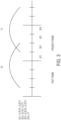
- FIG. 3 illustrates an example of framing and interpolation of LP parameters.
- a present frame is divided into four subframes SF1, SF2, SF3 and SF4, and the LP analysis window is centered at the last subframe SF4.
- the coder switches between 12.8 kHz and 16 kHz internal sampling rates, where 4 subframes per frame are used at 12.8 kHz and 5 subframes per frame are used at 16 kHz, and where the LP parameters are also quantized in the middle of the present frame (Fm).
- the LP filter parameters are transformed to another domain for quantization and interpolation purposes.
- Other LP parameter representations commonly used are reflection coefficients, log-area ratios, immitance spectrum pairs (used in AMR-WB; Reference [1]), and line spectrum pairs, which are also called line spectrum frequencies (LSF).
- LSF line spectrum frequencies
- the line spectrum frequency representation is used.
- An example of a method that can be used to convert the LP parameters to LSF parameters and vice versa can be found in Reference [2].
- LSF parameters which can be in the frequency domain in the range between 0 and Fs/2 (where Fs is the sampling frequency), or in the scaled frequency domain between 0 and ⁇ , or in the cosine domain (cosine of scaled frequency).
- a multi-rate CELP wideband coder is used where an internal sampling rate of 12.8 kHz is used at lower bit rates and an internal sampling rate of 16 kHz at higher bit rates.
- the LSFs cover the bandwidth from 0 to 6.4 kHz, while at a 16 kHz sampling rate they cover the range from 0 to 8 kHz.
- the present disclosure introduces a method for efficient interpolation of LP parameters between two frames at different internal sampling rates.
- the switching between 12.8 kHz and 16 kHz sampling rates is considered.
- the disclosed techniques are however not limited to these particular sampling rates and may apply to other internal sampling rates.
- the encoder is switching from a frame F1 with internal sampling rate S1 to a frame F2 with internal sampling rate S2.
- the LP parameters in the first frame are denoted LSF1 S1 and the LP parameters at the second frame are denoted LSF2 S2 .
- the LP parameters LSF1 and LSF2 are interpolated.
- the filters have to be set at the same sampling rate. This requires performing LP analysis of frame F1 at sampling rate S2.
- the LP analysis at sampling rate S2 can be performed on the past synthesis signal which is available at both encoder and decoder. This approach involves re-sampling the past synthesis signal from rate S1 to rate S2, and performing complete LP analysis, this operation being repeated at the decoder, which is usually computationally demanding.
- Alternative method and devices are disclosed herein for converting LP synthesis filter parameters LSF1 from sampling rate S1 to sampling rate S2 without the need to re-sample the past synthesis and perform complete LP analysis.
- the method, used at encoding and/or at decoding comprises computing the power spectrum of the LP synthesis filter at rate S1; modifying the power spectrum to convert it from rate S1 to rate S2; converting the modified power spectrum back to the time domain to obtain the filter autocorrelation at rate S2; and finally use the autocorrelation to compute LP filter parameters at rate S2.
- modifying the power spectrum to convert it from rate S1 to rate S2 comprises the following operations: If S1 is larger than S2, modifying the power spectrum comprises truncating the K-sample power spectrum down to K(S2/S1) samples, that is, removing K(S1-S2)/S1 samples.
- modifying the power spectrum comprises extending the K-sample power spectrum up to K(S2/S1) samples, that is, adding K(S2-S1)/S1 samples.
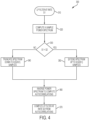
- Figure 4 is a block diagram illustrating an embodiment for converting the LP filter parameters between two different sampling rates.
- Sequence 300 of operations shows that a simple method for the computation of the power spectrum of the LP synthesis filter 1/A(z) is to evaluate the frequency response of the filter at K frequencies from 0 to 2 ⁇ .
- the LP filter is at a rate equal to S1 (operation 310).
- a test determines which of the following cases apply.
- the sampling rate S1 is larger than the sampling rate S2, and the power spectrum for frame F1 is truncated (operation 340) such that the new number of samples is K ( S2 / S 1) .
- the Fourier Transform of the autocorrelations of a signal gives the power spectrum of that signal.
- applying inverse Fourier Transform to the truncated power spectrum results in the autocorrelations of the impulse response of the synthesis filter at sampling rate S2.
- IFT Inverse Discrete Fourier Transform
- K 100
- the inverse DFT is then computed as in Equation (6) to obtain the autocorrelations at sampling rate S2 (operation 360) and the Levinson-Durbin algorithm (see Reference [1]) is used to compute the LP filter parameters at sampling rate S2 (operation 370). Then filter parameters are transformed to the LSF domain for interpolation with the LSFs of frame F2 in order to obtain LP parameters at each subframe.
- converting the LP filter parameters between different internal sampling rates is applied to the quantized LP parameters, in order to determine the interpolated synthesis filter parameters in each subframe, and this is repeated at the decoder.
- the weighting filter uses unquantized LP filter parameters, but it was found sufficient to interpolate between the unquantized filter parameters in new frame F2 and sampling-converted quantized LP parameters from past frame F1 in order to determine the parameters of the weighting filter in each subframe. This avoids the need to apply LP filter sampling conversion on the unquantized LP filter parameters as well.
- Another issue to be considered when switching between frames with different internal sampling rates is the content of the adaptive codebook, which usually contains the past excitation signal. If the new frame has an internal sampling rate S2 and the previous frame has an internal sampling rate S1, then the content of the adaptive codebook is re-sampled from rate S1 to rate S2, and this is performed at both the encoder and the decoder.
- the new frame F2 is forced to use a transient encoding mode which is independent of the past excitation history and thus does not use the history of the adaptive codebook.
- transient mode encoding can be found in PCT patent application WO 2008/049221 A1 "Method and device for coding transition frames in speech signals", the disclosure of which is incorporated by reference herein.
- LP-parameter quantizers usually use predictive quantization, which may not work properly when the parameters are at different sampling rates. In order to reduce switching artefacts, the LP-parameter quantizer may be forced into a non-predictive coding mode when switching between different sampling rates.
- a further consideration is the memory of the synthesis filter, which may be resampled when switching between frames with different sampling rates.
- the additional complexity that arises from converting LP filter parameters when switching between frames with different internal sampling rates may be compensated by modifying parts of the encoding or decoding processing.
- the fixed codebook search may be modified by lowering the number of iterations in the first subframe of the frame (see Reference [1] for an example of fixed codebook search).
- certain post-processing can be skipped.
- a post-processing technique as described in US patent 7,529,660 "Method and device for frequency-selective pitch enhancement of synthesized speech", the disclosure of which is incorporated by reference herein, may be used.
- This post-filtering is skipped in the first frame after switching to a different internal sampling rate (skipping this post-filtering also overcomes the need of past synthesis utilized in the post-filter).
- the past pitch delay used for decoder classifier and frame erasure concealment may be scaled by the factor S2/S1.
- FIG. 5 is a simplified block diagram of an example configuration of hardware components forming the encoder and/or decoder of Figures 1 and 2 .
- a device 400 may be implemented as a part of a mobile terminal, as a part of a portable media player, a base station, Internet equipment or in any similar device, and may incorporate the encoder 106, the decoder 110, or both the encoder 106 and the decoder 110.
- the device 400 includes a processor 406 and a memory 408.
- the processor 406 may comprise one or more distinct processors for executing code instructions to perform the operations of Figure 4 .
- the processor 406 may embody various elements of the encoder 106 and of the decoder 110 of Figures 1 and 2 .
- the processor 406 may further execute tasks of a mobile terminal, of a portable media player, base station, Internet equipement and the like.
- the memory 408 is operatively connected to the processor 406.
- An audio input 402 is present in the device 400 when used as an encoder 106.
- the audio input 402 may include for example a microphone or an interface connectable to a microphone.
- the audio input 402 may include the microphone 102 and the A/D converter 104 and produce the original analog sound signal 103 and/or the original digital sound signal 105.
- the audio input 402 may receive the original digital sound signal 105.
- an encoded output 404 is present when the device 400 is used as an encoder 106 and is configured to forward the encoding parameters 107 or the digital bit stream 111 containing the parameters 107, including the LP filter parameters, to a remote decoder via a communication link, for example via the communication channel 101, or toward a further memory (not shown) for storage.
- Non-limiting implementation examples of the encoded output 404 comprise a radio interface of a mobile terminal, a physical interface such as for example a universal serial bus (USB) port of a portable media player, and the like.
- USB universal serial bus
- An encoded input 403 and an audio output 405 are both present in the device 400 when used as a decoder 110.
- the encoded input 403 may be constructed to receive the encoding parameters 107 or the digital bit stream 111 containing the parameters 107, including the LP filter parameters from an encoded output 404 of an encoder 106.
- the encoded output 404 and the encoded input 403 may form a common communication module.
- the audio output 405 may comprise the D/A converter 115 and the loudspeaker unit 116. Alternatively, the audio output 405 may comprise an interface connectable to an audio player, to a loudspeaker, to a recording device, and the like.
- the audio input 402 or the encoded input 403 may also receive signals from a storage device (not shown). In the same manner, the encoded output 404 and the audio output 405 may supply the output signal to a storage device (not shown) for recording.
- the audio input 402, the encoded input 403, the encoded output 404 and the audio output 405 are all operatively connected to the processor 406.
- the components, process operations, and/or data structures described herein may be implemented using various types of operating systems, computing platforms, network devices, computer programs, and/or general purpose machines.
- devices of a less general purpose nature such as hardwired devices, field programmable gate arrays (FPGAs), application specific integrated circuits (ASICs), or the like, may also be used.
- FPGAs field programmable gate arrays
- ASICs application specific integrated circuits
- Systems and modules described herein may comprise software, firmware, hardware, or any combination(s) of software, firmware, or hardware suitable for the purposes described herein.
- Embodiment 1 A method implemented in a sound signal encoder for converting linear predictive (LP) filter parameters from a sound signal sampling rate S1 to a sound signal sampling rate S2, the method comprising:
- Embodiment 2 A method as recited in embodiment 1, wherein modifying the power spectrum of the LP synthesis filter to convert it from the sampling rate S1 to the sampling rate S2 comprises:
- Embodiment 3 A method as recited in any one of embodiments 1 and 2, wherein the conversion of the LP filter parameters occurs when an encoder switches from a frame with the sampling rate S1 to a frame with the sampling rate S2.
- Embodiment 4 A method as recited in embodiment 3, comprising computing LP filter parameters in each subframe of a current frame by interpolating LP filter parameters of the current frame at the sampling rate S2 with LP filter parameters of a past frame converted from the sampling rate S1 to the sampling rate S2.
- Embodiment 5 A method as recited in embodiment 4, comprising forcing the current frame to an encoding mode that does not use a history of an adaptive codebook.
- Embodiment 6 A method as recited in any one of embodiments 4 or 5, comprising forcing a LP- parameter quantizer to use a non-predictive quantization method in the current frame.
- Embodiment 7 The method as recited in any one of embodiments 1 to 6, wherein the power spectrum of the LP synthesis filter is a discrete power spectrum.
- Embodiment 8 A method as recited in any one of embodiments 1 to 7, comprising:
- Embodiment 9 A method as recited in any one of embodiments 1 to 8, comprising computing the power spectrum of the LP synthesis filter as an energy of a frequency response of the LP synthesis filter.
- Embodiment 10 A method as recited in any one of embodiments 1 to 9, comprising inverse transforming the modified power spectrum of the LP synthesis filter by using an inverse discrete Fourier Transform.
- Embodiment 11 A method as recited in any one of embodiments 1 to 10, comprising searching a fixed codebook using a reduced number of iterations.
- Embodiment 12 A method implemented in a sound signal decoder for converting received linear predictive (LP) filter parameters from a sound signal sampling rate S1 to a sound signal sampling rate S2, the method comprising:
- Embodiment 13 A method as recited in embodiment 12, wherein modifying the power spectrum of the LP synthesis filter to convert it from the sampling rate S1 to the sampling rate S2 comprises:
- Embodiment 14 A method as recited in any one of embodiments 12 and 13, wherein the conversion of the received LP filter parameters occurs when a decoder switches from a frame with the sampling rate S1 to a frame with the sampling rate S2.
- Embodiment 15 A method as recited in embodiment 14, comprising computing LP filter parameters in each subframe of a new frame by interpolating LP filter parameters of a current frame at the sampling rate S2 with LP filter parameters of a past frame converted from the sampling rate S1 to the sampling rate S2.
- Embodiment 16 The method as recited in any one of embodiments 12 to 15, wherein the power spectrum of the LP synthesis filter is a discrete power spectrum.
- Embodiment 17 A method as recited in any one of embodiments 12 to 16, comprising:
- Embodiment 18 A method as recited in any one of embodiments 12 to 17, comprising computing the power spectrum of the LP synthesis filter as an energy of a frequency response of the LP synthesis filter.
- Embodiment 19 A method as recited in any one of embodiments 12 to 18, comprising inverse transforming the modified power spectrum of the LP synthesis filter by using an inverse discrete Fourier Transform.
- Embodiment 20 A method as recited in any one of embodiments 12 to 19, wherein a post filtering is skipped to reduce decoding complexity.
- Embodiment 21 A device for use in a sound signal encoder for converting linear predictive (LP) filter parameters from a sound signal sampling rate S1 to a sound signal sampling rate S2, device comprising: a processor configured to:
- Embodiment 22 A device as recited in embodiment 21, wherein the processor is configured to:
- Embodiment 23 A device as recited in any one of embodiments 21 and 22, wherein the processor is configured to compute LP filter parameters in each subframe of a current frame by interpolating LP filter parameters of the current frame at the sampling rate S2 with LP filter parameters of a past frame converted from the sampling rate S1 to the sampling rate S2.
- Embodiment 24 A device as recited in any one of embodiments 21 to 23, wherein the processor is configured to:
- Embodiment 25 A device as recited in any one of embodiments 21 to 24, wherein the processor is configured to compute the power spectrum of the LP synthesis filter as an energy of a frequency response of the LP synthesis filter.
- Embodiment 26 A device as recited in any one of embodiments 21 to 25, wherein the processor is configured to inverse transform the modified power spectrum of the LP synthesis filter by using an inverse discrete Fourier Transform.
- Embodiment 27 An encoder as recited in any one of embodiments 21 to 26, further comprising a non-transitory memory storing code instructions executable by the processor.
- Embodiment 28 A computer-readable non-transitory memory storing code instructions for performing, when running on the processor of any one of embodiments 21 to 27, a method as recited in any one of embodiments 1 to 11.
- Embodiment 29 A device for use in a sound signal decoder for converting received linear predictive (LP) filter parameters from a sound signal sampling rate S1 to a sound signal sampling rate S2, the device comprising: a processor configured to:
- Embodiment 30 A device as recited in embodiment 29, wherein the processor is further configured to:
- Embodiment 31 A device as recited in any one of embodiments 29 and 30, wherein the processor is configured to compute LP filter parameters in each subframe of a current frame by interpolating LP filter parameters of the current frame at the sampling rate S2 with LP filter parameters of a past frame converted from the sampling rate S1 to the sampling rate S2.
- Embodiment 32 A device as recited in any one of embodiments 29 to 31, wherein the processor is configured to:
- Embodiment 33 A device as recited in any one of embodiments 29 to 32, wherein the processor is configured to compute the power spectrum of the LP synthesis filter as an energy of a frequency response of the LP synthesis filter.
- Embodiments 34 A device as recited in any one of embodiments 29 to 33, wherein the processor is configured to inverse transform the modified power spectrum of the LP synthesis filter by using an inverse discrete Fourier Transform.
- Embodiment 35 A decoder as recited in any one of embodiments 29 to 34, further comprising a non-transitory memory storing code instructions executable by the processor.
- Embodiment 36 A computer-readable non-transitory memory storing code instructions for performing, when running on the processor of any one of embodiments 29 to 35, a method as recited in any one of embodiments 12 to 20.
- Embodiment 37 A method for encoding a sound signal, comprising:
- Embodiment 38 The method as recited in embodiment 37, wherein modifying the power spectrum of the LP synthesis filter to convert it from the internal sampling rate S1 to the internal sampling rate S2 further comprises:
- Embodiment 39 The method as recited in embodiments 37 or 38, wherein the frames are divided into subframes, and wherein the method comprises: computing LP filter parameters in each subframe of a current frame by interpolating LP filter parameters of the current frame at the internal sampling rate S2 with LP filter parameters of a past frame converted from the internal sampling rate S1 to the internal sampling rate S2.
- Embodiment 40 The method as recited in any one of embodiments 37 to 39, comprising: forcing the current frame to an encoding mode using no history of an adaptive codebook.
- Embodiment 41 The method as recited in any one of embodiments 37 to 40, comprising: forcing a LP-parameter quantizer to use a non-predictive quantization method in the current frame.
- Embodiment 42 The method as recited in any one of embodiments 37 to 41, wherein the power spectrum of the LP synthesis filter is a discrete power spectrum.
- Embodiment 43 The method as recited in any one of embodiments 37 to 42, comprising:
- Embodiment 44 The method as recited in any one of embodiments 37 to 43, comprising: computing the power spectrum of the LP synthesis filter as an energy of a frequency response of the LP synthesis filter.
- Embodiment 45 The method as recited in any one of embodiments 37 to 44, comprising: inverse transforming the modified power spectrum of the LP synthesis filter by using an inverse discrete Fourier Transform.
- Embodiment 46 The method as recited in any one of embodiments 37 to 45, comprising: searching a fixed codebook using a reduced number of iterations.
- Embodiment 47 A method for decoding a sound signal, comprising:
- Embodiment 48 The method as recited in embodiment 47, wherein modifying the power spectrum of the LP synthesis filter to convert it from the internal sampling rate S1 to the internal sampling rate S2 comprises:
- Embodiment 49 The method as recited in embodiment 47 or 48, wherein the frames are divided into subframes, and wherein the method comprises: computing LP filter parameters in each subframe of a current frame by interpolating LP filter parameters of the current frame at the internal sampling rate S2 with LP filter parameters of a past frame converted from the internal sampling rate S1 to the internal sampling rate S2.
- Embodiment 50 The method as recited in any one of embodiments 47 to 49, wherein the power spectrum of the LP synthesis filter is a discrete power spectrum.
- Embodiment 51 The method as recited in any one of embodiments 47 to 50, comprising:
- Embodiment 52 The method as recited in any one of embodiments 47 to 51, comprising: computing the power spectrum of the LP synthesis filter as an energy of a frequency response of the LP synthesis filter.
- Embodiment 53 The method as recited in any one of embodiments 47 to 52, comprising inverse transforming the modified power spectrum of the LP synthesis filter by using an inverse discrete Fourier Transform.
- Embodiment 54 The method as recited in any one of embodiments 47 to 53, comprising skipping postfiltering to reduce decoding complexity.
- Embodiment 55 A device for encoding a sound signal, comprising:
- Embodiment 56 The device as recited in embodiment 55, wherein the processor is configured to:
- Embodiment 57 The device as recited in embodiment 55 or 56, wherein the frames are divided into subframes, and wherein the processor is configured to compute LP filter parameters in each subframe of a current frame by interpolating LP filter parameters of the current frame at the internal sampling rate S2 with LP filter parameters of a past frame converted from the internal sampling rate S1 to the internal sampling rate S2.
- Embodiment 58 The device as recited in any one of embodiments 55 to 57, wherein the processor is configured to:
- Embodiment 59 The device as recited in any one of embodiments 55 to 58, wherein the processor is configured to compute the power spectrum of the LP synthesis filter as an energy of a frequency response of the LP synthesis filter.
- Embodiment 60 The device as recited in any one of embodiments 55 to 59, wherein the processor is configured to inverse transform the modified power spectrum of the LP synthesis filter by using an inverse discrete Fourier Transform.
- Embodiment 61 A device for decoding a sound signal, comprising:
- Embodiment 62 The device as recited in embodiment 61, wherein the processor is configured to:
- Embodiment 63 The device as recited in embodiment 61 or 62, wherein the frames are divided into subframes, and wherein the processor is configured to compute LP filter parameters in each subframe of a current frame by interpolating LP filter parameters of the current frame at the internal sampling rate S2 with LP filter parameters of a past frame converted from the internal sampling rate S1 to the internal sampling rate S2.
- Embodiment 64 The device as recited in any one of embodiments 61 to 63, wherein the processor is configured to:
- Embodiment 65 The device as recited in any one of embodiments 61 to 64, wherein the processor is configured to compute the power spectrum of the LP synthesis filter as an energy of a frequency response of the LP synthesis filter.
- Embodiment 66 The device as recited in any one of embodiments 61 to 65, wherein the processor is configured to inverse transform the modified power spectrum of the LP synthesis filter by using an inverse discrete Fourier Transform.
- Embodiment 67 A method implemented in a CELP-based sound signal encoder or a CELP-based sound signal decoder for converting, when the encoder or the decoder switches from a first frame with an internal sampling rate S1 to a second frame, divided into subframes, with an internal sampling rate S2, linear predictive, LP, filter parameters of the first frame from the internal sampling rate S1 to the internal sampling rate S2, the method being characterized by :
- Embodiment 68 A method as recited in embodiment 67, wherein the step of determining interpolated LP filter parameters in the at least one subframe of the second frame further comprises: transforming the LP filter parameters of the first frame and second frame to line spectrum frequencies, LSF, representation or to line spectrum pairs, LSP, representation.
- Embodiment 69 A method as recited in embodiment 67 or 68, wherein modifying the power spectrum of the LP synthesis filter to convert it from the internal sampling rate S1 to the internal sampling rate S2 comprises:
- Embodiment 70 A method as recited in embodiment 69, comprising, when implemented in a CELP-based sound signal encoder, forcing the current frame to an encoding mode that does not use a history of an adaptive codebook.
- Embodiment 71 A method as recited in any one of embodiments 69 and 70, comprising, when implemented in a CELP-based sound signal encoder, forcing a LP-parameter quantizer to use a non-predictive quantization method in the current frame.
- Embodiment 72 A method as recited in any one of embodiments 67 to 71, wherein the power spectrum of the LP synthesis filter is a discrete power spectrum.
- Embodiment 73 A method as recited in any one of embodiments 67 to 72, comprising:
- Embodiment 74 A method as recited in embodiment 73, wherein the step of extending the power spectrum comprises repeating the sample at K/2 up to K2/2.
- Embodiment 75 A method as recited in any one of embodiments 67 to 74, comprising computing the power spectrum of the LP synthesis filter as an energy of a frequency response of the LP synthesis filter.
- Embodiment 76 A method as recited in any one of embodiments 67 to 75, comprising inverse transforming the modified power spectrum of the LP synthesis filter by using an inverse discrete Fourier Transform.
- Embodiment 77 A method as recited in any one of embodiments 67 to 76, comprising searching a fixed codebook using a reduced number of iterations.
- Embodiment 78 A method as recited in any one of embodiments 67 to 77, wherein, when the method is implemented in a CELP-based sound signal decoder, a post filtering is skipped to reduce decoding complexity.
- Embodiment 79 A device for use in a CELP-based sound signal encoder or a CELP-based sound signal decoder for converting, when the encoder or the decoder switches from a first frame with an internal sampling rate S1 to a second frame, divided into subframes, with an internal sampling rate S2, linear predictive, LP, filter parameters of the first frame from the internal sampling rate S1 to the internal sampling rate S2, the device being characterized in that it comprises: a processor configured to:
- Embodiment 80 A device as recited in embodiment 79, wherein the processor is configured to: transform the LP filter parameters of the first frame and second frame to line spectrum frequencies, LSF, representation or to line spectrum pairs, LSP, representation.
- Embodiment 81 A device as recited in embodiment 79 or 80, wherein the processor is configured to:
- Embodiment 82 A device as recited in any one of embodiments 79 to 81, wherein the processor is configured to:
- Embodiment 83 A device as recited in embodiment 82, wherein the processor is configured to extend the power spectrum by repeating the sample at K/2 up to K2/2.
- Embodiment 84 A device as recited in any one of embodiments 79 to 83, wherein the processor is configured to compute the power spectrum of the LP synthesis filter as an energy of a frequency response of the LP synthesis filter.
- Embodiment 85 A device as recited in any one of embodiments 79 to 84, wherein the processor is configured to inverse transform the modified power spectrum of the LP synthesis filter by using an inverse discrete Fourier Transform.
- Embodiment 86 A device as recited in any one of embodiments 79 to 85, further comprising a non-transitory memory storing code instructions executable by the processor to perform the computing, modifying, inverse transforming and using operations.
- Embodiment 87 A computer-readable non-transitory memory storing code instructions which, when running on a processor, cause the processor to perform a method as recited in any one of embodiments 67 to 78.
Landscapes
- Engineering & Computer Science (AREA)
- Physics & Mathematics (AREA)
- Audiology, Speech & Language Pathology (AREA)
- Computational Linguistics (AREA)
- Signal Processing (AREA)
- Health & Medical Sciences (AREA)
- Human Computer Interaction (AREA)
- Acoustics & Sound (AREA)
- Multimedia (AREA)
- Spectroscopy & Molecular Physics (AREA)
- Quality & Reliability (AREA)
- Compression, Expansion, Code Conversion, And Decoders (AREA)
- Transmission Systems Not Characterized By The Medium Used For Transmission (AREA)
Priority Applications (3)
| Application Number | Priority Date | Filing Date | Title |
|---|---|---|---|
| EP25197405.1A EP4629237A3 (de) | 2014-04-17 | 2014-07-25 | Verfahren, codierer und decodierer zur linearen prädiktiven codierung und decodierung von tonsignalen beim übergang zwischen rahmen mit verschiedenen abtastraten |
| HRP20251351TT HRP20251351T1 (hr) | 2014-04-17 | 2014-07-25 | Postupci, koder i dekoder za linearno prediktivno kodiranje i dekodiranje zvučnih signala pri prijelazu između okvira s različitim brzinama uzorkovanja |
| SI201432121T SI4336500T1 (sl) | 2014-04-17 | 2014-07-25 | Postopki, kodirnik in dekodirnik za linearno napovedno kodiranje in dekodiranje zvočnih signalov pri prehodu med okviri z različnimi hitrostmi vzorčenja |
Applications Claiming Priority (5)
| Application Number | Priority Date | Filing Date | Title |
|---|---|---|---|
| US201461980865P | 2014-04-17 | 2014-04-17 | |
| EP14889618.6A EP3132443B1 (de) | 2014-04-17 | 2014-07-25 | Verfahren, codierer und decodierer zur linearen prädiktiven codierung und decodierung von tonsignalen beim übergang zwischen rahmen mit unterschiedlichen abtastraten |
| PCT/CA2014/050706 WO2015157843A1 (en) | 2014-04-17 | 2014-07-25 | Methods, encoder and decoder for linear predictive encoding and decoding of sound signals upon transition between frames having different sampling rates |
| EP18215702.4A EP3511935B1 (de) | 2014-04-17 | 2014-07-25 | Verfahren, vorrichtung und nichttransitorischer computerlesbarer speicher zur linearen prädiktiven kodierung und dekodierung von tonsignalen beim übergang zwischen rahmen mit unterschiedlichen abtastraten |
| EP20189482.1A EP3751566B1 (de) | 2014-04-17 | 2014-07-25 | Verfahren, codierer und decodierer zur linearen prädiktiven codierung und decodierung von tonsignalen beim übergang zwischen rahmen mit unterschiedlichen abtastraten |
Related Parent Applications (4)
| Application Number | Title | Priority Date | Filing Date |
|---|---|---|---|
| EP20189482.1A Division EP3751566B1 (de) | 2014-04-17 | 2014-07-25 | Verfahren, codierer und decodierer zur linearen prädiktiven codierung und decodierung von tonsignalen beim übergang zwischen rahmen mit unterschiedlichen abtastraten |
| EP20189482.1A Division-Into EP3751566B1 (de) | 2014-04-17 | 2014-07-25 | Verfahren, codierer und decodierer zur linearen prädiktiven codierung und decodierung von tonsignalen beim übergang zwischen rahmen mit unterschiedlichen abtastraten |
| EP14889618.6A Division EP3132443B1 (de) | 2014-04-17 | 2014-07-25 | Verfahren, codierer und decodierer zur linearen prädiktiven codierung und decodierung von tonsignalen beim übergang zwischen rahmen mit unterschiedlichen abtastraten |
| EP18215702.4A Division EP3511935B1 (de) | 2014-04-17 | 2014-07-25 | Verfahren, vorrichtung und nichttransitorischer computerlesbarer speicher zur linearen prädiktiven kodierung und dekodierung von tonsignalen beim übergang zwischen rahmen mit unterschiedlichen abtastraten |
Related Child Applications (2)
| Application Number | Title | Priority Date | Filing Date |
|---|---|---|---|
| EP25197405.1A Division EP4629237A3 (de) | 2014-04-17 | 2014-07-25 | Verfahren, codierer und decodierer zur linearen prädiktiven codierung und decodierung von tonsignalen beim übergang zwischen rahmen mit verschiedenen abtastraten |
| EP25197405.1A Division-Into EP4629237A3 (de) | 2014-04-17 | 2014-07-25 | Verfahren, codierer und decodierer zur linearen prädiktiven codierung und decodierung von tonsignalen beim übergang zwischen rahmen mit verschiedenen abtastraten |
Publications (4)
| Publication Number | Publication Date |
|---|---|
| EP4336500A2 true EP4336500A2 (de) | 2024-03-13 |
| EP4336500A3 EP4336500A3 (de) | 2024-04-03 |
| EP4336500B1 EP4336500B1 (de) | 2025-08-27 |
| EP4336500B8 EP4336500B8 (de) | 2025-11-26 |
Family
ID=54322542
Family Applications (5)
| Application Number | Title | Priority Date | Filing Date |
|---|---|---|---|
| EP25197405.1A Pending EP4629237A3 (de) | 2014-04-17 | 2014-07-25 | Verfahren, codierer und decodierer zur linearen prädiktiven codierung und decodierung von tonsignalen beim übergang zwischen rahmen mit verschiedenen abtastraten |
| EP20189482.1A Active EP3751566B1 (de) | 2014-04-17 | 2014-07-25 | Verfahren, codierer und decodierer zur linearen prädiktiven codierung und decodierung von tonsignalen beim übergang zwischen rahmen mit unterschiedlichen abtastraten |
| EP18215702.4A Active EP3511935B1 (de) | 2014-04-17 | 2014-07-25 | Verfahren, vorrichtung und nichttransitorischer computerlesbarer speicher zur linearen prädiktiven kodierung und dekodierung von tonsignalen beim übergang zwischen rahmen mit unterschiedlichen abtastraten |
| EP24153530.1A Active EP4336500B8 (de) | 2014-04-17 | 2014-07-25 | Verfahren, codierer und decodierer zur linearen prädiktiven codierung und decodierung von tonsignalen beim übergang zwischen rahmen mit verschiedenen abtastraten |
| EP14889618.6A Active EP3132443B1 (de) | 2014-04-17 | 2014-07-25 | Verfahren, codierer und decodierer zur linearen prädiktiven codierung und decodierung von tonsignalen beim übergang zwischen rahmen mit unterschiedlichen abtastraten |
Family Applications Before (3)
| Application Number | Title | Priority Date | Filing Date |
|---|---|---|---|
| EP25197405.1A Pending EP4629237A3 (de) | 2014-04-17 | 2014-07-25 | Verfahren, codierer und decodierer zur linearen prädiktiven codierung und decodierung von tonsignalen beim übergang zwischen rahmen mit verschiedenen abtastraten |
| EP20189482.1A Active EP3751566B1 (de) | 2014-04-17 | 2014-07-25 | Verfahren, codierer und decodierer zur linearen prädiktiven codierung und decodierung von tonsignalen beim übergang zwischen rahmen mit unterschiedlichen abtastraten |
| EP18215702.4A Active EP3511935B1 (de) | 2014-04-17 | 2014-07-25 | Verfahren, vorrichtung und nichttransitorischer computerlesbarer speicher zur linearen prädiktiven kodierung und dekodierung von tonsignalen beim übergang zwischen rahmen mit unterschiedlichen abtastraten |
Family Applications After (1)
| Application Number | Title | Priority Date | Filing Date |
|---|---|---|---|
| EP14889618.6A Active EP3132443B1 (de) | 2014-04-17 | 2014-07-25 | Verfahren, codierer und decodierer zur linearen prädiktiven codierung und decodierung von tonsignalen beim übergang zwischen rahmen mit unterschiedlichen abtastraten |
Country Status (20)
| Country | Link |
|---|---|
| US (7) | US9852741B2 (de) |
| EP (5) | EP4629237A3 (de) |
| JP (2) | JP6486962B2 (de) |
| KR (1) | KR102222838B1 (de) |
| CN (2) | CN113223540B (de) |
| AU (1) | AU2014391078B2 (de) |
| BR (2) | BR112016022466B1 (de) |
| CA (2) | CA3134652C (de) |
| DK (3) | DK4336500T3 (de) |
| ES (4) | ES2717131T3 (de) |
| FI (2) | FI3751566T3 (de) |
| HR (3) | HRP20251351T1 (de) |
| HU (2) | HUE067149T2 (de) |
| LT (3) | LT3511935T (de) |
| MX (1) | MX362490B (de) |
| MY (2) | MY200591A (de) |
| RU (1) | RU2677453C2 (de) |
| SI (3) | SI3511935T1 (de) |
| WO (1) | WO2015157843A1 (de) |
| ZA (1) | ZA201606016B (de) |
Families Citing this family (13)
| Publication number | Priority date | Publication date | Assignee | Title |
|---|---|---|---|---|
| KR102222838B1 (ko) | 2014-04-17 | 2021-03-04 | 보이세지 코포레이션 | 다른 샘플링 레이트들을 가진 프레임들간의 전환시 사운드 신호의 선형 예측 인코딩 및 디코딩을 위한 방법, 인코더 및 디코더 |
| RU2639656C1 (ru) * | 2014-04-25 | 2017-12-21 | Нтт Докомо, Инк. | Устройство преобразования коэффициентов линейного предсказания и способ преобразования коэффициентов линейного предсказания |
| PL3139382T3 (pl) | 2014-05-01 | 2019-11-29 | Nippon Telegraph & Telephone | Urządzenie kodujące sygnał dźwiękowy, sposób kodowania sygnału dźwiękowego, program i nośnik rejestrujący |
| EP2988300A1 (de) | 2014-08-18 | 2016-02-24 | Fraunhofer-Gesellschaft zur Förderung der angewandten Forschung e.V. | Schalten von Abtastraten bei Audioverarbeitungsvorrichtungen |
| CN107358956B (zh) * | 2017-07-03 | 2020-12-29 | 中科深波科技(杭州)有限公司 | 一种语音控制方法及其控制模组 |
| EP3483878A1 (de) * | 2017-11-10 | 2019-05-15 | Fraunhofer-Gesellschaft zur Förderung der angewandten Forschung e.V. | Audiodecoder mit auswahlfunktion für unterschiedliche verlustmaskierungswerkzeuge |
| WO2019091576A1 (en) | 2017-11-10 | 2019-05-16 | Fraunhofer-Gesellschaft zur Förderung der angewandten Forschung e.V. | Audio encoders, audio decoders, methods and computer programs adapting an encoding and decoding of least significant bits |
| EP3483879A1 (de) | 2017-11-10 | 2019-05-15 | Fraunhofer-Gesellschaft zur Förderung der angewandten Forschung e.V. | Analyse-/synthese-fensterfunktion für modulierte geläppte transformation |
| EP3483882A1 (de) | 2017-11-10 | 2019-05-15 | Fraunhofer-Gesellschaft zur Förderung der angewandten Forschung e.V. | Steuerung der bandbreite in codierern und/oder decodierern |
| EP3483886A1 (de) | 2017-11-10 | 2019-05-15 | Fraunhofer-Gesellschaft zur Förderung der angewandten Forschung e.V. | Auswahl einer grundfrequenz |
| EP3483884A1 (de) | 2017-11-10 | 2019-05-15 | Fraunhofer-Gesellschaft zur Förderung der angewandten Forschung e.V. | Signalfiltrierung |
| CN114420100B (zh) * | 2022-03-30 | 2022-06-21 | 中国科学院自动化研究所 | 语音检测方法及装置、电子设备及存储介质 |
| EP4567789A4 (de) * | 2022-10-12 | 2025-07-30 | Samsung Electronics Co Ltd | Elektronische vorrichtung und verfahren zur adaptiven verarbeitung eines audiobitstroms und nichttransitorisches computerlesbares speichermedium |
Citations (2)
| Publication number | Priority date | Publication date | Assignee | Title |
|---|---|---|---|---|
| WO2008049221A1 (en) | 2006-10-24 | 2008-05-02 | Voiceage Corporation | Method and device for coding transition frames in speech signals |
| US7529660B2 (en) | 2002-05-31 | 2009-05-05 | Voiceage Corporation | Method and device for frequency-selective pitch enhancement of synthesized speech |
Family Cites Families (82)
| Publication number | Priority date | Publication date | Assignee | Title |
|---|---|---|---|---|
| US4058676A (en) * | 1975-07-07 | 1977-11-15 | International Communication Sciences | Speech analysis and synthesis system |
| DE3275784D1 (en) | 1981-10-22 | 1987-04-23 | Palomar Syst & Mach | Process and plate for processing miniature electronic components |
| JPS5936279B2 (ja) * | 1982-11-22 | 1984-09-03 | 博也 藤崎 | 音声分析処理方式 |
| US4980916A (en) | 1989-10-26 | 1990-12-25 | General Electric Company | Method for improving speech quality in code excited linear predictive speech coding |
| US5241692A (en) * | 1991-02-19 | 1993-08-31 | Motorola, Inc. | Interference reduction system for a speech recognition device |
| JP3509862B2 (ja) * | 1993-05-05 | 2004-03-22 | コーニンクレッカ フィリップス エレクトロニクス エヌ ヴイ | 少なくとも1個のコーダを有する伝送システム |
| US5673364A (en) * | 1993-12-01 | 1997-09-30 | The Dsp Group Ltd. | System and method for compression and decompression of audio signals |
| US5684920A (en) * | 1994-03-17 | 1997-11-04 | Nippon Telegraph And Telephone | Acoustic signal transform coding method and decoding method having a high efficiency envelope flattening method therein |
| US5651090A (en) * | 1994-05-06 | 1997-07-22 | Nippon Telegraph And Telephone Corporation | Coding method and coder for coding input signals of plural channels using vector quantization, and decoding method and decoder therefor |
| US5574747A (en) * | 1995-01-04 | 1996-11-12 | Interdigital Technology Corporation | Spread spectrum adaptive power control system and method |
| US5864797A (en) | 1995-05-30 | 1999-01-26 | Sanyo Electric Co., Ltd. | Pitch-synchronous speech coding by applying multiple analysis to select and align a plurality of types of code vectors |
| JP4132109B2 (ja) * | 1995-10-26 | 2008-08-13 | ソニー株式会社 | 音声信号の再生方法及び装置、並びに音声復号化方法及び装置、並びに音声合成方法及び装置 |
| US5867814A (en) * | 1995-11-17 | 1999-02-02 | National Semiconductor Corporation | Speech coder that utilizes correlation maximization to achieve fast excitation coding, and associated coding method |
| JP2778567B2 (ja) | 1995-12-23 | 1998-07-23 | 日本電気株式会社 | 信号符号化装置及び方法 |
| CN1146129C (zh) | 1996-02-15 | 2004-04-14 | 皇家菲利浦电子有限公司 | 降低了复杂度的信号传输系统和方法 |
| DE19616103A1 (de) * | 1996-04-23 | 1997-10-30 | Philips Patentverwaltung | Verfahren zum Ableiten charakteristischer Werte aus einem Sprachsignal |
| US6134518A (en) | 1997-03-04 | 2000-10-17 | International Business Machines Corporation | Digital audio signal coding using a CELP coder and a transform coder |
| US6233550B1 (en) | 1997-08-29 | 2001-05-15 | The Regents Of The University Of California | Method and apparatus for hybrid coding of speech at 4kbps |
| DE19747132C2 (de) * | 1997-10-24 | 2002-11-28 | Fraunhofer Ges Forschung | Verfahren und Vorrichtungen zum Codieren von Audiosignalen sowie Verfahren und Vorrichtungen zum Decodieren eines Bitstroms |
| US6311154B1 (en) | 1998-12-30 | 2001-10-30 | Nokia Mobile Phones Limited | Adaptive windows for analysis-by-synthesis CELP-type speech coding |
| JP2000206998A (ja) * | 1999-01-13 | 2000-07-28 | Sony Corp | 受信装置及び方法、通信装置及び方法 |
| WO2000057401A1 (en) | 1999-03-24 | 2000-09-28 | Glenayre Electronics, Inc. | Computation and quantization of voiced excitation pulse shapes in linear predictive coding of speech |
| US6691082B1 (en) * | 1999-08-03 | 2004-02-10 | Lucent Technologies Inc | Method and system for sub-band hybrid coding |
| SE9903223L (sv) * | 1999-09-09 | 2001-05-08 | Ericsson Telefon Ab L M | Förfarande och anordning i telekommunikationssystem |
| US6636829B1 (en) | 1999-09-22 | 2003-10-21 | Mindspeed Technologies, Inc. | Speech communication system and method for handling lost frames |
| CA2290037A1 (en) * | 1999-11-18 | 2001-05-18 | Voiceage Corporation | Gain-smoothing amplifier device and method in codecs for wideband speech and audio signals |
| US6732070B1 (en) * | 2000-02-16 | 2004-05-04 | Nokia Mobile Phones, Ltd. | Wideband speech codec using a higher sampling rate in analysis and synthesis filtering than in excitation searching |
| FI119576B (fi) * | 2000-03-07 | 2008-12-31 | Nokia Corp | Puheenkäsittelylaite ja menetelmä puheen käsittelemiseksi, sekä digitaalinen radiopuhelin |
| US6757654B1 (en) | 2000-05-11 | 2004-06-29 | Telefonaktiebolaget Lm Ericsson | Forward error correction in speech coding |
| SE0004838D0 (sv) * | 2000-12-22 | 2000-12-22 | Ericsson Telefon Ab L M | Method and communication apparatus in a communication system |
| US7155387B2 (en) * | 2001-01-08 | 2006-12-26 | Art - Advanced Recognition Technologies Ltd. | Noise spectrum subtraction method and system |
| JP2002251029A (ja) * | 2001-02-23 | 2002-09-06 | Ricoh Co Ltd | 感光体及びそれを用いた画像形成装置 |
| US6941263B2 (en) * | 2001-06-29 | 2005-09-06 | Microsoft Corporation | Frequency domain postfiltering for quality enhancement of coded speech |
| US6895375B2 (en) * | 2001-10-04 | 2005-05-17 | At&T Corp. | System for bandwidth extension of Narrow-band speech |
| WO2003058407A2 (en) * | 2002-01-08 | 2003-07-17 | Dilithium Networks Pty Limited | A transcoding scheme between celp-based speech codes |
| US6829579B2 (en) * | 2002-01-08 | 2004-12-07 | Dilithium Networks, Inc. | Transcoding method and system between CELP-based speech codes |
| JP3960932B2 (ja) * | 2002-03-08 | 2007-08-15 | 日本電信電話株式会社 | ディジタル信号符号化方法、復号化方法、符号化装置、復号化装置及びディジタル信号符号化プログラム、復号化プログラム |
| CA2388358A1 (en) | 2002-05-31 | 2003-11-30 | Voiceage Corporation | A method and device for multi-rate lattice vector quantization |
| CA2388439A1 (en) * | 2002-05-31 | 2003-11-30 | Voiceage Corporation | A method and device for efficient frame erasure concealment in linear predictive based speech codecs |
| US7346013B2 (en) * | 2002-07-18 | 2008-03-18 | Coherent Logix, Incorporated | Frequency domain equalization of communication signals |
| US6650258B1 (en) * | 2002-08-06 | 2003-11-18 | Analog Devices, Inc. | Sample rate converter with rational numerator or denominator |
| US7337110B2 (en) | 2002-08-26 | 2008-02-26 | Motorola, Inc. | Structured VSELP codebook for low complexity search |
| FR2849727B1 (fr) | 2003-01-08 | 2005-03-18 | France Telecom | Procede de codage et de decodage audio a debit variable |
| WO2004090870A1 (ja) * | 2003-04-04 | 2004-10-21 | Kabushiki Kaisha Toshiba | 広帯域音声を符号化または復号化するための方法及び装置 |
| JP2004320088A (ja) * | 2003-04-10 | 2004-11-11 | Doshisha | スペクトル拡散変調信号発生方法 |
| JP4679049B2 (ja) * | 2003-09-30 | 2011-04-27 | パナソニック株式会社 | スケーラブル復号化装置 |
| CN1677492A (zh) * | 2004-04-01 | 2005-10-05 | 北京宫羽数字技术有限责任公司 | 一种增强音频编解码装置及方法 |
| GB0408856D0 (en) | 2004-04-21 | 2004-05-26 | Nokia Corp | Signal encoding |
| WO2006028010A1 (ja) | 2004-09-06 | 2006-03-16 | Matsushita Electric Industrial Co., Ltd. | スケーラブル符号化装置およびスケーラブル符号化方法 |
| US20060235685A1 (en) * | 2005-04-15 | 2006-10-19 | Nokia Corporation | Framework for voice conversion |
| US7177804B2 (en) * | 2005-05-31 | 2007-02-13 | Microsoft Corporation | Sub-band voice codec with multi-stage codebooks and redundant coding |
| US20060291431A1 (en) * | 2005-05-31 | 2006-12-28 | Nokia Corporation | Novel pilot sequences and structures with low peak-to-average power ratio |
| US7707034B2 (en) * | 2005-05-31 | 2010-04-27 | Microsoft Corporation | Audio codec post-filter |
| WO2006134992A1 (ja) * | 2005-06-17 | 2006-12-21 | Matsushita Electric Industrial Co., Ltd. | ポストフィルタ、復号化装置及びポストフィルタ処理方法 |
| KR20070119910A (ko) | 2006-06-16 | 2007-12-21 | 삼성전자주식회사 | 액정표시장치 |
| US8589151B2 (en) * | 2006-06-21 | 2013-11-19 | Harris Corporation | Vocoder and associated method that transcodes between mixed excitation linear prediction (MELP) vocoders with different speech frame rates |
| US20080120098A1 (en) * | 2006-11-21 | 2008-05-22 | Nokia Corporation | Complexity Adjustment for a Signal Encoder |
| JP5264913B2 (ja) | 2007-09-11 | 2013-08-14 | ヴォイスエイジ・コーポレーション | 話声およびオーディオの符号化における、代数符号帳の高速検索のための方法および装置 |
| US8527265B2 (en) | 2007-10-22 | 2013-09-03 | Qualcomm Incorporated | Low-complexity encoding/decoding of quantized MDCT spectrum in scalable speech and audio codecs |
| CN101971251B (zh) | 2008-03-14 | 2012-08-08 | 杜比实验室特许公司 | 像言语的信号和不像言语的信号的多模式编解码方法及装置 |
| CN101320566B (zh) * | 2008-06-30 | 2010-10-20 | 中国人民解放军第四军医大学 | 基于多带谱减法的非空气传导语音增强方法 |
| EP2144231A1 (de) * | 2008-07-11 | 2010-01-13 | Fraunhofer-Gesellschaft zur Förderung der angewandten Forschung e.V. | Audiokodierungs-/-dekodierungschema geringer Bitrate mit gemeinsamer Vorverarbeitung |
| KR101261677B1 (ko) * | 2008-07-14 | 2013-05-06 | 광운대학교 산학협력단 | 음성/음악 통합 신호의 부호화/복호화 장치 |
| US8463603B2 (en) * | 2008-09-06 | 2013-06-11 | Huawei Technologies Co., Ltd. | Spectral envelope coding of energy attack signal |
| CN101853240B (zh) * | 2009-03-31 | 2012-07-04 | 华为技术有限公司 | 一种信号周期的估计方法和装置 |
| CN102844810B (zh) | 2010-04-14 | 2017-05-03 | 沃伊斯亚吉公司 | 用于在码激励线性预测编码器和解码器中使用的灵活和可缩放的组合式创新代码本 |
| JP5607424B2 (ja) * | 2010-05-24 | 2014-10-15 | 古野電気株式会社 | パルス圧縮装置、レーダ装置、パルス圧縮方法、およびパルス圧縮プログラム |
| BR122021003887B1 (pt) * | 2010-08-12 | 2021-08-24 | Fraunhofer-Gesellschaft Zur Forderung Der Angewandten Forschung E. V. | Reamostrar sinais de saída de codecs de áudio com base em qmf |
| US8924200B2 (en) * | 2010-10-15 | 2014-12-30 | Motorola Mobility Llc | Audio signal bandwidth extension in CELP-based speech coder |
| KR101747917B1 (ko) | 2010-10-18 | 2017-06-15 | 삼성전자주식회사 | 선형 예측 계수를 양자화하기 위한 저복잡도를 가지는 가중치 함수 결정 장치 및 방법 |
| EP2671323B1 (de) * | 2011-02-01 | 2016-10-05 | Huawei Technologies Co., Ltd. | Verfahren und vorrichtung zur bereitstellung von signalverarbeitungskoeffizienten |
| TWI488177B (zh) * | 2011-02-14 | 2015-06-11 | Fraunhofer Ges Forschung | 使用頻譜域雜訊整形之基於線性預測的編碼方案 |
| CN103534754B (zh) | 2011-02-14 | 2015-09-30 | 弗兰霍菲尔运输应用研究公司 | 在不活动阶段期间利用噪声合成的音频编解码器 |
| WO2013068634A1 (en) * | 2011-11-10 | 2013-05-16 | Nokia Corporation | A method and apparatus for detecting audio sampling rate |
| US9043201B2 (en) * | 2012-01-03 | 2015-05-26 | Google Technology Holdings LLC | Method and apparatus for processing audio frames to transition between different codecs |
| PL3444818T3 (pl) * | 2012-10-05 | 2023-08-21 | Fraunhofer-Gesellschaft zur Förderung der angewandten Forschung e.V. | Urządzenie do kodowania sygnału mowy wykorzystujące ACELP w dziedzinie autokorelacji |
| JP6345385B2 (ja) | 2012-11-01 | 2018-06-20 | 株式会社三共 | スロットマシン |
| US9842598B2 (en) * | 2013-02-21 | 2017-12-12 | Qualcomm Incorporated | Systems and methods for mitigating potential frame instability |
| CN103235288A (zh) * | 2013-04-17 | 2013-08-07 | 中国科学院空间科学与应用研究中心 | 基于频域的超低旁瓣混沌雷达信号生成及数字实现方法 |
| KR102222838B1 (ko) * | 2014-04-17 | 2021-03-04 | 보이세지 코포레이션 | 다른 샘플링 레이트들을 가진 프레임들간의 전환시 사운드 신호의 선형 예측 인코딩 및 디코딩을 위한 방법, 인코더 및 디코더 |
| RU2639656C1 (ru) * | 2014-04-25 | 2017-12-21 | Нтт Докомо, Инк. | Устройство преобразования коэффициентов линейного предсказания и способ преобразования коэффициентов линейного предсказания |
| EP2988300A1 (de) * | 2014-08-18 | 2016-02-24 | Fraunhofer-Gesellschaft zur Förderung der angewandten Forschung e.V. | Schalten von Abtastraten bei Audioverarbeitungsvorrichtungen |
-
2014
- 2014-07-25 KR KR1020167026105A patent/KR102222838B1/ko active Active
- 2014-07-25 DK DK24153530.1T patent/DK4336500T3/da active
- 2014-07-25 BR BR112016022466-3A patent/BR112016022466B1/pt active IP Right Grant
- 2014-07-25 MY MYPI2019006561A patent/MY200591A/en unknown
- 2014-07-25 CN CN202110417824.9A patent/CN113223540B/zh active Active
- 2014-07-25 SI SI201431686T patent/SI3511935T1/sl unknown
- 2014-07-25 EP EP25197405.1A patent/EP4629237A3/de active Pending
- 2014-07-25 LT LTEP18215702.4T patent/LT3511935T/lt unknown
- 2014-07-25 DK DK18215702.4T patent/DK3511935T3/da active
- 2014-07-25 ES ES14889618T patent/ES2717131T3/es active Active
- 2014-07-25 SI SI201432121T patent/SI4336500T1/sl unknown
- 2014-07-25 HU HUE20189482A patent/HUE067149T2/hu unknown
- 2014-07-25 HR HRP20251351TT patent/HRP20251351T1/hr unknown
- 2014-07-25 MX MX2016012950A patent/MX362490B/es active IP Right Grant
- 2014-07-25 CA CA3134652A patent/CA3134652C/en active Active
- 2014-07-25 HR HRP20240674TT patent/HRP20240674T1/hr unknown
- 2014-07-25 LT LTEP24153530.1T patent/LT4336500T/lt unknown
- 2014-07-25 RU RU2016144150A patent/RU2677453C2/ru active
- 2014-07-25 EP EP20189482.1A patent/EP3751566B1/de active Active
- 2014-07-25 HU HUE18215702A patent/HUE052605T2/hu unknown
- 2014-07-25 ES ES18215702T patent/ES2827278T3/es active Active
- 2014-07-25 ES ES20189482T patent/ES2976438T3/es active Active
- 2014-07-25 MY MYPI2016703171A patent/MY178026A/en unknown
- 2014-07-25 JP JP2016562841A patent/JP6486962B2/ja active Active
- 2014-07-25 DK DK20189482.1T patent/DK3751566T3/da active
- 2014-07-25 WO PCT/CA2014/050706 patent/WO2015157843A1/en not_active Ceased
- 2014-07-25 AU AU2014391078A patent/AU2014391078B2/en active Active
- 2014-07-25 FI FIEP20189482.1T patent/FI3751566T3/fi active
- 2014-07-25 EP EP18215702.4A patent/EP3511935B1/de active Active
- 2014-07-25 LT LTEP20189482.1T patent/LT3751566T/lt unknown
- 2014-07-25 EP EP24153530.1A patent/EP4336500B8/de active Active
- 2014-07-25 BR BR122020015614-7A patent/BR122020015614B1/pt active IP Right Grant
- 2014-07-25 ES ES24153530T patent/ES3053115T3/es active Active
- 2014-07-25 FI FIEP24153530.1T patent/FI4336500T3/fi active
- 2014-07-25 SI SI201432069T patent/SI3751566T1/sl unknown
- 2014-07-25 CN CN201480077951.7A patent/CN106165013B/zh active Active
- 2014-07-25 EP EP14889618.6A patent/EP3132443B1/de active Active
- 2014-07-25 CA CA2940657A patent/CA2940657C/en active Active
-
2015
- 2015-04-02 US US14/677,672 patent/US9852741B2/en active Active
-
2016
- 2016-08-30 ZA ZA2016/06016A patent/ZA201606016B/en unknown
-
2017
- 2017-11-15 US US15/814,083 patent/US10431233B2/en active Active
- 2017-11-16 US US15/815,304 patent/US10468045B2/en active Active
-
2019
- 2019-02-20 JP JP2019028281A patent/JP6692948B2/ja active Active
- 2019-10-07 US US16/594,245 patent/US11282530B2/en active Active
-
2020
- 2020-10-22 HR HRP20201709TT patent/HRP20201709T1/hr unknown
-
2021
- 2021-08-10 US US17/444,799 patent/US11721349B2/en active Active
-
2023
- 2023-06-14 US US18/334,853 patent/US12394425B2/en active Active
-
2025
- 2025-07-22 US US19/276,610 patent/US20250356867A1/en active Pending
Patent Citations (2)
| Publication number | Priority date | Publication date | Assignee | Title |
|---|---|---|---|---|
| US7529660B2 (en) | 2002-05-31 | 2009-05-05 | Voiceage Corporation | Method and device for frequency-selective pitch enhancement of synthesized speech |
| WO2008049221A1 (en) | 2006-10-24 | 2008-05-02 | Voiceage Corporation | Method and device for coding transition frames in speech signals |
Non-Patent Citations (1)
| Title |
|---|
| "Adaptive Multi-Rate - Wideband (AMR-WB) speech codec; Transcoding functions", 3GPP TECHNICAL SPECIFICATION 26.190, July 2005 (2005-07-01), Retrieved from the Internet <URL:http://www.3gpp.orQ.> |
Also Published As
Similar Documents
| Publication | Publication Date | Title |
|---|---|---|
| US12394425B2 (en) | Methods, encoder and decoder for linear predictive encoding and decoding of sound signals upon transition between frames having different sampling rates | |
| HK40130480A (en) | Methods, encoder and decoder for linear predictive encoding and decoding of sound signals upon transition between frames having different sampling rates | |
| HK40036813A (en) | Methods, encoder and decoder for linear predictive encoding and decoding of sound signals upon transition between frames having different sampling rates | |
| HK40036813B (en) | Methods, encoder and decoder for linear predictive encoding and decoding of sound signals upon transition between frames having different sampling rates | |
| HK40104768A (en) | Methods, encoder and decoder for linear predictive encoding and decoding of sound signals upon transition between frames having different sampling rates | |
| HK40104768B (en) | Methods, encoder and decoder for linear predictive encoding and decoding of sound signals upon transition between frames having different sampling rates | |
| HK40011418B (en) | Method, device and computer-readable non-transitory memory for linear predictive encoding and decoding of sound signals upon transition between frames having different sampling rates | |
| HK40011418A (en) | Method, device and computer-readable non-transitory memory for linear predictive encoding and decoding of sound signals upon transition between frames having different sampling rates | |
| HK40057033A (en) | Method, apparatus and memory for use in a sound signal encoder and decoder | |
| HK40057033B (zh) | 在声音信号编码器和解码器中使用的方法、设备和存储器 | |
| HK1227168A1 (en) | Methods, encoder and decoder for linear predictive encoding and decoding of sound signals upon transition between frames having different sampling rates | |
| HK1227168B (zh) | 在声音信号编码器和解码器中的使用的方法、设备和存储器 |
Legal Events
| Date | Code | Title | Description |
|---|---|---|---|
| PUAI | Public reference made under article 153(3) epc to a published international application that has entered the european phase |
Free format text: ORIGINAL CODE: 0009012 |
|
| STAA | Information on the status of an ep patent application or granted ep patent |
Free format text: STATUS: THE APPLICATION HAS BEEN PUBLISHED |
|
| REG | Reference to a national code |
Ref country code: DE Ref legal event code: R079 Free format text: PREVIOUS MAIN CLASS: G10L0019240000 Ipc: G10L0019120000 Ref country code: DE Ref legal event code: R079 Ref document number: 602014092327 Country of ref document: DE Free format text: PREVIOUS MAIN CLASS: G10L0019240000 Ipc: G10L0019120000 |
|
| PUAL | Search report despatched |
Free format text: ORIGINAL CODE: 0009013 |
|
| AC | Divisional application: reference to earlier application |
Ref document number: 3132443 Country of ref document: EP Kind code of ref document: P Ref document number: 3511935 Country of ref document: EP Kind code of ref document: P Ref document number: 3751566 Country of ref document: EP Kind code of ref document: P |
|
| AK | Designated contracting states |
Kind code of ref document: A2 Designated state(s): AL AT BE BG CH CY CZ DE DK EE ES FI FR GB GR HR HU IE IS IT LI LT LU LV MC MK MT NL NO PL PT RO RS SE SI SK SM TR |
|
| AK | Designated contracting states |
Kind code of ref document: A3 Designated state(s): AL AT BE BG CH CY CZ DE DK EE ES FI FR GB GR HR HU IE IS IT LI LT LU LV MC MK MT NL NO PL PT RO RS SE SI SK SM TR |
|
| RIC1 | Information provided on ipc code assigned before grant |
Ipc: G10L 21/038 20130101ALN20240228BHEP Ipc: G10L 19/07 20130101ALN20240228BHEP Ipc: G10L 19/16 20130101ALI20240228BHEP Ipc: G10L 19/24 20130101ALI20240228BHEP Ipc: G10L 19/26 20130101ALI20240228BHEP Ipc: G10L 19/06 20130101ALI20240228BHEP Ipc: G10L 19/12 20130101AFI20240228BHEP |
|
| REG | Reference to a national code |
Ref country code: HK Ref legal event code: DE Ref document number: 40104768 Country of ref document: HK |
|
| STAA | Information on the status of an ep patent application or granted ep patent |
Free format text: STATUS: REQUEST FOR EXAMINATION WAS MADE |
|
| 17P | Request for examination filed |
Effective date: 20241002 |
|
| RBV | Designated contracting states (corrected) |
Designated state(s): AL AT BE BG CH CY CZ DE DK EE ES FI FR GB GR HR HU IE IS IT LI LT LU LV MC MK MT NL NO PL PT RO RS SE SI SK SM TR |
|
| GRAP | Despatch of communication of intention to grant a patent |
Free format text: ORIGINAL CODE: EPIDOSNIGR1 |
|
| STAA | Information on the status of an ep patent application or granted ep patent |
Free format text: STATUS: GRANT OF PATENT IS INTENDED |
|
| RIC1 | Information provided on ipc code assigned before grant |
Ipc: G10L 21/038 20130101ALN20250306BHEP Ipc: G10L 19/07 20130101ALN20250306BHEP Ipc: G10L 19/16 20130101ALI20250306BHEP Ipc: G10L 19/24 20130101ALI20250306BHEP Ipc: G10L 19/26 20130101ALI20250306BHEP Ipc: G10L 19/06 20130101ALI20250306BHEP Ipc: G10L 19/12 20130101AFI20250306BHEP |
|
| INTG | Intention to grant announced |
Effective date: 20250324 |
|
| GRAS | Grant fee paid |
Free format text: ORIGINAL CODE: EPIDOSNIGR3 |
|
| GRAA | (expected) grant |
Free format text: ORIGINAL CODE: 0009210 |
|
| STAA | Information on the status of an ep patent application or granted ep patent |
Free format text: STATUS: THE PATENT HAS BEEN GRANTED |
|
| AC | Divisional application: reference to earlier application |
Ref document number: 3751566 Country of ref document: EP Kind code of ref document: P Ref document number: 3511935 Country of ref document: EP Kind code of ref document: P Ref document number: 3132443 Country of ref document: EP Kind code of ref document: P |
|
| AK | Designated contracting states |
Kind code of ref document: B1 Designated state(s): AL AT BE BG CH CY CZ DE DK EE ES FI FR GB GR HR HU IE IS IT LI LT LU LV MC MK MT NL NO PL PT RO RS SE SI SK SM TR |
|
| P01 | Opt-out of the competence of the unified patent court (upc) registered |
Free format text: CASE NUMBER: UPC_APP_0785_4336500/2025 Effective date: 20250722 |
|
| REG | Reference to a national code |
Ref country code: CH Ref legal event code: EP |
|
| REG | Reference to a national code |
Ref country code: DE Ref legal event code: R096 Ref document number: 602014092327 Country of ref document: DE |
|
| REG | Reference to a national code |
Ref country code: IE Ref legal event code: FG4D |
|
| GRAT | Correction requested after decision to grant or after decision to maintain patent in amended form |
Free format text: ORIGINAL CODE: EPIDOSNCDEC |
|
| REG | Reference to a national code |
Ref country code: CH Ref legal event code: R17 Free format text: ST27 STATUS EVENT CODE: U-0-0-R10-R17 (AS PROVIDED BY THE NATIONAL OFFICE) Effective date: 20251022 Ref country code: CH Ref legal event code: Y10 Free format text: ST27 STATUS EVENT CODE: U-0-0-Y10-Y00 (AS PROVIDED BY THE NATIONAL OFFICE) Effective date: 20251022 |
|
| REG | Reference to a national code |
Ref country code: CH Ref legal event code: Q17 Free format text: ST27 STATUS EVENT CODE: U-0-0-Q10-Q17 (AS PROVIDED BY THE NATIONAL OFFICE) Effective date: 20251029 |
|
| RIN2 | Information on inventor provided after grant (corrected) |
Inventor name: SALAMI, REDWAN Inventor name: EKSLER, VACLAV |
|
| REG | Reference to a national code |
Ref country code: DK Ref legal event code: T3 Effective date: 20251118 |
|
| REG | Reference to a national code |
Ref country code: NL Ref legal event code: FP |
|
| REG | Reference to a national code |
Ref country code: SE Ref legal event code: TRGR |
|
| REG | Reference to a national code |
Ref country code: FI Ref legal event code: FGE |
|
| REG | Reference to a national code |
Ref country code: HR Ref legal event code: T1PR Ref document number: P20251351 Country of ref document: HR |
|
| PG25 | Lapsed in a contracting state [announced via postgrant information from national office to epo] |
Ref country code: IS Free format text: LAPSE BECAUSE OF FAILURE TO SUBMIT A TRANSLATION OF THE DESCRIPTION OR TO PAY THE FEE WITHIN THE PRESCRIBED TIME-LIMIT Effective date: 20251227 |
|
| PG25 | Lapsed in a contracting state [announced via postgrant information from national office to epo] |
Ref country code: NO Free format text: LAPSE BECAUSE OF FAILURE TO SUBMIT A TRANSLATION OF THE DESCRIPTION OR TO PAY THE FEE WITHIN THE PRESCRIBED TIME-LIMIT Effective date: 20251127 |
|
| PG25 | Lapsed in a contracting state [announced via postgrant information from national office to epo] |
Ref country code: PT Free format text: LAPSE BECAUSE OF FAILURE TO SUBMIT A TRANSLATION OF THE DESCRIPTION OR TO PAY THE FEE WITHIN THE PRESCRIBED TIME-LIMIT Effective date: 20251229 |
|
| PG25 | Lapsed in a contracting state [announced via postgrant information from national office to epo] |
Ref country code: GR Free format text: LAPSE BECAUSE OF FAILURE TO SUBMIT A TRANSLATION OF THE DESCRIPTION OR TO PAY THE FEE WITHIN THE PRESCRIBED TIME-LIMIT Effective date: 20251128 |
|
| REG | Reference to a national code |
Ref country code: ES Ref legal event code: FG2A Ref document number: 3053115 Country of ref document: ES Kind code of ref document: T3 Effective date: 20260119 |
|
| PG25 | Lapsed in a contracting state [announced via postgrant information from national office to epo] |
Ref country code: BG Free format text: LAPSE BECAUSE OF FAILURE TO SUBMIT A TRANSLATION OF THE DESCRIPTION OR TO PAY THE FEE WITHIN THE PRESCRIBED TIME-LIMIT Effective date: 20250827 Ref country code: PL Free format text: LAPSE BECAUSE OF FAILURE TO SUBMIT A TRANSLATION OF THE DESCRIPTION OR TO PAY THE FEE WITHIN THE PRESCRIBED TIME-LIMIT Effective date: 20250827 |
|
| PG25 | Lapsed in a contracting state [announced via postgrant information from national office to epo] |
Ref country code: RS Free format text: LAPSE BECAUSE OF FAILURE TO SUBMIT A TRANSLATION OF THE DESCRIPTION OR TO PAY THE FEE WITHIN THE PRESCRIBED TIME-LIMIT Effective date: 20251127 |
|
| REG | Reference to a national code |
Ref country code: AT Ref legal event code: MK05 Ref document number: 1830950 Country of ref document: AT Kind code of ref document: T Effective date: 20250827 |
|
| PG25 | Lapsed in a contracting state [announced via postgrant information from national office to epo] |
Ref country code: SM Free format text: LAPSE BECAUSE OF FAILURE TO SUBMIT A TRANSLATION OF THE DESCRIPTION OR TO PAY THE FEE WITHIN THE PRESCRIBED TIME-LIMIT Effective date: 20250827 |
|
| PG25 | Lapsed in a contracting state [announced via postgrant information from national office to epo] |
Ref country code: AT Free format text: LAPSE BECAUSE OF FAILURE TO SUBMIT A TRANSLATION OF THE DESCRIPTION OR TO PAY THE FEE WITHIN THE PRESCRIBED TIME-LIMIT Effective date: 20250827 |
|
| PG25 | Lapsed in a contracting state [announced via postgrant information from national office to epo] |
Ref country code: CZ Free format text: LAPSE BECAUSE OF FAILURE TO SUBMIT A TRANSLATION OF THE DESCRIPTION OR TO PAY THE FEE WITHIN THE PRESCRIBED TIME-LIMIT Effective date: 20250827 |
|
| PG25 | Lapsed in a contracting state [announced via postgrant information from national office to epo] |
Ref country code: SK Free format text: LAPSE BECAUSE OF FAILURE TO SUBMIT A TRANSLATION OF THE DESCRIPTION OR TO PAY THE FEE WITHIN THE PRESCRIBED TIME-LIMIT Effective date: 20250827 |