EP4336626A1 - Batterie secondaire prismatique - Google Patents
Batterie secondaire prismatique Download PDFInfo
- Publication number
- EP4336626A1 EP4336626A1 EP23807903.2A EP23807903A EP4336626A1 EP 4336626 A1 EP4336626 A1 EP 4336626A1 EP 23807903 A EP23807903 A EP 23807903A EP 4336626 A1 EP4336626 A1 EP 4336626A1
- Authority
- EP
- European Patent Office
- Prior art keywords
- secondary battery
- prismatic secondary
- case
- cooler
- gas
- Prior art date
- Legal status (The legal status is an assumption and is not a legal conclusion. Google has not performed a legal analysis and makes no representation as to the accuracy of the status listed.)
- Pending
Links
Images





Classifications
-
- H—ELECTRICITY
- H01—ELECTRIC ELEMENTS
- H01M—PROCESSES OR MEANS, e.g. BATTERIES, FOR THE DIRECT CONVERSION OF CHEMICAL ENERGY INTO ELECTRICAL ENERGY
- H01M50/00—Constructional details or processes of manufacture of the non-active parts of electrochemical cells other than fuel cells, e.g. hybrid cells
- H01M50/10—Primary casings; Jackets or wrappings
- H01M50/102—Primary casings; Jackets or wrappings characterised by their shape or physical structure
- H01M50/103—Primary casings; Jackets or wrappings characterised by their shape or physical structure prismatic or rectangular
-
- H—ELECTRICITY
- H01—ELECTRIC ELEMENTS
- H01M—PROCESSES OR MEANS, e.g. BATTERIES, FOR THE DIRECT CONVERSION OF CHEMICAL ENERGY INTO ELECTRICAL ENERGY
- H01M50/00—Constructional details or processes of manufacture of the non-active parts of electrochemical cells other than fuel cells, e.g. hybrid cells
- H01M50/20—Mountings; Secondary casings or frames; Racks, modules or packs; Suspension devices; Shock absorbers; Transport or carrying devices; Holders
- H01M50/204—Racks, modules or packs for multiple batteries or multiple cells
- H01M50/207—Racks, modules or packs for multiple batteries or multiple cells characterised by their shape
- H01M50/211—Racks, modules or packs for multiple batteries or multiple cells characterised by their shape adapted for pouch cells
-
- H—ELECTRICITY
- H01—ELECTRIC ELEMENTS
- H01M—PROCESSES OR MEANS, e.g. BATTERIES, FOR THE DIRECT CONVERSION OF CHEMICAL ENERGY INTO ELECTRICAL ENERGY
- H01M10/00—Secondary cells; Manufacture thereof
- H01M10/60—Heating or cooling; Temperature control
- H01M10/61—Types of temperature control
- H01M10/613—Cooling or keeping cold
-
- H—ELECTRICITY
- H01—ELECTRIC ELEMENTS
- H01M—PROCESSES OR MEANS, e.g. BATTERIES, FOR THE DIRECT CONVERSION OF CHEMICAL ENERGY INTO ELECTRICAL ENERGY
- H01M10/00—Secondary cells; Manufacture thereof
- H01M10/60—Heating or cooling; Temperature control
- H01M10/64—Heating or cooling; Temperature control characterised by the shape of the cells
- H01M10/647—Prismatic or flat cells, e.g. pouch cells
-
- H—ELECTRICITY
- H01—ELECTRIC ELEMENTS
- H01M—PROCESSES OR MEANS, e.g. BATTERIES, FOR THE DIRECT CONVERSION OF CHEMICAL ENERGY INTO ELECTRICAL ENERGY
- H01M10/00—Secondary cells; Manufacture thereof
- H01M10/60—Heating or cooling; Temperature control
- H01M10/65—Means for temperature control structurally associated with the cells
- H01M10/655—Solid structures for heat exchange or heat conduction
- H01M10/6553—Terminals or leads
-
- H—ELECTRICITY
- H01—ELECTRIC ELEMENTS
- H01M—PROCESSES OR MEANS, e.g. BATTERIES, FOR THE DIRECT CONVERSION OF CHEMICAL ENERGY INTO ELECTRICAL ENERGY
- H01M10/00—Secondary cells; Manufacture thereof
- H01M10/60—Heating or cooling; Temperature control
- H01M10/65—Means for temperature control structurally associated with the cells
- H01M10/656—Means for temperature control structurally associated with the cells characterised by the type of heat-exchange fluid
- H01M10/6567—Liquids
-
- H—ELECTRICITY
- H01—ELECTRIC ELEMENTS
- H01M—PROCESSES OR MEANS, e.g. BATTERIES, FOR THE DIRECT CONVERSION OF CHEMICAL ENERGY INTO ELECTRICAL ENERGY
- H01M10/00—Secondary cells; Manufacture thereof
- H01M10/60—Heating or cooling; Temperature control
- H01M10/65—Means for temperature control structurally associated with the cells
- H01M10/656—Means for temperature control structurally associated with the cells characterised by the type of heat-exchange fluid
- H01M10/6569—Fluids undergoing a liquid-gas phase change or transition, e.g. evaporation or condensation
-
- H—ELECTRICITY
- H01—ELECTRIC ELEMENTS
- H01M—PROCESSES OR MEANS, e.g. BATTERIES, FOR THE DIRECT CONVERSION OF CHEMICAL ENERGY INTO ELECTRICAL ENERGY
- H01M50/00—Constructional details or processes of manufacture of the non-active parts of electrochemical cells other than fuel cells, e.g. hybrid cells
- H01M50/20—Mountings; Secondary casings or frames; Racks, modules or packs; Suspension devices; Shock absorbers; Transport or carrying devices; Holders
- H01M50/218—Mountings; Secondary casings or frames; Racks, modules or packs; Suspension devices; Shock absorbers; Transport or carrying devices; Holders characterised by the material
- H01M50/22—Mountings; Secondary casings or frames; Racks, modules or packs; Suspension devices; Shock absorbers; Transport or carrying devices; Holders characterised by the material of the casings or racks
- H01M50/222—Inorganic material
- H01M50/224—Metals
-
- H—ELECTRICITY
- H01—ELECTRIC ELEMENTS
- H01M—PROCESSES OR MEANS, e.g. BATTERIES, FOR THE DIRECT CONVERSION OF CHEMICAL ENERGY INTO ELECTRICAL ENERGY
- H01M50/00—Constructional details or processes of manufacture of the non-active parts of electrochemical cells other than fuel cells, e.g. hybrid cells
- H01M50/20—Mountings; Secondary casings or frames; Racks, modules or packs; Suspension devices; Shock absorbers; Transport or carrying devices; Holders
- H01M50/233—Mountings; Secondary casings or frames; Racks, modules or packs; Suspension devices; Shock absorbers; Transport or carrying devices; Holders characterised by physical properties of casings or racks, e.g. dimensions
- H01M50/24—Mountings; Secondary casings or frames; Racks, modules or packs; Suspension devices; Shock absorbers; Transport or carrying devices; Holders characterised by physical properties of casings or racks, e.g. dimensions adapted for protecting batteries from their environment, e.g. from corrosion
-
- H—ELECTRICITY
- H01—ELECTRIC ELEMENTS
- H01M—PROCESSES OR MEANS, e.g. BATTERIES, FOR THE DIRECT CONVERSION OF CHEMICAL ENERGY INTO ELECTRICAL ENERGY
- H01M50/00—Constructional details or processes of manufacture of the non-active parts of electrochemical cells other than fuel cells, e.g. hybrid cells
- H01M50/20—Mountings; Secondary casings or frames; Racks, modules or packs; Suspension devices; Shock absorbers; Transport or carrying devices; Holders
- H01M50/271—Lids or covers for the racks or secondary casings
- H01M50/273—Lids or covers for the racks or secondary casings characterised by the material
-
- H—ELECTRICITY
- H01—ELECTRIC ELEMENTS
- H01M—PROCESSES OR MEANS, e.g. BATTERIES, FOR THE DIRECT CONVERSION OF CHEMICAL ENERGY INTO ELECTRICAL ENERGY
- H01M50/00—Constructional details or processes of manufacture of the non-active parts of electrochemical cells other than fuel cells, e.g. hybrid cells
- H01M50/30—Arrangements for facilitating escape of gases
- H01M50/308—Detachable arrangements, e.g. detachable vent plugs or plug systems
-
- H—ELECTRICITY
- H01—ELECTRIC ELEMENTS
- H01M—PROCESSES OR MEANS, e.g. BATTERIES, FOR THE DIRECT CONVERSION OF CHEMICAL ENERGY INTO ELECTRICAL ENERGY
- H01M50/00—Constructional details or processes of manufacture of the non-active parts of electrochemical cells other than fuel cells, e.g. hybrid cells
- H01M50/30—Arrangements for facilitating escape of gases
- H01M50/342—Non-re-sealable arrangements
- H01M50/3425—Non-re-sealable arrangements in the form of rupturable membranes or weakened parts, e.g. pierced with the aid of a sharp member
-
- H—ELECTRICITY
- H01—ELECTRIC ELEMENTS
- H01M—PROCESSES OR MEANS, e.g. BATTERIES, FOR THE DIRECT CONVERSION OF CHEMICAL ENERGY INTO ELECTRICAL ENERGY
- H01M50/00—Constructional details or processes of manufacture of the non-active parts of electrochemical cells other than fuel cells, e.g. hybrid cells
- H01M50/30—Arrangements for facilitating escape of gases
- H01M50/35—Gas exhaust passages comprising elongated, tortuous or labyrinth-shaped exhaust passages
- H01M50/367—Internal gas exhaust passages forming part of the battery cover or case; Double cover vent systems
-
- H—ELECTRICITY
- H01—ELECTRIC ELEMENTS
- H01M—PROCESSES OR MEANS, e.g. BATTERIES, FOR THE DIRECT CONVERSION OF CHEMICAL ENERGY INTO ELECTRICAL ENERGY
- H01M50/00—Constructional details or processes of manufacture of the non-active parts of electrochemical cells other than fuel cells, e.g. hybrid cells
- H01M50/30—Arrangements for facilitating escape of gases
- H01M50/394—Gas-pervious parts or elements
-
- H—ELECTRICITY
- H01—ELECTRIC ELEMENTS
- H01M—PROCESSES OR MEANS, e.g. BATTERIES, FOR THE DIRECT CONVERSION OF CHEMICAL ENERGY INTO ELECTRICAL ENERGY
- H01M50/00—Constructional details or processes of manufacture of the non-active parts of electrochemical cells other than fuel cells, e.g. hybrid cells
- H01M50/50—Current conducting connections for cells or batteries
- H01M50/502—Interconnectors for connecting terminals of adjacent batteries; Interconnectors for connecting cells outside a battery casing
- H01M50/503—Interconnectors for connecting terminals of adjacent batteries; Interconnectors for connecting cells outside a battery casing characterised by the shape of the interconnectors
-
- H—ELECTRICITY
- H01—ELECTRIC ELEMENTS
- H01M—PROCESSES OR MEANS, e.g. BATTERIES, FOR THE DIRECT CONVERSION OF CHEMICAL ENERGY INTO ELECTRICAL ENERGY
- H01M50/00—Constructional details or processes of manufacture of the non-active parts of electrochemical cells other than fuel cells, e.g. hybrid cells
- H01M50/50—Current conducting connections for cells or batteries
- H01M50/502—Interconnectors for connecting terminals of adjacent batteries; Interconnectors for connecting cells outside a battery casing
- H01M50/505—Interconnectors for connecting terminals of adjacent batteries; Interconnectors for connecting cells outside a battery casing comprising a single busbar
-
- H—ELECTRICITY
- H01—ELECTRIC ELEMENTS
- H01M—PROCESSES OR MEANS, e.g. BATTERIES, FOR THE DIRECT CONVERSION OF CHEMICAL ENERGY INTO ELECTRICAL ENERGY
- H01M10/00—Secondary cells; Manufacture thereof
- H01M10/60—Heating or cooling; Temperature control
- H01M10/65—Means for temperature control structurally associated with the cells
- H01M10/655—Solid structures for heat exchange or heat conduction
- H01M10/6556—Solid parts with flow channel passages or pipes for heat exchange
-
- H—ELECTRICITY
- H01—ELECTRIC ELEMENTS
- H01M—PROCESSES OR MEANS, e.g. BATTERIES, FOR THE DIRECT CONVERSION OF CHEMICAL ENERGY INTO ELECTRICAL ENERGY
- H01M2200/00—Safety devices for primary or secondary batteries
- H01M2200/10—Temperature sensitive devices
-
- H—ELECTRICITY
- H01—ELECTRIC ELEMENTS
- H01M—PROCESSES OR MEANS, e.g. BATTERIES, FOR THE DIRECT CONVERSION OF CHEMICAL ENERGY INTO ELECTRICAL ENERGY
- H01M2200/00—Safety devices for primary or secondary batteries
- H01M2200/20—Pressure-sensitive devices
-
- H—ELECTRICITY
- H01—ELECTRIC ELEMENTS
- H01M—PROCESSES OR MEANS, e.g. BATTERIES, FOR THE DIRECT CONVERSION OF CHEMICAL ENERGY INTO ELECTRICAL ENERGY
- H01M50/00—Constructional details or processes of manufacture of the non-active parts of electrochemical cells other than fuel cells, e.g. hybrid cells
- H01M50/20—Mountings; Secondary casings or frames; Racks, modules or packs; Suspension devices; Shock absorbers; Transport or carrying devices; Holders
- H01M50/202—Casings or frames around the primary casing of a single cell or a single battery
-
- H—ELECTRICITY
- H01—ELECTRIC ELEMENTS
- H01M—PROCESSES OR MEANS, e.g. BATTERIES, FOR THE DIRECT CONVERSION OF CHEMICAL ENERGY INTO ELECTRICAL ENERGY
- H01M50/00—Constructional details or processes of manufacture of the non-active parts of electrochemical cells other than fuel cells, e.g. hybrid cells
- H01M50/30—Arrangements for facilitating escape of gases
-
- H—ELECTRICITY
- H01—ELECTRIC ELEMENTS
- H01M—PROCESSES OR MEANS, e.g. BATTERIES, FOR THE DIRECT CONVERSION OF CHEMICAL ENERGY INTO ELECTRICAL ENERGY
- H01M50/00—Constructional details or processes of manufacture of the non-active parts of electrochemical cells other than fuel cells, e.g. hybrid cells
- H01M50/30—Arrangements for facilitating escape of gases
- H01M50/375—Vent means sensitive to or responsive to temperature
-
- Y—GENERAL TAGGING OF NEW TECHNOLOGICAL DEVELOPMENTS; GENERAL TAGGING OF CROSS-SECTIONAL TECHNOLOGIES SPANNING OVER SEVERAL SECTIONS OF THE IPC; TECHNICAL SUBJECTS COVERED BY FORMER USPC CROSS-REFERENCE ART COLLECTIONS [XRACs] AND DIGESTS
- Y02—TECHNOLOGIES OR APPLICATIONS FOR MITIGATION OR ADAPTATION AGAINST CLIMATE CHANGE
- Y02E—REDUCTION OF GREENHOUSE GAS [GHG] EMISSIONS, RELATED TO ENERGY GENERATION, TRANSMISSION OR DISTRIBUTION
- Y02E60/00—Enabling technologies; Technologies with a potential or indirect contribution to GHG emissions mitigation
- Y02E60/10—Energy storage using batteries
Definitions
- the present invention relates to a prismatic secondary battery capable of suppressing a thermal propagation phenomenon in which other surrounding secondary batteries continuously overheat when thermal runaway occurs.
- Secondary batteries are rechargeable unlike primary batteries and are being researched and developed a lot due to their compact size and high capacity potential.
- the demand for secondary batteries as energy sources is increasing more rapidly due to technology development and an increase in demand for mobile devices and also due to electric vehicles and energy storage systems that are emerging in line with the needs of the times for environmental protection.
- Secondary batteries are classified into coin type batteries, cylindrical type batteries, prismatic type batteries, and pouch type batteries according to the shape of a battery case.
- an electrode assembly mounted in a battery case is a chargeable or dischargeable power generating device having a structure in which an electrode and a separator are stacked.
- Patent Document 1 Korean Registration Patent No. 10-1270796 (published June 5, 2013 )
- the present invention is directed to providing a secondary battery capable of effectively suppressing and preventing a thermal propagation phenomenon due to thermal runaway occurring in the secondary battery.
- the present invention relates to a prismatic secondary battery, and in one example, includes a case made of metal, at least one battery cell accommodated in the case, a cooler disposed at at least one side of the case, and a fixing body configured to fix the cooler, and formed with a vent hole configured to guide gas generated in the at least one battery cell and passing through the cooler to an outside of the case.
- the cooler may include an absorbent material impregnated with a liquid vaporized by heat, and a thermally conductive body formed with an insertion hole into which the absorbent material is inserted.
- the absorbent material may be a super absorbent matrix
- the super absorbent matrix may include a super absorbent polymer (SAP) or super absorbent fiber (SAF).
- liquid impregnated in the absorbent material may be water.
- the cooler may include a cover bonded to the front and back of the thermally conductive body with respect to a flow direction of the gas and melted by heat of the gas.
- the at least one battery cell may be a pouch-type battery cell having an electrode lead, and the electrode lead may protrude toward the cooler.
- the prismatic secondary battery of the present invention may include a side case coupled to one side end portion of the case, and configured to cover the fixing body, and a busbar provided between the fixing body and the side case and electrically connected to the electrode lead.
- a busbar hole configured to communicate with the vent hole and open toward the outside of the side case may be formed in the busbar.
- the cooler may include a filter disposed at at least one of the front and a back of the thermally conductive body with respect to a flow direction of the gas and moves to the vent hole, and configured to filter particles exceeding a certain size included in the gas
- an end filter configured to filter particles exceeding a certain size included in the gas passing through the cooler may be provided in the vent hole of the fixing body.
- the end filter may be broken or separated from the vent hole when a pressure exceeding a certain value is applied.
- the prismatic secondary battery of the present invention high-temperature gas and particles generated by a thermal runaway phenomenon are discharged to the outside through a cooling unit containing a built-in cooling liquid. Accordingly, in the prismatic secondary battery of the present invention, as a high-temperature ignition source emitted from overheated battery cells is discharged after being cooled in a case, the risk of a thermal propagation phenomenon occurring is significantly reduced.
- the prismatic secondary battery of the present invention as filters which filter particles exceeding a certain size are installed in a cooling unit and a vent hole, the risk of an external fire caused by an ignition source such as high-temperature particles can be effectively suppressed.
- a portion such as a layer, a film, a region, a plate, or the like when referred to as being “on” another portion, this includes not only a case in which the portion is “directly on” the other portion but also a case in which there is a still another portion therebetween.
- a portion such as a layer, a film, a region, a plate, or the like when referred to as being “under” another portion, this includes not only a case in which the portion is “directly under” the other portion but also a case in which there is still another portion therebetween.
- being disposed “on” in the present application may mean that something is disposed at the bottom or top.
- the present invention relates to a prismatic secondary battery, and in one example, the prismatic secondary battery of the present invention includes a metal case, at least one or more battery cells accommodated in the case, a cooling unit disposed at at least one side of the case, and a fixing body configured to fix the cooling unit, and formed with a vent hole configured to guide gas generated in the battery cells and passing through the cooling unit to the outside of the case.
- the cooling unit includes an absorbent material impregnated with a liquid vaporized by heat generated in the battery cells, and a thermally conductive body formed with an insertion hole into which the absorbent material is inserted.
- high-temperature gas and particles generated by a thermal runaway phenomenon are discharged to the outside through a cooling unit with a built-in cooling liquid, and accordingly, as a high-temperature ignition source emitted from overheated battery cells is discharged after being cooled in the cooling unit equipped in the case, the risk of a thermal propagation phenomenon occurring is significantly reduced.
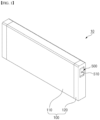
- FIG. 1 is a perspective view of a prismatic secondary battery 10 according to one embodiment of the present invention
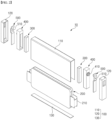
- FIG. 2 is an exploded perspective view of the prismatic secondary battery 10 in FIG. 1 .
- the prismatic secondary battery 10 of the present invention includes a metal case and at least one battery cell 200 accommodated in the case.
- the battery cell 200 in the illustrated embodiment is a pouch-type battery cell 200 with a bidirectional terminal in which electrode leads 210 respectively protrude on both sides in a width direction, and two pouch-type battery cells 200 are stored in the case.
- the case may be manufacturing by extruding and molding a metal material such as aluminum, stainless steel, an alloy including the same, or the like.
- the case in consideration of easy storage of the battery cells 200, costs of extrusion molding, and the like, the case is formed of a main case 110 having a cross section shaped like the lowercase English alphabet letter "n" and a lower plate 130 coupled to a lower opening.
- the prismatic secondary battery 10 of the present invention includes a cooling unit 300 disposed at at least one side of the case, and a fixing body 400 which fixes the cooling unit 300 to the case.
- the cooling unit 300 cools high-temperature gas generated in the battery cells 200 overheated by a thermal runaway phenomenon to an ignition temperature or lower before discharging the high-temperature gas to the outside.
- the cooling unit 300 operates in an emergency situation in which the high-temperature gas is generated by the thermal runaway phenomenon, and should fully maintain the cooling function in normal conditions.
- the cooling unit 300 includes an absorbent material 310 impregnated with a liquid vaporized by heat generated in the battery cells 200, and a thermally conductive body 320 formed with an insertion hole 322 into which the absorbent material 310 is inserted.
- the liquid impregnated in the absorbent material 310 absorbs heat corresponding to sensible heat and latent heat due to heat generated in the overheated battery cells 200, in other words, heat of the high-temperature gas, and in this process, the temperature of the high-temperature gas drops.
- the thermally conductive body 320 including the built-in absorbent material 310 in the insertion hole 322, is a structure that supports the absorbent material 310, and at the same time, serves to dissipate the heat absorbed by the absorbent material 310 to the surroundings.
- the time for the liquid in the absorbent material 310 to be vaporized is delayed as the thermally conductive body 320 dissipates heat to the surroundings, and accordingly, a heat absorption action of the liquid is maintained for a long time.
- the fixing body 400 serves to fix the cooling unit 300 to the case, and includes a vent hole 410 which guides gas generated in the battery cells 200 and passing through the cooling unit 300 to the outside of the case. Since a front surface and a back surface of the cooling unit 300 fixed to the fixing body 400 (with respect to a flow direction of the high-temperature gas) are not blocked, and a gap is formed between the back surface of the cooling unit 300, which enters the inside of the fixing body 400, and the vent hole 410, the flow of gas is not hindered.
- the absorbent material 310 may be an absorbent material 310 including a super absorbent matrix, for example, a super absorbent polymer (SAP) or a super absorbent fiber (SAF).
- a super absorbent matrix for example, a super absorbent polymer (SAP) or a super absorbent fiber (SAF).
- SAP super absorbent polymer
- SAF super absorbent fiber
- the super absorbent matrix is porous or fibrous and may absorb a large amount of liquid by expressing a capillary phenomenon, and the super absorbent fiber may be manufactured in a fiber form such as a nonwoven fabric by processing the super absorbent polymer.
- the type of acrylic acid copolymer used as the super absorbent polymer is not specifically limited, but preferably, the super absorbent polymer may be a copolymer including an acrylic acid monomer and at least one comonomer selected from the group consisting of maleic acid, itaconic acid, acrylamide, 2-acrylamide-2-methylpropanesulfonic acid, 2-(meth)acryloylethanesulfonic acid, 2-hydroxyethyl(meth)acrylate, and styrenesulfonic acid.
- the super absorbent polymer may have a water absorption amount of 10 g/g to 500 g/g, preferably 50 g/g to 200 g/g, but is not limited thereto. That is, 10 g to 500 g of water, preferably 50 g to 200 g, may be absorbed per 1 g of super absorbent polymer.
- the duration of a cooling effect may be improved as the water absorption amount of the super absorbent polymer is large, but when the water absorption amount exceeds 500 g/g, fluidity of the super absorbent polymer increases and thus it becomes difficult to maintain its form, making effective cooling impossible, and when the water absorption amount is smaller than 10 g/g, the duration of the cooling effect is too short and thus efficiency may be poor.
- the liquid impregnated in the absorbent material 310 may be water.
- Water is a substance with the greatest sensible heat and latent heat among readily available liquids. Accordingly, the water impregnated in the absorbent material 310 absorbs a large amount of heat during a process of a phase change from liquid to gas, and thus is suitable to be applied to the cooling unit 300 of the present invention.
- the cooling unit 300 may include a cover 330 bonded to each of the front and back of the thermally conductive body 320 with respect to a flow direction of the gas which is generated in the battery cells 200 and moves to the vent hole 410 of the fixing body 400.
- the cover 330 is a membrane member for preventing the liquid impregnated in the absorbent material 310 from being lost due to natural evaporation, and is melted by the heat of the gas introduced into the cooling unit 300 to expose the absorbent material 310 at an appropriate time.
- the electrode lead 210 of the battery cell 200 may protrude in a direction toward one side of the case where the cooling unit 300 is disposed. Since the electrode lead 210 is a component in which current is concentrated and overheating easily occurs, there is an advantage in that the high-temperature gas is immediately cooled and discharged when the electrode lead 210 is disposed to face the cooling unit 300.
- the prismatic secondary battery 10 of the present invention may include a side case 120 coupled to one side end portion of the case, that is, a side surface of the main case 110, to cover the fixing body 400, and a busbar 500 provided between the fixing body 400 and the side case 120.
- the busbar 500 is a component electrically connected to the electrode lead 210, and is partially exposed to the outside through a cut portion of the side case 120.
- the busbar 500 When the busbar 500 is disposed in the side case 120, the busbar 500 may block the vent hole 410 of the fixing body 400. In this case, a busbar hole 510 that communicates with the vent hole 410 and is open toward the outside of the side case 120 is formed in the busbar 500.
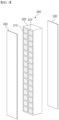
- FIG. 5 is a view illustrating a cooling unit 300 according to a second embodiment of the present invention
- FIG. 6 is a view illustrating a state in which an end filter 420 is provided in a vent hole 410 in the second embodiment of the present invention.
- a filter means is installed in the prismatic secondary battery 10, and thus may prevent the discharge of particles included in the high-temperature gas to the outside as they are. Particles exceeding a certain size, which are not sufficiently cooled after passing through the cooling unit 300, may become a high-temperature ignition source to cause an external fire, and the second embodiment of the present invention reduces the risk of fire due to such high-temperature particles.
- the second embodiment includes any one or more of two filter means.
- the cooling unit 300 includes a filter 340 which is disposed at at least one of the front and back of a thermally conductive body 320 with respect to a flow direction of the gas, which is generated in battery cells 200 and moves to the vent hole 410, and filters the particles exceeding a certain size included in the gas
- the filter 340 is installed at the front and/or the back of the thermally conductive body 320 to filter the particles in the gas flowing into and out of the cooling unit 300.
- a membrane member for preventing the loss of a liquid impregnated in the absorbent material 310 may be integrally laminated on the filter 340, and the membrane member may be melted and removed by the heat of the gas like the above-described cover 330.
- an end filter 420 which filters the particles exceeding a certain size included in the gas passing through the cooling unit 300 may be provided in the vent hole 410 of the fixing body 400.
- the end filter 420 of the vent hole 410 serves to secondarily filter the particles.
- the filter 340 of the cooling unit 300 and the end filter 420 of the vent hole 410 may be designed to filter particles of different sizes.
- the filter 340 of the cooling unit 300 having a relatively large area may be configured to filter particles of a relatively smaller size.
- FIG. 7 is a side perspective view illustrating the cooling unit 300 and the vent hole 410 including the end filter 420, and the embodiment in FIG. 7 shows a state in which both the filter 340 of the cooling unit 300 and the end filter 420 of the vent hole 410 are provided.
- FIG. 7 illustrates that a heat absorbing pouch 600 is interposed between two pouch-type battery cells 200.
- the heat absorbing pouch 600 has a built-in absorbent material that is the same as or similar to the absorbent material 310 provided in the cooling unit 300, and directly comes into contact with the battery cell 200 to generate a heat absorption action.
- the heat absorbing pouch 600 may include a weak portion whose strength (joint strength, tensile strength, or the like) is locally low. The liquid in the absorbent material absorbs heat and is vaporized, and the weak portion is broken by the internal pressure raised by the gas, causing a strong cooling and/or fire extinguishing action by ejecting high-pressure gas.
- the end filter 420 may be broken, or separated from the vent hole 410.
- the structure of the prismatic secondary battery 10 may collapse as the pressure in the case rises above its limit.
- the strength or structure of the end filter 420 may be designed so that the end filter 420 itself is broken or the end filter 420 may be separated from the vent hole 410 when excessive pressure is applied.
- FIG. 8 is a view illustrating the structure in which the end filter 420 may be separated by excessive internal pressure
- the illustrated structure is a structure in which a notch is formed in a protrusion 422, which fixes the end filter 420, so that when a pressure exceeding a certain value is applied, the protrusion 422 is broken, and thus the end filter 420 is discharged to the outside.
Landscapes
- Chemical & Material Sciences (AREA)
- Chemical Kinetics & Catalysis (AREA)
- Electrochemistry (AREA)
- General Chemical & Material Sciences (AREA)
- Engineering & Computer Science (AREA)
- Manufacturing & Machinery (AREA)
- Inorganic Chemistry (AREA)
- Secondary Cells (AREA)
- Gas Exhaust Devices For Batteries (AREA)
- Battery Mounting, Suspending (AREA)
- Connection Of Batteries Or Terminals (AREA)
Applications Claiming Priority (2)
| Application Number | Priority Date | Filing Date | Title |
|---|---|---|---|
| KR1020220061752A KR20230162850A (ko) | 2022-05-20 | 2022-05-20 | 각형 이차전지 |
| PCT/KR2023/006678 WO2023224384A1 (fr) | 2022-05-20 | 2023-05-17 | Batterie secondaire prismatique |
Publications (2)
| Publication Number | Publication Date |
|---|---|
| EP4336626A1 true EP4336626A1 (fr) | 2024-03-13 |
| EP4336626A4 EP4336626A4 (fr) | 2024-10-16 |
Family
ID=88835787
Family Applications (1)
| Application Number | Title | Priority Date | Filing Date |
|---|---|---|---|
| EP23807903.2A Pending EP4336626A4 (fr) | 2022-05-20 | 2023-05-17 | Batterie secondaire prismatique |
Country Status (6)
| Country | Link |
|---|---|
| US (1) | US20240387917A1 (fr) |
| EP (1) | EP4336626A4 (fr) |
| JP (1) | JP7714697B2 (fr) |
| KR (1) | KR20230162850A (fr) |
| CN (1) | CN117501516A (fr) |
| WO (1) | WO2023224384A1 (fr) |
Cited By (1)
| Publication number | Priority date | Publication date | Assignee | Title |
|---|---|---|---|---|
| EP4675772A1 (fr) * | 2024-07-03 | 2026-01-07 | Samsung Sdi Co., Ltd. | Batterie secondaire |
Families Citing this family (1)
| Publication number | Priority date | Publication date | Assignee | Title |
|---|---|---|---|---|
| WO2025178316A1 (fr) * | 2024-02-22 | 2025-08-28 | 주식회사 엘지에너지솔루션 | Élément de batterie et module de batterie comprenant celui-ci |
Family Cites Families (21)
| Publication number | Priority date | Publication date | Assignee | Title |
|---|---|---|---|---|
| JP5378670B2 (ja) * | 2006-10-13 | 2013-12-25 | パナソニック株式会社 | 電池パック |
| WO2010058587A1 (fr) * | 2008-11-21 | 2010-05-27 | パナソニック株式会社 | Bloc-batterie |
| JP5744600B2 (ja) * | 2011-03-31 | 2015-07-08 | 株式会社Gsユアサ | 二次電池システム |
| KR101270796B1 (ko) | 2011-06-20 | 2013-06-05 | 세방전지(주) | 안전장치가 구비된 배터리 |
| KR20150031611A (ko) * | 2013-09-16 | 2015-03-25 | 주식회사 엘지화학 | 가스의 선택적 투과를 위한 벤팅 부재를 포함하고 있는 전지팩 |
| JP2015135749A (ja) * | 2014-01-17 | 2015-07-27 | 栗田工業株式会社 | リチウムイオン電池、及びこれを用いた電子機器 |
| US9853267B2 (en) * | 2014-02-03 | 2017-12-26 | Ursatech Ltd. | Intumescent battery housing |
| BR112017003400B1 (pt) * | 2014-08-26 | 2022-01-11 | Nochar, Inc | Recipiente de transporte que tem uma camada de retardante de chama e uma camada de bloqueio térmico |
| EP3333934B1 (fr) * | 2015-10-28 | 2023-01-25 | Murata Manufacturing Co., Ltd. | Boîtier de dispositif électrique et bloc-batterie le comprenant |
| KR20180006150A (ko) * | 2016-07-08 | 2018-01-17 | 주식회사 엘지화학 | 안전성이 개선된 셀 모듈 어셈블리 및 이를 위한 팩 구조물 |
| KR102075101B1 (ko) * | 2016-08-10 | 2020-03-02 | 주식회사 엘지화학 | 냉각 구조가 개선된 배터리 팩 |
| US20190173074A1 (en) * | 2017-12-04 | 2019-06-06 | Kabushiki Kaisha Toshiba | Battery |
| DE102018105530A1 (de) * | 2018-03-09 | 2019-09-26 | Stöbich Technology Gmbh | Akku-Transportvorrichtung für einen Akkumulator |
| WO2020049249A1 (fr) * | 2018-09-04 | 2020-03-12 | Exoes | Systeme de refroidissement d'au moins un module electrique comprenant une pluralite de cellules de batteries immergees dans un fluide dielectrique |
| US20200112009A1 (en) * | 2018-10-04 | 2020-04-09 | Sargent Manufacturing Company | Electrochemical cell enclosure including a flame arrestor |
| WO2021005812A1 (fr) * | 2019-07-05 | 2021-01-14 | 栗田工業株式会社 | Structure de dispositif de stockage d'énergie |
| DE102019118905A1 (de) * | 2019-07-12 | 2021-01-14 | Carl Freudenberg Kg | Kühlsystem und Energiespeicher mit einem Kühlsystem |
| CN112310552B (zh) * | 2020-02-28 | 2023-01-31 | 宁德时代新能源科技股份有限公司 | 防爆阀、电池组及装置 |
| US12609409B2 (en) * | 2020-03-31 | 2026-04-21 | Panasonic Intellectual Property Management Co., Ltd. | Battery pack |
| JP7549733B2 (ja) * | 2020-10-19 | 2024-09-11 | ジアンス・コンテンポラリー・アンプレックス・テクノロジー・リミテッド | 電池、受電装置、電池を作製する方法及び設備 |
| KR102859337B1 (ko) | 2020-11-06 | 2025-09-11 | 삼성전자주식회사 | 플렉서블 디스플레이를 제어하는 방법 및 전자 장치 |
-
2022
- 2022-05-20 KR KR1020220061752A patent/KR20230162850A/ko active Pending
-
2023
- 2023-05-17 CN CN202380012391.6A patent/CN117501516A/zh active Pending
- 2023-05-17 WO PCT/KR2023/006678 patent/WO2023224384A1/fr not_active Ceased
- 2023-05-17 US US18/570,461 patent/US20240387917A1/en active Pending
- 2023-05-17 JP JP2023576408A patent/JP7714697B2/ja active Active
- 2023-05-17 EP EP23807903.2A patent/EP4336626A4/fr active Pending
Cited By (1)
| Publication number | Priority date | Publication date | Assignee | Title |
|---|---|---|---|---|
| EP4675772A1 (fr) * | 2024-07-03 | 2026-01-07 | Samsung Sdi Co., Ltd. | Batterie secondaire |
Also Published As
| Publication number | Publication date |
|---|---|
| JP7714697B2 (ja) | 2025-07-29 |
| US20240387917A1 (en) | 2024-11-21 |
| JP2024528783A (ja) | 2024-08-01 |
| EP4336626A4 (fr) | 2024-10-16 |
| CN117501516A (zh) | 2024-02-02 |
| WO2023224384A1 (fr) | 2023-11-23 |
| KR20230162850A (ko) | 2023-11-29 |
Similar Documents
| Publication | Publication Date | Title |
|---|---|---|
| EP4329048B1 (fr) | Batterie secondaire prismatique | |
| EP4336626A1 (fr) | Batterie secondaire prismatique | |
| JP7636104B2 (ja) | 二次電池用吸熱パウチアセンブリ | |
| JP7775339B2 (ja) | 冷却性能が強化されたバッテリーパック | |
| EP4489185A1 (fr) | Module de batterie secondaire à stabilité de température intérieure de module améliorée | |
| EP4322288A1 (fr) | Batterie secondaire prismatique avec absorbeur de chaleur intégré dans celle-ci | |
| KR20230153919A (ko) | 흡열체를 내장하는 각형 이차전지 | |
| EP4318739A1 (fr) | Bloc-batterie | |
| EP4468497B1 (fr) | Bloc-batterie ayant un conduit de ventilation à couvercle intégré | |
| CN117378082A (zh) | 内嵌有吸热器的棱柱形二次电池 | |
| KR20230148731A (ko) | 배터리 팩 | |
| KR20240010866A (ko) | 배터리 팩 | |
| KR102957609B1 (ko) | 냉각성능이 강화된 배터리 팩 | |
| EP4336630A1 (fr) | Batterie secondaire à sécurité améliorée | |
| CN117296188A (zh) | 电池组 |
Legal Events
| Date | Code | Title | Description |
|---|---|---|---|
| STAA | Information on the status of an ep patent application or granted ep patent |
Free format text: STATUS: THE INTERNATIONAL PUBLICATION HAS BEEN MADE |
|
| PUAI | Public reference made under article 153(3) epc to a published international application that has entered the european phase |
Free format text: ORIGINAL CODE: 0009012 |
|
| STAA | Information on the status of an ep patent application or granted ep patent |
Free format text: STATUS: REQUEST FOR EXAMINATION WAS MADE |
|
| 17P | Request for examination filed |
Effective date: 20231207 |
|
| AK | Designated contracting states |
Kind code of ref document: A1 Designated state(s): AL AT BE BG CH CY CZ DE DK EE ES FI FR GB GR HR HU IE IS IT LI LT LU LV MC ME MK MT NL NO PL PT RO RS SE SI SK SM TR |
|
| A4 | Supplementary search report drawn up and despatched |
Effective date: 20240916 |
|
| RIC1 | Information provided on ipc code assigned before grant |
Ipc: H01M 50/202 20210101ALI20240910BHEP Ipc: H01M 50/375 20210101ALI20240910BHEP Ipc: H01M 50/30 20210101ALI20240910BHEP Ipc: H01M 50/24 20210101ALI20240910BHEP Ipc: H01M 50/273 20210101ALI20240910BHEP Ipc: H01M 50/224 20210101ALI20240910BHEP Ipc: H01M 50/211 20210101ALI20240910BHEP Ipc: H01M 10/613 20140101ALI20240910BHEP Ipc: H01M 10/6553 20140101ALI20240910BHEP Ipc: H01M 10/6567 20140101ALI20240910BHEP Ipc: H01M 10/6569 20140101ALI20240910BHEP Ipc: H01M 10/647 20140101AFI20240910BHEP |
|
| STAA | Information on the status of an ep patent application or granted ep patent |
Free format text: STATUS: EXAMINATION IS IN PROGRESS |
|
| 17Q | First examination report despatched |
Effective date: 20250527 |
|
| DAV | Request for validation of the european patent (deleted) | ||
| DAX | Request for extension of the european patent (deleted) | ||
| REG | Reference to a national code |
Ref country code: DE Ref legal event code: R079 Free format text: PREVIOUS MAIN CLASS: H01M0010647000 Ipc: H01M0010656900 |
|
| GRAP | Despatch of communication of intention to grant a patent |
Free format text: ORIGINAL CODE: EPIDOSNIGR1 |
|
| STAA | Information on the status of an ep patent application or granted ep patent |
Free format text: STATUS: GRANT OF PATENT IS INTENDED |
|
| RIC1 | Information provided on ipc code assigned before grant |
Ipc: H01M 10/6569 20140101AFI20260310BHEP Ipc: H01M 50/103 20210101ALI20260310BHEP Ipc: H01M 10/6553 20140101ALI20260310BHEP Ipc: H01M 50/273 20210101ALI20260310BHEP Ipc: H01M 10/647 20140101ALI20260310BHEP Ipc: H01M 50/202 20210101ALI20260310BHEP Ipc: H01M 50/375 20210101ALI20260310BHEP Ipc: H01M 50/30 20210101ALI20260310BHEP Ipc: H01M 50/24 20210101ALI20260310BHEP Ipc: H01M 10/613 20140101ALI20260310BHEP Ipc: H01M 50/224 20210101ALI20260310BHEP Ipc: H01M 50/211 20210101ALI20260310BHEP Ipc: H01M 10/6567 20140101ALI20260310BHEP Ipc: H01M 10/6556 20140101ALN20260310BHEP |