EP4337556B1 - Emballage destiné à recevoir des cigarettes ou des bâtonnets de tabac, doté d'un récipient intégré destiné à recevoir des mégots de cigarettes ou des bâtonnets de tabac usagés - Google Patents
Emballage destiné à recevoir des cigarettes ou des bâtonnets de tabac, doté d'un récipient intégré destiné à recevoir des mégots de cigarettes ou des bâtonnets de tabac usagés Download PDFInfo
- Publication number
- EP4337556B1 EP4337556B1 EP22729065.7A EP22729065A EP4337556B1 EP 4337556 B1 EP4337556 B1 EP 4337556B1 EP 22729065 A EP22729065 A EP 22729065A EP 4337556 B1 EP4337556 B1 EP 4337556B1
- Authority
- EP
- European Patent Office
- Prior art keywords
- telescopic element
- pack
- cigarettes
- telescopic
- tobacco sticks
- Prior art date
- Legal status (The legal status is an assumption and is not a legal conclusion. Google has not performed a legal analysis and makes no representation as to the accuracy of the status listed.)
- Active
Links
Images



Classifications
-
- B—PERFORMING OPERATIONS; TRANSPORTING
- B65—CONVEYING; PACKING; STORING; HANDLING THIN OR FILAMENTARY MATERIAL
- B65D—CONTAINERS FOR STORAGE OR TRANSPORT OF ARTICLES OR MATERIALS, e.g. BAGS, BARRELS, BOTTLES, BOXES, CANS, CARTONS, CRATES, DRUMS, JARS, TANKS, HOPPERS, FORWARDING CONTAINERS; ACCESSORIES, CLOSURES, OR FITTINGS THEREFOR; PACKAGING ELEMENTS; PACKAGES
- B65D85/00—Containers, packaging elements or packages, specially adapted for particular articles or materials
- B65D85/07—Containers, packaging elements or packages, specially adapted for particular articles or materials for compressible or flexible articles
- B65D85/08—Containers, packaging elements or packages, specially adapted for particular articles or materials for compressible or flexible articles rod-shaped or tubular
- B65D85/10—Containers, packaging elements or packages, specially adapted for particular articles or materials for compressible or flexible articles rod-shaped or tubular for cigarettes
- B65D85/1081—Inserts or accessories added or joined to the container, e.g. coins, pens, cards, spacers
-
- A—HUMAN NECESSITIES
- A24—TOBACCO; CIGARS; CIGARETTES; SIMULATED SMOKING DEVICES; SMOKERS' REQUISITES
- A24F—SMOKERS' REQUISITES; MATCH BOXES; SIMULATED SMOKING DEVICES
- A24F15/00—Receptacles or boxes specially adapted for cigars, cigarettes, simulated smoking devices or cigarettes therefor
- A24F15/12—Receptacles or boxes specially adapted for cigars, cigarettes, simulated smoking devices or cigarettes therefor for pocket use
- A24F15/18—Receptacles or boxes specially adapted for cigars, cigarettes, simulated smoking devices or cigarettes therefor for pocket use combined with other objects
-
- B—PERFORMING OPERATIONS; TRANSPORTING
- B65—CONVEYING; PACKING; STORING; HANDLING THIN OR FILAMENTARY MATERIAL
- B65D—CONTAINERS FOR STORAGE OR TRANSPORT OF ARTICLES OR MATERIALS, e.g. BAGS, BARRELS, BOTTLES, BOXES, CANS, CARTONS, CRATES, DRUMS, JARS, TANKS, HOPPERS, FORWARDING CONTAINERS; ACCESSORIES, CLOSURES, OR FITTINGS THEREFOR; PACKAGING ELEMENTS; PACKAGES
- B65D21/00—Nestable, stackable or joinable containers; Containers of variable capacity
- B65D21/08—Containers of variable capacity
- B65D21/086—Collapsible or telescopic containers
-
- B—PERFORMING OPERATIONS; TRANSPORTING
- B65—CONVEYING; PACKING; STORING; HANDLING THIN OR FILAMENTARY MATERIAL
- B65D—CONTAINERS FOR STORAGE OR TRANSPORT OF ARTICLES OR MATERIALS, e.g. BAGS, BARRELS, BOTTLES, BOXES, CANS, CARTONS, CRATES, DRUMS, JARS, TANKS, HOPPERS, FORWARDING CONTAINERS; ACCESSORIES, CLOSURES, OR FITTINGS THEREFOR; PACKAGING ELEMENTS; PACKAGES
- B65D85/00—Containers, packaging elements or packages, specially adapted for particular articles or materials
- B65D85/07—Containers, packaging elements or packages, specially adapted for particular articles or materials for compressible or flexible articles
- B65D85/08—Containers, packaging elements or packages, specially adapted for particular articles or materials for compressible or flexible articles rod-shaped or tubular
- B65D85/10—Containers, packaging elements or packages, specially adapted for particular articles or materials for compressible or flexible articles rod-shaped or tubular for cigarettes
- B65D85/1018—Container formed by a flexible material, i.e. soft-packages
- B65D85/1027—Opening devices
-
- B—PERFORMING OPERATIONS; TRANSPORTING
- B65—CONVEYING; PACKING; STORING; HANDLING THIN OR FILAMENTARY MATERIAL
- B65D—CONTAINERS FOR STORAGE OR TRANSPORT OF ARTICLES OR MATERIALS, e.g. BAGS, BARRELS, BOTTLES, BOXES, CANS, CARTONS, CRATES, DRUMS, JARS, TANKS, HOPPERS, FORWARDING CONTAINERS; ACCESSORIES, CLOSURES, OR FITTINGS THEREFOR; PACKAGING ELEMENTS; PACKAGES
- B65D85/00—Containers, packaging elements or packages, specially adapted for particular articles or materials
- B65D85/07—Containers, packaging elements or packages, specially adapted for particular articles or materials for compressible or flexible articles
- B65D85/08—Containers, packaging elements or packages, specially adapted for particular articles or materials for compressible or flexible articles rod-shaped or tubular
- B65D85/10—Containers, packaging elements or packages, specially adapted for particular articles or materials for compressible or flexible articles rod-shaped or tubular for cigarettes
- B65D85/1036—Containers formed by erecting a rigid or semi-rigid blank
- B65D85/1045—Containers formed by erecting a rigid or semi-rigid blank having a cap-like lid hinged to an edge
-
- B—PERFORMING OPERATIONS; TRANSPORTING
- B65—CONVEYING; PACKING; STORING; HANDLING THIN OR FILAMENTARY MATERIAL
- B65D—CONTAINERS FOR STORAGE OR TRANSPORT OF ARTICLES OR MATERIALS, e.g. BAGS, BARRELS, BOTTLES, BOXES, CANS, CARTONS, CRATES, DRUMS, JARS, TANKS, HOPPERS, FORWARDING CONTAINERS; ACCESSORIES, CLOSURES, OR FITTINGS THEREFOR; PACKAGING ELEMENTS; PACKAGES
- B65D85/00—Containers, packaging elements or packages, specially adapted for particular articles or materials
- B65D85/07—Containers, packaging elements or packages, specially adapted for particular articles or materials for compressible or flexible articles
- B65D85/08—Containers, packaging elements or packages, specially adapted for particular articles or materials for compressible or flexible articles rod-shaped or tubular
- B65D85/10—Containers, packaging elements or packages, specially adapted for particular articles or materials for compressible or flexible articles rod-shaped or tubular for cigarettes
- B65D85/1036—Containers formed by erecting a rigid or semi-rigid blank
- B65D85/1045—Containers formed by erecting a rigid or semi-rigid blank having a cap-like lid hinged to an edge
- B65D85/1056—Containers formed by erecting a rigid or semi-rigid blank having a cap-like lid hinged to an edge characterized by the lid
-
- B—PERFORMING OPERATIONS; TRANSPORTING
- B65—CONVEYING; PACKING; STORING; HANDLING THIN OR FILAMENTARY MATERIAL
- B65D—CONTAINERS FOR STORAGE OR TRANSPORT OF ARTICLES OR MATERIALS, e.g. BAGS, BARRELS, BOTTLES, BOXES, CANS, CARTONS, CRATES, DRUMS, JARS, TANKS, HOPPERS, FORWARDING CONTAINERS; ACCESSORIES, CLOSURES, OR FITTINGS THEREFOR; PACKAGING ELEMENTS; PACKAGES
- B65D2205/00—Venting means
- B65D2205/02—Venting holes
-
- B—PERFORMING OPERATIONS; TRANSPORTING
- B65—CONVEYING; PACKING; STORING; HANDLING THIN OR FILAMENTARY MATERIAL
- B65D—CONTAINERS FOR STORAGE OR TRANSPORT OF ARTICLES OR MATERIALS, e.g. BAGS, BARRELS, BOTTLES, BOXES, CANS, CARTONS, CRATES, DRUMS, JARS, TANKS, HOPPERS, FORWARDING CONTAINERS; ACCESSORIES, CLOSURES, OR FITTINGS THEREFOR; PACKAGING ELEMENTS; PACKAGES
- B65D2209/00—Provisions for used articles
-
- B—PERFORMING OPERATIONS; TRANSPORTING
- B65—CONVEYING; PACKING; STORING; HANDLING THIN OR FILAMENTARY MATERIAL
- B65D—CONTAINERS FOR STORAGE OR TRANSPORT OF ARTICLES OR MATERIALS, e.g. BAGS, BARRELS, BOTTLES, BOXES, CANS, CARTONS, CRATES, DRUMS, JARS, TANKS, HOPPERS, FORWARDING CONTAINERS; ACCESSORIES, CLOSURES, OR FITTINGS THEREFOR; PACKAGING ELEMENTS; PACKAGES
- B65D2313/00—Connecting or fastening means
- B65D2313/04—Connecting or fastening means of magnetic type
Definitions
- the invention relates to a pack for holding cigarettes or tobacco sticks with an integrated container for holding cigarette butts or used tobacco sticks.
- the invention further relates to a kit comprising such a pack and a sales package.
- cigarette packs with an integrated container for cigarette butts are known. Such packs are used, for example, in the US 5,799,781 (WE Arthur ), the US 2002/0020640 A1 (G. Garcia ) , the US 2019/177077 A1 (A. Livigni et al. ) and the DE 296 19 233 (W. Kämpfert ).
- the corresponding solutions are complicated in structure and operation.
- the object of the invention is therefore to create a pack belonging to the technical field mentioned at the outset for holding cigarettes or tobacco sticks with an integrated container for holding cigarette butts or used tobacco sticks, which is simple in its construction and in its operation.
- the pack comprises a first telescopic element and a second telescopic element which is displaceably mounted in the first telescopic element, wherein the first telescopic element or the second telescopic element has an opening in a lateral surface which is arranged such that it is closed in a first relative position of the first telescopic element and the second telescopic element and is open in a second relative position of the first telescopic element and the second telescopic element, so that a first receiving space for cigarette butts or spent tobacco sticks is accessible.
- the first telescopic element and/or the second telescopic element at least partially enclose a second receiving space for cigarettes or tobacco sticks which is separated from the first receiving space.
- the first receiving space of the pack according to the invention is therefore suitable for receiving conventional cigarette butts and/or used tobacco sticks (or tobacco pens) for use with electric cigarettes (e-cigarettes) with corresponding heating systems.
- the telescopic elements exhibit a certain degree of dimensional stability, so that they retain their predetermined shape—except when certain predetermined forces are applied.
- the telescopic elements are preferably shaped and dimensioned in such a way that relative displacement in both directions is possible without additional bearing elements, as the outer surface of the telescopic elements slides against each other.
- the sliding movement can be supported by suitable coatings if necessary.
- the relative movement of the two telescopic elements allows the total storage space (and thus the external volume) of the package to be enlarged as needed through a linear extension. This results in simple operation. Two of the three dimensions of the container (e.g., the width and length of a cuboid container) remain unchanged even when the telescopic elements are moved relative to each other.
- the solution with two telescopic elements is also structurally simple, enabling cost-effective production.
- the package according to the invention has exactly one telescopic stage, i.e., there is exactly one first telescopic element and one second telescopic element, which are displaceable relative to each other.
- Alternative embodiments with two or more telescopic stages are possible. This allows—with increased complexity—in particular to increase the possible extension path and thus the possible volume of the first receiving space.
- the opening can be closed in such a way that an odor barrier is formed. This prevents unpleasant odors caused by cigarette butts stored in the first receiving space. Furthermore, the opening is preferably closed in such a way that it seals off air from the outside, so that still-smoldering butts or cigarette sticks are reliably smothered. In preferred embodiments, the opening closure can be designed such that it is essentially airtight when closed.
- the telescopic elements can be equipped with valves to facilitate relative movement.
- a (one-way) valve that allows air to escape from the first receiving chamber to the outside can support the retraction or extension movement.
- Such a valve would, of course, have to be equipped with a corresponding filter to To avoid unpleasant odors, it is also conceivable to use a valve that remains open during the sliding or opening process and automatically closes after the process is completed.
- the increase in volume of the first receiving chamber can be facilitated by a (one-way) valve that allows air to enter from the outside.
- a (one-way) valve that allows air to enter from the outside.
- the valve it is advisable for the valve to be closed in the normal state to prevent oxygen from entering.
- valves are required: For example, if the corresponding closure is designed in such a way that the airtight closure only occurs after the device has been fully inserted or opened, and the opening already occurs at the beginning of the extension process, no valves are necessary.
- the second telescopic element is essentially completely accommodated in the first telescopic element in the first relative position.
- the second telescopic element is invisible from the outside, at least along the casing, i.e., completely concealed by the first telescopic element.
- the package according to the invention is thus identical in shape to conventional packages, which has the advantage, among other things, that handling, e.g., by machines or vending machines, is identical and multiple packages can be packaged in the same way as conventional packages.
- the package according to the invention also has a (practically) identical external appearance.
- the volume of the first receiving chamber can be significantly varied. For example, in the first relative position, it is practically zero, while in a second, fully extended relative position, several cigarette butts can be accommodated in the first receiving chamber. After filling with a (further) cigarette butt or tobacco stick, the telescopic elements are retracted until the opening is securely closed. However, it will no longer be possible to fully insert the cigarette butt(s) picked up, ie the second telescopic element will protrude slightly beyond the first telescopic element.
- the volume of the first receiving space in a first (empty) configuration is less than 5 cm 3 and the volume in the second, closed but filled configuration is at least 15 cm 3 , preferably at least 25 cm 3 .
- This preferably allows several cigarette butts (or tobacco sticks) to be received in the container at the same time until it can be emptied at a suitable location.
- a small volume of the pack is made possible, in particular a volume that corresponds to the volume of a standard pack, while in the second configuration sufficient space is created to accommodate a certain number of cigarette butts or tobacco sticks while at the same time providing a secure closure.
- the pack according to the invention is thus capable of accommodating a certain number of cigarette butts or tobacco sticks, but its actual volume is always as small as possible, which is advantageous both from an aesthetic point of view and in terms of handling.
- the opening in the first relative position is closed by a surface of the other telescopic element that is parallel to the corresponding surface and in contact with it over a large area.
- the design is extremely simple to implement because additional sealing elements are unnecessary.
- the sealing of the closed opening can still be supported by sealing lips, which are arranged in particular on the interacting telescopic elements.
- Operation is also extremely simple, as the opening is automatically sealed when the telescopic elements are moved from the second relative position to the first relative position. This does not require the telescopic elements to complete the entire transition from the fully open position to the fully open position. retracted position; a partial transition may be sufficient. Similarly, when the telescopic elements are moved in one direction from the first relative position to the second relative position, the opening opens automatically; here, too, passing through only a partial transition may be sufficient. The user therefore does not have to worry about opening and closing the opening separately. Furthermore, it is ensured that the opening is always closed in the normal state.
- the opening is formed in the second telescopic element, wherein the second telescopic element is box-like with a closed bottom, and wherein the first telescopic element is box-like with an open bottom.
- Box-like here means that the elements are formed with relatively thin walls, in particular from a folded sheet of material, e.g., paper or cardboard; in particular, materials commonly used for the production of cigarette packs are used. This enables cost-effective production, even for disposable packaging.
- the formation of the opening in the second telescopic element prevents material from becoming trapped between the telescopic elements and is aesthetically advantageous because the opening is not visible when closed.
- the elements are made of a more durable material, e.g., metal, plastic, or hard cardboard. Novel dimensionally stable yet biodegradable materials such as bioplastics, cellulose composites, etc., can also be advantageously used.
- the package according to the invention can be readily used in multiple ways.
- the elements can be fully or partially magnetized or made of a ferromagnetic material, allowing the box to be easily used with magnetic accessories.
- a multi-use pack it is advantageous if the cigarettes or tobacco sticks can be purchased loose or in a material-saving sales packaging and inserted into the pack according to the invention.
- an advantageous kit comprises, in addition to the pack according to the invention, a sales package (single-use package) with cigarettes or tobacco sticks.
- the sales package consists in particular partially of a flexible film material.
- the sales package is advantageously designed such that it can be inserted, with the cigarettes or tobacco sticks accommodated therein, into the second receiving space of the pack according to the invention, in particular a reusable pack, and/or that cigarettes or tobacco sticks accommodated therein can be inserted from the sales package into the second receiving space.
- "Suitably insertable" here means that the cigarettes or tobacco sticks are already accommodated in the sales package in an arrangement that corresponds to the arrangement in the second receiving space, e.g., parallel in a corresponding number of rows. They can then be easily inserted into the receiving space parallel to their longitudinal axis.
- the material-saving sales packaging can, for example, be made of a suitable film material, such as cellulose hydrate (cellophane).
- a dividing line is formed on the sales packaging so that after insertion into the second receiving space, a first part of the sales packaging can be separated from a second part of the sales packaging and/or the sales packaging can be opened in such a way that it can be removed from the pack while the cigarettes or tobacco sticks remain in the second receiving space.
- the sales packaging and/or a wall of the receiving space for the cigarettes or tobacco sticks can have a holding surface, e.g. an adhesive surface, in order to temporarily hold the part in the pack.
- Steps b) and c) are carried out several times in the sense of a circular process.
- the opening is formed in a main surface of the second telescopic element, i.e., in a lateral surface with maximum extension. Compared to an arrangement on a smaller lateral surface, this results in more convenient operation and improved sealing – the latter because, for a given opening size, a larger surrounding contact area results between the lateral surface with the opening and a cooperating lateral surface of the other telescopic element.
- a lid is arranged on the first telescopic element opposite the open bottom, which lid is used to remove cigarettes or tobacco sticks from the second
- the receiving space can be opened and closed again.
- the lid can be a known hinged lid that is attached to the first telescopic element via a hinge.
- Such lids are particularly easy to implement for packaging made of cardboard.
- other designs can also be used, e.g., sliding lids that can be moved relative to the first telescopic element for opening and closing, particularly in the lid plane.
- the material thickness of the three parts of the pack according to the invention is each a maximum of 60%, preferably a maximum of 40%, of the material thickness of a conventional cigarette pack. It is also possible to produce the inner part in particular with a greatly reduced material thickness: While a box-like design with a certain degree of dimensional stability is preferred, a bag-like variant is also possible for the inner part.
- the inner part is attached to the first telescopic element via a tab that overlaps the second telescopic element in the first relative position.
- the tab can be attached to the base part of the first telescopic element or to a cover arranged on the first telescopic element, in particular to a hinged cover.
- a locking mechanism can be provided that only releases the lid when the second telescopic element assumes a certain extension position.
- a counter-section for the lid is advantageously arranged on the inner part, such that the lid can interact with the counter-section even when the second telescopic element is extended. This allows, in particular, the lid to be held in a closed position.
- the inner part advantageously extends further in the direction of the lid than the second telescopic element in the region of the counter-section (or counter-sections). To nevertheless enable easy ejection of the second telescopic element, it has an actuating section that protrudes at least beyond the first telescopic element.
- the first telescopic element and the second telescopic element have a rectangular cross-section perpendicular to a displacement direction. This results in a simple geometry, moderate friction between the telescopic elements, the use of simple blanks, and straightforward assembly using methods known from the production of paper and cardboard packaging.
- the first telescopic element and/or the second telescopic element are at least partially coated on an inner side with a fire-retardant material.
- a fire-retardant material e.g., paper-based materials.
- base materials e.g., paper-based materials.
- a base material that poses a low fire hazard is used.
- the telescopic elements can essentially form a mechanical support structure, and for the actual first receiving space to be formed by a non-dimensionally stable inner shell, e.g., a bag, made of a fire-retardant material, which is arranged in the telescopic elements and connected to them.
- a non-dimensionally stable inner shell e.g., a bag, made of a fire-retardant material, which is arranged in the telescopic elements and connected to them.
- the package may comprise means for automatically moving the first telescopic element and the second telescopic element in a direction from the second relative position to the first relative position without the action of an external force, so that the The intake volume is automatically minimized, taking into account any cigarette butts or tobacco sticks that are taken up.
- the means are, in particular, spring means or magnetic means. They can be designed as separate elements or integrated into the telescopic elements.
- the packing can be designed to contract into a compressed configuration as soon as the opposing force is removed. However, it can also be designed to remain in an extended configuration until the contraction is triggered, e.g., by a manual release action.
- spring means in particular rubber bands, tension springs, leaf springs and coil or torsion springs essentially surrounding one or more telescopic elements can be used.
- the telescopic elements are moved back and forth between the first and second relative positions by the user. After picking up a cigarette butt, the drawer is pushed back until further retraction is impossible due to the contents of the first receiving space. This also results in a minimal storage volume.
- the Figure 1 is an oblique view of a first embodiment of a cigarette pack according to the invention with an integrated container for holding cigarette butts.
- the cigarette pack 1 consists of a paper material, is essentially cuboid-shaped, and has a rear wall 2, two side walls 3, 4, a front wall 5, and a base 6.
- a pivoting lid 7 is arranged at the upper end of the cigarette pack 1. By opening the lid 7, the interior of the cigarette pack 1 becomes accessible for removing cigarettes.
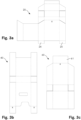
- Cigarette pack 1 is made up of the three Figures 2a-2c shown basic elements, which are shown in the Figure 1 In the assembled state shown, they are telescoped into each other.
- the base 6 is part of an extension 40 (2nd telescopic element; Fig. 2b ), which is relative to the outer part 20 (1st telescopic element; Fig. 2a ) and the inner part 60 ( Fig. 2c ) can be pulled out and pushed in in the longitudinal direction of the cigarette pack 1 (i.e. in a direction perpendicular to the base 6).
- the outer part 20 This has a base part 21, which is rectangular and prismatic in shape. On the upper side, it can be closed by the lid 7, which folds around a hinge. On the lower side, the outer part 20 is open. Two inwardly bent and glued tabs 24, 25 form stops for interaction with the pull-out 40, as described in more detail below.
- the lid 7 is shaped in a conventional manner; therefore, it need not be described in more detail here.
- the extension 40 is also rectangular and prismatic in shape; its outer dimensions are selected so that it can be conveniently moved within the outer part 20 along the longitudinal axes of the base parts.
- the extension 40 has an opening 42 in its front surface 41. This opening has a rectangular shape with rounded corners; its greatest extent is oriented transversely to the longitudinal direction. It is located in a central region of the front surface 41 relative to the longitudinal direction.
- the pull-out 40 has two outwardly bent and glued tabs 44, 45, which in turn form stops for interaction with the tabs 24, 25 of the pull-out 20 as described in more detail below.
- the rear surface of the drawer 40 extends less far upwards from the base 6 than the front surface 41.
- the inner part 60 is again rectangularly prismatic in shape, with the outer dimensions selected so that it can be accommodated in the drawer 40 without hindering its relative movement to the outer part 20 (and the inner part 60).
- the inner part 60 has an outwardly bent tab 61 on its rear side (see. Figure 3c ), with which it is glued to the inside of the rear wall 2 of the outer part 20.
- the inner part 60 forms a receiving space 9 for receiving the cigarettes (or tobacco sticks in the case of corresponding packs).
- the pull-out part 40 When pushed together, as seen from the Figure 1 As can be seen, the pull-out part 40 ends with its base 6 fittingly with the lower end of the outer part 20. The appearance of the pack in this state does not differ from that of known packs.
- the pull-out part 40 can now be pulled or pushed out longitudinally from the other two parts, at most until the stops formed by the tabs 24, 25; 44, 45 of the outer part or the pull-out part interact with one another.
- the pull-out part 40 can be pushed downwards over its rear end with the lid 7 of the pack open, at least until the pushed-out part can be grasped from the outside.
- Pulling it out, in particular with the lid 7 closed, can be made possible or easier by cutting out gripping cutouts at the lower end in the outer part 20, e.g. on its rear wall 2 and its front wall 5, and/or by providing the pull-out part 40 with suitable holding means, e.g. B. a pull tab.
- suitable holding means e.g. B. a pull tab.
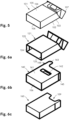
- the opening 42 and thus the receiving space 8 are accessible from the outside (cf. Fig. 4c ), which will be explained in more detail below.
- the opening 42 is closed again by interaction with the outer part 20.
- the outer part 20, the extension 40 and the inner part 60 can each be manufactured from a single piece of material.
- the outer part 20, the extension 40 and the inner part 60 are in the usual manner at the usual places glued together to form box-like elements.
- the pull-out section 40 can be easily inserted into the outer part 20 from above, i.e., from the lid side, without this insertion movement being impeded by the stops on the outer part 20 or on the pull-out section 40.
- the inner part 60 is then also inserted from above into the outer part 20 and the pull-out section 40.
- the inner part 60 is then glued to the outer part 20 via the bent tab 61.
- a fire-retardant coating is applied to the inner surfaces of the drawer 40 and the outer part 20 and the inner part 60 which delimit the receiving space for the cigarette butts.
- the pull-out tray 40 can, if necessary, be completely removed from the pack 1 by exerting increased pulling force, for example if the cigarette butts already collected are to be easily disposed of, in particular together with the pull-out tray 40 when the latter is no longer required.
- the pull-out tray 40 itself or a new pull-out tray (e.g., a reusable pull-out tray made of plastic or metal, for example) can be pushed back into the pack after emptying if necessary.
- the user can also decide from the outset to use their own, reusable pull-out tray instead of the original pull-out tray 40, thus removing the former and replacing it with the latter. Removal of the pull-out tray 40 can be facilitated by suitable perforations, e.g., in the area of the interacting tabs.
- FIG. 4a shows the cigarette pack 1 in the closed state. This corresponds to the delivery state, in which the pack is filled with cigarettes and the compartment for cigarette butts is empty. The lid 7 is still closed. The drawer 40 is fully inserted into the pack 1.
- the lid 7 is opened in a known manner so that the cigarettes in the Figure 4b situation described arises.
- the cigarette butt (and any cigarette butts already previously located in the receiving space 8) is pushed from the inner part 60 to the lower end of the drawer 40, so that after the drawer 40 has been pushed in, a minimal storage volume is ultimately achieved.
- the Figure 5 is an oblique view of a second embodiment of a cigarette pack according to the invention with an integrated container for holding cigarette butts. It corresponds in many respects to the first embodiment; the essential differences are discussed below.
- the cigarette pack 101 consists of a paper material, is essentially cuboid-shaped, with a rear wall 102, two side walls 103, 104, a front wall 105, and a base 106.
- a pivoting lid 107 is arranged at the upper end of the cigarette pack 101. By opening the lid 107, the interior of the cigarette pack 101 becomes accessible for removing cigarettes.
- the cigarette pack 101 is made up of the three Figures 6a-6c shown basic elements, which are shown in the Figure 5 In the assembled state shown, they are telescoped into each other.
- the base 106 is part of an extension 140 (2nd telescopic element; Fig. 6b ), which is relative to the outer part 120 (1st telescopic element; Fig. 6a ) and the inner part 160 ( Fig. 6c ) can be pulled out and pushed in in the longitudinal direction of the cigarette pack 101 (i.e. in a direction perpendicular to the base 106).
- the outer part 120 This has a base part 121, which is rectangular and prismatic in shape. On the upper side, it can be closed by the cover 107, which can be folded around a hinge. On the lower side, the outer part 120 is open. Two Internally bent and glued tabs 124, 125 form stops for interaction with the drawer 140, as described in more detail below.
- the cover 107 is formed in a conventional manner; therefore, it need not be described in more detail here.
- the extension 140 is also rectangularly prismatic in shape; its outer dimensions are selected so that it can be conveniently moved within the outer part 120 along the longitudinal axes of the base parts.
- the extension 140 has an opening 142 in its front surface 141. This opening has a rectangular shape with rounded corners; its greatest extent is oriented transversely to the longitudinal direction. It is arranged in a central region of the front surface 141 relative to the longitudinal direction.
- the extension 140 is shorter, with the exception of a pin-like bulge 143 at its upper end. It extends further upward from the front surface 141 on the side opposite the base 106 and is arranged in one of the lateral end regions.
- the drawer 140 has two outwardly bent and glued tabs 144, 145, which in turn form stops for interaction with the tabs 124, 125 of the drawer 120, as described in more detail below.
- the tabs 124, 125 are shorter.
- the rear surface of the drawer 140 extends upwards from the base 106 to the same extent as the front surface 141.
- the inner part 160 is again rectangularly prismatic in shape, with the outer dimensions selected so that it can be accommodated in the drawer 140 without hindering its relative movement to the outer part 120 (and the inner part 160).
- the inner part 160 has an outwardly bent tab 161 on its rear side (see. Figure 7c ), with which it is glued to the inside of the rear wall 102 of the outer part 120. The tab overlaps the rear surface of the pull-out 140 when pushed together.
- the inner part 160 is longer, so that even when the pull-out 140 is pulled out, it can interact with the lid 107 of the pack 101 and, in particular, hold it in a closed position.
- the pull-out part 140 When pushed together, as seen from the Figure 5 As can be seen, the pull-out part 140 ends with its base 106 so as to fit the lower end of the outer part 120. The appearance of the pack in this state does not differ from that of known packs.
- the pull-out part 140 can now be pulled or pushed out longitudinally from the other two parts, namely at most until the stops formed by the tabs 124, 125; 144, 145 of the outer part or the pull-out part interact with one another.
- the pull-out part 140 can be pushed downwards over the pin-like bulge 143 when the lid 107 of the pack is open, at least until the pushed-out part can be grasped from the outside.
- Pulling it out, in particular when the lid 107 is closed, can be additionally made possible or easier by inserting a stop in the outer part 120, e.g. For example, on its rear wall 102 and its front wall 105, or on both side walls 103, 104, engagement cutouts can be provided at the lower end. These can, for example, have a semicircular shape. Lateral slots in the outer part 120 can also be used, and/or the extension 140 can be equipped with suitable retaining means, e.g., a pull tab. Such elements can also replace the pin-like bulge 143.
- the inner part 160 is then also inserted from above into the outer part 120 and the pull-out section 140.
- the inner part 160 is then glued to the outer part 120 via the bent tab 161.
- the drawer 140 can be completely removed from the pack 101 if necessary by exerting increased pulling force, for example if the cigarette butts already collected are to be easily disposed of, in particular together with the drawer 140 when the latter is no longer needed.
- the drawer 140 itself or a new drawer (e.g., a reusable drawer, e.g., made of plastic or metal) can be pushed back into the pack after emptying if necessary.
- the user can also decide from the outset to use their own, reusable drawer instead of the original drawer 140, thus removing the former and replacing it with the latter. Removal of the drawer 140 can be facilitated by suitable perforations, e.g., in the area of the interacting tabs.
- a package for accommodating tobacco sticks (tobacco pins) for electronic cigarettes with an integrated holder for used sticks can also be produced in the same way.
- Features of the package's geometry such as absolute dimensions or length ratios, can be selected differently. The same applies to the shape, Dimensioning and placement of the opening for inserting the stubs or used sticks.
Landscapes
- Engineering & Computer Science (AREA)
- Mechanical Engineering (AREA)
- Packaging Of Annular Or Rod-Shaped Articles, Wearing Apparel, Cassettes, Or The Like (AREA)
Claims (12)
- Emballage (1, 101) destiné à loger des cigarettes ou des bâtonnets de tabac, comprenant un premier élément télescopique (20, 120) et un deuxième élément télescopique (40, 140), qui est logé pouvant se déplacer façon mobile dans le premier élément télescopique (20, 120), sachant que le premier élément télescopique (20, 120) ou le deuxième élément télescopique (40, 140) comporte une ouverture (42, 142) dans une surface d'enveloppe, qui est disposée de telle manière qu'elle est fermée dans une première position relative du premier élément télescopique (20, 120) et du deuxième élément télescopique (40, 140) et ouverte dans une deuxième position relative du premier élément télescopique (20, 120) et du deuxième élément télescopique (40, 140) de telle manière qu'un premier espace de logement (8) pour mégots de cigarettes ou bâtonnets de tabac consommés est accessible, sachant que le premier élément télescopique (20, 120) et/ou le deuxième élément télescopique (40, 140) entoure au moins en partie un deuxième espace de logement (9, 109) pour cigarettes ou bâtonnets de tabac, séparé du premier espace de logement (8),sachant que l'ouverture (42, 142) est constituée dans le deuxième élément télescopique (40, 140), sachant que le deuxième élément télescopique (40, 140) est constitué avec un fond fermé à la manière d'une boîte (6, 106) et sachant que le premier élément télescopique (20, 120) est constitué avec un fond ouvert à la manière d'une boîte,caractérisé en ce qu'une partie intérieure (60, 160) est disposée solidaire en déplacement sur le premier élément télescopique (20, 120), sachant que le deuxième élément télescopique (40, 140) peut être déplacé entre le premier élément télescopique (20, 120) et la partie intérieure (60, 160) et la partie intérieure (60, 160) constitue le deuxième espace de logement (9, 109) séparé du premier espace de logement (8).
- Emballage selon la revendication 1, caractérisé en ce que la partie intérieure (60, 160) est fixée sur le premier élément télescopique (20, 120) par le biais d'un rabat (61, 161) englobant le deuxième élément télescopique (40, 140) dans la première position relative.
- Emballage selon la revendication 1 ou 2, caractérisé en ce que le deuxième élément télescopique (40, 140) est disposé, pouvant être enlevé et en particulier pouvant être changé, entre le premier élément télescopique (20, 120) et la partie intérieure (60, 160).
- Emballage selon l'une quelconque des revendications 1 à 3, caractérisé en ce que le deuxième élément télescopique (40, 140) est logé dans la première position relative pour l'essentiel complètement dans le premier élément télescopique (20, 120).
- Emballage selon l'une quelconque des revendications 1 à 4, caractérisé en ce que l'ouverture (42, 142) est fermée dans la première position relative par une surface d'enveloppe de l'autre élément télescopique (20, 120), parallèle à la surface d'enveloppe correspondante et touchant celle-ci sur toute la surface.
- Emballage selon l'une quelconque des revendications 1 à 5 , caractérisé en ce qu'un couvercle (7, 107) opposé au fond ouvert est disposé sur le premier élément télescopique (20, 120), qui peut être ouvert et à nouveau fermé pour prélever des cigarettes ou des bâtonnets de tabac.
- Emballage selon la revendication 6, caractérisé en ce qu'une section complémentaire pour le couvercle (107) est disposée sur la partie intérieure (160) de telle manière que le couvercle (107) peut également coopérer avec la section complémentaire même avec le deuxième élément télescopique (140) retiré, en particulier pour maintenir le couvercle (107) dans une position fermée.
- Emballage selon l'une quelconque des revendications 1 à 7, caractérisé en ce que le premier élément télescopique (20, 120) et le deuxième élément télescopique (40, 140) sont constitués à la manière d'une boîte pliante, sachant que sur le premier et le deuxième élément télescopique (20, 40, 120, 140) sont disposées des butées coopérantes pour délimiter un déplacement relatif des éléments télescopiques (20, 40, 120, 140), sachant que les butées sont constituées en particulier par des rabats recourbés (24, 25, 44, 45, 124, 125, 144, 145).
- Emballage selon l'une quelconque des revendications 1 à 8, caractérisé en ce que le premier élément télescopique (20, 120) et le deuxième élément télescopique (40, 140) comportent une section rectangulaire perpendiculairement à une direction de déplacement.
- Emballage selon l'une quelconque des revendications 1 à 9, caractérisé en ce que le premier élément télescopique (20, 120) et/ou le deuxième élément télescopique (40, 140) est revêtu au moins en partie sur un côté intérieur d'un matériau ignifugeant.
- Ensemble comprenant :a) un emballage (1, 101) selon l'une quelconque des revendications 1 à 10,b) un emballage de vente avec des cigarettes ou des bâtonnets de tabac, sachant que l'emballage de vente est composé en particulier en partie d'un matériau en feuille souple,sachant que l'emballage de vente est constitué de telle manière qu'il peut être inséré avec les cigarettes ou bâtonnets de tabac logés dedans dans le deuxième espace de logement (9, 109), et/ou, que les cigarettes ou bâtonnets de tabac logés dedans peuvent être introduits de façon pratique dans le deuxième espace de logement (9, 109) à partir de l'emballage de vente.
- Ensemble selon la revendication 11, caractérisé en ce qu'une ligne de séparation est constituée sur l'emballage de vente de telle manière qu'après l'insertion dans le deuxième espace de logement (9, 109) une première partie de l'emballage de vente peut être séparée d'une deuxième partie de l'emballage de vente, et/ou l'emballage de vente peut être ouvert de telle sorte qu'il peut être éloigné de l'emballage (1, 101) en laissant les cigarettes ou bâtonnets de tabac dans le deuxième espace de logement (9, 109).
Applications Claiming Priority (3)
| Application Number | Priority Date | Filing Date | Title |
|---|---|---|---|
| CH00532/21A CH718628A2 (de) | 2021-05-11 | 2021-05-11 | Packung zur Aufnahme von Zigaretten oder Tabaksticks mit integriertem Behälter zur Aufnahme von Zigarettenstummeln oder verbrauchter Tabaksticks. |
| CH70279/21A CH718598A2 (de) | 2021-05-11 | 2021-09-16 | Packung zur Aufnahme von Zigaretten oder Tabaksticks mit integriertem Behälter zur Aufnahme von Zigarettenstummeln oder verbrauchter Tabaksticks. |
| PCT/EP2022/062661 WO2022238417A2 (fr) | 2021-05-11 | 2022-05-10 | Emballage destiné à recevoir des cigarettes ou des bâtonnets de tabac, doté d'un récipient intégré destiné à recevoir des mégots de cigarettes ou des bâtonnets de tabac usagés |
Publications (3)
| Publication Number | Publication Date |
|---|---|
| EP4337556A2 EP4337556A2 (fr) | 2024-03-20 |
| EP4337556C0 EP4337556C0 (fr) | 2025-03-12 |
| EP4337556B1 true EP4337556B1 (fr) | 2025-03-12 |
Family
ID=82016275
Family Applications (1)
| Application Number | Title | Priority Date | Filing Date |
|---|---|---|---|
| EP22729065.7A Active EP4337556B1 (fr) | 2021-05-11 | 2022-05-10 | Emballage destiné à recevoir des cigarettes ou des bâtonnets de tabac, doté d'un récipient intégré destiné à recevoir des mégots de cigarettes ou des bâtonnets de tabac usagés |
Country Status (2)
| Country | Link |
|---|---|
| EP (1) | EP4337556B1 (fr) |
| WO (1) | WO2022238417A2 (fr) |
Family Cites Families (7)
| Publication number | Priority date | Publication date | Assignee | Title |
|---|---|---|---|---|
| DE9318758U1 (de) * | 1993-12-08 | 1994-02-10 | Oemkes, Bettina, 45145 Essen | Verpackung für Zigaretten |
| US5799781A (en) | 1996-10-11 | 1998-09-01 | Arthur; Will Eugene | Cigarette package with ashtray |
| DE29619233U1 (de) * | 1996-11-06 | 1997-01-09 | Kämpfert, Wolfgang, 87561 Oberstdorf | Zigarettenpackung |
| US20020020640A1 (en) | 2000-08-21 | 2002-02-21 | Guadalupe Garcia | Packaging system with a receptacle for storing debris |
| ITBO20070401A1 (it) * | 2007-06-05 | 2007-09-04 | Gd Spa | Stecca di pacchetti di sigarette morbidi con involucro rigido riutilizzabile. |
| JP5240441B2 (ja) * | 2008-06-06 | 2013-07-17 | 凸版印刷株式会社 | ソフトパッケージ |
| WO2017199214A1 (fr) * | 2016-05-20 | 2017-11-23 | G.D Società per Azioni | Paquet de cigarettes électriquement chauffées |
-
2022
- 2022-05-10 WO PCT/EP2022/062661 patent/WO2022238417A2/fr not_active Ceased
- 2022-05-10 EP EP22729065.7A patent/EP4337556B1/fr active Active
Also Published As
| Publication number | Publication date |
|---|---|
| EP4337556A2 (fr) | 2024-03-20 |
| EP4337556C0 (fr) | 2025-03-12 |
| WO2022238417A2 (fr) | 2022-11-17 |
| WO2022238417A3 (fr) | 2023-02-02 |
Similar Documents
| Publication | Publication Date | Title |
|---|---|---|
| EP1399365B1 (fr) | Boite a couvercle | |
| EP2207736B1 (fr) | Système de récupération de mégots de cigarettes ou de cigarillos | |
| DE3933455A1 (de) | Verpackung aus duennem karton, insbesondere fuer zigaretten | |
| DE2537111A1 (de) | Packung mit schieberbetaetigter kappenkonstruktion | |
| DE102011110634A1 (de) | Zigarettenpackung und Verfahren zum Herstellen derselben | |
| DE9103702U1 (de) | Kombinierter Zündholz-/Zigarettenbehälter | |
| EP4337556A2 (fr) | Emballage destiné à recevoir des cigarettes ou des bâtonnets de tabac, doté d'un récipient intégré destiné à recevoir des mégots de cigarettes ou des bâtonnets de tabac usagés | |
| CH718598A2 (de) | Packung zur Aufnahme von Zigaretten oder Tabaksticks mit integriertem Behälter zur Aufnahme von Zigarettenstummeln oder verbrauchter Tabaksticks. | |
| DE19504094C1 (de) | Abfallbehältnis für Raucher- und/oder Kaugummiabfällen | |
| DE19846027A1 (de) | Schiebeschachtel | |
| EP0059915B1 (fr) | Récipient d'emballage pour objets creux en forme de baquette | |
| EP0727358B1 (fr) | Boíte pour bonbons enveloppés séparément | |
| DE102012100761A1 (de) | Wiederverschließbare Verpackung aus Papier, Karton oder Pappe, insbesondere für die Aufnahme von Blättern und Papier | |
| DE4404913B4 (de) | Starre, aufklappbare Packung für Tabakprodukte, insbesondere Zigaretten | |
| DE29619233U1 (de) | Zigarettenpackung | |
| EP2042444B1 (fr) | Emballage de cigarettes doté de rebords | |
| DE202019106408U1 (de) | Verpackung, Umhüllung für eine Verpackung und Zuschnitt zur Herstellung einer Umhüllung | |
| CH718569A2 (de) | Behälter zur Aufnahme von Zigarettenstummeln. | |
| WO2006003079A1 (fr) | Distributeur de chewing-gum | |
| DE102006047904A1 (de) | Tabakverpackung und System aus Tabakverpackung und Stopfmaschine | |
| DE202006000578U1 (de) | Abgabe- und Lagervorrichtung für Stückgut | |
| DE102008009421A1 (de) | Zigarette sowie Schachtel hierfür | |
| DE112022002816T5 (de) | Zigarettenschachtel | |
| DE35747C (de) | Taschenapparat zur Anfertigung von Cigaretten | |
| DE9000694U1 (de) | Abgabebehälter |
Legal Events
| Date | Code | Title | Description |
|---|---|---|---|
| STAA | Information on the status of an ep patent application or granted ep patent |
Free format text: STATUS: UNKNOWN |
|
| STAA | Information on the status of an ep patent application or granted ep patent |
Free format text: STATUS: THE INTERNATIONAL PUBLICATION HAS BEEN MADE |
|
| PUAI | Public reference made under article 153(3) epc to a published international application that has entered the european phase |
Free format text: ORIGINAL CODE: 0009012 |
|
| STAA | Information on the status of an ep patent application or granted ep patent |
Free format text: STATUS: REQUEST FOR EXAMINATION WAS MADE |
|
| 17P | Request for examination filed |
Effective date: 20231206 |
|
| AK | Designated contracting states |
Kind code of ref document: A2 Designated state(s): AL AT BE BG CH CY CZ DE DK EE ES FI FR GB GR HR HU IE IS IT LI LT LU LV MC MK MT NL NO PL PT RO RS SE SI SK SM TR |
|
| DAV | Request for validation of the european patent (deleted) | ||
| DAX | Request for extension of the european patent (deleted) | ||
| STAA | Information on the status of an ep patent application or granted ep patent |
Free format text: STATUS: EXAMINATION IS IN PROGRESS |
|
| 17Q | First examination report despatched |
Effective date: 20240905 |
|
| GRAP | Despatch of communication of intention to grant a patent |
Free format text: ORIGINAL CODE: EPIDOSNIGR1 |
|
| STAA | Information on the status of an ep patent application or granted ep patent |
Free format text: STATUS: GRANT OF PATENT IS INTENDED |
|
| INTG | Intention to grant announced |
Effective date: 20241108 |
|
| GRAS | Grant fee paid |
Free format text: ORIGINAL CODE: EPIDOSNIGR3 |
|
| GRAA | (expected) grant |
Free format text: ORIGINAL CODE: 0009210 |
|
| STAA | Information on the status of an ep patent application or granted ep patent |
Free format text: STATUS: THE PATENT HAS BEEN GRANTED |
|
| AK | Designated contracting states |
Kind code of ref document: B1 Designated state(s): AL AT BE BG CH CY CZ DE DK EE ES FI FR GB GR HR HU IE IS IT LI LT LU LV MC MK MT NL NO PL PT RO RS SE SI SK SM TR |
|
| REG | Reference to a national code |
Ref country code: GB Ref legal event code: FG4D Free format text: NOT ENGLISH |
|
| REG | Reference to a national code |
Ref country code: CH Ref legal event code: EP |
|
| REG | Reference to a national code |
Ref country code: DE Ref legal event code: R096 Ref document number: 502022003193 Country of ref document: DE |
|
| REG | Reference to a national code |
Ref country code: IE Ref legal event code: FG4D Free format text: LANGUAGE OF EP DOCUMENT: GERMAN |
|
| U01 | Request for unitary effect filed |
Effective date: 20250313 |
|
| U07 | Unitary effect registered |
Designated state(s): AT BE BG DE DK EE FI FR IT LT LU LV MT NL PT RO SE SI Effective date: 20250320 |
|
| U20 | Renewal fee for the european patent with unitary effect paid |
Year of fee payment: 4 Effective date: 20250528 |
|
| PG25 | Lapsed in a contracting state [announced via postgrant information from national office to epo] |
Ref country code: RS Free format text: LAPSE BECAUSE OF FAILURE TO SUBMIT A TRANSLATION OF THE DESCRIPTION OR TO PAY THE FEE WITHIN THE PRESCRIBED TIME-LIMIT Effective date: 20250612 |
|
| PG25 | Lapsed in a contracting state [announced via postgrant information from national office to epo] |
Ref country code: ES Free format text: LAPSE BECAUSE OF FAILURE TO SUBMIT A TRANSLATION OF THE DESCRIPTION OR TO PAY THE FEE WITHIN THE PRESCRIBED TIME-LIMIT Effective date: 20250312 |
|
| PG25 | Lapsed in a contracting state [announced via postgrant information from national office to epo] |
Ref country code: NO Free format text: LAPSE BECAUSE OF FAILURE TO SUBMIT A TRANSLATION OF THE DESCRIPTION OR TO PAY THE FEE WITHIN THE PRESCRIBED TIME-LIMIT Effective date: 20250612 |
|
| PG25 | Lapsed in a contracting state [announced via postgrant information from national office to epo] |
Ref country code: HR Free format text: LAPSE BECAUSE OF FAILURE TO SUBMIT A TRANSLATION OF THE DESCRIPTION OR TO PAY THE FEE WITHIN THE PRESCRIBED TIME-LIMIT Effective date: 20250312 |
|
| PG25 | Lapsed in a contracting state [announced via postgrant information from national office to epo] |
Ref country code: GR Free format text: LAPSE BECAUSE OF FAILURE TO SUBMIT A TRANSLATION OF THE DESCRIPTION OR TO PAY THE FEE WITHIN THE PRESCRIBED TIME-LIMIT Effective date: 20250613 |
|
| PGFP | Annual fee paid to national office [announced via postgrant information from national office to epo] |
Ref country code: CH Payment date: 20250601 Year of fee payment: 4 |
|
| PG25 | Lapsed in a contracting state [announced via postgrant information from national office to epo] |
Ref country code: SM Free format text: LAPSE BECAUSE OF FAILURE TO SUBMIT A TRANSLATION OF THE DESCRIPTION OR TO PAY THE FEE WITHIN THE PRESCRIBED TIME-LIMIT Effective date: 20250312 |
|
| PG25 | Lapsed in a contracting state [announced via postgrant information from national office to epo] |
Ref country code: PL Free format text: LAPSE BECAUSE OF FAILURE TO SUBMIT A TRANSLATION OF THE DESCRIPTION OR TO PAY THE FEE WITHIN THE PRESCRIBED TIME-LIMIT Effective date: 20250312 |
|
| PG25 | Lapsed in a contracting state [announced via postgrant information from national office to epo] |
Ref country code: CZ Free format text: LAPSE BECAUSE OF FAILURE TO SUBMIT A TRANSLATION OF THE DESCRIPTION OR TO PAY THE FEE WITHIN THE PRESCRIBED TIME-LIMIT Effective date: 20250312 |
|
| PG25 | Lapsed in a contracting state [announced via postgrant information from national office to epo] |
Ref country code: SK Free format text: LAPSE BECAUSE OF FAILURE TO SUBMIT A TRANSLATION OF THE DESCRIPTION OR TO PAY THE FEE WITHIN THE PRESCRIBED TIME-LIMIT Effective date: 20250312 |
|
| PG25 | Lapsed in a contracting state [announced via postgrant information from national office to epo] |
Ref country code: IS Free format text: LAPSE BECAUSE OF FAILURE TO SUBMIT A TRANSLATION OF THE DESCRIPTION OR TO PAY THE FEE WITHIN THE PRESCRIBED TIME-LIMIT Effective date: 20250712 |
|
| PLBE | No opposition filed within time limit |
Free format text: ORIGINAL CODE: 0009261 |
|
| STAA | Information on the status of an ep patent application or granted ep patent |
Free format text: STATUS: NO OPPOSITION FILED WITHIN TIME LIMIT |
|
| REG | Reference to a national code |
Ref country code: CH Ref legal event code: L10 Free format text: ST27 STATUS EVENT CODE: U-0-0-L10-L00 (AS PROVIDED BY THE NATIONAL OFFICE) Effective date: 20260121 |
|
| PG25 | Lapsed in a contracting state [announced via postgrant information from national office to epo] |
Ref country code: MC Free format text: LAPSE BECAUSE OF FAILURE TO SUBMIT A TRANSLATION OF THE DESCRIPTION OR TO PAY THE FEE WITHIN THE PRESCRIBED TIME-LIMIT Effective date: 20250312 |
|
| 26N | No opposition filed |
Effective date: 20251215 |
|
| PG25 | Lapsed in a contracting state [announced via postgrant information from national office to epo] |
Ref country code: IE Free format text: LAPSE BECAUSE OF NON-PAYMENT OF DUE FEES Effective date: 20250510 |