EP4338766A1 - Ballon für ballonkatheter und verfahren zur herstellung eines ballonkatheters - Google Patents
Ballon für ballonkatheter und verfahren zur herstellung eines ballonkatheters Download PDFInfo
- Publication number
- EP4338766A1 EP4338766A1 EP22807063.7A EP22807063A EP4338766A1 EP 4338766 A1 EP4338766 A1 EP 4338766A1 EP 22807063 A EP22807063 A EP 22807063A EP 4338766 A1 EP4338766 A1 EP 4338766A1
- Authority
- EP
- European Patent Office
- Prior art keywords
- balloon
- longitudinal axis
- axis direction
- proximal
- distal
- Prior art date
- Legal status (The legal status is an assumption and is not a legal conclusion. Google has not performed a legal analysis and makes no representation as to the accuracy of the status listed.)
- Granted
Links
Images





Classifications
-
- A—HUMAN NECESSITIES
- A61—MEDICAL OR VETERINARY SCIENCE; HYGIENE
- A61M—DEVICES FOR INTRODUCING MEDIA INTO, OR ONTO, THE BODY; DEVICES FOR TRANSDUCING BODY MEDIA OR FOR TAKING MEDIA FROM THE BODY; DEVICES FOR PRODUCING OR ENDING SLEEP OR STUPOR
- A61M25/00—Catheters; Hollow probes
- A61M25/10—Balloon catheters
- A61M25/1027—Making of balloon catheters
- A61M25/1029—Production methods of the balloon members, e.g. blow-moulding, extruding, deposition or by wrapping a plurality of layers of balloon material around a mandril
-
- A—HUMAN NECESSITIES
- A61—MEDICAL OR VETERINARY SCIENCE; HYGIENE
- A61L—METHODS OR APPARATUS FOR STERILISING MATERIALS OR OBJECTS IN GENERAL; DISINFECTION, STERILISATION OR DEODORISATION OF AIR; CHEMICAL ASPECTS OF BANDAGES, DRESSINGS, ABSORBENT PADS OR SURGICAL ARTICLES; MATERIALS FOR BANDAGES, DRESSINGS, ABSORBENT PADS OR SURGICAL ARTICLES
- A61L29/00—Materials for catheters, medical tubing, cannulae, or endoscopes or for coating catheters
- A61L29/04—Macromolecular materials
- A61L29/06—Macromolecular materials obtained otherwise than by reactions only involving carbon-to-carbon unsaturated bonds
-
- A—HUMAN NECESSITIES
- A61—MEDICAL OR VETERINARY SCIENCE; HYGIENE
- A61L—METHODS OR APPARATUS FOR STERILISING MATERIALS OR OBJECTS IN GENERAL; DISINFECTION, STERILISATION OR DEODORISATION OF AIR; CHEMICAL ASPECTS OF BANDAGES, DRESSINGS, ABSORBENT PADS OR SURGICAL ARTICLES; MATERIALS FOR BANDAGES, DRESSINGS, ABSORBENT PADS OR SURGICAL ARTICLES
- A61L29/00—Materials for catheters, medical tubing, cannulae, or endoscopes or for coating catheters
- A61L29/14—Materials characterised by their function or physical properties, e.g. lubricating compositions
-
- A—HUMAN NECESSITIES
- A61—MEDICAL OR VETERINARY SCIENCE; HYGIENE
- A61M—DEVICES FOR INTRODUCING MEDIA INTO, OR ONTO, THE BODY; DEVICES FOR TRANSDUCING BODY MEDIA OR FOR TAKING MEDIA FROM THE BODY; DEVICES FOR PRODUCING OR ENDING SLEEP OR STUPOR
- A61M25/00—Catheters; Hollow probes
- A61M25/10—Balloon catheters
-
- A—HUMAN NECESSITIES
- A61—MEDICAL OR VETERINARY SCIENCE; HYGIENE
- A61M—DEVICES FOR INTRODUCING MEDIA INTO, OR ONTO, THE BODY; DEVICES FOR TRANSDUCING BODY MEDIA OR FOR TAKING MEDIA FROM THE BODY; DEVICES FOR PRODUCING OR ENDING SLEEP OR STUPOR
- A61M25/00—Catheters; Hollow probes
- A61M25/10—Balloon catheters
- A61M25/104—Balloon catheters used for angioplasty
-
- B—PERFORMING OPERATIONS; TRANSPORTING
- B29—WORKING OF PLASTICS; WORKING OF SUBSTANCES IN A PLASTIC STATE IN GENERAL
- B29C—SHAPING OR JOINING OF PLASTICS; SHAPING OF MATERIAL IN A PLASTIC STATE, NOT OTHERWISE PROVIDED FOR; AFTER-TREATMENT OF THE SHAPED PRODUCTS, e.g. REPAIRING
- B29C49/00—Blow-moulding, i.e. blowing a preform or parison to a desired shape within a mould; Apparatus therefor
- B29C49/08—Biaxial stretching during blow-moulding
- B29C49/086—Biaxial stretching during blow-moulding mono-axial stretching, e.g. either length or width
-
- A—HUMAN NECESSITIES
- A61—MEDICAL OR VETERINARY SCIENCE; HYGIENE
- A61M—DEVICES FOR INTRODUCING MEDIA INTO, OR ONTO, THE BODY; DEVICES FOR TRANSDUCING BODY MEDIA OR FOR TAKING MEDIA FROM THE BODY; DEVICES FOR PRODUCING OR ENDING SLEEP OR STUPOR
- A61M25/00—Catheters; Hollow probes
- A61M25/10—Balloon catheters
- A61M2025/1043—Balloon catheters with special features or adapted for special applications
-
- A—HUMAN NECESSITIES
- A61—MEDICAL OR VETERINARY SCIENCE; HYGIENE
- A61M—DEVICES FOR INTRODUCING MEDIA INTO, OR ONTO, THE BODY; DEVICES FOR TRANSDUCING BODY MEDIA OR FOR TAKING MEDIA FROM THE BODY; DEVICES FOR PRODUCING OR ENDING SLEEP OR STUPOR
- A61M25/00—Catheters; Hollow probes
- A61M25/10—Balloon catheters
- A61M2025/1043—Balloon catheters with special features or adapted for special applications
- A61M2025/1084—Balloon catheters with special features or adapted for special applications having features for increasing the shape stability, the reproducibility or for limiting expansion, e.g. containments, wrapped around fibres, yarns or strands
-
- A—HUMAN NECESSITIES
- A61—MEDICAL OR VETERINARY SCIENCE; HYGIENE
- A61M—DEVICES FOR INTRODUCING MEDIA INTO, OR ONTO, THE BODY; DEVICES FOR TRANSDUCING BODY MEDIA OR FOR TAKING MEDIA FROM THE BODY; DEVICES FOR PRODUCING OR ENDING SLEEP OR STUPOR
- A61M2207/00—Methods of manufacture, assembly or production
- A61M2207/10—Device therefor
-
- B—PERFORMING OPERATIONS; TRANSPORTING
- B29—WORKING OF PLASTICS; WORKING OF SUBSTANCES IN A PLASTIC STATE IN GENERAL
- B29C—SHAPING OR JOINING OF PLASTICS; SHAPING OF MATERIAL IN A PLASTIC STATE, NOT OTHERWISE PROVIDED FOR; AFTER-TREATMENT OF THE SHAPED PRODUCTS, e.g. REPAIRING
- B29C2949/00—Indexing scheme relating to blow-moulding
- B29C2949/07—Preforms or parisons characterised by their configuration
- B29C2949/071—Preforms or parisons characterised by their configuration the preform being a tube, i.e. with both ends open
-
- B—PERFORMING OPERATIONS; TRANSPORTING
- B29—WORKING OF PLASTICS; WORKING OF SUBSTANCES IN A PLASTIC STATE IN GENERAL
- B29L—INDEXING SCHEME ASSOCIATED WITH SUBCLASS B29C, RELATING TO PARTICULAR ARTICLES
- B29L2031/00—Other particular articles
- B29L2031/753—Medical equipment; Accessories therefor
- B29L2031/7542—Catheters
- B29L2031/7543—Balloon catheters
Definitions
- the present invention relates to a balloon for a balloon catheter and a method of manufacturing a balloon catheter.
- Angioplasty in which a balloon catheter is inserted into a narrowed blood vessel to inflate the balloon to secure blood flow by dilating the blood vessel, is widely used as a minimally invasive therapy.
- the angioplasty is used, for example, to treat diseases such as myocardial infarction caused by stenosis in the coronary arteries of the heart, or to treat stenosis that occurs in the shunt for dialysis.
- a balloon of the balloon catheter is usually cylindrical in shape, with the distal and proximal sides tapered, and has a cylindrical straight tubular part, a proximal tapered part located proximal to the straight tubular part, and a distal tapered part located distal to the straight tubular part.
- the balloon is inflated at a pressure appropriate to the target site.
- the balloon may break. If the balloon breaks in the circumferential direction, there is a serious risk that a fragment of the balloon distal to the breakage point will remain inside the body. Therefore, even if the balloon were to break, the technique is needed such that the balloon does not break in the circumferential direction, but break in the longitudinal axis direction.
- Patent documents 1 to 3 have proposed balloons that address the issue of making the balloon pressure-resistant and reducing circumferential fracture.
- the Patent document 1 discloses a balloon in which the difference in the ratio of circumferentially oriented polymer chains in the inflatable part is less than a predetermined value
- the Patent document 2 discloses a balloon in which the ratio of the number of oriented distributions calculated by dividing the number of circumferentially oriented distributions by the number of axially oriented distributions in the tubular part is less than a predetermined value
- the patent document 3 discloses a balloon that breaks in the axial direction and is resistant to scattering rupture because the material of the balloon itself has molecular orientations that are aligned axially.
- the above-described balloons tried to suppress circumferential fracture and improve pressure resistance by controlling the molecular orientation of the balloon, they could not suppress circumferential fracture by making longitudinal axial fracture while controlling the site where the longitudinal axial fracture occurs when the balloon breaks.
- the longitudinal axial fracture may extend to the proximal or distal end side, which is relatively thick-walled, of the balloon to form a L-shaped crack, which is circumferential crack at the proximal or distal end sides, causing a risk that a broken piece remains in the body.
- conventional balloons are not sufficient to prevent such a L-shaped crack.
- the objective of the present invention is to provide a balloon for a balloon catheter that can suppress circumferential fracture by allowing the balloon to generate fracture in the longitudinal axis direction in the central part of the balloon even if the balloon breaks.
- Another objective of the present invention is to provide a balloon for a balloon catheter that can prevent longitudinal axial fracture from extending to the proximal or distal end side of the balloon to form a L-shaped crack that is circumferential fracture at the end part by keeping the longitudinal axial fracture within the straight tubular part.
- a balloon that is made of a resin having molecular orientation and has a longitudinal axis direction and a circumferential direction that is along a circumference of the balloon in an inflated state in a cross section perpendicular to the longitudinal axis direction, comprising: a straight tubular part, a proximal tapered part located proximal to the straight tubular part, and a distal tapered part located distal to the straight tubular part, wherein a proximal end of the straight tubular part is defined as a position of 0%, and distal end of the straight tubular part is defined as a position of 100% in the longitudinal axis direction; a main orientation direction of the molecular orientation in a proximal section from the position of 0% to a position of 10% and a distal section from a position of 90% to the position of 100% is the circumferential direction; and a longitudinal axis direction component of the molecular orientation in a central section
- the longitudinal axis direction component of the molecular orientation in the central section is more than the longitudinal axis direction component of the molecular orientation in the proximal section and the distal section, which allows the central section to trigger longitudinal axial fracture even if the balloon breaks due to overpressurization, etc., whereby allowing internal pressure to be released by generating the longitudinal axial fracture in the central section to prevent circumferential fracture.
- longitudinal axial fracture generated in the central section runs vigorously in the longitudinal axis direction beyond the proximal and distal sections, a L-shaped crack, which becomes circumferential fracture in the relatively thick-walled proximal and distal tapered parts.
- the balloon for a balloon catheter according to the present invention can prevent the longitudinal axial fracture generated in the central section from running vigorously beyond the proximal and distal sections to the proximal and distal tapered parts even if the longitudinal axial fracture reaches the proximal and distal sections, because the main orientation direction of the molecular orientation in the proximal and distal sections is the circumferential direction.
- the longitudinal axial fracture can be kept within the straight tubular part, preventing a L-shaped crack that is circumferential fracture in the proximal and distal tapered parts. As a result, the risk that a broken piece remains in the body caused by circumferential fracture or L-shaped crack can be avoided.
- a main orientation direction of the molecular orientation in the central section is the longitudinal axis direction.
- the longitudinal axis direction component of the molecular orientation gradually decreases from the central section toward the position of 0% and gradually decreases from the central section toward the position of 100%.
- a main orientation direction of the molecular orientation in the central section is the longitudinal axis direction
- a section from the position of 10% to a position of 40% is defined as a proximal central section and a section from a position of 60% to the position of 90% is defined as a distal central section
- a main orientation direction of the molecular orientation in the proximal central section and the distal central section changes from the longitudinal axis direction to the circumferential direction.
- a film thickness of the balloon in the central section is thinner than a film thickness of the balloon in the proximal section and the distal section.
- the present invention also provides a balloon catheter having the above balloon for a balloon catheter.
- the present invention further provides a method of manufacturing the above balloon catheter.
- One embodiment of the method of manufacturing the balloon catheter that can solve the above problems has a step of preparing a parison made of a resin; a step of preparing a mold having a lumen and inner wall surface forming the lumen, the inner wall surface having a straight tubular part, a proximal tapered part located proximal to the straight tubular part, and a distal tapered part located distal to the straight tubular part; a step of placing the parison in the mold; a step of a first extending process in which the parison is extended in the longitudinal axis direction until exceeding a necking region of a stress-strain curve while the mold is heated; and a step of a second extending process in which, after the first extending process, the parison, which has been extended until exceeding the necking region, is further extended in the longitudinal axis direction with a higher internal pressure of the parison than in the first extending process while the mold is
- the parison is pressurized at a lower pressure in the first extending process than in the second extending process, and is further pressurized after exceeding the necking region in the second extending process.
- the above manufacturing method preferably comprises a step of heating the mold so that a center portion of the straight tubular part of the mold is the hottest.
- circumferential fracture can be prevented by allowing the balloon to generate fracture in the longitudinal axis direction in the central part of the balloon even if the balloon breaks.
- the longitudinal axial fracture can be prevented from extending to the proximal or distal sides of the balloon to form a L-shaped crack that is circumferential fracture at the end part by keeping the longitudinal axial fracture within the straight tubular part. Therefore, even if the balloon breaks due to overpressurization, etc., the risk that a broken piece remains in the body caused by circumferential fracture or L-shaped crack can be avoided.
- a balloon for a balloon catheter in accordance with embodiments of the present invention is characterized in that the balloon is made of a resin having molecular orientation, has a longitudinal axis direction and a circumferential direction that is along a circumference of the balloon in an inflated state in a cross section perpendicular to the longitudinal axis direction, and has a straight tubular part, a proximal tapered part located proximal to the straight tubular part, and a distal tapered part located distal to the straight tubular part, wherein a proximal end of the straight tubular part is defined as a position of 0% and a distal end of the straight tubular part is defined as a position of 100% in the longitudinal axis direction, a main orientation direction of the molecular orientation in a proximal section from the position of 0% to a position of 10% and a distal section from a position of 90% to the position of 100% is the circumferential direction, and a longitudinal axis direction component of the molecular orientation in
- the longitudinal axis direction component of the molecular orientation in the central section is more than the longitudinal axis direction component of the molecular orientation in the proximal section and the distal section, which allows the central section to trigger longitudinal axial fracture even if the balloon breaks due to overpressurization, etc., whereby allowing internal pressure to be released by generating the longitudinal axis fracture in the central section to prevent circumferential fracture.
- longitudinal axial fracture generated in the central section runs vigorously in the longitudinal axis direction beyond the proximal and distal sections, a L-shaped crack, which becomes circumferential fracture in the relatively thick-walled proximal and distal tapered parts.
- the balloon for a balloon catheter in accordance with embodiments of the present invention can prevent the longitudinal axial fracture generated in the central section from running vigorously beyond the proximal and distal sections to the proximal and distal tapered parts even if the longitudinal axial fracture reaches the proximal and distal sections, because the main orientation direction of the molecular orientation in the proximal and distal sections is the circumferential direction.
- the longitudinal axial fracture can be kept within the straight tubular part, preventing a L-shaped crack that is circumferential fracture in the proximal and distal tapered parts.
- the balloon for a balloon catheter is sometimes referred to as merely "balloon".
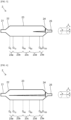
- FIG. 2 is a side view of a balloon catheter in accordance with one embodiment of the present invention.
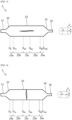
- FIG. 3 is a plan view of a balloon in accordance with one embodiment of the present invention with a longitudinal fracture
- FIG. 4 is a plan view showing an example of a circumferential fracture in a balloon
- FIG. 5 is a plan view showing an example of a L-shaped crack in a balloon
- FIG. 6 is a plan view showing another example of a L-shaped crack in a balloon.
- a proximal side refers to the direction towards a user's or operator's hand in the extending direction of a balloon catheter 1 or a longitudinal axis direction x of a shaft 3, and a distal side refers to the opposite side of the proximal side, that is, the direction towards the person to be treated.
- Members other than long-shaped members, such as shaft 3, also have the same longitudinal axis direction x as the shaft 3.
- the direction connecting the center of a balloon 2 and a point on the circumscribed circle of the balloon 2 in an inflated state in a cross section perpendicular to the longitudinal axis direction x is referred to as a radial direction y
- the direction along the circumference of the balloon 2 in an inflated state in a cross section perpendicular to the longitudinal axis direction x, i.e., in a cross section of the radial direction y is referred to as a circumferential direction z.
- the balloon catheter 1 has the shaft 3 and the balloon 2 disposed on a distal side of the shaft 3.
- the balloon 2 has the longitudinal axis direction x, the radial direction y, and the circumferential direction z, and is preferably formed into a tubular shape having openings on the proximal and distal sides.
- the balloon 2 is made of a resin having molecular orientation.
- the balloon catheter 1 is configured such that fluid is introduced into the balloon 2 through the shaft 3, and the inflation and deflation of the balloon 2 can be controlled using an indeflator (compressor/ decompressor for balloons).
- the fluid may be a pressurized fluid pressurized by a pump or the like.
- the balloon 2 has a straight tubular part 23, a proximal tapered part 22 located proximal to the straight tubular part 23, and a distal tapered part 24 located distal to the straight tubular part 23.
- the straight tubular part 23 preferably has approximately the same diameter along the longitudinal axis direction x, and the proximal tapered part 22 and the distal tapered part 24 are preferably formed so that the diameter decreases as it is away from the straight tubular part 23.
- the straight tubular part 23 having the largest diameter can make sufficient contact with the stenosis to facilitate treatment such as dilation of the stenosis.
- the proximal tapered part 22 and the distal tapered part 24 having reduced diameters allow the outer diameter of the proximal and distal end parts of the balloon 2 to be reduced when the balloon is deflated to reduce the step between the shaft 3 and the balloon 2, making the balloon 2 easier to insert and pass within the body cavity.
- the balloon 2 may have a proximal sleeve part 21 located proximal to the proximal tapered part 22 and may have a distal sleeve part 25 located distal to the distal tapered part 24. At least a part of the proximal sleeve part 21 and the distal sleeve part 25 can be fixed to the shaft 3.
- a main orientation direction of the molecular orientation in a proximal section 23a from the position of 0% D 0 to a position of 10% D 10 and a distal section 23e from a position of 90% D 90 to the position of 100% D 100 is the circumferential direction z
- a component in the longitudinal axis direction x of the molecular orientation in a central section 23c from a position of 40% D 40 to a position of 60% D 60 is more than a component in the longitudinal axis direction x of the molecular orientation in the proximal section 23a and the distal section 23e.
- the configuration in which the longitudinal axis direction component of the molecular orientation in the central section 23c is more than the longitudinal axis direction component of the molecular orientation in the proximal section 23a and the distal section 23e allows the central section 23c to trigger fracture in the longitudinal axis direction x even if the balloon 2 breaks due to overpressurization, etc. As shown in FIG. 3 , this allows internal pressure to be released by generating fracture in the longitudinal axis direction x in the central section 23c, whereby preventing fracture in the circumferential direction z shown in FIG. 4 or preventing fracture in the longitudinal axis direction x generated at the end part from reaching the tapered part to form a L-shaped crack shown in FIG. 5 .
- fracture in the circumferential direction z may be induced at the proximal tapered part 22 and the distal tapered part 24 to form a L-shaped crack as shown in FIG. 6 .
- the main orientation direction of the molecular orientation in the proximal section 23a and the distal section 23e is the circumferential direction z
- the fracture in the longitudinal axis direction x can be prevented from reaching the proximal tapered part 22 and the distal tapered part 24 beyond the proximal section 23a and the distal section 23e.
- This can keep the fracture in the longitudinal axis direction x within the straight tubular part 23, preventing a L-shaped crack that is circumferential fracture in the relatively thick-walled proximal tapered part 22 and distal tapered part 24.
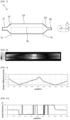
- FIG. 7 is a diagram showing a method of preparing a sample for measuring the molecular orientation of the straight tubular part 23 of the balloon 2 in accordance with one embodiment of the present invention.
- FIG. 8 is an example of a contour diagram obtained by measuring a balloon in accordance with one embodiment of the present invention with a two-dimensional birefringence evaluation system manufactured by Photonic Lattice, Inc.
- FIG. 9 and FIG. 10 are examples of a phase difference graph and an axial direction graph, respectively, obtained as a result of line analysis in the longitudinal axis direction.
- the molecular orientation of the straight tubular part 23 can be obtained by measuring a rectangular sample of the straight tubular part 23 using a two-dimensional birefringence evaluation system manufactured by Photonic Lattice, Inc.
- the rectangular sample can be obtained, as shown in FIG. 7 , by cutting off the proximal tapered part 22 and the distal tapered part 24 from the balloon 2 along a first cut line S 1 , and cutting the resulting straight tubular part 23 open along a second cut line S 2 in the longitudinal axis direction x.
- FIG. 8 An example of a contour diagram resulting from the measurement is shown in FIG. 8 , and examples of a phase difference graph and an axial direction graph obtained as a result of line analysis in the longitudinal axis direction x are shown in FIG. 9 and FIG. 10 , respectively.
- the left end corresponds to the position of 0% D 0 of the straight tubular part 23 and the right end corresponds to the position of 100% D 100 of the straight tubular part 23.
- the contour diagram shows the magnitude of the phase difference in terms of color contrast, and the orientation state can be visually observed. Information on the strength of orientation can be specifically obtained from the phase difference graph, and information on the orientation direction can be specifically obtained from the axial direction graph.
- the main orientation direction can be determined from the axial direction graph.
- the main orientation direction in the given section is the circumferential direction z.
- the main orientation direction in the given section is the longitudinal axis direction x.
- the intensity of the orientation component can be obtained from the phase difference graph.
- the lengths of the lines included in the range of 0° to 10° and the range of 170° to 180° in the respective sections in the axial direction graph are compared, and the section with the longest line included in the range can be determined as the section with more orientation direction component in the longitudinal axis direction x.
- the axial direction graph indicates that the main orientation direction of the molecular orientation in the proximal section 23a and the distal section 23e is the circumferential direction z.
- the main orientation direction of the molecular orientation in the central section 23c is the longitudinal axis direction x
- the molecular orientation component in the longitudinal axis direction x in the central section 23c is more than the molecular orientation component in the longitudinal axis direction x in the proximal section 23a and the distal section 23e.
- the phase difference graph indicates that the orientation intensity decreases from the central section 23c to the proximal and distal sides, i.e., the molecular orientation component in the longitudinal axis direction x decreases.
- the main orientation direction of the molecular orientation in the central section 23c is preferably the longitudinal axis direction x.
- the main orientation direction in the longitudinal axis direction x makes it easier to trigger fracture in the longitudinal axis direction x in the central section 23c even if the balloon 2 breaks due to overpressurization, etc. This allows internal pressure to be released by generating the fracture in the longitudinal axis direction x in the central section 23c, thus preventing fracture in the circumferential direction z more easily.
- the molecular orientation component in the longitudinal axis direction x gradually decreases from the central section 23c towards the position of 0% D 0 and gradually decreases from the central section 23c towards the position of 100% D 100 .
- Gradual decrease of the molecular orientation component in the longitudinal axis direction x from the central section 23c towards the position of 0% D 0 means that, for example, the molecular orientation component in the longitudinal axis direction x of the position of 40% D 40 , a position of 20%, and the position of 0% D 0 decreases in this order.
- Gradual decrease of the molecular orientation component in the longitudinal axis direction x from the central section 23c towards the position of 100% D 100 means that, for example, the molecular orientation component in the longitudinal axis direction x of the position of 60% D 60 , a position of 80%, and the position of 100% D 100 decreases in this order.
- the molecular orientation component in the longitudinal axis direction x does not necessarily have to decrease continuously from the central section 23c to the proximal or distal side.
- the molecular orientation component in the longitudinal axis direction x may decrease continuously from the central section 23c to the proximal or distal side.
- the main orientation direction of the molecular orientation in the proximal central section 23b and the distal central section 23d preferably changes from the longitudinal axis direction x to the circumferential direction z.
- the change in the main orientation direction of the molecular orientation from the longitudinal axis direction x to the circumferential direction z in the proximal central section 23b and the distal central section 23d makes it easier to keep fracture within the straight tubular part 23 because the progression of the fracture in the longitudinal axis direction x generated in the central section 23c can be easily stopped in the proximal central section 23b and the distal central section 23d.
- the change in the main orientation direction of the molecular orientation can be learnt from the axial direction graph.
- the example shown in FIG. 10 indicates that the main orientation direction of the molecular orientation changes from the longitudinal axis direction x to the circumferential direction z in the proximal central section 23b and the distal central section 23d.
- the film thickness of the balloon 2 in the central section 23c is preferably thinner than the film thickness of the balloon 2 in the proximal section 23a and the distal section 23e.
- the thinner film thickness in the central section 23c makes it easier to trigger fracture in the longitudinal axis direction x in the central section 23c, and thus, making it easy to keep the fracture in the longitudinal axis direction x within the central section 23c.
- the balloon 2 may have a protrusion part that projects outwardly in the radial direction y from the outer surface and extends in the longitudinal axis direction x.
- the protrusion part is preferably provided on the outer surface of the balloon 2 in a pattern such as dots, lines, or net-shape. Disposing the protrusion part on the outer surface of the balloon 2 can provide a function of scoring to the protrusion part to incise and dilate a calcified stenosis in angioplasty. It also makes it possible to increase the strength of the balloon 2 and prevent overinflation when being pressurized.
- Materials forming the balloon 2 include, for example, polyolefin-based resin such as polyethylene, polypropylene, ethylene-propylene copolymer; polyester-based resin such as polyethylene terephthalate and polyester elastomer; polyurethane-based resin such as polyurethane and polyurethane elastomer; polyphenylene sulfide-based resin; polyamide-based resin such as polyamide and polyamide elastomer; fluorine-based resin; silicone-based resin; and natural rubber such as latex rubber. Only one of these may be used, or two or more may be used in combination. Of these, polyamide-based resin, polyester-based resin, and polyurethane-based resin are preferably used.
- elastomer resin is preferably used from the viewpoint of thinning and flexibility of the balloon 2.
- nylon 12 nylon 11, and the like are suitable for the resin forming the balloon 2, and more preferably nylon 12 because it is relatively easy to mole when blow molding.
- polyamide elastomers such as polyether ester amide elastomer and polyamide ether elastomer are preferably used.
- polyether ester amide elastomer is preferred in terms of high yield strength and good dimensional stability of the balloon 2.
- the balloon 2 can be manufactured by placing a parison made of the above-described material in a mold, and biaxially stretching blow molding it. A preferred method of manufacturing the balloon 2 will be described below in the section "3. Method of manufacturing balloon catheter".
- a balloon catheter of the present invention has the above-described balloon for a balloon catheter.
- a balloon catheter in accordance with embodiments of the present invention can be understood referring to the above section "1. Balloon for balloon catheter" and FIG. 2 .
- Materials forming the shaft 3 include, for example, polyamide-based resin, polyester-based resin, polyurethane-based resin, polyolefin-based resin, fluorine-based resin, polyvinyl chloride-based resin, silicone-based resin, and natural rubber. Only one of these may be used, or two or more may be used in combination. Of these, the material forming the shaft 3 is preferably at least one of polyamide-based resin, polyolefin-based resin, and fluorine-based resin. This can improve surface slipperiness of the shaft 3 and improve the insertion of a balloon catheter 1 into the body cavity.
- the balloon 2 and the shaft 3 may be joined by adhesive bonding, welding, or by attaching a ring-shaped member at the point where the end of the balloon 2 and the shaft 3 overlap to swage them.
- the balloon 2 and the shaft 3 are preferably joined by welding.
- the balloon catheter 1 may be provided with a hub 4 at a proximal side of the shaft 3, and the hub 4 may be provided with a fluid inlet 6 that is connected to the flow channel of the fluid supplied to the interior of the balloon 2.
- the hub 4 preferably has a guidewire insertion port 5 that is connected to the guidewire insertion channel.
- the balloon catheter 1 which is a so-called over-the-wire type in which the guidewire is inserted over the distal to proximal side of the shaft 3
- the balloon 2 in accordance with embodiments of the present invention can be also applicable to a so-called rapid exchange balloon catheter in which the guidewire is inserted from the distal side to the midway of the proximal side of the shaft 3.
- the shaft 3 and the hub 4 may be joined by, for example, adhesive bonding or welding. Of these, the shaft 3 and the hub 4 are preferably joined by adhesive bonding.
- the adhesive bonding of the shaft 3 and the hub 4 can increase the bonding strength of the shaft 3 and the hub 4 to increase durability of the balloon catheter 1 when the materials forming the shaft 3 and the hub 4 are different, for example, in a case where the shaft 3 is made of material having high flexibility and the hub 4 is made of material having high stiffness.
- a method of manufacturing the balloon catheter in accordance with one embodiment of the present invention is characterized in that the method has a step of preparing a parison made of a resin; a step of preparing a mold having a lumen and inner wall surface forming the lumen, the inner wall surface having a straight tubular part, a proximal tapered part located proximal to the straight tubular part, and a distal tapered part located distal to the straight tubular part; a step of placing the parison in the mold; a step of a first extending process in which the parison is extended in the longitudinal axis direction until exceeding a necking region of a stress-strain curve while the mold is heated; and a step of a second extending process in which, after the first extending process, the parison, which has been extended until exceeding the necking region, is further extended in the longitudinal axis direction with a higher internal pressure of the parison than in the first extending process while the mold is heated.
- FIG. 11 is a cross-sectional view showing a condition where a parison is placed in a mold in accordance with one embodiment of the present invention.
- FIG. 12 is a cross-sectional view showing a condition where the parison is extended in the longitudinal axis direction until exceeding the necking region of the stress-strain curve while the mold is heated in a first extending process in accordance with one embodiment of the present invention.
- FIG. 11 is a cross-sectional view showing a condition where a parison is placed in a mold in accordance with one embodiment of the present invention.
- FIG. 12 is a cross-sectional view showing a condition where the parison is extended in the longitudinal axis direction until exceeding the necking region of the stress-strain curve while the mold is heated in a first extending process in accordance with one embodiment of the present invention.
- FIG. 13 is a cross-sectional view showing a condition where the parison, which has been extended until exceeding the necking region, is further extended in the longitudinal axis direction with a higher internal pressure of the parison than in the first extending process while the mold is heated in a second extending process in accordance with one embodiment of the present invention.
- FIG. 14 is a cross-sectional view showing a condition after finishing the second extending process in accordance with one embodiment of the present invention.
- the parison 70 is a tubular member having a lumen 71, and can be produced, for example, by extrusion molding.
- the parison 70 has one end and the other end, and extends in the longitudinal axis direction x from the one end to the other end.
- the cross-sectional shape of the parison 70 in the direction perpendicular to the longitudinal axis direction x may be approximately same along the longitudinal axis direction x.
- the cross-sectional shape of the parison 70 in the radial direction y may be different depending on the position in the longitudinal axis direction x.
- the outer diameter of a part of the parison 70, for example, the part corresponding to the straight tubular part 23, the proximal tapered part 22, and the distal tapered part 24 of the balloon 2 may be larger than the one in the other part.
- a mold 80 having a lumen 88 and inner wall surface forming the lumen 88 is prepared.
- the inner wall surface has a straight tubular part 83, a proximal tapered part 82 located proximal to the straight tubular part 83, and a distal tapered part 84 located distal to the straight tubular part 83.
- the inner wall surface forming the lumen 88 of the mold 80 may have a proximal sleeve part 81 located proximal to the proximal tapered part 82 and a distal sleeve part 85 located distal to the distal tapered part 84.
- the mold 80 may be formed by one member or by a plurality of members.
- the mold 80 may be formed by a plurality of halves, or a plurality of mold members may be formed such that they are divisible in the longitudinal axis direction x.
- the parison 70 is placed in the lumen 88 of the mold 80.
- the part is preferably positioned so that the part is located in the straight tubular part 83 of the mold 80. This makes it easy to make the part into the straight tubular part 23, the proximal tapered part 22, and the distal tapered part 24 of the balloon 2.
- the first extending process in which the parison 70 is extended in the longitudinal axis direction x while the mold 80 is heated is performed. At this time, the parison 70 is extended until exceeding the necking region R n of a stress-strain curve of the resin forming the parison 70.
- the necking region R n is the region showing flat stress after the yield point B and the lower yield point L, and in this region, the phenomenon in which the molecular chains of the resin that has started plastic deformation shift by stress. In the first extending process, it is important to extend the parison 70 beyond such a necking region R n .
- the internal pressure of the parison 70 in the first extending process is higher than the internal pressure of the parison 70 in the second extending process, and thus, in the above-described condition until exceeding the necking region R n , the parison 70 can be extended in the longitudinal axis direction x while extending in the circumferential direction z is restrained.
- the amount by which the parison 70 is extended in the longitudinal axis direction x until exceeding the necking region R n in the first extending process depends on the conditions of preparation of the parison 70 such as extrusion molding. Specifically, when the parison 70 has already been extended to some extent in the longitudinal axis direction x in extrusion molding or other preparation processes, the necking region R n can be exceeded even if the amount by which the parison 70 is extended in the longitudinal axis direction x in the first extending process is reduced by that amount.
- the second extending process in which the parison 70, which has been extended until exceeding the necking region R n , is further extended in the longitudinal axis direction x with a higher internal pressure of the parison 70 than in the first extending process while the mold 80 is heated is performed.
- the resin in the condition where the molecular chains of the resin have been brought closer together and closely oriented after exceeding the necking region R n is further extended in the longitudinal axis direction x.
- the parison 70 While the parison 70 is extended in the longitudinal axis direction x restraining the extension of the parison 70 in the circumferential direction z in the first extending process until exceeding the necking region R n , the parison 70 is extended not only in the longitudinal axis direction x but also in the circumferential direction z in the second extending process beyond the necking region R n , because the internal pressure of the parison 70 is higher in the second extending process than in the first extending process.
- the balloon 2 shown in FIG. 14 can be obtained.
- the balloon 2 By performing the above first extending process and second extending process, the balloon 2 can be obtained such that the main orientation direction of the molecular orientation in the proximal section 23a and the molecular orientation in the distal section 23e is the circumferential direction z, and the component in the longitudinal axis direction x of the molecular orientation in the central section 23c is more than the component in the longitudinal axis direction x of the molecular orientation in the proximal section 23a and the distal section 23e.
- the stress-strain curve shown in FIG. 1 clearly shows the necking region R n where the stress is constant, but depending on the resin, the region of constant stress may be short or not completely constant.
- the first point where the differential coefficient of the stress-strain curve becomes 5% or more of the average change rate up to the yield point B after the stress-strain curve exceeds the yield point B is defined as the strain that exceeds the necking region R n , and the first extending process can be performed until exceeding this strain.
- the heating temperature in the first extending process and the second extending process can be up to around the glass transition temperature of the resin forming the balloon 2.
- a heating means for the mold 80 a heater or the like generally known can be appropriately used.
- the inside of the parison 70 is preferably pressurized by introducing fluid into the lumen 71 of the parison 70, and the pressure is preferably 3 MPa or less.
- the lumen 71 of the parison 70 and the outside of the parison 70 may have the same pressure, and in other words, the lumen 71 of the parison 70 may be unpressurized.
- the inside of the parison 70 is preferably pressurized by introducing fluid into the lumen 71 of the parison 70, and the pressure is higher than the internal pressure of the parison 70 in the first extending process, and for example, the pressure is preferably 1 MPa or more, more preferably 1.5 MPa or more, and even more preferably 2 MPa or more, and preferably 5 MPa or less, more preferably 4.5 MPa or less, even more preferably 4 MPa or less, and may be 3 MPa or less.
- the parison 70 is unpressurized in the first extending process, and pressurization of the parison 70 starts after exceeding the necking region R n in the second extending process.
- This makes it easier to obtain the balloon 2 in which the main orientation direction of the molecular orientation in the proximal section 23a and the molecular orientation in the distal section 23e is the circumferential direction z, and the component in the longitudinal axis direction x of the molecular orientation in the central section 23c is more than the component in the longitudinal axis direction x of the molecular orientation in the proximal section 23a and the distal section 23e.
- the mold 80 is preferably heated so that the center portion of the straight tubular part 83 of the mold 80 is the hottest. This makes it easier to obtain the balloon 2 in which the component in the longitudinal axis direction x of the molecular orientation in the central section 23c is more than the component in the longitudinal axis direction x of the molecular orientation in the proximal section 23a and the distal section 23e, and also makes it easier to make the film thickness of the balloon 2 in the central section 23c thinner than the film thickness of the balloon 2 in the proximal section 23a and the distal section 23e.
- a parison was produced by extrusion molding polyamide 12.
- the parison was placed in a mold, and the parison was extended in the longitudinal axis direction until exceeding the necking region of the stress-strain curve with an inner pressure of 2 MPa to the parison while the mold was heated at 70°C.
- the parison was extended in the longitudinal axis direction with an inner pressure of 4.3 MPa to the parison while the mold was heated at 70°C, and a balloon was obtained.
- the proximal tapered part and the distal tapered part were cut off to obtain a tubular-shaped straight tubular part as shown in FIG. 7 , and cut open the tubular-shaped straight tubular part along the cut line in the longitudinal axis direction to obtain rectangular samples 1 to 5.
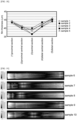
- the samples 1 to 5 were measured with a two-dimensional birefringence evaluation system WPA-100 manufactured by Photonic Lattice, Inc. to obtain the molecular orientation. Results are shown in FIG. 15 to FIG. 17 . In each of FIG. 15 to FIG. 17 , the data of the samples 1 to 5 are shown from top to bottom.
- the main orientation direction of the molecular orientation in the central section of the straight tubular part was the longitudinal axis direction
- the balloons in which the main orientation direction of the molecular orientation in the proximal section and distal section of the straight tubular part was the circumferential direction were stably obtained.
- the film thicknesses of the proximal section (1), the proximal central section (2), the central section (3), the distal central section (4), and the distal section (5) were measured using a spline micrometer SPM2-25MX manufactured by Mitutoyo Corporation. Results are shown in FIG. 18 .
- Each balloon had the thinnest film thickness in the central section, and the balloons in which the film thickness became thicker from the central section to the proximal and distal sides were stably obtained.
- Example 2 In the same manner as in Example 1, another 30 balloons were manufactured. Internal pressure was continuously applied to these 30 balloons until they were fractured, and the condition of fracture was observed after they were fractured to determine whether circumferential fracture occurred or not. No circumferential fracture occurred in any of the balloons.
- a parison was prepared in the same manner as in Example 1.
- the parison was placed in the same mold as Example 1, and the parison was extended in the longitudinal axis direction with an inner pressure of 3.5 MPa to the parison while the mold was heated at 60°C to obtain a balloon.
- the proximal tapered part and the distal tapered part were cut off to obtain a tubular-shaped straight tubular part as shown in FIG. 7 , and cut open the tubular-shaped straight tubular part along the cut line in the longitudinal axis direction to obtain rectangular samples 6 to 10.
- the samples 6 to 10 were measured with a two-dimensional birefringence evaluation system WPA-100 manufactured by Photonic Lattice, Inc. to obtain the molecular orientation. Results are shown in FIG. 19 to FIG. 21 . In each of FIG. 19 to FIG. 21 , the data of the samples 6 to 10 are shown from top to bottom.
- the longitudinal axis direction component of the molecular orientation in the central section of the straight tubular part was not more than the longitudinal axis direction component of the molecular orientation in the proximal section and the distal section.
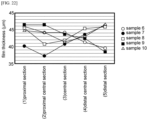
- the film thicknesses of the proximal section (1), the proximal central section (2), the central section (3), the distal central section (4), and the distal section (5) were measured using a spline micrometer SPM2-25MX manufactured by Mitutoyo Corporation. Results are shown in FIG. 22 .
- the tendency of film thickness in the longitudinal axis direction varied from balloon to balloon, which showed that the method in Comparative example 1 could not control the film thickness in the longitudinal axis direction.
Landscapes
- Health & Medical Sciences (AREA)
- Life Sciences & Earth Sciences (AREA)
- Heart & Thoracic Surgery (AREA)
- Engineering & Computer Science (AREA)
- Veterinary Medicine (AREA)
- Public Health (AREA)
- General Health & Medical Sciences (AREA)
- Animal Behavior & Ethology (AREA)
- Hematology (AREA)
- Biomedical Technology (AREA)
- Anesthesiology (AREA)
- Pulmonology (AREA)
- Biophysics (AREA)
- Child & Adolescent Psychology (AREA)
- Manufacturing & Machinery (AREA)
- Epidemiology (AREA)
- Vascular Medicine (AREA)
- Chemical & Material Sciences (AREA)
- Chemical Kinetics & Catalysis (AREA)
- Mechanical Engineering (AREA)
- Media Introduction/Drainage Providing Device (AREA)
Applications Claiming Priority (2)
| Application Number | Priority Date | Filing Date | Title |
|---|---|---|---|
| JP2021079672 | 2021-05-10 | ||
| PCT/JP2022/006686 WO2022239356A1 (ja) | 2021-05-10 | 2022-02-18 | バルーンカテーテル用バルーン及びバルーンカテーテルの製造方法 |
Publications (3)
| Publication Number | Publication Date |
|---|---|
| EP4338766A1 true EP4338766A1 (de) | 2024-03-20 |
| EP4338766A4 EP4338766A4 (de) | 2025-05-14 |
| EP4338766B1 EP4338766B1 (de) | 2026-03-11 |
Family
ID=84029029
Family Applications (1)
| Application Number | Title | Priority Date | Filing Date |
|---|---|---|---|
| EP22807063.7A Active EP4338766B1 (de) | 2021-05-10 | 2022-02-18 | Ballon für ballonkatheter und verfahren zur herstellung eines ballonkatheters |
Country Status (5)
| Country | Link |
|---|---|
| US (1) | US20240075258A1 (de) |
| EP (1) | EP4338766B1 (de) |
| JP (1) | JP7808100B2 (de) |
| CN (1) | CN117241843B (de) |
| WO (1) | WO2022239356A1 (de) |
Families Citing this family (2)
| Publication number | Priority date | Publication date | Assignee | Title |
|---|---|---|---|---|
| JPWO2023176182A1 (de) * | 2022-03-14 | 2023-09-21 | ||
| JP7830244B2 (ja) * | 2022-06-17 | 2026-03-16 | 株式会社カネカ | バルーンカテーテル用バルーンの製造方法及び金型セット |
Family Cites Families (11)
| Publication number | Priority date | Publication date | Assignee | Title |
|---|---|---|---|---|
| JP3766122B2 (ja) * | 1995-08-04 | 2006-04-12 | 株式会社カネカ | カテーテルバルーン及びその製造方法 |
| JP4351832B2 (ja) * | 2002-08-05 | 2009-10-28 | テルモ株式会社 | バルーンカテーテル |
| JP2004298354A (ja) * | 2003-03-31 | 2004-10-28 | Nippon Zeon Co Ltd | 拡張用バルーンおよびこれを備えたバルーンカテーテル |
| JP2004298356A (ja) * | 2003-03-31 | 2004-10-28 | Nippon Zeon Co Ltd | 拡張用バルーンおよびこれを備えたバルーンカテーテル |
| JP2005305187A (ja) * | 2005-07-07 | 2005-11-04 | Kaneka Corp | カテーテルバルーン及びその製造方法 |
| JP4978953B2 (ja) * | 2006-06-26 | 2012-07-18 | 朝日インテック株式会社 | バルーンカテーテルの製造方法 |
| JP6260281B2 (ja) * | 2012-02-09 | 2018-01-17 | 株式会社カネカ | バルーン用チューブ、バルーン、バルーンカテーテル、および、バルーン用チューブの製造方法 |
| EP2974766B1 (de) * | 2013-03-12 | 2022-09-21 | Terumo Kabushiki Kaisha | Ballon und herstellungsverfahren dafür |
| JP2017063803A (ja) * | 2014-02-14 | 2017-04-06 | テルモ株式会社 | バルーンおよびその製造方法 |
| CN112426612B (zh) * | 2019-08-26 | 2022-12-06 | 上海康德莱医疗器械股份有限公司 | 一种球囊及其制备和应用 |
| JP2021079672A (ja) | 2019-11-22 | 2021-05-27 | 京セラドキュメントソリューションズ株式会社 | 画像形成装置、通信制御方法 |
-
2022
- 2022-02-18 JP JP2023520794A patent/JP7808100B2/ja active Active
- 2022-02-18 CN CN202280033550.6A patent/CN117241843B/zh active Active
- 2022-02-18 EP EP22807063.7A patent/EP4338766B1/de active Active
- 2022-02-18 WO PCT/JP2022/006686 patent/WO2022239356A1/ja not_active Ceased
-
2023
- 2023-11-07 US US18/387,737 patent/US20240075258A1/en active Pending
Also Published As
| Publication number | Publication date |
|---|---|
| EP4338766A4 (de) | 2025-05-14 |
| US20240075258A1 (en) | 2024-03-07 |
| WO2022239356A1 (ja) | 2022-11-17 |
| CN117241843B (zh) | 2026-03-03 |
| CN117241843A (zh) | 2023-12-15 |
| JP7808100B2 (ja) | 2026-01-28 |
| JPWO2022239356A1 (de) | 2022-11-17 |
| EP4338766B1 (de) | 2026-03-11 |
Similar Documents
| Publication | Publication Date | Title |
|---|---|---|
| US9579492B2 (en) | Method for forming catheter balloon | |
| US8609016B2 (en) | Refoldable balloon and method of making and using the same | |
| US6620128B1 (en) | Balloon blowing process with metered volumetric inflation | |
| US10166371B2 (en) | Non-compliant multilayered balloon for a catheter | |
| US20240075258A1 (en) | Balloon for balloon catheter and method of manufacturing balloon catheter | |
| US12611526B2 (en) | Method for producing balloon catheter | |
| US20090264822A1 (en) | Method of Making a Zero-Fold Balloon With Variable Inflation Volume | |
| US20090254113A1 (en) | Dilatation balloon with ridges and methods | |
| US12544544B2 (en) | Balloon for balloon catheter | |
| US12337128B2 (en) | Balloon catheter | |
| CN111556771A (zh) | 具有一体式刻痕元件的球囊和相关方法 | |
| WO2006134638A1 (ja) | バルーンカテーテル | |
| EP2796162B1 (de) | Herstellungsverfahren für einen expansionsballon | |
| JP4815657B2 (ja) | 医療用ポリマーブレンド材料およびこの材料を用いた医療用バルーン | |
| US20240149025A1 (en) | Balloon for balloon catheter | |
| JP2004298354A (ja) | 拡張用バルーンおよびこれを備えたバルーンカテーテル | |
| JP7830244B2 (ja) | バルーンカテーテル用バルーンの製造方法及び金型セット | |
| JP2004298356A (ja) | 拡張用バルーンおよびこれを備えたバルーンカテーテル | |
| WO2023176182A1 (ja) | バルーンカテーテル用バルーン | |
| JP2023183917A (ja) | バルーンカテーテル用バルーンの製造方法 | |
| WO2023199634A1 (ja) | バルーンカテーテル用バルーン |
Legal Events
| Date | Code | Title | Description |
|---|---|---|---|
| STAA | Information on the status of an ep patent application or granted ep patent |
Free format text: STATUS: THE INTERNATIONAL PUBLICATION HAS BEEN MADE |
|
| PUAI | Public reference made under article 153(3) epc to a published international application that has entered the european phase |
Free format text: ORIGINAL CODE: 0009012 |
|
| STAA | Information on the status of an ep patent application or granted ep patent |
Free format text: STATUS: REQUEST FOR EXAMINATION WAS MADE |
|
| 17P | Request for examination filed |
Effective date: 20231103 |
|
| AK | Designated contracting states |
Kind code of ref document: A1 Designated state(s): AL AT BE BG CH CY CZ DE DK EE ES FI FR GB GR HR HU IE IS IT LI LT LU LV MC MK MT NL NO PL PT RO RS SE SI SK SM TR |
|
| DAV | Request for validation of the european patent (deleted) | ||
| DAX | Request for extension of the european patent (deleted) | ||
| A4 | Supplementary search report drawn up and despatched |
Effective date: 20250410 |
|
| RIC1 | Information provided on ipc code assigned before grant |
Ipc: A61M 25/10 20130101ALI20250404BHEP Ipc: A61L 29/14 20060101AFI20250404BHEP |
|
| GRAJ | Information related to disapproval of communication of intention to grant by the applicant or resumption of examination proceedings by the epo deleted |
Free format text: ORIGINAL CODE: EPIDOSDIGR1 |
|
| GRAP | Despatch of communication of intention to grant a patent |
Free format text: ORIGINAL CODE: EPIDOSNIGR1 |
|
| GRAP | Despatch of communication of intention to grant a patent |
Free format text: ORIGINAL CODE: EPIDOSNIGR1 |
|
| STAA | Information on the status of an ep patent application or granted ep patent |
Free format text: STATUS: GRANT OF PATENT IS INTENDED |
|
| INTG | Intention to grant announced |
Effective date: 20251103 |
|
| GRAS | Grant fee paid |
Free format text: ORIGINAL CODE: EPIDOSNIGR3 |
|
| P01 | Opt-out of the competence of the unified patent court (upc) registered |
Free format text: CASE NUMBER: UPC_APP_0019500_4338766/2025 Effective date: 20251226 |
|
| GRAA | (expected) grant |
Free format text: ORIGINAL CODE: 0009210 |
|
| STAA | Information on the status of an ep patent application or granted ep patent |
Free format text: STATUS: THE PATENT HAS BEEN GRANTED |
|
| AK | Designated contracting states |
Kind code of ref document: B1 Designated state(s): AL AT BE BG CH CY CZ DE DK EE ES FI FR GB GR HR HU IE IS IT LI LT LU LV MC MK MT NL NO PL PT RO RS SE SI SK SM TR |
|
| REG | Reference to a national code |
Ref country code: CH Ref legal event code: F10 Free format text: ST27 STATUS EVENT CODE: U-0-0-F10-F00 (AS PROVIDED BY THE NATIONAL OFFICE) Effective date: 20260311 Ref country code: GB Ref legal event code: FG4D |
|
| REG | Reference to a national code |
Ref country code: DE Ref legal event code: R096 Ref document number: 602022032236 Country of ref document: DE |
|
| REG | Reference to a national code |
Ref country code: IE Ref legal event code: FG4D |