EP4339280A1 - Procédé de production d'organoïde cardiaque dérivé de cellules souches pluripotentes humaines et organoïde cardiaque dérivé de cellules souches pluripotentes humaines ainsi produit - Google Patents
Procédé de production d'organoïde cardiaque dérivé de cellules souches pluripotentes humaines et organoïde cardiaque dérivé de cellules souches pluripotentes humaines ainsi produit Download PDFInfo
- Publication number
- EP4339280A1 EP4339280A1 EP22807607.1A EP22807607A EP4339280A1 EP 4339280 A1 EP4339280 A1 EP 4339280A1 EP 22807607 A EP22807607 A EP 22807607A EP 4339280 A1 EP4339280 A1 EP 4339280A1
- Authority
- EP
- European Patent Office
- Prior art keywords
- pluripotent stem
- cells
- human pluripotent
- culturing
- stem cell
- Prior art date
- Legal status (The legal status is an assumption and is not a legal conclusion. Google has not performed a legal analysis and makes no representation as to the accuracy of the status listed.)
- Pending
Links
Images








Classifications
-
- C—CHEMISTRY; METALLURGY
- C12—BIOCHEMISTRY; BEER; SPIRITS; WINE; VINEGAR; MICROBIOLOGY; ENZYMOLOGY; MUTATION OR GENETIC ENGINEERING
- C12N—MICROORGANISMS OR ENZYMES; COMPOSITIONS THEREOF; PROPAGATING, PRESERVING, OR MAINTAINING MICROORGANISMS; MUTATION OR GENETIC ENGINEERING; CULTURE MEDIA
- C12N5/00—Undifferentiated human, animal or plant cells, e.g. cell lines; Tissues; Cultivation or maintenance thereof; Culture media therefor
- C12N5/06—Animal cells or tissues; Human cells or tissues
- C12N5/0602—Vertebrate cells
- C12N5/0652—Cells of skeletal and connective tissues; Mesenchyme
- C12N5/0657—Cardiomyocytes; Heart cells
-
- C—CHEMISTRY; METALLURGY
- C12—BIOCHEMISTRY; BEER; SPIRITS; WINE; VINEGAR; MICROBIOLOGY; ENZYMOLOGY; MUTATION OR GENETIC ENGINEERING
- C12N—MICROORGANISMS OR ENZYMES; COMPOSITIONS THEREOF; PROPAGATING, PRESERVING, OR MAINTAINING MICROORGANISMS; MUTATION OR GENETIC ENGINEERING; CULTURE MEDIA
- C12N5/00—Undifferentiated human, animal or plant cells, e.g. cell lines; Tissues; Cultivation or maintenance thereof; Culture media therefor
- C12N5/06—Animal cells or tissues; Human cells or tissues
- C12N5/0602—Vertebrate cells
- C12N5/0652—Cells of skeletal and connective tissues; Mesenchyme
- C12N5/0656—Adult fibroblasts
-
- C—CHEMISTRY; METALLURGY
- C12—BIOCHEMISTRY; BEER; SPIRITS; WINE; VINEGAR; MICROBIOLOGY; ENZYMOLOGY; MUTATION OR GENETIC ENGINEERING
- C12N—MICROORGANISMS OR ENZYMES; COMPOSITIONS THEREOF; PROPAGATING, PRESERVING, OR MAINTAINING MICROORGANISMS; MUTATION OR GENETIC ENGINEERING; CULTURE MEDIA
- C12N5/00—Undifferentiated human, animal or plant cells, e.g. cell lines; Tissues; Cultivation or maintenance thereof; Culture media therefor
- C12N5/06—Animal cells or tissues; Human cells or tissues
- C12N5/0602—Vertebrate cells
- C12N5/069—Vascular Endothelial cells
-
- C—CHEMISTRY; METALLURGY
- C12—BIOCHEMISTRY; BEER; SPIRITS; WINE; VINEGAR; MICROBIOLOGY; ENZYMOLOGY; MUTATION OR GENETIC ENGINEERING
- C12N—MICROORGANISMS OR ENZYMES; COMPOSITIONS THEREOF; PROPAGATING, PRESERVING, OR MAINTAINING MICROORGANISMS; MUTATION OR GENETIC ENGINEERING; CULTURE MEDIA
- C12N5/00—Undifferentiated human, animal or plant cells, e.g. cell lines; Tissues; Cultivation or maintenance thereof; Culture media therefor
- C12N5/06—Animal cells or tissues; Human cells or tissues
- C12N5/0697—Artificial constructs associating cells of different lineages, e.g. tissue equivalents
-
- C—CHEMISTRY; METALLURGY
- C12—BIOCHEMISTRY; BEER; SPIRITS; WINE; VINEGAR; MICROBIOLOGY; ENZYMOLOGY; MUTATION OR GENETIC ENGINEERING
- C12N—MICROORGANISMS OR ENZYMES; COMPOSITIONS THEREOF; PROPAGATING, PRESERVING, OR MAINTAINING MICROORGANISMS; MUTATION OR GENETIC ENGINEERING; CULTURE MEDIA
- C12N2500/00—Specific components of cell culture medium
- C12N2500/30—Organic components
- C12N2500/38—Vitamins
-
- C—CHEMISTRY; METALLURGY
- C12—BIOCHEMISTRY; BEER; SPIRITS; WINE; VINEGAR; MICROBIOLOGY; ENZYMOLOGY; MUTATION OR GENETIC ENGINEERING
- C12N—MICROORGANISMS OR ENZYMES; COMPOSITIONS THEREOF; PROPAGATING, PRESERVING, OR MAINTAINING MICROORGANISMS; MUTATION OR GENETIC ENGINEERING; CULTURE MEDIA
- C12N2501/00—Active agents used in cell culture processes, e.g. differentation
- C12N2501/10—Growth factors
- C12N2501/115—Basic fibroblast growth factor (bFGF, FGF-2)
-
- C—CHEMISTRY; METALLURGY
- C12—BIOCHEMISTRY; BEER; SPIRITS; WINE; VINEGAR; MICROBIOLOGY; ENZYMOLOGY; MUTATION OR GENETIC ENGINEERING
- C12N—MICROORGANISMS OR ENZYMES; COMPOSITIONS THEREOF; PROPAGATING, PRESERVING, OR MAINTAINING MICROORGANISMS; MUTATION OR GENETIC ENGINEERING; CULTURE MEDIA
- C12N2501/00—Active agents used in cell culture processes, e.g. differentation
- C12N2501/10—Growth factors
- C12N2501/15—Transforming growth factor beta (TGF-β)
-
- C—CHEMISTRY; METALLURGY
- C12—BIOCHEMISTRY; BEER; SPIRITS; WINE; VINEGAR; MICROBIOLOGY; ENZYMOLOGY; MUTATION OR GENETIC ENGINEERING
- C12N—MICROORGANISMS OR ENZYMES; COMPOSITIONS THEREOF; PROPAGATING, PRESERVING, OR MAINTAINING MICROORGANISMS; MUTATION OR GENETIC ENGINEERING; CULTURE MEDIA
- C12N2501/00—Active agents used in cell culture processes, e.g. differentation
- C12N2501/10—Growth factors
- C12N2501/155—Bone morphogenic proteins [BMP]; Osteogenins; Osteogenic factor; Bone inducing factor
-
- C—CHEMISTRY; METALLURGY
- C12—BIOCHEMISTRY; BEER; SPIRITS; WINE; VINEGAR; MICROBIOLOGY; ENZYMOLOGY; MUTATION OR GENETIC ENGINEERING
- C12N—MICROORGANISMS OR ENZYMES; COMPOSITIONS THEREOF; PROPAGATING, PRESERVING, OR MAINTAINING MICROORGANISMS; MUTATION OR GENETIC ENGINEERING; CULTURE MEDIA
- C12N2501/00—Active agents used in cell culture processes, e.g. differentation
- C12N2501/10—Growth factors
- C12N2501/16—Activin; Inhibin; Mullerian inhibiting substance
-
- C—CHEMISTRY; METALLURGY
- C12—BIOCHEMISTRY; BEER; SPIRITS; WINE; VINEGAR; MICROBIOLOGY; ENZYMOLOGY; MUTATION OR GENETIC ENGINEERING
- C12N—MICROORGANISMS OR ENZYMES; COMPOSITIONS THEREOF; PROPAGATING, PRESERVING, OR MAINTAINING MICROORGANISMS; MUTATION OR GENETIC ENGINEERING; CULTURE MEDIA
- C12N2501/00—Active agents used in cell culture processes, e.g. differentation
- C12N2501/10—Growth factors
- C12N2501/165—Vascular endothelial growth factor [VEGF]
-
- C—CHEMISTRY; METALLURGY
- C12—BIOCHEMISTRY; BEER; SPIRITS; WINE; VINEGAR; MICROBIOLOGY; ENZYMOLOGY; MUTATION OR GENETIC ENGINEERING
- C12N—MICROORGANISMS OR ENZYMES; COMPOSITIONS THEREOF; PROPAGATING, PRESERVING, OR MAINTAINING MICROORGANISMS; MUTATION OR GENETIC ENGINEERING; CULTURE MEDIA
- C12N2501/00—Active agents used in cell culture processes, e.g. differentation
- C12N2501/40—Regulators of development
- C12N2501/415—Wnt; Frizzeled
-
- C—CHEMISTRY; METALLURGY
- C12—BIOCHEMISTRY; BEER; SPIRITS; WINE; VINEGAR; MICROBIOLOGY; ENZYMOLOGY; MUTATION OR GENETIC ENGINEERING
- C12N—MICROORGANISMS OR ENZYMES; COMPOSITIONS THEREOF; PROPAGATING, PRESERVING, OR MAINTAINING MICROORGANISMS; MUTATION OR GENETIC ENGINEERING; CULTURE MEDIA
- C12N2501/00—Active agents used in cell culture processes, e.g. differentation
- C12N2501/70—Enzymes
- C12N2501/72—Transferases [EC 2.]
- C12N2501/727—Kinases (EC 2.7.)
-
- C—CHEMISTRY; METALLURGY
- C12—BIOCHEMISTRY; BEER; SPIRITS; WINE; VINEGAR; MICROBIOLOGY; ENZYMOLOGY; MUTATION OR GENETIC ENGINEERING
- C12N—MICROORGANISMS OR ENZYMES; COMPOSITIONS THEREOF; PROPAGATING, PRESERVING, OR MAINTAINING MICROORGANISMS; MUTATION OR GENETIC ENGINEERING; CULTURE MEDIA
- C12N2506/00—Differentiation of animal cells from one lineage to another; Differentiation of pluripotent cells
- C12N2506/02—Differentiation of animal cells from one lineage to another; Differentiation of pluripotent cells from embryonic cells
-
- C—CHEMISTRY; METALLURGY
- C12—BIOCHEMISTRY; BEER; SPIRITS; WINE; VINEGAR; MICROBIOLOGY; ENZYMOLOGY; MUTATION OR GENETIC ENGINEERING
- C12N—MICROORGANISMS OR ENZYMES; COMPOSITIONS THEREOF; PROPAGATING, PRESERVING, OR MAINTAINING MICROORGANISMS; MUTATION OR GENETIC ENGINEERING; CULTURE MEDIA
- C12N2506/00—Differentiation of animal cells from one lineage to another; Differentiation of pluripotent cells
- C12N2506/03—Differentiation of animal cells from one lineage to another; Differentiation of pluripotent cells from non-embryonic pluripotent stem cells
-
- C—CHEMISTRY; METALLURGY
- C12—BIOCHEMISTRY; BEER; SPIRITS; WINE; VINEGAR; MICROBIOLOGY; ENZYMOLOGY; MUTATION OR GENETIC ENGINEERING
- C12N—MICROORGANISMS OR ENZYMES; COMPOSITIONS THEREOF; PROPAGATING, PRESERVING, OR MAINTAINING MICROORGANISMS; MUTATION OR GENETIC ENGINEERING; CULTURE MEDIA
- C12N2506/00—Differentiation of animal cells from one lineage to another; Differentiation of pluripotent cells
- C12N2506/45—Differentiation of animal cells from one lineage to another; Differentiation of pluripotent cells from artificially induced pluripotent stem cells
-
- C—CHEMISTRY; METALLURGY
- C12—BIOCHEMISTRY; BEER; SPIRITS; WINE; VINEGAR; MICROBIOLOGY; ENZYMOLOGY; MUTATION OR GENETIC ENGINEERING
- C12N—MICROORGANISMS OR ENZYMES; COMPOSITIONS THEREOF; PROPAGATING, PRESERVING, OR MAINTAINING MICROORGANISMS; MUTATION OR GENETIC ENGINEERING; CULTURE MEDIA
- C12N2513/00—3D culture
-
- Y—GENERAL TAGGING OF NEW TECHNOLOGICAL DEVELOPMENTS; GENERAL TAGGING OF CROSS-SECTIONAL TECHNOLOGIES SPANNING OVER SEVERAL SECTIONS OF THE IPC; TECHNICAL SUBJECTS COVERED BY FORMER USPC CROSS-REFERENCE ART COLLECTIONS [XRACs] AND DIGESTS
- Y02—TECHNOLOGIES OR APPLICATIONS FOR MITIGATION OR ADAPTATION AGAINST CLIMATE CHANGE
- Y02A—TECHNOLOGIES FOR ADAPTATION TO CLIMATE CHANGE
- Y02A50/00—TECHNOLOGIES FOR ADAPTATION TO CLIMATE CHANGE in human health protection, e.g. against extreme weather
- Y02A50/30—Against vector-borne diseases, e.g. mosquito-borne, fly-borne, tick-borne or waterborne diseases whose impact is exacerbated by climate change
Definitions
- the present invention relates to a method for producing human pluripotent stem cell-derived cardiac organoids and human pluripotent stem cell-derived cardiac organoids produced thereby.
- hPSCs human pluripotent stem cells
- organoids which may exhibit sufficient functionality and mimic actual organs in which cells do not exist individually but exist in clusters, have been researched and developed worldwide.
- Organoids that can mimic the structure and function of real human organs are possible through continuous cell division and differentiation from organ stem cells, such as intestine and brain, which are known to have organ-specific stem cells.
- organ stem cells such as intestine and brain
- this method may not be applied, and a method of producing cardiac organoids by separately differentiating various cells constituting the heart and then mixing the cells has been suggested as the only method.
- the present invention has been made in order to solve the above-described problem, and an object of the present invention is provide a method for producing cardiac organoids which sufficient to mimic the structure and function of an actual heart, including simultaneous differentiation into various cardiac constituent cells from human pluripotent stem cells and the self-organization of cells through interaction from the initial stage of development, and are sufficient to mimic the structure and function of an actual heart.
- a method for producing human pluripotent stem cell-derived cardiac organoids comprises: step (A) of preparing embryonic bodies having a diameter of 100 um to 130 um by culturing human pluripotent stem cells (hPSCs); step (B) of culturing the embryonic bodies, prepared in step (A), until the embryonic bodies have a diameter of 200 um to 250 ⁇ m; step (C) of differentiating the human pluripotent stem cell-derived embryonic bodies having a diameter of 200um to 250pm, obtained in step (B), into structures comprising mesoderm cells and endoderm cells; step (D) of differentiating the structures comprising mesoderm cells and endoderm cells, obtained in step (C), into cardiac organoids comprising self-organized cardiomyocytes, fibroblasts and endothelial cells; and step (E) of culturing and maturing the cardiac organoids obtained by differentiation in step (D), wherein the cardiac organoids matured in step (E) comprise self-
- the human pluripotent stem cells in step (A) are at least one cell type selected from among human embryonic stem cells (hESCs) and human induced pluripotent stem cells (hiPSCs).
- hESCs human embryonic stem cells
- hiPSCs human induced pluripotent stem cells
- step (A) is a step of preparing embryonic bodies having a diameter of 100 um to 130 ⁇ m by plating human pluripotent stem cells in an mTeSR1 medium supplemented with a Rho-associated kinase (ROCK) inhibitor (Y-27632) and culturing the cells for 1 day.
- ROCK Rho-associated kinase
- step (B) is a step of preparing human pluripotent stem cell-derived embryonic bodies having a diameter of 200 um to 250 um by culturing the embryonic bodies having a diameter of 100 um to 130 um, prepared in step (A), in mTeSR1 medium free of a Rho-associated kinase (ROCK) inhibitor (Y-27632) for 2 to 3 days.
- ROCK Rho-associated kinase
- Step (C) comprises: step (C-1) of culturing the human pluripotent stem cell-derived embryonic bodies having a diameter of 200 um to 250 um, prepared in step (B), for 2 days in an RPMI 1640 medium supplemented with B-27 supplement (minus insulin), CHIR99021, BMP4 (bone morphogenetic protein-4) and Activin A; and step (C-2) of differentiating the human pluripotent stem cell-derived embryonic bodies, cultured in step (C-1), into structures comprising mesoderm cells and endoderm cells by culturing the embryonic bodies for 2 days in an RPMI 1640 medium supplemented with B-27 supplement (minus insulin), XAV939 and L-ascorbic acid.
- step (C-1) is a step of culturing the human pluripotent stem cell-derived embryonic bodies having a diameter of 200 um to 250 um for 2 days in an RPMI 1640 supplemented with B-27 supplement (minus insulin), 6 ⁇ M to 8 ⁇ M of CHIR99021 as a GSK-3 ⁇ (glycogen synthase kinase-3 ⁇ ) inhibitor for Wnt signal activation, 9 ng/ml to 10 ng/ml of BMP4 as a component for BMP signal activation, and 8 ng/ml to 10 ng/ml of Activin A as a component for TGF- ⁇ (transforming growth factor- ⁇ ) signal activation.
- B-27 supplement minus insulin
- 6 ⁇ M to 8 ⁇ M of CHIR99021 as a GSK-3 ⁇ (glycogen synthase kinase-3 ⁇ ) inhibitor for Wnt signal activation
- 9 ng/ml to 10 ng/ml of BMP4 as a component for
- step (C-2) is a step of culturing the human pluripotent stem cell-derived embryonic bodies, cultured in step (C-1), for 2 days in an RPMI 1640 medium supplemented with B-27 supplement (minus insulin), 8 ⁇ M to 12 ⁇ M of XAV939 as a component for Wnt signaling inhibition and 40 ug/ml to 60 ⁇ g/ml of L-ascorbic acid as a component for BMP signal activation.
- step (D) comprises: step (D-1) of inducing differentiation into cardiomyocytes by culturing the structures comprising mesoderm cells and endoderm cells, obtained in step (C), for 2 days in a RPMI 1640 medium supplemented with B-27 supplement (minus insulin) and 40 ug/ml to 60 ⁇ g/ml of L-ascorbic acid; step (D-2) of inducing differentiation into fibroblasts and endothelial cells by culturing the structures, whose differentiation into cardiomyocytes has been induced in step (D-1), for 2 days in the RPMI 1640 medium used in step (D-1) and further supplemented with 20 ng/ml to 40 ng/ml of BMP4, 20 ng/ml to 40 ng/ml of VEGF (vascular endothelial growth factor) and 20 ng/ml to 40 ng/ml of FGF2 (fibroblast growth factor 2); step (D-3) of culturing the structures, whose
- step (E) is a step of maturing the cardiac organoids comprising self-organized cardiomyocytes, fibroblasts and endothelial cells, obtained through differentiation in step (D-4), by culturing the cardiac organoids for 10 to 20 days in an RPMI 1640 medium supplemented with B-27 supplement (minus vitamin A), 20 ng/ml to 40 ng/ml of VEGF (vascular endothelial growth factor), 20 ng/ml to 40 ng/ml of FGF2 (fibroblast growth factor 2), and 10 ng/ml to 15 ng/ml of SB431542 as a component for TGF- ⁇ (transforming growth factor- ⁇ ) signal inhibition.
- B-27 supplement minus vitamin A
- VEGF vascular endothelial growth factor
- FGF2 fibroblast growth factor 2
- the human pluripotent stem cell-derived cardiac organoids according to the present invention are produced through the above-described method for producing human pluripotent stem cell-derived cardiac organoids.
- the present invention has the following effects.
- cardiomyocytes, cardiac fibroblasts and endothelial cells constituting heart are simultaneously differentiated from human pluripotent stem cells, and self-organization is achieved through interaction from the early stage of development to differentiate in culture.
- cardiac organoids with conditions sufficient to mimic the structure and function of an actual heart can be prepared.
- cardiac organoids which are cardiac organoids in a state sufficient to mimic the structure and function of the heart can be used for drug screening and cardiotoxicity evaluation through disease modeling during new drug development which can dramatically increase the efficiency of new drug development.
- the present invention may contribute to technological development in the field of disease research by using the human pluripotent stem cell-derived cardiac organoids can be used as an alternative model for studying the mechanism of heart-related disease , contributing to the advancement of technology in the field of disease research.
- Human pluripotent stem cell-derived cardiac organoids can be used as an alternative model for studying the mechanism of heart-related diseases, contributing to the advancement of technology in the field of disease research.
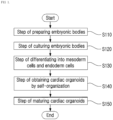
- step (S110) a process of preparing embryonic bodies having a diameter of 100 um to 130 um by culturing human pluripotent stem cells (hPSCs) is performed.
- hPSCs human pluripotent stem cells
- hPSCs human pluripotent stem cells
- hESCs human embryonic stem cells
- hiPSCs human induced pluripotent stem cells
- step (S110) of preparing embryonic bodies human pluripotent stem cells in culture are harvested and then seeded in a 6-well plate at a density of 1.5 ⁇ 10 6 cells/well using an mTeSR1 medium (Stem Cell Technologies, Canada) supplemented with 10 ⁇ M of a Rho-associated kinase) inhibitor (ROCK) (Y-27632, Tocris Bioscience, UK).
- mTeSR1 medium StemTeSR1 medium
- ROCK Rho-associated kinase inhibitor
- the 6-well plate in which the human pluripotent stem cells are plated, is not coated for prevent cell adhesion, and Matrigel that is generally used for organoid culture is also not used.
- a low-attachment plate may be used instead of the 6-well plate.
- embryonic bodies each composed of about 200 to 500 cells and having a diameter of 100 um to 130 um, are prepared in each well.
- this step (S120) a process of further culturing the embryo bodies are prepared in the embryo body preparation step (S110) to a diameter of 200 ⁇ m to 250 ⁇ m is performed.
- step (S120) is an embryo body having a diameter of 100 ⁇ m to 130 ⁇ m prepared through the preparing embryonic body step (S110) in an mTeSR culture medium without ROCK (Rho-associated kinase) inhibitor (Y27632). There are cultured for 2 to 3 days to prepare a human pluripotent stem cell-derived embryo with a diameter of 200 ⁇ m to 250 ⁇ m.
- ROCK Rho-associated kinase
- the culturing process using the mTeSR1 medium free of a Rho-associated kinase (ROCK) inhibitor (Y-27632) is preferably performed for 2 to 3 days while the medium is replaced with fresh medium one every day.
- ROCK Rho-associated kinase
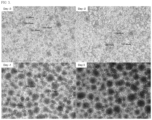
- embryo bodies having a diameter of 100 um to 130 um are prepared as shown in the photograph marked "Day-3", and after 2 to 3 days of additional culturing under varying medium conditions in embryonic body culture step (S120), the diameter increases gradually and comes within a diameter range of 250 um as shown in the photograph marked "Day 0".
- this step (S130) a process of differentiating the human pluripotent stem cell-derived embryonic bodies having a diameter of 200 um to 250 ⁇ m, obtained in embryo body culturing step (S120), into structures comprising mesoderm cells and endoderm cells is performed.
- this step (S130) of differentiating into mesoderm and endoderm cells is subdivided into 2 sequential steps.
- a first differentiation process (step (C-1)) of culturing the human pluripotent stem cell-derived embryonic bodies having a diameter of 200 um to 250 ⁇ m, prepared in embryonic body culturing step (B) for 2 days .
- the culture medium is RPMI 1640 supplemented with B-27 supplement (minus insulin), CHIR99021, BMP4 (bone morphogenetic protein-4) and activin A.
- the medium in which first culturing of the human pluripotent stem cell-derived embryonic bodies having a diameter of 200 um to 250 ⁇ m, prepared in embryonic body culturing step (B), is performed for 2 days, is an RPMI 1640 supplemented with B-27 supplement (minus insulin), 6 ⁇ M to 8 ⁇ M of CHIR99021, 9 ng/ml to 10 ng/ml of BMP4, and 8 ng/ml to 10 ng/ml of Activin A.
- CHIR99021 added to the RPMI 1640 medium used in the first differentiation process in step (S130) of differentiating into mesoderm and endoderm cells is a GSK-3 ⁇ (glycogen synthase kinase-3 ⁇ ) inhibitor for Wnt signal activation and is most preferably used at a concentration of 6 ⁇ M.
- BMP-4 bone morphogenetic protein-4
- RPMI 1640 medium used in the first differentiation process in step (S130) of differentiating into mesoderm and endoderm cells is a component for BMP signal activation, and is most preferably used at a concentration of 10 ng/ml.
- Activin A added to the RPMI 1640 medium used in the first differentiation process in step (S130) of differentiating into mesoderm and endoderm cells is a component for TGF- ⁇ (transforming growth factor- ⁇ ) signal activation, and is most preferably used at a concentration of 10 ng/ml.
- the first differentiation process is followed by a second differentiation process (step C-2) of culturing the human pluripotent stem cell-derived embryonic bodies, cultured in the first differentiation process in step (130) of differentiating into mesoderm and endoderm cells, for 2 days in an RPMI 1640 medium supplemented with B-27 supplement (minus insulin), XAV939 and L-ascorbic acid, thus differentiating the embryonic bodies into structures comprising mesoderm cells and endoderm cells.
- step C-2 of culturing the human pluripotent stem cell-derived embryonic bodies, cultured in the first differentiation process in step (130) of differentiating into mesoderm and endoderm cells, for 2 days in an RPMI 1640 medium supplemented with B-27 supplement (minus insulin), XAV939 and L-ascorbic acid, thus differentiating the embryonic bodies into structures comprising mesoderm cells and endoderm cells.
- the medium in which second culturing of the human pluripotent stem cell-derived embryonic bodies, cultured in the first differentiation process in step (130) of differentiating into mesoderm and endoderm cells, is performed for 2 days, is an RPMI 1640 medium supplemented with B-27 supplement (minus insulin; Thermo Fisher Scientific, USA), 8 ⁇ M to 12 ⁇ M of XAV939 and 40 ⁇ g/ml to 60 ⁇ g/ml of L-ascorbic acid.
- XAV939 added to the RPMI 1640 medium used in the second differentiation process in step (130) of differentiating into mesoderm and endoderm cells is a component for Wnt signal inhibition and is most preferably used at a concentration of 10 ⁇ M.
- XAV939 added to the RPMI 1640 medium used in the second differentiation process in step (130) of differentiating into mesoderm and endoderm cells is an inhibitor of Wnt production (IWP)-2, 3, 4 according to a practice, and IWP-2, 3, 4 may be used at the same concentration as described above.
- L-ascorbic acid added to the RPMI 1640 medium used in the second differentiation process in step (S130) of differentiating into mesoderm and endoderm cells is a component for Wnt signal inhibition and is most preferably used at a concentration of 50 ⁇ g/ml.
- step (S140) a process of differentiating the structures comprising mesoderm cells and endoderm cells, obtained in step (S130) of differentiating into mesoderm and endoderm cells, into cardiac organoids comprising self-organized cardiomyocytes, fibroblasts and endothelial cells, is performed.
- the Cardiac organoid self-organization step S140 is sequentially performed over four steps.
- a process of culturing a composition containing mesoderm cells and endoderm cells differentiated through mesoderm and endoderm cell differentiation (S130) is carried out in the first stage of RPMI 1640 with B-27 supplement (minus insulin) and L-ascorbic acid (L-Ascorbic acid) with a concentration of 40 to 60 ⁇ g/ml.
- L-ascorbic acid added to the RPMI 1640 medium used in the first organization process in step (S140) of obtaining cardiac organoids through self-organization is most preferably used at a concentration of 50 ⁇ g/ml.
- the first organization step is followed by a second organization process (step (D-2)) of inducing differentiation into fibroblasts and endothelial cells by culturing the structures, whose differentiation into cardiomyocytes has been induced in the first organization process (step (D-1)), for 2 days in the RPMI 1640 medium used in the first organization process (step (D-1)) and further supplemented with 20 ng/ml to 40 ng/ml of BMP4, 20 ng/ml to 40 ng/ml of VEGF (vascular endothelial growth factor) and 20 ng/ml to 40 ng/ml of FGF2 (fibroblast growth factor 2).
- step (D-2) of inducing differentiation into fibroblasts and endothelial cells by culturing the structures, whose differentiation into cardiomyocytes has been induced in the first organization process (step (D-1)), for 2 days in the RPMI 1640 medium used in the first organization process (step (D-1)) and further supplemented with 20
- BMP4 bone morphogenetic protein-4 added to the RPMI 1640 medium used in the second organization process in step (S140) of obtaining cardiac organoids through self-organization is a component for BMP signal activation, and is most preferably used at a concentration of 30 ng/ml.
- VEGF vascular endothelial growth factor
- RPMI 1640 medium used in the second organization process in step (S140) of obtaining cardiac organoids through self-organization is a component involved in vascular differentiation and formation, and is preferably used at a concentration of 30 ng/ml.
- FGF2 fibroblast growth factor 2 added to the RPMI 1640 medium used in the second organization process in step (S140) of obtaining cardiac organoids through self-organization is a component for FGF signal activation, and is preferably used at a concentration of 30 ng/ml.
- the second organization process is followed by a third organization process (step (D-3)) of culturing the structures, whose differentiation into cardiomyocytes, fibroblasts and endothelial cells has been induced in the second organization process (step (D-2)), for 2 days in an RPMI 1640 medium supplemented with B-27 supplement (minus vitamin A), 40 ⁇ g/ml to 60 ⁇ g/ml of L-ascorbic acid, 20 ng/ml to 40 ng/ml of BMP4, 20 ng/ml to 40 ng/ml of VEGF (vascular endothelial growth factor) and 20 ng/ml to 40 ng/ml of FGF2 (fibroblast growth factor 2).
- step (D-3) of culturing the structures, whose differentiation into cardiomyocytes, fibroblasts and endothelial cells has been induced in the second organization process (step (D-2)), for 2 days in an RPMI 1640 medium supplemented with B-27 supplement (minus vitamin A
- L-ascorbic acid added to the RPMI 1640 medium in the third organization process in step (S140) of obtaining cardiac organoids through self-organization is most preferably used at a concentration of 50 ⁇ g/ml.
- BMP4 bone morphogenetic protein-4
- BMP4 bone morphogenetic protein-4 added to the RPMI 1640 medium in the third organization process in step (S140) of obtaining cardiac organoids through self-organization is a component for BMP signal activation, and is preferably used at a concentration of 30 ng/ml.
- VEGF vascular endothelial growth factor
- FGF2 fibroblast growth factor 2 added to the RPMI 1640 medium in the third organization process in step (S140) of obtaining cardiac organoids through self-organization is a component for FGF signal activation, and is preferably used at a concentration of 30 ng/ml.
- step (D-4) of obtaining cardiac organoids through differentiation and self-organization by culturing the structures, cultured in the third organization process (step (D-3)), for 2 days in an RPMI 1640 medium supplemented with B-27 supplement (minus vitamin A), 20 ng/ml to 40 ng/ml of BMP4, 20 ng/ml to 40 ng/ml of VEGF (vascular endothelial growth factor) and 20 ng/ml to 40 ng/ml of FGF2 (fibroblast growth factor 2).
- B-27 supplement minus vitamin A
- BMP4 B-27 supplement
- VEGF vascular endothelial growth factor
- FGF2 fibroblast growth factor 2
- BMP4 bone morphogenetic protein-4 added to the RPMI 1640 medium used in the fourth organization process in step (S140) of obtaining cardiac organoids through self-organization is a component for BMP signal activation, and is preferably used at a concentration of 30 ng/ml.
- VEGF vascular endothelial growth factor
- RPMI 1640 medium used in the fourth organization process in step (S140) of obtaining cardiac organoids through self-organization is a component involved in vascular differentiation and formation, and is preferably used at a concentration of 30 ng/ml.
- FGF2 fibroblast growth factor 2 added to the RPMI 1640 medium used in the fourth organization process in step (S140) of obtaining cardiac organoids through self-organization is a component for FGF signal activation, and is preferably used at a concentration of 30 ng/ml.
- step (S140) of obtaining cardiac organoids through self-organization is completed through these sequential processes, cardiac organoids comprising self-organized cardiomyocytes, fibroblasts and endothelial cells are obtained.
- step (S150) a process of culturing and maturing the cardiac organoids obtained by differentiation in step (S140) of obtaining cardiac organoids through self-organization is performed.
- step (S150) of maturing cardiac organoids the cardiac organoids obtained in step (S140) of obtaining cardiac organoids through self-organization are cultured and matured in a maturation medium for 10 to 20 days so that they comprise self-organized cardiomyocytes, fibroblasts and endothelial cells.
- the medium for maturation of the cardiac organoids is an RPMI 1640 medium supplemented with B-27 supplement (minus vitamin A), 20 ng/ml to 40 ng/ml of VEGF (vascular endothelial growth factor), 20 ng/ml to 40 ng/ml of FGF2 (fibroblast growth factor 2), and 10 ng/ml to 15 ng/ml of SB431542 as a component for TGF- ⁇ (transforming growth factor- ⁇ ) signal inhibition.
- B-27 supplement minus vitamin A
- VEGF vascular endothelial growth factor
- FGF2 fibroblast growth factor 2
- SB431542 fibroblast growth factor 2
- VEGF vascular endothelial growth factor
- RPMI 1640 medium used in step (S150) of maturing cardiac organoids is a component involved in vascular differentiation and formation, and is preferably used at a concentration of 30 ng/ml.
- FGF2 fibroblast growth factor 2 added to the RPMI 1640 medium used in step (S150) of maturing cardiac organoids is a component for FGF signal activation, and is preferably used at a concentration of 30 ng/ml.
- SB431542 added to the RPMI 1640 medium used in step (S150) of maturing cardiac organoids is a component for TGF- ⁇ (transforming growth factor- ⁇ ) signal inhibition, and is preferably used at a concentration of 10 ng/ml.
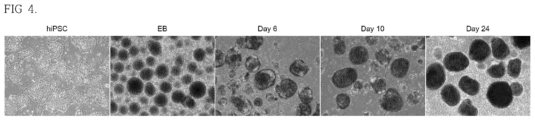
- EBs embryonic bodies
- hiPSCs human induced pluripotent stem cells
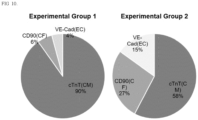
- step (S150) of maturing cardiac organoids is completed through the above-described sequential processes, cardiac organoids comprising self-organized cardiomyocytes, fibroblasts and endothelial cells at a cell number ratio of 55 to 65: 15 to 30: 15 through differentiation are obtained, and this cell number ratio is very close to a cell number ratio of 6: 2: 1.5, which is the number cell ratio between cardiomyocytes, fibroblasts and endothelial cells constituting an actual human heart.
- the cell number ratio between cardiomyocytes, fibroblasts and endothelial cells in the cardiac organoids is similar or identical to that in an actual heart, and the cardiac organoids obtained through simultaneous differentiation, self-organization of cells by interaction from the initial stage of development, and maturation are sufficient to mimic the structure and function of an actual heart, and thus the use thereof in drug screening and cardiac toxicity evaluation through disease modeling during new drug development may dramatically increase the efficiency of new drug development.
- human pluripotent stem cell-derived cardiac organoids produced through the above-described method for producing human pluripotent stem cell-derived multi-cellular cardiac organoids were as one experimental group, and for comparison with this experimental group, another experimental group was set. The results of comparing the suitability of these experimental groups for an actual heart in terms of structure and function will be described below.
- human pluripotent stem cell-derived cardiac organoids obtained through differentiation under different culture conditions were set as Experimental Group 1 and Experimental Group 2, respectively.
- Experimental Group 1 and Experimental Group 2 the process of preparing human pluripotent stem cell-derived embryonic bodies through embryonic body preparation step (S110) and embryonic body culturing step (S120) were the same between the experimental groups.
- human pluripotent stem cell-derived embryonic bodies with a diameter of 200 ⁇ m to 250 ⁇ m are primarily cultured in RPMI 1640 medium containing B-27 supplement (minus insulin), 6 ⁇ M of CHIR99021, 10 ng/ml of BMP4 and Activin A for 2 days. Then, further culturing the cultured human pluripotent stem cell-derived embryonic bodies for 2 days in an RPMI 1640 medium supplemented with B-27 supplement (minus insulin), 10 ⁇ M of XAV939 and 50 ⁇ g/ml of L-ascorbic acid, thus differentiating the embryonic bodies into structures comprising mesoderm cells and endoderm cells, was also the same between the experimental groups. Subsequent processes were performed under different culture conditions.
- a process of inducing differentiation into cardiomyocytes by culturing structures comprising differentiated mesoderm cells and endoderm cells for 2 days in an RPMI 1640 medium supplemented with B-27 supplement (minus insulin) and 50 ⁇ g/ml of L-ascorbic acid was performed, and then the structures were cultured for 2 days in an RPMI 1640 medium supplemented with B-27 supplement (minus vitamin A) and 50 ⁇ g/ml of L-ascorbic acid, and then cultured for 2 days in an RPMI 1640 supplemented with B-27 supplement (minus vitamin A) without L-ascorbic acid, thus obtaining cardiac organoids through self-organization.
- a process of inducing differentiation into cardiomyocytes by culturing structures comprising differentiated mesoderm cells and endoderm cells for 2 days in an RPMI 1640 medium supplemented with B-27 supplement (minus insulin) and 50 ⁇ g/ml of L-ascorbic acid was performed, and then the structures were cultured for 2 days in the above process and further supplemented with 30 ng/ml of BMP4, 30 ng/ml of VEGF (vascular endothelial growth factor) and 30 ng/ml of FGF2 (fibroblast growth factor 2), and then cultured for 2 days in an RPMI 1640 medium supplemented with B-27 supplement (minus vitamin A), 30 ⁇ g/ml of L-ascorbic acid, 30 ng/ml of BMP4, 30 ng/ml of VEGF (vascular endothelial growth factor) and 30 ng/ml of FGF2 (fibroblast growth factor 2), and then cultured for 2 days in
- the self-organized cardiac organoids corresponding to Experimental Group 2 were cultured and matured for 10 to 20 days in an RPMI 1640 medium supplemented with B-27 supplement (minus vitamin A), 30ng/ml of VEGF (vascular endothelial growth factor), 30 ng/ml of FGF2 (fibroblast growth factor 2) and 10 ng/ml of SB431542, thus obtaining Experimental Group 2.
- B-27 supplement minus vitamin A
- VEGF vascular endothelial growth factor
- FGF2 fibroblast growth factor 2
- SB431542 10 ng/ml of SB431542
- Experimental Group 1 showed a composition ratio of 90% cardiomyocytes, 6% fibroblasts, and 4% endothelial cells
- Experimental Group 2 showed a composition ratio of 58% cardiomyocytes, 27% fibroblasts, and 15% endothelial cells.
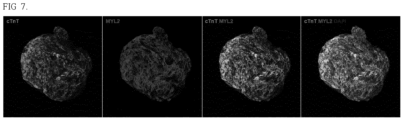
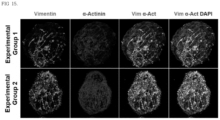
- NKX2.5, TNNT2, MYL2 and MYL7 were used as cardiomyocyte markers.
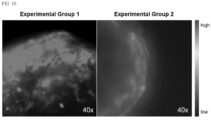
- the vascular endothelial cell marker VE-Cadherin is distributed in a form surrounding the outermost of the cardiac organoids, compared to Experimental Group 1.
- the calcium ion channel function of the cardiac organoids was measured and compared between Experimental Group 1 and Experimental Group 2.
- the prepared cardiac organoids of Experimental Group 2 overcome the limitations of lack of cardiac stem cells, are obtained by culture and differentiation, including simultaneous differentiation into cardiomyocytes, cardiac fibroblasts and vascular endothelial cells, which constitute the heart, from human pluripotent stem cells, and the self-organization of cells through interaction from the initial stage of development, and are sufficient to mimic the structure and function of an actual heart.
- Experimental Group 2 which corresponds to a suitable example of human pluripotent stem cell-derived cardiac organoids produced through the above-described method for producing human pluripotent stem cell-derived cardiac organoids, is sufficient to mimic the structure and function of the heart, may dramatically increase the efficiency of new drug development through the use thereof in drug screening and cardiac toxicity evaluation through disease modeling during new drug development, and is suitable for use an alternative model in studies on heart-related disease mechanisms.
Landscapes
- Health & Medical Sciences (AREA)
- Engineering & Computer Science (AREA)
- Biomedical Technology (AREA)
- Life Sciences & Earth Sciences (AREA)
- Wood Science & Technology (AREA)
- Zoology (AREA)
- Organic Chemistry (AREA)
- Bioinformatics & Cheminformatics (AREA)
- Genetics & Genomics (AREA)
- Chemical & Material Sciences (AREA)
- Biotechnology (AREA)
- Microbiology (AREA)
- Biochemistry (AREA)
- General Engineering & Computer Science (AREA)
- General Health & Medical Sciences (AREA)
- Cell Biology (AREA)
- Rheumatology (AREA)
- Cardiology (AREA)
- Vascular Medicine (AREA)
- Micro-Organisms Or Cultivation Processes Thereof (AREA)
Applications Claiming Priority (2)
| Application Number | Priority Date | Filing Date | Title |
|---|---|---|---|
| KR1020210060265A KR102678908B1 (ko) | 2021-05-10 | 2021-05-10 | 인간 전분화능 줄기세포 유래 심장 오가노이드 제조 방법 및 이를 통해 제조된 인간 전분화능 줄기세포 유래 심장 오가노이드 |
| PCT/KR2022/004329 WO2022239959A1 (fr) | 2021-05-10 | 2022-03-28 | Procédé de production d'organoïde cardiaque dérivé de cellules souches pluripotentes humaines et organoïde cardiaque dérivé de cellules souches pluripotentes humaines ainsi produit |
Publications (2)
| Publication Number | Publication Date |
|---|---|
| EP4339280A1 true EP4339280A1 (fr) | 2024-03-20 |
| EP4339280A4 EP4339280A4 (fr) | 2025-09-24 |
Family
ID=84028570
Family Applications (1)
| Application Number | Title | Priority Date | Filing Date |
|---|---|---|---|
| EP22807607.1A Pending EP4339280A4 (fr) | 2021-05-10 | 2022-03-28 | Procédé de production d'organoïde cardiaque dérivé de cellules souches pluripotentes humaines et organoïde cardiaque dérivé de cellules souches pluripotentes humaines ainsi produit |
Country Status (6)
| Country | Link |
|---|---|
| US (1) | US20230295576A1 (fr) |
| EP (1) | EP4339280A4 (fr) |
| JP (1) | JP7606254B2 (fr) |
| KR (1) | KR102678908B1 (fr) |
| CN (1) | CN116249767B (fr) |
| WO (1) | WO2022239959A1 (fr) |
Families Citing this family (10)
| Publication number | Priority date | Publication date | Assignee | Title |
|---|---|---|---|---|
| KR20240078988A (ko) * | 2022-11-28 | 2024-06-04 | 고려대학교 산학협력단 | 심혈관 오가노이드 성숙 촉진용 조성물 |
| KR102896225B1 (ko) * | 2022-12-12 | 2025-12-04 | 고려대학교 산학협력단 | 성숙된 심장 오가노이드 제조용 조성물 |
| EP4713435A1 (fr) * | 2023-05-17 | 2026-03-25 | Technion Research & Development Foundation Limited | Procédés de culture de cellules cardiaques et utilisation de cellules pour la modélisation de maladies |
| CN117286094B (zh) * | 2023-09-27 | 2024-09-10 | 中国人民解放军军事科学院军事医学研究院 | 一种人类器官来源外泌体的制备方法及其应用 |
| KR20250076941A (ko) * | 2023-11-23 | 2025-05-30 | (주) 넥셀 | 인간 전분화능 줄기세포 유래 심장 오가노이드를 이용해 허혈-재관류 손상에 의해 성체 급성 심근경색 및 심부전 질환이 유도된 체외 질환 모사 모델 제조 방법 및 이를 통해 제조된 체외 질환 모사 모델 |
| CN117757724B (zh) * | 2023-12-28 | 2024-08-16 | 广州医科大学 | 心肺祖细胞外泌体及其制备方法和应用 |
| WO2025146565A1 (fr) * | 2024-01-04 | 2025-07-10 | Alhashimi Fatma | Génération évolutive d'organoïdes cardiaques dérivés de cellules souches pluripotentes induites humaines |
| WO2025244091A1 (fr) * | 2024-05-23 | 2025-11-27 | 国立大学法人 熊本大学 | Procédé de production d'un modèle d'embryon, et modèle d'embryon |
| CN120624344A (zh) * | 2025-06-12 | 2025-09-12 | 西南医科大学 | 一种用于制备3d心脏类器官的培养基及3d心脏类器官的制备方法 |
| CN120519372B (zh) * | 2025-07-23 | 2026-04-03 | 国科大杭州高等研究院 | 基于人多能干细胞诱导的静脉血管类器官及其构建方法 |
Family Cites Families (11)
| Publication number | Priority date | Publication date | Assignee | Title |
|---|---|---|---|---|
| CN104293730B (zh) * | 2014-09-23 | 2017-07-28 | 云南中科灵长类生物医学重点实验室 | 多能干细胞体外定向分化为心肌细胞的方法 |
| CN107427537A (zh) * | 2015-03-03 | 2017-12-01 | 哈佛学院院长及董事 | 产生功能性人体组织的方法 |
| WO2017073794A1 (fr) * | 2015-10-30 | 2017-05-04 | 国立大学法人京都大学 | Procédé de production de tissu myocardique en trois dimensions à partir de cellules souches pluripotentes |
| US11760977B2 (en) * | 2016-05-25 | 2023-09-19 | Salk Institute For Biological Studies | Compositions and methods for organoid generation and disease modeling |
| KR101918817B1 (ko) * | 2016-10-06 | 2018-11-14 | (주) 넥셀 | 인간 줄기세포 유래 간세포 분화 방법 및 간세포 |
| JP7298844B2 (ja) * | 2017-06-05 | 2023-06-27 | テルモ株式会社 | 細胞培養物の製造方法 |
| US12163158B2 (en) | 2017-09-29 | 2024-12-10 | Fumitoshi Ishino | Organoid and method for producing same |
| EP3719116A4 (fr) * | 2017-11-30 | 2021-08-11 | Public University Corporation Yokohama City University | Formation d'un organe tridimensionnel à partir de cellules souches pluripotentes |
| CN108085295A (zh) * | 2017-12-29 | 2018-05-29 | 上海盛兆生物科技有限公司 | 基于生物材料3d人多能干细胞分化心肌组织的构建方法 |
| EP3540046A1 (fr) * | 2018-03-13 | 2019-09-18 | Medizinische Hochschule Hannover | Procédé de production d'organoïdes cardiaques |
| KR102180598B1 (ko) * | 2020-01-06 | 2020-11-18 | 한양대학교 산학협력단 | 줄기세포를 심근세포로 분화 유도하기 위한 배지 조성물 |
-
2021
- 2021-05-10 KR KR1020210060265A patent/KR102678908B1/ko active Active
-
2022
- 2022-03-28 EP EP22807607.1A patent/EP4339280A4/fr active Pending
- 2022-03-28 JP JP2023506066A patent/JP7606254B2/ja active Active
- 2022-03-28 US US18/015,970 patent/US20230295576A1/en active Pending
- 2022-03-28 WO PCT/KR2022/004329 patent/WO2022239959A1/fr not_active Ceased
- 2022-03-28 CN CN202280006108.4A patent/CN116249767B/zh active Active
Also Published As
| Publication number | Publication date |
|---|---|
| KR20220153170A (ko) | 2022-11-18 |
| CN116249767A (zh) | 2023-06-09 |
| JP7606254B2 (ja) | 2024-12-25 |
| US20230295576A1 (en) | 2023-09-21 |
| CN116249767B (zh) | 2025-11-14 |
| JP2023536130A (ja) | 2023-08-23 |
| EP4339280A4 (fr) | 2025-09-24 |
| WO2022239959A1 (fr) | 2022-11-17 |
| KR102678908B1 (ko) | 2024-07-01 |
Similar Documents
| Publication | Publication Date | Title |
|---|---|---|
| EP4339280A1 (fr) | Procédé de production d'organoïde cardiaque dérivé de cellules souches pluripotentes humaines et organoïde cardiaque dérivé de cellules souches pluripotentes humaines ainsi produit | |
| US10947506B2 (en) | Human cardiovascular progenitor cells | |
| Dang et al. | Efficiency of embryoid body formation and hematopoietic development from embryonic stem cells in different culture systems | |
| CA2718032C (fr) | Procede de generation de cellules progenitrices cardiovasculaires primates pour usage clinique a partir de cellules embryonnaires souches primates ou de cellules a l'etat embryonn aire, et leurs applications | |
| Pucéat | Embryological origin of the endocardium and derived valve progenitor cells: from developmental biology to stem cell-based valve repair | |
| JP2020162608A (ja) | 心外膜細胞を形成するための方法及び組成物 | |
| US20210363487A1 (en) | Methods for Cardiac Fibroblast Differentiation of Human Pluripotent Stem Cells | |
| JP7315923B2 (ja) | 臓器オルガノイド及びその製造方法 | |
| Prajapati et al. | Electrophysiological evaluation of human induced pluripotent stem cell-derived cardiomyocytes obtained by different methods | |
| Fukuda | Progress in myocardial regeneration and cell transplantation | |
| KR20230143136A (ko) | 자가 조직화된 인간 심장 오가노이드 | |
| Patra et al. | The functional properties of nephronectin: an adhesion molecule for cardiac tissue engineering | |
| JP7556083B2 (ja) | 多能性幹細胞由来の間葉系幹細胞直接分化用培地、それを利用して間葉系幹細胞を製造する方法、及びそれによって製造された間葉系幹細胞 | |
| WO2018190305A1 (fr) | Procédé de production de sphéroïdes de cellules différenciées | |
| Calderon et al. | Probing early heart development to instruct stem cell differentiation strategies | |
| US20200010807A1 (en) | Stepwise method for inducing cholangiocyte progenitors from hepatoblasts | |
| KR102788090B1 (ko) | 인간 전분화능 줄기세포 유래 3차원 심장 오가노이드의 기능성 평가 방법 | |
| EP4249585A1 (fr) | Modèles de tissu cardiaque, procédé de production de modèles de tissu cardiaque et utilisations de modèles de tissu cardiaque | |
| US20240132851A1 (en) | Methods for Differentiating Endothelial Cells | |
| CN120272410A (zh) | 心肝共生类器官的构建方法及其功能维持培养基 | |
| KR20260039127A (ko) | 심장 오가노이드 제조용 조성물 및 이를 이용한 심장 오가노이드 제조 방법 | |
| CN120944803A (zh) | 具有稳定腔室结构的心脏类器官 | |
| CN120624344A (zh) | 一种用于制备3d心脏类器官的培养基及3d心脏类器官的制备方法 | |
| Guddati | Derivation of cardiomyocytes from embryonic stem cells and development of techniques to study cardiac lineage |
Legal Events
| Date | Code | Title | Description |
|---|---|---|---|
| STAA | Information on the status of an ep patent application or granted ep patent |
Free format text: STATUS: THE INTERNATIONAL PUBLICATION HAS BEEN MADE |
|
| PUAI | Public reference made under article 153(3) epc to a published international application that has entered the european phase |
Free format text: ORIGINAL CODE: 0009012 |
|
| STAA | Information on the status of an ep patent application or granted ep patent |
Free format text: STATUS: REQUEST FOR EXAMINATION WAS MADE |
|
| 17P | Request for examination filed |
Effective date: 20230119 |
|
| AK | Designated contracting states |
Kind code of ref document: A1 Designated state(s): AL AT BE BG CH CY CZ DE DK EE ES FI FR GB GR HR HU IE IS IT LI LT LU LV MC MK MT NL NO PL PT RO RS SE SI SK SM TR |
|
| DAV | Request for validation of the european patent (deleted) | ||
| DAX | Request for extension of the european patent (deleted) | ||
| A4 | Supplementary search report drawn up and despatched |
Effective date: 20250825 |
|
| RIC1 | Information provided on ipc code assigned before grant |
Ipc: C12N 5/077 20100101AFI20250819BHEP Ipc: C12N 5/071 20100101ALI20250819BHEP |