EP4340094A1 - Électrolyte pour batterie lithium-ion non aqueuse, batterie lithium-ion non aqueuse et procédé de production d'une batterie lithium-ion non aqueuse - Google Patents
Électrolyte pour batterie lithium-ion non aqueuse, batterie lithium-ion non aqueuse et procédé de production d'une batterie lithium-ion non aqueuse Download PDFInfo
- Publication number
- EP4340094A1 EP4340094A1 EP22807512.3A EP22807512A EP4340094A1 EP 4340094 A1 EP4340094 A1 EP 4340094A1 EP 22807512 A EP22807512 A EP 22807512A EP 4340094 A1 EP4340094 A1 EP 4340094A1
- Authority
- EP
- European Patent Office
- Prior art keywords
- group
- carbon atoms
- sodium ion
- ion battery
- electrolyte solution
- Prior art date
- Legal status (The legal status is an assumption and is not a legal conclusion. Google has not performed a legal analysis and makes no representation as to the accuracy of the status listed.)
- Pending
Links
Images


Classifications
-
- H—ELECTRICITY
- H01—ELECTRIC ELEMENTS
- H01M—PROCESSES OR MEANS, e.g. BATTERIES, FOR THE DIRECT CONVERSION OF CHEMICAL ENERGY INTO ELECTRICAL ENERGY
- H01M10/00—Secondary cells; Manufacture thereof
- H01M10/05—Accumulators with non-aqueous electrolyte
- H01M10/056—Accumulators with non-aqueous electrolyte characterised by the materials used as electrolytes, e.g. mixed inorganic/organic electrolytes
- H01M10/0564—Accumulators with non-aqueous electrolyte characterised by the materials used as electrolytes, e.g. mixed inorganic/organic electrolytes the electrolyte being constituted of organic materials only
- H01M10/0566—Liquid materials
- H01M10/0567—Liquid materials characterised by the additives
-
- H—ELECTRICITY
- H01—ELECTRIC ELEMENTS
- H01M—PROCESSES OR MEANS, e.g. BATTERIES, FOR THE DIRECT CONVERSION OF CHEMICAL ENERGY INTO ELECTRICAL ENERGY
- H01M10/00—Secondary cells; Manufacture thereof
- H01M10/05—Accumulators with non-aqueous electrolyte
- H01M10/052—Li-accumulators
- H01M10/0525—Rocking-chair batteries, i.e. batteries with lithium insertion or intercalation in both electrodes; Lithium-ion batteries
-
- H—ELECTRICITY
- H01—ELECTRIC ELEMENTS
- H01M—PROCESSES OR MEANS, e.g. BATTERIES, FOR THE DIRECT CONVERSION OF CHEMICAL ENERGY INTO ELECTRICAL ENERGY
- H01M10/00—Secondary cells; Manufacture thereof
- H01M10/05—Accumulators with non-aqueous electrolyte
- H01M10/054—Accumulators with insertion or intercalation of metals other than lithium, e.g. with magnesium or aluminium
-
- H—ELECTRICITY
- H01—ELECTRIC ELEMENTS
- H01M—PROCESSES OR MEANS, e.g. BATTERIES, FOR THE DIRECT CONVERSION OF CHEMICAL ENERGY INTO ELECTRICAL ENERGY
- H01M10/00—Secondary cells; Manufacture thereof
- H01M10/05—Accumulators with non-aqueous electrolyte
- H01M10/056—Accumulators with non-aqueous electrolyte characterised by the materials used as electrolytes, e.g. mixed inorganic/organic electrolytes
- H01M10/0564—Accumulators with non-aqueous electrolyte characterised by the materials used as electrolytes, e.g. mixed inorganic/organic electrolytes the electrolyte being constituted of organic materials only
- H01M10/0566—Liquid materials
- H01M10/0568—Liquid materials characterised by the solutes
-
- H—ELECTRICITY
- H01—ELECTRIC ELEMENTS
- H01M—PROCESSES OR MEANS, e.g. BATTERIES, FOR THE DIRECT CONVERSION OF CHEMICAL ENERGY INTO ELECTRICAL ENERGY
- H01M10/00—Secondary cells; Manufacture thereof
- H01M10/05—Accumulators with non-aqueous electrolyte
- H01M10/056—Accumulators with non-aqueous electrolyte characterised by the materials used as electrolytes, e.g. mixed inorganic/organic electrolytes
- H01M10/0564—Accumulators with non-aqueous electrolyte characterised by the materials used as electrolytes, e.g. mixed inorganic/organic electrolytes the electrolyte being constituted of organic materials only
- H01M10/0566—Liquid materials
- H01M10/0569—Liquid materials characterised by the solvents
-
- H—ELECTRICITY
- H01—ELECTRIC ELEMENTS
- H01M—PROCESSES OR MEANS, e.g. BATTERIES, FOR THE DIRECT CONVERSION OF CHEMICAL ENERGY INTO ELECTRICAL ENERGY
- H01M10/00—Secondary cells; Manufacture thereof
- H01M10/05—Accumulators with non-aqueous electrolyte
- H01M10/058—Construction or manufacture
-
- H—ELECTRICITY
- H01—ELECTRIC ELEMENTS
- H01M—PROCESSES OR MEANS, e.g. BATTERIES, FOR THE DIRECT CONVERSION OF CHEMICAL ENERGY INTO ELECTRICAL ENERGY
- H01M2300/00—Electrolytes
- H01M2300/0017—Non-aqueous electrolytes
- H01M2300/0025—Organic electrolyte
-
- H—ELECTRICITY
- H01—ELECTRIC ELEMENTS
- H01M—PROCESSES OR MEANS, e.g. BATTERIES, FOR THE DIRECT CONVERSION OF CHEMICAL ENERGY INTO ELECTRICAL ENERGY
- H01M2300/00—Electrolytes
- H01M2300/0017—Non-aqueous electrolytes
- H01M2300/0025—Organic electrolyte
- H01M2300/0028—Organic electrolyte characterised by the solvent
-
- Y—GENERAL TAGGING OF NEW TECHNOLOGICAL DEVELOPMENTS; GENERAL TAGGING OF CROSS-SECTIONAL TECHNOLOGIES SPANNING OVER SEVERAL SECTIONS OF THE IPC; TECHNICAL SUBJECTS COVERED BY FORMER USPC CROSS-REFERENCE ART COLLECTIONS [XRACs] AND DIGESTS
- Y02—TECHNOLOGIES OR APPLICATIONS FOR MITIGATION OR ADAPTATION AGAINST CLIMATE CHANGE
- Y02E—REDUCTION OF GREENHOUSE GAS [GHG] EMISSIONS, RELATED TO ENERGY GENERATION, TRANSMISSION OR DISTRIBUTION
- Y02E60/00—Enabling technologies; Technologies with a potential or indirect contribution to GHG emissions mitigation
- Y02E60/10—Energy storage using batteries
Definitions
- One embodiment of the present disclosure relates to an electrolyte solution for a nonaqueous sodium ion battery, a nonaqueous sodium ion battery using the same, and a method for producing the nonaqueous sodium ion battery.
- lithium ion batteries are attracting attention as power storage systems for information-related devices and communication devices, that is, power storage systems for compact and high-energy-density applications such as personal computers, video cameras, digital still cameras, and mobile phones and power storage systems for large-scale power applications such as electric vehicles, hybrid vehicles, auxiliary power sources for fuel cell vehicles, and power storage.
- power storage systems for compact and high-energy-density applications such as personal computers, video cameras, digital still cameras, and mobile phones
- power storage systems for large-scale power applications such as electric vehicles, hybrid vehicles, auxiliary power sources for fuel cell vehicles, and power storage.
- a price of lithium has increased, and a sodium ion battery, which is less expensive, has attracted attention as a next generation secondary battery (Patent Literature 1).
- Patent Literatures 3 and 4 disclose that addition of a fluorosulfate to a nonaqueous lithium ion battery electrolyte solution improves high-temperature durability and an output characteristic.
- a nonaqueous sodium ion battery has already started to put into practical use, but as a result of studies performed by the present inventors, it has been found that there is room for improvement in terms of a cycle characteristic, (an effect of preventing) a gas generation amount during a high-temperature cycle test, and a high-temperature storage characteristic in applications where the nonaqueous sodium ion battery is used at a high temperature for a long period of time, such as automobiles.
- an object of one embodiment of the present disclosure is to provide an electrolyte solution for a nonaqueous sodium ion battery capable of improving at least one of a cycle characteristic of the nonaqueous sodium ion battery at a high temperature of 60°C or higher, (an effect of preventing) a gas generation amount during a high-temperature cycle test, and a high-temperature storage characteristic, a nonaqueous sodium ion battery using the same, and a method for producing the nonaqueous sodium ion battery.
- an electrolyte solution for a nonaqueous sodium ion battery capable of improving at least one of a cycle characteristic of the nonaqueous sodium ion battery at a high temperature of 60°C or higher, (an effect of preventing) a gas generation amount during a high-temperature cycle test, and a high-temperature storage characteristic can be obtained by using an electrolyte solution for a nonaqueous sodium ion battery containing (1) a fluorosulfate, (II) at least one selected from the group consisting of compounds represented by the following Formulae (1) to (9), vinylene carbonate, tris(trimethylsilyl)borate, and tris(trimethylsilyl)phosphate, (III) a sodium salt, and (IV) a nonaqueous solvent, and have completed the present disclosure.
- the present disclosure includes the following embodiments.
- One embodiment of the present disclosure allows for providing an electrolyte solution for a nonaqueous sodium ion battery capable of improving at least one of a cycle characteristic of the nonaqueous sodium ion battery at a high temperature of 60°C or higher, (an effect of preventing) a gas generation amount during a high-temperature cycle test, and a high-temperature storage characteristic, a nonaqueous sodium ion battery using the same, and a method for producing the nonaqueous sodium ion battery are provided.
- Ranges expressed with "to” in the present specification mean ranges including numerical values indicated before and after “to” as a lower limit and an upper limit.
- M represents a boron atom or a phosphorus atom
- m is an integer of 1 to 3
- n is an integer of 0 to 4
- p is 0 or 1
- R 1 represents an alkylene group having 1 to 10 carbon atoms, a halogenated alkylene group having 1 to 10 carbon atoms, an arylene group having 6 to 20 carbon atoms, or a halogenated arylene group having 6 to 20 carbon atoms (each of these groups may contain a substituent or a heteroatom in a structure thereof), when p is 1 and m is 2 or more, m R's may bond to each other, and when p is 0, R 1 does not exist and is a single bond;
- R 3 to R 12 are each independently a fluorine atom, or an organic group selected from the group consisting of an alkoxy group having 1 to 10 carbon atoms, an alkenyloxy group having 2 to 10 carbon atoms, an alkynyloxy group having 2 to 10 carbon atoms, a cycloalkoxy group having 3 to 10 carbon atoms, a cycloalkenyloxy group having 3 to 10 carbon atoms, and an aryloxy group having 6 to 10 carbon atoms, and a fluorine atom, an oxygen atom, and/or an unsaturated bond is optionally present in the organic group;
- R 13 to R 16 are each independently a hydrogen atom, an alkyl group having 1 to 10 carbon atoms, or a fluoroalkyl group having 1 to 10 carbon atoms, and n 2 is an integer of 1 to 3.
- R 17 to R 22 are each independently a hydrogen atom, an alkyl group having 1 to 10 carbon atoms, or a fluoroalkyl group having 1 to 10 carbon atoms, and n 3 is an integer of 0 to 2.
- the electrolyte solution for a nonaqueous sodium ion battery according to the present embodiment can improve at least one of a cycle characteristic at a high temperature of 60°C or higher, (an effect of preventing) a gas generation amount during a high-temperature cycle test, and a high-temperature storage characteristic by having the above-described configuration. Although the details of this mechanism are not clear, it is presumed that a good film can be formed on an electrode by containing the component (II) together with the fluorosulfate.
- the fluorosulfate is an ionic salt having an anion represented by SO 3 F - and a counter cation.
- various counter cations can be selected without any limitation on a type of counter cation as long as the counter cation does not impair performance of the electrolyte solution for a nonaqueous sodium ion battery and the nonaqueous sodium ion battery according to the present embodiment.
- the counter cation examples include metal cations such as lithium ions, sodium ions, potassium ions, rubidium ions, cesium ions, magnesium ions, calcium ions, barium ions, silver ions, copper ions, and iron ions; and onium cations such as tetraalkylammonium ions, tetraalkylpho sphonium ions, imidazolium ions, and ammonium ions having a spiro skeleton.
- metal cations such as lithium ions, sodium ions, potassium ions, rubidium ions, cesium ions, magnesium ions, calcium ions, barium ions, silver ions, copper ions, and iron ions
- onium cations such as tetraalkylammonium ions, tetraalkylpho sphonium ions, imidazolium ions, and ammonium ions having a spiro skeleton.
- lithium ions, sodium ions, potassium ions, tetraalkylammonium ions, tetraalkylphosphonium ions, or ammonium ions having a spiro skeleton are preferred, and lithium ions, sodium ions, tetraalkylammonium ions, or ammonium ions having a spiro skeleton are more preferred.
- An alkyl group in the tetraalkylammonium ion preferably has 1 to 6 carbon atoms
- an alkyl group in the tetraalkylphosphonium ion preferably has 1 to 6 carbon atoms.
- alkyl groups in the tetraalkylammonium ion may be the same or different from one another, and four alkyl groups in the tetraalkylphosphonium ion may be the same or different from one another.
- ammonium ion having a spiro skeleton is preferably, for example, 5-azoniaspiro[4.4]nonane.
- the fluorosulfate is not limited, but is preferably NaSO 3 F, LiSO 3 F, TEMASO 3 F, SBPSO 3 F, or TEASO 3 F, and particularly preferably NaSO 3 F, LiSO 3 F, or TEASO 3 F.
- TEA represents tetraethylammonium
- TEMA represents triethyl methyl ammonium
- SBP represents 5-azoniaspiro[4.4]nonane.
- a content x of the fluorosulfate is not limited, but is preferably 0.001 mass% or more, more preferably 0.008 mass% or more, still more preferably 0.08 mass% or more, and yet still more preferably 1.5 mass% or more with respect to the total amount of the electrolyte solution for a nonaqueous sodium ion battery. Further, the content of the fluorosulfate is not limited, but is preferably 11.5 mass% or less, more preferably 10.5 mass% or less, still more preferably 7.5 mass% or less, and particularly preferably 5.5 mass% or less with respect to the total amount of the electrolyte solution for a nonaqueous sodium ion battery.
- the content of the fluorosulfate is 0.001 mass% or more, at least one of a cycle characteristic of the nonaqueous sodium ion battery at the high temperature of 60°C or higher, (the effect of preventing) the gas generation amount during the high-temperature cycle test, and the high-temperature storage characteristic can be improved. Further, when the content is 11.5 mass% or less, the film formed on the electrode does not become too thick, and this hardly leads to an increase in resistance.
- fluorosulfates may be used alone, or two or more types thereof may be mixed and used in any combination and any proportion according to an application.
- the content x of the fluorosulfate preferably satisfies 0.008 mass% ⁇ x ⁇ 11.5 mass%, more preferably satisfies 0.008 mass% ⁇ x ⁇ 10.5 mass%, still more preferably satisfies 0.008 mass% ⁇ x ⁇ 7.5 mass%, and particularly preferably satisfies 1.5 mass% ⁇ x ⁇ 5.5 mass% with respect to the total amount of the electrolyte solution for a nonaqueous sodium ion battery.
- M represents a boron atom or a phosphorus atom
- m is an integer of 1 to 3
- n is an integer of 0 to 4
- p is 0 or 1
- R 1 represents an alkylene group having 1 to 10 carbon atoms, a halogenated alkylene group having 1 to 10 carbon atoms, an arylene group having 6 to 20 carbon atoms, or a halogenated arylene group having 6 to 20 carbon atoms (each of these groups may contain a substituent or a heteroatom in a structure thereof), when p is 1 and m is 2 or more, m R's may bond to each other, and when p is 0, R 1 does not exist and is a single bond;
- R 3 to R 12 are each independently a fluorine atom, or an organic group selected from the group consisting of an alkoxy group having 1 to 10 carbon atoms, an alkenyloxy group having 2 to 10 carbon atoms, an alkynyloxy group having 2 to 10 carbon atoms, a cycloalkoxy group having 3 to 10 carbon atoms, a cycloalkenyloxy group having 3 to 10 carbon atoms, and an aryloxy group having 6 to 10 carbon atoms, and a fluorine atom, an oxygen atom, and/or an unsaturated bond is optionally present in the organic group;
- R 13 to R 16 are each independently a hydrogen atom, an alkyl group having 1 to 10 carbon atoms, or a fluoroalkyl group having 1 to 10 carbon atoms, and n 2 is an integer of 1 to 3.
- R 17 to R 22 are each independently a hydrogen atom, an alkyl group having 1 to 10 carbon atoms, or a fluoroalkyl group having 1 to 10 carbon atoms, and n 3 is an integer of 0 to 2.
- R 1 represents an alkylene group having 1 to 10 carbon atoms
- the alkylene group having 1 to 10 carbon atoms is not limited, but may be linear or branched, preferably an alkylene group having 1 to 6 carbon atoms, and more preferably an alkylene group having 1 to 2 carbon atoms.
- R 1 represents a halogenated alkylene group having 1 to 10 carbon atoms
- the halogenated alkylene group having 1 to 10 carbon atoms is not limited, but may be linear or branched, preferably a halogenated alkylene group having 1 to 6 carbon atoms, and more preferably a halogenated alkylene group having 1 to 2 carbon atoms.
- halogenated alkylene group is a group in which a part or all of the hydrogen atoms of an alkylene group are substituted with halogen atoms.
- halogen atom in the halogenated alkylene group having 1 to 10 carbon atoms examples include a fluorine atom, a chlorine atom, a bromine atom, and an iodine atom.
- R 1 represents an arylene group having 6 to 20 carbon atoms
- the arylene group having 6 to 20 carbon atoms is not limited, but may be monocyclic or polycyclic, preferably an arylene group having 6 to 15 carbon atoms, and more preferably an arylene group having 6 to 10 carbon atoms.
- R 1 represents a halogenated arylene group having 6 to 20 carbon atoms
- the halogenated arylene group having 6 to 20 carbon atoms is not limited, but may be monocyclic or polycyclic, preferably a halogenated arylene group having 6 to 15 carbon atoms, and more preferably a halogenated arylene group having 6 to 10 carbon atoms.
- halogenated arylene group is a group in which a part or all of the hydrogen atoms of an arylene group are substituted with halogen atoms.
- halogen atom in the halogenated arylene group having 6 to 20 carbon atoms examples include a fluorine atom, a chlorine atom, a bromine atom, and an iodine atom.
- the group may contain a substituent or a heteroatom in a structure thereof.
- p 0.
- Examples of the halogen atom represented by R 2 include a fluorine atom, a chlorine atom, a bromine atom, and an iodine atom.
- alkali metal cation When A a+ represents an alkali metal cation, the alkali metal cation is not limited, but examples thereof include a lithium ion, a sodium ion, and a potassium ion.
- a a+ represents an alkaline earth metal cation
- the alkaline earth metal cation is not limited, but examples thereof include a magnesium ion and a calcium ion.
- the onium cation is not limited, but examples thereof include a tetraalkylammonium ion, a tetraalkylphosphonium ion, an imidazolium ion, and an ammonium ion having a spiro skeleton.
- An alkyl group in the tetraalkylammonium ion preferably has 1 to 6 carbon atoms
- an alkyl group in the tetraalkylphosphonium ion preferably has 1 to 6 carbon atoms.
- alkyl groups in the tetraalkylammonium ion may be the same or different from one another, and four alkyl groups in the tetraalkylphosphonium ion may be the same or different from one another.
- ammonium ion having a spiro skeleton is preferably, for example, 5-azoniaspiro[4.4]nonane.
- a to d are 1.
- R 3 to R 12 each independently represent an alkoxy group having 1 to 10 carbon atoms as the organic group
- the alkoxy group having 1 to 10 carbon atoms is not limited, but may be linear or branched.
- a linear alkoxy group is preferably an alkoxy group having 1 to 6 carbon atoms.
- An alkoxy group having 1 to 3 carbon atoms is more preferable.
- an alkoxy group having 3 to 10 carbon atoms is preferable, and an alkoxy group having 3 to 6 carbon atoms is more preferable.
- R 3 to R 12 each independently represent an alkenyloxy group having 2 to 10 carbon atoms as the organic group
- the alkenyloxy group having 2 to 10 carbon atoms is not limited, but may be linear or branched, preferably an alkenyloxy group having 2 to 6 carbon atoms, and more preferably an alkenyloxy group having 2 to 3 carbon atoms.
- R 3 to R 12 each independently represent an alkynyloxy group having 2 to 10 carbon atoms as the organic group
- the alkynyloxy group having 2 to 10 carbon atoms is not limited, but may be linear or branched, preferably an alkynyloxy group having 2 to 6 carbon atoms, and more preferably an alkynyloxy group having 2 to 3 carbon atoms.
- R 3 to R 12 each independently represent a cycloalkoxy group having 3 to 10 carbon atoms as the organic group
- the cycloalkoxy group having 3 to 10 carbon atoms is not limited, but may be monocyclic or polycyclic, preferably a cycloalkoxy group having 3 to 8 carbon atoms, more preferably a cycloalkoxy group having 3 to 6 carbon atoms.
- R 3 to R 12 each independently represent a cycloalkenyloxy group having 3 to 10 carbon atoms as the organic group
- the cycloalkenyloxy group having 3 to 10 carbon atoms is not limited, but may be monocyclic or polycyclic, preferably a cycloalkenyloxy group having 3 to 8 carbon atoms, more preferably a cycloalkenyloxy group having 3 to 6 carbon atoms.
- R 3 to R 12 each independently represent an aryloxy group having 6 to 10 carbon atoms as the organic group
- the aryloxy group having 6 to 10 carbon atoms is not limited, but may be monocyclic or polycyclic, and examples thereof include a phenyloxy group and a naphthyloxy group.
- R 3 to R 12 each independently represent the organic group selected from the above group, the fluorine atom, the oxygen atom, and/or the unsaturated bond may be present in the organic group.
- the expression "when an oxygen atom is present in an organic group” specifically refers to a group in which "-O-" (ether bond) is interposed between carbon atoms of the above groups.
- X 5 to X 7 each independently represent an alkyl group having 1 to 10 carbon atoms as an organic group
- the alkyl group having 1 to 10 carbon atoms is not limited, but may be linear or branched.
- a linear alkyl group is preferably an alkyl group having 1 to 6 carbon atoms, and more preferably an alkyl group having 1 to 3 carbon atoms.
- a branched alkyl group is preferably an alkyl group having 3 to 10 carbon atoms, and more preferably an alkyl group having 3 to 6 carbon atoms.
- alkenyl group having 2 to 10 carbon atoms is not limited, but may be linear or branched, preferably an alkenyl group having 2 to 6 carbon atoms, and more preferably an alkenyl group having 2 to 3 carbon atoms.
- alkynyl group having 2 to 10 carbon atoms is not limited, but may be linear or branched, preferably an alkynyl group having 2 to 6 carbon atoms, and more preferably an alkynyl group having 2 to 3 carbon atoms.
- cycloalkyl group having 3 to 10 carbon atoms is not limited, but may be monocyclic or polycyclic, preferably a cycloalkyl group having 3 to 8 carbon atoms, more preferably a cycloalkyl group having 3 to 6 carbon atoms.
- cycloalkenyl group having 3 to 10 carbon atoms is not limited, but may be monocyclic or polycyclic, preferably a cycloalkenyl group having 3 to 8 carbon atoms, more preferably a cycloalkenyl group having 3 to 6 carbon atoms.
- X 5 to X 7 each independently represent an aryl group having 6 to 10 carbon atoms as the organic group
- the aryl group having 6 to 10 carbon atoms is not limited, but may be monocyclic or polycyclic, and examples thereof include a phenyl group and a naphthyl group.
- examples of the alkoxy group having 1 to 10 carbon atoms include the same as the case of the alkoxy group having 1 to 10 carbon atoms when R 3 to R 12 described above each independently represent the alkoxy group having 1 to 10 carbon atoms as the organic group, and the preferred ranges are also the same.
- alkenyloxy group having 2 to 10 carbon atoms examples include the same as the case of the alkenyloxy group having 2 to 10 carbon atoms when R 3 to R 12 described above each independently represent the alkenyloxy group having 2 to 10 carbon atoms as the organic group, and the preferred ranges are also the same.
- alkynyloxy group having 2 to 10 carbon atoms examples include the same as the case of the alkynyloxy group having 2 to 10 carbon atoms when R 3 to R 12 described above each independently represent the alkynyloxy group having 2 to 10 carbon atoms as the organic group, and the preferred ranges are also the same.
- examples of the cycloalkoxy group having 3 to 10 carbon atoms include the same as the case of the cycloalkoxy group having 3 to 10 carbon atoms when R 3 to R 12 described above each independently represent the cycloalkoxy group having 3 to 10 carbon atoms as the organic group, and the preferred ranges are also the same.
- examples of the cycloalkenyloxy group having 3 to 10 carbon atoms include the same as the case of the cycloalkenyloxy group having 3 to 10 carbon atoms when R 3 to R 12 described above each independently represent the cycloalkenyloxy group having 3 to 10 carbon atoms as the organic group, and the preferred ranges are also the same.
- X 5 to X 7 each independently represent an aryloxy group having 6 to 10 carbon atoms as the organic group
- examples of the aryloxy group having 6 to 10 carbon atoms include the same as the case of the aryloxy group having 6 to 10 carbon atoms when R 3 to R 12 described above each independently represent the aryloxy group having 6 to 10 carbon atoms as the organic group, and the preferred ranges are also the same.
- X 5 to X 7 each independently represent the organic group selected from the above group, the fluorine atom, the oxygen atom, and/or the unsaturated bond may be present in the organic group.
- the expression "when an oxygen atom is present in an organic group” specifically refers to a group in which "-O-" (ether bond) is interposed between carbon atoms of the above groups.
- M 2 to M 8 are each independently a proton, a metal cation, or an onium cation. M 2 to M 8 are each independently typically a monovalent cation.
- M 2 to M 8 each independently represent a metal cation
- the metal cation is not limited, but examples thereof include an alkali metal cation, such as a lithium ion, a sodium ion, and a potassium ion.
- M 2 to M 8 each independently represent an onium cation
- the onium cation is not limited, but examples thereof include a tetraalkylammonium ion, a tetraalkylphosphonium ion, an imidazolium ion, and an ammonium ion having a spiro skeleton.
- An alkyl group in the tetraalkylammonium ion preferably has 1 to 6 carbon atoms
- an alkyl group in the tetraalkylphosphonium ion preferably has 1 to 6 carbon atoms.
- alkyl groups in the tetraalkylammonium ion may be the same or different from one another, and four alkyl groups in the tetraalkylphosphonium ion may be the same or different from one another.
- ammonium ion having a spiro skeleton is preferably, for example, 5-azoniaspiro[4.4]nonane.
- R 13 to R 16 each independently represent an alkyl group having 1 to 10 carbon atoms
- the alkyl group having 1 to 10 carbon atoms is not limited, but may be linear or branched.
- a linear alkyl group is preferably an alkyl group having 1 to 6 carbon atoms, and more preferably an alkyl group having 1 to 3 carbon atoms.
- a branched alkyl group is preferably an alkyl group having 3 to 10 carbon atoms, and more preferably an alkyl group having 3 to 6 carbon atoms.
- R 13 to R 16 each independently represent a fluoroalkyl group having 1 to 10 carbon atoms
- the fluoroalkyl group having 1 to 10 carbon atoms is not limited, but may be linear or branched.
- the "fluoroalkyl group” is a group in which a part or all of the hydrogen atoms of an alkyl group are substituted with fluorine atoms.
- a linear fluoroalkyl group is preferably a fluoroalkyl group having 1 to 6 carbon atoms, and more preferably a fluoroalkyl group having 1 to 3 carbon atoms.
- a branched fluoroalkyl group is preferably a fluoroalkyl group having 3 to 10 carbon atoms, and more preferably a fluoroalkyl group having 3 to 6 carbon atoms.
- the alkyl group having 1 to 10 carbon atoms and the fluoroalkyl group having 1 to 10 carbon atoms may have a substituent.
- R 17 to R 22 each independently represent an alkyl group having 1 to 10 carbon atoms
- examples of the alkyl group having 1 to 10 carbon atoms include the same as the case of the alkyl group having 1 to 10 carbon atoms when R 13 to R 16 described above each independently represent the alkyl group having 1 to 10 carbon atoms, and the preferred ranges are also the same.
- R 17 to R 22 each independently represent a fluoroalkyl group having 1 to 10 carbon atoms
- examples of the fluoroalkyl group having 1 to 10 carbon atoms include the same as the case of the fluoroalkyl group having 1 to 10 carbon atoms when R 13 to R 16 described above each independently represent the fluoroalkyl group having 1 to 10 carbon atoms, and the preferred ranges are also the same.
- the compound represented by the Formula (1) is preferably at least one selected from the group consisting of NaBF 2 (C 2 O 4 ), NaPF 4 (C 2 O 4 ), NaPF 2 (C 2 O 4 ) 2 , and NaP(C 2 O 4 ) 3 .
- the compound represented by the Formula (2) is preferably at least one selected from the group consisting of compounds in which R 3 and R 4 are each independently a fluorine atom, a methoxy group, an ethoxy group, or a propargyloxy group, and M 2 is a lithium ion, a sodium ion, a potassium ion, or a tetraalkylammonium ion.
- the compound represented by the Formula (3) is preferably at least one selected from the group consisting of compounds in which R 5 and R 6 are each independently a fluorine atom, a methoxy group, or an ethoxy group, and M 3 is a lithium ion, a sodium ion, a potassium ion, or a tetraalkylammonium ion.
- the compound represented by the Formula (4) is preferably at least one selected from the group consisting of compounds in which M 4 and M 5 are each independently a lithium ion, a sodium ion, a potassium ion, or a tetraalkylammonium ion.
- the compound represented by the Formula (5) is preferably at least one selected from the group consisting of LiN(SO 2 F) 2 , LiN(SO 2 F)(SO 2 CF 3 ), NaN(SO 2 F) 2 , NaN(SO 2 F)(SO 2 CF 3 ), KN(SO 2 F) 2 , and KN(SO 2 F)(SO 2 CF 3 ).
- the compound represented by the Formula (6) is preferably at least one selected from the group consisting of LiN(POF 2 ) 2 , LiN(POF 2 )(PO(OCH 3 ) 2 ), NaN(POF 2 ) 2 , NaN(POF 2 )(PO(OCH 3 ) 2 ), KN(POF 2 ) 2 , and KN(POF 2 )(PO(OCH 3 ) 2 ).
- the compound represented by the Formula (7) is preferably at least one selected from the group consisting of LiN(POF 2 )(SO 2 F), LiN(PO(OCH 3 ) 2 )(SO 2 F), NaN(POF 2 )(SO 2 F), NaN(PO(OCH 3 ) 2 )(SO 2 F), KN(POF 2 )(SO 2 F), and KN(PO(OCH 3 ) 2 )(SO 2 F).
- the compound represented by the Formula (8) is preferably at least one selected from the group consisting of 1,3-propene sultone, 1,4-butene sultone, and 2-methyl-1,3-propene sultone.
- the compound represented by the Formula (9) is preferably at least one selected from the group consisting of 1,3-propane sultone, 1,4-butane sultone, 1-methyl-1,3-propane sultone, and 3-methyl-1,3-propane sultone.
- a content y of the component (II) is not limited, but is preferably 0.01 mass% or more, more preferably 0.03 mass% or more, still more preferably 0.1 mass% or more, and yet still more preferably 0.8 mass% or more with respect to the total amount of the electrolyte solution for a nonaqueous sodium ion battery. Further, the content y of the component (II) is not limited, but is preferably 10.0 mass% or less, more preferably 8.0 mass% or less, still more preferably 5.0 mass% or less, yet still more preferably 3.5 mass% or less, and particularly preferably 2.5 mass% or less with respect to the total amount of the electrolyte solution for a nonaqueous sodium ion battery.
- the content y is 0.01 mass% or more, at least one of the cycle characteristic of the nonaqueous sodium ion battery at the high temperature of 60°C or higher, (the effect of preventing) the gas generation amount during the high-temperature cycle test, and the high-temperature storage characteristic can be improved. Further, when the content y is 10.0 mass% or less, the film formed on the electrode does not become too thick, and this hardly leads to an increase in resistance.
- One type of these components (II) may be used alone, or two or more types thereof may be mixed and used in any combination and any proportion according to an application.
- the content y of the component (II) preferably satisfies 0.01 mass% ⁇ y ⁇ 10.0 mass%, more preferably satisfies 0.03 mass% ⁇ y ⁇ 8.0 mass%, still more preferably satisfies 0.1 mass% ⁇ y ⁇ 5.0 mass%, yet still more preferably satisfies 0.1 mass% ⁇ y ⁇ 3.5 mass%, and particularly preferably satisfies 0.8 mass% ⁇ y ⁇ 2.5 mass% with respect to the total amount of the electrolyte solution for a nonaqueous sodium ion battery.
- a type of a sodium salt of a solute is not limited, and any sodium salt (excluding the fluorosulfate) can be used.
- Specific examples thereof include an electrolyte solution sodium salt represented by at least one selected from the group consisting of NaPF 6 , NaBF 4 , NaBF 2 (C 2 O 4 ), NaPF 4 (C 2 O 4 ), NaPF 2 (C 2 O 4 ) 2 , NaSbF 6 , NaAsF 6 , NaClO 4 , NaN(SO 2 F) 2 , NaN(SO 2 CF 3 ) 2 , NaN(SO 2 F)(SO 2 CF 3 ), NaN(C a F 2a+1 SO 2 )(C b F 2b+1 SO 2 ) (in which a and b are integers satisfying 2 ⁇ a ⁇ 20 and 2 ⁇ b ⁇ 20), NaSO 3 CF 3 ,NaSO 3 C 4 F 9 , NaN(POF 2 ) 2 , NaN(POF 2
- NaPF 6 NaBF 2 (C 2 O 4 ), NaPF 4 (C 2 O 4 ), NaPF 2 (C 2 O 4 ) 2 , NaN(SO 2 F) 2 , NaN(SO 2 CF 3 ) 2 , NaN(SO 2 C 2 F 5 ) 2 , NaN(POF 2 ) 2 , NaN(POF 2 )(SO 2 F), and NaPO 2 F 2 are preferred, NaPF 6 and NaN(SO 2 F) 2 are more preferred, and NaPF 6 is even more preferred.
- the electrolyte solution for a nonaqueous sodium ion battery contains NaPF 6 as the (III) sodium salt.
- a concentration z of the sodium salt in the electrolyte solution for a nonaqueous sodium ion battery according to the present embodiment is not limited, but is preferably 0.05 mol/L or more, more preferably 0.3 mol/L or more, and still more preferably 0.8 mol/L or more, and is preferably 5.0 mol/L or less, more preferably 2.0 mol/L or less, and still more preferably 1.5 mol/L or less with respect to the total amount of the electrolyte solution for a nonaqueous sodium ion battery.
- Setting the concentration to 0.05 mol/L or more allows for facilitating prevention of deterioration of a cycle characteristic of the nonaqueous sodium ion battery due to a decrease in ionic conductivity. And, setting the concentration to 5.0 mol/L or less allows for facilitating prevention of an increase in viscosity of the electrolyte solution for a nonaqueous sodium ion battery and an accompanying decrease in battery characteristic due to the decrease in ionic conductivity.
- One type of these components (III) may be used alone, or two or more types thereof may be mixed and used in any combination and any proportion according to an application.
- the concentration z of the component (III) preferably satisfies 0.3 mol/L ⁇ z ⁇ 5.0 mol/L, more preferably satisfies 0.4 mol/L ⁇ z ⁇ 3.0 mol/L, still more preferably satisfies 0.5 mol/L ⁇ z ⁇ 2.0 mol/L, and particularly preferably satisfies 0.8 mol/L ⁇ z ⁇ 1.5 mol/L with respect to the total amount of the electrolyte solution for a nonaqueous sodium ion battery.
- Some of the (III) sodium salt may overlap with some of the component (II), but when a content of the overlap is a predetermined amount or more (the concentration of the (III) sodium salt in the electrolyte solution for a nonaqueous sodium ion battery is 0.3 mol/L or more with respect to the total amount of the electrolyte solution for a nonaqueous sodium ion battery), the overlap works as a main electrolyte solution ((III) sodium salt), and when the content is less than the predetermined amount, the overlap works as an additive (component (II)).
- component (II) is a compound different from the (III) sodium salt.
- the component (II) is a compound other than NaBF 2 (C 2 O 4 ).
- a type of the nonaqueous solvent is not limited, and any nonaqueous solvent can be used. Specific examples thereof include the following nonaqueous solvents.
- cyclic ester examples include cyclic carbonates (excluding vinylene carbonate) such as ethylene carbonate, propylene carbonate, and butylene carbonate, ⁇ -butyrolactone, and ⁇ -valerolactone.
- Examples of a chain ester include chain carbonates such as dimethyl carbonate, diethyl carbonate, and ethyl methyl carbonate, methyl acetate, ethyl acetate, methyl propionate, and ethyl propionate.
- Examples of a cyclic ether include tetrahydrofuran, 2-methyltetrahydrofuran, 1,3-dioxolane, 2-methyl-1,3-dioxolane, 4-methyl-1,3-dioxolane, 1,3-dioxane, and the like.
- Examples of a chain ether include dimethoxyethane, diethoxyethane, diethyl ether, ethoxy-methoxy ethane, diethylene glycol dimethyl ether, triethylene glycol dimethyl ether, tetraethylene glycol dimethyl ether, dipropylene glycol dimethyl ether, and the like.
- Examples of a sulfur-containing nonaqueous solvent include dimethyl sulfoxide and sulfolane.
- one type of these nonaqueous solvents used in the present embodiment may be used alone, or two or more types thereof may be mixed and used in any combination and any proportion according to an application.
- the electrolyte solution for a nonaqueous sodium ion battery contains, as the nonaqueous solvent, at least one selected from the group consisting of a cyclic ester, a chain ester, a cyclic ether, and a chain ether.
- the electrolyte solution for a nonaqueous sodium ion battery contains the cyclic ester as the nonaqueous solvent, and the cyclic ester is a cyclic carbonate. Further, in one preferable embodiment, the electrolyte solution for a nonaqueous sodium ion battery contains the chain ester as the nonaqueous solvent, and the chain ester is a chain carbonate.
- the electrolyte solution for a nonaqueous sodium ion battery more preferably contains at least one selected from the group consisting of ethylene carbonate, propylene carbonate, butylene carbonate, dimethyl carbonate, diethyl carbonate, ethyl methyl carbonate, ⁇ -butyrolactone, methyl acetate, ethyl acetate, ethyl propionate, 1,3-dioxolane, 2-methyl-1,3-dioxolane, 4-methyl-1,3-dioxolane, dimethoxyethane, diethoxyethane, ethoxy-methoxy ethane, diethylene glycol dimethyl ether, triethylene glycol dimethyl ether, tetraethylene glycol dimethyl ether, and dipropylene glycol dimethyl ether as the nonaqueous solvent.
- nonaqueous solvents may be used alone, or two or more types thereof may be mixed and used in any combination and any proportion according to an application.
- the electrolyte solution for a nonaqueous sodium ion battery according to the present embodiment may contain other additives typically used in the electrolyte solution for a nonaqueous sodium ion battery at any proportion without departing from the gist of the present disclosure.
- specific examples thereof include compounds having an overcharge prevention effect, a negative electrode film-forming effect, and a positive electrode protection effect, such as cyclohexylbenzene, biphenyl, t-butyl benzene, t-amyl benzene, fluorobenzene, a vinylene carbonate oligomer (in which a number average molecular weight is 170 to 5,000.
- the number average molecular weight is a number average molecular weight in terms of standard polystyrene measured by gel permeation chromatography (GPC) using tetrahydrofuran (THF) as a solvent.
- GPC gel permeation chromatography
- THF tetrahydrofuran
- the electrolyte solution for a nonaqueous sodium ion battery according to the present embodiment contains fluoroethylene carbonate
- the content thereof is preferably not too large from the viewpoint of gas generation, and fluoroethylene carbonate may not be substantially contained.
- “Not be substantially contained” means “less than 0.001 mass% with respect to the total amount of the electrolyte solution”.
- the electrolyte solution for a nonaqueous sodium ion battery according to the present embodiment does not contain fluoroethylene carbonate.
- the electrolyte solution for a nonaqueous sodium ion battery according to the present embodiment contains 1,3,2-dioxathiolane-2,2-dioxide and/or 4-propyl-1,3,2-dioxathiolane-2,2-dioxide, a content thereof is preferably not too large from the viewpoint of storage stability, and when the electrolyte solution for a nonaqueous sodium ion battery contains 1,3,2-dioxathiolane-2,2-dioxide and/or 4-propyl-1,3,2-dioxathiolane-2,2-dioxide, a content thereof is preferably not too large from the viewpoint of storage stability, and may not be substantially contained.
- the electrolyte solution for a nonaqueous sodium ion battery according to the present embodiment does not contain 1,3,2-dioxathiolane-2,2-dioxide and/or 4-propyl-1,3,2-dioxathiolane-2,2-dioxide.
- the electrolyte solution for a nonaqueous sodium ion battery according to the present embodiment contains the above other additives
- the electrolyte solution for a nonaqueous sodium ion battery contains the other additives in an amount of preferably 0.01 mass% or more and 10 mass% or less with respect to the total amount of the electrolyte solution.
- the above sodium salt (a sodium salt other than the sodium salt used as the solute (excluding those corresponding to the components (1) and (II))) can also be used as another additive.
- the electrolyte solution for a nonaqueous sodium ion battery contains the other additives in an amount of preferably 0.3 mass% or more and 1.5 mass% or less with respect to the total amount of the electrolyte solution.
- the other additive may be a gelling agent or a crosslinked polymer.
- the electrolyte solution for a nonaqueous sodium ion battery according to the present embodiment can also be pseudo-solidified with the gelling agent or the crosslinked polymer, and the pseudo-solidified one is suitable, for example, for a sodium polymer battery.
- the nonaqueous sodium ion battery includes at least a positive electrode, a negative electrode, and the electrolyte solution for a nonaqueous sodium ion battery according to the present embodiment.
- the nonaqueous sodium ion battery according to the present embodiment is characterized in that the electrolyte solution for a nonaqueous sodium ion battery according to the present embodiment is used, and for the other components, the nonaqueous sodium ion battery uses usual members to be used in a general nonaqueous sodium ion battery. That is, the other components include a positive electrode and a negative electrode capable of occluding and discharging sodium, a current collector, a separator, an exterior body, and the like.
- a positive electrode material is not limited, but examples thereof include sodium-containing transition metal composite oxides such as NaCrO 2 , NaFeo.sCoo.sOz, NaFe 0.4 Mn 0.3 Ni 0.3 O 2 , NaNi 0.5 Ti 0.3 Mn 0.2 O 2 , Na 2/3 Ni 1/3 Ti 1/6 Mn 1/2 O 2 , and Na 2/3 Ni 1/3 Mn 2/3 O 2 , these sodium-containing transition metal composite oxides in which a plurality of transition metals such as Co, Mn, and Ni are mixed, sodium-containing transition metal composite oxides in which a part of the transition metals of these sodium-containing transition metal composite oxides is replaced with other metals other than the transition metals, polyanion type compounds such as NaFePO 4 , NaVPO 4 F, Na 3 V 2 (PO 4 ) 3 , and Na 2 Fe 2 (SO 4 ) 3 , oxides such as TiO 2 , V 2 O 5 , and MoO 3 , sulfides such as TiO 2 , V
- a positive electrode active material layer is formed on at least one surface of a positive electrode current collector.
- the positive electrode active material layer includes, for example, the positive electrode active material described above, a binder, and, if necessary, an electrically conductive agent.
- the binder include polytetrafluoroethylene, polyvinylidene fluoride, and a styrenebutadiene rubber (SBR) resin.
- SBR styrenebutadiene rubber
- the electrically conductive agent for example, carbon materials such as acetylene black, Ketjen black, carbon fiber, or graphite (granular graphite or flake graphite) can be used, and acetylene black or Ketjen black having low crystallinity is preferably used.
- a negative electrode material is not limited, but examples thereof include sodium metal and materials capable of occluding and discharging sodium ions.
- sodium metal an alloy of sodium metal and other metals such as tin, an intermetallic compound, various carbon materials such as hard carbon, a metal oxide such as titanium oxide, a metal nitride, (elemental) tin, a tin compound, activated carbon, a conductive polymer, and the like are used.
- (elemental) phosphorus such as red phosphorus and black phosphorus
- phosphorus compounds such as Co-P, Cu-P, Sn-P, Ge-P, and Mo-P
- (elemental) antimony, antimony compounds such as Sb/C and Bi-Sb, and the like are used.
- One type of these negative electrode active materials may be used alone, or two or more types thereof may be used in combination.
- a negative electrode active material layer is formed on at least one surface of a negative electrode current collector.
- the negative electrode active material layer includes, for example, the negative electrode active material described above, a binder, and, if necessary, an electrically conductive agent.
- the binder include polytetrafluoroethylene, polyvinylidene fluoride, and a styrenebutadiene rubber (SBR) resin.
- SBR styrenebutadiene rubber
- the electrically conductive agent for example, carbon materials such as acetylene black, Ketjen black, carbon fiber, or graphite (granular graphite or flake graphite) can be used.
- the current collectors of the positive electrode and the negative electrode copper, aluminum, stainless steel, nickel, titanium, alloys thereof, or the like can be used.
- An active material layer is formed on at least one surface of the current collector.
- a nonwoven fabric, a porous sheet, or a film made of polyolefin (for example, polypropylene and polyethylene), paper, glass fiber, or the like is used as the separator for preventing contact between the positive electrode and the negative electrode.
- polyolefin for example, polypropylene and polyethylene
- paper, glass fiber, or the like is used as the separator for preventing contact between the positive electrode and the negative electrode.
- These are preferably microporous so that the electrolyte solution permeates and ions easily permeate.
- a metal can having a coin shape, a cylindrical shape, a square shape, or the like, or a laminated exterior body can be used.
- Metal can materials include, for example, nickel-plated steel plates, stainless steel plates, nickel-plated stainless steel plates, aluminum or alloys thereof, nickel, and titanium.
- the laminated exterior body for example, an aluminum laminated film, a SUS laminated film, a silica-coated polypropylene or polyethylene laminated film, or the like can be used.
- the configuration of the nonaqueous sodium ion battery according to the present embodiment is not limited, but for example, can be a configuration in which an electrode element including the positive electrode and the negative electrode arranged to face each other and a nonaqueous electrolyte solution can be included in the exterior body.
- a shape of the nonaqueous sodium ion battery according to the present embodiment is not limited, but may have a coin shape, a cylindrical shape, a square shape, or an aluminum laminate sheet shape.
- the present invention also relates to a method for producing the nonaqueous sodium ion battery.
- the production method is a method for producing the nonaqueous sodium ion battery, and includes:
- PC propylene carbonate
- EC ethylene carbonate
- EMC ethyl methyl carbonate
- concentrations (mass%) of the (1) fluorosulfate, the component (II), and the other additive represent contents (mass%) relative to the total amount of the electrolyte solution for a nonaqueous sodium ion battery.
- a concentration (mol/L) of the (III) sodium salt represents a concentration relative to the total amount of the electrolyte solution for a nonaqueous sodium ion battery.
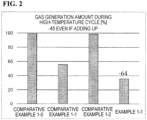
- a high-temperature cycle test was performed on each test cell prepared using an electrolyte solution shown in Table 2 as a test electrolyte solution, NaNi 0.5 Ti 0.3 Mn 0.2 O 2 as a positive electrode material, and hard carbon (Carbotron P manufactured by KUREHA CORPORATION) as a negative electrode material, and a cycle characteristic, a gas generation amount during the high-temperature cycle test, and a high-temperature storage characteristic were evaluated. Evaluation results are shown in Table 2.
- the test cell was prepared as follows.
- test positive electrode was prepared by the following procedure.
- a slurry solution was prepared by mixing 90 mass% of NaNi 0.5 Ti 0.3 Mn 0.2 O 2 as the positive electrode active material, 5 mass% of acetylene black as the electrically conductive agent, and 5 mass% of polyvinylidene fluoride (PVDF) as the binder, and further adding N-methylpyrrolidone as the solvent in an amount of 50 mass% with respect to a total mass of the positive electrode active material, the electrically conductive agent, and the binder.
- the slurry solution was applied onto an aluminum foil as the positive electrode current collector and dried at 150°C for 12 hours to obtain the test positive electrode including a positive electrode active material layer formed on the current collector.
- a test negative electrode was prepared by the following procedure.
- a slurry solution was prepared by mixing 90 mass% of a hard carbon powder (Carbotron P manufactured by KUREHA CORPORATION) as the negative electrode active material and 10 mass% of polyvinylidene fluoride (PVDF) as the binder, and further adding N-methylpyrrolidone as the solvent in an amount of 50 mass% with respect to a total mass of the negative electrode active material and the binder.
- the slurry solution was applied onto an aluminum foil as the negative electrode current collector and dried at 150°C for 12 hours to obtain the test negative electrode including a negative electrode active material layer formed on the current collector.
- test positive electrode and the test negative electrode were placed via a polyethylene separator impregnated with the test electrolyte solution, and a test cell for 50 mAh having an aluminum laminate exterior was assembled.
- the test cell was charged and discharged at current density of 0.32 mA/cm 2 by a constant-current constant-voltage method at an environmental temperature of 25°C with an upper limit of the charge voltage of 4.1 V and a lower limit of the discharge voltage of 1.5 V, and then a charge and discharge test at an environmental temperature of 60°C was performed to evaluate the cycle characteristic.
- the cell was charged to 4.1 V and discharged to 1.5 V, and the charge-discharge cycle was repeated at current density of 1.56 mA/cm 2 . Further, a degree of deterioration of the cell was evaluated with the discharge capacity maintenance rate at a 500th cycle in the charge and discharge test at the environmental temperature of 60°C.
- a "discharge capacity maintenance rate after a high-temperature cycle" represented by the discharge capacity maintenance rate at the 500th cycle was obtained by the following formula.
- a discharge capacity at a first cycle in the charge and discharge test at the environmental temperature of 60°C was defined as an initial discharge capacity.
- Discharge capacity maintenance rate after high-temperature cycle % discharge capacity at 500 th cycle / initial discharge capacity ⁇ 100
- the test cell was charged to an upper limit charge voltage of 4.1 V at a current density of 0.32 mA/cm 2 by a constant-current constant-voltage method at an environmental temperature of 25°C, and then discharged to 1.5 V at a constant current of 0.32 mA/cm 2 .
- the same charge and discharge cycle was repeated 10 times.
- a discharge capacity at a 10th cycle is defined as an "initial discharge capacity”.
- the test cell was charged to an upper limit charge voltage of 4.1 V at a current density of 0.32 mA/cm 2 by the constant-current constant-voltage method at an environmental temperature of 25°C.
- test cell was stored at 60°C for 4 weeks, and after cooling the battery to 25°C, the test cell was discharged to 1.5 V at a constant current of 0.32 mA/cm 2 at an environmental temperature of 25°C.
- the test cell was charged to an upper limit charge voltage of 4.1 V at a current density of 0.32 mA/cm 2 by the constant-current constant-voltage method, and then discharged to 1.5 V at a constant current of 0.32 mA/cm 2 .
- a discharge capacity at this time is defined as a "recovery capacity”.
- a "recovery discharge capacity maintenance rate after high-temperature storage” was determined by the following formula.
- Recovery discharge capacity maintenance rate after high-temperature storage % recovery capacity / initial discharge capacity ⁇ 100
- Evaluation results of Example and Comparative Examples shown in Table 2 are relative values with an evaluation result of Comparative Example 1-0 as 100%. Further, the same applies to all the following tables.
- a larger value for the "discharge capacity maintenance rate after a high-temperature cycle” is desirable, a larger value for the “recovery discharge capacity maintenance rate after high-temperature storage” is desirable, and a smaller value for the "gas generation amount during the high-temperature cycle” is desirable.
- Test cells were prepared in the same manner as in Example 1-1 except that electrolyte solutions shown in Tables 3 to 15 were used as test electrolyte solutions, and performance evaluation was performed. Evaluation results are shown in Tables 3 to 15.
- Test cells were prepared in the same manner as in Example 1-1 except that electrolyte solutions shown in Table 17 were used as the test electrolyte solutions, and performance evaluation was performed. Evaluation results are shown in Table 17.
- Test cells were prepared in the same manner as in Example 1-1 except that electrolyte solutions shown in Table 19 were used as the test electrolyte solutions, and performance evaluation was performed. Evaluation results are shown in Table 19.
- Test cells were prepared in the same manner as in Example 1-1 except that electrolyte solutions shown in Table 21 were used as the test electrolyte solutions, and performance evaluation was performed. Evaluation results are shown in Table 21.
- Example 4-2 Comparative Examples 4-3 and 4-4.
- the storage stability of the electrolyte solution was inferior to that of the electrolyte solutions according to other examples of the present disclosure. Specifically, after being stored at 25°C for one month, the electrolyte solution turned dark brown. As a result of gas chromatography analysis, it was found that a DTD concentration in the electrolyte solution decreased to 0.35 mass%.
- Example 5-1 Comparative Examples 5-1 and 5-2, Example 6-1, and Comparative Examples 6-1 and 6-2]
- Test cells were prepared in the same manner as in Example 1-1 except that electrolyte solutions shown in Table 23 were used as the test electrolyte solutions, and performance evaluation was performed. Evaluation results are shown in Table 23.
- One embodiment of the present disclosure allows for providing an electrolyte solution for a nonaqueous sodium ion battery capable of improving at least one of a cycle characteristic of the nonaqueous sodium ion battery at a high temperature of 60°C or higher, (an effect of preventing) a gas generation amount during a high-temperature cycle test, and a high-temperature storage characteristic, a nonaqueous sodium ion battery using the same, and a method for producing the nonaqueous sodium ion battery are provided.
Landscapes
- Chemical & Material Sciences (AREA)
- Engineering & Computer Science (AREA)
- Manufacturing & Machinery (AREA)
- Chemical Kinetics & Catalysis (AREA)
- Electrochemistry (AREA)
- General Chemical & Material Sciences (AREA)
- Physics & Mathematics (AREA)
- Condensed Matter Physics & Semiconductors (AREA)
- General Physics & Mathematics (AREA)
- Inorganic Chemistry (AREA)
- Materials Engineering (AREA)
- Secondary Cells (AREA)
Applications Claiming Priority (2)
| Application Number | Priority Date | Filing Date | Title |
|---|---|---|---|
| JP2021082006 | 2021-05-13 | ||
| PCT/JP2022/019976 WO2022239813A1 (fr) | 2021-05-13 | 2022-05-11 | Électrolyte pour batterie lithium-ion non aqueuse, batterie lithium-ion non aqueuse et procédé de production d'une batterie lithium-ion non aqueuse |
Publications (2)
| Publication Number | Publication Date |
|---|---|
| EP4340094A1 true EP4340094A1 (fr) | 2024-03-20 |
| EP4340094A4 EP4340094A4 (fr) | 2025-11-12 |
Family
ID=84029675
Family Applications (1)
| Application Number | Title | Priority Date | Filing Date |
|---|---|---|---|
| EP22807512.3A Pending EP4340094A4 (fr) | 2021-05-13 | 2022-05-11 | Électrolyte pour batterie lithium-ion non aqueuse, batterie lithium-ion non aqueuse et procédé de production d'une batterie lithium-ion non aqueuse |
Country Status (6)
| Country | Link |
|---|---|
| US (1) | US20240274879A1 (fr) |
| EP (1) | EP4340094A4 (fr) |
| JP (1) | JPWO2022239813A1 (fr) |
| KR (1) | KR20240006554A (fr) |
| CN (1) | CN117296180A (fr) |
| WO (1) | WO2022239813A1 (fr) |
Families Citing this family (4)
| Publication number | Priority date | Publication date | Assignee | Title |
|---|---|---|---|---|
| JP2024540368A (ja) * | 2021-11-08 | 2024-10-31 | ファラディオン リミテッド | 非水電解質組成物 |
| CN118352627A (zh) * | 2023-01-16 | 2024-07-16 | 宁德时代新能源科技股份有限公司 | 钠二次电池用电解质、钠二次电池及用电装置 |
| WO2024152146A1 (fr) * | 2023-01-16 | 2024-07-25 | 宁德时代新能源科技股份有限公司 | Électrolyte non aqueux, batterie au sodium-ion le contenant, et appareil électrique |
| CN117613388B (zh) * | 2024-01-19 | 2024-05-07 | 湖州超钠新能源科技有限公司 | 电解液和钠离子电池 |
Family Cites Families (10)
| Publication number | Priority date | Publication date | Assignee | Title |
|---|---|---|---|---|
| KR101412899B1 (ko) * | 2010-02-12 | 2014-06-26 | 미쓰비시 가가꾸 가부시키가이샤 | 비수계 전해액 및 비수계 전해액 2 차 전지 |
| JP6086467B2 (ja) | 2011-03-28 | 2017-03-01 | 日産自動車株式会社 | ナトリウムイオン二次電池 |
| JP6570858B2 (ja) | 2015-03-25 | 2019-09-04 | 住友化学株式会社 | ナトリウム二次電池用非水電解液およびナトリウム二次電池 |
| WO2017190365A1 (fr) * | 2016-05-06 | 2017-11-09 | 深圳先进技术研究院 | Batterie au sodium-ion et son procédé de préparation |
| WO2018179884A1 (fr) | 2017-03-30 | 2018-10-04 | パナソニックIpマネジメント株式会社 | Solution électrolytique non aqueuse et batterie rechargeable à électrolyte non aqueux |
| JP2019046614A (ja) * | 2017-08-31 | 2019-03-22 | 三菱ケミカル株式会社 | ナトリウムイオン二次電池用非水系電解液及びナトリウムイオン二次電池 |
| JP7223221B2 (ja) * | 2017-09-12 | 2023-02-16 | セントラル硝子株式会社 | 非水電解液用添加剤、非水電解液、及び非水電解液電池 |
| CN112470322B (zh) * | 2018-08-16 | 2024-09-20 | 中央硝子株式会社 | 非水系电解液、及非水系电解液二次电池 |
| CN114128006A (zh) * | 2019-07-09 | 2022-03-01 | 中央硝子株式会社 | 非水系电解液、和非水系电解液二次电池 |
| JP7328126B2 (ja) | 2019-11-19 | 2023-08-16 | 株式会社日立製作所 | 生産シミュレーション装置及び生産シミュレーション方法 |
-
2022
- 2022-05-11 JP JP2023521230A patent/JPWO2022239813A1/ja active Pending
- 2022-05-11 CN CN202280034227.0A patent/CN117296180A/zh active Pending
- 2022-05-11 KR KR1020237038899A patent/KR20240006554A/ko active Pending
- 2022-05-11 EP EP22807512.3A patent/EP4340094A4/fr active Pending
- 2022-05-11 US US18/560,508 patent/US20240274879A1/en active Pending
- 2022-05-11 WO PCT/JP2022/019976 patent/WO2022239813A1/fr not_active Ceased
Also Published As
| Publication number | Publication date |
|---|---|
| KR20240006554A (ko) | 2024-01-15 |
| WO2022239813A1 (fr) | 2022-11-17 |
| US20240274879A1 (en) | 2024-08-15 |
| CN117296180A (zh) | 2023-12-26 |
| EP4340094A4 (fr) | 2025-11-12 |
| JPWO2022239813A1 (fr) | 2022-11-17 |
Similar Documents
| Publication | Publication Date | Title |
|---|---|---|
| JP7016019B2 (ja) | 非水電解液電池用電解液、及びこれを用いた非水電解液電池 | |
| EP4340094A1 (fr) | Électrolyte pour batterie lithium-ion non aqueuse, batterie lithium-ion non aqueuse et procédé de production d'une batterie lithium-ion non aqueuse | |
| EP3166170B1 (fr) | Solution électrolytique pour batterie à solution électrolytique non aqueuse, et batterie à solution électrolytique non aqueuse l'utilisant | |
| CN113782817B (zh) | 非水电解液电池用电解液和使用其的非水电解液电池 | |
| EP2863468B1 (fr) | Électrolyte destiné à un accumulateur à électrolyte non aqueux, et accumulateur à électrolyte non aqueux utilisant celui-ci | |
| US7785740B2 (en) | Overcharge protection for electrochemical cells | |
| KR101636427B1 (ko) | 비수 전해액 전지용 전해액 및 비수 전해액 전지 | |
| CN111095653B (zh) | 固体电解质电池和包含该固体电解质电池的电池模块及电池组 | |
| CN105591149B (zh) | 可充电电池及其电解质配方 | |
| KR102423131B1 (ko) | 비수전해액용 첨가제, 비수전해액 전지용 전해액, 및 비수전해액 전지 | |
| EP2528152A1 (fr) | Solution électrolytique pour pile électrolytique non aqueuse, et pile électrolytique non aqueuse mettant en uvre celle-ci | |
| EP4340093A1 (fr) | Solution électrolytique pour batterie sodium-ion non aqueuse, et batterie sodium-ion non aqueuse ainsi que procédé de fabrication de celle-ci | |
| KR20160024413A (ko) | 리튬 전지용 전해질, 및 이를 포함하는 리튬 전지 | |
| JP2018200893A (ja) | 非水電解液及びこれを備えたリチウムイオン二次電池 | |
| EP4618220A1 (fr) | Solution électrolytique pour batteries sodium-ion non aqueuses, batterie sodium-ion non aqueuse et procédé de production de batterie sodium-ion non aqueuse | |
| US20210082635A1 (en) | Electrolyte of energy storage device, energy storage device, and manufacturing method of energy storage device | |
| CN108352571B (zh) | 二次电池用非水电解液和二次电池 | |
| JP6919202B2 (ja) | 非水電解質、蓄電素子及び蓄電素子の製造方法 | |
| EP4362158A1 (fr) | Solution électrolytique non aqueuse, batterie sodium-ion non aqueuse, batterie potassium-ion non aqueuse, procédé de fabrication de batterie sodium-ion non aqueuse, et procédé de fabrication de batterie potassium-ion non aqueuse | |
| JP6603014B2 (ja) | 非水電解液及びこれを備えたリチウムイオン二次電池 | |
| JP2018170237A (ja) | 電池用非水電解液及びリチウム二次電池 | |
| KR102931335B1 (ko) | 리튬 이차전지용 전해액 및 이를 포함하는 리튬 이차전지 | |
| CN121970170A (zh) | 非水电解液及非水电解液电池 | |
| EP4738517A1 (fr) | Solution électrolytique non aqueuse et batterie à électrolyte non aqueux | |
| EP4648165A1 (fr) | Solution électrolytique non aqueuse, batterie à électrolyte non aqueux et composé |
Legal Events
| Date | Code | Title | Description |
|---|---|---|---|
| STAA | Information on the status of an ep patent application or granted ep patent |
Free format text: STATUS: THE INTERNATIONAL PUBLICATION HAS BEEN MADE |
|
| PUAI | Public reference made under article 153(3) epc to a published international application that has entered the european phase |
Free format text: ORIGINAL CODE: 0009012 |
|
| STAA | Information on the status of an ep patent application or granted ep patent |
Free format text: STATUS: REQUEST FOR EXAMINATION WAS MADE |
|
| 17P | Request for examination filed |
Effective date: 20231109 |
|
| AK | Designated contracting states |
Kind code of ref document: A1 Designated state(s): AL AT BE BG CH CY CZ DE DK EE ES FI FR GB GR HR HU IE IS IT LI LT LU LV MC MK MT NL NO PL PT RO RS SE SI SK SM TR |
|
| DAV | Request for validation of the european patent (deleted) | ||
| DAX | Request for extension of the european patent (deleted) | ||
| A4 | Supplementary search report drawn up and despatched |
Effective date: 20251013 |
|
| RIC1 | Information provided on ipc code assigned before grant |
Ipc: H01M 10/0567 20100101AFI20251007BHEP Ipc: H01M 10/054 20100101ALI20251007BHEP Ipc: H01M 10/0525 20100101ALI20251007BHEP Ipc: H01M 10/0568 20100101ALI20251007BHEP Ipc: H01M 10/0569 20100101ALI20251007BHEP Ipc: H01M 10/058 20100101ALI20251007BHEP |