EP4340285A1 - Referenzsignalsendeverfahren und -vorrichtung - Google Patents
Referenzsignalsendeverfahren und -vorrichtung Download PDFInfo
- Publication number
- EP4340285A1 EP4340285A1 EP22814879.7A EP22814879A EP4340285A1 EP 4340285 A1 EP4340285 A1 EP 4340285A1 EP 22814879 A EP22814879 A EP 22814879A EP 4340285 A1 EP4340285 A1 EP 4340285A1
- Authority
- EP
- European Patent Office
- Prior art keywords
- reference signals
- sequence
- velocity
- group
- groups
- Prior art date
- Legal status (The legal status is an assumption and is not a legal conclusion. Google has not performed a legal analysis and makes no representation as to the accuracy of the status listed.)
- Pending
Links
- 238000000034 method Methods 0.000 title claims abstract description 86
- PCHJSUWPFVWCPO-UHFFFAOYSA-N gold Chemical group [Au] PCHJSUWPFVWCPO-UHFFFAOYSA-N 0.000 claims description 18
- 238000004590 computer program Methods 0.000 claims description 13
- 238000005259 measurement Methods 0.000 abstract description 77
- 238000004891 communication Methods 0.000 description 25
- 238000012545 processing Methods 0.000 description 20
- 230000006870 function Effects 0.000 description 18
- 238000010586 diagram Methods 0.000 description 15
- 238000001228 spectrum Methods 0.000 description 10
- 230000008569 process Effects 0.000 description 8
- 238000005516 engineering process Methods 0.000 description 6
- 238000010295 mobile communication Methods 0.000 description 5
- 230000010363 phase shift Effects 0.000 description 4
- 238000013461 design Methods 0.000 description 3
- 230000001133 acceleration Effects 0.000 description 2
- 230000005540 biological transmission Effects 0.000 description 2
- 238000004422 calculation algorithm Methods 0.000 description 2
- 230000000694 effects Effects 0.000 description 2
- 238000012544 monitoring process Methods 0.000 description 2
- 230000003190 augmentative effect Effects 0.000 description 1
- 230000006399 behavior Effects 0.000 description 1
- 230000009286 beneficial effect Effects 0.000 description 1
- 239000011449 brick Substances 0.000 description 1
- 238000004364 calculation method Methods 0.000 description 1
- 230000008859 change Effects 0.000 description 1
- 238000006243 chemical reaction Methods 0.000 description 1
- 230000000295 complement effect Effects 0.000 description 1
- 238000010276 construction Methods 0.000 description 1
- 125000004122 cyclic group Chemical group 0.000 description 1
- 238000013500 data storage Methods 0.000 description 1
- 238000001514 detection method Methods 0.000 description 1
- 230000004069 differentiation Effects 0.000 description 1
- 239000010931 gold Substances 0.000 description 1
- 229910052737 gold Inorganic materials 0.000 description 1
- 230000036541 health Effects 0.000 description 1
- 230000002452 interceptive effect Effects 0.000 description 1
- 230000003287 optical effect Effects 0.000 description 1
- 230000009467 reduction Effects 0.000 description 1
- 239000004065 semiconductor Substances 0.000 description 1
- XLYOFNOQVPJJNP-UHFFFAOYSA-N water Substances O XLYOFNOQVPJJNP-UHFFFAOYSA-N 0.000 description 1
Images




Classifications
-
- H—ELECTRICITY
- H04—ELECTRIC COMMUNICATION TECHNIQUE
- H04L—TRANSMISSION OF DIGITAL INFORMATION, e.g. TELEGRAPHIC COMMUNICATION
- H04L5/00—Arrangements affording multiple use of the transmission path
- H04L5/003—Arrangements for allocating sub-channels of the transmission path
- H04L5/0048—Allocation of pilot signals, i.e. of signals known to the receiver
- H04L5/005—Allocation of pilot signals, i.e. of signals known to the receiver of common pilots, i.e. pilots destined for multiple users or terminals
-
- H—ELECTRICITY
- H04—ELECTRIC COMMUNICATION TECHNIQUE
- H04L—TRANSMISSION OF DIGITAL INFORMATION, e.g. TELEGRAPHIC COMMUNICATION
- H04L5/00—Arrangements affording multiple use of the transmission path
- H04L5/0091—Signalling for the administration of the divided path, e.g. signalling of configuration information
- H04L5/0094—Indication of how sub-channels of the path are allocated
-
- Y—GENERAL TAGGING OF NEW TECHNOLOGICAL DEVELOPMENTS; GENERAL TAGGING OF CROSS-SECTIONAL TECHNOLOGIES SPANNING OVER SEVERAL SECTIONS OF THE IPC; TECHNICAL SUBJECTS COVERED BY FORMER USPC CROSS-REFERENCE ART COLLECTIONS [XRACs] AND DIGESTS
- Y02—TECHNOLOGIES OR APPLICATIONS FOR MITIGATION OR ADAPTATION AGAINST CLIMATE CHANGE
- Y02D—CLIMATE CHANGE MITIGATION TECHNOLOGIES IN INFORMATION AND COMMUNICATION TECHNOLOGIES [ICT], I.E. INFORMATION AND COMMUNICATION TECHNOLOGIES AIMING AT THE REDUCTION OF THEIR OWN ENERGY USE
- Y02D30/00—Reducing energy consumption in communication networks
- Y02D30/70—Reducing energy consumption in communication networks in wireless communication networks
Definitions
- This application relates to the field of wireless positioning/communication/sensing technologies, and in particular, to a reference signal sending method and a device.
- velocity measurement is an important and basic capability of a sensing system. How to implement unambiguous velocity measurement with low power consumption when a device performs velocity measurement is an important subject.
- This application provides a reference signal sending method and a device, to implement unambiguous velocity measurement with low power consumption.
- a reference signal sending method including: A first device generates n groups of reference signals, where n ⁇ 2; in the n groups of reference signals, a first group of reference signals includes M1 first reference signals sent at an interval, and a second group of reference signals includes M2 second reference signals sent at an interval; and a sending time interval between the first reference signals is S 1 T, a sending time interval between the second reference signals is S 2 T, S 1 and S 2 are coprime positive integers, T is a time length of one time unit, and M1 and M2 are integers greater than 1.
- the first device sends the n groups of reference signals.
- at least two groups of reference signals are sent at specific time intervals for measurement, so that a unique measurement value can be obtained, to reduce power consumption of the first device, and implement unambiguous velocity measurement.
- the first device may be a sensing device that can perform both sending and receiving.
- the first device sends the n groups of reference signals in one time period.
- a difference between a time point of an earliest first reference signal in the first group of reference signals in the n groups of reference signals and a time point of an earliest second reference signal in the second group of reference signals is less than or equal to a first threshold; and/or in the time period, a difference between a time point of a last first reference signal in the first group of reference signals in the n groups of reference signals and a time point of a last second reference signal in the second group of reference signals is less than or equal to a second threshold.
- the difference between the earliest reference signals in the two groups of reference signals should be less than or equal to the first threshold, and/or the difference between the last reference signals in the two groups of reference signals should be less than or equal to the second threshold, so that the deviation of the final measurement result is small.
- a ratio of total duration of the first group of reference signals to total duration of the second group of reference signals is less than or equal to a third threshold, where the total duration of the first group of reference signals is a difference between the time point of the last first reference signal in the first group of reference signals and the time point of the earliest first reference signal in the first group of reference signals, and the total duration of the second group of reference signals is a difference between the time point of the last second reference signal in the second group of reference signals and the time point of the earliest second reference signal in the second group of reference signals.
- the ratio of the total duration of the two groups of reference signals should be kept within a specific threshold range.
- the M1 first reference signals sent at an interval include reference signals repeatedly sent at least twice, and the reference signals repeatedly sent at least twice are determined based on a same sequence.
- the M1 first reference signals sent at an interval include one reference signal determined based on a first sequence and one reference signal determined based on a second sequence, the first sequence and the second sequence are components of a third sequence, and lengths of the first sequence and the second sequence are respectively N1 and N2.
- content of reference signals sent in a plurality of time units may be the same or different.
- the M2 second reference signals sent at an interval include reference signals repeatedly sent at least twice, and the reference signals repeatedly sent at least twice are determined based on a same sequence.
- the M2 second reference signals sent at an interval include one reference signal determined based on a fourth sequence and one reference signal determined based on a fifth sequence, the fourth sequence and the fifth sequence are components of a sixth sequence, and lengths of the fourth sequence and the fifth sequence are respectively N4 and N5.
- the third sequence is the Zad-off Chu sequence
- N ZC is a largest prime number less than or equal to N3, a smallest prime number greater than N3, a largest prime number less than or equal to 2N3, or a smallest prime number greater than 2N3;
- q is an integer greater than 0 and less than N ZC ;
- the first device is capable of determining, based on the third sequence, the first sequence whose length is K 1 and the second sequence whose length is K 2 , where the first sequence and the second sequence are segments of the third sequence.
- the third sequence is the m-sequence
- the third sequence is the Gold sequence
- x 1 and x 2 are both m-sequences, and N c 1 and N c 2 are integers.
- the method further includes: obtaining a velocity relative to a first target object, where the velocity is obtained by measuring reflected reference signals of the n groups of reference signals.
- the first device may obtain the velocity of the first target object in a self-sending and self-receiving manner.
- the method further includes: receiving indication information, where the indication information indicates a velocity of the first device relative to a first target object or a result of measuring the n groups of reference signals.
- the first device may obtain the velocity of the first target object in a manner of self-sending and receiving from another device.
- a third group of reference signals includes M3 third reference signals sent at an interval, a sending time interval of the third group of reference signals is S 3 T , M3 is an integer greater than 1, and S 1 , S 2 , and S 3 are coprime numbers.
- a sending time interval of the third group of reference signals is S 3 T
- M3 is an integer greater than 1
- S 1 , S 2 , and S 3 are coprime numbers.
- Three or more groups of reference signals are sent at specific time intervals for multi-target measurement, so that the unique unambiguous velocity of each target can be obtained, thereby reducing the power consumption of the first device, and implementing the unambiguous velocity measurement.
- the method further includes: obtaining a first velocity of the first device relative to a first target object and a second velocity of the first device relative to a second target object, where the first velocity and the second velocity are obtained by measuring the n groups of reference signals.
- the method further includes: determining a positioning parameter of the first target object and a positioning parameter of the second target object based on the n groups of reference signals, where the positioning parameter includes at least one of the following: a distance and an angle; and obtaining the velocity of the first device relative to the first target object and the velocity of the first device relative to the second target object based on the positioning parameter of the first target object and the positioning parameter of the second target object.
- the n groups of reference signals are sent at specific time intervals for multi-target measurement, a plurality of targets can be identified with reference to the spatial sensing parameters obtained by measuring the n groups of reference signals, and the unique unambiguous velocity of each target can be obtained, thereby reducing the power consumption of the first device, and implementing the unambiguous velocity measurement.
- a first device can implement the reference signal sending method in the first aspect.
- the first device may be a chip or a terminal.
- the foregoing method may be implemented by software, hardware, or hardware executing corresponding software.
- the first device may include a processing unit and a transceiver unit.
- the processing unit is configured to generate n groups of reference signals, where n ⁇ 2; in the n groups of reference signals, a first group of reference signals includes M1 first reference signals sent at an interval, and a second group of reference signals includes M2 second reference signals sent at an interval; and a sending time interval between the first reference signals is S 1 T, a sending time interval between the second reference signals is S 2 T, S 1 and S 2 are coprime positive integers, T is a time length of one time unit, and M1 and M2 are integers greater than 1.
- the transceiver unit is configured to send the n groups of reference signals.
- the first device sends the n groups of reference signals in one time period, where in the time period, a difference between a time point of an earliest first reference signal in the first group of reference signals in the n groups of reference signals and a time point of an earliest second reference signal in the second group of reference signals is less than or equal to a first threshold; and/or in the time period, a difference between a time point of a last first reference signal in the first group of reference signals in the n groups of reference signals and a time point of a last second reference signal in the second group of reference signals is less than or equal to a second threshold.
- a ratio of total duration of the first group of reference signals to total duration of the second group of reference signals is less than or equal to a third threshold, where the total duration of the first group of reference signals is a difference between the time point of the last first reference signal in the first group of reference signals and the time point of the earliest first reference signal in the first group of reference signals, and the total duration of the second group of reference signals is a difference between the time point of the last second reference signal in the second group of reference signals and the time point of the earliest second reference signal in the second group of reference signals.
- the M1 first reference signals sent at an interval include reference signals repeatedly sent at least twice, and the reference signals repeatedly sent at least twice are determined based on a same sequence.
- the M1 first reference signals sent at an interval include one reference signal determined based on a first sequence and one reference signal determined based on a second sequence, the first sequence and the second sequence are components of a third sequence, and lengths of the first sequence and the second sequence are respectively N1 and N2.
- the M2 second reference signals sent at an interval include reference signals repeatedly sent at least twice, and the reference signals repeatedly sent at least twice are determined based on a same sequence.
- the M2 second reference signals sent at an interval include one reference signal determined based on a fourth sequence and one reference signal determined based on a fifth sequence, the fourth sequence and the fifth sequence are components of a sixth sequence, and lengths of the fourth sequence and the fifth sequence are respectively N4 and N5.
- the processing unit is further configured to obtain a velocity relative to a first target object, where the velocity is obtained by measuring reflected reference signals of the n groups of reference signals.
- the transceiver unit is further configured to receive indication information, where the indication information indicates a velocity of the first device relative to a first target object or a result of measuring the n groups of reference signals.
- a third group of reference signals includes M3 third reference signals sent at an interval, a sending time interval of the third group of reference signals is S 3 T , M3 is an integer greater than 1, and S 1 , S 2 , and S 3 are coprime numbers.
- the processing unit is further configured to obtain a first velocity of the first device relative to a first target object and a second velocity of the first device relative to a second target object, where the first velocity and the second velocity are obtained by measuring the n groups of reference signals.
- the processing unit is further configured to determine a positioning parameter of the first target object and a positioning parameter of the second target object based on the n groups of reference signals, where the positioning parameter includes at least one of the following: a distance and an angle.
- the processing unit is further configured to obtain the velocity of the first device relative to the first target object and the velocity of the first device relative to the second target object based on the positioning parameter of the first target object and the positioning parameter of the second target object.
- the first device in the second aspect includes a processor coupled to a memory, and the processor is configured to support the apparatus in performing a corresponding function in the foregoing reference signal sending method.
- the memory is configured to be coupled to the processor, and stores a program (instructions) and/or data necessary for the apparatus.
- the first device may further include a communication interface configured to support communication between the apparatus and another network element.
- the memory may be located inside or outside the first device.
- the first device in the second aspect includes a processor and a transceiver apparatus.
- the processor is coupled to the transceiver apparatus.
- the processor is configured to execute a computer program or instructions, to control the transceiver apparatus to receive and send information.
- the processor executes the computer program or the instructions, the processor is further configured to implement the foregoing method through a logic circuit or by executing code instructions.
- the transceiver apparatus may be a transceiver, a transceiver circuit, or an input/output interface, and is configured to receive a signal from a first device other than the first device and transmit the signal to the processor; or send, to a first device other than the first device, a signal that is from the processor.
- the transceiver apparatus is the transceiver circuit or the input/output interface.
- a sending unit may be an output unit, for example, an output circuit or a communication interface; and a receiving unit may be an input unit, for example, an input circuit or a communication interface.
- a sending unit may be a transmitter, and a receiving unit may be a receiver.
- a computer-readable storage medium stores a computer program or instructions. When the computer program or instructions are executed, the method in the first aspect is implemented.
- a computer program product including instructions is provided. When the instructions are run on a first device, the first device is enabled to perform the method in the first aspect.
- This application may be applied to a 4 th generation (4 th generation, 4G) mobile communication system, a 5 th generation (5 th generation, 5G) mobile communication system, and the like, and may also be applied to another communication system, for example, an ultra-wideband (ultra-wideband, UWB) communication system.
- an entity needs to receive indication information, can feed back information and transmit data in an uplink, and may further send and/or receive a reference signal and the like.
- Another entity needs to send downlink data and a reference signal.
- FIG. 1 is a schematic diagram of an architecture of an integrated communication and sensing system according to an embodiment of this application.
- the communication system includes a radio access network device, a terminal, and a sensed target.
- the sensed target may be a vehicle, a pedestrian, a brick on a road, or the like.
- a first device may be the radio access network device or the terminal.
- the radio access network device may send downlink data to the terminal, or may receive uplink data sent by the terminal.
- the radio access network device may send a reference signal, and receive a signal reflected by the sensed target, to estimate a velocity, a distance, an angle, and the like of the sensed target.
- the terminal may receive downlink data sent by the radio access network device, or may send uplink data to the radio access network device.
- the terminal may send a reference signal, and receive a signal reflected by the sensed target, to estimate a velocity, a distance, an angle, and the like of the sensed target.
- the radio access network device may be a base station (base station), an evolved NodeB (evolved NodeB, eNodeB), a transmission reception point (transmission reception point, TRP), a next generation NodeB (next generation NodeB, gNB) in a 5 th generation (5 th generation, 5G) mobile communication system, a next generation base station in a 6 th generation (6 th generation, 6G) mobile communication system, a base station in a future mobile communication system, an access node in a Wi-Fi system, or the like, or may be a module or a unit, for example, a central unit (central unit, CU) or a distributed unit (distributed unit, DU), that completes a part of functions of a base station.
- the radio access network device may be a macro base station, may be a micro base station or an indoor base station, or may be a relay node, a donor node, or the like.
- a specific technology and a specific device form that are used by the radio access network device are not limited in embodiments of this application. For ease of description, the following provides descriptions by using an example in which the radio access network device is the base station.
- the terminal may also be referred to as user equipment (user equipment, UE), a mobile station, a mobile terminal, and the like.
- the terminal device may be widely used in various scenarios, for example, a device-to-device (device-to-device, D2D) scenario, a vehicle-to-everything (vehicle-to-everything, V2X) communication scenario, a machine-type communications (machine-type communications, MTC) scenario, an internet of things (internet of things, IOT) scenario, a virtual reality scenario, an augmented reality scenario, an industrial control scenario, a self-driving scenario, a telemedicine scenario, a smart grid scenario, a smart furniture scenario, a smart office scenario, a smart wearable scenario, a smart transportation scenario, and a smart city scenario.
- a device-to-device device-to-device, D2D
- V2X vehicle-to-everything
- MTC machine-type communications
- IOT internet of things
- the terminal device may be a mobile phone, a tablet computer, a computer with a wireless transceiver function, a wearable device, a vehicle, an unmanned aerial vehicle, a helicopter, an airplane, a ship, a robot, a robot arm, a smart home device, or the like.
- a specific technology and a specific device form that are used by the terminal device are not limited in embodiments of this application.
- the base station and the terminal may be fixed or movable.
- the base station and the terminal may be deployed on the land, including an indoor device, an outdoor device, a handheld device, or a vehicle-mounted device; may be deployed on the water; or may be deployed on an airplane, a balloon, and an artificial satellite in the air.
- Application scenarios of the base station and the terminal are not limited in embodiments of this application.
- Communication may be performed between a base station and a terminal, between base stations, and between terminals through a licensed spectrum, through an unlicensed spectrum, or through both a licensed spectrum and an unlicensed spectrum. Communication may be performed through a spectrum below 6 gigahertz (gigahertz, GHz), through a spectrum above 6 GHz, or through both a spectrum below 6 GHz and a spectrum above 6 GHz.
- a spectrum resource for wireless communication is not limited in embodiments of this application.
- a function of the base station may alternatively be performed by a module (for example, a chip) in the base station, or may be performed by a control subsystem including the function of the base station.
- the control subsystem including the function of the base station herein may be a control center in the foregoing application scenarios such as the smart grid, the industrial control, the smart transportation, and the smart city.
- a function of the terminal may alternatively be performed by a module (for example, a chip or a modem) in the terminal, or may be performed by an apparatus including the function of the terminal.
- FIG. 2 is a schematic diagram of an intelligent driving scenario according to an embodiment of this application.
- the scenario includes a vehicle 201, where at least one sensor (not shown in the figure) is installed in the vehicle 201, and the vehicle 201 further includes an intelligent driving apparatus (not shown in the figure).
- the sensor is configured to sense environment information around the vehicle 201, for example, a lane line 203 of a lane in which the vehicle 201 travels, a lane line 204 of an adjacent lane (namely, a lane adjacent to the lane in which the vehicle 201 travels), a road edge boundary 205, a pedestrian 206, a construction area 207, and another vehicle (for example, a front vehicle 202, a side vehicle (not shown in the figure), or a rear vehicle (not shown in the figure)).
- the sensor transmits the sensed environment information to a first device.
- a velocity is important data in applications such as an interactive game, fitness, and behavior monitoring (for example, sports and health monitoring on elderly living alone).
- a target moves excessively far (in other words, a velocity is excessively high) at a time interval between two reference signals, and a real phase shift of the target exceeds 180°, a phase shift value less than 180° is assigned to the target, and a velocity value corresponding to the phase shift is also less than a real velocity value. Consequently, the obtained velocity is incorrect, in other words, velocity ambiguity occurs.
- An unambiguous velocity is an obtainable radial velocity value relative to an object target.
- the maximum unambiguous velocity is a radial velocity value that is of a target object and that corresponds to a measurable maximum phase shift, namely, 180°, from one reference signal to a next reference signal.
- reference signals continuously occupy all OFDM symbols to implement measurement of a maximum unambiguous velocity whose theoretical value is c 0 4 f c T OFDM , where c 0 is a propagation velocity of an electromagnetic wave, and a unit of c 0 is m/s; f c is a center frequency of a carrier, and a unit of f c is Hz; and T OFDM is duration of one OFDM symbol, and a unit of T OFDM is s.
- ⁇ K max may be obtained within a velocity range of interest (which is a maximum unambiguous velocity c 0 4 f c T OFDM that is measurable when reference signals occupy all symbols), where v start is a measured velocity value that may be ambiguous; v step is ambiguity of velocity measurement, and is equal to twice the theoretical value of the maximum unambiguous velocity; and k is a quantity of integral cycles of the ambiguity.
- the measurable maximum unambiguous velocity is ⁇ 20 m/s.
- the measurable maximum unambiguous velocity is ⁇ 5 m/s
- an actual relative velocity of a terminal relative to a first target object is 7 m/s
- measured v start is -3 m/s.
- the obtained possible velocity value is -3+k* 10.
- the possible velocity value needs to fall within a range of the maximum unambiguous velocity (namely, ⁇ 20 m/s) that is measurable when the reference signals occupy all the symbols.
- obtained possible velocity values are - 13 m/s, -3 m/s, 7 m/s, or 17 m/s.
- the maximum unambiguous velocity obtained in the embodiment shown in FIG. 3b is a quarter of a maximum unambiguous velocity c 0 4 f c T that is measurable when reference signals are sent at an interval of a time length of one time unit, namely, c 0 16 f c T .
- one group of reference signals is sent for single-target velocity measurement, where the group of reference signals includes M4 fourth reference signals sent at an interval, where M4 is an integer greater than 1. It is assumed that there are 21 OFDM symbols in total in a velocity measurement reference signal pattern shown in FIG. 4 , and one fourth reference signal may be sent every two OFDM symbols. In this case, 11 symbol resources are required in total.
- the first device obtains, through measurement of the group of reference signals, a velocity of the terminal relative to the first target object.
- a maximum unambiguous velocity is half of the maximum unambiguous velocity c 0 4 f c T that is measurable when the reference signals are sent at the interval of the time length of one time unit, namely, c 0 8 f c T .
- the first device needs to send only one group of reference signals to obtain a maximum unambiguous velocity with high precision.
- the terminal sends a reference signal on a time-frequency resource to perform velocity measurement.
- a measurable maximum unambiguous velocity is related to a time interval of carrying two adjacent reference signals. A shorter interval indicates a larger measurable maximum unambiguous velocity.
- the reference signals are carried on orthogonal frequency division multiplexing (orthogonal frequency division multiplexing, OFDM) symbols (a modulation technology is not limited to an OFDM waveform)
- OFDM orthogonal frequency division multiplexing
- the reference signals need to be continuously sent to occupy all the symbol resources. Consequently, power consumption of the terminal is high.
- a communication signal cannot be sent on the time-frequency resources. This is unfavorable to integrated sensing and communication.
- a velocity measurement reference signal pattern with a large cycle is generally used.
- the velocity measurement reference signal pattern shown in FIG. 3b there are four symbols between two adjacent reference signals. In this way, there is no need to send the reference signal on each symbol, and power consumption can be lower than that generated when the symbols are fully occupied.
- the communication signal is sent on another symbol, to balance the communication and sensing performance.
- the measurable maximum unambiguous velocity is correspondingly lower than that generated when the reference signals occupy all the symbols. Compared with the maximum unambiguous velocity when the symbols are fully occupied, a maximum unambiguous velocity when an interval between two adjacent reference signals is S 1 symbols is reduced to 1/ S 1 .
- a first device sends at least two groups of reference signals at a specific time interval for measurement, so that a unique measurement value can be obtained, to reduce power consumption of the first device, and implement unambiguous velocity measurement.
- the solution in this application can be applied to velocity measurement in scenarios such as intelligent driving and smart home, and can also be applied to a distance measurement and the like.
- an embodiment of this application provides a sensing method.
- the method includes the following steps.
- a first device generates n groups of reference signals, where n ⁇ 2; in the n groups of reference signals, a first group of reference signals includes M1 first reference signals sent at an interval, and a second group of reference signals includes M2 second reference signals sent at an interval; and a sending time interval between the first reference signals is S 1 T, a sending time interval between the second reference signals is S 2 T, S 1 and S 2 are coprime positive integers, T is a time length of one time unit, and M1 and M2 are integers greater than 1.
- This embodiment is applied to a single-target velocity measurement scenario, to be specific, measurement of a velocity of the first device relative to one target (namely, a first target object).
- the first device may be a sensing device that can perform both sending and receiving.
- the first device generates the n groups of reference signals, where n ⁇ 2.
- the first group of reference signals in the n groups of reference signals includes the M1 first reference signals sent at an interval, and the second group of reference signals includes the M2 second reference signals sent at an interval.
- the sending time interval between the first reference signals is S 1 T, and the sending time interval between the second reference signals is S 2 T.
- S 1 and S 2 are coprime positive integers.
- velocities obtained by using two reference signals are respectively v start1 and v start 2
- quantities of integral cycles of corresponding ambiguity are respectively k 1 and k 2
- velocity values of the target that are obtained by using the two reference signals are respectively v start1 + k 1 S 1 2 c 0 4 f c T and v start 2 + k 2 S 2 2 c 0 4 f c T .
- v start1 + k 1 S 1 2 c 0 4 f c T v start 2 + k 2 S 2 2 c 0 4 f c T
- S 1 and S 2 are necessarily coprime numbers, so that a uniquely determined unambiguous velocity can be obtained under the dual-reference-signal condition.
- T is the time length of one time unit, and may be specifically one OFDM symbol, one slot (slot), one frame, one ultra-wideband (ultra-wideband, UWB) pulse, a burst (burst) including several pulses, a UWB symbol, a UWB frame, or the like.
- each group of reference signals is sent in a plurality of time units.
- content of the reference signals sent in the plurality of time units may be the same.
- the M1 first reference signals sent at an interval include reference signals repeatedly sent at least twice, and the reference signals repeatedly sent at least twice are determined based on a same sequence.
- the M1 first reference signals sent at an interval may include M1 repeatedly sent reference signals.
- the M2 second reference signals sent at an interval include reference signals repeatedly sent at least twice, and the reference signals repeatedly sent at least twice are determined based on a same sequence.
- the M2 second reference signals sent at an interval may include M2 repeatedly sent reference signals.
- content of the reference signals sent in the plurality of time units may be different.
- the M1 first reference signals sent at an interval include one reference signal determined based on a first sequence and one reference signal determined based on a second sequence, the first sequence and the second sequence are components of a third sequence, and lengths of the first sequence and the second sequence are respectively N1 and N2.
- a method for sending the first sequence and the second sequence based on the third sequence includes:
- the ZC sequence is proposed by Zad-off and Chu, and has excellent self-correlation and poor cross-correlation.
- ZC sequences may be classified into two types. A first type is generated by performing cyclic shift on a basic sequence. Based on a characteristic that discrete Fourier transform (discrete Fourier transform, DFT) of a ZC sequence is still a ZC sequence, a second type is generated by first performing DFT on a ZC sequence and then performing inverse fast Fourier transform (inverse fast Fourier transform, IFFT).
- DFT discrete Fourier transform
- IFFT inverse fast Fourier transform
- N ZC is a largest prime number less than or equal to N3, a smallest prime number greater than N3, a largest prime number less than or equal to 2N3, or a smallest prime number greater than 2N3;
- q is an integer greater than 0 and less than N ZC ;
- the first sequence whose length is K 1 and the second sequence whose length is K 2 may be determined based on the third sequence, where the first sequence and the second sequence are segments of the third sequence.
- the first device respectively sends the first sequence in the first time unit, and sends the second sequence in the second time unit, where the time interval between the second time unit and the first time unit is S 1 T.
- the third sequence is the m-sequence.
- the m-sequence short for a maximum linear feedback shift register sequence, is a sequence that has a longest cycle and that is generated by a shift register with linear feedback, and is a typical pseudo-random sequence.
- a Gold code is a pseudo-random code derived from the m-sequence, and has a pseudo-random characteristic similar to that of the m-sequence, but a quantity of Gold sequences is greater than that of m-sequences under a same length.
- x 1 and x 2 are both m-sequences, and N c 1 and N c 2 are integers.
- the third sequence may alternatively be the Gray sequence.
- the Gray sequence is a complementary sequence, and has a good time domain composition characteristic and a good frequency domain complementation characteristic. After appropriate signal conversion, the Gray sequence may be used as a spread spectrum technology to serve as a detection signal of a system.
- the M2 second reference signals sent at an interval include one reference signal determined based on a fourth sequence and one reference signal determined based on a fifth sequence, the fourth sequence and the fifth sequence are components of a sixth sequence, and lengths of the fourth sequence and the fifth sequence are respectively N4 and N5.
- a method for sending the fourth sequence and the fifth sequence based on the sixth sequence includes:
- n may be equal to 2 or greater than 2.
- the method in this embodiment is a double scale-based velocity measurement reference signal pattern design method.
- the time length T of the time unit is a symbol
- FIG. 6 is described by using an example in which T is an OFDM symbol.
- T may alternatively be a slot, a frame, a pulse, a burst, or the like.
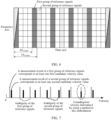
- FIG. 7 is a schematic diagram of unambiguous velocity measurement using double-scale reference signals.
- velocities are first respectively measured by using the two groups of reference signals: At least one first candidate velocity value may be obtained by measuring a first group of reference signals, and a measurement result of the first group of reference signals corresponds to the at least one first candidate velocity value.
- at least one second candidate velocity value may be obtained by measuring a second group of reference signals, and a measurement result of the second group of reference signals corresponds to the at least one second candidate velocity value.
- a real velocity value should belong to both the at least one first candidate velocity value determined by using the first group of reference signals and the at least one second candidate velocity value determined by using the second group of reference signals.
- the two velocities in the two groups of candidate velocity values are equal/close (as shown in FIG. 7 , one of the first candidate velocity values overlaps one of the second candidate velocity values)
- the two velocities may be considered as a real velocity of the first device relative to the first target object.
- the velocity of the first device relative to the first target object is a velocity value that makes a difference between the first candidate velocity value and the second candidate velocity value less than or equal to a first specified value.
- the velocity value less than or equal to the first specified value may be the first candidate velocity value, may be the second candidate velocity value, may be the first candidate velocity value and the second candidate velocity value (when the first candidate velocity value is equal to the second candidate velocity value), or may be a weighted average value of the first candidate velocity value and the second candidate velocity value.
- FIG. 8 is a schematic diagram of key parameters of a velocity measurement reference signal on a time axis.
- Each group of reference signals sent by the first device in one time period includes the following key parameters: a time point (referred to as a start time point) t 1 of an earliest reference signal in one group of reference signals in the time period, a time point (referred to as an end time point) t 2 of a last reference signal in the group of reference signals, total duration t 2 - t 1 of the reference signal group (namely, a difference between the time point of the last reference signal in the group of reference signals and the time point of the earliest reference signal in the group of reference signals), and duration S * T of a time interval between reference signals in the group of reference signals.
- the key parameters have the following features:
- t 1 1 the time point of the earliest reference signal in the first group of reference signals in the time period is t 1 1
- the time point of the earliest reference signal in the second group of reference signals in the time period is t 1 2
- the time point of the last reference signal in the first group of reference signals in the time period is t 2 1
- the time point of the last reference signal in the second group of reference signals in the time period is t 2 2 .
- t 1 1 may be less than, equal to, or greater than t 1 2 , in other words, there is no mandatory constraint on a sequence of sending the two groups of reference signals.
- t 2 1 may be less than, equal to, or greater than t 2 2 , in other words, there is no mandatory constraint on a sequence of completing the sending of the two groups of reference signals.
- a difference t 1 1 ⁇ t 1 2 between the start time points of the two groups of reference signals is preferably less than or equal to a first threshold.
- a specific value of the first threshold depends on an application scenario. In a scenario with a higher velocity, the first threshold should be smaller.
- a difference t 2 1 ⁇ t 2 2 between the end time points of the two groups of reference signals is preferably less than or equal to a second threshold.
- a specific value of the second threshold depends on an application scenario. In the scenario with a higher velocity, the threshold should be smaller.
- a ratio of total duration of the two groups of reference signals should be kept within a specific threshold range. Specifically, a ratio ( t 2 1 ⁇ t 1 1 t 2 2 ⁇ t 1 1 ) of total duration of the first group of reference signals to total duration of the second group of reference signals is less than or equal to a third threshold.
- a default value may be configured at delivery of the first device; or a value may be obtained through real-time calculation/adjustment based on a current scenario.
- the first threshold, the second threshold, or the third threshold may be manually set by personnel based on a scenario, or may be adjusted by the first device based on a motion status of the first device.
- the first target object sends some indication information to the first device. For example, the first target object notifies the first device that the first target object is a vehicle or a wearable device.
- the method may further include: The first device receives first indication information from the first target object, where the first indication information indicates current motion status information of the first target object.
- the first device adjusts at least one of the first threshold, the second threshold, or the third threshold based on the received first indication information.
- the method may further include: The first device receives second indication information from the first target object, where the second indication information indicates an attribute of the first target object.
- the first device adjusts at least one of the first threshold, the second threshold, or the third threshold based on the received second indication information.
- the attribute of the first target object indicates that the first target object is a vehicle, a wearable device, or the like.
- the first threshold and/or the second threshold needs to meet ⁇ t ⁇ v reso 2 , where t is the first threshold and/or the second threshold, ⁇ is an acceleration, and v reso is the velocity resolution.
- Related indication information for setting these parameters may be sent to the first device through the first target object. For example, for a person (or a wearable device), assuming that the acceleration ⁇ may reach 2 m/s, and the velocity resolution v reso is set to 5 cm/s in precision, t should be less than 0.0125s.
- the value should be as close as possible to 1, so that velocity resolutions of a plurality of groups of reference signals are as consistent as possible.
- a smaller velocity resolution indicates a larger allowed range of the value than a larger velocity resolution. This is mainly because when the velocity resolution is small, even if the value is slightly larger, an absolute value difference between the velocity resolutions of the plurality of groups of reference signals may remain at a small value.
- the value may be adjusted and set by using some indication information sent by the first target object to the first device (for example, generally, a velocity resolution for the person (or the wearable device) is less than a velocity resolution in a vehicle scenario, and therefore the value may be allowed to be slightly greater in a person scenario).
- the first device sends the n groups of reference signals.
- the first device After generating the n groups of reference signals, the first device sends the n groups of reference signals.
- the first device may or may not simultaneously send the n groups of reference signals.
- the first device may send the n groups of reference signals in a broadcast manner.
- the first device may send the n groups of reference signals for single-target velocity measurement. Therefore, the method may further include step S503. This step is an optional step, and is represented and connected by dashed lines in the figure.
- S503 The first device obtains the velocity relative to the first target object.
- the first device may obtain the velocity of the first device relative to the first target object in a self-sending and self-receiving manner.
- the first device sends the n groups of reference signals, the n groups of reference signals are reflected to the first device through the first target object, and the first device measures signals reflected through the first target object, to obtain the velocity of the first device relative to the first target object.
- the measurable maximum unambiguous velocity is c 0 4 f c T when the reference signals are sent at the interval of the time length of one time unit.
- the reflection includes diffuse reflection and specular reflection.
- the velocity may alternatively be obtained by measuring reference signals obtained by performing another process, for example, scattering or diffraction, on the n groups of reference signals by the first target object.
- the first device may obtain the velocity of the first device relative to the first target object in a manner of self-sending and receiving from another device. Specifically, the first device sends the n groups of reference signals.
- the first device further sends third indication information, where the third indication information indicates at least one of the following information:
- the first target object receives the n groups of reference signals, measures the n groups of reference signals to obtain the velocity of the first device relative to the first target object or a result of measuring the n groups of reference signals, and optionally, generates indication information.
- the indication information indicates the velocity of the first device relative to the first target object or the result of measuring the n groups of reference signals.
- the first target object sends the indication information.
- the first device receives the indication information. Specifically, the indication information indicates the velocity of the first device relative to the first target object. In this case, the first device may directly obtain the velocity of the first device relative to the first target object based on the indication information.
- the indication information indicates the result of measuring the n groups of reference signals.
- the first device processes the result of measuring the n groups of reference signals, to obtain the velocity of the first device relative to the first target object.
- the indication information indicates n v start obtained by the first target object based on the n groups of reference signals.
- the first device further calculates the unambiguous velocity of the first device relative to the first target object.
- a measurable maximum unambiguous velocity is c 0 2 f c T when reference signals occupy all symbols.
- the measurable maximum unambiguous velocity in the scenario of self-sending and receiving from another device is twice that generated when the reference signals are sent at the interval of the time length of one time unit in the self-sending and self-receiving scenario.
- a measurable maximum unambiguous velocity in the manner of self-sending and receiving from another device is also twice that generated in the self-sending and self-receiving manner.
- the algorithm may alternatively be another method, and is merely an example herein). Assuming that the velocities measured by using the two groups of reference signals are respectively v start , and v start 2 , the following three cases are discussed:
- the reference signals may be sent at a specific time interval, to reduce power consumption of the first device, and obtain the unambiguous velocity.
- the reference signals need to be sent on 21 symbols to occupy all the symbols.
- two groups of reference signals are used, where the sending time interval between the first reference signals in the first group of reference signals is four symbols, and the sending time interval between the second reference signals in the second group of reference signals is five symbols. In this case, only nine symbol resources need to be occupied, and 57% symbol resources can be saved.
- this embodiment can implement the unambiguous velocity measurement within a velocity range of interest (which is the maximum unambiguous velocity c 0 4 f c T OFDM that is measurable when the reference signals occupy all the symbols).
- this embodiment can achieve a comprehensively good effect between reducing the power consumption of the first device and implementing the unambiguous velocity.
- At least two groups of reference signals are sent at specific time intervals for the single-target velocity measurement, so that a unique measurement value can be obtained, to reduce the power consumption of the first device, and implement the unambiguous velocity measurement.
- FIG. 9 is a schematic diagram of pairing ambiguity in velocity measurement performed on two targets (a target 1 and a target 2) by using two scales. Velocities of the two targets measured based on the first group of reference signals are respectively v start11 and v start12 .
- two groups of candidate velocity values (which are respectively represented by a line 1 and a line 2) may be separately obtained according to a formula v start + kv step . Velocities of the two targets measured based on the second group of reference signals are respectively v start21 and v start22 .
- two groups of candidate velocity values may be separately obtained according to the formula v start + kv step .
- One pairing manner is the target 1 ⁇ v start11 , v start21 ⁇ (pairing the line 1 and the line 3) and the target 2 ⁇ v start12 , v start22 ⁇ (pairing the line 2 and the line 4)
- the other pairing manner is the target 1 ⁇ v start11 , v start22 ⁇ (pairing the line 1 and the line 4) and the target 2 ⁇ v start12 , v start21 ⁇ (pairing the line 2 and the line 3).
- Velocity values of the two targets can be respectively calculated in the two pairing manners. However, only one pairing manner is correct, and velocities calculated in the other pairing manner is incorrect. Therefore, the correct pairing manner cannot be identified by using only double-scale reference signals, and a pairing ambiguity problem exists.
- FIG. 10 is a schematic diagram of a target combination problem in a multi-target scenario.
- a velocity difference between targets is exactly an integer multiple kv step of ambiguity of a specific group of reference signals
- only one group of candidate velocity values can be determined by using the group of reference signals, and a plurality of targets may be considered as only one target. Consequently, the target combination problem occurs.
- an embodiment of this application provides another sensing method.
- the method includes the following steps.
- a first device generates n groups of reference signals, where n ⁇ 3; in the n groups of reference signals, a first group of reference signals includes M1 first reference signals sent at an interval, a second group of reference signals includes M2 second reference signals sent at an interval, and a third group of reference signals includes M3 third reference signals sent at an interval; and a sending time interval between the first reference signals is S 1 T, a sending time interval between the second reference signals is S 2 T, a sending time interval of the third group of reference signals in the n groups of reference signals is S 3 T , S 1 , S 2 , and S 3 are coprime positive integers, T is a time length of one time unit, and M1, M2, and M3 are integers greater than 1.
- This embodiment is applied to a multi-target velocity measurement scenario.
- one or more groups of reference signals (n ⁇ 3) are added based on double-scale reference signals, to resolve pairing ambiguity and target combination problems in the multi-target scenario.
- the added third group of reference signals includes the M3 third reference signals sent at an interval, and the sending time interval of the third group of reference signals is S 3 T , where S 1 , S 2 , and S 3 are coprime numbers.
- Each group of reference signals sent by the first device in one time period includes the following key parameters: a time point (referred to as a start time point) t 1 of an earliest reference signal in one group of reference signals in the time period, a time point (referred to as an end time point) t 2 of a last reference signal in the group of reference signals, total duration t 2 - t 1 of the reference signal group (namely, a difference between the time point of the last reference signal in the group of reference signals and the time point of the earliest reference signal in the group of reference signals), and duration S * T of a sending interval between reference signals in the group of reference signals.
- the key parameters have the following features:
- a difference t 1 n 1 ⁇ t 1 n 2 between the start time points of the any two groups of reference signals is preferably less than or equal to a first threshold.
- a specific value of the first threshold depends on an application scenario. In a scenario with a higher velocity, the first threshold should be smaller.
- a difference t 2 n 1 ⁇ t 2 n 2 between the end time points of the any two groups of reference signals is preferably less than or equal to a second threshold.
- a specific value of the second threshold depends on an application scenario. In the scenario with a higher velocity, the second threshold should be smaller.
- total duration of reference signals is directly related to a physical resolution of velocity measurement (a theoretical formula for the physical resolution of the velocity measurement is 1 t 2 ⁇ t 1 c 0 2 f c )
- a ratio of total duration of the any two groups of reference signals should be kept within a specific threshold range. This is because if the n groups of reference signals differ greatly in the velocity resolution, velocities determined by using the n groups of reference signals may fail to correspond to each other. For example, there are two targets whose velocities are respectively 10 m/s and 11 m/s. If a resolution of the first group of reference signals is 0.5 m/s, the two velocity values can be well identified.
- a resolution of the second group of reference signals is 2 m/s
- the second group of reference signals causes mixing of the two targets, and only one velocity measurement value can be obtained.
- a ratio ( t 2 n 1 ⁇ t 1 n 1 t 2 n 2 ⁇ t 1 n 2 ) of total duration of an n1 th group of reference signals to total duration of an n2 th group of reference signals is less than or equal to a third threshold.
- the first threshold For setting of the first threshold, the second threshold, and the third threshold, refer to the foregoing descriptions.
- the two velocities are combined under the first group of reference signals in which the sending time interval between the reference signals is S 1 T, the two velocities are not combined under the other group of reference signals in which the sending time interval between the reference signals is S 2 T. This ensures that the target combination problem in the multi-target case can be resolved theoretically by using the method that is based on a multi-scale reference signal pair.
- n groups of reference signals (n ⁇ 3), for the problems such as pairing ambiguity and target combination, an algorithm idea that may be applied is as follows: When a velocity of a target is measured by using A groups of reference signals, if a value of a candidate velocity corresponding to B groups of reference signals is equal to a specific velocity (A and B are positive integers, and A ⁇ B), it is considered that there is a real target at the velocity, and a velocity value of the target is obtained.
- S1 102 The first device sends the n groups of reference signals.
- the first device After generating the n groups of reference signals, the first device sends the n groups of reference signals.
- the first device may or may not simultaneously send the n groups of reference signals.
- the first device may send the n groups of reference signals in a broadcast manner.
- the first device may send the n groups of reference signals for multi-target velocity measurement. Therefore, the method may further include step S1103. This step is an optional step, and is represented and connected by dashed lines in the figure.
- the first device obtains a first velocity of the first device relative to a first target object and a second velocity of the first device relative to a second target object.
- the first device may obtain the first velocity of the first device relative to the first target object and the second velocity of the first device relative to the second target object in a self-sending and self-receiving manner.
- the first device sends the n groups of reference signals, and the n groups of reference signals are reflected to the first device separately through the first target object and the second target object.
- the first device measures reference signals reflected through the first target object, to obtain the first velocity of the first device relative to the first target object; and measures reference signals reflected through the second target object, to obtain the second velocity of the first device relative to the second target object.
- the first device may alternatively obtain the first velocity of the first device relative to the first target object and the second velocity of the first device relative to the second target object in a manner of self-sending and receiving from another device. Specifically, the first device sends the n groups of reference signals.
- the first device further sends fourth indication information, where the fourth indication information indicates at least one of the following information:
- the first target object receives the n groups of reference signals, measures the n groups of reference signals to obtain the velocity of the first device relative to the first target object or a result of measuring the n groups of reference signals, and optionally, generates first indication information.
- the first indication information indicates the first velocity of the first device relative to the first target object or the result of measuring the n groups of reference signals.
- the first target object sends the first indication information.
- the first device receives the first indication information.
- the second target object receives the n groups of reference signals, measures the n groups of reference signals to obtain the velocity of the first device relative to the second target object or a result of measuring the n groups of reference signals, and optionally, generates second indication information.
- the second indication information indicates the second velocity of the first device relative to the second target object or the result of measuring the n groups of reference signals.
- the second target object sends the second indication information.
- the first device receives the second indication information.
- the first indication information indicates the first velocity of the first device relative to the first target object
- the second velocity indication information indicates the second velocity of the first device relative to the second target object.
- the first device may obtain the velocity of the first device relative to the first target object and the velocity of the first device relative to the second target object with reference to the first indication information and the second indication information.
- the first indication information indicates the result of measuring the n groups of reference signals by the first target object
- the second indication information indicates the result of measuring the n groups of reference signals by the second target object.
- the first device processes the two results of measuring the n groups of reference signals, to obtain the velocity of the first device relative to the first target object and the velocity of the first device relative to the second target object.
- three or more groups of reference signals are sent at specific time intervals for multi-target measurement, so that the unique unambiguous velocity of each target can be obtained, to reduce power consumption of the first device, and implement unambiguous velocity measurement.
- an embodiment of this application provides still another sensing method.
- the method includes the following steps.
- a first device generates n groups of reference signals, where n ⁇ 3; in the n groups of reference signals, a first group of reference signals includes M1 first reference signals sent at an interval, a second group of reference signals includes M2 second reference signals sent at an interval, and a third group of reference signals includes M3 third reference signals sent at an interval; and a sending time interval between the first reference signals is S 1 T, a sending time interval between the second reference signals is S 2 T, a sending time interval of the third group of reference signals in the n groups of reference signals is S 3 T , S 1 , S 2 , and S 3 are coprime positive integers, T is a time length of one time unit, and M1, M2, and M3 are integers greater than 1.
- step S1001 For a specific implementation of this step, refer to step S1001.
- the first device sends the n groups of reference signals.
- step S1002 For a specific implementation of this step, refer to step S1002.
- the first device determines a positioning parameter of a first target object and a positioning parameter of a second target object based on the n groups of reference signals, where the positioning parameter includes at least one of the following: a distance and an angle.
- the n groups of reference signals may be further for positioning in addition to velocity sensing.
- the first device obtains a distance between the first device and the first target object and a distance between the first device and the second target object based on the n groups of reference signals, and/or obtains an angle between the first device and the first target object and an angle between the first device and the second target object based on the n groups of reference signals.
- the first device may identify the first target object and the second target object based on any one or more of the distance between the first device and the first target object, the distance between the first device and the second target object, the angle between the first device and the first target object, and the angle between the first device and the second target object.
- the first device obtains a velocity of the first device relative to the first target object and a velocity of the first device relative to the second target object based on the positioning parameter of the first target object and the positioning parameter of the second target object.
- the first device may determine whether the velocity is the velocity of the first device relative to the first target obj ect or the velocity of the first device relative to the second target object; or when obtaining specific indication information, the first device may determine a specific target object that reflects the indication information, to determine the velocity of the first device relative to the target object based on to the indication information.
- the positioning parameter is used in this embodiment.
- velocity measurement becomes a single-target velocity measurement scenario in most cases.
- the n groups of reference signals are sent at specific time intervals for multi-target measurement, a plurality of targets can be identified with reference to the spatial sensing parameters obtained by measuring the n groups of reference signals, and the unique unambiguous velocity of each target can be obtained, thereby reducing power consumption of the first device, and implementing unambiguous velocity measurement.
- the first device includes a corresponding hardware structure and/or software module for performing each function.
- a person skilled in the art should be easily aware that, in combination with the units and the method steps in the examples described in embodiments disclosed in this application, this application can be implemented by hardware or a combination of hardware and computer software. Whether a function is performed by hardware or hardware driven by computer software depends on particular application scenarios and design constraints of the technical solutions.
- FIG. 13 is a possible schematic diagram of a structure of a first device according to an embodiment of this application.
- the first device may be configured to implement a function of the first device in the foregoing method embodiments, and therefore can also implement the beneficial effects of the foregoing method embodiments.
- the first device 1300 includes a processing unit 1310 and a transceiver unit 1320.
- the processing unit 1310 is configured to generate n groups of reference signals, where n ⁇ 2; in the n groups of reference signals, a first group of reference signals includes M1 first reference signals sent at an interval, and a second group of reference signals includes M2 second reference signals sent at an interval; and a sending time interval between the first reference signals is S 1 T, a sending time interval between the second reference signals is S 2 T, S 1 and S 2 are coprime positive integers, T is a time length of one time unit, and M1 and M2 are integers greater than 1.
- the transceiver unit 1320 is configured to send the n groups of reference signals.
- the first device sends the n groups of reference signals in one time period, where in the time period, a difference between a time point of an earliest first reference signal in the first group of reference signals in the n groups of reference signals and a time point of an earliest second reference signal in the second group of reference signals is less than or equal to a first threshold; and/or in the time period, a difference between a time point of a last first reference signal in the first group of reference signals in the n groups of reference signals and a time point of a last second reference signal in the second group of reference signals is less than or equal to a second threshold.
- a ratio of total duration of the first group of reference signals to total duration of the second group of reference signals is less than or equal to a third threshold, where the total duration of the first group of reference signals is a difference between the time point of the last first reference signal in the first group of reference signals and the time point of the earliest first reference signal in the first group of reference signals, and the total duration of the second group of reference signals is a difference between the time point of the last second reference signal in the second group of reference signals and the time point of the earliest second reference signal in the second group of reference signals.
- the M1 first reference signals sent at an interval include reference signals repeatedly sent at least twice, and the reference signals repeatedly sent at least twice are determined based on a same sequence.
- the M1 first reference signals sent at an interval include one reference signal determined based on a first sequence and one reference signal determined based on a second sequence, the first sequence and the second sequence are components of a third sequence, and lengths of the first sequence and the second sequence are respectively N1 and N2.
- the M2 second reference signals sent at an interval include reference signals repeatedly sent at least twice, and the reference signals repeatedly sent at least twice are determined based on a same sequence.
- the M2 second reference signals sent at an interval include one reference signal determined based on a fourth sequence and one reference signal determined based on a fifth sequence, the fourth sequence and the fifth sequence are components of a sixth sequence, and lengths of the fourth sequence and the fifth sequence are respectively N4 and N5.
- the processing unit 1310 is further configured to obtain a velocity relative to a first target object, where the velocity is obtained by measuring reflected reference signals of the n groups of reference signals.
- the transceiver unit 1320 is further configured to receive indication information, where the indication information indicates a velocity of the first device relative to a first target object or a result of measuring the n groups of reference signals.
- a third group of reference signals includes M3 third reference signals sent at an interval, a sending time interval of the third group of reference signals is S 3 T , M3 is an integer greater than 1, and S 1 , S 2 , and S 3 are coprime numbers.
- the processing unit 1310 is further configured to obtain a first velocity of the first device relative to a first target object and a second velocity of the first device relative to a second target object, where the first velocity and the second velocity are obtained by measuring the n groups of reference signals.
- the processing unit 1310 is further configured to determine a positioning parameter of the first target object and a positioning parameter of the second target object based on the n groups of reference signals, where the positioning parameter includes at least one of the following: a distance and an angle.
- the processing unit 1310 is further configured to obtain the velocity of the first device relative to the first target object and the velocity of the first device relative to the second target object based on the positioning parameter of the first target object and the positioning parameter of the second target object.
- processing unit 1310 and the transceiver unit 1320 directly refer to related descriptions in the method embodiments shown in FIG. 5 , FIG. 11, and FIG. 12 . Details are not described herein again.
- a first device 1400 includes a processor 1410 and an interface circuit 1420.
- the processor 1410 and the interface circuit 1420 are coupled to each other.
- the interface circuit 1420 may be a transceiver or an input/output interface.
- the first device 1400 may further include a memory 1430, configured to store instructions executed by the processor 1410, store input data required by the processor 1410 to run the instructions, or store data generated after the processor 1410 runs the instructions.
- the processor 1410 is configured to implement a function of the processing unit 1310
- the interface circuit 1420 is configured to implement a function of the transceiver unit 1320.
- the chip in the terminal implements a function of the terminal in the foregoing method embodiments.
- the chip in the terminal receives information from another module (for example, a radio frequency module or an antenna) in the terminal, where the information is sent by an access network device to the terminal.
- the chip in the terminal sends information to another module (for example, a radio frequency module or an antenna) in the terminal, where the information is to be sent by the terminal to an access network device.
- the chip in the access network device implements a function of the access network device in the foregoing method embodiments.
- the chip in the access network device receives information from another module (for example, a radio frequency module or an antenna) in the access network device, where the information is sent by a terminal to the access network device.
- the chip in the access network device sends information to another module (for example, a radio frequency module or an antenna) in the access network device, where the information is to be sent by the access network device to a terminal.
- the processor in embodiments of this application may be a central processing unit (central processing unit, CPU), or may be another general-purpose processor, a digital signal processor (digital signal processor, DSP), an application-specific integrated circuit (application-specific integrated circuit, ASIC), a field programmable gate array (field programmable gate array, FPGA) or another programmable logic device, a transistor logic device, a hardware component, or any combination thereof.
- the general-purpose processor may be a microprocessor or any regular processor.
- the method steps in embodiments of this application may be implemented by hardware, or may be implemented by the processor by executing software instructions.
- the software instructions may include a corresponding software module.
- the software module may be stored in a random access memory, a flash memory, a read-only memory, a programmable read-only memory, an erasable programmable read-only memory, an electrically erasable programmable read-only memory, a register, a hard disk, a removable hard disk, a CD-ROM, or any other form of storage medium well-known in the art.
- a storage medium is coupled to a processor, so that the processor can read information from the storage medium and write information into the storage medium.
- the storage medium may be a component of the processor.
- the processor and the storage medium may be in an ASIC.
- the ASIC may be in an access network device or a terminal.
- the processor and the storage medium may exist in the access network device or the terminal as discrete components.
- All or some of the foregoing embodiments may be implemented by software, hardware, firmware, or any combination thereof.
- software is used to implement the embodiments, all or a part of the embodiments may be implemented in a form of a computer program product.
- the computer program product includes one or more computer programs or instructions. When the computer programs or instructions are loaded and executed on a computer, all or some of the processes or functions in embodiments of this application are executed.
- the computer may be a general-purpose computer, a special-purpose computer, a computer network, an access network device, user equipment, or another programmable apparatus.
- the computer programs or instructions may be stored in a computer-readable storage medium, or may be transmitted from a computer-readable storage medium to another computer-readable storage medium.
- the computer programs or instructions may be transmitted from a website, computer, server, or data center to another website, computer, server, or data center in a wired or wireless manner.
- the computer-readable storage medium may be any usable medium that can be accessed by a computer, or a data storage device, such as a server or a data center, integrating one or more usable media.
- the usable medium may be a magnetic medium, for example, a floppy disk, a hard disk, or a magnetic tape; may be an optical medium, for example, a digital video disc; or may be a semiconductor medium, for example, a solid-state drive.
- “at least one” means one or more, and "a plurality of” means two or more.
- the term “and/or” describes an association relationship of associated objects, and indicates that three relationships may exist.
- a and/or B may indicate the following three cases: Only A exists, both A and B exist, and only B exists.
- a and B may be singular or plural.
- the character “/” generally indicates an “or” relationship between associated objects.
- the character “/” indicates a "division” relationship between associated objects.
- “first” and “second” are merely examples, and there may be one or more "first” and “second”.
- “First” and “second” are only used to distinguish between objects of a same type. A first object and a second object may be a same object, or may be different objects.
Landscapes
- Engineering & Computer Science (AREA)
- Signal Processing (AREA)
- Computer Networks & Wireless Communication (AREA)
- Radar Systems Or Details Thereof (AREA)
Applications Claiming Priority (3)
| Application Number | Priority Date | Filing Date | Title |
|---|---|---|---|
| CN202110597413 | 2021-05-31 | ||
| CN202110978420.7A CN115484011A (zh) | 2021-05-31 | 2021-08-24 | 参考信号的发送方法及设备 |
| PCT/CN2022/086395 WO2022252832A1 (zh) | 2021-05-31 | 2022-04-12 | 参考信号的发送方法及设备 |
Publications (2)
| Publication Number | Publication Date |
|---|---|
| EP4340285A1 true EP4340285A1 (de) | 2024-03-20 |
| EP4340285A4 EP4340285A4 (de) | 2024-11-06 |
Family
ID=84323856
Family Applications (1)
| Application Number | Title | Priority Date | Filing Date |
|---|---|---|---|
| EP22814879.7A Pending EP4340285A4 (de) | 2021-05-31 | 2022-04-12 | Referenzsignalsendeverfahren und -vorrichtung |
Country Status (2)
| Country | Link |
|---|---|
| EP (1) | EP4340285A4 (de) |
| WO (1) | WO2022252832A1 (de) |
Families Citing this family (1)
| Publication number | Priority date | Publication date | Assignee | Title |
|---|---|---|---|---|
| CN120434657A (zh) * | 2024-02-05 | 2025-08-05 | 华为技术有限公司 | 一种信息传输方法、通信装置、通信系统及存储介质 |
Family Cites Families (7)
| Publication number | Priority date | Publication date | Assignee | Title |
|---|---|---|---|---|
| KR101323681B1 (ko) * | 2012-03-23 | 2013-10-30 | 국방과학연구소 | Ofdm 레이더 시스템의 속도추정장치 및 속도추정방법 |
| CN107317614B (zh) * | 2013-12-31 | 2020-09-04 | 上海华为技术有限公司 | 一种信道状态信息测量、参考信号的发送方法和装置 |
| US9541638B2 (en) * | 2014-11-11 | 2017-01-10 | Nxp B.V. | MIMO radar system |
| US10476641B2 (en) * | 2015-11-17 | 2019-11-12 | Qualcomm Incorporated | Back-to-back reference signals |
| CN107733493B (zh) * | 2016-08-10 | 2021-02-12 | 华为技术有限公司 | 用于确定预编码矩阵的方法和装置 |
| CN108809586B (zh) * | 2017-05-05 | 2021-01-08 | 维沃移动通信有限公司 | 信息的发送方法、接收方法、网络侧设备及终端设备 |
| EP4711816A2 (de) * | 2019-08-19 | 2026-03-18 | Shenzhen Yinwang Intelligent Technologies Co., Ltd. | Signalübertragungsverfahren und -vorrichtung, signalverarbeitungsverfahren und -vorrichtung und radarsystem |
-
2022
- 2022-04-12 WO PCT/CN2022/086395 patent/WO2022252832A1/zh not_active Ceased
- 2022-04-12 EP EP22814879.7A patent/EP4340285A4/de active Pending
Also Published As
| Publication number | Publication date |
|---|---|
| EP4340285A4 (de) | 2024-11-06 |
| WO2022252832A1 (zh) | 2022-12-08 |
Similar Documents
| Publication | Publication Date | Title |
|---|---|---|
| WO2024109637A1 (zh) | 信息发送方法、信息接收方法、装置及相关设备 | |
| CN117203914A (zh) | 信号处理方法、装置、设备及存储介质 | |
| US20250286671A1 (en) | Resource configuration method, resource determining method and apparatus, communication device, and storage medium | |
| US12574155B2 (en) | Signal sending method and apparatus | |
| EP4604405A1 (de) | Messbasiertes kommunikationsverfahren und vorrichtung | |
| US20250280396A1 (en) | Signal transmission method and device, signal sending node, and signal receiving node | |
| CN117595958A (zh) | 一种通信方法及装置 | |
| WO2023130940A1 (zh) | 信号设计方法及装置 | |
| EP4340285A1 (de) | Referenzsignalsendeverfahren und -vorrichtung | |
| CN115484011A (zh) | 参考信号的发送方法及设备 | |
| EP4451726A1 (de) | Vorrichtungserfassungsverfahren und -vorrichtung | |
| CN118075902A (zh) | 信号传输方法、感知方法、装置、终端及网络侧设备 | |
| CN119173782A (zh) | 感知方法、装置及系统 | |
| CN116774151A (zh) | 信号发送方法及装置 | |
| EP4586522A1 (de) | Ultrabreitbandbasiertes messverfahren und vorrichtung | |
| JP2026509763A (ja) | 検知通信方法および装置 | |
| US20260128931A1 (en) | Pulse train transmission method and communication apparatus | |
| EP4716165A1 (de) | Übertragungsverfahren für impulsfolge und kommunikationsvorrichtung | |
| US20250362403A1 (en) | Range Ambiguity Identification and Elimination by Exploiting Temporal Broadening Effect in THz-band Pulsed Radar | |
| EP4556936A1 (de) | Adaptives mehrfrequenzumtastungswellenformdesign für isac-anwendungen mit mehreren zielen | |
| CN120729461A (zh) | 信号生成方法、测量方法、装置及设备 | |
| CN120729460A (zh) | 信号发送方法、测量方法、装置及设备 | |
| CN120835391A (zh) | 信号发送方法、感知方法、装置及设备 | |
| CN119110330A (zh) | 信号映射方法、接收方法端及设备 | |
| CN119232333A (zh) | 信号发送、接收方法及设备 |
Legal Events
| Date | Code | Title | Description |
|---|---|---|---|
| STAA | Information on the status of an ep patent application or granted ep patent |
Free format text: STATUS: THE INTERNATIONAL PUBLICATION HAS BEEN MADE |
|
| PUAI | Public reference made under article 153(3) epc to a published international application that has entered the european phase |
Free format text: ORIGINAL CODE: 0009012 |
|
| STAA | Information on the status of an ep patent application or granted ep patent |
Free format text: STATUS: REQUEST FOR EXAMINATION WAS MADE |
|
| 17P | Request for examination filed |
Effective date: 20231212 |
|
| AK | Designated contracting states |
Kind code of ref document: A1 Designated state(s): AL AT BE BG CH CY CZ DE DK EE ES FI FR GB GR HR HU IE IS IT LI LT LU LV MC MK MT NL NO PL PT RO RS SE SI SK SM TR |
|
| DAV | Request for validation of the european patent (deleted) | ||
| DAX | Request for extension of the european patent (deleted) | ||
| A4 | Supplementary search report drawn up and despatched |
Effective date: 20241004 |
|
| RIC1 | Information provided on ipc code assigned before grant |
Ipc: G01S 13/58 20060101ALI20240927BHEP Ipc: H04L 5/00 20060101AFI20240927BHEP |