EP4341027B1 - Mandrin à serrage rapide pour scie cloche et ensemble scie cloche comprenant un mandrin à serrage rapide et une scie cloche - Google Patents
Mandrin à serrage rapide pour scie cloche et ensemble scie cloche comprenant un mandrin à serrage rapide et une scie cloche Download PDFInfo
- Publication number
- EP4341027B1 EP4341027B1 EP22730368.2A EP22730368A EP4341027B1 EP 4341027 B1 EP4341027 B1 EP 4341027B1 EP 22730368 A EP22730368 A EP 22730368A EP 4341027 B1 EP4341027 B1 EP 4341027B1
- Authority
- EP
- European Patent Office
- Prior art keywords
- clamping
- quick
- clamping ring
- rotation
- axis
- Prior art date
- Legal status (The legal status is an assumption and is not a legal conclusion. Google has not performed a legal analysis and makes no representation as to the accuracy of the status listed.)
- Active
Links
Images




Classifications
-
- B—PERFORMING OPERATIONS; TRANSPORTING
- B23—MACHINE TOOLS; METAL-WORKING NOT OTHERWISE PROVIDED FOR
- B23B—TURNING; BORING
- B23B51/00—Tools for drilling machines
- B23B51/04—Drills for trepanning
- B23B51/0473—Details about the connection between the driven shaft and the tubular cutting part; Arbors
-
- B—PERFORMING OPERATIONS; TRANSPORTING
- B23—MACHINE TOOLS; METAL-WORKING NOT OTHERWISE PROVIDED FOR
- B23B—TURNING; BORING
- B23B31/00—Chucks; Expansion mandrels; Adaptations thereof for remote control
- B23B31/02—Chucks
- B23B31/10—Chucks characterised by the retaining or gripping devices or their immediate operating means
- B23B31/12—Chucks with simultaneously-acting jaws, whether or not also individually adjustable
- B23B31/16—Chucks with simultaneously-acting jaws, whether or not also individually adjustable moving radially
- B23B31/16004—Jaws movement actuated by one or more spiral grooves
Definitions
- the invention relates to a quick-change chuck for connecting a hole saw to a drive, e.g., a drill.
- the invention relates to a quick-change chuck rotatable about a rotation axis for releasably holding a hole saw, which extends along the rotation axis from a rear or proximal drive end, designed for releasable connection to a drive, to a front or distal connection end, designed for releasable connection to the hole saw.
- distal and proximal refer to a drive that can be connected to the drive end of the hole saw assembly. Proximal is oriented toward this drive at the drive end, and distal is oriented away from this drive.
- the quick-change chuck comprises a base body which is designed to accommodate at least one clamping jaw relatively movable and adjustable relative to the rotation axis. At the connecting end, threaded segments are provided around the rotation axis to form an external thread, of which at least one thread segment is formed on the relatively movable clamping jaw.
- a spring is arranged between the clamping jaw and the base body, so that the at least one threaded segment can be moved against a spring force of the spring from an engagement position located radially further outwards into a release position located radially further inwards compared to this engagement position.
- the external thread engages in a corresponding central threaded opening in a saw base of the hole saw and thus connects the quick-change chuck to the hole saw in a rotationally fixed manner.
- driving pins can be formed between the connecting end and the hole saw, which, in the installed position, engage in correspondingly formed holes in a saw base of the hole saw.
- a center drill extending along the axis of rotation can also be detachably inserted into the chuck, preferably via a grub screw that can be screwed in laterally.
- the invention relates to a device for easily coupling and changing a hole saw with a drive.
- Such quick-change couplings are available in numerous different designs for industrial and professional applications, with hole saws of different sizes and diameters being used on the hole saw.
- Hole saws are typically box-like or cup-shaped, with a circular-cylindrical saw rim that has a sawing structure at the free front end and can be connected to a support or has a holder or support plate at a rear end.
- the invention relates to a hole saw arrangement comprising a quick-change chuck, a hole saw which can be connected to the chuck in a detachable but non-rotatable manner, and a center drill which can be connected to the chuck in a detachable but non-rotatable manner.
- a generic quick-change chuck and a hole saw arrangement of the type mentioned are known, for example, from EP 3 429 789 B1 or the WO 2019/090123 A1 .
- DE 20 2013 006 690 U1 discloses a different type of chuck in which the hole saw is screwed to a connecting piece that can be inserted into a shank and secured therein via a ball catch. By axially displacing a ball catch that surrounds the outside The ball catch can be released using the locking sleeve and the connecting piece can be removed from the mounting shaft using the hole saw.
- Pressing the clamping jaw together to release the hole saw i.e. to move the clamping jaw from the engagement position to the release position, requires a lot of force from the user and is therefore not always easy for the user to perform.
- Another problem with the state of the art is that the two thread segments are only pressed together in one longitudinal direction, thus reducing the thread diameter only in the longitudinal direction. Transverse to the direction in which the thread segments are pressed together, The side surfaces of the threads are flattened so that when compressed longitudinally, the external thread no longer engages the internal thread transversely. This means that the hole saw only engages the two longitudinally adjustable internal thread segments at an angle of approximately 30 to 40 degrees. Therefore, a large portion of the thread segment cannot be used to attach the hole saw to the base body, which reduces durability.
- the invention is based on the object of at least partially avoiding the disadvantages indicated and, in particular, of providing a quick-change chuck in which changing the hole saw is special.
- this object is achieved in a quick-change chuck of the type mentioned at the outset by a clamping ring which is rotatable about the rotational axis and is further designed to transfer the at least one clamping jaw from the engaged position to the release position upon rotation.
- This clamping ring thus forms a linear gear, i.e., converts a rotational movement into a translational movement of the clamping jaw.
- the user therefore only has to turn the clamping ring to release the at least one clamping jaw and transfer it to the release position, which is considerably easier than the compression required in the prior art.
- guide curves are provided in the clamping ring or in the main plane of the clamping ring, which extends transversely to the axis of rotation in the installed position, with a front curve end and a rear curve end, into which a complementarily designed guide pin, in particular a pin connected to the distal front side of the clamping jaw, in particular a pin inserted into the front of the chip jaw, engages on the other joining partner and is guided relatively movably in the guide curve when the clamping ring is opened and closed.
- the center of the front curve end lies on a center circle of the guide curve, an imaginary circle which extends around the axis of rotation through the center of the guide curve.
- the rear curve end is offset radially inwards or outwards in relation to this center circle, so that the jaw or guide pin guided in the guide curve is moved radially outwards or inwards along the outer edge of the guide curve when the clamping ring rotates.
- the guide curve thus forms a guide slot, i.e. a surface surrounding it, defined in particular by the clamping ring, in which a groove-like guide is provided for the guide pin, which at the rear end is further away from the central axis of rotation than at the front end, i.e. deviates from the circular path.
- the guide slot is designed in such a way that the clamping jaw is moved into the radially outward engagement position by the force of the spring.
- the design of the guide curve on the clamping ring and according to the invention the design of the guide pin on the clamping jaw.
- the guide pin can either be provided as a single piece on the clamping jaw, i.e. it can be molded onto it, or it can be designed to be inserted into it, e.g. as a pin that can be inserted into a corresponding receiving opening.
- the guide curve is designed as an arcuate curve segment, which extends as a curved section on an imaginary circle that encloses the axis of rotation and runs centrally through the guide curve.
- the front and rear ends of the curve are radially offset from this imaginary circle, so that a radial displacement of the guide pin guided in the guide curve occurs when the clamping ring rotates.
- the at least one clamping jaw is seated radially movable in a geometrically complementary clamping jaw receptacle on the base body, which is designed to be as rotationally symmetrical as possible, in particular designed as a recess or the like, in which the clamping jaw is seated and guided radially movable, i.e. can be moved back and forth radially in relation to the axis of rotation.
- the clamping jaw can comprise an insert section facing the base body in the installed position, which insert section is seated in a relatively movable manner in the corresponding clamping jaw receptacle of the base body.
- a clamping section is formed, preferably integrally formed, which In the installed position, it is offset parallel to the axis of rotation, preferably partially enclosing it in the proximal direction, i.e., extending upwards.
- the hole saw with its hole saw base and the central threaded opening provided therein with an internal thread, can be placed onto this clamping section.
- the insert and clamping sections extend at a right angle to each other, i.e. they enclose a right angle between them.
- the clamping section has a distally extending hollow cylinder section adjacent to the insert section, which preferably has no external thread and has a slightly larger outer diameter than a threaded section adjoining this hollow cylinder section further distally.
- a radially outwardly projecting separating flange is preferably formed between the hollow cylinder section thus formed, which is lower in the installed position, and the upper threaded section with a smaller outer diameter.
- an adapter ring acting as a spacer element can be placed on the hollow cylinder or clamping section of the clamping jaw on which the saw base of the hole saw sits, so that the hole saws with a central thread diameter of 9/16 inch can be connected to the upper thread segment.
- this adapter ring can be removed so that these hole saws, which preferably have an inner diameter of the central threaded opening of 5/8 inch, are clamped with the lower hollow cylinder section of the clamping section of the clamping jaw.
- a spring is arranged on the radial inside between the clamping jaw and a central region of the base body, which spring presses the clamping jaw radially outwards into the engaged position.
- the clamping ring which can be rotated about the axis of rotation, is thus arranged on the base body, preferably on the distal end, which is referred to here as the end facing away from the drive, whereby the end facing the drive, i.e. the drive end, represents the proximal end of the chuck.
- a simple rotation of the clamping ring about the axis of rotation thus brings about a linear adjustment of the at least one clamping jaw from the engaged position located further outwards in relation to the axis of rotation into the released position located further radially inwards in relation to the engaged position, whereby the threaded segments connected to the clamping jaws or formed on them move towards the axis of rotation and towards one another when loosening and away from the axis of rotation and from one another when tightening.
- the clamping ring is preferably arranged at the front distal end of the base body, e.g., placed on the front side of the chuck.
- clamping ring positioning means acting as alignment means are formed between the two joining partners (clamping ring, chuck).
- These clamping ring positioning means realize a coaxial arrangement of the clamping ring on the chuck, but at the same time also enable easy rotation of the clamping ring relative to the then stationary chuck.
- These clamping ring positioning means can, for example, comprise an outer edge or flange that surrounds the outer edge of the preferably circular base body, so that the clamping ring sits on the base body like a cover with an outer flange or shoulder.
- clamping ring positioning means therefore preferably comprise a flange that extends in particular transversely to the plane defined by the clamping ring (main plane of the clamping ring), or a flange that, when placed radially on the outside of the chuck, surrounds the outer peripheral edge of the chuck.
- the linear gear is designed in such a way that during rotation the movement of the at least one clamping jaw and the threaded segments formed thereon moves from the engagement position to the release position and vice versa, i.e. the at least one clamping jaw is pulled radially towards the axis of rotation or pushed away from it when rotating the Clamping ring, in particular guided in the clamping jaw receptacle in the base body, which is designed to correspond to the clamping jaw receptacle.
- the quick-change chuck can have a locking mechanism to prevent accidental release of the clamping jaws.
- this locking device has a radially outwardly projecting extension, projection, or the like on the front end of the jaw retraction curve, which implements a locking force that must first be overcome for release, into which the guide pin thus engages in the engaged position.
- the spring force automatically opens the at least one clamping jaw, so that the latter is designed to then automatically transfer it into the engaged or locked position. Due to the spring force, the corresponding guide pin only has to be moved slightly radially inwards, so that after overcoming this locking force, the clamping ring even moves automatically into the engaged position due to the spring force.
- clamping ring positioning means comprise a lid or a cover which is placed on the distal end of the clamping ring and thus surrounds or encloses the clamping ring on both sides in the installed position with the base body.
- Additional clamping ring positioning means can be formed between the cover and the clamping ring, e.g., in the form of complementary pins that engage corresponding rotary cams or guide cams.
- curved sections or curved segments are formed in a clamping ring main plane of the clamping ring on an imaginary circle around the axis of rotation. These curved sections or curved segments form one or more rotary cams in which fastening screws are guided. These screws connect the cover to the chuck and penetrate the clamping ring main plane of the clamping ring, thus acting as rotary cams.
- the fastening screws are preferably designed as countersunk head screws which are screwed into the top of the cover.
- three countersunk screws are screwed onto the surface of the cover, offset by approximately 120 degrees to each other, through the clamping ring into the base body, which accommodates the clamping jaws in a relatively movable manner.
- spacer bushings can be provided between the base body with the clamping jaw accommodated therein and the cover.
- These spacer bushings are preferably made of steel and enclose the screws or are penetrated by the screws and are guided in the directors of the clamping ring.
- three screws are provided, which engage in corresponding rotary cams of the clamping ring in the installed position and are particularly preferably provided with corresponding spacer bushings.
- a particularly harmonious and easily adjustable embodiment which thus avoids imbalances and the disadvantages outlined at the beginning particularly well, three clamping jaws are provided in the base body, in particular three are accommodated in the chuck at 120 degrees to each other with the central longitudinal axis radially extending from the central axis of rotation, for which purpose three corresponding clamping jaw receptacles are formed in the base body, which extend in a star shape from a central area of the base body and in which the clamping jaws are accommodated or seated in a radially displaceable manner.
- Each clamping jaw has a circular thread segment on the distal upper side, so that the three thread segments together form the circular-cylindrical threaded socket with the external thread for fastening the complementary internal thread in a central thread opening, i.e. an opening with an internal thread in the middle of the saw base.
- Each thread segment is therefore provided with a thread section, so that the circumferential surface of the external thread with interruptions is formed, on which the hole saw with the internal thread can be fastened in the saw base.
- a guide pin is provided on the distally oriented upper side of each of the clamping jaws, in particular inserted into the clamping jaw, which engages in the complementary guide curve on the clamping ring and is guided by the guide curve during rotation of the clamping ring.
- the clamping ring can also be called a synchronous ring in this case.
- the quick-change chuck is designed at its rear end for a rotationally fixed and preferably detachable connection to a drive, e.g., a drill chuck of a drill or cordless screwdriver, for which purpose the chuck preferably has a hexagon extending along the rotation axis.
- a drive e.g., a drill chuck of a drill or cordless screwdriver
- the chuck preferably has a hexagon extending along the rotation axis.
- the chuck can be detachably connected to a hole saw.
- the hole saw comprises a circular saw rim with a saw blade at the front end and a saw base extending transversely to the saw blade at the rear end, giving the hole saw a quasi-cup-shaped design.
- a threaded opening is provided in the center of this saw base, which can be removably connected to the external thread of the chuck.
- two or four driving pins extending parallel and offset from the axis of rotation are preferably provided on the distal front side of the quick-change chuck, which engage in correspondingly designed pin openings in the saw base of the hole saw.
- the detachable fastening of the centering drill within the base body along the central axis of rotation is preferably carried out via a grub screw that can be screwed into the base body at the side.
- an adapter ring can be placed on the keyless chuck distal to the cover. This adapter ring is used to ensure that smaller hole saws, which usually have a 9/16 inch internal thread, sit on and are held in place by the upper threaded section of the clamping jaws, i.e. the upper section of the clamping section of a clamping jaw, which has the external thread or thread segment radially on the outside.
- the adapter ring therefore encloses the lower hollow cylinder section of the hollow cylinder section of one or more clamping jaws up to the limiting flange, which separates the lower and somewhat wider hollow cylinder section from the upper threaded segment, which has a smaller external diameter and the external thread segment than the hollow cylinder section.
- larger hole saws with an outer diameter of 32 mm or more they typically have a 5/8-inch internal thread, which sits on the slightly wider lower hollow cylinder section of the clamping jaws and can be clamped to them. Therefore, no intermediate adapter ring is required, so the larger hole saws with an outer diameter greater than 32 mm sit directly on the distal connection end of the quick-change chuck or the drive pin.
- the indefinite article and the definite article do not refer solely to a single component, but should be understood as “at least one.”
- the terminology includes the aforementioned words, variations thereof, and similar meanings.
- the terms "about,” “substantially,” and similar terms in connection with the dimensions and a characteristic of a component of the invention do not describe the described dimension and characteristic as a strict limit or parameter and do not exclude minor variations thereof that are functionally similar.
- descriptions containing numerical parameters also include variations of these parameters according to mathematical and manufacturing principles in the prior art, e.g., rounding, deviations, and other systematic errors, manufacturing tolerances, etc.
- Reference symbol lines are lines that connect the reference symbol to the respective part.
- An arrow, on the other hand, that does not touch any part refers to an entire unit at which it is aimed.
- Figure 1 shows an isometric side view of the hole saw arrangement 1 according to the invention comprising a quick-change chuck 2 with its, to which a hole saw 32 is fastened at the front connection end and in which a center drill 28 is further inserted along the central axis of rotation D at the front or distal side.
- Figure 2 shows an isometric exploded view of the hole saw assembly according to Figure 1 .
- the base body 4 is designed as a substantially rotationally symmetrical, cylindrical rotary part, which extends along a rotational axis D from a rear - proximal - drive end to a front - distal - connection end.
- the base body is designed for connection to a drive, in particular a drill chuck, for which purpose the base body 4 in the present embodiment has a Hexagon 5 is inserted.
- This hexagon 5 is preferably detachably connected to the base body 4, but can also be formed integrally with the base body 4.
- the base body 4 has three radially extending clamping jaw receptacles 4.1 which are offset from one another by 120 degrees with their central longitudinal axes, which are sized to accommodate three correspondingly designed clamping jaws 14, each of which is radially displaceable in the clamping jaw receptacles 4.1 of the base body 4.
- the clamping jaws 14 each comprise a clamping jaw base 14.1, which in this case is designed similarly to a step, i.e., has a radially outwardly projecting vertical section 4.2, to which a horizontal section 4.3 extending radially inward from this vertical section adjoins at a right angle.
- the clamping jaw base functions as the insertion section of the clamping jaw 14, i.e., is designed to be inserted in a relatively movable manner into one of the three clamping jaw receptacles of the base body 4, which are offset by 120 degrees from one another.
- the vertical section does not have a straight front side on the outer edge, but rather an outer cylindrical curvature.
- On the distal upper side of the horizontal section 14.3, a pin hole 14.4 is provided, into which a guide pin 20 can be inserted.
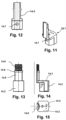
- a hollow cylinder section 14.5 is provided, offset from the rotation axis D, here integrally formed, which extends distally upwards and has, on the upper half, a threaded segment section 14.6 with a threaded segment on the outer surface of the hollow cylinder section 14.5. This forms the clamping section of the clamping jaw 14.
- the proximal hollow cylinder section 14.5 is somewhat wider than the distal threaded segment section, so that a hole saw with smaller central threaded openings with an inner diameter of preferably 9/16 inch can be placed on the threaded segment section 14.6 with the interposition of an adapter ring 36.
- a radially widened collar 14.7 can be formed at the transition between the proximal hollow cylinder section 14.5 and the distal threaded section 14.6.
- These driving pins 38 are inserted into corresponding holding holes in the cover 8 on both sides of the rotation axis D or are connected to it.
- the clamping ring 4 which together with the guide pins 20 forms the linear gear, is closer to the Figures 3 to 5
- the clamping ring 4 consists of a circular metal body, which forms a clamping ring main plane E extending transversely to the rotational axis D or extends in this.
- this clamping ring main plane E of the clamping ring 4 corresponding to the clamping jaws 14 or the guide pins 20 inserted therein, three guide curves 6.2 are provided, radially offset outwards from a central through-opening 6.1, which each extend from a leading end of the curve 6.2.1 to a trailing end of the curve 6.2.2.
- the curvature and the geometric design of the guide curves 6.2 thus determine the adjustment path of the clamping jaws 14 when the clamping ring 4 rotates about the rotation axis D.
- a radially outwardly projecting projection 6.2.3 is formed on the outside of the front end of the curve 6.2.1, which acts as a locking device for the clamping ring 6 in the retracted release position. Only after the blocking force created by this locking device has been overcome does the clamping ring automatically move into the engaged position by rotating clockwise due to the spring force.
- this adjustment range of the clamping jaws 14 is only a few millimeters, preferably 1.4 to 3 mm, which is why the guide curve 6.2 is designed to be almost linear and has only a slight curvature.
- the guide curve 6.2 extends with the front end 6.2.1 of the curve, with its radial outer side, almost adjacent to the center circle 22, whereas the rear end 6.2.2 of the curve is designed in the main plane E of the clamping ring such that the center circle 22 runs almost centrally in the rear end 6.2.2 of the curve. Therefore, the guide curve 6.2 does not run along a circular path around the rotational axis D, but rather runs slightly radially outward in a clockwise direction.
- the clamping ring 6 comprises an outer flange 6.5 which extends distally and proximally, preferably by the same amount, on the outer peripheral edge of the clamping ring main plane E defined by the clamping ring and extending transversely to the axis of rotation, in which a clamping ring plate preferably extends, and which is designed to sit on the base body 4 on the distal side and to encompass it and to receive the cover 8 on the distal side.
- the cover 8 is screwed to the front section of the base body 4 between the clamping jaw receptacles 4.1 via the three countersunk head screws 10, in which threaded holes are provided for receiving the countersunk head screws.
- a centering drill 28 can be fixed centrally in the base body 4 by means of a grub screw 26 screwed into a thread at the side.
- the invention relates to a quick-change chuck for connecting a hole saw to a drive, e.g., a drill.
- the quick-change chuck which is rotatable about a rotational axis, has thread segments arranged around the rotational axis for detachable connection to a hole saw to form an external thread, wherein at least one thread segment is mounted on an adjustable and spring-loaded A preloaded clamping jaw is arranged, and the at least one threaded segment is movable, against a spring force, from a radially outward engagement position into a release position located further radially inward relative to this engagement position.
- a clamping ring which is rotatable about the rotation axis and is designed to transfer the at least one clamping jaw from the engagement position into the release position upon rotation.
- three clamping jaws are provided.
Landscapes
- Engineering & Computer Science (AREA)
- Mechanical Engineering (AREA)
- Gripping On Spindles (AREA)
Claims (12)
- Mandrin à serrage rapide pour une scie cloche (32), lequel peut tourner autour d'un axe de rotation (D),qui s'étend le long de l'axe de rotation (D) depuis une extrémité d'entraînement arrière, conçue pour la liaison amovible avec un entraînement, jusqu'à une extrémité de liaison avant conçue pour la liaison amovible avec la scie cloche (32),comprenant un corps de base (4) qui présente au moins un logement de mâchoire de serrage et au moins une mâchoire de serrage (14) disposée dans celui-ci et déplaçable radialement par rapport à l'axe de rotation (D),des segments filetés (14.6) conçus pour former un filetage et disposés autour de l'axe de rotation étant prévus à l'extrémité de liaison,au moins un segment fileté (14.6) étant formé sur la mâchoire de serrage (14), un ressort (24) étant disposé entre la mâchoire de serrage (14) et le corps de base (4),caractérisé en ce queil est prévu une bague de serrage (6) pouvant tourner autour de l'axe de rotation (D), qui est conçue pour, lors d'une rotation, déplacer ladite au moins une mâchoire de serrage (14), pourvue du segment fileté (14.6), depuis une position d'engagement située radialement plus vers l'extérieur, à l'encontre d'une force élastique du ressort (24), jusque dans une position de libération située radialement plus vers l'intérieur par rapport à ladite position d'engagement,en ce que la bague de serrage présente au moins une came de guidage (6.2) qui est destinée à former une coulisse de guidage dans un plan principal de la bague de serrage s'étendant transversalement à l'axe de rotation, et qui présente une extrémité avant de came (6.2.1) et une extrémité arrière de came (6.2.2),en ce que l'extrémité avant de came (6.2.1.) est située radialement plus près de l'axe de rotation (D) que l'extrémité arrière de came (6.2.2),et en ce qu'il est prévu une tige de guidage (20) sur ladite au moins une mâchoire de serrage, qui coopère avec ladite au moins une came de guidage et qui est guidée par celle-ci.
- Mandrin à serrage rapide selon la revendication précédente,
caractérisé en ce que
la bague de serrage (6) peut être reliée à un corps de base (4) par l'intermédiaire d'un couvercle (8) de préférence en forme de plaque. - Mandrin à serrage rapide selon la revendication 2,
caractérisé en ce que
le couvercle (8) est relié au corps de base par des vis qui traversent des ouvertures de rotation (6.4) ménagées dans la bague de serrage (6) et faisant office de guides. - Mandrin à serrage rapide selon la revendication 3,
caractérisé en ce que
les vis sont entourées de douilles d'écartement (30). - Mandrin à serrage rapide selon l'une des revendications précédentes,
caractérisé en ce que
celui-ci présente trois logements de mâchoire de serrage (4.1) pour recevoir de manière mobile trois mâchoires de serrage (14) ayant chacune un segment fileté (14.6). - Mandrin à serrage rapide selon la revendication 5,
caractérisé en ce que
la bague de serrage (6) présente une came de guidage séparée (6.2) pour chaque mâchoire de serrage (14). - Mandrin à serrage rapide selon l'une des revendications précédentes,
caractérisé en ce quela bague de serrage (6) présente un plan principal de bague de serrage (E) s'étendant transversalement à l'axe de rotation, en position de montage,et en ce que des moyens de positionnement de la bague de serrage sont prévus entre la bague de serrage (6) et le corps de base (4), lesquels assurent une disposition coaxiale et mobile en rotation de la bague de serrage (6). - Mandrin à serrage rapide selon la revendication 7,
caractérisé en ce que
les moyens de positionnement de la bague de serrage comprennent une bride formée radialement à l'extérieur sur la bague de serrage (6), qui entoure au moins le corps de base (4) en position de montage. - Mandrin à serrage rapide selon l'une des revendications précédentes,
caractérisé en ce que
la bague rotative comprend un dispositif de blocage. - Mandrin à serrage rapide selon la revendication 9,
caractérisé en ce que
le dispositif de blocage présente une saillie (6.3) s'étendant radialement vers l'extérieur. - Mandrin à serrage rapide selon l'une des revendications précédentes,
caractérisé en ce que
ladite au moins une mâchoire de serrage comprend une portion d'insertion conçue pour être insérée de façon relativement mobile dans un logement de mâchoire de serrage, réalisé de façon complémentaire, du corps de base (4), ainsi qu'une portion de coincement qui se raccorde à celle-ci et qui est conçue pour être coincée dans une ouverture à taraudage central dans le fond de scie de la scie cloche (32). - Mandrin à serrage rapide selon la revendication 11,
caractérisé en ce que la portion de coincement comprend une portion cylindrique creuse (14.5) qui se raccorde à la portion d'insertion et qui s'étend, en position de montage, en décalage parallèlement à l'axe de rotation (D) depuis la portion d'insertion et se transforme en une portion filetée qui se raccorde de manière distale à celle-ci et qui présente un segment fileté (14.6) côté extérieur.
Applications Claiming Priority (2)
| Application Number | Priority Date | Filing Date | Title |
|---|---|---|---|
| DE102021112968.0A DE102021112968A1 (de) | 2021-05-19 | 2021-05-19 | Schnellwechselspannfutter für eine Lochsäge sowie Lochsägenanordnung mit einem Schnellwechselspannfutter und einer Lochsäge |
| PCT/EP2022/063247 WO2022243275A1 (fr) | 2021-05-19 | 2022-05-17 | Mandrin à serrage rapide pour scie cloche et ensemble scie cloche comprenant un mandrin à serrage rapide et une scie cloche |
Publications (3)
| Publication Number | Publication Date |
|---|---|
| EP4341027A1 EP4341027A1 (fr) | 2024-03-27 |
| EP4341027B1 true EP4341027B1 (fr) | 2025-05-07 |
| EP4341027C0 EP4341027C0 (fr) | 2025-05-07 |
Family
ID=82058433
Family Applications (1)
| Application Number | Title | Priority Date | Filing Date |
|---|---|---|---|
| EP22730368.2A Active EP4341027B1 (fr) | 2021-05-19 | 2022-05-17 | Mandrin à serrage rapide pour scie cloche et ensemble scie cloche comprenant un mandrin à serrage rapide et une scie cloche |
Country Status (3)
| Country | Link |
|---|---|
| EP (1) | EP4341027B1 (fr) |
| DE (1) | DE102021112968A1 (fr) |
| WO (1) | WO2022243275A1 (fr) |
Family Cites Families (4)
| Publication number | Priority date | Publication date | Assignee | Title |
|---|---|---|---|---|
| NL2006364C2 (nl) * | 2011-03-10 | 2012-09-11 | Mpe Techniek B V | Snelwisselsysteem voor roteerbaar gereedschap, en voet van een dergelijk systeem. |
| DE202013006690U1 (de) | 2013-07-19 | 2013-08-07 | EasyWork UG (haftungsbeschrängt) | Aufnahme für eine Lochsäge und Werkzeuganordnung |
| BR112018071702A2 (pt) | 2016-06-08 | 2019-02-19 | Gripp-X B.V. | montagem de serra-copo |
| US11364558B2 (en) * | 2017-11-03 | 2022-06-21 | Milwaukee Electric Tool Corporation | Hole saw arbor having an adjustable connection mechanism |
-
2021
- 2021-05-19 DE DE102021112968.0A patent/DE102021112968A1/de active Pending
-
2022
- 2022-05-17 WO PCT/EP2022/063247 patent/WO2022243275A1/fr not_active Ceased
- 2022-05-17 EP EP22730368.2A patent/EP4341027B1/fr active Active
Also Published As
| Publication number | Publication date |
|---|---|
| EP4341027A1 (fr) | 2024-03-27 |
| EP4341027C0 (fr) | 2025-05-07 |
| WO2022243275A1 (fr) | 2022-11-24 |
| DE102021112968A1 (de) | 2022-11-24 |
Similar Documents
| Publication | Publication Date | Title |
|---|---|---|
| DE102013209371B4 (de) | Kupplungsteil, insbesondere Schneidkopf für ein Rotationswerkzeug sowie hierzu komplementäres Kupplungsteil und Rotationswerkzeug | |
| DE865561C (de) | Werkzeugkopf | |
| WO2015154993A1 (fr) | Outil rotatif, en particulier perceuse, ainsi que tête de coupe pour un tel outil rotatif | |
| WO2013037458A1 (fr) | Système de serrage et corps de base, pince de serrage et outil rotatif associé, et procédé permettant d'installer l'outil rotatif dans le système de serrage | |
| DE2732677A1 (de) | Spannzange | |
| EP3703893B1 (fr) | Porte-outil de fraisage et outil de fraisage | |
| DE10259959B4 (de) | Kraftspannfutter und Keilstange dafür | |
| EP2929992A1 (fr) | Couteau et logement de couteau pour une machine à découper | |
| EP2282859B1 (fr) | Elément de maintien pour insert d'outil de retrait de copeaux | |
| EP4341027B1 (fr) | Mandrin à serrage rapide pour scie cloche et ensemble scie cloche comprenant un mandrin à serrage rapide et une scie cloche | |
| EP0129116B1 (fr) | Outil à fraiser vers l'avant et vers l'arrière | |
| DE3029133C2 (de) | Werkzeughalter | |
| DE102009044995B4 (de) | Schneideinsatzträger, Schneideinsatzund drehangetriebenes Schneidwerkzeug | |
| DE4214838A1 (de) | Spannfutter | |
| DE112008002475B4 (de) | Kraftfahrzeugscharnier | |
| DE102008008335B4 (de) | Werkzeug zur spanenden Bearbeitung von Werkstücken | |
| EP3890910B1 (fr) | Tête de forage pour le pochage de contours intérieurs non cylindriques | |
| DE3511580A1 (de) | Werkzeug-spannvorrichtung | |
| DE2909469C2 (de) | Spannvorrichtung für chirurgische Werkzeuge | |
| DE102021106246B4 (de) | Mehrteiliges, modulares Werkzeug | |
| DE10260493A1 (de) | Kraftspannfutter und Ausklinkschlüssel dafür | |
| EP4289537B1 (fr) | Outil d'ébavurage pour l'ébavurage avant et arrière des bords d'un trou | |
| DE102013222206A1 (de) | Werkzeug zur spanenden Bearbeitung von Werkstückoberflächen | |
| DE19837147C2 (de) | Spannfutter für Werkzeugmaschinen | |
| EP1896219A2 (fr) | Point de raccordement |
Legal Events
| Date | Code | Title | Description |
|---|---|---|---|
| STAA | Information on the status of an ep patent application or granted ep patent |
Free format text: STATUS: UNKNOWN |
|
| STAA | Information on the status of an ep patent application or granted ep patent |
Free format text: STATUS: THE INTERNATIONAL PUBLICATION HAS BEEN MADE |
|
| PUAI | Public reference made under article 153(3) epc to a published international application that has entered the european phase |
Free format text: ORIGINAL CODE: 0009012 |
|
| STAA | Information on the status of an ep patent application or granted ep patent |
Free format text: STATUS: REQUEST FOR EXAMINATION WAS MADE |
|
| 17P | Request for examination filed |
Effective date: 20231206 |
|
| AK | Designated contracting states |
Kind code of ref document: A1 Designated state(s): AL AT BE BG CH CY CZ DE DK EE ES FI FR GB GR HR HU IE IS IT LI LT LU LV MC MK MT NL NO PL PT RO RS SE SI SK SM TR |
|
| DAV | Request for validation of the european patent (deleted) | ||
| DAX | Request for extension of the european patent (deleted) | ||
| GRAP | Despatch of communication of intention to grant a patent |
Free format text: ORIGINAL CODE: EPIDOSNIGR1 |
|
| STAA | Information on the status of an ep patent application or granted ep patent |
Free format text: STATUS: GRANT OF PATENT IS INTENDED |
|
| INTG | Intention to grant announced |
Effective date: 20240917 |
|
| GRAS | Grant fee paid |
Free format text: ORIGINAL CODE: EPIDOSNIGR3 |
|
| GRAA | (expected) grant |
Free format text: ORIGINAL CODE: 0009210 |
|
| STAA | Information on the status of an ep patent application or granted ep patent |
Free format text: STATUS: THE PATENT HAS BEEN GRANTED |
|
| AK | Designated contracting states |
Kind code of ref document: B1 Designated state(s): AL AT BE BG CH CY CZ DE DK EE ES FI FR GB GR HR HU IE IS IT LI LT LU LV MC MK MT NL NO PL PT RO RS SE SI SK SM TR |
|
| REG | Reference to a national code |
Ref country code: GB Ref legal event code: FG4D Free format text: NOT ENGLISH |
|
| REG | Reference to a national code |
Ref country code: CH Ref legal event code: EP |
|
| REG | Reference to a national code |
Ref country code: DE Ref legal event code: R096 Ref document number: 502022003890 Country of ref document: DE |
|
| REG | Reference to a national code |
Ref country code: IE Ref legal event code: FG4D Free format text: LANGUAGE OF EP DOCUMENT: GERMAN |
|
| U01 | Request for unitary effect filed |
Effective date: 20250605 |
|
| U07 | Unitary effect registered |
Designated state(s): AT BE BG DE DK EE FI FR IT LT LU LV MT NL PT RO SE SI Effective date: 20250612 |
|
| U20 | Renewal fee for the european patent with unitary effect paid |
Year of fee payment: 4 Effective date: 20250618 |
|
| PGFP | Annual fee paid to national office [announced via postgrant information from national office to epo] |
Ref country code: AT Payment date: 20250721 Year of fee payment: 4 |
|
| PG25 | Lapsed in a contracting state [announced via postgrant information from national office to epo] |
Ref country code: ES Free format text: LAPSE BECAUSE OF FAILURE TO SUBMIT A TRANSLATION OF THE DESCRIPTION OR TO PAY THE FEE WITHIN THE PRESCRIBED TIME-LIMIT Effective date: 20250507 |
|
| PG25 | Lapsed in a contracting state [announced via postgrant information from national office to epo] |
Ref country code: GR Free format text: LAPSE BECAUSE OF FAILURE TO SUBMIT A TRANSLATION OF THE DESCRIPTION OR TO PAY THE FEE WITHIN THE PRESCRIBED TIME-LIMIT Effective date: 20250808 Ref country code: NO Free format text: LAPSE BECAUSE OF FAILURE TO SUBMIT A TRANSLATION OF THE DESCRIPTION OR TO PAY THE FEE WITHIN THE PRESCRIBED TIME-LIMIT Effective date: 20250807 |
|
| PG25 | Lapsed in a contracting state [announced via postgrant information from national office to epo] |
Ref country code: PL Free format text: LAPSE BECAUSE OF FAILURE TO SUBMIT A TRANSLATION OF THE DESCRIPTION OR TO PAY THE FEE WITHIN THE PRESCRIBED TIME-LIMIT Effective date: 20250507 |
|
| PG25 | Lapsed in a contracting state [announced via postgrant information from national office to epo] |
Ref country code: HR Free format text: LAPSE BECAUSE OF FAILURE TO SUBMIT A TRANSLATION OF THE DESCRIPTION OR TO PAY THE FEE WITHIN THE PRESCRIBED TIME-LIMIT Effective date: 20250507 |
|
| PG25 | Lapsed in a contracting state [announced via postgrant information from national office to epo] |
Ref country code: RS Free format text: LAPSE BECAUSE OF FAILURE TO SUBMIT A TRANSLATION OF THE DESCRIPTION OR TO PAY THE FEE WITHIN THE PRESCRIBED TIME-LIMIT Effective date: 20250807 |
|
| PG25 | Lapsed in a contracting state [announced via postgrant information from national office to epo] |
Ref country code: IS Free format text: LAPSE BECAUSE OF FAILURE TO SUBMIT A TRANSLATION OF THE DESCRIPTION OR TO PAY THE FEE WITHIN THE PRESCRIBED TIME-LIMIT Effective date: 20250907 |
|
| REG | Reference to a national code |
Ref country code: CH Ref legal event code: H13 Free format text: ST27 STATUS EVENT CODE: U-0-0-H10-H13 (AS PROVIDED BY THE NATIONAL OFFICE) Effective date: 20251223 |
|
| PG25 | Lapsed in a contracting state [announced via postgrant information from national office to epo] |
Ref country code: SM Free format text: LAPSE BECAUSE OF FAILURE TO SUBMIT A TRANSLATION OF THE DESCRIPTION OR TO PAY THE FEE WITHIN THE PRESCRIBED TIME-LIMIT Effective date: 20250507 |
|
| PG25 | Lapsed in a contracting state [announced via postgrant information from national office to epo] |
Ref country code: CH Free format text: LAPSE BECAUSE OF NON-PAYMENT OF DUE FEES Effective date: 20250531 |
|
| PG25 | Lapsed in a contracting state [announced via postgrant information from national office to epo] |
Ref country code: CZ Free format text: LAPSE BECAUSE OF FAILURE TO SUBMIT A TRANSLATION OF THE DESCRIPTION OR TO PAY THE FEE WITHIN THE PRESCRIBED TIME-LIMIT Effective date: 20250507 |
|
| PG25 | Lapsed in a contracting state [announced via postgrant information from national office to epo] |
Ref country code: SK Free format text: LAPSE BECAUSE OF FAILURE TO SUBMIT A TRANSLATION OF THE DESCRIPTION OR TO PAY THE FEE WITHIN THE PRESCRIBED TIME-LIMIT Effective date: 20250507 |
|
| PG25 | Lapsed in a contracting state [announced via postgrant information from national office to epo] |
Ref country code: MC Free format text: LAPSE BECAUSE OF FAILURE TO SUBMIT A TRANSLATION OF THE DESCRIPTION OR TO PAY THE FEE WITHIN THE PRESCRIBED TIME-LIMIT Effective date: 20250507 |
|
| PLBE | No opposition filed within time limit |
Free format text: ORIGINAL CODE: 0009261 |
|
| STAA | Information on the status of an ep patent application or granted ep patent |
Free format text: STATUS: NO OPPOSITION FILED WITHIN TIME LIMIT |
|
| REG | Reference to a national code |
Ref country code: CH Ref legal event code: L10 Free format text: ST27 STATUS EVENT CODE: U-0-0-L10-L00 (AS PROVIDED BY THE NATIONAL OFFICE) Effective date: 20260318 |
|
| PG25 | Lapsed in a contracting state [announced via postgrant information from national office to epo] |
Ref country code: IE Free format text: LAPSE BECAUSE OF NON-PAYMENT OF DUE FEES Effective date: 20250517 |
|
| 26N | No opposition filed |
Effective date: 20260210 |