EP4343420A2 - Procédé de fabrication d'un affichage piézo-électrophorétique - Google Patents
Procédé de fabrication d'un affichage piézo-électrophorétique Download PDFInfo
- Publication number
- EP4343420A2 EP4343420A2 EP24150412.5A EP24150412A EP4343420A2 EP 4343420 A2 EP4343420 A2 EP 4343420A2 EP 24150412 A EP24150412 A EP 24150412A EP 4343420 A2 EP4343420 A2 EP 4343420A2
- Authority
- EP
- European Patent Office
- Prior art keywords
- display
- electrode
- layer
- electro
- electrophoretic
- Prior art date
- Legal status (The legal status is an assumption and is not a legal conclusion. Google has not performed a legal analysis and makes no representation as to the accuracy of the status listed.)
- Pending
Links
Images












Classifications
-
- G—PHYSICS
- G02—OPTICS
- G02F—OPTICAL DEVICES OR ARRANGEMENTS FOR THE CONTROL OF LIGHT BY MODIFICATION OF THE OPTICAL PROPERTIES OF THE MEDIA OF THE ELEMENTS INVOLVED THEREIN; NON-LINEAR OPTICS; FREQUENCY-CHANGING OF LIGHT; OPTICAL LOGIC ELEMENTS; OPTICAL ANALOGUE/DIGITAL CONVERTERS
- G02F1/00—Devices or arrangements for the control of the intensity, colour, phase, polarisation or direction of light arriving from an independent light source, e.g. switching, gating or modulating; Non-linear optics
- G02F1/01—Devices or arrangements for the control of the intensity, colour, phase, polarisation or direction of light arriving from an independent light source, e.g. switching, gating or modulating; Non-linear optics for the control of the intensity, phase, polarisation or colour
- G02F1/165—Devices or arrangements for the control of the intensity, colour, phase, polarisation or direction of light arriving from an independent light source, e.g. switching, gating or modulating; Non-linear optics for the control of the intensity, phase, polarisation or colour based on translational movement of particles in a fluid under the influence of an applied field
- G02F1/1675—Constructional details
- G02F1/16755—Substrates
-
- G—PHYSICS
- G02—OPTICS
- G02F—OPTICAL DEVICES OR ARRANGEMENTS FOR THE CONTROL OF LIGHT BY MODIFICATION OF THE OPTICAL PROPERTIES OF THE MEDIA OF THE ELEMENTS INVOLVED THEREIN; NON-LINEAR OPTICS; FREQUENCY-CHANGING OF LIGHT; OPTICAL LOGIC ELEMENTS; OPTICAL ANALOGUE/DIGITAL CONVERTERS
- G02F1/00—Devices or arrangements for the control of the intensity, colour, phase, polarisation or direction of light arriving from an independent light source, e.g. switching, gating or modulating; Non-linear optics
- G02F1/01—Devices or arrangements for the control of the intensity, colour, phase, polarisation or direction of light arriving from an independent light source, e.g. switching, gating or modulating; Non-linear optics for the control of the intensity, phase, polarisation or colour
- G02F1/165—Devices or arrangements for the control of the intensity, colour, phase, polarisation or direction of light arriving from an independent light source, e.g. switching, gating or modulating; Non-linear optics for the control of the intensity, phase, polarisation or colour based on translational movement of particles in a fluid under the influence of an applied field
- G02F1/166—Devices or arrangements for the control of the intensity, colour, phase, polarisation or direction of light arriving from an independent light source, e.g. switching, gating or modulating; Non-linear optics for the control of the intensity, phase, polarisation or colour based on translational movement of particles in a fluid under the influence of an applied field characterised by the electro-optical or magneto-optical effect
- G02F1/167—Devices or arrangements for the control of the intensity, colour, phase, polarisation or direction of light arriving from an independent light source, e.g. switching, gating or modulating; Non-linear optics for the control of the intensity, phase, polarisation or colour based on translational movement of particles in a fluid under the influence of an applied field characterised by the electro-optical or magneto-optical effect by electrophoresis
-
- G—PHYSICS
- G02—OPTICS
- G02F—OPTICAL DEVICES OR ARRANGEMENTS FOR THE CONTROL OF LIGHT BY MODIFICATION OF THE OPTICAL PROPERTIES OF THE MEDIA OF THE ELEMENTS INVOLVED THEREIN; NON-LINEAR OPTICS; FREQUENCY-CHANGING OF LIGHT; OPTICAL LOGIC ELEMENTS; OPTICAL ANALOGUE/DIGITAL CONVERTERS
- G02F1/00—Devices or arrangements for the control of the intensity, colour, phase, polarisation or direction of light arriving from an independent light source, e.g. switching, gating or modulating; Non-linear optics
- G02F1/01—Devices or arrangements for the control of the intensity, colour, phase, polarisation or direction of light arriving from an independent light source, e.g. switching, gating or modulating; Non-linear optics for the control of the intensity, phase, polarisation or colour
- G02F1/165—Devices or arrangements for the control of the intensity, colour, phase, polarisation or direction of light arriving from an independent light source, e.g. switching, gating or modulating; Non-linear optics for the control of the intensity, phase, polarisation or colour based on translational movement of particles in a fluid under the influence of an applied field
- G02F1/1675—Constructional details
-
- G—PHYSICS
- G02—OPTICS
- G02F—OPTICAL DEVICES OR ARRANGEMENTS FOR THE CONTROL OF LIGHT BY MODIFICATION OF THE OPTICAL PROPERTIES OF THE MEDIA OF THE ELEMENTS INVOLVED THEREIN; NON-LINEAR OPTICS; FREQUENCY-CHANGING OF LIGHT; OPTICAL LOGIC ELEMENTS; OPTICAL ANALOGUE/DIGITAL CONVERTERS
- G02F1/00—Devices or arrangements for the control of the intensity, colour, phase, polarisation or direction of light arriving from an independent light source, e.g. switching, gating or modulating; Non-linear optics
- G02F1/01—Devices or arrangements for the control of the intensity, colour, phase, polarisation or direction of light arriving from an independent light source, e.g. switching, gating or modulating; Non-linear optics for the control of the intensity, phase, polarisation or colour
- G02F1/165—Devices or arrangements for the control of the intensity, colour, phase, polarisation or direction of light arriving from an independent light source, e.g. switching, gating or modulating; Non-linear optics for the control of the intensity, phase, polarisation or colour based on translational movement of particles in a fluid under the influence of an applied field
- G02F1/1675—Constructional details
- G02F1/1676—Electrodes
-
- G—PHYSICS
- G02—OPTICS
- G02F—OPTICAL DEVICES OR ARRANGEMENTS FOR THE CONTROL OF LIGHT BY MODIFICATION OF THE OPTICAL PROPERTIES OF THE MEDIA OF THE ELEMENTS INVOLVED THEREIN; NON-LINEAR OPTICS; FREQUENCY-CHANGING OF LIGHT; OPTICAL LOGIC ELEMENTS; OPTICAL ANALOGUE/DIGITAL CONVERTERS
- G02F1/00—Devices or arrangements for the control of the intensity, colour, phase, polarisation or direction of light arriving from an independent light source, e.g. switching, gating or modulating; Non-linear optics
- G02F1/01—Devices or arrangements for the control of the intensity, colour, phase, polarisation or direction of light arriving from an independent light source, e.g. switching, gating or modulating; Non-linear optics for the control of the intensity, phase, polarisation or colour
- G02F1/165—Devices or arrangements for the control of the intensity, colour, phase, polarisation or direction of light arriving from an independent light source, e.g. switching, gating or modulating; Non-linear optics for the control of the intensity, phase, polarisation or colour based on translational movement of particles in a fluid under the influence of an applied field
- G02F1/1685—Operation of cells; Circuit arrangements affecting the entire cell
-
- H—ELECTRICITY
- H10—SEMICONDUCTOR DEVICES; ELECTRIC SOLID-STATE DEVICES NOT OTHERWISE PROVIDED FOR
- H10N—ELECTRIC SOLID-STATE DEVICES NOT OTHERWISE PROVIDED FOR
- H10N30/00—Piezoelectric or electrostrictive devices
- H10N30/80—Constructional details
- H10N30/85—Piezoelectric or electrostrictive active materials
-
- G—PHYSICS
- G02—OPTICS
- G02F—OPTICAL DEVICES OR ARRANGEMENTS FOR THE CONTROL OF LIGHT BY MODIFICATION OF THE OPTICAL PROPERTIES OF THE MEDIA OF THE ELEMENTS INVOLVED THEREIN; NON-LINEAR OPTICS; FREQUENCY-CHANGING OF LIGHT; OPTICAL LOGIC ELEMENTS; OPTICAL ANALOGUE/DIGITAL CONVERTERS
- G02F1/00—Devices or arrangements for the control of the intensity, colour, phase, polarisation or direction of light arriving from an independent light source, e.g. switching, gating or modulating; Non-linear optics
- G02F1/01—Devices or arrangements for the control of the intensity, colour, phase, polarisation or direction of light arriving from an independent light source, e.g. switching, gating or modulating; Non-linear optics for the control of the intensity, phase, polarisation or colour
- G02F1/165—Devices or arrangements for the control of the intensity, colour, phase, polarisation or direction of light arriving from an independent light source, e.g. switching, gating or modulating; Non-linear optics for the control of the intensity, phase, polarisation or colour based on translational movement of particles in a fluid under the influence of an applied field
- G02F1/1675—Constructional details
- G02F2001/1678—Constructional details characterised by the composition or particle type
-
- G—PHYSICS
- G02—OPTICS
- G02F—OPTICAL DEVICES OR ARRANGEMENTS FOR THE CONTROL OF LIGHT BY MODIFICATION OF THE OPTICAL PROPERTIES OF THE MEDIA OF THE ELEMENTS INVOLVED THEREIN; NON-LINEAR OPTICS; FREQUENCY-CHANGING OF LIGHT; OPTICAL LOGIC ELEMENTS; OPTICAL ANALOGUE/DIGITAL CONVERTERS
- G02F2202/00—Materials and properties
- G02F2202/10—Materials and properties semiconductor
-
- G—PHYSICS
- G02—OPTICS
- G02F—OPTICAL DEVICES OR ARRANGEMENTS FOR THE CONTROL OF LIGHT BY MODIFICATION OF THE OPTICAL PROPERTIES OF THE MEDIA OF THE ELEMENTS INVOLVED THEREIN; NON-LINEAR OPTICS; FREQUENCY-CHANGING OF LIGHT; OPTICAL LOGIC ELEMENTS; OPTICAL ANALOGUE/DIGITAL CONVERTERS
- G02F2202/00—Materials and properties
- G02F2202/16—Materials and properties conductive
-
- G—PHYSICS
- G02—OPTICS
- G02F—OPTICAL DEVICES OR ARRANGEMENTS FOR THE CONTROL OF LIGHT BY MODIFICATION OF THE OPTICAL PROPERTIES OF THE MEDIA OF THE ELEMENTS INVOLVED THEREIN; NON-LINEAR OPTICS; FREQUENCY-CHANGING OF LIGHT; OPTICAL LOGIC ELEMENTS; OPTICAL ANALOGUE/DIGITAL CONVERTERS
- G02F2203/00—Function characteristic
- G02F2203/68—Green display, e.g. recycling, reduction of harmful substances
Definitions
- the subject matter disclosed herein relates to piezo electrophoretic displays which may be activated or driven without being connected to a power source, and methods for their manufacture.
- Non-emissive displays convey information using contrast differences, which are achieved by varying the reflectance of different frequencies of light; they are thus distinct from traditional emissive displays, which stimulate the eye by emitting light.
- One type of non-emissive display is an electrophoretic display, which utilizes the phenomenon of electrophoresis to achieve contrast. Electrophoresis refers to movement of charged particles in an applied electric field. When electrophoresis occurs in a liquid, the particles move with a velocity determined primarily by the viscous drag experienced by the particles, their charge, the dielectric properties of the liquid, and the magnitude of the applied field.
- An electrophoretic display utilizes charged particles of one color suspended in a dielectric liquid medium of a different color (that is, light reflected by the particles) is absorbed by the liquid.
- the suspension is housed in a cell located between (or partly defined by) a pair of oppositely disposed electrodes, one of which is transparent.
- the electrodes When the electrodes are operated to apply a DC or pulsed field across the medium, the particles migrate toward the electrode of opposite sign. The result is a visually observable color change.
- their color dominates the display; if the particles are drawn to the other electrode, however, they are obscured by the color of the liquid medium, which dominates instead.
- electrophoretic displays are bi-stable: their state persists even after the activating electric field is removed. This is generally achieved via residual charge on the electrodes and van der Waals interactions between the particles and the walls of the electrophoretic cell.
- the driving of an electrophoretic display requires a power source, such as a battery to provide power to the display anchor its driving circuitry.
- the power source may be a driver IC in order to generate an electric field.
- the electric field may also need to be enhanced by a circuitry. In any case, a physical connection through wires is required to attach the power source to the electrophoretic display and its driving circuitry.
- an electro-optic display may include a layer of electrophoretic material; a first conductive layer; and a piezoelectric material positioned between the layer of electrophoretic material and the first conductive layer, the piezoelectric material overlaps with a portion of the layer of electrophoretic material, and a portion of the first conductive layer overlaps with the rest of the electrophoretic material.
- optical property is typically color perceptible to the human eye, it may be another optical property, such as optical transmission, reflectance, luminescence or, in the case of displays intended for machine reading, pseudo-color in the sense of a change in reflectance of electromagnetic wavelengths outside the visible range.
- bistable and “bistability” are used herein in their conventional meaning in the art to refer to displays comprising display elements having first and second display states differing in at least one optical property, and such that after any given element has been driven, by means of an addressing pulse of finite duration, to assume either its first or second display state, after the addressing pulse has terminated, that state will persist for at least several times, for example at least four times, the minimum duration of the addressing pulse required to change the state of the display element.
- addressing pulse of finite duration
- some particle-based electrophoretic displays capable of gray scale are stable not only in their extreme black and white states but also in their intermediate gray states, and the same is true of some other types of electro-optic displays.
- This type of display is properly called “multi-stable” rather than bistable, although for convenience the term “bistable” may be used herein to cover both bistable and multi-stable displays.
- gray state is used herein in its conventional meaning in the imaging art to refer to a state intermediate two extreme optical states of a pixel, and does not necessarily imply a black-white transition between these two extreme states.
- E Ink patents and published applications referred to below describe electrophoretic displays in which the extreme states are white and deep blue, so that an intermediate "gray state” would actually be pale blue. Indeed, as already mentioned, the change in optical state may not be a color change at all.
- black and “white” may be used hereinafter to refer to the two extreme optical states of a display, and should be understood as normally including extreme optical states which are not strictly black and white, for example, the aforementioned white and dark blue states.
- the term “monochrome” may be used hereinafter to denote a display or drive scheme which only drives pixels to their two extreme optical states with no intervening gray states.
- each pixel is composed of a plurality of sub-pixels each of which can display less than all the colors which the display itself can show.
- each pixel is composed of a red sub-pixel, a green sub-pixel, a blue sub-pixel, and optionally a white sub-pixel, with each of the sub-pixels being capable of displaying a range of colors from black to the brightest version of its specified color.
- electro-optic displays are known.
- One type of electro-optic display is a rotating bichromal member type as described, for example, in U.S. Patents Nos. 5,808,783 ; 5,777,782 ; 5,760,761 ; 6,054,071 6,055,091 ; 6,097,531 ; 6,128,124 ; 6,137,467 ; and 6,147,791 (although this type of display is often referred to as a "rotating bichromal ball" display, the term "rotating bichromal member" is preferred as more accurate since in some of the patents mentioned above the rotating members are not spherical).
- Such a display uses a large number of small bodies (typically spherical or cylindrical) which have two or more sections with differing optical characteristics, and an internal dipole. These bodies are suspended within liquid-filled vacuoles within a matrix, the vacuoles being filled with liquid so that the bodies are free to rotate. The appearance of the display is changed by applying an electric field thereto, thus rotating the bodies to various positions and varying which of the sections of the bodies is seen through a viewing surface.
- This type of electro-optic medium is typically bistable.
- electro-optic display uses an electrochromic medium, for example an electrochromic medium in the form of a nanochromic film comprising an electrode formed at least in part from a semi-conducting metal oxide and a plurality of dye molecules capable of reversible color change attached to the electrode; see, for example O'Regan, B., et al., Nature 1991, 353, 737 ; and Wood, D., Information Display, 18(3), 24 (March 2002 ). See also Bach, U., et al., Adv. Mater., 2002, 14(11), 845 . Nanochromic films of this type are also described, for example, in U.S. Patents Nos. 6,301,038 ; 6,870,657 ; and 6,950,220 . This type of medium is also typically bistable.
- electro-optic display is an electro-wetting display developed by Philips and described in Hayes, R.A., et al., "Video-Speed Electronic Paper Based on Electrowetting", Nature, 425, 383-385 (2003 ). It is shown in U.S. Patent No. 7,420,549 that such electro-wetting displays can be made bistable.
- Electrophoretic display In which a plurality of charged particles move through a fluid under the influence of an electric field. Electrophoretic displays can have attributes of good brightness and contrast, wide viewing angles, state bistability, and low power consumption when compared with liquid crystal displays.
- electrophoretic media require the presence of a fluid.
- this fluid is a liquid, but electrophoretic media can be produced using gaseous fluids; see, for example, Kitamura, T., et al., "Electrical toner movement for electronic paper-like display", IDW Japan, 2001, Paper HCS1-1 , and Yamaguchi, Y., et al., "Toner display using insulative particles charged triboelectrically", IDW Japan, 2001, Paper AMD4-4 ). See also U.S. Patents Nos. 7,321,459 and 7,236,291 .
- Such gas-based electrophoretic media appear to be susceptible to the same types of problems due to particle settling as liquid-based electrophoretic media, when the media are used in an orientation which permits such settling, for example in a sign where the medium is disposed in a vertical plane. Indeed, particle settling appears to be a more serious problem in gas-based electrophoretic media than in liquid-based ones, since the lower viscosity of gaseous suspending fluids as compared with liquid ones allows more rapid settling of the electrophoretic particles.
- encapsulated electrophoretic and other electro-optic media comprise numerous small capsules, each of which itself comprises an internal phase containing electrophoretically-mobile particles in a fluid medium, and a capsule wall surrounding the internal phase.
- the capsules are themselves held within a polymeric binder to form a coherent layer positioned between two electrodes.
- the technologies described in these patents and applications include:
- microcell electrophoretic display A related type of electrophoretic display is a so-called "microcell electrophoretic display".
- the charged particles and the fluid are not encapsulated within microcapsules but instead are retained within a plurality of cavities formed within a carrier medium, typically a polymeric film.
- a carrier medium typically a polymeric film.
- electrophoretic media are often opaque (since, for example, in many electrophoretic media, the particles substantially block transmission of visible light through the display) and operate in a reflective mode
- many electrophoretic displays can be made to operate in a so-called "shutter mode" in which one display state is substantially opaque and one is light-transmissive. See, for example, U.S. Patents Nos. 5,872,552 ; 6,130,774 ; 6,144,361 ; 6,172,798 ; 6,271,823 ; 6,225,971 ; and 6,184,856 .
- Dielectrophoretic displays which are similar to electrophoretic displays but rely upon variations in electric field strength, can operate in a similar mode; see U.S. Patent No.
- Electro-optic media operating in shutter mode may be useful in multi-layer structures for full color displays; in such structures, at least one layer adjacent the viewing surface of the display operates in shutter mode to expose or conceal a second layer more distant from the viewing surface.
- An encapsulated electrophoretic display typically does not suffer from the clustering and settling failure mode of traditional electrophoretic devices and provides further advantages, such as the ability to print or coat the display on a wide variety of flexible and rigid substrates.
- printing is intended to include all forms of printing and coating, including, but without limitation: pre-metered coatings such as patch die coating, slot or extrusion coating, slide or cascade coating, curtain coating; roll coating such as knife over roll coating, forward and reverse roll coating; gravure coating; dip coating; spray coating; meniscus coating; spin coating; brush coating; air knife coating; silk screen printing processes; electrostatic printing processes; thermal printing processes; ink jet printing processes; electrophoretic deposition (See U.S. Patent No. 7,339,715 ); and other similar techniques.)
- pre-metered coatings such as patch die coating, slot or extrusion coating, slide or cascade coating, curtain coating
- roll coating such as knife over roll coating, forward and reverse roll coating
- gravure coating dip coating
- spray coating meniscus coating
- spin coating brush
- electro-optic materials may also be used in the present invention.
- An electrophoretic display normally comprises a layer of electrophoretic material and at least two other layers disposed on opposed sides of the electrophoretic material, one of these two layers being an electrode layer.
- both the layers are electrode layers, and one or both of the electrode layers are patterned to define the pixels of the display.
- one electrode layer may be patterned into elongate row electrodes and the other into elongate column electrodes running at right angles to the row electrodes, the pixels being defined by the intersections of the row and column electrodes.
- one electrode layer has the form of a single continuous electrode and the other electrode layer is patterned into a matrix of pixel electrodes, each of which defines one pixel of the display.
- electrophoretic display which is intended for use with a stylus, print head or similar movable electrode separate from the display
- only one of the layers adjacent the electrophoretic layer comprises an electrode, the layer on the opposed side of the electrophoretic layer typically being a protective layer intended to prevent the movable electrode damaging the electrophoretic layer.
- electrophoretic displays may be constructed with two continuous electrodes and an electrophoretic layer and a photoelectrophoretic layer between the electrodes. Because the photoelectrophoretic material changes resistivity with the absorption of photons, incident light can be used to alter the state of the electrophoretic medium.
- FIG. 1 Such a device is illustrated in FIG. 1 .
- the device of FIG. 1 works best when driven by an emissive source, such as an LCD display, located on the opposed side of the display from the viewing surface.
- the devices of U.S. Pat. No. 6,704,133 incorporated special barrier layers between the front electrode and the photoelectrophoretic material to reduce "dark currents" caused by incident light from the front of the display that leaks past the reflective electro-optic media.
- the term "light-transmissive" is used in this patent and herein to mean that the layer thus designated transmits sufficient light to enable an observer, looking through that layer, to observe the change in display states of the electro-optic medium, which will normally be viewed through the electrically-conductive layer and adjacent substrate (if present); in cases where the electro-optic medium displays a change in reflectivity at non-visible wavelengths, the term “light-transmissive” should of course be interpreted to refer to transmission of the relevant non-visible wavelengths.
- the substrate will typically be a polymeric film, and will normally have a thickness in the range of about 1 to about 25 mil (25 to 634 ⁇ m), preferably about 2 to about 10 mil (51 to 254 ⁇ m).
- the electrically-conductive layer is conveniently a thin metal or metal oxide layer of, for example, aluminum or ITO, or may be a conductive polymer.
- Poly (ethylene terephthalate) (PET) films coated with aluminum or ITO are available commercially, for example as "aluminized Mylar” ("Mylar” is a Registered Trade Mark) from E.I. du Pont de Nemours & Company, Wilmington DE, and such commercial materials may be used with good results in the front plane laminate.
- Assembly of an electro-optic display using such a front plane laminate may be effected by removing the release sheet from the front plane laminate and contacting the adhesive layer with the backplane under conditions effective to cause the adhesive layer to adhere to the backplane, thereby securing the adhesive layer, layer of electro-optic medium and electrically-conductive layer to the backplane.
- This process is well-adapted to mass production since the front plane laminate may be mass produced, typically using roll-to-roll coating techniques, and then cut into pieces of any size needed for use with specific backplanes.
- U.S. Patent No. 7,561,324 describes a so-called "double release sheet" which is essentially a simplified version of the front plane laminate of the aforementioned U.S. Patent No. 6,982,178 .
- One form of the double release sheet comprises a layer of a solid electro-optic medium sandwiched between two adhesive layers, one or both of the adhesive layers being covered by a release sheet.
- Another form of the double release sheet comprises a layer of a solid electro-optic medium sandwiched between two release sheets.
- Both forms of the double release film are intended for use in a process generally similar to the process for assembling an electro-optic display from a front plane laminate already described, but involving two separate laminations; typically, in a first lamination the double release sheet is laminated to a front electrode to form a front sub-assembly, and then in a second lamination the front sub-assembly is laminated to a backplane to form the final display, although the order of these two laminations could be reversed if desired.
- U. S. Patent No. 7,839,564 describes a so-called "inverted front plane laminate", which is a variant of the front plane laminate described in the aforementioned U.S. Patent No. 6,982,178 .
- This inverted front plane laminate comprises, in order, at least one of a light-transmissive protective layer and a light-transmissive electrically-conductive layer; an adhesive layer; a layer of a solid electro-optic medium; and a release sheet.
- This inverted front plane laminate is used to form an electro-optic display having a layer of lamination adhesive between the electro-optic layer and the front electrode or front substrate; a second, typically thin layer of adhesive may or may not be present between the electro-optic layer and a backplane.
- Such electro-optic displays can combine good resolution with good low temperature performance.
- U.S. Patent No. 3,383,993 discloses a photoelectrophoretic imaging apparatus that could be used to reproduce projected images on a medium, typically a transparent electrode, such as ITO.
- a medium typically a transparent electrode, such as ITO.
- the subject matter presented herein relates to several piezo electrophoretic display structural designs which do not need a power supply (e.g., battery or wired power supply etc.,) in order for the electrophoretic display to operate.
- a power supply e.g., battery or wired power supply etc.
- Piezoelectricity is the charge which accumulates in a solid material in response to applied mechanical stress.
- Suitable materials for the subject matter disclosed herein may include polyvinylidene fluoride (PVDF), quartz (SiO 2 ), berlinite (AlPO 4 ), gallium orthophosphate (GaPO 4 ), tourmaline, barium titanate (BaTiO 3 ), lead zirconate titanate (PZT), zinc oxide (ZnO), aluminum nitride (AlN), lithium tantalite, lanthanum gallium silicate, potassium sodium tartrate and any other known piezo materials.
- PVDF polyvinylidene fluoride
- quartz SiO 2
- berlinite AlPO 4
- gallium orthophosphate GaPO 4
- Tourmaline barium titanate
- BaTiO 3 barium titanate
- PZT lead zirconate titanate
- ZnO zinc oxide
- AlN aluminum nitride
- lithium tantalite lithium tantalite
- CR contrast ratio
- an electro-optic display e.g., an electrophoretic display
- FIG 1 illustrates a cross sectional view of an exemplary electro-optic display 100 using a piezo material 102 to drive an electrophoretic material (EPD) film 104 in accordance with the subject matter disclosed herein.
- the piezo film 102 may be laminated to a portion of the EPD film 104, and a conductive adhesive material (e.g., copper tape) may be used to cover up the piezo film 102 and the rest of the EPD film 104 as illustrated in Figures 1 And 2A.
- the conductive adhesive material may function as an electrode 2 108 and be affixed to a substrate (not shown).
- the electrode 2 108 may function as a pixel electrode for modulating a voltage potential across the EPD film 104 for displaying colors or images (e.g., by changing the graytones of the EPD film 104).
- an electrode 1 106 may overlap with the EPD film layer 104.
- the EPD film 104 may be fabricate onto the electrode 1 106 to begin with.
- electrode 1 106 may firstly be patterned to include micro-cell structures where electrophoretic fluid with electrophoretic particles may be embossed into the micro-cell structure to form an EPD film layer. For which the details will be described in Figures 9 and 11A-B below.
- the EPD film 104 and the electrode 1 106 may be of an integrated structure.
- both the electrode 1 106 and electrode 2 108 may be transparent, or either electrode 1 106 or electrode 2 108 may be transparent, such that display 100 may be viewed from either directions.
- the CR of the electro-optic display 100 may differ depending on the ratio of the EPD film 104 surface area A1 110 (i.e., the portion of EPD film 104 that is overlaps with or covered by or in direct contact with the piezo material 102) compared to that of area A2 112 (i.e., the portion of EPD film 104 that is overlapped with or covered by electrode 2 108), as illustrated in Figure 1 .
- Experimental result of the CR are shown below in Table 1 - Table 1.
- a display such as the one illustrated in Figure 1 may improve its CR by reducing the overall surface area (e.g., A2) of the EPD film 104 that overlaps or is on electrode 2 108 (i.e., conductive adhesive material).
- the CR improved from 2 when the ratio of EPD film 104 that is on piezo film 102 (e.g., A1) to that is on electrode 2 108 (e.g., A2) is 1:2, to 7 when the ratio became 2:1.
- the width of either electrode 1 106 or electrode 2 108 may be reduced such that whatever physical stress applied may be applied to the longer side of electrode 2 108 in a vertical direction.
- FIG. 2B illustrates an exemplary equivalent circuit of the display 100 shown in Figure 1 in accordance with the subject matter disclosed herein.
- Portion of the EPD film 104 in contact with the piezo film 102 may have an electrical resistance value R1 and the portion covered by electrode 2 108 may have an electrical resistance value R2.
- voltage generated by the piezo film 104 may be split between R1 and R2 placed in a series configuration.
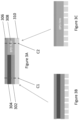
- a piezo film 302 may be laminated onto a semi-conductive or high-resistive layer 304, and then laminate the semi-conductive or high-resistive layer 304 onto an electrode 1 layer 306, as shown in Figure 3A .
- the semi-conductive or high-resistive layer 304 replaces portions of the EPD film 308 on top of the piezo film 302, thereby reducing the overall thickness of the display, as well as preventing a fast dissipation of charges across the piezo film 302 so the locally produced charges (by the piezo film 302) may be effectively and efficiently applied onto the EPD film 308, which results in an improvement in the display CR.
- Illustrated below in Table 2 is a comparison of the resistivity level of the semi-conductive layer 304 and the resulting CR. As shown, an optimum CR ratio of 12 may be achieved when the semi-conductive layer 304 has a resistivity of 10 8 Ohm*cm. Table 2. Display CR vs. Resistance Resistivity of material in between electrode 1 and piezo film (Ohm*cm) Response of display on strain change 10 2 Contrast ratio: 1.7 10 8 Contrast ratio: 12 >10 12 Contrast ratio: 1 (no response)
- display CR may be optimized by adjust the resistance value of the semi-conductive layer 304. For example, at a resistance range of approximately 10 8 (Ohm*cm), the display CR of 12 may be achieved.
- the resistance of the electrode 1 layer 306 may be at approximately 450ohm/sq, where the resistance of an electrode 2 layer 310 may be at 0.003ohm/sq, the EPD film 308 may have a resistance of approximately 10 7 to 10 8 oh, and the piezo material 302 may have a resistance of 10 13 to 10 14 ohm.
- Figures 3B and 3C are cross sectional views of the display illustrated in Figure 3A.
- Figure 3B shows the display cross-section along the C1 line
- Figure 3C shows the display cross-section along the C2 line.
- the electrode 2 layer 310 may be segmented.
- the changes in gray tone in the EPD film layer 308 will appear to be segmented as well.
- the electrode 2 310 is a single continuous sheet, the change in gray tone in the EPD film layer 308 will be continuous as well.
- both electrode 1 306 and electrode 2 310 may be transparent, and all the layers (e.g., layers 302, 304, 310 etc) may be transparent, such that the display can be viewed from either orientation or directions.
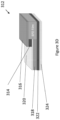
- Figure 3D illustrates a cross sectional view of another display 312 in accordance with the subject matter presented herein.
- This display 312 differs from the display illustrated in Figure 3A in that only a portion of the piezoelectric film layer 318 overlaps with the electrode 1 316 layer.
- the piezoelectric film layer 318 can avoid being placed in a neutral plane position, such that better images may be generated from the piezoelectric film 318.
- the piezoelectric film layer 318 may be a metalized piezo film and may be covered by a metal layer 320.
- a first semi-conductive layer 314 may be positioned between the metal layer 320 and the electrode 1 layer 316.
- another second semi-conductive layer 322 may be positioned between the piezoelectric film layer 318 and an electrode 2 layer 324. It should be appreciated that all the layers presented herein, including the electrode 1316 and electrode 2 324 layers may be transparent, such that this display may be viewed from either direction or orientation.
- a semi-conductive layer 402 may be placed between an electrode 2 layer 404 and a piezo film layer 406 and an EPD film layer 408, as shown in Figure 4 .
- This semi-conductive layer 402 may insulate the piezo film layer 406 and the EPD film layer 408 from electrode 2 404.
- the display illustrated in Figure 3A may be modified to include an additional semi-conductive layer to insulate the piezo film and the EPD film from electrode 2.
- the display illustrated in Figure 4 demonstrated the best CR performance at 18.
- the display configurations herein enables one to construct a piezo-electricity driven device with a thickness less than 50um, and also greatly simplifies the device structure and makes the display more sensitive to smaller applied physical stress.
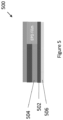
- Figure 5 illustrated another design 500 of a display.
- This display 500 is similar to the one shown in Figure 3A except an additional semi-conductive layer 502 is placed between the piezoelectric layer 504 and the electrode 2 layer 506.
- a comparison of the CR ratio between the various designs are illustrated in Table 3 below. Table 3. Comparative CR Response of display on strain change Piezo film directly contact with both electrodes Contrast Ratio: 1.7 Figure 1 Contrast Ratio: 7 Figure 3A Contrast Ratio: 12 Figure 4 Contrast Ratio: 18 Figure 5 Contrast Ratio: 14
- Electrodes 1 and electrode 2 layers may be transparent, such that these displays may be viewed from either direction or orientation.
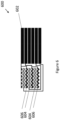
- FIGS 6 and 7 illustrate embodiments of piezo electrophoretic displays that may be configured to display various patterns, such as the jigsaw pattern in Figure 6 and the star shaped pattern in Figure 7 .
- a display 600 may include a plurality of electrodes 602 design to transport charges to electrophoretic display mediums 604s and 606s.
- the display medium 604 is of red color and the display medium 606 is of black color. It should be appreciated that other colors may be conveniently adopted.
- electrodes 602 on the top portion of the display may be connected to the black colored display mediums 606, and the electrodes 602 of the bottom portion may be connected to the red colored display mediums 604.
- the display mediums 606 and 604 may display both the black and red color.
- This particular configuration illustrated in Figure 6 can be printed using conductive material, greatly simplify the manufacturing process.
- a piezo electrophoretic display in accordance with the subject matter disclosed herein may be combined with another apparatus, such as a currency bill illustrated in Figure 8 .
- a display may be affixed to one end of a bill, and when physical stress is applied, the display can switch between one or more graytones. In this fashion, a user may easily distinguish a genuine bill from a counterfeiting one.
- the electrodes for the display may be segmented, and the resulting gray tone of the EPD material layer may appeal segmented.
- the electrodes for the display may be a continuous sheet, and the resulting gray tone of the EPD material may vary in a continuous fashion.
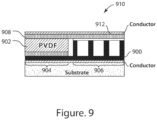
- FIG. 9 illustrates a cross sectional view of yet another embodiment of a piezoelectric display 910 in accordance with the subject matter presented herein.
- the EPD layer 900 may partially extend underneath a piezo-electric material 902 to substantially overlap and ensuring a secured connection with the piezo-electric material 902.
- the EPD layer 900 may have one portion having micro-cells 906 and another portion that is substantially flat 904 and configured for establishing a connection with the piezoelectric material 902.
- the piezo-electric material 902 is positioned to overlap on the substantially flat portion 904, ensuring a good connection with the EPD layer 900.
- This configuration can advantageously establish a strong connection between the piezo-electric material 902 and the EPD layer 900.
- this configuration offers a robust connection between the piezo-electric material 902 and the EPD layer 900 that is capable of withstanding repeated bending or applied stress onto the display device 910.
- an adhesive layer 908 may be placed between the piezoelectric material layer 902 and the conductor 912.
- the piezoelectric material 902 can be circular in shape and surrounds the EPD material 900.
- the piezo-electric material 902 and the EPD layer 900 may be sandwiched between two layers of conductors or conducting materials, and all the above mentioned layers and material may be positioned on a substrate that can be flexible.
- the substrate be less than 10 micron in thickness to make the overall device thin.
- ITO/PET may be used herein as substrate.
- flexible and transparent conductive coatings may be used, such as PEDOT:PSS, graphene, carbon nanotubes or silver nano wires.
- a barrier layer may be sputtered onto the substrate layer (e.g., PET) before coating the conductive layer to provide a barrier to the ink solvent, as shown in Figure 10 .
- this barrier layer may be SiOx. Since the substrate in this case is thin, the barrier layer may also be coated onto the other side of the substrate. Additionally, other optical layers may be printed onto the substrate for decoration purposes.
- the carrier film may be discarded after the display have been assembled. And the rest of the display, without the carrier film, may be integrated with other structures. It should be appreciated that all the layers presented herein, including the electrode 1 and electrode 2 layers may be transparent, such that this display may be viewed from either direction or orientation.
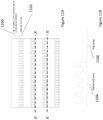
- FIG 11A illustrates a top view of the EPD layer 900 of Figure 9 .
- the EPD layer 900 may be manufactured by pattern micro-cell structures onto only portions of the layer 900, while leaving the other portion substantially flat.
- the substantially flat portions 1102 without the micro-cells i.e., a separate portion 1102 is designated to have microcell structures
- This method of manufacturing offers several advantages. Firstly, it is easier to fabricate the EPD layer in this fashion, where the contacting portion (i.e., the substantially flat portion) and the micro-cell portion 1102 are fabricated at the same time, compared to an alternative method where the fabrication of the two portions are done separately.
- FIG 11B illustrates a cross sectional view of the EPD layer as shown in Figure 11A .
- the EPD layer may include a first portion 1104 with micro-cells patterned and a flat portion 1106 with no micro-cells.
- the substantially flat portion 1106 and the micro-cell portion 1104 may be patterned at the same photolithography step.
- strips of release liners may be laminated on to the substantially flat portion, where the thickness of the release liner may be the same of the micro-cell height. It is preferred that the surface energy of the release liner to be sufficiently high such that the sealing layer will not de-wet on the top of the release liner, and in some embodiments, the surface energy may be tuned to a particular level depending on the application.
- the release liner in this case may include poly vinyl alcohol or other water soluble polymers.
- the release liner may be removed together with the ink and sealing layer on top of it to expose the flat area underneath.
- removing the release liners will remove the sealing layer/material and ink from the substantially flat portion of the EPD layer. This process can ensure a substantially clean break of the ink and sealing material from the micro-cell portion 1104.
- a piece of non-metalized piezo film may be laminated onto the flat.
- the total thickness of piezo film and adhesive layer may be similar to the total thickness of the sealing layer and the micro-cells.
- a piece of adhesive layer may be laminated onto the release liner and onto the full display panel.
- a in line humidifcation or off line chamber humidification step may be used to ensure good optical performance of the display.
- the structure may be cut along the A'A' line to create displays.
- a method for producing a display as describe above may include producing a layer of electrophoretic display material having a first portion 1102 and a second portion 1100, the first portion 1102 having a plurality of micro-cells and the second portion 1100 being substantially flat.
- the method may further include providing a piezoelectric material, and aligning the piezoelectric material to the second portion of the electrophoretic display material such that the piezoelectric material substantially overlaps with the second portion.
- the first 1102 and second 1100 portions of the electrophoretic material are produced using a single photolithography step.
- the method may further include placing the electrophoretic display material and the piezoelectric material onto a substrate, where the substrate may be flexible.
- the method may further include providing a conductive electrode onto the substrate, and providing a barrier layer between the conductive electrode and the substrate.
- the method may further include providing a layer of release liner, where the release liner has a height that is substantially similar to that of the plurality of micro-cells.
- another second electrode may be printed on top of the substrate as shown in Figure 6 .
- conducive ink may be used to pattern conductive traces or lines.
- the pattern may contain two portions. A first portion may be printed as small strips and a second portion may be a two pixel pattern. Where each pixel may be connected to one or two small stripes suing conductive ink. These patterns may then be subsequently aligned and laminated onto the above mentioned FPL with the piezoelectric film on top of the small stripes.
- FIGs 12A and 12B illustrate another embodiment of an electrophoretic display 1200 utilizing piezoelectric material.
- a piezoelectric material layer 1202 may be stacked with a display medium layer 1204 (e.g., an electrophoretic medium layer) to form a display.
- Two electrodes, electrode 1 1206 and electrode 2 1208 may be positioned on the two sides as shown in Figures 12A and 12B to sandwich the EPD layer 1204 and the piezoelectric material layer 1202 to complete a conductive path for the charges.
- the electrode 2 1208 may be a metal on piezoelectric film or a laminated conductive adhesive on piezo film. In this configuration, no other connections is needed to drive the electrophoretic display material 1204.
- FIG. 12B illustrates a view of the charge distribution.
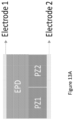
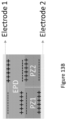
- piezo films with opposite poling directions may be positioned in a side by side configuration, as illustrated in Figures 13A and 13B .
- PZ1 and PZ2 can produce opposite voltages under an applied force
- Figure 13B shows one embodiment of charge distribution when force is applied. It should be appreciated that all the layers presented herein in Figures 12A-13B , including the electrode 1 and electrode 2 layers may be transparent, such that this display may be viewed from either direction or orientation.
- inventions shown in Figures 12A-13B not only reduces the overall device thickness to be less than 50 micro-meters, but also vastly improve the CR. It furthermore simplifies the device structure and makes the display device more sensitive to small strain changes.
- displays with structures that's similar to or based on the configurations illustrated in Figures 12A or Figure 1 may be modified to display latent images. Illustrated in Figure 14A is a display device 1400 similar to the one presented in Figure 12A , but with images or shapes laminated or printed onto either the electrode 1 1406 or electrode 2 1408. It should be appreciated that the configuration presented in Figure 14A is for illustrating the concept as other configurations can be easily adopted to achieve the same effect. In practice, every layer of the display 1400 may be transparent (e.g., layers 1402, 1404, 1406, 1408 etc), even the adhesive layers and the electrodes 1 and 2 layers, such that this display can be viewed from either direction or orientation.
- images or shapes may be printed or laminated onto a white background and onto either the electrode 1 1406 or electrode 2 1408, and viewed from an opposite side.
- the EPD layer 1404 is showing white color
- the printed image or shape will be hidden (i.e., see Figure 14B )
- the EPD 1404 switches to another color when force is applied, the printed image or shape may be displayed (i.e., see Figure 14C ).
- dark colored images or shapes may be produced onto either electrode 1 1406 or electrode 2 1408 without a background and be viewed from an opposite side.
- the display 1400 when the display 1400 is position over a black background, as illustrated in Figure 14D , the printed image or shape will remain hidden no matter how the EPD 1404 is bend.
- the display 1400 when the display 1400 is positioned over a white or light colored background, the printed image or shape will show up and it is more obvious when the EPD 1404 switches to a darker color, as illustrated in Figure 14E .
- images or shapes may be produced outside electrode 1s 1502, 1504 or either EPD display 1 1506 and EPD display 2 1508.
- the two EPD displays 1506, 1508 may be integrated together using a transparent adhesive material.
- force is applied (e.g., bending)
- both EPD display 1 1506 and EPD display 2 1508 can change color.
- EPD display 2 1508 turns dark and EPD display 1 1506 turns white
- the printed image or shape will not show up, as illustrated in Figure 15C .
- EPD display 2 1508 turns white and EPD display 1 1506 turns dark
- the printed image or shape will surface, as illustrated in Figure 15B .
Landscapes
- Physics & Mathematics (AREA)
- Nonlinear Science (AREA)
- General Physics & Mathematics (AREA)
- Optics & Photonics (AREA)
- Chemical & Material Sciences (AREA)
- Life Sciences & Earth Sciences (AREA)
- Health & Medical Sciences (AREA)
- Chemical Kinetics & Catalysis (AREA)
- Electrochemistry (AREA)
- Molecular Biology (AREA)
- Electrochromic Elements, Electrophoresis, Or Variable Reflection Or Absorption Elements (AREA)
- Devices For Indicating Variable Information By Combining Individual Elements (AREA)
- Mathematical Physics (AREA)
- Crystallography & Structural Chemistry (AREA)
- Control Of Indicators Other Than Cathode Ray Tubes (AREA)
Applications Claiming Priority (4)
| Application Number | Priority Date | Filing Date | Title |
|---|---|---|---|
| US201862673092P | 2018-05-17 | 2018-05-17 | |
| US201862727033P | 2018-09-05 | 2018-09-05 | |
| PCT/US2019/032805 WO2019222587A1 (fr) | 2018-05-17 | 2019-05-17 | Affichage électrophorétique piézoélectrique |
| EP19803813.5A EP3794410B1 (fr) | 2018-05-17 | 2019-05-17 | Procédé de fabrication d´un affichage électrophorétique piézoélectrique |
Related Parent Applications (1)
| Application Number | Title | Priority Date | Filing Date |
|---|---|---|---|
| EP19803813.5A Division EP3794410B1 (fr) | 2018-05-17 | 2019-05-17 | Procédé de fabrication d´un affichage électrophorétique piézoélectrique |
Publications (2)
| Publication Number | Publication Date |
|---|---|
| EP4343420A2 true EP4343420A2 (fr) | 2024-03-27 |
| EP4343420A3 EP4343420A3 (fr) | 2024-05-01 |
Family
ID=68532509
Family Applications (2)
| Application Number | Title | Priority Date | Filing Date |
|---|---|---|---|
| EP24150412.5A Pending EP4343420A3 (fr) | 2018-05-17 | 2019-05-17 | Procédé de fabrication d'un affichage piézo-électrophorétique |
| EP19803813.5A Active EP3794410B1 (fr) | 2018-05-17 | 2019-05-17 | Procédé de fabrication d´un affichage électrophorétique piézoélectrique |
Family Applications After (1)
| Application Number | Title | Priority Date | Filing Date |
|---|---|---|---|
| EP19803813.5A Active EP3794410B1 (fr) | 2018-05-17 | 2019-05-17 | Procédé de fabrication d´un affichage électrophorétique piézoélectrique |
Country Status (11)
| Country | Link |
|---|---|
| US (4) | US11181799B2 (fr) |
| EP (2) | EP4343420A3 (fr) |
| JP (4) | JP7104849B2 (fr) |
| KR (5) | KR102387849B1 (fr) |
| CN (2) | CN120233596A (fr) |
| AU (5) | AU2019269644B2 (fr) |
| CA (1) | CA3091692C (fr) |
| MX (2) | MX2020012298A (fr) |
| PL (1) | PL3794410T3 (fr) |
| TW (4) | TWI707178B (fr) |
| WO (1) | WO2019222587A1 (fr) |
Families Citing this family (7)
| Publication number | Priority date | Publication date | Assignee | Title |
|---|---|---|---|---|
| TWI707178B (zh) | 2018-05-17 | 2020-10-11 | 美商伊英克加利福尼亞有限責任公司 | 電光顯示器及製造顯示器的方法 |
| CN110376820A (zh) * | 2019-07-22 | 2019-10-25 | 京东方科技集团股份有限公司 | 一种电子纸、其驱动方法及显示装置 |
| EP4433868A4 (fr) * | 2021-11-19 | 2025-11-12 | E Ink Corp | Dispositif d'affichage ayant un filigrane formé par des images en demi-teinte |
| EP4487666A1 (fr) * | 2022-02-28 | 2025-01-08 | E Ink Corporation | Film piézoélectrique comprenant un liquide ionique et film d'affichage électrophorétique comprenant le film piézoélectrique |
| US20230273495A1 (en) * | 2022-02-28 | 2023-08-31 | E Ink California, Llc | Piezo-electrophoretic film including patterned piezo polarities for creating images via electrophoretic media |
| KR20250172740A (ko) * | 2023-08-29 | 2025-12-09 | 이 잉크 코포레이션 | 압전 전기 영동 필름 및 디스플레이와 이의 제조 방법 |
| AU2024414924A1 (en) * | 2023-12-31 | 2026-04-23 | E Ink Corporation | Piezo-electrophoretic films and displays, and methods for manufacturing the same |
Citations (50)
| Publication number | Priority date | Publication date | Assignee | Title |
|---|---|---|---|---|
| US3383993A (en) | 1964-07-23 | 1968-05-21 | Xerox Corp | Photoelectrophoretic imaging apparatus |
| US4418346A (en) | 1981-05-20 | 1983-11-29 | Batchelder J Samuel | Method and apparatus for providing a dielectrophoretic display of visual information |
| US5760761A (en) | 1995-12-15 | 1998-06-02 | Xerox Corporation | Highlight color twisting ball display |
| US5777782A (en) | 1996-12-24 | 1998-07-07 | Xerox Corporation | Auxiliary optics for a twisting ball display |
| US5808783A (en) | 1996-06-27 | 1998-09-15 | Xerox Corporation | High reflectance gyricon display |
| US5872552A (en) | 1994-12-28 | 1999-02-16 | International Business Machines Corporation | Electrophoretic display |
| US6054071A (en) | 1998-01-28 | 2000-04-25 | Xerox Corporation | Poled electrets for gyricon-based electric-paper displays |
| US6055091A (en) | 1996-06-27 | 2000-04-25 | Xerox Corporation | Twisting-cylinder display |
| US6097531A (en) | 1998-11-25 | 2000-08-01 | Xerox Corporation | Method of making uniformly magnetized elements for a gyricon display |
| US6128124A (en) | 1998-10-16 | 2000-10-03 | Xerox Corporation | Additive color electric paper without registration or alignment of individual elements |
| US6130774A (en) | 1998-04-27 | 2000-10-10 | E Ink Corporation | Shutter mode microencapsulated electrophoretic display |
| US6137467A (en) | 1995-01-03 | 2000-10-24 | Xerox Corporation | Optically sensitive electric paper |
| US6144361A (en) | 1998-09-16 | 2000-11-07 | International Business Machines Corporation | Transmissive electrophoretic display with vertical electrodes |
| US6147791A (en) | 1998-11-25 | 2000-11-14 | Xerox Corporation | Gyricon displays utilizing rotating elements and magnetic latching |
| US6184856B1 (en) | 1998-09-16 | 2001-02-06 | International Business Machines Corporation | Transmissive electrophoretic display with laterally adjacent color cells |
| US6225971B1 (en) | 1998-09-16 | 2001-05-01 | International Business Machines Corporation | Reflective electrophoretic display with laterally adjacent color cells using an absorbing panel |
| US6241921B1 (en) | 1998-05-15 | 2001-06-05 | Massachusetts Institute Of Technology | Heterogeneous display elements and methods for their fabrication |
| US6271823B1 (en) | 1998-09-16 | 2001-08-07 | International Business Machines Corporation | Reflective electrophoretic display with laterally adjacent color cells using a reflective panel |
| US6301038B1 (en) | 1997-02-06 | 2001-10-09 | University College Dublin | Electrochromic system |
| US6672921B1 (en) | 2000-03-03 | 2004-01-06 | Sipix Imaging, Inc. | Manufacturing process for electrophoretic display |
| US6704133B2 (en) | 1998-03-18 | 2004-03-09 | E-Ink Corporation | Electro-optic display overlays and systems for addressing such displays |
| US6788449B2 (en) | 2000-03-03 | 2004-09-07 | Sipix Imaging, Inc. | Electrophoretic display and novel process for its manufacture |
| US6866760B2 (en) | 1998-08-27 | 2005-03-15 | E Ink Corporation | Electrophoretic medium and process for the production thereof |
| US6870657B1 (en) | 1999-10-11 | 2005-03-22 | University College Dublin | Electrochromic device |
| US6922276B2 (en) | 2002-12-23 | 2005-07-26 | E Ink Corporation | Flexible electro-optic displays |
| US6950220B2 (en) | 2002-03-18 | 2005-09-27 | E Ink Corporation | Electro-optic displays, and methods for driving same |
| US6982178B2 (en) | 2002-06-10 | 2006-01-03 | E Ink Corporation | Components and methods for use in electro-optic displays |
| US7002728B2 (en) | 1997-08-28 | 2006-02-21 | E Ink Corporation | Electrophoretic particles, and processes for the production thereof |
| US7012600B2 (en) | 1999-04-30 | 2006-03-14 | E Ink Corporation | Methods for driving bistable electro-optic displays, and apparatus for use therein |
| US7072095B2 (en) | 2002-10-31 | 2006-07-04 | Sipix Imaging, Inc. | Electrophoretic display and novel process for its manufacture |
| US7075502B1 (en) | 1998-04-10 | 2006-07-11 | E Ink Corporation | Full color reflective display with multichromatic sub-pixels |
| US7116318B2 (en) | 2002-04-24 | 2006-10-03 | E Ink Corporation | Backplanes for display applications, and components for use therein |
| US7144942B2 (en) | 2001-06-04 | 2006-12-05 | Sipix Imaging, Inc. | Composition and process for the sealing of microcups in roll-to-roll display manufacturing |
| US7170670B2 (en) | 2001-04-02 | 2007-01-30 | E Ink Corporation | Electrophoretic medium and display with improved image stability |
| US7236291B2 (en) | 2003-04-02 | 2007-06-26 | Bridgestone Corporation | Particle use for image display media, image display panel using the particles, and image display device |
| US7312784B2 (en) | 2001-03-13 | 2007-12-25 | E Ink Corporation | Apparatus for displaying drawings |
| US7321459B2 (en) | 2002-03-06 | 2008-01-22 | Bridgestone Corporation | Image display device and method |
| US7339715B2 (en) | 2003-03-25 | 2008-03-04 | E Ink Corporation | Processes for the production of electrophoretic displays |
| US7411719B2 (en) | 1995-07-20 | 2008-08-12 | E Ink Corporation | Electrophoretic medium and process for the production thereof |
| US7420549B2 (en) | 2003-10-08 | 2008-09-02 | E Ink Corporation | Electro-wetting displays |
| US7453445B2 (en) | 2004-08-13 | 2008-11-18 | E Ink Corproation | Methods for driving electro-optic displays |
| US7535624B2 (en) | 2001-07-09 | 2009-05-19 | E Ink Corporation | Electro-optic display and materials for use therein |
| US7561324B2 (en) | 2002-09-03 | 2009-07-14 | E Ink Corporation | Electro-optic displays |
| US7679814B2 (en) | 2001-04-02 | 2010-03-16 | E Ink Corporation | Materials for use in electrophoretic displays |
| US7715088B2 (en) | 2000-03-03 | 2010-05-11 | Sipix Imaging, Inc. | Electrophoretic display |
| US7839564B2 (en) | 2002-09-03 | 2010-11-23 | E Ink Corporation | Components and methods for use in electro-optic displays |
| US8009348B2 (en) | 1999-05-03 | 2011-08-30 | E Ink Corporation | Machine-readable displays |
| US20120293858A1 (en) | 2011-05-21 | 2012-11-22 | E Ink Corporation | Electro-optic displays |
| US8319759B2 (en) | 2003-10-08 | 2012-11-27 | E Ink Corporation | Electrowetting displays |
| US9279906B2 (en) | 2012-08-31 | 2016-03-08 | E Ink California, Llc | Microstructure film |
Family Cites Families (83)
| Publication number | Priority date | Publication date | Assignee | Title |
|---|---|---|---|---|
| US3035200A (en) * | 1959-11-25 | 1962-05-15 | Sylvania Electric Prod | Electroluminescent display device |
| US3072821A (en) * | 1960-11-30 | 1963-01-08 | Gen Telephone & Elect | Display device |
| US5189771A (en) | 1986-04-28 | 1993-03-02 | Lawrence Fishman | Method of making a musical instrument transducer |
| US5319153A (en) | 1986-04-28 | 1994-06-07 | Lawrence Fishman | Musical instrument transducer assembly having a piezoelectric sheet |
| US5155285A (en) | 1986-04-28 | 1992-10-13 | Fishman Lawrence R | Musical instrument piezoelectric transducer |
| US4774867A (en) | 1986-04-28 | 1988-10-04 | Fishman Lawrence R | Musical instrument transducer |
| US4785704A (en) | 1986-06-19 | 1988-11-22 | Fishman Lawrence R | Musical instrument transducer |
| US4984498A (en) | 1987-10-26 | 1991-01-15 | Lawrence Fishman | Percussion transducer |
| US4911057A (en) | 1988-01-14 | 1990-03-27 | Fishman Lawrence R | Piezoelectric transducer device for a stringed musical instrument |
| US5125312A (en) | 1989-05-15 | 1992-06-30 | Korg/Fishpark Associates | Stringed musical instrument |
| US5930026A (en) | 1996-10-25 | 1999-07-27 | Massachusetts Institute Of Technology | Nonemissive displays and piezoelectric power supplies therefor |
| WO1998057228A1 (fr) * | 1997-06-10 | 1998-12-17 | Monsanto Company | Images commutables a details fins |
| JP4651193B2 (ja) | 1998-05-12 | 2011-03-16 | イー インク コーポレイション | ドローイングデバイス用途のためのマイクロカプセル化した電気泳動性の静電的にアドレスした媒体 |
| JP3837948B2 (ja) * | 1999-01-29 | 2006-10-25 | セイコーエプソン株式会社 | 電気泳動インク表示装置 |
| EP1724750B1 (fr) | 1999-01-29 | 2008-08-27 | Seiko Epson Corporation | Transducteur piézoélectrique et dispositif d'affichage avec de l'encre électrophorétique utilisant le transducteur piézoélectrique |
| US6677514B2 (en) | 1999-07-02 | 2004-01-13 | Fishman Transducers, Inc. | Coaxial musical instrument transducer |
| US6930818B1 (en) | 2000-03-03 | 2005-08-16 | Sipix Imaging, Inc. | Electrophoretic display and novel process for its manufacture |
| US7158282B2 (en) | 2000-03-03 | 2007-01-02 | Sipix Imaging, Inc. | Electrophoretic display and novel process for its manufacture |
| US7052571B2 (en) | 2000-03-03 | 2006-05-30 | Sipix Imaging, Inc. | Electrophoretic display and process for its manufacture |
| JP2002268099A (ja) | 2001-03-06 | 2002-09-18 | Sharp Corp | 光変調素子 |
| US8361356B2 (en) | 2001-06-04 | 2013-01-29 | Sipix Imaging, Inc. | Composition and process for the sealing of microcups in roll-to-roll display manufacturing |
| JP4515035B2 (ja) * | 2002-03-14 | 2010-07-28 | 株式会社半導体エネルギー研究所 | 表示装置及びその作製方法 |
| US7649674B2 (en) * | 2002-06-10 | 2010-01-19 | E Ink Corporation | Electro-optic display with edge seal |
| AU2003244117A1 (en) | 2002-06-21 | 2004-01-06 | Bridgestone Corporation | Image display and method for manufacturing image display |
| TW575646B (en) | 2002-09-04 | 2004-02-11 | Sipix Imaging Inc | Novel adhesive and sealing layers for electrophoretic displays |
| US7616374B2 (en) | 2002-09-23 | 2009-11-10 | Sipix Imaging, Inc. | Electrophoretic displays with improved high temperature performance |
| JP2004165267A (ja) * | 2002-11-11 | 2004-06-10 | Sharp Corp | 半導体発光素子および発光表示装置、ならびにそれらの製造方法 |
| US7572491B2 (en) | 2003-01-24 | 2009-08-11 | Sipix Imaging, Inc. | Adhesive and sealing layers for electrophoretic displays |
| US20040263483A1 (en) | 2003-06-24 | 2004-12-30 | Aufderheide Brian E | Sensing device |
| US20050011342A1 (en) | 2003-07-18 | 2005-01-20 | Fishman Lawrence R. | Musical instrument transducer |
| US8177942B2 (en) * | 2003-11-05 | 2012-05-15 | E Ink Corporation | Electro-optic displays, and materials for use therein |
| US7408699B2 (en) | 2005-09-28 | 2008-08-05 | Sipix Imaging, Inc. | Electrophoretic display and methods of addressing such display |
| US20080043318A1 (en) * | 2005-10-18 | 2008-02-21 | E Ink Corporation | Color electro-optic displays, and processes for the production thereof |
| KR101222965B1 (ko) * | 2006-02-16 | 2013-01-17 | 엘지디스플레이 주식회사 | 전기영동 표시장치 및 그 구동방법 |
| JP2008009110A (ja) * | 2006-06-29 | 2008-01-17 | Mitsubishi Pencil Co Ltd | 商品情報表示札、その表示方法及びそれを用いた商品情報表示札システム |
| US8830561B2 (en) | 2006-07-18 | 2014-09-09 | E Ink California, Llc | Electrophoretic display |
| JP4345820B2 (ja) * | 2007-01-22 | 2009-10-14 | セイコーエプソン株式会社 | 表示装置及び表示装置の製造方法並びに電子ペーパー |
| WO2008091850A2 (fr) * | 2007-01-22 | 2008-07-31 | E Ink Corporation | Feuille à plusieurs couches destinée à être utilisée dans des afficheurs électro-optiques |
| KR101319258B1 (ko) * | 2007-04-19 | 2013-10-18 | 에스케이플래닛 주식회사 | 쓰기 가능한 전자종이 표시소자 및 그의 제조 방법 |
| DE102007048102A1 (de) | 2007-10-06 | 2009-04-09 | Leonhard Kurz Gmbh & Co. Kg | Sicherheitselement zur Kennzeichnung eines Sicherheitsdokuments und Verfahren zu seiner Herstellung |
| KR101396940B1 (ko) * | 2007-12-05 | 2014-05-20 | 엘지디스플레이 주식회사 | 전기영동표시소자에 적용한 유기박막트랜지스터 및 그제조방법 |
| JP4623107B2 (ja) | 2008-02-21 | 2011-02-02 | セイコーエプソン株式会社 | 電気泳動表示装置及び電気泳動表示装置の製造方法 |
| JP2009231615A (ja) * | 2008-03-24 | 2009-10-08 | Seiko Epson Corp | 圧電素子の製造方法、圧電素子、電子機器 |
| JP2010085528A (ja) * | 2008-09-30 | 2010-04-15 | Nippon Hoso Kyokai <Nhk> | 表示素子及び該表示素子を備えた情報表示装置 |
| MX2012001784A (es) | 2009-08-12 | 2012-07-10 | Visual Physics Llc | Dispositivo de seguridad optico indicativo de manipulacion. |
| TWI544458B (zh) | 2010-04-02 | 2016-08-01 | 元太科技工業股份有限公司 | 顯示面板 |
| JP5577816B2 (ja) | 2010-04-22 | 2014-08-27 | セイコーエプソン株式会社 | 表示装置および電子機器 |
| TWI432835B (zh) | 2010-06-24 | 2014-04-01 | Au Optronics Corp | 可撓性顯示面板及其製造方法 |
| US20120127136A1 (en) | 2010-08-18 | 2012-05-24 | Kent Displays Incorporated | Display device including piezoelectric and liquid crystal layers |
| EP2431404A1 (fr) | 2010-08-27 | 2012-03-21 | Fraunhofer-Gesellschaft zur Förderung der angewandten Forschung e.V. | Solution ou suspension contenant du polymère fluoré, son procédé de fabrication et son utilisation dans la fabrication de couches piézo- et pyro-électriques |
| JP4882020B1 (ja) | 2010-10-27 | 2012-02-22 | 株式会社サクラクレパス | 電気泳動表示装置 |
| KR101766878B1 (ko) | 2011-02-28 | 2017-08-10 | 삼성디스플레이 주식회사 | 전기 영동 표시 장치 및 그 제조 방법 |
| JP2012181445A (ja) * | 2011-03-02 | 2012-09-20 | Seiko Epson Corp | 電気装置 |
| DE102011107421A1 (de) * | 2011-07-07 | 2013-01-10 | Leonhard Kurz Stiftung & Co. Kg | Mehrschichtiger Folienkörper |
| WO2013054432A1 (fr) | 2011-10-14 | 2013-04-18 | 株式会社ユーテック | Procédé de traitement de polarisation, dispositif de polarisation de champ magnétique et film piézoélectrique |
| DE102011117129A1 (de) | 2011-10-28 | 2013-05-02 | Leonhard Kurz Stiftung & Co. Kg | Anzeigeeinrichtung |
| TWI467306B (zh) * | 2012-01-19 | 2015-01-01 | E Ink Holdings Inc | 使用顯示器之球場邊線模組 |
| US8917439B2 (en) | 2012-02-09 | 2014-12-23 | E Ink California, Llc | Shutter mode for color display devices |
| US9025238B2 (en) * | 2012-06-20 | 2015-05-05 | E Ink California, Llc | Piezo electrophoretic display |
| TWI467237B (zh) | 2012-08-03 | 2015-01-01 | Au Optronics Corp | 立體影像顯示器及立體影像顯示裝置 |
| ES2784611T3 (es) | 2012-09-04 | 2020-09-29 | Joanneum Res Forschungsgmbh | Lámina piezoeléctrica impresa de detección de presión |
| KR101789896B1 (ko) * | 2013-02-01 | 2017-10-25 | 미쯔이가가꾸가부시끼가이샤 | 표시 장치 및 적층 광학 필름 |
| US9323393B2 (en) * | 2013-06-03 | 2016-04-26 | Qualcomm Incorporated | Display with peripherally configured ultrasonic biometric sensor |
| JP2015114448A (ja) * | 2013-12-11 | 2015-06-22 | セイコーエプソン株式会社 | 電気泳動表示装置、電気泳動表示装置の製造方法、電子機器 |
| US9361836B1 (en) | 2013-12-20 | 2016-06-07 | E Ink Corporation | Aggregate particles for use in electrophoretic color displays |
| JP2015184365A (ja) * | 2014-03-20 | 2015-10-22 | 富士ゼロックス株式会社 | 表示媒体、及び表示装置 |
| TW201621585A (zh) | 2014-10-14 | 2016-06-16 | 康寧公司 | 壓電膜結構與感測器以及使用該壓電膜結構與感測器的顯 示組件 |
| WO2016060959A1 (fr) | 2014-10-17 | 2016-04-21 | E Ink California, Llc | Composition et procédé d'étanchéification de microcellules |
| KR20160090588A (ko) * | 2015-01-22 | 2016-08-01 | 삼성전기주식회사 | 전자 종이 표시 장치 |
| TWI553614B (zh) * | 2015-07-06 | 2016-10-11 | 晶宏半導體股份有限公司 | 應用於電泳顯示器之共電極驅動方法及電路 |
| WO2017059011A1 (fr) * | 2015-09-30 | 2017-04-06 | E Ink Corporation | Couches adhésives de polyuréthane pour ensembles électro-optiques |
| US10087344B2 (en) | 2015-10-30 | 2018-10-02 | E Ink Corporation | Methods for sealing microcell containers with phenethylamine mixtures |
| JP2017146511A (ja) * | 2016-02-19 | 2017-08-24 | ソニー株式会社 | 表示装置および表示装置の製造方法ならびに電子機器 |
| KR20170112545A (ko) * | 2016-03-31 | 2017-10-12 | 주식회사 나노브릭 | 전기영동 디스플레이 장치 |
| US10203793B2 (en) * | 2016-04-01 | 2019-02-12 | Microsoft Technology Licensing, Llc | Updating a display by applying pressure |
| US11016288B2 (en) * | 2016-04-01 | 2021-05-25 | Intel Corporation | Adaptable displays using piezoelectric actuators |
| JPWO2018164047A1 (ja) * | 2017-03-06 | 2019-12-26 | コニカミノルタ株式会社 | 圧電部材、超音波発振素子、超音波プローブ、超音波診断装置、及び圧電部材の製造方法 |
| EP3631575A4 (fr) * | 2017-05-30 | 2021-01-13 | E Ink Corporation | Afficheurs électro-optiques |
| US10910551B2 (en) * | 2017-11-06 | 2021-02-02 | Samsung Electronics Co., Ltd. | Piezoelectric material, piezoelectric device including the piezoelectric material, and method of manufacturing the piezoelectric material |
| US20190198748A1 (en) * | 2017-12-26 | 2019-06-27 | Santosh Kumar BEHERA | Self-sensing bending actuator |
| TWI707178B (zh) | 2018-05-17 | 2020-10-11 | 美商伊英克加利福尼亞有限責任公司 | 電光顯示器及製造顯示器的方法 |
| WO2020036908A1 (fr) | 2018-08-14 | 2020-02-20 | E Ink California, Llc | Dispositif d'affichage électrophorétique piézoélectrique |
| KR102605479B1 (ko) | 2018-08-30 | 2023-11-22 | 엘지디스플레이 주식회사 | 압전 소자 및 이를 포함하는 표시 장치 |
-
2019
- 2019-05-17 TW TW108117162A patent/TWI707178B/zh active
- 2019-05-17 CA CA3091692A patent/CA3091692C/fr active Active
- 2019-05-17 JP JP2021504143A patent/JP7104849B2/ja active Active
- 2019-05-17 AU AU2019269644A patent/AU2019269644B2/en active Active
- 2019-05-17 CN CN202510064092.8A patent/CN120233596A/zh active Pending
- 2019-05-17 KR KR1020207025004A patent/KR102387849B1/ko active Active
- 2019-05-17 PL PL19803813.5T patent/PL3794410T3/pl unknown
- 2019-05-17 TW TW110140363A patent/TWI775662B/zh active
- 2019-05-17 KR KR1020227028310A patent/KR102589425B1/ko active Active
- 2019-05-17 TW TW109134064A patent/TWI746193B/zh active
- 2019-05-17 EP EP24150412.5A patent/EP4343420A3/fr active Pending
- 2019-05-17 WO PCT/US2019/032805 patent/WO2019222587A1/fr not_active Ceased
- 2019-05-17 KR KR1020217004923A patent/KR102433927B1/ko active Active
- 2019-05-17 MX MX2020012298A patent/MX2020012298A/es unknown
- 2019-05-17 KR KR1020247038657A patent/KR20240167951A/ko active Pending
- 2019-05-17 CN CN201980029193.4A patent/CN112041740B/zh active Active
- 2019-05-17 TW TW111131321A patent/TWI795334B/zh active
- 2019-05-17 KR KR1020237033699A patent/KR102733728B1/ko active Active
- 2019-05-17 EP EP19803813.5A patent/EP3794410B1/fr active Active
- 2019-05-17 US US16/415,022 patent/US11181799B2/en active Active
-
2020
- 2020-11-13 MX MX2024008692A patent/MX2024008692A/es unknown
-
2021
- 2021-10-20 AU AU2021254563A patent/AU2021254563B2/en active Active
- 2021-10-20 US US17/505,796 patent/US11892740B2/en active Active
-
2022
- 2022-02-28 JP JP2022029480A patent/JP7564142B2/ja active Active
- 2022-04-05 AU AU2022202254A patent/AU2022202254B2/en active Active
-
2023
- 2023-09-14 AU AU2023229534A patent/AU2023229534B2/en active Active
- 2023-12-22 US US18/394,980 patent/US12298645B2/en active Active
-
2024
- 2024-05-07 JP JP2024075106A patent/JP7833495B2/ja active Active
-
2025
- 2025-01-16 US US19/025,290 patent/US20250237921A1/en active Pending
- 2025-05-12 AU AU2025203383A patent/AU2025203383A1/en active Pending
- 2025-12-26 JP JP2025284210A patent/JP2026049028A/ja active Pending
Patent Citations (51)
| Publication number | Priority date | Publication date | Assignee | Title |
|---|---|---|---|---|
| US3383993A (en) | 1964-07-23 | 1968-05-21 | Xerox Corp | Photoelectrophoretic imaging apparatus |
| US4418346A (en) | 1981-05-20 | 1983-11-29 | Batchelder J Samuel | Method and apparatus for providing a dielectrophoretic display of visual information |
| US5872552A (en) | 1994-12-28 | 1999-02-16 | International Business Machines Corporation | Electrophoretic display |
| US6137467A (en) | 1995-01-03 | 2000-10-24 | Xerox Corporation | Optically sensitive electric paper |
| US7411719B2 (en) | 1995-07-20 | 2008-08-12 | E Ink Corporation | Electrophoretic medium and process for the production thereof |
| US5760761A (en) | 1995-12-15 | 1998-06-02 | Xerox Corporation | Highlight color twisting ball display |
| US5808783A (en) | 1996-06-27 | 1998-09-15 | Xerox Corporation | High reflectance gyricon display |
| US6055091A (en) | 1996-06-27 | 2000-04-25 | Xerox Corporation | Twisting-cylinder display |
| US5777782A (en) | 1996-12-24 | 1998-07-07 | Xerox Corporation | Auxiliary optics for a twisting ball display |
| US6301038B1 (en) | 1997-02-06 | 2001-10-09 | University College Dublin | Electrochromic system |
| US7002728B2 (en) | 1997-08-28 | 2006-02-21 | E Ink Corporation | Electrophoretic particles, and processes for the production thereof |
| US6054071A (en) | 1998-01-28 | 2000-04-25 | Xerox Corporation | Poled electrets for gyricon-based electric-paper displays |
| US6704133B2 (en) | 1998-03-18 | 2004-03-09 | E-Ink Corporation | Electro-optic display overlays and systems for addressing such displays |
| US7075502B1 (en) | 1998-04-10 | 2006-07-11 | E Ink Corporation | Full color reflective display with multichromatic sub-pixels |
| US6130774A (en) | 1998-04-27 | 2000-10-10 | E Ink Corporation | Shutter mode microencapsulated electrophoretic display |
| US6172798B1 (en) | 1998-04-27 | 2001-01-09 | E Ink Corporation | Shutter mode microencapsulated electrophoretic display |
| US6241921B1 (en) | 1998-05-15 | 2001-06-05 | Massachusetts Institute Of Technology | Heterogeneous display elements and methods for their fabrication |
| US6866760B2 (en) | 1998-08-27 | 2005-03-15 | E Ink Corporation | Electrophoretic medium and process for the production thereof |
| US6144361A (en) | 1998-09-16 | 2000-11-07 | International Business Machines Corporation | Transmissive electrophoretic display with vertical electrodes |
| US6271823B1 (en) | 1998-09-16 | 2001-08-07 | International Business Machines Corporation | Reflective electrophoretic display with laterally adjacent color cells using a reflective panel |
| US6225971B1 (en) | 1998-09-16 | 2001-05-01 | International Business Machines Corporation | Reflective electrophoretic display with laterally adjacent color cells using an absorbing panel |
| US6184856B1 (en) | 1998-09-16 | 2001-02-06 | International Business Machines Corporation | Transmissive electrophoretic display with laterally adjacent color cells |
| US6128124A (en) | 1998-10-16 | 2000-10-03 | Xerox Corporation | Additive color electric paper without registration or alignment of individual elements |
| US6147791A (en) | 1998-11-25 | 2000-11-14 | Xerox Corporation | Gyricon displays utilizing rotating elements and magnetic latching |
| US6097531A (en) | 1998-11-25 | 2000-08-01 | Xerox Corporation | Method of making uniformly magnetized elements for a gyricon display |
| US7012600B2 (en) | 1999-04-30 | 2006-03-14 | E Ink Corporation | Methods for driving bistable electro-optic displays, and apparatus for use therein |
| US8009348B2 (en) | 1999-05-03 | 2011-08-30 | E Ink Corporation | Machine-readable displays |
| US6870657B1 (en) | 1999-10-11 | 2005-03-22 | University College Dublin | Electrochromic device |
| US6672921B1 (en) | 2000-03-03 | 2004-01-06 | Sipix Imaging, Inc. | Manufacturing process for electrophoretic display |
| US7715088B2 (en) | 2000-03-03 | 2010-05-11 | Sipix Imaging, Inc. | Electrophoretic display |
| US6788449B2 (en) | 2000-03-03 | 2004-09-07 | Sipix Imaging, Inc. | Electrophoretic display and novel process for its manufacture |
| US7312784B2 (en) | 2001-03-13 | 2007-12-25 | E Ink Corporation | Apparatus for displaying drawings |
| US7170670B2 (en) | 2001-04-02 | 2007-01-30 | E Ink Corporation | Electrophoretic medium and display with improved image stability |
| US7679814B2 (en) | 2001-04-02 | 2010-03-16 | E Ink Corporation | Materials for use in electrophoretic displays |
| US7144942B2 (en) | 2001-06-04 | 2006-12-05 | Sipix Imaging, Inc. | Composition and process for the sealing of microcups in roll-to-roll display manufacturing |
| US7535624B2 (en) | 2001-07-09 | 2009-05-19 | E Ink Corporation | Electro-optic display and materials for use therein |
| US7321459B2 (en) | 2002-03-06 | 2008-01-22 | Bridgestone Corporation | Image display device and method |
| US6950220B2 (en) | 2002-03-18 | 2005-09-27 | E Ink Corporation | Electro-optic displays, and methods for driving same |
| US7116318B2 (en) | 2002-04-24 | 2006-10-03 | E Ink Corporation | Backplanes for display applications, and components for use therein |
| US6982178B2 (en) | 2002-06-10 | 2006-01-03 | E Ink Corporation | Components and methods for use in electro-optic displays |
| US7561324B2 (en) | 2002-09-03 | 2009-07-14 | E Ink Corporation | Electro-optic displays |
| US7839564B2 (en) | 2002-09-03 | 2010-11-23 | E Ink Corporation | Components and methods for use in electro-optic displays |
| US7072095B2 (en) | 2002-10-31 | 2006-07-04 | Sipix Imaging, Inc. | Electrophoretic display and novel process for its manufacture |
| US6922276B2 (en) | 2002-12-23 | 2005-07-26 | E Ink Corporation | Flexible electro-optic displays |
| US7339715B2 (en) | 2003-03-25 | 2008-03-04 | E Ink Corporation | Processes for the production of electrophoretic displays |
| US7236291B2 (en) | 2003-04-02 | 2007-06-26 | Bridgestone Corporation | Particle use for image display media, image display panel using the particles, and image display device |
| US7420549B2 (en) | 2003-10-08 | 2008-09-02 | E Ink Corporation | Electro-wetting displays |
| US8319759B2 (en) | 2003-10-08 | 2012-11-27 | E Ink Corporation | Electrowetting displays |
| US7453445B2 (en) | 2004-08-13 | 2008-11-18 | E Ink Corproation | Methods for driving electro-optic displays |
| US20120293858A1 (en) | 2011-05-21 | 2012-11-22 | E Ink Corporation | Electro-optic displays |
| US9279906B2 (en) | 2012-08-31 | 2016-03-08 | E Ink California, Llc | Microstructure film |
Non-Patent Citations (6)
| Title |
|---|
| BACH, U. ET AL., ADV. MATER., vol. 14, no. 11, 2002, pages 845 |
| HAYES, R.A. ET AL.: "Video-Speed Electronic Paper Based on Electrowetting", NATURE, vol. 425, 2003, pages 383 - 385, XP002286158, DOI: 10.1038/nature01988 |
| KITAMURA, T. ET AL.: "Paper HCSl-1", 2001, IDW JAPAN, article "Electrical toner movement for electronic paper-like display" |
| O'REGAN, B. ET AL., NATURE, vol. 353, 1991, pages 737 |
| WOOD, D., INFORMATION DISPLAY, vol. 18, no. 3, March 2002 (2002-03-01), pages 24 |
| YAMAGUCHI, Y. ET AL.: "Paper AMD4-4", 2001, IDW JAPAN, article "Toner display using insulative particles charged triboelectrically" |
Also Published As
Similar Documents
| Publication | Publication Date | Title |
|---|---|---|
| US12298645B2 (en) | Piezo electrophoretic display | |
| US20240329485A1 (en) | Piezo-electrophoretic films and displays, and methods for manufacturing the same | |
| HK40031788A (en) | Piezo electrophoretic display | |
| HK40031788B (zh) | 压电电泳显示器 |
Legal Events
| Date | Code | Title | Description |
|---|---|---|---|
| PUAI | Public reference made under article 153(3) epc to a published international application that has entered the european phase |
Free format text: ORIGINAL CODE: 0009012 |
|
| STAA | Information on the status of an ep patent application or granted ep patent |
Free format text: STATUS: THE APPLICATION HAS BEEN PUBLISHED |
|
| REG | Reference to a national code |
Ref country code: DE Ref legal event code: R079 Free format text: PREVIOUS MAIN CLASS: G02F0001167500 Ipc: G02F0001167000 |
|
| AC | Divisional application: reference to earlier application |
Ref document number: 3794410 Country of ref document: EP Kind code of ref document: P |
|
| AK | Designated contracting states |
Kind code of ref document: A2 Designated state(s): AL AT BE BG CH CY CZ DE DK EE ES FI FR GB GR HR HU IE IS IT LI LT LU LV MC MK MT NL NO PL PT RO RS SE SI SK SM TR |
|
| PUAL | Search report despatched |
Free format text: ORIGINAL CODE: 0009013 |
|
| RIN1 | Information on inventor provided before grant (corrected) |
Inventor name: BERHANE, ABRAHAM Inventor name: LIN, CRAIG Inventor name: ZANG, HONGMEI Inventor name: GU, HAIYAN |
|
| AK | Designated contracting states |
Kind code of ref document: A3 Designated state(s): AL AT BE BG CH CY CZ DE DK EE ES FI FR GB GR HR HU IE IS IT LI LT LU LV MC MK MT NL NO PL PT RO RS SE SI SK SM TR |
|
| RIC1 | Information provided on ipc code assigned before grant |
Ipc: G02F 1/1675 20190101ALI20240325BHEP Ipc: G02F 1/167 20190101AFI20240325BHEP |
|
| STAA | Information on the status of an ep patent application or granted ep patent |
Free format text: STATUS: REQUEST FOR EXAMINATION WAS MADE |
|
| 17P | Request for examination filed |
Effective date: 20241024 |
|
| RBV | Designated contracting states (corrected) |
Designated state(s): AL AT BE BG CH CY CZ DE DK EE ES FI FR GB GR HR HU IE IS IT LI LT LU LV MC MK MT NL NO PL PT RO RS SE SI SK SM TR |
|
| GRAP | Despatch of communication of intention to grant a patent |
Free format text: ORIGINAL CODE: EPIDOSNIGR1 |
|
| STAA | Information on the status of an ep patent application or granted ep patent |
Free format text: STATUS: GRANT OF PATENT IS INTENDED |
|
| INTG | Intention to grant announced |
Effective date: 20260213 |
|
| RAP3 | Party data changed (applicant data changed or rights of an application transferred) |
Owner name: E INK CORPORATION |