EP4343731B1 - Procédé et système de prédiction de retard pour un transport public programmé à l'aide d'un apprentissage profond multi-architecture - Google Patents
Procédé et système de prédiction de retard pour un transport public programmé à l'aide d'un apprentissage profond multi-architecture Download PDFInfo
- Publication number
- EP4343731B1 EP4343731B1 EP23192182.6A EP23192182A EP4343731B1 EP 4343731 B1 EP4343731 B1 EP 4343731B1 EP 23192182 A EP23192182 A EP 23192182A EP 4343731 B1 EP4343731 B1 EP 4343731B1
- Authority
- EP
- European Patent Office
- Prior art keywords
- stops
- window
- vehicles
- temporal
- architecture
- Prior art date
- Legal status (The legal status is an assumption and is not a legal conclusion. Google has not performed a legal analysis and makes no representation as to the accuracy of the status listed.)
- Active
Links
Images



Classifications
-
- G—PHYSICS
- G06—COMPUTING OR CALCULATING; COUNTING
- G06N—COMPUTING ARRANGEMENTS BASED ON SPECIFIC COMPUTATIONAL MODELS
- G06N3/00—Computing arrangements based on biological models
- G06N3/02—Neural networks
- G06N3/04—Architecture, e.g. interconnection topology
- G06N3/044—Recurrent networks, e.g. Hopfield networks
- G06N3/0442—Recurrent networks, e.g. Hopfield networks characterised by memory or gating, e.g. long short-term memory [LSTM] or gated recurrent units [GRU]
-
- G—PHYSICS
- G06—COMPUTING OR CALCULATING; COUNTING
- G06Q—INFORMATION AND COMMUNICATION TECHNOLOGY [ICT] SPECIALLY ADAPTED FOR ADMINISTRATIVE, COMMERCIAL, FINANCIAL, MANAGERIAL OR SUPERVISORY PURPOSES; SYSTEMS OR METHODS SPECIALLY ADAPTED FOR ADMINISTRATIVE, COMMERCIAL, FINANCIAL, MANAGERIAL OR SUPERVISORY PURPOSES, NOT OTHERWISE PROVIDED FOR
- G06Q10/00—Administration; Management
- G06Q10/04—Forecasting or optimisation specially adapted for administrative or management purposes, e.g. linear programming or "cutting stock problem"
- G06Q10/047—Optimisation of routes or paths, e.g. travelling salesman problem
-
- G—PHYSICS
- G06—COMPUTING OR CALCULATING; COUNTING
- G06N—COMPUTING ARRANGEMENTS BASED ON SPECIFIC COMPUTATIONAL MODELS
- G06N3/00—Computing arrangements based on biological models
- G06N3/02—Neural networks
- G06N3/04—Architecture, e.g. interconnection topology
- G06N3/0464—Convolutional networks [CNN, ConvNet]
-
- G—PHYSICS
- G06—COMPUTING OR CALCULATING; COUNTING
- G06N—COMPUTING ARRANGEMENTS BASED ON SPECIFIC COMPUTATIONAL MODELS
- G06N3/00—Computing arrangements based on biological models
- G06N3/02—Neural networks
- G06N3/08—Learning methods
-
- G—PHYSICS
- G06—COMPUTING OR CALCULATING; COUNTING
- G06N—COMPUTING ARRANGEMENTS BASED ON SPECIFIC COMPUTATIONAL MODELS
- G06N3/00—Computing arrangements based on biological models
- G06N3/02—Neural networks
- G06N3/08—Learning methods
- G06N3/091—Active learning
-
- G—PHYSICS
- G06—COMPUTING OR CALCULATING; COUNTING
- G06N—COMPUTING ARRANGEMENTS BASED ON SPECIFIC COMPUTATIONAL MODELS
- G06N3/00—Computing arrangements based on biological models
- G06N3/02—Neural networks
- G06N3/04—Architecture, e.g. interconnection topology
- G06N3/045—Combinations of networks
-
- G—PHYSICS
- G06—COMPUTING OR CALCULATING; COUNTING
- G06Q—INFORMATION AND COMMUNICATION TECHNOLOGY [ICT] SPECIALLY ADAPTED FOR ADMINISTRATIVE, COMMERCIAL, FINANCIAL, MANAGERIAL OR SUPERVISORY PURPOSES; SYSTEMS OR METHODS SPECIALLY ADAPTED FOR ADMINISTRATIVE, COMMERCIAL, FINANCIAL, MANAGERIAL OR SUPERVISORY PURPOSES, NOT OTHERWISE PROVIDED FOR
- G06Q50/00—Information and communication technology [ICT] specially adapted for implementation of business processes of specific business sectors, e.g. utilities or tourism
- G06Q50/40—Business processes related to the transportation industry
-
- G—PHYSICS
- G08—SIGNALLING
- G08G—TRAFFIC CONTROL SYSTEMS
- G08G1/00—Traffic control systems for road vehicles
- G08G1/01—Detecting movement of traffic to be counted or controlled
- G08G1/0104—Measuring and analyzing of parameters relative to traffic conditions
- G08G1/0125—Traffic data processing
- G08G1/0129—Traffic data processing for creating historical data or processing based on historical data
-
- G—PHYSICS
- G08—SIGNALLING
- G08G—TRAFFIC CONTROL SYSTEMS
- G08G1/00—Traffic control systems for road vehicles
- G08G1/20—Monitoring the location of vehicles belonging to a group, e.g. fleet of vehicles, countable or determined number of vehicles
- G08G1/202—Dispatching vehicles on the basis of a location, e.g. taxi dispatching
Definitions
- the disclosure herein generally relates to the field of public transport management, and, more particularly, to a method and system for delay prediction of a queried vehicle running in a scheduled public transport.
- Public transports are the backbone of the infrastructure and operation of any modern city. It is essential to provide accurate information of running status of all the vehicles of the public transport to its users. Being able to account for delays in scheduled public transit networks is crucial for public transit operators to perform timetabling and dispatch operations, and for informing passengers about changes in their trips. In addition, handling delays are crucial to a well-oiled transport network. Knowing them in advance allows operators to perform necessary dispatches, as well as make modifications to future timetables to mitigate delay.
- HUANG PING ET AL "A deep learning approach for multi-attribute data: A study of train delay prediction in railway systems", INFORMATION SCIENCES, ELSEVIER, AMSTERDAM, NL, vol. 516, 25 December 2019 (2019-12-25), pages 234-253 , discloses a deep learning approach (specifically a model named CLF-Net) that combines 3-dimensional convolutional neural networks (3DCNN), long short-term memory (LSTM) recurrent neural network, and fully connected neural network (FCNN) architectures to address the challenges aroused by presence of multi-attribute data in modelling dynamic systems.
- the CLF-Net uses individual factors with different attributes as input to achieve better predictions.
- the spatiotemporal features are fed into the 3D CNN, the time-series variables are fed into the LSTM, and the non-time-series factors are fed into the FCNN, respectively.
- CHEN SHUAI ET AL "Train Delay Prediction based on a Multimodal Deep-learning Method", 2021 CHINA AUTOMATION CONGRESS (CAC), IEEE, 22 October 2021 (2021-10-22), pages 3241-3246 , discloses a delay prediction model based on a multi-modal deep learning framework.
- the model considers the temporal and spatial characteristics and time-series characteristics of train operation, and then the Transformer and the three-dimensional convolutional neural network (3D CNN) are adopted to independently extract and merge these features.
- the Transformer with the attention mechanism solves the interference mechanism among trains and stations on the delay of the brain of interest.
- 3D CNN is used to extract the temporal and spatial data characteristics of trains.
- the real operation data of the Beijing Railway Administration HSR network is adopted to verify the effectiveness of the proposed model.
- LIU HONGUJIE ET AL "Bus Arrival Time Prediction Based on LSTM and Spatial-Temporal Feature Vector", IEEE ACCESS, IEEE, USA, vol. 8, 8 January 2020 (2020-01-08), pages 11917-11929 , discloses an arrival prediction method based on temporal vector and another arrival prediction method based on spatial vector to solve the problems of remote dependence of bus arrival and road incidents, respectively. Combining the advantages of the two prediction models, this prior art proposes a long short-term memory (LSTM) and Artificial neural networks (ANN) comprehensive prediction model based on spatial-temporal features vectors.
- the long-distance arrival-to-station prediction is realized from the dimension of time feature
- the short-distance arrival-to-station prediction is realized from the dimension of spatial feature, thereby realizing the bus-to-station prediction.
- Embodiments of the present disclosure present technological improvements as solutions to one or more of the above-mentioned technical problems recognized by the inventors in conventional systems.
- the invention is set out in the appended set of claims.
- the present disclosure provides a system and method for delay prediction for scheduled public transport.
- the present disclosure utilizes a novel deep learning technique that learns how to accurately predict delay that a vehicle may experience at stops while on its journey.
- the deep learning uses a multi-architectural approach that has an added edge over the standard learning approach in the scope of public transit delay prediction.
- the models are able to predict delays with less than half a minute of error, which is better than the current state of the art and is more than enough for public transit operators to make decisions.
- the splitting of the features into spatial, temporal and spatio-temporal and the use of the different arrangement of the networks make it unique and testing has proved that the model can be used over a long period of time across a whole network.
- the multi-architectural deep learning approach has been used to predict the delays of a queried vehicle in the scheduled public transport.
- historical operational data is gathered about the public transport in question.
- the historical operational data is transformed into temporal, and spatiotemporal data. While, the spatial data is obtained from geographical information. From the spatial, and temporal components of the data, the required features are extracted to make the training and testing data sets.
- the present disclosure uses different combinations of neural networks architectures that are suited for handling specific types of features. By feeding the features to networks that are suited to handling them and by utilizing these networks together to find the delay value using regression.
- the regressor model uses a state of the art neural network architecture for delay prediction, in which the neural network is composed of three separate kinds, each of which are good at dealing with a specific kind of data.
- One component is the Fully Connected Neural Network (FCNN), which is good at learning from static features i.e. the spatial component of the feature vector
- the second is the Long Short Term Memory (LSTM) network which is good at learning from temporal features
- the third is the 3D Convolutional Neural Network (3DCNN) which is good at learning from spatiotemporal features. Learned encoding from each are fed to another FCNN to produce the predicted delay value. It should be appreciated that the final prediction is depending upon the architecture. Encodings from one architecture is passed to another or encoding from multiple architectures are combined together to produce the predicted delay value
- the regressor network has been trained with respect to the information flow from one neural network component to another. Once the networks are trained, the regressor can be used to predict for the test data and future inputs.
- the training data is fed in to the network and a loss function, such as RMSE, is used to evaluate how well the network models the data.
- RMSE loss function
- the feature vector needs to be constructed for any future inputs, and then fed into the regressor network, which will then give a prediction for the arrival delay at the current stop. Also, by training on large amounts of data that was collected for a long period of time across a large geography, the solution has been seen to be generalizable.
- FIG. 1 through FIG. 4B where similar reference characters denote corresponding features consistently throughout the figures, there are shown preferred embodiments and these embodiments are described in the context of the following exemplary system and/or method.
- FIG. 1 illustrates a block diagram a system 100 for delay prediction for scheduled public transport.
- the network 106 may be a wireless or a wired network, or a combination thereof.
- the network 106 can be implemented as a computer network, as one of the different types of networks, such as virtual private network (VPN), intranet, local area network (LAN), wide area network (WAN), the internet, and such.
- the network 106 may either be a dedicated network or a shared network, which represents an association of the different types of networks that use a variety of protocols, for example, Hypertext Transfer Protocol (HTTP), Transmission Control Protocol/Internet Protocol (TCP/IP), and Wireless Application Protocol (WAP), to communicate with each other.
- the network 106 may include a variety of network devices, including routers, bridges, servers, computing devices, storage devices. The network devices within the network 106 may interact with the system 100 through communication links.
- the system 100 may be implemented in a workstation, a mainframe computer, a server, and a network server.
- the computing device 102 further comprises one or more hardware processors 108, one or more memory 110, hereinafter referred as a memory 110 and a data repository 112, for example, a repository 112.
- the memory 110 is in communication with the one or more hardware processors 108, wherein the one or more hardware processors 108 are configured to execute programmed instructions stored in the memory 110, to perform various functions as explained in the later part of the disclosure.
- the repository 112 may store data processed, received, and generated by the system 100.
- the memory 110 further comprises a plurality of units for performing various functions.
- the plurality of units comprises a data derivation unit 114, a feature extraction unit 116, a vector formation unit 118, a model generation unit 120 and a final encoding model training unit 122 as shown in the block diagram of FIG. 1 .
- the system 100 supports various connectivity options such as BLUETOOTH ® , USB, ZigBee and other cellular services.
- the network environment enables connection of various components of the system 100 using any communication link including Internet, WAN, MAN, and so on.
- the system 100 is implemented to operate as a stand-alone device.
- the system 100 may be implemented to work as a loosely coupled device to a smart computing environment. The components and functionalities of the system 100 are described further in detail.
- the problem statement can be defined as follows: With the help of following parameters the disclosure is predicting the arrival delay of queried vehicle at the current stop using multi-architectural deep learning models.
- k was chosen to be 1, although one could choose to predict more stops into the future, with varying effect. Also, it is not enough to just know about the queried vehicle and the stops it has covered; it also depends on other vehicles of the same mode that ran through these stops before the current vehicle.
- the target variable y is the arrival delay experienced by a vehicle at the current stop.
- the system 100 is configured to receive a historical data corresponding to a plurality of vehicles deployed on a network of the scheduled public transport, wherein a route in the network comprises a queried vehicle for which an expected arrival delay is to be predicted on a current stop.
- the system 100 comprises the data derivation module 114.
- the data derivation module 114 is configured to derive spatial data, temporal data and spatio-temporal data from the received historical data corresponding to the plurality of vehicles and a plurality of stops present along the route.
- the spatial data refers to geospatial information about the stations, such as the distances between any consecutive stations.
- the temporal data refers to information that ties vehicles of the same mode and stations together, such as the arrival and departure times, as well as the arrival and departure delay experienced at each station.
- Temporal data is always defined with respect to a vehicle undergoing a trip. The trip for which future delays to be predicted is denoted by T 0 and will be referred to as the current vehicle.
- the system 100 identifies two windows, i.e., a first window and a second window.
- the first window is of a set of stops from amongst the plurality of stops, wherein the set of stops are stops from where a trip of the queried vehicle has already completed.
- the second window is of a set of vehicles of the current stop, wherein the set of vehicles of the current stop has passed through all the stops in the first window before the queried vehicle, the set of vehicles are of a same mode that are in the second window based on a type of methods.
- the type of methods comprises a route-based method and a trip-based method.
- the set of vehicles of the same mode has covered the same set of stops as the queried vehicle before the queried vehicle.
- the trip-based method where the set of vehicles of the same mode has covered the same set of stops in the first window considered as the queried vehicle before the queried vehicle.
- the problem requires that trips by other vehicles of the same mode that have passed through the same stations as T 0 are considered to better gauge delays. For this, trip of the vehicle and what stations to inspect need to be defined. To do so, windows/frames over the network's current and previous states are applied. The first window is applied over stations, where for the current stop S n + 1 whose delay is to be predicted, S ( n-w s ) , S ( n-w s +1) ... S n stations were picked where the trip for the vehicle has already stopped. Data from these stations will be considered later to extract features. The second window determines what trips within the same mode are considered with respect to T 0 . The route-based and the trip-based are denoted as T wt r , T wt ⁇ 1 r , ... and T wt t , T wt ⁇ 1 t , ... respectively.
- the queried vehicle T 0 is considered, then stations S is looked, and then features are extracted.
- stations in the window are consecutive i.e. one occurs right after the other in the schedule. It should be appreciated that the stations could be picked up in a different way, such as a random set of stations that T 0 has covered so far. With respect to a few experiments with this random setup, consecutive stops seem to produce better results. However, in case there isn't data available for a few stops within that sequence, an alternative way of picking up stops may be useful.
- the system 100 comprises the feature extraction unit 116.
- the feature extraction unit 116 is configured to extract a plurality of spatial features for each stop in the first window; a plurality of temporal features for each stop in the first window covered by vehicles in the second window, and the plurality of spatio-temporal features.
- the plurality of spatial features comprises a distance between two consecutive stops, and a station vehicle capacity.
- the distance is between the two stops along the path that vehicles take to travel between the two stations.
- S i the distance is calculated between S i-1 and S i . It is denoted by dist ( S i-1 , S i ) .
- the station vehicle capacity captures the physical station capacity for vehicles entering and leaving the station. For trains, this is defined as the number of tracks in a station. For other modes, such as bus, it could be the width of the station indicating how many buses can stop there simultaneously. If no such information exists, this can be left as 0. This is defined with respect Si, and it is denoted by capacity (S i ).
- the spatial features for each stop in the window starting from S n-w s , and the feature vector so formed is denoted by x S , with dimensions of ( 2*w s ) .
- the plurality of temporal features comprises a scheduled travel time between all consecutive stops in the first window before the current stop, a scheduled dwell time at a stop, and a scheduled interval with preceding vehicle, a scheduled number of stops between a two consecutive stops in the first window.
- the plurality of temporal features also comprises the actual value of the travel time between all the consecutive stops before the current stop, the actual dwell time, and the actual interval with preceding vehicle at a stop.
- Each of the temporal features are computed for the current vehicle as well as the route-based and/or trip-based vehicle, for each stop in the first window.
- the actual travel time takes arrival and departure delays into consideration.
- travel time is calculated between S i-1 and S i .
- the travel time is difference between the arrival time at stop Si and departure time at stop S i-1 .
- the scheduled travel time is a pre-decided time taken by the vehicle between two stops, while the actual travel time is an actual time taken by the vehicle between two stops.
- the scheduled travel time and the actual travel time is denoted by sch_ttime(V, S i-1 ; Si) and act_ttime(V, S i-1 ; S i ) respectively.
- the scheduled dwell time is the difference of the scheduled departure and arrival at a stop.
- the actual dwell time is the difference of the actual departure and the actual arrival at a stop.
- the scheduled dwell time and the actual dwell time is calculated at Si, and is denoted by sch_dtime(V, S i ) and act_dtime(V, S i ), respectively.
- a vehicle V pc For Scheduled/Actual interval with preceding vehicle, a vehicle V pc must be picked which is called as the preceding vehicle. This vehicle stopped at and departed from the stop, right before the vehicle V.
- the scheduled interval with preceding vehicle is then calculated as the difference of the scheduled departure time of vehicle V at the station, and the scheduled departure time of vehicle V pc .
- the actual interval with preceding vehicle takes into account the departure delay experienced.
- the scheduled and the actual interval with preceding vehicle is calculated at S i , and is denoted by sch_ptime(V, V pc , S i ) and act_ptime(V, V pc , S i ) respectively.
- the scheduled number of stops are stops that occurred between the two stops in the first window, and is denoted by sstops(V, S i-1 , S i ).
- the plurality of spatio-temporal features comprises an arrival delay and a departure delay for each of the plurality of vehicles and for each of the plurality of stops in the first window.
- the arrival delay is denoted by arr_delay(V, S i ).
- the departure delay is denoted by dep_delay(V, S i ).
- the system 100 comprises the vector formation unit 118.
- the vector formation unit 118 is configured to form a spatial feature vector ( x S ) of a dimension of twice the number of stops in the first window using the plurality of spatial features, a temporal feature vector using the plurality of temporal features, and a spatio-temporal feature vector using a plurality of spatio-temporal features.
- the vehicle is chosen from the second window, and the above temporal features are calculated for each stop in the first window starting from S n-w s .
- the features are then arranged in the order of route-based vehicles, trip-based vehicle, and then the current vehicle.
- the feature vector so formed is denoted by x T . It has the dimensions (7 ⁇ w s ⁇ w v ).
- the plurality of spatio-temporal features is stacked into cubes.
- the spatio-temporal feature vector so formed is denoted by x ST and has the dimensions (4 ⁇ w s ⁇ w v ⁇ 1).
- the system comprises the model generation module 120.
- the model generation module 120 is configured to generate a first architecture of Fully Connected Neural Network (FCNN) using the spatial feature vector, a second architecture of a Long Short Term Memory (LSTM) network using the temporal feature vector and a third architecture of a 3D Convolutional Neural Network (3DCNN) using the spatio-temporal feature vector.
- FCNN Fully Connected Neural Network
- LSTM Long Short Term Memory
- 3DCNN 3D Convolutional Neural Network
- Equation (1) above describes a standard regression problem.
- the goal of the model is to reduce the RMSE/L2 loss using the equation (2).
- the system 100 comprises the final encoding model training unit 122.
- the final encoding model training unit 122 is configured to train a plurality of final encoding models provided a plurality of combinations of the first architecture, the second architecture and the third architecture.
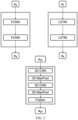
- FIG. 3A-3G depicts the different model architecture of the plurality of final encoding models according to some embodiment of the present disclosure.
- the architecture can be broken down into three specialized blocks: One consisting of fully connected layers which deal with spatial data, the second consisting of LSTMs which deal with temporal data, and the last consisting of 3D CNNs which deal with spatio-temporal data.
- the blocks are designed to specifically target these three components. They produce an encoding e X which is further propagated to get ⁇ .
- the system 100 is configured to choose a final encoding model from amongst the plurality of final encoding model based on accuracy of each of the plurality of final encoding models. It should be appreciated that in an example, a mean accuracy error can be calculated to check the accuracy of the models. And the delay for the queried vehicle is predicted at the current stop using the chosen final encoding model.
- FIG. 4A-4B illustrates a flow chart of a method 400 for delay prediction for scheduled public transport, in accordance with an example embodiment of the present disclosure.
- the method 400 depicted in the flow chart may be executed by a system, for example, the system 100 of FIG. 1 .
- the system 100 may be embodied in the computing device.
- Operations of the flowchart, and combinations of operations in the flowchart may be implemented by various means, such as hardware, firmware, processor, circuitry and/or other device associated with execution of software including one or more computer program instructions.
- one or more of the procedures described in various embodiments may be embodied by computer program instructions.
- the computer program instructions, which embody the procedures, described in various embodiments may be stored by at least one memory device of a system and executed by at least one processor in the system. Any such computer program instructions may be loaded onto a computer or other programmable system (for example, hardware) to produce a machine, such that the resulting computer or other programmable system embody means for implementing the operations specified in the flowchart.
- the operations of the method 400 are described with help of system 100. However, the operations of the method 400 can be described and/or practiced by using any other system.
- step 402 of the method 400 historical data is received corresponding to a plurality of vehicles deployed on a network of the scheduled public transport, wherein a route in the network comprises the queried vehicle for which an expected arrival delay is to be predicted on a current stop.
- step 404 spatial data, temporal data and spatio-temporal data is derived from the received historical data corresponding to the plurality of vehicles and a plurality of stops present along the route.
- the first window of a set of stops is identified from amongst the plurality of stops, wherein the set of stops are stops from where a trip of the queried vehicle has already completed.
- the second window of the set of vehicles of the current stop is identified, wherein the set of vehicles of the current stop has passed through all the stops in the first window before the queried vehicle, wherein the set of vehicles are of a same mode that are in the second window based on a type of methods.
- the type of methods comprises a route-based method and a trip-based method.
- the route-based method is where the set of vehicles of the same mode has covered the same set of stops as the queried vehicle before the queried vehicle.
- the trip-based method where the set of vehicles of the same mode has covered the same set of stops in the first window considered as the queried vehicle before the queried vehicle.
- the plurality of spatial features is extracted for each stop in the first window. Further at step 412, the spatial feature vector of a dimension of twice the number of stops in the first window is formed using the plurality of spatial features.
- the plurality of temporal features is extracted for each vehicle in the second window. Further at step 416, the temporal feature vector is formed using the plurality of temporal features. In the next step 418, the spatio-temporal feature vector is formed using a plurality of spatio-temporal features.
- the first architecture of Fully Connected Neural Network is generated using the spatial feature vector.
- the second architecture of a Long Short Term Memory (LSTM) network is generated using the temporal feature vector.
- the third architecture of a 3D Convolutional Neural Network (3DCNN) is generated using the spatio-temporal feature vector.
- the plurality of final encoding models provided in the plurality of combinations of the first architecture, the second architecture and the third architecture is trained.
- the final encoding model is chosen from amongst the plurality of final encoding model based on accuracy of each of the plurality of final encoding models.
- the delay is predicted for the queried vehicle at the current stop using the final encoding model.
- the system 100 can also be explained with the help of experimental results.
- Data was obtained from Infrabel's Open data raw punctuality data, which provides liveboard data for each year. It contains information on what trains arrived at and departed from a station, and also the geographical information that could be retrieved from a service provider or OpenGIS data. 2018 data was used for training, and 2019 data used for testing. The data was first rearranged into a required format, where the schedule is chunked into overlapping w s sized stop information for each train in the dataset. Because of the following reasons, a few chunks had to be removed from the data. Like, instances of negative or zero actual travel time, instances of negative actual dwell time, missing geographical information and negative arrival, or departure, delays.
- the window sizes are w s ⁇ ⁇ 3, 5 ⁇ and w t ⁇ ⁇ 3, 5 ⁇ .
- Each of the architectures present in TABLE 1 were trained for 60 epochs each with the Adam optimizer. The hyper parameters were tuned after multiple runs.
- the present model while being more generalizable is also trained on a much larger network than other existing methods, most of which are trained on single corridors. Therefore, the present model performs better considering the scope of the setting.
- the mean absolute error (MAE) obtained for the various configurations and models have been listed in TABLE 1.
- the embodiments of present disclosure herein address unresolved problem related to accurate prediction of a vehicle in a scheduled public transport.
- the embodiment thus provides a method and a system for delay prediction for scheduled public transport.
- the hardware device can be any kind of device which can be programmed including e.g. any kind of computer like a server or a personal computer, or the like, or any combination thereof.
- the device may also include means which could be e.g. hardware means like e.g. an application-specific integrated circuit (ASIC), a field-programmable gate array (FPGA), or a combination of hardware and software means, e.g.
- ASIC application-specific integrated circuit
- FPGA field-programmable gate array
- the means can include both hardware means and software means.
- the method embodiments described herein could be implemented in hardware and software.
- the device may also include software means.
- the embodiments may be implemented on different hardware devices, e.g. using a plurality of CPUs.
- the embodiments herein can comprise hardware and software elements.
- the embodiments that are implemented in software include but are not limited to, firmware, resident software, microcode, etc.
- the functions performed by various components described herein may be implemented in other components or combinations of other components.
- a computer-usable or computer readable medium can be any apparatus that can comprise, store, communicate, propagate, or transport the program for use by or in connection with the instruction execution system, apparatus, or device.
- a computer-readable storage medium refers to any type of physical memory on which information or data readable by a processor may be stored.
- a computer-readable storage medium may store instructions for execution by one or more processors, including instructions for causing the processor(s) to perform steps or stages consistent with the embodiments described herein.
- the term "computer-readable medium” should be understood to include tangible items and exclude carrier waves and transient signals, i.e., be non-transitory. Examples include random access memory (RAM), read-only memory (ROM), volatile memory, nonvolatile memory, hard drives, CD ROMs, DVDs, flash drives, disks, and any other known physical storage media.
Landscapes
- Engineering & Computer Science (AREA)
- Physics & Mathematics (AREA)
- Theoretical Computer Science (AREA)
- General Physics & Mathematics (AREA)
- Business, Economics & Management (AREA)
- Computational Linguistics (AREA)
- General Health & Medical Sciences (AREA)
- Software Systems (AREA)
- Mathematical Physics (AREA)
- General Engineering & Computer Science (AREA)
- Computing Systems (AREA)
- Molecular Biology (AREA)
- Evolutionary Computation (AREA)
- Data Mining & Analysis (AREA)
- Biophysics (AREA)
- Biomedical Technology (AREA)
- Health & Medical Sciences (AREA)
- Life Sciences & Earth Sciences (AREA)
- Artificial Intelligence (AREA)
- Human Resources & Organizations (AREA)
- Economics (AREA)
- Strategic Management (AREA)
- Development Economics (AREA)
- General Business, Economics & Management (AREA)
- Game Theory and Decision Science (AREA)
- Tourism & Hospitality (AREA)
- Quality & Reliability (AREA)
- Operations Research (AREA)
- Marketing (AREA)
- Entrepreneurship & Innovation (AREA)
- Management, Administration, Business Operations System, And Electronic Commerce (AREA)
Claims (14)
- Procédé mis en oeuvre par processeur (400) de prédiction de retard pour un transport public programmé, le procédé comprenant le fait de :recevoir, par l'intermédiaire d'une interface utilisateur (104), des données historiques correspondant à une pluralité de véhicules déployés dans un réseau du transport public programmé, dans lequel un itinéraire dans le réseau comprend un véhicule interrogé pour lequel un retard d'arrivée attendu doit être prédit à un arrêt en cours (402) ;dériver, par l'intermédiaire d'un ou plusieurs processeurs matériels (108), des données spatiales, des données temporelles et des données spatio-temporelles à partir des données historiques reçues correspondant à la pluralité de véhicules et à une pluralité d'arrêts présents le long de l'itinéraire (404) ;identifier, par l'intermédiaire dudit un ou desdits plusieurs processeurs matériels (108), une première fenêtre d'un ensemble d'arrêts parmi la pluralité d'arrêts, dans lequel l'ensemble d'arrêts correspond à des arrêts à partir desquels un trajet du véhicule interrogé s'est déjà achevé (406) ;identifier, par l'intermédiaire dudit un ou desdits plusieurs processeurs matériels (108), une deuxième fenêtre d'un ensemble de véhicules de l'arrêt en cours, dans lequel l'ensemble de véhicules de l'arrêt en cours est passé par tous les arrêts de la première fenêtre avant le véhicule interrogé, dans lequel l'ensemble de véhicules est d'un même mode qui se situe dans la deuxième fenêtre sur la base d'un type de procédés, dans lequel le type de procédés comprend :un procédé à base d'itinéraire, où l'ensemble de véhicules du même mode a couvert le même ensemble d'arrêts que le véhicule interrogé avant le véhicule interrogé ; etun procédé à base de trajet, dans lequel l'ensemble de véhicules du même mode a couvert le même ensemble d'arrêts dans la première fenêtre considérée que le véhicule interrogé avant le véhicule interrogé (408) ;extraire, par l'intermédiaire dudit un ou desdits plusieurs processeurs matériels (108), une pluralité de caractéristiques spatiales pour chaque arrêt dans la première fenêtre (410) ;former, par l'intermédiaire dudit un ou desdits plusieurs processeurs matériels (108), un vecteur de caractéristiques spatiales dont la dimension est égale à deux fois le nombre d'arrêts dans la première fenêtre à l'aide de la pluralité de caractéristiques spatiales (412) ;extraire, par l'intermédiaire dudit un ou desdits plusieurs processeurs matériels (108), une pluralité de caractéristiques temporelles pour chaque arrêt dans la première fenêtre couvert par des véhicules dans la deuxième fenêtre (414) ;former, par l'intermédiaire dudit un ou desdits plusieurs processeurs matériels (108), un vecteur de caractéristiques temporelles à l'aide de la pluralité de caractéristiques temporelles (416) ;former, par l'intermédiaire dudit un ou desdits plusieurs processeurs matériels (108), un vecteur de caractéristiques spatio-temporelles à l'aide d'une pluralité de caractéristiques spatio-temporelles (418) ;générer, par l'intermédiaire dudit un ou desdits plusieurs processeurs matériels (108), une première architecture de réseau de neurones entièrement connectés, « FCNN », à l'aide du vecteur de caractéristiques spatiales (420) ;générer, par l'intermédiaire dudit un ou desdits plusieurs processeurs matériels (108), une deuxième architecture d'un réseau à mémoire à long et court terme, « LSTM », à l'aide du vecteur de caractéristiques temporelles (422) ;générer, par l'intermédiaire dudit un ou desdits plusieurs processeurs matériels (108), une troisième architecture d'un réseau de neurones convolutif 3D, « 3DCNN », à l'aide du vecteur de caractéristiques spatio-temporelles (424) ;entraîner, par l'intermédiaire dudit un ou desdits plusieurs processeurs matériels (108), une pluralité de modèles de codage final fournis dans une pluralité de combinaisons de la première architecture, de la deuxième architecture et de la troisième architecture (426) ;choisir, par l'intermédiaire dudit un ou desdits plusieurs processeurs matériels (108), un modèle de codage final parmi la pluralité de modèles de codage final sur la base d'une précision de chaque modèle de la pluralité de modèles de codage final (428) ; etprédire, par l'intermédiaire dudit un ou desdits plusieurs processeurs matériels (108), un retard pour le véhicule interrogé à l'arrêt en cours, à l'aide du modèle de codage final (430).
- Procédé mis en oeuvre par processeur selon la revendication 1, dans lequel la pluralité de caractéristiques temporelles est agencée dans l'ordre de véhicules à base d'itinéraire, de véhicules à base de trajet, et du véhicule interrogé, dans lequel l'agencement se traduit par la formation du vecteur de caractéristiques temporelles.
- Procédé mis en oeuvre par processeur selon la revendication 1, dans lequel la pluralité de caractéristiques spatiales comprend une distance entre deux arrêts consécutifs, et une capacité de véhicules de station.
- Procédé mis en oeuvre par processeur selon la revendication 1, dans lequel la pluralité de caractéristiques temporelles comprend un temps de trajet programmé entre tous les arrêts consécutifs dans la première fenêtre avant l'arrêt en cours, un temps de séjour programmé à un arrêt, un intervalle programmé avec un véhicule précédent, un nombre programmé d'arrêts entre deux arrêts consécutifs dans la première fenêtre, un temps de trajet réel, un temps de séjour réel et un intervalle réel avec un véhicule précédent pour tous les arrêts consécutifs dans la première fenêtre.
- Procédé mis en oeuvre par processeur selon la revendication 1, dans lequel la pluralité de caractéristiques spatio-temporelles comprend un retard d'arrivée et un retard de départ pour chaque véhicule de la pluralité de véhicules et pour chaque arrêt de la pluralité d'arrêts, et dans lequel la pluralité de combinaisons comprend sept combinaisons dans lesquelles six combinaisons présentent une permutation portant sur la connexion de la première architecture, de la deuxième architecture et de la troisième architecture en série, et une combinaison présente deux modèles en parallèle et un modèle en série.
- Système (100) de prédiction de retard pour un transport public programmé, le système comprenant :une interface utilisateur (104) destinée à recevoir des données historiques correspondant à une pluralité de véhicules déployés sur un réseau du transport public programmé, dans lequel un itinéraire dans le réseau comprend un véhicule interrogé pour lequel un retard d'arrivée attendu doit être prédit à un arrêt en cours ;un ou plusieurs processeurs matériels (108) ;une mémoire (110), en communication avec ledit un ou lesdits plusieurs processeurs matériels, dans lesquels ledit un ou lesdits plusieurs processeurs matériels sont configurés de manière à exécuter des instructions programmées stockées dans ladite une ou lesdites plusieurs mémoires, en vue de :dériver des données spatiales, des données temporelles et des données spatio-temporelles à partir des données historiques reçues correspondant à la pluralité de véhicules et à une pluralité d'arrêts présents le long de l'itinéraire ;identifier une première fenêtre d'un ensemble d'arrêts parmi la pluralité d'arrêts, dans lequel l'ensemble d'arrêts correspond à des arrêts à partir desquels un trajet du véhicule interrogé s'est déjà achevé ;identifier une deuxième fenêtre d'un ensemble de véhicules de l'arrêt en cours, dans lequel l'ensemble de véhicules de l'arrêt en cours est passé par tous les arrêts de la première fenêtre avant le véhicule interrogé, dans lequel l'ensemble de véhicules est d'un même mode qui se situe dans la deuxième fenêtre sur la base d'un type de procédés, dans lequel le type de procédés comprend :un procédé à base d'itinéraire, où l'ensemble de véhicules du même mode a couvert le même ensemble d'arrêts que le véhicule interrogé avant le véhicule interrogé ; etun procédé à base de trajet, dans lequel l'ensemble de véhicules du même mode a couvert le même ensemble d'arrêts dans la première fenêtre considérée que le véhicule interrogé avant le véhicule interrogé ;extraire une pluralité de caractéristiques spatiales pour chaque arrêt dans la première fenêtre ;former un vecteur de caractéristiques spatiales dont la dimension est égale à deux fois le nombre d'arrêts dans la première fenêtre à l'aide de la pluralité de caractéristiques spatiales ;extraire une pluralité de caractéristiques temporelles pour chaque arrêt dans la première fenêtre couvert par des véhicules dans la deuxième fenêtre ;former un vecteur de caractéristiques temporelles à l'aide de la pluralité de caractéristiques temporelles ;former un vecteur de caractéristiques spatio-temporelles à l'aide d'une pluralité de caractéristiques spatio-temporelles ;générer une première architecture de réseau de neurones entièrement connectés, « FCNN », à l'aide du vecteur de caractéristiques spatiales ;générer une deuxième architecture d'un réseau à mémoire à long et court terme, « LSTM », à l'aide du vecteur de caractéristiques temporelles ;générer une troisième architecture d'un réseau de neurones convolutif 3D, « 3DCNN », à l'aide du vecteur de caractéristiques spatio-temporelles ;entraîner une pluralité de modèles de codage final fournis dans une pluralité de combinaisons de la première architecture, de la deuxième architecture et de la troisième architecture ;choisir un modèle de codage final parmi la pluralité de modèles de codage final sur la base d'une précision de chaque modèle de la pluralité de modèles de codage final ; etprédire un retard pour le véhicule interrogé à l'arrêt en cours, à l'aide du modèle de codage final.
- Système selon la revendication 6, dans lequel la pluralité de caractéristiques spatiales comprend une distance entre deux arrêts consécutifs, et une capacité de véhicules de station.
- Système selon la revendication 6, dans lequel la pluralité de caractéristiques temporelles comprend un temps de trajet programmé entre tous les arrêts consécutifs dans la première fenêtre avant l'arrêt en cours, un temps de séjour programmé à un arrêt, un intervalle programmé avec un véhicule précédent, un nombre programmé d'arrêts entre deux arrêts consécutifs dans la première fenêtre, un temps de trajet réel, un temps de séjour réel, et un intervalle réel avec un véhicule précédent pour tous les arrêts consécutifs dans la première fenêtre.
- Système selon la revendication 6, dans lequel la pluralité de caractéristiques spatio-temporelles comprend un retard d'arrivée et un retard de départ pour chaque véhicule de la pluralité de véhicules et pour chaque arrêt de la pluralité d'arrêts, et dans lequel la pluralité de combinaisons comprend sept combinaisons dans lesquelles six combinaisons présentent une permutation portant sur la connexion de la première architecture, de la deuxième architecture et de la troisième architecture en série, et une combinaison présente deux modèles en parallèle et un modèle en série.
- Un ou plusieurs supports non transitoires de stockage d'informations lisibles par machine comprenant une ou plusieurs instructions qui, lorsqu'elles sont exécutées par un ou plusieurs processeurs matériels, occasionnent le fait de :recevoir, par l'intermédiaire d'une interface utilisateur, des données historiques correspondant à une pluralité de véhicules déployés dans un réseau du transport public programmé, dans lequel un itinéraire dans le réseau comprend un véhicule interrogé pour lequel un retard d'arrivée attendu doit être prédit à un arrêt en cours ;dériver des données spatiales, des données temporelles et des données spatio-temporelles à partir des données historiques reçues correspondant à la pluralité de véhicules et à une pluralité d'arrêts présents le long de l'itinéraire ;identifier une première fenêtre d'un ensemble d'arrêts parmi la pluralité d'arrêts, dans lequel l'ensemble d'arrêts correspond à des arrêts à partir desquels un trajet du véhicule interrogé s'est déjà achevé ;identifier une deuxième fenêtre d'un ensemble de véhicules de l'arrêt en cours, dans lequel l'ensemble de véhicules de l'arrêt en cours est passé par tous les arrêts de la première fenêtre avant le véhicule interrogé, dans lequel l'ensemble de véhicules est d'un même mode qui se situe dans la deuxième fenêtre sur la base d'un type de procédés, dans lequel le type de procédés comprend :un procédé à base d'itinéraire, où l'ensemble de véhicules du même mode a couvert le même ensemble d'arrêts que le véhicule interrogé avant le véhicule interrogé ; etun procédé à base de trajet, dans lequel l'ensemble de véhicules du même mode a couvert le même ensemble d'arrêts dans la première fenêtre considérée que le véhicule interrogé avant le véhicule interrogé ;extraire une pluralité de caractéristiques spatiales pour chaque arrêt dans la première fenêtre ;former un vecteur de caractéristiques spatiales dont la dimension est égale à deux fois le nombre d'arrêts dans la première fenêtre à l'aide de la pluralité de caractéristiques spatiales ;extraire une pluralité de caractéristiques temporelles pour chaque arrêt dans la première fenêtre couvert par des véhicules dans la deuxième fenêtre ;former un vecteur de caractéristiques temporelles à l'aide de la pluralité de caractéristiques temporelles ;former un vecteur de caractéristiques spatio-temporelles à l'aide d'une pluralité de caractéristiques spatio-temporelles ;générer, une première architecture de réseau de neurones entièrement connectés, « FCNN », à l'aide du vecteur de caractéristiques spatiales ;générer une deuxième architecture d'un réseau à mémoire à long et court terme, « LSTM », à l'aide du vecteur de caractéristiques temporelles ;générer une troisième architecture d'un réseau de neurones convolutif 3D, « 3DCNN », à l'aide du vecteur de caractéristiques spatio-temporelles ;entraîner une pluralité de modèles de codage final fournis dans une pluralité de combinaisons de la première architecture, de la deuxième architecture et de la troisième architecture ;choisir un modèle de codage final parmi la pluralité de modèles de codage final sur la base d'une précision de chaque modèle de la pluralité de modèles de codage final ; etprédire un retard pour le véhicule interrogé à l'arrêt en cours, à l'aide du modèle de codage final.
- Ledit un ou lesdits plusieurs supports non transitoires de stockage d'informations lisibles par machine selon la revendication 10, dans lesquels la pluralité de caractéristiques temporelles est agencée dans l'ordre de véhicules à base d'itinéraire, de véhicules à base de trajet, et du véhicule interrogé, dans lequel l'agencement se traduit par la formation du vecteur de caractéristiques temporelles.
- Ledit un ou lesdits plusieurs supports non transitoires de stockage d'informations lisibles par machine selon la revendication 10, dans lesquels dans lequel la pluralité de caractéristiques spatiales comprend une distance entre deux arrêts consécutifs, et une capacité de véhicules de station.
- Ledit un ou lesdits plusieurs supports non transitoires de stockage d'informations lisibles par machine selon la revendication 10, dans lesquels la pluralité de caractéristiques temporelles comprend un temps de trajet programmé entre tous les arrêts consécutifs dans la première fenêtre avant l'arrêt en cours, un temps de séjour programmé à un arrêt, un intervalle programmé avec un véhicule précédent, un nombre programmé d'arrêts entre deux arrêts consécutifs dans la première fenêtre, un temps de trajet réel, un temps de séjour réel et un intervalle réel avec un véhicule précédent pour tous les arrêts consécutifs dans la première fenêtre.
- Ledit un ou lesdits plusieurs supports non transitoires de stockage d'informations lisibles par machine selon la revendication 10, dans lesquels la pluralité de caractéristiques spatio-temporelles comprend un retard d'arrivée et un retard de départ pour chaque véhicule de la pluralité de véhicules et pour chaque arrêt de la pluralité d'arrêts, et dans lequel la pluralité de combinaisons comprend sept combinaisons dans lesquelles six combinaisons présentent une permutation portant sur la connexion de la première architecture, de la deuxième architecture et de la troisième architecture en série, et une combinaison présente deux modèles en parallèle et un modèle en série.
Applications Claiming Priority (1)
| Application Number | Priority Date | Filing Date | Title |
|---|---|---|---|
| IN202221054665 | 2022-09-23 |
Publications (3)
| Publication Number | Publication Date |
|---|---|
| EP4343731A1 EP4343731A1 (fr) | 2024-03-27 |
| EP4343731B1 true EP4343731B1 (fr) | 2024-11-13 |
| EP4343731C0 EP4343731C0 (fr) | 2024-11-13 |
Family
ID=87748220
Family Applications (1)
| Application Number | Title | Priority Date | Filing Date |
|---|---|---|---|
| EP23192182.6A Active EP4343731B1 (fr) | 2022-09-23 | 2023-08-18 | Procédé et système de prédiction de retard pour un transport public programmé à l'aide d'un apprentissage profond multi-architecture |
Country Status (2)
| Country | Link |
|---|---|
| US (1) | US20240112096A1 (fr) |
| EP (1) | EP4343731B1 (fr) |
Families Citing this family (2)
| Publication number | Priority date | Publication date | Assignee | Title |
|---|---|---|---|---|
| CN118230556B (zh) * | 2024-05-24 | 2024-08-27 | 浙江中控信息产业股份有限公司 | 一种交通参数预测方法、装置和设备 |
| CN118824014B (zh) * | 2024-08-30 | 2025-03-28 | 杭州海康威视数字技术股份有限公司 | 交通流量预测方法、装置、电子设备及存储介质 |
Family Cites Families (10)
| Publication number | Priority date | Publication date | Assignee | Title |
|---|---|---|---|---|
| US8437006B2 (en) * | 2010-12-02 | 2013-05-07 | Nicholas G. Dagalakis | Displacement sensor with embedded coherent electromagnetic radiation interferometer for micro scale proximity measurements |
| US9159032B1 (en) * | 2014-03-19 | 2015-10-13 | Xerox Corporation | Predicting arrival times of vehicles based upon observed schedule adherence |
| CN103903429B (zh) * | 2014-03-26 | 2016-03-02 | 东南大学 | 一种快速公交停靠站的延误时间组合预测方法 |
| WO2016174745A1 (fr) * | 2015-04-28 | 2016-11-03 | 株式会社日立製作所 | Dispositif de prédiction de temps d'arrivée, système de prédiction de temps d'arrivée, et programme |
| US20180322431A1 (en) * | 2017-05-05 | 2018-11-08 | Walmart Apollo, Llc | Predicting realistic time of arrival for queue priority adjustment |
| CN109426930B (zh) * | 2017-08-25 | 2023-07-18 | 株式会社日立制作所 | 物流车辆的运输延迟预测系统及方法 |
| WO2019232693A1 (fr) * | 2018-06-05 | 2019-12-12 | Beijing Didi Infinity Technology And Development Co., Ltd. | Système et procédé pour la répartition de commandes de trajet |
| KR101935040B1 (ko) * | 2018-09-12 | 2019-01-03 | 이현수 | 음성안내 기반 대중교통 경로 안내 서비스 제공 방법 및 시스템 |
| CN111627239B (zh) * | 2019-02-28 | 2022-08-09 | 腾讯大地通途(北京)科技有限公司 | 公共交通信息的显示方法、装置、设备及存储介质 |
| DE112020001663T5 (de) * | 2019-03-29 | 2022-03-24 | Intel Corporation | Autonomes Fahrzeugsystem |
-
2023
- 2023-08-18 EP EP23192182.6A patent/EP4343731B1/fr active Active
- 2023-08-24 US US18/455,045 patent/US20240112096A1/en active Pending
Also Published As
| Publication number | Publication date |
|---|---|
| US20240112096A1 (en) | 2024-04-04 |
| EP4343731C0 (fr) | 2024-11-13 |
| EP4343731A1 (fr) | 2024-03-27 |
Similar Documents
| Publication | Publication Date | Title |
|---|---|---|
| EP4343731B1 (fr) | Procédé et système de prédiction de retard pour un transport public programmé à l'aide d'un apprentissage profond multi-architecture | |
| Liu et al. | Exploring data validity in transportation systems for smart cities | |
| CN106022541B (zh) | 一种到站时间预测方法 | |
| CN111199257A (zh) | 高铁行车设备故障诊断方法及装置 | |
| CN104424812B (zh) | 一种公交到站时间预测系统和方法 | |
| Farooq et al. | GPS based public transport arrival time prediction | |
| CN112766605B (zh) | 一种基于容器云平台的多源客流预测系统及方法 | |
| CN105303245A (zh) | 交通分析系统以及交通分析方法 | |
| CN105206040B (zh) | 一种基于ic卡数据的公交串车预测方法 | |
| CN114821247A (zh) | 一种模型的训练方法、装置、存储介质及电子装置 | |
| CN108415885A (zh) | 基于近邻回归的实时公交客流预测方法 | |
| CN105303865A (zh) | 检测用于交通出行分组的重要交通站点 | |
| CN115222265A (zh) | 一种铁路全线路轨道状态确定方法及装置 | |
| CN117494864A (zh) | 一种基于rsalgcn的城市轨道交通短时客流预测方法 | |
| Liu et al. | Data analytics approach for train timetable performance measures using automatic train supervision data | |
| CN115817587A (zh) | 用于解决列车运行延时的实时重调度方法和装置 | |
| CN116654058B (zh) | 一种轨道交通线网运行调整方法、装置、设备和存储介质 | |
| CN117496695A (zh) | 一种基于ic卡数据的乘客换乘站点识别及出行链重构方法 | |
| CN116424397A (zh) | 城市轨道交通运营故障下行车调整策略生成方法及系统 | |
| CN121146152A (zh) | 一种考虑地铁-公交换乘的地铁客流量预测方法、系统、设备及介质 | |
| JP7232673B2 (ja) | 列車運転制御装置および列車運転制御方法 | |
| CN103778799A (zh) | 基于对等网络分布式计算的公交自动报站方法 | |
| CN114662912B (zh) | 一种基于公交数字化转型的智能公交运营服务平台 | |
| CN115798209B (zh) | 一种公交实时空驶调度方法和系统 | |
| Khan et al. | Intelligent integration framework for smart transport system |
Legal Events
| Date | Code | Title | Description |
|---|---|---|---|
| PUAI | Public reference made under article 153(3) epc to a published international application that has entered the european phase |
Free format text: ORIGINAL CODE: 0009012 |
|
| STAA | Information on the status of an ep patent application or granted ep patent |
Free format text: STATUS: THE APPLICATION HAS BEEN PUBLISHED |
|
| AK | Designated contracting states |
Kind code of ref document: A1 Designated state(s): AL AT BE BG CH CY CZ DE DK EE ES FI FR GB GR HR HU IE IS IT LI LT LU LV MC ME MK MT NL NO PL PT RO RS SE SI SK SM TR |
|
| STAA | Information on the status of an ep patent application or granted ep patent |
Free format text: STATUS: REQUEST FOR EXAMINATION WAS MADE |
|
| 17P | Request for examination filed |
Effective date: 20240506 |
|
| RBV | Designated contracting states (corrected) |
Designated state(s): AL AT BE BG CH CY CZ DE DK EE ES FI FR GB GR HR HU IE IS IT LI LT LU LV MC ME MK MT NL NO PL PT RO RS SE SI SK SM TR |
|
| REG | Reference to a national code |
Ref country code: DE Ref legal event code: R079 Ref document number: 602023001017 Country of ref document: DE Free format text: PREVIOUS MAIN CLASS: G08G0001000000 Ipc: G06N0003044200 |
|
| GRAP | Despatch of communication of intention to grant a patent |
Free format text: ORIGINAL CODE: EPIDOSNIGR1 |
|
| STAA | Information on the status of an ep patent application or granted ep patent |
Free format text: STATUS: GRANT OF PATENT IS INTENDED |
|
| INTG | Intention to grant announced |
Effective date: 20240709 |
|
| RAP3 | Party data changed (applicant data changed or rights of an application transferred) |
Owner name: TATA CONSULTANCY SERVICES LTD. |
|
| RIC1 | Information provided on ipc code assigned before grant |
Ipc: G08G 1/00 20060101ALN20240701BHEP Ipc: G08G 1/01 20060101ALN20240701BHEP Ipc: G06N 3/045 20230101ALN20240701BHEP Ipc: G06N 3/08 20230101ALI20240701BHEP Ipc: G06N 3/0464 20230101ALI20240701BHEP Ipc: G06N 3/0442 20230101AFI20240701BHEP |
|
| GRAS | Grant fee paid |
Free format text: ORIGINAL CODE: EPIDOSNIGR3 |
|
| GRAA | (expected) grant |
Free format text: ORIGINAL CODE: 0009210 |
|
| STAA | Information on the status of an ep patent application or granted ep patent |
Free format text: STATUS: THE PATENT HAS BEEN GRANTED |
|
| AK | Designated contracting states |
Kind code of ref document: B1 Designated state(s): AL AT BE BG CH CY CZ DE DK EE ES FI FR GB GR HR HU IE IS IT LI LT LU LV MC ME MK MT NL NO PL PT RO RS SE SI SK SM TR |
|
| REG | Reference to a national code |
Ref country code: GB Ref legal event code: FG4D |
|
| REG | Reference to a national code |
Ref country code: CH Ref legal event code: EP |
|
| REG | Reference to a national code |
Ref country code: IE Ref legal event code: FG4D |
|
| REG | Reference to a national code |
Ref country code: DE Ref legal event code: R096 Ref document number: 602023001017 Country of ref document: DE |
|
| U01 | Request for unitary effect filed |
Effective date: 20241113 |
|
| U07 | Unitary effect registered |
Designated state(s): AT BE BG DE DK EE FI FR IT LT LU LV MT NL PT RO SE SI Effective date: 20241120 |
|
| PG25 | Lapsed in a contracting state [announced via postgrant information from national office to epo] |
Ref country code: HR Free format text: LAPSE BECAUSE OF FAILURE TO SUBMIT A TRANSLATION OF THE DESCRIPTION OR TO PAY THE FEE WITHIN THE PRESCRIBED TIME-LIMIT Effective date: 20241113 Ref country code: IS Free format text: LAPSE BECAUSE OF FAILURE TO SUBMIT A TRANSLATION OF THE DESCRIPTION OR TO PAY THE FEE WITHIN THE PRESCRIBED TIME-LIMIT Effective date: 20250313 |
|
| PG25 | Lapsed in a contracting state [announced via postgrant information from national office to epo] |
Ref country code: ES Free format text: LAPSE BECAUSE OF FAILURE TO SUBMIT A TRANSLATION OF THE DESCRIPTION OR TO PAY THE FEE WITHIN THE PRESCRIBED TIME-LIMIT Effective date: 20241113 |
|
| PG25 | Lapsed in a contracting state [announced via postgrant information from national office to epo] |
Ref country code: NO Free format text: LAPSE BECAUSE OF FAILURE TO SUBMIT A TRANSLATION OF THE DESCRIPTION OR TO PAY THE FEE WITHIN THE PRESCRIBED TIME-LIMIT Effective date: 20250213 |
|
| PG25 | Lapsed in a contracting state [announced via postgrant information from national office to epo] |
Ref country code: GR Free format text: LAPSE BECAUSE OF FAILURE TO SUBMIT A TRANSLATION OF THE DESCRIPTION OR TO PAY THE FEE WITHIN THE PRESCRIBED TIME-LIMIT Effective date: 20250214 |
|
| PG25 | Lapsed in a contracting state [announced via postgrant information from national office to epo] |
Ref country code: PL Free format text: LAPSE BECAUSE OF FAILURE TO SUBMIT A TRANSLATION OF THE DESCRIPTION OR TO PAY THE FEE WITHIN THE PRESCRIBED TIME-LIMIT Effective date: 20241113 |
|
| PG25 | Lapsed in a contracting state [announced via postgrant information from national office to epo] |
Ref country code: RS Free format text: LAPSE BECAUSE OF FAILURE TO SUBMIT A TRANSLATION OF THE DESCRIPTION OR TO PAY THE FEE WITHIN THE PRESCRIBED TIME-LIMIT Effective date: 20250213 |
|
| PG25 | Lapsed in a contracting state [announced via postgrant information from national office to epo] |
Ref country code: SM Free format text: LAPSE BECAUSE OF FAILURE TO SUBMIT A TRANSLATION OF THE DESCRIPTION OR TO PAY THE FEE WITHIN THE PRESCRIBED TIME-LIMIT Effective date: 20241113 |
|
| PG25 | Lapsed in a contracting state [announced via postgrant information from national office to epo] |
Ref country code: SK Free format text: LAPSE BECAUSE OF FAILURE TO SUBMIT A TRANSLATION OF THE DESCRIPTION OR TO PAY THE FEE WITHIN THE PRESCRIBED TIME-LIMIT Effective date: 20241113 |
|
| PG25 | Lapsed in a contracting state [announced via postgrant information from national office to epo] |
Ref country code: CZ Free format text: LAPSE BECAUSE OF FAILURE TO SUBMIT A TRANSLATION OF THE DESCRIPTION OR TO PAY THE FEE WITHIN THE PRESCRIBED TIME-LIMIT Effective date: 20241113 |
|
| PLBE | No opposition filed within time limit |
Free format text: ORIGINAL CODE: 0009261 |
|
| STAA | Information on the status of an ep patent application or granted ep patent |
Free format text: STATUS: NO OPPOSITION FILED WITHIN TIME LIMIT |
|
| U20 | Renewal fee for the european patent with unitary effect paid |
Year of fee payment: 3 Effective date: 20250825 |
|
| 26N | No opposition filed |
Effective date: 20250814 |
|
| PG25 | Lapsed in a contracting state [announced via postgrant information from national office to epo] |
Ref country code: MC Free format text: LAPSE BECAUSE OF FAILURE TO SUBMIT A TRANSLATION OF THE DESCRIPTION OR TO PAY THE FEE WITHIN THE PRESCRIBED TIME-LIMIT Effective date: 20241113 |