EP4344535A1 - Procédés et substrats pour induire et cultiver des corps fructifères du champignon laetiporus sulphureus en tant que substitut de viande vegan - Google Patents
Procédés et substrats pour induire et cultiver des corps fructifères du champignon laetiporus sulphureus en tant que substitut de viande vegan Download PDFInfo
- Publication number
- EP4344535A1 EP4344535A1 EP22198172.3A EP22198172A EP4344535A1 EP 4344535 A1 EP4344535 A1 EP 4344535A1 EP 22198172 A EP22198172 A EP 22198172A EP 4344535 A1 EP4344535 A1 EP 4344535A1
- Authority
- EP
- European Patent Office
- Prior art keywords
- substrate
- present
- predetermined
- fruiting
- bags
- Prior art date
- Legal status (The legal status is an assumption and is not a legal conclusion. Google has not performed a legal analysis and makes no representation as to the accuracy of the status listed.)
- Withdrawn
Links
Images



Classifications
-
- A—HUMAN NECESSITIES
- A01—AGRICULTURE; FORESTRY; ANIMAL HUSBANDRY; HUNTING; TRAPPING; FISHING
- A01G—HORTICULTURE; CULTIVATION OF VEGETABLES, FLOWERS, RICE, FRUIT, VINES, HOPS OR SEAWEED; FORESTRY; WATERING
- A01G18/00—Cultivation of mushrooms
- A01G18/20—Culture media, e.g. compost
-
- C—CHEMISTRY; METALLURGY
- C12—BIOCHEMISTRY; BEER; SPIRITS; WINE; VINEGAR; MICROBIOLOGY; ENZYMOLOGY; MUTATION OR GENETIC ENGINEERING
- C12N—MICROORGANISMS OR ENZYMES; COMPOSITIONS THEREOF; PROPAGATING, PRESERVING, OR MAINTAINING MICROORGANISMS; MUTATION OR GENETIC ENGINEERING; CULTURE MEDIA
- C12N1/00—Microorganisms; Compositions thereof; Processes of propagating, maintaining or preserving microorganisms or compositions thereof; Processes of preparing or isolating a composition containing a microorganism; Culture media therefor
- C12N1/14—Fungi; Culture media therefor
-
- C—CHEMISTRY; METALLURGY
- C12—BIOCHEMISTRY; BEER; SPIRITS; WINE; VINEGAR; MICROBIOLOGY; ENZYMOLOGY; MUTATION OR GENETIC ENGINEERING
- C12N—MICROORGANISMS OR ENZYMES; COMPOSITIONS THEREOF; PROPAGATING, PRESERVING, OR MAINTAINING MICROORGANISMS; MUTATION OR GENETIC ENGINEERING; CULTURE MEDIA
- C12N1/00—Microorganisms; Compositions thereof; Processes of propagating, maintaining or preserving microorganisms or compositions thereof; Processes of preparing or isolating a composition containing a microorganism; Culture media therefor
- C12N1/22—Processes using, or culture media containing, cellulose or hydrolysates thereof
-
- C—CHEMISTRY; METALLURGY
- C12—BIOCHEMISTRY; BEER; SPIRITS; WINE; VINEGAR; MICROBIOLOGY; ENZYMOLOGY; MUTATION OR GENETIC ENGINEERING
- C12R—INDEXING SCHEME ASSOCIATED WITH SUBCLASSES C12C - C12Q, RELATING TO MICROORGANISMS
- C12R2001/00—Microorganisms ; Processes using microorganisms
- C12R2001/645—Fungi ; Processes using fungi
Definitions
- the present invention relates to the reproducible large-scale indoor production of fruiting bodies of the fungus Laetiporus sulphureus or other fungi of the genus Laetiporus as foodstuff.
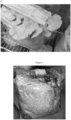
- the fungus Laetiporus sulphureus is a member of the class Agaricomycetes of the division Basidiomycota, group/order Polyporales and genus Laetiporus. Wild Laetiporus sulphureus typically grows seasonally between May and October on deciduous and coniferous trees, as well as on dead logs (NPL8, NPL13) (see Figure 1A ). Wild Laetiporus sulphureus is commonly found throughout North America, Europe, and Asia.
- Laetiporus sulphureus was traditionally used as therapeutic agent against pyretic diseases, coughs, gastric cancer, and rheumatism (NPL1, NPL2). Furthermore, the fruiting bodies of Laetiporus sulphureus were discovered to exhibit medicinal properties including, inter alia, immunomodulation, antitumor, hemagglutination, anticoagulation, antioxidant, antibacterial, antifungal, insecticidal, anti-ulcer, insulin tropic anti-HIV, and cytostatic activities (NPL1, NPL3, NPL4, NPL5, NPL3).
- the fruiting bodies of Laetiporus sulphureus are typically fleshy, sulfuric-yellow, semi-circular hats, that eventually form shelf-shaped, bracket-like bodies (NPL1), which typically have no gills, but rather tiny pores (NPL7) (see Figure 1B ).
- NPL1 shelf-shaped, bracket-like bodies
- NPL7 tiny pores
- NPL3, NPL8, NPL9, NPL10 young fruiting bodies of Laetiporus sulphureus are widely praised for their high nutritional value as well as their chicken-like texture and taste.
- Laetiporus sulphureus is commonly referred to as “Chicken-of-the-Woods” and as such has a great value as vegan/vegetarian alternative for meat, since no artificial additives to enhance taste and/or texture are required (NPL11).
- young fruiting bodies of Laetiporus sulphureus provide key nutritional components such as carbohydrates, proteins including essential amino acids, vitamins, minerals, essential fatty acids and dietary fiber (NPL12).
- Chinese patents CN 102391049 and CN 102405766 are directed to the in vitro production of fruiting bodies of Laetiporus sulphureus based on, inter alia, wood-based substrates.
- CN 102391049 discloses the use of Zinc sulfate (ZnSO 4 ) as mineral component in the substrate, which is known to cause acute stomach distress including nausea and vomiting when being consumed in too large amounts.
- ZnSO 4 Zinc sulfate
- the substrate disclosed in CN 102405766 does not seem to contain mineral components at all. However, mineral components act as buffer to counteract substrate acidification arising due to mycelial growth.
- the Polish patent PL 219753 relates to a previously published report (NPL16) and is based on a substrate containing, inter alia, wooden components from oak, i.e., oak sawdust, which according to common general knowledge is rich in tannins. Emerging fruiting bodies adsorb these tannins from the culture substrate and consequently, may be inedible due to their bitter taste. Furthermore, the substrate disclosed in PL 219753 contains a variety of different ingredients not all of which are readily available on a bigger scale, such as buckwheat bran and the triticale berry - a hybrid of wheat and rye - and wood dust of several different tree species.
- formation of fruiting bodies from Laetiporus sulphureus mycelium in PL 219753 is said to be either induced by a decrease in temperature from 2 to 4 °C for 24 h or by cold water injection into the cultivation vessel. Compared to fruiting body induction via temperature decrease, the injection of cold water is reported to result in an increased yield. Yet, injecting water is a labor-intensive step that additionally involves a high risk of contamination impacting the reproducibility of the method disclosed in PL 219753 .
- the technical problem underlying the present invention is the provision of improved means and methods for the induction of the formation and growth of fruiting bodies of fungi of the genus Laetiporus, including Laetiporus sulphureus.
- the present invention relates to methods and/or substrates for inducing and growing fungi of the genus Laetiporus, including Laetiporus sulphureus. Fruiting in the methods of the present invention is induced by a decrease in the CO 2 concentration during indoor/in vitro mushroom culture.
- the present invention further relates to culture substrates comprising a cellulose component, an amino acid component, a mineral component and, optionally, a fibrous component.
- the present invention further relates to fruiting bodies produced by performing the methods and/or using the substrates of the present invention, i.e., a fruiting body obtained by or obtainable by the method provided herein.
- the present invention is particularly useful for the industrial production of mushrooms of the genus Laetiporus, including Laetiporus sulphureus, in food-grade quality, and as such as foodstuff.
- the methods/substrates of the present invention provide improved induction and subsequent growth of fruiting bodies, preferably from Laetiporus sulphureus during indoor cultivation which could not have been achieved by previously known methods and/or substrates.
- the fruiting bodies obtained or obtainable by the present invention are rich in protein and safe for human consumption, since the substrates preferably to be used for cultivation do not contain ingredients of potential concern, such as toxic wood components and toxic mineral components and/or components which would render the fruiting body unsuitable for human consumption.
- the present invention relates to a method for inducing fruiting body formation of a fungus from the genus Laetiporus.
- the method of the first aspect comprises the following steps:
- the first predetermined CO 2 concentration in step a) is above atmospheric levels, preferably above 700 ppm, more preferably above 1000 ppm, even more preferably above 1500 ppm, above 2500 ppm and up to 5000 ppm or 10000 ppm.
- the second predetermined CO 2 concentration in step b) is below 1500 ppm, preferably below 1000 ppm, more preferably below 700 ppm, more preferably at atmospheric levels.
- the method of the first aspect of the present invention comprises a step of decreasing the first predetermined CO 2 concentration to a second predetermined CO 2 concentration.
- the CO 2 concentration is decreased within 5 days, preferably within 24 hours, preferably within 12 hours, even more preferably within 3 hours.
- the present invention relates to a method for growing the induced fruiting bodies of the fungus.
- the method of the second aspect of the present invention comprises the following steps:
- the incubation in step ii) is performed at the second predetermined CO2 concentration, a second predetermined temperature and/or a second predetermined humidity
- the second predetermined temperature is 12 °C to 26 °C, preferably 16 °C to 22 °C, more preferably is 18 °C and/or the second predetermined humidity is above 40 %, preferably above 50 %, more preferably above 70%, even more preferably above 80 %, preferably is 90 %.
- the present invention relates to substrates for inducing and growing a fruiting body of a fungus.
- the substrate according to the present invention comprises the following components:
- the substrates according to the present invention further comprises a predetermined water content.
- the predetermined water content is between 30 % to 70 %, preferably between 35 % to 55 %, more preferably 40 % to 50 %, even more preferably 40 % to 45 %, most preferably 43 %.
- the present invention relates to a fruiting body obtained by or obtainable by performing the methods, i.e., the induction and/or growth methods, disclosed herein.
- the present invention relates to a fruiting body of a fungus from the genus Laetiporus.
- the fruiting body comprises at least 5 %, preferably at least 7 %, more preferably at least 10 %, even more preferably at least 12 % of protein per gram of wet sample/fresh weight and preferably up to 10, 11, 12, 13, 14 or 15 % of protein per gram of wet sample/fresh weight.
- a fruiting body of a fungus comprises above 21 %, more preferably above 25 %, 30 % 35 %, 40 %, 45 %, 50 % of protein per gram of dry weight and up to 55 % or 60 % protein per gram of dry weight.
- the fungus is from the genus Laetiporus, more preferably from the species Laetiporus sulphureus.
- the fruiting body provided herein or obtained/obtainable by the herein provided methods is from a fungus from the genus Laetiporus, more preferably from the species Laetiporus sulphureus.
- the present invention provides methods and substrates for inducing and subsequently growing fruiting bodies of a fungus, preferably Laetiporus sulphureus.
- the methods and substrates of the present invention are useful for the in vitro/indoor production of Laetiporus sulphureus fruiting bodies in food-grade quality, which was not achieved by previously known methods and substrates.
- the methods of the present invention enable to reproducibly induce and grow fruiting bodies of the fungus Laetiporus sulphureus with 20 to 50 % reduced production time compared to culture methods known in the art.
- the fruiting bodies of the fungus Laetiporus sulphureus produced by using the substrates of the present invention are safe for human consumption and rich in protein.
- fungus fungi
- muscle(s) fungi
- the mycelium has a root-like structure and consists of a mass of branching, thread-like hyphae.
- the mycelium is the growing part of a mushroom by which the fungus absorbs nutrients from its surrounding environment.
- Hyphae further forming into knots, also referred to as primordia finally develop to the fruiting body of the mushroom.
- Fruiting bodies are the multicellular structure on which spore-producing structures (in the case of Basidiomycetes, basidia are borne) and as such are the reproductive part of a fungus.
- the spores dispersing from the mature fruiting bodies initiate the aforementioned life cycle again.
- the fleshy fruiting bodies are usually the consumed part of edible fungal species, although developing, unmature fruiting bodies and primordia may also be consumed.
- Fungi can be selected from the subkingdom Dikarya, the division Basidiomycota, the class Agaricomycetes, the order/group Polyporales, the family Fomitopsidaceae, the genus Laetiporus and the species Laetiporus sulphureus.
- in vitro cultured fruiting bodies are preferably selected from the genus Laetiporus, more preferably from the species Laetiporus sulphureus.
- each mushroom species may have different growth requirements. Therefore, the culture conditions need to be determined/adapted depending on the destined species to be cultivated.
- Cultivation of edible mushroom species commonly comprises several particular steps. First, mycelium of the desired fungal species is cultivated on a carrier medium, such as grains, in order to produce spawn. Next, a different, usually sterile substrate, is inoculated with the produced spawn. The inoculated mushroom mycelium then colonizes the substrate from the spawn propagules. When the substrate is fully colonized by the mycelium, the formation of primordia is induced via a change of the culture conditions. Most commonly in the art, induction of mushroom fruiting is initiated by a combination of a decrease in temperature and an increase in humidity. After formation of primordia, to balance the growth of the fruiting bodies the temperature may be increased again.
- cultivation of mushrooms relates to the indoor/in vitro cultivation of mushrooms, i.e., the cultivation in closed environments in which culture conditions (e.g., ventilation, temperature, relative humidity and light) can be tightly controlled and regulated (e.g., via sensors).
- Closed environments may include, but are not limited to, incubation chambers, greenhouses, incubation rooms and the like.
- incubation rooms/incubators which may have, for instance, a size of 14 m 2 , are particularly preferred.
- the mushrooms in the context of the present invention have an aerobic metabolism, meaning that oxygen is metabolized to, inter alia, carbon dioxide (CO 2 ).
- CO 2 carbon dioxide
- oxygen supply and CO 2 removal must be tightly regulated. This may be done via ventilation systems, such as industrial fans in combination with precise CO 2 measurements, such as CO 2 sensors, which may be placed at the cultivation vessels, and/or optionally, which may be placed in the cultivation vessels.
- the CO 2 concentration within the culture environment may be set adjusted based on ventilation. More specifically, if no/moderate ventilation is performed herein, the CO 2 concentration within the culture environment increases due to the mushrooms' metabolism. Whereas, when ventilation is increased the CO 2 levels can be lowered.
- ventilation means in particular that (filtered) atmospheric air (e.g., air with a lower CO 2 level compared to the air in the culture environments (e.g., incubation room)) is allowed to enter the culture environment (e.g., incubation room/incubator).
- the culture environments provided herein may be humidified and any means suitable for humidifying known in the art may be employed.
- the humidity in the culture environment of the present invention may be adjusted via humidifiers, including but not limited to, evaporative humidifiers, impeller humidifiers, ultrasonic humidifiers, high pressure mist producing systems and the like. According to the present invention, mist producing systems are preferred.
- the culture environment in the context of the present invention may be illuminated and any means suitable for illumination known in the art, such as a natural or an artificial light source, may be employed. According to the present invention an artificial dimmable light source with a broad spectrum is particularly useful.
- mycelium of the desired fungal species may be isolated from wild picked mushrooms, e.g., via incubation of spores or fungal matter on sterile medium in vessels/petri dishes or may be obtained from any other source known in the art.
- Means for producing spawn i.e., the mycelial matter to be vaccinated on the culture substrate also referred to as inoculate, is not limited and any suitable means known to the skilled person, may be employed.
- the produced spawn may include, but is not limited to, sawdust spawn, grain spawn, stick spawn, liquid spawn and the like. According to the present invention, grain spawn is particularly useful.
- the present invention relates to a method for inducing fruiting body formation of a fungus which is triggered/induced by a decrease in the CO 2 concentration during the culture process.
- the method of the first aspect of the present invention comprises the following steps:
- inducing fruiting body formation and “fruiting” are used interchangeably and refer to the development/formation/appearance of primordia, i.e., hyphal knots marking the initial, immature stage of the mushroom's fruiting bodies which typically have the size of a pea (e.g., diameter of about 4.0 to 7.5 mm).
- primordia i.e., hyphal knots marking the initial, immature stage of the mushroom's fruiting bodies which typically have the size of a pea (e.g., diameter of about 4.0 to 7.5 mm).
- fruiting body preferably refers to the mature/fully differentiated stage of mushroom.
- fruiting bodies are usually the fleshy consumed/consumable part of edible fungal species; the fruiting bodies typically consist of a dense/compact network of the mycelial matter of the fungus and/or are the mature/fully differentiated stage of mushroom and/or are larger in size compared to the above-mentioned primordia (i.e. compared to the initial stage of fruiting body formation).
- immature fruiting bodies may be consumed, as it is custom with other fungi species.
- fruiting body can also refer to developing and/or immature fruiting bodies.
- "Developing and/or immature fruiting body” in this context refers primarily to amorphous, developing and/or immature fruiting body (also termed herein amorphous fruiting body or amorphous immature fruiting body or amorphous developing fruiting body), e.g., fruiting bodies grown e.g., in the dark or under low light conditions (preferably ⁇ 100 lux), e.g., when performing step (ii) of the methods provided herein.
- Developing and/or immature fruiting body are usually larger in size compared to the primordia which are the initial, immature stage of the mushroom's fruiting bodies, as explained above.
- a “developing and/or immature fruiting body” can have a diameter of above 7.5 mm and up to several cm, e.g., up to 10, 15 or 20 cm).
- (a sample of) "fruiting bodies” e.g., to be harvested in accordance with the provided methods) as defined herein can, in addition, comprise primordia (in the sense of initial, immature stage of the mushroom's fruiting bodies or parts thereof).
- a sample of "fruiting bodies” e.g., to be harvested in accordance with the provided methods
- does not comprise primordia in the sense of initial, immature stage of the mushroom's fruiting bodies or parts thereof.
- a “fruiting body” herein preferably is a fresh weight fruiting body, i.e., a freshly harvested fruiting body (e.g., from shortly after harvest (like several minutes) to up to several weeks, particularly when stored at low temperatures (e.g., at 4 °C)), as compared to a dry/dried fruiting body.
- the "fruiting body” is pasteurized (directly) after harvest. Such a pasteurized fruiting body can then be stored for up to several weeks, particularly when stored at low temperatures (e.g., at 4 °C).
- Fruiting body induction can be visually observed/determined e.g., by emergence of primordia (i.e., initial stage of fruiting bodies).
- the percentage of induction efficiency can be calculated/determined based on the ratio of samples (e.g., inoculated culture vessels (e.g., polypropylene bags) with emerging fruiting bodies (e.g., appearance/development of primordia) and the total sample size (e.g., total number of inoculated culture vessels (e.g., polypropylene bags).
- samples e.g., inoculated culture vessels (e.g., polypropylene bags) with emerging fruiting bodies (e.g., appearance/development of primordia) and the total sample size (e.g., total number of inoculated culture vessels (e.g., polypropylene bags).
- Induction efficiency herein is high, preferably at least 5 %, more preferably at least 10 %, 15 %, 20 %, 25 %, 30 %, 35 %, 40 %, 45 %, 50 %, 55 %, 60 %, 65 %, 70 %, even more preferably at least 75 %, 80 %, 85 %, 90 % or 95 %.
- the methods for inducing fruiting body formation relate to methods for inducing fruiting body formation at a high induction efficiency herein, preferably at least 5 %, more preferably at least 10 %, 15 %, 20 %, 25%, 30%, 35%, 40%, 45%, 50%, 55 %, 60 %, 65 %, 70 %, even more preferably at least 75 %, 80 %, 85 %, 90 % or 95 % induction efficiency.
- the induction efficiency can also be indicated as a fold-increased compared to a method not comprising step (b) of the herein provided method, e.g., where the fungi a incubated at a first predetermined CO 2 concentration (such as when a high CO 2 concentration of between 2500 ppm to 5000 ppm is maintained, reference method).
- the induction efficiency according to the methods provided herein can be at least 2-fold, 3-fold, 4-fold, 5-fold or 6-fold increased compared to a method not comprising step (b) of the herein provided method.
- the x-fold increase can be determined by calculating the induction as explained further above for both the methods provided herein and a method not comprising step (b) of the herein provided method and normalizing the induction efficiency of the herein provided method to that of a method not comprising step (b) of the herein provided method, e.g. where the induction efficiency of the reference method is set to be 1 or 100 %.
- the first predetermined CO 2 concentration in step a) is above atmospheric levels.
- Atmospheric levels of CO 2 are currently at about 400 parts per million (ppm). The skilled person knows that the atmospheric CO 2 levels fluctuate on a daily basis and due to global warming are expected to increase in the coming years.
- the first predetermined CO 2 concentration in step a) is above 700 ppm, preferably above 1000 ppm, even more preferably above 1500 ppm, above 2500 ppm and up to 5000 ppm or 10000 ppm.
- the first predetermined CO 2 concentration in step a) is about 5000 ppm. It is envisaged herein that the first predetermined CO 2 concentration can be a range of the above given concentrations e.g., range from above atmospheric levels to 5000 ppm or 10000 ppm or even higher during the period of cultivation/incubation of step a).
- a high CO 2 concentration of about 5000 ppm may be reached as follows: incubation starts at atmospheric CO 2 concentration, wherein during incubation a higher than atmospheric CO 2 concentration is reached (e.g., about 5000 ppm), such as due to the increasing metabolization of the fungus.
- An increase of the CO 2 concentration can readily be obtained by reduced/no ventilation e.g., in closed incubation environments, such as incubators as described above.
- step a) is further performed at a first predetermined temperature and/or a first predetermined humidity.
- a useful first predetermined temperature in the methods of the present invention is 18 °C to 30 °C, preferably 22 °C to 28 °C. In a particularly preferred embodiment of the present invention, the first predetermined temperature in step a) is 26 °C.
- a useful first predetermined humidity according to the present invention is 35 to 80 %, preferably 40 to 70 %, more preferably 55%. In a particularly preferred embodiment of the present invention, the first predetermined humidity in step a) is 50 %.
- step a) it may be particularly useful to further perform the incubation in step a) in the dark or under low light conditions, preferably below 100 lux.
- the incubation in step a) is performed until the substrate is fully colonized by the inoculated mycelium.
- the skilled person will be able to evaluate the timepoint until complete mycelial colonization. In the context of the present invention, this may take typically at least 2 weeks, preferable 2 to 3 weeks.
- the skilled person will furthermore understand that the incubation is not limited in time, especially, when the incubation is performed at low temperatures.
- culture vessels containing fully colonized substrates may be incubated/cultured for up to 6 weeks, before fruiting is induced (i.e., before fruiting body formation is induced by incubating the substrate at a second predetermined CO 2 concentration/step (b)).
- the first predetermined CO 2 concentration will normally reach a peak (e.g., at about 5000 ppm) when the substrate is fully colonized by the inoculated mycelium.
- the incubation in step a) is performed up to 20 days.
- the culture conditions are/is changed (i.e., decreased, like to a second predetermined CO 2 concentration) when the substrate is fully colonized by the inoculated mycelium.
- the second predetermined CO 2 concentration in step b) is lower than the first predetermined CO 2 concentration in step a).
- the second predetermined determined CO 2 concentration can be any CO 2 concentration, as long as it is lower than 1500 ppm, e.g., 1000 ppm, 700 ppm, and so forth.
- the second predetermined CO 2 concentration is relatively lower than the first predetermined CO 2 concentration.
- the second predetermined CO 2 concentration in step b) is below 1500 ppm, preferably below 1000 ppm, more preferably below 700 ppm, even more preferably about atmospheric levels.
- the second predetermined CO 2 concentration in step b) is at atmospheric levels.
- incubation at a decreased CO 2 concentration includes decreasing the CO 2 concentration at the present culture environment or transferring the culture to another culture environment having a decreased CO 2 level.
- the CO 2 concentration may be decreased (i.e., by increasing ventilation) within 5 days, preferably within 24 hours, preferably within 12 hours.
- the incubation in step b) may be performed at a second predetermined temperature and/or a second predetermined humidity.
- the second predetermined temperature is decreased and the second predetermined humidity is increased compared to the first predetermined temperature and humidity, respectively.
- the second predetermined temperature/humidity is relatively lower/higher than the first predetermined temperature/humidity, respectively.
- a useful second predetermined temperature in the methods of the present invention is 12 °C to 26 °C, preferably 16 °C to 22 °C. In a particularly preferred embodiment of the present invention, the second predetermined temperature in step b) is 18 °C.
- a useful second predetermined humidity according to the present invention is above 40 %, preferably above 50 %, more preferably above 70%, even more preferably above 80 %.
- the second predetermined humidity in step b) is 90 %.
- the lighting regimen at step b) of the present invention is a 10 to 14 hours lighting regimen at above 100 lux per day, preferably 500 to 3000 lux, per day, but may range from 0 to 3000 lux or can even be higher than 3000 lux.
- a light value is maintained, e.g., when a range of 0 to 3000 lux is mentioned herein, it is preferred that a specific value is chosen, like e.g., 500 lux and this value is maintained for cultivation.
- the values may be adapted, e.g., changed from 500 lux to a higher value (and vice versa).
- “dark” generally refers preferably to 0 lux
- “low light” preferably refers to "1 lux to 100 lux or below”.
- High light preferably refers to more than 100 lux.
- the incubation in step b) is further performed at the first predetermined temperature and/or the first predetermined humidity and/or in the dark or under low light conditions.
- the temperature and/or humidity and/or dark or under low light conditions used when performing step a) are maintained when performing step (b).
- These conditions may be further chosen/maintained when performing methods for growing a fruiting body described herein, especially step (ii) thereof. Such conditions may be chosen if it is desired to achieve a more rapid growth of the fruiting body and/or less dense mycelium of the fruiting body and/or a less differentiated fruiting body, such as amorphous fruiting body.
- a useful first predetermined temperature in the methods of the present invention is 18 °C to 30 °C, preferably 22 °C to 28 °C.
- the first predetermined temperature in step a) is 26 °C.
- a useful first predetermined humidity according to the present invention is 35 to 80 %, preferably 40 to 70 %, more preferably 55%.
- the first predetermined humidity in step a) is 50 %.
- step b) The incubation in step b) is performed under conditions allowing the induction of fruiting bodies and/or until fruiting bodies (primordia) have formed.
- the skilled person will understand that the fruiting (primordia formation) may vary in time.
- the fruiting body induction (specifically in step b)) typically takes up to 7 days.
- the present invention relates to a method for growing a fruiting body of a fungus whose induction is triggered by a decrease in the CO 2 concentration during the culture process.
- the method of the second aspect of the present invention comprises the following steps:
- the fruiting may vary in time.
- the fruiting body induction in step i) typically takes up to 7 days.
- the incubation in step ii) is performed at the second predetermined CO 2 concentration and may be further performed at a second predetermined temperature and/or a second predetermined humidity.
- the second predetermined temperature is decreased and the second predetermined humidity is increased compared to the first predetermined temperature and humidity, respectively.
- the second predetermined temperature/humidity is relatively lower/higher than the first predetermined temperature/humidity, respectively.
- the second predetermined temperature and/or the second predetermined humidity and/or light condition can already be adjusted simultaneously with the decrease of the CO 2 concentration, i.e., during step b) in the aforementioned induction method.
- the predetermined temperature and/or the second predetermined humidity and/or light condition are/is maintained throughout the growth phase of the mushroom (i.e., during the incubation in step ii)).
- a useful second predetermined temperature in the methods of the present invention is 12 °C to 26 °C, preferably 16 °C to 22 °C. In a particularly preferred embodiment of the present invention, the second predetermined temperature in step ii) is 18 °C.
- a useful second predetermined humidity according to the present invention is above 40 %, preferably above 50 %, more preferably above 70%, even more preferably above 80 %.
- the second predetermined humidity in step ii) is 90 %.
- the lighting regimen at step ii) of the present invention is a 10 to 14 hours lighting regimen at 500 to 3000 lux per day.
- step b) and/or step ii) is further performed at the first predetermined temperature and/or the first predetermined humidity and/or in the dark or under low light conditions.
- the temperature and/or humidity and/or dark or under low light conditions used when performing step a) are maintained when performing step (b) and/or step (ii).
- These conditions may be further chosen/maintained when performing methods for growing a fruiting body described herein, especially step (ii) thereof. Such conditions may be chosen if it is desired to achieve a more rapid growth of the fruiting body and/or less dense mycelium of the fruiting body and/or a less differentiated fruiting body, such as amorphous fruiting body.
- a useful first predetermined temperature in the methods of the present invention is 18 °C to 30 °C, preferably 22 °C to 28 °C.
- the first predetermined temperature in step a) is 26 °C.
- a useful first predetermined humidity according to the present invention is 35 to 80 %, preferably 40 to 70 %, more preferably 55%.
- the first predetermined humidity in step a) is 50 %.
- fruiting body preferably refers to the mature/fully differentiated stage of mushroom.
- fruiting bodies are usually the fleshy consumed/consumable part of edible fungal species; the fruiting bodies typically consist of a dense/compact network of the mycelial matter of the fungus and/or are the mature/fully differentiated stage of mushroom and/or are larger in size compared to the above mentioned primordia (i.e. compared to the initial stage of fruiting body formation).Also developing, immature fruiting bodies may be consumed, as it is custom with other fungi species.
- fruiting body can also refer to developing and/or immature fruiting bodies.
- "Developing and/or immature fruiting body” in this context refers primarily to amorphous, developing and/or immature fruiting body (also termed herein amorphous fruiting body or amorphous immature fruiting body or amorphous developing fruiting body), e.g., fruiting bodies grown e.g., in the dark or under low light conditions (preferably ⁇ 100 lux), e.g., when performing step (ii) of the methods provided herein.
- Developing and/or immature fruiting body are usually larger in size compared to the primordia which are the initial, immature stage of the mushroom's fruiting bodies, as explained above.
- a “developing and/or immature fruiting body” can have a diameter of above 7.5 mm and up to several cm, e.g., up to 10, 15 or 20 cm).
- (a sample of) "fruiting bodies” e.g., to be harvested in accordance with the provided methods) as defined herein can, in addition, comprise primordia (in the sense of initial, immature stage of the mushroom's fruiting bodies or parts thereof).
- a sample of "fruiting bodies” e.g., to be harvested in accordance with the provided methods
- does not comprise primordia in the sense of initial, immature stage of the mushroom's fruiting bodies or parts thereof.
- a “fruiting body” herein preferably is a fresh weight fruiting body, i.e., a freshly harvested fruiting body (e.g., from shortly after harvest (like several minutes) to up to several weeks, particularly when stored at low temperatures (e.g., at 4 °C)), as compared to a dry/dried fruiting body.
- the "fruiting body” is pasteurized (directly) after harvest. Such a pasteurized fruiting body can then be stored for up to several weeks, particularly when stored at low temperatures (e.g., at 4 °C).
- the incubation in step ii) is performed for approximately 7 to 14 days.
- typically the cultured fruiting bodies described herein are ready to harvest approximately 7 to 14 days after primordia development.
- the harvest in step iii) may be performed by any means suitable for harvesting fruiting bodies known in the art, including but not limited to, harvesting by cutting and the like.
- Mushrooms/Fungi derive all the energy and factors necessary for growth through biochemical decomposition processes from the substrate on which they grow. Consequently, all the factors required for fruiting and subsequent growth of the fruiting bodies must already be present in the substrate.
- the substrates according to the present invention are preferably free of toxins and/or substances rendering the fruiting bodies deleterious or inedible or otherwise unsuitable for human consumption (e.g., when the fruiting bodies are not in food-grade quality).
- the present invention relates to substrates which may be used for inducing and growing a fruiting body of a fungus in the context of the present invention.
- the substrate according to the present invention comprises or consists of the following components:
- the substrate can, in addition/optionally, contain further components, such as a saccharated component, e.g., sugar, e.g., dextrose.
- a saccharated component e.g., sugar, e.g., dextrose.
- the amount/percentage of the components should be chosen to sum up to 100 % of the substrate, e.g., when the amount/percentage of the component(s) above is indicated with reference to the total dry weight of the substrate.
- the substrate comprises an amino acid component of 41.2 %
- the remaining components are composed of 58.8 % dry weight of the substrate.
- This kind of substrate can be prepared and stored; before using the substrate for fungus cultivation, an appropriate amount of water (or "predetermined" amount/percentage of water) needs to be added.
- the substrate with water should be sterilized prior to use and/or used in suitable (sterile) culture vessels, see below.
- the substrate comprises a predetermined amount/percentage of water (like a "ready to use” substrate).
- the indicated amount/percentage of the components refers to the amount/percentage of the dry weight of the substrate (i.e., the amount/percentage of the substrate without water).
- the amount/percentage of water is indicated with reference to all other components of the substrate (e.g., cellulose component, amino acid component, mineral component, and, optionally, a fibrous component and/or a carbohydrate/sugar, e.g., dextrose).
- a water content of 43 % means the substrate comprises 43 % water and 57 % other components.
- the amount/percentage of the components e.g., a cellulose component, an amino acid component, a mineral component, a fibrous component and/or further components, such as a carbohydrate/sugar, e.g., dextrose
- % of the total dry weight of the substrate it refers to the amount/percentage (w/w) of the (dry) component relative to the total amount/percentage of the (dry) substrate.
- the amount/percentage of water is indicated as "% water content” it refers to the amount/percentage (w/w) of water relative to the total amount/percentage of the (wet) substrate.
- the cellulose component is selected from the group consisting of wood chips, saw dust and/or combinations thereof.
- the wood chips and/or saw dust useful according to the present invention can be derived from deciduous trees and/or coniferous trees.
- cellulose component wood chips, saw dust and/or combinations thereof
- wood chips and/or saw dust derived from deciduous trees is/are a deciduous tree wood chips and/or saw dust.
- wood chips and/or saw dust derived from beech is/are beech wood chips and/or beech saw dust. This explanation applies mutatis mutandis to other aspects herein, e.g., exemplary trees mentioned herein below.
- the wood chips and/or saw dust are derived from trees selected from the group consisting of alder, ash, beech, birch, fruit trees (e.g., apple, pear, plum), poplar, willow, fir, larch, pine, and/or combinations thereof.
- the wooden component is derived from beech.
- the cellulose component contained in the substrates used herein is particularly not derived from timbers containing toxins such as yew, robinia and the like and/or containing a high amount of tannic acid such as oak, chestnut and the like.
- the size of the wood chips is not particularly limited and can be any suitable size known in the art.
- the size of the wood chips for use in the present invention is preferably between 0.2 and 30 mm.
- the amount of the cellulose component in the substrates of the present invention is between 25 % to 75 % of the total dry weight of the substrate, preferably between 35 to 65 % of the total dry weight of the substrate, more preferably between 45 to 55 % of the total dry weight of the substrate.
- the cellulose component in the substrate of the present invention is a mixture of wood chips and saw dust derived from beech, preferably amounting to about 47 % of the total dry weight of the substrate.
- the substrates used herein comprise an amino acid component, preferably a plant-based amino acid component.
- the amino acid component may be selected from the group consisting of grains, bran, malt, meal, algae, dried herbal matter (e.g., alfalfa hay), spirulina powder, nutritional yeast (e.g., beer yeast), nuts, beans, legumes and/or combinations thereof.
- Grains useful as amino acid component in the substrates of the present invention are not particularly limited and can be any cereal/kernel suitable for human consumption known in the art, including wheat, rye, rice, millet, barley, oats, corn, buckwheat, quinoa, chia, and the like.
- Bran i.e., miller's bran
- bran may contain the outer shell of any one of the aforementioned types of grain and/or mixtures thereof.
- malt is germinated grain dried in a process known as malting.
- malt may be based on any one of the aforementioned types of grain, such as barley malt, and/or mixtures thereof.
- meal may comprise residues of oil production in form of ground, defatted seeds, including but not limited to, lin, pumpkin, coco, poppy, rape, sunflower, sesame, thistle, soy, palm fruits (e.g., saw palmetto fruits, aça ⁇ berry) and other seeds used for oil production (e.g., hemp seeds) known in the art.
- defatted seeds including but not limited to, lin, pumpkin, coco, poppy, rape, sunflower, sesame, thistle, soy, palm fruits (e.g., saw palmetto fruits, aça ⁇ berry) and other seeds used for oil production (e.g., hemp seeds) known in the art.
- the amount of the amino acid component in the substrates of the present invention is between 1 % to 50 % of the total dry weight of the substrate, preferably between 8 % to 47.5 %, more preferably 35 to 47 %, and even more preferably 40 to 45 % of the total dry weight of the substrate.
- the amino acid component in the substrate of the present invention is amounting to about 41 % (e.g., 41.2 % or 41.3 %) of the total dry weight of the substrate.
- the amino acid component preferably is a mixture of wheat berries, wheat bran, corn flour and (deoiled) lin meal (preferably amounting to about 9.4 %, about 23.4 %, about 6.1 % and about 2.3 % of the total dry weight of the substrate, respectively).
- amino acid component according to the present invention does not need to exclusively contain amino acids (e.g., in form of single amino acids, peptides (e.g., 2 to 20 amino acids in length) and/or primarily in form of proteins (e.g., more than 20 and up to 200 or more amino acids in length)) and can contain in addition other compounds e.g., carbohydrates. Such other compounds can be advantageous for the mushroom to be cultured.
- amino acids e.g., in form of single amino acids, peptides (e.g., 2 to 20 amino acids in length) and/or primarily in form of proteins (e.g., more than 20 and up to 200 or more amino acids in length)
- other compounds e.g., carbohydrates.
- Such other compounds can be advantageous for the mushroom to be cultured.
- buffers stabilizing the pH may be added to the substrates used herein.
- any buffer known in the art which is not contrary to (inter)national food safety and quality laws and regulations, such as EDTA, may be used to optimize (i.e., increase) the pH of the substrates.
- An increase in the pH may additionally prevent the growth of mold and bacteria on top of and/or in the substrate.
- the substrates used herein comprise a mineral component acting as a pH buffer.
- the mineral component in the substrate can be selected from the group consisting of chalk, calcium carbonate (CaCO 3 ), dolomite, gypsum, ground seashells, coralligene, bone and/or other natural sources of calcium carbonate, magnesium carbonate, calcium sulphate and potassium sulphate and/or combinations thereof.
- dolomite refers to a mixture of CaCO 3 and MgCO 3 .
- the mineral component contained in the substrates of the present invention is not toxic or renders the produced fruiting-bodies inedible, such as Zinc sulfate (ZnSO 4 ) and the like. Accordingly, the substrate provided herein does preferably not comprise or contain a mineral component which is toxic or renders the produced fruiting-bodies inedible, such as Zinc sulfate (ZnSO 4 ).
- the amount of the mineral component in the substrates of the present invention is between 1 % to 10 % of the total dry weight of the substrate, preferably between 2.5 % to 7.5 % of the total dry weight of the substrate, more preferably between 4.5 to 5.5 % of the total dry weight of the substrate, most preferably is 5.4 % of the total dry weight of the substrate.
- the mineral component in the substrate of the present invention is a mixture of CaCO 3 , gypsum and dolomite, preferably amounting to 0.9 %, 3.1 % and 1.4 % of the total dry weight of the substrate, respectively.
- the substrates of the present invention may contain a fibrous component.
- the fibrous component to be used in the present invention may be generated as by-product and/or waste product of agriculture, forestry and the like.
- the fibrous component is plant-based and as such can include any vegetable-based fiber, wood-based fiber or stem material of low density.
- the fibrous component is preferably selected from the group consisting of hemp, wood fiber, peat, paper or cardboard, cotton hulls, jute, banana, coco, bagasse, flax, reed, nettle, straw, hay and/or combinations thereof.
- the amount of the fibrous component in the substrates of the present invention is between 2 % to 45 % of the total dry weight of the substrate, preferably between 4 % to 30 % of the total dry weight of the substrate, more preferably between 5 to 25 % of the total dry weight of the substrate, even more preferably between 5 to 10 % of the total dry weight of the substrate.
- the fibrous component is hemp, preferably amounting to 5.6 % of the total dry weight of the substrate.
- the substrates used herein typically have a predetermined water content, i.e., the aforementioned dry substrate ingredients are mixed with water to obtain a wet substrate with an adjusted amount of water.
- the predetermined water content of the substrate in the context of the present invention is preferably between 30 % to 70 %, preferably between 35 % to 55 %, more preferably between 40 % to 50 %, even more preferably between 40 % to 45 %.
- the predetermined water content of the substrate is about 43 % (e.g., 42.8 %).
- water refers to water having drinking water quality, including but not limited to, tab water, deionized water, distilled water, autoclaved water and the like. In the context of the present invention, deionized water is particularly useful.
- the substrate used herein may further be supplemented with a saccharated component.
- the saccharated component is selected from the group consisting of glucose, fructose, galactose, dextrose, maltose, sucrose, lactose, polyalcohols, glycosides, N-acetylglucosamine and/or combinations thereof.
- the amount of the saccharated component in the substrates of the present invention is between 0 % to 5 % of the total dry weight of the substrate, preferably between 0.5 % to 2 % of the total dry weight of the substrate, more preferably between 0.8 to 1.5 % of the total dry weight of the substrate.
- the saccharated component present in the substrates of the present invention is dextrose, preferably amounting to 0.9 % of the total dry weight of the substrate.
- the following relates to preferred substrates to be used and provided in the present invention.
- the substrate according to the present invention comprises or consists of the following components:
- the substrate according to the present invention (particularly as defined hereinabove) comprises a predetermined water content, preferably between 30 % to 70 %, preferably between 35 % to 55 %, more preferably about 35 %, about 43 %, about 55 %, or about 60 %. Most preferably, the substrate according to the present invention comprises a predetermined water content of about 43 %, particularly preferred 42.8 %).
- the substrate according to the present invention comprises or consists of the following components: 2000 g wheat berries, 1800 g beech saw dust, 8200 g beech wood chips (between 5 and 20 mm) and 1200 g hemp fiber, 16000 g water, 5000 g wheat bran, 1300 g corn flour, 670 g gypsum, 300 g Dolomite, 200 g CaCO 3 , 200 g dextrose and 500 g (deoiled) lin meal.
- the substrate comprises instead of 16000 g water: 11500 g water, 26000 g water or 32500 g water.
- the substrate above can be prepared as follows: 2000 g wheat berries, 1800 g beech saw dust, 8200 g beech wood chips (between 5 and 20 mm) and 1200 g hemp fiber are mixed and soaked in 16000 g water for 12-16 h. 5000 g wheat bran, 1300 g corn flour, 670 g gypsum, 300 g Dolomite, 200 g CaCO 3 , 200 g dextrose and 500 g lin meal are mixed dry and added to the soaked wood chips. Everything is then mixed together until all ingredients are blended well.
- the amount of the mentioned substrate components is indicated per dry weight (DW) as well as per wet substrate (WS).
- the amount per wet substrate (WS) is indicated in brackets.
- Examples 3 to 16 respectively, provide substrates with concrete amounts corresponding to the relative values given in the embodiments hereinbelow.
- the order of the embodiments herein below follows the order of the Examples 3 to 16. Accordingly, in the place of the embodiments hereinbelow also concrete substrates with concrete amounts provides in Examples 3 to 16 can be used in the general context of the present invention. This has been done exemplarily herein for the preferred substrates provided/used in Examples 3 to 6, wherein the substrate of Example 3 is particularly preferred. The same can, mutatis mutandis, be done for the substrates provided/used in Examples 7 to 16.
- the present invention relates to a substrate which comprises:
- the present invention relates to a substrate which comprises:
- the present invention relates to a substrate which comprises:
- the present invention relates to a substrate which comprises:
- the present invention relates to a substrate which comprises:
- the present invention relates to a substrate which comprises:
- the present invention relates to a substrate which comprises:
- the present invention relates to a substrate which comprises:
- the present invention relates to a substrate which comprises:
- the present invention relates to a substrate which comprises:
- the present invention relates to a substrate which comprises:
- the present invention relates to a substrate which comprises:
- the present invention relates to a substrate which comprises:
- the present invention relates to a substrate which comprises:
- Substrate can be easily contaminated with airborne microorganisms interfering with mushroom growth and ultimately, decreasing the yield. Thus, besides the requirement of the ideal growth conditions for the destined mushroom species, contamination with other fungi and bacteria must be prevented.
- Mushrooms of the species Laetiporus sulphureus are reported to be sensible for contamination, particularly with fungi from the genera Penicillium and Trichoderma [NPL16].
- the present invention relates to the use of sterile substrates and any means suitable for sterilizing known in the art, including steam sterilization (e.g., autoclaving), chemical sterilization, pasteurizing and the like may be employed. In the context of the present invention, steam sterilization is preferred.
- the sterilizing step is performed at temperatures sufficiently high and times sufficiently long to inactivate/kill undesired microorganism.
- it may be particularly useful to sterilize at temperatures between 80 °C to 135 °C for at least 1 hour, preferably at least 2 to 3 hours, more preferably at least 4 hours.
- the substrate is sterilized at 98 °C for 3.5 hours.
- said substrates may be provided in sterilizable vessels, preferably hermetically sealed sterilizable vessels, including but not limited to, polymer bags (e.g., polypropylene bags), polymer and glass containers and the like.
- sterilizable vessels preferably hermetically sealed sterilizable vessels, including but not limited to, polymer bags (e.g., polypropylene bags), polymer and glass containers and the like.
- the culture vessels (containing sterile substrate, see above) to be used herein need not be opened during induction and/or growth of the fruiting bodies, i.e., the substrate in the culture vessels to be used herein remains sterile throughout performing the methods herein, e.g., until after the fruiting body is harvested.
- some prior art methods require opening the culture vessels to induce fruiting body formation by watering the substrate. This can lead to contamination of the substrate which can be avoided by applying/using the methods herein.
- These sterilizable vessels may further contain one or more filters with a defined mesh size.
- the filter used herein may have a mesh size which is sufficiently big to enable the outgrowth of the hyphae but also sufficiently small to prevent permeation of potential sources of contamination, including, inter alia, bacteria, dust particles, spores of other fungi and the like.
- the filter has a mesh size of 2 ⁇ m to 50 ⁇ m, preferably of 2 ⁇ m to 20 ⁇ m, more preferably of 5 ⁇ m.
- the substrate is filled in polypropylene bags with a 5 ⁇ m filter and subsequently sterilized.
- the amount of substrate to be filled in the culture vessels useful in the context of the present invention depends on the capacity of the culture vessel. It is pointed out that the skilled person will be able to determine the amount of substrate to be filled into the culture vessel.
- the amount of substrate to be filled into the culture vessel used herein may be sufficiently small to enable complete closure of the culture vessel. According to the present invention, typically 3 kilograms of substrate are to be filled into the culture vessel.
- the substrate of the present invention is cooled down to temperatures between 20 °C to 35 °C, preferably 25 °C to 30 °C. In a preferred embodiment the substrate after sterilization is cooled down to 28 °C prior to being inoculated with spawn.
- steps which involve opening of the culture vessels after sterilization e.g., the inoculation of the substrate with spawn
- steps which involve opening of the culture vessels after sterilization e.g., the inoculation of the substrate with spawn
- steps which involve opening of the culture vessels after sterilization e.g., the inoculation of the substrate with spawn
- steps which involve opening of the culture vessels after sterilization e.g., the inoculation of the substrate with spawn, have to be performed in sterile environments, including but not limited to laminar flow cabins, clean rooms and the like.
- inoculation is performed in a laminar flow cabin.
- the sterile substrate is to be inoculation with the spawn.
- the person skilled in the art will be able to determine the amount of spawn to be inoculated into the substrate.
- Filled sterile substrates useful according to the present invention are typically inoculated with 40 to 80 g grain spawn.
- the polypropylene bags may be folded thrice and sealed with a clamp.
- the present invention relates to a fruiting body obtained by or obtainable by performing the methods, i.e., the induction and/or growth methods, disclosed herein.
- a fruiting body obtained by or obtainable by the methods is a fruiting body of a fungus from the genus Laetiporus, most preferably from fungal species Laetiporus sulphureus.
- the present invention relates to a fruiting body, preferably a fruiting body of a fungus from the genus Laetiporus, most preferably from fungal species Laetiporus sulphureus.
- fruiting body preferably refers to the mature/fully differentiated stage of mushroom.
- fruiting bodies are usually the fleshy consumed/consumable part of edible fungal species; the fruiting bodies typically consist of a dense/compact network of the mycelial matter of the fungus and/or are the mature/fully differentiated stage of mushroom and/or are larger in size compared to the above mentioned primordia (i.e. compared to the initial stage of fruiting body formation).Also developing, immature fruiting bodies may be consumed, as it is custom with other fungi species.
- fruiting body can also refer to developing and/or immature fruiting bodies.
- "Developing and/or immature fruiting body” in this context refers primarily to amorphous, developing and/or immature fruiting body (also termed herein amorphous fruiting body or amorphous immature fruiting body or amorphous developing fruiting body) , e.g. fruiting bodies grown e.g. in the dark or under low light conditions (preferably ⁇ 100 lux), e.g. when performing step (ii) of the methods provided herein.
- Developing and/or immature fruiting body are usually larger in size compared to the primordia which are the initial, immature stage of the mushroom's fruiting bodies, as explained above.
- a “developing and/or immature fruiting body” can have a diameter of above 7.5 mm and up to several cm, e.g. up to 10, 15 or 20 cm).
- (a sample of) "fruiting bodies” e.g. to be harvested in accordance with the provided methods) as defined herein can, in addition, comprise primordia (in the sense of initial, immature stage of the mushroom's fruiting bodies or parts thereof).
- a sample of "fruiting bodies” e.g. to be harvested in accordance with the provided methods
- does not comprise primordia in the sense of initial, immature stage of the mushroom's fruiting bodies or parts thereof.
- a “fruiting body” herein preferably is a fresh weight fruiting body, i.e., a freshly harvested fruiting body (e.g. from shortly after harvest (like several minutes) to up to several weeks, particularly when stored at low temperatures (e.g., at 4 °C) for), as compared to a dry/dried fruiting body.
- the "fruiting body” is pasteurized (directly) after harvest. Such a pasteurized fruiting body can then be stored for up to several weeks, particularly when stored at low temperatures (e.g., at 4 °C).
- the substrates according to the present invention are preferably free of toxins and/or substances rendering the fruiting bodies deleterious or inedible, fruiting bodies produced by using said substrates have food-grade quality.
- the fruiting bodies described herein are free of off-tastes, including but not limited to tannic acid and/or toxins, such as ZnSO 4 .
- "Free" means in particular that no detectable amounts are present and/or that the amount are minute, and especially the substances are not present in amounts that could cause a toxic reaction and/or would render the fruiting bodies deleterious or inedible (e.g., unsuitable for human consumption and/or not food grade quality).
- the substrates described herein also contain high-quality nutrients, fruiting bodies produced by using said substrates may have a high nutritional value, which even outperforms the nutritional value of wild growing mushrooms of the same species.
- the high nutritional value of the fruiting bodies particularly refers to a high amount of protein, preferably measured/indicated per gram of dry weight (DW) and/or per gram of wet sample/fresh weight.
- the fruiting bodies described herein have/comprise at least 4 %, preferably at least 5 %, 6 %, more preferably at least 7 %, 8 %, 9 %, even more preferably at least 10 % or 11 % even more preferably at least 12 % of protein per gram of wet sample/fresh weight and preferably up to 13, 14 or 15 % or even more of protein per gram of wet sample/fresh weight.
- the fruiting bodies described herein have/comprise above 21 %, 22, %, 23 %, 24 %, more preferably above 25 %, 30% 35 %, 40 %, 45%, 50% of protein per gram of dry weight and up to 55 % or 60 % protein per gram of dry weight.
- any means suitable for determining the protein content known in the art may be employed.
- useful methods for measuring protein content in the context of the present invention include, but are not limited to, the Kjeldahl method, Dumas method, direct measurement methods using UV-spectroscopy and refractive index measurement, Near-Infrared Reflectance and the like.
- the protein content of the fruiting bodies is determined by using the Dumas method e.g., by following the protocol below (see Nielsen, Nielsen (2014). Food Analysis. Springer Science & Business Media. p. 143. ISBN 9781441914774; NPL21):
- the crude nitrogen content can be determined using the DUMAS method, as follows. Samples of ground mushroom (100 mg) are weighed into the special tin foil cups commonly used with high precision scales. These tin foil cups are then balled up tightly and placed into prelabelled tubes (e.g., Eppendorf Tubes ® ) (1.5 mL).
- the essence of this method is to use a mixture of heat and gas to initially combust the sample with the use of oxygen, then completely reduce nitrogen oxides to nitrogen and then finally filter and trap all elements beside nitrogen which is then detected and determined by the machine.
- the crude nitrogen content is then converted to protein % by using the well-known conversion factor 6.25 (NPL18).
- the terms “comprising”, “including”, “having” or grammatical variants thereof are to be taken as specifying the stated features, integers, steps or components but do not preclude the addition of one or more additional features, integers, steps, components or groups thereof.
- the terms “comprising”/"including”/”having” encompass the terms “consisting of' and “consisting essentially of'. Thus, whenever the terms “comprising"/"including”/”having” are used herein, they can be replaced by “consisting essentially of' or, preferably, by “consisting of'.
- the term “consisting essentially of' means that specific further components (or likewise features, integers, steps and the like) can be present, namely those not materially affecting the essential characteristics of the product, composition, device or method.
- the term “consisting essentially of” (which can be interchangeably used herein with the term “comprising substantially”), allows the presence of other components in the product, composition, device or method in addition to the mandatory components (or likewise features, integers, steps and the like), provided that the essential characteristics of the product, composition, device or method are not materially affected by the presence of other components.
- method refers to manners, means, techniques and procedures for accomplishing a given task including, but not limited to, those manners, means, techniques and procedures either known to, or readily developed from known manners, means, techniques and procedures by practitioners of the chemical, biological and biophysical arts.
- isolated refers to a composition that has been removed from its in vivo location.
- the isolated compositions or compounds of the present invention are substantially free from other substances (e.g., other proteins or other compounds) that are present in their in-vivo location (i.e., purified or semi-purified compositions or compounds.)
- the term "about” refers to ⁇ 10%, preferably ⁇ 5%, more preferably ⁇ 1%.
- a or “an” may mean one or more. It is envisaged that concrete values disclosed herein (e.g. X g (like 10 g) or X % (like 10 %) are also disclosed as “about X” (like about X g (like about 10 g) or about X % (like about 10 %). However, it is preferred that when concrete values are disclosed herein, these concrete values are mean, i.e. without "about”.
- Example 1 Impact of different CO 2 concentrations on the induction and subsequent growth of fruiting bodies of the fungus Laetiporus sulphureus.
- Mycelium from collected fruiting bodies of Laetiporus sulphureus was isolated by incubation of fungal matter from the inner part of the fruiting body on sterile medium in petri dishes.
- To produce grain spawn wheat berries where steamed until soft and mixed with 5 % (dry sample) gypsum, then autoclaved at 121 °C for 60 min. After cooling, the mixture was inoculated with mycelium and incubated for two weeks.
- Polypropylene bags containing sterilized substrate inoculated with Laetiporus sulphureus grain spawn were transferred to five different incubation chambers.
- the used substrate was the same as described in Example 3 below.
- the bags were incubated in the dark or in very low light conditions below 100 lux at 26 °C (corresponding to first predetermined temperature) and 50 % humidity (corresponding to first predetermined humidity) with moderate ventilation, i.e., corresponding to CO 2 concentration at 5000 ppm for up to 3 weeks (corresponding to first predetermined CO 2 concentration).
- the CO 2 concentration increased from atmospheric levels during cultivation until it reached about 5000 ppm after 7 to 14 days of culture.
- the light conditions (below 100 lux), temperature (26 °C) and humidity (50 %) were maintained throughout this experiment, i.e., until primordia formed.
- the CO 2 concentration in the incubators which peaked at 5000 ppm (see above) was differentially decreased by ventilation as shown in Table 1 below for Incubators 2 to 4 (corresponding to second predetermined CO 2 concentration).
- the CO 2 concentration in Incubator 1 was not actively regulated by ventilation, but gradually decreased due to the declining metabolization of the fungi.
- Induction potential of the different CO 2 concentrations was visually evaluated based on the appearance of primordia (i.e., the initial stage of fruiting body formation) (see Table 1, last column), which emerge from the filter patches and/or folds in the bags (see Figure 2A ).
- Table 1 Overview of the CO 2 concentrations tested with respect to fruiting body induction potential. Fruiting body induction was visually confirmed by emergence of primordia (initial stage of fruiting bodies). Percentage of induction efficiency was calculated based on the ratio of samples (i.e., inoculated polypropylene bags) with emerging primordia (initial stage of fruiting bodies) and the total sample size.
- Example 2 describes the use of the fruiting body induction and growing method according to the present invention using various substrates in order to obtain fruiting bodies of a well cultivable fungus Laetiporus sulphureus strain.
- Example 2 is based on a substrate disclosed in the prior art PL 219753 .
- Examples 3 to 16 are based on substrates provided herein.
- 1100 g triticale berries, 4000 g deciduous saw dust, 5000 g oak wood chips were mixed and soaked in 18000 g water for 12-16 h.
- 1150 g corn flour, 1150 g millet 600 g gypsum, 264 g Dolomite, 180 g chalk, 7.2 g (NH 4 ) 2 SO 4 , 7.2 g K 2 HPO 4 , 0.72 g MgSO 4 , 180 g sucrose as well as 400 g buckwheat bran, 1500 g rye bran and 2700 g wheat bran were mixed dry and added to the soaked components. Everything was then mixed together until all ingredients were blended well.
- Polypropylene bags with a 5 ⁇ m filter batch were filled with 3 kg of the substrate.
- the top of the bags was folded thrice and fixated with a clamp.
- the bags were sterilized using steam at about 98°C for 3 to 4 h.
- the bags were transferred to a laminar flow bench.
- Each bag was opened and about 40 to 80 g grain spawn was added.
- the bags were then either folded and clamped again or sealed, and the substrate was thoroughly mixed with the grain spawn by kneading and shaking the bags.
- the bags were transferred to the incubation chamber, put on wire racks with a distance of about 15 cm between the bags and were incubated in the dark or in very low light conditions below 100 lux at 26 °C (corresponding to first predetermined temperature) and 50 % humidity (corresponding to first predetermined humidity) with moderate ventilation, i.e., CO 2 at 5000 ppm (corresponding to first predetermined CO 2 concentration) for up to 3 weeks.
- Example 3 Induction of fruiting bodies of the fungus Laetiporus sulphureus triggered by a decrease in the CO 2 concentration during in vitro culture with a substrate provided herein.
- Example 3 is identical to the protocol of Example 1 (Incubator 4) with the exception that simultaneously with the change to high ventilation (CO 2 ⁇ 700 ppm), temperature was decreased from 26 °C to 18 °C, humidity was increased from 50 % to 90 % and the light conditions were changed to a 14 h light regime with 500 to 3000 lux.
- the induction efficiency was comparable with that of Example 1 (Incubator 4).
- the experiment shows that the induction efficiency (induction of fruiting body/primordia) is increased by the incubation at a second predetermined CO 2 concentration. It is thought that temperature decrease, increase in humidity and increase in light have no effect on inducation efficiency; however, they increase the quality of the formed fruiting bodies (e.g., at higher temperatures mycelium is less dense).
- 2000 g wheat berries, 1800 g beech saw dust, 8200 g beech wood chips (between 5 and 20 mm) and 1200 g hemp fiber are mixed and soaked in 16000 g water for 12-16 h.
- 5000 g wheat bran, 1300 g corn flour, 670 g gypsum, 300 g Dolomite, 200 g CaCO 3 , 200 g dextrose and 500 g lin meal are mixed dry and added to the soaked wood chips. Everything is then mixed together until all ingredients are blended well.
- Polypropylene bags with a 5 ⁇ m filter batch are filled with 3 kg of the substrate each. The top of the bags is folded thrice and fixated with a clamp.
- the bags are sterilized using steam at about 98°C for 3 to 4 h. When chilled to a maximum of 28 °C, the bags are transferred to a laminar flow bench. Each bag is opened and about 40 to 80 g grain spawn is added. The bags are then either folded and clamped again or sealed, and the substrate is thoroughly mixed with the grain spawn by kneading and shaking the bags. The bags are transferred to the incubation chamber, put on wire racks with a distance of about 15 cm between the bags and are incubated in the dark or in very low light conditions below 100 lux at 26 °C and 50 % humidity with moderate ventilation, i.e., CO 2 at 5000 ppm for up to 3 weeks.
- moderate ventilation i.e., CO 2 at 5000 ppm for up to 3 weeks.
- Example 4 Induction of fruiting bodies of the fungus Laetiporus sulphureus triggered by a decrease in the CO 2 concentration during in vitro culture in combination with a substrate provided herein.
- Example 4 is identical to the protocol of Example 3 with the exception that a different substrate was used.
- 2000 g wheat berries, 1800 g beech saw dust, 8200 g beech wood chips (between 5 and 20 mm) and 1200 g hemp fiber are mixed and soaked in 11500 g water for 12-16 h.
- 5000 g wheat bran, 1300 g corn flour, 670 g gypsum, 300 g Dolomite, 200 g CaCO 3 , 200 g dextrose and 500 g lin meal are mixed dry and added to the soaked wood chips. Everything is then mixed together until all ingredients are blended well.
- Polypropylene bags with a 5 ⁇ m filter batch are filled with 3 kg of the substrate each. The top of the bags is folded thrice and fixated with a clamp.
- the bags are sterilized using steam at about 98°C for 3 to 4 h. When chilled to a maximum of 28 °C, the bags are transferred to a laminar flow bench. Each bag is opened and about 40 to 80 g grain spawn is added. The bags are then either folded and clamped again or sealed, and the substrate is thoroughly mixed with the grain spawn by kneading and shaking the bags. The bags are transferred to the incubation chamber, put on wire racks with a distance of about 15 cm between the bags and are incubated in the dark or in very low light conditions below 100 lux at 26 °C and 50 % humidity with moderate ventilation, i.e., CO 2 at 5000 ppm for up to 3 weeks.
- moderate ventilation i.e., CO 2 at 5000 ppm for up to 3 weeks.
- Example 5 Induction of fruiting bodies of the fungus Laetiporus sulphureus triggered by a decrease in the CO 2 concentration during in vitro culture in combination with a substrate provided herein.
- Example 5 is identical to the protocol of Example 3 with the exception that a different substrate was used.
- 2000 g wheat berries, 1800 g beech saw dust, 8200 g beech wood chips (between 5 and 20 mm) and 1200 g hemp fiber are mixed and soaked in 2600 g water for 12-16 h.
- 5000 g wheat bran, 1300 g corn flour, 670 g gypsum, 300 g Dolomite, 200 g CaCO 3 , 200 g dextrose and 500 g lin meal are mixed dry and added to the soaked wood chips. Everything is then mixed together until all ingredients are blended well.
- Polypropylene bags with a 5 ⁇ m filter batch are filled with 3 kg of the substrate each. The top of the bags is folded thrice and fixated with a clamp.
- the bags are sterilized using steam at about 98°C for 3 to 4 h. When chilled to a maximum of 28 °C, the bags are transferred to a laminar flow bench. Each bag is opened and about 40 to 80 g grain spawn is added. The bags are then either folded and clamped again or sealed, and the substrate is thoroughly mixed with the grain spawn by kneading and shaking the bags. The bags are transferred to the incubation chamber, put on wire racks with a distance of about 15 cm between the bags and are incubated in the dark or in very low light conditions below 100 lux at 26 °C and 50 % humidity with moderate ventilation, i.e., CO 2 at 5000 ppm for up to 3 weeks.
- moderate ventilation i.e., CO 2 at 5000 ppm for up to 3 weeks.
- Example 6 Induction of fruiting bodies of the fungus Laetiporus sulphureus triggered by a decrease in the CO 2 concentration during in vitro culture in combination with a substrate provided herein.
- Example 6 is identical to the protocol of Example 3 with the exception that a different substrate was used.
- 2000 g wheat berries, 1800 g beech saw dust, 8200 g beech wood chips (between 5 and 20 mm) and 1200 g hemp fiber are mixed and soaked in 32500 g water for 12-16 h.
- 5000 g wheat bran, 1300 g corn flour, 670 g gypsum, 300 g Dolomite, 200 g CaCO 3 , 200 g dextrose and 500 g lin meal are mixed dry and added to the soaked wood chips. Everything is then mixed together until all ingredients are blended well.
- Polypropylene bags with a 5 ⁇ m filter batch are filled with 3 kg of the substrate each. The top of the bags is folded thrice and fixated with a clamp.
- the bags are sterilized using steam at about 98°C for 3 to 4 h. When chilled to a maximum of 28 °C, the bags are transferred to a laminar flow bench. Each bag is opened and about 40 to 80 g grain spawn is added. The bags are then either folded and clamped again or sealed, and the substrate is thoroughly mixed with the grain spawn by kneading and shaking the bags. The bags are transferred to the incubation chamber, put on wire racks with a distance of about 15 cm between the bags and are incubated in the dark or in very low light conditions below 100 lux at 26 °C and 50 % humidity with moderate ventilation, i.e., CO 2 at 5000 ppm for up to 3 weeks.
- moderate ventilation i.e., CO 2 at 5000 ppm for up to 3 weeks.
- Example 7 Induction of fruiting bodies of the fungus Laetiporus sulphureus triggered by a decrease in the CO 2 concentration during in vitro culture in combination with a substrate provided herein.
- Example 7 is identical to the protocol of Example 3 with the exception that a different substrate was used.
- 2000 g wheat berries, 1800 g beech saw dust, 8200 g beech wood chips (sized between 5 and 20 mm) and 1200 g hemp fiber were mixed and soaked in 16000 g water for 12-16 h.
- 1300 g corn flour, 670 g gypsum, 300 g Dolomite, 200 g CaCO 3 , 200 g dextrose as well as 500 g lin meal, 1000 g sunflower meal, 1000 g poppy seed meal, 1000 g hemp meal, 1000 g pumpkin seed meal and 1000 g rape meal were mixed dry and added to the soaked components. Everything was then mixed together until all ingredients were blended well.
- Polypropylene bags with a 5 ⁇ m filter batch were filled with 3 kg of the substrate.
- the top of the bags was folded thrice and fixated with a clamp.
- the bags were sterilized using steam at about 98°C for 3 to 4 h.
- the bags are transferred to a laminar flow bench.
- Each bag was opened and about 40 to 80 g grain spawn was added.
- the bags were then either folded and clamped again or sealed, and the substrate was thoroughly mixed with the grain spawn by kneading and shaking the bags.
- the bags were transferred to the incubation chamber, put on wire racks with a distance of about 15 cm between the bags and were incubated in the dark or in very low light conditions below 100 lux at 26 °C and 50 % humidity with moderate ventilation, i.e., CO 2 at 5000 ppm for up to 3 weeks.
- moderate ventilation i.e., CO 2 at 5000 ppm for up to 3 weeks.
- CO2 ⁇ 700 ppm high ventilation
- 18 °C and 90 % humidity under a 14 h light regime with 500 to 3000 lux.
- the fruiting bodies emerged from the filter patches and/or holes in the bags. The fruiting efficiency is shown in Table 2, 7 th row.
- Example 8 Induction of fruiting bodies of the fungus Laetiporus sulphureus triggered by a decrease in the CO 2 concentration during in vitro culture in combination with a substrate provided herein.
- Example 8 is identical to the protocol of Example 3 with the exception that a different substrate was used.
- the bags were sterilized using steam at about 98 °C for 3 to 4 h. When chilled to a maximum of 28 °C, the bags were transferred to a laminar flow bench. Each bag was opened and about 40 to 80 g grain spawn was added. The bags were then either folded and clamped again or sealed, and the substrate is thoroughly mixed with the grain spawn by kneading and shaking the bags. The bags were transferred to the incubation chamber, put on wire racks with a distance of about 15 cm between the bags and were incubated in the dark or in very low light conditions below 100 lux at 26 °C and 50 % humidity with moderate ventilation, i.e., CO 2 at 5000 ppm for up to 3 weeks.
- moderate ventilation i.e., CO 2 at 5000 ppm for up to 3 weeks.
- Example 9 Induction of fruiting bodies of the fungus Laetiporus sulphureus triggered by a decrease in the CO 2 concentration during in vitro culture in combination with a substrate provided herein.
- Example 9 is identical to the protocol of Example 3 with the exception that a different substrate was used.
- the bags were sterilized using steam at about 98 °C for 3 to 4 h. When chilled to a maximum of 28 °C, the bags were transferred to a laminar flow bench. Each bag was opened and about 40 to 80 g grain spawn was added. The bags were then either folded and clamped again or sealed, and the substrate was thoroughly mixed with the grain spawn by kneading and shaking the bags. The bags were transferred to the incubation chamber, put on wire racks with a distance of about 15 cm between the bags and were incubated in the dark or in very low light conditions below 100 lux at 26 °C and 50 % humidity with moderate ventilation, i.e., CO 2 at 5000 ppm for up to 3 weeks.
- moderate ventilation i.e., CO 2 at 5000 ppm for up to 3 weeks.
- Example 10 Induction of fruiting bodies of the fungus Laetiporus sulphureus triggered by a decrease in the CO 2 concentration during in vitro culture in combination with a substrate provided herein.
- Example 10 is identical to the protocol of Example 3 with the exception that a different substrate was used.
- 2000 g wheat berries, 1800 g beech saw dust, 4200 g beech wood chips (sized between 5 and 20 mm) as well as 1200 g hemp fiber, 2000 g lin fiber and 2000 g cut straw were mixed and soaked in 16000 g water for 12-16 h.
- 5000 g wheat bran, 1300 g corn flour, 670 g gypsum, 300 g Dolomite, 200 g CaCO 3 , 200 g dextrose and 500 g lin meal were mixed dry and added to the soaked components. Everything was then mixed together until all ingredients were blended well.
- 3 Polypropylene bags with a 5 ⁇ m filter batch were filled with 3 kg of the substrate.
- the top of the bags was folded thrice and fixated with a clamp.
- the bags were sterilized using steam at about 98 °C for 3 to 4 h.
- the bags were transferred to a laminar flow bench.
- Each bag was opened and about 40 to 80 g grain spawn was added.
- the bags were then either folded and clamped again or sealed, and the substrate was thoroughly mixed with the grain spawn by kneading and shaking the bags.
- the bags were transferred to the incubation chamber, put on wire racks with a distance of about 15 cm between the bags and were incubated in the dark or in very low light conditions below 100 lux at 26 °C and 50 % humidity with moderate ventilation, i.e., CO 2 at 5000 ppm for up to 3 weeks.
- moderate ventilation i.e., CO 2 at 5000 ppm for up to 3 weeks.
- CO2 ⁇ 700 ppm high ventilation
- 18 °C and 90 % humidity under a 14 h light regime with 500 to 3000 lux.
- the fruiting bodies emerged from the filter patches and/or holes in the bags. The fruiting efficiency is shown in Table 2, 10 th row.
- Example 11 Induction of fruiting bodies of the fungus Laetiporus sulphureus triggered by a decrease in the CO 2 concentration during in vitro culture in combination with a substrate provided herein.
- Example 11 is identical to the protocol of Example 3 with the exception that a different substrate was used.
- 3000 g beech saw dust, 12000 g beech wood chips (sized between 5 and 20 mm) as well as 3000 g hemp fiber were mixed and soaked in 16000 g water for 12-16 h.
- 1300 g wheat bran, 670 g gypsum, 300 g Dolomite, 200 g CaCO 3 and 500 g lin meal were mixed dry and added to the soaked components. Everything was then mixed together until all ingredients were blended well.
- Polypropylene bags with a 5 ⁇ m filter batch were filled with 3 kg of the substrate. The top of the bags was folded thrice and fixated with a clamp. The bags were sterilized using steam at about 98 °C for 3 to 4 h.
- the bags When chilled to a maximum of 28 °C, the bags were transferred to a laminar flow bench. Each bag was opened and about 40 to 80 g grain spawn was added. The bags were then either folded and clamped again or sealed, and the substrate was thoroughly mixed with the grain spawn by kneading and shaking the bags. The bags were transferred to the incubation chamber, put on wire racks with a distance of about 15 cm between the bags and were incubated in the dark or in very low light conditions below 100 lux at 26 °C and 50 % humidity with moderate ventilation, i.e., CO 2 at 5000 ppm for up to 3 weeks.
- moderate ventilation i.e., CO 2 at 5000 ppm for up to 3 weeks.
- Example 12 Induction of fruiting bodies of the fungus Laetiporus sulphureus triggered by a decrease in the CO 2 concentration during in vitro culture with a substrate provided herein.
- Example 12 is identical to the protocol of Example 3 with the exception that a different substrate was used.
- the bags were sterilized using steam at about 98°C for 3 to 4 h. When chilled to a maximum of 28 °C, the bags were transferred to a laminar flow bench. Each bag was opened and about 40 to 80 g grain spawn was added. The bags were then either folded and clamped again or sealed, and the substrate was thoroughly mixed with the grain spawn by kneading and shaking the bags. The bags were transferred to the incubation chamber, put on wire racks with a distance of about 15 cm between the bags and were incubated in the dark or in very low light conditions below 100 lux at 26 °C and 50 % humidity with moderate ventilation, i.e., CO 2 at 5000 ppm for up to 3 weeks.
- moderate ventilation i.e., CO 2 at 5000 ppm for up to 3 weeks.
- Example 13 Induction of fruiting bodies of the fungus Laetiporus sulphureus triggered by a decrease in the CO 2 concentration during in vitro culture with a substrate provided herein.
- Example 13 The protocol of Example 13 is identical to the protocol of Example 3 with the exception that a different substrate was used.
- the bags were sterilized using steam at about 98°C for 3 to 4 h. When chilled to a maximum of 28 °C, the bags were transferred to a laminar flow bench. Each bag was opened and about 40 to 80 g grain spawn was added. The bags were then either folded and clamped again or sealed, and the substrate was thoroughly mixed with the grain spawn by kneading and shaking the bags. The bags were transferred to the incubation chamber, put on wire racks with a distance of about 15 cm between the bags and were incubated in the dark or in very low light conditions below 100 lux at 26 °C and 50 % humidity with moderate ventilation, i.e., CO 2 at 5000 ppm for up to 3 weeks.
- moderate ventilation i.e., CO 2 at 5000 ppm for up to 3 weeks.
- Example 14 Induction of fruiting bodies of the fungus Laetiporus sulphureus triggered by a decrease in the CO 2 concentration during in vitro culture with a substrate provided herein.
- Example 14 is identical to the protocol of Example 3 with the exception that a different substrate was used.
- the bags When chilled to a maximum of 28 °C, the bags were transferred to a laminar flow bench. Each bag was opened and about 40 to 80 g grain spawn was added. The bags were then either folded and clamped again or sealed, and the substrate was thoroughly mixed with the grain spawn by kneading and shaking the bags. The bags were transferred to the incubation chamber, put on wire racks with a distance of about 15 cm between the bags and were incubated in the dark or in very low light conditions below 100 lux at 26 °C and 50 % humidity with moderate ventilation, i.e., CO 2 at 5000 ppm for up to 3 weeks.
- moderate ventilation i.e., CO 2 at 5000 ppm for up to 3 weeks.
- Example 15 Induction of fruiting bodies of the fungus Laetiporus sulphureus triggered by a decrease in the CO 2 concentration during in vitro culture with a substrate provided herein.
- Example 15 is identical to the protocol of Example 3 with the exception that a different substrate was used.
- the bags were sterilized using steam at about 98°C for 3 to 4 h. When chilled to a maximum of 28 °C, the bags were transferred to a laminar flow bench. Each bag was opened and about 40 to 80 g grain spawn was added. The bags were then either folded and clamped again or sealed, and the substrate was thoroughly mixed with the grain spawn by kneading and shaking the bags. The bags were transferred to the incubation chamber, put on wire racks with a distance of about 15 cm between the bags and were incubated in the dark or in very low light conditions below 100 lux at 26 °C and 50 % humidity with moderate ventilation, i.e., CO 2 at 5000 ppm for up to 3 weeks.
- moderate ventilation i.e., CO 2 at 5000 ppm for up to 3 weeks.
- Example 16 Induction of fruiting bodies of the fungus Laetiporus sulphureus triggered by a decrease in the CO 2 concentration during in vitro culture with a substrate provided herein.
- Example 16 is identical to the protocol of Example 3 with the exception that a different substrate was used.
- the bags When chilled to a maximum of 28 °C, the bags were transferred to a laminar flow bench. Each bag was opened and about 40 to 80 g grain spawn was added. The bags were then either folded and clamped again or sealed, and the substrate was thoroughly mixed with the grain spawn by kneading and shaking the bags. The bags were transferred to the incubation chamber, put on wire racks with a distance of about 15 cm between the bags and were incubated in the dark or in very low light conditions below 100 lux at 26 °C and 50 % humidity with moderate ventilation, i.e., CO 2 at 5000 ppm for up to 3 weeks.
- moderate ventilation i.e., CO 2 at 5000 ppm for up to 3 weeks.
- Induction efficiency was further normalized with respect to Example 2, i.e., relating to the substrate disclosed in PL 219753.
- Substrate CO 2 concentration for induction Sample size Fruiting bodies emerged Induction efficiency Value for the induction efficiency in % (normalized to Ex. 2) Yes No Ex. 2 ⁇ 700 ppm 14 1 13 7.1% 100% Ex. 3 ⁇ 700 ppm 146 115 31 78.8 % 1110 % Ex. 4 ⁇ 700 ppm 12 10 2 16.7 % 235 % Ex. 5 ⁇ 700 ppm 33 13 20 39.4 % 555 % Ex. 6 ⁇ 700 ppm 18 6 12 33.3 % 469 % Ex. 7 ⁇ 700 ppm 12 7 5 58.3 % 821 % Ex.
- Example 17 characterizes the Laetiporus sulphureus fruiting bodies harvested after performing the present invention with respect to their biochemical composition in comparison to fruiting bodies of the same species which were picked from the wild.
- mushrooms may adsorb ingredients from the substrate on which they grow enables to tweak the biochemical composition of the mushroom based on the substrates used for culture.
- the used substrate contained an amino acid component as the substrate used above in Example 6, i.e., the amino acid component amounted to approx. 41.2 % of the total dry weight of the substrate and is a mixture of wheat berries, wheat bran, corn flour and (deoiled) lin meal (amounting to 9.4 %, 23.4 %, 6.1 % and 2.3 % of the total dry weight of the substrate, respectively).
- the biochemical composition of the in vitro cultivated Laetiporus sulphureus strains was compared to two wild Laetiporus sulphureus strains which were picked in Bavaria, Germany. Specifically, the fruiting bodies were analyzed with respect to moisture, ash, dry matter, protein, fat and carbohydrate content. The results are summarized in Table 3 below. The therein shown increased protein content of the fruiting bodies obtained in accordance with the invention compared to the wild-type fruiting bodies is primarily attributed to the amino acid component of the herein used substrate.
- the crude nitrogen content was determined using the DUMAS method. Samples of ground mushroom (100 mg) were weighed into the special tin foil cups commonly used on the LECO instrument. These tin foil cups were then balled up tightly and placed into prelabelled Eppendorf Tubes ® (1.5 mL). These tightly packed samples were then loaded onto the TruSpec ® N series (LECO, Monchengladbach, Germany). The parameters set for the run consisted of an oven temperature at 950 °C, the post burn temperature at 850 °C and the thermo electric cooler temperature at 5 °C.
- the essence of this method is to use a mixture of heat and gas to initially combust the sample with the use of oxygen, then completely reduce nitrogen oxides to nitrogen and then finally filter and trap all elements beside nitrogen which is then detected and determined by the machine.
- the crude nitrogen content was then converted to protein % by using the well-known conversion factor 6.25 (NPL18).
- NPL18 conversion factor 6.25
- the protein content of the mushroom samples per fresh weight (FW) and dry weight (DW) is shown in Table 3, 6 th and 7 th row, respectively. Protein content determined for fresh weight (FW) can be readily converted into protein content for dry weight (DW) and vice versa.
- Example 1 shows that induction of fruiting bodies of the fungal species Laetiporus sulphureus can be triggered by a decrease in the CO 2 concentration from substrate colonized by mycelium (see Table 1 ).
- Examples 1 and 3 furthermore show, that the second predetermined temperature, second predetermined humidity and the light regimen can be adjusted after or simultaneously with the decrease in the CO 2 concentration.
- Example 2 shows that fruiting bodies of Laetiporus sulphureus can be induced/grown when the method of the present invention is combined with a known substrate and as such that the method of the present invention is not limited to the use of a substrate provided herein (see Table 2 , 2 nd row).
- Examples 3 to 16 show that combining the methods of the present invention with the substrates provided herein may further improve induction and consequently, growth of fruiting bodies of the fungal species Laetiporus sulphureus (see Table 2 , 3 rd to last row) compared to prior art methods. No fruiting bodies were obtained, and cultures got contaminated when the method and the substrate disclosed in PL 219753 were used. When the method of the invention and substrate known from the art PL 219753 was used (Example 2), the formation of fruiting bodies was induced (see Table 2 , 2 nd row).
- Examples 3 to 6 show that fruiting can be induced, and fruiting bodies grow based on different predetermined water contents of the substrates, e.g., 42.8 %, 30.8 %, 54.9 % and 60.3 %, respectively (see Table 2, 3 rd to 6 th row).
- Example 11 shows that the presence of a saccharated component as defined herein is not absolutely necessary in the substrates used herein, although it may be advantageous, in order to induce fruiting body formation (see Table 2, 7 th row).
- Examples 7 to 10, 12 and 14 to 16 further show that fruiting can be induced, and fruiting bodies grow based on different types of the amino acid component, e.g., mixtures of grain and (different types of) meal, mixtures of grain, meal and nutritional yeast as well as mixtures of grain, meal and bran, respectively (see corresponding experiments in Table 2).
- Example 9 shows that fruiting can be induced/grown in the absence of a fibrous component.
- Example 17 shows that the Laetiporus sulphureus fruiting bodies induced and grown by using the methods/substrates of the present invention have an improved nutritional value, specifically, an increased protein content compared to wild-growing specimen (see Table 3, 6 th and 7 th row). The increased protein content of the induced and subsequently, grown Laetiporus sulphureus fruiting bodies is a consequence of using the methods and/or substrates of the present invention.
Landscapes
- Life Sciences & Earth Sciences (AREA)
- Health & Medical Sciences (AREA)
- Engineering & Computer Science (AREA)
- Chemical & Material Sciences (AREA)
- Wood Science & Technology (AREA)
- Bioinformatics & Cheminformatics (AREA)
- Organic Chemistry (AREA)
- Biotechnology (AREA)
- Zoology (AREA)
- Genetics & Genomics (AREA)
- Tropical Medicine & Parasitology (AREA)
- Virology (AREA)
- Biomedical Technology (AREA)
- Microbiology (AREA)
- Mycology (AREA)
- Medicinal Chemistry (AREA)
- Biochemistry (AREA)
- General Engineering & Computer Science (AREA)
- General Health & Medical Sciences (AREA)
- Botany (AREA)
- Environmental Sciences (AREA)
- Mushroom Cultivation (AREA)
Priority Applications (2)
| Application Number | Priority Date | Filing Date | Title |
|---|---|---|---|
| EP22198172.3A EP4344535A1 (fr) | 2022-09-27 | 2022-09-27 | Procédés et substrats pour induire et cultiver des corps fructifères du champignon laetiporus sulphureus en tant que substitut de viande vegan |
| PCT/IB2023/061869 WO2024069618A2 (fr) | 2022-09-27 | 2023-11-24 | Procédés et substrats pour l'induction et la croissance de fructifications pour la production du champignon laetiporus sulphureus comme substitut de viande végétalien |
Applications Claiming Priority (1)
| Application Number | Priority Date | Filing Date | Title |
|---|---|---|---|
| EP22198172.3A EP4344535A1 (fr) | 2022-09-27 | 2022-09-27 | Procédés et substrats pour induire et cultiver des corps fructifères du champignon laetiporus sulphureus en tant que substitut de viande vegan |
Publications (1)
| Publication Number | Publication Date |
|---|---|
| EP4344535A1 true EP4344535A1 (fr) | 2024-04-03 |
Family
ID=83506223
Family Applications (1)
| Application Number | Title | Priority Date | Filing Date |
|---|---|---|---|
| EP22198172.3A Withdrawn EP4344535A1 (fr) | 2022-09-27 | 2022-09-27 | Procédés et substrats pour induire et cultiver des corps fructifères du champignon laetiporus sulphureus en tant que substitut de viande vegan |
Country Status (2)
| Country | Link |
|---|---|
| EP (1) | EP4344535A1 (fr) |
| WO (1) | WO2024069618A2 (fr) |
Citations (3)
| Publication number | Priority date | Publication date | Assignee | Title |
|---|---|---|---|---|
| PL219753A2 (fr) | 1979-11-20 | 1980-11-03 | Lubelska Polt | |
| CN102391049A (zh) | 2011-08-18 | 2012-03-28 | 汤阴县食用菌研究所 | 一种野生硫磺菌栽培培养基配方 |
| CN102405766A (zh) | 2011-08-18 | 2012-04-11 | 汤阴县食用菌研究所 | 一种野生硫磺菌的仿生栽培工艺 |
-
2022
- 2022-09-27 EP EP22198172.3A patent/EP4344535A1/fr not_active Withdrawn
-
2023
- 2023-11-24 WO PCT/IB2023/061869 patent/WO2024069618A2/fr not_active Ceased
Patent Citations (3)
| Publication number | Priority date | Publication date | Assignee | Title |
|---|---|---|---|---|
| PL219753A2 (fr) | 1979-11-20 | 1980-11-03 | Lubelska Polt | |
| CN102391049A (zh) | 2011-08-18 | 2012-03-28 | 汤阴县食用菌研究所 | 一种野生硫磺菌栽培培养基配方 |
| CN102405766A (zh) | 2011-08-18 | 2012-04-11 | 汤阴县食用菌研究所 | 一种野生硫磺菌的仿生栽培工艺 |
Non-Patent Citations (25)
| Title |
|---|
| AGAFONOVA, S. V.OLENNIKOV, D. N.BOROVSKII, G. BPENZINA, T. A.: "Chemical composition of fruiting bodies from two strains of Laetiporus sulphureus", CHEMISTRY OF NATURAL COMPOUNDS, vol. 43, no. 6, 2007, pages 687 - 688, XP019571477 |
| BÁNFI RENÁTA ET AL: "Characterisation of the large-scale production process of oyster mushroom (Pleurotus ostreatus) with the analysis of succession and spatial heterogeneity of lignocellulolytic enzyme activities", FUNGAL BIOLOGY, ELSEVIER, AMSTERDAM, NL, vol. 119, no. 12, 22 October 2015 (2015-10-22), pages 1354 - 1363, XP029312371, ISSN: 1878-6146, DOI: 10.1016/J.FUNBIO.2015.10.003 * |
| FOOD CRUMBLES, vol. What Is Vegetarian Chicken and How Is It Made?, 28 July 2019 (2019-07-28), Retrieved from the Internet <URL:https://foodcrumbles.com/vegetarian-chicken-made/> |
| GRIENKE, U.ZOLL, MPEINTNER, U.ROLLINGER, J. M.: "European medicinal polypores-A modern view on traditional uses", JOURNAL OFETHNOPHARMACOLOGY, vol. 154, 2014, pages 564 - 583 |
| KHATUA, S.GHOSH, S.ACHARYA, K.ACHARYA, K.: "Laetiporus sulphureus (Bull.: Fr.) Murr. as Food as Medicine", PHARMACOGNOSY JOURNAL, vol. 9, no. 6s, 2017, pages 1 - 15, Retrieved from the Internet <URL:https://doi.org/10.5530/pj.2017.6s.151> |
| KLAUS, A.KOZARSKI, M.NIKSIC, M.JAKOVLJEVIC, D.TODOROVIC, N.STEFANOSKA, I.GRIENSVEN, L. J. L. D. V.: "The edible mushroom Laetiporus sulphureus as potential source of natural antioxidants", INTERNATIONAL JOURNAL OF FOOD SCIENCES AND NUTRITION, vol. 64, no. 5, 2013, pages 599 - 610, Retrieved from the Internet <URL:https://doi.org/10.3109/09637486.2012.759190> |
| KOVACS, D.VETTER, J.: "Chemical composition of the mushroom Laetiporus sulphureus (Bull.) Murill", ACTA ALIMENTARIA,, vol. 44, no. 1, 2015, pages 104 - 110 |
| LIN RONGMEI ET AL: "Responses of the Mushroom Pleurotus ostreatus under Different CO2 Concentration by Comparative Proteomic Analyses", JOURNAL OF FUNGI, vol. 8, no. 7, 21 June 2022 (2022-06-21), XP093023099, ISSN: 2309-608X, DOI: 10.3390/jof8070652 * |
| LINDNER, D. L.BANIK, M. T.: "Molecular phylogeny of Laetiporus and other brown rot polypore genera in North America", MYCOLOGIA, vol. 100, no. 3, 2008, pages 417 - 430 |
| MATTILA, P.SALO-VAANANEN, P.KONKO, K.ARO, H.JALAVA, T.: "Basic composition and amino acid contents of mushrooms cultivated in Finland", JOURNAL OF AGRICULTURAL AND FOOD CHEMISTRY, vol. 50, no. 22, 2002, pages 6419 - 6422 |
| OLENNIKOV, D. N.AGAFONOVA, S. V.BOROVSKII, G. B.PENZINA, T. A.ROKHIN, A. V: "Water-soluble endopolysaccharides from the fruiting bodies of Laetiporus sulphureus (Bull.: Fr.) Murr", APPLIED BIOCHEMISTRY AND MICROBIOLOGY,, vol. 45, no. 5, 2009, pages 536 - 543 |
| OLENNIKOV, D. N.AGAFONOVA, S. V.NAZAROVA, A. V.BOROVSKII, G. B.PENZINA, T. A.: "Organic acids and carbohydrates from Laetiporus sulphureus fruiting bodies", CHEMISTRY OF NATURAL COMPOUNDS, vol. 44, no. 6, 2008, pages 762 - 763, Retrieved from the Internet <URL:https://doi.org/10.1007/sl0600-009-9180-x> |
| OLENNIKOV, D. N.TANKHAEVA, L. M.AGAFONOVA, S. V.: "Antioxidant components of Laetiporus sulphureus (Bull.: Fr.) Murr. fruit bodies", APPLIED BIOCHEMISTRY AND MICROBIOLOGY, vol. 47, no. 4, 2011, pages 419 - 425, Retrieved from the Internet <URL:https://doi.org/10.1134/S0003683811040107> |
| OTA, Y., HATTORI, T., BANIK, M. T., HAGEDORN, G., SOTOME, K., TOKUDA, S., & ABE, Y.: "The genus Laetiporus (Basidiomycota, Polyporales) in East Asia", MYCOLOGICAL RESEARCH, vol. 113, no. 11, 2009, pages 1283 - 1300, XP026765207, Retrieved from the Internet <URL:https://doi.org/10.1016/j.mycres.2009.08.014> DOI: 10.1016/j.mycres.2009.08.014 |
| PETROVIC JOVANA ET AL: "Laetiporus sulphureus, edible mushroom from Serbia: Investigation on volatile compounds, in vitro antimicrobial activity and in situ control of Aspergillus flavus in tomato paste", FOOD AND CHEMICAL TOXICOLOGY, vol. 59, 1 September 2013 (2013-09-01), GB, pages 297 - 302, XP093023103, ISSN: 0278-6915, Retrieved from the Internet <URL:https://www.sciencedirect.com/science/article/pii/S0278691513003980/pdfft?md5=ebf1107958260e740cc4d7a4e067779c&pid=1-s2.0-S0278691513003980-main.pdf> DOI: 10.1016/j.fct.2013.06.021 * |
| PETROVIC, J.GLAMOCLIJA, J.STOJKOVIC, D. S.CIRIC, A.NIKOLIC, M.BUKVICKI, D.GUERZONI, M. E.SOKOVIC, M. D.: "Laetiporus sulphureus, edible mushroom from Serbia: Investigation on volatile compounds, in vitro antimicrobial activity and in situ control of Aspergillus flavus in tomato paste", FOOD AND CHEMICAL TOXICOLOGY, vol. 59, 2013, pages 297 - 302, Retrieved from the Internet <URL:https://doi.org/10.1016/j.fct.2013.06.021> |
| PLESZCZYNSKA MALGORZATA ET AL: "Successful large-scale production of fruiting bodies of Laetiporus sulphureus (Bull.: Fr.) Murrill on an artificial substrate", WORLD JOURNAL OF MICROBIOLOGY AND BIOTECHNOLOGY, vol. 29, no. 4, 1 April 2013 (2013-04-01), Dordrecht, pages 753 - 758, XP093020772, ISSN: 0959-3993, Retrieved from the Internet <URL:https://link.springer.com/content/pdf/10.1007/s11274-012-1230-z.pdf?pdf=button> DOI: 10.1007/s11274-012-1230-z * |
| PLESZCZYNSKA, M.WIATER, ASIWULSKI, M.SZCZODRAK, J.: "Successful large-scale production of fruiting bodies of Laetiporus sulphureus (Bull.: Fr.) Murrill on an artificial substrate", WORLD JOURNAL OF MICROBIOLOGY AND BIOTECHNOLOGY, vol. 29, no. 4, 2013, pages 753 - 758 |
| RAPIOR, S.KONSKA, G.GUILLOT, J.ANDARY, C.BESSIERE, J.-M.: "Volatile composition of Laetiporus sulphureus", CRYPTOGAMIE MYCOLOGIE, vol. 21, no. 1, 2000, pages 67 - 72, Retrieved from the Internet <URL:https://doi.org/10.1016/S0181-1584(00)00109-3> |
| RHEE, K. C.: "Determination of total nitrogen", CURRENT PROTOCOLS IN FOOD ANALYTICAL CHEMISTRY, no. 1, 2001, pages 1 - 2 |
| RIOS, J.-L.ANDUJAR, I.RECIO, M.-C.GINER, R.-M.: "Lanostanoids from Fungi: A Group of Potential Anticancer Compounds", JOURNAL OF NATURAL PRODUCTS, vol. 75, no. 11, 2012, pages 2016 - 2044, Retrieved from the Internet <URL:https://doi.org/10.1021/np300412h> |
| SAKAMOTO YUICHI ED - KÜES URSULA ET AL: "Influences of environmental factors on fruiting body induction, development and maturation in mushroom-forming fungi", FUNGAL BIOLOGY REVIEWS, ELSEVIER LTD, GB, vol. 32, no. 4, 17 March 2018 (2018-03-17), pages 236 - 248, XP085470262, ISSN: 1749-4613, DOI: 10.1016/J.FBR.2018.02.003 * |
| SULKOWSKA-ZIAJA, K.MUSZYNSKA, BGAWALSKA, A.SALACIAK, K.: "Laetiporus sulphureus - CHEMICAL COMPOSITION AND MEDICINAL VALUE", ACTA SCIENTIARUM POLONORUM HORTORUM CULTUS, vol. 77, no. 1, 2018, pages 87 - 96, Retrieved from the Internet <URL:https://doi.org/10.24326/asphc.2018.1.8> |
| UPADHYAYA, J., ANALYSIS OF NUTRITIONAL AND NUTRACEUTICAL PROPERTIES OF WILD-GROWN MUSHROOMS OF NEPAL, 2018, pages 0038 - 1644943, Retrieved from the Internet <URL:https://doi.org/10.1055/s-0038-1644943> |
| WIATER, A.PLESZCZYNSKA, MSZCZODRAK, J.JANUSZ, G.: "Comparative Studies on the Induction of Trichoderma harzianum Mutanase by α-(1→3)-Glucan-Rich Fruiting Bodies and Mycelia of Laetiporus sulphureus", INTERNATIONAL JOURNAL OF MOLECULAR SCIENCES, vol. 13, no. 8, 2012, pages 9584 - 9598, Retrieved from the Internet <URL:https://doi.org/10.3390/ijms13089584> |
Also Published As
| Publication number | Publication date |
|---|---|
| WO2024069618A2 (fr) | 2024-04-04 |
| WO2024069618A3 (fr) | 2024-06-06 |
Similar Documents
| Publication | Publication Date | Title |
|---|---|---|
| CN1032567C (zh) | 培养真菌包括香菇(lentinus edodes)的基质和方法 | |
| KR101284029B1 (ko) | 참다래를 이용한 버섯 재배용 배지 원료 조성물 및 이를 이용한 버섯의 재배 방법 | |
| Gurung et al. | Effect of different substrates on the production of Ganoderma lucidum (Curt.: Fr.) Karst. | |
| Daba et al. | Production of mushroom (Pleurotus ostreatus) in Egypt as a source of nutritional and medicinal food | |
| Umeo et al. | Screening of basidiomycetes in submerged cultivation based on antioxidant activity | |
| De et al. | Substrate level optimization for better yield of oyster mushroom (Pleurotus ostreatus) production, using different ratio of rice straw and sugarcane bagasse | |
| Nikšić et al. | Farming of medicinal mushrooms | |
| Nguyen et al. | Study on the mycelium growth and primordial formation of king oyster mushroom (Pleurotus eryngii) on cardboard and spent coffee ground. | |
| JP6991521B1 (ja) | 霊芝の栽培方法 | |
| KR101629207B1 (ko) | 흰개미 버섯 재배용 배지 제조방법 | |
| KR101629206B1 (ko) | 흰개미 버섯 재배용 배지 | |
| Hu et al. | Effect of light and atmosphere on the cultivation of the golden oyster culinary-medicinal mushroom, Pleurotus citrinopileatus (higher Basidiomycetes) | |
| Sharma et al. | Flammulina velutipes, the culinary medicinal winter mushroom | |
| EP4344535A1 (fr) | Procédés et substrats pour induire et cultiver des corps fructifères du champignon laetiporus sulphureus en tant que substitut de viande vegan | |
| Jasinska et al. | Impact of substrate supplemented with CaCO3 on mycelial growth, yield, morphological features and storability of fruiting bodies of black poplar mushroom Agrocybe cylindracea (DC.) Marie. | |
| KR101634587B1 (ko) | 흰개미버섯 재배 방법 | |
| CN114532141B (zh) | 一种提高榆黄蘑菇柄中总糖含量的方法 | |
| Farhan et al. | Production of Food Mushrooms (Lentinula edodes) Isolated from the Iraqi Environment Using Agricultural Waste | |
| Thulasi et al. | Mycelial culture and spawn production of two oyster mushrooms, Pleurotus florida and Pleurotus eous on different substrates | |
| Kotasthane | Oyster Mushroom and its value added products | |
| Martin | Study of the growth and biomass composition of the edible mushroom Pleurotus ostreatus | |
| Dawidowicz | Cultivation of oyster mushrooms (Pleurotus sp.) using organic waste: an example with Pleurotus pulmonarius (Fr.) Quel. | |
| Yadav et al. | A Guide to Cultivating Pleurotus ostreatus and Other Edible Oyster Mushrooms | |
| JP2008193969A (ja) | シメジの人工栽培用培養基 | |
| JP4685821B2 (ja) | ホンシメジの人工栽培方法 |
Legal Events
| Date | Code | Title | Description |
|---|---|---|---|
| PUAI | Public reference made under article 153(3) epc to a published international application that has entered the european phase |
Free format text: ORIGINAL CODE: 0009012 |
|
| STAA | Information on the status of an ep patent application or granted ep patent |
Free format text: STATUS: THE APPLICATION HAS BEEN PUBLISHED |
|
| AK | Designated contracting states |
Kind code of ref document: A1 Designated state(s): AL AT BE BG CH CY CZ DE DK EE ES FI FR GB GR HR HU IE IS IT LI LT LU LV MC MK MT NL NO PL PT RO RS SE SI SK SM TR |
|
| STAA | Information on the status of an ep patent application or granted ep patent |
Free format text: STATUS: THE APPLICATION IS DEEMED TO BE WITHDRAWN |
|
| 18D | Application deemed to be withdrawn |
Effective date: 20241005 |