EP4345183A1 - Hitzebeständiger austenitischer fe-cr-ni-al stahl mit hohem nickelgehalt - Google Patents
Hitzebeständiger austenitischer fe-cr-ni-al stahl mit hohem nickelgehalt Download PDFInfo
- Publication number
- EP4345183A1 EP4345183A1 EP23200470.5A EP23200470A EP4345183A1 EP 4345183 A1 EP4345183 A1 EP 4345183A1 EP 23200470 A EP23200470 A EP 23200470A EP 4345183 A1 EP4345183 A1 EP 4345183A1
- Authority
- EP
- European Patent Office
- Prior art keywords
- alloy
- less
- equal
- mass percentage
- alloys
- Prior art date
- Legal status (The legal status is an assumption and is not a legal conclusion. Google has not performed a legal analysis and makes no representation as to the accuracy of the status listed.)
- Granted
Links
Images



Classifications
-
- C—CHEMISTRY; METALLURGY
- C22—METALLURGY; FERROUS OR NON-FERROUS ALLOYS; TREATMENT OF ALLOYS OR NON-FERROUS METALS
- C22C—ALLOYS
- C22C19/00—Alloys based on nickel or cobalt
- C22C19/03—Alloys based on nickel or cobalt based on nickel
- C22C19/05—Alloys based on nickel or cobalt based on nickel with chromium
- C22C19/058—Alloys based on nickel or cobalt based on nickel with chromium without Mo and W
-
- C—CHEMISTRY; METALLURGY
- C21—METALLURGY OF IRON
- C21D—MODIFYING THE PHYSICAL STRUCTURE OF FERROUS METALS; GENERAL DEVICES FOR HEAT TREATMENT OF FERROUS OR NON-FERROUS METALS OR ALLOYS; MAKING METAL MALLEABLE, e.g. BY DECARBURISATION OR TEMPERING
- C21D2211/00—Microstructure comprising significant phases
- C21D2211/001—Austenite
-
- C—CHEMISTRY; METALLURGY
- C22—METALLURGY; FERROUS OR NON-FERROUS ALLOYS; TREATMENT OF ALLOYS OR NON-FERROUS METALS
- C22C—ALLOYS
- C22C19/00—Alloys based on nickel or cobalt
- C22C19/03—Alloys based on nickel or cobalt based on nickel
- C22C19/05—Alloys based on nickel or cobalt based on nickel with chromium
- C22C19/051—Alloys based on nickel or cobalt based on nickel with chromium and Mo or W
- C22C19/053—Alloys based on nickel or cobalt based on nickel with chromium and Mo or W with the maximum Cr content being at least 30% but less than 40%
Definitions
- the present invention relates to the field of austenitic alloys requiring good mechanical and environmental resistance, at high temperatures, in particular for use in reforming furnaces for the direct reduction of iron ore or more generally as a structural material. for application at very high temperatures such as in heat treatment ovens. It relates in particular to an austenitic alloy with a high nickel content, which has excellent resistance to corrosion and creep at service temperatures greater than or equal to 1100°C.
- Austenitic alloys based on nickel, chromium and iron called “refractory” have been known for many years for their applications at very high temperatures (see in particular the document FR2333870 ).
- the present invention proposes a solution to achieve the aforementioned objectives.
- the invention relates to a refractory austenitic "aluminoformer" alloy, with high chromium and nickel contents, which has excellent resistance to the environment and to creep, at temperatures greater than or equal to 1100°C, typically between 1100°C. C and 1185°C.
- the invention relates to a refractory austenitic alloy, intended to be used at a service temperature greater than or equal to 1100°C.
- the present alloy can be used for furnaces of reforming, which are subjected to refractory brick temperatures typically between 1100°C and 1185°C.
- the refractory austenitic alloy according to the invention is mainly composed of nickel (between 50.0% and 61.0%), chromium (between 25.0% and 32.0%), iron (between 4.0% and 18.0%) and aluminum (between 1.0% and 6.0%).
- chromium is required to ensure good resistance to corrosion (oxidation) and to allow the formation of chromium carbides, which favorably impact the creep resistance of the alloy.
- the maximum mass percentage of chromium is constrained to 32.0%, in particular to limit the excessive integration of alphagenic element tending to destabilize the austenitic structure of the alloy.
- the Cr content is defined between 26.0% and 31.0%, to further promote the protection of the alloy from the environment and its resistance to creep.
- the minimum nickel content is defined at 50.0% in order to maintain a refractory alloy with an austenitic structure, because the alloy contains at least 25.0% chromium as well as other alphagenic elements which tend to destabilize the austenitic structure. in favor of a ferritic structure.
- the quantity of nickel is limited to 61.0%, or even limited to 57.0%, or even 55.0% for economic reasons, nickel being a strong cost contributor.
- the mass percentage of iron balances the compounds of the alloy, so that the sum of the mass percentages of said compounds reaches 100%.
- a content between 4.0% and 18.0% makes the balance over other compounds more advantageous.
- an iron content greater than or equal to 13.0% is desirable in order to reduce the costs of the grade.
- Aluminum is present in the alloy at a medium to high content, between 1.0% and 6.0%. Such a content allows the formation of a layer of aluminum oxide (alumina), continuous on the surface of the alloy, in a wide range of oxygen partial pressure (ranging from less than 5 particles per million to high partial pressures such as in air), and a wide range of temperatures (typically, temperatures above 1000°C).
- the surface layer of aluminum oxide then forms a very resistant and effective barrier to corrosion (oxidation, carburizing, nitriding) of the alloy, at high temperatures, typically 1100°C and above.
- the mass percentage of aluminum is greater than or equal to 2.0%, or even greater than or equal to 2.5%.
- Higher aluminum content ensures the formation of an aluminum oxide layer over a wider range of environmental conditions. It also allows access to a larger aluminum “reservoir” and thus maintains the properties of the alloy over longer periods of time, in very harsh environments where the layers of aluminum oxides are consumed.
- B2 according to the Strukturbericht notation qualifies a phase comprising two types of atoms (here, Ni and Al) in equal proportion and whose crystallographic structure is "interpenetrated primitive cubic", that is to say that each of the two atom types form a simple centered cubic lattice, with an atom of one type at the center of each cube of the other type.
- Carbon must be present in the alloy for its hardening effect, by precipitation and by solid solution.
- the carbon mass percentage range is defined between 0.05% and 0.60%.
- a percentage greater than or equal to 0.16%, or even 0.25%, or even 0.35% allows the formation of a significant volume fraction of carbides and improves the castability of the alloy.
- the niobium content of the alloy is defined between 0.15% and 1.50% to fix the carbon in the form of carbonitrides rich in niobium and/or titanium.
- niobium in combination with titanium, prevents the formation of phase G, a phase rich in silicon, unfavorable for creep properties.
- the niobium content is greater than or equal to 0.2%, 0.4%, 0.5%, 0.8%, or even 1%; and the niobium content is less than or equal to 1.4%, 1.3%, or even 1.2%.
- a reactive element within the meaning of the present invention is defined as one of rare earths or hafnium.
- the addition of at least one reactive element is beneficial to the growth, adhesion and protective nature of the alumina layer. This or these element(s) promote(s) the fragmentation of the chromium carbide network and yet have a beneficial effect with respect to creep resistance.
- a total content (sum of the contents of all the reactive elements introduced) greater than 0.060% does not provide any additional effect even though it has a strong impact on the cost and the eco-responsible nature of the material.
- a minimum total content of 0.010% is required to obtain the above benefits.
- the total mass percentage of reactive elements is chosen greater than or equal to 0.020%.
- the alloy additionally contains silicon, to improve castability and increase corrosion resistance.
- the quantity of this element is nevertheless limited to 0.30%, or even 0.25%, in order to avoid the presence of G and ⁇ phases (intermetallic phase comprising Fe, Cr, Ni and Si), which are harmful to creep.
- the Si content is between 0.01% and 0.20%, or even between 0.05% and 0.20%.
- Manganese is also present in the alloy, to improve weldability and for its beneficial effect in oxidation because it acts as a trap for sulfur. It also has a beneficial effect on creep because it increases the solubility of nitrogen in austenite and promotes the stability of the austenitic structure. However, its content is limited to 0.30% to limit the formation of the B2-NiAl intermetallic phase, which negatively impacts creep resistance.
- the content in manganese is between 0.05% and 0.25%, or even between 0.05% and 0.20%, or even between 0.01% and 0.20%.
- the alloy includes vanadium, up to a mass percentage of 1.0%.
- This compound is known to improve the creep properties of austenitic stainless steels through its impact on the precipitation of chromium carbides, by increasing their volume fraction.
- Vanadium also helps in the precipitation of carbonitrides rich in niobium, titanium and/or vanadium, during aging, and it also has a solid solution hardening effect. Its content must be limited to 1.0% to maintain its beneficial effects and avoid a deterioration in the oxidation behavior of the shade.
- the vanadium content is between 0.005% and 0.5%; it may possibly be greater than or equal to 0.010%, or even greater than or equal to 0.1%.
- Titanium promotes the formation of fine intra-granular carbonitrides and their subsequent evolution during aging (favorable to creep resistance). It can be included in the alloy in a mass percentage of up to 0.40%. Advantageously, the mass percentage of titanium is greater than 0.05%.
- the alloy also contains nitrogen which, through its gammagenic nature (stabilizes the austenitic structure), improves the creep properties. Its presence in the alloy also contributes to the formation of carbonitrides rich in niobium, titanium and/or vanadium which reinforce the creep properties. Its content is limited to 0.20% to avoid the formation of unfavorable phases with creep and oxidation properties.
- the mass percentage of nitrogen is greater than or equal to 0.015%, preferably greater than or equal to 0.040%, 0.045%, 0.048%, 0.060%, still preferably greater than or equal to 0.10%, or even preferably greater than or equal to 0.12%.
- Sulfur is an undesirable element in the alloy, but can be found as a trace (impurity) in the grade. It is desirable to limit the presence of this element in order to degrade the protective nature of the alumina layer as little as possible. Sulfur can therefore be present in the alloy but at levels strictly below 0.0060% (i.e. ⁇ 60 ppm).
- the sulfur content is less than 0.0050% ( ⁇ 50 ppm), or even less than 0.0020% ( ⁇ 20 ppm), preferably less than 0.00050% ( ⁇ 5 ppm).
- Other compounds may possibly be found in trace form in the alloy, such as for example zirconium ( ⁇ 0.03%), tungsten ( ⁇ 0.01%), cobalt ( ⁇ 0.08%). , molybdenum ( ⁇ 0.2%), copper ( ⁇ 0.05%) or tantalum ( ⁇ 0.02%), but they are not voluntarily introduced into the alloy; their potential presence is linked to the fact that these elements can be found as impurities in the fillers incorporated during the manufacture of the alloy.
- the alloy may possibly be polluted by other trace impurities whose content is of the order of particles per million (ppm), and strictly less than 200 ppm, such as phosphorus, lead, tin, boron, magnesium or arsenic.
- trace impurities whose content is of the order of particles per million (ppm), and strictly less than 200 ppm, such as phosphorus, lead, tin, boron, magnesium or arsenic.
- composition of the alloy can be measured by spark spectrometry.
- the table of the figure 1 presents the composition of the austenitic alloy according to the present invention.
- the austenitic alloy according to the invention further complies with two criteria linking the mass percentages (x Cr , x Al , x C , x Si , x Mn , x Ti , x Nb , x N , x V , x S , x Ni ) of all or part of the compounds of said alloy.
- the first criterion is an oxidation criterion, determined empirically. It relates the chromium, aluminum and sulfur contents of the alloy. The equation is built around acceptable values of these three compounds (26% for Cr, 2% for Al and 30 ppm for sulfur). This equation gives a different weight to each element depending on the impact of its content on resistance to oxidation at high temperatures. For simplicity, the criterion has been standardized and it must be greater than 1 to guarantee good oxidation behavior.
- the second criterion concerns the solvus temperature of a certain type of carbides, namely M 23 C 6 carbides.
- M 23 C 6 carbides A relationship has been established between the mass percentages of certain elements which are linked to the solvus temperature of carbides M 23 C 6 .
- This temperature must be high (i.e. greater than or equal to 1070°C) to promote the secondary precipitation of Cr carbides (M 23 C 6 ) at operating temperatures and to guarantee optimal mechanical performance (resistance to creep).
- the second criterion is defined by: ⁇ 17.64 + 19.61 x Al ⁇ 1.29 x Al 2 ⁇ 101.46 x NOT + 450.65 x NOT 2 ⁇ 5.8368 x NOT 3 + 9.68 x V + 43.12 x Ti + 30.02 x If + 11.42 x Neither ⁇ 0.18 x Neither 2 + 35.05 x No. + 47.92 x Cr ⁇ 0.34 x Cr 2 + 13.97 x Mn ⁇ 239.66 x VS > 1070 ° VS .
- the service temperature is the temperature to which the alloy is intended to be subjected, during its use: for example, for an alloy forming a reformer tube in a direct iron ore reduction installation, the service temperature may be between 1050°C and 1175°C.
- the applicant was able to determine that, in an austenitic alloy with a high nickel content, the creep resistance, at the service temperature, can achieve exceptional performance when it not only presents a “favorable” microstructure for the creep resistance. but also very good resistance to oxidation at said temperature, hence the definition of the two criteria previously stated.
- This synergistic effect is particularly true for the very high service temperatures targeted and represents the heart of this invention.
- a microstructure optimized for creep resistance is a necessary but not sufficient condition for high creep resistance at very high temperatures (>1100°C), it turns out that the ability of the grade to self-protect from the environment plays a crucial role and is also necessary (criterion 1).
- a “favorable” microstructure in this case means that, at the service temperature, the chemical composition of the alloy must be such that the solvus temperature of the carbides M 23 C 6 is equal to or greater than 1070°C, to favor the secondary precipitation of said carbides from the M 7 C 3 carbides present in the as-cast alloy.
- Said maximum temperature of the stability domain can be seen as the limiting temperature below which there is transformation in the alloy of carbides M 7 C 3 (present in the alloy in the as-cast state) into carbides M 23 C 6 ; this transformation leads to a desired secondary precipitation of chromium carbides, which improves the creep performance of the alloy. Such a transformation takes place over a temperature range corresponding to the stability range of the M 23 C 6 phase.
- the maximum temperature T max M 23 VS 6 must be greater than or equal to 1070°C in order to favor secondary precipitation in the alloy subjected to the service temperature, during its use. This condition corresponds to the second criterion.
- the maximum temperature T max M 23 VS 6 can be defined greater than or equal to 1100°C, or even greater than or equal to 1150°C.
- f oxy is an oxidation function and x Cr , x Al and x S are the mass percentages respectively of Cr, Al and S in the alloy.
- the f oxy oxidation function must be greater than 1 in order to guarantee good oxidation behavior of the alloy subjected to the service temperature, and to optimize, in a synergistic manner, the creep resistance of the alloy during of its use.
- the condition f oxy ⁇ 1 corresponds to the first criterion according to the present invention.
- Performance tests focus on the alloys' resistance to accelerated aging, cyclic oxidation, and their resistance to creep.
- the table of the figure 2 presents different alloys which have been studied by the applicant.
- Alloys 1 to 4 are in accordance with the present invention.
- Alloys 5 to 9 are counterexamples which do not satisfy all of the characteristics of the present invention.
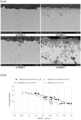
- FIG. 3 presents cross-sectional optical microscopy images of alloys 1 to 8 after they have undergone an accelerated aging heat treatment at 1150°C for 125 hours.
- the scale on these images is 50 ⁇ m.
- a dendritic structure is observed with a network of chromium carbides of type M 7 C 3 and/or M 23 C 6 located at the level of the inter-dendritic spaces as well as on the surface of the samples. Note that the surface was protected with a copper deposit in the cases of alloys 1, 2 and 6, this deposit has a clear contrast on the optical microscopy images and it is observable in the form of islands spaced at the level of the surface.
- the network of carbides rich in chromium is found entirely present up to the surface of the samples of alloys 1, 2, 3, 4 and 7. On the contrary, we observe a free layer of chromium carbides near the surface of alloys 5 and 8, as well as an internal oxidation layer. In the case of alloy 6, the width of the decarburized layer is such that, in the image, we do not observe the network of chromium carbides; on the other hand, a significant internal oxidation layer is observed.
- the large black contrast objects formed within the sample of alloys 5, 6 and 8 are aluminum nitrides.
- microstructures of alloys 1 and 6, observed by scanning electron microscope, are presented on the figure 4 (a and b) and were chemically analyzed by energy dispersive spectroscopy (EDS) ( figure 4, c And d ).
- EDS energy dispersive spectroscopy
- alloy 1 has formed a protective alumina layer on the surface.
- the aluminum signal obtained by EDS shows a peak at the surface (see figure 4 (c) ) and the chrome profile ( figure 4(d) ) shows a nominal monotonic concentration with peaks which correspond to the presence of chromium carbides.
- FIG. 5a shows the evolution in mass of alloys 2 and 5, during cyclic oxidation.
- the graph presents the number of cycles on the abscissa, a cycle corresponding to the sequence: 45 min at 1150°C and 15 min at room temperature.
- figures 5b presents cross-sectional images of these same alloys, having undergone 20 oxidation cycles in the case of alloy 2 ( figure 5b (a) and (c) ) and 10 cycles in the case of alloy 5 ( figure 5b (b) and (d) ), at two different magnifications.
- the creep resistance of alloys 1 to 9 was evaluated from creep tests at 1050°C, 1100°C, 1125°C, 1150°C and/or 1175°C, under stresses of 17, 16.5, 13 , 11.5, 10 and 9 MPa, the tests being carried out on samples taken from parts made from the different alloys.
Landscapes
- Chemical & Material Sciences (AREA)
- Engineering & Computer Science (AREA)
- Materials Engineering (AREA)
- Mechanical Engineering (AREA)
- Metallurgy (AREA)
- Organic Chemistry (AREA)
- Turbine Rotor Nozzle Sealing (AREA)
- Treatment Of Steel In Its Molten State (AREA)
- Compositions Of Oxide Ceramics (AREA)
Applications Claiming Priority (1)
| Application Number | Priority Date | Filing Date | Title |
|---|---|---|---|
| FR2210006A FR3140380B1 (fr) | 2022-09-30 | 2022-09-30 | ACIER AUSTENITIQUE REFRACTAIRE Fe-Cr-Ni-Al A HAUTE TENEUR EN NICKEL |
Publications (2)
| Publication Number | Publication Date |
|---|---|
| EP4345183A1 true EP4345183A1 (de) | 2024-04-03 |
| EP4345183B1 EP4345183B1 (de) | 2025-05-28 |
Family
ID=84569670
Family Applications (1)
| Application Number | Title | Priority Date | Filing Date |
|---|---|---|---|
| EP23200470.5A Active EP4345183B1 (de) | 2022-09-30 | 2023-09-28 | Hitzebeständiger austenitischer fe-cr-ni-al stahl mit hohem nickelgehalt |
Country Status (4)
| Country | Link |
|---|---|
| US (1) | US20240117471A1 (de) |
| EP (1) | EP4345183B1 (de) |
| ES (1) | ES3037401T3 (de) |
| FR (1) | FR3140380B1 (de) |
Citations (3)
| Publication number | Priority date | Publication date | Assignee | Title |
|---|---|---|---|---|
| FR2333870A1 (fr) | 1975-12-02 | 1977-07-01 | Pompey Acieries | Alliage refractaire a base de nickel et de chrome possedant une resistance elevee a l'oxydation, a la carburation et au fluage a tres haute temperature |
| US4248629A (en) | 1978-03-22 | 1981-02-03 | Acieries Du Manoir Pompey | Nickel- and chromium-base alloys possessing very-high resistance to carburization at very-high temperature |
| US5997809A (en) * | 1998-12-08 | 1999-12-07 | Inco Alloys International, Inc. | Alloys for high temperature service in aggressive environments |
-
2022
- 2022-09-30 FR FR2210006A patent/FR3140380B1/fr active Active
-
2023
- 2023-09-27 US US18/475,445 patent/US20240117471A1/en active Pending
- 2023-09-28 EP EP23200470.5A patent/EP4345183B1/de active Active
- 2023-09-28 ES ES23200470T patent/ES3037401T3/es active Active
Patent Citations (3)
| Publication number | Priority date | Publication date | Assignee | Title |
|---|---|---|---|---|
| FR2333870A1 (fr) | 1975-12-02 | 1977-07-01 | Pompey Acieries | Alliage refractaire a base de nickel et de chrome possedant une resistance elevee a l'oxydation, a la carburation et au fluage a tres haute temperature |
| US4248629A (en) | 1978-03-22 | 1981-02-03 | Acieries Du Manoir Pompey | Nickel- and chromium-base alloys possessing very-high resistance to carburization at very-high temperature |
| US5997809A (en) * | 1998-12-08 | 1999-12-07 | Inco Alloys International, Inc. | Alloys for high temperature service in aggressive environments |
Non-Patent Citations (2)
| Title |
|---|
| FACCO A ET AL: "Microstructure influence on creep properties of heat-resistant austenitic alloys with high aluminum content", MATERIALS SCIENCE, ELSEVIER, AMSTERDAM, NL, vol. 783, 22 March 2020 (2020-03-22), XP086144995, ISSN: 0921-5093, [retrieved on 20200322], DOI: 10.1016/J.MSEA.2020.139276 * |
| HALDER R. ET AL: "Microstructural studies on Alloy 693", JOURNAL OF NUCLEAR MATERIALS, vol. 453, no. 1-3, 1 October 2014 (2014-10-01), NETHERLANDS, pages 91 - 97, XP093030237, ISSN: 0022-3115, DOI: 10.1016/j.jnucmat.2014.07.005 * |
Also Published As
| Publication number | Publication date |
|---|---|
| FR3140380B1 (fr) | 2025-12-26 |
| ES3037401T3 (en) | 2025-10-01 |
| EP4345183B1 (de) | 2025-05-28 |
| US20240117471A1 (en) | 2024-04-11 |
| FR3140380A1 (fr) | 2024-04-05 |
Similar Documents
| Publication | Publication Date | Title |
|---|---|---|
| Brady et al. | Composition, microstructure, and water vapor effects on internal/external oxidation of alumina-forming austenitic stainless steels | |
| AU2007216791B2 (en) | Cobalt-chromium-iron-nickel alloys amenable to nitride strengthening | |
| EP3362585B1 (de) | Stahl, produkt aush dem stahl und verfahren zur herstellung | |
| CH644401A5 (fr) | Superalliage a base de nickel contenant des metaux du groupe platine. | |
| US10633717B2 (en) | Low thermal expansion superalloy and manufacturing method thereof | |
| CA2984131A1 (fr) | Acier, produit realise en cet acier, et son procede de fabrication | |
| CA2607446C (fr) | Acier martensitique durci, procede de fabrication d'une piece a partir de cet acier, et piece ainsi obtenue | |
| WO2009007562A1 (fr) | Acier martensitique durci à teneur faible ou nulle en cobalt, procédé de fabrication d'une pièce à partir de cet acier, et pièce ainsi obtenue | |
| EP3719165B1 (de) | Verfahren zur herstellung einer ni-basierten legierung sowie ni-basierte legierung | |
| US20190127832A1 (en) | Austenitic Stainless Steel | |
| FR2522335A1 (fr) | Alliage de nickel resistant a l'oxydation | |
| EP1281785A2 (de) | Rostfreier austenitischer Stahl, der von Kaltverformung gefolgt werden kann | |
| JP6741876B2 (ja) | 合金板及びガスケット | |
| EP4345183B1 (de) | Hitzebeständiger austenitischer fe-cr-ni-al stahl mit hohem nickelgehalt | |
| FR2501237A1 (fr) | Alliage a base de cobalt | |
| EP3578676B1 (de) | Austenitische legierung mit hohem aluminiumgehalt und assoziiertes designverfahren | |
| EP2655684A1 (de) | Verfahren zur herstellung einer verstärkten legierung durch plasmanitrierung | |
| RU2429308C2 (ru) | Аустенитная нержавеющая сталь | |
| EP3757238B1 (de) | Feuerfeste legierung auf nickelbasis und mit hohem chromgehalt, und entsprechendes entwicklungsverfahren | |
| WO2017182531A1 (fr) | Armature de rupteur de pont thermique pour la construction de bâtiments, et rupteur de pont thermique la comportant | |
| JP2021055141A (ja) | フェライト系ステンレス鋼 | |
| FR3026748A1 (fr) | Alliage metallique, piece metallique et procede d'obtention | |
| CN1222583A (zh) | 具有良好抗氧化性的奥氏体不锈钢 | |
| EP3411509B1 (de) | Zusammensetzung für einen stahl mit verbesserten antikokungs-eigenschaften | |
| FR2598439A1 (fr) | Alliages a base de nickel, durcis par precipitation, presentant une resistance amelioree a la fissuration par corrosion sous tension |
Legal Events
| Date | Code | Title | Description |
|---|---|---|---|
| PUAI | Public reference made under article 153(3) epc to a published international application that has entered the european phase |
Free format text: ORIGINAL CODE: 0009012 |
|
| STAA | Information on the status of an ep patent application or granted ep patent |
Free format text: STATUS: REQUEST FOR EXAMINATION WAS MADE |
|
| 17P | Request for examination filed |
Effective date: 20230928 |
|
| AK | Designated contracting states |
Kind code of ref document: A1 Designated state(s): AL AT BE BG CH CY CZ DE DK EE ES FI FR GB GR HR HU IE IS IT LI LT LU LV MC ME MK MT NL NO PL PT RO RS SE SI SK SM TR |
|
| GRAP | Despatch of communication of intention to grant a patent |
Free format text: ORIGINAL CODE: EPIDOSNIGR1 |
|
| STAA | Information on the status of an ep patent application or granted ep patent |
Free format text: STATUS: GRANT OF PATENT IS INTENDED |
|
| INTG | Intention to grant announced |
Effective date: 20250213 |
|
| GRAS | Grant fee paid |
Free format text: ORIGINAL CODE: EPIDOSNIGR3 |
|
| GRAA | (expected) grant |
Free format text: ORIGINAL CODE: 0009210 |
|
| STAA | Information on the status of an ep patent application or granted ep patent |
Free format text: STATUS: THE PATENT HAS BEEN GRANTED |
|
| AK | Designated contracting states |
Kind code of ref document: B1 Designated state(s): AL AT BE BG CH CY CZ DE DK EE ES FI FR GB GR HR HU IE IS IT LI LT LU LV MC ME MK MT NL NO PL PT RO RS SE SI SK SM TR |
|
| REG | Reference to a national code |
Ref country code: GB Ref legal event code: FG4D Free format text: NOT ENGLISH |
|
| REG | Reference to a national code |
Ref country code: CH Ref legal event code: EP |
|
| REG | Reference to a national code |
Ref country code: DE Ref legal event code: R096 Ref document number: 602023003690 Country of ref document: DE |
|
| REG | Reference to a national code |
Ref country code: IE Ref legal event code: FG4D Free format text: LANGUAGE OF EP DOCUMENT: FRENCH |
|
| REG | Reference to a national code |
Ref country code: NL Ref legal event code: FP |
|
| REG | Reference to a national code |
Ref country code: ES Ref legal event code: FG2A Ref document number: 3037401 Country of ref document: ES Kind code of ref document: T3 Effective date: 20251001 |
|
| P01 | Opt-out of the competence of the unified patent court (upc) registered |
Free format text: CASE NUMBER: UPC_APP_5675_4345183/2025 Effective date: 20250903 |
|
| PG25 | Lapsed in a contracting state [announced via postgrant information from national office to epo] |
Ref country code: FI Free format text: LAPSE BECAUSE OF FAILURE TO SUBMIT A TRANSLATION OF THE DESCRIPTION OR TO PAY THE FEE WITHIN THE PRESCRIBED TIME-LIMIT Effective date: 20250528 |
|
| PGFP | Annual fee paid to national office [announced via postgrant information from national office to epo] |
Ref country code: DE Payment date: 20250919 Year of fee payment: 3 |
|
| REG | Reference to a national code |
Ref country code: LT Ref legal event code: MG9D |
|
| PG25 | Lapsed in a contracting state [announced via postgrant information from national office to epo] |
Ref country code: GR Free format text: LAPSE BECAUSE OF FAILURE TO SUBMIT A TRANSLATION OF THE DESCRIPTION OR TO PAY THE FEE WITHIN THE PRESCRIBED TIME-LIMIT Effective date: 20250829 Ref country code: NO Free format text: LAPSE BECAUSE OF FAILURE TO SUBMIT A TRANSLATION OF THE DESCRIPTION OR TO PAY THE FEE WITHIN THE PRESCRIBED TIME-LIMIT Effective date: 20250828 |
|
| PG25 | Lapsed in a contracting state [announced via postgrant information from national office to epo] |
Ref country code: PL Free format text: LAPSE BECAUSE OF FAILURE TO SUBMIT A TRANSLATION OF THE DESCRIPTION OR TO PAY THE FEE WITHIN THE PRESCRIBED TIME-LIMIT Effective date: 20250528 |
|
| PG25 | Lapsed in a contracting state [announced via postgrant information from national office to epo] |
Ref country code: BG Free format text: LAPSE BECAUSE OF FAILURE TO SUBMIT A TRANSLATION OF THE DESCRIPTION OR TO PAY THE FEE WITHIN THE PRESCRIBED TIME-LIMIT Effective date: 20250528 |
|
| PGFP | Annual fee paid to national office [announced via postgrant information from national office to epo] |
Ref country code: BE Payment date: 20250918 Year of fee payment: 3 |
|
| PG25 | Lapsed in a contracting state [announced via postgrant information from national office to epo] |
Ref country code: HR Free format text: LAPSE BECAUSE OF FAILURE TO SUBMIT A TRANSLATION OF THE DESCRIPTION OR TO PAY THE FEE WITHIN THE PRESCRIBED TIME-LIMIT Effective date: 20250528 |
|
| PGFP | Annual fee paid to national office [announced via postgrant information from national office to epo] |
Ref country code: AT Payment date: 20251020 Year of fee payment: 3 Ref country code: FR Payment date: 20250922 Year of fee payment: 3 |
|
| PG25 | Lapsed in a contracting state [announced via postgrant information from national office to epo] |
Ref country code: RS Free format text: LAPSE BECAUSE OF FAILURE TO SUBMIT A TRANSLATION OF THE DESCRIPTION OR TO PAY THE FEE WITHIN THE PRESCRIBED TIME-LIMIT Effective date: 20250828 |
|
| PG25 | Lapsed in a contracting state [announced via postgrant information from national office to epo] |
Ref country code: IS Free format text: LAPSE BECAUSE OF FAILURE TO SUBMIT A TRANSLATION OF THE DESCRIPTION OR TO PAY THE FEE WITHIN THE PRESCRIBED TIME-LIMIT Effective date: 20250928 |
|
| PG25 | Lapsed in a contracting state [announced via postgrant information from national office to epo] |
Ref country code: LV Free format text: LAPSE BECAUSE OF FAILURE TO SUBMIT A TRANSLATION OF THE DESCRIPTION OR TO PAY THE FEE WITHIN THE PRESCRIBED TIME-LIMIT Effective date: 20250528 |
|
| REG | Reference to a national code |
Ref country code: AT Ref legal event code: MK05 Ref document number: 1798657 Country of ref document: AT Kind code of ref document: T Effective date: 20250528 |
|
| PG25 | Lapsed in a contracting state [announced via postgrant information from national office to epo] |
Ref country code: DK Free format text: LAPSE BECAUSE OF FAILURE TO SUBMIT A TRANSLATION OF THE DESCRIPTION OR TO PAY THE FEE WITHIN THE PRESCRIBED TIME-LIMIT Effective date: 20250528 Ref country code: SM Free format text: LAPSE BECAUSE OF FAILURE TO SUBMIT A TRANSLATION OF THE DESCRIPTION OR TO PAY THE FEE WITHIN THE PRESCRIBED TIME-LIMIT Effective date: 20250528 Ref country code: AT Free format text: LAPSE BECAUSE OF FAILURE TO SUBMIT A TRANSLATION OF THE DESCRIPTION OR TO PAY THE FEE WITHIN THE PRESCRIBED TIME-LIMIT Effective date: 20250528 |
|
| PGFP | Annual fee paid to national office [announced via postgrant information from national office to epo] |
Ref country code: IT Payment date: 20250930 Year of fee payment: 3 |
|
| PG25 | Lapsed in a contracting state [announced via postgrant information from national office to epo] |
Ref country code: CZ Free format text: LAPSE BECAUSE OF FAILURE TO SUBMIT A TRANSLATION OF THE DESCRIPTION OR TO PAY THE FEE WITHIN THE PRESCRIBED TIME-LIMIT Effective date: 20250528 |
|
| PG25 | Lapsed in a contracting state [announced via postgrant information from national office to epo] |
Ref country code: EE Free format text: LAPSE BECAUSE OF FAILURE TO SUBMIT A TRANSLATION OF THE DESCRIPTION OR TO PAY THE FEE WITHIN THE PRESCRIBED TIME-LIMIT Effective date: 20250528 |
|
| PG25 | Lapsed in a contracting state [announced via postgrant information from national office to epo] |
Ref country code: SK Free format text: LAPSE BECAUSE OF FAILURE TO SUBMIT A TRANSLATION OF THE DESCRIPTION OR TO PAY THE FEE WITHIN THE PRESCRIBED TIME-LIMIT Effective date: 20250528 |
|
| PGFP | Annual fee paid to national office [announced via postgrant information from national office to epo] |
Ref country code: ES Payment date: 20251030 Year of fee payment: 3 |
|
| REG | Reference to a national code |
Ref country code: DE Ref legal event code: R097 Ref document number: 602023003690 Country of ref document: DE |
|
| PG25 | Lapsed in a contracting state [announced via postgrant information from national office to epo] |
Ref country code: RO Free format text: LAPSE BECAUSE OF FAILURE TO SUBMIT A TRANSLATION OF THE DESCRIPTION OR TO PAY THE FEE WITHIN THE PRESCRIBED TIME-LIMIT Effective date: 20250528 |
|
| PLBE | No opposition filed within time limit |
Free format text: ORIGINAL CODE: 0009261 |
|
| STAA | Information on the status of an ep patent application or granted ep patent |
Free format text: STATUS: NO OPPOSITION FILED WITHIN TIME LIMIT |
|
| REG | Reference to a national code |
Ref country code: CH Ref legal event code: L10 Free format text: ST27 STATUS EVENT CODE: U-0-0-L10-L00 (AS PROVIDED BY THE NATIONAL OFFICE) Effective date: 20260409 |