EP4345907A1 - Halbleiterbauelement und verfahren - Google Patents
Halbleiterbauelement und verfahren Download PDFInfo
- Publication number
- EP4345907A1 EP4345907A1 EP22198238.2A EP22198238A EP4345907A1 EP 4345907 A1 EP4345907 A1 EP 4345907A1 EP 22198238 A EP22198238 A EP 22198238A EP 4345907 A1 EP4345907 A1 EP 4345907A1
- Authority
- EP
- European Patent Office
- Prior art keywords
- trench
- base
- field plate
- dielectric
- insulating layer
- Prior art date
- Legal status (The legal status is an assumption and is not a legal conclusion. Google has not performed a legal analysis and makes no representation as to the accuracy of the status listed.)
- Pending
Links
- 239000004065 semiconductor Substances 0.000 title claims abstract description 113
- 238000000034 method Methods 0.000 title claims description 46
- 239000000758 substrate Substances 0.000 claims abstract description 75
- 239000004020 conductor Substances 0.000 claims description 65
- 239000000463 material Substances 0.000 claims description 45
- 239000003989 dielectric material Substances 0.000 claims description 44
- 230000002093 peripheral effect Effects 0.000 claims description 26
- 210000000746 body region Anatomy 0.000 claims description 20
- 238000001020 plasma etching Methods 0.000 claims description 17
- 238000000151 deposition Methods 0.000 claims description 16
- 230000008021 deposition Effects 0.000 claims description 16
- 238000001039 wet etching Methods 0.000 claims description 12
- 238000000231 atomic layer deposition Methods 0.000 claims description 11
- 238000005498 polishing Methods 0.000 claims description 8
- 239000000126 substance Substances 0.000 claims description 8
- BOTDANWDWHJENH-UHFFFAOYSA-N Tetraethyl orthosilicate Chemical compound CCO[Si](OCC)(OCC)OCC BOTDANWDWHJENH-UHFFFAOYSA-N 0.000 claims description 3
- 238000000277 atomic layer chemical vapour deposition Methods 0.000 claims description 3
- 238000009413 insulation Methods 0.000 claims 2
- 241000237519 Bivalvia Species 0.000 claims 1
- 235000020639 clam Nutrition 0.000 claims 1
- 239000010410 layer Substances 0.000 description 112
- VYPSYNLAJGMNEJ-UHFFFAOYSA-N Silicium dioxide Chemical compound O=[Si]=O VYPSYNLAJGMNEJ-UHFFFAOYSA-N 0.000 description 33
- 239000007787 solid Substances 0.000 description 25
- 229910052814 silicon oxide Inorganic materials 0.000 description 19
- XUIMIQQOPSSXEZ-UHFFFAOYSA-N Silicon Chemical compound [Si] XUIMIQQOPSSXEZ-UHFFFAOYSA-N 0.000 description 10
- 238000007373 indentation Methods 0.000 description 10
- 229910021420 polycrystalline silicon Inorganic materials 0.000 description 10
- 229920005591 polysilicon Polymers 0.000 description 10
- 229910052710 silicon Inorganic materials 0.000 description 10
- 239000010703 silicon Substances 0.000 description 10
- 239000007789 gas Substances 0.000 description 9
- 235000012239 silicon dioxide Nutrition 0.000 description 7
- 239000000377 silicon dioxide Substances 0.000 description 7
- 239000011810 insulating material Substances 0.000 description 6
- 230000003647 oxidation Effects 0.000 description 6
- 238000007254 oxidation reaction Methods 0.000 description 6
- 230000015572 biosynthetic process Effects 0.000 description 5
- CJNBYAVZURUTKZ-UHFFFAOYSA-N hafnium(iv) oxide Chemical compound O=[Hf]=O CJNBYAVZURUTKZ-UHFFFAOYSA-N 0.000 description 4
- 238000004519 manufacturing process Methods 0.000 description 4
- 239000000203 mixture Substances 0.000 description 4
- 239000011343 solid material Substances 0.000 description 4
- 239000003990 capacitor Substances 0.000 description 3
- 239000002019 doping agent Substances 0.000 description 3
- 238000002513 implantation Methods 0.000 description 3
- 239000012212 insulator Substances 0.000 description 3
- 238000001465 metallisation Methods 0.000 description 3
- BPQQTUXANYXVAA-UHFFFAOYSA-N Orthosilicate Chemical compound [O-][Si]([O-])([O-])[O-] BPQQTUXANYXVAA-UHFFFAOYSA-N 0.000 description 2
- MCMNRKCIXSYSNV-UHFFFAOYSA-N ZrO2 Inorganic materials O=[Zr]=O MCMNRKCIXSYSNV-UHFFFAOYSA-N 0.000 description 2
- 230000015556 catabolic process Effects 0.000 description 2
- 238000010292 electrical insulation Methods 0.000 description 2
- -1 for example Substances 0.000 description 2
- 229910052735 hafnium Inorganic materials 0.000 description 2
- VBJZVLUMGGDVMO-UHFFFAOYSA-N hafnium atom Chemical compound [Hf] VBJZVLUMGGDVMO-UHFFFAOYSA-N 0.000 description 2
- 238000004518 low pressure chemical vapour deposition Methods 0.000 description 2
- RVTZCBVAJQQJTK-UHFFFAOYSA-N oxygen(2-);zirconium(4+) Chemical compound [O-2].[O-2].[Zr+4] RVTZCBVAJQQJTK-UHFFFAOYSA-N 0.000 description 2
- 239000002243 precursor Substances 0.000 description 2
- 239000011800 void material Substances 0.000 description 2
- GFQYVLUOOAAOGM-UHFFFAOYSA-N zirconium(iv) silicate Chemical compound [Zr+4].[O-][Si]([O-])([O-])[O-] GFQYVLUOOAAOGM-UHFFFAOYSA-N 0.000 description 2
- OKTJSMMVPCPJKN-UHFFFAOYSA-N Carbon Chemical compound [C] OKTJSMMVPCPJKN-UHFFFAOYSA-N 0.000 description 1
- 230000006978 adaptation Effects 0.000 description 1
- PNEYBMLMFCGWSK-UHFFFAOYSA-N aluminium oxide Inorganic materials [O-2].[O-2].[O-2].[Al+3].[Al+3] PNEYBMLMFCGWSK-UHFFFAOYSA-N 0.000 description 1
- 238000004380 ashing Methods 0.000 description 1
- 229910052799 carbon Inorganic materials 0.000 description 1
- 229910052593 corundum Inorganic materials 0.000 description 1
- 230000005684 electric field Effects 0.000 description 1
- 238000005530 etching Methods 0.000 description 1
- 230000005669 field effect Effects 0.000 description 1
- 235000015250 liver sausages Nutrition 0.000 description 1
- 229910044991 metal oxide Inorganic materials 0.000 description 1
- 150000004706 metal oxides Chemical class 0.000 description 1
- 229910021421 monocrystalline silicon Inorganic materials 0.000 description 1
- 150000004767 nitrides Chemical class 0.000 description 1
- 229920002120 photoresistant polymer Polymers 0.000 description 1
- 238000007789 sealing Methods 0.000 description 1
- 239000002356 single layer Substances 0.000 description 1
- 229910001845 yogo sapphire Inorganic materials 0.000 description 1
Images



Classifications
-
- H—ELECTRICITY
- H10—SEMICONDUCTOR DEVICES; ELECTRIC SOLID-STATE DEVICES NOT OTHERWISE PROVIDED FOR
- H10D—INORGANIC ELECTRIC SEMICONDUCTOR DEVICES
- H10D12/00—Bipolar devices controlled by the field effect, e.g. insulated-gate bipolar transistors [IGBT]
- H10D12/411—Insulated-gate bipolar transistors [IGBT]
- H10D12/441—Vertical IGBTs
- H10D12/461—Vertical IGBTs having non-planar surfaces, e.g. having trenches, recesses or pillars in the surfaces of the emitter, base or collector regions
- H10D12/481—Vertical IGBTs having non-planar surfaces, e.g. having trenches, recesses or pillars in the surfaces of the emitter, base or collector regions having gate structures on slanted surfaces, on vertical surfaces, or in grooves, e.g. trench gate IGBTs
-
- H—ELECTRICITY
- H10—SEMICONDUCTOR DEVICES; ELECTRIC SOLID-STATE DEVICES NOT OTHERWISE PROVIDED FOR
- H10D—INORGANIC ELECTRIC SEMICONDUCTOR DEVICES
- H10D12/00—Bipolar devices controlled by the field effect, e.g. insulated-gate bipolar transistors [IGBT]
- H10D12/01—Manufacture or treatment
- H10D12/031—Manufacture or treatment of IGBTs
- H10D12/032—Manufacture or treatment of IGBTs of vertical IGBTs
- H10D12/038—Manufacture or treatment of IGBTs of vertical IGBTs having a recessed gate, e.g. trench-gate IGBTs
-
- H—ELECTRICITY
- H10—SEMICONDUCTOR DEVICES; ELECTRIC SOLID-STATE DEVICES NOT OTHERWISE PROVIDED FOR
- H10D—INORGANIC ELECTRIC SEMICONDUCTOR DEVICES
- H10D30/00—Field-effect transistors [FET]
- H10D30/01—Manufacture or treatment
- H10D30/021—Manufacture or treatment of FETs having insulated gates [IGFET]
- H10D30/028—Manufacture or treatment of FETs having insulated gates [IGFET] of double-diffused metal oxide semiconductor [DMOS] FETs
- H10D30/0291—Manufacture or treatment of FETs having insulated gates [IGFET] of double-diffused metal oxide semiconductor [DMOS] FETs of vertical DMOS [VDMOS] FETs
- H10D30/0297—Manufacture or treatment of FETs having insulated gates [IGFET] of double-diffused metal oxide semiconductor [DMOS] FETs of vertical DMOS [VDMOS] FETs using recessing of the gate electrodes, e.g. to form trench gate electrodes
-
- H—ELECTRICITY
- H10—SEMICONDUCTOR DEVICES; ELECTRIC SOLID-STATE DEVICES NOT OTHERWISE PROVIDED FOR
- H10D—INORGANIC ELECTRIC SEMICONDUCTOR DEVICES
- H10D30/00—Field-effect transistors [FET]
- H10D30/60—Insulated-gate field-effect transistors [IGFET]
- H10D30/64—Double-diffused metal-oxide semiconductor [DMOS] FETs
- H10D30/66—Vertical DMOS [VDMOS] FETs
- H10D30/668—Vertical DMOS [VDMOS] FETs having trench gate electrodes, e.g. UMOS transistors
-
- H—ELECTRICITY
- H10—SEMICONDUCTOR DEVICES; ELECTRIC SOLID-STATE DEVICES NOT OTHERWISE PROVIDED FOR
- H10D—INORGANIC ELECTRIC SEMICONDUCTOR DEVICES
- H10D62/00—Semiconductor bodies, or regions thereof, of devices having potential barriers
- H10D62/10—Shapes, relative sizes or dispositions of the regions of the semiconductor bodies; Shapes of the semiconductor bodies
- H10D62/113—Isolations within a component, i.e. internal isolations
- H10D62/115—Dielectric isolations, e.g. air gaps
-
- H—ELECTRICITY
- H10—SEMICONDUCTOR DEVICES; ELECTRIC SOLID-STATE DEVICES NOT OTHERWISE PROVIDED FOR
- H10D—INORGANIC ELECTRIC SEMICONDUCTOR DEVICES
- H10D62/00—Semiconductor bodies, or regions thereof, of devices having potential barriers
- H10D62/10—Shapes, relative sizes or dispositions of the regions of the semiconductor bodies; Shapes of the semiconductor bodies
- H10D62/124—Shapes, relative sizes or dispositions of the regions of semiconductor bodies or of junctions between the regions
- H10D62/126—Top-view geometrical layouts of the regions or the junctions
- H10D62/127—Top-view geometrical layouts of the regions or the junctions of cellular field-effect devices, e.g. multicellular DMOS transistors or IGBTs
-
- H—ELECTRICITY
- H10—SEMICONDUCTOR DEVICES; ELECTRIC SOLID-STATE DEVICES NOT OTHERWISE PROVIDED FOR
- H10D—INORGANIC ELECTRIC SEMICONDUCTOR DEVICES
- H10D62/00—Semiconductor bodies, or regions thereof, of devices having potential barriers
- H10D62/10—Shapes, relative sizes or dispositions of the regions of the semiconductor bodies; Shapes of the semiconductor bodies
- H10D62/17—Semiconductor regions connected to electrodes not carrying current to be rectified, amplified or switched, e.g. channel regions
- H10D62/393—Body regions of DMOS transistors or IGBTs
-
- H—ELECTRICITY
- H10—SEMICONDUCTOR DEVICES; ELECTRIC SOLID-STATE DEVICES NOT OTHERWISE PROVIDED FOR
- H10D—INORGANIC ELECTRIC SEMICONDUCTOR DEVICES
- H10D64/00—Electrodes of devices having potential barriers
- H10D64/01—Manufacture or treatment
-
- H—ELECTRICITY
- H10—SEMICONDUCTOR DEVICES; ELECTRIC SOLID-STATE DEVICES NOT OTHERWISE PROVIDED FOR
- H10D—INORGANIC ELECTRIC SEMICONDUCTOR DEVICES
- H10D64/00—Electrodes of devices having potential barriers
- H10D64/111—Field plates
- H10D64/117—Recessed field plates, e.g. trench field plates or buried field plates
Definitions
- Transistors used in power electronic applications are typically fabricated with silicon (Si) semiconductor materials.
- Common transistor devices for power applications include Si CoolMOS ® , Si Power MOSFETs, and Si Insulated Gate Bipolar Transistors (IGBTs).
- US 10,304,933 B1 discloses a trench-based MOSFET device with a shield electrode, also commonly referred to as a field plate, at the base of the trench under a gate electrode that is arranged towards the top of the trench.
- the shield electrode is electrically insulated from the gate electrode and the side wall of the trench by a shield dielectric that includes solid dielectric portions and a cavity disposed between the shield electrode and the sidewall of the trench.
- the cavity may be gas-filled, for example air-filled, and have a dielectric constant which is less than the dielectric constant of solid material used in the shield dielectric.
- the effective dielectric constant of the shield dielectric is reduced with the aim of reducing the gate drain capacitance.
- a semiconductor device which comprises a semiconductor substrate having a first major surface, a trench extending from the first major surface into the semiconductor substrate.
- the trench has a base and a sidewall which extends from the base to the first major surface.
- a field plate is arranged in the trench and has a height f.
- the field plate is electrically insulated from the semiconductor substrate by a dielectric structure arranged in the trench.
- the dielectric structure comprises a first portion comprising a first dielectric constant and a second portion comprising a second dielectric constant that is higher than the first dielectric constant.
- the first portion of the dielectric structure is arranged in a lower portion of the trench and the second portion of the dielectric structure is arranged in an upper portion of the trench.
- the second portion of the dielectric structure has a height or thickness x and overlaps the height of the field plate by a distance v 1 , wherein f*0.1 ⁇ v 1 ⁇ f * 0.8 orf*0.3 ⁇ v 1 ⁇ f * 0.6.
- the lower first portion of the dielectric structure comprises an oxide, e.g. silicon dioxide
- the upper second portion of the dielectric structure comprises a so-called HighK dielectric.
- a HighK dielectric material has a higher dielectric constant ( ⁇ , kappa) compared to silicon dioxide. Examples of a HighK dielectric material include hafnium silicate, zirconium silicate, hafnium dioxide and zirconium dioxide.
- the higher dielectric constant of the second portion of the dielectric structure that is located towards the upper part of the field plate and in the upper part of the trench allows the semiconductor substrate in the region of the semiconductor substrate laterally adjoining the second portion of the dielectric structure to have a higher doping level.
- This enables an improvement in the parameter Ron (on resistance) x A compared to structures in which the dielectric structure is formed by a single material having a single dielectric constant.
- an unacceptably high increase in the breakdown voltage may be avoided.
- the field plate may be formed of conductive material, for example polysilicon, and is electrically insulated from the semiconductor substrate by the dielectric structure.
- the dielectric material of the upper second portion of the dielectric structure may be solid and the second portion of the dielectric structure may have a thickness x such that it overlaps the field plate by a distance vi of at least 10% of the height f of the field plate.
- the overlapping distance v1 may extend substantially perpendicularly to the first major surface when the field plate and the second portion of the dielectric structure extend into the trench substantially perpendicularly to the first major surface. At least the portion of the second portion of the dielectric structure that overlaps the field plate is positioned within the trench and below the first major surface.
- At least 20% of the height f of the field plate is not vertically overlapped by the second portion of the dielectric structure.
- the height of the field plate that is not vertically overlapped by the upper second portion of the dielectric structure may be vertically overlapped by the lower first portion of the dielectric structure.
- the dielectric structure further comprises one or more intermediate portions of the dielectric structure that are arranged vertically between the first and second portion of the dielectric structure and that comprise a material with a dielectric constant that is intermediate that of the first and second portion of the dielectric structure so that the dielectric constant increases in the direction from the base of the trench to the first major surface of the semiconductor substrate.
- the first, second and any intermediate portions of the dielectric structure are formed of a solid dielectric material.
- the first portion of the dielectric structure comprises a cavity and the second portion of the dielectric structure seals the cavity so that an enclosed and sealed cavity is formed between a side wall of the field plate and the side wall of the trench and within the trench.
- the cavity is empty, i.e. free of solid material and may be vacuum-filled or gas-filled.
- the cavity may also be called a void.
- the second portion of the dielectric structure is formed of dielectric material that is positioned in the upper portion of the trench and that extends between the field plate and the side wall of the trench.
- the second portion of the dielectric structure can be considered to form a cap or plug which seals and encloses the cavity within the trench.
- the second portion of the dielectric structure can be considered to have the form of a plug or stopper that is positioned in the upper portion of the trench and that extends between the field plate and the side wall of the trench.
- the second portion of the dielectric structure may be formed of dielectric material in the solid state.
- the first portion and the second portion of the dielectric structure may each have a ring-shape, whereby the outer contour of the ring corresponds to the inner contour of the trench, e.g. rectangular in plan view for a rectangular strip-like trench, and the inner contour of the ring corresponds to the outer contour of the field plate, e.g. rectangular in plan view for a rectangular strip-like field plate and rectangular strip-like trench.
- the second portion of the dielectric structure may be positioned entirely within the upper portion of the trench or may have a T-shape in cross-section and extend over an edge region of the first major surface and upper surface of the field plate.
- One or more further dielectric layers may be arranged on the first major surface of the semiconductor substrate that further extend over the upper surface of the second portion of the dielectric structure and the upper surface of the field plate. These one or more further dielectric layers may be part of a metallization structure.
- the second portion of the dielectric structure is formed by a portion of a dielectric layer that extends in a vertical direction into the upper portion of the trench. This dielectric layer also extends laterally over the first major surface of the semiconductor substrate and the upper surface of the field plate. The portion of the dielectric layer located within the trench extends between the field plate and the side wall of the trench.
- the dielectric layer may be part of a metallization structure and the second portion of the dielectric structure may be an integral part of this dielectric layer.
- the portion of the dielectric layer forming the second portion of the dielectric structure in the trench have the form of a cap or plug that is positioned in the upper portion of the trench and that extends between the field plate and the side wall of the trench.
- the portion of the dielectric layer forming the second portion of the dielectric structure in the trench may have a ring-shape, whereby the outer contour of the ring corresponds to the inner contour of the trench, e.g. rectangular in plan view for a rectangular strip-like trench, and the inner contour of the ring corresponds to the outer contour of the field plate, e.g. rectangular in plan view for a rectangular strip-like field plate and rectangular strip-like trench.
- the contact between the second portion of the dielectric structure and the upper portion of the field plate and the side wall of the trench forms a seal, which may have the form of a cap or plug, that seals and encloses the cavity and assists in reliably sealing the cavity within the trench.
- This arrangement also assists in ensuring the position of the field plate within the trench.
- the second portion of the dielectric structure also may act to mechanically stabilised the solid material of the field plate within the trench since it vertically overlaps the upper most portion of the field plate by the distance x, whereby x refers to the maximum overlapping distance.
- the field plate may have a greater height and is also not secured in position by means of a dielectric layer positioned intermediate the depth of the trench. The depth of the trench is the distance between the base of the trench and the first major surface of the semiconductor substrate.
- the enclosed cavity laterally and continuously surrounds the field plate within the trench.
- the cavity has an inner substantially vertical surface formed by the field plate and an outer substantially vertical surface formed by the side wall of the trench.
- the cavity has an upper surface formed by the lower surface of the second portion of the dielectric structure and a lower surface formed by the base of the trench.
- the dielectric material of the second portion of the dielectric structure is selected so as to have a higher dielectric constant than the dielectric constant of the cavity.
- the cavity may be filled with one or more gases, for example, air, or by the atmosphere present during the formation of the second portion of the dielectric structure.
- the cavity may be filled with a vacuum or with a vacuum including various processing gases.
- a semiconductor device in which the dielectric constant of the dielectric structure, which electrically insulates the field plate from the semiconductor substrate, varies along the height of the field plate and, therefore, along the depth of the trench.
- the dielectric constant increases in a direction from the base of the field plate to the first major surface of the substrate.
- the dielectric structure comprises an enclosed and sealed cavity comprising a vacuum or gas located towards the lower region of the trench and a solid dielectric material located in the upper region of the trench.
- the cavity has a lower dielectric constant than the dielectric constant of the solid dielectric material forming the second portion of the dielectric structure.
- the second portion of the dielectric structure that forms a cap for the cavity may be formed of a single material, such as silicon oxide, or may be formed of a so-called high-k dielectric material.
- the second portion of the dielectric structure may be formed of two or more sublayers and include a lower sublayer and an upper sublayer on the lower sublayer.
- the lower sublayer forms the upper surface of the cavity.
- the lower sublayer has a dielectric constant which is higher than that of the cavity but which is lower than that of the upper sublayer.
- the cavity may include a vacuum
- the lower sublayer of the second portion of the dielectric structure may be formed of silicon oxide
- the upper sublayer may be formed of a high-k dielectric material.
- the solid dielectric material of the second portion of the dielectric structure that is located towards the upper part of the field plate allows the semiconductor substrate in the region adjoining the first major surface to have a higher doping level whilst still enabling the pitch of the trenches to be reduced, since the cavity in the lower part of the trench enables the thickness of the dielectric layer in a lateral direction to be reduced and consequently, the pitch between trenches to be reduced.
- This enables an improvement in the parameter Ron (on resistance) x A (area) over structures in which the dielectric structure is formed by a single material having a single dielectric constant, whether this dielectric constant be that of the solid dielectric material of the second portion of the dielectric structure or that of the vacuum or gas within the cavity.
- the semiconductor substrate may comprise an epitaxial deposited layer that is formed on a base substrate, for example an epitaxial silicon layer formed on a silicon wafer.
- the epitaxial layer comprises a drift region of the first conductivity a first conductivity type, a body region of a second conductivity type that opposes the first conductivity type and a source region of the first conductivity type.
- the body region is arranged on and forms a pn junction with the drift region.
- the source region is arranged on and/or in the body region.
- This structure forms a transistor device, such as a MOSFET.
- the transistor device is a vertical transistor device with a drift region that extends substantially perpendicularly to the first major surface.
- the dielectric structure has a higher dielectric constant towards the top of the trench compared to the bottom of the trench.
- This arrangement may be used to allow an increase in the doping concentration in the drift zone in regions of the epitaxial layer adjacent to the second portion of the dielectric structure.
- the higher dielectric constant of the second portion of the dielectric structure provides suitable electrical insulation over the increased conductivity of the drift zone due to the increased doping concentration of the drift zone in regions of the epitaxial layer located laterally adjacent to the second portion of the dielectric structure. This enables the parameter Ron x A to be reduced. Use is also made of the observation that the electric field is higher at the base of the trench than towards the opening of the trench at the first major surface.
- the dielectric constant of the dielectric structure is selected to be lower towards the base in order to prove the electrical insulation towards the base of the trench.
- the dielectric constant of the first portion of the dielectric structure within the trench may be lower than the dielectric constant of the second portion of the dielectric structure within the trench.
- the field plate extends to or near to the first major surface of the semiconductor substrate.
- the side wall of the trench may extend substantially perpendicularly to the first major surface or may be slightly inclined to the first major surface such that the trench is slightly tapered with a smaller area at its base than at the opening at the first major surface.
- the trench in which the field plate is arranged may have an elongate stripe-like form having a length which extends parallel to the first major surface, its length being greater than its width and greater than its depth from the first major surface.
- the side wall of the trench has a plurality of side wall sections which are arranged substantially perpendicularly to one other to from a stripe-like rectangular trench.
- a plurality of trenches is provided which extend substantially parallel to one another so that a stripe-like mesa of the semiconductor material of the semiconductor substrate is formed between adjacent ones of the trenches.
- the trench has a columnar or needle type shape.
- a columnar or needle-shaped trench has a small or narrow circumference or width in proportion to its height / depth in the substrate-
- a columnar or needle trench may have an octagonal, circular, square, hexagonal and shape in plan view.
- a columnar trench may have a single side wall, for example if the trench is circular in plan view, or may have a plurality of side walls sections arranged at an angle to one another, for example if the columnar trench has a square or hexagonal shape in plan view.
- a plurality of columnar trenches is provided.
- the columnar trenches consequently the field plate positioned in the trench may be arranged in a regular square grid array of rows and columns, or an offset rows or a hexagonal array, for example.
- the semiconductor substrate may be formed of silicon and may be formed of monocrystalline silicon or an epitaxially deposited silicon layer, which is often referred to as an epi layer.
- the field plate has an upper surface which is substantially coplanar with the first major surface of the substrate.
- the thickness x of the second portion of the dielectric structure, the height f of the field plate and the distance vi of the overlap between the second portion of the dielectric structure and the field plate are measured from the first major surface and perpendicularly to the first major surface.
- the upper surface of the second portion of the dielectric structure is arranged above the first major surface of the substrate and the upper surface of the field plate is coplanar with the first major surface or positioned below the first major surface within the trench.
- the thickness x of the second portion of the dielectric structure is greater than the vertical overlap vi between the second portion of the dielectric structure and the field plate, i.e. x > vi.
- the field plate is formed of a conductive material and in some embodiments of the semiconductor device the conductive property is used more generally.
- the semiconductor device may be a capacitor.
- the semiconductor device is a transistor device, for example a MOSFET device and the conductive field plate is used as a charge compensation structure.
- the field plate may be coupled to source potential or ground potential.
- the semiconductor substrate comprises a drift region of the first conductivity a first conductivity type, a body region of a second conductivity type that opposes the first conductivity type and a source region of the first conductivity type.
- the body region is arranged on and forms a pn junction with the drift region.
- the source region is arranged on and/or in the body region.
- This structure forms a transistor device, such as a MOSFET.
- the transistor device is a vertical transistor device with a drift region that extends substantially perpendicularly to the first major surface.
- the pn junction formed between the drift region and the body region is located at a depth d from the first major surface.
- the second portion of the dielectric structure is formed of the solid dielectric material and having the thickness x extends beyond the pn junction and overlaps the drift region by a distance v 2 , wherein d*0.1 ⁇ v 2 ⁇ d * 0.8 or d*0.3 ⁇ v 2 ⁇ d* 0.6.
- the lower surface of the second portion of the dielectric structure is positioned at a greater distance from the first major surface compared to the pn junction.
- the second portion of the dielectric structure extends into the trench beyond the pn junction by a distance v 2 .
- the trench does not include a gate electrode so that the field plate extends to or near to the first major surface of the semiconductor substrate.
- the gate electrode may be arranged in the gate trench which is arranged in a mesa laterally adjacent the trench in which the field plate is positioned.
- the gate trench also extends from the first major surface into the semiconductor substrate.
- a plurality of trenches may be provided such that a mesa is formed between adjacent ones of the trenches with a gate trench positioned in each mesa.
- the dielectric structure within the trench further comprises a pillar of solid-state dielectric material which is positioned between the base of the trench and a lower surface of the field plate.
- the lower surface of the field plate is spaced apart from the base of the trench by the pillar of solid dielectric material which has a height a.
- the first portion of the dielectric structure has a base or lower surface which vertically overlaps with the pillar of dielectric material by a distance b.
- the lower surface of the first portion of the dielectric structure is in direct contact with the peripheral regions of the base of the trench such that the first portion of the dielectric structure extends from the base of the trench to the lower surface of the upper second portion of the dielectric structure.
- the base of the trench is entirely covered by an additional dielectric material.
- the first portion of the dielectric structure has a height which is such that it vertically overlaps with at least an upper portion of the pillar of dielectric material by a distance b.
- the distance b is b ⁇ a*0,6 or b ⁇ a*0,8.
- the lower surface of the first portion of the dielectric structure may be spaced apart from the base of the trench by a distance a-b and 0 ⁇ (a-b) ⁇ a * 0.4.
- the cavity has a base which vertically overlaps with the pillar of dielectric material by a distance b.
- the base of the cavity may be formed by the peripheral regions of the base of the trench such that the cavity extends from the base of the trench to the lower surface of the second portion of the dielectric structure.
- the base of the trench is entirely covered by dielectric material such that the cavity has a base formed by dielectric material.
- the cavity has a height which is such that it vertically overlaps with at least an upper portion of the pillar of dielectric material by a distance b.
- the distance b is b ⁇ a*0,6 or b ⁇ a*0,8.
- the base of the cavity is spaced apart from the base of the trench by a distance a-b and 0 ⁇ (a-b) ⁇ a * 0.4.
- the pillar of dielectric material comprises two or more sublayers which may have the same composition, for example silicon oxide, or differing compositions.
- Two sublayers formed of the same composition, for example silicon oxide, may be formed using different methods, for example thermal oxidation and high density plasma deposition.
- the first portion of the dielectric structure is a cavity
- at least the side wall of the field plate and the sidewalls and base of the trench may be covered with a dielectric layer which forms a liner layer.
- the cavity comprises a base and sidewalls formed by dielectric layer and is sealed at the top by the second portion of the dielectric structure formed by a solid dielectric material.
- the second portion of the dielectric structure that provides a cap for the cavity is formed of silicon dioxide and the dielectric liner layer, if used, is also formed of silicon oxide.
- the cap, pillar and the dielectric liner layer are formed of silicon oxide so that the cavity is bounded on all sides by silicon oxide. This may assist in forming a good seal between the cap and the dielectric liner layer and also in providing a stable atmosphere or vacuum, within the cavity.
- Exemplary embodiments also provide methods for fabricating a cavity in a trench which may be used to form the semiconductor device of any one of the embodiments described herein. The methods may be used to form a capacitor or a transistor device.
- the method comprises forming a trench in a first major surface of the semiconductor substrate, the trench having a base and a sidewall extending from the base to the first major surface.
- the method further comprises forming a first insulating layer on the base of the trench and on the sidewall of the trench, inserting conductive material into the trench and filling the trench.
- the first insulating layer is selectively removed from the sidewall and peripheral regions of the base of the trench to form a recess.
- a second insulating layer is formed in the trench that caps or seals the recess so as to form an enclosed cavity in the trench.
- the cap is at least partly and in some embodiments is entirely positioned within the trench.
- the cap has a thickness x and overlaps the height f of the conductive material.
- the recess is, however, not entirely filled by the second insulating layer such that the cavity is formed between the cap and base of the trench.
- the cavity may be filled with a vacuum or a gas.
- the cap may be positioned at least partially within the trench such that the cap overlaps the conductive material by a distance v1, wherein f*0.1 ⁇ v 1 ⁇ f * 0.8 or f*0.3 ⁇ v 1 ⁇ f * 0.6.
- the dielectric material of the cap is solid and the cap has a thickness x such that it overlaps the field plate by a distance vi of at least 10% of the height f of the field plate and at least 20% of the height f of the field plate is not vertically overlapped by the cap so that a cavity is formed between the side wall of the field plate and the side wall of the trench within the trench.
- the overlapping distance v1 may extend substantially perpendicularly to the first major surface when the field plate and the cap extend into the trench substantially perpendicularly to the first major surface.
- At least the portion of the second portion of the dielectric structure, that overlaps the field plate, is positioned within the trench and below the first major surface.
- the dielectric material forming the cap may have a dielectric constant that is greater than the dielectric constant of the cavity and/or other material(s) used in the dielectric structure that is located within the trench under the cap.
- the first insulating layer bounds a central recess formed in the trench which has dimensions suitable for forming a field plate from the conducive material inserted into this recess.
- the first insulating layer may be formed by deposition or oxidation and may comprise multiple sublayers.
- the first insulating layer is subsequently selectively removed from the trench to form a recess at the periphery of the trench, whereby the conductive material and the material of the semiconductor substrate remain largely unetched.
- the first insulating layer may be subsequently selectively removed from the trench to form a recess at the periphery of the trench by wet etching,
- the selectivity of the material of the first insulating layer, e.g. silicon oxide, over the conductive material, e.g. polysilicon, and/or the material of the semiconductor substrate, e.g. silicon may be around 100 to 1.
- the first insulating layer is selectively removed from the sidewall and peripheral regions of the base of the trench entirely so as to form a recess having a base and a sidewall formed by the material of the semiconductor substrate, e.g. silicon.
- An arrangement in which the conductive material is arranged on a pillar formed of the first insulating layer and spaced apart from the side wall of the trench by the recess is formed.
- the first insulating layer is not removed from regions of the trench positioned between the lower surface of the conductive material and the base of the trench.
- the conductive material may also have a pillar form and forms the field plate in embodiments in which the semiconductor device is a transistor device.
- the shape of the conductive material in the trench and the field plate is determined by the shape of the trench.
- the field plate also has an elongate strip-like form.
- the field plate has a columnar form.
- the first insulating layer may be formed on the base and the sidewall of the trench using various methods.
- the first insulating layer is formed by first forming a first insulating sublayer on the sidewall and base of the trench such that it bounds a centrally positioned recess in the trench.
- the first insulating sublayer is then at least partly removed from at least the sidewall of the trench.
- the first insulating layer is entirely removed from the side wall.
- the first insulating sublayer remains on the base of the trench.
- the first insulating layer may be formed using different techniques which may result in different arrangements of the first insulating layer. For example, within a high density plasma (HDP) deposition the thickness on a planar surface, such as the base of the trench, is larger than the thickness on sidewalls, such as the trench sidewall. After an HDP deposition and an oxide wet etch, the oxide on the sidewalls may be removed. whereas the oxide on the base of the trench will partially remain.
- HDP high density plasma
- a second insulating sublayer is then formed on the sidewall and on the first insulating sublayer arranged on the base of the trench. This forms an arrangement in which the total thickness of the insulating material on the base of the trench is greater than the thickness of the insulating material on the side wall of the trench.
- the remaining unfilled portion of the trench that is bounded by the second insulating sublayer forms the centrally positioned recess that defines the dimensions of the field plate and its position within the trench.
- the first insulating layer is formed by forming the first insulating sublayer on the sidewall and the base of the trench such that bounds a centrally positioned recess in the trench.
- the trench i.e. the remaining centrally positioned recess, is then filled with sacrificial material.
- the sacrificial material is then selectively removed from the upper portion of the trench to form a recess in the centre of the trench.
- a lowermost portion of the sacrificial material remains and forms a plug of sacrificial material that is arranged at the base of the recess and that is partially positioned within the first insulating sublayer.
- the centrally positioned recess is laterally surrounded by the first insulating sublayer.
- the method continues by at least partly removing the first insulating sublayer from the sidewall of the trench.
- the first insulating layer is entirely removed from the side wall. Some of the first insulating sublayer remains on the base of the trench and the plug of the sacrificial material protrudes above the first insulating sublayer remaining on the base of the trench. The plug is then removed. This may result in the formation of an indentation in the first insulating sublayer which remains on the base of the trench.
- a second insulating sublayer is then formed on the sidewalls of the trench and on the first insulating sublayer which remains on the base of the trench. The second insulating sublayer may be conformally deposited such that an indentation is formed in the upper surface of the second insulating sublayer.
- the sacrificial material may be removed by wet etching and/or ashing.
- the selectivity of the sacrificial material over the first insulating sublayer may be around 100 to 1.
- the first insulating sublayer may be formed by high-density plasma deposition and the second insulating sublayer may be formed by atomic layer deposition.
- the first insulating sublayer may be removed from the sidewalls by wet etching.
- the first insulating layer is removed by wet etching or plasma etching or a combination may be used, for example wet etching followed by plasma etching.
- the second insulating layer which is used to cap the recess and form the cavity may be deposited by atomic layer deposition, or chemical vapour deposition or TEOS (Tetra Ethyl Ortho Silicate) deposition.
- the methods of both embodiments result in a first insulating layer having a greater thickness at the base of the trench than on the sidewall of the trench.
- the method continues by forming a third insulating layer over the surface of the conductive material, the sidewalls of the trench and the peripheral regions of the base of the trench.
- the third insulating layer is a thin insulating layer such that the recess is still present between the sidewall of the conductive material and the sidewall and base of the trench which are lined with the third insulating layer.
- the second insulating layer that is formed in the trench and caps the recess to form the enclosed cavity in the trench, extends between the third insulating layer arranged on side wall of the conductive material and the side wall of the trench.
- the cavity is bounded by the third insulating layer positioned on sidewall and base of the trench and on the sidewall of the conductive material and by the cap formed by the second insulating layer arranged in the upper portion of the trench.
- the second insulating layer while forming the second insulating layer so as to cap the recess and form the enclosed cavity of the trench, some of the material of the second insulating layer is formed on the peripheral regions of the base of the trench.
- the cavity is bounded at the base and at the top by two separate regions of the second insulating layer.
- the sidewall of the cavity may be formed by the sidewall of the conductive material and the sidewall of the trench or may be formed by the third insulating layer if this is used.
- the first insulating layer is formed not only in the trench but is also formed over the first major surface of the substrate.
- the conductive material may also be further formed over the first insulating layer that is located on the first major surface of the substrate as well as on the first insulating layer within the trench. Subsequently, a planarisation process is carried out.
- planarisation process may be carried out using various methods.
- the planarisation process comprises selectively plasma etching the conductive material or a combination of chemical mechanical polishing to remove the conductive material followed by plasma etching to remove the first insulating layer.
- chemical mechanical polishing is used to remove the conductive material and the first insulating layer from the first major surface.
- both the conductive material and the first insulating layer are removed from the first major surface by plasma etching.
- the conductive material within the trench may be used in a transistor device according to one of the embodiments described herein to provide a field plate arranged within the trench formed in the semiconductor substrate.
- the semiconductor substrate may have the first conductivity type for example n-type, and forms the drift region.
- a drain region of the first conductivity type may be formed at the second major surface of the semiconductor substate that opposes the first major surface.
- a body region of the second conductivity type, e.g. p-type, that opposes the first conductivity type is formed on the drift region and a source region of the first conductivity type is formed on and/or in the body region.
- the source region and the body region may be formed by implantation of suitable dopants into the first major surface of the semiconductor substrate.
- the source and body region may be formed before or after the formation of the trench and the field plate and dielectric structure within the trench.
- the method may also be used to fabricate a transistor device having the relative dimensions of the, field plate and pillar as set out in one of the embodiments described herein.
- the cap has a thickness x
- the field plate has a height f and the cap overlaps the field plate by a distance v1, wherein f*0.1 ⁇ v 1 ⁇ f * 0.8 or f*0.3 ⁇ v 1 ⁇ f * 0.6
- the pillar spaces the field plate is spaced apart from the base of a trench by a height a and the cavity has a base that vertically overlaps with pillar by a distance b, wherein b ⁇ a*0,6 or b ⁇ a*0,8.
- lateral or lateral direction should be understood to mean a direction or extent that runs generally parallel to the lateral extent of a semiconductor material or semiconductor carrier.
- the lateral direction thus extends generally parallel to these surfaces or sides.
- vertical or “vertical direction” is understood to mean a direction that runs generally perpendicular to these surfaces or sides and thus to the lateral direction. The vertical direction therefore runs in the thickness direction of the semiconductor material or semiconductor carrier.
- various device types and/or doped semiconductor regions may be identified as being of n type or p type, but this is merely for convenience of description and not intended to be limiting, and such identification may be replaced by the more general description of being of a "first conductivity type” or a "second, opposite conductivity type” where the first type may be either n or p type and the second type then is either p or n type.
- the Figures illustrate relative doping concentrations by indicating "-" or “+” next to the doping type "n" or "p".
- n - means a doping concentration which is lower than the doping concentration of an "n"-doping region while an "n + “-doping region has a higher doping concentration than an "n"-doping region.
- Doping regions of the same relative doping concentration do not necessarily have the same absolute doping concentration.
- two different "n"-doping regions may have the same or different absolute doping concentrations.
- the semiconductor device is a transistor device and may be a MOSFET (Metal Oxide Semiconductor Field Effect Transistor) device, an insulated gate bipolar transistor (IGBT) device or a Bipolar Junction Transistor (BJT).
- MOSFET Metal Oxide Semiconductor Field Effect Transistor
- IGBT insulated gate bipolar transistor
- BJT Bipolar Junction Transistor
- the transistor device may be a vertical transistor device with a drift path that extends substantially perpendicularly to the major surfaces of the device.
- the electrodes or terminals of the transistor device are referred to herein as source, drain and gate. As used herein, these terms also encompass the functionally equivalent terminals of other types of transistor devices, such as an insulated gate bipolar transistor (IGBT).
- IGBT insulated gate bipolar transistor
- the term “source” encompasses not only a source of a MOSFET device and of a superjunction device but also an emitter of an insulator gate bipolar transistor (IGBT) device and an emitter of a Bipolar Junction Transistor (BJT) device
- the term “drain” encompasses not only a drain of a MOSFET device or of a superjunction device but also a collector of an insulator gate bipolar transistor (IGBT) device and a collector of a BJT device
- the term “gate” encompasses not only a gate of a MOSFET device or of a superjunction device but also a gate of an insulator gate bipolar transistor (IGBT) device and a base of a
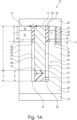
- Figure 1A illustrates a cross-sectional view of a semiconductor device 10 which comprises a semiconductor substrate 11 having a first major surface 12 and a trench 13 extending from the first major surface 12 into the semiconductor substrate 11.
- the trench 13 has a base 14 and sidewall 15 which extends from the base 14 to the first major surface 12.
- the sidewall 15 extends from the periphery of the base and entirely surrounds the periphery 14 of the base 14.
- the trench 13 has an elongate stripe -like form with the longest direction extending into the plane of the drawing.
- the side wall 15 has four side wall sections with adjoining sections extending substantially perpendicularly to one another to form a rectangular striped trench 13.
- the trench 13 has a columnar or needle type shape. If the columnar trench is circular in plan view, it has a single side wall. If the columnar trench is, for example square or hexagonal in plan view, the side wall of the columnar trench has four and six side wall sections, respectively, whereby adjoining sections extend at an angle to one another, e.g. substantially perpendicularly or around 60°.
- the side wall 15 of the trench 13 may extend substantially perpendicularly to the first major surface 12 or the trench 15 may taper slightly such that the base 14 has a smaller area than the opening of the trench 13 at the first major surface 12.
- the base 14 of the trench 13 may be substantially parallel to the first major surface 12 or have a concave form.
- An electrically conductive field plate 16 is arranged in the trench 13 and has a height f.
- an upper surface 17 of the field plate 16 is substantially coplanar with the first major surface 12 of the semiconductor substrate 11.
- the lower surface 18 of the field plate 16 is therefore positioned at a distance from the first major surface 12 that corresponds to the height f of the field plate.
- the field plate 16 is formed of electrically conductive material such as n-doped polysilicon and is electrically insulated from the semiconductor substrate 11 by a dielectric structure 19 which is arranged in the trench 13.
- the dielectric structure 19 comprises a first portion 20 arranged in a lower portion of the trench 13 and a second portion 22 arranged in an upper portion of the trench 13.
- the first portion 20 of the dielectric structure 19 comprises a dielectric having a first dielectric constant and the second portion 22 of the dielectric structure 19 comprises a dielectric having a second dielectric constant that is higher than the first dielectric constant.
- the first portion 20 of the dielectric structure 19 is formed by an enclosed and sealed cavity and the second portion 22 of the dielectric structure 19 provides a cap or plug that is positioned within the trench 13 and that seals the cavity.
- the dielectric structure 19 comprises an enclosed and sealed cavity 20 which is laterally positioned between a sidewall 21 of the field plate 16 and the sidewall 15 of the trench 13.
- the cavity 20 is sealed at the top by a cap 22 formed of a dielectric material which is solid.
- the base of the cavity 12 is formed by a peripheral region 23 of the base 14 of the trench 13 that is uncovered by the field plate 16.
- the cavity 20 is, therefore, bounded by the lower surface 29 of the cap 22 of solid dielectric material at the top, the sidewall 21 of the electrically conductive material of the field plate 16 at its inner side and the sidewall 15 of the trench 13 at its opposing outer side and at the base by the peripheral region 23 of the base 14.
- the side wall 15 and peripheral region 23 of the trench 13 are provided by the semiconductor material of the substrate 11, e.g. silicon.
- the cavity 20 laterally and continuously surrounds the field plate 16 within the trench 13.
- the cavity 20 is free of solid material and may be filled by a gas or vacuum, for example, the atmosphere of the processing chamber during the process in which the cap 22 is formed.
- the cavity 20 may also be considered to be a void that is formed in the dielectric structure 19.
- the sidewall 15 of the trench, the sidewall 21 of the field plate 16 and the peripheral region 23 of the base 14 of the trench are covered by a solid dielectric material, for example silicon oxide, in the form of a lining or liner layer which bounds the cavity 20.
- a solid dielectric material for example silicon oxide
- the cap 22 has a maximum thickness or height x between its upper surface 24 and lower surface 29 in a direction which is substantially perpendicular to the first surface 12 and parallel to the height f of the field plate 16.
- the upper surface of the cap 22 is substantially coplanar with the first major surface 12 so that the thickness x of the cap 22 is measured with respect to the first major surface 12.
- the cap 22 extends between fills the space between the sidewall 21 of the field plate 16 and the sidewall 15 of the trench 13 in the upper portion of the trench 13.
- the cap 22 has a breadth y which corresponds to the distance between the sidewall 15 of the trench 13 and the sidewall 21 of the field plate 16.
- the cap 22 is positioned only within the upper portion of the trench 13. In this embodiment, the cap 22 extends into the trench 13 from the first major surface by a distance x which corresponds to the thickness of the cap 22.
- the cap 22, therefore overlaps the height of the field plate 16 in a direction which is substantially perpendicular to the first major surface 12 of the substrate 11 and can be considered to vertically overlap the field plate 16.
- the cap 20 overlaps the height of the field plate 16 by a distance v 1 , whereby f*0.1 ⁇ v 1 ⁇ f * 0.8 or f*0.3 ⁇ v 1 ⁇ f * 0.6.
- the minimum overlap of the height of the field plate 16 by the cap is 10%.
- This provides a reliable seal for the cavity 20 and assists in securing the position of the field pate 16 within the trench 13.
- This overlap may be increased up to 80% of the height of the field plate 16 so that at least 20% of the height of the field plate 16 is surrounded by a cavity 20.
- the overlapping distance v 1 may, however, differ from the thickness x of the cap 22 in embodiments in which, for example, the upper surface 17 of the field plate 16 is positioned within the trench 13 and spaced at a distance from the first major surface 12 and/or in embodiments in which the upper surface 24 of the cap 22 protrudes above the first major surface 12.
- the solid dielectric material of the cap 22 has, in some embodiments, a higher dielectric constant than the dielectric constant of the cavity.
- a vacuum has a dielectric constant of around 1.
- the cap 22 may be formed of silicon oxide, e.g. silicon dioxide, which has a dielectric constant of around 3.9.
- the dielectric constant of the dielectric structure 19 within the trench 13 increase from the lower surface 18 to the upper surface 17 of the field plate16.
- the solid dielectric material towards the upper part of the field plate 16 enables the semiconductor substrate 11 in the region adjoining the first major surface 12 to have a higher doping level.
- the pitch of the trenches 13 can be reduced, since the cavity 20 in the lower part of the trench 13 enables the thickness of the dielectric structure 19 in a lateral direction to be reduced and consequently, the pitch between trenches to be reduced.
- This combination of features enables an improvement in the parameter Ron (on resistance) x A, a reduction the gate drain capacitance and an improved the breakdown voltage of the device.
- the dielectric structure 19 which electrically insulates the field plate 16 from the semiconductor substrate 11 further comprises a pillar 25 of solid dielectric material which is positioned between the lower surface 18 of the field plate 16 and the base 14 of the trench 13.
- the pillar 25 may have a width and a length which substantially corresponds to the width and length of the field plate 16.
- the pillar 25 has a height a. The sum of the height a of the pillar 25 and the height f of the field plate 16 may correspond to the depth of the trench 13, that is the distance between the base 14 and the first major surface 12.
- the cavity 20 overlaps the pillar 25 of solid dielectric material in the same direction as the overlap vi between the solid dielectric 22 and the field plate 16.
- the cavity 20 overlaps the height a of the pillar 25 by distance b, whereby b ⁇ a*0,6 or b ⁇ a*0,8. In other words the cavity 20 overlaps 60% to 100% of the height of the pillar 25 or 80% to 100% of the height of the pillar 25.
- the peripheral region 23 of the base 14 is covered by a layer of solid dielectric material which has a thickness as measured from the base 14 which is less than the thickness a of the pillar 25, in these embodiments, the base of the cavity 20 is spaced apart from the base 14 of the trench 13 by distance (a-b) which lies in the range of 0 ⁇ (a-b) ⁇ a * 0.4.
- the cavity 20 laterally and continuously surrounds the field plate 16 within the trench 13.
- the cavity 20 is also positioned between the base 18 of the field plate 16 and the base 14 of the trench 13.
- the pillar 25 of solid dielectric material may be omitted.
- the vertical overlap between the cap 22 and the upper portion of the field plate 16 serves to not only seal the cavity 20 but also to anchor the field plate 16 in position within the trench, particularly in embodiments in which the pillar 25 is omitted.
- the field plate 16 is formed of an electrically conductive material, typically polysilicon.
- the semiconductor substrate 11 is typically formed of silicon and the solid dielectric material forming the cap 22 may be silicon oxide.
- the pillar 25 may also be formed of silicon oxide. In some embodiments, the pillar 25 is formed of two sublayers 26, 27 which may have the same or differing compositions.
- the semiconductor device 10 is, in the embodiment illustrated in figure 1 , a transistor device.
- the arrangement of the trench 13, electrically conductive field plate 16 and the dielectric structure 19 comprising the cavity 20 and cap 22, which electrically insulates the field plate 16 from the semiconductor substrate 11, may be used to in other types of semiconductor devices.
- the field plate 16 is not used as a field plate 16 but uses the more general properties of an electrically conductive material and the dielectric properties of the dielectric structure 19.
- the arrangement may be used to form a capacitor.
- the semiconductor device 10 is a transistor device.
- the semiconductor substrate 11 comprises a drift region 30 of the first conductivity type, for example n-type, a body region 31 of a second conductivity type which opposes the first conductivity type, for example p-type if the drift region is n-type, which is arranged on the drift region 30 and source region 32 formed of the first conductivity type which is arranged on and/or in the body region 31.
- the semiconductor device 10 further includes a drain region 33 of the first conductivity type which is arranged below the base 14 of the trench 13.
- the transistor device 10 is a vertical transistor device, for example a vertical MOSFET device.
- the body region 31 forms a pn junction 34 with the underlying drift region 30 which is positioned at a distance d from the first major surface 12.
- the lower surface 29 of the cap 22 is positioned at a distance x from the first major surface 12 within the trench 13 and the distance x is greater than the distance d of the pn junction 34 from the first major surface 12.
- the cap 22 vertically the overlaps the source region 32, the body region 31 and extends beyond the position 34 of the pn junction 34 by a distance v 2 .
- the cap 22 vertically overlaps the drift region 30 by the distance v 2 .
- the transistor device also comprises a gate electrode 35 which is positioned in a gate trench 36 which extends from the first major surface 12 into the semiconductor substrate 11.
- the gate trench 36 also has a base 37 and sidewalls 38 which extend from the base 37 to the first major surface 12.
- the gate electrode 35 is formed of conductive material, for example polysilicon, and is electrically insulated from the semiconductor substrate 11 by a gate dielectric 39 which lines the base 37 and sidewalls 38 of the gate trench 36.
- the trench 13 is one of a plurality of trenches which are arranged in a regular array and spaced apart from one another by a mesa 28 formed by the semiconductor substrate 11.
- the trenches 13 each have an elongate strip-like shape
- the trenches 13 extend substantially parallel to one another and a stripe-like mesa 28 is formed between the side walls of adjacent trenches 13.
- the trenches 13 may be arranged in an array of rows and columns or off-set rows, for example.
- the mesa 28 comprises the drift region 30, body region 31 and source region 32.
- the gate trench 36 is positioned in the mesa 28 and is laterally spaced apart from neighbouring ones of the trenches 13.
- the upper surface 12 of the substrate 11 may be covered by an electrically insulating layer 40 which forms a part of the frontside metallisation structure and which covers the upper surface 17 of the field plate 16 and the gate electrode 35 in addition to the first major surface 12. Contacts are made to the field plate 16, the gate electrode 35 and the mesa 28 which are positioned in a different plane of the semiconductor device 10 and cannot be seen in the cross-sectional view of figure 1 .
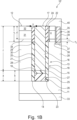
- Figure 1B illustrates a cross-sectional view of a semiconductor device 10' according to an embodiment which differs from the semiconductor device 10 illustrated in, and described with reference to, figure 1A in the material of the first portion 20 of the dielectric structure 19 that is formed within the trench 13.
- the first portion of the dielectric structure 19 comprises a dielectric material in the solid state rather than a cavity.
- the first portion 20 of the dielectric structure 19 comprises a dielectric having a first dielectric constant and the second portion 22 of the dielectric structure 19 comprises a dielectric having a second dielectric constant that is higher than the first dielectric constant.
- the lower first portion 20 of the dielectric structure 19 comprises an oxide, e.g. silicon dioxide
- the upper second portion 22 of the dielectric structure 19 comprises a so-called HighK dielectric.
- a HighK dielectric material has a higher dielectric constant ( ⁇ , kappa) compared to silicon dioxide. Examples of a HighK dielectric material include hafnium silicate, zirconium silicate, hafnium dioxide and zirconium dioxide.
- the dielectric structure 19 is not limited to having two portions 20, 22 comprising dielectric materials of differing dielectric constant but may include more than two portions.
- the dielectric structure 19 further comprises one or more intermediate portions of the dielectric structure19 that are arranged vertically between the lower first portion 20 of the dielectric structure 19 and the upper second portion 22 of the dielectric structure 19 and that comprise a material with a dielectric constant that is intermediate that of the first and second portions 20, 22 of the dielectric structure 19.
- the dielectric constant of the dielectric structure 19 within the trench 13 increases in the direction from the base 14 of the trench 13 to the first major surface 12 of the semiconductor substrate 11.
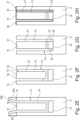
- Figure 2 which includes figures 2A to 2J , illustrates a method for fabricating a sealed cavity in a trench according to an embodiment.
- the method may be used to fabricate the semiconductor device of any one of the embodiments described herein including the semiconductor device 10 shown in figure 1A with the field plate 16 arranged in the trench 13 and electrically insulated from the semiconductor substrate 11 by the dielectric structure 19 including the vacuum-filled or gas-filled cavity 20 and the cap 22 of solid dielectric material.
- the method may be carried out before the fabrication of the body region 31 and source region 32, for example by implantation of suitable dopants into the semiconductor substate 11, or the body region 31 and source region 32 may first be formed by implantation of dopants into the semiconductor substate 11 and then the trench 13 is formed.
- the gate trench 36 and gate electrode 35 with its gate dielectric 39 may be formed using some of the processes used to form the trench 13 for the field plate 16.
- a trench 13 is formed in the upper surface 12 of the semiconductor substrate 11 and is lined with a first insulating sublayer 50a which extends over the first major surface 12 of the semiconductor substrate 11 and over the sidewall 15 and base 14 of the trench 13.
- the thickness of the first insulating sublayer 50a may be greater on the horizontal surfaces, that is the first major surface 12 of the semiconductor substrate 11 and the base 14 of the trench 13, than on the vertical surfaces, that is the sidewall 15 of the trench 13.
- the first insulating sublayer 50a may be formed by thermal oxidation or high density plasma deposition and may comprise silicon oxide.
- the first insulating sublayer 50a is removed entirely from the sidewalls 15 of the trench 13 and partially from the base 14 of the trench 13 such that its thickness on the base 14 of the trench 13 is reduced.
- the first insulating sublayer 50a remains on the first major surface 12 and on the base 14 of the trench 13 but its thickness may be reduced.
- the first insulating sublayer 50a may be removed by wet etching.
- a second insulating sublayer 50b is deposited which covers the first insulating sublayer 50a on the first major surface 12, the sidewall 15 and the remainder of the first insulating sublayer 50a positioned on the base 14 of the trench 13.
- the second insulating sublayer 50b may be conformally deposited and may be deposited using Atomic Layer Deposition (ALD).
- the first and second insulating sublayers 50a, 50b may comprise silicon dioxide.
- the first and second insulating sublayers 50a, 50b form a first insulating layer 50 which covers the first major surface 12, the base 14 and sidewall 15 of the trench 13.
- the first insulating layer 50 has a greater thickness on the base 14 than on the side wall 15 of the trench 13.
- the first insulating layer 50 may be formed of a single layer rather than the two sublayers 50a, 50b shown in the embodiment illustrated in figure 2 .
- conductive material 51 is then inserted into the trench 13 and fills the trench 13 and also extends over the first insulating layer 50 arranged on the first major surface 12 of the semiconductor substrate 11.
- the conductive material 51 may be polysilicon, for example polysilicon highly doped with the first conductivity type. Highly doped polysilicon may be deposited using LPCVD (Low Pressure Chemical Vapour Deposition).
- a planarisation process is carried out.
- the planarisation process may be carried out using various methods.
- the planarisation process comprises selectively plasma etching the conductive material 51 or a combination of chemical mechanical polishing to remove the conductive material 51 from the first major surface 12 followed by plasma etching to remove the underlying first insulating layer 50 from the first major surface 12.
- chemical mechanical polishing is used to remove the conductive material 51 and the first insulating layer 50 from the first surface 12.
- both the conductive material 51 and the first insulating layer 50 may be removed from the first surface 12 by plasma etching.
- the conductive material 51 is selectively removed such that it has an upper surface 52 which is substantially coplanar with the first major surface 12 of the semiconductor substrate 11 to form a field plate 16 in the trench 13.
- the conductive material 51 is, therefore, removed from the first insulating layer 50 arranged on the first major surface 12 such that an opening is formed in the first insulating layer 50 with the upper surface 52 of the conductive material 51 at its base.
- the first insulating layer 50 may then be entirely removed from the first major surface 12.
- the second insulating sublayer 50b is then selectively removed from the upper portion of the trench 13 exposing the sidewalls 15 of the trench and upper portion of the conductive material 51 and forming a recess 53 which laterally surrounds the upper portion of the conductive material 51 within the trench 13.
- the base of the peripheral recess 53 is formed by a portion of the first insulating layer 50 remaining in the trench 13 which vertically overlaps sidewall 21 of the conductive material 51 at the base.
- the second insulating sublayer 50b may be selectively removed over the conductive material 51 and the semiconductor substrate 111 by wet etching or plasma etching or wet etching followed by plasma etching.
- the method continues, as shown in figure 2G , by selectively removing the portions of the first insulating layer 50, which are positioned laterally adjacent to the conductive material 51 such that a pillar 25 of dielectric material is formed from the remainder of the first insulating layer 50.
- the pillar 25 comprises two the sublayers 50a, 50b of the first insulating layer 50.
- the pillar 25 may have lateral dimensions, i.e. a width and a length, which correspond to the lateral dimensions of the conductive material 15.
- the recess 53 now extends from the first major surface 12 to the base 14 of the trench such that the peripheral regions 23 of the base 14 are uncovered by the first insulating layer 50.
- a thin dielectric layer 54 is deposited which covers the first major surface 12, the sidewalls 15 and peripheral region 23 of the base 14 of the trench 13, the sidewall of the pillar 25 and the sidewall 21 and upper surface 59 of the conductive material 51, as illustrated in figure 2H .
- This dielectric liner layer 54 may be used to assist in improving the adhesion between the material of the cap and materials of the conductive material 51 and semiconductor substrate 11 so as to provide a good seal for the cavity within the trench 13.
- the dielectric liner layer 54 may be formed by thermal oxidation and/or deposition and may comprise silicon oxide.
- a second insulating layer 55 is deposited onto the first major surface which extends into the upper portion of the trench 13 and which forms the cap 22.
- the second insulating layer 55 extends into the trench 13 by a maximum distance x from the first surface 12 and overlaps the upper portion of the conductive material 51 forming the field plate 16 by a distance vi.
- the lower surface 29 of the cap 22 is not horizontal as depicted in the schematic view of figure 1 but includes an indentation 56 or up turned V or U-form such that the cap 22 has a maximum thickness x from the first major surface 12 along the sidewall 15 of the trench 13 and the sidewall 21 of the field plate 16 which is greater than its thickness x 2 from the first major surface 12 at a point intermediate the width of the cap 22.
- This indentation 56 may have a height z.
- This form of the lower surface 29 of the cap 22 may arise due to preferential growth of the second insulating layer 55 on the sidewall 15 of the trench 13 and sidewall 21 of the field plate 16.
- some of the second insulating layer 55 is also deposited on the peripheral regions 23 of the base 14 of the trench 13, as shown in figure 21 , such that the base of the cavity 20 is formed by the second insulating material positioned on the base 14 of the trench 13.
- the cavity 20 has an upper side that is formed by the second insulating material forming the cap 22 and vertical sides extending between the second insulating layer 55 on the base 4 of the trench 13 and the lower surface 19 of the cap 22 by the dielectric layer 54 which lines the sidewall 15 of the trench 13, the sidewall 21 of the field plate 16 and the side wall of the pillar 25.
- the second insulating layer 55 extends between the dielectric layer 54 positioned on the side wall 15 of the trench and the side wall 21 of the conductive material 51.
- the second insulating layer 55 may be deposited using ALD or CVD, for example and may be formed of silicon oxide.
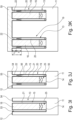
- Figure 2J shows a larger portion of the semiconductor substrate 11 which includes two neighbouring trenches 13 and the mesa 28 formed between them.
- the deposition conditions for forming the second insulating layer 55 can be controlled in order that the second insulating layer 55 is deposited at the top of the trench and optionally only to a smaller extent at the base 14 of the trench so as to form the cavity 20 within the trench 13.
- ALD deposition in order to prevent material deposition in higher depth x the sticking coefficient of the precursor is elected so as to be large (close to 1).
- TMA Al 2 O 3 precursor
- the height Z of the wedge or indentation 56 may be larger than in case of ALD.
- the epitaxial doping profile of the semiconductor substrate 11 may be adjusted in order to further improve performance and device stability in dependence on the dielectric constant of the material used for the second insulating layer 55, the depth x of the cap 22 and the shape of the indentation and the width Y and consequently the height of the cavity 20 and its vertical position with respect to the field plate 16.
- Figure 3 which includes figures 3A to 3K illustrates a method for forming a sealed cavity in a trench according to another embodiment. This method may be used for fabricating the semiconductor device 10 according to the embodiments described herein including the semiconductor device illustrated in figure 1 . The method described with reference to figure 3 differs from the method described with reference to figure 2 in the fabrication of the first insulating layer 50.
- a trench 13 is formed in the first surface 12 of the semiconductor substrate 11, for example by etching, and a first insulating sublayer 50a is formed which lines the sidewalls sidewall 15 and base 14 of the trench 13 and which extends over the first major surface 12 of the semiconductor substrate 11.
- the first insulating sublayer 50a may be formed by thermal oxidation and/or deposition and may comprise silicon oxide.
- a sacrificial material 57 is then deposited which fills the trench 13.
- the sacrificial material 57 may also extend over the first major surface 12.
- the sacrificial material 57 is formed of a material that is selectably etchable over the material of the semiconductor substrate, e.g. silicon, and also over the material of the first insulating sublayer 50a, e.g. silicon oxide.
- the sacrificial material may be carbon, a photoresist or a nitride, for example.
- the sacrificial material 57 is selectively removed to form a recess 58 in the centre of the trench 13. A portion of the sacrificial material 57 remains at the base of the trench 13 to form a plug 60, as can be seen in figure 3C . The entire sidewall 15 of the trench 13 and the first major surface 12 are covered by the first insulating sublayer 50a at this stage. The removal of the upper portion of the sacrificial material 57 forms a central recess that is bounded at the sides by the first insulating sublayer 50a and at the base by the plug 60.
- the first insulating sublayer 50a is then removed from the first major surface 12 and the sidewall 15 of the trench 13.
- the first insulating sublayer 50a may be removed entirely from the first major surface 12 of the semiconductor substrate 11 and from the side wall 15 of the trench 13 in the upper portion of the trench 13. A portion of the first insulating sublayer 50a remains in the base 14 of the trench 13.
- the first insulating sublayer 50a may also be removed such that a portion of the plug 60 is revealed and protrudes from the remaining portion of the first insulating sublayer 50a positioned at the base 14 of the trench 30. A wet etch may be used.
- the plug 60 is then removed such that the base 14 of the trench 13 is covered by the remainder of the first insulating layer 50a and includes an indentation in its upper surface which was previously filled by the plug 60.
- a second insulating sublayer 50b is then formed which covers the first major surface 12 of the substrate 11, the exposed sidewall 15 of the trench 13 and the upper surface of the first insulating sublayer 50a remaining on the base 14 of the trench 13,
- the second insulating layer 50b may be deposited using Atomic Layer Deposition (ALD) and may be formed of silicon oxide. In some embodiments, the second insulating layer 50b is also formed on the first major surface 12.
- ALD Atomic Layer Deposition
- conductive material 51 is then inserted into the conductive into the trench 13 so as to fill the trench 13.
- the conductive material 51 may have an upper surface 59 which is substantially coplanar with the first major surface 12.
- the conductive material 51 may be polysilicon, for example polysilicon highly doped with the first conductivity type.
- a planarisation process is carried out.
- the planarisation process may be carried out using various methods.
- the planarisation process comprises selectively plasma etching the conductive material 51 or a combination of chemical mechanical polishing to remove the conductive material 51 from the first major surface 12 followed by plasma etching to remove the second insulating sublayer 50b from the first major surface 12.
- chemical mechanical polishing is used to remove the conductive material 51 and the second insulating sublayer 50b from the first surface 12.
- both the conductive material 51 and the second insulating sublayer 50b may be removed from the first surface 12 by plasma etching.
- the second insulating sublayer 50b is then removed from the first major surface 12 and upper portion of the trench 13 so as to expose sidewall 15 the trench and the sidewall 21 of the field plate 16 in the upper portion of the trench 13 and form the recess 53.
- the base of the field plate 16 is positioned within the first and second insulating sublayers 50a, 50b arranged in the lower portion of the trench 13.
- the second insulating sublayer 50b may be selectively removed over the conductive material 51 and material of the semiconductor substrate 11 by wet etching.
- the remainder of the first and second insulating sublayers 50a, 50b is then removed from the peripheral region of the trench 13 to form the pillar 25.
- the pillar 25 is formed of the two sublayers 50a, 50b.
- the remainder of the first and second insulating sublayers 50a, 50b may be removed from the peripheral region 23 of the base 14 of the trench 13 to form the pillar 25 by carrying out an anisotropic etch.
- the first and second insulating sublayers 50a, 50b are removed entirely from the peripheral region 23 of the base 14 of the trench 13 while leaving the pillar 25 formed of the first and second sublayers 50a, 50b under the lower surface of the conductive material 51.
- the base of the lower surface of the field plate 16 has a protruding portion which protrudes into the second insulating sublayer 50b which may provide a better mechanical interlocking between the field plate 16 and the pillar 25.
- the dielectric layer 54 may be deposited which lines the sidewall 55, peripheral region 23 of the base 14 of the trench 13 and which covers the sidewall of the pillar 25, the sidewall 21 of the field plate 16 and the first major surface 12, as illustrated in figure 31 .
- the dielectric layer 54 may be formed of an oxide, for example a silicon oxide and may be formed by thermal oxidation and/or deposition.
- the second insulating layer 55 is then deposited to form the cap 22 in the upper portion of the trench and so as to seal the cavity 20. Similar to the structure for the cap 22 shown in figure 21 , the second insulating layer 55 and the cap 22 extends into the trench 13 by a maximum distance x from the first surface 12.
- the lower surface 29 of the cap 22 includes an indentation 56 or up turned V or U-form such that the cap 22 has a thickness x from the first major surface 12 along the sidewall 15 of the trench 13 and the sidewall 21 of the field plate 16 which is greater than its thickness x2 from the first major surface 12 at a point intermediate the width of the cap 22.
- This indentation may have a height z.
- This form of the lower surface 29 of the cap 22 may arise due to preferential growth of the second insulating layer 55 on the sidewall 15 of the trench 13 and sidewall 21 of the field plate 16.
- the cavity 20 has a base formed by the second insulating material positioned on the base 14 of the trench 13, an upper side formed by the second insulating material forming the cap 22 and vertical sides by the dielectric layer 54 which lines the sidewall 15 of the trench 13, sidewall 21 of the field plate 16 and the side wall of the pillar 25.
- the second insulating layer 55 extends between the dielectric layer 54 positioned on the side wall 15 of the trench and the side wall 21 of the conductive material 51 at both the top and bottom of the cavity 20.
- Figure 3K illustrates a view of the semiconductor device 10 and two trenches 13 and illustrates the mesa 28 formed between adjoining ones of the trenches 13.
Landscapes
- Element Separation (AREA)
Priority Applications (5)
| Application Number | Priority Date | Filing Date | Title |
|---|---|---|---|
| EP22198238.2A EP4345907A1 (de) | 2022-09-28 | 2022-09-28 | Halbleiterbauelement und verfahren |
| DE102023121994.4A DE102023121994A1 (de) | 2022-09-28 | 2023-08-17 | Halbleitervorrichtung und verfahren |
| US18/466,432 US20240105784A1 (en) | 2022-09-28 | 2023-09-13 | Semiconductor device and method |
| KR1020230126882A KR20240044354A (ko) | 2022-09-28 | 2023-09-22 | 반도체 디바이스 및 방법 |
| CN202311271456.7A CN117790552A (zh) | 2022-09-28 | 2023-09-28 | 半导体器件和方法 |
Applications Claiming Priority (1)
| Application Number | Priority Date | Filing Date | Title |
|---|---|---|---|
| EP22198238.2A EP4345907A1 (de) | 2022-09-28 | 2022-09-28 | Halbleiterbauelement und verfahren |
Publications (1)
| Publication Number | Publication Date |
|---|---|
| EP4345907A1 true EP4345907A1 (de) | 2024-04-03 |
Family
ID=83688898
Family Applications (1)
| Application Number | Title | Priority Date | Filing Date |
|---|---|---|---|
| EP22198238.2A Pending EP4345907A1 (de) | 2022-09-28 | 2022-09-28 | Halbleiterbauelement und verfahren |
Country Status (5)
| Country | Link |
|---|---|
| US (1) | US20240105784A1 (de) |
| EP (1) | EP4345907A1 (de) |
| KR (1) | KR20240044354A (de) |
| CN (1) | CN117790552A (de) |
| DE (1) | DE102023121994A1 (de) |
Families Citing this family (2)
| Publication number | Priority date | Publication date | Assignee | Title |
|---|---|---|---|---|
| US12191351B1 (en) * | 2024-05-14 | 2025-01-07 | Globalfoundries Singapore Pte. Ltd. | Laterally-diffused metal-oxide-semiconductor devices with an air gap |
| DE102024121365A1 (de) | 2024-07-26 | 2026-01-29 | Infineon Technologies Austria Ag | Halbleitervorrichtung und verfahren zum bilden eines leitfähigen elements und einer dielektrischen struktur in einem graben |
Citations (4)
| Publication number | Priority date | Publication date | Assignee | Title |
|---|---|---|---|---|
| WO2012006261A2 (en) * | 2010-07-06 | 2012-01-12 | Maxpower Semiconductor Inc. | Power semiconductor devices, structures, and related methods |
| CN106298939A (zh) * | 2016-08-22 | 2017-01-04 | 电子科技大学 | 一种具有复合介质层结构的积累型dmos |
| US20170263767A1 (en) * | 2016-03-08 | 2017-09-14 | Kabushiki Kaisha Toshiba | Semiconductor device |
| US10304933B1 (en) | 2018-04-24 | 2019-05-28 | Semiconductor Components Industries, Llc | Trench power MOSFET having a trench cavity |
-
2022
- 2022-09-28 EP EP22198238.2A patent/EP4345907A1/de active Pending
-
2023
- 2023-08-17 DE DE102023121994.4A patent/DE102023121994A1/de active Pending
- 2023-09-13 US US18/466,432 patent/US20240105784A1/en active Pending
- 2023-09-22 KR KR1020230126882A patent/KR20240044354A/ko active Pending
- 2023-09-28 CN CN202311271456.7A patent/CN117790552A/zh active Pending
Patent Citations (4)
| Publication number | Priority date | Publication date | Assignee | Title |
|---|---|---|---|---|
| WO2012006261A2 (en) * | 2010-07-06 | 2012-01-12 | Maxpower Semiconductor Inc. | Power semiconductor devices, structures, and related methods |
| US20170263767A1 (en) * | 2016-03-08 | 2017-09-14 | Kabushiki Kaisha Toshiba | Semiconductor device |
| CN106298939A (zh) * | 2016-08-22 | 2017-01-04 | 电子科技大学 | 一种具有复合介质层结构的积累型dmos |
| US10304933B1 (en) | 2018-04-24 | 2019-05-28 | Semiconductor Components Industries, Llc | Trench power MOSFET having a trench cavity |
Also Published As
| Publication number | Publication date |
|---|---|
| DE102023121994A1 (de) | 2024-03-28 |
| KR20240044354A (ko) | 2024-04-04 |
| CN117790552A (zh) | 2024-03-29 |
| US20240105784A1 (en) | 2024-03-28 |
Similar Documents
| Publication | Publication Date | Title |
|---|---|---|
| US11682704B2 (en) | Method of producing a semiconductor device | |
| KR100589252B1 (ko) | 자기 정렬된 소스 및 접촉을 가진 트랜치 fet | |
| US20240105784A1 (en) | Semiconductor device and method | |
| US12230706B2 (en) | Transistor device having a cell field and method of fabricating a gate of the transistor device | |
| US20240339507A1 (en) | Semiconductor device | |
| CN111564493A (zh) | 沟渠式功率电晶体及其制作方法 | |
| US20240128329A1 (en) | Semiconductor device and method of producing a cavity in a trench | |
| US12166080B2 (en) | Semiconductor transistor device having a titled body contact area and method of manufacturing the same | |
| US12094969B2 (en) | Transistor device having a field plate | |
| US11569345B2 (en) | Gas dopant doped deep trench super junction high voltage MOSFET | |
| US20260032978A1 (en) | Semiconductor device and method for forming a conductive member and a dielectric structure in a trench | |
| EP4411822A1 (de) | Halbleiterbauelement und verfahren zur herstellung einer elektrisch isolierenden struktur in einem graben | |
| US20240339506A1 (en) | Semiconductor device and method of fabricating a semiconductor device | |
| US20260068274A1 (en) | Transistor device and method for fabricating same | |
| US20230352582A1 (en) | Power transistor device and method of fabricating a transistor device | |
| US20250254910A1 (en) | Transistor device and method of forming a gate electrode and a field plate in a columnar trench |
Legal Events
| Date | Code | Title | Description |
|---|---|---|---|
| PUAI | Public reference made under article 153(3) epc to a published international application that has entered the european phase |
Free format text: ORIGINAL CODE: 0009012 |
|
| STAA | Information on the status of an ep patent application or granted ep patent |
Free format text: STATUS: THE APPLICATION HAS BEEN PUBLISHED |
|
| AK | Designated contracting states |
Kind code of ref document: A1 Designated state(s): AL AT BE BG CH CY CZ DE DK EE ES FI FR GB GR HR HU IE IS IT LI LT LU LV MC MK MT NL NO PL PT RO RS SE SI SK SM TR |
|
| STAA | Information on the status of an ep patent application or granted ep patent |
Free format text: STATUS: REQUEST FOR EXAMINATION WAS MADE |
|
| 17P | Request for examination filed |
Effective date: 20241004 |
|
| RBV | Designated contracting states (corrected) |
Designated state(s): AL AT BE BG CH CY CZ DE DK EE ES FI FR GB GR HR HU IE IS IT LI LT LU LV MC MK MT NL NO PL PT RO RS SE SI SK SM TR |