EP4347673B1 - Zusammensetzung, die ein cyclisches imid-enthaltendes monomer und einen organoboran-komplex enthält, und damit zusammenhängende artikel und verfahren - Google Patents
Zusammensetzung, die ein cyclisches imid-enthaltendes monomer und einen organoboran-komplex enthält, und damit zusammenhängende artikel und verfahren Download PDFInfo
- Publication number
- EP4347673B1 EP4347673B1 EP22737658.9A EP22737658A EP4347673B1 EP 4347673 B1 EP4347673 B1 EP 4347673B1 EP 22737658 A EP22737658 A EP 22737658A EP 4347673 B1 EP4347673 B1 EP 4347673B1
- Authority
- EP
- European Patent Office
- Prior art keywords
- composition
- substrate
- bromide
- acrylate
- carbon atoms
- Prior art date
- Legal status (The legal status is an assumption and is not a legal conclusion. Google has not performed a legal analysis and makes no representation as to the accuracy of the status listed.)
- Active
Links
Classifications
-
- C—CHEMISTRY; METALLURGY
- C09—DYES; PAINTS; POLISHES; NATURAL RESINS; ADHESIVES; COMPOSITIONS NOT OTHERWISE PROVIDED FOR; APPLICATIONS OF MATERIALS NOT OTHERWISE PROVIDED FOR
- C09J—ADHESIVES; NON-MECHANICAL ASPECTS OF ADHESIVE PROCESSES IN GENERAL; ADHESIVE PROCESSES NOT PROVIDED FOR ELSEWHERE; USE OF MATERIALS AS ADHESIVES
- C09J133/00—Adhesives based on homopolymers or copolymers of compounds having one or more unsaturated aliphatic radicals, each having only one carbon-to-carbon double bond, and at least one being terminated by only one carboxyl radical, or of salts, anhydrides, esters, amides, imides, or nitriles thereof; Adhesives based on derivatives of such polymers
- C09J133/04—Homopolymers or copolymers of esters
- C09J133/14—Homopolymers or copolymers of esters of esters containing halogen, nitrogen, sulfur or oxygen atoms in addition to the carboxy oxygen
-
- B—PERFORMING OPERATIONS; TRANSPORTING
- B32—LAYERED PRODUCTS
- B32B—LAYERED PRODUCTS, i.e. PRODUCTS BUILT-UP OF STRATA OF FLAT OR NON-FLAT, e.g. CELLULAR OR HONEYCOMB, FORM
- B32B15/00—Layered products comprising a layer of metal
- B32B15/04—Layered products comprising a layer of metal comprising metal as the main or only constituent of a layer, which is next to another layer of the same or of a different material
- B32B15/08—Layered products comprising a layer of metal comprising metal as the main or only constituent of a layer, which is next to another layer of the same or of a different material of synthetic resin
- B32B15/085—Layered products comprising a layer of metal comprising metal as the main or only constituent of a layer, which is next to another layer of the same or of a different material of synthetic resin comprising polyolefins
-
- B—PERFORMING OPERATIONS; TRANSPORTING
- B32—LAYERED PRODUCTS
- B32B—LAYERED PRODUCTS, i.e. PRODUCTS BUILT-UP OF STRATA OF FLAT OR NON-FLAT, e.g. CELLULAR OR HONEYCOMB, FORM
- B32B15/00—Layered products comprising a layer of metal
- B32B15/18—Layered products comprising a layer of metal comprising iron or steel
-
- B—PERFORMING OPERATIONS; TRANSPORTING
- B32—LAYERED PRODUCTS
- B32B—LAYERED PRODUCTS, i.e. PRODUCTS BUILT-UP OF STRATA OF FLAT OR NON-FLAT, e.g. CELLULAR OR HONEYCOMB, FORM
- B32B27/00—Layered products comprising a layer of synthetic resin
- B32B27/18—Layered products comprising a layer of synthetic resin characterised by the use of special additives
-
- B—PERFORMING OPERATIONS; TRANSPORTING
- B32—LAYERED PRODUCTS
- B32B—LAYERED PRODUCTS, i.e. PRODUCTS BUILT-UP OF STRATA OF FLAT OR NON-FLAT, e.g. CELLULAR OR HONEYCOMB, FORM
- B32B27/00—Layered products comprising a layer of synthetic resin
- B32B27/32—Layered products comprising a layer of synthetic resin comprising polyolefins
-
- B—PERFORMING OPERATIONS; TRANSPORTING
- B32—LAYERED PRODUCTS
- B32B—LAYERED PRODUCTS, i.e. PRODUCTS BUILT-UP OF STRATA OF FLAT OR NON-FLAT, e.g. CELLULAR OR HONEYCOMB, FORM
- B32B37/00—Methods or apparatus for laminating, e.g. by curing or by ultrasonic bonding
- B32B37/12—Methods or apparatus for laminating, e.g. by curing or by ultrasonic bonding characterised by using adhesives
-
- B—PERFORMING OPERATIONS; TRANSPORTING
- B32—LAYERED PRODUCTS
- B32B—LAYERED PRODUCTS, i.e. PRODUCTS BUILT-UP OF STRATA OF FLAT OR NON-FLAT, e.g. CELLULAR OR HONEYCOMB, FORM
- B32B7/00—Layered products characterised by the relation between layers; Layered products characterised by the relative orientation of features between layers, or by the relative values of a measurable parameter between layers, i.e. products comprising layers having different physical, chemical or physicochemical properties; Layered products characterised by the interconnection of layers
- B32B7/04—Interconnection of layers
- B32B7/12—Interconnection of layers using interposed adhesives or interposed materials with bonding properties
-
- C—CHEMISTRY; METALLURGY
- C08—ORGANIC MACROMOLECULAR COMPOUNDS; THEIR PREPARATION OR CHEMICAL WORKING-UP; COMPOSITIONS BASED THEREON
- C08F—MACROMOLECULAR COMPOUNDS OBTAINED BY REACTIONS ONLY INVOLVING CARBON-TO-CARBON UNSATURATED BONDS
- C08F220/00—Copolymers of compounds having one or more unsaturated aliphatic radicals, each having only one carbon-to-carbon double bond, and only one being terminated by only one carboxyl radical or a salt, anhydride ester, amide, imide or nitrile thereof
- C08F220/02—Monocarboxylic acids having less than ten carbon atoms; Derivatives thereof
- C08F220/10—Esters
- C08F220/26—Esters containing oxygen in addition to the carboxy oxygen
- C08F220/28—Esters containing oxygen in addition to the carboxy oxygen containing no aromatic rings in the alcohol moiety
- C08F220/281—Esters containing oxygen in addition to the carboxy oxygen containing no aromatic rings in the alcohol moiety and containing only one oxygen, e.g. furfuryl (meth)acrylate or 2-methoxyethyl (meth)acrylate
-
- C—CHEMISTRY; METALLURGY
- C09—DYES; PAINTS; POLISHES; NATURAL RESINS; ADHESIVES; COMPOSITIONS NOT OTHERWISE PROVIDED FOR; APPLICATIONS OF MATERIALS NOT OTHERWISE PROVIDED FOR
- C09D—COATING COMPOSITIONS, e.g. PAINTS, VARNISHES OR LACQUERS; FILLING PASTES; CHEMICAL PAINT OR INK REMOVERS; INKS; CORRECTING FLUIDS; WOODSTAINS; PASTES OR SOLIDS FOR COLOURING OR PRINTING; USE OF MATERIALS THEREFOR
- C09D4/00—Coating compositions, e.g. paints, varnishes or lacquers, based on organic non-macromolecular compounds having at least one polymerisable carbon-to-carbon unsaturated bond ; Coating compositions, based on monomers of macromolecular compounds of groups C09D183/00 - C09D183/16
-
- C—CHEMISTRY; METALLURGY
- C09—DYES; PAINTS; POLISHES; NATURAL RESINS; ADHESIVES; COMPOSITIONS NOT OTHERWISE PROVIDED FOR; APPLICATIONS OF MATERIALS NOT OTHERWISE PROVIDED FOR
- C09J—ADHESIVES; NON-MECHANICAL ASPECTS OF ADHESIVE PROCESSES IN GENERAL; ADHESIVE PROCESSES NOT PROVIDED FOR ELSEWHERE; USE OF MATERIALS AS ADHESIVES
- C09J4/00—Adhesives based on organic non-macromolecular compounds having at least one polymerisable carbon-to-carbon unsaturated bond ; adhesives, based on monomers of macromolecular compounds of groups C09J183/00 - C09J183/16
-
- C—CHEMISTRY; METALLURGY
- C09—DYES; PAINTS; POLISHES; NATURAL RESINS; ADHESIVES; COMPOSITIONS NOT OTHERWISE PROVIDED FOR; APPLICATIONS OF MATERIALS NOT OTHERWISE PROVIDED FOR
- C09J—ADHESIVES; NON-MECHANICAL ASPECTS OF ADHESIVE PROCESSES IN GENERAL; ADHESIVE PROCESSES NOT PROVIDED FOR ELSEWHERE; USE OF MATERIALS AS ADHESIVES
- C09J4/00—Adhesives based on organic non-macromolecular compounds having at least one polymerisable carbon-to-carbon unsaturated bond ; adhesives, based on monomers of macromolecular compounds of groups C09J183/00 - C09J183/16
- C09J4/06—Organic non-macromolecular compounds having at least one polymerisable carbon-to-carbon unsaturated bond in combination with a macromolecular compound other than an unsaturated polymer of groups C09J159/00 - C09J187/00
-
- C—CHEMISTRY; METALLURGY
- C09—DYES; PAINTS; POLISHES; NATURAL RESINS; ADHESIVES; COMPOSITIONS NOT OTHERWISE PROVIDED FOR; APPLICATIONS OF MATERIALS NOT OTHERWISE PROVIDED FOR
- C09J—ADHESIVES; NON-MECHANICAL ASPECTS OF ADHESIVE PROCESSES IN GENERAL; ADHESIVE PROCESSES NOT PROVIDED FOR ELSEWHERE; USE OF MATERIALS AS ADHESIVES
- C09J5/00—Adhesive processes in general; Adhesive processes not provided for elsewhere, e.g. relating to primers
-
- B—PERFORMING OPERATIONS; TRANSPORTING
- B32—LAYERED PRODUCTS
- B32B—LAYERED PRODUCTS, i.e. PRODUCTS BUILT-UP OF STRATA OF FLAT OR NON-FLAT, e.g. CELLULAR OR HONEYCOMB, FORM
- B32B2250/00—Layers arrangement
- B32B2250/02—2 layers
-
- B—PERFORMING OPERATIONS; TRANSPORTING
- B32—LAYERED PRODUCTS
- B32B—LAYERED PRODUCTS, i.e. PRODUCTS BUILT-UP OF STRATA OF FLAT OR NON-FLAT, e.g. CELLULAR OR HONEYCOMB, FORM
- B32B2264/00—Composition or properties of particles which form a particulate layer or are present as additives
- B32B2264/10—Inorganic particles
- B32B2264/101—Glass
-
- C—CHEMISTRY; METALLURGY
- C08—ORGANIC MACROMOLECULAR COMPOUNDS; THEIR PREPARATION OR CHEMICAL WORKING-UP; COMPOSITIONS BASED THEREON
- C08F—MACROMOLECULAR COMPOUNDS OBTAINED BY REACTIONS ONLY INVOLVING CARBON-TO-CARBON UNSATURATED BONDS
- C08F2800/00—Copolymer characterised by the proportions of the comonomers expressed
- C08F2800/20—Copolymer characterised by the proportions of the comonomers expressed as weight or mass percentages
-
- C—CHEMISTRY; METALLURGY
- C09—DYES; PAINTS; POLISHES; NATURAL RESINS; ADHESIVES; COMPOSITIONS NOT OTHERWISE PROVIDED FOR; APPLICATIONS OF MATERIALS NOT OTHERWISE PROVIDED FOR
- C09J—ADHESIVES; NON-MECHANICAL ASPECTS OF ADHESIVE PROCESSES IN GENERAL; ADHESIVE PROCESSES NOT PROVIDED FOR ELSEWHERE; USE OF MATERIALS AS ADHESIVES
- C09J2400/00—Presence of inorganic and organic materials
- C09J2400/10—Presence of inorganic materials
- C09J2400/16—Metal
- C09J2400/166—Metal in the pretreated surface to be joined
-
- C—CHEMISTRY; METALLURGY
- C09—DYES; PAINTS; POLISHES; NATURAL RESINS; ADHESIVES; COMPOSITIONS NOT OTHERWISE PROVIDED FOR; APPLICATIONS OF MATERIALS NOT OTHERWISE PROVIDED FOR
- C09J—ADHESIVES; NON-MECHANICAL ASPECTS OF ADHESIVE PROCESSES IN GENERAL; ADHESIVE PROCESSES NOT PROVIDED FOR ELSEWHERE; USE OF MATERIALS AS ADHESIVES
- C09J2423/00—Presence of polyolefin
- C09J2423/10—Presence of homo or copolymers of propene
- C09J2423/108—Presence of homo or copolymers of propene in the pretreated surface to be joined
-
- C—CHEMISTRY; METALLURGY
- C09—DYES; PAINTS; POLISHES; NATURAL RESINS; ADHESIVES; COMPOSITIONS NOT OTHERWISE PROVIDED FOR; APPLICATIONS OF MATERIALS NOT OTHERWISE PROVIDED FOR
- C09J—ADHESIVES; NON-MECHANICAL ASPECTS OF ADHESIVE PROCESSES IN GENERAL; ADHESIVE PROCESSES NOT PROVIDED FOR ELSEWHERE; USE OF MATERIALS AS ADHESIVES
- C09J2433/00—Presence of (meth)acrylic polymer
Definitions
- Adhesives are known to be useful for bonding one substrate to another, e.g., a metal to a metal, a metal to a plastic, a plastic to a plastic, a glass to a glass.
- Structural adhesives are attractive alternatives to mechanical joining methods, such as riveting or spot welding, because structural adhesives distribute load stresses over larger areas rather than concentrating such stresses at a few points. Structural adhesives may also produce cleaner and quieter products because they can dampen vibration and reduce noise.
- Low-surface-energy substrates e.g., polyethylene, polypropylene and polytetrafluoroethylene
- the difficulties in adhesively bonding these materials are reported, for example, in " Adhesion Problems at Polymer Surfaces" by D. M. Brewis that appeared in Progress in Rubber and Plastic Technology, volume 1, page 1 (1985 ).
- To bond these materials it can be necessary to use complex and costly surface preparation techniques such as flame treatment, corona discharge, plasma treatment, oxidation by ozone or oxidizing acids, and sputter etching.
- the complexity and cost of these approaches do not render them particularly suitable for use by the retail consumer (e.g., for repair of household items) or in low volume operations.
- the present disclosure provides a composition useful, for example, as a sealant or adhesive, for example, a structural adhesive.
- the present disclosure provides a composition including a blend of monomers comprising at least one of a cyclic imide-containing acrylate or a cyclic imide-containing methacrylate and an organoborane complex.
- the composition is packaged as a two-part composition, wherein a first part comprises the blend of monomers, and wherein a second part comprises the organoborane complex.
- the present disclosure provides an article bonded with the composition, which is cured.
- the article comprises at least one low-surface-energy plastic.
- the present disclosure provides a method of making a bonded article.
- the method includes applying the composition on at least one of the first substrate or the second substrate, adhering the first substrate and the second substrate using the adhesive composition, and allowing the adhesive composition to at least partially cure to make the bonded article.
- the method can include combining the first part and the second part to make the composition.
- the composition of the present disclosure can provide greater adhesion to metals such as galvanized steel than comparable compositions that include the same blend of monomers as the composition of the present disclosure with the exception that it does not include the cyclic imide-containing acrylate or a cyclic imide-containing methacrylate.
- the beneficial adhesion is observed, in some embodiments, even when the substrates receive no surface treatment (e.g., corona, flame, abrasion) before bonding.
- alkyl and alkenyl refer to monovalent groups that are radicals of an alkane or alkene and include straight-chain, branched, cyclic, and bicyclic alkyl groups, and combinations thereof, including both unsubstituted and substituted alkyl groups. Unless otherwise indicated, the alkyl groups typically contain from 1 to 30 carbon atoms, with alkenyl groups containing from 2 to 20 carbon atoms.
- the alkyl groups contain 1 to 20 carbon atoms, 1 to 10 carbon atoms, 1 to 6 carbon atoms, 1 to 4 carbon atoms, or 1 to 3 carbon atoms
- alkenyl groups contain 2 to 20 carbon atoms, 2 to 10 carbon atoms, 2 to 6 carbon atoms, 2 to 4 carbon atoms, or 2 to 3 carbon atoms
- Cyclic groups can be monocyclic or polycyclic and typically have from 3 to 10 ring carbon atoms.
- alkyl groups include methyl, ethyl, n-propyl, n-butyl, n-pentyl, isobutyl, t-butyl, isopropyl, n-octyl, n-heptyl, ethylhexyl, cyclopentyl, cyclohexyl, cycloheptyl, adamantyl, and norbomyl.
- alkylene and alkenylene are the divalent or trivalent form of the “alkyl” and “alkenyl” groups defined above.
- alkylenyl and alkenylenyl are used when “alkylene” and “alkenylene”, respectively, are substituted.
- an arylalkylenyl group comprises an alkylene to which an aryl group is attached.
- aryl refers to a monovalent group that is aromatic and, typically, carbocyclic.
- the aryl has at least one aromatic ring. Any additional rings can be unsaturated, partially saturated, saturated, or aromatic.
- the aromatic ring can have one or more additional carbocyclic rings that are fused to the aromatic ring.
- the aryl groups typically contain from 6 to 30 carbon atoms. In some embodiments, the aryl groups contain 6 to 20, 6 to 18, 6 to 16, 6 to 12, or 6 to 10 carbon atoms. Examples of an aryl group include phenyl, naphthyl, biphenyl, phenanthryl, and anthracyl.
- arylene is the divalent form of the "aryl” groups defined above.
- catenated means an atom other than carbon (e.g., oxygen, nitrogen, or sulfur) that replaces one or more carbon atoms in a carbon chain (for example, so as to form a carbon-heteroatom-carbon chain or a carbon-heteroatom-heteroatom-carbon chain).
- interrupted for example, with regard to an alkylene group refers to having part of the alkylene on both sides of the interrupting group such as an arylene or catenated oxygen atom.
- -CH 2 CH 2 -C 6 H 5 -CH 2 -CH 2 - is an example of an alkylene group interrupted by an arylene.
- acrylic refers to both acrylic and methacrylic polymers, oligomers, and monomers.
- free-radically polymerizable means free-radically homopolymerizable and/or free-radically copolymerizable (i.e., with a different monomer/oligomer).
- (meth)acryl refers to acryl (also referred to in the art as acryloyl and acrylyl) and/or methacryl (also referred to in the art as methacryloyl and methacrylyl).
- phrases “comprises at least one of” followed by a list refers to comprising any one of the items in the list and any combination of two or more items in the list.
- the phrase “at least one of” followed by a list refers to any one of the items in the list or any combination of two or more items in the list.
- curable refers to forming polymer chains and/or joining polymer chains together by covalent chemical bonds, usually via crosslinking molecules or groups, to form a network polymer. Curing includes at least partial curing.
- a crosslinked polymer is generally characterized by insolubility but may be swellable in the presence of an appropriate solvent.
- the composition of the present disclosure includes a blend of monomers comprising at least one of a cyclic imide-containing acrylate or a cyclic imide-containing methacrylate.
- the cyclic imide-containing acrylate or a cyclic imide-containing methacrylate comprises a ring system that includes one or more rings, in some embodiments, two rings.
- the ring system may include one or more saturated rings, unsaturated rings, aromatic rings, or a combination thereof.
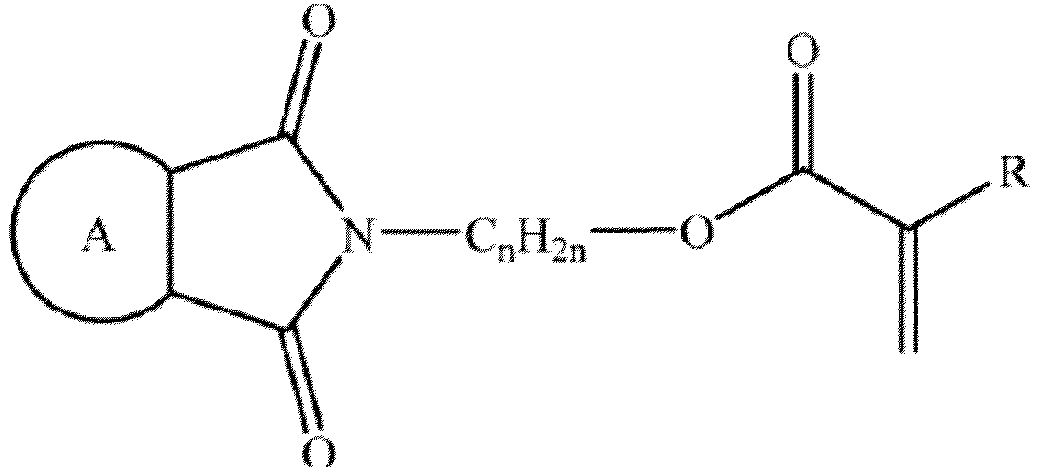
- the cyclic imide-containing acrylate or a cyclic imide-containing methacrylate is represented by formula: wherein A represents a saturated, unsaturated, or aromatic ring, n is an integer from 1 to 18, and R is hydrogen or methyl.
- A represents a 5- to 8-membered ring. In some embodiments, A represents a 5- to 8- (in some embodiments, 5- to 7-) membered, saturated ring. In some embodiments, A represents a 6-membered, saturated ring. In some embodiments, n is an integer from 2 to 16, 2 to 12, 2 to 8, 2 to 6, or 2 to 4. In some embodiments, n is 2. In some embodiments, R is hydrogen. In some embodiments, R is methyl.
- the cyclic imide-containing acrylate or cyclic imide-containing methacrylate is wherein R is hydrogen or methyl (that is, 2-(hexahydrophthalimido)ethyl acrylate or 2-(hexahydrophthalimido)ethyl methacrylate).
- the cyclic imide-containing acrylate or cyclic imide-containing methacrylate is 2-(hexahydrophthalimido)ethyl methacrylate.
- 2-(Hexahydrophthalimido)ethyl methacrylate is commercially available, for example, from Miwon North America (Exton, Pa.) under the trade designation "MIRAMER M1089").
- 2-(Hexahydrophthalimido)ethyl acrylate is commercially available, for example, from Miwon North America under the trade designation "MIRAMER M1088").
- the composition of the present disclosure includes at least 5 wt. %, at least 10 wt. %, or at least 15 wt. % of the cyclic imide-containing acrylate or the cyclic imide-containing methacrylate based on the total weight of the monomers in the composition. In some embodiments, the composition of the present disclosure includes up to 50 wt. %, 40 wt. %, 30 wt. %, or 25 wt. %, of the cyclic imide-containing acrylate or the cyclic imide-containing methacrylate based on the total weight of the monomers in the composition.
- the blend of monomers in the composition of the present disclosure can also include other monofunctional free-radically polymerizable monomers, in some embodiments, acrylic monomers.
- useful monomers include 2-phenoxyethyl (meth)acrylate, benzyl (meth)acrylate, alkoxylated lauryl (meth)acrylate, alkoxylated phenol (meth)acrylate, alkoxylated tetrahydrofurfuryl (meth)acrylate, caprolactone (meth)acrylate, cyclic trimethylolpropane formal (meth)acrylate, ethylene glycol methyl ether (meth)acrylate, ethoxylated nonyl phenol (meth)acrylate, isodecyl (meth)acrylate, isooctyl (meth)acrylate, lauryl (meth)acrylate, octadecyl (meth)acrylate (stearyl (meth)acrylate), tetrahydrofurfuryl
- Further useful monomers include a partial or complete ester of a polyhydric alcohol (e.g., ethylene glycol, diethylene glycol, polyethylene glycol, trimethylol propane, triethylene glycol, tetraethylene glycol, dipropylene glycol, tripropylene glycol, tetrapropylene glycol, pentapropylene glycol, polypropylene glycol, ethoxylated or propoxylated diphenylol propane) and (meth)acrylic acid; a (meth)acrylic acid ester of hydroxy-terminated polyurethane; or an aliphatic polyester urethane (meth)acrylate.
- a polyhydric alcohol e.g., ethylene glycol, diethylene glycol, polyethylene glycol, trimethylol propane, triethylene glycol, tetraethylene glycol, dipropylene glycol, tripropylene glycol, tetrapropylene glycol, pentapropylene glycol, polypropylene glycol
- monomers in the blend of monomers include vinyl acetate; vinyl chloride; vinyl fluoride; vinyl bromide; styrene; dibehenyl benzene; a crotonic acid ester; a maleic acid ester; a styrenated unsaturated polyester resin; N,N-dimethyl acrylamide; a nitrogen-containing polymerizable monomer such as N,N-diethyl acrylamide, N-t-butyl acrylamide, N-(acryloyl)morpholine, N-(acryloyl)piperidine. Any combination of these monomers may be useful.
- the blend of monomers comprises at least one of an acrylic ester of an alkanol having from 1 to 12 carbon atoms, a methacrylic ester of an alkanol having from 1 to 12 carbon atoms, tetrahydrofurfuryl acrylate, or tetrahydrofurfuryl methacrylate.
- acrylic esters of an alkanol having from 1 to 12 carbon atoms include n-butyl acrylate, s-butyl acrylate, t-butyl acrylate, n-pentyl acrylate, isopentyl acrylate, hexyl acrylate, cyclohexyl acrylate, heptyl acrylate, isoamyl acrylate, 2-ethylhexyl acrylate, n-octyl acrylate, 2-octyl acrylate, isooctyl acrylate, n-nonyl acrylate, isononyl acrylate, n-decyl acrylate, isodecyl acrylate, n-dodecyl acrylate, isobornyl acrylate, 2-methylbutyl acrylate, 4-methyl-2-pentyl acrylate, and methacrylates of the foregoing acrylates.
- M-40G methoxy tripropylene glycol methacrylate (available from Shin-Nakamura Co. Ltd. as M-30PG, butoxy diethylene glycol methacrylate (available from Shin-Nakamura Co. Ltd. as B-20G), phenoxy ethylene glycol methacrylate (available from Shin-Nakamura Co. Ltd. as PHE-1G), phenoxy diethylene glycol methacrylate (available from Shin-Nakamura Co. Ltd. as PHE-2G), dicyclopentenyloxyethyl methacrylate (available from Hitachi Chemical, Tokyo, Japan, as FANCRYL FA-512M), 4-methacryloxyethyl trimellitic anhydride (available from Designer Molecules, Inc.
- the organoborane in the composition of the present disclosure initiates free-radical polymerization of the cyclic imide-containing acrylate or the cyclic imide-containing methacrylate and other monomers to form a polymer that can be useful as a bonding composition (e.g., an acrylic adhesive).
- the organoborane initiator may be represented by the following general formula: wherein R 1 is alkyl having from 1 to 10 carbon atoms, and R 2 and R 3 are each independently alkyl having from 1 to 10 carbon atoms or aryl. In some embodiments, R 1 , R 2 , and R 3 are each independently alkyl having from 1 to 5 carbon atoms.
- R 1 , R 2 , and R 3 may all be different, or more than one of R 1 , R 2 , and R 3 may be the same.
- suitable organoboranes include trimethylborane, triethylborane, tri-n-propylborane, triisopropylborane, tri-n-butylborane, triisobutylborane, and tri-sec-butylborane.
- Organoborane initiators are typically complexed with a complexing agent.
- suitable complexing agents in the organoborane complex include amines, amidines, hydroxides, and alkoxides.
- the complexing agent can be monofunctional, in some embodiments, the complexing agent includes more than one complexing group (e.g., diamines and polyamines described below).
- the ratio of the boron atom to the complexing group in the complexing agent in the complex is generally at least 0.1:1, or at least 0.3:1, or at least 0.5:1, or at least 0.8:1, or at least 0.9:1 and, up to 2:1, or up to 1.5:1, or up to 1.2:1.
- the ratio is in a range of 0.1:1 to 2:1, or in a range of 0.5:1 to 1.5:1, or in a range of 0.8:1 to 1.2:1, or in a range of 0.9:1 to 1.1:1, or 1:1.
- the complexing agent is an amine.
- Blends of different amines and blends of different organoborane amine complexes may also be used.
- the organoborane complex is represented by formula: wherein
- the amine complexing agent is a polyamine, and at least of R 4 or R 5 is alkyl, arylalkylenyl, or polyoxyalkylenyl terminated by a primary or secondary amino group.
- Suitable polyamines include diamines represented by formula: R 5 HN-R 6 -NHR 5 , wherein R 5 is as defined above, and wherein R 6 is arylene or a linear or branched alkylene or alkylene interrupted with or terminated by arylene.
- suitable diamines include 1,2-ethanediamine, 1,3-propanediamine, 1,5-pentanediamine, 1,6-hexanediamine, 1,12-dodecanediamine, 2-methyl-1,5-pentanediamine, 3-methyl-1,5-pentanediamine, and isomers of these materials.
- suitable polyamines include triamines and tetraamines (e.g., triethylene tetraamine and diethylene triamine).
- polyamines include polyoxyalkylenepolyamines such as those represented by formulas: H 2 NR 8 -O-(R 9 O) w -R 8 NH z and [H 2 NR 8 -O-(R 9 O) w ] z -R 11 .
- R 8 and R 9 are each independently alkylene groups having 1 to 10 carbon atoms.
- R 8 is an alkylene group having 2 to 4 carbon atoms (e.g., ethylene, n-propylene, iso-propylene, n-butylene or iso-butylene).
- each R 9 is independently an alkylene having 2 or 3 carbon atoms (e.g., ethylene, n-propylene, or iso-propylene).
- R 11 is a linear or branched alkylene or alkylene interrupted with or terminated by arylene, wherein the alkylene group is optionally interrupted by one or more catenated oxygen atoms.
- the value of w is at least 1, in some embodiments form 1 to 150, or from 1 to 20.
- the value of z is >2, in some embodiments 3 or 4 (so as to provide, respectively, polyoxyalkylene triamines and tetraamines).
- the number average molecular weight of the polyoxyalkylenepolyamine is up to 5,000 or 1,000 or in a range from 140 to 1,000.
- the polyoxyalkylenepolyamine and its complex with the organoborane are liquid at room temperature ("room temperature” refers to, herein, a temperature of 20 °C to 25 °C)
- suitable polyoxyalkylenepolyamines include polyethyleneoxidediamine, polypropyleneoxidediamine, polypropyleneoxidetriamine, diethyleneglycoldipropylamine, triethyleneglycoldipropylamine, polytetramethyleneoxidediamine, poly(ethyleneoxide-copropyleneoxide)diamine, and poly(ethyleneoxide-co-propyleneoxide)triamine.
- suitable polyoxyalkylenepolyamines include those commercially available from Huntsman Chemical Company under the trade designation "JEFFAMINE” such as the D, ED, and EDR series diamines (e.g., D-400, D-2000, D-5000, ED-600, ED-900, ED-2001, and EDR-148), and the T series triamines (e.g., T-403), as well as DCA-221 from Dixie Chemical Company.
- JEFFAMINE such as the D, ED, and EDR series diamines (e.g., D-400, D-2000, D-5000, ED-600, ED-900, ED-2001, and EDR-148)
- T-403 T-403
- DCA-221 from Dixie Chemical Company
- a suitable polyamine also includes the condensation reaction product of diprimary amine-terminated material (i.e., the two terminal groups are primary amine) and one or more materials containing at least two groups reactive with primary amine.
- the complexing agent is a hydroxide or an alkoxide.
- the hydroxide or alkoxide is represented by formula ( (-) O-R 15 ) n M (m+) , wherein R 15 is independently selected from hydrogen or an organic group (e.g., alkyl or alkylene group); M (m+) represents a countercation (e.g., sodium, potassium, tetraalkylammonium, or combinations thereof); n is greater than zero; and m is greater than zero.
- hydroxide and alkoxide complexing agents examples include sodium hydroxide, tetrabutylammonium hydroxide, sodium methoxide, and tetrabutylammonium methoxide. Further details regarding hydroxide and alkoxide complexing agents can be found, for example, in U.S. Pat. 6,486,090 (Moren ).
- the complexing agent is an amidine.
- the amidine complexing agent is represented by formula wherein: R 16 is hydrogen or an organic group (in some embodiments, an alkyl or alkylene group); R 17 and R 18 are independently a monovalent organic group or part of a cyclic structure; and w, x, and y are integers. In some embodiments, w is 1 and x is 0, 1, 2, or 3.
- amidine complexing agents examples include N,N,N',N'-tetramethylguanidine; 1,8-diazabicyclo[5.4.0]undec-7-ene (DBU); 1,5-diazabicyclo[4.3.0]non-5-ene (DBN); 2-methylimidazole; 2-methylimidazoline; and 4-(N,N-dimethylamino)-pyridine . Further details about amidine complexing agents can be found, for example, in U.S. Pat. No. 6,410,667 (Moren ).
- an organoborane complex may be readily prepared using known techniques. Typically, the complexing agent is combined with the organoborane in an inert atmosphere (e.g., a glove box flushed with nitrogen to an environment having less than 100 ppm oxygen) with slow stirring.
- the organoborane can be added from a pressure equalizing dropping funnel to a flask into which the coupling agent has been previously weighed. An exotherm is often observed, and cooling of the mixture is, therefore, useful. Addition of the organoborane may be moderated to control the exotherm. If the ingredients have a high vapor pressure, it is desirable to keep the reaction temperature below about 70 °C to 80 °C.
- the complex be kept in a capped vessel in a cool, dark location, if desired.
- the organoborane complex can be formulated with a diluent or a blend of two or more different diluents.
- the organoborane-amine complex may be readily prepared using known techniques, as described, for example, in U. S. Pat. Nos. 5,616,796 (Pocius et al. ), 5,621,143 (Pocius ), 6,252,023 (Moren ), 6,410,667 (Moren ), and 6,486,090 (Moren ).
- TEB-DAP triethylborane-1,3-diaminopropane (or 1,3-propanediamine) complex
- TnBB-MOPA tri-n-butylborane-3-methoxypropylamine complex
- TEB-DETA triethylborane-diethylenetriamine complex
- TnBB-DAP tri- n -butylborane-1,3-diaminopropane complex
- TsBB-DAP tri- sec -butylborane-1,3-diaminopropane complex
- TEB-HMDA triethylborane-hexamethylenediamine (also 1,6-hexanediamine or 1,6-diaminohexane) complex) is available from AkzoNobel, Amsterdam
- the composition of the present disclosure comprises a salt of a positively charged metal capable of having at least two oxidation states.
- the metal salt may be useful, for example, for modifying the cure kinetics of the composition to provide a desirable balance of long adhesive worklife and fast rate of strength build.
- the metal salt may have any positive charge ranging from 1 to 6 and any appropriate counterion or counterions to balance the positive charge and may have one or more covalently bonded ligands.
- Chemically accessible oxidation states of various metals can be found, for example, in " Chemistry of the Elements" by N. N. Greenwood and A. Earnshaw, Pergamon Press, 1984, at pages 24 to 37 .
- metal cations in the metal salt include vanadium, chromium, manganese, iron, cobalt, nickel, copper, molybdenum, ruthenium, rhodium, palladium, antimony, platinum, and cerium cations.
- the metal cation in the metal salt is a vanadium, chromium, manganese, iron, cobalt, nickel, copper, ruthenium, palladium, or antimony cation.
- the metal cation in the metal salt is a manganese, iron, cobalt, or copper metal cation.
- the metal salt is a copper salt or iron salt.
- the metal salts useful in the composition comprise at least one counterion having a charge in a range from 1 to 3.
- suitable counterions include halides, borates, sulfonates, and carboxylates.
- the anion in the metal salt is chloride, bromide, tetrafluoroborate, trifluoromethanesulfonate, naphthenate, or 2-ethylhexanoate.
- the metal salt comprises at least one of copper (II) bromide, copper (II) chloride, copper (II) 2-ethylhexanoate, iron (III) bromide, vanadium (III) bromide, chromium (III) bromide, ruthenium (III) bromide, copper (II) tetrafluoroborate, copper (II) trifluoromethanesulfonate, copper (II) naphthenate, copper (I) bromide, iron (II) bromide, manganese (II) bromide, cobalt (II) bromide, nickel (II) bromide, antimony (III) bromide, and palladium (II) bromide.
- the metal salt can be present in the composition in any suitable amount.
- a generally effective amount of metal salt is up to 40,000 parts per million (ppm), from 60 ppm to 20,000 ppm, or from about 100 ppm to about 4,000 ppm based on the total weight of the composition.
- the composition further comprises a decomplexing agent for the organoborane complex.
- decomplexing agent refers to a compound capable of liberating the initiator (e.g., organoborane) from its complexing agent, thereby enabling initiation of the polymerizable monomers of the composition.
- Decomplexing agents may also be referred to as “activators” or “liberators”, and these terms may be used synonymously herein.
- the decomplexing agent comprises at least one of an acid, an ester, an anhydride, an aldehyde, a ⁇ -ketone, an isocyanate (e.g., isophorone diisocyanate and toluene diisocyanate), an acid chloride (e.g., methacryloyl chloride), or a sulfonyl chloride.
- Any acid that can liberate the organoborane by reacting with the amine group may be employed.
- Useful acids include Lewis acids (e.g., SnCl 4 and TiCl 4 ) and Bronsted acids (e.g., carboxylic acids, HCl, H 2 SO 4 , H 3 PO 4 , phosphonic acid, phosphinic acid, and silicic acid).
- Useful carboxylic acids include those having the general formula R 20 -COOH, wherein R 20 is hydrogen, an alkyl group having 1 to 30, 1 to 8, 9 to 30, 15 to 30, or 1 to 4 carbon atoms, an alkenyl group having 2 to 30, 2 to 8, 9 to 30, 15 to 30, or 2 to 4 carbon atoms, or an aryl group having 6 to 10 or 6 to 8 carbon atoms.
- the alkyl and alkenyl groups may comprise a straight chain, or they may be branched.
- the aryl groups may be unsubstituted or have up to four substituents such as alkyl, alkoxy, and halogen.
- suitable carboxylic acids include acrylic acid, methacrylic acid, acetic acid, benzoic acid, and p-methoxybenzoic acid.
- Other useful decomplexing agents for organoborane-amine complexes include multi-functional carboxylic acids and multi-functional carboxylic acid esters, which may be saturated, unsaturated, aromatic, or a combination thereof and can include up to 30, 20, 12, or 10 carbon atoms.
- the carbon chains may be straight-chain or branched and may be interrupted by one or more catenated oxygen, nitrogen, or sulfur atoms.
- Suitable multi-functional carboxylic acids and multi-functional carboxylic acid esters can be difunctional, trifunctional, tetrafunctional, or have a higher level of functionality.
- Examples of useful dicarboxylic acids include oxalic acid, malonic acid, succinic acid, glutaric acid, adipic acid, maleic acid, fumaric acid, phthalic acid, hexahydrophthalic acid, isophthalic acid, and terephthalic acid.
- Examples of useful multifunctional carboxylic acid esters include 1,2-ethylene bismaleate, 1,2-propylene bismaleate, 2,2'-diethyleneglycol bismaleate, 2,2'-dipropyleneglycol bismaleate, and trimethylolpropane trismaleate.
- R 24 -C(O)-O-C(O)-R 25 Other useful carboxylic acid anhydrides include those represented by formula R 24 -C(O)-O-C(O)-R 25 , wherein R 24 and R 25 are independently alkyl, alkenyl, or aryl, wherein alkyl and alkenyl may be straight-chain, branched, or cyclic and may include up to 18 carbon atoms. In some embodiments, R 24 and R 25 include 1 to 9 carbon atoms (e.g., acetic anhydride and propionic anhydride) .
- Aryl groups e.g., phenyl
- aldehydes which may be saturated, unsaturated, aromatic, or a combination thereof and can include up to 30, 20, 12, or 10 carbon atoms.
- the aldehyde is represented by formula R 27 -(CHO) x , wherein R 27 is alkyl, haloalkyl, hydroxyalkyl, or alkoxyalkyl, each of which can include 1 to 10 or 1 to 4 carbon atoms and may be straight-chained or branched, or aryl having 6 to 10 or 6 to 8 carbon atoms, and x is 1 or 2.
- the aryl groups may be unsubstituted or may be substituted by up to four substituents such as halogen, hydroxy, alkoxy, alkyl and nitro.
- substituents such as halogen, hydroxy, alkoxy, alkyl and nitro.
- useful aldehyde decomplexing agents include benzaldehyde, o-, m- and p-nitrobenzaldehyde, 2,4-dichlorobenzaldehyde, p-tolylaldehyde, and 3-methoxy-4 hydroxybenzaldehyde.
- Blocked aldehydes such as acetals may also be useful decomplexing agents.
- the beta-ketone compound is a 1,3-dicarbonyl compound.
- suitable beta-ketone decomplexing agents include methyl acetoacetate, ethyl acetoacetate, t-butyl acetoacetate, 2-methacryloyloxyethyl acetoacetate, diethylene glycol bis(acetoacetate), polycaprolactone tris(acetoacetate), polypropylene glycol bis(acetoacetate), poly(styrene-co-allyl acetoacetate), N,N-dimethylacetoacetamide, N-methylacetoacetamide, acetoacetanilide, ethylene bis(acetoacetamide), polypropylene glycol bis(acetoacetamide), acetoacetamide, and acetoacetonitrile.
- Further examples of beta-ketone decomplexing agents can be found, for example, in U.S. Pat. No. 6,849,569 (Moren ).
- the decomplexing agent can be included in the composition in any effective amount (e.g., an amount effective to promote polymerization by liberating the initiator from its complexing agent, but without materially adversely affecting desired properties of the ultimate polymerized composition).
- the decomplexing agent is provided in an amount such that the ratio of amine-, amidine-, hydroxide- or alkoxide-reactive groups in the decomplexing agent to amine, amidine, hydroxide or alkoxide groups in the organoborane complex is in the range of 0.5:1.0 to 10.0:1.0, 0.5: 1.0 to 4.0:1.0, or 1.0:1.0.
- Free-radical inhibitors such as hydroquinone monomethyl ether and tris (N-nitroso-N-phenylhydroxylamine) aluminum salt may be included in the composition of the present disclosure, for example, to prevent or reduce polymerization of the polymerizable monomers during storage.
- Inhibitors may be added in an amount that does not materially affect the rate of polymerization or the ultimate properties of polymers made therewith. Inhibitors are generally useful in amounts from 100 ppm to 10,000 ppm based on the total weight of the blend of monomers in the composition.
- composition of the present disclosure may be provided as a one-part or two-part composition, for example, depending on the organoborane complex chosen as well as the identity and amount of optional additional components such as the decomplexing agent and the metal salt.
- the composition of the present disclosure is packaged as a two-part composition, in which a first part comprises the blend of monomers, and a second part comprises the organoborane complex. At least one of the first part or the second part may include a decomplexing agent, a salt of a positively charged metal capable of having at least two oxidation states, a toughening agent, filler, reactive diluent, plasticizer, or a free-radical inhibitor as described herein in any of their embodiments.
- the first part further comprises a decomplexing agent for the organoborane complex. In some embodiments, the first part further comprises a free-radical inhibitor. In some embodiments, the first part further comprises a salt of a positively charged metal capable of having at least two oxidation states.
- the second part may be in the form of a paste, for example, that includes a plasticizer or reactive diluent and optionally at least one of tougheners, dyes, pigments, tackifiers, or fillers as described herein in any of their embodiments. Some pastes of organoborane complexes, for example, are commercially available.
- An example of a useful second part is an accelerator obtained under the trade designation "3M SCOTCH-WELD DP8010NS", from 3M Company, St. Paul, Minn.
- the identity and amount of the organoborane complex chosen as well as the identity and amount of optional additional components such as the decomplexing agent and the metal salt can affect the worklife of the composition.
- the worklife refers to the time between the mixing of the composition and the time after which the composition has reduced capacity to form strong adhesive bonds.
- the Worklife Test Method described in U.S. Pat. No. 6,734,268 (Moren ) may be useful for determining worklife.
- the worklife of the composition is at least five, ten, or twenty minutes or more
- the composition of the present disclosure or at least one of the first part or the second part of the two-part composition of the present disclosure includes a thickener.
- Thickeners may be employed to increase the viscosity of the composition of the present disclosure to an easily applied, viscous syrup-like consistency.
- Thickeners useful in the composition of the present disclosure include medium (e.g., 40,000 to 200,000 grams/mole) molecular weight poly(butyl methacrylate) or copolymer of butyl methacrylate.
- the thickener is a copolymer of butyl methacrylate and methyl methacrylate.
- the thickener may be incorporated into the composition (in some embodiments, at least one of the first part or the second part) in any useful amount.
- the thickener is present in an amount of up to 50 wt. %, 40 wt.%, 30 wt. %, 25 wt. %, 20 wt. %, 15 wt. %, 10 wt. %, 5 wt. %, based on the total weight of the blend of monomers.
- the composition of the present disclosure or at least one of the first part or the second part of the two-part composition of the present disclosure includes a reactive diluent.
- Suitable reactive diluents include 1,4-dioxo-2-butene functional compounds as reported in U.S. Pat. No. 6,252,023 (Moren ).
- the composition of the present disclosure or at least one of the first part or the second part of the two-part composition of the present disclosure includes an aziridine compound.
- the second part of the composition includes an aziridine compound to dissolve or dilute the organoborane complex, which can help provide two-part adhesives that can be combined in a commercially useful mix ratio.
- the diluent is not reactive with the organoborane or the organoborane complex and functions as an extender of the organoborane or the organoborane complex.
- the decomplexing agent can also react with the aziridine compound.
- the aziridine compound useful as a diluent has at least one aziridine ring or group where a carbon or nitrogen atom thereof may be optionally substituted by alkyl, aryl, alkylcarbonyl, arylcarbonyl, cyanoalkyl, or alkylene optionally interrupted or terminated by arylene.
- the carbon or nitrogen atom is substituted by a short-chain alkyl group (e.g., a C 1-4 alkyl such as methyl, ethyl, or propyl).
- Suitable mono-functional aziridines include N-ethyl aziridine, N-(2-cyanoethyl)aziridine, N-butyl aziridine, iso-butyl aziridine, 2-aziridinyl ethanol, 1-aziridinyl ethanol, 1-iso-butyryl aziridine, and 1-butyryl aziridine.
- the aziridine compound is a polyaziridine (i.e., having more than aziridine group).
- the aziridine rings may be substituted by any of the substituents described above and may be connected to each other by any alkylene, arylene, alkylene optionally interrupted or terminated by arylene, any of which may be interrupted with functional groups such as ethers, esters, sulfides, and phosphine oxides.
- the polyaziridine may have a molecular weight of at least 300 grams per mole.
- Suitable polyaziridines include the reaction product of aziridine or methylaziridine with trimethylol propane triacrylate or pentaerythritol triacrylate [e.g., trimethylolpropane tris-(2-methyl-1-aziridinepropionate), trimethylolpropane tris-(aziridinyl propionate), tetramethylolmethane tris(aziridinylpropionate), and pentaerythritol tris[3-(1-aziridinyl)propionate)].
- trimethylol propane triacrylate or pentaerythritol triacrylate e.g., trimethylolpropane tris-(2-methyl-1-aziridinepropionate), trimethylolpropane tris-(aziridinyl propionate), tetramethylolmethane tris(aziridinylpropionate), and pentaerythritol tri
- tri-functional aziridines include tris-(2-methyl-1-aziridinyl)phosphine oxide), tris-(1-aziridinyl) phosphine sulfide, tris-(1-aziridinyl) phosphine oxide, N,N'-toluene-2,4-bis(1-aziridinecarboxamide), N,N-hexamethylene-1,6-bis(1-aziridinecarboxamide), N,N'-hexamethylene-bis-1,6-bis-(2-methyl-1-aziridinecarboxamide), 1,6-hexanediol bis-(aziridinyl propionate), and 1,6-hexanediol bis-(2-methyl aziridinyl propionate).
- polyaziridines examples include CX-100 (from DSM NeoResins, Inc.), XAMA-7 (from EIT, Inc.), and MAPO (tris[1-(2-methyl)aziridinyl]phosphine oxide (from Aceto Corp).
- the aziridine compound is used in an effective amount, which may depend, for example, on whether reaction of the aziridine compound with the decomplexing agent is desirable.
- the aziridine compound is present in up to 50%, 25%, or 10%, based on the total weight of the composition or at least one of the first part or the second part, for example, the second part of the two-part composition.
- the aziridine compound is typically a liquid at or near room temperature (e.g., in a range from 10 °C to 32 °C) or forms a liquid solution with the organoborane complex at or near room temperature.
- substantial amounts e.g., at least 50 wt. %, 75 wt. % or 100 wt.%)
- the organoborane complex may be dissolved in the aziridine compound.
- the composition of the present disclosure or at least one of the first part or the second part of the two-part composition of the present disclosure includes a vinyl aromatic compound, for example, vinyl aromatic compounds of the type reported in U.S. Pat. No. 6,479,602 (Moren ).
- a useful vinyl aromatic compound is an ⁇ -methylstyrene-group-containing oligomer prepared by reacting 3-isopropenyl- ⁇ , ⁇ -dimethylbenzyl isocyanate (obtainable as product name "TMI" from Cytec Industries, Inc., Woodland Park, NJ) with a monofunctional or multifunctional reactive hydrogen compound (e.g., at least one of a monofunctional or multifunctional amine or alcohol).
- Suitable monfunctional and multifunctional amines include any of those described above in connection with the organoborane amine complex.
- Suitable alcohol-containing compounds include polypropylene glycol, polycaprolactone triol, and diethylene glycol.
- the vinyl aromatic compound can be added in an amount of at least 1 wt. %, 2 wt. %, or 5 wt. % and/or up to 65 wt. %, 60 wt. %, 50 wt. %, 40 wt. %, 30 wt. %, 20 wt. %, or 10 wt. %, based on the total weight of the composition or based on the total weight of at least one of the first part or the second part of the two-part composition.
- the second part of the two-part composition includes a vinyl aromatic compound described above in any of its embodiments.
- composition of the present disclosure or at least one of the first part or the second part of the two-part composition of the present disclosure may include other components useful, for example, for adhesive compositions.
- the composition or at least one of the first part or second part of the two-part composition can include at least one of toughening agents (e.g., acrylic core/shell polymers; styrene-butadiene/methacrylate core/shell polymers; acrylonitrile-butadiene rubber), plasticizers (e.g., aliphatic and aromatic hydrocarbons, alkyl esters, alkyl ethers, aryl esters, and aryl ethers), tackifiers, corrosion inhibitors, UV stabilizers, antioxidants, flame retardants, thixotropic agents such as fumed silica, dyes, pigments (e.g., ferric oxide, brick dust, carbon black, and titanium oxide), reinforcing agents (e.g., silica, magnesium sulfate, calcium sulf
- the composition of the present disclosure or at least one of the first part or the second part of the two-part composition of the present disclosure includes a filler.
- fillers useful for some embodiments of the composition of the present disclosure include at least one of a micro-fibrillated polyethylene, a fumed silica, a talc, a wollastonite, an aluminosilicate clay (e.g., halloysite), phlogopite mica, calcium carbonate, kaolin clay, metal oxides (e.g., silica, barium oxide, calcium oxide, magnesium oxide, zirconium oxide, titanium oxide, zinc oxide), nanoparticle fillers (e.g., nanosilica, nanozirconia), carbon black, hollow glass/ceramic beads, solid glass/ceramic spheres, antistatic compounds, and chalk.
- Particulates such as any of these fillers, pigments, conductive particles, clays, and thixotropic agents may be present in the composition in any desired amount.
- the composition may also be free of such particulates or include up to 0.01 wt. %, 0.1 wt. %, 0.5 wt. %, or one wt. %, based on the total weight of the composition.
- the composition of the present disclosure includes at least one wt. % and/or up to 20 wt. %, 15 wt. %, 10 wt. %, or 5 wt. % of such particulates, alone or in combination, based on the total weight of the composition or at least one of the first part or the second part of the two-part composition.
- the composition of the present disclosure includes an elastomeric material (i.e., toughening agent).
- toughening agent elastomeric material
- These materials can improve the fracture toughness of bonding compositions made therewith, which can be beneficial when, for example, bonding stiff, high yield strength materials (e.g., metal substrates that do not mechanically absorb energy as easily as other materials, such as flexible polymeric substrates).
- An example of a toughening agent are core-shell polymers having a polymerized diene rubbery backbone or core to which is grafted a shell of an acrylic acid ester or methacrylic acid ester, monovinyl aromatic hydrocarbon, or a mixture thereof, such as those disclosed in U.S. Pat. No. 3,496,250 (Czerwinski ).
- Rubbery backbones can comprise polymerized butadiene or a polymerized mixture of butadiene and styrene.
- Shells comprising polymerized methacrylic acid esters can be lower alkyl (C 1-4 ) methacrylates.
- Monovinyl aromatic hydrocarbons can be styrene, alpha-methylstyrene, vinyltoluene, vinylxylene, ethylvinylbenzene, isopropylstyrene, chlorostyrene, dichlorostyrene, and ethylchloro styrene.
- Core-shell polymers e.g., acrylic core/shell polymers and styrene-butadiene/methacrylate core/shell polymers
- a core-shell polymer to the composition may help reduce the tendency for the composition to leave an undesirable "string" upon dispensing from a syringe-type applicator and/or may help reduce the tendency for the composition to sag or slump after having been applied to a vertical surface.
- a core-shell polymer or other elastomeric material may be included in the composition of the present disclosure or at least one of the first part or the second part of the two-part composition of the present disclosure in an amount of at least 5 wt. %, 10 wt. %, 15 wt. %, or 20 wt. % and up to 40 wt. %, 35 wt. %, 30 wt. %, or 25 wt. %, based on total weight of the composition or at least one of the first part or the second part of the two-part composition.
- elastomeric material e.g., acrylonitrile-butadiene rubber
- the composition may also be free of such toughening agents or include them in up to 0.01 wt. %, 0.1 wt. %, 0.5 wt. %, or one wt. %, based on the total weight of the composition or at least one of the first part or the second part of the two-part composition.
- the first part and the second part can be combined at any suitable volume ratio.
- the first part and the second part can be combined at a volume ratio in a range of from 5:100 to 100:1, 10:100 to 50:1, or 1:1 to 20:1.
- the two parts of the composition can be made to be capable of being combined in a common, whole number mix ratio such as 10:1, 4:1, 3:1, 2:1, or 1:1.
- the second part of the two-part composition is a solution of a 2:1 mole ratio complex of triethyl borane and a diamine such as 1,6-hexamethylene diamine in a polyaziridine liquid, for example, triemethylol propane tris(3-methylaziridine)propionate, combined with a vinyl aromatic compound described above, fumed silica, and carbon black.
- the vinyl aromatic compound can be an adduct of 2:1 3-isopropenyl- ⁇ , ⁇ -dimethylbenzyl isocyanate and a diamine-terminated polypropylene glycol obtained from Huntsman Petrochemical Corp. under the trade designation "JEFFAMINE D2000".
- the second part of the two-part composition can include, for example, 12 grams of a 2:1 mole ratio complex of triethyl borane and 1,6-hexamethylene diamine, 22 grams of "CX-100" from DSM NeoResins, Inc., 62 grams of an adduct of 2:1 3-isopropenyl- ⁇ , ⁇ -dimethylbenzyl isocyanate and a diamine-terminated polypropylene glycol obtained from Huntsman Petrochemical Corp. under the trade designation "JEFFAMINE D2000", 4 grams of "CAB-O-SIL TS-720" fumed silica, and 0.2 gram of carbon black.
- the second part can be prepared as described, for example, in U.S. Pat. Appl. Pub. No. 2016/0347975 (Irie ), paragraphs [0075] and [0076].
- the first part and the second part can be located in any suitable system or kit for containing, mixing, and dispensing the first part and the second part.
- the system can be suited for large-scale industrial applications or small-scale applications.
- Either system can include first and second chambers for holding the respective first part and second part.
- the chambers can be sized for any application and formed from plastic, metal, or any other suitable material.
- a dispenser can be adapted to receive the first part and the second part and dispense a mixture of the first part and the second part on a substrate.
- the dispenser can function to facilitate mixing of the first part and the second part, or a mixing chamber can be disposed upstream of the dispenser and in fluid communication with the first chamber and the second chamber.
- the mixing chamber can be adapted to rotate in order to facilitate mixing, or the mixing chamber can include a number of baffles to induce rotation of the first part and the second part.
- the system can include elements such as one or more plunger or one or more pumps.
- the one or more plungers can be useful for systems that are handheld.
- a user can push one or two plungers, between at least a first and a second position, to force the first part and the second part through the system. If there is one plunger, then the first part and the second part can be dispensed at equal volumes or at a predetermined volume ratio.
- Pumps can be useful in industrial applications where large volumes or a continuous supply of the first part and the second part are dispensed.
- These systems can include one or more pumps that are in fluid communication with the first and second chambers.
- the one or more pumps can be located downstream of the first and second chambers but upstream of the mixing chamber.
- the pumps can be adapted or controlled to pump an equal volume of the first part and the second part or to pump different quantities of each part according to a predetermined volume ratio.
- composition of the present disclosure may be at least partially cured by exposure to thermal energy (e.g., in an oven, infrared radiation, or thermal conduction), by exposure to oxygen, by combining two-parts of a two part composition, or any combination of the foregoing.
- thermal energy e.g., in an oven, infrared radiation, or thermal conduction
- a crosslinked composition is generally obtained, and if sufficiently cured it may be suitable for use as a structural adhesive to bond two adherends.
- the composition is typically sandwiched between the adherends and at least partially cured; for example, for a time sufficient to achieve at least a desired level of bond strength.
- compositions of the present disclosure may be used, for example, to bond a first substrate to a second substrate to provide a bonded article.
- substrates may be bonded with compositions of the present disclosure such as metal (e.g., galvanized steel, stainless steel, or aluminum), glass (e.g., which may be coated with indium tin oxide), a polymer (e.g., a plastic, rubber, thermoplastic elastomer, or thermoset), or a composite.
- a composite material may be made from any two or more constituent materials with different physical or chemical properties. When the constituents are combined to make a composite, a material having characteristics different from the individual components is typically achieved.
- useful composites include fiber-reinforced polymers (e.g., carbon fiber reinforced epoxies and glass-reinforced plastic), metal matrix compositions, and ceramic matrix composites.
- Useful polymeric substrates that can be bonded include polymers such as polyolefins (polypropylene, polyethylene, high density polyethylene, blends of polypropylene), fluoropolymers, polyamide 6 (PA6), polyamide 6,6, acrylonitrile butadiene styrene (ABS), polycarbonate (PC), PC/ABS blends, polyvinyl chloride (PVC), polyamide (PA), polyurethane (PUR), thermoplastic elastomers (TPE), polyolefin elastomers (e.g., ethylene-propylene rubber, ethylene-propylene-diene rubber), fluoropolymer elastomers, polyoxymethylene (POM), polystyrene, poly(methyl) methacrylate (PMMA), polyvin
- the article in some embodiments, at least one of the first substrate or the second substrate, comprises a low-surface-energy plastic.
- Low-surface-energy plastics are typically those that have a surface energy of less than 45 millijoules per square meter (mJ/m 2 ), more typically less than 40 mJ/m 2 or less than 35 mJ/m 2 . Included among such materials are polyvinyl chloride, polymethylmethacrylate, polyethylene, polypropylene, acrylonitrile-butadiene-styrene, and fluorinated polymers such as polytetrafluoroethylene.
- Polyethylene, polypropylene, and fluoropolymers have surface energies less than 35 mJ/m 2 , and some fluoropolymers such as polytetrafluoroethylene have a surface energy of less than 20 mJ/m 2 .
- the low-surface-energy plastic in the article of the present disclosure can be part of a composite material such as a fiber-reinforced plastic or a glass-reinforced plastic.
- the present disclosure provides an article bonded with the composition disclosed herein in any of its embodiments, wherein the composition is cured, and wherein the article comprises at least one low-surface-energy plastic.
- the article further comprises at least one of a metal or glass.
- the article further comprises another plastic, which is not necessarily a low-surface-energy plastic.
- the present disclosure provides a method of making a bonded article comprising a first substrate and a second substrate.
- the method includes applying the composition of present disclosure on at least one of the first substrate or the second substrate, adhering the first substrate and the second substrate using the composition, and allowing the composition to at least partially cure to make the bonded article.
- the method includes combining the first part and the second part of the two-part composition to provide an adhesive composition, applying the adhesive composition to at least a portion of one surface of the first substrate, adhering the first substrate and the second substrate using the adhesive composition, and allowing the adhesive composition to at least partially cure to make the bonded article.
- at least one of the first substrate or second substrate comprises at least one low-surface-energy plastic.
- the first substrate or second substrate further comprises at least one of a metal or glass.
- the first substrate or second substrate further comprises another plastic, which is not necessarily a low-surface-energy plastic.
- the method is carried out without subjecting the low-surface-energy plastic to flame treatment, corona discharge, plasma treatment, oxidation by ozone or oxidizing acids, sputter etching, primer treatment, or any combination thereof.
- the composition is desirably used to bond the first substrate and the second substrate during the worklife of the composition, as described above. While it is not practical to enumerate a particular curing temperature suitable for all situations, generally suitable temperatures are in a range from 23 °C to 200 °C. In some embodiments, advantageously, the composition can be cured at room temperature (e.g., 23 °C to 30 °C, or below 40 °C), in at least 5 minutes, 10 minutes, 20 minutes, 30 minutes, or 45 minutes, for example.
- room temperature e.g., 23 °C to 30 °C, or below 40 °C
- the composition can be cured at room temperature (e.g., 23 °C to 30 °C, or below 40 °C), within up to 60 minutes, 90 minutes, 120 minutes, 6 hours, 12 hours, 24 hours, 48 hours, or 72 hours for example. Full strength will normally be reached in less than 24 hours under ambient conditions. Post-curing at an elevated temperature may also be used if desired.
- room temperature e.g., 23 °C to 30 °C, or below 40 °C
- Full strength will normally be reached in less than 24 hours under ambient conditions.
- Post-curing at an elevated temperature may also be used if desired.
- the first and second substrates can be joined together with pressure to force excess composition out of the bond line. This may be advantageous for displacing composition that has been exposed to air and that may have advanced too far in cure.
- the typical bond line thickness is 0.1 to 0.3 mm but may exceed 1.0 mm when gap filling is needed.
- composition of the present disclosure can be useful, for example, for bonding electronic articles and automotive (e.g., electronic vehicles) and aerospace components.
- compositions known to provide good adhesion to low-surface-energy plastics can have less desirable adhesion to metals.
- Example 2 which is a bonded article made by a composition of the present disclosure
- Comparative Example A2 which is a bonded article made by a composition that is the same as the composition of the present disclosure except that it contains no cyclic imide-containing acrylate or a cyclic imide-containing methacrylate
- at least a 40 percent improvement in overlap shear was observed with the addition of the cyclic imide-containing acrylate or a cyclic imide-containing methacrylate to the blend of monomers.
- the adhesive bonds made from the composition of the present disclosure can better withstand exposure to high temperature and high humidity followed by storage in a freezer as shown in Table 6.
- the resulting mixed adhesives were used to prepare overlap shear test samples on polypropylene, glass-filled polypropylene, and galvanized steel.
- All polypropylene coupon samples obtained from Plastics International, Eden Prairie, MN, were 0.32 cm x 2.54 cm x 10.2 cm (1/8 in. x 1 in. x 4 in.) and were only wiped with isopropanol alcohol prior to bonding.
- Glass-filled polypropylene obtained under the trade designation "VERSITEX", from US Liner Company, Cranberry Township, PA, were 0.32 cm x 20.3 cm x 30.5 cm (1/8 in. x 8 in. x 12 in.) sheets and cut to 0.32 cm x 2.54 cm x 20.3 cm (1/8 in. x 1 in.
- Galvanized steel coupon samples obtained from Joseph T. Ryerson and Son, Inc., Coon Rapids, MN, were 2.54 cm x 10.16 cm x 0.16 cm (1 in. x 4 in. x 1/16 in.) and were prepared using one of three methods: (1) only wiped with isopropanol alcohol prior to bonding, or (2) abraded with a pad with the trade designation "SCOTCHBRITE" (3M Company, St. Paul, MN) and mounted on an elastic palm sander followed by wiping with isopropanol alcohol prior to bonding, or (3) grit-blasted using fine mesh sand.
- SCOTCHBRITE trade designation
- a 1.27-cm (1/2 in.) or 2.54-cm (1 in.) overlap was used when preparing the overlap shear samples.
- the bond line was clamped with binder clips during cure and the clips were removed after 90 minutes or 24 hours at 25 °C.
- Testing was run on a 5,000 lb. (22 kN) load cell for overlap shear.
- Polypropylene/polypropylene overlap shear samples were run at 2 in./min. and polypropylene/galvanized overlap shear samples were run at 0.1 in./min (0.25 cm/min.).
- the peak stress values (psi) were reported, and each value an average of three specimens. Samples prepared are reported in Table 5, and results from testing are reported in Table 6.
- Galvanized/polypropylene (free or glass-filled) OLS samples were prepared as described above, except using a 1 in. (2.54-cm) overlap, were conditioned in a 150 °F (66 °C) and 95% RH chamber for 21 days, whereupon they were removed and immediately placed in a -40 °F (-40 °C) freezer and conditioned for a further 24 hours. After a 24-hour period of equilibration at 25 °C the specimens were tested according to the above detailed OLS procedure. Samples prepared are reported in Table 5, and results from testing are reported in Table 6.
- Example 1 was prepared by combining components in the amounts indicated in Table 2 in a polypropylene MAX 600 DAC cup (FlackTek, Inc., Landrum, SC). The combined components were speed mixed with a SPEEDMIXER DAC 400.2 VAC (FlackTek, Inc., Landrum, SC) for 4 minutes at 2000 rpm. The adhesive mixture, which warmed upon mixing, was allowed to cool. The final adhesive "Part B" mixture was then degassed by capping the mixing cup with a polypropylene lid that contained a vent hole and high-shear mixed under reduced pressure (33 mm Hg) for 2 minutes at 1750 rpm.
- the adhesive "Part B” mixture was loaded into the 10-part side of a 10:1 dual syringe cartridge dispenser, using the accelerator "Part A” with the trade designation "3M SCOTCH-WELD DP8010NS” Acrylic Adhesive (3M Company, St. Paul, MN) in the 1-part side of the dispenser. All bonds for overlap shear testing were prepared by dispensing approximately 0.3 grams of adhesive resin mixture and the accelerator resin through a static mixing tip.
- Comparative Example A was prepared as described in Example 1 except that the components in the amounts indicated in Table 3, below, were used for the Part B mixture.
- Table 3 Comparative Example A "Part B" Mixture Material wt. (g) wt. % THFMA 123.575 49.43 Cab-O-Sil TS-720 5.05 2.02 2-EHMA 45.75 18.3 Dibutyl Itaconate 10 4 Succinic Anhydride 1.325 0.53 Blendex 362 57.025 22.81 Copper (II) Napthenate 2.275 0.91 Envirosphere SL300 5 2 250 100
- Comparative Example B was prepared as described in Example 1 except that the components in the amounts indicated in Table 4, below, were used for the Part B mixture.
- Table 4 Comparative Example B "Part B" Mixture Material wt. % THFMA 45.9 Cab-O-Sil TS-720 2.02 2-EHMA 15.34 Dibutyl Itaconate 3.94 Succinic Anhydride 0.53 Blendex 362 22.81 Copper (II) Napthenate 0.91 NK Ester SA 6.55 Envirosphere SL300 2 100
- Example 1 and CE B compositions were evaluated on polypropylene (PP)-polypropylene bonds and PP-galvanized steel bonds. A 0.5-in. (1.27-cm) overlap was used to adhere the coupons. Polypropylene coupons were wiped with isopropanol alcohol before bonding. Galvanized steel samples were wiped with isopropanol alcohol, grit-blasted using fine mesh sand, and wiped with isopropanol again before bonding.
- the substrates and adhesive composition used for each of Ex. 4 and 5 and CE B3 and B4 are shown in Table 7, below. OLS testing of Examples 4 and 5 and Comparative Examples B3 and B4 after curing for 24 hours at 25 °C resulted in substrate failure (SF) for all the samples.
Landscapes
- Chemical & Material Sciences (AREA)
- Organic Chemistry (AREA)
- Health & Medical Sciences (AREA)
- Chemical Kinetics & Catalysis (AREA)
- Medicinal Chemistry (AREA)
- Polymers & Plastics (AREA)
- Life Sciences & Earth Sciences (AREA)
- Engineering & Computer Science (AREA)
- Materials Engineering (AREA)
- Wood Science & Technology (AREA)
- Addition Polymer Or Copolymer, Post-Treatments, Or Chemical Modifications (AREA)
Claims (15)
- Eine Zusammensetzung, umfassend:eine Monomermischung, umfassend mindestens eines von einem cyclischen imidhaltigen Acrylat oder einem cyclischen imidhaltigen Methacrylat; undeinen Organoborankomplex.
- Die Zusammensetzung nach Anspruch 1, verpackt als eine zweiteilige Zusammensetzung, wobei ein erster Teil die Monomermischung umfasst und wobei ein zweiter Teil den Organoborankomplex umfasst.
- Die Zusammensetzung nach Anspruch 2, wobei der erste Teil ferner mindestens eines von einem Dekomplexierungsmittel für den Organoborankomplex oder einem Salz eines positiv geladenen Metalls, das mindestens zwei Oxidationsstufen aufweisen kann, umfasst.
- Die Zusammensetzung nach Anspruch 1, ferner umfassend mindestens eines von einem Dekomplexierungsmittel für den Organoborankomplex oder einem Salz eines positiv geladenen Metalls, das mindestens zwei Oxidationsstufen aufweisen kann.
- Die Zusammensetzung nach Anspruch 3 oder 4, wobei das Dekomplexierungsmittel mindestens eines von einer Säure, einem Anhydrid, einem Aldehyd, einem β-Keton, einem Isocyanat, einem Säurechlorid oder einem Sulfonylchlorid umfasst.
- Die Zusammensetzung nach einem der Ansprüche 3 bis 5, wobei das Metallsalz mindestens eines von einem Kupfer(II)-bromid, Kupfer(II)-chlorid, Kupfer(II)-2-ethylhexanoat, Eisen(III)-bromid, Vanadium(III)-bromid, Chrom(III)-bromid, Ruthenium(III)-bromid, Kupfer(II)-tetrafluoroborat, Kupfer(II)-trifluormethansulfonat, Kupfer(II)-naphthenat, Kupfer(I)-bromid, Eisen(II)-bromid, Mangan(II)-bromid, Cobalt(II)-bromid, Nickel(II)-bromid, Antimon(III)-bromid oder Palladium(II)-bromid umfasst.
- Die Zusammensetzung nach einem der Ansprüche 1 bis 6, wobei der Organoborankomplex mindestens eines von einem Amin, einem Amidin, einem Hydroxid oder einem Alkoxid umfasst.
- Die Zusammensetzung nach einem der Ansprüche 1 bis 7, wobei der Organoborankomplex durch eine Formel dargestellt wird:
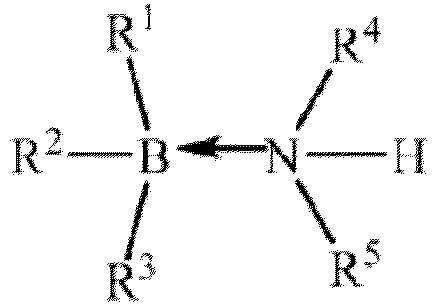 R1 Alkyl, das von 1 bis 10 Kohlenstoffatome aufweist, ist;R2 und R3 jeweils unabhängig voneinander Alkyl, das von 1 bis 10 Kohlenstoffatome aufweist, oder Aryl sind;R4 und R5 jeweils unabhängig voneinander Wasserstoff, Alkyl, das von 1 bis 10 Kohlenstoffatome aufweist, Arylalkylenyl, Polyoxyalkylenyl oder Alkyl, Arylalkylenyl oder Polyoxyalkylenyl sind, terminiert durch eine primäre oder sekundäre Aminogruppe oder eine primäre oder sekundäre Aminogruppe, die mit R1B(R2)R3 komplexiert ist, oder R4 und R5 sich zusammen mit dem Stickstoffatom, an das sie gebunden sind, verbinden, um einen 3- bis 7-gliedrigen Ring zu bilden.
 - Die Zusammensetzung nach einem der Ansprüche 1 bis 8, ferner umfassend mindestens eines von einem Plastifikator, einem Füllstoff, einem reaktiven Verdünnungsmittel oder einem Weichmacher.
- Die Zusammensetzung nach einem der Ansprüche 1 bis 9, wobei die Monomermischung mindestens eines von einem Acrylsäureester eines Alkanols, das von 1 bis 12 Kohlenstoffatome aufweist, einem Methacrylsäureester eines Alkanols, das von 1 bis 12 Kohlenstoffatome aufweist, Tetrahydrofurfurylacrylat oder Tetrahydrofurfurylmethacrylat umfasst.
- Die Zusammensetzung nach einem der Ansprüche 1 bis 10, wobei das mindestens eine von einem cyclischen imidhaltigen Acrylat oder einem cyclischen imidhaltigen Methacrylat durch die Formel dargestellt wird:
- Ein Gegenstand, der mit der Zusammensetzung nach einem der Ansprüche 1 bis 11 gebunden ist, wobei die Zusammensetzung mindestens teilweise ausgehärtet ist und wobei der Gegenstand mindestens einen Kunststoff mit niedriger Oberflächenenergie umfasst.
- Ein Verfahren zum Herstellen eines gebundenen Gegenstands, umfassend ein erstes Substrat und ein zweites Substrat, das Verfahren umfassend:Aufbringen der Zusammensetzung nach einem der Ansprüche 1 oder 4 bis 11, in Abhängigkeit von Anspruch 1, auf mindestens eines von dem ersten oder dem zweiten Substrat;Verkleben des ersten Substrats und des zweiten Substrats unter Verwendung der Zusammensetzung; undund Ermöglichen, dass die Zusammensetzung mindestens teilweise aushärtet, um den gebundenen Gegenstand herzustellen.
- Ein Verfahren zum Herstellen eines gebundenen Gegenstands, umfassend ein erstes Substrat und ein zweites Substrat, das Verfahren umfassend:Kombinieren des ersten Teils und des zweiten Teils der Zusammensetzung nach einem der Ansprüche 2, 3 oder 5 bis 11, in Abhängigkeit von Anspruch 2, um eine Klebstoffzusammensetzung bereitzustellen;Aufbringen der Klebstoffzusammensetzung auf mindestens eines von dem ersten und dem zweiten Substrat;Verkleben des ersten Substrats und des zweiten Substrats unter Verwendung der Klebstoffzusammensetzung; undErmöglichen, dass die Klebstoffzusammensetzung mindestens teilweise aushärtet, um den gebundenen Gegenstand herzustellen.
- Das Verfahren nach Anspruch 13 oder 14, wobei mindestens eines von dem ersten und dem zweiten Substrat mindestens eines von einem Kunststoff mit niedriger Oberflächenenergie, Metall oder Glas umfasst.
Applications Claiming Priority (2)
| Application Number | Priority Date | Filing Date | Title |
|---|---|---|---|
| US202163196056P | 2021-06-02 | 2021-06-02 | |
| PCT/IB2022/055150 WO2022254369A1 (en) | 2021-06-02 | 2022-06-02 | Composition including cyclic imide-containing monomer and organoborane complex and related articles and methods |
Publications (2)
| Publication Number | Publication Date |
|---|---|
| EP4347673A1 EP4347673A1 (de) | 2024-04-10 |
| EP4347673B1 true EP4347673B1 (de) | 2024-10-09 |
Family
ID=82399492
Family Applications (1)
| Application Number | Title | Priority Date | Filing Date |
|---|---|---|---|
| EP22737658.9A Active EP4347673B1 (de) | 2021-06-02 | 2022-06-02 | Zusammensetzung, die ein cyclisches imid-enthaltendes monomer und einen organoboran-komplex enthält, und damit zusammenhängende artikel und verfahren |
Country Status (4)
| Country | Link |
|---|---|
| US (1) | US20240271021A1 (de) |
| EP (1) | EP4347673B1 (de) |
| CN (1) | CN117412998B (de) |
| WO (1) | WO2022254369A1 (de) |
Family Cites Families (22)
| Publication number | Priority date | Publication date | Assignee | Title |
|---|---|---|---|---|
| US3496250A (en) | 1967-02-21 | 1970-02-17 | Borg Warner | Blends of epoxy resins and acrylonitrile butadiene-styrene graft copolymers |
| US4538920A (en) | 1983-03-03 | 1985-09-03 | Minnesota Mining And Manufacturing Company | Static mixing device |
| US5082147A (en) | 1988-02-29 | 1992-01-21 | Richard Jacobs | Composition dispensing system |
| US5621143A (en) | 1995-04-14 | 1997-04-15 | Minnesota Mining And Manufacturing Company | Organoborane polyoxyalkylenepolyamine complexes and adhesive compositions made therewith |
| US5616796A (en) | 1995-04-14 | 1997-04-01 | Minnesota Mining And Manufacturing Company | Organoborane polyamine complexes and adhesive composition made therewith |
| US5935711A (en) | 1996-10-23 | 1999-08-10 | 3M Innovative Properties Company | Organoborane amine complex initiator systems and polymerizable compositions made therewith |
| US6252023B1 (en) * | 1999-03-19 | 2001-06-26 | 3M Innovative Properties Company | Organoborane amine complex inatator systems and polymerizable compositions made therewith |
| US6486090B1 (en) | 1999-11-04 | 2002-11-26 | 3M Innovative Properties Company | Initiator/hydroxide and initiator/alkoxide complexes, systems comprising the complexes, and polymerized compositions made therewith |
| US6410667B1 (en) | 1999-11-04 | 2002-06-25 | 3M Innovative Properties Company | Initiator/amidine complexes, systems comprising the complexes, and polymerized compositions made therewith |
| US6479602B1 (en) | 2000-03-15 | 2002-11-12 | 3M Innovative Properties | Polymerization initiator systems and bonding compositions comprising vinyl aromatic compounds |
| JP2002194312A (ja) * | 2000-12-15 | 2002-07-10 | Three M Innovative Properties Co | 粘着剤及びそれを用いた粘着シート |
| US6849569B2 (en) | 2001-12-31 | 2005-02-01 | 3M Innovative Properties Company | Initiator systems comprising β-ketone compounds |
| US6734268B2 (en) | 2001-12-31 | 2004-05-11 | 3M Innovative Properties Company | Metal salt modifiers for bonding compositions |
| WO2003089536A2 (en) | 2002-04-19 | 2003-10-30 | Loctite (R & D) Limited | Polymerisation initiators based on ammonium tetraalkyl boranes, polymerisable compositions, and uses thereof for bonding low surface energy substrates |
| US8378005B2 (en) * | 2006-02-17 | 2013-02-19 | Toyo Ink Mfg. Co., Ltd. | Active energy ray-curable inkjet ink composition |
| US8137896B2 (en) * | 2008-07-29 | 2012-03-20 | Eastman Kodak Company | Method of preparing lithographic printing plates |
| EP2834314A1 (de) * | 2012-04-06 | 2015-02-11 | Ips Corporation | Haftzusammensetzung zum kleben mvon polyolefinsubstraten mit niedriger oberflächenenergie |
| TWI665087B (zh) * | 2014-02-19 | 2019-07-11 | 荷蘭商薩比克全球科技公司 | 多層板、彼之製造和使用方法、及包含該多層板之物件 |
| JP6297857B2 (ja) | 2014-02-21 | 2018-03-20 | スリーエム イノベイティブ プロパティズ カンパニー | 2液型接着剤及びそれを含む構造体 |
| JP6849303B2 (ja) | 2015-08-12 | 2021-03-24 | スリーエム イノベイティブ プロパティズ カンパニー | 2液型接着剤及びその硬化物を含む構造体 |
| JP6895714B2 (ja) * | 2016-03-30 | 2021-06-30 | デンカ株式会社 | 薄厚基板用組成物及び仮固定方法 |
| US10913876B2 (en) * | 2016-05-27 | 2021-02-09 | Ips Corporation | Polyurea-poly(meth)acrylate interpenetrating polymer network adhesive compositions and methods of using the same |
-
2022
- 2022-06-02 CN CN202280039515.5A patent/CN117412998B/zh active Active
- 2022-06-02 WO PCT/IB2022/055150 patent/WO2022254369A1/en not_active Ceased
- 2022-06-02 EP EP22737658.9A patent/EP4347673B1/de active Active
- 2022-06-02 US US18/564,661 patent/US20240271021A1/en active Pending
Also Published As
| Publication number | Publication date |
|---|---|
| US20240271021A1 (en) | 2024-08-15 |
| CN117412998A (zh) | 2024-01-16 |
| CN117412998B (zh) | 2024-08-13 |
| WO2022254369A1 (en) | 2022-12-08 |
| EP4347673A1 (de) | 2024-04-10 |
Similar Documents
| Publication | Publication Date | Title |
|---|---|---|
| CN103540268B (zh) | 用于结构粘合剂的组合物 | |
| EP1263907B1 (de) | Polymerisationsinitiator-systeme und haftzusammensetzungen, die vinylaromatische verbindungen enthalten | |
| JP6297857B2 (ja) | 2液型接着剤及びそれを含む構造体 | |
| EP1461365B1 (de) | beta-KETONVERBINDUNGEN ENTHALTENDE INITIATORSYSTEME UND DAMIT HERGESTELLTE ZUSAMMENSETZUNGEN | |
| WO2022130340A1 (en) | Composition including monomer with a carboxylic acid group, monomer with a hydroxyl group, a cycloalkyl monomer, and crosslinker and related articles and methods | |
| US20240084060A1 (en) | Composition including an acrylic monomer with a carboxylic acid group, an acrylic monomer with a hydroxyl group, an alkyl (meth)acrylate monomer and crosslinker, and related articles and methods | |
| US11739172B2 (en) | Composition including monomer with a carboxylic acid group, monomer with a hydroxyl group, and crosslinker and related articles and methods | |
| US12600885B2 (en) | Composition including monomer with a carboxylic acid group, monomer with a hydroxyl group, an alkyl monomer, and crosslinker and related article and method | |
| CN107922788B (zh) | 包含甲基丙烯酸苯氧乙酯和甲基丙烯酸四氢糠酯的二元粘合剂,包括其固化材料的结构体 | |
| EP4347673B1 (de) | Zusammensetzung, die ein cyclisches imid-enthaltendes monomer und einen organoboran-komplex enthält, und damit zusammenhängende artikel und verfahren | |
| JP2018100345A (ja) | 2液型接着剤及びその硬化物を含む構造体 | |
| WO2024214070A1 (en) | Two-part adhesive composition and method of making a bonded article | |
| JP2025031462A (ja) | 加飾シート用粘着剤組成物、加飾シート、加飾構造体およびその製造方法 | |
| HK1052525B (en) | Polymerization initiator systems and bonding compositions comprising vinyl aromatic compounds |
Legal Events
| Date | Code | Title | Description |
|---|---|---|---|
| STAA | Information on the status of an ep patent application or granted ep patent |
Free format text: STATUS: UNKNOWN |
|
| STAA | Information on the status of an ep patent application or granted ep patent |
Free format text: STATUS: THE INTERNATIONAL PUBLICATION HAS BEEN MADE |
|
| PUAI | Public reference made under article 153(3) epc to a published international application that has entered the european phase |
Free format text: ORIGINAL CODE: 0009012 |
|
| STAA | Information on the status of an ep patent application or granted ep patent |
Free format text: STATUS: REQUEST FOR EXAMINATION WAS MADE |
|
| 17P | Request for examination filed |
Effective date: 20231129 |
|
| AK | Designated contracting states |
Kind code of ref document: A1 Designated state(s): AL AT BE BG CH CY CZ DE DK EE ES FI FR GB GR HR HU IE IS IT LI LT LU LV MC MK MT NL NO PL PT RO RS SE SI SK SM TR |
|
| GRAP | Despatch of communication of intention to grant a patent |
Free format text: ORIGINAL CODE: EPIDOSNIGR1 |
|
| STAA | Information on the status of an ep patent application or granted ep patent |
Free format text: STATUS: GRANT OF PATENT IS INTENDED |
|
| DAV | Request for validation of the european patent (deleted) | ||
| DAX | Request for extension of the european patent (deleted) | ||
| INTG | Intention to grant announced |
Effective date: 20240529 |
|
| GRAS | Grant fee paid |
Free format text: ORIGINAL CODE: EPIDOSNIGR3 |
|
| GRAA | (expected) grant |
Free format text: ORIGINAL CODE: 0009210 |
|
| STAA | Information on the status of an ep patent application or granted ep patent |
Free format text: STATUS: THE PATENT HAS BEEN GRANTED |
|
| AK | Designated contracting states |
Kind code of ref document: B1 Designated state(s): AL AT BE BG CH CY CZ DE DK EE ES FI FR GB GR HR HU IE IS IT LI LT LU LV MC MK MT NL NO PL PT RO RS SE SI SK SM TR |
|
| REG | Reference to a national code |
Ref country code: CH Ref legal event code: EP |
|
| P01 | Opt-out of the competence of the unified patent court (upc) registered |
Free format text: CASE NUMBER: APP_50950/2024 Effective date: 20240909 |
|
| REG | Reference to a national code |
Ref country code: DE Ref legal event code: R096 Ref document number: 602022006724 Country of ref document: DE |
|
| REG | Reference to a national code |
Ref country code: IE Ref legal event code: FG4D |
|
| REG | Reference to a national code |
Ref country code: LT Ref legal event code: MG9D |
|
| REG | Reference to a national code |
Ref country code: NL Ref legal event code: MP Effective date: 20241009 |
|
| REG | Reference to a national code |
Ref country code: AT Ref legal event code: MK05 Ref document number: 1730534 Country of ref document: AT Kind code of ref document: T Effective date: 20241009 |
|
| PG25 | Lapsed in a contracting state [announced via postgrant information from national office to epo] |
Ref country code: NL Free format text: LAPSE BECAUSE OF FAILURE TO SUBMIT A TRANSLATION OF THE DESCRIPTION OR TO PAY THE FEE WITHIN THE PRESCRIBED TIME-LIMIT Effective date: 20241009 |
|
| PG25 | Lapsed in a contracting state [announced via postgrant information from national office to epo] |
Ref country code: NL Free format text: LAPSE BECAUSE OF FAILURE TO SUBMIT A TRANSLATION OF THE DESCRIPTION OR TO PAY THE FEE WITHIN THE PRESCRIBED TIME-LIMIT Effective date: 20241009 |
|
| PG25 | Lapsed in a contracting state [announced via postgrant information from national office to epo] |
Ref country code: IS Free format text: LAPSE BECAUSE OF FAILURE TO SUBMIT A TRANSLATION OF THE DESCRIPTION OR TO PAY THE FEE WITHIN THE PRESCRIBED TIME-LIMIT Effective date: 20250209 Ref country code: HR Free format text: LAPSE BECAUSE OF FAILURE TO SUBMIT A TRANSLATION OF THE DESCRIPTION OR TO PAY THE FEE WITHIN THE PRESCRIBED TIME-LIMIT Effective date: 20241009 Ref country code: PT Free format text: LAPSE BECAUSE OF FAILURE TO SUBMIT A TRANSLATION OF THE DESCRIPTION OR TO PAY THE FEE WITHIN THE PRESCRIBED TIME-LIMIT Effective date: 20250210 |
|
| PG25 | Lapsed in a contracting state [announced via postgrant information from national office to epo] |
Ref country code: FI Free format text: LAPSE BECAUSE OF FAILURE TO SUBMIT A TRANSLATION OF THE DESCRIPTION OR TO PAY THE FEE WITHIN THE PRESCRIBED TIME-LIMIT Effective date: 20241009 |
|
| PG25 | Lapsed in a contracting state [announced via postgrant information from national office to epo] |
Ref country code: BG Free format text: LAPSE BECAUSE OF FAILURE TO SUBMIT A TRANSLATION OF THE DESCRIPTION OR TO PAY THE FEE WITHIN THE PRESCRIBED TIME-LIMIT Effective date: 20241009 |
|
| PG25 | Lapsed in a contracting state [announced via postgrant information from national office to epo] |
Ref country code: ES Free format text: LAPSE BECAUSE OF FAILURE TO SUBMIT A TRANSLATION OF THE DESCRIPTION OR TO PAY THE FEE WITHIN THE PRESCRIBED TIME-LIMIT Effective date: 20241009 |
|
| PG25 | Lapsed in a contracting state [announced via postgrant information from national office to epo] |
Ref country code: NO Free format text: LAPSE BECAUSE OF FAILURE TO SUBMIT A TRANSLATION OF THE DESCRIPTION OR TO PAY THE FEE WITHIN THE PRESCRIBED TIME-LIMIT Effective date: 20250109 |
|
| PG25 | Lapsed in a contracting state [announced via postgrant information from national office to epo] |
Ref country code: GR Free format text: LAPSE BECAUSE OF FAILURE TO SUBMIT A TRANSLATION OF THE DESCRIPTION OR TO PAY THE FEE WITHIN THE PRESCRIBED TIME-LIMIT Effective date: 20250110 Ref country code: LV Free format text: LAPSE BECAUSE OF FAILURE TO SUBMIT A TRANSLATION OF THE DESCRIPTION OR TO PAY THE FEE WITHIN THE PRESCRIBED TIME-LIMIT Effective date: 20241009 Ref country code: AT Free format text: LAPSE BECAUSE OF FAILURE TO SUBMIT A TRANSLATION OF THE DESCRIPTION OR TO PAY THE FEE WITHIN THE PRESCRIBED TIME-LIMIT Effective date: 20241009 |
|
| PG25 | Lapsed in a contracting state [announced via postgrant information from national office to epo] |
Ref country code: PL Free format text: LAPSE BECAUSE OF FAILURE TO SUBMIT A TRANSLATION OF THE DESCRIPTION OR TO PAY THE FEE WITHIN THE PRESCRIBED TIME-LIMIT Effective date: 20241009 |
|
| PG25 | Lapsed in a contracting state [announced via postgrant information from national office to epo] |
Ref country code: RS Free format text: LAPSE BECAUSE OF FAILURE TO SUBMIT A TRANSLATION OF THE DESCRIPTION OR TO PAY THE FEE WITHIN THE PRESCRIBED TIME-LIMIT Effective date: 20250109 |
|
| PG25 | Lapsed in a contracting state [announced via postgrant information from national office to epo] |
Ref country code: SM Free format text: LAPSE BECAUSE OF FAILURE TO SUBMIT A TRANSLATION OF THE DESCRIPTION OR TO PAY THE FEE WITHIN THE PRESCRIBED TIME-LIMIT Effective date: 20241009 |
|
| PGFP | Annual fee paid to national office [announced via postgrant information from national office to epo] |
Ref country code: DE Payment date: 20250520 Year of fee payment: 4 |
|
| PG25 | Lapsed in a contracting state [announced via postgrant information from national office to epo] |
Ref country code: DK Free format text: LAPSE BECAUSE OF FAILURE TO SUBMIT A TRANSLATION OF THE DESCRIPTION OR TO PAY THE FEE WITHIN THE PRESCRIBED TIME-LIMIT Effective date: 20241009 |
|
| REG | Reference to a national code |
Ref country code: DE Ref legal event code: R097 Ref document number: 602022006724 Country of ref document: DE |
|
| PG25 | Lapsed in a contracting state [announced via postgrant information from national office to epo] |
Ref country code: EE Free format text: LAPSE BECAUSE OF FAILURE TO SUBMIT A TRANSLATION OF THE DESCRIPTION OR TO PAY THE FEE WITHIN THE PRESCRIBED TIME-LIMIT Effective date: 20241009 |
|
| PG25 | Lapsed in a contracting state [announced via postgrant information from national office to epo] |
Ref country code: RO Free format text: LAPSE BECAUSE OF FAILURE TO SUBMIT A TRANSLATION OF THE DESCRIPTION OR TO PAY THE FEE WITHIN THE PRESCRIBED TIME-LIMIT Effective date: 20241009 |
|
| PG25 | Lapsed in a contracting state [announced via postgrant information from national office to epo] |
Ref country code: SK Free format text: LAPSE BECAUSE OF FAILURE TO SUBMIT A TRANSLATION OF THE DESCRIPTION OR TO PAY THE FEE WITHIN THE PRESCRIBED TIME-LIMIT Effective date: 20241009 |
|
| PG25 | Lapsed in a contracting state [announced via postgrant information from national office to epo] |
Ref country code: CZ Free format text: LAPSE BECAUSE OF FAILURE TO SUBMIT A TRANSLATION OF THE DESCRIPTION OR TO PAY THE FEE WITHIN THE PRESCRIBED TIME-LIMIT Effective date: 20241009 |
|
| PG25 | Lapsed in a contracting state [announced via postgrant information from national office to epo] |
Ref country code: IT Free format text: LAPSE BECAUSE OF FAILURE TO SUBMIT A TRANSLATION OF THE DESCRIPTION OR TO PAY THE FEE WITHIN THE PRESCRIBED TIME-LIMIT Effective date: 20241009 |
|
| PLBE | No opposition filed within time limit |
Free format text: ORIGINAL CODE: 0009261 |
|
| STAA | Information on the status of an ep patent application or granted ep patent |
Free format text: STATUS: NO OPPOSITION FILED WITHIN TIME LIMIT |
|
| PG25 | Lapsed in a contracting state [announced via postgrant information from national office to epo] |
Ref country code: SE Free format text: LAPSE BECAUSE OF FAILURE TO SUBMIT A TRANSLATION OF THE DESCRIPTION OR TO PAY THE FEE WITHIN THE PRESCRIBED TIME-LIMIT Effective date: 20241009 |
|
| 26N | No opposition filed |
Effective date: 20250710 |
|
| REG | Reference to a national code |
Ref country code: CH Ref legal event code: H13 Free format text: ST27 STATUS EVENT CODE: U-0-0-H10-H13 (AS PROVIDED BY THE NATIONAL OFFICE) Effective date: 20260127 |
|
| PG25 | Lapsed in a contracting state [announced via postgrant information from national office to epo] |
Ref country code: MC Free format text: LAPSE BECAUSE OF FAILURE TO SUBMIT A TRANSLATION OF THE DESCRIPTION OR TO PAY THE FEE WITHIN THE PRESCRIBED TIME-LIMIT Effective date: 20241009 |
|
| PG25 | Lapsed in a contracting state [announced via postgrant information from national office to epo] |
Ref country code: LU Free format text: LAPSE BECAUSE OF NON-PAYMENT OF DUE FEES Effective date: 20250602 |
|
| REG | Reference to a national code |
Ref country code: BE Ref legal event code: MM Effective date: 20250630 |
|
| PG25 | Lapsed in a contracting state [announced via postgrant information from national office to epo] |
Ref country code: IE Free format text: LAPSE BECAUSE OF NON-PAYMENT OF DUE FEES Effective date: 20250602 |
|
| PG25 | Lapsed in a contracting state [announced via postgrant information from national office to epo] |
Ref country code: BE Free format text: LAPSE BECAUSE OF NON-PAYMENT OF DUE FEES Effective date: 20250630 |
|
| PG25 | Lapsed in a contracting state [announced via postgrant information from national office to epo] |
Ref country code: FR Free format text: LAPSE BECAUSE OF NON-PAYMENT OF DUE FEES Effective date: 20250630 |
|
| PG25 | Lapsed in a contracting state [announced via postgrant information from national office to epo] |
Ref country code: CH Free format text: LAPSE BECAUSE OF NON-PAYMENT OF DUE FEES Effective date: 20250630 |