EP4348414B1 - Codage de réseau de calcul pour évaluation entièrement homomorphique - Google Patents
Codage de réseau de calcul pour évaluation entièrement homomorphique Download PDFInfo
- Publication number
- EP4348414B1 EP4348414B1 EP22734227.6A EP22734227A EP4348414B1 EP 4348414 B1 EP4348414 B1 EP 4348414B1 EP 22734227 A EP22734227 A EP 22734227A EP 4348414 B1 EP4348414 B1 EP 4348414B1
- Authority
- EP
- European Patent Office
- Prior art keywords
- operations
- network
- range
- computation
- values
- Prior art date
- Legal status (The legal status is an assumption and is not a legal conclusion. Google has not performed a legal analysis and makes no representation as to the accuracy of the status listed.)
- Active
Links
Images

Classifications
-
- H—ELECTRICITY
- H04—ELECTRIC COMMUNICATION TECHNIQUE
- H04L—TRANSMISSION OF DIGITAL INFORMATION, e.g. TELEGRAPHIC COMMUNICATION
- H04L9/00—Cryptographic mechanisms or cryptographic arrangements for secret or secure communications; Network security protocols
- H04L9/008—Cryptographic mechanisms or cryptographic arrangements for secret or secure communications; Network security protocols involving homomorphic encryption
-
- H—ELECTRICITY
- H04—ELECTRIC COMMUNICATION TECHNIQUE
- H04L—TRANSMISSION OF DIGITAL INFORMATION, e.g. TELEGRAPHIC COMMUNICATION
- H04L9/00—Cryptographic mechanisms or cryptographic arrangements for secret or secure communications; Network security protocols
- H04L9/30—Public key, i.e. encryption algorithm being computationally infeasible to invert or user's encryption keys not requiring secrecy
- H04L9/3093—Public key, i.e. encryption algorithm being computationally infeasible to invert or user's encryption keys not requiring secrecy involving Lattices or polynomial equations, e.g. NTRU scheme
-
- G—PHYSICS
- G06—COMPUTING OR CALCULATING; COUNTING
- G06F—ELECTRIC DIGITAL DATA PROCESSING
- G06F2207/00—Indexing scheme relating to methods or arrangements for processing data by operating upon the order or content of the data handled
- G06F2207/38—Indexing scheme relating to groups G06F7/38 - G06F7/575
- G06F2207/48—Indexing scheme relating to groups G06F7/48 - G06F7/575
- G06F2207/4802—Special implementations
- G06F2207/4818—Threshold devices
- G06F2207/4824—Neural networks
-
- G—PHYSICS
- G06—COMPUTING OR CALCULATING; COUNTING
- G06F—ELECTRIC DIGITAL DATA PROCESSING
- G06F7/00—Methods or arrangements for processing data by operating upon the order or content of the data handled
- G06F7/38—Methods or arrangements for performing computations using exclusively denominational number representation, e.g. using binary, ternary, decimal representation
- G06F7/48—Methods or arrangements for performing computations using exclusively denominational number representation, e.g. using binary, ternary, decimal representation using non-contact-making devices, e.g. tube, solid state device; using unspecified devices
- G06F7/544—Methods or arrangements for performing computations using exclusively denominational number representation, e.g. using binary, ternary, decimal representation using non-contact-making devices, e.g. tube, solid state device; using unspecified devices for evaluating functions by calculation
Definitions
- the presently disclosed subject matter relates to a method to convert a first computation network of operations into a second computation network of FHE operations, a computer readable medium, and a system for converting a first computation network of operations into a second computation network of operations.
- FHE Fully Homomorphic Encryption
- Homomorphic encryption can be used for privacy-preserving outsourced storage and computation. This allows data to be encrypted and out-sourced to a cloud environment for processing and/or storage, all while encrypted.
- homomorphic cryptography may be applied in fields such as health care in which privacy regulations may make it difficult to share plain data, but computations on encrypted medical data may be allowable.
- a medical model developed, say, to classify medical data may be configured to receive medical data from a third party, say a hospital, in encrypted form.
- the medical model might, e.g., classify medical data, e.g., as normal or abnormal, or as having some particular medical syndrome, disease, or other disorder.
- the medical model may be applied to medical data that is received in encrypted form. This means that the party that evaluates the medical model does not have access to the plain medical data that corresponds to the encrypted medical data.
- the user of the service can decrypt the result of the medical model application.
- a cryptosystem that supports arbitrary computations on ciphertexts is known as a fully homomorphic encryption (FHE) scheme.
- FHE fully homomorphic encryption
- Such a scheme enables the evaluation of a wide range of functions, and which can be run on encrypted inputs to produce an encryption of the result. For example, so-called functional completeness can be obtained once a combination of and-gates and or-gates are available as this allows one to implement any Boolean circuit.
- Such a circuit can be run by an untrusted party without revealing its inputs and internal state and output.
- a fully homomorphic encryption may be leveled, in which case the number of certain operations cannot exceed a predetermined threshold.
- a leveled fully homomorphic scheme may be converted to an unleveled FHE scheme by performing bootstrapping operations. A bootstrapping operation increases the number of operations than can be performed on an encrypted data item.
- a fully homomorphic encryption scheme may support computations expressed in some special form, e.g., as a Boolean or arithmetic circuit.
- a leveled fully homomorphic encryption scheme may support the evaluation of arbitrary circuits but of a bounded, pre-determined, depth.
- Unleveled fully homomorphic encryption (FHE) allows the evaluation of arbitrary circuits of unbounded depth.
- a leveled FHE scheme may be converted to an unleveled FHE scheme by periodic execution of a bootstrapping operation on data. It is known how to compile a computation, e.g., a function, in the form of a circuit.
- the cryptographic scheme TFHE uses a mathematical structure called the Torus.
- An example of a torus is R / Z , e.g., the real numbers modulo 1 (other moduli are possible, but 1 is convenient). Values on the torus are often represented in practical implementations as a suitable finite ring, e.g., Z / mZ , where m is a modulus, e.g., the integers modulo a modulus.
- the integer modulus is typically a power of 2, e.g., 2 q , where q might be, e.g., 32 or 64, and is generally less than or equal to 128.
- Encryption of a torus value may be done as in the particular scheme; e.g., as in the above quoted paper "Programmable Bootstrapping Enables Efficient Homomorphic Inference of Deep Neural Networks".
- the numbers modulo the modulus represent the values on the torus, e.g., a range from 0 (included) to 1 (excluded).
- Some FHE operations may impose an even smaller range on their input(s), e.g., from 0 to 1 2 or even from 0 to 1 4 . Since values occurring in the conventional first computational network are often outside the range supported by the FHE, e.g., outside the range from 0 to 1, there is a need to encode values in the first computational network as smaller values that do fit in the range. Only some of the values of the first computational network need to be encoded: clearly, confidential data is to be encrypted and is encoded first, but also, for example, constants that may be added or subtracted to intermediate encrypted values.
- the encryption may be the trivial encryption if the data to be added or subtracted is not confidential, e.g., parameters of the model.
- a notable example of a value which does not need to be encoded is the case of a non-confidential integer constant, by which an intermediate encrypted value is multiplied.
- a traditional approach to achieve this is to scale all values in the first computation network down until all values fit into the smallest range supported by the FHE scheme.
- One particular drawback with this approach is that, even if such scaling down is possible for the particular first computational network, it will incur a loss of accuracy. This in turn will either lead to a degrading of the fidelity of the network when run using FHE operations, or huge crypto parameters will have to be taken in the second computational network to counteract this accuracy loss. The latter option would in turn lead to an increased memory use and slower computation speed.
- the first computational network operates on input represented as real numbers, e.g., floating-point numbers or fixed-point numbers. Such real numbers can be converted to real number on the torus, and in turn to TFHE encoded values. These types of inputs are of particular relevance for many practical applications, e.g., neural networks and the like.
- the first computation network could also have integer valued inputs, which can likewise be converted to points on the torus; for example, they could be converted to real numbers.
- the first and second computation networks are neural networks, e.g., deep neural networks. In an embodiment, the first and second computation networks are arranged to receive an input image. In an embodiment, the first and second computation networks are neural networks arranged to receive an input image. The input image may be a medical input image although this is not necessary.
- the second computational network preferably computes the same function as the first computational network, although for most applications it might be possible that the second computational network computes a function which is approximated. Even a close approximation is preferred to full fidelity for performance.
- the second computational network computes a function on an image, e.g., an image classification, or a control signal for a machine, or the like, it is often sufficient if the output of the second computational network is close to the output of the first computational network, or close to a reference output.
- a first computation network of operations is obtained for conversion. It assumed that the first computation network already avoids multiplications of encrypted values by real numbers. Such multiplications are not forbidden per se, as they can be implemented as a programmable bootstrapping (PBS), but a PBS is much more expensive than operations that can be performed natively, such as addition or multiplication by integers.
- the first computation network can be converted into a second computation network which can be computed on encrypted values, using FHE operations.
- operations in the first computation network can be converted one to one, although it is sometimes advantageous to insert additional operations in the second computational network, as explained herein.
- Particularly advantageous FHE schemes are those on the torus, as they allow efficient programmable bootstrapping in addition to native addition and integer multiplication.
- Elements in the FHE scheme may have a restricted range, this is in particular true for the torus, which can be thought of as the set of real numbers modulo an integer, typically modulo one.
- values in the first computational network e.g., input values, intermediate values or output values may well lie outside that range, an encoding is needed from values in the first computational network to the second computational network.
- the encoding can be implicit in the second computational network; the encodings may be used to set the parameters of the operations in the second computational network, but the encodings are not explicitly needed, say, to execute the second computation network.
- Different layers in the second computational network may have different prescribed ranges, e.g., the range that values need to stay in to ensure correct processing, e.g., due to technicalities of the FHE scheme used, or the particular operation, or the number of operands in an operation, etc.
- the prescribed range for most matrix operations may have size 1, e.g., the prescribed range may be from 0 to 1, whereas a PBS that needs padding bit may require a range from 0 to 1 ⁇ 2, whereas a PBS that does not require a padding bit, e.g., a negacylic operation, may use a range from 0 to 1, whereas a PBS that uses multiple operands, may need more padding, e.g., use a range from 0 to 1/4, e.g., for a MaxPool, etc.
- Determining the prescribed range for an operation may be implemented as a look-up table. For example, a look-up table may map an operation in the first computational network to an FHE operation, and also provide the prescribed range, etc.
- a scaling factor may be determined such that applying the scaling factor to the supported range for a value maps it to a range having the size of the prescribed range. For example, a scaling factor may be applied to a value in the supported range by multiplying the value with the scaling factor.
- An encoding may also comprise a shift which is added to the scaled value.
- the operations that will receive the scaled value can be adjusted to receive the input values scaled with the scaling factor.
- An operation may be adjusted to expect input values that are too large by a factor.
- a linear mapping such as ax + b
- the shift factor can be determined by applying the scaling factor to a supported range before the operation, and shifting the scaled supported range to fall in the prescribed range. For example, if the supported range is [-30, 20], the scaling factor is 0.01, and our prescribed range is [0, 1/2], then the scaled supported range becomes [-0.3, 0.2]. One can apply a shift of 0.3 to get a range of [0, 1/2]. If the prescribed range is larger than the scaled supported range, there are multiple choices for the shift factor. For example, if the supported range is [-25, 20], the scaling factor is 0.01, and our prescribed range is [0, 1/2], then the scaled supported range becomes [-0.25, 0.2]. One can then apply any shift between 0.25 and 0.3 to get a range included in [0, 1/2].
- a further operation A ( x ) may be adjusted to receive the input values scaled with the scaling factor and shifted with a shift value A ( d 1 x - s 1 ) . In this case, it may be that the further operation operates individually on values in a layer, so that the shift s 1 may be different for different values.
- the scaling factor d 1 is the same for all values in the layer on which operation A acts.
- an encoding at the output of a PBS e.g., further adjusting a further operation A ( x ) .
- a ( x ) is further adjusted to produce an output value scaled with a further scaling function for a next operation, e.g., this may be A ( )/ d 2 or A ( )/ d 2 + s 2 , together with the first encoding this may become A ( d 1 x - s 1 ) / d 2 + s 2 .
- These additional encodings increase the number of independent encodings, thus decreasing the number of values or layers that are assigned the same scaling factor. This in turn means that choices for the encoding values can better suit the particular supported ranges occurring in the layers, instead of using a less optimal scaling factor induced by a supported range from a different layer.
- scaling factors may be found by first assigning symbolic scaling factors to layers between operations, and to reduce the number of symbolic scaling factors based on conditions placed on them imposed by the first network architecture or topology. For example, the number of symbolic scaling factors may be reduced by setting some of them equal to one another.
- so-called join layers or join operations discussed herein can impose such conditions.
- a Join layer is defined as a layer which uses the result of two or more previously-computed layers.
- Actual values can then be assigned to each symbolic scaling factors by determining the smallest scaling factor that will still fit each supported range for the values occurring in the layers to which the scaling factor will be applied. For example, one can compute a scaling factor for each value in those layers, and take the smallest one, or equivalently the largest encoding divisor.
- values in a layer may have a supported range that is smaller after applying the scaling factor than the size of the prescribed range. This can happen naturally, for example if the scaling factor is smaller to account for the supported range of another value. It can also be enforced by taking the scaling factor intentionally too small, i.e., smaller than required; e.g., by decreasing the size of the prescribed range. This means that scaled supported range will fit loosely in a prescribed range, so to say. That is the scaled range can be shifted into the prescribed range using multiple different shifts, as described earlier. As noted herein, some operations, like a PBS, may need a shift to ensure that the values that it operates on are in the range expected by the operation.
- test-vectors which are arrays used during the PBS that encode the input output behavior of the PBS
- shifts which might well be equal to the number of values in the input layer.
- a single test vector may be used, which has the advantage to make the computation of the test vectors faster, to reduce the memory used during the execution of the second network, or to reduce the storage of the second network, to name a few. This can be done more systematically by grouping the programmable bootstrapping operations according to the individual shift of the input values, and by assigning one test vector to each group. This can significantly reduce the number of required test vectors and thus shrink the size of the second computational network.
- the number of performed PBS is maintained equal, and so is the second-network execution time.
- a particularly useful application of conversion is allowing the execution of computation on private data.
- a computation such as a medical evaluation of an image or other medical data.
- Medical data may comprise a medical image.
- a medical image may comprise, e.g., multi-dimensional image data, e.g., to two-dimensional (2D), three-dimensional (3D) or four-dimensional (4D) images, acquired by various acquisition modalities such as, but not limited to, standard X-ray Imaging, Computed Tomography (CT), Magnetic Resonance Imaging (MRI), Ultrasound (US), Positron Emission Tomography (PET), Single Photon Emission Computed Tomography (SPECT), and Nuclear Medicine (NM).
- CT Computed Tomography
- MRI Magnetic Resonance Imaging
- US Ultrasound
- PET Positron Emission Tomography
- SPECT Single Photon Emission Computed Tomography
- NM Nuclear Medicine
- An embodiment of the method may be implemented on a computer as a computer implemented method, or in dedicated hardware, or in a combination of both.
- Executable code for an embodiment of the method may be stored on a computer program product.
- Examples of computer program products include memory devices, optical storage devices, integrated circuits, servers, online software, etc.
- the computer program product comprises non-transitory program code stored on a computer readable medium for performing an embodiment of the method when said program product is executed on a computer.
- the computer program comprises computer program code adapted to perform all or part of the steps of an embodiment of the method when the computer program is run on a computer.
- the computer program is embodied on a computer readable medium.
- a further aspect is an electronic system or device, e.g., a computer, configured for conversion according to an embodiment, e.g., a system for converting a first computation network of operations into a second computation network of operations.
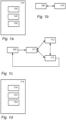
- Figure 1a schematically shows an example of an embodiment of an FHE computing system 110, e.g., a system for performing a computation using fully homomorphic encryption (FHE).
- the system 110 of figure 1a may be used to perform a computation on data, even though said data is received in encrypted form, e.g., from a data provider.
- System 110 may comprise a processor system 130, a storage 140, and a communication interface 150.
- Storage 140 may comprise local storage, e.g., a local hard drive or electronic memory.
- Storage 140 may comprise non-local storage, e.g., cloud storage. In the latter case, storage 140 may comprise a storage interface to the non-local storage.
- storage 140 may store encrypted data items, e.g., received from one or more data providers or generated as intermediate results or end results, e.g., outputs, of the computation.
- most or all data items on which the computation of system 110 is performed are encrypted with a key (or keys) that is not known to system 110-that is system 110 may not be configured to obtain the plain data items corresponding to the encrypted data items, e.g., such as stored in storage 140.
- the decryption key in plain form is secret for system 110, though the encryption/decryption key may be available in encrypted form.
- the processor system may be configured to perform a sequence of FHE operations, which may include such arithmetic operations on encrypted values as addition and multiplication, but may also include arithmetic operations on encrypted polynomials.
- Performing a computation using FHE operations may be done by stringing a series of FHE operations after one another, some of which may operate on input values, other may operate on intermediate values. Typically, most or all the operations are done on encrypted values, so that the FHE system does not know the confidential values that it is working on.
- One source of FHE computations is to start from a regular computation, e.g., a sequence of non-FHE operations and to convert the conventional computation into an FHE computation.
- a particular suitable source of computations that can be converted are so-called computation networks, also called computational networks.
- the nodes represent operations and the edges in the network indicate which operations take values from other operations as input.
- a computation network may be represented as a directed, cycle-free graph, in which nodes represent operations and directed edges indicate which operations take input from which previous operations.
- the computation network may be represented in the form of a text file, e.g., as a sequence of operators.
- a computation network may also be represented as a connection table, together with information indicating the type of the operators.
- Input nodes in the computation network may represent external output, while output nodes may represent output values.
- This concept of computation network can be expanded while still being amenable to conversion by an embodiment.
- the computation network might also not contain loops, e.g., may be cycle free, but this is also not necessary as loops having a fixed number of iterations can be accommodated in an FHE network as well, e.g., by unrolling the loop. Even loops with a dynamically determined number of iterations may be converted if there is an upper bound on the number of cycles in the loop; in the latter case the dynamic loop may first be converted to a loop with a fixed number of iterations.
- Figure 1d schematically shows an example of an embodiment of a system 114 for converting a computation for FHE.
- System 114 may be configured to convert a first computation network of operations arranged to compute a function into a second computation network of FHE operations arranged to compute the same function.
- system 114 comprises a processor system 134, a storage 144, and a communication interface 154.
- system 110 and 114 may be the same system, this is not necessary though.
- system 114 may receive a representation of a first computation network and convert it into a second computation network for FHE execution.
- system 114 may receive the first computation network from a third party, e.g., from data provider system 160 or the like.
- the first computation network may originate elsewhere, for example, a conventional compiler may receive a high-level description of the desired computation and produce the first computation network, e.g., even multiple first computation networks each for some aspect of the computation that together perform the overall computation.
- the second computation network may be transferred to system 110 for computation. If systems 110 and 114 are the same then the second computation network may be executed on the same system.
- system 114 may be provided by the same party that provides computation system 110.
- a user of system 110 may install a system 114 on its own premises, e.g., by downloading appropriate software and using that to convert his computation networks which in turn may be uploaded to system 110 for execution.
- System 110 and system 114 may communicate internally, with each other, with other systems, external storage, input devices, output devices, and/or one or more sensors over a computer network.
- the computer network may be an internet, an intranet, a LAN, a WLAN, etc.
- the computer network may be the Internet.
- the system comprises a connection interface which is arranged to communicate within the system or outside the system as needed.
- the connection interface may comprise a connector, e.g., a wired connector, e.g., an Ethernet connector, an optical connector, etc., or a wireless connector, e.g., an antenna, e.g., a Wi-Fi, 4G or 5G antenna.
- Communication e.g., internal communication, may use other communication protocols or media, e.g., an internal data bus.
- system 110 and system 114 the communication interfaces 150 and 154 may be used to send and/or receive digital data.
- system 110 may be configured to receive encrypted data items from an external computer, e.g., a data providing computer.
- system 110 may be configured to transmit computation results to an external computer, typically, in an encrypted format.
- communication interface 150 may be used for internal communication in system 110, e.g., to distribute the computation of multiple computation entities, e.g., computing devices.
- system 114 may be configured to receive a first computation network and/or to transmit a converted second computation network.
- systems 110 and/or 114 may be implemented in a processor system, e.g., one or more processor circuits, e.g., microprocessors, examples of which are shown herein.
- Systems 110 and/or 114 may comprise multiple processors, which may be distributed over different locations. For example, systems 110 and/or 114 may use cloud computing.
- FIG. 1 Some of the figures herein show functional units that may be functional units of the processor system. For example, a figure may be used as a blueprint of a possible functional organization of the processor system.
- the processor circuit(s) are not shown separate from the units in most figures.
- the functional units shown in figures 2 may be wholly or partially implemented in computer instructions that are stored at a system such as systems 110 and/or 114, e.g., in an electronic memory of the system, and are executable by a microprocessor of the system.
- functional units are implemented partially in hardware, e.g., as coprocessors, e.g., arithmetic and/or cryptographic coprocessors, and partially in software stored and executed on systems 110 and/or 114.
- Figure 1b schematically shows an example of an embodiment of a system for performing a computation using FHE.
- Figure 1b shows the FHE system of figure 1a in the context of a data provider system 160.
- FHE system 110 is configured for performing a computation using fully homomorphic encryption (FHE) cryptography.
- FHE fully homomorphic encryption
- system 110 may be configured to receive encrypted data items from a data provider 160. At least some data items may be received in encrypted form. Some data items may be received in plain format. The computation is run on the received data items and possibly also on stored data items. Interestingly, the computation may be performed on the encrypted data, without decrypting the data, e.g., without converting encrypted data items to data in a plain format.
- System 110 may be configured for an FHE scheme, e.g., for a number of FHE operations.
- FHE operation may include gates.
- an FHE system may be configured for a so-called NAND-gate.
- an FHE system may have an addition and a multiplication operation, e.g., in a finite field, or finite ring, or the like.
- the operations of the FHE scheme are in principle sufficient to perform a wide range of computations, with the exception that the number of consecutive operations may be limited, e.g., if the FHE scheme is a leveled scheme without a bootstrapping operation, or without a bootstrapping operation being employed.
- encrypted data in an FHE scheme and as implemented in an FHE system involves some measure of noise.
- encryption of a data item may comprise mapping the data item to a point in a key-dependent lattice, to which some noise is added.
- the noise When a data item has just been encrypted the noise is low-the encryption is fresh. For example, the amount of noise is so low, that if a data item were to be decrypted, the noise can be removed at some point in the decryption process, e.g., by rounding. On the other hand, the noise should be high enough to make attacks on the system sufficiently hard. For example, in the hypothetical absence of noise, many FHE schemes could be attacked with linear algebra, or other efficient algorithms, e.g., lattice-based algorithms. When a data item is encrypted, noise is added that is chosen so that attacks are hard while FHE operations can still be performed. Most FHE operations will increase the noise that is inherent in an encrypted FHE data item.
- a leveled FHE scheme can perform some limited number of operations, one after the other.
- the leveled FHE scheme is designed such that the worst-case noise at the end of such a number of operations is below a bound needed for decryption.
- Another approach are so-called bootstrapping operations.
- a bootstrapping operation reduces noise in an encrypted data item, by returning a fresh encryption of the same data with less noise.
- a bootstrapping operation is notably possible if the FHE scheme is capable enough to evaluate homomorphically its decryption algorithm in the encrypted domain-sometimes called a bootstrappable FHE scheme.
- a bootstrapping operation receives helper data related to the encryption key that allows reducing the noise without decryption of the encrypted data items.
- the helper data is an encrypted version of the key used to decrypt the data item.
- the decryption key may be the same as the encryption key, in case of a symmetric-key FHE scheme, or may be distinct therefrom, e.g., in case of an asymmetric-key FHE scheme.
- an FHE scheme may use other keys, such as a key for homomorphic evaluation. The latter is typically a public key corresponding to a private key which may be stored at the data provider.
- the bootstrapping operation performs the decryption of an encrypted data item, counterintuitively the decryption is performed in the encrypted domain, so that the homomorphic decryption does not actually reveal anything about the plain data item.
- the bootstrapping operation then performs the noise reduction-typically by homomorphic rounding.
- the result is an encrypted data item, with a lower, fixed noise level.
- the noise present in the ciphertext resulting from bootstrapping results from the bootstrapping operation.
- Determining when a bootstrapping is needed can be done by keeping track how large the noise level will be, e.g., assuming a worst-case scenario. Instead of a worst-case scenario, an average-case may be assumed, although this may increase the risk of a computation result which cannot be decrypted. For example, a computation that is inherently robust against occasional errors, such as a neural network evaluation, may be performed using average-case analysis for the noise propagation.
- the noise analysis e.g., worst-case or average-case analysis, may be done beforehand, but may also be done dynamically.
- the noise-increase may depend on the particular computation.
- an FHE scalar multiplication increases noise by an amount that depends on the multiplicand.
- One approach is to perform a bootstrapping operation often, e.g., after every operation, or after every set number of operations, e.g., every two.
- Particularly useful are programmable bootstrapping operations which can reduce noise in addition to computing a function.
- the function can be an encoded as a lookup table, this table being called the test-vector of the programmable bootstrapping.
- FHE schemes can be applied in many settings.
- FHE system 110 may be operated by a cloud provider.
- the cloud provider may offer computation and storage services to its clients.
- data provider 160 e.g., a client of the cloud provider can send their data in encrypted form.
- the cloud provider can still perform the required computations, and/or the required storage, but will not be able to know the corresponding to plain data nor the result of the computation.
- data provider 160 may use an encryption key of a type corresponding to the particular FHE scheme used in the FHE system, to encrypt the data items.
- a corresponding decryption key may be used to decrypt the encrypted data items. Encryption and decryption keys may be the same-and typically are so.
- a training system may be configured to train machine-learning models, e.g., image classifiers, e.g., medical models, typically while having access to the plain data items. For example, backpropagation may be performed on the input data. The resulting model parameters may be processed by an embodiment for running on encrypted data.
- machine-learning models e.g., image classifiers, e.g., medical models
- backpropagation may be performed on the input data.
- the resulting model parameters may be processed by an embodiment for running on encrypted data.
- the FHE system 110 may be used to offer the model, FHE system 110 may be used to offer the model, FHE system 110 may be used to offer the model, say, for use with medical data. This is typically done with plain model parameters, but with encrypted data, e.g., encrypted input, intermediate and output data.
- An effect of the system is that a computation is performed, say an image classification, e.g., a medical image classification, without the computer knowing the plain data items. For example, a mammogram may be evaluated for cancer, without the image ever being in the plain at system 110 and without system 110 knowing what the outcome of the cancer evaluation is.
- system 110 may be used for protected control of a device.
- a device even a large device such as a power plant, may send sensor values to system 110 and receive encrypted control signals in return; the control signals being computed from the sensor signals.
- An attacker of the system may be able to determine the contents of data going to and from system 110, or even gain access to intermediate data of system 110, but he will not be helped by that as the data is encrypted.
- control signal may involve such mathematical operation as linear algebra, averages, matrix multiplication, polynomial evaluations, and so on, all of which are possible to execute with FHE operations.
- a store e.g., a collection in a storage, of encrypted data items may be maintained in the FHE system; some of these may be received some may be the result of an FHE computation, e.g., intermediate results.
- the FHE system may be configured to apply an FHE operation to one, two or more encrypted data items in a store, e.g., a collection of input and/or intermediate and/or output values.
- the result will be a new encrypted data item that may be stored in the store.
- the encrypted data store may be stored in a storage of the FHE system. This may be local storage or a distributed storage. In the latter case, it may happen that one or more encrypted data items are represented multiple times in the encrypted data store.
- Encrypted data items may be sent from one computing device to another, e.g., if their values are needed elsewhere.
- the encrypted data store may be implemented in various ways, e.g., as a register file, an array, various data structure, and so on.
- an encryption key may be a string of n digits s i
- + and ⁇ respectively represents the addition between torus elements and a product between integers and torus elements
- a i are n torus elements
- ⁇ is the plain data item as a torus element
- e is the noise, e.g., a torus element drawn from a probability distribution, e.g., a Gaussian distribution.
- the secret digits s 1 , ... , s n of the secret key s are bits; this is not necessary though.
- the secret digits s j could take on more than 2 values, e.g., three values (ternary digits), four values, or even more.
- the encrypted data items may represent all kinds of data.
- encrypted data items may represent numbers that need to be averaged, or which are used for linear regression, etc.
- the encrypted data items may represent an image.
- each pixel of the image may correspond to one or more encrypted data items.
- a grey-scale pixel may be represented by a grey level, which in turn may be represented by a single encrypted data item.
- 256 grey levels may be encoded in a single encrypted data item.
- a color pixel may be represented as multiple color levels, e.g., RGB levels, which in turn may be represented by a tuple of encrypted data items.
- three 256-level colors may be encoded in three encrypted data items. How many encrypted data items are used to represent some type of data depends on the capacity of the FHE scheme. For example, more restrictive FHE schemes may only be capable of encoding one bit per encrypted data item. In that case, one color pixel, may require 24 encrypted data items.
- Noise increase may depend on the type of operation, e.g., addition versus multiplication, and on the other parameters if any.
- an FHE operation may be multiplication with a known, e.g., plain value, e.g., multiplication by 2, multiplication with a known polynomial, and so on.
- a known value e.g., plain value
- multiplication with a larger value may increase the noise more than multiplication with a smaller value.
- Exactly how much noise increases given the performed operations can be calculated mathematically, or could be estimated empirically. While some operations may add significant amounts of noise, others may not add noise, e.g., an addition with a plain constant.
- a set of FHE operations may be defined for the computation. For example, from a target FHE computation, a network or circuit of operations may be built that together implement the computation.
- the operations may be Boolean operations.
- the operations may all be NAND operations.
- the computation may be represented as a list of FHE operations that are to be performed together with an indication on which FHE encrypted data item they are to be performed.
- the noise associated with the new computed (not-fresh) encrypted data items may grow. This is not a problem so long the noise stays within a limit needed for decryption. If more operations are to be performed, a bootstrapping operation can be performed.
- the size of encrypted data items in an FHE scheme can be quite large. Moreover, the more operations an FHE scheme is to perform without a bootstrapping operation the larger the size of an encrypted data item typically will be. Likewise, a higher resistance against attacks may be obtained with larger FHE parameters and in turn with larger encrypted data items. For example, the data items may be mapped to an FHE system featuring larger FHE parameters, so that more noise can be added while still being able to successfully perform operations. Increasing the range of values that a secret key digit can take on, will increase the entropy, and thus contribute to the FHE security.
- Figure 1c schematically shows an example of an embodiment of a system for performing a computation using FHE. Shown in figure 1c is the data provider system 160, and three FHE devices: Devices 111, 112, and 113. Each of devices 111, 112, and 113 are capable of performing FHE operations on encrypted data items. Together the three devices form the FHE system. There may be two or more than three FHE devices cooperating to form an FHE system.
- the computation is distributed over multiple FHE devices, in the example shown, three FHE devices.
- one of the multiple FHE devices may transmit encrypted data items to one or more of the other multiple FHE devices, e.g., received encrypted data items or intermediate encrypted data items, e.g., partial computation results.
- each of the multiple FHE devices may be configured to receive encrypted data items from the other devices.
- a prime example of a computation network for which there is a desire to transform it from conventional computation into FHE computation are neural networks.
- a system for converting takes a first neural network as input, which is an example of a first computation network, and generates a second neural network as output, which is an example of a second computation network.
- the second computation network may comprise a representation of FHE operators, their parameters, and so on.
- the second computation network computes the function represented by the first computation network, or typically, an approximation of the function. Especially, for neural networks, computing an approximation is acceptable.
- Converting a computational network is not limited to neural networks, although these are an important class of functions that can be well converted in this manner. Neural networks are often insensitive to small inaccuracies introduced throughout the computation. Thus neural networks tend to convert into especially efficient second computational networks using an embodiment.
- Encrypted values in an FHE scheme are typically limited to a fixed number of bits.
- the term real number or real is used herein to indicate a number that needs not be an integer.
- real is used, in FHE such numbers are typically represented in a number format comprising multiple digits.
- fixed-point precision is used to represent reals, rather than floating-point numbers.
- TFHE encrypted values may be numbers restricted to an interval, typically, between 0 (inclusive) and 1 (exclusive).
- real numbers may be values between 0 and 1 having a fixed precision, say, of 32 bit or 64 bit.
- a value on the torus may be represented by values outside the interval, but with the understanding that two values x and y represent the same torus value if they are equal modulo 1.
- real numbers are represented in a finite digital real-number representation, typically representing a rational approximation of the real number.
- Floating point or fixed point representation are typical examples of such real-number representations.
- a real-valued matrix multiplication may comprise a real-valued matrix multiplication represented by a real-valued matrix and optionally a real-valued vector addition represented by a real-valued vector.
- one, or more, or all elements of the real-valued matrix are represented in a finite digital real-number representation.
- one, or more, or all elements of the real-valued vector are represented in a finite digital real-number representation.
- all elements of both the real-value matrix and the real-valued vector are represented in a finite digital real-number representation; this is not necessary though and mixed representation matrix and/or vectors are a possibility.
- the floating point number format is described in, e.g., IEEE 754.
- Evaluating a neural network as a second computational network of FHE operation is useful to improve the privacy of users.
- Other examples of computation networks include: (i) running a medical test on one's private information, e.g., DNA data without revealing either the private information or the result of the test, (ii) spam detection: one can detect if a mail is a spam without having the key to decrypt it, e.g., without seeing the mail.
- An example of the former system may comprise a first device where medical data is obtained, e.g., received from on more sensors.
- the sensors may include, e.g., a temperature sensor.
- the sensors may include image sensors.
- the data is encoded according to an input encoding and encrypted using a secret key.
- the encrypted data may then be sent to a medical device where a second computational network is applied to the encrypted data.
- the encrypted output may be a classification of the input, e.g., an image classification.
- the encrypted result can be sent back to the medical device for decryption and decoding.
- An example of the latter system may comprise a first mail device where e-mail is received, the e-mail may then be encrypted according to the FHE scheme, e.g., using a secret key known at the first mail device.
- the first mail device may first encode the mail to a series of torus points, e.g., using an input encoding, and then encrypt the series to a series of encrypted values, e.g., using an LWE representation.
- the encrypted series is then sent to a spam-detector device, where a second computational network is installed.
- the encrypted values may also include other information, e.g., meta data, e.g., origin and/or destination addresses.
- the second computational network is applied to the series of encrypted values and produces an encrypted result, e.g., a binary spam or no-spam result, or a real-valued number, say, representing a probability that the mail is spam.
- the second computational network is obtained as a conversion from a first computational network, e.g., trained for spam detection.
- the encrypted output value (or values) is then sent from the spam-detector device to the first mail device, where the output is decrypted, e.g., using the secret key, and decoded, e.g., using an output decoding.
- the first mail device may discard the mail or not. For example, the first mail device may decide to display or not show the mail based on the decrypted output, or decide whether to forward the mail to a second mail device.
- Fully homomorphic encryption is an encryption paradigm where one can perform computations on encrypted data using only public material.
- the FHE scheme does not require knowing, e.g., a private key of the user, and does not to decrypt ciphertexts.
- TFHE for Torus-FHE
- TFHE schemes support an efficient bootstrapping (BS), which allows to reduce the noise in the scheme, and thus, support the homomorphic evaluation of neural networks (NN) as deep as desired.
- BS bootstrapping
- the bootstrapping operation can be combined with any function that needs to be performed on data, thus combining function evaluation and noise reduction.
- PBS programmable bootstrapping
- a programmable bootstrapping can reduce noise and perform, say, an activation function at the same time.
- TFHE supports some operations directly on the encrypted data without performing bootstrapping. These operations include: modular addition, typically with 1 as the modulus, and multiplication between a (clear) integer and an encrypted value, represented as a torus element. Encrypted values in a torus scheme are mapped onto real-valued numbers modulo 1, e.g., between 0 (inclusive) and 1 (exclusive). Although reference is made to real numbers, these values are typically represented in a fixed precision, as, say, a 32 or 64-bit number, and not in say IEEE 754 representation.
- the second computational network is TFHE-based, which, when executed, computes a neural network over encrypted input data.
- the parameters that define the second computational network are allowed to be plain values, that is the model does not need to be confidential, even though, it operates on encrypted values, e.g., encrypted input, intermediate and output values. Encrypted values may represent values on a torus, e.g., may represent real numbers modulo one.
- the torus points are mapped to a discrete ring.
- Operations that are performed in the first computational network must be translated into operation for the second computation network.
- a first difficulty in transforming a first computation network, such as a neural network, to an FHE computation network is that the first computation network may contain multiplications between an encrypted value and a non-integer value.
- Such operations can be done, e.g., using a programmable bootstrapping.
- a programmable bootstrapping For example, in a neural network one may encounter such operations as convolutions, matrix multiplications, batch normalization, etc.
- convolutions e.g., matrix multiplications, batch normalization, etc.
- There are several approaches to take when avoiding such multiplications between a real-valued number and an encrypted value For example one may:
- a further issue is that operations in the first computation network are often not constrained to remain in a particular small interval, but encrypted values in the FHE operations are restricted to be on the torus, and thus modulo a modulus, typically, modulo 1.
- One solution to this is to scale all values in the first computation network to values so that they are sufficiently small and are between 0 and 1 and stay between 0 and 1. If values increase too much, they can occasionally be scaled to smaller values.
- Nonlinear operations can be adapted to expected scaled values rather than the original values.
- a matrix multiplication being linear, works on a scaled value as well as on the unscaled value.
- a matrix addition can be scaled in proportion to the scaled variables.
- the inventors have found that the accuracy of the second computational network can be improved, e.g., to provide outputs that are closer to the first computational network, or that are closer to the function that the first computational network models, by improving the encoding of values in the first computational network into encrypted values for the second computational network, e.g., values that are between 0 and 1.
- a first scaling factor is determined for a first set of values, e.g., one or more layers
- a second scaling factor is determined for a second set of values, e.g., one or more layers.
- the second set does not overlap the first set.
- a scaling factor can be determined for all values, by determining a scaling factor for multiple sets of values, e.g., each set comprising one or more layers, until all values have a scaling factor, the multiple sets of values being not overlapping.
- Figure 2 schematically shows an example of an embodiment of a converting system 200.
- System 200 is configured to convert a first computation network of operations arranged to compute a function into a second computation network of FHE operations arranged to compute the same function.
- An important class of networks are neural networks, but the computational networks may also represent other functions.
- Figure 2 schematically shows a first computation network 210, of which operations 211, 212 and 214 are shown.
- first computation network 210 will comprise more than 3 operations, e.g., more than 10, more than 100, etc.
- Many operations in the first computation network can be directly transformed into operations that can be natively performed on encrypted values, e.g., without using a programmable bootstrapping, e.g., as an encrypted operation with a computation cost comparable to the original non-encrypted computation.
- addition of two encrypted values is natively possible in Torus based schemes.
- Multiplication between a plain integer and an encrypted value is also natively possible.
- Addition and integer multiplication are natively possible, in particular, in TFHE schemes.
- the combination of acting on a torus point encrypted using LWE is advantageous, especially in combination with a programmable bootstrapping.
- integral matrix multiplication can be natively performed on encrypted values.
- convolutions with an integer kernel and batch normalization with an integer multiplicand can be natively performed. In fact, these operations can be seen as a type of matrix multiplication.
- Input values are assumed to be received already encoded such that the input values fit in the required range.
- Operations in the second computational network are adjusted so that intermediate values and output values are also encoded as desired, e.g., to fit in the prescribed range.
- the value a is called the scaling factor.
- the value b is called the shift.
- an encoding can be assigned to each value occurring in the first computational network, and a corresponding value in the second computation network. Such a correspondence needs not be known explicitly when using the second computational network, as the operations are adjusted to produce values in the desired encoding.
- these encodings are compatible with linear operations, in particular matrix operations.
- the linear operations preserve the scaling factor of encodings.
- the shift can be ignored for the linear operations, but not for non-linear operations like a PBS.
- the shift can be determined and applied on the input of the PBS, or directly incorporated in the previous operation.
- the PBS itself can be adjusted for shift and scaling factor. That is the PBS can be configured with a test vector that configures the PBS for a particular input-output behavior, so that given an encoded input value as the input of the PBS, the output is an encoding of the desired function applied to the input value. Needless to say, the input value and output value are not only encoded but also encrypted.
- a PBS adjusted to receive encoded values may produce values in a fixed encoding, e.g., the encoding with shift zero and scaling factor 1.
- a PBS can be modified to produce values in an encoding that is chosen for that operation, such that it optimizes further operations, depending on the architecture. Encodings can be optimized for the data that is expected to be processed, and the architecture of the computational network.
- Values are typically modulo 1 in a TFHE-based second computation network, and so, most of the values lie in a range of size 1.
- a value When a value is used as the input of a PBS, its range must often be even narrower: it needs to be in [0, ⁇ [, for a certain ⁇ .
- An important application is to transform a neural network into an TFHE-based equivalent, where the neural network is executed over encrypted data. For example, this is useful to ensure privacy of user. For example, to run a medical test on one's private information (e.g., comprising DNA information) without revealing either the private information nor the result of the test.
- private information e.g., comprising DNA information
- the first computation network and the second computation network of operations are configured to take an image as input.
- the first computation network and the second computation network may be a neural network taking at least an image as input.
- the image may be a medical image.
- the matrix operations are converted into matrix operations in the second computational network, except that they are performed on encrypted values, the further operations may be converted into one or more PBS operations.
- Converting system 200 may comprise a first computation network 210.
- First computation network 210 may be a neural network or the like.
- First computation network 210 may be configured to operate using conventional arithmetic. Operations 211-214 are shown.
- First computation network 210 may be stored in a storage of system 200, e.g., by storing the parameters of network 210.
- Converting system 200 may produce a second computation network 220.
- Second computation network 220 comprises FHE operations corresponding to the operations in the first computation network. Operations 221-224 are shown.
- second computation network 220 may comprise additional operations; in this example operation 223 is inserted while the other operations have a corresponding operation in the first computation network 210.
- the operations in network 220 are configured to compute the same function, possibly at a lower accuracy, but operating on FHE values, in an embodiment on TFHE values.
- a torus FHE is used using LWE encryption.
- an FHE is used with a programmable bootstrapping that implies a prescribed range for its input.
- Converting system 200 comprises a scaling factor unit 230 configured to determine a scaling factor of the encodings.
- Scaling factor unit 230 may also compute the shift of an encoding, but this is not always necessary.
- system 200 comprises a range unit 231 configured to determine for the input values of an operation that is to be converted a supported range of the input value in the first computation network.
- range unit 231 may evaluate the first computation network on inputs in a sample storage 232, and observe the ranges of the values, e.g., input values, intermediate values, and output values of the first computational network.
- Range unit 231 is optional since the observed ranges could also be obtained from a third party, in particular from the same supplier as the first computational network.
- a supported range can be derived from an observed range; they may be equal, or the supported range may be taken a bit larger than the observed range, for example with a multiplicative margin, e.g. of 5% or more, or of 20% or more.
- enlarging the supported range, or decreasing the scaling factor may be used to reduce the number of PBS test vectors in the second computational network.
- Scaling factor unit 230 is configured to compute the scaling factor between the size of the supported range of a value in the first computational network and the size of a scaled range of the value in the second computational network, wherein applying the scaling factor to each input value's supported range is at most the size of the prescribed range.
- Scaling factor unit 230 may also insert operations in the first computation network, which are later represented by operations in the second computational network to improve encoding.
- System 200 comprises a converting unit 240 configured to convert an operation in the first computational network to one or more operations in the second computational network.
- the operations in the second computational network are adjusted to receive input values scaled with the scaling factor. Examples of converting are given herein.
- system 200 may comprise a grouping unit 260 for reducing the number of PBS operations in the second computational network.
- the operation of unit 260 is explained herein.
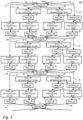
- Figure 3 is a fragment of a network called GoogLeNet or Inception v1, the winner of ILSVRC 2014.
- Inception is a deep convolutional neural network architecture for object detection and image classification. More details of that network are available in the paper "Going deeper with convolutions" (included herein by reference) and on the corresponding page of inception_v1 (included herein by reference) on the Open Neural Network Exchange (ONNX) currently hosted on GitHub.
- the network in figure 3 has been modified compared to the original network by removing multiplications with a real-valued number. In this case, real-valued matrices have been converted by multiplying them with an expansion factor, and rounding individually the entries of the matrices to an integer.
- FIG. 3 Shown in figure 3 are multiple operations, and layers between them. Layers are denoted with a reference sign between 1 and 99.
- the top of the figure 3 shows a concatenation operation. Concatenation operations are indicated as 'Concat_xx', where xx indicates the particular concatenation operation.
- the output of the concatenation operation is input to several other operations.
- the values that are output of one operation, and input to a next operation, are together referred to as a layer.
- the concatenation operation Concat_52 provides values for layer 53.
- the concatenation operation can be directly transformed to an FHE operation as it only changes the order of values, which can be done on plain as well as on encrypted values.
- a concatenation operation is an example of so-called join operation as it combines values from different operations. A join operation may require additional care as will be discussed below.
- convolution operations are also shown in figure 3; indicated with 'Conv_xx'.
- a convolution is an example of a matrix operation.
- the real-valued matrix multiplication in the matrix operation is replaced by an integer-valued matrix multiplication.
- Functions that use the convolution result as input are assumed to be adjusted for the integer-valued convolution.
- ReLU operations are also shown in figure 3 .
- a ReLU is an example of a non-linear operation, often a further operation, the ReLU can also take input say from the concatenation operation.
- a ReLU being a non-linear operation, will be replaced with a programmable bootstrapping.
- pool operations are a type of discretization process, in which an input set of values, e.g., an image, hidden-layer output matrix, etc., is down-sampled thus reducing its dimensionality.
- an input set of values e.g., an image, hidden-layer output matrix, etc.
- subsets of the values are replaced with their maximum.
- a MaxPool operation may be implemented by using a bootstrapping operation that takes the maximum of two values, and repeatedly apply it to obtain the maxima of the subsets.
- a MaxPool over multiple values can be implemented as the repetition of multiple MaxPools over two values.
- An AveragePool may be implemented as summation, which can be done directly on the encrypted values and a division, which may be implemented as a programmable bootstrapping.
- Dropout is an operation used in neural network training, but which is typically replaced with the identity during inferences.
- An Add operation stands for additions of layers; it is a linear operation, but is typically a join operation, so that some care is needed, as discussed herein.
- activation functions include: sigmoid function, softmax function, softplus function, softsign function, tanh function, selu function, elu function, exponential function, LeakyReLU layer, PReLU layer, ThresholdedReLU layer
- linear operations, and permutation type operations such as flatten or concatenate may be converted to linear or permutation operations in the second computational network. These operations preserve the scaling factor of input values though shifts may change.
- Other operations in particular non-linear operations, e.g., activation functions such as sigmoid and ReLu functions may be implemented in a PBS.
- a PBS can be adjusted to accept an encoding. The output of the PBS may use a default encoding or may use a customized encoding.
- a first computation network 210 such as shown in figure 3 may be adjusted to remove real-valued matrix multiplications.
- Such a network has been provided to an embodiment of system 200 and successfully converted to second computation network 220.
- the object detection can be run on an encrypted input image and the detected object can be produced in encrypted form.
- a file comprising the type of operations, their parameters, e.g., weights, and the connections in the network may be provided in a digital format.
- system 200 may receive the first computation format from an external source outside of system 200.
- system 200 may obtain the computation network as the output of a local compiler or of a neural network training unit, either of which may be installed on system 200.
- the matrix operations are transformed into corresponding operations that can be performed on FHE encrypted values, e.g., TFHE.
- FHE encrypted values e.g., TFHE.
- operations are converted to operations in an FHE, where the FHE has a native addition, and a programmable bootstrapping and wherein values and PBS inputs have a restricted range.
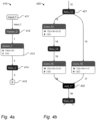
- FIG 4a schematically shows an example of an embodiment of a first computation network 410.
- a flatten operation Flatten_0 is followed by a matrix operation Gemm_1. These operations preserve the scaling factor although the Gemm_1 may change the shift.
- Range unit 231 may determine for all values in layers input_1, 1, and 2 the range in which the values occur. For example, range unit 231 may evaluate the first computational network for multiple inputs and observe the ranges that values may have. Next for each of the layers a prescribed range can be determined. For example, assume the input of Gemm_1 and Flatten_0 operations (i.e., input_1 and 1 layer) have a prescribed range of size 1, while input of ReLu_2 (i.e., 2 layer) has a prescribed range of size 1 ⁇ 2. Note that the values are exemplifying, as a different implementation of these operations may have a different range size.
- Scaling unit 230 can now determine a scaling factor such that multiplying a value in any of the layers input_1, 1, and 2, will make the size of its range fit into the prescribed range. For example, for each value in these layers one can compute (Prescribed range size in that layer) / (Size of the range of the value) and take the minimum over these values as the scaling factor. Should the minimum scaling factor be more than 1, then scaling is not necessary and the scaling factor can be taken to be 1, although scaling might still be used in an embodiment.
- the scaling factor applied to the input of the second network (here, input_1) can be communicated to a user of the second computation network, so that he/she can scale the input values with the scaling factor before encrypting the input values and sending them to the system where the second computational network is evaluated.
- the flatten_0 and Gemm_1 operations have no requirement for shift.
- the flatten operation does not need adjustment.
- the matrix multiplication part of the matrix operation does not need adjustment either, though the matrix addition part in Gemm_1 may be multiplied by the scaling factor to keep the output value of Gemm_1 correct up to a scaling factor.
- the encrypted values now only occur in ranges of the prescribed size, say 1 ⁇ 2.
- some values in the layers up to and including layer 2 may have quite different ranges in the first computation network even after multiplication with the scaling factor, e.g., some values may occur in ranges of 199.7 to 200.2 whereas another value may occur say between -17.4 to -16.9. Since encrypted values in the second computation network are all modulo 1, a shift is applied to these values, so that the non-linear operation PBS correct the value correctly.
- Values in the second computation network at the input to a linear operation are encoded according to some encoding and thus have an associated shift, but for the linear operation the shift can remain implicit, i.e., do not really need to be known or modified, since any value would be compatible with linear operation.
- the shift offset is computed to shift the scaled supported range into the prescribed range.
- this shift is determined for each value in layer 2 individually: in our example, the value in [199.7, 200.2[ could be shifted by -199.7 while the value in [-17.4, -16.9[ could be shifted by 17.4.
- the shift can be applied by inserting an addition operation between Gemm_1 and ReLu_2, though in this case the shift can advantageously be combined in the previous operation, i.e., within the bias in Gemm_1.
- test vectors depend on (input and output) scaling factors and (input and output) shifts. In our case, we took equal values for all the values in layer 2 in term of (input and output) scaling factors, so there are as many test vectors as there are shifts.
- test vectors As there are values in layer 2.
- fewer test vectors than values in layer 2 may be needed by applying grouping to shifts, i.e., by making that several values of layer 2 share the same shift, as discussed herein.
- the encoding of the output of ReLu_2 depends on the data, e.g., the observed ranges in layer 3.
- the size of the larges range in layer i is referred to as ⁇ i , which correspond to supported ranges.
- the different encodings in the second computation network are referred to as E i .
- Layers input_1, 1 and 2 will have encodings E 0 all with an encoding divisor d 0 while layer 3 will have encodings E 1 all with an encoding divisor d 1 .
- the Shift is taken into account in layer 2, so that the PBSs can run on positive values.
- s 0 is the shift of the encoding of the value on which the activation function is applied (i.e., s 0 is the shift for 2), and which could be different for all values in that layer.
- the supported range e.g., the range of a value in the first computation network that will be supported may be determined from the observed range. For example, an observed range may be determined for each value by evaluating the first computation network and keeping track for each value what its maximum and minimum values are. One may set the observed range equal to the supported range. However, one may take the supported range a bit larger than the observed range.
- a margin function may be applied to margins of the observed range.
- the margin may be relative, e.g., a percentage may be added to the maximum value, e.g., 1% or more may be added, or 10% may be added; for the minimum value a corresponding amount may be subtracted.
- the margin function may be absolute, e.g., a fixed amount may be added or subtracted, e.g., 1 or more, or 10 or more to the maximum or minimum values, respectively.
- the margin function may be applied directly on the size of the prescribed range, e.g., 1% or more may be added, or 10% may be added, etc.
- the amount added or subtracted may be the maximum of an absolute value and a relative value.
- the amount added or subtracted is a multiple of the standard deviation of the value, e.g., twice the standard deviation of a value.
- the standard deviation may be determined, e.g., by the range unit 231.
- the prescribed range may be prescribed by the particular (T)FHE scheme.
- T the particular (T)FHE scheme.
- the TFHE scheme mentioned in the background one may use a range of prescribed size 1 for matrix operations, a prescribed range size of 1 ⁇ 2 for most activation functions, and a prescribed range size of 1 ⁇ 4 for activation functions where the input is the addition of difference of two values.
- a shift may have to be adjusted in as well, depending on the shifts of a and b, so that the PBS has a positive input.
- the prescribed range only depends on the type of operation and the type of TFHE, and not on the data that is processed. For example, obtaining the prescribed range and/or range size may be implemented as a lookup table mapping operation to range and/or range size.
- the prescribed range for a further operation is from 0 inclusive up to a value ⁇ , which is typically less than or equal to 1.
- the prescribed range for a max-pool operation will typically be half the size of the prescribed range of an activation function.
- ⁇ may be 1 ⁇ 2 for most activation functions but 1 ⁇ 4 for MaxPool operations.
- a scaling function may be defined for each value in the first computation network to a corresponding value in the second computation network, so that a value in the original first computation network is mapped to the corresponding value on the torus in the second computational network.
- the torus value in turn may be represented by a value modulo a modulus, e.g., 2 q .
- m represents a suitably large integer, e.g., 2 q .
- the elements of the torus, the reals mod 1 cannot all be written as a fraction a / m, but all of them can be well approximated by some a / m.
- the shift s may well be different for each value, e.g., per neuron.
- a neural network is made of tensors, and that individual elements of these tensors are called neurons.
- the shift might have a different value for each neuron, although steps can be taken to reduce the number of different shifts.
- values in the same layer having the same scaling factor though they may have a different shift. Assigning the same scaling factor to all values in a layer is not strictly necessary. It is possible to keep track of optimized divisors per value. Indeed, for PBS applications this would not take much additional work, as multiple PBS test vectors are often needed for a layer anyway.
- the scaling factor of the encoding function may be taken into account at no additional costs. However, if linear operations occur often, as they do in, say, neural networks, it will turn out that most divisors in a layer need to be equal anyway. Keeping track of individual divisors per value may occasionally give a better encoding, e.g., when the network comprises a split operation, e.g., the opposite of a concatenation.
- the operations are adjusted to receive the input values scaled with the scaling factor that is assigned to the input.
- the shifts of the input encodings are known and can be used to compute the relevant shift for operations computed on the input values or on intermediate values that are derived from it.
- the matrix can stay as it is, assuming it is already an integer matrix. Note that the values that go into the matrix operation will have an associated shift, which will change due to the matrix operation.
- the shift can be implicit however as no explicit adjustment for the shift is needed at this point.
- a further operation A ( x ) is adjusted to receive the input values scaled with the scaling factor and shifted with a shift value ( A ( d 1 x - s 1 )) . This may mean as many adjusted further operations as there are shifts in a given layer.
- a further operation f ( ) may thus be converted into multiple TFHE operations, each adjusted for the same scaling factor and multiple different shift values ( f ( d 1 x - s i )) . If an output encoding is used, the series of PBS that are applied to the values in the layer may each have the same scaling factor.
- W is a constant integer tensor called weight
- B is a constant real-valued tensor called a bias.
- x, y and z are real-valued.
- Tensor can be regarded as matrices. The goal is to transform this small NN into a homomorphic NN with the same accuracy which runs with elements in the torus, e.g., to replace original operations by operations which can be executed modulo 1 while changing the accuracy as little as possible.
- Figure 4b schematically shows an example of an embodiment of a first computation network.
- Figure 4b shows a fork layer 13.
- a fork layer is defined as a layer which is used in at least two different operations.
- Layer 13 is a fork layer because it is used as an input in two different operations: Conv_13 and Conv_16.
- a Join layer is a layer which uses the result of two or more previously-computed layers.
- Layer 18 is a join layer because it uses as an input two different layers: layer 16 and 17 produced by operations Conv_15 and Conv_16 respectively.
- the corresponding operation that produces layer 18 is the join operation 422, here Add_17.
- Join layers are typically implemented in the second computational network as native operations, in this case as additions.
- join layers are a layer which use two previous layers or more.
- joins are additions, subtraction, concatenation. More generally, any operation using 2 or more sources and implemented with native operations may be regarded as a join layer.
- their scaling factor should be equal or made equal.
- the first computation network comprises joins, solving the encodings-that is finding appropriate encoding divisors-is more complicated.
- an operation in the first computation network receives input values from multiple earlier operations
- the corresponding operation in the second computation network receives input values from corresponding multiple earlier operations scaled with a scaling factor that is equal for all input values of said corresponding operation.
- Fork and join layers are important for many classical neural networks, such as e.g., Resnet, VGG, mobilenet, to just name of few.
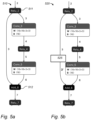
- Encoding in the presence of join layers may be resolved as follows.
- the scaling unit may be configured to
- PBSs introduce a new encoding divisor. Instead, one may only force some encodings to be equal and/or introduce encoding converting functions. Introducing new encoding divisors through a PBS is advantageous however, as it imposes little cost and allows more flexibility in solving constraints which are due to Join operations. For example, a PBS may be changed as A ( )/ d 2 or A ( )/ d 2 + s 2 , note that the PBS may also be adjusted for the encoding of the input values, which is not shown here. Introducing an encoding divisor in the output of a PBS increases the number of divisors d j 's .
- Having more divisors means that the encodings are more independent, because the number of layers L i sharing the same d j is reduced, and so, d j can be optimized more independently of each other. As a result, a better encoding may be found, e.g., the scaled ranges may be closer to the prescribed ranges, so that there is less accuracy loss due to scaling.
- converting the first computation network comprises inserting one or more further operations in the first computational network between two operations corresponding to an operation in the first computation network to transition from one scaling factor to another scaling factor, e.g., introducing an additional scaling factor.
- Such an inserted operation is referred to as a rescaling operation. Note that it is not necessary to insert further operations when converting the first computation network comprises, for example, if one does not insert new encoding divisors in PBS.
- Figure 5a schematically shows an example of an embodiment of a first computation network 510.
- Figure 5b schematically shows an example of an embodiment of a first computation network 520 which is the same as first computation network 510 with an additional operation 525 inserted.
- the rescaling function is inserted between a PBS, in this case ReLu_2 and a join operation, in this case, Add_6.
- a rescaling 525 is introduced.
- layers 3', 6, 5, and 7 have the same scaling factor, say a 1
- layers 3 and 4 have the same scaling factor, say a 2 .
- These two scaling factors may be different, in which case the PBS ReLu_4 would change the scaling factor, which is a possibility.
- scaling factor a 1 may be small to accommodate the large ranges in layers 3 and 4, while scaling factor a 2 may be larger as allowed by the smaller ranges in the remainder of the network.
- a rescaling can be introduced in a branch of a join operation, e.g., if the scaling factor becomes quite small, e.g., smaller than a threshold.
- a rescaling is advantageous right before a join operation, in a branch between fork and join where there is no PBS.
- layers U1 and U2 are the result of a PBS.
- Layers X1 and X2 are the result of a matrix operation, here a Gemm. They may also be convolutions, say.
- Join layer X3 is a join of X1 and X2, say a concatenation, an addition, a subtraction, etc.
- the scaling factor for X1 and X2 must be equal because they are used in the Join operation, which means that layers U1 and U2 have the same scaling factor. Note that X1 and U1 have the same scaling factor, and X2 and U2 have the same scaling factor, because Gemm operations preserve the scaling factor.
- the two branches that culminate in the join operation have the same scaling factor which often is not ideal for the encoding of these values. Indeed, if, say, the output of Gemm_1, e.g., layer X1, happens to have a value that has a large, supported range, then this may cause a small scaling factor, which in turn would cause a small scaling factor on X2 as well since the encoding divisor is shared for the two branches. The fact that a small scaling factor will be imposed on the branch of U2 and X2 is not good for accuracy.
- the rescaling allows Gemm_2 to be computed with a different scaling factor, e.g., a larger scaling factor.
- a different scaling factor e.g., a larger scaling factor.
- the result may be scaled down to the smaller scaling factor of X1, by PBS_4, so that the Join operation receives equal scaling factors as expected.
- the accuracy of the Gemm_2 operation is improved.
- the scaling factor introduced on the output of PBS_1 and PBS_2 respectively can be different and selected to fit the following operations best.
- the function f may be done by a new inserted PBS which transitions from one encoding to the other, in the general case and notably if l is a rea number . Even better, if l is an integer, or can be approximated to an integer, then the function f can be done directly, natively, by a single multiplication by l on the encrypted values, as integer multiplication is a natively supported operation.
- Doing the function f as a native multiplication is much more efficient. This is why one can change a bit the encoding divisors, such that they are still valid (i.e., give correct ranges of data in the second network, by following prescribed ranges) and such that l is an integer.
- One may increase the encoding divisors d 1 a bit, such that d 1 / d 2 is an integer: more precisely, we would replace d 1 by d 1 ' , for d 1 ′ d 1 + ⁇ d 1 mod d 2 , such that d 1 ' / d 2 is an integer.
- a negligible factor e.g., within a threshold.
- Deciding to replace a rescaling by an integer multiplication instead of a PBS may depend on an optimization flag or an optimization performed dynamically at the moment of the generation of the second network. For example, it may depend on whether one optimizes for execution time or accuracy. Accuracy could be determined by the accuracy unit 250.
- Inserting a rescaling is advantageous as it avoids that encodings need to be equal, and so avoids having encodings shared for many layers which shrink the options for encodings and can lead to too inaccurate solutions.
- Doing the rescaling with integer multiplication is more efficient but may reduce the accuracy or precision.
- Doing the rescaling with a PBS operator makes the second computational network slower to execute but is better for accuracy and precision.
- the encodings and adjustment are done automatically by a computer.
- equations are determined involving the encodings, such that they can be solved to find appropriate parameters. This improves the accuracy of the neural network as it avoids using too large encoding divisors.
- Using independent encoding divisors for different encodings and layers allows choosing encoding divisors that are locally best. Conventionally, in the art, all encoding divisors are made equal, sometimes implicitly so. This makes it impossible to address large and complex networks such as Resnet or VGG, while these can be addressed with an embodiment.
- the encoding divisors of the two or more layers at the input of the join operator preferably have equal encoding divisors.
- actual values can be assigned to them by comparing the supported ranges to the prescribed ranges.
- a provided dataset is used to compute values ⁇ i : that is the size of the largest range of a value in a layer.
- the dataset is typically provided by a user.
- the dataset is a typical set of inputs for the neural network. Note that sizes can be evaluated on the first computational network, e.g., neural network.
- an embodiment may comprise
- a layer can be regarded as a tensor of computed values sometimes called neurons; operation on layers may then be regarded as operations on these individual neurons.
- ⁇ i may be computed differently as well.
- ⁇ i Maximum over j max i , j ⁇ Minimum over j min i , j
- Applying the shift may be done by inserting an adding layer, or modifying a previously operation to automatically apply this additive factor.
- the matrix addition part also called the bias
- the output encoding of the PBS may be adjusted so that values have the same shift.
- c j is the maximal value of ⁇ i / r i taken for all i such that layer L i has encoding E j .
- the network architecture causes that the same encoding divisor d 0 is used as the input as at the output of the ReLu_14; this is not necessary, as we have seen previously that it is possible to change the encoding divisor at the PBS time, when useful.
- the shifts s 0 and s 1 may be per value, which means that there are as many test vectors for ReLu_14 as there are values in layer 14.
- the input shifts s 0 depend on how the values of the first computation network in layer 14 are represented in the second computation network.
- the input shifts can be determined, e.g., by parsing the network and tracking the values from the input through the network, while keeping track of the shifts.
- the output shifts s 1 in ReLu_14 are optional, they may be chosen as 0. Changing the shift of the encoding may be done in the previous operation, i.e., in the bias of Conv_13. In ReLu_18 it preferred that the inputs are positive, e.g., in the range from 0 to 1 ⁇ 2.
- the shift can simply be applied by inserting an extra addition (with the shift) between Add_17 and ReLu_18. Another more intricated solution (but faster) is to not have an extra addition, but directly change the bias Conv_15 or Conv_16.
- test vectors can become dramatically too large when we have millions of values, like in big networks like Resnet of VGG or others.
- test vectors instead of having thousands or millions of test vectors for a given layer for very large networks, one only uses s test vectors, where s can be quite small, such as 128 or less. The larger s, the more accurate the network, but also the most expensive the test vectors are, in term of storage notably. So, finding the best s is a matter of tradeoff.
- system 200 comprises a group unit 260.
- the grouping unit is configured to determine the shifts in a layer which are to be inputs of a PBS layer. Each test vector of the PBS layer is adjusted for the particular shift of the value.
- Grouping unit 260 is configured for
- This scaling factor will be used for all values in the layer.
- a first value in the layer happens to have the largest supported range size and runs, say from 10 to 20, and that second value in the layer has a supported range from 11 to 21.
- the range of the first value becomes 0.5 to 1, so that the encoding function of the first value becomes 0.05 x - 0.5.
- the range of the second value becomes 0.55 to 1.05, so that the encoding function of the first value becomes 0.05 x - 0.55.
- the number of PBSs that are needed is reduced.
- the number of PBS can be reduced by using same test vector for the first and second values.
- the range of the first value from 10 to 20 of the value above scales to the range 0.4 to 0.8.
- the range of the second value from 11 to 21 of the value above scales to the range 0.44 to 0.84.
- the shift that is to be applied to the values in the layer before a PBS can be applied in a dedicated operation, e.g., an extra add operation, though often applying the shift can be combined with a previous operation (e.g., in a bias of a previous Conv or Gemm).
- the conversion system may comprise a communication interface.
- the communication interfaces may be selected from various alternatives.
- the interface may be a network interface to a local or wide area network, e.g., the Internet, a storage interface to an internal or external data storage, a keyboard, an application interface (API), etc.
- the communication interface may be configured to connect to a computer network.
- the communication interface may be used to receive a digital data set.
- the data set may comprise data items, e.g., parameters, values and the like indicating the first computation network and on which the conversion is to be performed by the system.
- the data may also include a sample set for evaluation of ranges or of accuracy parameters.
- the data may also include a desired level of accuracy.
- a data set for determining ranges may be the same as a data set to determine accuracy of a converted network.
- a conversion system such as system 114 and/or 200 may have a user interface, which may include well-known elements such as one or more buttons, a keyboard, display, touch screen, etc.
- the user interface may be arranged for accommodating user interaction for configuring the systems, applying the system to new data, etc.
- Storage may be implemented as an electronic memory, say a flash memory, or magnetic memory, say hard disk or the like. Storage may comprise multiple discrete memories together making up the storage. Storage may comprise a temporary memory, say a RAM.
- the storage may be cloud storage.
- the systems may be implemented in a single device.
- the system comprises one or more microprocessors which execute appropriate software stored at the system; for example, that software may have been downloaded and/or stored in a corresponding memory, e.g., a volatile memory such as RAM or a non-volatile memory such as Flash.
- the systems may, in whole or in part, be implemented in programmable logic, e.g., as field-programmable gate array (FPGA).
- FPGA field-programmable gate array
- the systems may be implemented, in whole or in part, as a so-called application-specific integrated circuit (ASIC), e.g., an integrated circuit (IC) customized for their particular use.
- ASIC application-specific integrated circuit
- the circuits may be implemented in CMOS, e.g., using a hardware description language such as Verilog, VHDL, etc.
- the systems may comprise circuits for the evaluation of cryptographic primitives.
- a processor circuit may be implemented in a distributed fashion, e.g., as multiple sub-processor circuits.
- a storage may be distributed over multiple distributed sub-storages.
- Part or all of the memory may be an electronic memory, magnetic memory, etc.
- the storage may have volatile and a non-volatile part.
- Part of the storage may be read-only.
- Figure 6 schematically shows an example of an embodiment of a converting method 600 to convert a first computation network of operations into a second computation network of operations.
- the method may be computer-implemented.
- a processor system may be configured for it.
- TFHE torus fully homomorphic encrypted
- the method may be applied to multiple operations as well.
- the method comprises
- Embodiments of the method may be executed using software, which comprises instructions for causing a processor system to perform method 600.
- Software may only include those steps taken by a particular sub-entity of the system.
- the software may be stored in a suitable storage medium, such as a hard disk, a floppy, a memory, an optical disc, etc.
- the software may be sent as a signal along a wire, or wireless, or using a data network, e.g., the Internet.
- the software may be made available for download and/or for remote usage on a server.
- Embodiments of the method may be executed using a bitstream arranged to configure programmable logic, e.g., a field-programmable gate array (FPGA), to perform the method.
- FPGA field-programmable gate array
- the presently disclosed subject matter also extends to computer programs, particularly computer programs on or in a carrier, adapted for putting the presently disclosed subject matter into practice.
- the program may be in the form of source code, object code, a code intermediate source, and object code such as partially compiled form, or in any other form suitable for use in the implementation of an embodiment of the method.
- An embodiment relating to a computer program product comprises computer executable instructions corresponding to each of the processing steps of at least one of the methods set forth. These instructions may be subdivided into subroutines and/or be stored in one or more files that may be linked statically or dynamically.
- Another embodiment relating to a computer program product comprises computer executable instructions corresponding to each of the devices, units and/or parts of at least one of the systems and/or products set forth.
- Figure 7a shows a computer readable medium 1000 having a writable part 1010, and a computer readable medium 1001 also having a writable part.
- Computer readable medium 1000 is shown in the form of an optically readable medium.
- Computer readable medium 1001 is shown in the form of an electronic memory, in this case a memory card.
- Computer readable medium 1000 and 1001 may store data 1020 wherein the data may indicate instructions, which when executed by a processor system, cause a processor system to perform an embodiment of a conversion method, according to an embodiment.
- the computer program 1020 may be embodied on the computer readable medium 1000 as physical marks or by magnetization of the computer readable medium 1000. However, any other suitable embodiment is conceivable as well.
- the computer readable medium 1000 may be any suitable computer readable medium, such as a hard disk, solid state memory, flash memory, etc., and may be non-recordable or recordable.
- the computer program 1020 comprises instructions for causing a processor system to perform said conversion method.
- the computer readable medium may also or instead comprise the results of executing a method according to an embodiment, e.g., a second computational network.
- FIG. 7b shows in a schematic representation of a processor system 1140 according to an embodiment of an FHE device or system.
- the processor system comprises one or more integrated circuits 1110.
- the architecture of the one or more integrated circuits 1110 is schematically shown in Figure 7b .
- Circuit 1110 comprises a processing unit 1120, e.g., a CPU, for running computer program components to execute a method according to an embodiment and/or implement its modules or units.
- Circuit 1110 comprises a memory 1122 for storing programming code, data, etc. Part of memory 1122 may be read-only.
- Circuit 1110 may comprise a communication element 1126, e.g., an antenna, connectors or both, and the like.
- Circuit 1110 may comprise a dedicated integrated circuit 1124 for performing part or all of the processing defined in the method.
- Processor 1120, memory 1122, dedicated IC 1124 and communication element 1126 may be connected to each other via an interconnect 1130, say a bus.
- the processor system 1110 may be arranged for contact and/or contact-less communication, using an antenna and/or connectors, respectively.
- processor system 1140 e.g., the FHE system or device may comprise a processor circuit and a memory circuit, the processor being arranged to execute software stored in the memory circuit.
- the processor circuit may be an Intel Core i7 processor, ARM Cortex-R8, etc.
- the processor circuit may be ARM Cortex M0.
- the memory circuit may be an ROM circuit, or a non-volatile memory, e.g., a flash memory.
- the memory circuit may be a volatile memory, e.g., an SRAM memory.
- the device may comprise a non-volatile software interface, e.g., a hard drive, a network interface, etc., arranged for providing the software.
- the various components may be duplicated in various embodiments.
- the processor 1120 may include multiple microprocessors that are configured to independently execute the methods described herein or are configured to perform steps or subroutines of the methods described herein such that the multiple processors cooperate to achieve the functionality described herein.
- the various hardware components may belong to separate physical systems.
- the processor 1120 may include a first processor in a first server and a second processor in a second server.
- any reference signs placed between parentheses shall not be construed as limiting the claim.
- Use of the verb 'comprise' and its conjugations does not exclude the presence of elements or steps other than those stated in a claim.
- the article 'a' or 'an' preceding an element does not exclude the presence of a plurality of such elements.
- Expressions such as "at least one of” when preceding a list of elements represent a selection of all or of any subset of elements from the list. For example, the expression, "at least one of A, B, and C" should be understood as including only A, only B, only C, both A and B, both A and C, both B and C, or all of A, B, and C.
Landscapes
- Engineering & Computer Science (AREA)
- General Physics & Mathematics (AREA)
- Physics & Mathematics (AREA)
- Theoretical Computer Science (AREA)
- Signal Processing (AREA)
- Computer Networks & Wireless Communication (AREA)
- Computer Security & Cryptography (AREA)
- Mathematical Optimization (AREA)
- Computing Systems (AREA)
- Pure & Applied Mathematics (AREA)
- Mathematical Analysis (AREA)
- Mathematical Physics (AREA)
- Algebra (AREA)
- Computational Mathematics (AREA)
- General Engineering & Computer Science (AREA)
- Complex Calculations (AREA)
Claims (22)
- Un procédé mis en œuvre par ordinateur pour convertir un premier réseau de calcul (210) d'opérations en un second réseau de calcul (220) d'opérations, les opérations du second réseau de calcul étant des opérations chiffrées entièrement homomorphes (FHE), les opérations du premier réseau de calcul comprenant des opérations matricielles (y = Wx + B) incluant une multiplication matricielle intégrale et d'autres opérations (z = A(y)), la conversion du premier réseau de calcul en second réseau de calcul comprend la conversion des opérations dans le premier réseau de calcul en opérations FHE correspondantes dans le second réseau de calcul,- dans lequel la conversion d'une opération dans le premier réseau de calcul comprend- l'obtention pour les valeurs d'entrée de l'opération d'une plage prise en charge des valeurs d'entrée dans le premier réseau de calcul, dans lequel le premier réseau de calcul est évalué pour un ensemble d'échantillons de valeurs d'entrée tout en surveillant les valeurs d'entrée de l'opération pour obtenir une plage observée des valeurs d'entrée de l'opération, la plage prise en charge étant dérivée de la plage observée,- la détermination d'une plage prescrite pour les valeurs d'entrée d'une opération FHE correspondante, dans lequel la plage prescrite garantit un traitement correct des valeurs d'entrée par l'opération FHE,- la détermination d'un facteur d'échelle (1/d1 ) entre la taille de la plage prise en charge d'une valeur dans le premier réseau de calcul et la taille d'une plage mise à l'échelle de la valeur dans le second réseau de calcul, de telle sorte que la taille de la plage mise à l'échelle obtenue en appliquant le facteur d'échelle à la plage prise en charge de chaque valeur d'entrée soit au plus égale à la taille de la plage prescrite,- l'ajustement de l'opération pour recevoir les valeurs d'entrée mises à l'échelle avec le facteur d'échelle.
- Un procédé de conversion selon la revendication 1, dans lequel une opération matricielle comprend une multiplication matricielle et une addition matricielle (Wx + B), l'ajustement de l'opération matricielle comprenant l'ajustement de l'addition matricielle {B' = B/d1 ) mais pas la multiplication matricielle, pour recevoir les valeurs d'entrée mises à l'échelle avec le facteur d'échelle (x' = x/d1 ).
- Un procédé de conversion selon l'une quelconque des revendications précédentes, dans lequel une opération supplémentaire (A(x)) est ajustée pour recevoir les valeurs d'entrée mises à l'échelle avec le facteur d'échelle et décalées avec une valeur de décalage (A(d1x - s1 )).
- Un procédé de conversion selon l'une quelconque des revendications précédentes, dans lequel une autre opération (A(x)) dans le premier réseau de calcul comprend une fonction (f(xi )) appliquée à chaque valeur d'entrée, la fonction étant convertie en plusieurs opérations FHE ajustées pour le même facteur d'échelle et plusieurs valeurs de décalage différentes (f(d1x - s1)).
- Un procédé de conversion selon l'une quelconque des revendications précédentes, dans lequel une opération supplémentaire (A(x)) est en outre ajustée pour produire une valeur de sortie mise à l'échelle avec une fonction de mise à l'échelle supplémentaire pour une opération suivante (A()/d2; A()/d2 + s2 ).
- Un procédé de conversion selon l'une quelconque des revendications précédentes, dans lequel le premier réseau de calcul et le second réseau de calcul sont des réseaux neuronaux.
- Un procédé de conversion selon l'une quelconque des revendications précédentes, dans lequel la plage prescrite pour une opération supplémentaire est comprise entre 0 inclus et une valeur (ε) inférieure ou égale à 1.
- Un procédé de conversion selon l'une quelconque des revendications précédentes, dans lequel la plage prescrite pour une opération de pool maximal est la moitié de la taille de la plage prescrite d'une fonction d'activation.
- Un procédé de conversion selon l'une quelconque des revendications précédentes, dans lequel la plage prise en charge est calculée à partir d'une plage observée plus grande en appliquant une fonction de marge à la plage observée.
- Un procédé de conversion selon l'une quelconque des revendications précédentes, dans lequel une opération dans le premier réseau de calcul reçoit des valeurs d'entrée provenant de multiples opérations antérieures, l'opération correspondante dans le second réseau de calcul recevant des valeurs d'entrée provenant de multiples opérations antérieures correspondantes mises à l'échelle avec un facteur d'échelle qui est égal pour toutes les valeurs d'entrée.
- Un procédé de conversion selon la revendication 10, dans lequel l'opération dans le premier réseau de calcul qui reçoit des valeurs d'entrée provenant de multiples opérations antérieures est une addition, une soustraction ou une concaténation.
- Un procédé de conversion selon l'une quelconque des revendications précédentes, dans lequel les valeurs dans le second réseau de calcul sont égales aux valeurs dans le premier réseau de calcul auquel une fonction de mise à l'échelle est appliquée, la fonction de mise à l'échelle (x' = x/d + s) étant défini par un facteur d'échelle (1/d) et un ajout décalé (s), les valeurs dans la même couche présentant le même facteur d'échelle.
- Un procédé de conversion selon l'une quelconque des revendications précédentes, comprenant les étapes consistant à- attribuer un facteur d'échelle symbolique à chaque couche entre les opérations,- dériver des conditions sur les facteurs d'échelle symboliques de la première architecture réseau,- réduire le nombre de facteurs d'échelle symboliques en utilisant les conditions dérivées.
- Un procédé de conversion selon l'une quelconque des revendications 12 et 13, comprenant l'étape consistant à- déterminer une valeur de décalage pour une valeur d'entrée à partir d'une différence entre la plage prise en charge après mise à l'échelle et la plage prescrite.
- Un procédé de conversion selon la revendication 13 ou 14, comprenant- pour les facteurs d'échelle symboliques restants correspondant à une ou plusieurs couches dans le second réseau, un facteur d'échelle étant associé au facteur d'échelle symbolique, dans lequel le facteur d'échelle appliqué aux plages prises en charge dans la ou les couches correspondantes s'intègre dans les plages prescrites de la ou des couches correspondantes.
- Un procédé de conversion selon l'une quelconque des revendications précédentes, comprenant l'insertion d'une opération supplémentaire dans le second réseau de calcul entre deux opérations correspondant à une opération dans le premier réseau de calcul pour passer d'un facteur d'échelle à un autre facteur d'échelle.
- Un procédé de conversion selon la revendication 16, dans lequel l'opération supplémentaire est une multiplication d'entiers.
- Un procédé de conversion selon l'une quelconque des revendications précédentes, une autre opération (A(x)) étant mise en œuvre dans le second réseau de calcul sous forme de multiples opérations d'amorçage programmables présentant des vecteurs de test chacun ajusté pour une valeur de décalage individuelle, le procédé comprenant en outre- le regroupement des vecteurs de test mettant en œuvre l'opération ultérieure en fonction des décalages individuels,- le remplacement des vecteurs de test dans un groupe par une seule opération d'amorçage programmable réduisant le nombre de vecteurs de test,- l'ajustement du décalage de l'entrée de l'amorçage programmable correspondant au décalage de l'un des groupes.
- Un procédé de conversion selon l'une quelconque des revendications précédentes, dans lequel le premier réseau de calcul et le second réseau de calcul d'opérations sont configurés pour prendre une image en entrée.
- Un procédé de conversion selon l'une quelconque des revendications précédentes, dans lequel une autre opération comprend une ou plusieurs des fonctions suivantes : une fonction d'activation, une fonction ReLu, une fonction sigmoïde, une fonction softmax, une fonction softplus, une fonction softsign, une fonction tanh, une fonction selu, une fonction elu, une fonction exponentielle, une couche LeakyReLU, une couche PReLU, une couche ThresholdedReLU.
- Un support transitoire ou non transitoire lisible par ordinateur (1000) comprenant des données (1020) représentant une quelconque parmi- des instructions qui, lorsqu'elles sont exécutées par un système processeur, amènent le système processeur à exécuter le procédé selon l'une quelconque des revendications 1-20, et- des données représentant un second réseau de calcul obtenues selon l'une quelconque des revendications 1-20.
- Un système de conversion d'un premier réseau de calcul d'opérations en un second réseau de calcul d'opérations, les opérations du second réseau de calcul étant des opérations cryptées entièrement homomorphes (FHE), les opérations du premier réseau de calcul comprenant des opérations matricielles (y = Wx + B) incluant une multiplication matricielle intégrale et d'autres opérations (z = A(y)), la conversion du premier réseau de calcul en second réseau de calcul comprend la conversion des opérations du premier réseau de calcul en opérations FHE correspondantes dans le second réseau de calcul, le système comprenant- une interface de communication pour recevoir le premier réseau de calcul,- un système processeur configuré pour convertir une opération dans le premier réseau de calcul, la conversion d'une opération comprenant- l'obtention pour les valeurs d'entrée de l'opération d'une plage prise en charge des valeurs d'entrée dans le premier réseau de calcul, dans lequel le premier réseau de calcul est évalué pour un ensemble d'échantillons de valeurs d'entrée tout en surveillant les valeurs d'entrée de l'opération pour obtenir une plage observée des valeurs d'entrée de l'opération, la plage prise en charge étant dérivée de la plage observée,- la détermination d'une plage prescrite pour les valeurs d'entrée d'une opération FHE correspondante, dans laquelle la plage prescrite garantit un traitement correct des valeurs d'entrée par l'opération FHE, la détermination d'un facteur d'échelle (1/d1 ) entre la taille de la plage prise en charge d'une valeur dans le premier réseau de calcul et la taille d'une plage mise à l'échelle de la valeur dans le second réseau de calcul, de telle sorte que la taille de la plage mise à l'échelle obtenue en appliquant le facteur d'échelle à la plage prise en charge de chaque valeur d'entrée soit au plus égale à la taille de la plage prescrite,- l'ajustement de l'opération pour recevoir les valeurs d'entrée mises à l'échelle avec le facteur d'échelle.
Applications Claiming Priority (3)
| Application Number | Priority Date | Filing Date | Title |
|---|---|---|---|
| EP21290038 | 2021-06-04 | ||
| EP21197777.2A EP4099149A1 (fr) | 2021-06-04 | 2021-09-20 | Codage de réseau de calcul pour évaluation entièrement homomorphique |
| PCT/EP2022/065197 WO2022254011A1 (fr) | 2021-06-04 | 2022-06-03 | Codage de réseau de calcul pour une évaluation entièrement homomorphe |
Publications (2)
| Publication Number | Publication Date |
|---|---|
| EP4348414A1 EP4348414A1 (fr) | 2024-04-10 |
| EP4348414B1 true EP4348414B1 (fr) | 2025-02-26 |
Family
ID=82258396
Family Applications (1)
| Application Number | Title | Priority Date | Filing Date |
|---|---|---|---|
| EP22734227.6A Active EP4348414B1 (fr) | 2021-06-04 | 2022-06-03 | Codage de réseau de calcul pour évaluation entièrement homomorphique |
Country Status (6)
| Country | Link |
|---|---|
| US (1) | US20240364496A1 (fr) |
| EP (1) | EP4348414B1 (fr) |
| JP (1) | JP2024522361A (fr) |
| KR (1) | KR20240018490A (fr) |
| IL (1) | IL308745A (fr) |
| WO (1) | WO2022254011A1 (fr) |
Families Citing this family (3)
| Publication number | Priority date | Publication date | Assignee | Title |
|---|---|---|---|---|
| CN117278196A (zh) * | 2023-09-15 | 2023-12-22 | 支付宝(杭州)信息技术有限公司 | Fhe芯片和计算设备 |
| US20250300806A1 (en) * | 2024-03-22 | 2025-09-25 | Chain Reaction, Ltd. | A method of optimizing linear transformation |
| US12476788B2 (en) * | 2024-04-08 | 2025-11-18 | International Business Machines Corporation | Tournament-league mechanisms for comparison based computer operations |
Family Cites Families (4)
| Publication number | Priority date | Publication date | Assignee | Title |
|---|---|---|---|---|
| US9946970B2 (en) * | 2014-11-07 | 2018-04-17 | Microsoft Technology Licensing, Llc | Neural networks for encrypted data |
| JP6695595B2 (ja) * | 2017-08-30 | 2020-05-20 | 株式会社アクセル | 推論装置、及び推論方法 |
| JP6391900B1 (ja) * | 2017-11-27 | 2018-09-19 | 三菱電機株式会社 | 準同型推論装置、準同型推論方法、準同型推論プログラム及び秘匿情報処理システム |
| JP6962578B2 (ja) * | 2019-05-21 | 2021-11-05 | 株式会社アクセル | 暗号処理システム、暗号処理装置、暗号処理プログラム、及び暗号処理方法 |
-
2022
- 2022-06-03 EP EP22734227.6A patent/EP4348414B1/fr active Active
- 2022-06-03 WO PCT/EP2022/065197 patent/WO2022254011A1/fr not_active Ceased
- 2022-06-03 US US18/565,983 patent/US20240364496A1/en active Pending
- 2022-06-03 JP JP2023574404A patent/JP2024522361A/ja active Pending
- 2022-06-03 IL IL308745A patent/IL308745A/en unknown
- 2022-06-03 KR KR1020237042619A patent/KR20240018490A/ko active Pending
Also Published As
| Publication number | Publication date |
|---|---|
| EP4348414A1 (fr) | 2024-04-10 |
| JP2024522361A (ja) | 2024-06-18 |
| US20240364496A1 (en) | 2024-10-31 |
| WO2022254011A1 (fr) | 2022-12-08 |
| IL308745A (en) | 2024-01-01 |
| KR20240018490A (ko) | 2024-02-13 |
Similar Documents
| Publication | Publication Date | Title |
|---|---|---|
| Blatt et al. | Optimized homomorphic encryption solution for secure genome-wide association studies | |
| US12574206B2 (en) | Blind rotation for use in fully homomorphic encryption | |
| EP4315022B1 (fr) | Conversion de réseau de calcul pour l'évaluation entièrement homomorphique | |
| EP4348414B1 (fr) | Codage de réseau de calcul pour évaluation entièrement homomorphique | |
| US20240267222A1 (en) | Computation on lwe-encrypted values | |
| US11991266B2 (en) | Fully homomorphic cryptography with improved data item representation | |
| KR102653914B1 (ko) | 암호화된 스칼라 곱셈 | |
| KR102887786B1 (ko) | 블라인드 회전을 포함하는 암호화된 컴퓨팅 | |
| EP4087177A1 (fr) | Rotation aveugle à utiliser dans le cadre de cryptage entièrement homomorphique | |
| EP4099149A1 (fr) | Codage de réseau de calcul pour évaluation entièrement homomorphique | |
| CN117337553A (zh) | 用于全同态加密的盲旋转 | |
| EP4195577A1 (fr) | Calcul crypté comprenant une rotation aveugle | |
| CN117425876A (zh) | 用于全同态评估的计算网络编码 |
Legal Events
| Date | Code | Title | Description |
|---|---|---|---|
| STAA | Information on the status of an ep patent application or granted ep patent |
Free format text: STATUS: UNKNOWN |
|
| STAA | Information on the status of an ep patent application or granted ep patent |
Free format text: STATUS: THE INTERNATIONAL PUBLICATION HAS BEEN MADE |
|
| PUAI | Public reference made under article 153(3) epc to a published international application that has entered the european phase |
Free format text: ORIGINAL CODE: 0009012 |
|
| STAA | Information on the status of an ep patent application or granted ep patent |
Free format text: STATUS: REQUEST FOR EXAMINATION WAS MADE |
|
| 17P | Request for examination filed |
Effective date: 20240104 |
|
| AK | Designated contracting states |
Kind code of ref document: A1 Designated state(s): AL AT BE BG CH CY CZ DE DK EE ES FI FR GB GR HR HU IE IS IT LI LT LU LV MC MK MT NL NO PL PT RO RS SE SI SK SM TR |
|
| P01 | Opt-out of the competence of the unified patent court (upc) registered |
Effective date: 20240530 |
|
| DAV | Request for validation of the european patent (deleted) | ||
| DAX | Request for extension of the european patent (deleted) | ||
| GRAP | Despatch of communication of intention to grant a patent |
Free format text: ORIGINAL CODE: EPIDOSNIGR1 |
|
| STAA | Information on the status of an ep patent application or granted ep patent |
Free format text: STATUS: GRANT OF PATENT IS INTENDED |
|
| RIC1 | Information provided on ipc code assigned before grant |
Ipc: H04L 9/00 20220101ALI20240930BHEP Ipc: H04L 9/30 20060101ALI20240930BHEP Ipc: G06F 7/544 20060101AFI20240930BHEP |
|
| INTG | Intention to grant announced |
Effective date: 20241029 |
|
| GRAS | Grant fee paid |
Free format text: ORIGINAL CODE: EPIDOSNIGR3 |
|
| GRAA | (expected) grant |
Free format text: ORIGINAL CODE: 0009210 |
|
| STAA | Information on the status of an ep patent application or granted ep patent |
Free format text: STATUS: THE PATENT HAS BEEN GRANTED |
|
| AK | Designated contracting states |
Kind code of ref document: B1 Designated state(s): AL AT BE BG CH CY CZ DE DK EE ES FI FR GB GR HR HU IE IS IT LI LT LU LV MC MK MT NL NO PL PT RO RS SE SI SK SM TR |
|
| REG | Reference to a national code |
Ref country code: GB Ref legal event code: FG4D |
|
| REG | Reference to a national code |
Ref country code: CH Ref legal event code: EP |
|
| REG | Reference to a national code |
Ref country code: DE Ref legal event code: R096 Ref document number: 602022011197 Country of ref document: DE |
|
| REG | Reference to a national code |
Ref country code: IE Ref legal event code: FG4D |
|
| REG | Reference to a national code |
Ref country code: NL Ref legal event code: MP Effective date: 20250226 |
|
| PG25 | Lapsed in a contracting state [announced via postgrant information from national office to epo] |
Ref country code: RS Free format text: LAPSE BECAUSE OF FAILURE TO SUBMIT A TRANSLATION OF THE DESCRIPTION OR TO PAY THE FEE WITHIN THE PRESCRIBED TIME-LIMIT Effective date: 20250526 |
|
| PG25 | Lapsed in a contracting state [announced via postgrant information from national office to epo] |
Ref country code: FI Free format text: LAPSE BECAUSE OF FAILURE TO SUBMIT A TRANSLATION OF THE DESCRIPTION OR TO PAY THE FEE WITHIN THE PRESCRIBED TIME-LIMIT Effective date: 20250226 |
|
| PG25 | Lapsed in a contracting state [announced via postgrant information from national office to epo] |
Ref country code: PL Free format text: LAPSE BECAUSE OF FAILURE TO SUBMIT A TRANSLATION OF THE DESCRIPTION OR TO PAY THE FEE WITHIN THE PRESCRIBED TIME-LIMIT Effective date: 20250226 |
|
| PGFP | Annual fee paid to national office [announced via postgrant information from national office to epo] |
Ref country code: DE Payment date: 20250627 Year of fee payment: 4 |
|
| PG25 | Lapsed in a contracting state [announced via postgrant information from national office to epo] |
Ref country code: ES Free format text: LAPSE BECAUSE OF FAILURE TO SUBMIT A TRANSLATION OF THE DESCRIPTION OR TO PAY THE FEE WITHIN THE PRESCRIBED TIME-LIMIT Effective date: 20250226 |
|
| REG | Reference to a national code |
Ref country code: LT Ref legal event code: MG9D |
|
| PG25 | Lapsed in a contracting state [announced via postgrant information from national office to epo] |
Ref country code: IS Free format text: LAPSE BECAUSE OF FAILURE TO SUBMIT A TRANSLATION OF THE DESCRIPTION OR TO PAY THE FEE WITHIN THE PRESCRIBED TIME-LIMIT Effective date: 20250626 Ref country code: NO Free format text: LAPSE BECAUSE OF FAILURE TO SUBMIT A TRANSLATION OF THE DESCRIPTION OR TO PAY THE FEE WITHIN THE PRESCRIBED TIME-LIMIT Effective date: 20250526 |
|
| PG25 | Lapsed in a contracting state [announced via postgrant information from national office to epo] |
Ref country code: NL Free format text: LAPSE BECAUSE OF FAILURE TO SUBMIT A TRANSLATION OF THE DESCRIPTION OR TO PAY THE FEE WITHIN THE PRESCRIBED TIME-LIMIT Effective date: 20250226 |
|
| PG25 | Lapsed in a contracting state [announced via postgrant information from national office to epo] |
Ref country code: HR Free format text: LAPSE BECAUSE OF FAILURE TO SUBMIT A TRANSLATION OF THE DESCRIPTION OR TO PAY THE FEE WITHIN THE PRESCRIBED TIME-LIMIT Effective date: 20250226 |
|
| PG25 | Lapsed in a contracting state [announced via postgrant information from national office to epo] |
Ref country code: LV Free format text: LAPSE BECAUSE OF FAILURE TO SUBMIT A TRANSLATION OF THE DESCRIPTION OR TO PAY THE FEE WITHIN THE PRESCRIBED TIME-LIMIT Effective date: 20250226 Ref country code: PT Free format text: LAPSE BECAUSE OF FAILURE TO SUBMIT A TRANSLATION OF THE DESCRIPTION OR TO PAY THE FEE WITHIN THE PRESCRIBED TIME-LIMIT Effective date: 20250626 |
|
| PGFP | Annual fee paid to national office [announced via postgrant information from national office to epo] |
Ref country code: FR Payment date: 20250625 Year of fee payment: 4 |
|
| PG25 | Lapsed in a contracting state [announced via postgrant information from national office to epo] |
Ref country code: GR Free format text: LAPSE BECAUSE OF FAILURE TO SUBMIT A TRANSLATION OF THE DESCRIPTION OR TO PAY THE FEE WITHIN THE PRESCRIBED TIME-LIMIT Effective date: 20250527 Ref country code: BG Free format text: LAPSE BECAUSE OF FAILURE TO SUBMIT A TRANSLATION OF THE DESCRIPTION OR TO PAY THE FEE WITHIN THE PRESCRIBED TIME-LIMIT Effective date: 20250226 |
|
| REG | Reference to a national code |
Ref country code: AT Ref legal event code: MK05 Ref document number: 1771293 Country of ref document: AT Kind code of ref document: T Effective date: 20250226 |
|
| PG25 | Lapsed in a contracting state [announced via postgrant information from national office to epo] |
Ref country code: SE Free format text: LAPSE BECAUSE OF FAILURE TO SUBMIT A TRANSLATION OF THE DESCRIPTION OR TO PAY THE FEE WITHIN THE PRESCRIBED TIME-LIMIT Effective date: 20250226 |
|
| PG25 | Lapsed in a contracting state [announced via postgrant information from national office to epo] |
Ref country code: SM Free format text: LAPSE BECAUSE OF FAILURE TO SUBMIT A TRANSLATION OF THE DESCRIPTION OR TO PAY THE FEE WITHIN THE PRESCRIBED TIME-LIMIT Effective date: 20250226 |
|
| PG25 | Lapsed in a contracting state [announced via postgrant information from national office to epo] |
Ref country code: DK Free format text: LAPSE BECAUSE OF FAILURE TO SUBMIT A TRANSLATION OF THE DESCRIPTION OR TO PAY THE FEE WITHIN THE PRESCRIBED TIME-LIMIT Effective date: 20250226 |
|
| PG25 | Lapsed in a contracting state [announced via postgrant information from national office to epo] |
Ref country code: IT Free format text: LAPSE BECAUSE OF FAILURE TO SUBMIT A TRANSLATION OF THE DESCRIPTION OR TO PAY THE FEE WITHIN THE PRESCRIBED TIME-LIMIT Effective date: 20250226 |
|
| PG25 | Lapsed in a contracting state [announced via postgrant information from national office to epo] |
Ref country code: AT Free format text: LAPSE BECAUSE OF FAILURE TO SUBMIT A TRANSLATION OF THE DESCRIPTION OR TO PAY THE FEE WITHIN THE PRESCRIBED TIME-LIMIT Effective date: 20250226 |
|
| PGFP | Annual fee paid to national office [announced via postgrant information from national office to epo] |
Ref country code: CH Payment date: 20250701 Year of fee payment: 4 |
|
| PG25 | Lapsed in a contracting state [announced via postgrant information from national office to epo] |
Ref country code: EE Free format text: LAPSE BECAUSE OF FAILURE TO SUBMIT A TRANSLATION OF THE DESCRIPTION OR TO PAY THE FEE WITHIN THE PRESCRIBED TIME-LIMIT Effective date: 20250226 Ref country code: CZ Free format text: LAPSE BECAUSE OF FAILURE TO SUBMIT A TRANSLATION OF THE DESCRIPTION OR TO PAY THE FEE WITHIN THE PRESCRIBED TIME-LIMIT Effective date: 20250226 |
|
| PG25 | Lapsed in a contracting state [announced via postgrant information from national office to epo] |
Ref country code: RO Free format text: LAPSE BECAUSE OF FAILURE TO SUBMIT A TRANSLATION OF THE DESCRIPTION OR TO PAY THE FEE WITHIN THE PRESCRIBED TIME-LIMIT Effective date: 20250226 |
|
| PG25 | Lapsed in a contracting state [announced via postgrant information from national office to epo] |
Ref country code: SK Free format text: LAPSE BECAUSE OF FAILURE TO SUBMIT A TRANSLATION OF THE DESCRIPTION OR TO PAY THE FEE WITHIN THE PRESCRIBED TIME-LIMIT Effective date: 20250226 |
|
| REG | Reference to a national code |
Ref country code: DE Ref legal event code: R097 Ref document number: 602022011197 Country of ref document: DE |
|
| PLBE | No opposition filed within time limit |
Free format text: ORIGINAL CODE: 0009261 |
|
| STAA | Information on the status of an ep patent application or granted ep patent |
Free format text: STATUS: NO OPPOSITION FILED WITHIN TIME LIMIT |
|
| PG25 | Lapsed in a contracting state [announced via postgrant information from national office to epo] |
Ref country code: MC Free format text: LAPSE BECAUSE OF FAILURE TO SUBMIT A TRANSLATION OF THE DESCRIPTION OR TO PAY THE FEE WITHIN THE PRESCRIBED TIME-LIMIT Effective date: 20250226 |
|
| 26N | No opposition filed |
Effective date: 20251127 |
|
| PG25 | Lapsed in a contracting state [announced via postgrant information from national office to epo] |
Ref country code: LU Free format text: LAPSE BECAUSE OF NON-PAYMENT OF DUE FEES Effective date: 20250603 |
|
| REG | Reference to a national code |
Ref country code: BE Ref legal event code: MM Effective date: 20250630 |
|
| PG25 | Lapsed in a contracting state [announced via postgrant information from national office to epo] |
Ref country code: IE Free format text: LAPSE BECAUSE OF NON-PAYMENT OF DUE FEES Effective date: 20250603 |
|
| PG25 | Lapsed in a contracting state [announced via postgrant information from national office to epo] |
Ref country code: BE Free format text: LAPSE BECAUSE OF NON-PAYMENT OF DUE FEES Effective date: 20250630 |