EP4349255A1 - Instrument d'écriture - Google Patents
Instrument d'écriture Download PDFInfo
- Publication number
- EP4349255A1 EP4349255A1 EP22200188.5A EP22200188A EP4349255A1 EP 4349255 A1 EP4349255 A1 EP 4349255A1 EP 22200188 A EP22200188 A EP 22200188A EP 4349255 A1 EP4349255 A1 EP 4349255A1
- Authority
- EP
- European Patent Office
- Prior art keywords
- writing
- user
- writing instrument
- data
- force
- Prior art date
- Legal status (The legal status is an assumption and is not a legal conclusion. Google has not performed a legal analysis and makes no representation as to the accuracy of the status listed.)
- Withdrawn
Links
- 238000000034 method Methods 0.000 claims abstract description 54
- 238000012544 monitoring process Methods 0.000 claims abstract description 38
- 238000004891 communication Methods 0.000 claims description 23
- 239000000463 material Substances 0.000 claims description 6
- 230000003213 activating effect Effects 0.000 claims description 4
- 208000010877 cognitive disease Diseases 0.000 description 21
- 238000004422 calculation algorithm Methods 0.000 description 19
- 210000003811 finger Anatomy 0.000 description 9
- 208000024827 Alzheimer disease Diseases 0.000 description 7
- 230000008569 process Effects 0.000 description 7
- 208000027061 mild cognitive impairment Diseases 0.000 description 6
- 206010012289 Dementia Diseases 0.000 description 4
- 230000009471 action Effects 0.000 description 4
- 230000006870 function Effects 0.000 description 4
- 238000011161 development Methods 0.000 description 3
- 238000005259 measurement Methods 0.000 description 3
- 230000003287 optical effect Effects 0.000 description 3
- 230000009467 reduction Effects 0.000 description 3
- 230000004913 activation Effects 0.000 description 2
- 230000008901 benefit Effects 0.000 description 2
- 210000004556 brain Anatomy 0.000 description 2
- 239000013078 crystal Substances 0.000 description 2
- 238000010586 diagram Methods 0.000 description 2
- 238000004146 energy storage Methods 0.000 description 2
- 238000005516 engineering process Methods 0.000 description 2
- 230000008713 feedback mechanism Effects 0.000 description 2
- 230000002068 genetic effect Effects 0.000 description 2
- 230000004770 neurodegeneration Effects 0.000 description 2
- 208000015122 neurodegenerative disease Diseases 0.000 description 2
- 230000004044 response Effects 0.000 description 2
- 230000000284 resting effect Effects 0.000 description 2
- 210000003813 thumb Anatomy 0.000 description 2
- 101150037123 APOE gene Proteins 0.000 description 1
- 108700028369 Alleles Proteins 0.000 description 1
- 208000000044 Amnesia Diseases 0.000 description 1
- 208000037259 Amyloid Plaque Diseases 0.000 description 1
- 208000028698 Cognitive impairment Diseases 0.000 description 1
- 206010019196 Head injury Diseases 0.000 description 1
- 206010020772 Hypertension Diseases 0.000 description 1
- 208000026139 Memory disease Diseases 0.000 description 1
- 229920001410 Microfiber Polymers 0.000 description 1
- UCKMPCXJQFINFW-UHFFFAOYSA-N Sulphide Chemical compound [S-2] UCKMPCXJQFINFW-UHFFFAOYSA-N 0.000 description 1
- 230000001133 acceleration Effects 0.000 description 1
- 238000004458 analytical method Methods 0.000 description 1
- 210000004027 cell Anatomy 0.000 description 1
- 229920002678 cellulose Polymers 0.000 description 1
- 239000001913 cellulose Substances 0.000 description 1
- 230000019771 cognition Effects 0.000 description 1
- 230000003930 cognitive ability Effects 0.000 description 1
- 230000001149 cognitive effect Effects 0.000 description 1
- 239000003086 colorant Substances 0.000 description 1
- 230000000295 complement effect Effects 0.000 description 1
- 230000002354 daily effect Effects 0.000 description 1
- 238000012217 deletion Methods 0.000 description 1
- 230000037430 deletion Effects 0.000 description 1
- 238000003745 diagnosis Methods 0.000 description 1
- 201000010099 disease Diseases 0.000 description 1
- 208000037265 diseases, disorders, signs and symptoms Diseases 0.000 description 1
- 230000000694 effects Effects 0.000 description 1
- 230000007613 environmental effect Effects 0.000 description 1
- 230000003203 everyday effect Effects 0.000 description 1
- 210000000245 forearm Anatomy 0.000 description 1
- 230000036541 health Effects 0.000 description 1
- 230000006698 induction Effects 0.000 description 1
- 230000003993 interaction Effects 0.000 description 1
- 239000007788 liquid Substances 0.000 description 1
- 210000004932 little finger Anatomy 0.000 description 1
- 230000033001 locomotion Effects 0.000 description 1
- 238000012423 maintenance Methods 0.000 description 1
- 239000003550 marker Substances 0.000 description 1
- 230000006984 memory degeneration Effects 0.000 description 1
- 208000023060 memory loss Diseases 0.000 description 1
- 239000002184 metal Substances 0.000 description 1
- 239000003658 microfiber Substances 0.000 description 1
- 230000001537 neural effect Effects 0.000 description 1
- 210000002682 neurofibrillary tangle Anatomy 0.000 description 1
- 239000013307 optical fiber Substances 0.000 description 1
- 230000008447 perception Effects 0.000 description 1
- 238000007639 printing Methods 0.000 description 1
- 238000012545 processing Methods 0.000 description 1
- 238000004080 punching Methods 0.000 description 1
- 238000012552 review Methods 0.000 description 1
- 230000035807 sensation Effects 0.000 description 1
- 239000007787 solid Substances 0.000 description 1
- 238000012360 testing method Methods 0.000 description 1
- 230000000007 visual effect Effects 0.000 description 1
- 210000000707 wrist Anatomy 0.000 description 1
Images



Classifications
-
- A—HUMAN NECESSITIES
- A61—MEDICAL OR VETERINARY SCIENCE; HYGIENE
- A61B—DIAGNOSIS; SURGERY; IDENTIFICATION
- A61B5/00—Measuring for diagnostic purposes; Identification of persons
- A61B5/103—Measuring devices for testing the shape, pattern, colour, size or movement of the body or parts thereof, for diagnostic purposes
- A61B5/11—Measuring movement of the entire body or parts thereof, e.g. head or hand tremor or mobility of a limb
- A61B5/1124—Determining motor skills
-
- A—HUMAN NECESSITIES
- A61—MEDICAL OR VETERINARY SCIENCE; HYGIENE
- A61B—DIAGNOSIS; SURGERY; IDENTIFICATION
- A61B5/00—Measuring for diagnostic purposes; Identification of persons
- A61B5/40—Detecting, measuring or recording for evaluating the nervous system
- A61B5/4076—Diagnosing or monitoring particular conditions of the nervous system
- A61B5/4088—Diagnosing of monitoring cognitive diseases, e.g. Alzheimer, prion diseases or dementia
-
- A—HUMAN NECESSITIES
- A61—MEDICAL OR VETERINARY SCIENCE; HYGIENE
- A61B—DIAGNOSIS; SURGERY; IDENTIFICATION
- A61B5/00—Measuring for diagnostic purposes; Identification of persons
- A61B5/68—Arrangements of detecting, measuring or recording means, e.g. sensors, in relation to patient
- A61B5/6887—Arrangements of detecting, measuring or recording means, e.g. sensors, in relation to patient mounted on external non-worn devices, e.g. non-medical devices
- A61B5/6898—Portable consumer electronic devices, e.g. music players, telephones, tablet computers
-
- A—HUMAN NECESSITIES
- A61—MEDICAL OR VETERINARY SCIENCE; HYGIENE
- A61B—DIAGNOSIS; SURGERY; IDENTIFICATION
- A61B2562/00—Details of sensors; Constructional details of sensor housings or probes; Accessories for sensors
- A61B2562/02—Details of sensors specially adapted for in-vivo measurements
- A61B2562/0247—Pressure sensors
Definitions
- the present disclosure relates to a method for monitoring a writing tip force of a writing instrument's user, a writing instrument for monitoring a writing tip force of its user, and a digital surface device for monitoring a writing tip force of its user.
- MoCA Montreal Cognitive Assessment
- AD Alzheimer's Disease
- APOE allele of APOE gene.
- Other risk factors are history of head injury, clinical depression, and high blood pressure.
- Mild Cognitive Impairment is an early stage of memory loss or other cognitive ability loss (such as language or visual/spatial perception) in individuals who maintain the ability to independently perform most daily activities. Individuals with MCI may have a higher risk of developing dementia.
- the present disclosure relates to a computer-implemented method for monitoring a writing tip force of a writing instrument, comprising:
- the method may comprise storing monitored pressure data as historical pressure data.
- the method may comprise extrapolating a time span of the writing instrument not in contact with the writing surface between two consecutive writing strokes from the monitored force; and generating data from the monitored force and the extrapolated time span.
- at least one step of the method may be executed by a digital surface device comprising the writing surface.
- an indication may be provided in case the force is below an average force of historical data and/or a time span of the writing instrument not in contact with the writing surface between two consecutive writing strokes is above an average time span of historical data.
- the method may comprise providing personal user data for calibration and/or comparing the generated data to historical data from the user.
- the method may comprise alerting the user in case of an indication by activating a tactile feedback generator of the writing instrument.
- the indication may be provided via a user interface of the writing instrument or wherein the indication is provided via a wireless communication system to an external device having an interface.
- the present disclosure relates to a writing instrument for monitoring a writing tip force of its user, comprising:
- the writing instrument may comprise a hand presence sensor configured to obtain information regarding a usage state of the writing instrument.
- the writing instrument may comprise a tactile feedback generator configured to alert the user in case that data of at least two writing sessions of the user deviates from an average of historical data from the user.
- the writing instrument may comprise an ink cartridge comprising a tip end and an opposed end, wherein the one or more sensors are mechanically connected to the ink cartridge.
- the writing instrument may comprise a barrel-shaped housing, wherein the one or more sensors are arranged between the opposed end of the ink cartridge and the housing.
- the writing instrument may comprise a barrel-shaped housing, wherein the one or more sensors comprise a ring of a material that can convert mechanical pressure to an electrical signal and wherein the ring is arranged between the ink cartridge and the housing.
- the present disclosure relates to a digital surface device for monitoring a writing tip force of its user, comprising:
- a user is enabled to be notified over the potential of developing a cognitive disorder via the use of smart writing instrument with pen tip pressure sensors. This is enabled by a system on the pen that monitors and tracks the applied pressure on the writing surface and also their time between consecutive writing strokes i.e., air-time over time.
- force sensors on specific pen body areas that come in constant contact with writing instrument's ink cartridge measure the applied force of the pen's nib on the writing surface over time and over specific tasks and compare it with user's historical data. Further, that data may be used to extract the time that the user is not contacting the writing surface while they are writing or drawing i.e., air-time. If the force data captured deviate significantly, the user is alerted.
- the user initiates their note taking process as usual.
- the pen monitors the force that they apply with their pen on their writing surface as well as their air-time. This is achieved by placing force sensors between the pen barrel and the ink cartridge in multiple locations e.g., the end of the ink cartridge and the rear of the pen's barrel. Said sensors can capture the force data with a fairly high accuracy over a wide range in order to ensure that any variances can be identified.
- the signals from the sensors are transferred to and analyzed by the on-board electronics.
- the user is alerted by a mobile device connected to the smart pen or alternatively by a tactile feedback mechanism on the pen.
- Tactile feedback mechanism can generate frequencies below 500Hz and is located as close to the tip of the writing instrument as possible, to ensure that the vibrations are felt by the user's finger tips.
- the fingertips are sensitive enough that can differentiate and identify a wide range of vibration frequencies.
- the device also incorporates the required electronics and software drivers for connecting wirelessly e.g., Bluetooth, Wi-Fi, etc. to an optional supplementary device.
- wirelessly e.g., Bluetooth, Wi-Fi, etc.
- the system can now in real time, capture the pen's tip pressure and compare that data to previous known historical data on that specific user's average applied pressure on the writing surface. Additionally, the device can extrapolate the current air-time and compare it to historical data. If the current extracted writing features deviate significantly from the historical average, for multiple sessions, the writing instrument will notify the user by a mobile device app alert or via a series of tactile vibrations on the pen. This alert will signal the user to go and seek medical attention.
- An example system of the present disclosure may provide the following features:
- a system for enabling the user to be notified on the potential of developing a cognitive disorder e.g., AD, MCI, etc. and seek medical attention to confirm the findings.
- the writing instrument is a wellness device.
- the present disclosure enables a writing instrument such as a personal smart pen to constantly monitor the user's applied pressure on the writing surface via the pen's nib while they are writing or drawing. Simultaneously, that data is used to extrapolate the air-time between consequent strokes. As the user is taking notes or performing tasks that require writing, over time, the device is creating a profile that can be used as reference.
- the pen can notify them and indicate the need for medical attention to confirm or deny the potential development of a cognitive disorder.
- Said smart pen system is always adapting to the user's current state and does not need any additional maintenance.
- piezoelectric crystals e.g cellulose microfiber or flexible liquid metal-tin sulfide
- These PE nanogenerators can generate voltage in the order of milli-Volts (50-120mV) with a power output of several micro-Watts. Said materials can be used for measuring the force applied by the user, as their voltage output is related to the pressure applied.
- monitoring the force between the writing tip of the writing instrument and the writing surface during a writing session is performed with a writing instrument configured to monitor a tip force that comprises two or more magnets housed inside the barrel shaped body of the writing instrument.
- a first magnet may be arranged at the end of the tip of the writing instrument that is concealed inside the barrel shaped body.
- the first magnet exhibits a magnetic moment which can be measured e.g. by magnetometers arranged on the digital surface device.
- the first magnet is configured to move translationally along a longitudinal axis upon pressure exerted by the tip of the writing instrument during a writing session.
- the second magnet of the pair of magnets is permanently fixed to a wall inside the barrel shaped body of the writing instrument at a distance that is sufficiently far from the first magnet so as to ensure the first magnet does not come in contact with the second magnet when the tip is in a retracted position.
- Such a configuration of the first and second magnets is described in document US2014362057A1 , its content being herein incorporated by reference in its entirety.
- the digital surface device may comprise a plurality of magnetometers that are mechanically linked to one another without any degree of freedom so as to preserve a predefined distance between each of said magnetometers.
- the digital surface device may also comprise a communication system configured to provide an indication in case that data of at least two writing sessions of the user deviates from an average of historical data from the user; and a computer system configured to execute a computer-implemented method for monitoring a writing tip force of a digital writing instrument substantially as described herein.
- haptic and tactile feedback technologies have been miniaturized to the degree that they can fit in a small form-factor device.
- Such devices range from vibration motors to linear actuators and piezoelectric crystals, which can accomplish complex haptic sensations with a low-power requirements.
- handwriting is the writing action done with a writing instrument, such as a pen or pencil, using the hand.
- Handwriting includes both printing and cursive styles.
- Handwriting involves the use of a pen or pencil which the user keeps holding with his hand/fingers even when he does not write.
- the normal pen grip may be performed in the following way:
- Writing Instrument Barrel may refer to a main body of the writing instrument that provides the core structure of the pen and comes in direct contact with the user's fingertips.
- digital device may refer to an electronic device that uses discrete, numerable data and processes for all its operations, and is capable of displaying content to the user. Examples of such a device include but are not limited to: Mobile phones, Laptops, Tablets, Personal computers, Netbooks, iPads, etc.
- haptic or tactile feedback may refer to a physical response on a digital device from the user input, also known as kinaesthetic communication.
- human machine interface may refer to a user interface or dashboard or an input system that connects a person to a machine, system, or device. For example, a physical button on a remote controller.
- “Handwriting air-time” may refer to the time spent of the writing instrument not in contact with the writing surface between two consecutive writing strokes e.g., the time spent between writing each letter.
- group of users may refer to a panel of users selected through specific methodology, with the scope to test products and provide feedback, in order to provide statistical insights to specific parameters of the products and their respective use.
- Fig. 1 shows an overview of components of a writing instrument 10 according to the present disclosure.
- the writing instrument 10 can be named Tip Pressure Changes Measurement Smart Pen, digital writing instrument or digital device.
- An example of the writing instrument 10 enables the user to monitor their applied pressure on the writing surface via the pen tip while they are using the writing instrument 10 as well as their air-time, and alert them in the event that there is significant variance in the measurements, which could indicate the potential of a cognitive disorder.
- the writing instrument 10 includes a power supply 12 to provide the energy for the following sub-systems of the writing instrument 10.
- the power supply 12 includes a subsystem energy storage 14 which is the energy source of the writing instrument 10 and can be of the form of a battery.
- the power supply 12 includes a subsystem charging system 16 which includes the electronics for charging and maintaining the health of the energy storage 14.
- the writing instrument 10 includes a subsystem tactile feedback generator 18 that is capable of receiving digital data and converting them into vibrations that can be felt by the user. Hence, its location can be as close to the user's finger tips as possible i.e., close to the tip of a digital pen.
- the tactile feedback generator 18 includes a subsystem feedback generator 20 that is responsible for converting the analog electrical signals i.e., electrical energy into mechanical energy in the form of vibrations that can be felt by the user i.e., the user's fingertips.
- the subsystem may generate vibrations in the range of 0 to 500 Hz with a controllable amplitude, while being power efficient enough to be integrated within a portable consumer product.
- the feedback generator 20 can be of the form but not limited to at least one of rotary motors with a weight off the center of rotation, linear vibration motors, and piezoelectric vibration motors.
- the tactile feedback generator 18 may include feedback electronics 22 that include the hardware i.e., motor drivers and firmware for converting the digital signal e.g., in the form of binary into an electrical e.g., analog signal that can drive the feedback generator 20.
- feedback electronics 22 include the hardware i.e., motor drivers and firmware for converting the digital signal e.g., in the form of binary into an electrical e.g., analog signal that can drive the feedback generator 20.
- the writing instrument 10 includes a subassembly tip force sensing assembly 24 that encompasses the hardware required for converting mechanical pressure into an electrical signal.
- this subassembly is located at the grip of the writing instrument 10 i.e., the location where the user usually rests and grips the pen with his fingers during their writing.
- the type of the force sensors could be of the form but not limited to at least one of:
- the writing instrument 10 includes a component writing instrument electronics or device electronics 26 which enables the writing instrument 10 to function.
- the device electronics 26 include the subcomponent analog signal capture electronics 28 that encompasses all electronics including the physical and digital signal filters and the analog to digital converter A2D as well as firmware to capture an analog signal from the tip force sensing assembly 24 and convert it into a digital format.
- the device electronics 26 may include a subcomponent storage medium 30 that includes the hardware, firmware and software for the writing instrument 10 to store data captured by the system and more specifically the analog signal capture electronics 28. Moreover, this subcomponent allows the writing instrument operating system or device operating system 40 to load said data and utilize it for a wide range of uses e.g., data comparison, data viewing, data deletion, etc.
- the storage medium 30 could be of the form but not limited to at least one of magnetic storage, optical storage, and solid state storage (e.g., NAND Flash, NOR Flash, etc.).
- the device electronics 26 may include a subsystem human machine interface (HMI) input 32 that includes all of the hardware and software for the writing instrument 10 to accept human input and display its state to the user.
- the physical input interface of the writing instrument 10 could be of the form of a button, a rotational encoder wheel, or a linear slider.
- the display element of this interface can be at least one LED light of single or multiple colors.
- the input and display interfaces are read and controlled by the device operating system 40.
- the device electronics 26 may include a subcomponent hand presence sensor 33 that gives feedback to the device regarding its usage state i.e., if it is being held or used or if it is resting on a surface.
- the hand presence sensor 33 is located on the pen barrel close to the area that the user is making direct contact with their fingertips. Said information can be used to enhance the accuracy of the algorithm that calculates the user's air-time and/or if the device should enter a "sleep" mode.
- the sensor used can be of the form of at least one of capacitive sensors, optical proximity sensors, ultrasonic proximity sensors, time of flight sensors, and piezoelectric sensors.
- the device electronics 26 may include a subsystem computational system 34 that includes the hardware for the writing instrument 10 to function.
- the main function of this subsystem is to run the device operating system 40 and coordinate the hardware of the writing instrument 10 such that the user's requests and inputs to the writing instrument 10 are recognized and executed accordingly.
- it enables the writing instrument's 10 functionality via executing the writing instrument's 10 main software regarding the storage medium 30 and the human machine interface (HMI) input 32.
- Said subsystem include the Central Processing Unit (CPU), as well as the Random-Access Memory (RAM) and Read Only Memory (ROM).
- the device electronics 26 may include a subcomponent communication electronics 36 for establishing a wireless connection between the digital writing instrument 10 and other devices such as a digital device, a mobile phone, a personal computer, etc.).
- the communication protocol could be of the form but not limited to at least one of Bluetooth, NFC, and Wireless Fidelity (WiFi).
- the communication electronics 36 may include or may be in communication with an HMI display component of the writing instrument 10.
- the optional communication electronics 36 on the smart pen device may enable the user to visually see a graph of their measurements over time or even the raw captured data.
- the writing instrument 10 includes a subcomponent device software 38.
- the subcomponent device software 38 includes a software component device operating system 40 also known as Operating System (OS) that manages the writing instrument's 10 hardware, software resources, and provides common services for application specific algorithms.
- OS Operating System
- the subcomponent device software 38 may include a tip pressure algorithm 42 that is responsible for utilizing the data from a tip force sensing assembly and generating a value that is related to the user's applied force on the writing surface via the pen's nib in Newton.
- Said algorithm is running in the background constantly and comparing its currently generated value to historical data that are read from the storage medium 30.
- Said algorithm may include or consist of the method for monitoring a writing tip force of a writing instrument's user an example of which is depicted in Fig. 6 .
- the subcomponent device software 38 may include an "air-time" calculation algorithm 43 that is responsible for determining the amount of time the user is spending without contacting the writing surface between two consecutive writing strokes. Said algorithm is making use of the data supplied by the tip force sensing assembly. Hence, the data of the tip force sensing assembly in addition to the data from the hand presence sensor 33 is utilized in order to ensure that the user is actually engaging with the writing instrument 10 and it is not left on a surface for example.
- the algorithm is looking at the absolute signal from the tip force sensing assembly over time and it is assuming that the at point of contact the forces will spike creating an impulse (a local maxima) which could then be tagged with a time stamp and compared against the previous and/or following impulse (next contact with the writing surface between strokes). This comparison will be used to create an average estimation of the user's air-time.
- Said algorithm is running in the background constantly and comparing its currently generated value to historical data that are read from the storage medium 30.
- the system can now generate an indication or a signal that is sent to the tactile feedback generator 18 in order to inform the user of the potential of a cognitive disorder.
- the writing instrument 10 may be creating a baseline in a calibration process and it may not be capable of providing any form of feedback to the user.
- a digital surface device 90 for monitoring a writing tip force of its user may also be provided to function together with a writing instrument or a pen.
- all or at least most of the described components are included in the digital surface device 90 while the writing instrument or pen can be a standard instrument without digital technology.
- the components shown in Fig. 1 may be distributed between the digital surface device 90 and the writing instrument.
- the disclosure is based on the data that can be gathered and extrapolated from a pressure sensor that measures the forces applied by the writing instrument's tip to the writing surface. Similar benefits could be achieved by utilizing a "headless" digital surface which has no screen that can capture the pressure applied on it by a writing instrument. Said digital surface may therefore incorporate all of the other subcomponents described above and enable the same functionalities.
- the digital surface device 90 may include a writing surface for writing action of the writing instrument.
- the writing surface may be digital or analog and includes a writing area pressure sensor 92 for monitoring or measuring the force between the writing tip of the writing instrument and a writing surface during a writing session with the writing instrument.
- the digital surface device 90 comprises:
- the user's fingertip grip 44 depicts the physical force applied by the user due to the contact of the user's finger tips with a main body or a grip section of the writing instrument 10.
- the device may also incorporate the required electronics and software drivers for connecting wirelessly (i.e., Bluetooth, Wi-Fi, etc.) to an optional supplementary device.
- wirelessly i.e., Bluetooth, Wi-Fi, etc.
- the system described above can be adapted to accept input from an external mobile device, that would enable the introduction of data regarding the user's state.
- the user can enter via a smart phone app their age, weight, gender and if they have been diagnosed with any form of Cognitive Disorder in the past.
- That data can then be fed into the device's software and improve the accuracy of the system or reduce the time and/or sessions required for the device to calibrate itself and gather enough historical data.
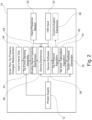
- Fig. 2 illustrates a process flow diagram of a writing instrument 10 according to the present disclosure.
- the power supply 12 of the writing instrument 10 supplies power to the tip force sensing assembly 24, the device electronics 26, and the tactile feedback generator 18.
- the HMI input 32 supplies the device electronics 26 and the device software 38 with user input.
- Values or parameters generated by the tip force sensing assembly 24 are received and processed by the analog signal capture electronics 28. In case of digital signals from the tip force sensing assembly 24 the analog signal capturing can be skipped. The digital signals are fed into the device electronics 26 and passed to the device software 38. Then, the digital values are input to the tip pressure algorithm 42.
- the tip pressure algorithm 42 compares the measured pressure data to historical pressure data from the same user or group of users and decides whether the measured data deviates significantly from the historical data.
- the air-time calculation algorithm 43 is responsible for determining the amount of time the user is spending without contacting the writing surface between two consecutive writing strokes. Said algorithm is making use of the data supplied by the tip force sensing assembly 24. Hence, the data of the tip force sensing assembly 24 in addition to the data from the hand presence sensor 33 is utilized in order to ensure that the user is actually engaging with the writing instrument 10 and it is not left on a surface for example.
- the tactile feedback generator 18 is started to provide an indication to the user.
- the outcome of the comparison is supplied to the communication electronics 36 which in turn provide the outcome of the comparison to digital device of the user.
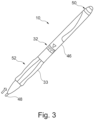
- Fig. 3 illustrates a perspective view of a writing instrument 10 according to the present disclosure.
- the writing instrument 10 can correspond to the writing instrument 10 as depicted in Fig. 1 or Fig. 2 .
- the writing instrument 10 includes a barrel shaped body 46 with a writing tip 48.
- the writing tip 48 could be an ink writing tip or a digital writing tip.
- the HMI input 32 includes in this example as selection wheel as well as the marker e.g., in form of a pointer orientated towards the selection wheel.
- the writing instrument 10 further includes an HMI display or HMI output 50 which is capable of indicating information like e.g., status information of the writing instrument 10 to the user.
- the HMI output 50 is arranged at an end opposite to the writing tip 48 and has the form of an LED strip.
- the writing instrument 10 further includes a grip section 52 which is located close to the writing tip 48.
- the hand presence sensor 33 is located on the pen barrel close to the area that the user is making direct contact with their fingertips. Said information can be used to enhance the accuracy of the algorithm that calculates the user's air-time and/or if the device should enter a "sleep" mode.
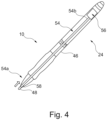
- Fig. 4 illustrates a perspective view of a writing instrument 10 according to the present disclosure.
- the writing instrument 10 can correspond to the writing instrument 10 as depicted in Fig. 1 to Fig. 3 .
- the writing instrument 10 includes an ink cartridge 54 that extends longitudinally inside the barrel shaped body 46.
- the ink cartridge 54 may be a hollow metal or plastic tub that store the ink.
- the tip force sensing assembly 24 encompasses a force sensor 56 or 58 for converting mechanical pressure into an electrical signal.
- the ink cartridge 54 comprises a tip end 54a and an opposed end 54b or rear end, wherein the force sensor 56 or 58 is mechanically connected to the ink cartridge 54.
- the ink cartridge 54 could be connected to the main body of the writing instrument 10 i.e., the barrel shaped body 46 by being press fit into the opening of the body 46. Then, the area that houses the pen tip 48 is conical and is pressed into the corresponding conical opening of the body 46. Then, the pen tip pressure is transferred via the conical attachment to the body 46.
- the force sensor 58 comprises a ring of a material that can convert mechanical pressure to an electrical signal and the ring is arranged between the ink cartridge 54 and the housing or body 46.
- the force sensor 58 may include or consist of the conical attachment.
- the ink cartridge 54 could be connected to the main body of the writing instrument 10 i.e., the barrel shaped body 46 by being mechanically secured between the rear end of the body 46 and a separate component that is secured press fit or via threads on the front of the pen barrel. Then, the force sensor 56 is located between the ink cartridge 54 and the rear end of the body 46.
- Fig. 5 illustrates a perspective view of a writing instrument 10 according to the present disclosure.
- Fig. 5 could depict different aspects of the writing instrument 10 shown in Figs. 3 and 4 .
- the writing instrument 10 may include a tactile feedback generator 18 which is arranged in the grip section 52.
- the tactile feedback generator 18 may be part of a communication system or is a communication system to provide an indication in case that data of at least two writing sessions of the user deviates from an average of historical data from the user. Thus, the tactile feedback generator 18 can alert the user in case of holding pressure reduction.
- the user can optionally adjust the amplitude of the vibrations of the tactile feedback generator 18 via the HMI 32.
- Fig. 6 illustrates a method flow chart for monitoring a fingertip strength of a writing instrument's user according to the present disclosure.
- the user activates their personal writing instrument 10.
- Such activation may be achieved by a user input e.g., via the HMI input 32. It is also possible that the writing instrument 10 automatically detects activation by the tip force sensing assembly 24 and/or the hand presence sensor 33.
- step 110 the user initiates their note taking process or tasks as usual.
- the writing instrument 10 is constantly monitoring the amount of pressure that their pen's tip is applying on the writing surface.
- force sensors are capturing accurate data from the interaction between the user's hand, the pen's barrel, the ink cartridge (pen's nib) and the writing surface.
- the writing instrument 10 is comparing the newly captured and extrapolated data to historical ones from the same user.
- the step 120 includes generating data from the monitored force, storing generated data as historical data, and comparing the generated data to historical data from the user.
- the captured data is extrapolated to evaluate the time spent between two consecutive writing strokes.
- the step 130 includes to extrapolate a time span of the writing instrument not in contact with the writing surface between two consecutive writing strokes from the monitored force; and to generate data from the monitored force and the extrapolated time span.
- step 140 in the event that multiple writing sessions from the user have indicated that pressure applied on the writing surface has varied significantly and the air-time has increased, the pen will alert them. Reduction in pen tip pressure while writing can be associated with increased risk of dementia or cognitive disorders. The increase of air-time can indicate the potential of a cognitive disorder.
- the step 140 includes providing an indication in case that data of at least two writing sessions of the user deviates from an average of historical data from the user.
- An indication may be provided in case the force is below an average force of historical data and/or a time span of the writing instrument 10 not in contact with the writing surface between two consecutive writing strokes is above an average time span of historical data.
- a tactile feedback generator communicates to the user the alert or the indication and may inform the user to seek medical attention.
- the user may adjust the amplitude of the vibrations of the feedback generator via the HMI input 32.
- At least one step of this method is executed by the writing instrument 10. Additionally, or alternatively, at least one step of this method is executed by the digital surface device 90 comprising the writing surface.
- the present disclosure also relates to the computer-implemented method for monitoring a fingertip strength of a writing instrument's user and the writing instrument for monitoring a fingertip strength of its user of the following aspects:
Landscapes
- Health & Medical Sciences (AREA)
- Life Sciences & Earth Sciences (AREA)
- Engineering & Computer Science (AREA)
- Molecular Biology (AREA)
- Animal Behavior & Ethology (AREA)
- Neurology (AREA)
- Biophysics (AREA)
- Pathology (AREA)
- Veterinary Medicine (AREA)
- Biomedical Technology (AREA)
- Heart & Thoracic Surgery (AREA)
- Medical Informatics (AREA)
- Public Health (AREA)
- Surgery (AREA)
- Physics & Mathematics (AREA)
- General Health & Medical Sciences (AREA)
- Physiology (AREA)
- Dentistry (AREA)
- Multimedia (AREA)
- Child & Adolescent Psychology (AREA)
- Developmental Disabilities (AREA)
- Hospice & Palliative Care (AREA)
- Oral & Maxillofacial Surgery (AREA)
- Psychiatry (AREA)
- Psychology (AREA)
- Neurosurgery (AREA)
- Pens And Brushes (AREA)
Priority Applications (1)
| Application Number | Priority Date | Filing Date | Title |
|---|---|---|---|
| EP22200188.5A EP4349255A1 (fr) | 2022-10-07 | 2022-10-07 | Instrument d'écriture |
Applications Claiming Priority (1)
| Application Number | Priority Date | Filing Date | Title |
|---|---|---|---|
| EP22200188.5A EP4349255A1 (fr) | 2022-10-07 | 2022-10-07 | Instrument d'écriture |
Publications (1)
| Publication Number | Publication Date |
|---|---|
| EP4349255A1 true EP4349255A1 (fr) | 2024-04-10 |
Family
ID=83994962
Family Applications (1)
| Application Number | Title | Priority Date | Filing Date |
|---|---|---|---|
| EP22200188.5A Withdrawn EP4349255A1 (fr) | 2022-10-07 | 2022-10-07 | Instrument d'écriture |
Country Status (1)
| Country | Link |
|---|---|
| EP (1) | EP4349255A1 (fr) |
Citations (3)
| Publication number | Priority date | Publication date | Assignee | Title |
|---|---|---|---|---|
| WO2007003417A2 (fr) * | 2005-07-04 | 2007-01-11 | Fachhochschule Regensburg | Crayon fluidique destine a la detection de donnees neuromotrices |
| US20110217679A1 (en) * | 2008-11-05 | 2011-09-08 | Carmel-Haifa University Economic Corporation Ltd. | Diagnosis method and system based on handwriting analysis |
| US20140362057A1 (en) | 2013-06-07 | 2014-12-11 | Commissariat A L'energie Atomique Et Aux Energies Alternatives | System and method for plotting the mark drawn on a writing medium |
-
2022
- 2022-10-07 EP EP22200188.5A patent/EP4349255A1/fr not_active Withdrawn
Patent Citations (3)
| Publication number | Priority date | Publication date | Assignee | Title |
|---|---|---|---|---|
| WO2007003417A2 (fr) * | 2005-07-04 | 2007-01-11 | Fachhochschule Regensburg | Crayon fluidique destine a la detection de donnees neuromotrices |
| US20110217679A1 (en) * | 2008-11-05 | 2011-09-08 | Carmel-Haifa University Economic Corporation Ltd. | Diagnosis method and system based on handwriting analysis |
| US20140362057A1 (en) | 2013-06-07 | 2014-12-11 | Commissariat A L'energie Atomique Et Aux Energies Alternatives | System and method for plotting the mark drawn on a writing medium |
Non-Patent Citations (3)
| Title |
|---|
| IMPEDOVO DONATO ET AL: "A Handwriting-Based Protocol for Assessing Neurodegenerative Dementia", COGNITIVE COMPUTATION, NEW YORK, N.Y. : SPRINGER, US, vol. 11, no. 4, 2 May 2019 (2019-05-02), pages 576 - 586, XP036849188, ISSN: 1866-9956, [retrieved on 20190502], DOI: 10.1007/S12559-019-09642-2 * |
| LUNARDINI FRANCESCA ET AL: "A Smart Ink Pen for the Ecological Assessment of Age-Related Changes in Writing and Tremor Features", IEEE TRANSACTIONS ON INSTRUMENTATION AND MEASUREMENT, IEEE, USA, vol. 70, 30 December 2020 (2020-12-30), pages 1 - 13, XP011832235, ISSN: 0018-9456, [retrieved on 20210120], DOI: 10.1109/TIM.2020.3045838 * |
| SEKIMOTO RYUKICHI ET AL: "EVIDENT: Extraction and Visualization Interface of Drawing Execution in Neuropsychological Tests", 10 July 2020, 16TH EUROPEAN CONFERENCE - COMPUTER VISION - ECCV 2020, CORNELL UNIVERSITY LIBRARY, 201 OLIN LIBRARY CORNELL UNIVERSITY ITHACA, NY 14853, PAGE(S) 460 - 472, XP047554760 * |
Similar Documents
| Publication | Publication Date | Title |
|---|---|---|
| EP3518129B1 (fr) | Dispositif électronique et son procédé de commande | |
| US11144124B2 (en) | Electronic device and control method thereof | |
| US9612661B2 (en) | Closed loop feedback interface for wearable devices | |
| US9720515B2 (en) | Method and apparatus for a gesture controlled interface for wearable devices | |
| US20130096397A1 (en) | Sensitivity evaluation system, sensitivity evaluation method, and program | |
| CN105764414B (zh) | 用于测量生物信号的方法及装置 | |
| US20170215757A1 (en) | Physiological signal detection and analysis systems and devices | |
| JP2009240374A (ja) | 皮膚特性測定装置および皮膚特性測定プログラム | |
| US11207489B2 (en) | Enhanced brain-machine interfaces with neuromodulation | |
| KR20200040564A (ko) | 혈압 추정 장치 및 방법과, 혈압 추정 지원 장치 | |
| CN110198665A (zh) | 电子设备及其控制方法 | |
| Dobosz et al. | Brain-computer interface for mobile devices | |
| Belk et al. | A Computer Mouse for Stress Identification of Older Adults at Work. | |
| Schmitz et al. | 3DA: Assessing 3D-Printed Electrodes for Measuring Electrodermal Activity | |
| Kellihan et al. | A real-world neuroimaging system to evaluate stress | |
| Hörmann et al. | Fine-grained prediction of cognitive workload in a modern working environment by utilizing short-term physiological parameters | |
| JP6628341B2 (ja) | 意思解読装置及び意思伝達支援装置 | |
| EP4349253A1 (fr) | Instrument d'écriture | |
| US12558021B2 (en) | Writing instrument | |
| Rania et al. | EOG based text and voice controlled remote interpreter for quadriplegic patients | |
| EP4350706A1 (fr) | Système d'écriture | |
| CN110446459A (zh) | 血压相关信息显示装置及方法 | |
| EP3735895A1 (fr) | Détection de paralysie, faiblesse et/ou engourdissement dans une partie du corps d'un sujet | |
| KR20210149375A (ko) | 임피던스 측정 장치 및 방법과, 체내 물질 성분 분석 장치 | |
| Martin | Comparison of machine learning models: Gesture recognition using a multimodal wrist orthosis for tetraplegics |
Legal Events
| Date | Code | Title | Description |
|---|---|---|---|
| PUAI | Public reference made under article 153(3) epc to a published international application that has entered the european phase |
Free format text: ORIGINAL CODE: 0009012 |
|
| STAA | Information on the status of an ep patent application or granted ep patent |
Free format text: STATUS: THE APPLICATION HAS BEEN PUBLISHED |
|
| AK | Designated contracting states |
Kind code of ref document: A1 Designated state(s): AL AT BE BG CH CY CZ DE DK EE ES FI FR GB GR HR HU IE IS IT LI LT LU LV MC ME MK MT NL NO PL PT RO RS SE SI SK SM TR |
|
| STAA | Information on the status of an ep patent application or granted ep patent |
Free format text: STATUS: THE APPLICATION IS DEEMED TO BE WITHDRAWN |
|
| 18D | Application deemed to be withdrawn |
Effective date: 20241011 |