EP4349598A2 - Procédés et revêtements pour enregistrement et lecture audio avancés - Google Patents
Procédés et revêtements pour enregistrement et lecture audio avancés Download PDFInfo
- Publication number
- EP4349598A2 EP4349598A2 EP24158808.6A EP24158808A EP4349598A2 EP 4349598 A2 EP4349598 A2 EP 4349598A2 EP 24158808 A EP24158808 A EP 24158808A EP 4349598 A2 EP4349598 A2 EP 4349598A2
- Authority
- EP
- European Patent Office
- Prior art keywords
- conformal coating
- phonorecord
- substrate
- coating
- lacquer
- Prior art date
- Legal status (The legal status is an assumption and is not a legal conclusion. Google has not performed a legal analysis and makes no representation as to the accuracy of the status listed.)
- Pending
Links
Images





Classifications
-
- G—PHYSICS
- G11—INFORMATION STORAGE
- G11B—INFORMATION STORAGE BASED ON RELATIVE MOVEMENT BETWEEN RECORD CARRIER AND TRANSDUCER
- G11B3/00—Recording by mechanical cutting, deforming or pressing, e.g. of grooves or pits; Reproducing by mechanical sensing; Record carriers therefor
- G11B3/68—Record carriers
- G11B3/682—Record carriers comprising protective coatings, e.g. anti static, anti-friction
-
- B—PERFORMING OPERATIONS; TRANSPORTING
- B32—LAYERED PRODUCTS
- B32B—LAYERED PRODUCTS, i.e. PRODUCTS BUILT-UP OF STRATA OF FLAT OR NON-FLAT, e.g. CELLULAR OR HONEYCOMB, FORM
- B32B15/00—Layered products comprising a layer of metal
- B32B15/04—Layered products comprising a layer of metal comprising metal as the main or only constituent of a layer, which is next to another layer of the same or of a different material
- B32B15/043—Layered products comprising a layer of metal comprising metal as the main or only constituent of a layer, which is next to another layer of the same or of a different material of metal
-
- B—PERFORMING OPERATIONS; TRANSPORTING
- B32—LAYERED PRODUCTS
- B32B—LAYERED PRODUCTS, i.e. PRODUCTS BUILT-UP OF STRATA OF FLAT OR NON-FLAT, e.g. CELLULAR OR HONEYCOMB, FORM
- B32B15/00—Layered products comprising a layer of metal
- B32B15/04—Layered products comprising a layer of metal comprising metal as the main or only constituent of a layer, which is next to another layer of the same or of a different material
- B32B15/08—Layered products comprising a layer of metal comprising metal as the main or only constituent of a layer, which is next to another layer of the same or of a different material of synthetic resin
-
- B—PERFORMING OPERATIONS; TRANSPORTING
- B32—LAYERED PRODUCTS
- B32B—LAYERED PRODUCTS, i.e. PRODUCTS BUILT-UP OF STRATA OF FLAT OR NON-FLAT, e.g. CELLULAR OR HONEYCOMB, FORM
- B32B15/00—Layered products comprising a layer of metal
- B32B15/16—Layered products comprising a layer of metal next to a particulate layer
-
- B—PERFORMING OPERATIONS; TRANSPORTING
- B32—LAYERED PRODUCTS
- B32B—LAYERED PRODUCTS, i.e. PRODUCTS BUILT-UP OF STRATA OF FLAT OR NON-FLAT, e.g. CELLULAR OR HONEYCOMB, FORM
- B32B15/00—Layered products comprising a layer of metal
- B32B15/18—Layered products comprising a layer of metal comprising iron or steel
-
- B—PERFORMING OPERATIONS; TRANSPORTING
- B32—LAYERED PRODUCTS
- B32B—LAYERED PRODUCTS, i.e. PRODUCTS BUILT-UP OF STRATA OF FLAT OR NON-FLAT, e.g. CELLULAR OR HONEYCOMB, FORM
- B32B15/00—Layered products comprising a layer of metal
- B32B15/20—Layered products comprising a layer of metal comprising aluminium or copper
-
- B—PERFORMING OPERATIONS; TRANSPORTING
- B32—LAYERED PRODUCTS
- B32B—LAYERED PRODUCTS, i.e. PRODUCTS BUILT-UP OF STRATA OF FLAT OR NON-FLAT, e.g. CELLULAR OR HONEYCOMB, FORM
- B32B27/00—Layered products comprising a layer of synthetic resin
- B32B27/14—Layered products comprising a layer of synthetic resin next to a particulate layer
-
- B—PERFORMING OPERATIONS; TRANSPORTING
- B32—LAYERED PRODUCTS
- B32B—LAYERED PRODUCTS, i.e. PRODUCTS BUILT-UP OF STRATA OF FLAT OR NON-FLAT, e.g. CELLULAR OR HONEYCOMB, FORM
- B32B27/00—Layered products comprising a layer of synthetic resin
- B32B27/30—Layered products comprising a layer of synthetic resin comprising vinyl (co)polymers; comprising acrylic (co)polymers
-
- B—PERFORMING OPERATIONS; TRANSPORTING
- B32—LAYERED PRODUCTS
- B32B—LAYERED PRODUCTS, i.e. PRODUCTS BUILT-UP OF STRATA OF FLAT OR NON-FLAT, e.g. CELLULAR OR HONEYCOMB, FORM
- B32B27/00—Layered products comprising a layer of synthetic resin
- B32B27/30—Layered products comprising a layer of synthetic resin comprising vinyl (co)polymers; comprising acrylic (co)polymers
- B32B27/304—Layered products comprising a layer of synthetic resin comprising vinyl (co)polymers; comprising acrylic (co)polymers comprising vinyl halide (co)polymers, e.g. PVC, PVDC, PVF, PVDF
-
- B—PERFORMING OPERATIONS; TRANSPORTING
- B32—LAYERED PRODUCTS
- B32B—LAYERED PRODUCTS, i.e. PRODUCTS BUILT-UP OF STRATA OF FLAT OR NON-FLAT, e.g. CELLULAR OR HONEYCOMB, FORM
- B32B3/00—Layered products comprising a layer with external or internal discontinuities or unevennesses, or a layer of non-planar shape; Layered products comprising a layer having particular features of form
- B32B3/26—Layered products comprising a layer with external or internal discontinuities or unevennesses, or a layer of non-planar shape; Layered products comprising a layer having particular features of form characterised by a particular shape of the outline of the cross-section of a continuous layer; characterised by a layer with cavities or internal voids ; characterised by an apertured layer
- B32B3/30—Layered products comprising a layer with external or internal discontinuities or unevennesses, or a layer of non-planar shape; Layered products comprising a layer having particular features of form characterised by a particular shape of the outline of the cross-section of a continuous layer; characterised by a layer with cavities or internal voids ; characterised by an apertured layer characterised by a layer formed with recesses or projections, e.g. hollows, grooves, protuberances, ribs
-
- B—PERFORMING OPERATIONS; TRANSPORTING
- B32—LAYERED PRODUCTS
- B32B—LAYERED PRODUCTS, i.e. PRODUCTS BUILT-UP OF STRATA OF FLAT OR NON-FLAT, e.g. CELLULAR OR HONEYCOMB, FORM
- B32B5/00—Layered products characterised by the non- homogeneity or physical structure, i.e. comprising a fibrous, filamentary, particulate or foam layer; Layered products characterised by having a layer differing constitutionally or physically in different parts
- B32B5/16—Layered products characterised by the non- homogeneity or physical structure, i.e. comprising a fibrous, filamentary, particulate or foam layer; Layered products characterised by having a layer differing constitutionally or physically in different parts characterised by features of a layer formed of particles, e.g. chips, powder or granules
-
- B—PERFORMING OPERATIONS; TRANSPORTING
- B32—LAYERED PRODUCTS
- B32B—LAYERED PRODUCTS, i.e. PRODUCTS BUILT-UP OF STRATA OF FLAT OR NON-FLAT, e.g. CELLULAR OR HONEYCOMB, FORM
- B32B9/00—Layered products comprising a layer of a particular substance not covered by groups B32B11/00 - B32B29/00
- B32B9/005—Layered products comprising a layer of a particular substance not covered by groups B32B11/00 - B32B29/00 comprising one layer of ceramic material, e.g. porcelain, ceramic tile
- B32B9/007—Layered products comprising a layer of a particular substance not covered by groups B32B11/00 - B32B29/00 comprising one layer of ceramic material, e.g. porcelain, ceramic tile comprising carbon, e.g. graphite, composite carbon
-
- B—PERFORMING OPERATIONS; TRANSPORTING
- B32—LAYERED PRODUCTS
- B32B—LAYERED PRODUCTS, i.e. PRODUCTS BUILT-UP OF STRATA OF FLAT OR NON-FLAT, e.g. CELLULAR OR HONEYCOMB, FORM
- B32B9/00—Layered products comprising a layer of a particular substance not covered by groups B32B11/00 - B32B29/00
- B32B9/04—Layered products comprising a layer of a particular substance not covered by groups B32B11/00 - B32B29/00 comprising such particular substance as the main or only constituent of a layer, which is next to another layer of the same or of a different material
- B32B9/045—Layered products comprising a layer of a particular substance not covered by groups B32B11/00 - B32B29/00 comprising such particular substance as the main or only constituent of a layer, which is next to another layer of the same or of a different material of synthetic resin
-
- B—PERFORMING OPERATIONS; TRANSPORTING
- B32—LAYERED PRODUCTS
- B32B—LAYERED PRODUCTS, i.e. PRODUCTS BUILT-UP OF STRATA OF FLAT OR NON-FLAT, e.g. CELLULAR OR HONEYCOMB, FORM
- B32B9/00—Layered products comprising a layer of a particular substance not covered by groups B32B11/00 - B32B29/00
- B32B9/04—Layered products comprising a layer of a particular substance not covered by groups B32B11/00 - B32B29/00 comprising such particular substance as the main or only constituent of a layer, which is next to another layer of the same or of a different material
- B32B9/048—Layered products comprising a layer of a particular substance not covered by groups B32B11/00 - B32B29/00 comprising such particular substance as the main or only constituent of a layer, which is next to another layer of the same or of a different material made of particles
-
- G—PHYSICS
- G11—INFORMATION STORAGE
- G11B—INFORMATION STORAGE BASED ON RELATIVE MOVEMENT BETWEEN RECORD CARRIER AND TRANSDUCER
- G11B3/00—Recording by mechanical cutting, deforming or pressing, e.g. of grooves or pits; Reproducing by mechanical sensing; Record carriers therefor
- G11B3/44—Styli, e.g. sapphire, diamond
-
- G—PHYSICS
- G11—INFORMATION STORAGE
- G11B—INFORMATION STORAGE BASED ON RELATIVE MOVEMENT BETWEEN RECORD CARRIER AND TRANSDUCER
- G11B3/00—Recording by mechanical cutting, deforming or pressing, e.g. of grooves or pits; Reproducing by mechanical sensing; Record carriers therefor
- G11B3/68—Record carriers
- G11B3/70—Record carriers characterised by the selection of material or structure; Processes or apparatus specially adapted for manufacturing record carriers
-
- G—PHYSICS
- G11—INFORMATION STORAGE
- G11B—INFORMATION STORAGE BASED ON RELATIVE MOVEMENT BETWEEN RECORD CARRIER AND TRANSDUCER
- G11B3/00—Recording by mechanical cutting, deforming or pressing, e.g. of grooves or pits; Reproducing by mechanical sensing; Record carriers therefor
- G11B3/68—Record carriers
- G11B3/72—Groove formations, e.g. run-in groove, run-out groove
-
- B—PERFORMING OPERATIONS; TRANSPORTING
- B32—LAYERED PRODUCTS
- B32B—LAYERED PRODUCTS, i.e. PRODUCTS BUILT-UP OF STRATA OF FLAT OR NON-FLAT, e.g. CELLULAR OR HONEYCOMB, FORM
- B32B2250/00—Layers arrangement
- B32B2250/02—2 layers
-
- B—PERFORMING OPERATIONS; TRANSPORTING
- B32—LAYERED PRODUCTS
- B32B—LAYERED PRODUCTS, i.e. PRODUCTS BUILT-UP OF STRATA OF FLAT OR NON-FLAT, e.g. CELLULAR OR HONEYCOMB, FORM
- B32B2255/00—Coating on the layer surface
- B32B2255/06—Coating on the layer surface on metal layer
-
- B—PERFORMING OPERATIONS; TRANSPORTING
- B32—LAYERED PRODUCTS
- B32B—LAYERED PRODUCTS, i.e. PRODUCTS BUILT-UP OF STRATA OF FLAT OR NON-FLAT, e.g. CELLULAR OR HONEYCOMB, FORM
- B32B2255/00—Coating on the layer surface
- B32B2255/10—Coating on the layer surface on synthetic resin layer or on natural or synthetic rubber layer
-
- B—PERFORMING OPERATIONS; TRANSPORTING
- B32—LAYERED PRODUCTS
- B32B—LAYERED PRODUCTS, i.e. PRODUCTS BUILT-UP OF STRATA OF FLAT OR NON-FLAT, e.g. CELLULAR OR HONEYCOMB, FORM
- B32B2255/00—Coating on the layer surface
- B32B2255/20—Inorganic coating
-
- B—PERFORMING OPERATIONS; TRANSPORTING
- B32—LAYERED PRODUCTS
- B32B—LAYERED PRODUCTS, i.e. PRODUCTS BUILT-UP OF STRATA OF FLAT OR NON-FLAT, e.g. CELLULAR OR HONEYCOMB, FORM
- B32B2264/00—Composition or properties of particles which form a particulate layer or are present as additives
- B32B2264/10—Inorganic particles
- B32B2264/107—Ceramic
- B32B2264/108—Carbon, e.g. graphite particles
-
- B—PERFORMING OPERATIONS; TRANSPORTING
- B32—LAYERED PRODUCTS
- B32B—LAYERED PRODUCTS, i.e. PRODUCTS BUILT-UP OF STRATA OF FLAT OR NON-FLAT, e.g. CELLULAR OR HONEYCOMB, FORM
- B32B2307/00—Properties of the layers or laminate
- B32B2307/20—Properties of the layers or laminate having particular electrical or magnetic properties, e.g. piezoelectric
- B32B2307/202—Conductive
-
- G—PHYSICS
- G11—INFORMATION STORAGE
- G11B—INFORMATION STORAGE BASED ON RELATIVE MOVEMENT BETWEEN RECORD CARRIER AND TRANSDUCER
- G11B2220/00—Record carriers by type
- G11B2220/20—Disc-shaped record carriers
Definitions
- the various embodiments of the disclosure relate generally to materials and methods of improving the durability and sound and data reproduction quality of phonorecords.
- the vinyl disk format was originally developed because of its capacity for mass production using a stamping process.
- the process begins with an audio recording.
- the audio recording is transcribed using a lathe to cut a groove in a soft material such as acetate or nitrocellulose.
- This transcribed audio is the closest to the original, and is termed the master cut or master lacquer.
- the process of producing the consumer vinyl record involves several additional steps, or "generations.”
- the master lacquer is first coated, generally with a layer of silver, and electroplated, using a metal such as nickel, to make a metal master.
- the metal master, or "father" is a negative of the original master lacquer.
- the father plate is too fragile to undergo the stamping process, therefore additional steps, or generations, must be performed in order to form a stamper that can withstand the stamping process to form the vinyl records. Accordingly, the father plate is then oxidized and plated again. The resulting plate, the "mother", is then separated from the father.
- the mother plate is a metal duplicate of the original master lacquer.
- the mother plate is then oxidized and plated to make stamper plates, which are negatives of the original master lacquer.
- the stamper plates are then used to imprint the recording onto heated vinyl blanks.
- one father plate can produce about 10 mother plates, one mother plate can produce about 10 stampers, and one stamper can produce about 1000 vinyl records.
- there are several additional steps, or "generations" required to yield a final product. Production or manufacturing defects arising during these extra generations yield diminished quality further removing the vinyl products from the original audio recording.
- An embodiment can be a phonorecord for embodying an audio recording comprising a metal substrate, a lacquer coating disposed on at least a portion of the metal substrate, the lacquer coating can comprise one or more grooves embodying the audio recording; and a conformal coating
- An embodiment can be a method for producing a phonorecord for embodying an audio recording comprising providing a metal substrate, disposing a lacquer coating onto at least a portion of the metal substrate; introducing one or more grooves into the lacquer coating, the one or more grooves can embody the audio recording; and disposing a conformal coating onto at least a portion of the lacquer coating.
- the lacquer coating can comprise a nitrocellulose lacquer.
- the conformal coating can be made from a material comprising one or more of quartz (SiO 2 ), sapphire (AI 2 O 3 ), or diamond-like carbon (DLC).
- the material can be quartz (SiO 2 ).
- the material can be sapphire (Al 2 O 3 ).
- the material can be diamond-like carbon.
- the Mohs Hardness of the conformal coating can be greater than the Mohs Hardness of the lacquer coating. In an embodiment, the conformal coating can have a Mohs Hardness of at least about 7. In an embodiment the Vickers Hardness of the conformal coating can be greater than the Vickers Hardness of the lacquer coating. In an embodiment, the conformal coating can have a Vickers Hardness of at least about 1000.
- the thickness of the conformal coating can be from about 10 nm to about 500 nm. In an embodiment, the thickness of the conformal coating can be from about 10 to about 200 nm. In an embodiment, the thickness of the conformal coating can be from about 100 nm to about 150 nm. In an embodiment, the metal substrate can comprise aluminum.
- the phonorecord can comprise a conductive layer disposed onto at least a portion of the conformal coating; the conductive layer can be configured to shed dust from an outer surface of the phonorecord.
- the conductive layer can comprise a carbon-based material selected from the group consisting of carbon nanotubes, graphene, and graphite.
- the one or more grooves can form a lacquer coating topography.
- the conformal coating can have a conformal coating topography that can be substantially identical to the lacquer coating topography.
- the phonorecord can further comprise an optical layer disposed onto at least a portion of the lacquer coating, the optical layer can store digital data.
- the phonorecord can further comprise an optical layer disposed onto at least a portion of the lacquer coating, the optical layer can store digital data.
- disposing the conformal coating can comprise performing one or more of ion assisted deposition, electron beam evaporation, sputtering, thermal evaporation, chemical vapor deposition and physical vapor deposition. In an embodiment, disposing the conformal coating can comprise performing ion assisted deposition. In an embodiment, disposing the conformal coating can comprise performing ion assisted deposition. In an embodiment, disposing the conformal coating can comprise performing atomic layer deposition.
- disposing the conformal can be performed at a temperature of less than about 100 °C.
- An embodiment can be a phonorecord for embodying an audio recording comprising a vinyl substrate, the vinyl substrate can comprise one or more grooves embodying the audio recording; and a conformal coating disposed on at least a portion of the vinyl substrate, the conformal coating can have a Vickers Hardness of at least about 1000.
- the one or more grooves can form a vinyl substrate topography.
- the conformal coating has a conformal coating topography that can be substantially identical to the vinyl substrate topography.
- the phonorecord can further comprise an optical layer disposed onto at least a portion of the vinyl substrate, the optical layer can store digital data.
- An embodiment can be a phonorecord for embodying a negative of an audio recording that can comprise a metal substrate, the metal substrate can comprise one or more ridges embodying the negative of the audio recording; and a conformal coating disposed on at least a portion of the substrate, the conformal coating can have a Vickers Hardness of at least about 1000.
- the conformal coating can be configured to provide increased durability to the metal substrate such that the phonorecord is capable of withstanding a plurality of stamps into a vinyl blank.
- the phonorecord can be configured to withstand a vinyl stamping process.
- An embodiment can be a stylus for playing back an audio recording embodied on a phonorecord that can comprise a carbon-based substrate and a conformal coating disposed onto at least a portion of the carbon-based substrate, the conformal coating can have a Vickers Hardness of at least about 1000.
- the stylus can be shaped to interface with one or more grooves of the phonorecord.
- the carbon-based substrate can be selected from the group consisting of carbon nanotubes, graphene, and graphite.
- Ranges may be expressed herein as from “about” or “approximately” one particular value and/or to “about” or “approximately” another particular value. When such a range is expressed, another embodiment includes from the one particular value and/or to the other particular value.
- Various embodiments of the disclosure are directed to the materials and methods for improving durability and sound and data reproduction quality of phonorecords, including, but not limited to, vinyl disc recording technologies.
- One particular advantage of this disclosure is to remove the number of "generations" required between the creation of an original lathe-cut lacquer master disc and replication into the ultimate end-use consumer product. Decreasing the number of generations between the lacquer master and the consumer product can increase the sound reproduction quality of the audio recording.
- the lacquer material of master lacquers is generally made from a soft and easily damaged material that is incapable of withstanding multiple playbacks on an audio playback device, such as a turntable.
- consumer vinyl records are often associated with distortion, pops, clicks, and surface noise inherent to the format because of the physical properties of the vinyl.
- Vinyl is a good insulator and will hold a static charge such that dust and other particles accumulate on the surface.
- Vinyl records also have a finite playability. Vinyl is not an especially hard material, and its surface can be easily scratched, which over time causes sound fidelity to diminish.
- Consumer vinyl records can be subject to degradation and damage from repeated playback on an audio playback device, such as a turntable.
- Various embodiments of the disclosure can produce superior sound reproduction, incorporate digital data, increase foreign particle resistance and shedding, increase longevity and durability, and increase abrasion resistance of master phonorecords and end-use consumer phonorecords.
- An embodiment of the invention can be a phonorecord for embodying an audio recording.
- An audio recording can be any sound created by nature or computer actions, including, but not limited to manual instruments (e.g., guitars, pianos and the like), human speech, sounds of nature, computer-generated sound, and computer generated data representative of certain sounds.
- the phonorecord can comprise an audio recording.
- the phonorecord can comprise analog data, e.g., analog acoustic data.
- the phonorecord can comprise digital data.
- the digital data can comprise data embodying audio, video, images, text, advertisements, voice comments from an artist, bonus material, e.g., B-side tracks, and the like.
- the phonorecord can comprise both digital data and analog data.
- the phonorecord can be a master cut or master lacquer.
- the phonorecord can be an end-user consumer record.
- the phonorecord can be a "father" plate that can be configured to withstand the stamping process so as to eliminate steps, or generations, between the master lacquer and the end-use consumer vinyl phonorecord.
- the phonorecord can be an end-use consumer phonorecord for embodying an audio recording can comprise a vinyl substrate.
- the vinyl substrate can comprise one or more grooves embodying an audio recording.
- the vinyl substrate can comprise polyvinyl chloride (PVC).
- PVC polyvinyl chloride
- the PVC can be doped with an additional material, including, but not limited to lead, TiO 2 , Co + , and the like.
- the PVC can also include an agent, such as a dye, for imparting color into the material.
- a conformal coating can be disposed into at least a portion of the vinyl substrate.
- the phonorecord can be a master cut or a master lacquer phonorecord for embodying an audio recording.
- the phonorecord can comprise a substrate, a lacquer coating disposed on at least a portion of the substrate, and a conformal coating disposed on at least a portion of the lacquer coating.
- the substrate can be a metal substrate.
- the metal substrate can comprise or consist of many different metals known in the art, including, but not limited to, aluminum, magnesium, titanium, copper, iron and alloys thereof, e.g., steel.
- the substrate can comprise aluminum.
- the substrate can comprise an aluminum alloy.
- the substrate can consist of aluminum.
- the substrate can consist of an aluminum alloy.
- the phonorecord can be a "father" plate that can be configured to withstand a vinyl stamping process so as to eliminate steps, or generations, between the master lacquer formation and the end-use consumer vinyl phonorecord.
- the "father” plate phonorecord can be a negative of an original master lacquer so that it can be used as a stamper to imprint vinyl blanks.
- the "father” phonorecord can comprise a metal substrate and a conformal coating disposed on at least a portion of the metal substrate.
- the phonorecord can embody a negative of an audio recording.
- the metal substrate can be made from a variety of metals including, silver, gold, nickel, chromium, and the like.
- the substrate can comprise a material selected from the group consisting of silver, gold, and nickel. In an embodiment, the substrate can consist of a material selected from the group consisting of silver, gold and nickel. In an embodiment the substrate and comprise or consist of nickel. In an embodiment, the metal substrate can comprise one or more ridges embodying a negative of an audio recording. In an embodiment the "father" plate phonorecord can be a negative of an original master lacquer. In an embodiment, the "father" plate phonorecord can be a negative of an original master lacquer such that the phonorecord can be used as a stamper to produce end-use consumer vinyl records.
- the "father" plate phonorecord can comprise at least one ridge, the at least one ridge of the "father” plate phonorecord being a negative of the at least one groove of the master lacquer.
- the phonorecord can be configured to withstand a vinyl stamping process, including imprinting a plurality of vinyl blanks using the phonorecord.
- the metal substrate can be coated with the conformal coating in order to provide durability and wearability to the metal substrate such that the phonorecord can withstand a vinyl stamping process.
- the lacquer coating can comprise a nitrocellulose lacquer.
- the lacquer coating can consist of a nitrocellulose lacquer.
- the lacquer can be made from other polymeric materials such as materials used in microelectronics processing, photolithographic materials, e.g., benzocyclobutene (BCB)-based polymers, and the like.
- the phonorecord can comprise a conformal coating.
- the conformal coating can be disposed onto at least a portion of a lacquer coating.
- the conformal coating can be disposed onto the entirety of a lacquer coating.
- the conformal coating can be disposed onto at least a portion of a vinyl substrate.
- the conformal coating can be disposed onto the entirety of the vinyl substrate.
- the conformal coating can be disposed onto at least a portion of a metal substrate.
- the conformal coating can be disposed onto the entirety of a metal substrate.
- the conformal coating can comprise or consist of a variety of materials including, but not limited to minerals such as quartz, topaz, corundum, sapphire, diamond, diamond-like carbon, and combinations thereof.
- the conformal coating can comprise or consist of minerals, gemstones, and/or birthstones, including, but not limited to, diamond, ruby, amethyst, aquamarine, garnet, emerald, tourmaline, topaz, peridot, tanzanite, zircon, turquoise, and the like.
- the conformal coating can be made from a material comprising or consisting of silica, alumina, sol-gels, calcogenides, parylene, fluoropolymers such as polytetrafluoroethylene (PTFE), and carbon-based materials such as diamond, carbonado, diamond-like carbon, amorphous carbon, graphene, graphite, carbon nanotubes, and the like, and combinations thereof.
- the conformal coating can be made from a material comprising or consisting of quartz (SiO 2 ), sapphire (AI 2 O 3 ), or diamond-like carbon (DLC), and combinations thereof.
- the material can comprise quartz.
- the material can consist of quartz.
- the material can comprise sapphire.
- the material can consist of sapphire. In an embodiment, the material can comprise diamond-like carbon. In an embodiment, the material can consist of diamond-like carbon. In an embodiment, the conformal coating can comprise or consist of quartz, sapphire, diamond-like carbon, or combinations thereof.
- the conformal coating can be configured to provide increased durability, wearability, and/or lubricity to a substrate or coating.
- the substrate can comprise or consist of a variety of materials including, but not limited to, a vinyl substrate, a carbon-based substrate, or a metal substrate.
- the conformal coating can be configured to provide increased durability, wearability, and/or lubricity to the lacquer coating.
- the conformal coating can be made from a harder material than the lacquer coating.
- the conformal coating can be configured to provide increased durability, wearability, and/or lubricity to the vinyl substrate.
- the conformal coating can be made from a harder material than the vinyl substrate.
- the conformal coating can be configured to provide increased durability, wearability, and/or lubricity to the metal substrate.
- the conformal coating can be made from a harder material than the metal substrate.
- the Mohs Hardness of the conformal coating can be greater than the Mohs Hardness of the lacquer coating. In an embodiment, the Mohs Hardness of the conformal coating can be greater than the Mohs Hardness of the vinyl substrate.
- the Mohs scale is a qualitative ordinal scale that characterizes the scratch resistance of various minerals and materials through the ability of a harder material to scratch a softer material. A person of ordinary skill in the art would know that various minerals are assigned various hardness values on the Mohs scale.
- the conformal coating can have a Mohs Hardness of at least about 6. In an embodiment, the conformal coating can have a Mohs Hardness of at least about 7.
- the conformal coating can have a Mohs Hardness from about 7 to about 10. In an embodiment, the conformal coating can have a Mohs Hardness of about 7. In an embodiment, the conformal coating can have a Mohs Hardness of about 8. In an embodiment, the conformal coating can have a Mohs Hardness of about 9. In an embodiment, the conformal coating can have a Mohs Hardness of about 10.
- the hardness of materials can also be quantified by the Vickers hardness test.
- the Vickers test is performed to observe a material's ability to resist plastic deformation for a standard source.
- the Vickers test can be used for a variety of materials, including all metals, and the unit of hardness is known as the Vickers Pyramid Number (HV) or Diamond Pyramid Hardness (DPH).
- HV Vickers Pyramid Number
- DPH Diamond Pyramid Hardness
- the Vickers Hardness of the conformal coating can be greater than the Vickers Hardness of the lacquer coating.
- the Vickers Hardness of the conformal coating can be greater than the Vickers Hardness of the vinyl substrate.
- the Vickers Hardness of the conformal coating can be at least about 1000HV.
- the Vickers Hardness of the conformal coating can be from about 1000HV to about 10000HV. In an embodiment, the Vickers Hardness of the conformal coating can be about 1000HV. In an embodiment, the Vickers Hardness of the conformal coating can be about 2000HV. In an embodiment, the Vickers Hardness of the conformal coating can be about 1940HV on the parallel axis and about 2200HV on the perpendicular axis. In an embodiment, the Vickers Hardness of the conformal coating can be from about 2000HV to about 4000HV. In an embodiment, the Vickers Hardness of the conformal coating can be from about 2000HV to about 10,000HV. In an embodiment, the Vickers Hardness of the conformal coating can be about 10,000HV.
- the thickness of the conformal coating can be from about 10 nm to about 500 nm. In an embodiment, the thickness of the conformal coating can be from about 10 to about 200 nm. In an embodiment, the thickness of the conformal coating can be from about 100 nm to about 150 nm. In an embodiment, the thickness of the conformal coating can be from about 100 nm to about 200 nm. In an embodiment, the thickness of the conformal coating can be about 150 nm.
- the conformal coating can be intimately associated with a substrate or coating onto which it is disposed such that the conformal coating can comprise one or more grooves that are substantially identical to the one or more grooves of the substrate or coating onto which it is disposed.
- the one or more grooves in the lacquer coating can form a lacquer coating topography.
- the lacquer coating topography can be the three-dimensional surface features and contours of the lacquer coating.
- the one or more grooves that can be disposed into the lacquer coating create the lacquer coating topography.
- the conformal coating can have a conformal coating topography.
- the conformal coating topography can be the three-dimensional surface features and contours of the conformal coating.
- the conformal coating can be disposed onto at least a portion of the lacquer coating such that the conformal coating topography can be substantially identical to the lacquer coating topography.
- the conformal coating can comprise substantially identical grooves as the lacquer coating such that the conformal coating embodies the substantially identical audio recording as the lacquer coating.
- the conformal coating can be intimately associated with the lacquer coating such that the conformal coating comprises substantially identical grooves to the lacquer coating.
- the conformal coating can comprise one or more grooves.
- the one or more grooves in the conformal coating can be substantially identical to the one or more grooves disposed in the lacquer coating.
- the one or more grooves in a substrate can form a substrate topography.
- the substrate topography can be the three-dimensional surface features and contours of the substrate.
- the one or more grooves that are disposed into the substrate create the substrate topography.
- the conformal coating can have a conformal coating topography.
- the conformal coating topography can be the three-dimensional surface features and contours of the conformal coating.
- the conformal coating can be disposed onto at least a portion of the substrate such that the conformal coating topography can be substantially identical to the substrate topography.
- the conformal coating can comprise substantially identical grooves as the substrate such that the conformal coating embodies the substantially identical audio recording as the substrate.
- the conformal coating can be intimately associated with the substrate such that the conformal coating comprises substantially identical grooves to the substrate.
- the conformal coating can comprise one or more grooves.
- the one or more grooves in the conformal coating can be substantially identical to the one or more grooves disposed in the substrate.
- the substrate can be any substrate, including, but not limited to, a vinyl substrate, or a metal substrate, or a carbon-based substrate.
- one or more ridges in a substrate can form a substrate topography.
- the conformal coating can be disposed onto at least a portion of the substrate such that the conformal coating topography can be substantially identical to the substrate topography.
- the conformal coating can be intimately associated with the substrate such that the conformal coating comprises substantially identical ridges to the substrate.
- the phonorecord can further comprise a conductive layer disposed onto at least a portion of the conformal coating.
- a conductive layer can be disposed onto at least a portion of the lacquer coating.
- a conductive layer can be disposed into at least a portion of a substrate, including, but not limited to a vinyl substrate or a metal substrate.
- the conductive layer can be configured to shed dust and/or other particles from an outer surface of the phonorecord.
- the conductive layer can be configured to shed dust and/or other particles from at least a portion of the one or more grooves in the conformal coating.
- the conductive layer can be configured to decrease or eliminate static charge in the vinyl substrate.
- the conductive layer can comprise a material selected from the group consisting of a carbon-based material and a metal.
- the conductive layer can comprise a carbon-based material including, but not limited to carbon nanotubes, graphene, graphite, amorphous carbon, diamond-like carbon (DLC), diamond, and the like, and combinations thereof.
- the conductive layer can comprise a graphene-based material.
- the conductive layer can consist of a carbon-based material.
- the conductive layer can be made from a metal including, but not limited to metal nanoparticles.
- the conformal coating and the conductive layer are the same layer and form a conformal-conductive layer.
- the conformal-conductive layer comprises a conductive material and thereby serves as both the conformal coating and the conductive layer.
- the conformal-conductive layer can comprise or consist of graphene, thereby providing the durability and wear resistance of the conformal coating and the conductive properties and dust-particle shedding of the conductive layer.
- the conformal-conductive layer can comprise or consist of metal nanoparticles.
- the conformal-conductive layer can comprises or consist of a liquid dispersion of graphene.
- the liquid conformal-conductive coating (e.g., liquid dispersion of graphene and/or nanoparticles) can be applied by a consumer to a phonorecord.
- the phonorecord can be configured to produce a plurality of playbacks of the audio recording on an audio playback device with minimal or no damage or degradation to the conformal coating.
- the conformal coating can be configured to allow a plurality of playbacks of the audio recording without decreasing the sound quality of the audio recording.
- the conformal coating can be configured to allow a plurality of playbacks of the phonorecord on an audio playback device with minimal or no altering of the conformal coating topography or lacquer coating topography.
- the phonorecord can be configured to allow a plurality of playbacks of the phonorecord on an audio playback device with minimal or no altering of the vinyl substrate topography.
- the conformal coating can produce a high degree of sound fidelity when played on a phonorecord device or audio playback device, such as a turntable, phonograph, and the like. Additionally the coated analog audio recording can be played a plurality of times without diminishing sound quality. Surprisingly, phonorecords comprising the conformal coating can have improved playback quality upon multiple playbacks on an audio playback device.
- An embodiment of the invention can be a phonorecord for embodying an audio recording comprising a metal substrate and nitrocellulose lacquer.
- the nitrocellulose lacquer can further comprise a conductive dopant.
- the conductive dopant can comprise a carbon-based material as described above or a metal.
- a conductive layer can be disposed onto at least a portion of the nitrocellulose lacquer.
- the phonorecord can further comprise an optical layer.
- the optical layer can be configured to store digital data.
- the optical layer can be made from any optical material that is capable of storing digital data, including, but not limited to, aluminum, and the like.
- the optical layer can be disposed onto at least a portion of the lacquer coating.
- the optical layer can be disposed onto the entirety of the lacquer coating.
- the optical layer can be disposed onto at least a portion of the vinyl substrate.
- the optical layer can be disposed onto the entirety of the vinyl substrate.
- the vinyl substrate can be doped with the optical material such that the optical material is incorporated into, mixed, or within the vinyl substrate.
- the optical layer can be intimately associated with the vinyl substrate such that the optical layer has the same topography, or grooves, as the vinyl substrate.
- the optical layer can be intimately associated with the lacquer coating such that the optical layer has the same topography, or grooves, as the lacquer coating.
- the optical layer can comprise or consist of quantum dots that are disposed onto at least a portion of a lacquer coating or a substrate such as a vinyl, carbon-based, or metal substrate.
- the quantum dots can be disposed onto the plateau, or flat portion between the one or more grooves of the lacquer coating or the substrate.
- the presence of the dot can indicate a "1" whereas the absence of a dot can indicate a "0".
- the presence of the dot can indicate a "0” whereas the absence of a dot can indicate a "1”.
- the wavelength specific absorption of the quantum dot quantum dot (or any other type of material or physical structure with wavelength selective absorption or reflectance) can be used to indicate a 0 or 1 when interleaved with a reflective or absorptive surface.
- the wavelength selective absorbers and reflectors could be interleaved or vertical stacked to enable multi wavelength reading as well as higher density data storage.
- An embodiment of the invention can be a stylus for playing back an audio recording embodied on a phonorecord.
- the stylus can produce superior sound reproduction, and decreased friction and abrasion on the phonorecord surface.
- the stylus can comprise a substrate and a conformal coating disposed onto at least a portion of the substrate.
- the substrate can be made from a variety of materials, including, but not limited to, carbon-based materials, metals, ceramics, diamond, sapphire, quartz and the like.
- the stylus can comprise a nanowire substrate, similar to an atomic force microscopy tip.
- the substrate can comprise a carbon-based material.
- the carbon-based substrate can be selected from the group consisting of carbon nanotubes, graphene, and graphite.
- the carbon-based material can be bundles of carbon nanotubes.
- the stylus can embody a variety of shapes such that the tip of the stylus "fits" into or conforms to the groove disposed into a phonorecord.
- the conformal coating disposed on at least a portion of the stylus substrate can be made from materials as described above.
- the conformal coating can comprise a material selected from the group consisting of quartz, sapphire, and diamond-like carbon.
- the conformal coating can be made from quartz, sapphire, diamond-like carbon, or combinations thereof.
- the conformal coating can have the properties as described above including.
- the conformal coating can have a Mohs Hardness of at least about 7.
- the conformal coating can have a Vickers Hardness of at least about 1000.
- the conformal coating can have the dimensions as described above.
- the thickness of the conformal coating can be from about 100 nm to about 150 nm.
- the stylus can comprise a sapphire substrate and a diamond-like-carbon conformal coating. In an embodiment, the stylus can comprise a diamond substrate and a sapphire conformal coating. In an embodiment, the stylus can comprise a diamond substrate and a quartz conformal coating. In an embodiment, the stylus can comprise a sapphire substrate and a quartz conformal coating.
- a method for producing a phonorecord for embodying an audio recording can comprise providing a substrate, introducing one or more grooves embodying an audio recording into the substrate, and disposing a conformal coating onto at least a portion of the substrate.
- the substrate can be made from a variety of materials including, but not limited to vinyl, metal, or a carbon-based material.
- a method for producing a phonorecord for embodying an audio recording can comprise providing a substrate disposing a lacquer coating onto at least a portion of at least one surface of the substrate; introducing one or more grooves into the lacquer coating, the one or more grooves embodying the audio recording; and disposing a conformal coating onto at least a portion of the lacquer coating.
- a method for manufacturing an end-use consumer phonorecord can comprise providing a vinyl substrate, introducing one or more grooves into the vinyl substrate, and disposing a conformal coating onto at least a portion of the vinyl substrate.
- Embodiments of the invention can include methods of manufacturing a stylus for playing back an audio recording as described herein.
- a method of manufacturing the stylus can comprise providing a substrate and disposing a conformal coating onto a least a portion of the substrate.
- An embodiment can comprise growing aligned carbon-nanotubes to form a stylus substrate.
- An embodiment can comprise gem cutting to form a stylus substrate.
- An embodiment can comprise nanowire growth to form a stylus substrate.
- the one or more grooves can be introduced into the lacquer coating by various methods include, but not limited to diamond scribe, and the like.
- the one or more grooves can be introduced into the vinyl substrate by various methods including, but not limited to stamping a press plate into molten, or heated, vinyl, and the like.
- the one or more grooves can be introduced into a metal substrate, e.g., a "father" plate substrate, by electroplating a master lacquer and peeling the plated metal from the master lacquer, thereby forming a negative of the master lacquer.
- the conformal coating can be disposed onto at least a portion of the lacquer coating, vinyl substrate, or stylus substrate using various methods including, but not limited to, physical vapor deposition techniques, chemical vapor deposition techniques, chemical techniques, electrochemical techniques, spraying, roll-to-roll coating, and the like.
- the conformal coating can be disposed onto at least a portion of the substrate using ion assisted deposition (IAD), atomic layer deposition (ALD), and plasma enhanced chemical vapor deposition (PECVD), sputtering, thermal evaporation, electron-beam evaporation, plasma spraying, and the like.
- IAD ion assisted deposition
- ALD atomic layer deposition
- PECVD plasma enhanced chemical vapor deposition
- the conformal coating can also be disposed onto the substrate via spin coating, dip coating, and the like.
- the disposing the conformal coating can comprise ion assisted deposition.
- the disposing the conformal coating can comprise atomic layer deposition.
- the disposing the conformal coating can be performed at a temperature less than the degradation temperature of nitrocellulose. In an embodiment, the disposing the conformal coating can be performed at a temperature of less than about 100 °C. In an embodiment, the disposing the conformal coating can be performed at a temperature of about 100 °C. In an embodiment, the disposing the conformal coating can be performed at a temperature from about 50 °C to about 150 °C. In an embodiment, the disposing the conformal coating can be performed at a temperature from about 50 °C to about 200 °C.
- the methods of producing the phonorecord can further comprise disposing an optical layer onto at least a portion of a substrate or coating.
- an optical layer can be disposed onto at least a portion of a lacquer coating.
- an optical layer can be disposed onto at least a portion of a substrate, including a vinyl substrate, a carbon-based substrate, and/or a metal substrate.
- the optical layer can be disposed onto at least a portion of the conformal coating.
- the optical layer can be disposed into a vinyl substrate by doping the vinyl substrate with the optical material such that the optical material is incorporated into, mixed, or within the vinyl substrate.
- the optical layer can be disposed by additively printing quantum dots onto at least a portion of the lacquer coating and/or vinyl, metal, or carbon-based substrate.
- the quantum dots can be disposed on the flat portion - or "plateau" - of the lacquer or substrate (e.g., between the one or more grooves, or between the V-shaped one or more grooves).
- An embodiment of the invention can be production of the conformal coated master lacquer using the techniques described herein, followed by production of a negative "father” plate via methods such as electroplating, and the like, followed by production of the conformal coated negative "father” plate using the techniques described herein.
- the conformal coated negative "father” plate can be used as a stamper in order to produce end-use consumer records, e.g., vinyl records.
- the end-use consumer records can be coated with the conformal layer to produce a conformal coated end-use consumer phonorecord using the techniques described herein.
- An embodiment of the invention decreases the number of generations from lathe-cut master to end-use consumer phonorecord as compared to known methods.
- An embodiment of the invention increases the sound and data reproduction quality as compared to known methods.
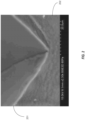
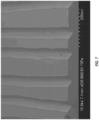
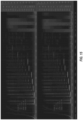
- Fig. 2 shows an SEM image of one of the grooves in a nitrocellulose lacquer 202 phonorecord after deposition of a 150 nm quartz (Si02) coating 201, in accordance with an embodiment of the invention.
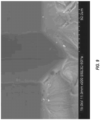
- Fig. 8 shows an SEM image of a lacquer coating surface 802 which has been partially deposited with a TiO 2 coating 801, in accordance with an embodiment of the invention.
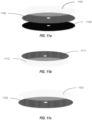
- Fig. 11a represents a master lacquer according to an embodiment of the invention.
- Fig. 11a shows metal substrate 1103, lacquer coating 1102 and conformal coating 1101.
- Fig. 11b represents a "father” plate, or negative of the master lacquer that is shown in Fig. 11a .
- the "father" plate Fig. 1 1b can be used as a stamper.
- Substrate 1111 embodies a negative of an audio recording.
- Substrate 1111 is coated with conformal coating 1112.
- Fig. 11c represents a consumer vinyl disc. Vinyl disc/substrate 1122 is coated with conformal coating 1121.
- Fig. 12 shows a method of making a master lacquer that is capable of withstanding multiple playbacks on a playback device.
- Original data sources 1301, e.g., studio performances, original acetates, analog tapes, digital recordings, and the like can be embodied on a master lacquer comprising a substrate 1303, e.g., a metal substrate, and a lacquer coating 1304 via various methods, such as diamond scribing using a needle or stylus 1302.
- the master lacquer comprising the metal substrate 1303 and lacquer coating 1304 can be coated with conformal coating 1305 to produce a conformal coated master lacquer.
- the conformal coating 1305 can increase the durability and wearability of the master lacquer such that the conformal coated master lacquer can be played on an audio playback device, e.g., a turntable, for a plurality of playbacks with minimal or no damage or degradation to the conformal coating or to the one or more grooves embodying an audio recording that are disposed onto the lacquer coating via a diamond scribe, and the like 1302.
- an audio playback device e.g., a turntable
Landscapes
- Engineering & Computer Science (AREA)
- Ceramic Engineering (AREA)
- Life Sciences & Earth Sciences (AREA)
- Wood Science & Technology (AREA)
- Chemical & Material Sciences (AREA)
- Paints Or Removers (AREA)
- Magnetic Record Carriers (AREA)
- Laminated Bodies (AREA)
Applications Claiming Priority (6)
| Application Number | Priority Date | Filing Date | Title |
|---|---|---|---|
| US201562204044P | 2015-08-12 | 2015-08-12 | |
| US201562203995P | 2015-08-12 | 2015-08-12 | |
| US201562210675P | 2015-08-27 | 2015-08-27 | |
| US201562210712P | 2015-08-27 | 2015-08-27 | |
| PCT/US2016/046869 WO2017027832A1 (fr) | 2015-08-12 | 2016-08-12 | Procédés et revêtements pour l'enregistrement et la reproduction audio avancés |
| EP16835996.6A EP3334593B8 (fr) | 2015-08-12 | 2016-08-12 | Procédés et revêtements pour l'enregistrement et la reproduction audio avancés |
Related Parent Applications (2)
| Application Number | Title | Priority Date | Filing Date |
|---|---|---|---|
| EP16835996.6A Division EP3334593B8 (fr) | 2015-08-12 | 2016-08-12 | Procédés et revêtements pour l'enregistrement et la reproduction audio avancés |
| EP16835996.6A Division-Into EP3334593B8 (fr) | 2015-08-12 | 2016-08-12 | Procédés et revêtements pour l'enregistrement et la reproduction audio avancés |
Publications (2)
| Publication Number | Publication Date |
|---|---|
| EP4349598A2 true EP4349598A2 (fr) | 2024-04-10 |
| EP4349598A3 EP4349598A3 (fr) | 2024-07-03 |
Family
ID=57984532
Family Applications (2)
| Application Number | Title | Priority Date | Filing Date |
|---|---|---|---|
| EP24158808.6A Pending EP4349598A3 (fr) | 2015-08-12 | 2016-08-12 | Procédés et revêtements pour enregistrement et lecture audio avancés |
| EP16835996.6A Active EP3334593B8 (fr) | 2015-08-12 | 2016-08-12 | Procédés et revêtements pour l'enregistrement et la reproduction audio avancés |
Family Applications After (1)
| Application Number | Title | Priority Date | Filing Date |
|---|---|---|---|
| EP16835996.6A Active EP3334593B8 (fr) | 2015-08-12 | 2016-08-12 | Procédés et revêtements pour l'enregistrement et la reproduction audio avancés |
Country Status (5)
| Country | Link |
|---|---|
| US (1) | US10629227B2 (fr) |
| EP (2) | EP4349598A3 (fr) |
| CA (1) | CA2995368C (fr) |
| ES (1) | ES2982889T3 (fr) |
| WO (1) | WO2017027832A1 (fr) |
Families Citing this family (2)
| Publication number | Priority date | Publication date | Assignee | Title |
|---|---|---|---|---|
| US11626228B2 (en) * | 2016-12-22 | 2023-04-11 | Rogers Corporation | Multi-layer magneto-dielectric material |
| DE102019133806A1 (de) | 2019-12-10 | 2021-06-10 | B.H. Mayer's Kunstprägeanstalt GmbH | Münze oder Medaille |
Family Cites Families (11)
| Publication number | Priority date | Publication date | Assignee | Title |
|---|---|---|---|---|
| US1247232A (en) * | 1913-03-01 | 1917-11-20 | Patrick B Delany | Lubricating and polishing pad for talking-machine records. |
| US3668404A (en) * | 1970-09-29 | 1972-06-06 | Kurt Lehovec | Electro-optical microtransducer comprising diffractive element monolithically integrated with photoelectric device |
| US3842217A (en) | 1971-03-22 | 1974-10-15 | Rca Corp | Record fabrication of a capacitive type storage medium |
| DE2639222C3 (de) | 1976-08-31 | 1979-10-11 | Polygram Gmbh, 2000 Hamburg | Verfahren zum Trocknen der Oberfläche eines als Träger einer Bild- und/ oder Tonsignalspur bestimmten Körpers |
| US4168330A (en) * | 1977-10-13 | 1979-09-18 | Rca Corporation | Method of depositing a silicon oxide layer |
| US4190503A (en) * | 1977-12-28 | 1980-02-26 | Sony Corporation | Method of manufactureing a record matrix |
| US4363844A (en) | 1980-09-22 | 1982-12-14 | Lewis Terry W | Metallized information carrying discs |
| DE3270547D1 (en) * | 1981-02-21 | 1986-05-22 | Gfo Ges Fuer Oberflaechentech | Antistatic and scratch-resistant sound/picture recording supports and method for their production |
| US5112025A (en) * | 1990-02-22 | 1992-05-12 | Tdk Corporation | Molds having wear resistant release coatings |
| US6071597A (en) | 1997-08-28 | 2000-06-06 | 3M Innovative Properties Company | Flexible circuits and carriers and process for manufacture |
| US9105284B2 (en) | 2012-05-13 | 2015-08-11 | Tyson York Winarski | Magnetic media having graphene wear protection layers |
-
2016
- 2016-08-12 CA CA2995368A patent/CA2995368C/fr active Active
- 2016-08-12 EP EP24158808.6A patent/EP4349598A3/fr active Pending
- 2016-08-12 WO PCT/US2016/046869 patent/WO2017027832A1/fr not_active Ceased
- 2016-08-12 EP EP16835996.6A patent/EP3334593B8/fr active Active
- 2016-08-12 US US15/752,170 patent/US10629227B2/en active Active
- 2016-08-12 ES ES16835996T patent/ES2982889T3/es active Active
Also Published As
| Publication number | Publication date |
|---|---|
| CA2995368C (fr) | 2022-02-08 |
| ES2982889T3 (es) | 2024-10-18 |
| EP3334593A1 (fr) | 2018-06-20 |
| EP4349598A3 (fr) | 2024-07-03 |
| EP3334593B8 (fr) | 2024-05-22 |
| EP3334593B1 (fr) | 2024-04-03 |
| US10629227B2 (en) | 2020-04-21 |
| WO2017027832A1 (fr) | 2017-02-16 |
| US20180240474A1 (en) | 2018-08-23 |
| EP3334593A4 (fr) | 2019-07-31 |
| CA2995368A1 (fr) | 2017-02-16 |
Similar Documents
| Publication | Publication Date | Title |
|---|---|---|
| JP4020850B2 (ja) | 磁気記録媒体の製造方法、製造装置、インプリントスタンパ及びその製造方法 | |
| CN101401154B (zh) | 磁记录介质、其制造方法以及磁记录和再现装置 | |
| CN102036797B (zh) | 树脂制模制作用叠层体和叠层体、树脂制模和磁记录介质的制造方法 | |
| JP4597933B2 (ja) | 磁気記録媒体の製造方法、並びに磁気記録再生装置 | |
| EP3334593B1 (fr) | Procédés et revêtements pour l'enregistrement et la reproduction audio avancés | |
| CN1246849C (zh) | 光记录媒体 | |
| JP2005133166A (ja) | パターン転写用スタンパ及びその製造方法 | |
| JP2009184338A (ja) | モールド構造体、及びそれを用いたインプリント方法、並びに磁気記録媒体及びその製造方法 | |
| JP2006032423A (ja) | インプリント加工用スタンパーおよびその製造方法 | |
| JP5033003B2 (ja) | モールド構造体及びそれを用いたインプリント方法、並びに磁気記録媒体及びその製造方法 | |
| JP2009283093A (ja) | 磁気記録媒体の製造方法 | |
| JP2011034648A (ja) | ナノ金型、金型の製造方法および磁気記録媒体の製造方法 | |
| CN1815568A (zh) | 磁记录介质和磁记录再生装置 | |
| CN104424965A (zh) | 图案形成方法、剥离方法、磁记录介质的制造方法、磁记录介质、以及压模的制造方法 | |
| US8414967B2 (en) | Process for producing magnetic recording medium and magnetic recording and reproducing apparatus | |
| US484582A (en) | Process of duplicating phonograms | |
| FR2676577A1 (fr) | Procede de fabrication de matrices de pressages, notamment pour la realisation de disques optiques. | |
| WO2004095445A1 (fr) | Matrice de pressage et son procede de production | |
| JP2006278879A (ja) | スタンパの製造方法 | |
| JP5293128B2 (ja) | ナノ構造体製造方法および磁気記憶媒体製造方法 | |
| WO2007055345A1 (fr) | Méthode de fabrication de support d’enregistrement magnétique, support d’enregistrement magnétique et dispositif de lecture/écriture magnétique | |
| JP2009241513A (ja) | レジストパターン形成方法、モールド構造体の製造方法、及び磁気記録媒体の製造方法 | |
| JPS60138088A (ja) | 情報記録金型の製法 | |
| US8278029B2 (en) | Stamper production method and read-only optical disc production method | |
| JP2010282678A (ja) | 磁気記録媒体の製造方法およびモールドの剥離装置 |
Legal Events
| Date | Code | Title | Description |
|---|---|---|---|
| PUAI | Public reference made under article 153(3) epc to a published international application that has entered the european phase |
Free format text: ORIGINAL CODE: 0009012 |
|
| STAA | Information on the status of an ep patent application or granted ep patent |
Free format text: STATUS: REQUEST FOR EXAMINATION WAS MADE |
|
| 17P | Request for examination filed |
Effective date: 20240221 |
|
| AC | Divisional application: reference to earlier application |
Ref document number: 3334593 Country of ref document: EP Kind code of ref document: P |
|
| AK | Designated contracting states |
Kind code of ref document: A2 Designated state(s): AL AT BE BG CH CY CZ DE DK EE ES FI FR GB GR HR HU IE IS IT LI LT LU LV MC MK MT NL NO PL PT RO RS SE SI SK SM TR |
|
| RAP3 | Party data changed (applicant data changed or rights of an application transferred) |
Owner name: IONIC RECORDING COMPANY, LLC |
|
| REG | Reference to a national code |
Ref country code: DE Ref legal event code: R079 Free format text: PREVIOUS MAIN CLASS: B32B0027300000 Ipc: G11B0003440000 |
|
| PUAL | Search report despatched |
Free format text: ORIGINAL CODE: 0009013 |
|
| AK | Designated contracting states |
Kind code of ref document: A3 Designated state(s): AL AT BE BG CH CY CZ DE DK EE ES FI FR GB GR HR HU IE IS IT LI LT LU LV MC MK MT NL NO PL PT RO RS SE SI SK SM TR |
|
| RIC1 | Information provided on ipc code assigned before grant |
Ipc: B32B 27/30 20060101ALI20240524BHEP Ipc: B32B 27/14 20060101ALI20240524BHEP Ipc: B32B 15/16 20060101ALI20240524BHEP Ipc: B32B 15/20 20060101ALI20240524BHEP Ipc: B32B 15/18 20060101ALI20240524BHEP Ipc: B32B 15/08 20060101ALI20240524BHEP Ipc: B32B 15/04 20060101ALI20240524BHEP Ipc: B32B 9/00 20060101ALI20240524BHEP Ipc: B32B 5/16 20060101ALI20240524BHEP Ipc: B32B 9/04 20060101ALI20240524BHEP Ipc: C01F 7/02 20220101ALI20240524BHEP Ipc: C01B 33/12 20060101ALI20240524BHEP Ipc: B32B 7/02 20190101ALI20240524BHEP Ipc: B32B 3/30 20060101ALI20240524BHEP Ipc: G11B 3/72 20060101ALI20240524BHEP Ipc: G11B 3/68 20060101ALI20240524BHEP Ipc: G11B 3/44 20060101AFI20240524BHEP |
|
| STAA | Information on the status of an ep patent application or granted ep patent |
Free format text: STATUS: EXAMINATION IS IN PROGRESS |
|
| 17Q | First examination report despatched |
Effective date: 20260320 |