EP4349607A1 - Procédé et appareil de fabrication d'une bande de matériau d'emballage stratifiée - Google Patents
Procédé et appareil de fabrication d'une bande de matériau d'emballage stratifiée Download PDFInfo
- Publication number
- EP4349607A1 EP4349607A1 EP23201450.6A EP23201450A EP4349607A1 EP 4349607 A1 EP4349607 A1 EP 4349607A1 EP 23201450 A EP23201450 A EP 23201450A EP 4349607 A1 EP4349607 A1 EP 4349607A1
- Authority
- EP
- European Patent Office
- Prior art keywords
- paperboard layer
- layer
- ink
- paperboard
- drying
- Prior art date
- Legal status (The legal status is an assumption and is not a legal conclusion. Google has not performed a legal analysis and makes no representation as to the accuracy of the status listed.)
- Pending
Links
Images



Classifications
-
- B—PERFORMING OPERATIONS; TRANSPORTING
- B32—LAYERED PRODUCTS
- B32B—LAYERED PRODUCTS, i.e. PRODUCTS BUILT-UP OF STRATA OF FLAT OR NON-FLAT, e.g. CELLULAR OR HONEYCOMB, FORM
- B32B38/00—Ancillary operations in connection with laminating processes
- B32B38/14—Printing or colouring
- B32B38/145—Printing
-
- B—PERFORMING OPERATIONS; TRANSPORTING
- B31—MAKING ARTICLES OF PAPER, CARDBOARD OR MATERIAL WORKED IN A MANNER ANALOGOUS TO PAPER; WORKING PAPER, CARDBOARD OR MATERIAL WORKED IN A MANNER ANALOGOUS TO PAPER
- B31B—MAKING CONTAINERS OF PAPER, CARDBOARD OR MATERIAL WORKED IN A MANNER ANALOGOUS TO PAPER
- B31B50/00—Making rigid or semi-rigid containers, e.g. boxes or cartons
- B31B50/02—Feeding or positioning sheets, blanks or webs
- B31B50/10—Feeding or positioning webs
-
- B—PERFORMING OPERATIONS; TRANSPORTING
- B31—MAKING ARTICLES OF PAPER, CARDBOARD OR MATERIAL WORKED IN A MANNER ANALOGOUS TO PAPER; WORKING PAPER, CARDBOARD OR MATERIAL WORKED IN A MANNER ANALOGOUS TO PAPER
- B31B—MAKING CONTAINERS OF PAPER, CARDBOARD OR MATERIAL WORKED IN A MANNER ANALOGOUS TO PAPER
- B31B50/00—Making rigid or semi-rigid containers, e.g. boxes or cartons
- B31B50/25—Surface scoring
-
- B—PERFORMING OPERATIONS; TRANSPORTING
- B31—MAKING ARTICLES OF PAPER, CARDBOARD OR MATERIAL WORKED IN A MANNER ANALOGOUS TO PAPER; WORKING PAPER, CARDBOARD OR MATERIAL WORKED IN A MANNER ANALOGOUS TO PAPER
- B31B—MAKING CONTAINERS OF PAPER, CARDBOARD OR MATERIAL WORKED IN A MANNER ANALOGOUS TO PAPER
- B31B50/00—Making rigid or semi-rigid containers, e.g. boxes or cartons
- B31B50/74—Auxiliary operations
- B31B50/88—Printing; Embossing
-
- B—PERFORMING OPERATIONS; TRANSPORTING
- B32—LAYERED PRODUCTS
- B32B—LAYERED PRODUCTS, i.e. PRODUCTS BUILT-UP OF STRATA OF FLAT OR NON-FLAT, e.g. CELLULAR OR HONEYCOMB, FORM
- B32B27/00—Layered products comprising a layer of synthetic resin
- B32B27/06—Layered products comprising a layer of synthetic resin as the main or only constituent of a layer, which is next to another layer of the same or of a different material
- B32B27/08—Layered products comprising a layer of synthetic resin as the main or only constituent of a layer, which is next to another layer of the same or of a different material of synthetic resin
-
- B—PERFORMING OPERATIONS; TRANSPORTING
- B32—LAYERED PRODUCTS
- B32B—LAYERED PRODUCTS, i.e. PRODUCTS BUILT-UP OF STRATA OF FLAT OR NON-FLAT, e.g. CELLULAR OR HONEYCOMB, FORM
- B32B27/00—Layered products comprising a layer of synthetic resin
- B32B27/06—Layered products comprising a layer of synthetic resin as the main or only constituent of a layer, which is next to another layer of the same or of a different material
- B32B27/10—Layered products comprising a layer of synthetic resin as the main or only constituent of a layer, which is next to another layer of the same or of a different material of paper or cardboard
-
- B—PERFORMING OPERATIONS; TRANSPORTING
- B32—LAYERED PRODUCTS
- B32B—LAYERED PRODUCTS, i.e. PRODUCTS BUILT-UP OF STRATA OF FLAT OR NON-FLAT, e.g. CELLULAR OR HONEYCOMB, FORM
- B32B29/00—Layered products comprising a layer of paper or cardboard
- B32B29/002—Layered products comprising a layer of paper or cardboard as the main or only constituent of a layer, which is next to another layer of the same or of a different material
-
- B—PERFORMING OPERATIONS; TRANSPORTING
- B32—LAYERED PRODUCTS
- B32B—LAYERED PRODUCTS, i.e. PRODUCTS BUILT-UP OF STRATA OF FLAT OR NON-FLAT, e.g. CELLULAR OR HONEYCOMB, FORM
- B32B29/00—Layered products comprising a layer of paper or cardboard
- B32B29/002—Layered products comprising a layer of paper or cardboard as the main or only constituent of a layer, which is next to another layer of the same or of a different material
- B32B29/005—Layered products comprising a layer of paper or cardboard as the main or only constituent of a layer, which is next to another layer of the same or of a different material next to another layer of paper or cardboard layer
-
- B—PERFORMING OPERATIONS; TRANSPORTING
- B32—LAYERED PRODUCTS
- B32B—LAYERED PRODUCTS, i.e. PRODUCTS BUILT-UP OF STRATA OF FLAT OR NON-FLAT, e.g. CELLULAR OR HONEYCOMB, FORM
- B32B41/00—Arrangements for controlling or monitoring lamination processes; Safety arrangements
-
- B—PERFORMING OPERATIONS; TRANSPORTING
- B41—PRINTING; LINING MACHINES; TYPEWRITERS; STAMPS
- B41J—TYPEWRITERS; SELECTIVE PRINTING MECHANISMS, i.e. MECHANISMS PRINTING OTHERWISE THAN FROM A FORME; CORRECTION OF TYPOGRAPHICAL ERRORS
- B41J11/00—Devices or arrangements of selective printing mechanisms, e.g. ink-jet printers or thermal printers, for supporting or handling copy material in sheet or web form
- B41J11/0015—Devices or arrangements of selective printing mechanisms, e.g. ink-jet printers or thermal printers, for supporting or handling copy material in sheet or web form for treating before, during or after printing or for uniform coating or laminating the copy material before or after printing
- B41J11/002—Curing or drying the ink on the copy materials, e.g. by heating or irradiating
- B41J11/0021—Curing or drying the ink on the copy materials, e.g. by heating or irradiating using irradiation
- B41J11/00212—Controlling the irradiation means, e.g. image-based controlling of the irradiation zone or control of the duration or intensity of the irradiation
-
- B—PERFORMING OPERATIONS; TRANSPORTING
- B41—PRINTING; LINING MACHINES; TYPEWRITERS; STAMPS
- B41J—TYPEWRITERS; SELECTIVE PRINTING MECHANISMS, i.e. MECHANISMS PRINTING OTHERWISE THAN FROM A FORME; CORRECTION OF TYPOGRAPHICAL ERRORS
- B41J11/00—Devices or arrangements of selective printing mechanisms, e.g. ink-jet printers or thermal printers, for supporting or handling copy material in sheet or web form
- B41J11/0015—Devices or arrangements of selective printing mechanisms, e.g. ink-jet printers or thermal printers, for supporting or handling copy material in sheet or web form for treating before, during or after printing or for uniform coating or laminating the copy material before or after printing
- B41J11/002—Curing or drying the ink on the copy materials, e.g. by heating or irradiating
- B41J11/0021—Curing or drying the ink on the copy materials, e.g. by heating or irradiating using irradiation
- B41J11/00216—Curing or drying the ink on the copy materials, e.g. by heating or irradiating using irradiation using infrared [IR] radiation or microwaves
-
- B—PERFORMING OPERATIONS; TRANSPORTING
- B41—PRINTING; LINING MACHINES; TYPEWRITERS; STAMPS
- B41J—TYPEWRITERS; SELECTIVE PRINTING MECHANISMS, i.e. MECHANISMS PRINTING OTHERWISE THAN FROM A FORME; CORRECTION OF TYPOGRAPHICAL ERRORS
- B41J11/00—Devices or arrangements of selective printing mechanisms, e.g. ink-jet printers or thermal printers, for supporting or handling copy material in sheet or web form
- B41J11/0015—Devices or arrangements of selective printing mechanisms, e.g. ink-jet printers or thermal printers, for supporting or handling copy material in sheet or web form for treating before, during or after printing or for uniform coating or laminating the copy material before or after printing
- B41J11/002—Curing or drying the ink on the copy materials, e.g. by heating or irradiating
- B41J11/0022—Curing or drying the ink on the copy materials, e.g. by heating or irradiating using convection means, e.g. by using a fan for blowing or sucking air
- B41J11/00222—Controlling the convection means
-
- B—PERFORMING OPERATIONS; TRANSPORTING
- B41—PRINTING; LINING MACHINES; TYPEWRITERS; STAMPS
- B41M—PRINTING, DUPLICATING, MARKING, OR COPYING PROCESSES; COLOUR PRINTING
- B41M7/00—After-treatment of prints, e.g. heating, irradiating, setting of the ink, protection of the printed stock
- B41M7/0027—After-treatment of prints, e.g. heating, irradiating, setting of the ink, protection of the printed stock using protective coatings or layers by lamination or by fusion of the coatings or layers
-
- B—PERFORMING OPERATIONS; TRANSPORTING
- B41—PRINTING; LINING MACHINES; TYPEWRITERS; STAMPS
- B41M—PRINTING, DUPLICATING, MARKING, OR COPYING PROCESSES; COLOUR PRINTING
- B41M7/00—After-treatment of prints, e.g. heating, irradiating, setting of the ink, protection of the printed stock
- B41M7/009—After-treatment of prints, e.g. heating, irradiating, setting of the ink, protection of the printed stock using thermal means, e.g. infrared radiation, heat
-
- B—PERFORMING OPERATIONS; TRANSPORTING
- B65—CONVEYING; PACKING; STORING; HANDLING THIN OR FILAMENTARY MATERIAL
- B65B—MACHINES, APPARATUS OR DEVICES FOR, OR METHODS OF, PACKAGING ARTICLES OR MATERIALS; UNPACKING
- B65B61/00—Auxiliary devices, not otherwise provided for, for operating on sheets, blanks, webs, binding material, containers or packages
- B65B61/02—Auxiliary devices, not otherwise provided for, for operating on sheets, blanks, webs, binding material, containers or packages for perforating, scoring, slitting, or applying code or date marks on material prior to packaging
- B65B61/025—Auxiliary devices, not otherwise provided for, for operating on sheets, blanks, webs, binding material, containers or packages for perforating, scoring, slitting, or applying code or date marks on material prior to packaging for applying, e.g. printing, code or date marks on material prior to packaging
-
- B—PERFORMING OPERATIONS; TRANSPORTING
- B65—CONVEYING; PACKING; STORING; HANDLING THIN OR FILAMENTARY MATERIAL
- B65D—CONTAINERS FOR STORAGE OR TRANSPORT OF ARTICLES OR MATERIALS, e.g. BAGS, BARRELS, BOTTLES, BOXES, CANS, CARTONS, CRATES, DRUMS, JARS, TANKS, HOPPERS, FORWARDING CONTAINERS; ACCESSORIES, CLOSURES, OR FITTINGS THEREFOR; PACKAGING ELEMENTS; PACKAGES
- B65D65/00—Wrappers or flexible covers; Packaging materials of special type or form
- B65D65/38—Packaging materials of special type or form
- B65D65/40—Applications of laminates for particular packaging purposes
-
- B—PERFORMING OPERATIONS; TRANSPORTING
- B32—LAYERED PRODUCTS
- B32B—LAYERED PRODUCTS, i.e. PRODUCTS BUILT-UP OF STRATA OF FLAT OR NON-FLAT, e.g. CELLULAR OR HONEYCOMB, FORM
- B32B2255/00—Coating on the layer surface
- B32B2255/12—Coating on the layer surface on paper layer
-
- B—PERFORMING OPERATIONS; TRANSPORTING
- B32—LAYERED PRODUCTS
- B32B—LAYERED PRODUCTS, i.e. PRODUCTS BUILT-UP OF STRATA OF FLAT OR NON-FLAT, e.g. CELLULAR OR HONEYCOMB, FORM
- B32B2307/00—Properties of the layers or laminate
- B32B2307/40—Properties of the layers or laminate having particular optical properties
- B32B2307/402—Coloured
- B32B2307/4023—Coloured on the layer surface, e.g. ink
-
- B—PERFORMING OPERATIONS; TRANSPORTING
- B32—LAYERED PRODUCTS
- B32B—LAYERED PRODUCTS, i.e. PRODUCTS BUILT-UP OF STRATA OF FLAT OR NON-FLAT, e.g. CELLULAR OR HONEYCOMB, FORM
- B32B2439/00—Containers; Receptacles
-
- B—PERFORMING OPERATIONS; TRANSPORTING
- B32—LAYERED PRODUCTS
- B32B—LAYERED PRODUCTS, i.e. PRODUCTS BUILT-UP OF STRATA OF FLAT OR NON-FLAT, e.g. CELLULAR OR HONEYCOMB, FORM
- B32B2439/00—Containers; Receptacles
- B32B2439/70—Food packaging
-
- B—PERFORMING OPERATIONS; TRANSPORTING
- B41—PRINTING; LINING MACHINES; TYPEWRITERS; STAMPS
- B41J—TYPEWRITERS; SELECTIVE PRINTING MECHANISMS, i.e. MECHANISMS PRINTING OTHERWISE THAN FROM A FORME; CORRECTION OF TYPOGRAPHICAL ERRORS
- B41J25/00—Actions or mechanisms not otherwise provided for
- B41J2025/008—Actions or mechanisms not otherwise provided for comprising a plurality of print heads placed around a drum
-
- B—PERFORMING OPERATIONS; TRANSPORTING
- B41—PRINTING; LINING MACHINES; TYPEWRITERS; STAMPS
- B41J—TYPEWRITERS; SELECTIVE PRINTING MECHANISMS, i.e. MECHANISMS PRINTING OTHERWISE THAN FROM A FORME; CORRECTION OF TYPOGRAPHICAL ERRORS
- B41J2202/00—Embodiments of or processes related to ink-jet or thermal heads
- B41J2202/01—Embodiments of or processes related to ink-jet heads
- B41J2202/21—Line printing
Definitions
- the invention relates to a method for manufacturing a laminated packaging material web for liquid food packaging containers, a converting unit, and a laminated packaging material web.
- Packaging containers of the single use disposable type for liquid foods are often produced from a laminated packaging material.
- the laminated packaging material is produced as a continuous web, which is either used in a roll-fed filling machine or cut into separate blanks for use in a blank-fed packaging machine.
- the laminated packaging material is produced using a converting procedure in which multiple materials are joined and processed to form the ready-to-use web of laminated packaging material.
- a paperboard layer forming the core layer of the laminated packaging material, is typically printed on the outside (i.e., the side intended as the exterior side of the laminated packaging material), for example by digital, like inkjet, printing, dried, and laminated in between sealable layers.
- the paperboard layer may be pre-coated before the printing, and/or already be bonded to one or more layers.
- a suggested technique for drying the paperboard layer after printing, particularly digital printing, using water-based inks, such as pigmented water-based inks, is infrared radiation. While this technique allows for a fast drying, it has been observed that more powerful drying will also dry the paperboard layer, i.e., the moisture content of the paperboard layer will be reduced. The moisture loss in an area of the paperboard layer will vary with the printed design and, in particular, will be related to the color printed on the area, particularly the amount of black pigment.
- printed inks may not be covered by a coating, like a varnish, after printing. They are laminated by, for example, polymer layers to protect the printing after dried.
- the method comprises inkjet printing a plurality of ink droplets on a paperboard layer, for instance to form a decor layer, the ink droplets comprising color pigments and a solvent; determining a proportion of a first subset of the ink droplets in relation to the full plurality of ink droplets, the first subset comprising color pigments of only one specific color; determining an adjusted drying power based on the determined proportion of the first subset of the ink droplets; and evaporating, in other words, drying, at least some of the solvent by applying hot air and/or infrared radiation at the adjusted drying power such that the color pigments are immobilized.
- This is advantageous in that the moisture content of the paperboard layer is substantially maintained, even when the printed design varies.
- the moisture content of the paperboard layer may for instance be 4% or more, between 5% and 10%, or preferably between 5% and 8.5%.
- the highly probable paperboard layer is one used for a liquid food packaging.
- the highly probable laminated packaging material web is a laminated liquid food packaging material web, alternatively named as liquid packaging board.
- the paperboard used in the liquid packaging board in general, has a face, called top surface, optimized for printing, and other face, back surface, having water repellent properties to withstand water absorption from outer environment. Therefore, the paperboard is not suitable to moisten from back surface, if needed like being over-dried after drying. For a paperboard printed by water-based inks also can not be moisten after drying from top surface to avoid resolving the pointed ink. Re-moistening may also be not preferred for liquid food packaging material production due to food safety requirements.
- printing may be performed up to more than 200%TAC (Total Area Coverage) with CMYK (cyan, magenta, yellow, and black) combinations.
- TAC Total Area Coverage
- CMYK cyan, magenta, yellow, and black
- the ink may have not only water but also some organic volatiles.
- the water and volatile organic content combination may lead higher boiling point to dry the ink. Thus, it may need higher drying energy that may lead over drying of the paperboard, if only IR is employed.
- the method may further comprise flexographic printing, or other printing techniques, and the décor layer may hence be obtained by inkjet printing only, or by a hybrid approach combining two or more printing techniques.
- the décor layer may be inkjet printed and flexography printed.
- Ink used for inkjet printing may comprise a higher ratio of solvent relative color pigment than ink used for flexographic printing.
- inkjet ink may comprise approximately 4 times more water content than flexographic ink.
- the total amount of ink laid down on the paperboard layer is several times more for inkjet printing as compared to flexographic printing. Hence, for inkjet printing, it is even more important to provide a fast drying process that does not reduce the moisture content of the paperboard layer.
- the method may further comprise applying a print substrate layer to said paperboard layer prior to inkjet printing.
- the invention may be more beneficial when the paperboard layer needs to be dried as quick as possible. For instance, if the paperboard has a print substrate layer that avoids migration of the solvent of the ink, which is most likely water-based ink, by the paperboard, then drying as quick as possible without over drying the packaging material may be more beneficial. In other words, if the paperboard has a print substrate layer that can keep almost all solvent of the ink, which is most likely water-based ink, printed on the print substrate layer, then drying as quick as possible without over drying the packaging material may be more beneficial.
- Applying a print substrate may for instance comprise coating the paperboard layer with a pre-coating, or priming the paperboard layer by a plasma treatment to create an optimal surface tension / wettability for the print substrate layer on the surface of the paperboard layer, or applying a surface conditioner, thereby changing the topology or properties relating to static electricity.
- the print substrate may fully cover the paperboard layer, it may cover only the areas to be covered by the decor layer, or they may cover an intermediately sized area of the paperboard layer.
- the paperboard layer may comprise a printable coating, for instance a white pigment and clay-coating as the print substrate layer.
- a printable coating for instance a white pigment and clay-coating as the print substrate layer.
- Such a clay coating will form a water repellant surface on the paperboard layer meaning that the solvent of the ink cannot migrate be absorbed into the paperboard fibrous layer. This requires an increased drying power, as it is important to dry the ink fast before being subjected to further downstream processes.
- the print substrate layer may be a clay-coating that is also primed before inkjet printing.
- the print substrate layer may be provided on the paperboard layer before the inkjet printing on the same production site; and/or well before, for example in another production site, so on the site, where the inkjet printing is realized, no application of the print substrate layer is realized.
- the proportion of the first subset of the ink droplets in relation to the full plurality of ink droplets is substantially constant for a pre-defined cyclically repeated printing pattern, and the adjusted drying power is determined for each pre-defined cyclically repeated printing pattern. This is beneficial as it allows for an efficient and uniform drying of each printing pattern, and facilitates a maintained moisture content of the paperboard layer.
- the method further comprises providing a crease line pattern to said paperboard layer.
- the crease line pattern may be repeated in a machine direction.
- a crease line may be provided upstream and/or downstream of inkjet printing.
- the paperboard layer has a thickness of minimum 90 ⁇ m, and/or a weight of minimum 65 gsm.
- the paperboard layer may be an uncoated paperboard, or a paperboard laminated with one or more layers, for example polymer layers, before inkjet printing and/or application of the print substrate layer.
- the paperboard layer may be transported along the machine direction at a substantially constant speed, for example on 200 m/min or faster.
- the solvent is evaporated by a combination of applying hot air and infrared radiation, and the hot air is applied after the infrared radiation.
- drying the décor layer further comprises controlling the moisture content of the paperboard layer by adjusting the ratio between the infrared radiation and the flow of hot air. This is beneficial as it allows for precise control of the décor layer and the paperboard layer, and facilitates a maintained moisture content at a minimized drying time.
- Drying the décor layer may further comprise controlling the moisture content of the paperboard layer by adjusting the mass flow of the hot air to targeted flow velocity in the supply air slots in the dryer (i.e., impingement dryer), and by adjusting the temperature of the hot air.
- the hot air dryers may have a slot velocity 45-85 m/s and air temperature 55-80°C.
- the humidity in the hot air fed by the hot air dryers to dry the decor layer may be controlled, preferably inline.
- the temperature of the paperboard may be controlled, preferably inline. If the printed and laminated packaging material has more than one lane, each one of the lanes that will be used to feed a liquid food filling machine may be controlled individually during the printing and/or drying and/or downstream of drying to avoid having temperature gradients.
- controlling the moisture level comprises determining a drying time, and determining the ratio between the infrared radiation and the flow of hot air by minimizing the amount of infrared radiation while still ensuring complete drying within the drying time. By this, issues related to moisture loss in the paperboard layer is minimized.
- the drying the décor layer may be performed by exposing an area of the paperboard layer to infrared radiation, and subsequently exposing the same area of the paperboard layer to the flow of hot air.
- an area of the paperboard layer may be exposed to infrared radiation until a determined moisture level of the paperboard is reached, and the remaining drying of the décor layer may be carried out by the flow of hot air.
- the infrared radiation may have a spectral emission within 0.4 ⁇ m - 4 ⁇ m.
- the infrared radiation may be a near-infrared radiation, a short-wave infrared radiation, a mid-wave infrared radiation, or a radiation in several infrared regions.
- the invention may perform without any re-humidification or moistening provided downstream of drying. Thus, an extra operation and controls related to that may be avoided.
- the method of printing and drying of the laminated packaging material may be performed roll-to-roll, meaning that a roll of paperboard may be unrolled upstream of printing, and rolled downstream of laminating with a further layer.
- Rolling of laminated packaging material causes friction and stretching forces on the printings, so the printings should be dried properly while not causing over drying of the paperboard.
- crease line patterns are formed on the laminated packaging material, these patterns should withstand against the friction and stretching forces by the help of maintained moisture content in the paperboard.
- a rolled packaging material web may be transported in a facilitated manner to a further step, like filling a product inside the packaging material web, probably a liquid food.
- the ink solvent may comprise of different volatile and nonvolatile organic content, such as for instance glycol.
- the ink solvent may comprise water.
- the method further comprises laminating at least a further layer to the printed paperboard layer.
- the evaporating at least some of the solvent by applying hot air and/or infrared radiation at the adjusted drying power is performed such that the surface temperature of the paperboard layer does not exceed 65°C, preferably the surface temperature of the paperboard layer does not exceed 60°C, more preferably the surface temperature of the paperboard layer does not exceed 56°C.
- the surface temperature of the paperboard layer does not exceed 65°C, preferably the surface temperature of the paperboard layer does not exceed 60°C, more preferably the surface temperature of the paperboard layer does not exceed 56°C.
- the first subset of the ink droplets may have a dark color in comparison with the full plurality of ink droplets. Determining an adjusted drying power based on a proportion of dark colored ink droplets is an efficient way to dry a printed decor on a paperboard layer such that the moisture content of the paperboard is maintained, even when the design of the decor varies. Especially for IR drying, darker colors tend to absorb more IR radiation thereby generating more heat, increasing the surface temperature and dry out the moisture content of the paperboard layer. By setting a drying power limit for a dark area, even when it is only a subset of the used ink, will then limit the increase of the surface temperature also for printed areas with a lighter color, which consequently will assist in maintaining a sufficiently high moisture content in the paperboard layer.
- Dark color may mean a color having more black pigment compared to other colors used to print.
- rolling the printed and laminated packaging material onto a roller may be performed. If a crease line pattern is provided to said paperboard layer, then rolling the printed, creased and laminated packaging material onto a roller may be performed, after laminating at least a further layer.
- a rolled packaging material web may be transported in a facilitated manner to a further step, like filling a product inside the packaging material web, probably a liquid food.
- the converting unit may be configured to perform the continuous in-line method for manufacturing a laminated packaging material web described herein and therefore implies all aspects disclosed regarding that method.
- the converting unit comprises a paperboard layer feeding station, an inkjet printer configured to print an ink comprising color pigments and a solvent on the paperboard layer, a drying station configured to dry the ink at an adjusted drying power by exposing the paperboard layer to infrared radiation and a flow of hot air.
- the drying station comprises a control unit configured to determine the adjusted drying power based on a determined proportion of a first subset of the ink in relation to the full ink, the first subset comprising color pigments of only one specific color.
- the converting unit may comprise a creasing station configured to provide a crease line pattern to the paperboard layer.
- the comprised stations may be arranged in the following order, upstream to downstream: paperboard layer feeding station, inkjet printer, drying station, creasing station.
- the converting unit may further comprise at least one lamination station configured to laminate a plurality of layers to the printed and creased paperboard layer.
- the drying station may comprise a separate hot air dryer and infrared dryer, and the hot air dryer may be arranged downstream the infrared dryer.
- creasing station upstream of the inkjet printer; or to have more than one creasing station located on both downstream and upstream of the inkjet printer; or having a combined unit for the inkjet printer and the creasing station that allows creasing before and/or after the printing.
- the converting unit may further comprise a print substrate station configured to apply a print substrate layer to prepare the paperboard layer before being printed by the inkjet printer.
- applying a print substrate layer may comprise coating the paperboard layer with a pre-coating, for instance a clay coating or a primed clay coating, or priming the paperboard layer by a plasma treatment to form the print substrate layer on the surface of the paperboard layer, or applying a surface conditioner or in other ways modify the properties of a surface of the paperboard layer.
- the converting unit may further comprise a second drying station for drying the print substrate layer.
- the order of stations may be not limiting for the invention. Various order of the mentioned stations may be used by the skilled person as long as being technically possible to achieve the advantage of maintaining substantially the moisture content of the paperboard layer by IR drying and hot air drying.
- the converting unit may be a roll-to-roll unit, meaning that a roll of paperboard may be unrolled upstream of printing, and rolled downstream of laminating with a further layer.
- Rolling of laminated packaging material causes friction and stretching forces on the printings, so the printings should be dried properly while not causing over drying of the paperboard.
- crease line patterns are formed on the laminated packaging material, these patterns should withstand against the friction and stretching forces by the help of maintained moisture content in the paperboard.
- a rolled packaging material web may be transported in a facilitated manner to a further step, like filling a product inside the packaging material web, probably a liquid food.
- a laminated packaging material web comprises a paperboard layer having an inkjet printed decor layer comprising a plurality of ink droplets.
- the moisture content of the paperboard layer is 4% or more, preferably between 5% and 8.5%.
- the moisture content of the paperboard layer may be between 6% and 8.5% after inkjet printing the decor layer, and in the final laminated packaging material web, the moisture content of the paperboard layer may be substantially the same, or slightly lower. This implies that the paperboard layer has not suffered any significant moisture loss, at least of a magnitude that would result in any major defects of the laminated packaging material web.
- the laminated packaging material may have a crease line pattern, for example, the crease line pattern may be cyclically repeated in a machine direction.
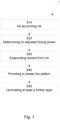
- the method 1 comprises inkjet printing S10 a plurality of ink droplets 300 on a paperboard layer 130.
- the paperboard layer 130 may comprise paper, paperboard, or other cellulose-based material.
- Inkjet printing is a type of digital printing or computer printing. During inkjet printing, a digital image is recreated by jetting droplets of ink onto a substrate, such as a paperboard layer 130 or a print substrate layer (not shown) which will be further discussed herein.
- the ink droplets 300 comprise color pigments and a solvent.
- the solvent may comprise water and volatile organic content, for instance glycol.
- the method further comprises determining S20 an adjusted drying power based on a determined proportion of a first subset 310 of the ink droplets in relation to the full plurality of ink droplets 300, the first subset 310 comprising color pigments of only one specific color.
- the method 1 may select a specific color of the intended decor layer and from there the first subset 310 of ink droplets corresponding to the selected color. Based on the determined subset 310 of ink droplets, the method 1 determines the adjusted drying power.
- the method further comprises evaporating S30 at least some of the solvent by applying hot air HA and/or infrared radiation IR at the adjusted drying power such that the color pigments are immobilized.
- Infrared radiation hereinafter IR
- IR radiates onto the paperboard layer, where it to some extent will be absorbed by pigments within the ink 300, causing solvent of the ink 300 to evaporate.
- High radiation intensity going through the ink 300 does not only remove moisture from the ink 300 however, but also from the cellulose-based paperboard layer 130, and may result in a variety of issues regarding performance of the laminated packaging material web 100.
- a laminated packaging material web 100 comprising a paperboard layer 130 with a reduced moisture content may suffer from problems relating to cracks, especially in areas where multiple crease lines intersect, and delamination of the laminated packaging material web 100, as well as the integrity of the final packaging container. To minimize issues related to paperboard moisture losses, the drying power of the IR may be adjusted.
- An adjusted drying power may be realized by varying spectral emission, radiation intensity or exposure time of the IR radiation, which will affect the level of transmission through the printed ink 300.
- the degree of darkness in the ink 300 will also affect transmission of IR, as black pigment absorbs more infrared radiation than other colors.
- lighter colors for example, Red, Green or Violet
- darker colors i.e., Black, Brown or Dark Green, may demand about 20% less IR energy.
- hot air drying may be utilized for evaporating S30 at least some of the solvent.
- Hot air drying is a simple and established technique in which ambient air is heated and the heat is transferred from the flow of hot air to a printed ink by convection, and evaporated solvent (i.e., with saturated air) from the ink is transported to the air also by convection.
- the hot air HA mainly affects the surface of the paperboard layer 130, and penetration into the paperboard is minimal.
- Adjusting the drying power of hot air HA may be performed by for example adjusting the flow or the temperature of the hot air HA.
- the hot air HA may be applied after the IR.
- the IR may first evaporate as much solvent as possible without losing too much moisture in the paperboard layer and securing that the paperboard temperature is kept below target, and the surface directed hot air HA may then evaporate the rest of the solvent, resulting in a highly time efficient process with maintained moisture content in the paperboard layer.
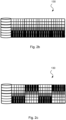
- Fig. 2a illustrates a paperboard layer 130 having a design pattern where four different colored areas have been inkjet printed. Each of the four areas comprises different proportions of a first subset 310 of ink droplets, illustrated in Fig. 2a as comprising black color pigments, in relation to the full plurality of ink droplets 300. Typically, the different colored areas have different distributions of colors and/or different selections of colors.
- Figs. 2b and 2c show design patterns of increasing complexity where the need for an adaptable ink drying is evident. For such patterns, a non-adjustable drying method would involve a risk to dry out the paperboard if the IR drying power is controlled to sufficiently dry the ink droplets of light color.
- the first subset 310 of the ink droplets in relation to the full plurality of ink droplets 300 By determining S20 an adjusted drying power based on a determined proportion of a first subset 310 of the ink droplets in relation to the full plurality of ink droplets 300, the first subset 310 comprising color pigments of only one specific color, and evaporating S30 at least some of the solvent by applying hot air HA and/or infrared radiation IR at the adjusted drying power, solvent can be evaporated from the whole area of interest such that all color pigments are immobilized, while maintaining the moisture content of the paperboard layer 130.
- the proportion of the first subset 310 of the ink droplets in relation to the full plurality of ink droplets 300 may be substantially constant for a pre-defined cyclically repeated printing pattern, as illustrated in Figs. 2b and 2c .
- the adjusted drying power may be determined S20 for each pre-defined cyclically repeated printing pattern.
- the proportion of a subset 310 of the ink in relation to the full ink 300, where the subset 310 comprises color pigments of a certain color, further affects the temperature of the ink 300. Dark color pigments will absorb more infrared radiation and thereby increase the surface temperature of the paperboard layer 130 of which it is printed upon.
- the step of evaporating S30 solvent may be performed such that the surface temperature of the paperboard layer 130 does not exceed 65°C.
- the surface temperature of the paperboard layer 130 does not exceed 60°C, and more preferably the surface temperature of the paperboard layer 130 does not exceed 56°C.
- the method may further comprise providing S40 a crease line pattern to the paperboard layer 130 after evaporating the solvent.
- the crease line pattern facilitates the formation of packaging containers from the laminated packaging material web 100, not illustrated.
- the crease line pattern may be cyclically repeated in a machine direction MD.
- the machine direction MD may be defined as the direction parallel to the movement of the paperboard layer 130 through a manufacturing equipment such as a converting unit 200 as illustrated in Fig. 4 , or as the circumferential direction of a roll of paper used for providing the paperboard layer 130 as illustrated in Figs. 2a-c .
- the laminate packaging material web 100 may have a machine direction MD, and a transverse direction TD, defined in perpendicular direction to the machine direction MD.
- the dimension of the laminate packaging material web in the machine direction MD may be substantially larger than in the transverse direction TD.
- the paperboard layer 130 may be transported along the machine direction as defined above at a substantially constant speed.
- a preferred converting speed is 200 m/min or higher.
- An example path of the paperboard layer 130 through a converting unit 200 is illustrated in Fig. 4 .
- the method may further comprise laminating S50 at least a further layer 110, 120, 160 to the printed and creased paperboard layer 130.
- a cross-section of an example of a laminated packaging material web comprising a paperboard layer 130, printed with ink 300, and a plurality of layers 110, 120, 160 laminated to it is illustrated in Fig. 3 .
- the laminated packaging material web 100 illustrated in the figure comprises two sealable layers 110, 160, arranged on the outside of the laminated packaging material web 100, topmost in the figure, to constitute the outside or exterior of a packaging container formed from the laminated packaging material web 100, and the inside of the laminated packaging material web 100, lowermost in the figure, to be in direct contact with a filled food product in the packaging container.
- the sealable layers 110, 160 are preferably liquid tight.
- the sealable layers 110, 160 may be heat sealable or comprise a thermoplastic material.
- Fig. 3 further illustrates a barrier layer 120, laminated to the paperboard layer 130, preferably on the inside, as defined above.
- the barrier layer 120 may comprise any barrier material that is suitable to maintain a food safe environment for the packaged liquid food product.
- metals such as aluminum foil, polymer materials, such as ethylene vinyl alcohol copolymers, EVOH, or polyamides, PA, polysaccharides such as starch or fibrillar or crystalline cellulose, polymer--based film substrates being provided with a barrier coating; the barrier coating being selected from metals, metal oxides, inorganic oxides, other inorganic compounds or carbon-based coatings, such as amorphous diamond-like carbon, DLC, coatings.
- the barrier layer 120 may be a cellulose based material and/or a composite material or multilayer coating material, for example comprising a non-metal material such as plastic, paper or cellulose-based material and a metal material for instance comprising Aluminum.
- the method may comprise additional print substrate application, printing and/or drying steps.
- a surface treatment may be applied to the paperboard layer 130 which then is printed using flexographic printing, and dried by exposing the printed area to infrared radiation IR and/or hot air HA.
- a print substrate layer may subsequently be applied to the paperboard layer 130, and the print substrate layer may be dried by IR and/or hot air HA.
- a décor layer may be inkjet printed S10 on the print substrate layer and dried S30 by exposing the paperboard layer 130 to infrared radiation IR and/or a flow of hot air HA.
- the paperboard layer 130 may be further printed using flexographic printing and dried again.
- the print substrate layer may be applied to the paperboard layer 130 prior to inkjet printing S10.
- Applying a print substrate layer may for instance comprise coating the paperboard layer 130 with a pre-coating, priming the paperboard layer 130 by a plasma treatment, flame treatment, corona treatment or applying a surface conditioner, thereby conditioning the surface, for instance like, changing the topology, surface tension, wettability, properties relating to static electricity, or other surface properties.
- the print substrate layer may be a clay coating or a primed clay coating, for instance, to change surface properties of the paperboard.
- the clay coating will form a water repellant surface on the paperboard layer meaning that the solvent of the ink cannot migrate into the paperboard layer.
- the print substrate layer may comprise a polymer film or a metalized polymer film. These alternatives also form a water repellant surface on the paperboard layer meaning that the solvent of the ink cannot migrate into the paperboard layer. This requires an increased drying power, as it is important to dry the ink fast before being subjected to further downstream processes.
- the print substrate layer may fully cover the paperboard layer 130, it may cover only the areas to be covered by the decor layer (plurality of ink droplets), or it may cover in intermediately sized area of the paperboard layer 130.
- the method may further comprise drying, if needed, the print substrate layer prior to printing the décor layer.
- the paperboard layer 130 of the laminated packaging material web 100 may after the method of Fig. 1 have a crease line pattern, preferably a crease line pattern being cyclically repeated in the machine direction, and the moisture content will be 4% or more, between 5% and 10%, or, preferably, between 5% and 8.5%.
- the moisture content of the paperboard layer 130 may, after the method described above, not be significantly lower than the moisture content provided before the steps of the method is carried out.
- the provided moisture content of the paperboard layer 130 may be between 6% and 8.5% before the step of evaporating S30 solvent from the paperboard layer 130. This implies that the paperboard layer 130 of the laminated packaging material web 100 has not suffered moisture losses of a magnitude that would result in any defects of the paperboard layer 130, and that quality of the final product is ensured.
- a converting unit 200 configured to manufacture a laminated packaging material web 100 is illustrated in a schematic view.
- the converting unit 200 may be configured to perform the method as described above and all aspects disclosed regarding the method may be implied also for the converting unit 200, as well as the other way around.
- the converting unit 200 comprises a paperboard layer feeding station 210, preferably configured to continuously forward the paperboard layer 130 at a constant speed, more preferably in the machine direction. More than one feeding station 210 may be comprised in the converting unit 200, in Fig. 4 , there are two feeding stations 210 illustrated.
- the converting unit 200 further comprises an inkjet printer 220 configured to print an ink 300 comprising color pigments and a solvent on the paperboard layer 130.
- the inkjet printer 220 is illustrated as a support cylinder and a plurality of printer heads for cyan C, magenta M, yellow Y, and black K and may be extended for multi color printing with for example orange, green, violet. It should be noted that the exact configuration of the inkjet printer 220 may be different depending on the particular application, for example, the inkjet printer 220 may comprise multiple printer heads arranged in the machine direction and/or the transverse direction in order to cover the entire width of the paperboard layer 130.
- the converting unit 200 further comprises a drying station 230 configured to dry the ink 300 at an adjusted drying power by exposing the paperboard layer 130 to infrared radiation IR and a flow of hot air HA.
- the drying station 230 may comprise a separate hot air dryer 233 and infrared dryer 232, and the hot air dryer 233 may be arranged downstream the infrared dryer 232.
- the drying station 230 comprises a control unit 231 configured to determine the adjusted drying power based on a determined proportion of a first subset 310 of the ink in relation to the full ink 300, the first subset 310 comprising color pigments of only one specific color.
- the infrared dryer 232 may be arranged in direction substantially perpendicular to the machine direction MD such that it extends across the paperboard layer 130 in a transversal, or substantially transversal direction TD.
- the infrared dryer 232 may comprise a plurality of dryers.
- the control unit 231 may be programmed to control the operation of the individual dryers. Depending on the design pattern, each dryer may be controlled individually to provide a desired level of IR such that absorption by the paperboard layer is minimized. As an example, for drying of the paperboard layer 130 as illustrated in Fig. 2a , all individual dryers may be controlled to provide the same first adjusted drying power for the first area, then provide a second adjusted drying power for the second area etc. For drying the paperboard layer 130 as illustrated in Figs. 2b and 2c , each dryer may be controlled to provide individual adjusted drying powers for each area.
- the converting unit 200 further comprises a creasing station 240 configured to provide a crease line pattern to the paperboard layer 130.
- the stations may be arranged in the following order, upstream to downstream: paperboard layer feeding station 210, inkjet printer 220, drying station 230, creasing station 240.
- the converting unit 200 may further comprise at least one lamination station 250 configured to laminate a plurality of layers 110, 120, 160 to the printed and creased paperboard layer 130.
- the converting unit (200) may also comprise a print substrate station (not shown), in parallel to the method explained before, before the inkjet printer (220).
Landscapes
- General Health & Medical Sciences (AREA)
- Toxicology (AREA)
- Health & Medical Sciences (AREA)
- Thermal Sciences (AREA)
- Mechanical Engineering (AREA)
- Physics & Mathematics (AREA)
- Engineering & Computer Science (AREA)
- Wrappers (AREA)
- Ink Jet (AREA)
- Ink Jet Recording Methods And Recording Media Thereof (AREA)
- Application Of Or Painting With Fluid Materials (AREA)
- Inks, Pencil-Leads, Or Crayons (AREA)
- Laminated Bodies (AREA)
Applications Claiming Priority (2)
| Application Number | Priority Date | Filing Date | Title |
|---|---|---|---|
| EP22199398 | 2022-10-03 | ||
| EP22213975 | 2022-12-15 |
Publications (1)
| Publication Number | Publication Date |
|---|---|
| EP4349607A1 true EP4349607A1 (fr) | 2024-04-10 |
Family
ID=88192176
Family Applications (1)
| Application Number | Title | Priority Date | Filing Date |
|---|---|---|---|
| EP23201450.6A Pending EP4349607A1 (fr) | 2022-10-03 | 2023-10-03 | Procédé et appareil de fabrication d'une bande de matériau d'emballage stratifiée |
Country Status (5)
| Country | Link |
|---|---|
| US (1) | US20260054475A1 (fr) |
| EP (1) | EP4349607A1 (fr) |
| JP (1) | JP2025533739A (fr) |
| CN (1) | CN119968275A (fr) |
| WO (1) | WO2024074494A1 (fr) |
Citations (4)
| Publication number | Priority date | Publication date | Assignee | Title |
|---|---|---|---|---|
| US20190047299A1 (en) * | 2016-02-12 | 2019-02-14 | Kao Corporation | Ink jet recording method |
| US10744794B2 (en) * | 2016-04-07 | 2020-08-18 | Think Laboratory Co., Ltd. | Inkjet printing-lamination inline system and method |
| EP3459726B1 (fr) * | 2017-09-21 | 2020-08-26 | BHS Corrugated Maschinen-und Anlagenbau GmbH | Installation à cartons ondulés |
| US11001028B2 (en) * | 2015-09-24 | 2021-05-11 | Bhs Corrugated Maschinen- Und Anlagenbau Gmbh | Corrugator machine |
-
2023
- 2023-10-03 EP EP23201450.6A patent/EP4349607A1/fr active Pending
- 2023-10-03 WO PCT/EP2023/077337 patent/WO2024074494A1/fr not_active Ceased
- 2023-10-03 US US19/104,530 patent/US20260054475A1/en active Pending
- 2023-10-03 JP JP2025514221A patent/JP2025533739A/ja active Pending
- 2023-10-03 CN CN202380070246.3A patent/CN119968275A/zh active Pending
Patent Citations (4)
| Publication number | Priority date | Publication date | Assignee | Title |
|---|---|---|---|---|
| US11001028B2 (en) * | 2015-09-24 | 2021-05-11 | Bhs Corrugated Maschinen- Und Anlagenbau Gmbh | Corrugator machine |
| US20190047299A1 (en) * | 2016-02-12 | 2019-02-14 | Kao Corporation | Ink jet recording method |
| US10744794B2 (en) * | 2016-04-07 | 2020-08-18 | Think Laboratory Co., Ltd. | Inkjet printing-lamination inline system and method |
| EP3459726B1 (fr) * | 2017-09-21 | 2020-08-26 | BHS Corrugated Maschinen-und Anlagenbau GmbH | Installation à cartons ondulés |
Also Published As
| Publication number | Publication date |
|---|---|
| US20260054475A1 (en) | 2026-02-26 |
| JP2025533739A (ja) | 2025-10-09 |
| WO2024074494A1 (fr) | 2024-04-11 |
| CN119968275A (zh) | 2025-05-09 |
Similar Documents
| Publication | Publication Date | Title |
|---|---|---|
| US11318732B2 (en) | Machine arrangement for sequential processing of sheet-type substrates | |
| JP6685920B2 (ja) | コーティング組成物、印刷パッケージング積層材、パッケージング積層材の製造方法、及びパッケージング容器 | |
| US4939992A (en) | Flexographic coating and/or printing method and apparatus including interstation driers | |
| EP2732976B1 (fr) | Solution de post-traitement pour impression à jet d'encre numérique | |
| EP3444119B1 (fr) | Procédé d'impression, imprimante et système d'impression | |
| US8002936B2 (en) | Dual-web method for fixing a radiation-curable gel-ink image on a substrate | |
| US5606914A (en) | Process and device for printing sheeting in rotary offset press | |
| CN107531042A (zh) | 用于施用箔的方法、施用设备和印刷设备 | |
| US9776423B2 (en) | Web-fed inkjet printing press and method for printing a printing material | |
| US20130033549A1 (en) | Methods, apparatus, and systems for spreading radiation curable gel ink | |
| EP4360897A1 (fr) | Procédé et unité de fabrication d'une bande de matériau d'emballage stratifiée | |
| EP4349607A1 (fr) | Procédé et appareil de fabrication d'une bande de matériau d'emballage stratifiée | |
| EP4349606B1 (fr) | Procédé de fabrication d'une bande de matériau d'emballage stratifiée | |
| US11207895B2 (en) | Method for printing on a surface of a non-absorbent substrate with an ink to be applied by an inkjet printing device, and digital printing press for carrying out the method | |
| JP2006167984A (ja) | 容器成形用積層材およびその製造方法 | |
| EP4228896B1 (fr) | Procédé de fabrication de panneaux décoratifs | |
| EP3616935B1 (fr) | Matériau d'emballage stratifié pour produits alimentaires liquides, son procédé de fabrication, procédé d'impression sur celui-ci et emballage fabriqué à partir de celui-ci | |
| US20170361626A1 (en) | Coating device |
Legal Events
| Date | Code | Title | Description |
|---|---|---|---|
| PUAI | Public reference made under article 153(3) epc to a published international application that has entered the european phase |
Free format text: ORIGINAL CODE: 0009012 |
|
| STAA | Information on the status of an ep patent application or granted ep patent |
Free format text: STATUS: THE APPLICATION HAS BEEN PUBLISHED |
|
| AK | Designated contracting states |
Kind code of ref document: A1 Designated state(s): AL AT BE BG CH CY CZ DE DK EE ES FI FR GB GR HR HU IE IS IT LI LT LU LV MC ME MK MT NL NO PL PT RO RS SE SI SK SM TR |
|
| STAA | Information on the status of an ep patent application or granted ep patent |
Free format text: STATUS: REQUEST FOR EXAMINATION WAS MADE |
|
| 17P | Request for examination filed |
Effective date: 20241010 |
|
| RBV | Designated contracting states (corrected) |
Designated state(s): AL AT BE BG CH CY CZ DE DK EE ES FI FR GB GR HR HU IE IS IT LI LT LU LV MC ME MK MT NL NO PL PT RO RS SE SI SK SM TR |
|
| STAA | Information on the status of an ep patent application or granted ep patent |
Free format text: STATUS: EXAMINATION IS IN PROGRESS |
|
| 17Q | First examination report despatched |
Effective date: 20250210 |