EP4349727A1 - Blank sheet and paper container - Google Patents
Blank sheet and paper container Download PDFInfo
- Publication number
- EP4349727A1 EP4349727A1 EP21944250.6A EP21944250A EP4349727A1 EP 4349727 A1 EP4349727 A1 EP 4349727A1 EP 21944250 A EP21944250 A EP 21944250A EP 4349727 A1 EP4349727 A1 EP 4349727A1
- Authority
- EP
- European Patent Office
- Prior art keywords
- blank sheet
- coat layers
- back surface
- sheet
- coat
- Prior art date
- Legal status (The legal status is an assumption and is not a legal conclusion. Google has not performed a legal analysis and makes no representation as to the accuracy of the status listed.)
- Pending
Links
Images


Classifications
-
- B—PERFORMING OPERATIONS; TRANSPORTING
- B65—CONVEYING; PACKING; STORING; HANDLING THIN OR FILAMENTARY MATERIAL
- B65D—CONTAINERS FOR STORAGE OR TRANSPORT OF ARTICLES OR MATERIALS, e.g. BAGS, BARRELS, BOTTLES, BOXES, CANS, CARTONS, CRATES, DRUMS, JARS, TANKS, HOPPERS, FORWARDING CONTAINERS; ACCESSORIES, CLOSURES, OR FITTINGS THEREFOR; PACKAGING ELEMENTS; PACKAGES
- B65D3/00—Rigid or semi-rigid containers having bodies or peripheral walls of curved or partially-curved cross-section made by winding or bending paper without folding along defined lines
- B65D3/10—Rigid or semi-rigid containers having bodies or peripheral walls of curved or partially-curved cross-section made by winding or bending paper without folding along defined lines characterised by form of integral or permanently secured end closure
- B65D3/12—Flanged discs permanently secured, e.g. by adhesives or by heat-sealing
-
- B—PERFORMING OPERATIONS; TRANSPORTING
- B65—CONVEYING; PACKING; STORING; HANDLING THIN OR FILAMENTARY MATERIAL
- B65D—CONTAINERS FOR STORAGE OR TRANSPORT OF ARTICLES OR MATERIALS, e.g. BAGS, BARRELS, BOTTLES, BOXES, CANS, CARTONS, CRATES, DRUMS, JARS, TANKS, HOPPERS, FORWARDING CONTAINERS; ACCESSORIES, CLOSURES, OR FITTINGS THEREFOR; PACKAGING ELEMENTS; PACKAGES
- B65D3/00—Rigid or semi-rigid containers having bodies or peripheral walls of curved or partially-curved cross-section made by winding or bending paper without folding along defined lines
- B65D3/22—Rigid or semi-rigid containers having bodies or peripheral walls of curved or partially-curved cross-section made by winding or bending paper without folding along defined lines with double walls; with walls incorporating air-chambers; with walls made of laminated material
-
- B—PERFORMING OPERATIONS; TRANSPORTING
- B65—CONVEYING; PACKING; STORING; HANDLING THIN OR FILAMENTARY MATERIAL
- B65D—CONTAINERS FOR STORAGE OR TRANSPORT OF ARTICLES OR MATERIALS, e.g. BAGS, BARRELS, BOTTLES, BOXES, CANS, CARTONS, CRATES, DRUMS, JARS, TANKS, HOPPERS, FORWARDING CONTAINERS; ACCESSORIES, CLOSURES, OR FITTINGS THEREFOR; PACKAGING ELEMENTS; PACKAGES
- B65D81/00—Containers, packaging elements, or packages, for contents presenting particular transport or storage problems, or adapted to be used for non-packaging purposes after removal of contents
- B65D81/38—Containers, packaging elements, or packages, for contents presenting particular transport or storage problems, or adapted to be used for non-packaging purposes after removal of contents with thermal insulation
- B65D81/3865—Containers, packaging elements, or packages, for contents presenting particular transport or storage problems, or adapted to be used for non-packaging purposes after removal of contents with thermal insulation drinking cups or like containers
- B65D81/3874—Containers, packaging elements, or packages, for contents presenting particular transport or storage problems, or adapted to be used for non-packaging purposes after removal of contents with thermal insulation drinking cups or like containers formed of different materials, e.g. laminated or foam filling between walls
-
- Y—GENERAL TAGGING OF NEW TECHNOLOGICAL DEVELOPMENTS; GENERAL TAGGING OF CROSS-SECTIONAL TECHNOLOGIES SPANNING OVER SEVERAL SECTIONS OF THE IPC; TECHNICAL SUBJECTS COVERED BY FORMER USPC CROSS-REFERENCE ART COLLECTIONS [XRACs] AND DIGESTS
- Y02—TECHNOLOGIES OR APPLICATIONS FOR MITIGATION OR ADAPTATION AGAINST CLIMATE CHANGE
- Y02W—CLIMATE CHANGE MITIGATION TECHNOLOGIES RELATED TO WASTEWATER TREATMENT OR WASTE MANAGEMENT
- Y02W30/00—Technologies for solid waste management
- Y02W30/50—Reuse, recycling or recovery technologies
- Y02W30/80—Packaging reuse or recycling, e.g. of multilayer packaging
Definitions
- the present invention relates to a blank sheet used for a paper container and a paper container including the blank sheet.
- Patent Document 1 discloses a paper cup as a paper container with a heat insulating outer sleeve made from a blank sheet wound along an outer periphery of a barrel section of a paper container main body.
- lamination processing is often provided for coating any of a front surface or a back surface of a blank sheet used for the paper container with, for example, a film made of resin or the like.
- the blank sheet used for the paper container passes between various rollers and the like in a manufacturing line during mass production.
- Patent Document 1 JP-A-2016-000623
- the present invention has been made in consideration of the above-described problem, and it is an object of the present invention to provide a blank sheet used for a paper container that can reduce warping of the blank sheet and eventually lower a risk of causing clogging between various rollers and the like in a manufacturing line during mass production and a paper container including the blank sheet.
- the inventor of the present invention has invented a blank sheet used for a paper container.
- the blank sheet includes coat layers formed after an aqueous coating agent is applied on at least any one of a front surface or a back surface of a sheet body of the blank sheet and the aqueous coating agent dries.
- the coat layers on the front surface or the back surface of the sheet body are formed at a plurality of positions at intervals.
- a blank sheet according to a first invention is a blank sheet used for a paper container.
- the blank sheet includes coat layers formed after an aqueous coating agent is applied on at least any one of a front surface or a back surface of a sheet body of the blank sheet and the aqueous coating agent dries.
- the coat layers on the front surface or the back surface of the sheet body are formed at a plurality of positions at intervals.
- the coat layers are provided only on one of the front surface or the back surface of the sheet body.
- the coat layers have a thickness of 5 ⁇ m to 20 ⁇ m.
- a proportion of a coat area occupied by the coat layers on the front surface or the back surface of the sheet body is 80% or less.
- a proportion of a coat area occupied by the coat layers on the front surface or the back surface of the sheet body is 17% or more.
- a Cobb water absorption capacity difference between the front surface and the back surface of the sheet body on which the coat layers at a plurality of positions are formed is 15.5 g/m 2 or less.
- the blank sheet is a heat insulating sheet that covers an outer surface of a paper container main body of the paper container.
- the paper container main body is a paper cup main body
- the heat insulating sheet is a heat insulating outer sleeve wound along an outer periphery of a barrel section of the paper cup main body.
- a paper container according to a tenth invention includes the blank sheet according to any of the first invention to the ninth invention directly or indirectly on a paper container main body.
- a paper cup according to an eleventh invention includes the blank sheet according to the ninth invention as the heat insulating outer sleeve wound along the outer periphery of the barrel section of the paper cup main body.
- the coat layers are formed after the aqueous coating agent is applied on at least any one of the front surface or the back surface of the sheet body of the blank sheet used for the paper container and the aqueous coating agent dries.
- the coat layers are formed at a plurality of positions at intervals.
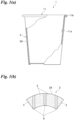
- Fig. 1(a) is a side view illustrating the paper cup 1 partly broken off as a paper container according to the embodiment of the present invention
- Fig. 1(b) is a plan view illustrating a back surface of a heat insulating outer sleeve 2 as a blank sheet, which is a heat insulating sheet for the paper cup 1 in Fig. 1(a)
- Fig. 2 is a partially enlarged view illustrating an enlarged part of the back surface of the heat insulating outer sleeve 2 as a blank sheet, which is the heat insulating sheet for the paper cup 1 in Fig. 1(b) .
- the paper cup 1 as a paper container includes a paper cup main body 11 as a paper container main body and the heat insulating outer sleeve 2 as a blank sheet, which is a heat insulating sheet wound along an outer periphery of a barrel section 11a of the paper cup main body 11.
- the paper cup main body 11 is composed of the closed-end and tubular barrel section 11a having a curl section 1 1b at an upper edge thereof.
- the heat insulating outer sleeve 2 includes a sheet body 2A using paper as a main material and coat layers 3.
- the coat layers 3 are formed after an aqueous coating agent is applied on a back surface of the sheet body 2A and the aqueous coating agent dries.
- the sheet body 2A has a fan shape and covers an outer surface of the barrel section 11a when wound along the outer periphery of the barrel section 11a of the paper cup main body 11.
- the coat layers 3 are formed at a plurality of positions on the back surface of the sheet body 2A with non-coat surfaces 4 as intervals provided.
- These coat layers 3 at a plurality of positions have approximately identical areas, and the non-coat surfaces 4 as intervals are approximately identical. Then, these coat layers 3 at a plurality of positions are bilaterally symmetrical on the back surface of the sheet body 2A.
- These coat layers 3 at a plurality of positions are not limited to a vertical stripe shape as illustrated in Fig. 1(b) , and for example, other patterns, such as a lateral stripe shape and a lattice shape, may be employed.
- these coat layers 3 at a plurality of positions have a plurality of cracks 5.
- the heat insulating outer sleeve 2 is wound along the outer periphery of the barrel section 11a of the paper cup main body 11 and bonded to be attached by heating the coat layers 3 as a heat seal.
- thicknesses of these coat layers 3 at a plurality of positions need to be 5 ⁇ m at a minimum considering heat-sealing properties for the purpose of bonding a heat-seal type by these coat layers 3 at a plurality of positions and are preferably from 5 ⁇ m to 20 ⁇ m because a thickness exceeding 20 ⁇ m becomes wasteful.
- other ranges may be employed.
- a proportion of a coat area occupied by the coat layers 3 on the back surface of the sheet body 2A is preferably 80% or less, and more preferably 60% or less.
- the proportion of the coat area occupied by the coat layers 3 on the back surface of the sheet body 2A is preferably 17% or more.
- a Cobb water absorption capacity difference between a front surface and the back surface of the sheet body 2A on which the coat layers 3 at a plurality of positions are formed is preferably 15.5 g/m 2 or less.
- a percentage of an area occupied by the plurality of cracks 5 on the coat layers 3 is preferably 11.8% or less per unit area (here, the unit area is 1 mm 2 ).
- the coat layers 3 may be provided also on the front surface of the sheet body 2A.
- resin as a main component of the aqueous coating agent used for forming the coat layers 3 include, for example, polyolefin resin, polypropylene resin, polyethylene resin, modified polypropylene resin, modified polyethylene resin, polyethylenimine resin, ethylene-vinyl acetate copolymer resin, polyolefin ionomer resin, ethylene-acrylic acid copolymer resin, ethylene-methacrylic acid copolymer resin, ethylene-methyl methacrylate copolymer resin, ethylene-vinyl chloride copolymer resin, ethylene-methylacrylate copolymer resin, polyvinyl alcohol resin, acrylic acid resin, acrylic acid copolymer resin, styrene-acrylic acid copolymer resin, methacrylic acid resin, polymethyl methacrylate resin, methacrylic acid copolymer resin, vinyl chloride resin, polyvinylidene chloride resin, vinyl acetate resin, polyurethane resin, polyester resin, polyethylene tere
- biodegradable resins and the like may be the resin as the main component of the aqueous coating agent used for forming the coat layers 3.
- the coat layers 3 are formed after the aqueous coating agent applied on the back surface of the sheet body 2A of the heat insulating outer sleeve 2 as a blank sheet dries.
- the heat insulating outer sleeve 2 as a blank sheet is a heat insulating sheet used for the paper cup 1 as a paper container.
- the coat layers 3 are formed at a plurality of positions on the back surface of the sheet body 2A with the non-coat surfaces 4 as intervals provided.
- the coat layers 3 are used for bonding of a heat-seal type that is superior to bonding of a cold glue type.
- the embodiment of the present invention has advantages of an improved operating rate, a lowered rejection rate, and the like in mass-producing the paper cup 1.
- the coat layers 3 at a plurality of positions have approximately identical areas, and the non-coat surfaces 4 as intervals are approximately identical. Furthermore, these coat layers 3 at a plurality of positions are bilaterally symmetrical on the back surface of the sheet body 2A. In view of this, in the embodiment of the present invention, the uniformity of the bonding strength of the heat insulating outer sleeve 2 to the outer periphery of the barrel section 11a of the paper cup main body 11 can be ensured.
- the coat layers 3 at a plurality of positions have the plurality of cracks 5.
- the coat layers 3 can be formed in a short time, resulting in good manufacturing efficiency.
- the proportion of the coat area occupied by the coat layers 3 having a thickness of 10 ⁇ m on one surface of the blank sheet was 80%.
- aqueous coating agent For the aqueous coating agent forming the coat layers 3 of the samples of Comparative Example 1, Present Invention Example 1, Present Invention Example 2, and Present Invention Example 3, an aqueous coating agent (product name: CHEMIPEARL S300) manufactured by Mitsui Chemicals with a 5% diluting solvent (isopropyl alcohol) added was used.
- an ionomer an ethylene-methacrylic acid copolymer
- a solid content concentration was 35%.
- the aqueous coating agent was applied so as to achieve a target proportion of the coat area occupied by the coat layers 3 on the one surface of each sample and dried in an oven at 140°C for 50 seconds for preparation.
- the sample of Comparative Example 1 had warpage (a warpage height of 20 mm) on the coat layers 3 side.
- the samples of Present Invention Example 1, Present Invention Example 2, and Present Invention Example 3 had no warpage.
- the proportion of the coat area occupied by the coat layers 3 on the front surface or the back surface of the sheet body 2A was preferably 80% or less.
- the proportion of the coat area occupied by the coat layers 3 on the front surface or the back surface of the sheet body 2A was preferably 17% or more, especially for the purpose of bonding.
- the percentage of the area occupied by the plurality of cracks 5 on the coat layers 3 is 11.84% per unit area (here, the unit area is 1 mm 2 ).
- the percentage of the area occupied by the plurality of cracks 5 on the coat layers 3 is 11.8% per unit area (here, the unit area is 1 mm 2 ).
- Fig. 6 illustrates the test results.
- Comparative Example 3 the surfaces of the coat layers 3 of two out of the five samples lifted.
- the present invention is applied only to the paper cup 1, it is not limited to this.
- the present invention may be applied to any paper containers including paper containers for food products and medicinal products, and the like.
Landscapes
- Engineering & Computer Science (AREA)
- Mechanical Engineering (AREA)
- Packages (AREA)
Abstract
Description
- The present invention relates to a blank sheet used for a paper container and a paper container including the blank sheet.
- Conventionally, many paper containers including paper cups have been manufactured using blank sheets using paper as a main material.
- For example,
Patent Document 1 discloses a paper cup as a paper container with a heat insulating outer sleeve made from a blank sheet wound along an outer periphery of a barrel section of a paper container main body. - In this type of paper container, for the purpose of bonding a heat-seal type and the like, lamination processing is often provided for coating any of a front surface or a back surface of a blank sheet used for the paper container with, for example, a film made of resin or the like.
- However, by providing the lamination processing for coating any of a front surface or a back surface of a blank sheet with a film made of resin or the like, when a heating state changes to a normal temperature state, the coated film shrinks, and the blank sheet warps to the coated film side.
- Meanwhile, the blank sheet used for the paper container passes between various rollers and the like in a manufacturing line during mass production.
- It has uniquely been found that a problem arises in that large warping of the blank sheet at this time increases a risk of causing troubles, such as clogging, when a blank is conveyed on the manufacturing line.
Patent Document 1:JP-A-2016-000623 - Therefore, the present invention has been made in consideration of the above-described problem, and it is an object of the present invention to provide a blank sheet used for a paper container that can reduce warping of the blank sheet and eventually lower a risk of causing clogging between various rollers and the like in a manufacturing line during mass production and a paper container including the blank sheet.
- In order to solve the above-described problem, the inventor of the present invention has invented a blank sheet used for a paper container. The blank sheet includes coat layers formed after an aqueous coating agent is applied on at least any one of a front surface or a back surface of a sheet body of the blank sheet and the aqueous coating agent dries. The coat layers on the front surface or the back surface of the sheet body are formed at a plurality of positions at intervals.
- A blank sheet according to a first invention is a blank sheet used for a paper container. The blank sheet includes coat layers formed after an aqueous coating agent is applied on at least any one of a front surface or a back surface of a sheet body of the blank sheet and the aqueous coating agent dries. The coat layers on the front surface or the back surface of the sheet body are formed at a plurality of positions at intervals.
- In the blank sheet according to a second invention, which is in the first invention, the coat layers at a plurality of positions are formed bilaterally symmetrically on the front surface or the back surface of the sheet body.
- In the blank sheet according to a third invention, which is in the first invention or the second invention, the coat layers are provided only on one of the front surface or the back surface of the sheet body.
- In the blank sheet according to a fourth invention, which is in any of the first invention to the third invention, the coat layers have a thickness of 5 µm to 20 µm.
- In the blank sheet according to a fifth invention, which is in any of the first invention to the fourth invention, a proportion of a coat area occupied by the coat layers on the front surface or the back surface of the sheet body is 80% or less.
- In the blank sheet according to a sixth invention, which is in any of the first invention to the fifth invention, a proportion of a coat area occupied by the coat layers on the front surface or the back surface of the sheet body is 17% or more.
- In the blank sheet according to a seventh invention, which is in any of the first invention to the sixth invention, a Cobb water absorption capacity difference between the front surface and the back surface of the sheet body on which the coat layers at a plurality of positions are formed is 15.5 g/m2 or less.
- In the blank sheet according to an eighth invention, which is in any of the first invention to the seventh invention, the blank sheet is a heat insulating sheet that covers an outer surface of a paper container main body of the paper container.
- In the blank sheet according to a ninth invention, which is in the eighth invention, the paper container main body is a paper cup main body, and the heat insulating sheet is a heat insulating outer sleeve wound along an outer periphery of a barrel section of the paper cup main body.
- A paper container according to a tenth invention includes the blank sheet according to any of the first invention to the ninth invention directly or indirectly on a paper container main body.
- A paper cup according to an eleventh invention includes the blank sheet according to the ninth invention as the heat insulating outer sleeve wound along the outer periphery of the barrel section of the paper cup main body.
- According to the present invention with the above-described configurations, the coat layers are formed after the aqueous coating agent is applied on at least any one of the front surface or the back surface of the sheet body of the blank sheet used for the paper container and the aqueous coating agent dries. The coat layers are formed at a plurality of positions at intervals. As a result of conducting experimental validation, it has been seen that warping of the blank sheet can be reduced. This can lower a risk of causing clogging between various rollers and the like in a manufacturing line during mass production.
-
-
Fig. 1(a) is a side view illustrating a paper cup partly broken off as a paper container according to an embodiment of the present invention, andFig. 1(b) is a plan view illustrating a back surface of a heat insulating outer sleeve as a blank sheet, which is a heat insulating sheet for the paper cup inFig. 1(a) . -
Fig. 2 is a partially enlarged view illustrating an enlarged part of the back surface of the heat insulating outer sleeve as a blank sheet, which is the heat insulating sheet for the paper cup inFig. 1(b) . -
Fig. 3 is a table illustrating results ofexperimental validation 1. -
Fig. 4 is a table illustrating results ofexperimental validation 2. -
Fig. 5 is a table illustrating results ofexperimental validation 3. -
Fig. 6 is a table illustrating results ofexperimental validation 4. - The following describes an embodiment exemplified by applying the present invention by referring to the drawings.
- First, using
Fig. 1 andFig. 2 , apaper cup 1 as a paper container according to the embodiment of the present invention will be described.Fig. 1(a) is a side view illustrating thepaper cup 1 partly broken off as a paper container according to the embodiment of the present invention, andFig. 1(b) is a plan view illustrating a back surface of a heat insulatingouter sleeve 2 as a blank sheet, which is a heat insulating sheet for thepaper cup 1 inFig. 1(a) .Fig. 2 is a partially enlarged view illustrating an enlarged part of the back surface of the heat insulatingouter sleeve 2 as a blank sheet, which is the heat insulating sheet for thepaper cup 1 inFig. 1(b) . - As illustrated in
Fig. 1(a) , thepaper cup 1 as a paper container according to the embodiment of the present invention includes a paper cupmain body 11 as a paper container main body and the heat insulatingouter sleeve 2 as a blank sheet, which is a heat insulating sheet wound along an outer periphery of abarrel section 11a of the paper cupmain body 11. - The paper cup
main body 11 is composed of the closed-end andtubular barrel section 11a having acurl section 1 1b at an upper edge thereof. - As illustrated in
Fig. 1(b) , the heat insulatingouter sleeve 2 includes asheet body 2A using paper as a main material andcoat layers 3. Thecoat layers 3 are formed after an aqueous coating agent is applied on a back surface of thesheet body 2A and the aqueous coating agent dries. - The
sheet body 2A has a fan shape and covers an outer surface of thebarrel section 11a when wound along the outer periphery of thebarrel section 11a of the paper cupmain body 11. - The
coat layers 3 are formed at a plurality of positions on the back surface of thesheet body 2A withnon-coat surfaces 4 as intervals provided. - These
coat layers 3 at a plurality of positions have approximately identical areas, and thenon-coat surfaces 4 as intervals are approximately identical. Then, thesecoat layers 3 at a plurality of positions are bilaterally symmetrical on the back surface of thesheet body 2A. - These
coat layers 3 at a plurality of positions are not limited to a vertical stripe shape as illustrated inFig. 1(b) , and for example, other patterns, such as a lateral stripe shape and a lattice shape, may be employed. - Furthermore, as illustrated in
Fig. 2 , thesecoat layers 3 at a plurality of positions have a plurality ofcracks 5. - Note that these
coat layers 3 at a plurality of positions need not have the plurality ofcracks 5. - Then, the heat insulating
outer sleeve 2 is wound along the outer periphery of thebarrel section 11a of the paper cupmain body 11 and bonded to be attached by heating thecoat layers 3 as a heat seal. - Here, it has been seen that thicknesses of these
coat layers 3 at a plurality of positions need to be 5 µm at a minimum considering heat-sealing properties for the purpose of bonding a heat-seal type by thesecoat layers 3 at a plurality of positions and are preferably from 5 µm to 20 µm because a thickness exceeding 20 µm becomes wasteful. However, other ranges may be employed. - As illustrated in results of
experimental validation 1 described below, a proportion of a coat area occupied by thecoat layers 3 on the back surface of thesheet body 2A is preferably 80% or less, and more preferably 60% or less. - Additionally, as illustrated in results of
experimental validation 2 described below, the proportion of the coat area occupied by thecoat layers 3 on the back surface of thesheet body 2A is preferably 17% or more. - Additionally, as illustrated in results of
experimental validation 3 described below, a Cobb water absorption capacity difference between a front surface and the back surface of thesheet body 2A on which thecoat layers 3 at a plurality of positions are formed is preferably 15.5 g/m2 or less. - Furthermore, as illustrated in results of
experimental validation 4 described below, when thecoat layers 3 at a plurality of positions have the plurality ofcracks 5, a percentage of an area occupied by the plurality ofcracks 5 on thecoat layers 3 is preferably 11.8% or less per unit area (here, the unit area is 1 mm2). - For the purpose of further increasing heat insulating properties and providing a sense of luxury by looking nice to enhance commodity value and the like, the coat layers 3 may be provided also on the front surface of the
sheet body 2A. - Examples of resin as a main component of the aqueous coating agent used for forming the coat layers 3 include, for example, polyolefin resin, polypropylene resin, polyethylene resin, modified polypropylene resin, modified polyethylene resin, polyethylenimine resin, ethylene-vinyl acetate copolymer resin, polyolefin ionomer resin, ethylene-acrylic acid copolymer resin, ethylene-methacrylic acid copolymer resin, ethylene-methyl methacrylate copolymer resin, ethylene-vinyl chloride copolymer resin, ethylene-methylacrylate copolymer resin, polyvinyl alcohol resin, acrylic acid resin, acrylic acid copolymer resin, styrene-acrylic acid copolymer resin, methacrylic acid resin, polymethyl methacrylate resin, methacrylic acid copolymer resin, vinyl chloride resin, polyvinylidene chloride resin, vinyl acetate resin, polyurethane resin, polyester resin, polyethylene terephthalate resin, polylactic acid resin, polyhydroxyalkanoic acid resin, polybutylene succinate resin, polyamide resin, copolymer nylon resin, polystyrene resin, styrene-maleic acid copolymer resin, phenol resin, and rosin-modified phenol resin.
- Besides, for example, in consideration of the environment, biodegradable resins and the like may be the resin as the main component of the aqueous coating agent used for forming the coat layers 3.
- According to the embodiment of the present invention described above, the coat layers 3 are formed after the aqueous coating agent applied on the back surface of the
sheet body 2A of the heat insulatingouter sleeve 2 as a blank sheet dries. The heat insulatingouter sleeve 2 as a blank sheet is a heat insulating sheet used for thepaper cup 1 as a paper container. The coat layers 3 are formed at a plurality of positions on the back surface of thesheet body 2A with thenon-coat surfaces 4 as intervals provided. As a result of conducing the experimental validation described below, it has been seen that warping of the heat insulatingouter sleeve 2 as a blank sheet can be reduced. This can lower a risk of causing troubles, such as blank clogging, on a manufacturing line during mass production. - Additionally, in the embodiment of the present invention, the coat layers 3 are used for bonding of a heat-seal type that is superior to bonding of a cold glue type. In view of this, the embodiment of the present invention has advantages of an improved operating rate, a lowered rejection rate, and the like in mass-producing the
paper cup 1. - In the embodiment of the present invention, the coat layers 3 at a plurality of positions have approximately identical areas, and the
non-coat surfaces 4 as intervals are approximately identical. Furthermore, thesecoat layers 3 at a plurality of positions are bilaterally symmetrical on the back surface of thesheet body 2A. In view of this, in the embodiment of the present invention, the uniformity of the bonding strength of the heat insulatingouter sleeve 2 to the outer periphery of thebarrel section 11a of the paper cupmain body 11 can be ensured. - In addition, in the embodiment of the present invention, the coat layers 3 at a plurality of positions have the plurality of
cracks 5. In view of this, in the embodiment of the present invention, for example, since it is only necessary to form the coat layers 3 by applying a next application layer over a previous application layer before the previous application layer dries, the coat layers 3 can be formed in a short time, resulting in good manufacturing efficiency. - The following describes the results of the
experimental validation 1 conducted to confirm effects of the present invention. - In the
experimental validation 1, fan-shaped blank sheets having a thickness of 0.239 mm and a basis weight of 200 g/m2 were used for all samples of Comparative Example 1, Present Invention Example 1, Present Invention Example 2, and Present Invention Example 3. - In the sample of Comparative Example 1, a proportion of a coat area occupied by the coat layers 3 having a thickness of 10 µm on one surface of the blank sheet was 100%.
- In the sample of Present Invention Example 1, the proportion of the coat area occupied by the coat layers 3 having a thickness of 10 µm on one surface of the blank sheet was 80%.
- In the sample of Present Invention Example 2, the proportion of the coat area occupied by the coat layers 3 having a thickness of 10 µm on one surface of the blank sheet was 60%.
- In the sample of Present Invention Example 3, the proportion of the coat area occupied by the coat layers 3 having a thickness of 10 µm on one surface of the blank sheet was 40%.
- The presence or absence of warpage in the samples thus configured of Comparative Example 1, Present Invention Example 1, Present Invention Example 2, and Present Invention Example 3 was confirmed. Then, the test results illustrated in
Fig. 3 were obtained. - For the aqueous coating agent forming the coat layers 3 of the samples of Comparative Example 1, Present Invention Example 1, Present Invention Example 2, and Present Invention Example 3, an aqueous coating agent (product name: CHEMIPEARL S300) manufactured by Mitsui Chemicals with a 5% diluting solvent (isopropyl alcohol) added was used. In the aqueous coating agent, an ionomer (an ethylene-methacrylic acid copolymer) was the resin as the main component, and a solid content concentration was 35%. The aqueous coating agent was applied so as to achieve a target proportion of the coat area occupied by the coat layers 3 on the one surface of each sample and dried in an oven at 140°C for 50 seconds for preparation.
- As illustrated in
Fig. 3 , the sample of Comparative Example 1 had warpage (a warpage height of 20 mm) on the coat layers 3 side. In contrast to this, the samples of Present Invention Example 1, Present Invention Example 2, and Present Invention Example 3 had no warpage. - Consequently, it was confirmed that the proportion of the coat area occupied by the coat layers 3 on the front surface or the back surface of the
sheet body 2A was preferably 80% or less. - The following describes the results of the
experimental validation 2 conducted to confirm the effects of the present invention. - In the
experimental validation 2, samples of Comparative Example 2 and Present Invention Example 4 were prepared in a way similar to that of the aboveexperimental validation 1. - In the sample of Comparative Example 2, the proportion of the coat area occupied by the coat layers 3 having a thickness of 10 µm on one surface of the blank sheet was 10.7%.
- In the sample of Present Invention Example 4, the proportion of the coat area occupied by the coat layers 3 having a thickness of 10 µm on one surface of the blank sheet was 16.8%.
- A peeling test from an adherend was conducted on the samples thus configured of Comparative Example 2 and Present Invention Example 4 to confirm them as being excellent when they had a required bonding strength and as being poor when they did not. Then, the test results illustrated in
Fig. 4 were obtained. - As illustrated in
Fig. 4 , the sample of Comparative Example 2 was poor. In contrast to this, the sample of Present Invention Example 4 was excellent. - Consequently, it was confirmed that the proportion of the coat area occupied by the coat layers 3 on the front surface or the back surface of the
sheet body 2A was preferably 17% or more, especially for the purpose of bonding. - The following describes the results of the
experimental validation 3 conducted to confirm the effects of the present invention. - In the
experimental validation 3, in addition to the samples of Comparative Example 1 and Present Invention Example 1 used in theexperimental validation 1, a sample of Present Invention Example 5 with a proportion of the coat area occupied by the coat layers 3 having a thickness of 10 µm on one surface of the blank sheet being 30% was used. - Then, the Cobb water absorption capacities of the front surface and the back surface of the
sheet body 2A of each sample were measured to calculate each Cobb water absorption capacity difference. - Note that the Cobb water absorption capacity measurement was conducted for a measuring time of 2 minutes on a measured area of 20 cm2 (JIS P 8140).
- As illustrated in
Fig. 5 , it was confirmed that the Cobb water absorption capacity difference between the front surface and the back surface of thesheet body 2A was 17.5 g/m2 in the sample of Comparative Example 1, whereas the Cobb water absorption capacity difference between the front surface and the back surface of thesheet body 2A was 15.5 g/m2 or less in the samples of Present Invention Example 1 and Present Invention Example 5. - This supported the fact that when the proportion of the coat area occupied by the coat layers 3 on the front surface or the back surface of the
sheet body 2A was 80% or less, a moisture absorption difference between the front surface and the back surface of thesheet body 2A decreased, and the decrease in the moisture absorption difference between the front surface and the back surface of thesheet body 2A could reduce warpage. - The following describes the results of the
experimental validation 4 conducted to confirm the effects of the present invention. - In the
experimental validation 4, samples of Comparative Example 3 and Present Invention Example 6, each with a proportion of the coat area occupied by the coat layers 3 having a thickness of 10 µm on one surface of the blank sheet being 80%, were prepared in a way approximately similar to that of the aboveexperimental validation 1. However, unlike the sample of Present Invention Example 1, in the samples of Comparative Example 3 and Present Invention Example 6, the coat layers 3 had the plurality ofcracks 5. - In the sample of Comparative Example 3, the percentage of the area occupied by the plurality of
cracks 5 on the coat layers 3 is 11.84% per unit area (here, the unit area is 1 mm2). - In the sample of Present Invention Example 6, the percentage of the area occupied by the plurality of
cracks 5 on the coat layers 3 is 11.8% per unit area (here, the unit area is 1 mm2). - Five samples thus configured were prepared for each of Comparative Example 3 and Present Invention Example 6 to confirm whether or not there was any case where surfaces of the coat layers 3 lifted.
-
Fig. 6 illustrates the test results. In Comparative Example 3, the surfaces of the coat layers 3 of two out of the five samples lifted. - In contrast to this, in the samples of Present Invention Example 6, not one out of the five samples had the surfaces of the coat layers 3 lifting.
- From the test results, when the percentage of the area occupied by the plurality of
cracks 5 on the coat layers 3 exceeds 11.8% per unit area (here, the unit area is 1 mm2), the surfaces of the coat layers 3 lift, resulting in slightly inferior quality. In view of this, it was confirmed that while manufacturing efficiency was good when the coat layers 3 at a plurality of positions had the plurality ofcracks 5, the percentage of the area occupied by the plurality ofcracks 5 on the coat layers 3 was preferably 11.8% or less per unit area (here, the unit area was 1 mm2). - Piecing together the results of the
experimental validations 1 to 4 conducted to confirm the effects of the present invention, it is considered that the present invention is especially effective when the coat layers 3 are provided only on one surface of thesheet body 2A. - While the embodiments of the present invention have been described above, the embodiments have been presented as examples, and are not intended to limit the scope of the invention. The novel embodiments described herein can be embodied in a variety of other configurations. Various omissions, substitutions, and changes can be made without departing from the gist of the invention. The embodiments and the modifications thereof are within the scope and the gist of the invention and within the scope of the inventions described in the claims and their equivalents.
- In the embodiments described above, while the present invention is applied only to the
paper cup 1, it is not limited to this. For example, the present invention may be applied to any paper containers including paper containers for food products and medicinal products, and the like. -
- 1:
- Paper cup (Paper container)
- 11:
- Paper cup main body (Paper container main body)
- 11a:
- Barrel section
- 11b:
- Curl section
- 2:
- Heat insulating outer sleeve (Blank sheet)
- 2A:
- Sheet body
- 3:
- Coat layer
- 4:
- Non-coat surface (Interval)
- 5:
- Crack
Claims (11)
- A blank sheet used for a paper container, comprisingcoat layers formed after an aqueous coating agent is applied on at least any one of a front surface or a back surface of a sheet body of the blank sheet and the aqueous coating agent dries, whereinthe coat layers on the front surface or the back surface of the sheet body are formed at a plurality of positions at intervals.
- The blank sheet according to claim 1, wherein
the coat layers at a plurality of positions are formed bilaterally symmetrically on the front surface or the back surface of the sheet body. - The blank sheet according to claim 1 or 2, wherein
the coat layers are provided only on one of the front surface or the back surface of the sheet body. - The blank sheet according to any one of claims 1 to 3, wherein
the coat layers have a thickness of 5 µm to 20 µm. - The blank sheet according to any one of claims 1 to 4, wherein
a proportion of a coat area occupied by the coat layers on the front surface or the back surface of the sheet body is 80% or less. - The blank sheet according to any one of claims 1 to 5, wherein
a proportion of a coat area occupied by the coat layers on the front surface or the back surface of the sheet body is 17% or more. - The blank sheet according to any one of claims 1 to 6, wherein
a Cobb water absorption capacity difference between the front surface and the back surface of the sheet body on which the coat layers at a plurality of positions are formed is 15.5 g/m2 or less. - The blank sheet according to any one of claims 1 to 7, wherein
the blank sheet is a heat insulating sheet that covers an outer surface of a paper container main body of the paper container. - The blank sheet according to claim 8, whereinthe paper container main body is a paper cup main body, andthe heat insulating sheet is a heat insulating outer sleeve wound along an outer periphery of a barrel section of the paper cup main body.
- A paper container comprising
the blank sheet according to any one of claims 1 to 9 directly or indirectly on a paper container main body. - A paper cup comprising
the blank sheet according to claim 9 as the heat insulating outer sleeve wound along the outer periphery of the barrel section of the paper cup main body.
Applications Claiming Priority (2)
| Application Number | Priority Date | Filing Date | Title |
|---|---|---|---|
| JP2021094432 | 2021-06-04 | ||
| PCT/JP2021/045621 WO2022254758A1 (en) | 2021-06-04 | 2021-12-10 | Blank sheet and paper container |
Publications (2)
| Publication Number | Publication Date |
|---|---|
| EP4349727A1 true EP4349727A1 (en) | 2024-04-10 |
| EP4349727A4 EP4349727A4 (en) | 2025-04-16 |
Family
ID=84324078
Family Applications (1)
| Application Number | Title | Priority Date | Filing Date |
|---|---|---|---|
| EP21944250.6A Pending EP4349727A4 (en) | 2021-06-04 | 2021-12-10 | Blank sheet and paper container |
Country Status (4)
| Country | Link |
|---|---|
| EP (1) | EP4349727A4 (en) |
| JP (1) | JP7686753B2 (en) |
| CN (1) | CN117279837B (en) |
| WO (1) | WO2022254758A1 (en) |
Family Cites Families (7)
| Publication number | Priority date | Publication date | Assignee | Title |
|---|---|---|---|---|
| US5769311A (en) * | 1994-08-02 | 1998-06-23 | Toppan Printing Co., Ltd. | Heat insulating cup and method of manufacturing the same |
| JP3856248B2 (en) * | 1997-04-07 | 2006-12-13 | 日本紙パック株式会社 | Cardboard insulation cup and method for producing the same |
| JPH11240530A (en) * | 1998-02-26 | 1999-09-07 | Toppan Printing Co Ltd | Insulated paper cup container |
| JP4341935B2 (en) * | 1998-07-01 | 2009-10-14 | 日本紙パック株式会社 | Insulating paper cup and manufacturing method thereof |
| EP2243719B1 (en) * | 2006-04-03 | 2012-10-03 | LBP Manufacturing, Inc. | Thermally activatable insulating packaging |
| US20100181328A1 (en) * | 2009-01-16 | 2010-07-22 | Cook Matthew R | Protective sleeve |
| JP2016000623A (en) | 2014-06-12 | 2016-01-07 | 東罐興業株式会社 | Outer sleeve for thermal insulation and thermo-insulating paper container |
-
2021
- 2021-12-10 EP EP21944250.6A patent/EP4349727A4/en active Pending
- 2021-12-10 JP JP2023525361A patent/JP7686753B2/en active Active
- 2021-12-10 WO PCT/JP2021/045621 patent/WO2022254758A1/en not_active Ceased
- 2021-12-10 CN CN202180098214.5A patent/CN117279837B/en active Active
Also Published As
| Publication number | Publication date |
|---|---|
| JP7686753B2 (en) | 2025-06-02 |
| CN117279837A (en) | 2023-12-22 |
| WO2022254758A1 (en) | 2022-12-08 |
| JPWO2022254758A1 (en) | 2022-12-08 |
| CN117279837B (en) | 2026-04-17 |
| EP4349727A4 (en) | 2025-04-16 |
Similar Documents
| Publication | Publication Date | Title |
|---|---|---|
| EP4166326B1 (en) | Gas barrier laminate and packaging bag | |
| AU750072B2 (en) | Compostable coated paper or paperboard, a method for manufacturing the same and products obtained thereof | |
| US20110139660A1 (en) | Food Packaging | |
| CN100475658C (en) | Sealed container and method for manufacturing same | |
| EP4209343A1 (en) | Gas-barrier multilayer body and packageing bag | |
| EP4349727A1 (en) | Blank sheet and paper container | |
| CN109065655A (en) | A kind of encapsulation foreboard and its preparation process | |
| RS57606B1 (en) | A sheet, a method of making and using a sheet as a lid for packages | |
| JP2019038554A (en) | Lid material for preventing content adhesion | |
| WO2023091918A1 (en) | Thermoformable dual ovenable recyclable coated cellulosic board, dual ovenable recyclable coated cellulosic board food vessels thermoformed therefrom, and methods for manufacturing and using thereof | |
| WO2017122671A1 (en) | Adhesive sheet | |
| US20220064868A1 (en) | Thermoformable Ovenable Recyclable Coated Cellulosic Board, Ovenable Recyclable Coated Cellulosic Board Food Vessels Thermoformed Therefrom, and Methods for Manufacturing and Using Thereof | |
| CN102686778B (en) | Manufacturing method of resin-coated metal sheet | |
| CN108602580A (en) | Laminated sheets and packaging container sleeves | |
| WO2023228736A1 (en) | Layered body, method for producing same, and molded article | |
| JP7671690B2 (en) | container | |
| JP5605448B2 (en) | Paper cup container | |
| CN201347418Y (en) | Carton-sealing adhesive tape using composite packaging film as substrate | |
| JP5510215B2 (en) | Lid material | |
| JP2017217814A (en) | Production method of cylindrical paper container | |
| JP5875830B2 (en) | Corrugated board manufacturing method and paper container using the same | |
| JP2009096533A (en) | Paper cup container | |
| KR102867373B1 (en) | Method of Packing Materials | |
| JP2000248495A (en) | Production of antimicrobial paper, antimicrobial paper and production of antimicrobial corrugated board | |
| JPS61197239A (en) | Composite material for paper vessel, etc, and manufacture thereof |
Legal Events
| Date | Code | Title | Description |
|---|---|---|---|
| STAA | Information on the status of an ep patent application or granted ep patent |
Free format text: STATUS: THE INTERNATIONAL PUBLICATION HAS BEEN MADE |
|
| PUAI | Public reference made under article 153(3) epc to a published international application that has entered the european phase |
Free format text: ORIGINAL CODE: 0009012 |
|
| STAA | Information on the status of an ep patent application or granted ep patent |
Free format text: STATUS: REQUEST FOR EXAMINATION WAS MADE |
|
| 17P | Request for examination filed |
Effective date: 20230818 |
|
| AK | Designated contracting states |
Kind code of ref document: A1 Designated state(s): AL AT BE BG CH CY CZ DE DK EE ES FI FR GB GR HR HU IE IS IT LI LT LU LV MC MK MT NL NO PL PT RO RS SE SI SK SM TR |
|
| DAV | Request for validation of the european patent (deleted) | ||
| DAX | Request for extension of the european patent (deleted) | ||
| REG | Reference to a national code |
Ref country code: DE Ref legal event code: R079 Free format text: PREVIOUS MAIN CLASS: B65D0025360000 Ipc: B65D0003060000 |
|
| A4 | Supplementary search report drawn up and despatched |
Effective date: 20250314 |
|
| RIC1 | Information provided on ipc code assigned before grant |
Ipc: B65D 81/38 20060101ALI20250310BHEP Ipc: B65D 3/22 20060101ALI20250310BHEP Ipc: B65D 3/06 20060101AFI20250310BHEP |
|
| STAA | Information on the status of an ep patent application or granted ep patent |
Free format text: STATUS: EXAMINATION IS IN PROGRESS |
|
| 17Q | First examination report despatched |
Effective date: 20251110 |