EP4353042B1 - Répétition de premier message pour équipements utilisateurs critiques pour la mission - Google Patents
Répétition de premier message pour équipements utilisateurs critiques pour la mission Download PDFInfo
- Publication number
- EP4353042B1 EP4353042B1 EP22734139.3A EP22734139A EP4353042B1 EP 4353042 B1 EP4353042 B1 EP 4353042B1 EP 22734139 A EP22734139 A EP 22734139A EP 4353042 B1 EP4353042 B1 EP 4353042B1
- Authority
- EP
- European Patent Office
- Prior art keywords
- message
- repetition
- prach
- random access
- met
- Prior art date
- Legal status (The legal status is an assumption and is not a legal conclusion. Google has not performed a legal analysis and makes no representation as to the accuracy of the status listed.)
- Active
Links
Images




Classifications
-
- H—ELECTRICITY
- H04—ELECTRIC COMMUNICATION TECHNIQUE
- H04W—WIRELESS COMMUNICATION NETWORKS
- H04W74/00—Wireless channel access
- H04W74/08—Non-scheduled access, e.g. ALOHA
-
- H—ELECTRICITY
- H04—ELECTRIC COMMUNICATION TECHNIQUE
- H04W—WIRELESS COMMUNICATION NETWORKS
- H04W74/00—Wireless channel access
- H04W74/002—Transmission of channel access control information
-
- H—ELECTRICITY
- H04—ELECTRIC COMMUNICATION TECHNIQUE
- H04W—WIRELESS COMMUNICATION NETWORKS
- H04W74/00—Wireless channel access
- H04W74/08—Non-scheduled access, e.g. ALOHA
- H04W74/0833—Random access procedures, e.g. with 4-step access
-
- H—ELECTRICITY
- H04—ELECTRIC COMMUNICATION TECHNIQUE
- H04W—WIRELESS COMMUNICATION NETWORKS
- H04W74/00—Wireless channel access
- H04W74/002—Transmission of channel access control information
- H04W74/006—Transmission of channel access control information in the downlink, i.e. towards the terminal
Definitions
- UEs mission critical user equipments
- a UE Before a UE can properly communicate within a network, it must carry out cell search to find, synchronize, and identify a cell. Then, it can acquire basic system information and perform random access procedure to establish a connection to the cell.
- SS/PBCH block Similar to Long-Term Evolution (LTE), a pair of SS - primary synchronization signal (PSS) and secondary synchronization signal (SSS) - is periodically transmitted on downlink from each cell to allow a UE to initially access to the network. By detecting SS, a UE can obtain the physical cell identity, achieve downlink synchronization in both time and frequency, and acquire the timing for PBCH.
- PBCH carries the master information block (MIB) which contains minimum system information that a UE is needed to acquire system information block 1 (SIB 1). SIB1 carries the remaining minimum system information that is needed for a UE to be able to perform subsequent random-access procedure.
- MIB master information block
- SIB1 carries the remaining minimum system information that is needed for a UE to be able to perform subsequent random-access procedure.
- the 4-step random access produce (for initial access), also referred to as Type-1 random access procedure in 3GPP Technical Specification (TS) 38.213, is illustrated in Figure 1 .
- a UE initiates the random-access procedure by transmitting in UL a random-access preamble (Msg 1) on a physical random-access channel (PRACH).
- PRACH physical random-access channel
- step 2 base station (BS) (e.g., gNB) may respond by transmitting in DL a random-access response (RAR) on a Physical Downlink Shared Channel (PDSCH) (Msg2).
- RAR random-access response
- PDSCH Physical Downlink Shared Channel
- step 3 and step 4 One of the main purposes of applying step 3 and step 4 is to resolve such potential contention.
- the 2-step random access produce (for initial access), also referred to as Type-2 random access procedure in TS 38.213, is illustrated in Figure 2 .
- UE sends a message A (msgA) including random access preamble together with higher layer data such as RRC connection request possibly with some small payload on PUSCH.
- the network e.g., BS
- RAR Random Access Response
- msgB Random Access Response
- the time and frequency resource on which a random-access preamble (Msg 1) is transmitted is defined as a PRACH occasion.
- the time resources and preamble format for the Msg1 transmission is configured by a PRACH configuration index, which indicates a row in a PRACH configuration table specified in TS 38.211 - Tables 6.3.3.2-2, 6.3.3.2-3, 6.3.3.2-4 for FR1 paired spectrum, FR1 unpaired spectrum and FR2 with unpaired spectrum, respectively.
- Table 1 shows PRACH configuration for preamble format 0 for FR1 unpaired spectrum.
- the value of x indicates the PRACH configuration period in number of system frames.
- the value of y indicates the system frame within each PRACH configuration period on which the PRACH occasions are configured. For instance, if y is set to 0, then it means PRACH occasions only configured in the first frame of each PRACH configuration period.
- the values in the column "subframe number” tells on which subframes are configured with PRACH occasion.
- the values in the column "starting symbol” is the symbol index.
- Time Division Duplex In case of Time Division Duplex (TDD), semi-statically configured Downlink (DL) parts and/or actually transmitted SSBs can override and invalidate some time-domain PRACH occasions defined in the PRACH configuration table. More specifically, PRACH occasions in the Uplink (UL) part are always valid, and a PRACH occasion within the X part is valid as long as it does not precede or collide with an SSB in the RACH slot and it is at least N symbols after the DL part and the last symbol of an SSB. N is 0 or 2 depending on PRACH format and subcarrier spacing.
- n SFN mod x y Subframe number Starting symbol Number of PRACH slots within a subframe N t RA , slot , number of time-domain PRACH occasions within a PRACH slot N dur RA , PRACH duration x y 0 0 16 1 9 0 - - 0 1 0 8 1 9 0 - - 0 2 0 4 1 9 0 - - 0 3 0 2 0 9 0 - - 0 4 0 2 1 9 0 - - 0 5 0 2 0 4 0 - - 0 6 0 2 1 4 0 - - 0 7 0 1 0 9 0 - - 0 8 0 1 0 8 0 - - 0 9 0 1 0 7 0 - - 0 10 0 1 0 6 0 - - 0 11
- msg1-FDM The number of PRACH transmission occasions FDMed in one time instance.
- msg1-FrequencyStart Offset of lowest PRACH transmission occasion in frequency domain with respective to Physical Resource Block (PRB) 0. The value is configured so that the corresponding RACH resource is entirely within the bandwidth of the UL Bandwidth Part (BWP).
- PRB Physical Resource Block
- Figure 5 shows an example with two SSBs per PRACH occasion.
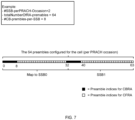
- a UE is provided a number N of SS/PBCH blocks associated with one PRACH occasion and a number R of contention-based preambles per SS/PBCH block per valid PRACH occasion by ssb-perRACH-OccasionAndCB-PreamblesPerSSB. If N ⁇ 1, one SS/PBCH block is mapped to 1/ N consecutive valid PRACH occasions and R contention based preambles with consecutive indexes associated with the SS/PBCH block per valid PRACH occasion start from preamble index 0.
- N If N ⁇ 1, R contention based preambles with consecutive indexes associated with SS/PBCH block n, 0 ⁇ n ⁇ N -1, per valid PRACH occasion start from preamble index n ⁇ N preamble total / N where N preamble total is provided by totalNumberOfRA-Preambles and is an integer multiple of N .
- SS/PBCH block indexes provided by ssb-PositionsInBurst in SIB1 or in ServingCellConfigCommon are mapped to valid PRACH occasions in the following order where the parameters are described in [4, TS 38.211].
- the RACH occasions for 2-step RACH can be either separately configured (also known as Type-2 random access procedure with separate configuration of PRACH occasions with Type-1 random access procedure) or are shared with 4-step RACH (also known as Type-2 random access procedure with common configuration of PRACH occasions with Type-1 random access procedure) in which case different set of preamble IDs will be used.
- Figure 9 illustrates associated preambles for CBRA and CFRA per SSB per PRACH occasion when ROs for 2-step RACH and 4-step RACH are shared.
- Document US 2021/058971 A1 relates to relates to wireless communication systems. More particularly, the present disclosure relates to repetition of physical random access channel (PRACH) preamble transmission for user equipments (UEs) and enhancing transmission of a PRACH preamble for UEs.
- PRACH physical random access channel
- Document WO 2019/024130 A1 relates generally to wireless communication and more specifically to configurations for transmitting random access preamble messages.
- Mission critical (MC) services require coverage that is beyond what is typically needed for commercial services.
- the network should prioritize the access requests from UEs configured to provide MC services over the access requests from normal UEs.
- message 1 shown in Figure 1 or message A shown in Figure 2 is the first message transmitted from a UE during the initial procedure, it is important to ensure the robustness of message 1 or message A transmissions from MC UEs.
- UEs user equipments
- a computer program comprising instructions which when executed by processing circuitry cause the processing circuitry to perform the method described above.
- a base station for configuring user equipments (UEs) to repeatedly transmit a first message while a repetition condition is met according to claim 17.
- UEs user equipments
- embodiments of this disclosure provide methods of enabling and/or configuring first message repetition for MC UEs.
- the first message repetition can improve network coverage and robustness of PRACH transmissions, thereby improving rate successfully and reducing latency for connection setup for MC UEs.
- methods of some embodiments of this disclosure can be used to allow PRACH repetition only for MC UEs in order to prioritize the random access for MC UEs.
- Some embodiments of this disclosure provide methods for configuring, prioritizing, and/or supporting the first message repetition (i.e., a repeated transmission of the first message) for particular type(s) of UEs such as MC UEs, UEs configured with multimedia priority service(s), etc.
- the transmission of the "first message” may be a Msg1 transmission in 4-step RACH or a MsgA or MsgA PRACH transmission in 2-step RACH.
- the “first message repetition” may mean multiple PRACH transmissions before the end of RAR window and/or multiple PRACH transmissions from one UE before PRACH reattempt happens.
- the "PRACH resources" may be PRACH resources in time or frequency domain or different PRACH preamble sequences.
- the first message repetition may be associated with a specific set of PRACH resources that are dedicated for MC UEs.
- a PRACH resource may be a time-frequency PRACH occasion or a random-access preamble index.
- the MC UEs may always perform Msg1 repetition when using these resources if certain criteria are met.
- the number of the repetitions may be indicated by the number of consecutive PRACH occasions configured in the time domain.
- said one or more UE capabilities includes i) a capability of repeatedly transmitting Msg1, Msg3, and/or MsgA, and/or ii) beamforming related capability.
- said one or more UE capabilities includes i) a capability of repeatedly transmitting Msg1, Msg3, and/or MsgA, and/or ii) beamforming related capability.
- Msg1, Msg3, and MsgA are defined in 3GPP TS 38.213, Section 8.
- said one or more criteria includes that a measurement of a downlink reference signal is below or not larger than a predetermined threshold.
- the repetition parameter further indicates the number of allowed or required repeated transmissions of the first message.
- Process 1100 is for configuring a user equipment (UE) to repeatedly transmit a first message while a repetition condition is met.
- Process 1100 may begin with step s1102.
- Step s1102 comprises receiving a second message including a repetition parameter.
- the repetition parameter indicates that a UE receiving the second message including the repetition parameter is allowed to or must transmit the first message repeatedly while the repetition condition is met if one or more criteria are met.
- Step s1104 comprises based on the received second message, determining whether to repeatedly transmit the first message.
- Step s1106 comprises transmitting the first message.
- the first message includes random access preamble.
- the repetition condition is that (i) a random access response (RAR) window has not been ended and/or (ii) physical random access channel (PRACH) reattempt has not occurred.
- RAR random access response
- PRACH physical random access channel
- the second message is a broadcast message
- the repetition parameter is included in system information block (SIB) of the broadcast message.
- SIB system information block
- said one or more criteria includes that the UE receiving the second message is (i) a UE configured to provide a mission critical (MC) service, (ii) a UE configured to provide multimedia priority services, or (iii) any one of (i) and (ii).
- MC mission critical
- said one or more criteria is associated with one or more UE capabilities.
- said one or more UE capabilities includes i) a capability of repeatedly transmitting Msg1, Msg3, and/or MsgA, and/or ii) beamforming related capability.
- Examples of the beamforming related capability include the capability of transmitting Msg1, Msg3, and/or MsgA using a wide beam and/or a narrow beam, the capability of performing an analog beamforming and/or a digital beamforming, the capability of performing a beam sweeping for Msg1, Msg3, and/or MsgA transmissions, the capability of using a higher transmit power for Msg1, Msg3, and/or MsgA transmissions, the number of narrow beams per a UE panel, etc.
- said one or more UE capabilities may be defined per frequency range (e.g., FR1, FR2), frequency band, cell, or bandwidth part.
- the related UE capabilities may be associated with a specific feature such as, for example, random access procedure during initial access, random access procedure for beam failure recovery, random access procedure for link failure recovery, or/and random access procedure for handover.
- the method further comprises receiving a downlink reference signal, and said one or more criteria includes that a measurement of the downlink reference signal is below or not larger than a predetermined threshold.
- the repetition parameter further indicates the number of allowed or required repeated transmissions of the first message.
- a particular group of PRACH resources are assigned for repeated transmission of the first message.
- FIG. 12 is a block diagram of a network node (e.g., a base station such as gNB), according to some embodiments.
- apparatus 1200 may comprise: processing circuitry (PC) 1202, which may include one or more processors (P) 1255 (e.g., one or more general purpose microprocessors and/or one or more other processors, such as an application specific integrated circuit (ASIC), field-programmable gate arrays (FPGAs), and the like), which processors may be co-located in a single housing or in a single data center or may be geographically distributed ( i.e., apparatus 1200 may be a distributed computing apparatus); a network interface 1268 comprising a transmitter (Tx) 1265 and a receiver (Rx) 1267 for enabling apparatus 1200 to transmit data to and receive data from other nodes connected to a network 1250 (e.g., an Internet Protocol (IP) network) to which network interface 1268 is connected; communication circuitry 1248, which is coupled
- IP Internet Protocol
- CPP 1241 includes a computer readable medium (CRM) 1242 storing a computer program (CP) 1243 comprising computer readable instructions (CRI) 1244.
- CRM 1242 may be a non-transitory computer readable medium, such as, magnetic media (e.g., a hard disk), optical media, memory devices (e.g., random access memory, flash memory), and the like.
- the CRI 1244 of computer program 1243 is configured such that when executed by PC 1202, the CRI causes apparatus 1200 to perform steps described herein (e.g., steps described herein with reference to the flow charts).
- apparatus 1200 may be configured to perform steps described herein without the need for code. That is, for example, PC 1202 may consist merely of one or more ASICs. Hence, the features of the embodiments described herein may be implemented in hardware and/or software.
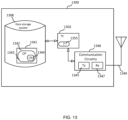
- a UE may comprise: processing circuitry (PC) 1302, which may include one or more processors (P) 1355 (e.g., one or more general purpose microprocessors and/or one or more other processors, such as an application specific integrated circuit (ASIC), field-programmable gate arrays (FPGAs), and the like); communication circuitry 1348, which is coupled to an antenna arrangement 1349 comprising one or more antennas and which comprises a transmitter (Tx) 1345 and a receiver (Rx) 1347 for enabling the UE to transmit data and receive data (e.g., wirelessly transmit/receive data); and a local storage unit (a.k.a., "data storage system”) 1308, which may include one or more non-volatile storage devices and/or one or more volatile storage devices.
- PC processing circuitry
- P processors
- ASIC application specific integrated circuit
- FPGAs field-programmable gate arrays
- communication circuitry 1348 which is coupled to an antenna arrangement 1349 comprising one or more antennas and which comprises a
- CPP 1341 includes a computer readable medium (CRM) 1342 storing a computer program (CP) 1343 comprising computer readable instructions (CRI) 1344.
- CRM 1342 may be a non-transitory computer readable medium, such as, magnetic media (e.g., a hard disk), optical media, memory devices (e.g., random access memory, flash memory), and the like.
- the CRI 1344 of computer program 1343 is configured such that when executed by PC 1302, the CRI causes the UE to perform steps described herein (e.g., steps described herein with reference to the flow charts).
- the UE may be configured to perform steps described herein without the need for code. That is, for example, PC 1302 may consist merely of one or more ASICs. Hence, the features of the embodiments described herein may be implemented in hardware and/or software.
Landscapes
- Engineering & Computer Science (AREA)
- Computer Networks & Wireless Communication (AREA)
- Signal Processing (AREA)
- Mobile Radio Communication Systems (AREA)
Claims (20)
- Procédé (1000) de configuration d'un ou plusieurs équipements utilisateurs, UE, pour transmettre de manière répétée un premier message lorsqu'une condition de répétition est remplie, le procédé étant réalisé par une station de base et comprenant :l'inclusion (s1002) dans un deuxième message d'un paramètre de répétition, dans lequel le paramètre de répétition indique qu'un UE recevant le deuxième message incluant le paramètre de répétition est autorisé à ou doit transmettre le premier message de manière répétée tant que la condition de répétition est remplie si un ou plusieurs critères sont remplis ; etla transmission (s1004) du deuxième message, caractérisée en ce quela condition de répétition est que la nouvelle tentative du canal d'accès aléatoire physique, PRACH, n'a pas eu lieu, etlesdits un ou plusieurs critères incluent que l'UE recevant le deuxième message est (i) un UE configuré pour fournir un service critique pour la mission, MC, (ii) un UE configuré pour fournir un ou plusieurs services multimédias prioritaires, ou (iii) l'un quelconque de (i) et (ii).
- Procédé selon la revendication 1, dans lequel le premier message comprend un préambule à accès aléatoire.
- Procédé selon l'une quelconque des revendications 1 à 2, dans lequel la condition de répétition est également qu'une fenêtre de réponse d'accès aléatoire, RAR, n'a pas été terminée.
- Procédé selon l'une quelconque des revendications 1 à 3, dans lequelle deuxième message est un message de diffusion, etle paramètre de répétition est inclus dans le bloc d'informations système, SIB, du message de diffusion.
- Procédé selon l'une quelconque des revendications 1 à 4, dans lequel lesdits un ou plusieurs critères sont associés à une ou plusieurs capacités d'UE.
- Procédé selon la revendication 5, dans lequel lesdites une ou plusieurs capacités d'UE comprennent i) une capacité de transmission répétée de Msg1, Msg3 et/ou MsgA, et/ou ii) une capacité liée à la formation de faisceau.
- Procédé selon l'une quelconque des revendications 1 à 6, dans lequel lesdits un ou plusieurs critères incluent qu'une mesure d'un signal de référence de liaison descendante soit inférieure ou non supérieure à un seuil prédéterminé.
- Procédé selon l'une quelconque des revendications 1 à 7, dans lequel le paramètre de répétition indique en outre le nombre de transmissions répétées autorisées ou requises du premier message.
- Procédé selon l'une quelconque des revendications 1 à 8, dans lequel
un groupe particulier de ressources PRACH est dédié à la transmission répétée du premier message pour les UE. - Procédé (1100) de configuration d'un équipement utilisateur (UE) pour transmettre de manière répétée un premier message lorsqu'une condition de répétition est remplie, le procédé étant réalisé par un UE et comprend :la réception (s1102) d'un deuxième message incluant un paramètre de répétition, le paramètre de répétition indiquant qu'un UE recevant le deuxième message incluant le paramètre de répétition est autorisé à ou doit transmettre le premier message de manière répétée pendant que la condition de répétition est remplie si un ou plusieurs critères sont remplis ;sur la base du deuxième message reçu, la détermination (s1104) s'il faut transmettre de manière répétée le premier message ;etla transmission (s1106) du premier message, caractérisée en ce quela condition de répétition est que la nouvelle tentative du canal d'accès aléatoire physique, PRACH, n'a pas eu lieu, etlesdits un ou plusieurs critères incluent que l'UE recevant le deuxième message est (i) un UE configuré pour fournir un service critique pour la mission, MC, (ii) un UE configuré pour fournir un ou plusieurs services prioritaires multimédia, ou (iii) l'un quelconque de (i) et (ii).
- Procédé selon la revendication 10, dans lequel le premier message comprend un préambule d'accès aléatoire et dans lequel la condition de répétition est également qu'une fenêtre de réponse d'accès aléatoire, RAR, n'a pas été terminée.
- Procédé selon l'une quelconque des revendications 10 à 11, dans lequelle deuxième message est un message de diffusion, etle paramètre de répétition est inclus dans le bloc d'informations système, SIB, du message de diffusion.
- Procédé selon l'une quelconque des revendications 10 à 12, dans lequel lesdits un ou plusieurs critères sont associés à une ou plusieurs capacités d'UE et dans lequel lesdites une ou plusieurs capacités d'UE comprennent i) une capacité de transmission répétée de Msg1, Msg3 et/ou MsgA, et/ou ii) une capacité liée à la formation de faisceau.
- Procédé selon l'une quelconque des revendications 10 à 13, dans lequelle procédé comprend en outre la réception d'un signal de référence de liaison descendante, etlesdits un ou plusieurs critères incluent qu'une mesure du signal de référence de liaison descendante soit inférieure ou non supérieure à un seuil prédéterminé.
- Procédé selon l'une quelconque des revendications 10 à 14, dans lequel le paramètre de répétition indique en outre le nombre de transmissions répétées autorisées ou requises du premier message.
- Procédé selon l'une quelconque des revendications 10 à 15, dans lequel un groupe particulier de ressources PRACH est dédié à la transmission répétée du premier message.
- Station de base (1200) permettant de configurer un ou plusieurs équipements utilisateurs, UE, pour transmettre de manière répétée un premier message lorsqu'une condition de répétition est remplie, comprenant un moyen configuré pour :inclure (s1002) dans un deuxième message un paramètre de répétition, dans lequel le paramètre de répétition indique qu'un UE recevant le deuxième message incluant le paramètre de répétition est autorisé à ou doit transmettre le premier message de manière répétée tant que la condition de répétition est remplie si un ou plusieurs critères sont remplis ; ettransmettre (s1004) le deuxième message, caractérisée en ce quela condition de répétition est que la nouvelle tentative du canal d'accès aléatoire physique, PRACH, n'a pas eu lieu, etlesdits un ou plusieurs critères incluent que l'UE recevant le deuxième message est (i) un UE configuré pour fournir un service critique pour la mission, MC, (ii) un UE configuré pour fournir un ou plusieurs services multimédias prioritaires, ou (iii) l'un quelconque de (i) et (ii).
- Station de base selon la revendication 17, dans laquelle la station de base comprend en outre un moyen configuré pour réaliser le procédé selon l'une quelconque des revendications 2 à 9.
- Equipement utilisateur, UE, (1300) permettant de transmettre de manière répétée un premier message lorsqu'une condition de répétition est remplie, comprenant un moyen configuré pour :recevoir (s1102) un deuxième message incluant un paramètre de répétition, le paramètre de répétition indiquant qu'un UE recevant le deuxième message incluant le paramètre de répétition est autorisé à ou doit transmettre le premier message de manière répétée pendant que la condition de répétition est remplie si un ou plusieurs critères sont remplis ;sur la base du deuxième message reçu, déterminer (s1104) s'il faut transmettre de manière répétée le premier message ; ettransmettre (s1106) le premier message, caractérisée en ce que la condition de répétition est que la nouvelle tentative du canal d'accès aléatoire physique, PRACH, n'a pas eu lieu, etlesdits un ou plusieurs critères incluent que l'UE recevant le deuxième message est (i) un UE configuré pour fournir un service critique pour la mission, MC, (ii) un UE configuré pour fournir un ou plusieurs services multimédias prioritaires, ou (iii) l'un quelconque de (i) et (ii).
- UE selon la revendication 19, dans lequel l'UE comprend en outre un moyen configuré pour réaliser le procédé selon l'une quelconque des revendications 11 à 16.
Applications Claiming Priority (2)
| Application Number | Priority Date | Filing Date | Title |
|---|---|---|---|
| CN2021098658 | 2021-06-07 | ||
| PCT/EP2022/064587 WO2022258416A1 (fr) | 2021-06-07 | 2022-05-30 | Répétition de premier message pour équipements utilisateurs critiques pour la mission |
Publications (3)
| Publication Number | Publication Date |
|---|---|
| EP4353042A1 EP4353042A1 (fr) | 2024-04-17 |
| EP4353042C0 EP4353042C0 (fr) | 2025-07-09 |
| EP4353042B1 true EP4353042B1 (fr) | 2025-07-09 |
Family
ID=82258258
Family Applications (1)
| Application Number | Title | Priority Date | Filing Date |
|---|---|---|---|
| EP22734139.3A Active EP4353042B1 (fr) | 2021-06-07 | 2022-05-30 | Répétition de premier message pour équipements utilisateurs critiques pour la mission |
Country Status (4)
| Country | Link |
|---|---|
| US (1) | US20240267944A1 (fr) |
| EP (1) | EP4353042B1 (fr) |
| JP (1) | JP7695404B2 (fr) |
| WO (1) | WO2022258416A1 (fr) |
Families Citing this family (3)
| Publication number | Priority date | Publication date | Assignee | Title |
|---|---|---|---|---|
| US20240032107A1 (en) * | 2022-07-14 | 2024-01-25 | Samsung Electronics Co., Ltd. | Initial access with multiple prach transmissions |
| US20240381431A1 (en) * | 2023-05-12 | 2024-11-14 | Qualcomm Incorporated | Determination of physical random access channel repetition numbers and associated selection criteria |
| CN116614869B (zh) * | 2023-07-17 | 2023-10-27 | 上海星思半导体有限责任公司 | Dtx模式的配置方法、接收方法、装置及处理器 |
Family Cites Families (11)
| Publication number | Priority date | Publication date | Assignee | Title |
|---|---|---|---|---|
| US7239884B2 (en) * | 2003-01-23 | 2007-07-03 | Motorola, Inc. | Method for providing improved access times for a communication device |
| DE112015006779T5 (de) * | 2015-08-06 | 2018-05-24 | Intel IP Corporation | Ausführen missionskritischer Kommunikation an einem Teilnehmergerät (UE) |
| EP3691396B1 (fr) * | 2015-11-05 | 2024-07-10 | Nec Corporation | Station de base, procédé associé et terminal radio |
| WO2019024130A1 (fr) * | 2017-08-02 | 2019-02-07 | Qualcomm Incorporated | Configurations de transmission de messages de préambule d'accès aléatoire |
| KR102902138B1 (ko) * | 2019-06-27 | 2025-12-19 | 삼성전자 주식회사 | 무선 통신 시스템에서 랜덤 액세스을 위한 방법 및 장치 |
| WO2021012137A1 (fr) * | 2019-07-22 | 2021-01-28 | Qualcomm Incorporated | Répétition de la transmission de séquences d'accès aléatoire |
| US11310836B2 (en) * | 2019-08-19 | 2022-04-19 | Samsung Electronics Co., Ltd. | Repetition of PRACH preamble transmission for UEs |
| WO2021127958A1 (fr) * | 2019-12-24 | 2021-07-01 | Qualcomm Incorporated | Techniques de répétition de message d'accès aléatoire dans des communications formées en faisceau |
| US12022519B2 (en) * | 2020-02-21 | 2024-06-25 | Qualcomm Incorporated | Physical random access channel repetition and receive-beam sweep and associated beam refinement |
| CN116349299B (zh) * | 2020-08-06 | 2025-10-28 | 苹果公司 | 用于经由随机接入信道(rach)过程从用户装备(ue)的非活动直接传输的基带处理器、ue设备和方法 |
| US11792862B2 (en) * | 2020-10-16 | 2023-10-17 | Qualcomm Incorporated | Message 3 repetition conditioned on PRACH coverage enhancement |
-
2022
- 2022-05-30 JP JP2023572648A patent/JP7695404B2/ja active Active
- 2022-05-30 US US18/567,757 patent/US20240267944A1/en active Pending
- 2022-05-30 EP EP22734139.3A patent/EP4353042B1/fr active Active
- 2022-05-30 WO PCT/EP2022/064587 patent/WO2022258416A1/fr not_active Ceased
Also Published As
| Publication number | Publication date |
|---|---|
| WO2022258416A1 (fr) | 2022-12-15 |
| EP4353042C0 (fr) | 2025-07-09 |
| JP2024519991A (ja) | 2024-05-21 |
| US20240267944A1 (en) | 2024-08-08 |
| JP7695404B2 (ja) | 2025-06-18 |
| EP4353042A1 (fr) | 2024-04-17 |
Similar Documents
| Publication | Publication Date | Title |
|---|---|---|
| EP4144139B1 (fr) | Différenciation de premiers messages dans une procédure cfra | |
| US11596001B2 (en) | Method and apparatus for performing multiple RACH procedures | |
| EP4145942A1 (fr) | Procédé et appareil d'accès aléatoire pour un terminal à capacité réduite dans un système de communication sans fil | |
| EP3997938B1 (fr) | Procédés, dispositif terminal et station de base pour procédure d'accès aléatoire | |
| CN113455089B (zh) | 随机接入过程中的竞争解决 | |
| EP4353042B1 (fr) | Répétition de premier message pour équipements utilisateurs critiques pour la mission | |
| JP2017507574A (ja) | 無線通信ネットワークのアクセス方法 | |
| US20220369375A1 (en) | Method and apparatus for random access | |
| EP3372040B1 (fr) | Appareil et procédé d'accès aléatoire fondé sur une écoute avant transmission à sous-trames partielles | |
| EP3964013B1 (fr) | Procédé d'accès à un réseau de communication cellulaire dans un spectre sans licence | |
| WO2021204087A1 (fr) | Procédé et appareil d'accès aléatoire | |
| US12389446B2 (en) | Information indication method and apparatus, device, and storage medium | |
| WO2022262411A1 (fr) | Procédé, équipement utilisateur et nœud de réseau pour groupement de préambules à base de caractéristiques | |
| EP4144173B1 (fr) | Différenciation de second message dans une procédure d'accès aléatoire | |
| US12213181B2 (en) | Method and apparatus for random access | |
| US12177909B2 (en) | Method and apparatus for random access | |
| US12615661B2 (en) | Method and apparatus for random access | |
| US20230300902A1 (en) | Method and Apparatus for Random Access | |
| HK1208986A1 (en) | Base station, user equipment and methods for random access | |
| HK1232373B (en) | Base station, user equipment and methods for random access | |
| HK1208986B (en) | Base station, user equipment and methods for random access |
Legal Events
| Date | Code | Title | Description |
|---|---|---|---|
| STAA | Information on the status of an ep patent application or granted ep patent |
Free format text: STATUS: UNKNOWN |
|
| STAA | Information on the status of an ep patent application or granted ep patent |
Free format text: STATUS: THE INTERNATIONAL PUBLICATION HAS BEEN MADE |
|
| PUAI | Public reference made under article 153(3) epc to a published international application that has entered the european phase |
Free format text: ORIGINAL CODE: 0009012 |
|
| STAA | Information on the status of an ep patent application or granted ep patent |
Free format text: STATUS: REQUEST FOR EXAMINATION WAS MADE |
|
| 17P | Request for examination filed |
Effective date: 20231204 |
|
| AK | Designated contracting states |
Kind code of ref document: A1 Designated state(s): AL AT BE BG CH CY CZ DE DK EE ES FI FR GB GR HR HU IE IS IT LI LT LU LV MC MK MT NL NO PL PT RO RS SE SI SK SM TR |
|
| DAV | Request for validation of the european patent (deleted) | ||
| DAX | Request for extension of the european patent (deleted) | ||
| STAA | Information on the status of an ep patent application or granted ep patent |
Free format text: STATUS: EXAMINATION IS IN PROGRESS |
|
| 17Q | First examination report despatched |
Effective date: 20241022 |
|
| RIC1 | Information provided on ipc code assigned before grant |
Ipc: H04W 74/00 20090101ALN20250205BHEP Ipc: H04W 74/08 20240101AFI20250205BHEP |
|
| GRAP | Despatch of communication of intention to grant a patent |
Free format text: ORIGINAL CODE: EPIDOSNIGR1 |
|
| STAA | Information on the status of an ep patent application or granted ep patent |
Free format text: STATUS: GRANT OF PATENT IS INTENDED |
|
| RIC1 | Information provided on ipc code assigned before grant |
Ipc: H04W 74/00 20090101ALN20250210BHEP Ipc: H04W 74/08 20240101AFI20250210BHEP |
|
| INTG | Intention to grant announced |
Effective date: 20250319 |
|
| GRAS | Grant fee paid |
Free format text: ORIGINAL CODE: EPIDOSNIGR3 |
|
| GRAA | (expected) grant |
Free format text: ORIGINAL CODE: 0009210 |
|
| STAA | Information on the status of an ep patent application or granted ep patent |
Free format text: STATUS: THE PATENT HAS BEEN GRANTED |
|
| AK | Designated contracting states |
Kind code of ref document: B1 Designated state(s): AL AT BE BG CH CY CZ DE DK EE ES FI FR GB GR HR HU IE IS IT LI LT LU LV MC MK MT NL NO PL PT RO RS SE SI SK SM TR |
|
| REG | Reference to a national code |
Ref country code: GB Ref legal event code: FG4D |
|
| REG | Reference to a national code |
Ref country code: CH Ref legal event code: EP |
|
| REG | Reference to a national code |
Ref country code: IE Ref legal event code: FG4D |
|
| U01 | Request for unitary effect filed |
Effective date: 20250714 |
|
| U07 | Unitary effect registered |
Designated state(s): AT BE BG DE DK EE FI FR IT LT LU LV MT NL PT RO SE SI Effective date: 20250718 |
|
| PG25 | Lapsed in a contracting state [announced via postgrant information from national office to epo] |
Ref country code: IS Free format text: LAPSE BECAUSE OF FAILURE TO SUBMIT A TRANSLATION OF THE DESCRIPTION OR TO PAY THE FEE WITHIN THE PRESCRIBED TIME-LIMIT Effective date: 20251109 |
|
| PG25 | Lapsed in a contracting state [announced via postgrant information from national office to epo] |
Ref country code: NO Free format text: LAPSE BECAUSE OF FAILURE TO SUBMIT A TRANSLATION OF THE DESCRIPTION OR TO PAY THE FEE WITHIN THE PRESCRIBED TIME-LIMIT Effective date: 20251009 |
|
| PG25 | Lapsed in a contracting state [announced via postgrant information from national office to epo] |
Ref country code: HR Free format text: LAPSE BECAUSE OF FAILURE TO SUBMIT A TRANSLATION OF THE DESCRIPTION OR TO PAY THE FEE WITHIN THE PRESCRIBED TIME-LIMIT Effective date: 20250709 |
|
| PG25 | Lapsed in a contracting state [announced via postgrant information from national office to epo] |
Ref country code: GR Free format text: LAPSE BECAUSE OF FAILURE TO SUBMIT A TRANSLATION OF THE DESCRIPTION OR TO PAY THE FEE WITHIN THE PRESCRIBED TIME-LIMIT Effective date: 20251010 |
|
| PG25 | Lapsed in a contracting state [announced via postgrant information from national office to epo] |
Ref country code: PL Free format text: LAPSE BECAUSE OF FAILURE TO SUBMIT A TRANSLATION OF THE DESCRIPTION OR TO PAY THE FEE WITHIN THE PRESCRIBED TIME-LIMIT Effective date: 20250709 |
|
| PG25 | Lapsed in a contracting state [announced via postgrant information from national office to epo] |
Ref country code: RS Free format text: LAPSE BECAUSE OF FAILURE TO SUBMIT A TRANSLATION OF THE DESCRIPTION OR TO PAY THE FEE WITHIN THE PRESCRIBED TIME-LIMIT Effective date: 20251009 |
|
| PG25 | Lapsed in a contracting state [announced via postgrant information from national office to epo] |
Ref country code: ES Free format text: LAPSE BECAUSE OF FAILURE TO SUBMIT A TRANSLATION OF THE DESCRIPTION OR TO PAY THE FEE WITHIN THE PRESCRIBED TIME-LIMIT Effective date: 20250709 |
|
| PG25 | Lapsed in a contracting state [announced via postgrant information from national office to epo] |
Ref country code: SM Free format text: LAPSE BECAUSE OF FAILURE TO SUBMIT A TRANSLATION OF THE DESCRIPTION OR TO PAY THE FEE WITHIN THE PRESCRIBED TIME-LIMIT Effective date: 20250709 |
|
| PG25 | Lapsed in a contracting state [announced via postgrant information from national office to epo] |
Ref country code: CZ Free format text: LAPSE BECAUSE OF FAILURE TO SUBMIT A TRANSLATION OF THE DESCRIPTION OR TO PAY THE FEE WITHIN THE PRESCRIBED TIME-LIMIT Effective date: 20250709 |
|
| PG25 | Lapsed in a contracting state [announced via postgrant information from national office to epo] |
Ref country code: SK Free format text: LAPSE BECAUSE OF FAILURE TO SUBMIT A TRANSLATION OF THE DESCRIPTION OR TO PAY THE FEE WITHIN THE PRESCRIBED TIME-LIMIT Effective date: 20250709 |