EP4353174A2 - Verfahren zur kontaktierung von flexiblen elektroden - Google Patents
Verfahren zur kontaktierung von flexiblen elektroden Download PDFInfo
- Publication number
- EP4353174A2 EP4353174A2 EP24159225.2A EP24159225A EP4353174A2 EP 4353174 A2 EP4353174 A2 EP 4353174A2 EP 24159225 A EP24159225 A EP 24159225A EP 4353174 A2 EP4353174 A2 EP 4353174A2
- Authority
- EP
- European Patent Office
- Prior art keywords
- conductor
- electrode
- layer
- metalliferous
- substrate
- Prior art date
- Legal status (The legal status is an assumption and is not a legal conclusion. Google has not performed a legal analysis and makes no representation as to the accuracy of the status listed.)
- Withdrawn
Links
Images


Classifications
-
- A—HUMAN NECESSITIES
- A61—MEDICAL OR VETERINARY SCIENCE; HYGIENE
- A61N—ELECTROTHERAPY; MAGNETOTHERAPY; RADIATION THERAPY; ULTRASOUND THERAPY
- A61N1/00—Electrotherapy; Circuits therefor
- A61N1/02—Details
- A61N1/04—Electrodes
- A61N1/0404—Electrodes for external use
- A61N1/0472—Structure-related aspects
- A61N1/048—Electrodes characterised by a specific connection between lead and electrode
-
- H—ELECTRICITY
- H01—ELECTRIC ELEMENTS
- H01R—ELECTRICALLY-CONDUCTIVE CONNECTIONS; STRUCTURAL ASSOCIATIONS OF A PLURALITY OF MUTUALLY-INSULATED ELECTRICAL CONNECTING ELEMENTS; COUPLING DEVICES; CURRENT COLLECTORS
- H01R43/00—Apparatus or processes specially adapted for manufacturing, assembling, maintaining, or repairing of line connectors or current collectors or for joining electric conductors
- H01R43/20—Apparatus or processes specially adapted for manufacturing, assembling, maintaining, or repairing of line connectors or current collectors or for joining electric conductors for assembling or disassembling contact members with insulating base, case or sleeve
-
- A—HUMAN NECESSITIES
- A61—MEDICAL OR VETERINARY SCIENCE; HYGIENE
- A61N—ELECTROTHERAPY; MAGNETOTHERAPY; RADIATION THERAPY; ULTRASOUND THERAPY
- A61N1/00—Electrotherapy; Circuits therefor
- A61N1/02—Details
- A61N1/04—Electrodes
- A61N1/05—Electrodes for implantation or insertion into the body, e.g. heart electrode
- A61N1/0551—Spinal or peripheral nerve electrodes
- A61N1/0558—Anchoring or fixation means therefor
-
- B—PERFORMING OPERATIONS; TRANSPORTING
- B05—SPRAYING OR ATOMISING IN GENERAL; APPLYING FLUENT MATERIALS TO SURFACES, IN GENERAL
- B05D—PROCESSES FOR APPLYING FLUENT MATERIALS TO SURFACES, IN GENERAL
- B05D3/00—Pretreatment of surfaces to which liquids or other fluent materials are to be applied; After-treatment of applied coatings, e.g. intermediate treating of an applied coating preparatory to subsequent applications of liquids or other fluent materials
- B05D3/06—Pretreatment of surfaces to which liquids or other fluent materials are to be applied; After-treatment of applied coatings, e.g. intermediate treating of an applied coating preparatory to subsequent applications of liquids or other fluent materials by exposure to radiation
-
- C—CHEMISTRY; METALLURGY
- C23—COATING METALLIC MATERIAL; COATING MATERIAL WITH METALLIC MATERIAL; CHEMICAL SURFACE TREATMENT; DIFFUSION TREATMENT OF METALLIC MATERIAL; COATING BY VACUUM EVAPORATION, BY SPUTTERING, BY ION IMPLANTATION OR BY CHEMICAL VAPOUR DEPOSITION, IN GENERAL; INHIBITING CORROSION OF METALLIC MATERIAL OR INCRUSTATION IN GENERAL
- C23C—COATING METALLIC MATERIAL; COATING MATERIAL WITH METALLIC MATERIAL; SURFACE TREATMENT OF METALLIC MATERIAL BY DIFFUSION INTO THE SURFACE, BY CHEMICAL CONVERSION OR SUBSTITUTION; COATING BY VACUUM EVAPORATION, BY SPUTTERING, BY ION IMPLANTATION OR BY CHEMICAL VAPOUR DEPOSITION, IN GENERAL
- C23C18/00—Chemical coating by decomposition of either liquid compounds or solutions of the coating forming compounds, without leaving reaction products of surface material in the coating; Contact plating
- C23C18/16—Chemical coating by decomposition of either liquid compounds or solutions of the coating forming compounds, without leaving reaction products of surface material in the coating; Contact plating by reduction or substitution, e.g. electroless plating
-
- A—HUMAN NECESSITIES
- A61—MEDICAL OR VETERINARY SCIENCE; HYGIENE
- A61B—DIAGNOSIS; SURGERY; IDENTIFICATION
- A61B18/00—Surgical instruments, devices or methods for transferring non-mechanical forms of energy to or from the body
- A61B18/04—Surgical instruments, devices or methods for transferring non-mechanical forms of energy to or from the body by heating
- A61B18/12—Surgical instruments, devices or methods for transferring non-mechanical forms of energy to or from the body by heating by passing a current through the tissue to be heated, e.g. high-frequency current
- A61B18/14—Probes or electrodes therefor
- A61B18/1492—Probes or electrodes therefor having a flexible, catheter-like structure, e.g. for heart ablation
-
- A—HUMAN NECESSITIES
- A61—MEDICAL OR VETERINARY SCIENCE; HYGIENE
- A61N—ELECTROTHERAPY; MAGNETOTHERAPY; RADIATION THERAPY; ULTRASOUND THERAPY
- A61N1/00—Electrotherapy; Circuits therefor
- A61N1/02—Details
- A61N1/04—Electrodes
- A61N1/05—Electrodes for implantation or insertion into the body, e.g. heart electrode
- A61N1/056—Transvascular endocardial electrode systems
-
- H—ELECTRICITY
- H01—ELECTRIC ELEMENTS
- H01B—CABLES; CONDUCTORS; INSULATORS; SELECTION OF MATERIALS FOR THEIR CONDUCTIVE, INSULATING OR DIELECTRIC PROPERTIES
- H01B13/00—Apparatus or processes specially adapted for manufacturing conductors or cables
- H01B13/003—Apparatus or processes specially adapted for manufacturing conductors or cables using irradiation
Definitions
- the invention relates to a method for the electrical connection of an electrode (101) to a conductor (102) to form an electrode-conductor composite, an electrode-conductor composite produced according to the method according to the invention, and the use of laser irradiation of a metalliferous layer for producing an electrode-conductor composite.
- An electrode-conductor composite of this type is in particular advantageous for the use in the medical technology.
- the electrical contact-connection of an electrical conductor can often represent a large challenge, in particular in the case of small dimensions. Good electrical conductivity and mechanical stability, e.g., are thereby desired even in the case of heavy use for a longer period of time. This applies in particular in the case of the electrical contact-connection of lines in medical devices. In devices, which are inserted into the human or animal body, it is desirable to use thin lines, which, however, may represent a challenge for the electrical contact-connection due to their size.
- Electrical contact-connections which are located on a flexible substrate, represent particular challenges, for example in the case of the contact-connection of conductor tracks with sensors or stimulation electrodes, which are located on flexible plastic substrates. Further difficulties also result, for example, when flexible electrodes are very thin and the leads, which connect the electrodes to the pulse generators, are dimensioned significantly larger. In many cases, the different materials in the area of the contact-connection (metal and polymers) furthermore represent a large challenge.
- the contact-connection is often formed too rigidly in the prior art, so that the advantage of the flexibility gets lost.
- Known contact-connections are furthermore not sufficiently stable in the long term, so that the service life is not sufficiently long (fatigue breakage at the contact-connection).
- a contact-connection can take place without additional material.
- the formed contact-connection is not stable in the long term and is also not suitable for all materials.
- the adhesion as described, for example, in EP0612538A2 , provides for a flexible connection, but an additional material is required thereby, which is generally not biocompatible and often becomes brittle after a certain period of time.
- Welding provides for a contact-connection without additional material, but forms a rigid, relatively large-volume contact-connection. In many cases, the welding of thin layers is demanding or impossible, because they can be thermally destroyed, in particular while attempting the contact-connection with high-melting materials, such as platinum.
- the soldering can be performed as welding at low temperature, but the formed contact-connections are likewise rigid, and a non-biocompatible, additional material is required.
- the invention provides, for example, for a contact-connection, which is stable in the long term, with flat construction in particular on flexible substrates, so that the flexibility of the entire system of lead and flexible electrode is ensured.
- This method can be adapted more easily to required design variations than prior art methods and provides products with improved properties, as described below.
- the improved contact-connection can show itself, for example, in a higher reliability, stability, and conductivity.
- the invention provides, for example, a contact-connection with improved breaking strength and breaking stability.
- a first aspect of the invention relates to a method for the electrical connection of an electrode to a conductor to form an electrode-conductor composite, comprising
- the metallic layer contains a metal or a metal oxide.
- Platinum oxide, iridium oxide, titanium oxide, tantalum oxide, niobium oxide, copper oxide are examples for suitable metal oxides.
- the metalliferous layer is preferably set up to form a coherent, electroconductive metal layer, when it is irradiated with a laser.
- particles of copper oxide which are in a suspension, are converted into metallic copper by irradiating with a laser, so that an electroconductive coherent metal layer is formed on a substrate.
- Suitable copper oxide is, for example, the NanoArc copper oxide powder, which can be obtained from Alfa Aesar, with a particle dimeter of approximately 200-300 nm. This is described, for example, in Kang et al, J. Phys. Chem. C20111154823664-23670 .
- infrared lasers with a wavelength of approximately 1000 nm, e.g.
- 1070 nm are particularly suitable for the conversion of CuO into metallic copper.
- metal particles are fused to form a coherent electroconductive metal layer by irradiation with a laser.
- metal particles and/or metal oxide particles are sintered to form a coherent electroconductive metal layer by irradiation with a laser.
- the metalliferous layer can comprise a metal powder or a metalliferous suspension.
- the metalliferous layer consists of a metal powder.
- the metalliferous layer consists of a metalliferous suspension.
- a metalliferous suspension comprises, for example, metal particles or metal oxide particles, and a liquid, for example water. This liquid can also comprise an organic solvent, for example a mixture of poly(vinylpyrrolidone) and ethylene glycol.
- the liquid can comprise a dispersing agent.
- a dispersing agent of this type is preferably selected so that it keeps the metal particles or metal oxide particles in the colloidal state in the liquid.
- the electrode and/or the conductor are located on a substrate.
- the substrate is a film.
- the substrate comprises a plastic.
- the substrate is flexible, for example a flexible plastic film. "Flexible" means that the substrate can be deformed significantly by manual force, without breaking or tearing, Examples for flexible substrates are plastic films, which are typically used as substrates for the production of film cables in the electronics industry. Polyester films with a thickness of 0.1-0.5 mm are examples for this.
- the flexible substrate comprises polyurethane, polyimide, silicon, PEEK, or LCP.
- the suspension can be applied to the substrate by a coating process, for example spin coating.
- Coherent means here that a metal layer is formed, which is formed continuously in such a way that it can serve as electrical connection of two electrical components.
- a conductor is an electroconductive structure, which is provided for the electrical connection of electrical or electronic components.
- a conductor can be, for example, a wire, for example an electrically insulated wire, or a conductor track.
- the wire can be part of a cable.
- the conductor can be, for example, a metal wire.
- the conductor comprises one or several of the metals Pt, Ir, Ta, Pd, Ti, Fe, Au, Ag, Mo, Nb, W, Ni, Ti, or a mixture or alloy thereof, respectively.
- the conductor comprises the alloys MP35, PtIr10, PtIr20, 316L, 301, or nitinol.
- the conductor can also comprise multi-layer material systems.
- the conductor preferably comprises MP35, Au, Ta, Pt, Ir, or Pd.
- a part of the conductor consists of MP35, Au, Ta, Pt, Ir, or Pd, or alloys of these metals.
- the conductor contains less than 3%, 2%, or less than 1% of Fe.
- MP35 is a curable alloy on the basis of nickel-cobalt. A variation of MP35 is described in the industrial standard ASTM F562-13.
- MP35 is an alloy, which comprises 33 to 37% of Co, 19 to 21% of Cr, 9 to 11% of Mo, and 33 to 37% of Ni.
- PtIr10 is an alloy of 88 to 92% of platinum and 8 to 12% of iridium.
- PtIr20 is an alloy of 78 to 82% of platinum and 18 to 22% of iridium.
- 316L is an acid-resistant CrNiMo austenitic steel with approx. 17% of Cr; approx. 12% of Ni, and at least 2.0% of Mo. A variation of 316L is described in the industrial standard 10088-2. In one embodiment, 316L is an alloy, which comprises 16.5 to 18.5% of Cr; 2 to 2.5% of Mo, and 10 to 13% of Ni.
- 301 is a chromium nickel steel with a high corrosion resistance. A variation of 301 is described in the industrial standard DIN 1.4310. In one embodiment, 301 is an alloy, which comprises 16 to 18% of Cr and 6 to 8% of Ni.
- Nitinol is a nickel-titanium alloy with shape memory with an orderly cubic crystal structure and a nickel portion of approximately 55%, wherein the remaining portion consists of titanium. Nitinol has good properties with respect to biocompatibility and corrosion resistance. Unless otherwise specified, all percentages herein are to be understood as percentage by mass (% by weight).
- the conductor has a spherical or a flattened form at its end. In one embodiment, the conductor is connected at this end to the metal layer. In one embodiment, the conductor is connected to the metal layer at this end by irradiation of a metalliferous layer with a laser.
- An electrode is an electroconductive structure.
- the electrode is suitable to output an electrical signal to the human body or to receive an electrical signal from the human body.
- An electrode can also comprise a conductor track.
- the electrode is a conductor track, which is arranged on a substrate.
- the conductor track is connected to a substrate.
- the conductor track is connected directly to a substrate.
- the electrode is a sensor or a stimulation electrode for use in the human or animal body.
- the electrode comprises a metal or a metal alloy, for example those metals or alloys, which are described herein as being suitable for the conductor.
- the electrode consists of a biocompatible material.
- a biocompatible material is a material, which is suitable for the implementation into the human or animal body.
- the electrode comprises gold or platinum.
- the electrode consists of gold or platinum.
- the electrode is set up to receive or to output an electrical signal. In one embodiment, the electrode is set up to receive an electrical signal from the human body or to output it to the human body. In some embodiments, the electrode comprises one or several of the metals Pt, Ir, Ta, Pd, Ti, Fe, Au, Mo, Nb, W, Ni, Ti, or a mixture or alloy thereof, respectively. In some embodiments, the electrode comprises the alloys MP35, PtIr20, PtIr10, PdIr10, 316L, or 301. The electrode can also comprise multi-layer material systems. In some embodiments, the electrode consists of one or several of these materials.
- the method comprises the steps a to c:
- an electrode and a conductor are provided, which are arranged on a substrate, for example a flexible plastic film.
- the electrode and the conductor are preferably firmly connected to the substrate.
- the electrode and the conductor are located on the same side of the substrate.
- step b the electrode and the conductor are brought into contact with the metalliferous layer.
- a metalliferous layer can be applied to the substrate so that it simultaneously covers the electrode as well as the substrate at least partially.
- the metalliferous layer is preferably applied at that location, at which the coherent metal layer is to be created, for example along the shortest connecting line between the electrode and the conductor.
- the metalliferous layer can comprise, for example, a metalliferous suspension, a paste, or a metal power, or can consist thereof.
- the suspension, paste, or the powder can in each case comprise a metal and/or metal oxide.
- Metal or metal oxide particles are present in colloidal state in a suspension, i.e. they are dispersed evenly in a liquid.
- a paste is a suspension, which has a particle content, which is so high that it is no longer free-flowing.
- a powder is a granular medium, which comprises only solid matter.
- the metalliferous layer is irradiated with a laser, so that a coherent metal layer, which connects the electrode and the conductor in an electroconductive manner, is formed from the metal or metal oxide particles in the metalliferous layer.
- metal oxide particles can thereby be reduced to form elemental metal, and/or metal particles can be fused or sintered to form a coherent layer.
- the method comprises steps d to g:
- a conductor is hereby initially provided on a substrate, as described above. In this step, however, an electrode does not necessarily also need to be provided yet.
- the conductor is brought into contact with the metalliferous layer, as described above.
- the metalliferous layer can comprise, for example, a metalliferous suspension, a paste, or a metal powder, or can consist thereof, as described above.
- an electrode is formed by irradiation of the metalliferous layer with a laser. In one embodiment, the formation of the electrode takes place by irradiation of the metalliferous layer with a laser in such a way that an electrical connection of the electrode to the conductor is formed directly. In one embodiment, the conductor and the electrode are connected to one another in a different way. An electrode-conductor composite is formed by the electroconductive connection of the electrode to the conductor.
- an electrode is initially provided on the substrate by irradiation of a metalliferous layer with a laser, and a conductor is subsequently provided and is connected to the electrode.
- the conductor can thereby be formed by irradiation of a metalliferous layer with a laser or can be provided in a different way. This can take place, for example, with the help of complementary structures, as described in more detail below.
- the electrode and/or the conductor are fixed to the substrate, so that they do not change their position during the formation of the metalliferous layer.
- the electrode and/or the conductor are embedded into the flexible substrate by irradiation with a laser.
- the substrate is partially melted or softened at a suitable position by irradiation of the substrate, so that the electrode and/or the conductor sink into the substrate, and are thus embedded into the substrate.
- the electrode and/or the conductor are pressed into the substrate.
- the substrate is softened or melted by irradiation with a laser, and the electrode and/or the conductor are subsequently pressed into the softened or melted substrate.
- the electrode and/or the conductor are preferably furthermore accessible to the outside, i.e. they can subsequently also be connected to one another in a conductive manner with the help of a metalliferous layer, without having to remove the substrate.
- the electrode and/or the conductor are fixed to the substrate by the embedding into the substrate, so that they are no longer movable relative to the substrate.
- the conductor and/or the electrode can, for example, be pressed or melted into the substrate.
- the electrode and/or the conductor are fixed to the substrate by applying an additional fixing layer.
- the fixing layer is preferably arranged outside of the metalliferous layer and/or of the electrical connection formed therefrom.
- the contact-connection area between electrode and conductor can thus be kept free from the material of the fixing layer.
- This fixing layer can be, for example, an adhesive, a photoresist, or a low-melting plastic.
- the low-melting plastic has a melting temperature of less than 300°C, 200°C, or 150°C.
- the electrode and/or the conductor is fixed to the substrate by applying an additional fixing layer prior to the irradiation of the metalliferous layer with the laser.
- the electrode and/or the conductor is fixed by a holding device, for example a gripper or a clamping device.
- the conductor and/or the electrode are embedded into the substrate with the help of an injection molding process.
- the conductor is embedded into the substrate as described above, and an electrode is subsequently formed by irradiating a metalliferous layer.
- the conductor as well as the electrode are embedded into the substrate as described above, and the electrode is subsequently connected to the conductor by irradiating a metalliferous layer, and thus forming a coherent metal layer.
- the electrode and the conductor have different diameters. This refers to the smallest diameter of the electrode or of the conductor, respectively, at that location, at which a connection between the electrode and the conductor is to take place with the help of the electroconductive metal layer. This can be, for example, the diameter of a wire or the width of a conductor track. It is possible with the help of the method according to the invention to design the geometry of the electroconductive metal layer, which is formed by irradiation of the metalliferous layer with a laser, to be virtually arbitrary. In this way, the formation of the electroconductive metal layer can take place in such a way in one embodiment that the electroconductive metal layer forms a geometrical and mechanical gradient between the diameters of the electrode and the conductor.
- the width and/or height of the electroconductive metal layer tapers continuously between the electrode and the conductor in order to establish an even transition between the diameters of the electrode and the conductor.
- a gradient at the height of the electroconductive metal layer can be attained by an increasing or decreasing layer thickness of the electroconductive metal layer. This can be attained, for example, in that the laser power and/or irradiation duration is increased accordingly by variation of the movement speed or the number of the laser pass-overs of the laser at the areas, which are to have a higher layer thickness.
- the steps of bringing the electrode and/or the conductor into contact with a metalliferous layer and the irradiation of the metalliferous layer with a laser can be repeated several times, wherein a higher number of repetitions are performed in the areas with a desired higher layer thickness.
- a method is therefore provided, wherein the electrode and the conductor have different diameters, and the formation of an electroconductive material layer takes place in such a way that the electroconductive metal layer forms a gradient between the diameters of the electrode and of the conductor.
- the gradient is a geometrical and/or mechanical gradient.
- the method furthermore comprises the removing of the metalliferous layer after the formation of the electroconductive metal layer.
- the metalliferous layer By the irradiation of the metalliferous layer with a laser, only a portion of the metal particles become parts of the electroconductive material layer in some cases. The remaining metal particles and optionally the carrier, which can be part of the metalliferous layer, are no longer required after the formation of the electroconductive metal layer, and can be removed.
- the metalliferous layer is completely removed after the formation of the electroconductive metal layer. In one embodiment, the electroconductive metal layer is thereby not removed.
- the metalliferous layer is applied as liquid suspension, as paste, or as metal powder, as described above in more detail.
- the metalliferous layer can for example be applied to the substrate in such a way that it in each case partially covers the electrode and the conductor, and covers the area of the substrate located therebetween, in which the electroconductive metal layer is to form a connection between the electrode and the conductor.
- the electrode and/or the conductor is coated in order to improve the connection to the electroconductive metal layer.
- This coating can be coated, for example, with a meltable material, for example a low-melting metal.
- the conductor is an electrically insulated wire and is coated at a non-insulated area of the wire.
- the conductor and/or the electrode is coated with a material, which chemically reacts with the metalliferous layer.
- the conductor and/or the electrode are coated with nanoparticles.
- the nanoparticles are set up to chemically or physically react with the metalliferous layer, in particular with the metal or metal oxide particles contained therein.
- the electrode and/or the conductor is coated with a material, which effects or supports the reduction of a metal oxide in the metalliferous layer.
- the electrode and/or the conductor is coated with a coating, which comprises a polymer.
- the polymer is a conductive polymer, for example PEDOT, or a polymer, which comprises carbon particles or carbon nanotubes.
- the coating comprises a metal or an alloy.
- the metal is platinum or gold.
- the alloy is a nickel-titanium alloy.
- the metal or the alloy preferably have a low melting point, for example a melting point of less than 500°C, 450°C, or 400°C. This low melting point can be attained, for example, in that the metal or the alloy are present in the form of nanoparticles. Particles with an average size diameter of less than 100 nm are referred to as nanoparticles.
- the electrode and/or the conductor is coated with a coating, which comprises a polymer and metal nanoparticles.
- the electrode and/or the conductor are provided with a structure or are roughened in order to improve the connection to the electroconductive metal layer.
- the electrode and the conductor are provided with structures, which are in each case complementary to one another. This makes it possible that the electrode and the conductor can be connected to one another in a positive manner.
- the electrode and the conductor are connected to one another in a positive manner as well as in a non-positive manner.
- the electrode and the conductor are connected to one another in a positive manner as well as by means of a substance-to-substance bond.
- the substance-to-substance bond of the electrode to the conductor comprises the irradiation of a metalliferous layer with a laser, and thus formation of a coherent electroconductive metal layer, which connects the electrode to the conductor.
- the substance-to-substance bond of the electrode to the conductor comprises the cold welding (press fit) of the electrode to the conductor.
- the conductor and the electrode are connected to one another by pressing.
- an electrically insulating layer is additionally applied to the electroconductive metal layer.
- the electroconductive metal layer is covered completely by the electrically insulating layer.
- the electrically insulating layer comprises a polymer.
- the polymer is selected from the group consisting of silicon, polyethylene, polyurethane, polyimide, polyamide, PEEK, fluorinated plastics. Fluorinated plastics are, for example, ETFE, PTFE, PFA, PVDF, or FEP.
- a further aspect of the invention relates to an electrode-conductor composite, which is produced or can be produced according to any one of the above-described methods.
- An electrode-conductor composite comprises an electrode, which is connected to a conductor in an electroconductive manner.
- the electrode-conductor composite is electrical medical device or a part of a device of this type.
- the electrical medical device can be, e.g., a lead, pulse generator, pacemaker, cardiac resynchronization device, catheter, sensor, or stimulator.
- Leads are electrical lines, which can be used, for example, in medical applications, such as neuromodulation, cardiac stimulation, deep brain stimulation, spinal cord stimulation, peripheral nerve stimulation, or gastric stimulation.
- catheters according to the invention are those, which are set up for the electrophysiological mapping or the ablation of tissue.
- the lead is set up and/or intended to be connected to a generator of an active implantable device.
- a lead of the invention can also be used in a medical device in order to receive an electrical signal.
- a stimulator is a medical device, which can have a physiological effect by outputting an electrical signal to the body of a living being.
- a neurostimulator can effect an electrical signal in the nerve cell (e.g. an action potential) by outputting an electrical signal to a nerve cell.
- a further embodiment relates to a microelectrode or a microelectrode array, which comprises an electrode-conductor composite described herein.
- a further aspect relates to the use of laser irradiation of a metalliferous layer, and thus forming an electrical connection for producing an electrode-conductor composite. This use can be, for example, for one of the methods described herein.
- Fig. 1 describes a first method.
- a substrate 105 is initially provided.
- a conductor 102 is arranged on the substrate, The conductor 102 can be fixed to the substrate 105 temporarily or permanently.
- the conductor 102 can be a wire, for example.
- the conductor 102 can be pressed into the substrate and/or can be partially melted into the substrate in order to fix the conductor 102 to the substrate 105.
- a metalliferous layer is applied to the substrate 105, so that it at least partially covers the conductor 102.
- the metalliferous layer 103 covers the substrate 105 and the conductor 102 at least at that location, at which a coherent conductive metal layer 104 is to be formed.
- step 114 the metalliferous layer 103 is irradiated at this location with a laser (not shown), so that the coherent conductive metal layer 104 forms.
- An electrode 101 is formed from the metal layer 104 in this example, namely in such a way that the electrode 101 is connected to the conductor 102 in an electroconductive manner, thus forms an electrode-conductor composite on the substrate 105.
- step 115 the remaining metalliferous layer 103 is removed. What remains is the electrode-conductor composite on the substrate 105.
- step 116 the resulting electrode-conductor composite is covered with an electrically insulating layer 108.
- the metal layer 104 can be protected against damages thereby.
- the step 116 is optional and can also be omitted.
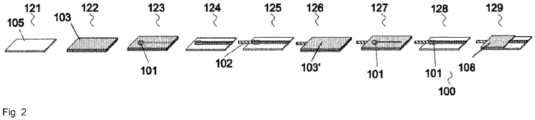
- Fig. 2 describes a second method.
- a substrate 105 is provided.
- a metalliferous layer 103 is applied to the substrate 105.
- the metalliferous layer 103 is irradiated with a laser (not shown), so that an electrode 101 made of metal forms on the substrate 105.
- the remaining metalliferous layer 103 is removed.
- a conductor 102 is provided and is brought into contact with the electrode 101.
- the substrate 105, the conductor 102, and the electrode 101 are covered with a further metalliferous layer 103'.
- step 127 the further metalliferous layer 103' is irradiated with a laser, so that a further coherent electroconductive metal layer forms, which connects the electrode 101 to the conductor 102 in an electroconductive manner.
- step 129 an electrically insulating layer 108 is applied to the further electroconductive metal layer 103'.
- the electrode 101 as well as the electroconductive metal layer, which connects the electrode to the conductor 102 is in each case formed by irradiation of a metalliferous layer 103, 103' with a laser.
- the two metalliferous layers 103, 103' can be identical or different.
- Fig. 3 describes a third method.
- a substrate 105 is provided.
- the substrate 105 is covered with a metalliferous layer 103 and is thus brought into contact with the substrate 105.
- the metalliferous layer 103 is irradiated with a laser, so that an electroconductive, coherent metal layer 104 forms on the substrate 105. The laser is thereby guided in such a way that the metal layer 104 forms an electrode 101 with a structure 107 at the end of the electrode 101.
- the excess portion of the metalliferous layer 103 is removed.
- a conductor 102 is provided, which has a structure 107 ⁇ , which is complementary to the structure 107 of the electrode 101, so that the two structures 107, 107'engage with one another and can be connected to one another in a positive manner.
- an electrode-conductor composite 100 is formed.
- the structures 107, 107 ⁇ are covered with electrically insulating layer 108.
Landscapes
- Health & Medical Sciences (AREA)
- Engineering & Computer Science (AREA)
- Chemical & Material Sciences (AREA)
- Biomedical Technology (AREA)
- Veterinary Medicine (AREA)
- Public Health (AREA)
- General Health & Medical Sciences (AREA)
- Animal Behavior & Ethology (AREA)
- Life Sciences & Earth Sciences (AREA)
- Radiology & Medical Imaging (AREA)
- Nuclear Medicine, Radiotherapy & Molecular Imaging (AREA)
- Cardiology (AREA)
- Neurology (AREA)
- Orthopedic Medicine & Surgery (AREA)
- Neurosurgery (AREA)
- Heart & Thoracic Surgery (AREA)
- Materials Engineering (AREA)
- Organic Chemistry (AREA)
- Metallurgy (AREA)
- Mechanical Engineering (AREA)
- Physics & Mathematics (AREA)
- Chemical Kinetics & Catalysis (AREA)
- General Chemical & Material Sciences (AREA)
- Plasma & Fusion (AREA)
- Manufacturing & Machinery (AREA)
- Laser Beam Processing (AREA)
- Electrotherapy Devices (AREA)
- Conductive Materials (AREA)
- Electrodes Of Semiconductors (AREA)
Applications Claiming Priority (2)
| Application Number | Priority Date | Filing Date | Title |
|---|---|---|---|
| DE102019006709.6A DE102019006709A1 (de) | 2019-09-25 | 2019-09-25 | Kontaktierung flexibler Elektroden |
| EP20183127.8A EP3799082B1 (de) | 2019-09-25 | 2020-06-30 | Verfahren zur kontaktierung von flexiblen elektroden |
Related Parent Applications (2)
| Application Number | Title | Priority Date | Filing Date |
|---|---|---|---|
| EP20183127.8A Division-Into EP3799082B1 (de) | 2019-09-25 | 2020-06-30 | Verfahren zur kontaktierung von flexiblen elektroden |
| EP20183127.8A Division EP3799082B1 (de) | 2019-09-25 | 2020-06-30 | Verfahren zur kontaktierung von flexiblen elektroden |
Publications (2)
| Publication Number | Publication Date |
|---|---|
| EP4353174A2 true EP4353174A2 (de) | 2024-04-17 |
| EP4353174A3 EP4353174A3 (de) | 2024-07-10 |
Family
ID=71409169
Family Applications (2)
| Application Number | Title | Priority Date | Filing Date |
|---|---|---|---|
| EP20183127.8A Active EP3799082B1 (de) | 2019-09-25 | 2020-06-30 | Verfahren zur kontaktierung von flexiblen elektroden |
| EP24159225.2A Withdrawn EP4353174A3 (de) | 2019-09-25 | 2020-06-30 | Verfahren zur kontaktierung von flexiblen elektroden |
Family Applications Before (1)
| Application Number | Title | Priority Date | Filing Date |
|---|---|---|---|
| EP20183127.8A Active EP3799082B1 (de) | 2019-09-25 | 2020-06-30 | Verfahren zur kontaktierung von flexiblen elektroden |
Country Status (3)
| Country | Link |
|---|---|
| US (1) | US20210085956A1 (de) |
| EP (2) | EP3799082B1 (de) |
| DE (1) | DE102019006709A1 (de) |
Families Citing this family (2)
| Publication number | Priority date | Publication date | Assignee | Title |
|---|---|---|---|---|
| CN114406515A (zh) * | 2022-01-28 | 2022-04-29 | 中国科学院上海微系统与信息技术研究所 | 一种脑电极器件的焊接方法及脑电极器件 |
| DE102024123841A1 (de) * | 2024-08-21 | 2026-02-26 | Contract Medical International Gmbh | Verfahren zur Herstellung eines Katheterkörpers |
Citations (2)
| Publication number | Priority date | Publication date | Assignee | Title |
|---|---|---|---|---|
| EP0612538A2 (de) | 1993-02-22 | 1994-08-31 | Cardiac Pacemakers, Inc. | Metallisierte Herzelektrode |
| US20180126155A1 (en) | 2016-11-07 | 2018-05-10 | Micro-Leads, Inc. | Multi-electrode array with unitary body |
Family Cites Families (4)
| Publication number | Priority date | Publication date | Assignee | Title |
|---|---|---|---|---|
| US6740411B2 (en) * | 2001-02-21 | 2004-05-25 | Ngk Spark Plug Co. Ltd. | Embedding resin, wiring substrate using same and process for producing wiring substrate using same |
| US8700178B2 (en) * | 2005-12-27 | 2014-04-15 | Boston Scientific Neuromodulation Corporation | Stimulator leads and methods for lead fabrication |
| KR100951320B1 (ko) * | 2007-07-26 | 2010-04-05 | 주식회사 엘지화학 | 레이저 조사에 의한 전기전도성 구리 패턴층의 형성방법 |
| WO2014087945A1 (ja) * | 2012-12-07 | 2014-06-12 | 富士フイルム株式会社 | 導電膜の製造方法、プリント配線基板 |
-
2019
- 2019-09-25 DE DE102019006709.6A patent/DE102019006709A1/de not_active Ceased
-
2020
- 2020-06-30 EP EP20183127.8A patent/EP3799082B1/de active Active
- 2020-06-30 EP EP24159225.2A patent/EP4353174A3/de not_active Withdrawn
- 2020-09-23 US US17/029,741 patent/US20210085956A1/en not_active Abandoned
Patent Citations (2)
| Publication number | Priority date | Publication date | Assignee | Title |
|---|---|---|---|---|
| EP0612538A2 (de) | 1993-02-22 | 1994-08-31 | Cardiac Pacemakers, Inc. | Metallisierte Herzelektrode |
| US20180126155A1 (en) | 2016-11-07 | 2018-05-10 | Micro-Leads, Inc. | Multi-electrode array with unitary body |
Non-Patent Citations (1)
| Title |
|---|
| KANG, J. PHYS. CHEM., pages C20111154823664 - 23670 |
Also Published As
| Publication number | Publication date |
|---|---|
| EP3799082B1 (de) | 2024-04-24 |
| DE102019006709A1 (de) | 2021-03-25 |
| US20210085956A1 (en) | 2021-03-25 |
| EP4353174A3 (de) | 2024-07-10 |
| EP3799082A1 (de) | 2021-03-31 |
Similar Documents
| Publication | Publication Date | Title |
|---|---|---|
| DE102011053018B4 (de) | Elektrode für medizinische Anwendungen, System mit einer derartigen Elektrode und Verfahren zur Herstellung einer derartigen Elektrode | |
| CA2972032C (en) | Methods, compositions, and systems for device implantation | |
| KR101841055B1 (ko) | 변위 저항성 미소전극, 미소전극 번들 및 미소전극 어레이 | |
| US7787963B2 (en) | Device for insertion of electrode lines or other medical instruments into a body | |
| US20130303873A1 (en) | PDMS-Based Stretchable Multi-Electrode and Chemotrode Array for Epidural and Subdural Neuronal Recording, Electrical Stimulation and Drug Delivery | |
| US20110307042A1 (en) | Electrode arrays based on polyetherketoneketone | |
| KR20090047498A (ko) | 층상 전극 어레이 및 케이블 | |
| EP3799082B1 (de) | Verfahren zur kontaktierung von flexiblen elektroden | |
| WO2006116968A2 (de) | Biostabile neuroelektrode | |
| Ghane-Motlagh et al. | A review of microelectrode array technologies: design and implementation challenges | |
| US11672974B2 (en) | Contacting method and system | |
| US20130296678A1 (en) | Combination structural porous surfaces for functional electrode stimulation and sensing | |
| EP3185363B1 (de) | Verfahren zur elektrischen kontaktierung einer beschichteten leitung mit einer schicht | |
| US20180345009A1 (en) | Neural interfaces including extensible lead bodies | |
| Bechtold et al. | Fabrication of self-expandable NiTi thin film devices with micro-electrode array for bioelectric sensing, stimulation and ablation | |
| US12420086B2 (en) | Method of manufacturing nerve electrode | |
| US11484721B2 (en) | Contacting method and system | |
| US12220573B2 (en) | Electrode-electrical conductor system for a medical device | |
| US20220134113A1 (en) | Stretchable electrode assembly | |
| US20230140560A1 (en) | Electrode with protected edge region | |
| Stieglitz et al. | Miniaturized neural interfaces and implants | |
| Chen et al. | Titanium Nitride Nanotubes Electrodes for Chronic Neural Stimulation | |
| WO2015120190A1 (en) | Systems and methods for multi-layer electrodes | |
| Lienemann | Materials and Devices for Stretchable Electronic Nerve Interfaces | |
| Shah et al. | Diffusion-bonded electrodes for chronic neural stimulation |
Legal Events
| Date | Code | Title | Description |
|---|---|---|---|
| PUAI | Public reference made under article 153(3) epc to a published international application that has entered the european phase |
Free format text: ORIGINAL CODE: 0009012 |
|
| STAA | Information on the status of an ep patent application or granted ep patent |
Free format text: STATUS: THE APPLICATION HAS BEEN PUBLISHED |
|
| AC | Divisional application: reference to earlier application |
Ref document number: 3799082 Country of ref document: EP Kind code of ref document: P |
|
| AK | Designated contracting states |
Kind code of ref document: A2 Designated state(s): AL AT BE BG CH CY CZ DE DK EE ES FI FR GB GR HR HU IE IS IT LI LT LU LV MC MK MT NL NO PL PT RO RS SE SI SK SM TR |
|
| REG | Reference to a national code |
Ref country code: DE Ref legal event code: R079 Free format text: PREVIOUS MAIN CLASS: A61B0018140000 Ipc: H01B0013000000 |
|
| PUAL | Search report despatched |
Free format text: ORIGINAL CODE: 0009013 |
|
| AK | Designated contracting states |
Kind code of ref document: A3 Designated state(s): AL AT BE BG CH CY CZ DE DK EE ES FI FR GB GR HR HU IE IS IT LI LT LU LV MC MK MT NL NO PL PT RO RS SE SI SK SM TR |
|
| RIC1 | Information provided on ipc code assigned before grant |
Ipc: H01R 43/20 20060101ALI20240605BHEP Ipc: A61N 1/05 20060101ALI20240605BHEP Ipc: A61B 18/14 20060101ALI20240605BHEP Ipc: H01B 13/00 20060101AFI20240605BHEP |
|
| STAA | Information on the status of an ep patent application or granted ep patent |
Free format text: STATUS: REQUEST FOR EXAMINATION WAS MADE |
|
| STAA | Information on the status of an ep patent application or granted ep patent |
Free format text: STATUS: EXAMINATION IS IN PROGRESS |
|
| 17P | Request for examination filed |
Effective date: 20241218 |
|
| 17Q | First examination report despatched |
Effective date: 20250117 |
|
| STAA | Information on the status of an ep patent application or granted ep patent |
Free format text: STATUS: THE APPLICATION HAS BEEN WITHDRAWN |
|
| 18W | Application withdrawn |
Effective date: 20250217 |