EP4354856A2 - Modes de copie intra-bloc et de prédiction inter unifiés - Google Patents
Modes de copie intra-bloc et de prédiction inter unifiés Download PDFInfo
- Publication number
- EP4354856A2 EP4354856A2 EP24159778.0A EP24159778A EP4354856A2 EP 4354856 A2 EP4354856 A2 EP 4354856A2 EP 24159778 A EP24159778 A EP 24159778A EP 4354856 A2 EP4354856 A2 EP 4354856A2
- Authority
- EP
- European Patent Office
- Prior art keywords
- prediction
- current
- intra
- picture
- current picture
- Prior art date
- Legal status (The legal status is an assumption and is not a legal conclusion. Google has not performed a legal analysis and makes no representation as to the accuracy of the status listed.)
- Pending
Links
Images






Classifications
-
- H—ELECTRICITY
- H04—ELECTRIC COMMUNICATION TECHNIQUE
- H04N—PICTORIAL COMMUNICATION, e.g. TELEVISION
- H04N19/00—Methods or arrangements for coding, decoding, compressing or decompressing digital video signals
- H04N19/10—Methods or arrangements for coding, decoding, compressing or decompressing digital video signals using adaptive coding
- H04N19/134—Methods or arrangements for coding, decoding, compressing or decompressing digital video signals using adaptive coding characterised by the element, parameter or criterion affecting or controlling the adaptive coding
- H04N19/157—Assigned coding mode, i.e. the coding mode being predefined or preselected to be further used for selection of another element or parameter
- H04N19/159—Prediction type, e.g. intra-frame, inter-frame or bidirectional frame prediction
-
- H—ELECTRICITY
- H04—ELECTRIC COMMUNICATION TECHNIQUE
- H04N—PICTORIAL COMMUNICATION, e.g. TELEVISION
- H04N19/00—Methods or arrangements for coding, decoding, compressing or decompressing digital video signals
- H04N19/10—Methods or arrangements for coding, decoding, compressing or decompressing digital video signals using adaptive coding
- H04N19/102—Methods or arrangements for coding, decoding, compressing or decompressing digital video signals using adaptive coding characterised by the element, parameter or selection affected or controlled by the adaptive coding
- H04N19/103—Selection of coding mode or of prediction mode
- H04N19/107—Selection of coding mode or of prediction mode between spatial and temporal predictive coding, e.g. picture refresh
-
- H—ELECTRICITY
- H04—ELECTRIC COMMUNICATION TECHNIQUE
- H04N—PICTORIAL COMMUNICATION, e.g. TELEVISION
- H04N19/00—Methods or arrangements for coding, decoding, compressing or decompressing digital video signals
- H04N19/70—Methods or arrangements for coding, decoding, compressing or decompressing digital video signals characterised by syntax aspects related to video coding, e.g. related to compression standards
-
- H—ELECTRICITY
- H04—ELECTRIC COMMUNICATION TECHNIQUE
- H04N—PICTORIAL COMMUNICATION, e.g. TELEVISION
- H04N19/00—Methods or arrangements for coding, decoding, compressing or decompressing digital video signals
- H04N19/10—Methods or arrangements for coding, decoding, compressing or decompressing digital video signals using adaptive coding
- H04N19/102—Methods or arrangements for coding, decoding, compressing or decompressing digital video signals using adaptive coding characterised by the element, parameter or selection affected or controlled by the adaptive coding
- H04N19/103—Selection of coding mode or of prediction mode
- H04N19/105—Selection of the reference unit for prediction within a chosen coding or prediction mode, e.g. adaptive choice of position and number of pixels used for prediction
-
- H—ELECTRICITY
- H04—ELECTRIC COMMUNICATION TECHNIQUE
- H04N—PICTORIAL COMMUNICATION, e.g. TELEVISION
- H04N19/00—Methods or arrangements for coding, decoding, compressing or decompressing digital video signals
- H04N19/10—Methods or arrangements for coding, decoding, compressing or decompressing digital video signals using adaptive coding
- H04N19/102—Methods or arrangements for coding, decoding, compressing or decompressing digital video signals using adaptive coding characterised by the element, parameter or selection affected or controlled by the adaptive coding
- H04N19/13—Adaptive entropy coding, e.g. adaptive variable length coding [AVLC] or context adaptive binary arithmetic coding [CABAC]
-
- H—ELECTRICITY
- H04—ELECTRIC COMMUNICATION TECHNIQUE
- H04N—PICTORIAL COMMUNICATION, e.g. TELEVISION
- H04N19/00—Methods or arrangements for coding, decoding, compressing or decompressing digital video signals
- H04N19/10—Methods or arrangements for coding, decoding, compressing or decompressing digital video signals using adaptive coding
- H04N19/134—Methods or arrangements for coding, decoding, compressing or decompressing digital video signals using adaptive coding characterised by the element, parameter or criterion affecting or controlling the adaptive coding
- H04N19/157—Assigned coding mode, i.e. the coding mode being predefined or preselected to be further used for selection of another element or parameter
-
- H—ELECTRICITY
- H04—ELECTRIC COMMUNICATION TECHNIQUE
- H04N—PICTORIAL COMMUNICATION, e.g. TELEVISION
- H04N19/00—Methods or arrangements for coding, decoding, compressing or decompressing digital video signals
- H04N19/10—Methods or arrangements for coding, decoding, compressing or decompressing digital video signals using adaptive coding
- H04N19/169—Methods or arrangements for coding, decoding, compressing or decompressing digital video signals using adaptive coding characterised by the coding unit, i.e. the structural portion or semantic portion of the video signal being the object or the subject of the adaptive coding
- H04N19/17—Methods or arrangements for coding, decoding, compressing or decompressing digital video signals using adaptive coding characterised by the coding unit, i.e. the structural portion or semantic portion of the video signal being the object or the subject of the adaptive coding the unit being an image region, e.g. an object
- H04N19/174—Methods or arrangements for coding, decoding, compressing or decompressing digital video signals using adaptive coding characterised by the coding unit, i.e. the structural portion or semantic portion of the video signal being the object or the subject of the adaptive coding the unit being an image region, e.g. an object the region being a slice, e.g. a line of blocks or a group of blocks
-
- H—ELECTRICITY
- H04—ELECTRIC COMMUNICATION TECHNIQUE
- H04N—PICTORIAL COMMUNICATION, e.g. TELEVISION
- H04N19/00—Methods or arrangements for coding, decoding, compressing or decompressing digital video signals
- H04N19/10—Methods or arrangements for coding, decoding, compressing or decompressing digital video signals using adaptive coding
- H04N19/169—Methods or arrangements for coding, decoding, compressing or decompressing digital video signals using adaptive coding characterised by the coding unit, i.e. the structural portion or semantic portion of the video signal being the object or the subject of the adaptive coding
- H04N19/17—Methods or arrangements for coding, decoding, compressing or decompressing digital video signals using adaptive coding characterised by the coding unit, i.e. the structural portion or semantic portion of the video signal being the object or the subject of the adaptive coding the unit being an image region, e.g. an object
- H04N19/176—Methods or arrangements for coding, decoding, compressing or decompressing digital video signals using adaptive coding characterised by the coding unit, i.e. the structural portion or semantic portion of the video signal being the object or the subject of the adaptive coding the unit being an image region, e.g. an object the region being a block, e.g. a macroblock
-
- H—ELECTRICITY
- H04—ELECTRIC COMMUNICATION TECHNIQUE
- H04N—PICTORIAL COMMUNICATION, e.g. TELEVISION
- H04N19/00—Methods or arrangements for coding, decoding, compressing or decompressing digital video signals
- H04N19/10—Methods or arrangements for coding, decoding, compressing or decompressing digital video signals using adaptive coding
- H04N19/169—Methods or arrangements for coding, decoding, compressing or decompressing digital video signals using adaptive coding characterised by the coding unit, i.e. the structural portion or semantic portion of the video signal being the object or the subject of the adaptive coding
- H04N19/184—Methods or arrangements for coding, decoding, compressing or decompressing digital video signals using adaptive coding characterised by the coding unit, i.e. the structural portion or semantic portion of the video signal being the object or the subject of the adaptive coding the unit being bits, e.g. of the compressed video stream
-
- H—ELECTRICITY
- H04—ELECTRIC COMMUNICATION TECHNIQUE
- H04N—PICTORIAL COMMUNICATION, e.g. TELEVISION
- H04N19/00—Methods or arrangements for coding, decoding, compressing or decompressing digital video signals
- H04N19/50—Methods or arrangements for coding, decoding, compressing or decompressing digital video signals using predictive coding
- H04N19/503—Methods or arrangements for coding, decoding, compressing or decompressing digital video signals using predictive coding involving temporal prediction
- H04N19/51—Motion estimation or motion compensation
- H04N19/513—Processing of motion vectors
-
- H—ELECTRICITY
- H04—ELECTRIC COMMUNICATION TECHNIQUE
- H04N—PICTORIAL COMMUNICATION, e.g. TELEVISION
- H04N19/00—Methods or arrangements for coding, decoding, compressing or decompressing digital video signals
- H04N19/50—Methods or arrangements for coding, decoding, compressing or decompressing digital video signals using predictive coding
- H04N19/503—Methods or arrangements for coding, decoding, compressing or decompressing digital video signals using predictive coding involving temporal prediction
- H04N19/51—Motion estimation or motion compensation
- H04N19/58—Motion compensation with long-term prediction, i.e. the reference frame for a current frame not being the temporally closest one
-
- H—ELECTRICITY
- H04—ELECTRIC COMMUNICATION TECHNIQUE
- H04N—PICTORIAL COMMUNICATION, e.g. TELEVISION
- H04N19/00—Methods or arrangements for coding, decoding, compressing or decompressing digital video signals
- H04N19/50—Methods or arrangements for coding, decoding, compressing or decompressing digital video signals using predictive coding
- H04N19/593—Methods or arrangements for coding, decoding, compressing or decompressing digital video signals using predictive coding involving spatial prediction techniques
Definitions
- Engineers use compression (also called source coding or source encoding) to reduce the bit rate of digital video. Compression decreases the cost of storing and transmitting video information by converting the information into a lower bit rate form. Decompression (also called decoding) reconstructs a version of the original information from the compressed form.
- a "codec" is an encoder/decoder system.
- a video codec standard typically defines options for the syntax of an encoded video bitstream, detailing parameters in the bitstream when particular features are used in encoding and decoding. In many cases, a video codec standard also provides details about the decoding operations a decoder should perform to achieve conforming results in decoding. Aside from codec standards, various proprietary codec formats define other options for the syntax of an encoded video bitstream and corresponding decoding operations.
- video compression techniques include "intra-picture” compression and "inter-picture” compression.
- Intra-picture compression techniques compress individual pictures
- inter-picture compression techniques compress pictures with reference to a preceding and/or following picture (often called a reference or anchor picture) or pictures.
- Motion estimation is a process for estimating motion between pictures.
- an encoder using motion estimation attempts to match a current block of sample values in a current picture with a candidate block of the same size in a search area in another picture, the reference picture.
- the encoder finds an exact or "close enough" match in the search area in the reference picture, the encoder parameterizes the change in position between the current and candidate blocks as motion data (such as a motion vector ("MV")).
- MV is conventionally a two-dimensional value, having a horizontal MV component that indicates left or right spatial displacement and a vertical MV component that indicates up or down spatial displacement.
- An MV can indicate an integer-pixel displacement or, in some codec formats, a fractional-pixel displacement.
- motion compensation is a process of reconstructing pictures from reference picture(s) using motion data.
- Intra block copy is a prediction mode under development for HEVC extensions.
- For intra BC prediction mode the sample values of a current block of a current picture are predicted using previously reconstructed sample values in the same picture.
- a block vector indicates a displacement from the current block to a region of the current picture that includes the previously reconstructed sample values used for prediction.
- a BV indicates an integer-pixel displacement.
- the BV is signaled in the bitstream.
- Intra BC prediction is a form of intra-picture prediction - intra BC prediction for a block of a picture does not use any sample values other than sample values in the same picture.
- intra BC prediction mode has several problems.
- the added complexity of implementing intra BC prediction mode during encoding and decoding may not justify including intra BC prediction as a coding/decoding tool.
- bitstream syntax, semantics of syntax elements and many coding/decoding processes for inter prediction mode are reused or slightly modified to enable intra BC prediction for blocks of a frame.
- a motion compensation process applies a motion vector ("MV") that indicates a displacement within the current picture, with the current picture being used as a reference picture for the motion compensation process.
- MV motion vector
- various coding/decoding tools designed for inter prediction mode can also be applied when intra BC prediction is used, which simplifies implementation of intra BC prediction.
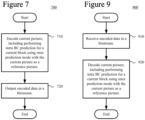
- a video encoder encodes a current picture to produce encoded data.
- the encoder performs intra BC prediction for a current block of the current picture, where the intra BC prediction uses inter prediction mode with the current picture as a reference picture.
- the encoder outputs the encoded data in a bitstream.
- the encoder can be adapted in any one or more of the following ways.
- the encoder can determine whether to enable or disable intra BC prediction mode, then set a value of a flag in the bitstream to indicate whether the intra BC prediction mode is enabled or disabled. For example, the encoder determines whether to enable or disable intra BC prediction mode for a sequence, and the flag is part of a sequence parameter set ("SPS"). Alternatively, the encoder can determine whether to enable or disable BC prediction mode on a picture-by-picture basis, slice-by-slice basis, or some other basis.
- SPS sequence parameter set
- the encoder can set values of syntax elements of the bitstream such that none of the syntax elements leads to referencing of a non-reconstructed part of the current picture during the encoding the current picture. That is, even when inter prediction mode syntax, semantics, processing, etc. are used to implement intra BC prediction functionality, the encoder can set the values of syntax elements such that intra BC prediction references only previously reconstructed parts of the current picture.
- the encoder can use any of several different approaches to signal motion vector ("MV") information for intra BC prediction (where MVs are used as block vectors ("BVs") during encoding). For example, the encoder can identify an MV of the current block, where the MV indicates an integer-pixel offset. The encoder signals the MV in the bitstream at integer-pixel precision. Or, as another example, the encoder can identify an MV of the current block, where the MV indicates an integer-pixel offset, but signal the MV in the bitstream at a fractional-pixel precision ( e.g ., 1 ⁇ 4-pixel precision). Even when luma MVs have integer-pixel precision, corresponding chroma MVs can have a fractional-pixel precision. After the encoder derives a chroma MV from a luma MV indicating an integer-pixel offset, the encoder can round or truncate the chroma MV to indicate an integer-pixel offset.
- MV signal motion vector
- BVs block vectors
- the encoder can initially mark the current picture as a long-term reference picture, then mark the current picture as a short-term reference picture after the encoding of the current picture finishes.
- this enables intra BC prediction using the current picture as a reference picture in inter prediction mode, while limiting how the current picture affects other processes such as MV prediction and MV scaling.
- the encoder can set a coding mode that applies for the current block, choosing from among multiple available coding modes, where the coding modes include intra prediction mode, inter prediction mode and intra BC prediction mode. For example, the encoder sets the coding mode for a current coding unit.
- the bitstream includes a syntax element that indicates the coding mode that applies for the current block. If the coding mode that applies for the current block is the intra BC prediction mode, syntax elements for the current block follow syntax for the inter prediction mode, except that inter prediction direction and a reference picture index are inferred. In this case (coding mode that applies for the current block is intra BC prediction mode), prediction direction is not needed, and the reference picture is known to be the current picture.
- the encoder can set a counter that indicates a number of reference pictures active for the current slice.
- the counter indicates a single reference picture is active when intra BC prediction mode is enabled.
- a value of a syntax element in the bitstream can indicate the number of reference pictures active for the current slice.
- the encoder can add the current picture to a reference picture list ("RPL"). For example, the encoder adds the current picture at a last position of the RPL, and increments a counter that indicates a number of reference pictures active for a current slice that includes the current block. If the current slice is a P slice or a B slice, the encoder can add the current picture to the RPL after invocation of a list construction process in which one or more other reference pictures are added to the RPL. Alternatively, if the current slice is a P slice or a B slice, the encoder can add the current picture to the RPL during a list construction process in which one or more other reference pictures are added to the RPL.
- RPL reference picture list
- the encoder can combine, as prediction results from two different reference pictures, the results of the intra BC prediction for the current block and results of motion-compensated prediction for the current block. This allows the encoder to blend results of intra BC prediction and results of motion-compensated prediction for the current block. Alternatively, combining of results of intra BC prediction and results of motion-compensated prediction is not allowed.
- the encoder can perform intra BC prediction on 4x4 blocks. For example, if (a) the reference picture is the current picture and (b) the prediction direction is uni-predictive (from the RPL that includes the current picture), the encoder can use 4x4 block size (for intra BC prediction). In some example implementations, this permits intra BC prediction down to the smallest block size that is allowed for spatial intra prediction.
- the encoder can make the decision about block size considering, among other factors, reference pictures and prediction directions used for blocks. Then, when the block size that applies for a current block is 4x4, the encoder can skip signaling of syntax elements for prediction direction and reference picture index for the current block, since the prediction direction can only be uni-predictive (from the RPL that includes the current picture) and the reference picture can only be the current picture. Alternatively, in this situation, the encoder disables 4x4 block size for intra BC prediction.
- the encoder can use advanced MV prediction mode, merge mode, skip mode and/or another coding tool that is part of inter prediction mode. By reusing such coding tools, implementation of intra BC prediction is simplified.
- the encoder can perform merge mode processing for the current block. For example, for each of one or more merge mode candidate, the encoder obtains the merge mode candidate and checks whether the merge mode candidate references the current picture. If so, the encoder retains the merge mode candidate. Otherwise, the encoder excludes the merge mode candidate. Later, if the number of retained merge mode candidates is less than the number of allowed merge mode candidates, the encoder can add one or more pre-defined merge mode candidates.
- the encoder when the current block is part of a current slice that is an I slice, the encoder can set values of syntax elements and output the syntax elements in different ways depending on whether intra BC prediction mode is enabled. For example, if intra BC prediction mode is enabled, the syntax elements for the current I slice follow syntax for a P slice or B slice, but if the intra BC prediction mode is not enabled, the syntax elements for the current I slice follow default syntax for an I slice. In this way, syntax for inter prediction mode can be reused for intra BC prediction, which simplifies implementation.
- the encoder can disable temporal MV prediction for the current I slice. This can streamline encoding by simplifying MV prediction and avoiding MV scaling, and by avoiding using information in another picture/slice when encoding the current I slice.
- the encoder can evaluate whether, aside from the current picture, (a) the number of reference pictures in the first RPL matches the number of reference pictures in the second RPL, and (b) each of the reference pictures in the first RPL is also represented at a corresponding position in the second RPL.
- the encoder can set a value of a syntax element in the bitstream that indicates whether only zero-value MV differentials are allowed when the second RPL is used in bidirectional inter prediction for blocks of the B slice.
- a video decoder receives encoded data in a bitstream.
- the video decoder decodes a current picture using the encoded data.
- the video decoder performs intra BC prediction for a current block of the current picture, where the intra BC prediction uses inter prediction mode with the current picture as a reference picture.
- the decoder can be adapted in any one or more of the following ways.
- the decoder can receive a flag in the bitstream that indicates whether intra BC prediction mode is enabled or disabled, then enable or disable the intra BC prediction mode accordingly.
- the flag is part of a SPS, and the decoder enables or disables the intra prediction mode for a sequence.
- the decoder can enable or disable BC prediction mode on a picture-by-picture basis, slice-by-slice basis, or some other basis, with the flag signaled at an appropriate layer of bitstream syntax.
- the bitstream can be constrained to include no syntax elements that lead to referencing of a non-reconstructed part of the current picture during the decoding the current picture. That is, even when inter prediction mode syntax, semantics, processing, etc. are used to implement intra BC prediction functionality, the values of syntax elements are set such that intra BC prediction references only previously reconstructed parts of the current picture.
- the decoder can use any of several different approaches to reconstructing MV information for intra BC prediction (where MVs are used as BVs during decoding). For example, the decoder can reconstruct an MV of the current block, where the MV indicates an integer-pixel offset and is signaled in the bitstream at integer-pixel precision. As part of the reconstructing, the decoder scales the MV to a fractional-pixel precision before use of the MV in a motion compensation process. Or, as another example, the decoder can reconstruct an MV of the current block, where the MV indicates an integer-pixel offset but is signaled in the bitstream at a fractional-pixel precision (e.g ., 1 ⁇ 4-pixel precision).
- a fractional-pixel precision e.g ., 1 ⁇ 4-pixel precision
- corresponding chroma MVs can have a fractional-pixel precision.
- the decoder can round or truncate the chroma MV to indicate an integer-pixel offset.
- the decoder can initially mark the current picture as a long-term reference picture, then mark the current picture as a short-term reference picture after the decoding of the current picture finishes.
- this enables intra BC prediction using the current picture as a reference picture in inter prediction mode, while limiting how the current picture affects other processes such as MV prediction and MV scaling.
- the decoder can parse, from the bitstream, a syntax element that indicates a coding mode that applies for the current block, then set the coding mode.
- the coding mode can be selected from among multiple available coding modes, including intra prediction mode, inter prediction mode and intra BC prediction mode. For example, the decoder sets the coding mode for a current coding unit. If the coding mode that applies for the current block is the intra BC prediction mode, syntax elements for the current block follow syntax for the inter prediction mode, except that inter prediction direction and a reference picture index are inferred. In this case (coding mode that applies for the current block is intra BC prediction mode), prediction direction is not needed, and the reference picture is known to be the current picture.
- the decoder can set a counter that indicates a number of reference pictures active for the current slice.
- the counter indicates a single reference picture is active when intra BC prediction mode is enabled.
- a value of a syntax element in the bitstream can indicate the number of reference pictures active for the current slice.
- the decoder can add the current picture to an RPL. For example, the decoder adds the current picture at a last position of the RPL, and increments a counter that indicates a number of reference pictures active for a current slice that includes the current block. If the current slice is a P slice or a B slice, the decoder can add the current picture to the RPL after invocation of a list construction process in which one or more other reference pictures are added to the RPL. Alternatively, if the current slice is a P slice or a B slice, the decoder can add the current picture to the RPL during a list construction process in which one or more other reference pictures are added to the RPL.
- the decoder can combine, as prediction results from two different reference pictures, the results of the intra BC prediction for the current block and results of motion-compensated prediction for the current block. This allows the decoder to blend results of intra BC prediction and results of motion-compensated prediction for the current block. Alternatively, combining of results of intra BC prediction and results of motion-compensated prediction is not allowed.
- the decoder can perform intra BC prediction on 4x4 blocks. For example, if (a) the reference picture is the current picture and (b) the prediction direction is uni-predictive (from the RPL that includes the current picture), the decoder can use 4x4 block size (for intra BC prediction). In some example implementations, this permits intra BC prediction down to the smallest block size that is allowed for spatial intra prediction.
- the decoder parses a syntax element for the block size without knowing prediction direction or reference picture index for a current block, and hence without knowing whether the block uses intra BC prediction or inter-picture prediction. If the block size is 4x4, however, the decoder can skip parsing of syntax elements for the prediction direction and reference picture index for the current block.
- the prediction direction for the current block can only be uni-predictive (from the RPL that includes the current picture), and the reference picture for the current block can only be the current picture, so syntax elements for prediction direction and reference picture index for the current block are omitted from the bitstream.
- the decoder disables 4x4 block size for intra BC prediction.
- the decoder can use advanced MV prediction mode, merge mode, skip mode and/or another coding/decoding tool that is part of inter prediction mode. By reusing such coding/decoding tools, implementation of intra BC prediction is simplified.
- the decoder can perform merge mode processing for the current block. For example, for each of one or more merge mode candidates, the decoder obtains the merge mode candidate and checks whether the merge mode candidate references the current picture. If so, the decoder retains the merge mode candidate. Otherwise, the decoder excludes the merge mode candidate. Later, if the number of retained merge mode candidates is less than the number of allowed merge mode candidates, the decoder can add one or more pre-defined merge mode candidates.
- the decoder can parse syntax elements in different ways depending on whether intra BC prediction mode is enabled. For example, if intra BC prediction mode is enabled, the syntax elements for the current I slice follow syntax for a P slice or B slice, but if the intra BC prediction mode is not enabled, the syntax elements for the current I slice follow default syntax for an I slice. In this way, syntax for inter prediction mode can be reused for intra BC prediction, which simplifies implementation.
- the decoder can disable temporal MV prediction for the current I slice. This can streamline decoding by simplifying MV prediction and avoiding MV scaling, and by avoiding using information in another picture/slice when decoding the current I slice.
- the decoder decodes the current slice like a P slice or B slice.
- the innovations for unified intra BC and inter prediction modes can be implemented as part of a method, as part of a computing device adapted to perform the method or as part of a tangible computer-readable media storing computer-executable instructions for causing a computing device to perform the method.
- the various innovations can be used in combination or separately.
- selectively enabling/disabling intra BC prediction mode can be used in combination with any of the reference picture management approaches described herein (for RPL construction and/or reference picture marking), or the selective enabling/disabling of intra BC prediction mode or a reference picture management approach can be used separately.
- Any of the approaches described herein for signaling or reconstructing MV information can be used separately or in combination with a preceding tool or combination.
- any of the approaches described herein for compound prediction can be used separately or in combination with a preceding tool or combination.
- Any of the approaches described herein for intra BC prediction with 4x4 blocks can be used separately or in combination with a preceding tool or combination.
- Any of the approaches described herein for intra BC prediction that uses advanced MV prediction mode, merge mode, skip mode or another coding/decoding tool of inter prediction mode, with temporal MV prediction enabled or disabled can be used separately or in combination with a preceding tool or combination.
- Any of the approaches described herein for intra BC prediction that uses inter prediction mode syntax, semantics or coding/decoding processes can be used separately or in combination with a preceding tool or combination.
- innovations described herein are illustrated with reference to syntax elements and operations specific to the HEVC standard.
- innovations described herein can also be implemented for other standards or formats.
- operations described herein are in places described as being performed by a video encoder or video decoder, in many cases the operations can be performed by another type of media processing tool.
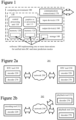
- FIG. 1 illustrates a generalized example of a suitable computing system (100) in which several of the described innovations may be implemented.
- the computing system (100) is not intended to suggest any limitation as to scope of use or functionality, as the innovations may be implemented in diverse general-purpose or special-purpose computing systems.
- the computing system (100) includes one or more processing units (110, 115) and memory (120, 125).
- the processing units (110, 115) execute computer-executable instructions.
- a processing unit can be a general-purpose central processing unit ("CPU"), processor in an application-specific integrated circuit ("ASIC") or any other type of processor.
- CPU central processing unit
- ASIC application-specific integrated circuit
- Figure 1 shows a central processing unit (110) as well as a graphics processing unit or co-processing unit (115).
- the tangible memory (120, 125) may be volatile memory (e.g., registers, cache, RAM), non-volatile memory (e.g., ROM, EEPROM, flash memory, etc.), or some combination of the two, accessible by the processing unit(s).
- the memory (120, 125) stores software (180) implementing one or more innovations for unified intra BC and inter prediction modes, in the form of computer-executable instructions suitable for execution by the processing unit(s).
- a computing system may have additional features.
- the computing system (100) includes storage (140), one or more input devices (150), one or more output devices (160), and one or more communication connections (170).
- An interconnection mechanism such as a bus, controller, or network interconnects the components of the computing system (100).
- operating system software provides an operating environment for other software executing in the computing system (100), and coordinates activities of the components of the computing system (100).
- the tangible storage (140) may be removable or non-removable, and includes magnetic disks, magnetic tapes or cassettes, CD-ROMs, DVDs, or any other medium which can be used to store information and which can be accessed within the computing system (100).
- the storage (140) stores instructions for the software (180) implementing one or more innovations for unified intra BC and inter prediction modes.
- the input device(s) (150) may be a touch input device such as a keyboard, mouse, pen, or trackball, a voice input device, a scanning device, or another device that provides input to the computing system (100).
- the input device(s) (150) may be a camera, video card, TV tuner card, screen capture module, or similar device that accepts video input in analog or digital form, or a CD-ROM or CD-RW that reads video input into the computing system (100).
- the output device(s) (160) may be a display, printer, speaker, CD-writer, or another device that provides output from the computing system (100).
- the communication connection(s) (170) enable communication over a communication medium to another computing entity.
- the communication medium conveys information such as computer-executable instructions, audio or video input or output, or other data in a modulated data signal.
- a modulated data signal is a signal that has one or more of its characteristics set or changed in such a manner as to encode information in the signal.
- communication media can use an electrical, optical, RF, or other carrier.
- Computer-readable media are any available tangible media that can be accessed within a computing environment.
- Computer-readable media include memory (120, 125), storage (140), and combinations of any of the above.
- program modules include routines, programs, libraries, objects, classes, components, data structures, etc. that perform particular tasks or implement particular abstract data types.
- the functionality of the program modules may be combined or split between program modules as desired in various embodiments.
- Computer-executable instructions for program modules may be executed within a local or distributed computing system.
- system and “device” are used interchangeably herein. Unless the context clearly indicates otherwise, neither term implies any limitation on a type of computing system or computing device. In general, a computing system or computing device can be local or distributed, and can include any combination of special-purpose hardware and/or general-purpose hardware with software implementing the functionality described herein.
- the disclosed methods can also be implemented using specialized computing hardware configured to perform any of the disclosed methods.
- the disclosed methods can be implemented by an integrated circuit (e.g., an ASIC (such as an ASIC digital signal processor (“DSP”), a graphics processing unit (“GPU”), or a programmable logic device (“PLD”), such as a field programmable gate array (“FPGA”)) specially designed or configured to implement any of the disclosed methods.
- an ASIC such as an ASIC digital signal processor (“DSP"), a graphics processing unit (“GPU”), or a programmable logic device (“PLD”), such as a field programmable gate array (“FPGA”)
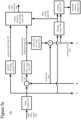
- Figures 2a and 2b show example network environments (201, 202) that include video encoders (220) and video decoders (270).
- the encoders (220) and decoders (270) are connected over a network (250) using an appropriate communication protocol.
- the network (250) can include the Internet or another computer network.
- each real-time communication (“RTC") tool (210) includes both an encoder (220) and a decoder (270) for bidirectional communication.
- a given encoder (220) can produce output compliant with a variation or extension of the HEVC standard (also known as H.265), SMPTE 421M standard, ISO-IEC 14496-10 standard (also known as H.264 or AVC), another standard, or a proprietary format, with a corresponding decoder (270) accepting encoded data from the encoder (220).
- the bidirectional communication can be part of a video conference, video telephone call, or other two-party or multi-party communication scenario.
- the network environment (201) in Figure 2a includes two real-time communication tools (210), the network environment (201) can instead include three or more real-time communication tools (210) that participate in multi-party communication.
- a real-time communication tool (210) manages encoding by an encoder (220).
- Figure 3 shows an example encoder system (300) that can be included in the real-time communication tool (210).
- the real-time communication tool (210) uses another encoder system.
- a real-time communication tool (210) also manages decoding by a decoder (270).
- Figure 4 shows an example decoder system (400), which can be included in the real-time communication tool (210).
- the real-time communication tool (210) uses another decoder system.
- an encoding tool (212) includes an encoder (220) that encodes video for delivery to multiple playback tools (214), which include decoders (270).
- the unidirectional communication can be provided for a video surveillance system, web camera monitoring system, screen capture module, remote desktop conferencing presentation or other scenario in which video is encoded and sent from one location to one or more other locations.
- the network environment (202) in Figure 2b includes two playback tools (214), the network environment (202) can include more or fewer playback tools (214).
- a playback tool (214) communicates with the encoding tool (212) to determine a stream of video for the playback tool (214) to receive. The playback tool (214) receives the stream, buffers the received encoded data for an appropriate period, and begins decoding and playback.
- Figure 3 shows an example encoder system (300) that can be included in the encoding tool (212).
- the encoding tool (212) uses another encoder system.
- the encoding tool (212) can also include server-side controller logic for managing connections with one or more playback tools (214).
- Figure 4 shows an example decoder system (400), which can be included in the playback tool (214).
- the playback tool (214) uses another decoder system.
- a playback tool (214) can also include client-side controller logic for managing connections with the encoding tool (212).
- FIG 3 is a block diagram of an example encoder system (300) in conjunction with which some described embodiments may be implemented.
- the encoder system (300) can be a general-purpose encoding tool capable of operating in any of multiple encoding modes such as a low-latency encoding mode for real-time communication, a transcoding mode, and a higher-latency encoding mode for producing media for playback from a file or stream, or it can be a special-purpose encoding tool adapted for one such encoding mode.
- the encoder system (300) can be implemented as an operating system module, as part of an application library or as a standalone application.
- the encoder system (300) receives a sequence of source video frames (311) from a video source (310) and produces encoded data as output to a channel (390).
- the encoded data output to the channel can include content encoded using unified intra BC and inter prediction modes.
- the video source (310) can be a camera, tuner card, storage media, screen capture module, or other digital video source.
- the video source (310) produces a sequence of video frames at a frame rate of, for example, 30 frames per second.
- frame generally refers to source, coded or reconstructed image data.
- a frame is a progressive-scan video frame.
- an interlaced video frame might be de-interlaced prior to encoding.
- two complementary interlaced video fields are encoded together as a single video frame or encoded as two separately-encoded fields.
- frame or "picture” can indicate a single non-paired video field, a complementary pair of video fields, a video object plane that represents a video object at a given time, or a region of interest in a larger image.
- the video object plane or region can be part of a larger image that includes multiple objects or regions of a scene.
- An arriving source frame (311) is stored in a source frame temporary memory storage area (320) that includes multiple frame buffer storage areas (321, 322, ... , 32n).
- a frame buffer (321, 322, etc.) holds one source frame in the source frame storage area (320).
- a frame selector (330) selects an individual source frame from the source frame storage area (320).
- the order in which frames are selected by the frame selector (330) for input to the encoder (340) may differ from the order in which the frames are produced by the video source (310), e.g., the encoding of some frames may be delayed in order, so as to allow some later frames to be encoded first and to thus facilitate temporally backward prediction.
- the encoder system (300) can include a pre-processor (not shown) that performs pre-processing (e.g., filtering) of the selected frame (331) before encoding.
- the pre-processing can include color space conversion into primary (e.g., luma) and secondary (e.g., chroma differences toward red and toward blue) components and resampling processing (e.g. , to reduce the spatial resolution of chroma components) for encoding.
- primary e.g., luma
- secondary e.g., chroma differences toward red and toward blue
- resampling processing e.g. , to reduce the spatial resolution of chroma components
- video has been converted to a color space such as YUV, in which sample values of a luma (Y) component represent brightness or intensity values, and sample values of chroma (U, V) components represent color-difference values.
- the chroma sample values may be sub-sampled to a lower chroma sampling rate (e.g ., for YUV 4:2:0 format or YUV 4:2:2), or the chroma sample values may have the same resolution as the luma sample values ( e.g ., for YUV 4:4:4 format).
- a lower chroma sampling rate e.g ., for YUV 4:2:0 format or YUV 4:2:2:2
- chroma components are downsampled by a factor of two horizontally and by a factor of two vertically.
- chroma components are downsampled by a factor of two horizontally.
- the video can be encoded in another format (e.g ., RGB 4:4:4 format).
- the encoder (340) encodes the selected frame (331) to produce a coded frame (341) and also produces memory management control operation ("MMCO") signals (342) or reference picture set (“RPS”) information. If the current frame is not the first frame that has been encoded, when performing its encoding process, the encoder (340) may use one or more previously encoded/decoded frames (369) that have been stored in a decoded frame temporary memory storage area (360). Such stored decoded frames (369) are used as reference frames for inter-frame prediction of the content of the current source frame (331).
- the MMCO/RPS information (342) indicates to a decoder which reconstructed frames may be used as reference frames, and hence should be stored in a frame storage area.
- the encoder (340) includes multiple encoding modules that perform encoding tasks such as partitioning into tiles, intra prediction estimation and prediction, motion estimation and compensation, frequency transforms, quantization and entropy coding.
- the exact operations performed by the encoder (340) can vary depending on compression format.
- the format of the output encoded data can be a variation or extension of HEVC format (H.265), Windows Media Video format, VC-1 format, MPEG-x format ( e.g ., MPEG-1, MPEG-2, or MPEG-4), H.26x format (e.g., H.261, H.262, H.263, H.264), or another format.
- the encoder (340) can partition a frame into multiple tiles of the same size or different sizes. For example, the encoder (340) splits the frame along tile rows and tile columns that, with frame boundaries, define horizontal and vertical boundaries of tiles within the frame, where each tile is a rectangular region. Tiles are often used to provide options for parallel processing.
- a frame can also be organized as one or more slices, where a slice can be an entire frame or region of the frame. A slice can be decoded independently of other slices in a frame, which improves error resilience. The content of a slice or tile is further partitioned into blocks or other sets of samples for purposes of encoding and decoding.
- a coding tree unit (“CTU”) includes luma sample values organized as a luma coding tree block (“CTB”) and corresponding chroma sample values organized as two chroma CTBs.
- CTB luma coding tree block
- the size of a CTU (and its CTBs) is selected by the encoder, and can be, for example, 64x64, 32x32 or 16x16 sample values.
- a CTU includes one or more coding units.
- a coding unit (“CU”) has a luma coding block (“CB”) and two corresponding chroma CBs.
- a CTU with a 64x64 luma CTB and two 64x64 chroma CTBs can be split into four CUs, with each CU including a 32x32 luma CB and two 32x32 chroma CBs, and with each CU possibly being split further into smaller CUs.
- a CTU with a 64x64 luma CTB and two 32x32 chroma CTBs (YUV 4:2:0 format) can be split into four CUs, with each CU including a 32x32 luma CB and two 16x16 chroma CBs, and with each CU possibly being split further into smaller CUs.
- the smallest allowable size of CU e.g., 8 ⁇ 8, 16 ⁇ 16 can be signaled in the bitstream.
- a CU can have a prediction mode such as inter or intra.
- a CU includes one or more prediction units for purposes of signaling of prediction information (such as prediction mode details, displacement values, etc.) and/or prediction processing.
- a prediction unit (“PU") has a luma prediction block ("PB") and two chroma PBs.
- PB luma prediction block
- the PU has the same size as the CU, unless the CU has the smallest size (e.g ., 8x8).
- the CU can be split into four smaller PUs (e.g., each 4x4 if the smallest CU size is 8x8) or the PU can have the smallest CU size, as indicated by a syntax element for the CU.
- a CU also has one or more transform units for purposes of residual coding/decoding, where a transform unit ("TU") has a transform block ("TB") and two chroma TBs.
- TU transform unit
- TB transform block
- a PU in an intra-predicted CU may contain a single TU (equal in size to the PU) or multiple TUs.
- block can indicate a CB, PB, TB or other set of sample values, depending on context.
- the encoder decides how to partition video into CTUs, CUs, PUs, TUs, etc.
- the encoder represents an intra-coded block of a source frame (331) in terms of prediction from other, previously reconstructed sample values in the frame (331).
- a motion estimator uses the current frame as a reference frame
- An intra-frame prediction reference region (or intra-prediction region, for short) is a region of samples in the frame that are used to generate BC-prediction values for the block.
- the intra-frame prediction region can be indicated with a block vector ("BV") value (which is signaled and applied as motion vector ("MV”) information).
- BV block vector
- MV motion vector
- the intra-picture estimator (or motion estimator) can output prediction information (such as MV information for intra BC prediction or prediction mode (direction) for intra spatial prediction), which is entropy coded.
- An intra-picture prediction predictor applies spatial prediction information to determine intra prediction values.
- a motion compensator (using the current frame as a reference frame) applies the MV information to determine intra BC prediction values.
- the encoder (340) represents an inter-frame coded, predicted block of a source frame (331) in terms of prediction from reference frames.
- a motion estimator estimates the motion of the block with respect to one or more reference frames (369). When multiple reference frames are used, the multiple reference frames can be from different temporal directions or the same temporal direction.
- a motion-compensated prediction reference region is a region of samples in the reference frame(s) that are used to generate motion-compensated prediction values for a block of samples of a current frame.
- the motion estimator outputs motion information such as MV information, which is entropy coded.
- a motion compensator applies MV values to reference frames (369) to determine motion-compensated prediction values for inter-frame prediction.
- the encoder can determine the differences (if any) between a block's prediction values (intra or inter) and corresponding original values. These prediction residual values are further encoded using a frequency transform, quantization and entropy encoding. For example, the encoder (340) sets values for quantization parameter ("QP") for a picture, tile, slice and/or other portion of video, and quantizes transform coefficients accordingly.
- QP quantization parameter
- the entropy coder of the encoder (340) compresses quantized transform coefficient values as well as certain side information (e.g ., MV information, selected MV precision, QP values, mode decisions, parameter choices).
- Typical entropy coding techniques include Exponential-Golomb coding, Golomb-Rice coding, arithmetic coding, differential coding, Huffman coding, run length coding, variable-length-to-variable-length (“V2V”) coding, variable-length-to-fixed-length (“V2F”) coding, Lempel-Ziv (“LZ”) coding, dictionary coding, probability interval partitioning entropy coding ("PIPE”), and combinations of the above.
- the entropy coder can use different coding techniques for different kinds of information, can apply multiple techniques in combination ( e.g ., by applying Golomb-Rice coding followed by arithmetic coding), and can choose from among multiple code tables within a particular coding technique.
- An adaptive deblocking filter is included within the motion compensation loop in the encoder (340) to smooth discontinuities across block boundary rows and/or columns in a decoded frame.
- Other filtering such as de-ringing filtering, adaptive loop filtering ("ALF”), or sample-adaptive offset (“SAO”) filtering; not shown
- ALF adaptive loop filtering
- SAO sample-adaptive offset
- the coded frames (341) and MMCO/RPS information (342) are processed by a decoding process emulator (350).
- the decoding process emulator (350) implements some of the functionality of a decoder, for example, decoding tasks to reconstruct reference frames. In a manner consistent with the MMCO/RPS information (342), the decoding process emulator (350) determines whether a given coded frame (341) needs to be reconstructed and stored for use as a reference frame in inter-frame prediction of subsequent frames to be encoded.
- the decoding process emulator (350) models the decoding process that would be conducted by a decoder that receives the coded frame (341) and produces a corresponding decoded frame (351). In doing so, when the encoder (340) has used decoded frame(s) (369) that have been stored in the decoded frame storage area (360), the decoding process emulator (350) also uses the decoded frame(s) (369) from the storage area (360) as part of the decoding process.
- the decoded frame temporary memory storage area (360) includes multiple frame buffer storage areas (361, 362, ..., 36 n ).
- the decoding process emulator (350) manages the contents of the storage area (360) in order to identify any frame buffers (361, 362, etc.) with frames that are no longer needed by the encoder (340) for use as reference frames.
- the decoding process emulator (350) stores a newly decoded frame (351) in a frame buffer (361, 362, etc.) that has been identified in this manner.
- the coded frames (341) and MMCO/RPS information (342) are buffered in a temporary coded data area (370).
- the coded data that is aggregated in the coded data area (370) contains, as part of the syntax of an elementary coded video bitstream, encoded data for one or more pictures.
- the coded data that is aggregated in the coded data area (370) can also include media metadata relating to the coded video data (e.g., as one or more parameters in one or more supplemental enhancement information (“SEI”) messages or video usability information (“VUI”) messages).
- SEI Supplemental Enhancement Information
- VUI video usability information
- the aggregated data (371) from the temporary coded data area (370) are processed by a channel encoder (380).
- the channel encoder (380) can packetize and/or multiplex the aggregated data for transmission or storage as a media stream (e.g ., according to a media program stream or transport stream format such as ITU-T H.222.0
- the channel encoder (380) can organize the aggregated data for storage as a file ( e.g ., according to a media container format such as ISO/IEC 14496-12), in which case the channel encoder (380) can add syntax elements as part of the syntax of the media storage file. Or, more generally, the channel encoder (380) can implement one or more media system multiplexing protocols or transport protocols, in which case the channel encoder (380) can add syntax elements as part of the syntax of the protocol(s).
- the channel encoder (380) provides output to a channel (390), which represents storage, a communications connection, or another channel for the output.
- the channel encoder (380) or channel (390) may also include other elements (not shown), e.g ., for forward-error correction ("FEC") encoding and analog signal modulation.
- FEC forward-error correction
- FIG. 4 is a block diagram of an example decoder system (400) in conjunction with which some described embodiments can be implemented.
- the decoder system (400) can be a general-purpose decoding tool capable of operating in any of multiple decoding modes such as a low-latency decoding mode for real-time communication and a higher-latency decoding mode for media playback from a file or stream, or it can be a special-purpose decoding tool adapted for one such decoding mode.
- the decoder system (400) can be implemented as an operating system module, as part of an application library or as a standalone application. Overall, the decoder system (400) receives coded data from a channel (410) and produces reconstructed frames as output for an output destination (490).
- the coded data can include content encoded using unified intra BC and inter prediction modes.
- the decoder system (400) includes a channel (410), which can represent storage, a communications connection, or another channel for coded data as input.
- the channel (410) produces coded data that has been channel coded.
- a channel decoder (420) can process the coded data. For example, the channel decoder (420) de-packetizes and/or demultiplexes data that has been aggregated for transmission or storage as a media stream (e.g ., according to a media program stream or transport stream format such as ITU-T H.222.0
- a media stream e.g ., according to a media program stream or transport stream format such as ITU-T H.222.0
- the channel decoder (420) separates coded video data that has been aggregated for storage as a file ( e.g ., according to a media container format such as ISO/IEC 14496-12), in which case the channel decoder (420) can parse syntax elements added as part of the syntax of the media storage file.
- the channel decoder (420) can implement one or more media system demultiplexing protocols or transport protocols, in which case the channel decoder (420) can parse syntax elements added as part of the syntax of the protocol(s).
- the channel (410) or channel decoder (420) may also include other elements (not shown), e.g ., for FEC decoding and analog signal demodulation.
- the coded data (421) that is output from the channel decoder (420) is stored in a temporary coded data area (430) until a sufficient quantity of such data has been received.
- the coded data (421) includes coded frames (431) and MMCO/RPS information (432).
- the coded data (421) in the coded data area (430) contain, as part of the syntax of an elementary coded video bitstream, coded data for one or more pictures.
- the coded data (421) in the coded data area (430) can also include media metadata relating to the encoded video data (e.g ., as one or more parameters in one or more SEI messages or VUI messages).
- the coded data area (430) temporarily stores coded data (421) until such coded data (421) is used by the decoder (450). At that point, coded data for a coded frame (431) and MMCO/RPS information (432) are transferred from the coded data area (430) to the decoder (450). As decoding continues, new coded data is added to the coded data area (430) and the oldest coded data remaining in the coded data area (430) is transferred to the decoder (450).
- the decoder (450) decodes a coded frame (431) to produce a corresponding decoded frame (451). As appropriate, when performing its decoding process, the decoder (450) may use one or more previously decoded frames (469) as reference frames for inter-frame prediction. The decoder (450) reads such previously decoded frames (469) from a decoded frame temporary memory storage area (460). Generally, the decoder (450) includes multiple decoding modules that perform decoding tasks such as entropy decoding, intra-frame prediction, motion-compensated inter-frame prediction, inverse quantization, inverse frequency transforms, and merging of tiles. The exact operations performed by the decoder (450) can vary depending on compression format.
- the decoder (450) receives encoded data for a compressed frame or sequence of frames and produces output including decoded frame (451).
- a buffer receives encoded data for a compressed frame and, at an appropriate time, makes the received encoded data available to an entropy decoder.
- the entropy decoder entropy decodes entropy-coded quantized data as well as entropy-coded side information, typically applying the inverse of entropy encoding performed in the encoder.
- ⁇ motion compensator applies motion information to one or more reference frames to form motion-compensated prediction values for any inter-coded blocks of the frame being reconstructed.
- the motion compensator can determine a selected MV precision (e.g ., integer-pixel MV precision, 1 ⁇ 2-pixel MV precision, or 1 ⁇ 4-pixel MV precision). The motion compensator can then apply MVs having the selected MV precision.
- An intra-frame prediction module can spatially predict sample values of a current block from neighboring, previously reconstructed sample values. Or, for intra BC prediction, the motion compensator can predict sample values of a current block using previously reconstructed sample values of an intra-frame prediction region in the current frame, as a reference frame. The intra-frame prediction region can be indicated with an MV value.
- the decoder (450) also reconstructs prediction residual values.
- An inverse quantizer inverse quantizes entropy-decoded data.
- the decoder (450) sets values for QP for a picture, tile, slice and/or other portion of video based on syntax elements in the bitstream, and inverse quantizes transform coefficients accordingly.
- An inverse frequency transformer converts the quantized, frequency-domain data into spatial-domain data.
- the decoder (450) combines reconstructed prediction residual values with motion-compensated prediction values.
- the decoder (450) can similarly combine prediction residual values with prediction values from intra-frame prediction.
- An adaptive deblocking filter is included within the motion compensation loop in the video decoder (450) to smooth discontinuities across block boundary rows and/or columns in the decoded frame (451).
- Other filtering (such as de-ringing filtering, ALF, or SAO filtering; not shown) can alternatively or additionally be applied as in-loop filtering operations.
- the decoded frame temporary memory storage area (460) includes multiple frame buffer storage areas (461, 462, ..., 46 n ).
- the decoded frame storage area (460) is an example of a decoded picture buffer.
- the decoder (450) uses the MMCO/RPS information (432) to identify a frame buffer (461, 462, etc.) in which it can store a decoded frame (451).
- the decoder (450) stores the decoded frame (451) in that frame buffer.
- An output sequencer (480) identifies when the next frame to be produced in output order is available in the decoded frame storage area (460).
- the output sequencer (480) When the next frame (481) to be produced in output order is available in the decoded frame storage area (460), it is read by the output sequencer (480) and output to the output destination (490) ( e.g ., display).
- the order in which frames are output from the decoded frame storage area (460) by the output sequencer (480) may differ from the order in which the frames are decoded by the decoder (450).
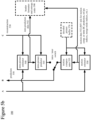
- Figures 5a and 5b are a block diagram of a generalized video encoder (500) in conjunction with which some described embodiments may be implemented.
- the encoder (500) receives a sequence of video pictures including a current picture as an input video signal (505) and produces encoded data in a coded video bitstream (595) as output.
- the encoder (500) is block-based and uses a block format that depends on implementation. Blocks may be further sub-divided at different stages, e.g ., at the prediction, frequency transform and/or entropy encoding stages. For example, a picture can be divided into 64x64 blocks, 32x32 blocks or 16x16 blocks, which can in turn be divided into smaller blocks of sample values for coding and decoding. In implementations of encoding for the HEVC standard, the encoder partitions a picture into CTUs (CTBs), CUs (CBs), PUs (PBs) and TU (TBs).
- CTBs CTUs
- CBs CTUs
- CBs CUs
- PBs PUs
- TBs TU
- the encoder (500) compresses pictures using intra-picture coding and/or inter-picture coding. Many of the components of the encoder (500) are used for both intra-picture coding and inter-picture coding. The exact operations performed by those components can vary depending on the type of information being compressed.
- a tiling module (510) optionally partitions a picture into multiple tiles of the same size or different sizes. For example, the tiling module (510) splits the picture along tile rows and tile columns that, with picture boundaries, define horizontal and vertical boundaries of tiles within the picture, where each tile is a rectangular region.
- the general encoding control (520) receives pictures for the input video signal (505) as well as feedback (not shown) from various modules of the encoder (500). Overall, the general encoding control (520) provides control signals (not shown) to other modules (such as the tiling module (510), transformer/scaler/quantizer (530), scaler/inverse transformer (535), intra-picture estimator (540), motion estimator (550) and intra/inter switch) to set and change coding parameters during encoding. In particular, in conjunction with the motion estimator (550), the general encoding control (520) can manage intra BC prediction and inter prediction. The general encoding control (520) can also evaluate intermediate results during encoding, for example, performing rate-distortion analysis. The general encoding control (520) produces general control data (522) that indicates decisions made during encoding, so that a corresponding decoder can make consistent decisions. The general control data (522) is provided to the header formatter/entropy coder (590).
- a motion estimator (550) estimates the motion (or displacement) of blocks of sample values of the current picture of the input video signal (505) with respect to one or more reference pictures.
- the reference picture is the current picture
- the motion estimator (550) estimates displacement of the sample values of a current block to different candidate regions within the current picture.
- the motion estimator (550) can select a motion vector ("MV") precision (e.g ., integer-pixel MV precision, 1 ⁇ 2-pixel MV precision, or 1 ⁇ 4-pixel MV precision), then use the selected MV precision during motion estimation.
- the decoded picture buffer (570) buffers one or more reconstructed previously coded pictures for use as reference pictures.
- the motion estimator (550) produces as side information motion data (552) such as MV data (including MV values indicating displacements for intra BC prediction), merge mode index values and reference picture selection data, as well as side information that indicates the selected MV precision.
- side information including motion data (552) is provided to the header formatter/entropy coder (590) as well as the motion compensator (555).
- the motion compensator (555) applies MV values having the selected MV precision to the reconstructed reference picture(s) from the decoded picture buffer (570). Or, for intra BC prediction, the motion compensator (555) applies MV values to reconstructed parts of the current picture as a reference picture, to predict sample values for blocks of the current picture.
- the chroma data for a picture has the same resolution as the luma data (e.g . when the format is YUV 4:4:4 format or RGB 4:4:4 format)
- the MV value that is applied for a chroma block may be the same as the MV value applied for the luma block.
- the MV value that is applied for a chroma block may be scaled down and possibly rounded to adjust for the difference in chroma resolution (e.g ., for YUV 4:2:0 format, by dividing the vertical and horizontal components of the MV value by two and truncating or rounding them to integer-pixel offsets; for YUV 4:2:2 format, by dividing the horizontal component of the MV value by two and truncating or rounding it to an integer-pixel offset).
- the motion compensator (555) produces motion-compensated predictions for the current picture and, for intra BC prediction, intra BC prediction values for the current picture.
- an intra-picture estimator (540) determines how to perform spatial intra-picture prediction for blocks of sample values of a current picture of the input video signal (505).
- the current picture can be entirely or partially coded using intra-picture coding.
- the intra-picture estimator (540) determines how to spatially predict sample values of a current block of the current picture from neighboring, previously reconstructed sample values of the current picture.
- the intra-picture estimator (540) produces as side information intra prediction data (542), such as prediction mode direction (for intra spatial prediction).
- the intra prediction data (542) is provided to the header formatter/entropy coder (590) as well as the intra-picture predictor (545).
- the intra-picture predictor (545) spatially predicts sample values of a current block of the current picture from neighboring, previously reconstructed sample values of the current picture.
- the intra/inter switch selects values of a motion-compensated prediction or intra-picture prediction for use as the prediction (558) for a given block.
- the difference (if any) between a block of the prediction (558) and a corresponding part of the original current picture of the input video signal (505) provides values of the residual (518).
- reconstructed residual values are combined with the prediction (558) to produce a reconstruction (538) of the original content from the video signal (505). In lossy compression, however, some information is still lost from the video signal (505).
- a frequency transformer converts spatial-domain video data into frequency-domain (i.e ., spectral, transform) data.
- the frequency transformer applies a discrete cosine transform ("DCT"), an integer approximation thereof, or another type of forward block transform (e.g ., a discrete sine transform or an integer approximation thereof) to blocks of prediction residual data (or sample value data if the prediction (558) is null), producing blocks of frequency transform coefficients.
- DCT discrete cosine transform
- the encoder (500) may also be able to indicate that such transform step is skipped.
- the scaler/quantizer scales and quantizes the transform coefficients.
- the quantizer applies dead-zone scalar quantization to the frequency-domain data with a quantization step size that varies on a frame-by-frame basis, tile-by-tile basis, slice-by-slice basis, block-by-block basis, frequency-specific basis or other basis.
- the quantized transform coefficient data (532) is provided to the header formatter/entropy coder (590).
- a scaler/inverse quantizer performs inverse scaling and inverse quantization on the quantized transform coefficients.
- An inverse frequency transformer performs an inverse frequency transform, producing blocks of reconstructed prediction residual values or sample values.
- the encoder (500) combines reconstructed residual values with values of the prediction (558) (e.g ., motion-compensated prediction values, intra-picture prediction values) to form the reconstruction (538).
- the values of the reconstruction (538) can be fed back to the intra-picture estimator (540) and intra-picture predictor (545). Also, the values of the reconstruction (538) can be used for motion-compensated prediction of subsequent pictures, or for intra BC prediction using the current picture as a reference picture. The values of the reconstruction (538) can be further filtered.
- a filtering control (560) determines how to perform deblock filtering and SAO filtering on values of the reconstruction (538), for a given picture of the video signal (505). The filtering control (560) produces filter control data (562), which is provided to the header formatter/entropy coder (590) and merger/filter(s) (565).
- the encoder (500) merges content from different tiles into a reconstructed version of the picture.
- the encoder (500) selectively performs deblock filtering and SAO filtering according to the filter control data (562), so as to adaptively smooth discontinuities across boundaries in the frames.
- Other filtering such as de-ringing filtering or ALF; not shown
- Tile boundaries can be selectively filtered or not filtered at all, depending on settings of the encoder (500), and the encoder (500) may provide syntax within the coded bitstream to indicate whether or not such filtering was applied.
- the decoded picture buffer (570) buffers the reconstructed current picture for use in subsequent motion-compensated prediction.
- the header formatter/entropy coder (590) formats and/or entropy codes the general control data (522), quantized transform coefficient data (532), intra prediction data (542), motion data (552) and filter control data (562). MV values can be predictively coded.
- the header formatter/entropy coder (590) uses Exponential-Golomb coding for entropy coding of various syntax elements such as syntax elements for differential MV values, after MV prediction.
- the header formatter/entropy coder (590) provides the encoded data in the coded video bitstream (595).
- the format of the coded video bitstream (595) can be a variation or extension of HEVC format, Windows Media Video format, VC-1 format, MPEG-x format (e.g ., MPEG-1, MPEG-2, or MPEG-4), H.26x format (e.g ., H.261, H.262, H.263, H.264), or another format.
- modules of the encoder can be added, omitted, split into multiple modules, combined with other modules, and/or replaced with like modules.
- encoders with different modules and/or other configurations of modules perform one or more of the described techniques.
- Specific embodiments of encoders typically use a variation or supplemented version of the encoder (500). The relationships shown between modules within the encoder (500) indicate general flows of information in the encoder; other relationships are not shown for the sake of simplicity.
- FIG. 6 is a block diagram of a generalized decoder (600) in conjunction with which some described embodiments can be implemented.
- the decoder (600) receives encoded data in a coded video bitstream (605) and produces output including pictures for reconstructed video (695).
- the format of the coded video bitstream (605) can be a variation or extension of HEVC format, Windows Media Video format, VC-1 format, MPEG-x format ( e.g ., MPEG-1, MPEG-2, or MPEG-4), H.26x format ( e.g. , H.261, H.262, H.263, H.264), or another format.
- the decoder (600) is block-based and uses a block format that depends on implementation. Blocks may be further sub-divided at different stages. For example, a picture can be divided into 64x64 blocks, 32x32 blocks or 16x16 blocks, which can in turn be divided into smaller blocks of sample values. In implementations of decoding for the HEVC standard, a picture is partitioned into CTUs (CTBs), CUs (CBs), PUs (PBs) and TU (TBs).
- CTUs CTUs
- CBs CUs
- PBs PUs
- TBs TU
- the decoder (600) decompresses pictures using intra-picture decoding and/or inter-picture decoding. Many of the components of the decoder (600) are used for both intra-picture decoding and inter-picture decoding. The exact operations performed by those components can vary depending on the type of information being decompressed.
- a buffer receives encoded data in the coded video bitstream (605) and makes the received encoded data available to the parser/entropy decoder (610).
- the parser/entropy decoder (610) entropy decodes entropy-coded data, typically applying the inverse of entropy coding performed in the encoder (500) (e.g ., context-adaptive binary arithmetic decoding).
- the parser/entropy decoder (610) produces general control data (622), quantized transform coefficient data (632), intra prediction data (642), motion data (652) and filter control data (662).
- the parser/entropy decoder (610) can entropy decode syntax elements for differential MV values, e.g ., using context-adaptive binary arithmetic decoding, then combine the differential MV values with predicted MV values to reconstruct MV values that may be used for inter-picture prediction or intra BC prediction.
- the general decoding control (620) receives the general control data (622) and provides control signals (not shown) to other modules (such as the scaler/inverse transformer (635), intra-picture predictor (645), motion compensator (655) and intra/inter switch) to set and change decoding parameters during decoding.
- modules such as the scaler/inverse transformer (635), intra-picture predictor (645), motion compensator (655) and intra/inter switch.
- a motion compensator (655) receives the motion data (652), such as MV data, reference picture selection data and merge mode index values.
- the motion compensator (655) also receives an indication of the selected MV precision.
- the motion compensator (655) applies MVs having the selected MV precision to the reconstructed reference picture(s) from the decoded picture buffer (670).
- the motion compensator (655) applies MVs having the selected MV precision to reconstructed parts of the current picture, as a reference picture, to predict sample values of blocks of the current picture.
- the motion compensator (655) produces motion-compensated predictions for inter-coded blocks of the current picture and/or intra-BC-predicted values for intra-BC-predicted blocks of the current picture.
- the decoded picture buffer (670) stores one or more previously reconstructed pictures for use as reference pictures.
- the intra-frame prediction predictor (645) receives the intra prediction data (642), such as prediction mode direction (for intra spatial prediction). For intra spatial prediction, using values of a reconstruction (638) of the current picture, according to prediction mode data, the intra-picture predictor (645) spatially predicts sample values of a current block of the current picture from neighboring, previously reconstructed sample values of the current picture.
- the intra/inter switch selects values of a motion-compensated prediction or intra-picture prediction for use as the prediction (658) for a given block. For example, when HEVC syntax is followed, the intra/inter switch can be controlled based on a syntax element encoded for a CU of a picture that can contain intra-predicted CUs and inter-predicted CUs.
- the decoder (600) combines the prediction (658) with reconstructed residual values to produce the reconstruction (638) of the content from the video signal.
- the scaler/inverse transformer receives and processes the quantized transform coefficient data (632).
- a scaler/inverse quantizer performs inverse scaling and inverse quantization on the quantized transform coefficients.
- An inverse frequency transformer performs an inverse frequency transform, producing blocks of reconstructed prediction residual values or sample values.
- the inverse frequency transformer applies an inverse block transform to frequency transform coefficients, producing sample value data or prediction residual data.
- the inverse frequency transform can be an inverse DCT, an integer approximation thereof, or another type of inverse frequency transform (e.g ., an inverse discrete sine transform or an integer approximation thereof).
- the values of the reconstruction (638) can be fed back to the intra-picture predictor (645). Also, the values of the reconstruction (638) can be used for motion-compensated prediction of subsequent pictures, or for intra BC prediction using the current picture as a reference picture. For inter-picture prediction, the values of the reconstruction (638) can be further filtered.
- the decoder (600) merges content from different tiles into a reconstructed version of the picture. The decoder (600) selectively performs deblock filtering and SAO filtering according to the filter control data (662) and rules for filter adaptation, so as to adaptively smooth discontinuities across boundaries in the frames.
- Tile boundaries can be selectively filtered or not filtered at all, depending on settings of the decoder (600) or a syntax indication within the encoded bitstream data.
- the decoded picture buffer (670) buffers the reconstructed current picture for use in subsequent motion-compensated prediction.
- the decoder (600) can also include a post-processing filter.
- the post-processing filter can include de-ringing filtering, adaptive Wiener filtering, film-grain reproduction filtering, SAO filtering or another kind of filtering.
- modules of the decoder can be added, omitted, split into multiple modules, combined with other modules, and/or replaced with like modules.
- decoders with different modules and/or other configurations of modules perform one or more of the described techniques.
- Specific embodiments of decoders typically use a variation or supplemented version of the decoder (600).
- the relationships shown between modules within the decoder (600) indicate general flows of information in the decoder; other relationships are not shown for the sake of simplicity.
- Both intra block copy (“BC”) prediction and inter-picture prediction use sample values of previously reconstructed blocks to predict the sample values of a current block of a current picture.
- Inter-picture prediction uses sample values of previously reconstructed blocks in another picture.
- Intra BC prediction uses sample values of previously reconstructed blocks in the current picture.
- bitstream syntax, semantics of syntax elements and many coding/decoding processes for inter prediction mode are reused or slightly modified to enable intra BC prediction for blocks of a picture.
- various coding/decoding tools designed for inter prediction mode can also be applied when intra BC prediction is used, which simplifies implementation of intra BC prediction.
- Figure 7 shows a generalized technique (700) for encoding with unified intra BC and inter prediction modes.
- a video encoder such as one described above with reference to Figure 3 or Figure 5 , or another video encoder, can perform the technique (700).
- the video encoder encodes (710) a current picture to produce encoded data.
- the encoder performs intra BC prediction for a current block of the current picture, where the intra BC prediction uses inter prediction mode with the current picture as a reference picture.
- the current block can be a prediction block ("PB") or other block.
- PB prediction block
- the encoder performs motion compensation, applying an MV that indicates a displacement within the current picture, with the current picture being used as the reference picture for the motion compensation.
- the encoder can perform the technique (800) shown in Figure 8 or encode the current picture in some other way.
- the encoder outputs (720) the encoded data in a bitstream.
- the format of the bitstream is a variation or extension of HEVC format (H.265).
- the format of the bitstream is a variation or extension of Windows Media Video format, VC-1 format, MPEG-x format (e.g ., MPEG-1, MPEG-2, or MPEG-4), H.26x format (e.g ., H.261, H.262, H.263, H.264), or another format.
- the encoder can repeat the technique (700) on a picture-by-picture basis.
- Figure 7 does not show other types of prediction that can be used when encoding the current picture.
- Figure 8 shows an example technique (800) for encoding that includes unified intra BC and inter prediction modes.
- a video encoder such as one described above with reference to Figure 3 or Figure 5 , or another video encoder, can perform the technique (800).
- the encoder adds (810) the current picture to a reference picture list ("RPL").
- RPL reference picture list
- the encoder adds the current picture to an RPL using one of the approaches described below in the section entitled, "Reference Picture Management.”
- the encoder adds the current picture to an RPL using another approach.
- the encoder encodes the coding units ("CUs") of the current slice.
- CUs coding units
- Different CUs can have different coding modes (prediction modes).
- the encoder sets (820) the coding mode for the current CU. For example, the encoder selects spatial intra prediction mode or inter prediction mode as the coding mode for the current CU. Alternatively, the encoder selects from among other and/or additional coding modes.
- the encoder checks (830) the coding mode for the current CU. If the coding mode is not inter prediction mode, the encoder encodes (840) the prediction unit(s) ("PU(s)") of the current CU (specifically, PBs of the PU(s)) using spatial intra prediction.
- the current CU can include a single PU. Or, if the PU size is smaller than the CU size, the current CU can include multiple PUs.
- the encoder checks (850) whether the current picture is the reference picture for a given PU of the current CU. In this example, different PUs can use different reference pictures for prediction. If the current picture is the reference picture for a given PU, the encoder encodes (860) the PU (specifically, PBs of the PU) using intra BC prediction. Otherwise (current picture is not the reference picture for the PU), the encoder encodes (870) the PU (specifically, PBs of the PU) using inter-picture prediction. As part of the encoding (860, 870) in inter prediction mode, the encoder can use advanced MV prediction for the PU, merge mode for the PU, or skip mode for the CU.
- the encoder can implement the inter-picture prediction and intra BC prediction using the same motion compensation process.
- current slice is an I slice
- the current picture may be the only reference picture available for the current slice, such that intra BC prediction is always used if the coding mode of the current CU is inter prediction mode, and the encoder need not check (850) the reference picture for PU(s) of the current CU.
- the encoder After encoding a PU of the current CU in inter prediction mode, the encoder checks (880) whether to continue with the next PU of the current CU.
- the current CU can include a single PU or, if the PU size is smaller than the CU size, multiple PUs. If there is another PU in the current CU, the encoder continues by encoding the next PU in the current CU in inter prediction mode.
- the encoder checks (890) whether to continue with the next CU in the current slice. In this way, the encoder encodes the CUs of the current slice on a CU-by-CU basis.
- the encoder can repeat the technique (800) on a slice-by-slice basis for the slices of the current picture. Alternatively, the encoder can repeat the technique on a picture-by-picture basis.
- the encoder can be adapted in any one or more of the following ways.
- Intra BC prediction can be implemented as a case of inter prediction mode, without explicit signaling of an intra BC prediction mode for the current block or a block that contains the current block. Instead, the encoder signals the mode that applies for the current block to be inter prediction mode, but the MV value for the current block represents a displacement within the current picture, which is used as a reference picture. Treatment of the current block depends on which reference picture is used. If the reference picture index for the current block selects the current picture, intra BC prediction is used in inter prediction mode; otherwise, inter-picture prediction is used.
- the encoder can selectively enable or disable intra BC prediction mode, then set a value of a flag in the bitstream to indicate whether the intra BC prediction mode is enabled or disabled. For example, the encoder determines whether to enable or disable intra BC prediction mode for a sequence, and the flag is part of a SPS. Alternatively, the encoder can determine whether to enable or disable BC prediction mode on a picture-by-picture basis, slice-by-slice basis, or some other basis, and signal the flag as part of a picture parameter set ("PPS"), slice header, or some other syntax structure, or as part of a video usability information ("VUI”) message. If intra BC prediction mode is enabled, the current picture can be a reference picture. Otherwise (intra BC prediction not enabled), the current picture cannot be a reference picture.
- PPS picture parameter set
- VUI video usability information
- the encoder can set a coding mode that applies for the current block, choosing from among multiple available coding modes that include an intra BC prediction mode.
- the coding modes include intra prediction mode, inter prediction mode and intra BC prediction mode.
- the encoder can set the coding mode for a current CU or some other block.
- the bitstream includes a syntax element that indicates the coding mode that applies for the current block. If the coding mode that applies for the current block is the intra BC prediction mode, syntax elements generally follow syntax for the inter prediction mode. Inter prediction direction and reference picture index need not be signaled when intra BC coding mode is explicitly signaled, however. The values of these syntax elements can be inferred --- if the coding mode that applies for the current block is intra BC prediction mode, prediction direction is not needed, and the reference picture is known to be the current picture.
- RPL Reference Picture Management. ⁇ s part of the encoding, the encoder can add the current picture to a reference picture list ("RPL").
- RPL is a list of reference pictures used for inter-picture prediction or, with the current picture added to the list, intra BC prediction.
- RPL reference picture list
- HEVC when encoding a current slice that includes a current block, either one or two RPLs are available list 0 and list 1. The way a current picture is added to an RPL can depend on implementation.
- the encoder adds the current picture at a last position of an RPL. Considering how reference picture index values are entropy coded, adding the current picture at the last position of the RPL presumes the current picture will be the least commonly used reference picture for a P slice or B slice.
- the encoder increments a counter that indicates a number of reference pictures active (e.g ., for a current slice that includes the current block). For example, if the current slice is a P slice or a B slice, the encoder adds the current picture to an RPL after invocation of an RPL construction process in which one or more other reference pictures are added to the RPL. If the current slice is an I slice, when intra BC prediction mode is enabled, the encoder adds the current picture to the RPL at the start of encoding of the current slice, and the counter indicates a single reference picture is active for the current 1 slice.
- the timing of adding the current picture to an RPL is different. For example, if the current slice is a P slice or a B slice, the encoder adds the current picture to an RPL during an RPL construction process in which one or more other reference pictures are added to the RPL. If the current slice is an I slice, when intra BC prediction mode is enabled, the encoder adds the current picture to the RPL at the start of encoding of the current slice, and the counter indicates a single reference picture is active for the current I slice.
- a value of a syntax element in the bitstream can indicate the number of reference pictures active (e.g ., for a current slice).
- the syntax element is num_ref_idx_10_active_minus1 or num_ref_idx_1_active_minus1.
- a reference picture can be a long-term reference picture ("LTRP") or short-term reference picture (“STRP”), which affects reference picture management and some operations such as MV prediction and MV scaling.
- LTRP long-term reference picture
- STRP short-term reference picture
- the encoder can initially mark the current picture as an LTRP, then mark the current picture as an STRP after the encoding of the current picture finishes. This enables intra BC prediction using the current picture as a reference picture in inter prediction mode, while limiting how the current picture affects other processes such as MV prediction and MV scaling.
- the current picture can be marked in some other way to limit its effects on MV prediction and MV scaling operations.
- the encoder can use any of several different approaches to MV signaling and MV prediction for the MV that is applied when performing intra BC prediction for the current block.
- the encoder when intra BC prediction is used for the current block, the encoder identifies an MV of the current block, where the MV indicates an integer-pixel offset.
- the encoder signals the MV in the bitstream at integer-pixel precision.
- the encoder can adjust the MV (e.g., scaling by a factor of four, left shifting by two) before applying it in a motion compensation process that works with fractional-pixel MV values ( e.g ., MVs with 1 ⁇ 4-pixel precision).
- the encoder when intra BC prediction is used for the current block, the encoder identifies an MV of the current block, and the MV indicates an integer-pixel offset, but the encoder signals the MV in the bitstream at a fractional-pixel precision (e.g ., 1 ⁇ 4-pixel precision).
- corresponding chroma MVs can have a fractional-pixel precision after scaling (e.g ., for YUV 4:2:0 video or YUV 4:2:2 video).
- the encoder can round or truncate the chroma MV to indicate an integer-pixel offset.
- the encoder can use merge mode, skip mode, advanced MV prediction mode and/or another coding tool that is available for MV signaling or MV prediction in inter prediction mode.
- merge mode the encoder derives one or more merge mode candidates from spatially or temporally adjacent blocks (where a merge mode candidate has an inter prediction direction, a reference picture index and an MV value), selects one of the merge mode candidates, and signals a merge mode index that indicates the selected merge mode candidate.
- Skip mode can be implemented as a special case of merge mode in which no residual information is signaled for a current block.
- the encoder derives an MV predictor from spatially or temporally adjacent blocks, determines an MV difference and encodes the MV difference and an MV predictor index.
- the encoder derives an MV predictor from spatially or temporally adjacent blocks, determines an MV difference and encodes the MV difference and an MV predictor index.
- the encoder can screen merge mode candidates to remove candidates that do not reference the current picture. For example, for each of one or more merge mode candidate, the encoder obtains the merge mode candidate and checks whether it references the current picture. If the merge mode candidate references the current picture, the encoder retains the merge mode candidate. Otherwise, the encoder excludes the merge mode candidate. In this way, the encoder effectively limits the merge mode candidates to MVs previously used for intra BC prediction. Later, if the number of retained merge mode candidates is less than the number of allowed merge mode candidates, the encoder can add one or more pre-defined merge mode candidates, which are expected to provide reasonable options for MV prediction when intra BC prediction is used.
- the encoder when the encoder uses merge mode or advanced MV prediction mode for an intra-BC-predicted block in an I slice, the encoder can disable temporal MV prediction. This can streamline encoding by simplifying MV prediction and avoiding MV scaling, and by avoiding using information in another picture/slice when encoding the current I slice.
- the syntax of inter prediction mode can be followed for intra BC prediction, which simplifies implementation.
- the syntax elements for an intra-BC-predicted block can include syntax elements for an MV value, merge mode index, reference picture index, etc.
- An intra-BC-predicted block can be part of an I slice, P slice or B slice.
- the encoder can set values of syntax elements in different ways depending on whether intra BC prediction mode is enabled. If intra BC prediction mode is enabled, the syntax elements for the current I slice follow syntax for a P slice or B slice (depending on which RPL includes the current picture - P slice if list 0, B slice otherwise). If the intra BC prediction mode is not enabled, the syntax elements for the current I slice follow default syntax for an I slice (that is, syntax for blocks predicted using spatial intra prediction).
- the encoder When intra BC prediction mode is enabled, the encoder sets values of syntax elements of the bitstream such that none of the syntax elements leads to referencing of a non-reconstructed part of the current picture during the encoding the current picture. That is, even when inter prediction mode syntax, semantics, processing, etc. are used to implement intra BC prediction functionality, the encoder sets the values of syntax elements such that intra BC prediction references only previously reconstructed parts of the current picture.
- inter prediction mode For unified intra BC and inter prediction modes, many encoding processes in inter prediction mode can be used for intra BC prediction, which simplifies implementation. In a few respects, however, encoding processes of inter prediction mode may be modified for intra BC prediction.
- the encoder can use 4x4 block size for intra BC prediction even if 4x4 block size is not otherwise used for inter prediction mode.
- the encoder can use 4x4 block size if the reference picture is the current picture and the prediction direction is uni-predictive (from the RPL that includes the current picture).
- block size for inter prediction mode is signaled before a reference picture indicator (e.g ., when block size (partition mode) is signaled for a CU, but prediction directions and reference picture indices are signaled for PUs of the CU)
- the encoder can decide block size considering, among other factors, reference pictures and prediction directions used for blocks.
- the encoder can skip signaling of syntax elements for prediction direction and reference picture index for the current block, since the prediction direction can only be uni-predictive (from the RPL that includes the current picture) and the reference picture can only be the current picture.
- syntax elements for prediction direction and reference picture index for the current block can be omitted from the bitstream.
- 4x4 block size for intra BC prediction is disabled.
- use of 4x4 block size for intra BC prediction can be enabled or disabled for a sequence or within a sequence, as indicated by a syntax element in the bitstream.
- the encoder can enable a compound intra-inter prediction mode. For example, when the current block is part of a B slice, the encoder can combine, as prediction results from two different reference pictures, the results of intra BC prediction for the current block and results of motion-compensated prediction for the current block. This allows the encoder to blend results of intra BC prediction and results of motion-compensated prediction for the current block. Alternatively, combining of results of intra BC prediction and results of motion-compensated prediction is not allowed.
- the encoder can modify the process of setting the value of a syntax element that indicates whether only zero-value MV differentials are allowed when a second RPL is used in bidirectional inter prediction for blocks of the B slice.
- the current picture is added to a first RPL or second RPL.
- the encoder can evaluate whether, aside from the current picture, (a) the number of reference pictures in the first RPL matches the number of reference pictures in the second RPL, and (b) each of the reference pictures in the first RPL is also represented at a corresponding position in the second RPL.
- the encoder can set the value of the syntax element to indicate only zero-value MV differentials are allowed when the second RPL is used in bidirectional inter prediction for blocks of the B slice.
- the syntax element is the mvd_l1_zero_flag syntax element.
- Figure 9 shows a generalized technique (900) for decoding with unified intra BC and inter prediction modes.
- a video decoder such as one described above with reference to Figure 4 or Figure 6 , or another video decoder, can perform the technique (900).
- the video decoder receives (910) encoded data in a bitstream.
- the format of the bitstream is a variation or extension of HEVC format (H.265).
- the format of the bitstream is a variation or extension of Windows Media Video format, VC-1 format, MPEG-x format (e.g., MPEG-1, MPEG-2, or MPEG-4), H.26x format (e.g., H.261, H.262, H.263, H.264), or another format.
- the video decoder decodes (920) a current picture using the encoded data.
- the video decoder performs intra BC prediction for a current block of the current picture, where the intra BC prediction uses inter prediction mode with the current picture as a reference picture.
- the current block can be a PB or other block.
- the decoder performs motion compensation, applying an MV that indicates a displacement within the current picture, with the current picture being used as the reference picture for the motion compensation.
- the decoder can perform the technique (1000) shown in Figure 10 or decode the current picture in some other way.
- the decoder can repeat the technique (900) on a picture-by-picture basis.
- Figure 9 does not show other types of prediction that can be used when decoding the current picture.
- Figure 10 shows an example technique (1000) for decoding that includes unified intra BC and inter prediction modes.
- a video decoder such as one described above with reference to Figure 4 or Figure 6 , or another video decoder, can perform the technique (1000).
- the decoder adds (1010) the current picture to an RPL.
- the decoder adds the current picture to an RPL using one of the approaches described below in the section entitled, "Reference Picture Management.”
- the decoder adds the current picture to an RPL using another approach.
- the decoder decodes the CUs of the current slice.
- Different CUs can have different coding modes (prediction modes).
- the decoder sets (1020) the coding mode for the current CU, e.g., based on a syntax element in the bitstream. For example, the decoder selects spatial intra prediction mode or inter prediction mode as the coding mode for the current CU. Alternatively, the decoder selects from among other and/or additional coding modes.
- the decoder checks (1030) the coding mode for the current CU. If the coding mode is not inter prediction mode, the decoder decodes (1040) the PU(s) of the current CU (specifically, PBs of the PU(s)) using spatial intra prediction. For spatial intra prediction, the current CU can include a single PU. Or, if the PU size is smaller than the CU size, the current CU can include multiple PUs.
- the decoder checks (1050) whether the current picture is the reference picture for a given PU of the current CU. In this example, different PUs can use different reference pictures for prediction. If the current picture is the reference picture for a given PU, the decoder decodes (1060) the PU (specifically, PBs of the PU) using intra BC prediction. Otherwise (current picture is not the reference picture for the PU), the decoder decodes (1070) the PU (specifically, PBs of the PU) using inter-picture prediction.
- the decoder can use advanced MV prediction for the PU, merge mode for the PU, or skip mode for the CU.
- the decoder can implement the inter-picture prediction and intra BC prediction using the same motion compensation process.
- the current picture may be the only reference picture available for the current slice, such that intra BC prediction is always used if the coding mode of the current CU is inter prediction mode, and the decoder need not check (1050) the reference picture for PU(s) of the current CU.
- the decoder After decoding a PU of the current CU in inter prediction mode, the decoder checks (1080) whether to continue with the next PU of the current CU.
- the current CU can include a single PU or, if the PU size is smaller than the CU size, multiple PUs. If there is another PU in the current CU, the decoder continues by decoding the next PU in the current CU in inter prediction mode.
- the decoder checks (1090) whether to continue with the next CU in the current slice. In this way, the decoder decodes the CUs of the current slice on a CU-by-CU basis.
- the decoder can repeat the technique (1000) on a slice-by-slice basis for the slices of the current picture. Alternatively, the decoder can repeat the technique on a picture-by-picture basis.
- the decoder can be adapted in any one or more of the following ways.
- Intra BC prediction can be implemented as a case of inter prediction mode, without explicit signaling of an intra BC prediction mode for the current block or a block that contains the current block. Instead, the decoder determines the mode that applies for the current block to be inter prediction mode.
- the MV value for the current block represents a displacement within the current picture, however, which is used as a reference picture. Treatment of the current block depends on which reference picture is used. If the reference picture index for the current block selects the current picture, intra BC prediction is used in inter prediction mode; otherwise, inter-picture prediction is used.
- the decoder can selectively enable or disable intra BC prediction mode based on a signal at a higher layer of bitstream syntax. For example, the decoder receives and parses a flag in the bitstream that indicates whether intra BC prediction mode is enabled or disabled. The flag can be part of a SPS, indicating whether intra BC prediction mode is enabled or disabled for a sequence. Alternatively, the decoder can selectively enable or disable BC prediction mode on a picture-by-picture basis, slice-by-slice basis, or some other basis, based on a flag signaled as part of a PPS, slice header, or some other syntax structure, or as part of a VUI message. If intra BC prediction mode is enabled, the current picture can be a reference picture. Otherwise (intra BC prediction not enabled), the current picture cannot be a reference picture.
- the decoder can parse, from the bitstream, a syntax element that indicates a coding mode that applies for the current block (where one option for the coding mode is intra BC prediction mode), then set the coding mode. For example, the decoder chooses among multiple available coding modes that include intra prediction mode, inter prediction mode and intra BC prediction mode. The decoder can set the coding mode for a current CU or some other block. If the coding mode that applies for the current block is the intra BC prediction mode, syntax elements generally follow syntax for the inter prediction mode. Inter prediction direction and reference picture index need not be signaled when intra BC coding mode is explicitly signaled, however, since the values of these syntax elements can be inferred.
- the decoder can add the current picture to an RPL.
- the way a current picture is added to an RPL can depend on implementation.
- the decoder adds the current picture at a last position of an RPL.
- the decoder increments a counter that indicates a number of reference pictures active (e.g ., for a current slice that includes the current block). For example, if the current slice is a P slice or a B slice, the decoder adds the current picture to an RPL after invocation of an RPL construction process in which one or more other reference pictures are added to the RPL. If the current slice is an I slice, when intra BC prediction mode is enabled, the decoder adds the current picture to the RPL at the start of decoding of the current slice, and the counter indicates a single reference picture is active for the current I slice.
- the timing of adding the current picture to an RPL is different. For example, if the current slice is a P slice or a B slice, the decoder adds the current picture to an RPL during an RPL construction process in which one or more other reference pictures are added to the RPL. If the current slice is an I slice, when intra BC prediction mode is enabled, the decoder adds the current picture to the RPL at the start of decoding of the current slice, and the counter indicates a single reference picture is active for the current I slice.
- a value of a syntax element in the bitstream can indicate the number of reference pictures active (e.g ., for a current slice).
- the syntax element is num_ref_idx_10_active_minus1 or num_ref_idx_l1_active_minus1.
- a reference picture can be an LTRP or STRP.
- the decoder can initially mark the current picture as an LTRP, then mark the current picture as an STRP after the decoding of the current picture finishes. This enables intra BC prediction using the current picture as a reference picture in inter prediction mode, while limiting how the current picture affects other processes such as MV prediction and MV scaling. Alternatively, the current picture can be marked in some other way to limit its effects on MV prediction and MV scaling operations.
- the decoder can use any of several different approaches to MV prediction and MV reconstruction for the MV that is applied when performing intra BC prediction for the current block.
- the decoder when intra BC prediction is used for the current block, the decoder reconstructs an MV of the current block, where the MV indicates an integer-pixel offset and is signaled in the bitstream at integer-pixel precision.
- the decoder adjusts the MV (e.g ., scaling by a factor of four, left shifting by two) before applying it in a motion compensation process that works with fractional-pixel MV values (e.g ., MVs with 1 ⁇ 4-pixel precision).
- the decoder reconstructs an MV of the current block, where the MV indicates an integer-pixel offset, but the MV is signaled in the bitstream at a fractional-pixel precision (e.g ., 1 ⁇ 4-pixel precision).
- corresponding chroma MVs can have a fractional-pixel precision after scaling (e.g ., for YUV 4:2:0 video or YUV 4:2:2 video).
- the decoder can round or truncate the chroma MV to indicate an integer-pixel offset.
- the decoder can use merge mode, skip mode, advanced MV prediction mode and/or another coding/decoding tool that is available for MV reconstruction in inter prediction mode.
- merge mode the decoder derives one or more merge mode candidates from spatially or temporally adjacent blocks, then selects one of the merge mode candidates based on a merge mode index signaled in the bitstream.
- advanced MV prediction mode in general, the decoder derives an MV predictor from spatially or temporally adjacent blocks and from an MV predictor index, decodes an MV difference and combines the MV difference with the MV predictor.
- the decoder can screen merge mode candidates to remove candidates that do not reference the current picture. For example, for each of one or more merge mode candidate, the decoder obtains the merge mode candidate and checks whether it references the current picture. If the merge mode candidate references the current picture, the decoder retains the merge mode candidate. Otherwise, the decoder excludes the merge mode candidate. Later, if the number of retained merge mode candidates is less than the number of allowed merge mode candidates, the decoder can add one or more pre-defined merge mode candidates, which are expected to provide reasonable options for MV prediction when intra BC prediction is used.
- pre-defined merge mode candidates using the current picture as reference picture and having an MV in the list ⁇ (-W, 0), (0, - H ) , ( -W, - H ) , (-2 W , 0), (0, -2H ) ⁇ can be added until the number of allowed merge mode candidates is reached.
- the decoder when the decoder uses merge mode or advanced MV prediction mode for an intra-BC-predicted block in an I slice, the decoder can disable temporal MV prediction. This can streamline decoding by simplifying MV prediction and avoiding MV scaling, and by avoiding using information in another picture/slice when decoding the current I slice.
- the syntax of inter prediction mode can be followed for intra BC prediction, which simplifies implementation.
- the syntax elements for an intra-BC-predicted block can include syntax elements for an MV value, merge mode index, reference picture index, etc.
- An intra-BC-predicted block can be part of an I slice, P slice or B slice.
- the decoder can parse syntax elements in different ways depending on whether intra BC prediction mode is enabled. If intra BC prediction mode is enabled, the syntax elements for the current I slice follow syntax for a P slice or B slice (depending on which RPL includes the current picture - P slice if list 0, B slice otherwise), and the current I slice is decoded as a P slice or B slice. If the intra BC prediction mode is not enabled, the syntax elements for the current I slice follow default syntax for an I slice (that is, syntax for blocks predicted using spatial intra prediction).
- the bitstream is constrained to include no syntax elements that lead to referencing of a non-reconstructed part of the current picture during the decoding the current picture. That is, even when inter prediction mode syntax, semantics, processing, etc. are used to implement intra BC prediction functionality, the values of syntax elements are set such that intra BC prediction references only previously reconstructed parts of the current picture.
- inter prediction mode For unified intra BC and inter prediction modes, many decoding processes in inter prediction mode can be used for intra BC prediction, which simplifies implementation. In a few respects, however, decoding processes of inter prediction mode may be modified for intra BC prediction.
- the decoder can use 4x4 block size for intra BC prediction even if 4x4 block size is not otherwise used for inter prediction mode. For example, as part of inter prediction mode processing for the current block, if (a) the reference picture is the current picture and (b) the prediction direction is uni-predictive (from the RPL that includes the current picture), the decoder can use 4x4 block size for intra BC prediction.
- the decoder parses a syntax element for the block size without knowing prediction direction or reference picture index for a current block, and hence without knowing whether the block uses intra BC prediction or inter-picture prediction. If the block size is 4x4, the decoder can skip parsing of syntax element for the prediction direction and reference picture index for the current block.
- the prediction direction for the current block can only be uni-predictive (from the RPL that includes the current picture), and the reference picture for the current block can only be the current picture, so syntax elements for prediction direction and reference picture index for the current block are omitted from the bitstream.
- 4x4 block size for intra BC prediction is disabled.
- use of 4x4 block size for intra BC prediction can be enabled or disabled for a sequence or within a sequence, as indicated by a syntax element in the bitstream.
- the decoder can enable a compound intra-inter prediction mode. For example, when the current block is part of a B slice, the decoder can combine, as prediction results from two different reference pictures, the results of intra BC prediction for the current block and results of motion-compensated prediction for the current block. This allows the decoder to blend results of intra BC prediction and results of motion-compensated prediction for the current block. Alternatively, combining of results of intra BC prediction and results of motion-compensated prediction is not allowed.
- an encoder and/or decoder can be adapted in any one or more of the following ways.
- some adaptations are illustrated as differences or modification relative to the HEVC standard.
- Other adaptations are illustrated as differences or modification relative to JCTVC-P1005 vl, which is a draft extension to the HEVC standard.
- bitstream syntax for an I slice generally follows bitstream syntax for a P or B slice (depending on the RPL to which the current picture is added). For purposes of encoding and decoding, with some modifications or constraints on the processes, an I slice is treated like a P or B slice.
- Figures 11a - 11c show example syntax structures for unified intra BC and inter prediction modes. In general, syntax elements that may be signaled in the bitstream (depending on conditions) are shown in boldface.
- Figure 11a shows a portion of an example syntax structure (1101) for a slice segment header.
- This syntax element indicates the number of merge mode candidates allowed in merge mode processing for the current slice.
- the five_minus_max_num_merge cand syntax element is signaled if the value of the intra_block_copy_enabled flag is 1. (As before, the syntax element is also signaled if the current slice is a P slice or B slice.)
- the syntax element intra block copy enabled flag can be set as described in the next section, or set in some other way when intra BC prediction is enabled for a slice.
- Figures 11b and 11c show an example syntax structure (1102) for a coding unit ("CU").
- the cu_skip_flag syntax element indicates whether the current CU is skipped (value 1) or not skipped (value 0).
- the cu skip flag syntax element is signaled if intra_block_copy_enabled_flag is 1. (As before, the syntax element is also signaled if the current slice is not an I slice.)
- the lines: else ⁇ if( slice_type! I ⁇ intra_block_copy_enabled_flag) pred_mode_flag ae(v) add a case in which the pred_mode_flag syntax element is signaled.
- the pred mode flag syntax element indicates whether the coding mode of the current CU is inter prediction mode (value 0), of which intra BC prediction is a case, or spatial intra prediction mode (value 1).
- the pred_mode flag syntax is signaled if intra_block_copy_enabled flag is 1. (As before, the syntax element is also signaled if the current slice is not an I slice.)
- an occurrence of the intra be flag syntax element and various references to the intra_bc_flag syntax element are removed, such that intra BC prediction is no longer treated as a distinct coding mode or type of intra prediction. Instead, intra BC prediction mode is handled as a case of inter prediction mode. References to the intra_bc_flag syntax element (and associated treatment of intra BC prediction as a distinct coding mode/type) are also removed from syntax structures (not shown) for transform tree, transform unit and residual coding. Thus, when intra BC prediction is used for a CU, syntax structures for prediction unit, transform tree, transform unit and residual coding follow syntax for a CU coded in inter prediction mode.
- intra-picture decoding processes are modified in the example implementations to remove intra BC prediction as a distinct coding mode/type. Instead, intra BC prediction is handled as a case of inter prediction mode for which the reference picture is the current picture. Intra BC prediction is used when a signaled (or derived) reference picture index indicates that the current picture is the reference picture for motion compensation. In this case, the MV(s) signaled for PU(s) of a current CU represent block vector values.
- intra BC prediction is enabled or disabled for a sequence by means of a flag in a SPS.
- intra BC prediction is enabled for the sequence, and inter prediction mode is used for the CU, with the current picture as reference picture.
- intra_block_copy_enabled_flag 1
- the process of adding the current picture into an RPL 2
- the process of adding the current picture into RPL 0 is not invoked.
- the value of intra_block_copy enabled flag is inferred to be 0.
- Figure 12 shows a generalized technique (1200) for encoding or decoding that includes selectively enabling intra BC prediction for a sequence.
- a video encoder such as one described above with reference to Figure 3 or Figure 5 , or another video encoder, can perform the technique (1200).
- a video decoder such as one described above with reference to Figure 4 or Figure 6 , or another video decoder, can perform the technique (1200).
- the encoder or decoder determines (1210) whether to enable intra BC prediction for a video sequence. For example, the encoder makes the determination (1210) based on a setting for an encoding session or application, then signals a syntax element in an SPS for the sequence to indicate whether intra BC prediction is enabled. Or, the decoder makes the determination (1210) based on a syntax element in a SPS for the sequence.
- the encoder/decoder encodes/decodes (1230) the sequence with intra BC prediction enabled. Otherwise, the encoder/decoder encodes/decodes (1220) the sequence without intra BC prediction enabled.
- the encoder/decoder can repeat the technique (1200) on a sequence-by-sequence basis.
- another high-level flag in a VUI message or other syntax structure can indicate whether intra BC prediction is enabled or disabled.
- the decision to enable or disable intra BC prediction can be made on a sequence-by-sequence basis, picture-by-picture basis, slice-by-slice basis or some other basis.
- the values of up to two syntax elements in the bitstream indicate the number of reference pictures active in two RPLs for a current slice.
- the syntax element num_ref_idx_l0_active_minus1 indicates the number of reference pictures active in RPL 0 for the current slice (as the number minus 1)
- the syntax element num_ref_idx_11_active_minus1 indicates the number of reference pictures active in RPL 1 for the current slice (as the number minus 1).
- num_ref_idx_10_active_minus1 and/or the value of num_ref_idx_l1_active_minus1 is increased by 1 for the current slice, to account for the current picture as a reference picture.
- num_ref_idx_l0_active_minus1 and/or num_ref_idx_l1_active_minus1 are set to zero for the current slice when intra BC prediction is used, to account for the addition of the current picture to RPL 0 and/or RPL 1.
- the syntax element num ref idx 10 active minus 1 may be signaled as part of a slice segment header and specifies the maximum reference index for RPL 0 that may be used to decode the slice.
- the value of num ref idx_l0_active_minus1 is in the range of 0 to 14, inclusive.
- num ref idx 10 active minus 1 is not present in the slice segment header for a P or B slice, the value of num_ref_idx_l0_active_minus1 is inferred to be equal to num ref idx 10 default _active_minus1.
- the value of num_ref idx_l0_active_minus1 is inferred to be equal to -1 for I slice.
- the value of num_ref idx_10_active minus 1 is increased by 1.
- the syntax element num_ref_idx_l1_active minus 1 may be signaled as part of the slice segment header for a B slice and specifies the maximum reference index for RPL 1 that may be used to decode the slice.
- the value of num_ref_idx_l1 active_minus1 is in the range of 0 to 14, inclusive.
- num ref_idx_l1_active minus! is not present in the slice segment header for a B slice
- the value of num_ref idx_l1_active_minus 1 is inferred to be equal to num ref_idx_l1_default_active_minus1.
- num_ref_idx_l1 default_active_minus1 is inferred to be equal to -1 for the I slice.
- num ref idx_l1_active_minus 1 is increased by 1.
- the process of adding the current picture to RPL 0 is invoked after completion of the RPL construction process in which one or more other reference pictures are added to RPL 0.
- the process of adding the current picture to RPL 0 is invoked at the beginning of the decoding process for the I slice.
- the value of num ref ,idx _l0_active_minus1 is increased by 1 for the current slice.
- Figure 13 shows an example technique (1300) for constructing a RPL that includes the current picture.
- a video encoder such as one described above with reference to Figure 3 or Figure 5 , or another video encoder, can perform the technique (1300).
- a video decoder such as one described above with reference to Figure 4 or Figure 6 , or another video decoder, can perform the technique (1300).
- the encoder or decoder checks (1310) whether the current slice is an I slice. If not (e.g ., the current slice is a P slice or B slice), the encoder/decoder constructs (1320) the RPL with a default RPL construction process, adding one or more other reference pictures (not the current picture) to the RPL.
- the encoder/decoder adds (1330) the current picture at the last position of the RPL.
- the encoder/decoder updates the counter that indicates the number of reference pictures active in the RPL for the current slice (e.g., as indicated with the num_ref_idx 10 active minus 1 syntax element).
- the encoder/decoder can repeat the technique (1300) on a slice-by-slice basis for the slices of the current picture. Alternatively, the encoder/decoder can repeat the technique on a picture-by-picture basis.
- the current picture can be added at the last position of RefPicList1 (RPL 1), and the value of num ref idx_l1_active_minus1 is increased by 1 for the current slice.
- the current picture is added to RPL 1 after completion of the RPL construction process in which one or more other reference pictures are added to RPL 1 (for a P or B slice) or at the start of decoding the current slice (for an I slice).
- the current picture can be added at the last position of RPL 0 (as described above) and added at the last position of RPL 1 (as described above), with the values of num ref idx 10 active minus 1 and num ref idx_l1_active minus 1 each being increased by 1 for the current slice.
- the current picture When the current picture is added to an RPL, the current picture can also be marked "used for long-term reference,” as explained below. When decoding of the current picture finishes, the current picture can be marked "used for short-term reference,” as explained below.
- the current picture can be added to an RPL during an RPL construction process in which one or more other reference pictures are added to the RPL.
- Figures 14a-14c show different approaches (1401, 1402, 1403) to adding a current picture during an RPL construction process.
- the value of num_ref_idx_l0_active_minus1 is increased by 1
- the variable NumRpsCurrTempList0 is set to Max(num ref idx 10 active_minus1+1, NumPocTotalCurr)
- the list RefPicListTemp0 is constructed.
- Figure 14b shows a second approach (1402) to adding a current picture during an RPL construction process. Compared to the approach (1401) shown in Figure 14a , the timing is different.
- the current picture can be added at some other position of RefPicListTemp0.
- RefPicListTemp1 is a list for RPL 1, with a corresponding increase in the value of num_ref_idx_l0 active_minus1 by 1.
- the current picture when the current picture is added to an RPL because intra BC prediction is enabled, the current picture is marked as a long-term reference picture ("LTRP"). That is, when the current picture is added to an RPL for intra BC prediction, the current picture is marked "used for long-term reference.” After decoding of the current picture finishes, the current picture is marked as a short-term reference picture (“STRP") - that is, "used for short-term reference.”
- LTRP long-term reference picture
- STP short-term reference picture
- the bitstream does not contain any syntax elements that would lead to the use of sample values of any non-reconstructed region in the current picture for intra BC prediction.
- Such constraints on the values of syntax elements in the bitstream can be expressed as follows.
- a derivation process for z-scan order block availability accepts, as inputs, (1) the luma location (xCurr, yCurr) of the top-left sample of the current block relative to the top-left luma sample of the current picture, and (2) the luma location (xNbY, yNbY) covered by a neighboring block relative to the top-left luma sample of the current picture.
- This block availability process produces, as output, the availability of the neighboring block covering the location (xNbY, yNbY).
- the luma location (xCb, yCb) specifies the top-left sample of the current luma coding block ("CB") relative to the top-left luma sample of the current picture
- the luma location (xBl, yBl) specifies the top-left sample of the current luma prediction block ("PB") relative to the top-left sample of the current luma CB.
- RPL reference picture in an RPL
- RPL 0 the reference picture in an RPL
- the output of the block availability process shall be TRUE. That is, when the input (2) is the top-left corner of the block referenced by the MV for intra BC prediction, the output of the block availability process shall be TRUE.
- the output of the block availability process shall be TRUE.
- the two variables nPbW and nPbH specify the width and height, respectively, of the luma PB.
- MV values are modified when the reference picture in an RPL (e.g., RPL 0) is the current picture.
- RPL e.g., RPL 0
- mvL0 is a luma MV signaled with integer-pixel precision
- mvCL0 is a chroma MV derived with inter-pixel precision.
- Other conditions on bitstream conformance (which apply whether or not intra BC prediction is enabled, whether or not the current picture is a reference picture, etc.) also apply.
- variable initType (which specifies ctxldx for which initialization is needed for each of three initialization types) is set as follows. If the current slice is an I slice and intra BC prediction is not enabled, initType is 0. Otherwise, if the current slice is an I slice and intra BC prediction is enabled, initType is 1. Otherwise, the value of initType is set as described in JCTVC-P1005_vl. Finally, compared to JCTVC-P1005_vl, constraints that reference the intra_be flag are removed.
- compound prediction that combines sample values from intra BC prediction and sample values from another prediction is not allowed. That is, bi-directive prediction in which at least one of the reference pictures is the current picture is not allowed. This constraint can be enforced by checking values of syntax elements in the bitstream.
- compound prediction that combines sample values from intra BC prediction and sample values from another prediction is allowed. That is, bi-directive prediction in which at least one of the reference pictures is the current picture is allowed.
- the size of the PB can be 4x4 for intra BC prediction.
- Other block sizes e.g., 64x64, 64x32, 32x64, 64x16, 64x48, 16x64, 48x64, 32x32, 32 ⁇ 16, 16 ⁇ 32, 32 ⁇ 8, 32 ⁇ 24, 8 ⁇ 32, 24 ⁇ 32, 16 ⁇ 16, 16 ⁇ 8, 8 ⁇ 16, 16 ⁇ 4, 16 ⁇ 12, 4 ⁇ 16, 12 ⁇ 16, 8 ⁇ 8, 8x4 and 4x8) are also possible.
- intra BC prediction in which the size of the PB can be 4x4 is not supported.
- an MV used as a block vector for intra BC prediction is signaled with integer-pixel precision.
- an MV used for motion compensation relative to another picture is signaled with fractional-pixel precision.
- the precision of the MV for a current block of a current picture depends on the reference picture. If the reference picture is the current picture, the MV has integer-pixel precision. Otherwise (the reference picture is another picture), the MV has fractional-pixel precision. In practice, this can mean the interpretation of the signaled MV value varies depending on whether the current picture is the reference picture.
- the MV is scaled before the MV is used in a motion compensation process that works with fractional-pixel MV values.
- the horizontal and vertical components of the MV are scaled by a factor of 4 (with a left shift by 2, or with a multiplication) before the MV is input to a motion compensation process that accepts 1 ⁇ 4-pixel MV values.
- Chroma MV components which may indicate a fractional-pixel offset even if the corresponding luma MV component indicates an integer-pixel offset, can be rounded or truncated to indicate an integer-pixel offset. For example, for 4:2:0 video, when a luma MV is (1, 1), without rounding or truncation, the corresponding chroma MV would be (0.5, 0.5). To avoid this, the chroma MV can be modified as follows.
- (xVec, yVec) is a luma MV in integer-pixel precision.
- (xScale, yScale) is the scale of converting the luma MV to a chroma MV.
- the chroma MV is calculated as (xVec>>xScale, yVec>>yScale).
- (xScale, yScale) is (1, 1).
- (xScale, yScale) is (1, 0).
- (xScale, yScale) is (0, 0).
- the (xVec, yVec) is modified as (xVec>>xScale ⁇ xScale, yVec>>yScale ⁇ yScale) before using as the chroma MV for motion compensation of chroma sample values.
- MVs are signaled with fractional-pixel precision such as 1 ⁇ 2-pixel precision or 1 ⁇ 4-pixel precision.
- MVs used in intra BC prediction still indicate integer-pixel offsets, but they are signaled with a fractional-pixel precision.
- various coding/decoding tools used for inter prediction mode can be used when intra BC prediction is used.
- an encoder and decoder can use merge mode, skip mode and/or advanced MV prediction when the current picture is used as a reference picture for motion compensation (that is, for intra BC prediction).
- an encoder and decoder can modify merge mode processing when a flag (or other value) distinguishes intra BC prediction from regular inter prediction mode.
- the encoder/decoder can check whether a given merge mode candidate uses the current picture as a reference picture. If so, the encoder/decoder includes the merge mode candidate in the set of merge mode candidates. If not, the encoder/decoder can exclude the current merge mode candidate, marking it unavailable.
- the encoder/decoder can add merge mode candidates from a pre-defined list to the merge candidate set.
- the pre-defined list is merge mode candidates using the current picture as reference picture and having an MV ⁇ ( - W, 0), (0, -H ), ( -W, - H ), ( - 2 W , 0), (0, -2H) ⁇ , where W is the width of current CU, and H is the height of current CU.
- Merge mode candidates from the list can be added, one after the other in the order given in the list, until the number of merge candidate allowed is reached.
- temporal MV prediction is disabled for an I slice when intra BC prediction is enabled.
- the I slice may be treated like a P slice (or B slice) in many coding/decoding operations, and even though bitstream syntax for the I slice may follow bitstream syntax for a P slice (or B slice), disabling temporal MV prediction simplifies merge mode processing, advanced MV prediction and other operations, and avoids using information from another picture/slice during encoding or decoding of the current I slice.
- a temporal MV predictor when a temporal MV predictor is derived during encoding or decoding, if slice_temporal_mvp_enabled_flag is equal to 0 or the current slice type is I, both components of the temporal MV predictor are set equal to 0, and the temporal MV predictor is marked as not being available.
- the syntax element mvd_l1_zero flag is part of a slice segment header for a B slice.
- mvd 11 zero flag is 1, only zero-value MV differentials are allowed for RPL 1, if bidirectional prediction is used.
- an encoder adapts its decision-making process for setting the value of mvd_l1_zero _flag syntax element when intra BC prediction is enabled.
- the encoder checks that (1) the number of reference pictures in RPL 0 equals the number of reference pictures in RPL 1, and (2) for every reference picture in RPL 0, the same reference picture (with the same POC) exists at the same position in RPL 1. If both conditions are satisfied, mvd_l1_zero_flag is set to 1. Otherwise, mvd_l1_zero_flag is set to 0.
- the encoder checks slightly different conditions, which ignore the current picture. For example, if the current picture is added at the last position of RPL 0, the encoder checks that (1) the number of reference pictures in RPL 0 minus 1 (to account for the current picture) equals the number of reference pictures in RPL 1, and (2) for every reference picture in RPL 0 (except the last reference picture in RPL 0), the same reference picture (with the same POC) exists at the same position in RPL 1. If both conditions are satisfied, mvd l1 zero flag is set to 1. Otherwise, mvd 11_zero_flag is set to 0.
- intra BC prediction can be selected as a distinct coding mode from among available coding modes that include intra BC prediction mode, intra prediction mode (spatial prediction) and inter prediction mode.
- intra BC prediction can be selected as the coding mode for a CU, and the bitstream includes a syntax element that indicates the coding mode that applies for the current CU.
- the coding mode that applies for the current CU is the intra BC prediction mode
- syntax elements for the current CU (and its PUs, TUs, etc.) generally follow syntax for the inter prediction mode.
- Inter prediction direction and reference picture index are not explicitly signaled for the PUs, however, when intra BC coding mode is explicitly signaled for the current CU. Instead, the values of these syntax elements can be inferred.
- the coding mode that applies for the current CU is intra BC prediction mode
- signaling of prediction direction is not needed for any PU of the CU
- the reference picture is known to be the current picture.
- the inter prediction direction is inferred to be 0 (uni-directive prediction from RPL 0)
- the reference picture index is inferred to be the one indicating the current picture as the reference picture.
Landscapes
- Engineering & Computer Science (AREA)
- Multimedia (AREA)
- Signal Processing (AREA)
- Compression Or Coding Systems Of Tv Signals (AREA)
Priority Applications (1)
| Application Number | Priority Date | Filing Date | Title |
|---|---|---|---|
| EP24159778.0A EP4354856A3 (fr) | 2014-06-19 | 2014-06-19 | Modes de copie intra-bloc et de prédiction inter unifiés |
Applications Claiming Priority (3)
| Application Number | Priority Date | Filing Date | Title |
|---|---|---|---|
| EP14895133.8A EP3158734A1 (fr) | 2014-06-19 | 2014-06-19 | Modes de copie intra-bloc et de prédiction inter unifiés |
| EP24159778.0A EP4354856A3 (fr) | 2014-06-19 | 2014-06-19 | Modes de copie intra-bloc et de prédiction inter unifiés |
| PCT/CN2014/080302 WO2015192353A1 (fr) | 2014-06-19 | 2014-06-19 | Modes de copie intra-bloc et de prédiction inter unifiés |
Related Parent Applications (1)
| Application Number | Title | Priority Date | Filing Date |
|---|---|---|---|
| EP14895133.8A Division EP3158734A1 (fr) | 2014-06-19 | 2014-06-19 | Modes de copie intra-bloc et de prédiction inter unifiés |
Publications (2)
| Publication Number | Publication Date |
|---|---|
| EP4354856A2 true EP4354856A2 (fr) | 2024-04-17 |
| EP4354856A3 EP4354856A3 (fr) | 2024-06-19 |
Family
ID=54934706
Family Applications (2)
| Application Number | Title | Priority Date | Filing Date |
|---|---|---|---|
| EP24159778.0A Pending EP4354856A3 (fr) | 2014-06-19 | 2014-06-19 | Modes de copie intra-bloc et de prédiction inter unifiés |
| EP14895133.8A Withdrawn EP3158734A1 (fr) | 2014-06-19 | 2014-06-19 | Modes de copie intra-bloc et de prédiction inter unifiés |
Family Applications After (1)
| Application Number | Title | Priority Date | Filing Date |
|---|---|---|---|
| EP14895133.8A Withdrawn EP3158734A1 (fr) | 2014-06-19 | 2014-06-19 | Modes de copie intra-bloc et de prédiction inter unifiés |
Country Status (5)
| Country | Link |
|---|---|
| US (10) | US10785486B2 (fr) |
| EP (2) | EP4354856A3 (fr) |
| KR (4) | KR102780333B1 (fr) |
| CN (1) | CN105493505B (fr) |
| WO (1) | WO2015192353A1 (fr) |
Families Citing this family (143)
| Publication number | Priority date | Publication date | Assignee | Title |
|---|---|---|---|---|
| US10506254B2 (en) | 2013-10-14 | 2019-12-10 | Microsoft Technology Licensing, Llc | Features of base color index map mode for video and image coding and decoding |
| JP6359101B2 (ja) | 2013-10-14 | 2018-07-18 | マイクロソフト テクノロジー ライセンシング,エルエルシー | ビデオ及び画像の符号化及び復号のためのイントラブロックコピー予測モードの特徴 |
| CN105659602B (zh) | 2013-10-14 | 2019-10-08 | 微软技术许可有限责任公司 | 用于视频和图像编码的帧内块复制预测模式的编码器侧选项 |
| CN105917650B (zh) | 2014-01-03 | 2019-12-24 | 微软技术许可有限责任公司 | 视频和图像编/解码的方法、计算设备及计算机可读介质 |
| US10390034B2 (en) | 2014-01-03 | 2019-08-20 | Microsoft Technology Licensing, Llc | Innovations in block vector prediction and estimation of reconstructed sample values within an overlap area |
| US11284103B2 (en) | 2014-01-17 | 2022-03-22 | Microsoft Technology Licensing, Llc | Intra block copy prediction with asymmetric partitions and encoder-side search patterns, search ranges and approaches to partitioning |
| US10542274B2 (en) | 2014-02-21 | 2020-01-21 | Microsoft Technology Licensing, Llc | Dictionary encoding and decoding of screen content |
| US10136141B2 (en) * | 2014-06-11 | 2018-11-20 | Qualcomm Incorporated | Determining quantization parameter (QP) values and delta QP values for palette coded blocks in video coding |
| CN105493505B (zh) | 2014-06-19 | 2019-08-06 | 微软技术许可有限责任公司 | 统一的帧内块复制和帧间预测模式 |
| CN105392008B (zh) * | 2014-08-22 | 2018-09-25 | 中兴通讯股份有限公司 | 一种预测编、解码方法和相应的编、解码器和电子设备 |
| US10412387B2 (en) * | 2014-08-22 | 2019-09-10 | Qualcomm Incorporated | Unified intra-block copy and inter-prediction |
| CA2959682C (fr) | 2014-09-30 | 2022-12-06 | Microsoft Technology Licensing, Llc | Regles pour modes de prediction intra-image lorsqu'un traitement parallele de fronts d'onde est active |
| US9918105B2 (en) * | 2014-10-07 | 2018-03-13 | Qualcomm Incorporated | Intra BC and inter unification |
| US10212445B2 (en) * | 2014-10-09 | 2019-02-19 | Qualcomm Incorporated | Intra block copy prediction restrictions for parallel processing |
| EP3284258A4 (fr) * | 2015-05-28 | 2019-04-17 | HFI Innovation Inc. | Procédé et appareil pour utiliser une image actuelle en tant qu'image de référence |
| US10638140B2 (en) | 2015-05-29 | 2020-04-28 | Qualcomm Incorporated | Slice level intra block copy and other video coding improvements |
| EP3308540B1 (fr) | 2015-06-09 | 2020-04-15 | Microsoft Technology Licensing, LLC | Encodage/décodage robuste de pixels avec code d'échappement en mode palette |
| CN119383364A (zh) | 2015-06-11 | 2025-01-28 | 杜比实验室特许公司 | 使用自适应去块滤波编码和解码图像的方法及介质 |
| US10097836B2 (en) * | 2015-09-28 | 2018-10-09 | Samsung Electronics Co., Ltd. | Method and device to mark a reference picture for video coding |
| KR102390162B1 (ko) * | 2015-10-16 | 2022-04-22 | 삼성전자주식회사 | 데이터 인코딩 장치 및 데이터 인코딩 방법 |
| US10602187B2 (en) | 2015-11-30 | 2020-03-24 | Intel Corporation | Efficient, compatible, and scalable intra video/image coding using wavelets and HEVC coding |
| US9955176B2 (en) * | 2015-11-30 | 2018-04-24 | Intel Corporation | Efficient and scalable intra video/image coding using wavelets and AVC, modified AVC, VPx, modified VPx, or modified HEVC coding |
| EP3968634A1 (fr) * | 2016-04-26 | 2022-03-16 | Intellectual Discovery Co., Ltd. | Procédé et dispositif de codage/décodage d'images |
| WO2018012933A1 (fr) * | 2016-07-14 | 2018-01-18 | 삼성전자 주식회사 | Procédé de décodage vidéo et dispositif associé, et procédé de codage vidéo et dispositif associé |
| CN116567220A (zh) | 2016-08-11 | 2023-08-08 | Lx 半导体科技有限公司 | 图像编码/解码设备和图像数据的发送设备 |
| JP6891895B2 (ja) * | 2016-09-16 | 2021-06-18 | ソニーグループ株式会社 | 画像処理装置および画像処理方法 |
| US20190215521A1 (en) * | 2016-09-22 | 2019-07-11 | Mediatek Inc. | Method and apparatus for video coding using decoder side intra prediction derivation |
| EP3301930A1 (fr) * | 2016-09-30 | 2018-04-04 | Thomson Licensing | Procédé et appareil de codage et de décodage de vidéo omnidirectionnelle |
| KR102390413B1 (ko) * | 2017-03-03 | 2022-04-25 | 에스케이텔레콤 주식회사 | 영상 부호화 또는 복호화하기 위한 장치 및 방법 |
| US20180376148A1 (en) | 2017-06-23 | 2018-12-27 | Qualcomm Incorporated | Combination of inter-prediction and intra-prediction in video coding |
| US10674159B2 (en) | 2017-07-28 | 2020-06-02 | Microsoft Technology Licensing, Llc | Effective intra encoding for screen data |
| KR20240065329A (ko) * | 2017-08-03 | 2024-05-14 | 광동 오포 모바일 텔레커뮤니케이션즈 코포레이션 리미티드 | 어파인 예측을 이용하여 비디오 신호를 처리하는 방법 및 장치 |
| JP2019041165A (ja) * | 2017-08-23 | 2019-03-14 | 富士通株式会社 | 画像符号化装置、画像復号装置、画像処理方法、及び画像処理プログラム |
| CN116634154A (zh) * | 2017-09-08 | 2023-08-22 | 株式会社Kt | 视频信号处理方法及装置 |
| CN109587479B (zh) * | 2017-09-29 | 2023-11-10 | 华为技术有限公司 | 视频图像的帧间预测方法、装置及编解码器 |
| WO2019073112A1 (fr) | 2017-10-09 | 2019-04-18 | Nokia Technologies Oy | Appareil, procédé, et programme informatique pour un codage et un décodage vidéo |
| US10986349B2 (en) | 2017-12-29 | 2021-04-20 | Microsoft Technology Licensing, Llc | Constraints on locations of reference blocks for intra block copy prediction |
| CN111869216B (zh) | 2018-02-12 | 2024-05-28 | 联发科技股份有限公司 | 用于视频编解码系统的语法处理的方法和装置 |
| CN112204981B (zh) * | 2018-03-29 | 2024-11-01 | 弗劳恩霍夫应用研究促进协会 | 用于选择用于填补的帧内预测模式的装置 |
| US10462483B1 (en) | 2018-04-26 | 2019-10-29 | Tencent America LLC | Method and apparatus for video coding |
| WO2019234598A1 (fr) | 2018-06-05 | 2019-12-12 | Beijing Bytedance Network Technology Co., Ltd. | Interaction entre ibc et stmvp |
| EP3788782A1 (fr) | 2018-06-21 | 2021-03-10 | Beijing Bytedance Network Technology Co. Ltd. | Héritage mv de sous-blocs entre des composants de couleur |
| CN110636298B (zh) | 2018-06-21 | 2022-09-13 | 北京字节跳动网络技术有限公司 | 对于Merge仿射模式和非Merge仿射模式的统一约束 |
| US10904559B2 (en) * | 2018-07-13 | 2021-01-26 | Tencent America LLC | Block vector prediction in intra block copy mode |
| CN110166770B (zh) * | 2018-07-18 | 2022-09-23 | 腾讯科技(深圳)有限公司 | 视频编码方法、装置、计算机设备和存储介质 |
| CN118694937A (zh) * | 2018-07-30 | 2024-09-24 | 三星电子株式会社 | 图像编码方法和设备、图像解码方法和设备以及装置 |
| CN110896485B (zh) * | 2018-09-13 | 2021-10-15 | 华为技术有限公司 | 一种预测运动信息的解码方法及装置 |
| US11997311B2 (en) * | 2018-09-17 | 2024-05-28 | Hfi Innovation Inc. | Methods and apparatuses of combining multiple predictors for block prediction in video coding systems |
| US11463736B2 (en) * | 2018-09-21 | 2022-10-04 | Sharp Kabushiki Kaisha | Systems and methods for signaling reference pictures in video coding |
| WO2020065517A1 (fr) | 2018-09-24 | 2020-04-02 | Beijing Bytedance Network Technology Co., Ltd. | Prédiction de vecteurs de mouvement basée sur l'historique simplifié |
| KR102863821B1 (ko) | 2018-10-08 | 2025-09-25 | 에스케이텔레콤 주식회사 | 현재 픽처 참조 모드를 이용한 예측 방법 및 영상 복호화 장치 |
| JP7230189B2 (ja) | 2018-10-08 | 2023-02-28 | エルジー エレクトロニクス インコーポレイティド | シンタックスデザイン方法及びシンタックスを用いてコーディングを行う装置 |
| US11284066B2 (en) * | 2018-10-10 | 2022-03-22 | Tencent America LLC | Method and apparatus for intra block copy in intra-inter blending mode and triangle prediction unit mode |
| CN112840654B (zh) | 2018-10-12 | 2024-04-16 | 韦勒斯标准与技术协会公司 | 使用多假设预测的视频信号处理方法和装置 |
| CN111083489B (zh) | 2018-10-22 | 2024-05-14 | 北京字节跳动网络技术有限公司 | 多次迭代运动矢量细化 |
| CN111083484B (zh) | 2018-10-22 | 2024-06-28 | 北京字节跳动网络技术有限公司 | 基于子块的预测 |
| US11758164B2 (en) | 2018-10-23 | 2023-09-12 | Tencent America LLC | Method and apparatus for video coding |
| CN117156129A (zh) | 2018-10-23 | 2023-12-01 | 韦勒斯标准与技术协会公司 | 通过使用基于子块的运动补偿处理视频信号的方法和设备 |
| CN112997495B (zh) | 2018-11-10 | 2024-02-20 | 北京字节跳动网络技术有限公司 | 当前图片参考中的取整 |
| CN111436227B (zh) | 2018-11-12 | 2024-03-29 | 北京字节跳动网络技术有限公司 | 在视频处理中使用组合帧间-帧内预测 |
| WO2020103877A1 (fr) | 2018-11-20 | 2020-05-28 | Beijing Bytedance Network Technology Co., Ltd. | Codage et décodage de modes de codage vidéo |
| WO2020103852A1 (fr) | 2018-11-20 | 2020-05-28 | Beijing Bytedance Network Technology Co., Ltd. | Calcul de différence basé sur une position partielle |
| EP3857896A4 (fr) | 2018-11-22 | 2021-12-01 | Beijing Bytedance Network Technology Co. Ltd. | Procédé de coordination pour une inter-prédiction basée sur des sous-blocs |
| US20200169757A1 (en) * | 2018-11-23 | 2020-05-28 | Mediatek Inc. | Signaling For Multi-Reference Line Prediction And Multi-Hypothesis Prediction |
| WO2020108574A1 (fr) * | 2018-11-28 | 2020-06-04 | Beijing Bytedance Network Technology Co., Ltd. | Procédé d'amélioration de mode de dérivation de transformée ou de quantification |
| CN113170181B (zh) * | 2018-11-29 | 2023-12-08 | 北京字节跳动网络技术有限公司 | 块内拷贝模式中的仿射继承方法 |
| EP3888360A1 (fr) * | 2018-11-30 | 2021-10-06 | InterDigital VC Holdings, Inc. | Combinaison de triangle et de multi-hypothèse pour le codage et le décodage vidéo |
| US20220014778A1 (en) | 2018-11-30 | 2022-01-13 | Interdigital Vc Holdings, Inc. | Unified process and syntax for generalized prediction in video coding/decoding |
| WO2020125798A1 (fr) | 2018-12-22 | 2020-06-25 | Beijing Bytedance Network Technology Co., Ltd. | Mode de copie intra-bloc à partition d'arbre double |
| CN118741098A (zh) * | 2018-12-12 | 2024-10-01 | 数码士有限公司 | 使用当前图片参考的视频信号处理方法和设备 |
| US10855992B2 (en) * | 2018-12-20 | 2020-12-01 | Alibaba Group Holding Limited | On block level bi-prediction with weighted averaging |
| CN115442616B (zh) * | 2018-12-21 | 2026-04-17 | 华为技术有限公司 | 视频解码方法及装置 |
| WO2020129950A1 (fr) | 2018-12-21 | 2020-06-25 | Sharp Kabushiki Kaisha | Systèmes et procédés de réalisation d'une prédiction inter dans un codage vidéo |
| CN113261291B (zh) * | 2018-12-22 | 2024-07-26 | 北京字节跳动网络技术有限公司 | 基于多个参数的两步交叉分量预测模式 |
| CN109874011B (zh) * | 2018-12-28 | 2020-06-09 | 杭州海康威视数字技术股份有限公司 | 编码方法、解码方法及装置 |
| US11234044B2 (en) * | 2018-12-28 | 2022-01-25 | Sony Group Corporation | Transmission apparatus, transmission method, encoding apparatus, encoding method, reception apparatus, and reception method |
| CN113228634B (zh) * | 2018-12-31 | 2025-10-17 | 交互数字Vc控股公司 | 组合的帧内及帧间预测 |
| US11032574B2 (en) * | 2018-12-31 | 2021-06-08 | Tencent America LLC | Method and apparatus for video coding |
| WO2020141831A2 (fr) * | 2018-12-31 | 2020-07-09 | 엘지전자 주식회사 | Procédé et appareil de codage d'image faisant appel à une prédiction de copie intra-bloc |
| US20220086475A1 (en) * | 2019-01-09 | 2022-03-17 | Lg Electronics Inc. | Method and device for signaling whether tmvp candidate is available |
| WO2020146697A1 (fr) * | 2019-01-11 | 2020-07-16 | Vid Scale, Inc | Prédiction intra-planaire améliorée en utilisant de candidats de vecteur de mouvement à mode de fusion |
| WO2020149630A1 (fr) * | 2019-01-15 | 2020-07-23 | 엘지전자 주식회사 | Procédé et dispositif de décodage d'image basé sur une prédiction cclm dans un système de codage d'image |
| JP7277590B2 (ja) * | 2019-01-18 | 2023-05-19 | ウィルス インスティテュート オブ スタンダーズ アンド テクノロジー インコーポレイティド | モーション補償を用いたビデオ信号処理方法及び装置 |
| US11095915B2 (en) * | 2019-01-31 | 2021-08-17 | Qualcomm Incorporated | Shared motion vector predictor list for intra block copy mode in video coding |
| CN113475079B (zh) * | 2019-02-01 | 2026-03-24 | 北京字节跳动网络技术有限公司 | 环路整形和帧内块复制之间的相互作用 |
| SG11202107959WA (en) | 2019-02-02 | 2021-08-30 | Beijing Bytedance Network Technology Co Ltd | Buffer management for intra block copy in video coding |
| WO2020156549A1 (fr) | 2019-02-02 | 2020-08-06 | Beijing Bytedance Network Technology Co., Ltd. | Procédés d'accès à la mémoire tampon pour copie intra-bloc dans un codage vidéo |
| WO2020164630A1 (fr) | 2019-02-17 | 2020-08-20 | Beijing Bytedance Network Technology Co., Ltd. | Signalisation de candidats de fusion de copie intra-bloc |
| KR102874728B1 (ko) | 2019-02-19 | 2025-10-22 | (주)휴맥스 | 인트라 예측 기반 비디오 신호 처리 방법 및 장치 |
| US12356001B2 (en) | 2019-02-20 | 2025-07-08 | Beijing Dajia Internet Information Technology Co., Ltd. | Methods and apparatus of motion vector rounding, clipping and storage for inter prediction |
| EP4679827A3 (fr) * | 2019-02-20 | 2026-01-28 | Beijing Dajia Internet Information Technology Co., Ltd. | Dérivation de vecteur de mouvement contraint pour des images de référence à long terme dans un codage vidéo |
| CN118540488B (zh) | 2019-02-20 | 2025-04-01 | 北京达佳互联信息技术有限公司 | 用于帧间预测的运动向量舍入、截取和存储的方法和装置 |
| CN113545068B (zh) | 2019-03-01 | 2023-09-15 | 北京字节跳动网络技术有限公司 | 用于视频编解码中的帧内块复制的基于顺序的更新 |
| EP3915265A4 (fr) | 2019-03-01 | 2022-06-22 | Beijing Bytedance Network Technology Co., Ltd. | Prédiction sur la base d'une direction pour copie de bloc intra dans un codage vidéo |
| KR20240132530A (ko) * | 2019-03-04 | 2024-09-03 | 베이징 바이트댄스 네트워크 테크놀로지 컴퍼니, 리미티드 | 비디오 코딩에서 인트라 블록 복사의 구현 형태 |
| JP7192145B2 (ja) * | 2019-03-06 | 2022-12-19 | 北京字節跳動網絡技術有限公司 | サイズに依存したインターコーディング |
| KR102635518B1 (ko) | 2019-03-06 | 2024-02-07 | 베이징 바이트댄스 네트워크 테크놀로지 컴퍼니, 리미티드 | 변환된 단예측 후보의 사용 |
| WO2020180155A1 (fr) * | 2019-03-07 | 2020-09-10 | 엘지전자 주식회사 | Procédé et appareil de traitement de signal vidéo |
| CN113709475B (zh) * | 2019-03-11 | 2022-11-01 | 杭州海康威视数字技术股份有限公司 | 一种编解码方法、装置及其设备 |
| JP7267785B2 (ja) * | 2019-03-11 | 2023-05-02 | キヤノン株式会社 | 画像復号装置、画像復号方法、及びプログラム |
| KR102501210B1 (ko) * | 2019-03-12 | 2023-02-17 | 베이징 다지아 인터넷 인포메이션 테크놀로지 컴퍼니 리미티드 | 결합된 인터 및 인트라-예측 모드의 제한되고 조정된 적용 |
| CN118827985A (zh) | 2019-03-13 | 2024-10-22 | Lg 电子株式会社 | 对色度块使用分段限制的视频编码/解码方法和设备,以及发送比特流的方法 |
| CN111726630B (zh) * | 2019-03-18 | 2024-03-15 | 华为技术有限公司 | 基于三角预测单元模式的处理方法及装置 |
| CN113661709B (zh) * | 2019-03-27 | 2024-08-09 | 北京字节跳动网络技术有限公司 | 仿射高级运动矢量预测中的运动信息精度对齐 |
| US11252442B2 (en) * | 2019-04-08 | 2022-02-15 | Tencent America LLC | Method and apparatus for video coding |
| CN117221532B (zh) | 2019-04-09 | 2024-03-29 | 北京达佳互联信息技术有限公司 | 用于视频解码的方法、装置和存储介质 |
| KR20210145754A (ko) | 2019-04-12 | 2021-12-02 | 베이징 바이트댄스 네트워크 테크놀로지 컴퍼니, 리미티드 | 행렬 기반 인트라 예측에서의 산출 |
| US11363279B2 (en) * | 2019-04-15 | 2022-06-14 | Tencent America LLC | Method and apparatus in video coding with flexible coding order |
| CN113748676B (zh) | 2019-04-16 | 2024-05-10 | 北京字节跳动网络技术有限公司 | 帧内编解码模式下的矩阵推导 |
| CN113728647B (zh) | 2019-05-01 | 2023-09-05 | 北京字节跳动网络技术有限公司 | 基于矩阵的帧内预测的上下文编码 |
| SG11202112517QA (en) | 2019-05-22 | 2021-12-30 | Beijing Bytedance Network Technology Co Ltd | Matrix-based intra prediction using upsampling |
| WO2020238837A1 (fr) | 2019-05-25 | 2020-12-03 | Beijing Bytedance Network Technology Co., Ltd. | Codage de vecteurs de blocs pour blocs codés de copie intra-bloc |
| CN114051735B (zh) | 2019-05-31 | 2024-07-05 | 北京字节跳动网络技术有限公司 | 基于矩阵的帧内预测中的一步下采样过程 |
| WO2020244536A1 (fr) * | 2019-06-03 | 2020-12-10 | Beijing Bytedance Network Technology Co., Ltd. | Prédiction de copie intra et intra-bloc combinée pour codage vidéo |
| JP2022534320A (ja) | 2019-06-05 | 2022-07-28 | 北京字節跳動網絡技術有限公司 | マトリクスベースイントラ予測のためのコンテキスト決定 |
| CN113966612B (zh) * | 2019-06-16 | 2025-07-04 | 北京字节跳动网络技术有限公司 | 屏幕内容编解码根据与运动信息之间的相互作用 |
| AU2020294374B2 (en) * | 2019-06-19 | 2024-01-11 | Lg Electronics Inc. | Image decoding method for performing inter-prediction when prediction mode for current block ultimately cannot be selected, and device for same |
| CN112118450B (zh) * | 2019-06-21 | 2022-03-29 | 杭州海康威视数字技术股份有限公司 | 预测模式的解码、编码方法及装置 |
| CA3145240C (fr) | 2019-06-24 | 2024-06-11 | Lg Electronics Inc. | Procede et appareil de codage d'image base sur une prediction inter |
| JP7335365B2 (ja) * | 2019-06-24 | 2023-08-29 | エルジー エレクトロニクス インコーポレイティド | 動きベクトル差分を利用した映像コーディング方法及び装置 |
| KR102793883B1 (ko) | 2019-06-24 | 2025-04-11 | 엘지전자 주식회사 | 움직임 벡터를 이용한 영상 코딩 방법 및 장치 |
| CN118631998A (zh) * | 2019-06-25 | 2024-09-10 | 华为技术有限公司 | 一种帧间预测方法及装置 |
| CN117294841A (zh) | 2019-07-06 | 2023-12-26 | 北京字节跳动网络技术有限公司 | 用于视频编解码中的帧内块复制的虚拟预测缓冲 |
| KR102635519B1 (ko) | 2019-07-10 | 2024-02-07 | 베이징 바이트댄스 네트워크 테크놀로지 컴퍼니, 리미티드 | 비디오 코딩에서 인트라 블록 카피를 위한 샘플 식별 |
| KR102695788B1 (ko) | 2019-07-11 | 2024-08-14 | 베이징 바이트댄스 네트워크 테크놀로지 컴퍼니, 리미티드 | 비디오 코딩에서 인트라 블록 복사를 위한 비트스트림 적합 제약 |
| JP7665212B2 (ja) | 2019-07-25 | 2025-04-21 | ウィルス インスティテュート オブ スタンダーズ アンド テクノロジー インコーポレイティド | ビデオ信号処理方法及び装置 |
| US11399199B2 (en) * | 2019-08-05 | 2022-07-26 | Qualcomm Incorporated | Chroma intra prediction units for video coding |
| KR102808776B1 (ko) | 2019-08-13 | 2025-05-15 | 두인 비전 컴퍼니 리미티드 | 서브 블록 기반 인터 예측의 모션 정밀도 |
| WO2021037078A1 (fr) * | 2019-08-26 | 2021-03-04 | Beijing Bytedance Network Technology Co., Ltd. | Extensions de mode de codage intra dans un codage vidéo |
| CN119743597B (zh) | 2019-09-09 | 2026-04-28 | 北京字节跳动网络技术有限公司 | 视频编解码块的递归划分 |
| CN120128701B (zh) * | 2019-09-12 | 2026-02-17 | 阿里巴巴(中国)有限公司 | 计算机实现的编解码方法及非暂时性计算机可读存储介质 |
| WO2021050226A1 (fr) | 2019-09-12 | 2021-03-18 | Alibaba Group Holding Limited | Procédé et appareil de codage ou de décodage de vidéo |
| CN110636295B (zh) * | 2019-09-27 | 2023-10-24 | 腾讯科技(深圳)有限公司 | 视频编解码方法和装置、存储介质及电子装置 |
| KR20260003392A (ko) | 2019-10-28 | 2026-01-06 | 두인 비전 컴퍼니 리미티드 | 색상 성분에 기초한 신택스 시그널링 및 파싱 |
| CN114641994B (zh) * | 2019-11-07 | 2024-12-27 | 交互数字Ce专利控股有限公司 | 编码和解码方法及装置 |
| WO2021188571A1 (fr) * | 2020-03-16 | 2021-09-23 | Beijing Dajia Internet Information Technology Co., Ltd. | Améliorations apportées à un mode de fusion avec différences de vecteur de mouvement |
| CN120111220A (zh) * | 2020-04-05 | 2025-06-06 | 字节跳动有限公司 | 视频编解码中滤波的高级控制 |
| WO2021204063A1 (fr) | 2020-04-07 | 2021-10-14 | FG Innovation Company Limited | Dispositif et procédé de codage de données vidéo |
| WO2022114742A1 (fr) * | 2020-11-24 | 2022-06-02 | 현대자동차주식회사 | Appareil et procédé de codage et décodage vidéo |
| WO2023020444A1 (fr) | 2021-08-16 | 2023-02-23 | Mediatek Inc. | Réordonnancement de candidats pour mode de fusion avec différence de vecteur de mouvement |
| US11805245B2 (en) * | 2021-08-16 | 2023-10-31 | Mediatek Inc. | Latency reduction for reordering prediction candidates |
| CN118435599A (zh) * | 2021-12-21 | 2024-08-02 | 联发科技股份有限公司 | 用于视频编解码系统帧间预测的交叉分量线性模型的方法和装置 |
| US11849129B2 (en) * | 2022-03-18 | 2023-12-19 | Qualcomm Incorporated | Intra-block copy decoding using dynamic re-mapping of on-chip memory |
Family Cites Families (264)
| Publication number | Priority date | Publication date | Assignee | Title |
|---|---|---|---|---|
| GB2114404B (en) | 1982-01-28 | 1986-07-02 | British Broadcasting Corp | Generating a colour video signal representative of a stored picture |
| JPH087553B2 (ja) | 1988-10-27 | 1996-01-29 | インターナショナル・ビジネス・マシーンズ・コーポレーション | 色画像量子化方法及び装置 |
| US5706290A (en) | 1994-12-15 | 1998-01-06 | Shaw; Venson | Method and apparatus including system architecture for multimedia communication |
| US6389162B2 (en) | 1996-02-15 | 2002-05-14 | Canon Kabushiki Kaisha | Image processing apparatus and method and medium |
| JPH10262258A (ja) | 1997-03-19 | 1998-09-29 | Sony Corp | 画像符号化装置及び方法 |
| JP2000102016A (ja) | 1998-09-22 | 2000-04-07 | Victor Co Of Japan Ltd | 動き補償予測回路 |
| JP2001251507A (ja) | 2000-03-03 | 2001-09-14 | Fujitsu Ltd | 画像処理装置 |
| US6701012B1 (en) | 2000-07-24 | 2004-03-02 | Sharp Laboratories Of America, Inc. | Out-of-layer pixel generation for a decomposed-image layer |
| US6748116B1 (en) | 2000-08-22 | 2004-06-08 | Airzip, Inc. | Apparatus and method for compressing and decompressing image files |
| DE10049571C1 (de) | 2000-10-06 | 2002-06-13 | Siemens Ag | Verfahren und Anordnung zum Übertragen eines Vektors |
| US7023924B1 (en) | 2000-12-28 | 2006-04-04 | Emc Corporation | Method of pausing an MPEG coded video stream |
| US6853755B2 (en) | 2001-03-28 | 2005-02-08 | Sharp Laboratories Of America, Inc. | Method and apparatus for adaptive compression of scanned documents |
| US7031540B2 (en) | 2001-09-12 | 2006-04-18 | Mobitv, Inc. | Transformation to increase the lempel-ziv compressibility of images with minimal visual distortion |
| JP2004007379A (ja) | 2002-04-10 | 2004-01-08 | Toshiba Corp | 動画像符号化方法及び動画像復号化方法 |
| US7120196B2 (en) | 2002-04-29 | 2006-10-10 | Ess Technology, Inc. | Intra-prediction using intra-macroblock motion compensation |
| RU2314656C2 (ru) | 2002-06-11 | 2008-01-10 | Нокиа Корпорейшн | Внутреннее кодирование, основанное на пространственном прогнозировании |
| US7289674B2 (en) | 2002-06-11 | 2007-10-30 | Nokia Corporation | Spatial prediction based intra coding |
| US7016547B1 (en) | 2002-06-28 | 2006-03-21 | Microsoft Corporation | Adaptive entropy encoding/decoding for screen capture content |
| CN100446560C (zh) | 2003-01-10 | 2008-12-24 | 汤姆森特许公司 | 用于平滑在误差掩蔽期间产生的人为产物的解码器装置和方法 |
| DE10301362B4 (de) | 2003-01-16 | 2005-06-09 | GEMAC-Gesellschaft für Mikroelektronikanwendung Chemnitz mbH | Blockdatenkompressionssystem, bestehend aus einer Kompressionseinrichtung und einer Dekompressionseinrichtung, und Verfahren zur schnellen Blockdatenkompression mit Multi-Byte-Suche |
| US7373005B2 (en) | 2003-04-10 | 2008-05-13 | Micron Technology, Inc. | Compression system for integrated sensor devices |
| US7609763B2 (en) | 2003-07-18 | 2009-10-27 | Microsoft Corporation | Advanced bi-directional predictive coding of video frames |
| MXPA06002212A (es) | 2003-08-26 | 2006-05-19 | Thomson Licensing | Metodo y aparato para codificar bloques intra-inter-codificados hibridos. |
| US7317839B2 (en) | 2003-09-07 | 2008-01-08 | Microsoft Corporation | Chroma motion vector derivation for interlaced forward-predicted fields |
| US7724827B2 (en) | 2003-09-07 | 2010-05-25 | Microsoft Corporation | Multi-layer run level encoding and decoding |
| KR101044934B1 (ko) | 2003-12-18 | 2011-06-28 | 삼성전자주식회사 | 움직임 벡터 추정방법 및 부호화 모드 결정방법 |
| JP4591657B2 (ja) | 2003-12-22 | 2010-12-01 | キヤノン株式会社 | 動画像符号化装置及びその制御方法、プログラム |
| US8036271B2 (en) | 2004-02-24 | 2011-10-11 | Lsi Corporation | Method and apparatus for determining a second picture for temporal direct-mode block prediction |
| JP4338654B2 (ja) | 2004-03-18 | 2009-10-07 | 三洋電機株式会社 | 動きベクトル検出装置及び方法、及びその動きベクトル検出装置を利用可能な画像符号化装置 |
| US8116374B2 (en) | 2004-05-07 | 2012-02-14 | Broadcom Corporation | Method and system for generating a transform size syntax element for video decoding |
| JP4418762B2 (ja) | 2004-05-07 | 2010-02-24 | キヤノン株式会社 | 画像符号化装置及び画像復号装置及びそれらの制御方法、並びに、コンピュータプログラム及びコンピュータ可読記憶媒体 |
| EP1784985B1 (fr) | 2004-07-20 | 2017-05-10 | Qualcomm Incorporated | Procédé et appareil de prédiction de vecteur de movement dans le cadre de la compression vidéo temporelle |
| JP2006140683A (ja) | 2004-11-11 | 2006-06-01 | Canon Inc | 画像符号化装置 |
| US7720154B2 (en) | 2004-11-12 | 2010-05-18 | Industrial Technology Research Institute | System and method for fast variable-size motion estimation |
| JP2006140758A (ja) | 2004-11-12 | 2006-06-01 | Toshiba Corp | 動画像符号化方法、動画像符号化装置および動画像符号化プログラム |
| KR100679035B1 (ko) | 2005-01-04 | 2007-02-06 | 삼성전자주식회사 | 인트라 bl 모드를 고려한 디블록 필터링 방법, 및 상기방법을 이용하는 다 계층 비디오 인코더/디코더 |
| US20060274070A1 (en) | 2005-04-19 | 2006-12-07 | Herman Daniel L | Techniques and workflows for computer graphics animation system |
| US20060282855A1 (en) | 2005-05-05 | 2006-12-14 | Digital Display Innovations, Llc | Multiple remote display system |
| KR100716999B1 (ko) | 2005-06-03 | 2007-05-10 | 삼성전자주식회사 | 영상의 대칭성을 이용한 인트라 예측 방법, 이를 이용한영상의 복호화, 부호화 방법 및 장치 |
| KR101211665B1 (ko) | 2005-08-12 | 2012-12-12 | 삼성전자주식회사 | 영상의 인트라 예측 부호화, 복호화 방법 및 장치 |
| JP2007053561A (ja) | 2005-08-17 | 2007-03-01 | Matsushita Electric Ind Co Ltd | 画像符号化装置および画像符号化方法 |
| EP1924970B1 (fr) | 2005-08-19 | 2009-03-11 | TELEFONAKTIEBOLAGET LM ERICSSON (publ) | Compression de texture fondee sur deux teintes a luminosite modifiee |
| US7986844B2 (en) | 2005-11-22 | 2011-07-26 | Intel Corporation | Optimized video compression using hashing function |
| US7956930B2 (en) | 2006-01-06 | 2011-06-07 | Microsoft Corporation | Resampling and picture resizing operations for multi-resolution video coding and decoding |
| US8792555B2 (en) | 2006-01-31 | 2014-07-29 | Qualcomm Incorporated | Methods and systems for resizing multimedia content |
| CN101026761B (zh) | 2006-02-17 | 2010-05-12 | 中国科学院自动化研究所 | 一种具有最小误差的快速变尺寸块匹配的运动估计方法 |
| US7668382B2 (en) | 2006-02-24 | 2010-02-23 | Microsoft Corporation | Block-based fast image compression |
| US7616816B2 (en) | 2006-03-20 | 2009-11-10 | Sarnoff Corporation | System and method for mission-driven visual information retrieval and organization |
| WO2007119198A1 (fr) | 2006-04-14 | 2007-10-25 | Nxp B.V. | Estimation de mouvement au niveau des bordures d'image |
| CA2655970A1 (fr) | 2006-07-07 | 2008-01-10 | Telefonaktiebolaget L M Ericsson (Publ) | Gestion de donnees video |
| DE102007035204A1 (de) | 2006-07-28 | 2008-02-07 | Mediatek Inc. | Videoverarbeitungs- und - betriebsvorrichtung |
| US8472527B2 (en) | 2006-09-13 | 2013-06-25 | Texas Instruments Incorporated | Hierarchical motion estimation using original frame for sub-sampled reference |
| JP5529537B2 (ja) | 2006-09-22 | 2014-06-25 | トムソン ライセンシング | 複数経路ビデオ符号化及び復号化のための方法及び装置 |
| FR2906433B1 (fr) | 2006-09-22 | 2009-02-27 | Canon Kk | Procedes et dispositifs de codage et de decodage d'images, programme d'ordinateur les mettant en oeuvre et support d'informaton permettant de les mettre en oeuvre |
| US20080084924A1 (en) | 2006-10-05 | 2008-04-10 | Donald Martin Monro | Matching pursuits basis selection design |
| US8218641B2 (en) | 2006-10-31 | 2012-07-10 | Sony Computer Entertainment Inc. | Picture encoding using same-picture reference for pixel reconstruction |
| US8218640B2 (en) | 2006-10-31 | 2012-07-10 | Sony Computer Entertainment Inc. | Picture decoding using same-picture reference for pixel reconstruction |
| JP2008154015A (ja) * | 2006-12-19 | 2008-07-03 | Hitachi Ltd | 復号化方法および符号化方法 |
| US7907783B2 (en) | 2007-01-24 | 2011-03-15 | Samsung Electronics Co., Ltd. | Apparatus and method of matching symbols in a text image coding and decoding system |
| CN100527842C (zh) | 2007-01-26 | 2009-08-12 | 清华大学 | 基于背景的运动估计编码方法 |
| CA2676709C (fr) | 2007-02-23 | 2013-06-25 | Nippon Telegraph And Telephone Corporation | Procede de codage et procede de decodage video, leur dispositif, leur programme et support a programme enregistre |
| US8160150B2 (en) | 2007-04-10 | 2012-04-17 | Texas Instruments Incorporated | Method and system for rate distortion optimization |
| EP2145482A1 (fr) | 2007-04-19 | 2010-01-20 | Thomson Licensing | Génération de données d'image de référence adaptatives pour une prédiction intra-image |
| US7903873B2 (en) | 2007-09-13 | 2011-03-08 | Microsoft Corporation | Textual image coding |
| CN101420606A (zh) | 2007-10-23 | 2009-04-29 | 青岛海信电器股份有限公司 | 图像处理方法和装置 |
| JP2009147807A (ja) | 2007-12-17 | 2009-07-02 | Fujifilm Corp | 画像処理装置 |
| CN101232619B (zh) * | 2008-01-25 | 2011-05-11 | 浙江大学 | 嵌入帧内编码块的视频编码方法 |
| TWI375472B (en) | 2008-02-04 | 2012-10-21 | Ind Tech Res Inst | Intra prediction method for luma block of video |
| CN101552924B (zh) | 2008-03-31 | 2011-08-03 | 深圳市融创天下科技发展有限公司 | 一种用于视频编码的空间预测方法 |
| KR101705138B1 (ko) | 2008-04-11 | 2017-02-09 | 톰슨 라이센싱 | 변위된 인트라 예측과 템플릿 매칭을 위한 디블록 필터링 |
| JP2009260473A (ja) | 2008-04-14 | 2009-11-05 | Canon Inc | 色処理方法及び装置、プログラム、記録媒体 |
| JP2010035137A (ja) | 2008-07-01 | 2010-02-12 | Sony Corp | 画像処理装置および方法、並びにプログラム |
| CN102113326A (zh) | 2008-08-04 | 2011-06-29 | 杜比实验室特许公司 | 重叠块差异估计和补偿体系结构 |
| US8213503B2 (en) | 2008-09-05 | 2012-07-03 | Microsoft Corporation | Skip modes for inter-layer residual video coding and decoding |
| US8385404B2 (en) | 2008-09-11 | 2013-02-26 | Google Inc. | System and method for video encoding using constructed reference frame |
| KR101306834B1 (ko) | 2008-09-22 | 2013-09-10 | 에스케이텔레콤 주식회사 | 인트라 예측 모드의 예측 가능성을 이용한 영상 부호화/복호화 장치 및 방법 |
| US8254704B2 (en) | 2008-10-30 | 2012-08-28 | Microsoft Corporation | Remote computing platforms providing high-fidelity display and interactivity for clients |
| US8180165B2 (en) | 2008-12-19 | 2012-05-15 | Microsoft Corp. | Accelerated screen codec |
| KR101359490B1 (ko) | 2008-12-23 | 2014-02-10 | 에스케이 텔레콤주식회사 | 컬러 영상 부호화/복호화 방법 및 장치 |
| TW201028018A (en) | 2009-01-07 | 2010-07-16 | Ind Tech Res Inst | Encoder, decoder, encoding method and decoding method |
| CA2750735C (fr) | 2009-02-02 | 2018-09-18 | Calgary Scientific Inc. | Transmission de donnees d'image |
| RU2420021C2 (ru) | 2009-03-24 | 2011-05-27 | Корпорация "САМСУНГ ЭЛЕКТРОНИКС Ко., Лтд." | Способ сжатия изображений и видеопоследовательностей |
| EP2249571A1 (fr) | 2009-05-04 | 2010-11-10 | Thomson Licensing SA | Procédé et dispositif de codage d'un cadre d'image comprenant des macroblocs |
| JP5566455B2 (ja) | 2009-06-22 | 2014-08-06 | トムソン ライセンシング | 画像系列のビデオデータを符号化する方法及びエンコーダ並びに現在のブロックを復号化する方法及びデコーダ |
| WO2011004598A1 (fr) | 2009-07-10 | 2011-01-13 | パナソニック株式会社 | Procédé de codage vidéo, dispositif, programme et circuit intégré |
| CN101626512A (zh) | 2009-08-11 | 2010-01-13 | 北京交通大学 | 一种基于相关性优化准则的多描述视频编码方法及装置 |
| EP2991353B1 (fr) | 2009-10-01 | 2017-03-08 | SK Telecom Co., Ltd. | Appareil de codage d'image utilisant une couche divisée |
| TWI566586B (zh) | 2009-10-20 | 2017-01-11 | 湯姆生特許公司 | 一序列形象的現時區塊之寫碼方法和重建方法 |
| EP2493195A1 (fr) | 2009-10-20 | 2012-08-29 | Sharp Kabushiki Kaisha | Dispositif d'encodage vidéo, dispositif de décodage vidéo et structure de données |
| JP5321426B2 (ja) | 2009-11-26 | 2013-10-23 | 株式会社Jvcケンウッド | 画像符号化装置、画像復号化装置、画像符号化方法、及び画像復号化方法 |
| KR101623124B1 (ko) | 2009-12-03 | 2016-05-24 | 에스케이 텔레콤주식회사 | 비디오 인코딩 장치 및 그 인코딩 방법, 비디오 디코딩 장치 및 그 디코딩 방법, 및 거기에 이용되는 방향적 인트라 예측방법 |
| WO2011095259A1 (fr) | 2010-02-05 | 2011-08-11 | Telefonaktiebolaget L M Ericsson (Publ) | Sélection de vecteurs de mouvement prédits candidats |
| US20110194613A1 (en) | 2010-02-11 | 2011-08-11 | Qualcomm Incorporated | Video coding with large macroblocks |
| JP5375676B2 (ja) | 2010-03-04 | 2013-12-25 | 富士通株式会社 | 画像処理装置、画像処理方法、および画像処理プログラム |
| CN102939751B (zh) | 2010-03-31 | 2016-03-16 | 法国电信 | 通过向前运动补偿、对应的流和计算机程序实施预测的用于对图像序列进行编码和解码的方法和装置 |
| US8644375B2 (en) | 2010-04-09 | 2014-02-04 | Sharp Laboratories Of America, Inc. | Methods and systems for intra prediction |
| KR101752418B1 (ko) | 2010-04-09 | 2017-06-29 | 엘지전자 주식회사 | 비디오 신호 처리 방법 및 장치 |
| KR102268821B1 (ko) | 2010-04-09 | 2021-06-23 | 엘지전자 주식회사 | 비디오 데이터 처리 방법 및 장치 |
| US8619857B2 (en) | 2010-04-09 | 2013-12-31 | Sharp Laboratories Of America, Inc. | Methods and systems for intra prediction |
| WO2011136896A1 (fr) | 2010-04-27 | 2011-11-03 | Sony Corporation | Prédiction intra-trame adaptative limite pour améliorer une qualité vidéo subjective |
| KR20110123651A (ko) | 2010-05-07 | 2011-11-15 | 한국전자통신연구원 | 생략 부호화를 이용한 영상 부호화 및 복호화 장치 및 그 방법 |
| CN103141091A (zh) | 2010-06-21 | 2013-06-05 | 汤姆逊许可公司 | 图像数据编码/解码的方法及其设备 |
| KR101292093B1 (ko) | 2010-07-02 | 2013-08-08 | (주)휴맥스 | 화면내 예측 부호화를 위한 영상 부호화/복호화 장치 및 방법 |
| KR101484281B1 (ko) | 2010-07-09 | 2015-01-21 | 삼성전자주식회사 | 블록 병합을 이용한 비디오 부호화 방법 및 그 장치, 블록 병합을 이용한 비디오 복호화 방법 및 그 장치 |
| AU2011279139B2 (en) | 2010-07-14 | 2016-02-04 | Ntt Docomo, Inc. | Low-complexity intra prediction for video coding |
| CN105227958B (zh) | 2010-07-20 | 2019-06-25 | Sk电信有限公司 | 用于解码视频信号的解码装置 |
| HUE072362T2 (hu) | 2010-11-04 | 2025-11-28 | Ge Video Compression Llc | Blokkegyesítési és kihagyási módot támogató képkódolás |
| US8787459B2 (en) | 2010-11-09 | 2014-07-22 | Sony Computer Entertainment Inc. | Video coding methods and apparatus |
| KR101756442B1 (ko) | 2010-11-29 | 2017-07-11 | 에스케이텔레콤 주식회사 | 인트라예측모드의 중복성을 최소화하기 위한 영상 부호화/복호화 방법 및 장치 |
| US8767835B2 (en) | 2010-12-28 | 2014-07-01 | Mitsubishi Electric Research Laboratories, Inc. | Method for coding videos using dictionaries |
| US20120163457A1 (en) | 2010-12-28 | 2012-06-28 | Viktor Wahadaniah | Moving picture decoding method, moving picture coding method, moving picture decoding apparatus, moving picture coding apparatus, and moving picture coding and decoding apparatus |
| KR101739579B1 (ko) | 2011-01-04 | 2017-05-24 | 에스케이 텔레콤주식회사 | 코딩 유닛 단위 병렬 인트라예측을 이용한 부호화/복호화 방법 및 장치 |
| US8913662B2 (en) | 2011-01-06 | 2014-12-16 | Qualcomm Incorporated | Indicating intra-prediction mode selection for video coding using CABAC |
| KR20120080122A (ko) | 2011-01-06 | 2012-07-16 | 삼성전자주식회사 | 경쟁 기반의 다시점 비디오 부호화/복호화 장치 및 방법 |
| EP4557737A3 (fr) | 2011-01-07 | 2025-08-06 | LG Electronics Inc. | Procédé de codage et de décodage d'informations d'image et dispositif l'utilisant |
| HUE028417T2 (en) | 2011-01-14 | 2016-12-28 | Ge Video Compression Llc | Entropy encoding and decoding scheme |
| WO2012097376A1 (fr) | 2011-01-14 | 2012-07-19 | General Instrument Corporation | Mode de fusion spatiale de blocs |
| WO2012097377A1 (fr) | 2011-01-14 | 2012-07-19 | General Instrument Corporation | Mode de fusion spatiale et temporelle conjointe de blocs pour hevc |
| US8755437B2 (en) | 2011-03-17 | 2014-06-17 | Mediatek Inc. | Method and apparatus for derivation of spatial motion vector candidate and motion vector prediction candidate |
| CN103329534B (zh) | 2011-01-19 | 2017-03-08 | 瑞萨电子株式会社 | 图像编码装置及图像解码装置 |
| US9532066B2 (en) | 2011-01-21 | 2016-12-27 | Qualcomm Incorporated | Motion vector prediction |
| US8548057B2 (en) | 2011-01-25 | 2013-10-01 | Microsoft Corporation | Video coding redundancy reduction |
| US9319716B2 (en) | 2011-01-27 | 2016-04-19 | Qualcomm Incorporated | Performing motion vector prediction for video coding |
| US9288501B2 (en) | 2011-03-08 | 2016-03-15 | Qualcomm Incorporated | Motion vector predictors (MVPs) for bi-predictive inter mode in video coding |
| US9788019B2 (en) | 2011-03-09 | 2017-10-10 | Hfi Innovation Inc. | Method and apparatus of transform unit partition with reduced complexity |
| EP3139611A1 (fr) | 2011-03-14 | 2017-03-08 | HFI Innovation Inc. | Procédé et appareil de dérivation de prédiction de vecteur de mouvement temporel |
| HRP20230425T1 (hr) | 2011-03-21 | 2023-07-07 | Lg Electronics, Inc. | Odabir prediktora vektora kretanja |
| US8693547B2 (en) | 2011-04-06 | 2014-04-08 | Google Inc. | Apparatus and method for coding using motion vector segmentation |
| CN103620676B (zh) | 2011-04-21 | 2016-03-09 | 三星电子株式会社 | 对线性预测编码系数进行量化的方法、声音编码方法、对线性预测编码系数进行反量化的方法、声音解码方法以及记录介质 |
| WO2012146320A1 (fr) | 2011-04-29 | 2012-11-01 | Telefonaktiebolaget L M Ericsson (Publ) | Encodeur, décodeur et procédés de ceux-ci de compression de texture |
| US20120281760A1 (en) | 2011-05-04 | 2012-11-08 | Hyung Joon Kim | Iterative Grid-Pattern Motion Search |
| US8971416B2 (en) | 2011-05-05 | 2015-03-03 | Vixs Systems, Inc | Video decoder with vector processor and methods for use therewith |
| CN102137263B (zh) | 2011-05-09 | 2013-07-03 | 松日数码发展(深圳)有限公司 | 基于cnm关键帧分类的分布式视频编码及解码方法 |
| US20140085418A1 (en) * | 2011-05-16 | 2014-03-27 | Sony Corporation | Image processing device and image processing method |
| US20120294353A1 (en) | 2011-05-16 | 2012-11-22 | Mediatek Inc. | Apparatus and Method of Sample Adaptive Offset for Luma and Chroma Components |
| CN102238391B (zh) * | 2011-05-25 | 2016-12-07 | 深圳市云宙多媒体技术有限公司 | 一种预测编码方法、装置 |
| JP5727873B2 (ja) | 2011-06-10 | 2015-06-03 | 日本放送協会 | 動きベクトル検出装置、符号化装置、及びこれらのプログラム |
| CN103688533B (zh) | 2011-06-20 | 2015-12-23 | 联发科技(新加坡)私人有限公司 | 可减少行存储器的色度帧内预测方法及装置 |
| WO2012174990A1 (fr) | 2011-06-24 | 2012-12-27 | Mediatek Inc. | Procédé et appareil pour supprimer la redondance dans des prédicteurs de vecteurs de mouvement |
| BR112013030347B1 (pt) | 2011-06-27 | 2022-06-28 | Sun Patent Trust | Método de decodificação de imagem, método de codificação de imagem, aparelho de decodificação de imagem, aparelho de codificação de imagem e aparelho de codificação e de decodificação de imagem |
| US9060173B2 (en) | 2011-06-30 | 2015-06-16 | Sharp Kabushiki Kaisha | Context initialization based on decoder picture buffer |
| CN103650496B (zh) | 2011-07-12 | 2018-09-21 | 华为技术有限公司 | 用于在hevc中编码的基于像素的帧内预测 |
| CN102223541B (zh) | 2011-07-14 | 2013-07-03 | 北京工业大学 | 一种混合图像的编码方法 |
| US9232237B2 (en) | 2011-08-05 | 2016-01-05 | Texas Instruments Incorporated | Block-based parallel deblocking filter in video coding |
| CN103748877B (zh) | 2011-08-17 | 2017-05-10 | 联发科技(新加坡)私人有限公司 | 帧内预测方法和装置 |
| MX365013B (es) | 2011-08-29 | 2019-05-20 | Ibex Pt Holdings Co Ltd | Metodo para generar un bloque de prediccion en modo de prediccion de vector de movimiento avanzada (amvp). |
| US8804816B2 (en) | 2011-08-30 | 2014-08-12 | Microsoft Corporation | Video encoding enhancements |
| US9578336B2 (en) | 2011-08-31 | 2017-02-21 | Texas Instruments Incorporated | Hybrid video and graphics system with automatic content detection process, and other circuits, processes, and systems |
| US9451284B2 (en) * | 2011-10-10 | 2016-09-20 | Qualcomm Incorporated | Efficient signaling of reference picture sets |
| EP4472208A3 (fr) | 2011-10-21 | 2025-02-19 | Nokia Technologies Oy | Procédé de codage et appareil |
| GB2495990A (en) | 2011-10-28 | 2013-05-01 | Canon Kk | Motion compensated image coding with omission of coding mode cost calculation for a motion predictor in a set. |
| US9484952B2 (en) | 2011-11-03 | 2016-11-01 | Qualcomm Incorporated | Context state and probability initialization for context adaptive entropy coding |
| US10390046B2 (en) | 2011-11-07 | 2019-08-20 | Qualcomm Incorporated | Coding significant coefficient information in transform skip mode |
| CN104094601B (zh) | 2011-11-08 | 2018-01-19 | 谷歌技术控股有限责任公司 | 用于采样自适应偏移编码和/或信令的装置和方法 |
| EP3468184B1 (fr) | 2011-11-11 | 2022-07-27 | GE Video Compression, LLC | Codage de partition de wedgelet efficace utilisant une prédiction |
| US20130121417A1 (en) | 2011-11-16 | 2013-05-16 | Qualcomm Incorporated | Constrained reference picture sets in wave front parallel processing of video data |
| WO2013072484A1 (fr) | 2011-11-18 | 2013-05-23 | Fraunhofer-Gesellschaft zur Förderung der angewandten Forschung e.V. | Codage multivue avec traitement résiduel efficace |
| US9883203B2 (en) | 2011-11-18 | 2018-01-30 | Qualcomm Incorporated | Adaptive overlapped block motion compensation |
| CA2840036C (fr) | 2011-11-25 | 2018-12-18 | Panasonic Corporation | Procede de traitement d'images et dispositif de traitement d'images |
| RU2493670C2 (ru) | 2011-12-15 | 2013-09-20 | Федеральное государственное автономное образовательное учреждение высшего профессионального образования "Национальный исследовательский университет "МИЭТ" | Способ блочной межкадровой компенсации движения для видеокодеков |
| CN104012092A (zh) | 2011-12-20 | 2014-08-27 | 摩托罗拉移动有限责任公司 | 高效变换单元编码的方法和设备 |
| US20130163664A1 (en) | 2011-12-22 | 2013-06-27 | Qualcomm Incorporated | Unified partition mode table for intra-mode coding |
| US9762904B2 (en) | 2011-12-22 | 2017-09-12 | Qualcomm Incorporated | Performing motion vector prediction for video coding |
| US9900615B2 (en) | 2011-12-28 | 2018-02-20 | Microsoft Technology Licensing, Llc | Representative motion information for temporal motion prediction in video encoding and decoding |
| WO2013102293A1 (fr) | 2012-01-04 | 2013-07-11 | Mediatek Singapore Pte. Ltd. | Améliorations apportées à une prédiction intra de composantes chromatiques basée sur des pixels luma |
| US9451252B2 (en) | 2012-01-14 | 2016-09-20 | Qualcomm Incorporated | Coding parameter sets and NAL unit headers for video coding |
| US9332259B2 (en) | 2012-01-18 | 2016-05-03 | Qualcomm Incorporated | Indication of use of wavefront parallel processing in video coding |
| JP2013150173A (ja) | 2012-01-19 | 2013-08-01 | Sony Corp | 画像処理装置および方法 |
| US9210438B2 (en) | 2012-01-20 | 2015-12-08 | Sony Corporation | Logical intra mode naming in HEVC video coding |
| CN104081781B (zh) | 2012-01-20 | 2018-11-02 | Ge视频压缩有限责任公司 | 一种编码器、解码器、编解码方法及用于传送解多工的方法 |
| US20130188719A1 (en) | 2012-01-20 | 2013-07-25 | Qualcomm Incorporated | Motion prediction in svc using motion vector for intra-coded block |
| JP2013150215A (ja) | 2012-01-20 | 2013-08-01 | Fujitsu Ltd | 動画像復号装置、動画像符号化装置、動画像復号方法、動画像符号化方法、動画像復号プログラム及び動画像符号化プログラム |
| US10244246B2 (en) | 2012-02-02 | 2019-03-26 | Texas Instruments Incorporated | Sub-pictures for pixel rate balancing on multi-core platforms |
| WO2013128010A2 (fr) | 2012-03-02 | 2013-09-06 | Canon Kabushiki Kaisha | Procédé et dispositifs pour coder une séquence d'images en un flux binaire vidéo hiérarchique, et décoder un flux binaire vidéo hiérarchique correspondant |
| US8737824B1 (en) | 2012-03-09 | 2014-05-27 | Google Inc. | Adaptively encoding a media stream with compound prediction |
| US9503720B2 (en) | 2012-03-16 | 2016-11-22 | Qualcomm Incorporated | Motion vector coding and bi-prediction in HEVC and its extensions |
| WO2013148002A2 (fr) | 2012-03-26 | 2013-10-03 | Euclid Discoveries, Llc | Encodage et décodage vidéo basés sur le contexte |
| US20130258052A1 (en) | 2012-03-28 | 2013-10-03 | Qualcomm Incorporated | Inter-view residual prediction in 3d video coding |
| US9838684B2 (en) | 2012-04-11 | 2017-12-05 | Qualcomm Incorporated | Wavefront parallel processing for video coding |
| US20130272409A1 (en) | 2012-04-12 | 2013-10-17 | Qualcomm Incorporated | Bandwidth reduction in video coding through applying the same reference index |
| CA2864002A1 (fr) | 2012-04-24 | 2013-10-31 | Mediatek Inc. | Procede et appareil de deduction de vecteurs de mouvement pour un codage video tridimensionnel |
| GB2501535A (en) | 2012-04-26 | 2013-10-30 | Sony Corp | Chrominance Processing in High Efficiency Video Codecs |
| US9521410B2 (en) | 2012-04-26 | 2016-12-13 | Qualcomm Incorporated | Quantization parameter (QP) coding in video coding |
| US9762903B2 (en) * | 2012-06-01 | 2017-09-12 | Qualcomm Incorporated | External pictures in video coding |
| CN102752595B (zh) * | 2012-06-29 | 2014-07-09 | 香港应用科技研究院有限公司 | 用于深度图编码和解码的混合型跳过模式 |
| US9621905B2 (en) | 2012-06-29 | 2017-04-11 | Qualcomm Incorporated | Tiles and wavefront parallel processing |
| US9635369B2 (en) | 2012-07-02 | 2017-04-25 | Qualcomm Incorporated | Video parameter set including HRD parameters |
| US9264713B2 (en) | 2012-07-11 | 2016-02-16 | Qualcomm Incorporated | Rotation of prediction residual blocks in video coding with transform skipping |
| US9549182B2 (en) * | 2012-07-11 | 2017-01-17 | Qualcomm Incorporated | Repositioning of prediction residual blocks in video coding |
| US9467692B2 (en) | 2012-08-31 | 2016-10-11 | Qualcomm Incorporated | Intra prediction improvements for scalable video coding |
| US20140071235A1 (en) | 2012-09-13 | 2014-03-13 | Qualcomm Incorporated | Inter-view motion prediction for 3d video |
| EP3876538A1 (fr) | 2012-09-26 | 2021-09-08 | Velos Media International Limited | Procédé de codage d'images et appareil de codage d'images |
| JPWO2014050948A1 (ja) | 2012-09-28 | 2016-08-22 | シャープ株式会社 | 画像復号装置、画像復号方法及び画像符号化装置 |
| WO2014053099A1 (fr) | 2012-10-03 | 2014-04-10 | Mediatek Inc. | Méthode et appareil pour l'hérédité d'informations de mouvement dans le codage de vidéo tridimensionnelle |
| US9357214B2 (en) | 2012-12-07 | 2016-05-31 | Qualcomm Incorporated | Advanced merge/skip mode and advanced motion vector prediction (AMVP) mode for 3D video |
| US9615090B2 (en) | 2012-12-28 | 2017-04-04 | Qualcomm Incorporated | Parsing syntax elements in three-dimensional video coding |
| US9826244B2 (en) | 2013-01-08 | 2017-11-21 | Qualcomm Incorporated | Device and method for scalable coding of video information based on high efficiency video coding |
| CN103067716B (zh) | 2013-01-10 | 2016-06-29 | 华为技术有限公司 | 深度图像的编解码方法和编解码装置 |
| US9800857B2 (en) | 2013-03-08 | 2017-10-24 | Qualcomm Incorporated | Inter-view residual prediction in multi-view or 3-dimensional video coding |
| US9516306B2 (en) | 2013-03-27 | 2016-12-06 | Qualcomm Incorporated | Depth coding modes signaling of depth data for 3D-HEVC |
| US10904551B2 (en) * | 2013-04-05 | 2021-01-26 | Texas Instruments Incorporated | Video coding using intra block copy |
| CN103237226B (zh) | 2013-04-07 | 2016-08-03 | 宁波大学 | 一种立体视频宏块丢失错误隐藏方法 |
| WO2014166104A1 (fr) | 2013-04-12 | 2014-10-16 | Mediatek Singapore Pte. Ltd. | Suppression de la dépendance à l'analyse sémantique pour la compensation d'éclairage |
| US11323747B2 (en) * | 2013-06-05 | 2022-05-03 | Qualcomm Incorporated | Residual differential pulse code modulation (DPCM) extensions and harmonization with transform skip, rotation, and scans |
| CN103281538B (zh) | 2013-06-06 | 2016-01-13 | 上海交通大学 | 基于滚动哈希和块级别帧内预测的帧内编码方法 |
| CN111800640B (zh) | 2013-06-13 | 2023-11-10 | 上海天荷电子信息有限公司 | 方向交替变换来回扫描串匹配的图像编码解码方法和装置 |
| US9300967B2 (en) * | 2013-06-19 | 2016-03-29 | Apple Inc. | Sample adaptive offset control |
| US10015515B2 (en) | 2013-06-21 | 2018-07-03 | Qualcomm Incorporated | Intra prediction from a predictive block |
| GB2516422A (en) | 2013-07-09 | 2015-01-28 | Sony Corp | Data encoding and decoding |
| US20150016533A1 (en) | 2013-07-12 | 2015-01-15 | Qualcomm Incorporated | Intra motion compensation extensions |
| US9558567B2 (en) | 2013-07-12 | 2017-01-31 | Qualcomm Incorporated | Palette prediction in palette-based video coding |
| US20150016516A1 (en) * | 2013-07-15 | 2015-01-15 | Samsung Electronics Co., Ltd. | Method for intra prediction improvements for oblique modes in video coding |
| SG11201510554RA (en) | 2013-07-24 | 2016-02-26 | Qualcomm Inc | Simplified advanced motion prediction for 3d-hevc |
| US9774879B2 (en) | 2013-08-16 | 2017-09-26 | Sony Corporation | Intra-block copying enhancements for HEVC in-range-extension (RExt) |
| CN112383780B (zh) | 2013-08-16 | 2023-05-02 | 上海天荷电子信息有限公司 | 点匹配参考集和索引来回扫描串匹配的编解码方法和装置 |
| US10313682B2 (en) | 2013-08-26 | 2019-06-04 | Qualcomm Incorporated | Determining regions when performing intra block copying |
| US9503715B2 (en) | 2013-08-30 | 2016-11-22 | Qualcomm Incorporated | Constrained intra prediction in video coding |
| WO2015032350A1 (fr) | 2013-09-07 | 2015-03-12 | 同济大学 | Procédé et dispositif de compression d'image utilisant l'appariement de blocs |
| US20150071357A1 (en) | 2013-09-12 | 2015-03-12 | Qualcomm Incorporated | Partial intra block copying for video coding |
| AU2013228045A1 (en) | 2013-09-13 | 2015-04-02 | Canon Kabushiki Kaisha | Method, apparatus and system for encoding and decoding video data |
| US10009629B2 (en) | 2013-10-11 | 2018-06-26 | Sony Corporation | Video coding system with search range and method of operation thereof |
| US10506254B2 (en) | 2013-10-14 | 2019-12-10 | Microsoft Technology Licensing, Llc | Features of base color index map mode for video and image coding and decoding |
| JP6359101B2 (ja) | 2013-10-14 | 2018-07-18 | マイクロソフト テクノロジー ライセンシング,エルエルシー | ビデオ及び画像の符号化及び復号のためのイントラブロックコピー予測モードの特徴 |
| CN105659602B (zh) | 2013-10-14 | 2019-10-08 | 微软技术许可有限责任公司 | 用于视频和图像编码的帧内块复制预测模式的编码器侧选项 |
| US20150110181A1 (en) | 2013-10-18 | 2015-04-23 | Samsung Electronics Co., Ltd. | Methods for palette prediction and intra block copy padding |
| US10291827B2 (en) | 2013-11-22 | 2019-05-14 | Futurewei Technologies, Inc. | Advanced screen content coding solution |
| US10321141B2 (en) | 2013-12-18 | 2019-06-11 | Hfi Innovation Inc. | Method and apparatus for palette initialization and management |
| TWI536811B (zh) | 2013-12-27 | 2016-06-01 | 財團法人工業技術研究院 | 影像處理方法與系統、解碼方法、編碼器與解碼器 |
| US10390034B2 (en) | 2014-01-03 | 2019-08-20 | Microsoft Technology Licensing, Llc | Innovations in block vector prediction and estimation of reconstructed sample values within an overlap area |
| CN105917650B (zh) | 2014-01-03 | 2019-12-24 | 微软技术许可有限责任公司 | 视频和图像编/解码的方法、计算设备及计算机可读介质 |
| US9883197B2 (en) | 2014-01-09 | 2018-01-30 | Qualcomm Incorporated | Intra prediction of chroma blocks using the same vector |
| US20150271515A1 (en) * | 2014-01-10 | 2015-09-24 | Qualcomm Incorporated | Block vector coding for intra block copy in video coding |
| US11284103B2 (en) | 2014-01-17 | 2022-03-22 | Microsoft Technology Licensing, Llc | Intra block copy prediction with asymmetric partitions and encoder-side search patterns, search ranges and approaches to partitioning |
| GB2522844A (en) | 2014-01-29 | 2015-08-12 | Sony Corp | Data encoding and decoding |
| US9699468B2 (en) | 2014-02-10 | 2017-07-04 | Microsoft Technology Licensing, Llc | Adaptive screen and video coding scheme |
| WO2015124110A1 (fr) | 2014-02-21 | 2015-08-27 | Mediatek Singapore Pte. Ltd. | Procédé de codage vidéo utilisant une prédiction basée sur une copie intra bloc d'image |
| US10542274B2 (en) | 2014-02-21 | 2020-01-21 | Microsoft Technology Licensing, Llc | Dictionary encoding and decoding of screen content |
| US10567754B2 (en) | 2014-03-04 | 2020-02-18 | Microsoft Technology Licensing, Llc | Hash table construction and availability checking for hash-based block matching |
| MX361228B (es) | 2014-03-04 | 2018-11-29 | Microsoft Technology Licensing Llc | Inversión de bloque y modo de omisión en predicción de intracopia de bloque. |
| US9681135B2 (en) | 2014-03-14 | 2017-06-13 | Hfi Innovation Inc. | Method for palette table initialization and management |
| KR101854066B1 (ko) | 2014-03-17 | 2018-05-02 | 노키아 테크놀로지스 오와이 | 비디오 인코딩 및 디코딩을 위한 방법 및 기술 장비 |
| US20150264348A1 (en) | 2014-03-17 | 2015-09-17 | Qualcomm Incorporated | Dictionary coding of video content |
| US10477232B2 (en) | 2014-03-21 | 2019-11-12 | Qualcomm Incorporated | Search region determination for intra block copy in video coding |
| US10432928B2 (en) * | 2014-03-21 | 2019-10-01 | Qualcomm Incorporated | Using a current picture as a reference for video coding |
| AU2014202682A1 (en) | 2014-05-16 | 2015-12-03 | Canon Kabushiki Kaisha | Method, apparatus and system for copying a block of video samples |
| US11323733B2 (en) | 2014-05-23 | 2022-05-03 | Qualcomm Incorporated | Predictor palette initialization in palette-based video coding |
| CN105493505B (zh) | 2014-06-19 | 2019-08-06 | 微软技术许可有限责任公司 | 统一的帧内块复制和帧间预测模式 |
| KR102402622B1 (ko) | 2014-06-19 | 2022-05-27 | 브이아이디 스케일, 인크. | 블록 벡터 도출을 이용하여 인트라 블록 복사 코딩을 위한 방법 및 시스템 |
| KR101748620B1 (ko) | 2014-06-20 | 2017-07-04 | 성균관대학교산학협력단 | 영상의 부호화/복호화 방법 및 이를 이용하는 장치 |
| US10477204B2 (en) | 2014-06-20 | 2019-11-12 | Sharp Kabushiki Kaisha | Harmonized palette coding |
| US9948949B2 (en) | 2014-06-20 | 2018-04-17 | Qualcomm Incorporated | Intra block copy block vector signaling for video coding |
| US20150381994A1 (en) | 2014-06-27 | 2015-12-31 | Futurewei Technologies, Inc. | Advanced screen content coding with improved palette table and index map coding methods |
| US10412387B2 (en) | 2014-08-22 | 2019-09-10 | Qualcomm Incorporated | Unified intra-block copy and inter-prediction |
| CN111988606B (zh) | 2014-09-15 | 2022-09-20 | 寰发股份有限公司 | 去区块滤波方法、相应地编码装置和存储介质 |
| CA2959682C (fr) | 2014-09-30 | 2022-12-06 | Microsoft Technology Licensing, Llc | Regles pour modes de prediction intra-image lorsqu'un traitement parallele de fronts d'onde est active |
| US9832467B2 (en) | 2014-10-07 | 2017-11-28 | Qualcomm Incorporated | Deblock filtering for intra block copying |
| US9591325B2 (en) | 2015-01-27 | 2017-03-07 | Microsoft Technology Licensing, Llc | Special case handling for merged chroma blocks in intra block copy prediction mode |
| US10638140B2 (en) | 2015-05-29 | 2020-04-28 | Qualcomm Incorporated | Slice level intra block copy and other video coding improvements |
| US10462468B2 (en) | 2015-09-08 | 2019-10-29 | Mediatek Inc. | Method and system of decoded picture buffer for intra block copy mode |
| WO2017205621A1 (fr) | 2016-05-25 | 2017-11-30 | Arris Enterprises Llc | Structure de blocs de codages jvet avec partitionnement asymétrique |
| JP2018032949A (ja) | 2016-08-23 | 2018-03-01 | キヤノン株式会社 | 動きベクトル検出装置およびその制御方法 |
| US10817747B2 (en) | 2019-03-14 | 2020-10-27 | Ubicquia Iq Llc | Homography through satellite image matching |
| MY209376A (en) | 2019-08-23 | 2025-07-04 | Apple Inc | Image signal encoding/decoding method and apparatus therefor |
| CN115362673B (zh) | 2020-02-14 | 2025-12-02 | 抖音视界有限公司 | 视频比特流中的并置图片指示 |
-
2014
- 2014-06-19 CN CN201480048017.2A patent/CN105493505B/zh active Active
- 2014-06-19 US US15/319,797 patent/US10785486B2/en active Active
- 2014-06-19 EP EP24159778.0A patent/EP4354856A3/fr active Pending
- 2014-06-19 KR KR1020237030245A patent/KR102780333B1/ko active Active
- 2014-06-19 EP EP14895133.8A patent/EP3158734A1/fr not_active Withdrawn
- 2014-06-19 KR KR1020227020924A patent/KR102576562B1/ko active Active
- 2014-06-19 KR KR1020177001605A patent/KR102311815B1/ko active Active
- 2014-06-19 WO PCT/CN2014/080302 patent/WO2015192353A1/fr not_active Ceased
- 2014-06-19 KR KR1020217032017A patent/KR102413529B1/ko active Active
-
2020
- 2020-09-01 US US17/009,358 patent/US11172207B2/en active Active
-
2021
- 2021-10-08 US US17/497,451 patent/US11632558B2/en active Active
-
2023
- 2023-03-06 US US18/178,599 patent/US11985332B2/en active Active
-
2024
- 2024-04-10 US US18/632,052 patent/US12316860B2/en active Active
-
2025
- 2025-03-25 US US19/089,845 patent/US20250227247A1/en active Pending
- 2025-03-25 US US19/090,056 patent/US20250227251A1/en active Pending
- 2025-03-25 US US19/089,953 patent/US20250227249A1/en active Pending
- 2025-03-25 US US19/089,900 patent/US20250227248A1/en active Pending
- 2025-03-25 US US19/090,011 patent/US20250227250A1/en active Pending
Also Published As
| Publication number | Publication date |
|---|---|
| US20170142418A1 (en) | 2017-05-18 |
| US11172207B2 (en) | 2021-11-09 |
| US20240275987A1 (en) | 2024-08-15 |
| KR102413529B1 (ko) | 2022-06-24 |
| CN105493505B (zh) | 2019-08-06 |
| US20250227250A1 (en) | 2025-07-10 |
| US12316860B2 (en) | 2025-05-27 |
| KR102576562B1 (ko) | 2023-09-07 |
| US11985332B2 (en) | 2024-05-14 |
| US20250227247A1 (en) | 2025-07-10 |
| US11632558B2 (en) | 2023-04-18 |
| US20250227248A1 (en) | 2025-07-10 |
| US20220030251A1 (en) | 2022-01-27 |
| CN105493505A (zh) | 2016-04-13 |
| US20250227249A1 (en) | 2025-07-10 |
| KR20170021302A (ko) | 2017-02-27 |
| EP4354856A3 (fr) | 2024-06-19 |
| WO2015192353A1 (fr) | 2015-12-23 |
| US20230209068A1 (en) | 2023-06-29 |
| EP3158734A4 (fr) | 2017-04-26 |
| US20200404289A1 (en) | 2020-12-24 |
| EP3158734A1 (fr) | 2017-04-26 |
| KR20220092636A (ko) | 2022-07-01 |
| KR20230130178A (ko) | 2023-09-11 |
| US10785486B2 (en) | 2020-09-22 |
| KR20210124534A (ko) | 2021-10-14 |
| KR102311815B1 (ko) | 2021-10-13 |
| KR102780333B1 (ko) | 2025-03-12 |
| US20250227251A1 (en) | 2025-07-10 |
Similar Documents
| Publication | Publication Date | Title |
|---|---|---|
| US12316860B2 (en) | Unified intra block copy and inter prediction modes | |
| US12413771B2 (en) | Block vector prediction in video and image coding/decoding | |
| US10735725B2 (en) | Boundary-intersection-based deblock filtering | |
| WO2016200714A2 (fr) | Stratégies de recherche pour des modes de prédiction intra-images | |
| HK40111355A (en) | Unified intra block copy and inter prediction modes |
Legal Events
| Date | Code | Title | Description |
|---|---|---|---|
| PUAI | Public reference made under article 153(3) epc to a published international application that has entered the european phase |
Free format text: ORIGINAL CODE: 0009012 |
|
| STAA | Information on the status of an ep patent application or granted ep patent |
Free format text: STATUS: REQUEST FOR EXAMINATION WAS MADE |
|
| 17P | Request for examination filed |
Effective date: 20240226 |
|
| AC | Divisional application: reference to earlier application |
Ref document number: 3158734 Country of ref document: EP Kind code of ref document: P |
|
| AK | Designated contracting states |
Kind code of ref document: A2 Designated state(s): AL AT BE BG CH CY CZ DE DK EE ES FI FR GB GR HR HU IE IS IT LI LT LU LV MC MK MT NL NO PL PT RO RS SE SI SK SM TR |
|
| PUAL | Search report despatched |
Free format text: ORIGINAL CODE: 0009013 |
|
| AK | Designated contracting states |
Kind code of ref document: A3 Designated state(s): AL AT BE BG CH CY CZ DE DK EE ES FI FR GB GR HR HU IE IS IT LI LT LU LV MC MK MT NL NO PL PT RO RS SE SI SK SM TR |
|
| RIC1 | Information provided on ipc code assigned before grant |
Ipc: H04N 19/70 20140101ALI20240511BHEP Ipc: H04N 19/58 20140101ALI20240511BHEP Ipc: H04N 19/103 20140101AFI20240511BHEP |
|
| REG | Reference to a national code |
Ref country code: HK Ref legal event code: DE Ref document number: 40111355 Country of ref document: HK |
|
| GRAP | Despatch of communication of intention to grant a patent |
Free format text: ORIGINAL CODE: EPIDOSNIGR1 |
|
| STAA | Information on the status of an ep patent application or granted ep patent |
Free format text: STATUS: GRANT OF PATENT IS INTENDED |
|
| INTG | Intention to grant announced |
Effective date: 20260310 |