EP4356776A2 - Semelle intercalaire ayant un espace libre libre - Google Patents
Semelle intercalaire ayant un espace libre libre Download PDFInfo
- Publication number
- EP4356776A2 EP4356776A2 EP24160498.2A EP24160498A EP4356776A2 EP 4356776 A2 EP4356776 A2 EP 4356776A2 EP 24160498 A EP24160498 A EP 24160498A EP 4356776 A2 EP4356776 A2 EP 4356776A2
- Authority
- EP
- European Patent Office
- Prior art keywords
- midsole
- support plate
- shoe sole
- clear space
- region
- Prior art date
- Legal status (The legal status is an assumption and is not a legal conclusion. Google has not performed a legal analysis and makes no representation as to the accuracy of the status listed.)
- Pending
Links
Images
Classifications
-
- A—HUMAN NECESSITIES
- A43—FOOTWEAR
- A43B—CHARACTERISTIC FEATURES OF FOOTWEAR; PARTS OF FOOTWEAR
- A43B13/00—Soles; Sole-and-heel integral units
- A43B13/14—Soles; Sole-and-heel integral units characterised by the constructive form
- A43B13/18—Resilient soles
- A43B13/181—Resiliency achieved by the structure of the sole
- A43B13/185—Elasticated plates sandwiched between two interlocking components, e.g. thrustors
-
- A—HUMAN NECESSITIES
- A43—FOOTWEAR
- A43B—CHARACTERISTIC FEATURES OF FOOTWEAR; PARTS OF FOOTWEAR
- A43B13/00—Soles; Sole-and-heel integral units
- A43B13/02—Soles; Sole-and-heel integral units characterised by the material
- A43B13/12—Soles with several layers of different materials
-
- A—HUMAN NECESSITIES
- A43—FOOTWEAR
- A43B—CHARACTERISTIC FEATURES OF FOOTWEAR; PARTS OF FOOTWEAR
- A43B13/00—Soles; Sole-and-heel integral units
- A43B13/14—Soles; Sole-and-heel integral units characterised by the constructive form
- A43B13/18—Resilient soles
- A43B13/181—Resiliency achieved by the structure of the sole
-
- A—HUMAN NECESSITIES
- A43—FOOTWEAR
- A43B—CHARACTERISTIC FEATURES OF FOOTWEAR; PARTS OF FOOTWEAR
- A43B13/00—Soles; Sole-and-heel integral units
- A43B13/02—Soles; Sole-and-heel integral units characterised by the material
- A43B13/12—Soles with several layers of different materials
- A43B13/125—Soles with several layers of different materials characterised by the midsole or middle layer
-
- A—HUMAN NECESSITIES
- A43—FOOTWEAR
- A43B—CHARACTERISTIC FEATURES OF FOOTWEAR; PARTS OF FOOTWEAR
- A43B13/00—Soles; Sole-and-heel integral units
- A43B13/37—Sole and heel units
-
- A—HUMAN NECESSITIES
- A43—FOOTWEAR
- A43B—CHARACTERISTIC FEATURES OF FOOTWEAR; PARTS OF FOOTWEAR
- A43B23/00—Uppers; Boot legs; Stiffeners; Other single parts of footwear
- A43B23/02—Uppers; Boot legs
- A43B23/0205—Uppers; Boot legs characterised by the material
- A43B23/0235—Different layers of different material
Definitions
- the present invention relates to the field of shoe technology, in particular shoes for everyday use, such as sneakers, and relates to a sole for such a shoe.
- the load on the foot in everyday life is typically much lower than when running.
- the shoe remains on the ground longer when standing, for example, than a typical running shoe, which means that the stability requirements for the sole of such a shoe are different from those of a running shoe.
- soles with a gel core as a cushioning system are known. Everyday shoes with soles that have a gel core in the heel area to ensure vertical cushioning when walking are widespread. Furthermore, improvements in the vertical cushioning properties have been achieved by attaching individual spring elements in the heel area between the outsole and the insole.
- Other known solutions for cushioning include gases encapsulated in the sole and/or closed air chambers.
- a shoe sole which has a satisfactory cushioning effect and at the same time reduces the energy loss during the impression due to the cushioning.
- a sole is provided which is lightweight and can be produced in a more environmentally friendly and cost-effective manner.
- a shoe sole is provided which can satisfactorily cushion both vertical and horizontal forces that occur when walking.
- a shoe sole is provided which enables a stable stand and preferably prevents or reduces the floating effect.
- the general object is achieved by a shoe sole which comprises a support plate and a midsole with a forefoot area, a midfoot area and a heel area.
- the midsole has a clear space which is open towards the underside of the midsole and which is peripherally essentially completely surrounded by the midsole and is delimited by the support plate.
- the midsole itself thus has a continuous central opening which is closed by the support plate. Open towards the underside means that the clear space is designed as a recess which is open when worn, as seen from the ground.
- the support plate typically delimits the clear space in a vertical direction. The clear space extends from the heel area over the midfoot area into the forefoot area of the midsole.
- the support plate is designed to absorb the weight of the wearer and to
- the peripherally surrounding midsole is designed to act as a support structure and cushioning system. In contrast to conventional soles, it is not the midsole but the support plate that acts as the main load-bearing element.
- the support plate thus allows the midsole to be reduced to the peripheral area of the shoe sole. Since the support plate is much lighter than midsoles made of common polymer materials, the weight of the shoe sole is significantly reduced.
- the support plate can be flexurally elastic and incompressible.
- the support plate is preferably at least partially exposed to the environment on the underside of the shoe sole and is therefore at least partially visible from the outside, or partially uncovered by the midsole, preferably in the area of the clear space.
- the midsole is preferably designed in such a way that the support plate does not come into contact with the ground when walking.
- the midsole can form a bridge that runs peripherally, preferably completely, around the clear space.
- This bridge can have a width of 1 to 4 cm, preferably 2 to 4 cm. When walking, the bridge can come into contact with the ground either directly or via an outsole attached to the bridge.
- the free space is located in the middle of the midsole. Since the free space is completely surrounded by the midsole, it does not extend to the outside of the midsole. On the one hand, the free space allows for significant weight savings and, on the other hand, it makes it easier to bend the support plate. This means that a more rigid plate can be used than with a sole without free space, which can still be bent comfortably when walking and thus provides a high imprint energy. This means that the wearer tires less quickly and has a more comfortable walking experience. The sole also becomes more flexible, which also increases comfort.
- the longitudinal direction L of the sole is described by an axis from the heel area to the forefoot area and thus extends along the longitudinal axis of the sole.
- the transverse direction Q of the sole runs transversely to the longitudinal axis and essentially parallel to the underside of the sole, or essentially parallel to the ground. The transverse direction thus runs along a transverse axis of the sole.
- the vertical direction V refers to a direction from the underside of the sole in the direction of the insole, or in the operative state in the direction of the wearer's foot, and thus runs along a vertical axis of the sole.
- the outside of the midsole refers to the peripherally surrounding outer region of the midsole.
- the medial region of the midsole is the region of one shoe of a pair of shoes which, when worn, faces the second running shoe.
- the lateral region of the midsole of a pair of running shoes refers to the outer region of the midsole which, in a pair of running shoes, faces away from the second running shoe when worn and is thus arranged opposite the medial region.
- Soft elastic materials for soles are well known to those skilled in the art. For example, materials with a Young's modulus of about 0.0001 to 0.2 GPa, in particular 0.001 to 0.1 GPa can be used. Typically, such materials can comprise polymer foams. Soft elastic materials can be rubber, ethylene-vinyl acetate copolymer (EVA), polyurethane, in particular thermoplastic polyurethane (TPU) or expanded thermoplastic polyurethane (eTPU), polyamides, e.g. PA-11, PA-12, nylon, polyethylene terephthalate (PET) or polybutylene terephthalate (TBT) or mixtures thereof.
- EVA ethylene-vinyl acetate copolymer
- TPU thermoplastic polyurethane
- eTPU expanded thermoplastic polyurethane
- polyamides e.g. PA-11, PA-12, nylon, polyethylene terephthalate (PET) or polybutylene terephthalate (TBT) or mixtures
- the stable support plate can be made of a hard polymer, e.g. LDPE, HDPE, polypropylene, etc. or of carbon fibers or mixtures thereof. Furthermore, the stable support plate can additionally or alternatively comprise or consist of a hardened textile material.
- the stable support plate is therefore preferably made of a different material than the midsole.
- the stable support plate is bent by the wearer during the step and rolling movement. Due to the typically flexurally elastic properties of the plate, the impression process is supported by the plate returning to its original, almost flat shape. This effect is further enhanced by the clear space. The larger the space, or the larger the width in the transverse direction of the clear space, the more efficient the energy transfer during the impression.
- the stable support plate preferably has a Shore Durometer of 60 to 70 Shore D, preferably 62 to 68 Shore D.
- the stable support plate can generally have a thickness, i.e. an extension in the vertical direction of up to 5 mm, in particular 1 to 5 mm, preferably 1.5 to 4 mm
- the stability support plate is designed so that the wearer's foot is positioned substantially completely over the stability support plate in the operative state.
- the wearer's foot is preferably not positioned directly over the midsole.
- the clear space in the transverse direction of the midsole has a width (clear width in the transverse direction) of at least 25% of the total width in the transverse direction of the midsole.
- the width (clear width in the transverse direction) can be at least 1 cm, preferably at least 1.5 cm, in particular between 1 cm and 5 cm, preferably between 1.5 cm and 5 cm. Due to the stable support plate, the clear space can be designed to be relatively wide without causing instability.
- the length (clear width in the longitudinal direction) of the clear space in the longitudinal direction can be at least 70%, in particular 70% to 95%, preferably 70% to 85% of the length of the midsole in the longitudinal direction.
- the length (clear width in the longitudinal direction) depends on the respective shoe size, but in some exemplary embodiments can be at least 20 cm, in particular between 20 and 30 cm.
- the clear space in the transverse direction of the midsole has a width (clear width in the transverse direction) of at least 1.5 cm, preferably at least 2 cm, at least at one point.
- the clear space can have a variable width (clear width in the transverse direction) in the transverse direction over its length in the longitudinal direction of the midsole.
- the midsole that surrounds the clear space can be curved, i.e. not straight, at the periphery of the clear space.
- the clear space is completely surrounded peripherally by the midsole.
- the width (clear width in the transverse direction) of the clear space in the transverse direction in the forefoot area is larger than in the heel area and/or in the midfoot area, since in the forefoot area in the area of the metatarsophalangeal joints of the wearer the sole is bent when walking and therefore increased flexibility in this area is advantageous for wearing comfort and energy transfer during imprint.
- the midsole has a circumferential step for better attachment of the support plate.
- the support plate is arranged on the step and/or attached to it.
- the support plate is flush with the the midsole surrounding the support plate, so that the transition area between the support plate and the midsole is continuously stepped in the vertical direction.
- the step can preferably be formed in the direction of the clear space or essentially completely surround it peripherally.
- the upper side of the support plate i.e. the surface of the support plate which faces the wearer's foot or the insole when worn, is uncovered by the midsole.
- the midsole thus only surrounds the support plate peripherally, which means that material and environmentally harmful polymer material can be saved without reducing the comfort and cushioning effect.
- the length of the support plate in the longitudinal direction is at least 80%, preferably 80% to 95% of the length of the midsole and/or the width of the support plate in the transverse direction (Q) is at least 50%, preferably 50 to 90%, of the width of the midsole in the transverse direction (Q).
- the support plate holds the weight of the wearer and distributes it efficiently over the entire shoe sole, in particular to the midsole that runs around the periphery and is arranged vertically below the support plate.
- the midsole has a cavity in the heel area that is delimited by the midsole and the support plate.
- a cavity is provided in addition to the channels and is typically designed to provide an additional cushioning effect when the shoe first comes into contact with the ground.
- the cavity can also be designed to compress elastically due to the forces that occur when running.
- the cavity can be formed or delimited completely or at least partially by the soft, elastic midsole.
- the cavity is completely closed.
- the cavity is a completely closed hollow space that is elastically compressible.
- the cavity can be completely delimited and closed by the soft-elastic midsole, or completely delimited and closed by the soft-elastic midsole and the stable support plate. By completely closing the cavity, stones or pieces of wood can be prevented from getting caught in the cavity.
- the cavity is arranged between the heel edge, i.e. the rearmost part of the midsole in the longitudinal direction, and the clear space.
- the cavity optimally complements the channels for cushioning, since the heel area that comes into contact with the ground first has a greatly improved cushioning effect.
- the midsole is at least partially provided with an outsole on the underside.
- the lateral area of the midsole is completely provided with the outsole.
- the outsole can have anti-slip properties. It has been shown that slipping during stepping and imprinting can be effectively avoided if an anti-slip outsole is only arranged in the lateral area. At least in part of the medial area, such an outsole can be dispensed with due to the natural movement of the foot when running, without the shoe slipping on the ground when running. This can save both material and weight.
- the outsole cannot be an integral part of the midsole.
- the outsole can be made of a different material than the midsole which is, for example, more abrasion-resistant than the material of the soft elastic midsole.
- the outsole can also be structured, which improves the anti-slip properties.
- the structuring can, for example, have regularly and irregularly arranged grooves or channels.
- the midsole has a plurality of channels formed as blind holes that are open to the clear space and extend toward the outside of the midsole.
- the channels designed as blind holes are not continuous.
- the outside of the midsole is preferably made all the way around and from a single material and has no openings on the sides.
- the channels are designed and dimensioned in such a way that the midsole is designed to be cushioning, so that the channels narrow or at least partially close when walking.
- the channels are at least partially limited by the soft, elastic midsole or formed by it.
- the stable support plate also prevents the deformation of the channels from being passed on to the wearer's foot.
- a channel is understood to be a recess, which can typically be tubular. In general, a channel is completely or partially delimited by channel walls. Typically, the channels are empty. The channels are at least partially collapsible. Since the channels are designed as blind holes, they are only open on one side. In preferred embodiments, the channels of the midsole can run essentially parallel to each other. In some embodiments, the height of the individual channels, ie the extension in vertical direction between 1 mm and 1 cm and/or the length of the channel, ie the extent of the individual channels in the longitudinal direction of the sole, between 1 and 2.5 cm.
- the wall thickness between one end of the channel and the outside of the midsole can be at least 3 mm, in particular 3 to 15 mm, preferably between 5 and 15 mm. Such a wall thickness effectively prevents the occurrence of a floating effect and increases the stability of the sole.
- the channels are arranged in the heel area and the midfoot area, in particular the channels can only be arranged in the heel area and the midfoot area, so that the forefoot area is free of channels. Since the first contact of the foot normally takes place in the heel area, a good cushioning effect is particularly important in this area. By omitting channels in the forefoot area, the impression is supported and improved, since cushioning channels in the forefoot area lead to a loss of energy during the impression process.
- the channels are designed to deform in the vertical and/or horizontal direction due to the forces that occur when running, such that the openings of the channels are closed by at least 1/3, preferably at least 2/3.
- the channels are preferably not completely closed by the forces that occur when running. It has been shown that a lower cushioning effect is required for everyday and leisure shoes than for sports shoes. Since the channels preferably do not close completely, better stability is achieved and the floating effect is avoided or at least reduced.
- the forces that occur when running are typically due to the weight of the wearer, which can be between 40 and 120 kg, in particular between 50 and 100 kg.
- the channels are limited by the support plate and the soft elastic midsole. In some embodiments, the channels are completely limited by the support plate and the soft elastic midsole. Typically, the support plate limits the channels in the vertical direction.
- the channels in particular all channels, can have a U-shaped cross-section in the longitudinal direction.
- the soft-elastic midsole forms the U-shape of the channels and the stable support plate limits the U-shape in the vertical direction.
- a U-shaped cross-section is particularly advantageous because it allows not only vertically acting forces, but also optimally horizontally acting forces, such as those that occur when running on uneven terrain, to be efficiently dampened.
- the midsole has one or more transverse grooves which are arranged longitudinally in front of and/or behind a channel and open towards the underside of the midsole.
- Such grooves facilitate the closure of the channel in the horizontal direction, i.e. in the longitudinal direction of the midsole.
- the channel can be sheared more easily due to this groove, which increases the damping effect for horizontally acting forces.
- one, two or three such grooves per side, i.e. on the lateral and medial side may be sufficient to achieve a sufficient damping effect.
- one Depth of the groove from 0.1 to 0.5 cm, preferably from 0.1 to 0.3 cm to achieve this effect.
- a further aspect of the invention relates to a shoe comprising a shoe sole according to the embodiments described here.
- the shoe has an outer upper and an inner textile upper. These may not be integrally designed.
- the outer upper may be made of a different material than the inner upper, such as leather or synthetic leather.
- the inner upper can typically be designed as a sock.
- the inner upper can be elastic.
- An elastic inner upper can, for example, be designed so that when unworn it has a space with a smaller volume than the volume of the wearer's foot and is stretched when worn. This ensures that the wearer's foot is tightly enclosed, which greatly increases wearing comfort.
- the inner upper is designed to be freely movable at least partially relative to the outer upper.
- the inner upper can be connected to the outer upper in some places.
- the inner upper can be sewn or glued to the outer upper in the heel area.
- the inner upper is designed to be movable relative to the outer upper at least in the midfoot area and/or in the forefoot area.
- the inner upper defines an interior space that is completely separated from the outer upper, so that the wearer's foot does not come into contact with the outer upper.
- a further aspect of the invention relates to the use of a shoe sole according to the embodiments described here in the manufacture of a shoe.
- the manufacture can comprise attaching an upper to such a shoe sole.
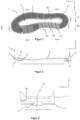
- FIG. 1 a view of the underside of a sole 1 according to an embodiment of the invention is shown.
- the sole 1 has a midsole 2, which includes a clear space 21.
- the clear space 21 is as in the Figure 1 visible, completely surrounded peripherally by the midsole 2.
- the stability support plate 3 is shown, which limits the clear space 21 in the vertical direction V, so that the stability support plate is exposed to the surroundings in the area of the clear space and is uncovered by the midsole in this area.
- the clear space 21 has a variable width along its length in the longitudinal direction L. The width, i.e. the direct extension of the clear space 21 in the transverse direction Q, is greater in the forefoot area than in the midfoot area or in the heel area.
- the midsole is designed in such a way that the clear space 21 has a curved periphery.
- the channels 23a, 23b and 23c are open towards the clear space 21.
- the midsole 2 shown is completely provided with the structured outsole 4 in the lateral area LB and partially in the medial area MB. In the area of the channels 23a, 23b and 23c, the medial area is not provided with an outsole.
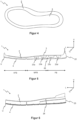
- the Figure 2 shows a longitudinal section along BB in longitudinal direction L of the Figure 1 shown sole 1.
- the midsole 2 has the clear space 21 with clear width I in the longitudinal direction L, which is directed towards the underside of the midsole 2 and thus towards the ground when worn. is designed to be open and extends from the heel area FB over the midfoot area MFB into the forefoot area VFB.
- the clear space 21 is peripherally surrounded by the midsole 2 and limited in the vertical direction V by the support plate 3.
- the Figure 2 clearly shows that the support plate 3 is peripherally surrounded by the midsole 2. As a result, a large part of the wearer's weight first acts on the support plate and is then distributed to the midsole that peripherally surrounds it.
- the midsole 2 has a circumferential step 25 on which the support plate 3 is arranged. In the longitudinal direction between the clear space 21 and the heel edge 22, the midsole 2 has a cavity 24 that is completely closed and is formed and delimited by the midsole 2 and the support plate 3.
- the Figure 3 shows a cross section of the Figure 1 shown embodiment along AA (cf. Figure 1 ).
- the cross-section runs through the channel 23c.
- the channel 23c is designed as a blind hole.
- the wall thickness W between the end of the channel and the outside of the midsole can be at least 3 mm.
- the channel 23c is open towards the clear space 21 and is delimited in the vertical direction V by the stable support plate 3.
- the clear space 21 is also delimited in the vertical direction V by the stable support plate 3.
- the clear space 21 has the clear height x in the vertical direction V.
- the space generally has a maximum clear width z in the transverse direction Q in the region of the channel 23c and a smaller clear width y in the transverse direction Q on the underside of the sole.
- the Figure 4 shows a view of the upper side, ie that of the insole and the foot of the wearer of a shoe with sole 1 of a sole 1 according to the invention. It is clear that the Stable support plate 3 is completely surrounded peripherally by the midsole 2 and the upper side of the stable support plate is uncovered by the midsole 2.
- Figure 5 shows a sole 1 according to the invention in longitudinal section through the channels 23a, 23b, 23c and 23d along CC according to Figure 1 .
- Sole 1 comprises a midsole 2, which has a heel area FB, a midfoot area FB and a forefoot area VFB.
- the midsole 2 has channels 23a, 23b, 23c and 23d in the heel area FB and in the midfoot area MFB which extend in the transverse direction Q and which are each designed as blind holes and are arranged essentially parallel to one another.
- the forefoot area is free of channels.
- the channels 23a, 23b, 23c and 23d are U-shaped in cross-section in the longitudinal direction and are delimited in the vertical direction V by the stable support plate 3.
- the channels 23a, 23b, 23c and 23d are thus completely and exclusively delimited by the soft-elastic midsole 2 and the stable support plate 3, regardless of the shape of the channels.
- the midsole 2 has a groove 26 in the longitudinal direction L in front of the channel 23c and behind the channel 23b, which is arranged longitudinally between the channels and facilitates their horizontal shearing in the longitudinal direction L.
- the underside U of the midsole 2, ie the side facing the ground when worn, is provided with a structured outsole 4.
- channels 23a, 23b, 23c and 23d are blind holes, ie they extend towards the outside of the midsole 2, but are not continuous, so that the outside of the midsole 2 as in the Figure 5 shown, generally has no channels or side openings.
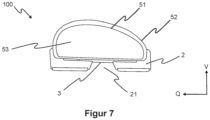
- FIG 7 is a cross section in transverse direction Q along DD according to Figure 1 through the forefoot area of a shoe 100 according to the invention with an inventive Sole shown.
- the sole comprises midsole 2 which comprises a clear space 21.
- the clear space 21 is completely surrounded peripherally by the midsole 2.
- the stable support plate 3 is shown, which limits the clear space 21 in the vertical direction V.
- the shoe 100 also has an outer upper 52 and an inner upper 51.
- the inner upper 51 is designed in such a way that an interior 53 is defined which is essentially completely delimited from the outer upper 52, so that the wearer's foot, which is arranged in the interior 53, does not come into contact with the outer upper.
- the inner upper 51 in the forefoot area is designed to be essentially movable relative to the outer upper 52 and can be moved relative to it to a certain extent.
Landscapes
- Chemical & Material Sciences (AREA)
- Engineering & Computer Science (AREA)
- Materials Engineering (AREA)
- Footwear And Its Accessory, Manufacturing Method And Apparatuses (AREA)
Applications Claiming Priority (3)
| Application Number | Priority Date | Filing Date | Title |
|---|---|---|---|
| CH00078/20A CH717066A1 (de) | 2020-01-23 | 2020-01-23 | Schuhsohle umfassend eine Mittelsohle mit lichtem Freiraum. |
| EP21701736.7A EP4093234B1 (fr) | 2020-01-23 | 2021-01-21 | Semelle intercalaire ayant un espace libre clair |
| PCT/EP2021/051351 WO2021148543A1 (fr) | 2020-01-23 | 2021-01-21 | Semelle intercalaire ayant un espace libre libre |
Related Parent Applications (2)
| Application Number | Title | Priority Date | Filing Date |
|---|---|---|---|
| EP21701736.7A Division EP4093234B1 (fr) | 2020-01-23 | 2021-01-21 | Semelle intercalaire ayant un espace libre clair |
| EP21701736.7A Division-Into EP4093234B1 (fr) | 2020-01-23 | 2021-01-21 | Semelle intercalaire ayant un espace libre clair |
Publications (2)
| Publication Number | Publication Date |
|---|---|
| EP4356776A2 true EP4356776A2 (fr) | 2024-04-24 |
| EP4356776A3 EP4356776A3 (fr) | 2024-07-03 |
Family
ID=69570495
Family Applications (2)
| Application Number | Title | Priority Date | Filing Date |
|---|---|---|---|
| EP24160498.2A Pending EP4356776A3 (fr) | 2020-01-23 | 2021-01-21 | Semelle intercalaire ayant un espace libre libre |
| EP21701736.7A Active EP4093234B1 (fr) | 2020-01-23 | 2021-01-21 | Semelle intercalaire ayant un espace libre clair |
Family Applications After (1)
| Application Number | Title | Priority Date | Filing Date |
|---|---|---|---|
| EP21701736.7A Active EP4093234B1 (fr) | 2020-01-23 | 2021-01-21 | Semelle intercalaire ayant un espace libre clair |
Country Status (6)
| Country | Link |
|---|---|
| US (2) | US12127627B2 (fr) |
| EP (2) | EP4356776A3 (fr) |
| CN (1) | CN114980772B (fr) |
| CH (1) | CH717066A1 (fr) |
| PT (1) | PT4093234T (fr) |
| WO (1) | WO2021148543A1 (fr) |
Families Citing this family (4)
| Publication number | Priority date | Publication date | Assignee | Title |
|---|---|---|---|---|
| CH717157A1 (de) * | 2020-02-20 | 2021-08-31 | On Clouds Gmbh | Sohle für ein Laufschuh. |
| USD1069376S1 (en) * | 2023-02-23 | 2025-04-08 | Top Glory Trading Group Inc | Running shoe sole |
| CN116746738A (zh) * | 2023-06-30 | 2023-09-15 | 安踏(中国)有限公司 | 一种具有弹性织物的中空鞋底和鞋子 |
| US12369685B1 (en) | 2024-06-12 | 2025-07-29 | 1158990 B.C. Ltd. | Shoe midsole with delayed energy return and lateral shear stability |
Family Cites Families (13)
| Publication number | Priority date | Publication date | Assignee | Title |
|---|---|---|---|---|
| ITPD20030312A1 (it) * | 2003-12-30 | 2005-06-30 | Geox Spa | Suola traspirante ed impermeabile per calzature |
| WO2007146958A2 (fr) * | 2006-06-12 | 2007-12-21 | Hardy Alan H | Système de matelassage pour chaussure |
| US20090293305A1 (en) * | 2008-05-30 | 2009-12-03 | St Ip, Llc | Full length airbag |
| US8510970B2 (en) * | 2010-03-30 | 2013-08-20 | Howard Baum | Shoe sole with energy restoring device |
| US8424221B2 (en) * | 2009-04-01 | 2013-04-23 | Reebok International Limited | Training footwear |
| DE102009028627B4 (de) * | 2009-08-18 | 2019-12-19 | Adidas Ag | Sportschuh |
| EP2454959A1 (fr) * | 2010-11-19 | 2012-05-23 | Andreas Bennert | Ensemble de maintien de semelle multicomposant pour chaussure de sport |
| CN102309088B (zh) * | 2011-04-27 | 2013-07-17 | 茂泰(福建)鞋材有限公司 | 一种带有支撑片的鞋底 |
| CN108783747B (zh) * | 2013-04-10 | 2020-11-03 | 安踏(中国)有限公司 | 一种鞋底以及具有该鞋底的鞋子 |
| US9578920B2 (en) * | 2014-05-13 | 2017-02-28 | Ariat International, Inc. | Energy return, cushioning, and arch support plates, and footwear and footwear soles including the same |
| US20190150563A1 (en) * | 2017-11-21 | 2019-05-23 | Altra Llc | Spring mechanism in a shoe |
| US10548370B2 (en) * | 2018-02-28 | 2020-02-04 | Rockport Ip Holdings, Llc | Shoe sole construction |
| US11622602B2 (en) * | 2020-08-18 | 2023-04-11 | Puma SE | Article of footwear having a sole plate |
-
2020
- 2020-01-23 CH CH00078/20A patent/CH717066A1/de unknown
-
2021
- 2021-01-21 EP EP24160498.2A patent/EP4356776A3/fr active Pending
- 2021-01-21 CN CN202180009985.2A patent/CN114980772B/zh active Active
- 2021-01-21 WO PCT/EP2021/051351 patent/WO2021148543A1/fr not_active Ceased
- 2021-01-21 PT PT217017367T patent/PT4093234T/pt unknown
- 2021-01-21 EP EP21701736.7A patent/EP4093234B1/fr active Active
- 2021-01-21 US US17/792,628 patent/US12127627B2/en active Active
-
2024
- 2024-09-30 US US18/901,367 patent/US20250017318A1/en active Pending
Also Published As
| Publication number | Publication date |
|---|---|
| EP4356776A3 (fr) | 2024-07-03 |
| EP4093234A1 (fr) | 2022-11-30 |
| WO2021148543A1 (fr) | 2021-07-29 |
| PT4093234T (pt) | 2024-04-30 |
| US20250017318A1 (en) | 2025-01-16 |
| CH717066A1 (de) | 2021-07-30 |
| CN114980772A (zh) | 2022-08-30 |
| US20230041399A1 (en) | 2023-02-09 |
| US12127627B2 (en) | 2024-10-29 |
| EP4093234B1 (fr) | 2024-04-10 |
| CN114980772B (zh) | 2024-04-23 |
Similar Documents
| Publication | Publication Date | Title |
|---|---|---|
| EP4106571B1 (fr) | Semelle pour chaussure de course | |
| DE102011102849B4 (de) | Schuhsole mit Röhren | |
| EP4093234B1 (fr) | Semelle intercalaire ayant un espace libre clair | |
| DE60030188T2 (de) | Schuhwerk | |
| DE69926340T2 (de) | Einsatz mit verformbaren teilen | |
| DE102013202353B4 (de) | Sohle für einen Schuh | |
| DE3508308C2 (de) | Sportschuh | |
| DE102019107402A1 (de) | Zwischensohlenkonstruktion für einen Schuh | |
| DE69623496T2 (de) | Schuh mit verstärkenen stabilisationsmerkmale | |
| EP1945053A1 (fr) | Chaussures en particulier chaussure de sport | |
| CH718419A2 (de) | Sohle mit gewölbter elastischer Platte. | |
| DE102019214944A1 (de) | Sohlenelement | |
| CH718659A2 (de) | Sohle mit zweilagiger Mittelsohle. | |
| EP4284210B1 (fr) | Semelle présentant une fonction d'amortissement horizontal et vertical | |
| EP4284209A1 (fr) | Semelle à propriétés d'amortissement variables | |
| WO2020193034A1 (fr) | Semelle de chaussure de course pourvue d'une plaque composite renforcée de fibres | |
| DE202022002913U1 (de) | Sohle mit horizontaler und vertikaler Dämpfung | |
| DE202022002920U1 (de) | Sohle mit variablen Dämpfungseigenschaften | |
| DE102025106494A1 (de) | Sohlenstruktur und Schuh mit der Sohlenstruktur | |
| EP4670556A2 (fr) | Semelle à propriétés d'amortissement variables | |
| CH718399A1 (de) | Sohle mit gewölbter elastischer Platte. | |
| WO2003049565A1 (fr) | Chaussure | |
| DE20215149U1 (de) | Schuh | |
| DE29905906U1 (de) | Schuh- bzw. Laufsohle sowie Schuh mit dieser Sohle |
Legal Events
| Date | Code | Title | Description |
|---|---|---|---|
| PUAI | Public reference made under article 153(3) epc to a published international application that has entered the european phase |
Free format text: ORIGINAL CODE: 0009012 |
|
| STAA | Information on the status of an ep patent application or granted ep patent |
Free format text: STATUS: THE APPLICATION HAS BEEN PUBLISHED |
|
| AC | Divisional application: reference to earlier application |
Ref document number: 4093234 Country of ref document: EP Kind code of ref document: P |
|
| AK | Designated contracting states |
Kind code of ref document: A2 Designated state(s): AL AT BE BG CH CY CZ DE DK EE ES FI FR GB GR HR HU IE IS IT LI LT LU LV MC MK MT NL NO PL PT RO RS SE SI SK SM TR |
|
| REG | Reference to a national code |
Ref country code: DE Ref legal event code: R079 Free format text: PREVIOUS MAIN CLASS: A43B0023020000 Ipc: A43B0013120000 |
|
| PUAL | Search report despatched |
Free format text: ORIGINAL CODE: 0009013 |
|
| AK | Designated contracting states |
Kind code of ref document: A3 Designated state(s): AL AT BE BG CH CY CZ DE DK EE ES FI FR GB GR HR HU IE IS IT LI LT LU LV MC MK MT NL NO PL PT RO RS SE SI SK SM TR |
|
| RIC1 | Information provided on ipc code assigned before grant |
Ipc: A43B 23/02 20060101ALI20240527BHEP Ipc: A43B 13/18 20060101ALI20240527BHEP Ipc: A43B 13/12 20060101AFI20240527BHEP |
|
| STAA | Information on the status of an ep patent application or granted ep patent |
Free format text: STATUS: REQUEST FOR EXAMINATION WAS MADE |
|
| 17P | Request for examination filed |
Effective date: 20240813 |
|
| RBV | Designated contracting states (corrected) |
Designated state(s): AL AT BE BG CH CY CZ DE DK EE ES FI FR GB GR HR HU IE IS IT LI LT LU LV MC MK MT NL NO PL PT RO RS SE SI SK SM TR |
|
| STAA | Information on the status of an ep patent application or granted ep patent |
Free format text: STATUS: EXAMINATION IS IN PROGRESS |
|
| 17Q | First examination report despatched |
Effective date: 20250123 |
|
| GRAP | Despatch of communication of intention to grant a patent |
Free format text: ORIGINAL CODE: EPIDOSNIGR1 |
|
| STAA | Information on the status of an ep patent application or granted ep patent |
Free format text: STATUS: GRANT OF PATENT IS INTENDED |
|
| INTG | Intention to grant announced |
Effective date: 20260402 |
|
| P01 | Opt-out of the competence of the unified patent court (upc) registered |
Free format text: CASE NUMBER: UPC_APP_0014136_4356776/2026 Effective date: 20260429 |
|
| GRAS | Grant fee paid |
Free format text: ORIGINAL CODE: EPIDOSNIGR3 |
|
| GRAA | (expected) grant |
Free format text: ORIGINAL CODE: 0009210 |
|
| STAA | Information on the status of an ep patent application or granted ep patent |
Free format text: STATUS: THE PATENT HAS BEEN GRANTED |