EP4360612A1 - Kosmetisches reinigungsgel mit hoher transparenz - Google Patents
Kosmetisches reinigungsgel mit hoher transparenz Download PDFInfo
- Publication number
- EP4360612A1 EP4360612A1 EP23197072.4A EP23197072A EP4360612A1 EP 4360612 A1 EP4360612 A1 EP 4360612A1 EP 23197072 A EP23197072 A EP 23197072A EP 4360612 A1 EP4360612 A1 EP 4360612A1
- Authority
- EP
- European Patent Office
- Prior art keywords
- cleansing gel
- gel according
- total weight
- cleansing
- sodium
- Prior art date
- Legal status (The legal status is an assumption and is not a legal conclusion. Google has not performed a legal analysis and makes no representation as to the accuracy of the status listed.)
- Pending
Links
- 239000002537 cosmetic Substances 0.000 title claims description 16
- 239000004094 surface-active agent Substances 0.000 claims description 24
- 238000004140 cleaning Methods 0.000 claims description 21
- 239000011734 sodium Substances 0.000 claims description 20
- DGAQECJNVWCQMB-PUAWFVPOSA-M Ilexoside XXIX Chemical compound C[C@@H]1CC[C@@]2(CC[C@@]3(C(=CC[C@H]4[C@]3(CC[C@@H]5[C@@]4(CC[C@@H](C5(C)C)OS(=O)(=O)[O-])C)C)[C@@H]2[C@]1(C)O)C)C(=O)O[C@H]6[C@@H]([C@H]([C@@H]([C@H](O6)CO)O)O)O.[Na+] DGAQECJNVWCQMB-PUAWFVPOSA-M 0.000 claims description 19
- 229910052708 sodium Inorganic materials 0.000 claims description 19
- LFQSCWFLJHTTHZ-UHFFFAOYSA-N Ethanol Chemical compound CCO LFQSCWFLJHTTHZ-UHFFFAOYSA-N 0.000 claims description 15
- 125000002252 acyl group Chemical group 0.000 claims description 14
- -1 hydroxypropyl Chemical group 0.000 claims description 14
- 239000003381 stabilizer Substances 0.000 claims description 13
- 239000000230 xanthan gum Substances 0.000 claims description 12
- 229920001285 xanthan gum Polymers 0.000 claims description 12
- 229940082509 xanthan gum Drugs 0.000 claims description 12
- 235000010493 xanthan gum Nutrition 0.000 claims description 12
- 229920000642 polymer Polymers 0.000 claims description 11
- XLYOFNOQVPJJNP-UHFFFAOYSA-N water Substances O XLYOFNOQVPJJNP-UHFFFAOYSA-N 0.000 claims description 11
- QCDWFXQBSFUVSP-UHFFFAOYSA-N 2-phenoxyethanol Chemical compound OCCOC1=CC=CC=C1 QCDWFXQBSFUVSP-UHFFFAOYSA-N 0.000 claims description 10
- QXNVGIXVLWOKEQ-UHFFFAOYSA-N Disodium Chemical compound [Na][Na] QXNVGIXVLWOKEQ-UHFFFAOYSA-N 0.000 claims description 10
- 125000000217 alkyl group Chemical group 0.000 claims description 10
- AEIJTFQOBWATKX-UHFFFAOYSA-N octane-1,2-diol Chemical compound CCCCCCC(O)CO AEIJTFQOBWATKX-UHFFFAOYSA-N 0.000 claims description 10
- 229960005323 phenoxyethanol Drugs 0.000 claims description 10
- KWIUHFFTVRNATP-UHFFFAOYSA-N Betaine Natural products C[N+](C)(C)CC([O-])=O KWIUHFFTVRNATP-UHFFFAOYSA-N 0.000 claims description 9
- DNIAPMSPPWPWGF-UHFFFAOYSA-N Propylene glycol Chemical compound CC(O)CO DNIAPMSPPWPWGF-UHFFFAOYSA-N 0.000 claims description 9
- 150000001413 amino acids Chemical class 0.000 claims description 9
- 239000003755 preservative agent Substances 0.000 claims description 9
- 229940071089 sarcosinate Drugs 0.000 claims description 9
- QWGRWMMWNDWRQN-UHFFFAOYSA-N 2-methylpropane-1,3-diol Chemical compound OCC(C)CO QWGRWMMWNDWRQN-UHFFFAOYSA-N 0.000 claims description 8
- 229940080421 coco glucoside Drugs 0.000 claims description 8
- 229940100573 methylpropanediol Drugs 0.000 claims description 8
- FSYKKLYZXJSNPZ-UHFFFAOYSA-N sarcosine Chemical compound C[NH2+]CC([O-])=O FSYKKLYZXJSNPZ-UHFFFAOYSA-N 0.000 claims description 8
- 230000007935 neutral effect Effects 0.000 claims description 7
- 229920001059 synthetic polymer Polymers 0.000 claims description 7
- 229960003237 betaine Drugs 0.000 claims description 6
- MRUAUOIMASANKQ-UHFFFAOYSA-N cocamidopropyl betaine Chemical group CCCCCCCCCCCC(=O)NCCC[N+](C)(C)CC([O-])=O MRUAUOIMASANKQ-UHFFFAOYSA-N 0.000 claims description 6
- 229940073507 cocamidopropyl betaine Drugs 0.000 claims description 6
- 150000001875 compounds Chemical class 0.000 claims description 6
- JDRSMPFHFNXQRB-IBEHDNSVSA-N decyl glucoside Chemical compound CCCCCCCCCCO[C@@H]1O[C@H](CO)[C@@H](O)[C@H](O)[C@H]1O JDRSMPFHFNXQRB-IBEHDNSVSA-N 0.000 claims description 6
- WHUUTDBJXJRKMK-VKHMYHEASA-N L-glutamic acid Chemical compound OC(=O)[C@@H](N)CCC(O)=O WHUUTDBJXJRKMK-VKHMYHEASA-N 0.000 claims description 5
- QAOWNCQODCNURD-UHFFFAOYSA-L Sulfate Chemical compound [O-]S([O-])(=O)=O QAOWNCQODCNURD-UHFFFAOYSA-L 0.000 claims description 5
- 238000001595 flow curve Methods 0.000 claims description 5
- 229930195712 glutamate Natural products 0.000 claims description 5
- 238000005259 measurement Methods 0.000 claims description 5
- 125000002801 octanoyl group Chemical group C(CCCCCCC)(=O)* 0.000 claims description 5
- 108700004121 sarkosyl Proteins 0.000 claims description 5
- KSAVQLQVUXSOCR-UHFFFAOYSA-M sodium lauroyl sarcosinate Chemical group [Na+].CCCCCCCCCCCC(=O)N(C)CC([O-])=O KSAVQLQVUXSOCR-UHFFFAOYSA-M 0.000 claims description 5
- 229940045885 sodium lauroyl sarcosinate Drugs 0.000 claims description 5
- 230000005540 biological transmission Effects 0.000 claims description 4
- PUPZLCDOIYMWBV-UHFFFAOYSA-N (+/-)-1,3-Butanediol Chemical compound CC(O)CCO PUPZLCDOIYMWBV-UHFFFAOYSA-N 0.000 claims description 3
- 229940015975 1,2-hexanediol Drugs 0.000 claims description 3
- 229940043375 1,5-pentanediol Drugs 0.000 claims description 3
- NCZPCONIKBICGS-UHFFFAOYSA-N 3-(2-ethylhexoxy)propane-1,2-diol Chemical compound CCCCC(CC)COCC(O)CO NCZPCONIKBICGS-UHFFFAOYSA-N 0.000 claims description 3
- 229940100524 ethylhexylglycerin Drugs 0.000 claims description 3
- 229940087068 glyceryl caprylate Drugs 0.000 claims description 3
- FHKSXSQHXQEMOK-UHFFFAOYSA-N hexane-1,2-diol Chemical compound CCCCC(O)CO FHKSXSQHXQEMOK-UHFFFAOYSA-N 0.000 claims description 3
- WCVRQHFDJLLWFE-UHFFFAOYSA-N pentane-1,2-diol Chemical compound CCCC(O)CO WCVRQHFDJLLWFE-UHFFFAOYSA-N 0.000 claims description 3
- 229960004063 propylene glycol Drugs 0.000 claims description 3
- GHBFNMLVSPCDGN-UHFFFAOYSA-N rac-1-monooctanoylglycerol Chemical compound CCCCCCCC(=O)OCC(O)CO GHBFNMLVSPCDGN-UHFFFAOYSA-N 0.000 claims description 3
- TXFPEBPIARQUIG-UHFFFAOYSA-N 4'-hydroxyacetophenone Chemical compound CC(=O)C1=CC=C(O)C=C1 TXFPEBPIARQUIG-UHFFFAOYSA-N 0.000 claims description 2
- 229940073499 decyl glucoside Drugs 0.000 claims description 2
- 229940079779 disodium cocoyl glutamate Drugs 0.000 claims description 2
- 239000012153 distilled water Substances 0.000 claims description 2
- PYIDGJJWBIBVIA-UYTYNIKBSA-N lauryl glucoside Chemical compound CCCCCCCCCCCCO[C@@H]1O[C@H](CO)[C@@H](O)[C@H](O)[C@H]1O PYIDGJJWBIBVIA-UYTYNIKBSA-N 0.000 claims description 2
- 229940048848 lauryl glucoside Drugs 0.000 claims description 2
- KWIUHFFTVRNATP-UHFFFAOYSA-O N,N,N-trimethylglycinium Chemical compound C[N+](C)(C)CC(O)=O KWIUHFFTVRNATP-UHFFFAOYSA-O 0.000 claims 3
- 244000007835 Cyamopsis tetragonoloba Species 0.000 claims 2
- PXEDJBXQKAGXNJ-QTNFYWBSSA-L disodium L-glutamate Chemical group [Na+].[Na+].[O-]C(=O)[C@@H](N)CCC([O-])=O PXEDJBXQKAGXNJ-QTNFYWBSSA-L 0.000 claims 1
- 238000002360 preparation method Methods 0.000 abstract description 26
- 239000000499 gel Substances 0.000 description 62
- 239000000047 product Substances 0.000 description 16
- 244000303965 Cyamopsis psoralioides Species 0.000 description 10
- PEDCQBHIVMGVHV-UHFFFAOYSA-N Glycerine Chemical compound OCC(O)CO PEDCQBHIVMGVHV-UHFFFAOYSA-N 0.000 description 8
- 238000000034 method Methods 0.000 description 7
- 125000004432 carbon atom Chemical group C* 0.000 description 6
- KRKNYBCHXYNGOX-UHFFFAOYSA-N citric acid Chemical compound OC(=O)CC(O)(C(O)=O)CC(O)=O KRKNYBCHXYNGOX-UHFFFAOYSA-N 0.000 description 6
- 210000004209 hair Anatomy 0.000 description 6
- 239000003906 humectant Substances 0.000 description 6
- 230000000622 irritating effect Effects 0.000 description 6
- 239000000203 mixture Substances 0.000 description 6
- 238000004925 denaturation Methods 0.000 description 5
- 210000003743 erythrocyte Anatomy 0.000 description 5
- 239000002994 raw material Substances 0.000 description 5
- 239000000126 substance Substances 0.000 description 5
- QAOWNCQODCNURD-UHFFFAOYSA-N Sulfuric acid Chemical compound OS(O)(=O)=O QAOWNCQODCNURD-UHFFFAOYSA-N 0.000 description 4
- 230000036425 denaturation Effects 0.000 description 4
- 235000011187 glycerol Nutrition 0.000 description 4
- 150000002632 lipids Chemical class 0.000 description 4
- 238000004806 packaging method and process Methods 0.000 description 4
- FJKROLUGYXJWQN-UHFFFAOYSA-N 4-hydroxybenzoic acid Chemical compound OC(=O)C1=CC=C(O)C=C1 FJKROLUGYXJWQN-UHFFFAOYSA-N 0.000 description 3
- CSCPPACGZOOCGX-UHFFFAOYSA-N Acetone Chemical compound CC(C)=O CSCPPACGZOOCGX-UHFFFAOYSA-N 0.000 description 3
- KFZMGEQAYNKOFK-UHFFFAOYSA-N Isopropanol Chemical compound CC(C)O KFZMGEQAYNKOFK-UHFFFAOYSA-N 0.000 description 3
- FKNQFGJONOIPTF-UHFFFAOYSA-N Sodium cation Chemical compound [Na+] FKNQFGJONOIPTF-UHFFFAOYSA-N 0.000 description 3
- 230000002378 acidificating effect Effects 0.000 description 3
- 235000014113 dietary fatty acids Nutrition 0.000 description 3
- 150000002148 esters Chemical class 0.000 description 3
- 235000019441 ethanol Nutrition 0.000 description 3
- 239000003925 fat Substances 0.000 description 3
- 235000019197 fats Nutrition 0.000 description 3
- 229930195729 fatty acid Natural products 0.000 description 3
- 239000000194 fatty acid Substances 0.000 description 3
- 150000004665 fatty acids Chemical class 0.000 description 3
- 239000003921 oil Substances 0.000 description 3
- 235000019198 oils Nutrition 0.000 description 3
- 239000002304 perfume Substances 0.000 description 3
- 150000003839 salts Chemical class 0.000 description 3
- 239000002437 shaving preparation Substances 0.000 description 3
- QFOHBWFCKVYLES-UHFFFAOYSA-N Butylparaben Chemical compound CCCCOC(=O)C1=CC=C(O)C=C1 QFOHBWFCKVYLES-UHFFFAOYSA-N 0.000 description 2
- 206010018910 Haemolysis Diseases 0.000 description 2
- 102000001554 Hemoglobins Human genes 0.000 description 2
- 108010054147 Hemoglobins Proteins 0.000 description 2
- KEAYESYHFKHZAL-UHFFFAOYSA-N Sodium Chemical compound [Na] KEAYESYHFKHZAL-UHFFFAOYSA-N 0.000 description 2
- DKGAVHZHDRPRBM-UHFFFAOYSA-N Tert-Butanol Chemical compound CC(C)(C)O DKGAVHZHDRPRBM-UHFFFAOYSA-N 0.000 description 2
- XSQUKJJJFZCRTK-UHFFFAOYSA-N Urea Chemical compound NC(N)=O XSQUKJJJFZCRTK-UHFFFAOYSA-N 0.000 description 2
- 238000010521 absorption reaction Methods 0.000 description 2
- 238000003556 assay Methods 0.000 description 2
- 244000309466 calf Species 0.000 description 2
- 238000009472 formulation Methods 0.000 description 2
- 125000002791 glucosyl group Chemical group C1([C@H](O)[C@@H](O)[C@H](O)[C@H](O1)CO)* 0.000 description 2
- 230000008588 hemolysis Effects 0.000 description 2
- 229940071145 lauroyl sarcosinate Drugs 0.000 description 2
- 239000007788 liquid Substances 0.000 description 2
- LXCFILQKKLGQFO-UHFFFAOYSA-N methylparaben Chemical compound COC(=O)C1=CC=C(O)C=C1 LXCFILQKKLGQFO-UHFFFAOYSA-N 0.000 description 2
- 244000005700 microbiome Species 0.000 description 2
- 230000003020 moisturizing effect Effects 0.000 description 2
- 239000000178 monomer Substances 0.000 description 2
- LPUQAYUQRXPFSQ-DFWYDOINSA-M monosodium L-glutamate Chemical compound [Na+].[O-]C(=O)[C@@H](N)CCC(O)=O LPUQAYUQRXPFSQ-DFWYDOINSA-M 0.000 description 2
- 231100000017 mucous membrane irritation Toxicity 0.000 description 2
- QELSKZZBTMNZEB-UHFFFAOYSA-N propylparaben Chemical compound CCCOC(=O)C1=CC=C(O)C=C1 QELSKZZBTMNZEB-UHFFFAOYSA-N 0.000 description 2
- 229940079781 sodium cocoyl glutamate Drugs 0.000 description 2
- 239000000243 solution Substances 0.000 description 2
- 230000000087 stabilizing effect Effects 0.000 description 2
- OVSKIKFHRZPJSS-UHFFFAOYSA-N 2,4-D Chemical compound OC(=O)COC1=CC=C(Cl)C=C1Cl OVSKIKFHRZPJSS-UHFFFAOYSA-N 0.000 description 1
- OSCJHTSDLYVCQC-UHFFFAOYSA-N 2-ethylhexyl 4-[[4-[4-(tert-butylcarbamoyl)anilino]-6-[4-(2-ethylhexoxycarbonyl)anilino]-1,3,5-triazin-2-yl]amino]benzoate Chemical compound C1=CC(C(=O)OCC(CC)CCCC)=CC=C1NC1=NC(NC=2C=CC(=CC=2)C(=O)NC(C)(C)C)=NC(NC=2C=CC(=CC=2)C(=O)OCC(CC)CCCC)=N1 OSCJHTSDLYVCQC-UHFFFAOYSA-N 0.000 description 1
- 229940090248 4-hydroxybenzoic acid Drugs 0.000 description 1
- ODHCTXKNWHHXJC-VKHMYHEASA-N 5-oxo-L-proline Chemical compound OC(=O)[C@@H]1CCC(=O)N1 ODHCTXKNWHHXJC-VKHMYHEASA-N 0.000 description 1
- NIXOWILDQLNWCW-UHFFFAOYSA-M Acrylate Chemical compound [O-]C(=O)C=C NIXOWILDQLNWCW-UHFFFAOYSA-M 0.000 description 1
- 244000144927 Aloe barbadensis Species 0.000 description 1
- 235000002961 Aloe barbadensis Nutrition 0.000 description 1
- 241000894006 Bacteria Species 0.000 description 1
- 240000001548 Camellia japonica Species 0.000 description 1
- 241000222122 Candida albicans Species 0.000 description 1
- 240000006740 Cichorium endivia Species 0.000 description 1
- 235000018536 Cichorium endivia Nutrition 0.000 description 1
- 240000004784 Cymbopogon citratus Species 0.000 description 1
- 235000017897 Cymbopogon citratus Nutrition 0.000 description 1
- FBPFZTCFMRRESA-FSIIMWSLSA-N D-Glucitol Natural products OC[C@H](O)[C@H](O)[C@@H](O)[C@H](O)CO FBPFZTCFMRRESA-FSIIMWSLSA-N 0.000 description 1
- FBPFZTCFMRRESA-JGWLITMVSA-N D-glucitol Chemical compound OC[C@H](O)[C@@H](O)[C@H](O)[C@H](O)CO FBPFZTCFMRRESA-JGWLITMVSA-N 0.000 description 1
- 241000588724 Escherichia coli Species 0.000 description 1
- WQZGKKKJIJFFOK-GASJEMHNSA-N Glucose Natural products OC[C@H]1OC(O)[C@H](O)[C@@H](O)[C@@H]1O WQZGKKKJIJFFOK-GASJEMHNSA-N 0.000 description 1
- UFHFLCQGNIYNRP-UHFFFAOYSA-N Hydrogen Chemical compound [H][H] UFHFLCQGNIYNRP-UHFFFAOYSA-N 0.000 description 1
- XPJVKCRENWUEJH-UHFFFAOYSA-N Isobutylparaben Chemical compound CC(C)COC(=O)C1=CC=C(O)C=C1 XPJVKCRENWUEJH-UHFFFAOYSA-N 0.000 description 1
- CMHMMKSPYOOVGI-UHFFFAOYSA-N Isopropylparaben Chemical compound CC(C)OC(=O)C1=CC=C(O)C=C1 CMHMMKSPYOOVGI-UHFFFAOYSA-N 0.000 description 1
- 235000010254 Jasminum officinale Nutrition 0.000 description 1
- 240000005385 Jasminum sambac Species 0.000 description 1
- 240000007817 Olea europaea Species 0.000 description 1
- 235000019482 Palm oil Nutrition 0.000 description 1
- 235000019483 Peanut oil Nutrition 0.000 description 1
- GOOHAUXETOMSMM-UHFFFAOYSA-N Propylene oxide Chemical compound CC1CO1 GOOHAUXETOMSMM-UHFFFAOYSA-N 0.000 description 1
- 241000588770 Proteus mirabilis Species 0.000 description 1
- 241000589517 Pseudomonas aeruginosa Species 0.000 description 1
- LCTONWCANYUPML-UHFFFAOYSA-M Pyruvate Chemical compound CC(=O)C([O-])=O LCTONWCANYUPML-UHFFFAOYSA-M 0.000 description 1
- 240000004808 Saccharomyces cerevisiae Species 0.000 description 1
- 206010040880 Skin irritation Diseases 0.000 description 1
- 241000191967 Staphylococcus aureus Species 0.000 description 1
- 244000269722 Thea sinensis Species 0.000 description 1
- 241000589634 Xanthomonas Species 0.000 description 1
- TVXBFESIOXBWNM-UHFFFAOYSA-N Xylitol Natural products OCCC(O)C(O)C(O)CCO TVXBFESIOXBWNM-UHFFFAOYSA-N 0.000 description 1
- 239000002253 acid Substances 0.000 description 1
- 239000004480 active ingredient Substances 0.000 description 1
- 239000013543 active substance Substances 0.000 description 1
- 239000000654 additive Substances 0.000 description 1
- IAJILQKETJEXLJ-QTBDOELSSA-N aldehydo-D-glucuronic acid Chemical group O=C[C@H](O)[C@@H](O)[C@H](O)[C@H](O)C(O)=O IAJILQKETJEXLJ-QTBDOELSSA-N 0.000 description 1
- 235000011399 aloe vera Nutrition 0.000 description 1
- 125000003277 amino group Chemical group 0.000 description 1
- 125000000129 anionic group Chemical group 0.000 description 1
- 150000001450 anions Chemical class 0.000 description 1
- 235000019606 astringent taste Nutrition 0.000 description 1
- 230000004888 barrier function Effects 0.000 description 1
- 230000031018 biological processes and functions Effects 0.000 description 1
- 230000015572 biosynthetic process Effects 0.000 description 1
- 229940067596 butylparaben Drugs 0.000 description 1
- DTFQOFKRUDOJCR-UHFFFAOYSA-L calcium;4-carboxyphenolate Chemical compound [Ca+2].OC1=CC=C(C([O-])=O)C=C1.OC1=CC=C(C([O-])=O)C=C1 DTFQOFKRUDOJCR-UHFFFAOYSA-L 0.000 description 1
- 229940095731 candida albicans Drugs 0.000 description 1
- 239000004202 carbamide Substances 0.000 description 1
- 235000013877 carbamide Nutrition 0.000 description 1
- 125000003178 carboxy group Chemical group [H]OC(*)=O 0.000 description 1
- 210000004027 cell Anatomy 0.000 description 1
- 238000005119 centrifugation Methods 0.000 description 1
- 239000007795 chemical reaction product Substances 0.000 description 1
- 230000003749 cleanliness Effects 0.000 description 1
- 239000003240 coconut oil Substances 0.000 description 1
- 235000019864 coconut oil Nutrition 0.000 description 1
- 235000018597 common camellia Nutrition 0.000 description 1
- 239000008139 complexing agent Substances 0.000 description 1
- 239000013256 coordination polymer Substances 0.000 description 1
- 239000003398 denaturant Substances 0.000 description 1
- SMVRDGHCVNAOIN-UHFFFAOYSA-L disodium;1-dodecoxydodecane;sulfate Chemical compound [Na+].[Na+].[O-]S([O-])(=O)=O.CCCCCCCCCCCCOCCCCCCCCCCCC SMVRDGHCVNAOIN-UHFFFAOYSA-L 0.000 description 1
- MOTZDAYCYVMXPC-UHFFFAOYSA-N dodecyl hydrogen sulfate Chemical compound CCCCCCCCCCCCOS(O)(=O)=O MOTZDAYCYVMXPC-UHFFFAOYSA-N 0.000 description 1
- 229940043264 dodecyl sulfate Drugs 0.000 description 1
- 231100000673 dose–response relationship Toxicity 0.000 description 1
- 235000013399 edible fruits Nutrition 0.000 description 1
- 230000000694 effects Effects 0.000 description 1
- 239000003792 electrolyte Substances 0.000 description 1
- 230000008030 elimination Effects 0.000 description 1
- 238000003379 elimination reaction Methods 0.000 description 1
- 238000006266 etherification reaction Methods 0.000 description 1
- 229960001617 ethyl hydroxybenzoate Drugs 0.000 description 1
- 235000010228 ethyl p-hydroxybenzoate Nutrition 0.000 description 1
- 239000004403 ethyl p-hydroxybenzoate Substances 0.000 description 1
- NUVBSKCKDOMJSU-UHFFFAOYSA-N ethylparaben Chemical compound CCOC(=O)C1=CC=C(O)C=C1 NUVBSKCKDOMJSU-UHFFFAOYSA-N 0.000 description 1
- 238000011156 evaluation Methods 0.000 description 1
- 230000001815 facial effect Effects 0.000 description 1
- 230000002349 favourable effect Effects 0.000 description 1
- 239000000945 filler Substances 0.000 description 1
- 239000000834 fixative Substances 0.000 description 1
- 235000013312 flour Nutrition 0.000 description 1
- 239000006260 foam Substances 0.000 description 1
- 239000004872 foam stabilizing agent Substances 0.000 description 1
- 238000005187 foaming Methods 0.000 description 1
- 239000008103 glucose Substances 0.000 description 1
- 235000009569 green tea Nutrition 0.000 description 1
- 210000004919 hair shaft Anatomy 0.000 description 1
- 239000001257 hydrogen Substances 0.000 description 1
- 229910052739 hydrogen Inorganic materials 0.000 description 1
- 125000004435 hydrogen atom Chemical group [H]* 0.000 description 1
- QAOWNCQODCNURD-UHFFFAOYSA-M hydrogensulfate Chemical compound OS([O-])(=O)=O QAOWNCQODCNURD-UHFFFAOYSA-M 0.000 description 1
- 125000002887 hydroxy group Chemical group [H]O* 0.000 description 1
- 238000001727 in vivo Methods 0.000 description 1
- 238000011534 incubation Methods 0.000 description 1
- 239000004615 ingredient Substances 0.000 description 1
- 239000002085 irritant Substances 0.000 description 1
- 230000007794 irritation Effects 0.000 description 1
- 229940113094 isopropylparaben Drugs 0.000 description 1
- 125000000311 mannosyl group Chemical group C1([C@@H](O)[C@@H](O)[C@H](O)[C@H](O1)CO)* 0.000 description 1
- HEBKCHPVOIAQTA-UHFFFAOYSA-N meso ribitol Natural products OCC(O)C(O)C(O)CO HEBKCHPVOIAQTA-UHFFFAOYSA-N 0.000 description 1
- 235000010270 methyl p-hydroxybenzoate Nutrition 0.000 description 1
- 239000004292 methyl p-hydroxybenzoate Substances 0.000 description 1
- 229960002216 methylparaben Drugs 0.000 description 1
- 231100000252 nontoxic Toxicity 0.000 description 1
- 230000003000 nontoxic effect Effects 0.000 description 1
- 239000004006 olive oil Substances 0.000 description 1
- 235000008390 olive oil Nutrition 0.000 description 1
- 150000007524 organic acids Chemical class 0.000 description 1
- 239000002540 palm oil Substances 0.000 description 1
- 239000000312 peanut oil Substances 0.000 description 1
- 239000004033 plastic Substances 0.000 description 1
- 229960003191 potassium methylparaben Drugs 0.000 description 1
- DPMDQHINTKFMKS-UHFFFAOYSA-M potassium;4-butoxycarbonylphenolate Chemical compound [K+].CCCCOC(=O)C1=CC=C([O-])C=C1 DPMDQHINTKFMKS-UHFFFAOYSA-M 0.000 description 1
- HFTYFFXNUVBSII-UHFFFAOYSA-M potassium;4-ethoxycarbonylphenolate Chemical compound [K+].CCOC(=O)C1=CC=C([O-])C=C1 HFTYFFXNUVBSII-UHFFFAOYSA-M 0.000 description 1
- DKGFIVSGQRBSOG-UHFFFAOYSA-M potassium;4-hydroxybenzoate Chemical compound [K+].OC1=CC=C(C([O-])=O)C=C1 DKGFIVSGQRBSOG-UHFFFAOYSA-M 0.000 description 1
- MOCBTMXJPWSHOD-UHFFFAOYSA-M potassium;4-methoxycarbonylphenolate Chemical compound [K+].COC(=O)C1=CC=C([O-])C=C1 MOCBTMXJPWSHOD-UHFFFAOYSA-M 0.000 description 1
- TUMYXYVXTFDMTJ-UHFFFAOYSA-M potassium;4-propoxycarbonylphenolate Chemical compound [K+].CCCOC(=O)C1=CC=C([O-])C=C1 TUMYXYVXTFDMTJ-UHFFFAOYSA-M 0.000 description 1
- 238000004321 preservation Methods 0.000 description 1
- 230000002335 preservative effect Effects 0.000 description 1
- 235000010232 propyl p-hydroxybenzoate Nutrition 0.000 description 1
- 239000004405 propyl p-hydroxybenzoate Substances 0.000 description 1
- 229960003415 propylparaben Drugs 0.000 description 1
- 229940079889 pyrrolidonecarboxylic acid Drugs 0.000 description 1
- 238000011084 recovery Methods 0.000 description 1
- 210000002374 sebum Anatomy 0.000 description 1
- 230000001953 sensory effect Effects 0.000 description 1
- 230000036556 skin irritation Effects 0.000 description 1
- 231100000475 skin irritation Toxicity 0.000 description 1
- 239000000344 soap Substances 0.000 description 1
- ZLVSYODPTJZFMK-UHFFFAOYSA-M sodium 4-hydroxybenzoate Chemical compound [Na+].OC1=CC=C(C([O-])=O)C=C1 ZLVSYODPTJZFMK-UHFFFAOYSA-M 0.000 description 1
- 235000010268 sodium methyl p-hydroxybenzoate Nutrition 0.000 description 1
- HLDPLHCMNIULPL-UHFFFAOYSA-M sodium;4-(2-methylpropoxycarbonyl)phenolate Chemical compound [Na+].CC(C)COC(=O)C1=CC=C([O-])C=C1 HLDPLHCMNIULPL-UHFFFAOYSA-M 0.000 description 1
- OGBHACNFHJJTQT-UHFFFAOYSA-M sodium;4-butoxycarbonylphenolate Chemical compound [Na+].CCCCOC(=O)C1=CC=C([O-])C=C1 OGBHACNFHJJTQT-UHFFFAOYSA-M 0.000 description 1
- QYNMSPKSYXPZHG-UHFFFAOYSA-M sodium;4-ethoxycarbonylphenolate Chemical compound [Na+].CCOC(=O)C1=CC=C([O-])C=C1 QYNMSPKSYXPZHG-UHFFFAOYSA-M 0.000 description 1
- PESXGULMKCKJCC-UHFFFAOYSA-M sodium;4-methoxycarbonylphenolate Chemical compound [Na+].COC(=O)C1=CC=C([O-])C=C1 PESXGULMKCKJCC-UHFFFAOYSA-M 0.000 description 1
- IXMINYBUNCWGER-UHFFFAOYSA-M sodium;4-propoxycarbonylphenolate Chemical compound [Na+].CCCOC(=O)C1=CC=C([O-])C=C1 IXMINYBUNCWGER-UHFFFAOYSA-M 0.000 description 1
- 239000007787 solid Substances 0.000 description 1
- 239000000600 sorbitol Substances 0.000 description 1
- 229960002920 sorbitol Drugs 0.000 description 1
- 235000010356 sorbitol Nutrition 0.000 description 1
- 239000003549 soybean oil Substances 0.000 description 1
- 235000012424 soybean oil Nutrition 0.000 description 1
- 230000003595 spectral effect Effects 0.000 description 1
- 239000011550 stock solution Substances 0.000 description 1
- 150000003467 sulfuric acid derivatives Chemical class 0.000 description 1
- 239000006228 supernatant Substances 0.000 description 1
- 235000019640 taste Nutrition 0.000 description 1
- 231100000027 toxicology Toxicity 0.000 description 1
- 229940045136 urea Drugs 0.000 description 1
- 239000001993 wax Substances 0.000 description 1
- 230000036642 wellbeing Effects 0.000 description 1
- 239000000811 xylitol Substances 0.000 description 1
- HEBKCHPVOIAQTA-SCDXWVJYSA-N xylitol Chemical compound OC[C@H](O)[C@@H](O)[C@H](O)CO HEBKCHPVOIAQTA-SCDXWVJYSA-N 0.000 description 1
- 235000010447 xylitol Nutrition 0.000 description 1
- 229960002675 xylitol Drugs 0.000 description 1
Classifications
-
- A—HUMAN NECESSITIES
- A61—MEDICAL OR VETERINARY SCIENCE; HYGIENE
- A61K—PREPARATIONS FOR MEDICAL, DENTAL OR TOILETRY PURPOSES
- A61K8/00—Cosmetics or similar toiletry preparations
- A61K8/02—Cosmetics or similar toiletry preparations characterised by special physical form
- A61K8/04—Dispersions; Emulsions
- A61K8/042—Gels
-
- A—HUMAN NECESSITIES
- A61—MEDICAL OR VETERINARY SCIENCE; HYGIENE
- A61K—PREPARATIONS FOR MEDICAL, DENTAL OR TOILETRY PURPOSES
- A61K8/00—Cosmetics or similar toiletry preparations
- A61K8/18—Cosmetics or similar toiletry preparations characterised by the composition
- A61K8/30—Cosmetics or similar toiletry preparations characterised by the composition containing organic compounds
- A61K8/40—Cosmetics or similar toiletry preparations characterised by the composition containing organic compounds containing nitrogen
- A61K8/44—Aminocarboxylic acids or derivatives thereof, e.g. aminocarboxylic acids containing sulfur; Salts; Esters or N-acylated derivatives thereof
-
- A—HUMAN NECESSITIES
- A61—MEDICAL OR VETERINARY SCIENCE; HYGIENE
- A61K—PREPARATIONS FOR MEDICAL, DENTAL OR TOILETRY PURPOSES
- A61K8/00—Cosmetics or similar toiletry preparations
- A61K8/18—Cosmetics or similar toiletry preparations characterised by the composition
- A61K8/30—Cosmetics or similar toiletry preparations characterised by the composition containing organic compounds
- A61K8/40—Cosmetics or similar toiletry preparations characterised by the composition containing organic compounds containing nitrogen
- A61K8/44—Aminocarboxylic acids or derivatives thereof, e.g. aminocarboxylic acids containing sulfur; Salts; Esters or N-acylated derivatives thereof
- A61K8/442—Aminocarboxylic acids or derivatives thereof, e.g. aminocarboxylic acids containing sulfur; Salts; Esters or N-acylated derivatives thereof substituted by amido group(s)
-
- A—HUMAN NECESSITIES
- A61—MEDICAL OR VETERINARY SCIENCE; HYGIENE
- A61K—PREPARATIONS FOR MEDICAL, DENTAL OR TOILETRY PURPOSES
- A61K8/00—Cosmetics or similar toiletry preparations
- A61K8/18—Cosmetics or similar toiletry preparations characterised by the composition
- A61K8/30—Cosmetics or similar toiletry preparations characterised by the composition containing organic compounds
- A61K8/60—Sugars; Derivatives thereof
- A61K8/604—Alkylpolyglycosides; Derivatives thereof, e.g. esters
-
- A—HUMAN NECESSITIES
- A61—MEDICAL OR VETERINARY SCIENCE; HYGIENE
- A61K—PREPARATIONS FOR MEDICAL, DENTAL OR TOILETRY PURPOSES
- A61K8/00—Cosmetics or similar toiletry preparations
- A61K8/18—Cosmetics or similar toiletry preparations characterised by the composition
- A61K8/72—Cosmetics or similar toiletry preparations characterised by the composition containing organic macromolecular compounds
- A61K8/73—Polysaccharides
-
- A—HUMAN NECESSITIES
- A61—MEDICAL OR VETERINARY SCIENCE; HYGIENE
- A61K—PREPARATIONS FOR MEDICAL, DENTAL OR TOILETRY PURPOSES
- A61K8/00—Cosmetics or similar toiletry preparations
- A61K8/18—Cosmetics or similar toiletry preparations characterised by the composition
- A61K8/72—Cosmetics or similar toiletry preparations characterised by the composition containing organic macromolecular compounds
- A61K8/73—Polysaccharides
- A61K8/737—Galactomannans, e.g. guar; Derivatives thereof
-
- A—HUMAN NECESSITIES
- A61—MEDICAL OR VETERINARY SCIENCE; HYGIENE
- A61Q—SPECIFIC USE OF COSMETICS OR SIMILAR TOILETRY PREPARATIONS
- A61Q19/00—Preparations for care of the skin
- A61Q19/10—Washing or bathing preparations
-
- A—HUMAN NECESSITIES
- A61—MEDICAL OR VETERINARY SCIENCE; HYGIENE
- A61K—PREPARATIONS FOR MEDICAL, DENTAL OR TOILETRY PURPOSES
- A61K2800/00—Properties of cosmetic compositions or active ingredients thereof or formulation aids used therein and process related aspects
- A61K2800/20—Chemical, physico-chemical or functional or structural properties of the composition as a whole
- A61K2800/26—Optical properties
- A61K2800/262—Transparent; Translucent
Definitions
- the present invention describes a cosmetic cleansing gel with a high degree of transparency, which is designed in such a way that it can be removed from a tube.
- the cleansing gel is also intended for use as a preparation for shaving.
- Cleansing gels are well known and transparent cleansing gels are also widely available. To make the transparency clearer, such preparations are usually offered in transparent packaging. This packaging is usually plastic bottles with the product being removed from an opening provided for this purpose. Examples of products include: Jasmine Scent Nourishing shower (Mintel entry number: 8948416); Cotton Blossom Scented Care shower (Mintel entry number: 8413185) and Shower Gel with Lemongrass & Oil (Mintel entry number: 567965).
- Cleaning products including cleaning gels, are used to clean the skin and hair. After the cleaning process, the user ideally feels clean, fresh and well-being. People have always had the need to clean themselves, i.e. to remove dirt from their skin or hair.
- the aim of the cleaning process is to remove dirt from the surface of the skin.
- the dirt film consists of solid or liquid components that have come onto the skin from the outside.
- the dirt film also includes excess skin lipids and dead body cells. With the help of surface-active ingredients in the cleaning compositions, the components of the dirt film enter the wash liquor and are removed from the skin by the rinsing process.
- surface lipids of the skin can also be dissolved to a limited extent by the surface-active substances in the cleaning preparations and removed during the rinsing process.
- the loss of skin lipids can lead to dryness and skin irritation.
- the cleansing gel should be transparent, ideally very transparent. Consumers associate transparency with freshness and cleanliness, both properties that a cleansing product should and must achieve after use by the consumer. In order to make the transparency visible and to provide a different type of packaging unit, the task was to offer the cleansing gel according to the invention in a transparent tube.
- Cleansing preparations including cleansing gels, that are offered in a tube are already available. However, in most cases the tubes are opaque, i.e. not transparent. Examples include the following products: 2in1 Deep Cleanse Gel (Mintel entry number: 9754606), Cleansing Gel (Mintel entry number 9769706) and others.
- the preparation must have certain rheological properties to ensure that it can be removed from the tube without any problems.
- the cleansing gels should be gentle on the skin and have a pH value in the neutral or skin-neutral range.
- the cleansing gel according to the invention is an aqueous preparation.
- the water content is from 50 to 95% by weight, preferably from 65 to 90% by weight, based on the total weight of the cleansing gel.
- the cleansing gel according to the invention is also intended for shaving preparation.
- Shaving preparation is a procedure, especially for wet shaving, that softens the (beard) hair so that the effort required to shave is reduced. This reduces the pulling on the hair shaft ("tugging").
- the softening of the (beard) hair is achieved by absorbing water. However, the sebum layer of the hair must be removed so that the water can be absorbed sufficiently well and quickly.
- the cleansing gel is free of synthetic polymers.
- Synthetic polymers are polymers that are composed of one or more monomers and that are chemically synthesized in a non-natural manner. Organisms. These monomers are usually purely synthetic in nature. This means that the entire polymer is synthetic in nature. Such polymers have no natural equivalent and therefore cannot be broken down in a biological process or can only be broken down extremely slowly. No synthetic polymers are added to the cleansing gel according to the invention and they do not enter the cleansing gel as additives or auxiliary substances from other raw materials. The cleansing gel according to the invention is therefore free of synthetic polymers.
- the cleansing gel is free of parabens.
- Parabens are understood to mean in particular the parabens approved for cosmetic preparations, namely 4-hydroxybenzoic acid, butylparaben, ethylparaben, isobutylparaben, isopropylparaben, potassium butylparaben, potassium ethylparaben, potassium methylparaben, potassium paraben, potassium propylparaben, calcium paraben, methylparaben, sodium butylparaben, sodium ethylparaben, sodium isobutylparaben, sodium methylparaben, sodium paraben, sodium propylparaben, sodium phenylparaben and/or propylparaben.
- the cleansing gel is free of sulfate-containing compounds.
- sulfates refers to salts and esters of sulfuric acid.
- the salts can be represented by the formulas SO 4 2- (anion) and HSO 4 - (hydrogen sulfate anion), while the esters have the general formula RO-SOz-OR ⁇ , where R and/or R ⁇ are organic radicals and R ⁇ can also be hydrogen.
- RO-SOz-OR ⁇ where R and/or R ⁇ are organic radicals and R ⁇ can also be hydrogen.
- the acid dissociates and exists as a salt.
- sulfate-free means that the respective raw material or the respective composition contains less than 0.1 wt. %, preferably less than 0.01 wt. %, particularly preferably 0 wt. % of sulfate ions and/or esters of sulfuric acid.
- the cleansing gel according to the invention contains at least one amino acid surfactant.
- These surfactants are characterized by the fact that the basis is amino acids that have reacted with fatty acids or (natural) fatty acid mixtures. N-acyl amino acids are advantageously used as surfactants in cosmetic preparations.
- the cleansing gel according to the invention further advantageously contains at least one sodium acyl sarcosinate and/or at least one sodium/disodium acyl glutamate.
- Sodium acylsarcosinates can be described by the formula RCON(CH 3 )CH 2 COOM where R is an alkyl or alkenyl radical with 5 to 29 carbon atoms, preferably 7 to 21 carbon atoms, and M is a sodium cation. Further preferred is an acyl sarcosinate with an alkyl radical of 11 carbon atoms, i.e. a lauroyl sarcosinate.
- the lauroyl sarcosinate is in the form of sodium lauroyl sarcosinate, which is available, for example, under the trade name Eversoft S-12 from Sino Lion (USA).
- the cleansing gel according to the invention contains at least one sodium acyl sarcosinate, it is present in a content of 0.5 to 10.0% by weight, preferably 2.0 to 6.0% by weight, based on the total weight of the gel. This information refers to the active content.
- active use concentration or " active content” in the sense of the present invention: If a raw material is present in the form of a 50% solution (for example because it is only available in this form on the market), then - with a use concentration of this "raw material solution” of 8.0% by weight - only an “active content” of 4.0% by weight, based on the total weight of the preparation, is achieved.
- Sodium/disodium acylglutamates can be described by the following formula, RCONHCH(CH 2 CH 2 COOM A )COOM B where R is an alkyl or alkenyl radical with 5 to 29 carbon atoms, preferably 7 to 21 carbon atoms and M A in the case of sodium acylglutamate is a sodium cation and M B is a hydrogen atom or in the case of disodium acylglutamate M A and M B are each a sodium cation.
- an acylglutamate with an alkyl radical which is derived from a natural oil or fat, for example alkyl radicals of fatty acids such as those found in palm oil, soybean oil or coconut oil.
- the compound disodium cocoyl glutamate/sodium cocoyl glutamate is particularly preferred, which is known for example under the It is available under the trade name Eversoft UCS-40S from Sino Lion (USA) or as Hostapon CCG from Clariant.
- the cleansing gel according to the invention contains at least one sodium/disodium acylglutamate, it is present in a total content of 0.5 to 10.0% by weight, preferably 0.5 to 5.0% by weight, based on the total weight of the gel. This information refers to the active content.
- the total content of the surfactants mentioned is 1.0 to 12.0% by weight, preferably 2.5 to 11.0% by weight, based on the total weight of the gel. This information refers in each case to the active content.
- the cleansing gel according to the invention contains at least one further surfactant which is not an amino acid surfactant, preferably selected from alkylpropyl betaines and/or alkylpolyglucosides.
- Alkylamidopropylbetaines can be represented by the following structure: where R is an alkyl radical having 7 to 21 carbon atoms.
- the alkylamidopropylbetaine is a cocamidopropylbetaine.
- Cocamidopropyl betaine can be purchased, for example, from Evonik under the trade name Tegobetain F50 B or from Solvay under the trade name Mackam 50ULM.
- the cleansing gel according to the invention contains at least one alkylamidopropyl betaine, it is present with a total weight of 0.5 to 15% by weight, preferably 2.5 to 12% by weight, based on the total weight of the gel. This information refers to the active content.
- Alkylpolyglucosides can be described by the following formula: where m can be the numbers 1 to 5 and n the numbers 5 to 21, preferably 9 to 17. The average number of glucose units is preferably 1.2 to 2, more preferably 1.2 to 1.8.
- the at least one alkyl polyglucoside is selected from the group coco-glucoside, decyl glucoside, lauryl glucoside and/or caprylyl/capryl glucoside, in particular cocoglucoside and/or caprylyl/capryl glucoside.
- Cocoglucoside can be purchased, for example, from BASF under the trade name Plantacare 818 UP and Caprylyl/Capryl Glucoside can be purchased, for example, from Seppic GmbH under the trade name Oramix CG 110.
- the cleansing gel according to the invention contains at least one alkyl polyglucoside, it is present with a total weight of 0.1 to 10.0% by weight, preferably 1.0 to 2.5% by weight, based on the total weight of the gel. This information refers to the active content.
- the cleansing gel according to the invention contains at least one alkylamidopropyl betaine and at least one alkyl polyglucoside
- the total weight of the surfactants mentioned is in the range from 0.6 to 15.0% by weight, preferably 2.6 to 12.0% by weight, based on the total weight of the gel. This information refers to the active content.
- the cleansing gel according to the invention contains a combination of the polymers xanthan gum and hydroxypropyl guar.
- the said combination makes a significant contribution to the transparency and the desirable rheological properties of the cleansing gel according to the invention.
- Hydroxypropyl Guar is the collective term for the reaction products that are formed during the alkaline-catalyzed etherification of guar flour with propylene oxide.
- the hydroxy hydrogen atoms of the guar are partially replaced by groups of the type replaced with n ⁇ 0.
- Hydroxypropyl Guar can be purchased from Rhodia Operations SA, for example, under the trade name Jaguar HP-105.
- Xanthan gum is obtained with the help of microorganisms of the genus Xanthomonas.
- Xanthan gum is a polymer that consists of a main chain of ⁇ -1,4 glycosidically linked glucose molecules. Every second glucose residue is attached to a side chain consisting of two mannose residues, a glucuronic acid residue and pyruvate.
- Xanthan gum dissolves well in hot and cold water, forming single helices and double helices. A three-dimensional network is created.
- Xanthan gum can be purchased, for example, under the trade name Keltrol CG-F V from CP Kelco.
- the cleansing gel according to the invention contains the combination of the polymers xanthan gum and hydroxypropyl guar with a total weight of 0.9 to 3.0% by weight, preferably 1.0 to 2.5% by weight, based on the total weight of the gel. It is advantageous if xanthan gum is contained with a content of 0.8 to 1.5% by weight and hydroxypropyl guar with a content of 0.1 to 1.5% by weight, based on the total weight of the gel.
- the cleansing gel according to the invention must be preserved in an alternative way. What is meant by parabens in the sense of the invention has already been described.
- the cleaning gel according to the invention may contain the preservative phenoxyethanol.
- Phenoxyethanol can be represented by the following formula:
- Phenoxyethanol is particularly effective in acidic and neutral, but also in alkaline environments and is completely non-toxic. Even the use of low concentrations can achieve sufficient preservation of cosmetic products. Due to its neutral taste, phenoxyethanol quickly found its way into the pharmaceutical and cosmetic industries. Its effect is directed against gram-positive and gram-negative bacteria, such as Escherichia coli, Pseudomonas aeruginosa, Proteus mirabilis, Staphylococcus aureus, as well as against yeasts such as Candida albicans and other microorganisms. Phenoxyethanol is a viscous liquid with a faint, slightly pleasant smell and an astringent taste.
- phenoxyethanol is contained in the cleansing gel according to the invention, it is present in a content of 0.4 to 0.95% by weight, preferably 0.6 to 0.9% by weight, based on the total weight of the gel.
- the cleansing gel according to the invention can contain at least one stabilizer.
- stabilizers are understood to mean those substances that are not included in the list of approved preservatives (Cosmetics Regulation Annex 6; Regulation (EC) No. 1223/2009, Annex V), but nevertheless have a stabilizing effect on the corresponding preparation and/or promote the stability of the preparation when used together with preservatives.
- the following compounds are advantageous as stabilizers: Propylene glycol, ethylhexylglycerin, 1,2-hexanediol, methylpropanediol, butylene glycol, caprylyl glycol, glyceryl caprylate, hydroxyacetophenone, pentylene glycol and/or ethanol, preferably used as alcohol denat.
- the denaturant in alcohol denat. is preferably isopropyl alcohol and t-butyl alcohol.
- the stabilizers methylpropanediol, caprylyl glycol and/or alcohol denat. are also advantageously used.
- the at least one stabilizer is contained in the cleansing gel according to the invention, the at least one stabilizer is present with a total weight of 0.2 to 10.0 wt.%, based on the total weight of the gel.
- the pH value of the cleansing gel according to the invention is in the neutral or skin-neutral range.
- the optimal pH value of facial and body skin is between 4.7 and 5.75; this corresponds to the skin-neutral pH range.
- a pH value of 7 is considered neutral. Anything below this is acidic, anything above this is alkaline. This means that the skin's natural pH value is in the acidic range.
- the pH value can be adjusted and kept stable using the means commonly used in the technical field of cosmetics.
- the pH value is preferably adjusted using a physiologically compatible organic acid, particularly citric acid.
- Humectants can provide moisture to the skin and/or help prevent moisture loss from the skin.
- Humectants are hygroscopic substances that can bind water. This water-binding capacity is based on hydrophilic groups such as hydroxyl groups, but also amine groups and carboxyl groups.
- Humectants are, for example, glycerin, biosaccharide gum-1, pyrrolidone carboxylic acid, urea, sorbitol, xylitol, aloe vera gel and others. According to the invention, the use of glycerin is preferred.
- the compounds listed under stabilizers have a moisturizing effect in addition to their stabilizing effect.
- the cleansing gel according to the invention additionally contains one or more humectants
- the humectant(s) is/are present in a total content of 0.01 to 30% by weight, preferably 5 to 20% by weight, based on the total weight of the preparation.
- the preparation according to the invention can contain cosmetic auxiliaries as are usually used in such preparations, for example complexing agents, perfumes, substances for increasing foaming, fillers which improve the feel of the skin, fats, oils, waxes or other usual components of a cosmetic or dermatological formulation, such as foam stabilizers, electrolytes and others.
- cosmetic auxiliaries as are usually used in such preparations, for example complexing agents, perfumes, substances for increasing foaming, fillers which improve the feel of the skin, fats, oils, waxes or other usual components of a cosmetic or dermatological formulation, such as foam stabilizers, electrolytes and others.
- the preparation according to the invention can be prepared by any method customary in the cosmetic industry and suitable for this form of preparation.
- the cleaning gel according to the invention is transparent.
- the transparency was determined using a transmission measurement.
- the measurement was carried out using a commercially available UV-Vis spectrometer at 420 nm; the measurement was carried out in 1 cm disposable cuvettes against distilled water as a reference.
- a preparation is transparent within the meaning of the invention if the transmission values reach at least 80% in relation to the reference value.
- the cleaning gel according to the invention advantageously has a shear stress at the yield point of at least 10 Pa and a maximum of 50 Pa.
- the yield point is considered to be the critical shear stress of the flow curve.
- the flow curve is measured on a shear stress-controlled rheometer type SR-2000 from Rheometric Scientific at 25°C ⁇ 1°C with 25 mm plate/plate geometry and a gap of 1 mm, with filling taking care of the structure.
- a suitable constant shear stress time ramp of 40 Pa/min is specified and an appropriate structural recovery time is maintained before the test and the critical shear stress is specified at the maximum of the flow curve.
- the product is carefully removed with a spoon spatula and placed into the measuring device.
- the product should not be sheared in order to avoid destroying or influencing the structures.
- the cleansing gel according to the invention is gentle on the skin. To prove this, an RBC assay was carried out.
- the standard RBC assay (10 minutes incubation) is used to estimate in vivo ocular mucosal irritation potential of surfactants and surfactant-containing products.
- a defined aliquot of isolated calf erythrocytes is incubated with a series of increasing concentrations of the WAS test sample to be examined (stock solution with formulations 1:100 w/v or for raw materials 0.1% active content in PBS) for 10 minutes with shaking at room temperature (RT). After centrifugation, the supernatants obtained are analyzed photometrically for their content of released hemoglobin (HbO2) at 530 nm. From this, the relative degree of hemolysis is calculated and the concentration response curve is determined with the H50 value [ ⁇ l/ml] as a parameter. This indicates the concentration of the test sample at which 50% of the hemoglobin is released.
- HbO2 released hemoglobin
- a defined aliquot of isolated calf erythrocytes is incubated with a fixed concentration of the test sample (1% w/v or 0.1% active content) for 10 minutes with shaking at RT and then centrifuged. The change in spectral absorption at 575 nm and 540 nm is measured in comparison to native HbO2.
- the denaturation index DI [%] is calculated from the ratio of the absorption values to one another. Na lauryl sulfate (0.1% active content) serves as the 100% standard.
- the quotient represents the ratio of the parameters of hemolysis (H50) and denaturation (DI) and is used to characterize and classify the test samples examined.
- H50 hemolysis
- DI denaturation
Landscapes
- Health & Medical Sciences (AREA)
- Life Sciences & Earth Sciences (AREA)
- Animal Behavior & Ethology (AREA)
- General Health & Medical Sciences (AREA)
- Public Health (AREA)
- Veterinary Medicine (AREA)
- Birds (AREA)
- Epidemiology (AREA)
- Chemical & Material Sciences (AREA)
- Dispersion Chemistry (AREA)
- Dermatology (AREA)
- Cosmetics (AREA)
Abstract
Reinigungsgel mit einer hohen Transparenz, das derart ausgestaltet ist, dass eine Entnahme aus einer Tube erfolgen kann. Das Reinigungsgel ist auch zur Rasurvorbereitung vorgesehen.
Description
- Die vorliegende Erfindung beschreibt ein kosmetisches Reinigungsgel mit einer hohen Transparenz, das derart ausgestaltet ist, dass eine Entnahme aus einer Tube erfolgen kann. Das Reinigungsgel ist auch zur Rasurvorbereitung vorgesehen.
- Reinigungsgele sind an sich bekannt und auch transparente Reinigungsgele sind vielfach erhältlich. Um die Transparenz zu verdeutlichen, werden derartige Zubereitungen zumeist in transparenten Verpackungen angeboten. Diese Verpackungen sind in der Regel Plastikflaschen, bei denen die Entnahme aus einer dafür vorgesehenen Öffnung erfolgt. Als Beispiele seien die folgenden Produkte genannt: Jasmine Scent Nourishing Shower (Mintel Eintragsnummer: 8948416); Cotton Blossom Scented Care Shower (Mintel Eintragsnummer: 8413185) und Shower Gel with Lemongrass & Oil (Mintel Eintragsnummer: 567965).
- Reinigungsprodukte, auch Reinigungsgele, dienen dazu, die Haut und die Haare zu reinigen. Nach dem Reinigungsprozess stellt sich beim Anwender im Idealfall ein Gefühl von Sauberkeit, Frische und Wohlbefinden ein. Der Mensch hat von je her das Bedürfnis gehabt sich zu reinigen, d.h. Schmutz von der Haut oder aus den Haaren zu entfernen. Ziel des Reinigungsprozesses ist es Schmutz von der Hautoberfläche zu entfernen. Der Schmutzfilm besteht aus festen oder flüssigen Komponenten, die von außen auf die Haut gelangt sind. Ebenfalls zum Schmutzfilm gehören überschüssige Hautlipide und abgestorbene Körperzellen. Mithilfe von oberflächenaktiven Inhaltsstoffen in den Reinigungszusammensetzungen gelangen die Komponenten des Schmutzfilms in die Waschflotte und werden durch den Abspülprozess von der Haut entfernt. Neben der Beseitigung des Schmutzfilms können jedoch auch in begrenztem Maße Oberflächenlipide der Haut, beispielsweise Barrierelipide, durch die oberflächenaktiven Substanzen in den Reinigungszubereitungen gelöst und im Abspülvorgang mit entfernt werden. Der Verlust der Hautlipide kann zu Austrocknungserscheinungen und Hautirritationen führen.
- Es sind verschiedene Konzepte bekannt, um in Reinigungszubereitungen die irritative Wirkungen von bestimmten Tensiden abzumildern. Eine Möglichkeit besteht in der Auswahl von besonders milden Tensiden. Eine weitere Möglichkeit bietet der Einsatz von rückfettenden Inhaltsstoffen in Reinigungszubereitungen. Ebenso trägt der Verzicht von anionischen Tensiden auf Seifen-Basis dazu bei, das Reizpotential von Reinigungszubereitungen abzusenken.
- Über die Zeit haben sich die Reinigungsprozesse gewandelt wie auch die Produkte, die zur Reinigung verwendet werden. Heutzutage werden vielfach spezielle Reinigungsprodukte verwendet, z.B. für den Körper, für die Haare, für das Gesicht, für die Füße und andere mehr. Die jeweiligen Reinigungsprodukte werden wiederum in unterschiedlichen Ausführungsformen angeboten.
- Trotz dieser Vielzahl von verschiedenen Produktformen, wird bei Verbraucherumfragen von den Konsumenten immer wieder der Wunsch nach neuen, innovativen Produktformen geäu-βert.
- Somit bestand also der Bedarf, eine Reinigungszubereitung in einer andersartigen Verpackung zur Verfügung zu stellen.
- Das Reinigungsgel sollte transparent sein, idealerweise sehr transparent. Transparenz wird von Verbraucher mit Frische und Sauberkeit assoziiert, beides Eigenschaften, die ein Reinigungsprodukt nach der Anwendung beim Verbraucher erreichen soll und muss. Um die Transparenz sichtbar zu machen und eine andersartige Verpackungseinheit zur Verfügung zu stellen, bestand die Aufgabe darin, das erfindungsgemäße Reinigungsgel in einer transparenten Tube anzubieten.
- Reinigungszubereitungen, auch Reinigungsgele, die in einer Tube angeboten werden, sind bereits erhältlich. Die Tuben sind jedoch in den allermeisten Fällen undurchsichtig, also nicht transparent. Als Beispiele seien die folgenden Produkte genannt: 2in1 Deep Cleanse Gel (Mintel-Eintragsnummer: 9754606), Cleansing Gel (Mintel-Eintragsnummer 9769706) und andere mehr.
- Für die Entnahme eines Reinigungsgels aus einer Tube gelten besondere Anforderungen. Die Zubereitung muss bestimmte rheologische Eigenschaften aufweisen, um eine Problemlose Entnahme aus der Tube sicherzustellen.
- Weiterhin sollte auf bestimmte Substanzen verzichtet werden, wie der Einsatz von synthetischen Polymeren, von Parabenen und der Einsatz von Sulfat-haltigen Verbindungen.
- Der Verzicht auf synthetische Polymere bedeutet, dass wohl bekannte und gut einsetzbare Polymere aus der Gruppe der Acrylat-basierten Polymere nicht mehr verwendet werden; gleichwohl sollen aber Produkte mit vergleichbaren rheologische und sensorischen Eigenschaften bereitgestellt werden.
- Auch der Verzicht auf Parabene, die sich als Konservierungsmittel in Kosmetika bewährt haben, gleichwohl aber von Verbraucherinnen nicht mehr gewünscht werden, führt dazu alternative Mittel zur Konservierung von Kosmetika einzusetzen, die aber die Anforderungen der EU an die Haltbarkeit von Kosmetika erfüllen müssen.
- In Bezug auf den Verzicht von Sulfat-haltigen Verbindungen muss auch eine Alternative für das vielfach in Reinigungszubereitungen eingesetzte Tensid Natrium Laurylethersulfat gefunden werden. Dieses Tensid zeichnet sich durch eine gute Reinigungsleistung und gute Schaumbildung aus.
- Weiterhin sollen die Reinigungsgele mild zur Haut sein und einen pH-Wert im neutralen oder Haut-neutralen Bereich aufweisen.
- Gelöst wurden alle diese Aufgaben durch ein kosmetisches Reinigungsgel, enthaltend
- wenigstens ein Aminosäure-Tensid, bevorzugt ausgewählt aus wenigstens einem Natrium Acyl-Sarkosinat und/oder wenigstens einem Natrium/Dinatrium Acyl Glutamat,
- wenigstens ein weiteres Tensid, das kein Aminosäure-Tensid ist, bevorzugt ausgewählt aus wenigstens einem Alkylpropylbetain und/oder wenigstens einem Alkylpolyglucosid,
- eine Kombination der Polymere Xanthan Gum und Hydroxypropyl Guar.
- Das erfindungsgemäße Reinigungsgel ist eine wässrige Zubereitung. Der Wassergehalt beträgt von 50 bis 95 Gew.-%, bevorzugt von 65 bis 90 Gew.-%, bezogen auf das Gesamtgewicht des Reinigungsgels.
- Das erfindungsgemäße Reinigungsgel ist auch zur Rasurvorbereitung vorgesehen.
- Unter Rasurvorbereitung wird ein Vorgehen, insbesondere bei der Nassrasur, verstanden, dass dazu führt, dass die (Bart-)Haare aufgeweicht werden, so dass der Kraftaufwand bei der Rasur verringert wird. Dadurch wird das Ziehen am Haarschaft ("Ziepen") vermindert. Das Aufweichen der (Bart-)Haare wird durch eine Wasseraufnahme erreicht. Die Sebumschicht der Haare muss aber entfernt werden, damit die Wasseraufnahme hinreichend gut und schnell erfolgen kann.
- Erfindungsgmäß ist das Reinigungsgel frei von synthetischen Polymeren. Unter synthetischen Polymeren sind solche Polymere zu verstehen, die sich aus einem oder verschiedenen Monomeren zusammensetzen und die in einem chemischen, nicht von natürlichen Organismen ausgeführten Syntheseprozess entstehen. Diese Monomere sind in der Regel rein synthetischer Natur. Daraus folgt, dass das gesamte Polymer synthetischer Natur ist. Derartige Polymere haben kein natürliches Äquivalent und können daher auch nicht in einem biologischen Prozess abgebaut werden oder nur äußerst langsam. Dem erfindungsgemäßen Reinigungsgel werden keine synthetischen Polymere zugesetzt und sie gelangen auch nicht als Bei- oder Hilfsstoffe von anderen Rohstoffen in das Reinigungsgel. Das erfindungsgemäße Reinigungsgel ist also frei von synthetischen Polymeren.
- Erfindungsgmäß ist das Reinigungsgel frei von Parabenen.
- Unter Parabenen werden insbesondere die für kosmetische Zubereitungen zugelassenen Parabene, nämlich 4-Hydroxybenzoesäure, Butylparaben, Ethylparaben, Isobutylparaben, Isopropylparaben, Kalium Butylparaben, Kalium Ethylparaben, Kalium Methylparaben, Kalium Paraben, Kalium Propylparaben, Kalzium Paraben, Methylparaben, Natrium Butylparaben, Natrium Ethylparaben, Natrium Isobutylparaben, Natrium Methylparaben, Natrium Paraben, Natrium Propylparaben, Natrium Propylparaben, Phenylparaben und/oder Propylparaben verstanden.
- Erfindungsgmäß ist das Reinigungsgel frei von Sulfat-haltigen Verbindungen.
- Unter dem Begriff Sulfate werden Salze und Ester der Schwefelsäure verstanden. Die Salze sind durch die Formeln SO4 2- (Anion) und HSO4 - (Hydrogensulfat-Anion) darstellbar, während die Ester die allgemeine Formel R-O-SOz-O-R` haben, wobei R und/oder R` organische Reste sind und R` auch Wasserstoff sein. Bei entsprechendem pH-Wert dissoziiert die Säure und liegt als Salz vor.
- Im Sinne der vorliegenden Erfindung bedeutet Sulfat-frei, dass der jeweilige Rohstoff oder die jeweilige Zusammensetzung weniger als 0,1 Gew. %, bevorzugt weniger als 0,01 Gew.-%, insbesondere bevorzugt 0 Gew. % an Sulfat-Ionen und/oder Estern der Schwefelsäure enthält.
- Das erfindungsgemäße Reinigungsgel enthält wenigstens ein Aminosäure-Tensid. Diese Tenside zeichnen sich dadurch aus, dass Aminosäuren die Grundlage bilden, die mit Fettsäuren oder (natürlichen) Fettsäuregemischen reagiert haben. Vorteilhaft werden N-Acyl-Aminosäuren als Tenside in kosmetischen Zubereitungen eingesetzt.
- Im erfindungsgemäßen Reinigungsgel sind weiter vorteilhaft wenigstens ein Natrium Acyl-Sarkosinate und/oder wenigstens ein Natrium/Dinatrium Acyl Glutamat enthalten.
- Natrium Acylsarkosinate lassen sich durch die Formel
RCON(CH3)CH2COOM
beschreiben, wobei R ein Alkyl- oder Alkenylrest mit 5 bis 29 Kohlenstoffatomen, bevorzugt 7 bis 21 Kohlenstoffatomen und M ein Natriumkation ist. Weiter bevorzugt ist ein Acylsarkosinat mit einem Alkylrest von 11 Kohlenstoffatomen, also ein Lauroylsarkosinat. Das Lauroylsarkosinat liegt als Natrium Lauroylsarkosinat vor, das beispielsweise unter der Handelsbezeichnung Eversoft S-12 bei der Firma Sino Lion (USA) erhältlich ist. - Wenn in dem erfindungsgemäßen Reinigungsgel wenigstens ein Natrium Acylsarkosinat enthalten ist, so liegt es mit einem Gehalt von 0,5 bis 10,0 Gew.-%, bevorzugt 2,0 bis 6,0 Gew.-% vor, bezogen auf das Gesamtgewicht des Gels. Diese Angabe bezieht sich auf den Aktivgehalt .
- Was unter "aktiver Einsatzkonzentration" bzw. "Aktivaehalt" im Sinne der vorliegenden Erfindung zu verstehen ist, soll das folgende Beispiel verdeutlichen: Liegt ein Rohstoff z. B. in Form einer 50 %-igen Lösung vor (beispielsweise, weil er nur in dieser Form auf dem Markt erhältlich ist), so ist - bei einer Einsatzkonzentration dieser "Rohstofflösung" von 8,0 Gew.-% - in der Zubereitung nur ein "Aktivgehalt" von 4,0 Gew.-%, bezogen auf das Gesamtgewicht der Zubereitung, verwirklicht.
- Natrium/Dinatrium Acylglutamate lassen sich durch folgende Formel beschreiben,
RCONHCH(CH2CH2COOMA)COOMB
wobei R ein Alkyl- oder Alkenylrest mit 5 bis 29 Kohlenstoffatomen, bevorzugt 7 bis 21 Kohlenstoffatomen und MA im Falle von Natrium Acylglutamat ein Natriumkation und MB ein Wasserstoffatom sind oder im Falle von Dinatrium Acylglutamat MA und MB jeweils ein Natriumkation sind. Weiter bevorzugt ist ein Acylglutamat mit einem Alkylrest, der sich von einem natürlichen Öl oder Fett ableitet, also beispielsweise Alkylreste von Fettsäuren wie sie in Palmöl, Sojaöl oder Kokosöl vorliegen. Ganz besonders bevorzugt ist die Verbindung Dinatrium Cocoyl Glutamat/Natrium Cocoyl Glutamat, die beispielsweise unter der Handelsbezeichnung Eversoft UCS-40S bei der Firma Sino Lion (USA) oder als Hostapon CCG von der Firma Clariant erhältlich ist. - Wenn in dem erfindungsgemäßen Reinigungsgel wenigstens ein Natrium/Dinatrium Acylglutamat enthalten ist, so liegt es mit einem Gesamtgehalt von 0,5 bis 10,0 Gew.-%, bevorzugt 0,5 bis 5,0 Gew.-% vor, bezogen auf das Gesamtgewicht des Gels. Diese Angabe bezieht sich auf den Aktivgehalt.
- Wenn in dem erfindungsgemäßen Reinigungsgel wenigstens ein Natrium Acylsarkosinat und wenigstens ein Natrium/Dinatrium Acylglutamat vorliegen, so beträgt der Gesamtgehalt der genannten Tenside 1,0 bis 12,0 Gew.-%, bevorzugt 2,5 bis 11,0 Gew.-%, bezogen auf das Gesamtgewicht des Gels. Diese Angabe bezieht sich jeweils auf den Aktivgehalt.
- Das erfindungsgemäße Reinigungsgel enthält wenigstens ein weiteres Tensid, das kein Aminosäure-Tensid ist, bevorzugt ausgewählt aus Alkylpropylbetainen und/oder Alkypolyglucosiden.
- Alkylamidopropylbetaine lassen sich durch die folgende Struktur darstellen:

- In einer bevorzugten Ausführungsform ist das Alkylamidopropylbetaine ein Cocamidopropylbetaine.
- Cocamidopropylbetaine kann beispielsweise von der Firma Evonik unter der Handelsbezeichnung Tegobetain F50 B oder von der Firma Solvay unter der Handelsbezeichnung Mackam 50ULM bezogen werden.
- Wenn in dem erfindungsgemäßen Reinigungsgel wenigstens ein Alkylamidopropylbetain enthalten ist, so liegt es mit einem Gesamtgewicht von 0,5 bis 15 Gew.-%, bevorzugt 2,5 bis 12 Gew.-% vor, bezogen auf das Gesamtgewicht des Gels. Diese Angabe bezieht sich auf den Aktivgehalt.
- Alkylpolyglucoside lassen sich durch die folgende Formel beschreiben:

- Es ist bevorzugt, wenn das wenigstens eine Alkylpolyglucosid aus der Gruppe Coco-Glucosid, Decylglucosid, Laurylglucosid und/oder Caprylyl/Capryl Glucosid ausgewählt wird, insbesondere Cocoglucosid und/oder Caprylyl/Capryl Glucosid.
- Cocoglucosid kann beispielsweise bei der Firma BASF unter der Handelsbezeichnung Plantacare 818 UP bezogen werden und Caprylyl/Capryl Glucosid kann beispielsweise bei der Firma Seppic GmbH unter der Handelsbezeichnung Oramix CG 110 bezogen werden.
- Wenn in dem erfindungsgemäßen Reinigungsgel wenigstens ein Alkylpolyglucosid enthalten ist, so liegt es mit einem Gesamtgewicht von 0,1 bis 10,0 Gew.-%, bevorzugt 1,0 bis 2,5 Gew.-% vor, bezogen auf das Gesamtgewicht des Gels. Diese Angabe bezieht sich auf den Aktivgehalt.
- Wenn in dem erfindungsgemäßen Reinigungsgel wenigstens ein Alkylamidopropylbetain und wenigstens ein Alkylpolyglucosid enthalten sind, so liegt das Gesamtgewicht der genannten Tenside im Bereich von 0,6 bis 15,0 Gew.-%, bevorzugt 2,6 bis 12,0 Gew.-%, bezogen auf das Gesamtgewicht des Gels. Diese Angabe bezieht sich auf den Aktivgehalt.
- Das erfindungsgemäße Reinigungsgel enthält eine Kombination der Polymere Xanthan Gum und Hydroxypropyl Guar. Die genannte Kombination leistet einen wesentlichen Beitrag zur Transparenz und den wünschenswerten rheologischen Eigenschaften des erfindungsgemäßen Reinigungsgels.
- Hydroxypropyl Guar ist der Sammelbegriff für die Reaktionsprodukte, die bei der alkalisch katalysierten Veretherung von Guarmehl mit Propylenoxid entstehen. Dabei werden die Hydroxywasserstoffatome des Guarans teilweise durch Gruppen des Typs
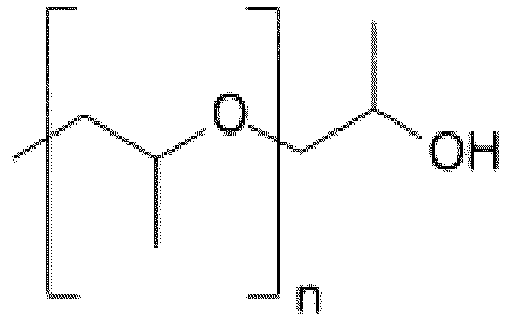
- Hydroxypropyl Guar kann beispielsweise unter der Handelsbezeichnung Jaguar HP-105 bei der Firma Rhodia Operations SA bezogen werden.
- Xanthan Gum wird mit Hilfe von Mikroorganismen der Gattung Xanthomonas gewonnen. Xanthan Gum ist ein Polymer, das aus einer Hauptkette aus β-1,4 glykosidisch verknüpften Glucosemolekülen besteht. An jedem zweiten Glucoserest hängt eine Seitenkette aus zwei Mannoseresten, einem Glucoronsäurerest und Pyruvat.
- Xanthan Gum löst sich gut in heißem und kaltem Wasser, dabei bilden sich Einfachhelices und Doppelhelices. Es entsteht ein dreidimensionales Netzwerk.
- Xanthan Gum kann beispielsweise unter der Handelsbezeichnung Keltrol CG-F V von der Firma CP Kelco bezogen werden.
- In dem erfindungsgemäßen Reinigungsgel ist die Kombination der Polymere Xanthan Gum und Hydroxypropyl Guar mit einem Gesamtgewicht von 0,9 bis 3,0 Gew.-%, bevorzugt 1,0 bis 2,5 Gew.-% enthalten, bezogen auf das Gesamtgewicht des Gels. Dabei ist es vorteilhaft, wenn Xanthan Gum mit einem Gehalt von 0,8 bis 1,5 Gew.-% und Hydroxypropyl Guar mit einem Gehalt von 0,1 bis 1,5 Gew.-% enthalten ist, bezogen auf das Gesamtgewicht des Gels.
- Da auf die Verwendung der Konservierungsmittelgruppe der Parabene verzichtet werden soll, muss die Konservierung des erfindungsgemäßen Reinigungsgels auf eine alternative Weise erfolgen. Was im Sinne der Erfindung unter Parabenen zu verstehen ist, wurde bereits beschrieben.
- In dem erfindungsgemäßen Reinigungsgel kann das Konservierungsmittel Phenoxyethanol enthalten sein.
- Phenoxyethanol kann durch folgende Formel dargestellt werden:

- Phenoxyethanol ist vor allem in saurem und neutralem, aber auch im alkalischen Milieu wirksam und völlig ungiftig. Bereits durch den Einsatz von niedrigen Konzentrationen kann eine ausreichende Konservierung kosmetischer Produkte erreicht werden. Aufgrund seines neutralen Geschmacks fand Phenoxyethanol schnell Eingang in die pharmazeutische und kosmetische Industrie. Seine Wirkung richtet sich gegen Gram-positive und Gram-negative Bakterien, wie zum Beispiel Escherichia coli, Pseudomonas aeruginosa, Proteus mirabilis, Staphylococcus aureus, sowie gegen Hefepilze, wie Candida albicans und andere Mikroorganismen. Phenoxyethanol ist eine viskose Flüssigkeit von schwachem, leicht angenehmen Geruch und einem zusammenziehenden Geschmack. Es wurde in der Natur nachgewiesen in tropischen Früchten, in Cichorium endivia sowie in grünem Tee (Camellia sinesis). Es hat einen milden, rosenähnlichen Duft und wird für Parfümkompositionen auch als Fixatur eingesetzt. Es ist mischbar mit Aceton, Ethylalkohol und Glycerin, löslich in und Fetten, z.B. Oliven- und Erdnussöl, jedoch wenig löslich in Wasser.
- Wenn im erfindungsgemäßen Reinigungsgel Phenoxyethanol enthalten ist, so liegt es mit einem Gehalt von 0,4 bis 0,95 Gew.-%, bevorzugt 0,6 bis 0,9 Gew.-% vor, bezogen auf das Gesamtgewicht des Gels.
- Weiterhin kann das erfindungsgemäße Reinigungsgel wenigstens einen Stabilisator enthalten. Im Sinne der vorliegenden Erfindung sind als Stabilisatoren diejenigen Substanzen zu verstehen, die nicht in der Liste der zugelassenen Konservierungsstoffe (Kosmetikverordnung Anlage 6; Verordnung (EG) Nr. 1223/2009, Anhang V) aufgeführt sind, gleichwohl aber eine stabilisierende Wirkung für die entsprechende Zubereitung haben und/oder im gemeinsamen Einsatz mit Konservierungsmitteln die Stabilität der Zubereitung fördern.
- Als Stabilisatoren sind folgende Verbindungen vorteilhaft: Propylenglycol, Ethylhexylglycerin, 1,2-Hexanediol, Methylpropanediol, Butylene Glycol, Caprylyl Glycol, Glyceryl Caprylate, Hydroxyacetophenone, Pentylene Glycol und/oder Ethanol, bevorzugt verwendet als Alkohol denat. Das Vergällungsmittel im Alkohol denat. ist vorteilhaft Isopropylalkohol und t-Butylalkohol. Weiter vorteilhaft werden die Stabilisatoren Methylpropandiol, Caprylyl Glycol und/oder Alkohol denat. verwendet.
- Wenn in dem erfindungsgemäßen Reinigungsgel wenigstens ein Stabilisator enthalten ist, so liegt der wenigstens eine Stabilisator mit einem Gesamtgewicht von 0,2 bis 10,0 Gew.-% vor, bezogen auf das Gesamtgewicht des Gels.
- Der pH-Wert des erfindungsgemäßen Reinigungsgels liegt im neutralen oder Haut-neutralen Bereich. Der optimale pH-Wert der Gesichts- und Körperhaut liegt zwischen 4,7 und 5,75; dies entspricht dem Haut-neutralen pH-Bereich. Ein pH-Wert von 7 gilt als neutral. Alles darunter ist sauer, alles darüber alkalisch. Das heißt, der natürliche pH-Wert der Haut liegt im sauren Bereich.
- Der pH-Wert kann mit den im technischen Gebiet der Kosmetik üblichen Mitteln eingestellt und stabil gehalten werden. Vorteilhaft wird der pH-Wert jedoch mit einer physiologisch verträglichen organischen Säure, insbesondere vorteilhaft mit Citronensäure eingestellt.
- Reinigungsgele, deren pH-Wert auf einen neutralen Wert (pH = 7) eingestellt werden, enthalten vorteilhaft als Stabilisatoren nur Alkohol denat. und Caprylyl Glycol und keine Konservierungsmittel.
- Reinigungsgele, deren pH-Wert auf einen Haut-neutralen Wert (beispielsweise pH-Wert = 5,5) eingestellt wird, enthalten vorteilhaft als Aminosäuretensid nur Natrium Lauroyl Sarcosinate, als weitere Tenside nur Cocamidopropylbetaine und Cocoglucosid, als Konservierungsmittel nur Phenoxyethanol und als Stabilisatoren nur Methylpropandiol und Caprylyl Glycol.
- Erfindungsgemäß vorteilhaft ist ebenfalls, wenn zusätzlich ein oder mehrere Feuchthaltemittel in die erfindungsgemäße Zubereitung eingearbeitet werden. Feuchthaltemittel können der Haut Feuchtigkeit verleihen und/oder dazu beitragen, einen Feuchtigkeitsverlust der Haut zu verhindern. Bei den Feuchthaltemitteln handelt es sich um hygroskopische Substanzen, die Wasser binden können. Dieses Wasserbindevermögen beruht auf hydrophilen Gruppen, wie Hydroxylgruppen, aber auch Amingruppen und Carboxylgruppen. Feuchthaltemittel sind beispielsweise Glycerin, Biosaccaride Gum-1, Pyrrolidoncarbonsäure, Harnstoff, Sorbitol, Xylitol, Aloe Vera Gel und andere mehr. Erfindungsgemäß bevorzugt ist der Einsatz von Glycerin.
- Die unter Stabilisatoren genannten Verbindungen Propylenglycol, Ethylhexylglycerin, 1,2-Hexanediol, Methylpropanediol, Butylene Glycol, Caprylyl Glycol, Glyceryl Caprylate und Pentylene Glycol haben neben ihrer stabilisierenden Wirkung auch eine feuchthaltende Wirkung.
- Wenn in dem erfindungsgemäßen Reinigungsgel zusätzlich ein oder mehrere Feuchthaltemittel enthalten sind, so liegt/en das oder die Feuchthaltemittel mit einem Gesamtgehalt von 0,01 bis 30 Gew.-%, bevorzugt 5 bis 20 Gew.-%, bezogen auf das Gesamtgewicht der Zubereitung, vor.
- Die erfindungsgemäße Zubereitung kann kosmetische Hilfsstoffe enthalten, wie sie üblicherweise in solchen Zubereitungen verwendet werden, z. B. Komplexbildner, Parfüme, Substanzen zum Steigern des Schäumens, Füllstoffe, die das Hautgefühl verbessern, Fette, Öle, Wachse oder andere übliche Bestandteile einer kosmetischen oder dermatologischen Formulierung, wie beispielsweise Schaumstabilisatoren, Elektrolyte und andere mehr.
- Die erfindungsgemäße Zubereitung kann nach jeder in der kosmetischen Industrie üblichen und für diese Zubereitungsform geeigneten Methode hergestellt werden.
- Das erfindungsgemäße Reinigungsgel ist transparent. Die Transparenz wurde mithilfe einer Transmissionsmessung bestimmt. Die Messung wurde mit einem handelsüblichen UV-Vis-Spektrometer bei 420nm durchgeführt; die Messung erfolgte in 1cm-Einmalküvetten gegen Aqua dest. als Referenz. Eine Zubereitung ist im Sinne der Erfindung transparent, wenn die Transmissionswerte mindestens 80 % in Bezug auf den Referenzwert erreichen.
- Um eine problemlose Entnahme aus einer Tube zu gewährleisten, weist das erfindungsgemäße Reinigungsgel vorteilhaft eine Schubspannung an der Fließgrenze von mindestens 10 Pa und maximal 50 Pa auf.
- Als Fließgrenze im Sinne der vorliegenden Schrift wird die kritische Schubspannung der Fließkurve angesehen.
- Gemessen wird die Fließkurve auf einem schubspannungsgesteuerten Rheometer Typ SR-2000 der Firma Rheometric Scientific bei 25°C ± 1°C mit 25 mm Platte/Platte Geometrie bei einem Spalt von 1 mm, wobei strukturschonend befüllt wird. Es wird eine geeignete konstante Schubspannungszeitrampe von 40 Pa/min vorgegeben und vor dem Test eine entsprechende Strukturerholungszeit eingehalten und die kritische Schubspannung im Maximum der Fließkurve angegeben.
- Das Produkt wird vorsichtig mit einem Löffelspatel entnommen und in das Messgerät eingebracht. Dabei sollte das Produkt nicht geschert werden, um eine Zerstörung oder Beeinflussung der Strukturen zu vermeiden.
- Das erfindungsgemäße Reinigungsgel ist milde zur Haut. Um dies zu belegen, wurde ein RBC-Assay durchgeführt.
- Der Standard-RBC-Assay (10 Minuten Inkubation) dient zur Abschätzung von in vivo Augenschleimhautreizpotentialen von Tensiden und tensidhaltigen Produkten.
- Ein definiertes Aliquot isolierter Kalbserythrozyten wird mit einer Reihe steigender Konzentrationen des zu untersuchenden WAS-Prüfmusters (Stammlösung mit Formulierungen 1:100 w/v bzw. für Rohstoffe 0.1 % Aktivgehalt in PBS) für 10 Minuten unter Schütteln bei Raumtemperatur (RT) inkubiert. Nach Zentrifugation werden die gewonnenen Überstände photometrisch auf ihren Gehalt an freigesetztem Hämoglobin (HbO2) bei 530 nm analysiert. Daraus wird der relative Hämolysegrad berechnet und die Konzentrations-Response-Kurve mit dem H50-Wert [µl/ml] als Kenngröße bestimmt. Dieser gibt die Konzentration des Prüfmusters an, bei der 50% des Hämoglobins freigesetzt werden.
- Ein definiertes Aliquot isolierter Kalbserythrozyten wird mit einer fixen Konzentration des Prüfmusters (1% w/v bzw. 0.1% Aktivgehalt) für 10 Minuten unter Schütteln bei RT inkubiert und dann zentrifugiert. Die Änderung der spektralen Absorption bei 575 nm und 540 nm wird im Vergleich zum nativen HbO2 gemessen. Aus dem Verhältnis der Absorptionswerte zueinander wird der Denaturierungsindex DI [%] berechnet. Als 100%-Standard dient Na-Laurylsulfat (0.1% Aktivgehalt).
- Der Quotient stellt das Verhältnis der Kenngrößen von Hämolyse (H50) und Denaturierung (DI) dar und wird zur Charakterisierung und Klassifizierung der untersuchten Prüfmuster verwendet. Zur weitergehenden Information wird auf das Dokument Pape, W.J.W. et al., Molecular Toxicology, 1,525-536, 1987, verwiesen.
- Die getesteten Reinigungsgele wiesen in diesem empfindlichen Test, der auf eine Bestimmung des Augenschleimhautreizpotentials ausgerichtet ist, Werte von 3,06 und 5,43 (L/D-
- Quotient) auf, also "moderately irritant". Dies sind für Reinigungszubereitungen sehr gute Werte.
- Die im genannten Test ermittelten Werte können folgendermaßen eingeordnet werden:
L/D-Quotient Bewertung > 100 Non-irritant > 10 Slightly irritant > 1 Moderately irritant > 0,1 irritant < 0,1 Strongly irritant/corrosive - Aus den vorstehenden Messungen und Ergebnissen wird deutlich, dass sehr transparente Reinigungsgele zur Verfügung gestellt werden, die aufgrund der günstigen rheologischen Eigenschaften problemlos aus einer Tube entnommen werden können und zudem für Reinigungszubereitungen sehr milde sind. Diese Reinigungsgele sind aufgrund dieser Eigenschaften auch gut geeignet, der Rasurvorbereitung zu dienen, also als Rasiergele.
- Die nachfolgenden Beispiele sollen die vorliegende Erfindung verdeutlichen, ohne sie einzuschränken. Die Zahlenwerte in den Beispielen bedeuten Gewichtsprozente, bezogen auf das Gesamtgewicht der jeweiligen Zubereitungen. Die Angaben beziehen sich auf die jeweiligen Aktivgehalte.
INCI-Bezeichnung 1 2 3 4 5 Sodium Cocoyl Glutamate 3 3 0 0 3 Parfüm 0 0 0,35 0 0,35 Caprylyl Glycol 0,25 0,25 0,25 0,25 0,25 Glycerin 5 5 5 5 5 Methylpropanediol 0 0 3 3 0 Citronensäure 0 0 0,2 0,2 0 Phenoxyethanol 0 0,8 0,8 0,8 0 Alcohol Denat 10,0 10 0 0 10 Hydroxypropyl Guar 0,465 0,465 0,465 0,465 0,465 Xanthan Gum 1,1 1,1 1,1 1,1 1,1 Wasser Ad 100 Ad 100 Ad 100 Ad 100 Ad 100 Cocamidopropylbetain 1,68 1,68 1,6 1,6 1,68 Sodium Lauroyl Sarcosinate 1,5 1,5 4,5 4,5 1,5 Coco-Glucoside 1,54 1,54 1,43 1,43 1,54 Transmission bei 420 nm 84,0 83,1 85,3 83,2 RBC-Test: L/D-Quotient 5,43 3,06 Schubspannung [Pa] 20,1 13,2 16,0 20,8
Claims (22)
- Kosmetisches Reinigungsgel, enthaltend• wenigstens ein Aminosäure-Tensid, bevorzugt ausgewählt aus wenigstens einem Natrium Acyl-Sarkosinat und/oder wenigstens einem Natrium/Dinatrium Acyl Glutamat,• wenigstens ein weiteres Tensid, das kein Aminosäure-Tensid ist, bevorzugt ausgewählt aus wenigstens einem Alkylpropylbetain und/oder wenigstens einem Alkylpolyglucosid,• eine Kombination der Polymere Xanthan Gum und Hydroxypropyl Guar.
- Reinigungsgel nach Anspruch 1, dadurch gekennzeichnet, dass der Wassergehalt von 50 bis 95 Gew.-%, bevorzugt von 65 bis 90 Gew.-% beträgt, bezogen auf das Gesamtgewicht des Reinigungsgels.
- Reinigungsgel nach Anspruch 1und/oder 2, dadurch gekennzeichnet, dass das Reinigungsgel keine synthetischen Polymere, keine Parabene und/oder keine Sulfat-haltigen Verbindungen enthält.
- Reinigungsgel nach wenigstens einem der vorstehenden Ansprüche, dadurch gekennzeichnet, dass das wenigstens eine Natrium Acylsarkosinat mit einem Gehalt von 0,5 bis 10,0 Gew.-%, bevorzugt 2,0 bis 6,0 Gew.-% vorliegt, bezogen auf das Gesamtgewicht des Gels
- Reinigungsgel nach wenigstens einem der vorstehenden Ansprüche, dadurch gekennzeichnet, dass das Natrium Acyl-Sarkosinate Natrium Lauroylsarkosinat ist.
- Reinigungsgel nach wenigstens einem der vorstehenden Ansprüche, dadurch gekennzeichnet, dass das wenigstens ein Natrium/Dinatrium Acylglutamat mit einem Gesamtgehalt von 0,5 bis 10,0 Gew.-%, bevorzugt 0,5 bis 5,0 Gew.-% vorliegt, bezogen auf das Gesamtgewicht des Gels.
- Reinigungsgel nach wenigstens einem der vorstehenden Ansprüche, dadurch gekennzeichnet, dass das Natrium/Dinatrium Acylglutamat Dinatrium Cocoyl Glutamat ist.
- Reinigungsgel nach wenigstens einem der vorstehenden Ansprüche, dadurch gekennzeichnet, dass wenigstens ein Natrium Acylsarkosinat und wenigstens ein Natrium/Dinatrium Acylglutamat vorliegen, bevorzugt mit einem Gesamtgewicht von 1,0 bis 12,0 Gew.-%, bevorzugt 2,5 bis 11,0 Gew.-%, bezogen auf das Gesamtgewicht des Gels.
- Reinigungsgel nach wenigstens einem der vorstehenden Ansprüche, dadurch gekennzeichnet, dass das wenigstens eine Alkylamidopropylbetain mit einem Gesamtgewicht von 0,5 bis 15 Gew.-%, bevorzugt 2,5 bis 12 Gew.-% vorliegt, bezogen auf das Gesamtgewicht des Gels
- Reinigungsgel nach wenigstens einem der vorstehenden Ansprüche, dadurch gekennzeichnet, dass Alkylamidopropylbetaine Cocamidopropylbetaine ist.
- Reinigungsgel nach wenigstens einem der vorstehenden Ansprüche, dadurch gekennzeichnet, dass das wenigstens eine Alkylpolyglucosid mit einem Gesamtgewicht von 0,1 bis 10,0 Gew.-%, bevorzugt 1,0 bis 2,5 Gew.-% vorliegt, bezogen auf das Gesamtgewicht des Gels.
- Reinigungsgel nach wenigstens einem der vorstehenden Ansprüche, dadurch gekennzeichnet, dass das wenigstens eine Alkylpolyglucosid aus der Gruppe Coco-Glucosid, Decylglucosid, Laurylglucosid und/oder Caprylyl/Capryl Glucosid ausgewählt wird, bevorzugt aus der Gruppe Cocoglucosid und/oder Caprylyl/Capryl Glucosid.
- Reinigungsgel nach wenigstens einem der vorstehenden Ansprüche, dadurch gekennzeichnet, dass wenigstens ein Alkylamidopropylbetain und wenigstens ein Alkylpolyglucosid enthalten sind, bevorzugt mit einem Gesamtgewicht im Bereich von 0,6 bis 15,0 Gew.-%, bevorzugt 2,6 bis 12,0 Gew.-%, bezogen auf das Gesamtgewicht des Gels.
- Reinigungsgel nach wenigstens einem der vorstehenden Ansprüche, dadurch gekennzeichnet, dass die Kombination der Polymere Xanthan Gum und Hydroxypropyl Guar mit einem Gesamtgewicht von 0,9 bis 3,0 Gew.-%, bevorzugt 1,0 bis 2,5 Gew.-% enthalten ist, bezogen auf das Gesamtgewicht des Gels.
- Reinigungsgel nach wenigstens einem der vorstehenden Ansprüche, dadurch gekennzeichnet, dass Phenoxyethanol enthalten ist, bevorzugt mit einem Gehalt von 0,4 bis 0,95 Gew.-%, bevorzugt 0,6 bis 0,9 Gew.-% vor, bezogen auf das Gesamtgewicht des Gels.
- Reinigungsgel nach wenigstens einem der vorstehenden Ansprüche, dadurch gekennzeichnet, dass wenigstens ein Stabilisator ausgewählt aus der Gruppe Propylenglycol, Ethylhexylglycerin, 1,2-Hexanediol, Methylpropandiol, Butylene Glycol, Caprylyl Glycol, Glyceryl Caprylate, Hydroxyacetophenone, Pentylene Glycol, Ethanol und/oder Alkohol denat., bevorzugt aus der Gruppe Methylpropandiol, Caprylyl Glycol und/oder Alkohol denat. enthalten ist
- Reinigungsgel nach wenigstens einem der vorstehenden Ansprüche, dadurch gekennzeichnet, dass der wenigstens eine Stabilisator mit einem Gesamtgewicht von 0,2 bis 10,0 Gew.-% vorliegt, bezogen auf das Gesamtgewicht des Gels.
- Reinigungsgel nach wenigstens einem der vorstehenden Ansprüche, dadurch gekennzeichnet, dass der pH-Wert des erfindungsgemäßen Reinigungsgels im neutralen oder Haut-neutralen Bereich liegt.
- Reinigungsgel nach Anspruch 18, dadurch gekennzeichnet, dass der pH-Wert 7 beträgt und als Stabilisatoren nur Alkohol denat. und Caprylyl Glycol und keine weiteren Konservierungsmittel enthalten sind.
- Reinigungsgel nach Anspruch 18, dadurch gekennzeichnet, dass der pH-Wert 5,5, beträgt und als Aminosäuretensid nur Natrium Lauroyl Sarcosinate, als weitere Tenside nur Cocamidopropylbetaine und Cocoglucosid, als Konservierungsmittel nur Phenoxyethanol und als Stabilisatoren nur Methylpropandiol und Caprylyl Glycol enthalten sind.
- Reinigungsgel nach wenigstens einem der vorstehenden Ansprüche, dadurch gekennzeichnet, dass der Transmissionswert mindestens 80 % des Referenzwertes beträgt, wobei die Messung bei 420 nm durchgeführt wird, der Referenzwert mit Aqua dest. ermittelt wird und die Messküvette eine 1cm-Einmalküvette ist.
- Reinigungsgel nach wenigstens einem der vorstehenden Ansprüche, dadurch gekennzeichnet, dass das Reinigungsgel eine Schubspannung an der Fließgrenze von mindestens 10 Pa und maximal 50 Pa aufweist, wobei eine Fließkurve auf einem schubspannungsgesteuerten Rheometer Typ SR-2000 der Firma Rheometric Scientific bei 25°C ± 1°C mit 25 mm Platte/Platte Geometrie bei einem Spalt von 1 mm gemessen wird, wobei eine geeignete konstante Schubspannungszeitrampe von 40 Pa/min vorgegeben und die Schubspannung im Maximum der Fließkurve bestimmt wird.
Applications Claiming Priority (1)
| Application Number | Priority Date | Filing Date | Title |
|---|---|---|---|
| DE102022211303.9A DE102022211303A1 (de) | 2022-10-25 | 2022-10-25 | Kosmetisches Reinigungsgel mit hoher Transparenz |
Publications (1)
| Publication Number | Publication Date |
|---|---|
| EP4360612A1 true EP4360612A1 (de) | 2024-05-01 |
Family
ID=88020837
Family Applications (1)
| Application Number | Title | Priority Date | Filing Date |
|---|---|---|---|
| EP23197072.4A Pending EP4360612A1 (de) | 2022-10-25 | 2023-09-13 | Kosmetisches reinigungsgel mit hoher transparenz |
Country Status (2)
| Country | Link |
|---|---|
| EP (1) | EP4360612A1 (de) |
| DE (1) | DE102022211303A1 (de) |
Citations (1)
| Publication number | Priority date | Publication date | Assignee | Title |
|---|---|---|---|---|
| WO2022008334A1 (en) * | 2020-07-07 | 2022-01-13 | Bayer Consumer Care Ag | Oil-containing washing composition |
-
2022
- 2022-10-25 DE DE102022211303.9A patent/DE102022211303A1/de active Pending
-
2023
- 2023-09-13 EP EP23197072.4A patent/EP4360612A1/de active Pending
Patent Citations (1)
| Publication number | Priority date | Publication date | Assignee | Title |
|---|---|---|---|---|
| WO2022008334A1 (en) * | 2020-07-07 | 2022-01-13 | Bayer Consumer Care Ag | Oil-containing washing composition |
Non-Patent Citations (3)
| Title |
|---|
| DATABASE GNPD [online] MINTEL; 10 December 2020 (2020-12-10), ANONYMOUS: "Anti-Clog Pores Scrub Gel", XP093133208, retrieved from https://www.gnpd.com/sinatra/recordpage/8328341/ Database accession no. 8328341 * |
| DATABASE GNPD [online] MINTEL; 16 May 2019 (2019-05-16), ANONYMOUS: "Alum Stone High Protection Gel", XP093133210, retrieved from https://www.gnpd.com/sinatra/recordpage/6555185/ Database accession no. 6555185 * |
| PAPE, W.J.W., MOLECULAR TOXICOLOGY, vol. 1, 1987, pages 525 - 536 |
Also Published As
| Publication number | Publication date |
|---|---|
| DE102022211303A1 (de) | 2024-04-25 |
Similar Documents
| Publication | Publication Date | Title |
|---|---|---|
| EP3890684A1 (de) | O/w-emulsion mit rhamnolipiden | |
| EP2682161B1 (de) | Flüssiges Reinigungs- und Pflegemittel | |
| EP3810080B1 (de) | Milde kosmetische reinigungszubereitung | |
| WO2020173639A1 (de) | Reinigungstücher getränkt mit tränkungsmitteln enthaltend biotenside | |
| DE102010055767A1 (de) | Wirkstoffkombinationen aus Glucosylglyceriden und einem oder mehreren milden Tensiden | |
| DE60030917T2 (de) | Verwendung von Zinkalkylsulfaten und/oder -alkyl(poly)ethoxysulfaten als Tenside und Konservierungsmittel in Reiningungsmitteln oder kosmetischen Zusammensetzungen | |
| DE102018215331A1 (de) | Sulfat-freie, schäumende Reinigungszubereitung auf Basis einer Emulsion | |
| EP3930675B1 (de) | Glycolipid-haltige reinigungszubereitung enthaltend mizellen | |
| DE10025124A1 (de) | Kombinationen von Glycerinmo9noalkylethern und Aryl-substituierten Alkoholen | |
| EP2654699B1 (de) | Wirkstoffkombinationen aus glucosylglyceriden und einem oder mehreren konservierungsmitteln | |
| EP3883534B1 (de) | Ölhaltige gesichtspflegezubereitung | |
| EP3536383A1 (de) | Reinigungs- und pflegezubereitungen enthaltend ein polyoxyalkylen carboxylat | |
| DE102018215330A1 (de) | Schäumende Reinigungszubereitung auf Basis einer Emulsion | |
| EP4360612A1 (de) | Kosmetisches reinigungsgel mit hoher transparenz | |
| WO2021004711A1 (de) | Fettsäure-polyglycerylester-haltige reinigungszubereitung | |
| EP2409680A2 (de) | Kosmetisches Körperreinigungsmittel mit nicht spürbarem Fehlen von alkoxylierten Tensiden | |
| DE102010055838A1 (de) | Wirkstoffkombinationen aus Glucosylglyceriden und einem oder mehreren sauren Konservierungsmitteln | |
| WO2018172332A1 (de) | Schäumende reinigungszubereitung enthaltend polyquaternium-16 polymere | |
| DE102020202554A1 (de) | Neuartige Reinigungszubereitung | |
| EP0442519B2 (de) | Selbstkonservierende flüssige Tensidsysteme | |
| DE19534370C2 (de) | Verwendung von kationischem Chitosan | |
| DE19631594A1 (de) | Shampoo | |
| EP4221663B1 (de) | Verbesserte reinigungstücher getränkt mit tränkungsmitteln basierend auf hydrodispersionen | |
| DE202019005940U1 (de) | Glycolipid-haltige Reinigungszubereitung enthaltend Mizellen | |
| DE102016206252A1 (de) | Neuartige schäumende Zubereitungen |
Legal Events
| Date | Code | Title | Description |
|---|---|---|---|
| PUAI | Public reference made under article 153(3) epc to a published international application that has entered the european phase |
Free format text: ORIGINAL CODE: 0009012 |
|
| STAA | Information on the status of an ep patent application or granted ep patent |
Free format text: STATUS: THE APPLICATION HAS BEEN PUBLISHED |
|
| AK | Designated contracting states |
Kind code of ref document: A1 Designated state(s): AL AT BE BG CH CY CZ DE DK EE ES FI FR GB GR HR HU IE IS IT LI LT LU LV MC ME MK MT NL NO PL PT RO RS SE SI SK SM TR |
|
| STAA | Information on the status of an ep patent application or granted ep patent |
Free format text: STATUS: REQUEST FOR EXAMINATION WAS MADE |
|
| 17P | Request for examination filed |
Effective date: 20241106 |