EP4362668B1 - System zur bestimmung der zeitlichen verteilung eines tieres in zonen eines stalls - Google Patents
System zur bestimmung der zeitlichen verteilung eines tieres in zonen eines stalls Download PDFInfo
- Publication number
- EP4362668B1 EP4362668B1 EP22741587.4A EP22741587A EP4362668B1 EP 4362668 B1 EP4362668 B1 EP 4362668B1 EP 22741587 A EP22741587 A EP 22741587A EP 4362668 B1 EP4362668 B1 EP 4362668B1
- Authority
- EP
- European Patent Office
- Prior art keywords
- animal
- time
- zone
- spent
- tag
- Prior art date
- Legal status (The legal status is an assumption and is not a legal conclusion. Google has not performed a legal analysis and makes no representation as to the accuracy of the status listed.)
- Active
Links
Images




Classifications
-
- A—HUMAN NECESSITIES
- A01—AGRICULTURE; FORESTRY; ANIMAL HUSBANDRY; HUNTING; TRAPPING; FISHING
- A01K—ANIMAL HUSBANDRY; AVICULTURE; APICULTURE; PISCICULTURE; FISHING; REARING OR BREEDING ANIMALS, NOT OTHERWISE PROVIDED FOR; NEW BREEDS OF ANIMALS
- A01K29/00—Other apparatus for animal husbandry
- A01K29/005—Monitoring or measuring activity
-
- A—HUMAN NECESSITIES
- A01—AGRICULTURE; FORESTRY; ANIMAL HUSBANDRY; HUNTING; TRAPPING; FISHING
- A01K—ANIMAL HUSBANDRY; AVICULTURE; APICULTURE; PISCICULTURE; FISHING; REARING OR BREEDING ANIMALS, NOT OTHERWISE PROVIDED FOR; NEW BREEDS OF ANIMALS
- A01K11/00—Marking of animals
- A01K11/006—Automatic identification systems for animals, e.g. electronic devices, transponders for animals
-
- G—PHYSICS
- G01—MEASURING; TESTING
- G01S—RADIO DIRECTION-FINDING; RADIO NAVIGATION; DETERMINING DISTANCE OR VELOCITY BY USE OF RADIO WAVES; LOCATING OR PRESENCE-DETECTING BY USE OF THE REFLECTION OR RERADIATION OF RADIO WAVES; ANALOGOUS ARRANGEMENTS USING OTHER WAVES
- G01S5/00—Position-fixing by co-ordinating two or more direction or position line determinations; Position-fixing by co-ordinating two or more distance determinations
- G01S5/02—Position-fixing by co-ordinating two or more direction or position line determinations; Position-fixing by co-ordinating two or more distance determinations using radio waves
- G01S5/14—Determining absolute distances from a plurality of spaced points of known location
-
- G—PHYSICS
- G06—COMPUTING OR CALCULATING; COUNTING
- G06Q—INFORMATION AND COMMUNICATION TECHNOLOGY [ICT] SPECIALLY ADAPTED FOR ADMINISTRATIVE, COMMERCIAL, FINANCIAL, MANAGERIAL OR SUPERVISORY PURPOSES; SYSTEMS OR METHODS SPECIALLY ADAPTED FOR ADMINISTRATIVE, COMMERCIAL, FINANCIAL, MANAGERIAL OR SUPERVISORY PURPOSES, NOT OTHERWISE PROVIDED FOR
- G06Q50/00—Information and communication technology [ICT] specially adapted for implementation of business processes of specific business sectors, e.g. utilities or tourism
- G06Q50/02—Agriculture; Fishing; Forestry; Mining
-
- G—PHYSICS
- G01—MEASURING; TESTING
- G01S—RADIO DIRECTION-FINDING; RADIO NAVIGATION; DETERMINING DISTANCE OR VELOCITY BY USE OF RADIO WAVES; LOCATING OR PRESENCE-DETECTING BY USE OF THE REFLECTION OR RERADIATION OF RADIO WAVES; ANALOGOUS ARRANGEMENTS USING OTHER WAVES
- G01S2205/00—Position-fixing by co-ordinating two or more direction or position line determinations; Position-fixing by co-ordinating two or more distance determinations
- G01S2205/01—Position-fixing by co-ordinating two or more direction or position line determinations; Position-fixing by co-ordinating two or more distance determinations specially adapted for specific applications
- G01S2205/02—Indoor
Definitions
- the invention relates to a system for determining distribution of time that an animal has spent in different zones of an agricultural indoor environment such as a barn for cows, during a predetermined time period.
- Dairy farms often comprise automatic milking systems, allowing the animals to stroll around freely in a dwelling area and may visit an automatic milking equipment, such as a milking robot, rotating milking parlour, etc., for milking. The animals may then voluntarily go and visit the automatic milking equipment for being milked, tempted by nutrition offered at the automatic milking equipment, and/ or sorted out by a gate in a forced animal traffic layout in the barn. This is sometimes also referred to as a voluntary milking system, or just robotic milking.
- Herds of animals are becoming bigger and bigger. It may become a challenge for the farmer to detect an exception animal, like animals predicted to be in heat (for performing insemination); as well as sick or injured animals or animals with an otherwise abnormal state or behaviour.
- an exception animal like animals predicted to be in heat (for performing insemination); as well as sick or injured animals or animals with an otherwise abnormal state or behaviour.
- Several attempts have been made to find solutions for this purpose, for example based on measurement and analysis of milk yield, rumination, milk composition, hormones, etc., of the respective animal. However, they all have their limitations. It may for this reason be desired to find another methodology to identify the exception animal, to be utilised alone, or in combination with other measurements.
- RTLS Real-Time Location Systems
- the animal is provided with a tag comprising a radio transmitter transmitting radio signals, or blinks.
- These radio signals of the tag are received by receivers, or anchors as they also may be referred to, which are positioned at different known positions in the barn.
- the receivers may determine direction, angle of arrival and/ or time delay of the received signals and forward this information to a positioning controller, which is calculating a set of position coordinates of the animal based on one or more signal locating algorithms, such as trilateration, multilateration, and/ or triangulation of the radio signals of the tag/ radio transmitter, as received by the respective receivers.
- the current position of the animal may thereby be determined.
- various problems are associated with RTLS. The mere fact of being able to detect the current position of the animals within the barn does not help much in determining current animal status.
- FR 3 067 218 A1 discloses a method for identification of a piece of equipment or a driveway to be fitted out or moved in a barn, or of an individual in a group of cattle to be dehorned, involving processing set of measurements and identifying traveling track of animal based on frequentation of animal.
- the system aims at determining distribution of time that a respective animal has spent in different zones of a barn during a predetermined time period.
- the zones are dedicated for a respective activity comprising a feeding zone dedicated for eating, a resting zone dedicated for resting and a transportation zone dedicated for walking.
- the system comprises a processing controller and a database.
- the database is configured to store position coordinates of the respective zones of the barn.
- the system also comprises a positioning controller and a set of tags, wherein each tag is associated with the respective animal.
- Each tag comprises a processing device, a radio transmitter and a memory.
- the memory stores a tag identity i.e., a code which is uniquely identifying the tag.
- the tag is in turn associated with an animal identity of the animal associated with/ carrying the tag, for example in a look-up table or in the database.
- the processing device is configured to transmit a radio signal via the radio transmitter, repeatedly at a regular time interval; wherein each radio signal comprises the tag identity.
- the regular time interval between radio signal transmissions may be for example about every 2.2 seconds. Other regular time intervals such as every 2 seconds, every 3 seconds, etc., may be applied in other embodiments.
- the system also comprises at least three receivers, positioned at a respective predetermined position in the barn.
- the receivers, or anchors are each one configured to receive the transmitted radio signals and communicate information related to the received radio signals with the positioning controller.
- the communicated information may comprise for example a measured angle of arrival of the received signal, a measured signal strength of the received signal and/ or a time of arrival/ delay time of the received signal.
- the positioning controller is configured to repeatedly obtain the information related to the received radio signals, received from the respective receivers. The positioning controller then, for each tag identity calculates a set of position coordinates of the tag comprising the respective tag identity based on the information related to the received radio signals of the radio transmitter received by the receivers. The positioning controller is also configured to provide data entities, each data entity comprising the calculated position coordinates of the tag associated with a timestamp and/ or an index number to the processing controller.
- the processing controller is configured to determine distribution of time that an animal associated with the tag comprising the tag identity has spent in different zones of the barn by associating each obtained data entity with a respective zone based on the position coordinates of the respective information entity and the position coordinates of the zones. Then, the number of data entities in each respective zone are counted and a calculation is made, concerning amount of time the animal has spent in each respective zone by multiplying the number of data entities associated with each respective zone with the regular time interval, such as for example 2.2 seconds.
- a distribution of time the animal spends in each respective zone, and thereby also indirectly an approximation of the activity performed by the animal during the predetermined time period is determined.
- a deviation from a normality behaviour could immediately be detected by the farmer.
- the farmer is at an early stage enabled to detect a deviating animal behaviour, for example by comparing current distribution of time in the different zone, with an expected/ average distribution of time.
- the farmer could at an early stage implement executive decisions concerning appropriate measures, depending on the kind of deviations, such as for example apply insemination when heat is indicated due to excess walking/ activity, i.e. when the animal spends more time than average/ expected in a transportation zone of the barn.
- the farmer is also enabled to make visual health inspection for the particular animal when walking activity is low and/ or resting time is high and/ or eating time is low.
- competent veterinarian assistance could be applied at a very early stage, eliminating, minimising or at least reducing time in a deviating state of the animal, and thereby also suffering of the animal while increasing milk yield of the farm.
- the reason may be that the animal is low ranked and may never/ seldom be able to access the fodder table, which may require change of fodder group for the particular animal, etc.
- Deviations between the current time distribution between different zones/ activities and historical time distribution could thereby be detected automatically and the farmer could instantly be alerted for taking appropriate measures.
- the historical distribution of time that the respective animal has spent in different zones of the barn may be stored in the database associated with a time of the day when the distribution was determined.
- the processing controller may then be configured to determine the time of the day when the distribution of time that the animal has spent in different zones is determined using a clock functionality and make the comparison with historical distribution of time the animal at the corresponding time of the day.
- the animals will behave differently at different times of the day, and for example be resting more at night-time while being more active at daytime. By storing and comparing time distribution made at the same time of the day, it is assured that a relevant comparison is made. Another advantage by determining the time of the day when determining the animal position/ activity is that a change in behaviour over time of an animal could be detected, which may relate to animal status and condition, which may impact milk yield.
- the processing controller may also define a cluster of obtained data entities having position coordinates within a distance limit and a timestamp and/ or index number within a time limit. Position coordinates of a gravity point of the defined cluster may then be calculated. Also, the zone the position coordinates of the gravity point is associated with is determined. In addition, the processing controller may determine that all data entities of the cluster are associated with the zone of the cluster gravity point.
- the positioning of an animal/ tag standing close to a border between two zones may swap between the zones although the animal in reality may move only within the same zone, or not be moving at all.
- the reason is for example signal interference, reflections of radio signals against different objects in the barn, for example.
- the processing controller may additionally be configured to determine zone association of the respective data entity by applying a rolling average of the position coordinates of the preceding data entities within a predetermined window length and associating all data entities within the predetermined window length with the same zone.
- the tag comprises an accelerometer.
- the accelerometer determines movement data of the animal, or rather the body part wherein the tag/ accelerometer is attached. Each data entity thereby comprises accelerometer data of the accelerometer.
- the processing controller is also configured to detect that the animal is ruminating at position coordinates of any one of the obtained data entities, based on analysis of the accelerometer data of the data entity. In case the position coordinates of the data entity are situated close to a limitation/ border of the resting zone associating the data entity of the animal with the resting zone when rumination is detected.
- a typical behaviour of at least some animals is that they are ruminating fodder several times, typically while they are resting in a resting cubicle.
- the animal may be considered located in the resting zone, as concluded based on accelerometer detections of the rumination of the animal.
- the processing controller may be configured to compare the calculated time the animal has spent in the transportation zone with a heat time threshold limit and generate a heat alert for the animal when the heat time threshold limit is exceeded.
- the heat time threshold limit may be individually adapted to the particular animal, or alternatively comprise a general/ average value.
- the processing controller may also, or alternatively be configured to compare the time the animal has spent in the resting zone with a passivity time threshold limit, and generate an anomaly alert for the animal when the passivity time threshold limit is exceeded.
- the passivity time threshold limit may be individually adapted to the particular animal, or alternatively comprise a general value.
- the farmer is thereby enabled to detect an animal which is sick or hurt at an early stage and is thereby also enabled to apply appropriate solutions (medications, veterinary visit, etc.), thereby shortening and/ or eliminating down time of the animal, which enhances milk production.
- the radio transmitter of the tags may be configured to transmit a radio signal in an Ultra-Wide Band (UWB), which is an appropriate radio technology for indoor positioning.
- UWB Ultra-Wide Band
- At least one of the zones of the barn may in alternatives be divided into sub-zones.
- the sub- zones of a resting zone may be a number of cubicles, the sub- zones of a feeding zone may comprise feeding stations, for example.
- the processing controller may be configured to compile the calculated amount of time each animal has spent in each sub-zone. Also, the processing controller may detect a sub-zone which is used less than a threshold time, based on the compilation.
- the system may in addition also comprise an output device, such as a computer, portable communication device, a computer tablet, etc., of the farmer.
- the processing controller may be configured to output information concerning distribution of time that the animal has spent in different zones of the barn on the output device.
- the processing controller may be configured to output the generated alert on the output device.
- the farmer is consequently provided with information and alerts for continuous monitoring of the herd and is enabled to detect behaviour deviations of an animal at an early stage.
- Figure 1 is an illustration depicting an example of a barn interior comprising a system 100, according to an embodiment of the invention.
- An animal 101 is associated with a tag 110, comprising a radio transmitter which repeatedly, for example at a regular time interval is transmitting a radio signal, or blink; for example, about every 2.2 seconds in some examples.
- the regular time interval may be set to another time interval, for example parts of a second, every second, every 3 seconds, etc.
- the animal 101 may be a cow as illustrated in Figure 1 , but may in other examples be any arbitrary domesticated animal, such as for example bull, horse, goat, sheep, camel, dairy buffalo, yak, etc.
- the tag 110 is attached to a body part of the animal 101, such as around the neck or pierced in one of the ears of the animal 101, or possibly any other body part.
- the tag 110 may have a memory which may comprise data which is uniquely identifying the tag and/ or the animal 101, i.e. an identity reference such as a locally or globally unique number, name, and/ or code, etc. Details of the tag 110 and various components comprised therein are illustrated in Figure 5 and discussed in the corresponding section of the description.
- the transmitter of the tag 110 emits wireless signals which may be received by a positioning controller 130 via a number of receivers 120a, 120b, 120c, such as typically at least three receivers 120a, 120b, 120c.
- receivers 120a, 120b, 120c, or anchors are mounted in the barn at predetermined, known positions, which are distinct from each other.
- Wireless signalling based on UWB may provide certain advantages and a more detailed positioning of the tag 110/ animal 101 may be made, in comparison with alternative radio band solutions.
- the positioning controller 130 Upon repeatedly receiving the data related to the received radio signals, received from the respective receivers 120a, 120b, 120c, possibly via a gateway 125, the positioning controller 130 is configured to, based on the tag identity, calculate a set of position coordinates of the tag 110 comprising the tag identity based on the information related to the received radio signals of the radio transmitter 110 received by the receivers 120a, 120b, 120c.
- the positioning controller 130 may determine position of the tag 110, based on signals emitted by the tag 110.
- the position of the tag 110 (and thereby also of the associated animal 101) may be made e.g. via triangulation or trilateration in at least two directions, e.g. two perpendicular directions such as X and Y. In some embodiments, the position of the tag 110 may also be determined in Z direction.
- Each data entity composed by the positioning controller 130 may comprise, or at least be configured to comprise, a timestamp, a tag identity, a blink index number, an X coordinate, an Y coordinate, a Z coordinate, and/ or accelerometer data.
- the receivers 120a, 120b, 120c may receive every blink of the tag 110, thereby enabling the positioning controller 130 to continuously determine the position of the tag 110.
- a blink may not be received by one, some or all of the receivers 120a, 120b, 120c, thereby producing a gap in the series of blinks.
- the received blink may be distorted or disturbed by interference with other signals or signal reflections by obstacles in the barn, which affect positioning of the tag 110/ animal 101.
- the positioning controller 130 is configured to provide data entities, each data entity comprising the calculated position coordinates of the tag 110 comprising the tag identity, associated with a timestamp and/ or an index number to a processing controller 150 and/ or a database 140.
- the computational functions of the provided system 100 has in the illustrated example been divided between one positioning controller 130 and one processing controller 150, which are physically separated both from each other and from the farm. In other embodiments however, the computational functions of both the positioning controller 130 and the processing controller 150 may be performed by one single controller, which may be situated at the farm, or remotely therefrom while communicationally connected. In yet other embodiments, the described computing functions of the positioning controller 130 and the processing controller 150 may be sub divided into additional controllers, which may be communicationally connected with each other, thereby enabled to perform the computations of the system 100.
- the processing controller 150 and/ or the database 140 may be remotely situated in relation to the farm, connected to the positioning controller 130/ RTLS via a wired or wireless network in some embodiments. Thereby, data processing, calculations and data storage may be made centrally, which saves resources and spare the farmer from data maintenance, software updates, etc.
- processing controller 150 and/ or the database 140 may be locally situated at the farm. Thereby a solution is achieved, which is independent in relation to network connection functionality.
- the collected data may thereby be obtained and analysed by the processing controller 150, for example by sorting the obtained data entities in order of sampling based on index number and/ or timestamp during a predetermined time period, associated with the same animal 101.
- a lost data entity, or data entity comprising no, or incomplete data may thereby be detected.
- Data entities not comprising position coordinates (X/ Y and possibly Z), or at least not complete position coordinates may be eliminated.
- analysis of the obtained data entities may result in filtering and removal of outlier positions.
- an interpolation may be made based on the preceding and the subsequent data entities; or possibly an extrapolation based on the preceding data entities.
- the processing controller 150 may then determine distribution of time that the animal 101 has spent in different zones of the barn.
- the barn 200 may comprise various zones dedicated for different purposes, such as for example a feed table 210 for eating, cubicles 220 for resting, and a walking zone 230 for transportation and strolling around and socialising.
- the barn also has a door 240, where the animals 101, 102, 103 may exit the barn 200, for example to a meadow field, for outdoor recreation. It may be estimated how long time the animal 101, 102, 103 spend outside by assuming the animal 101, 102, 103 exits the barn 200 when no more radio signalling is received from his/ her tag 110, after having been located close to the door 240, and correspondingly assuming returning to the barn 200 when reappearing at the door 240.
- barns 200 there may be a water dispenser zone, a brush zone, a milking robot zone, a waiting zone for accessing the milking robot, a milking zone, multiple entrances/ exit zones, etc.
- Figure 3 illustrates a virtual representation 300 of the barn 200 comprising sets of position coordinates 310, 320, 330, corresponding to the position coordinates of the respective zones 210, 220, 230 of the barn 200.
- the current position of the respective animal 101, 102, 103 may be represented by a respective data entity 301, 302, 303 comprising an X and a Y coordinate each, besides other data as already mentioned.
- Figure 4B schematically illustrates data entities 301 of one particular animal 101 during the predetermined time period.
- a lost data entity 301 may be detected and replaced by interpolation/ extrapolation of the surrounding/ preceding data entities.
- Figure 4C schematically illustrates an example of data entities 301, wherein outlier data entities 410a, 410b, 410c are filtered out and deleted according to some different principles or methodologies.
- some data entities 301 may comprise position coordinates which are incorrect in relation to the actual position of the animal 101.
- the signalling may also be at least temporarily affected by various machines etc., temporarily placed or moving around in the barn.
- signals may be lost, and/ or alternatively comprise incomplete information for enabling positioning of the animal 101, 102, 103 at the moment of the transmitted signal.
- the data entity 301 may be positioned by inserting an interpolated/ extrapolated value.
- the identification and removal of the most obvious outliers 410a, 410b, 410c due to reflections etc., may be an iterative process, based on velocity calculations of animal velocity between successive data entities 301.
- the position having the highest velocity may be deleted, and the velocities for the remaining data entities 301 in the array 400 may be recalculated, as long as the maximum velocity > 2000 mm/s (2 m/s or 7.2 km/h), when the animal 101 is a cow. Other animals may have other velocity threshold limits.
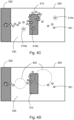
- Figure 4E illustrates an example of determining position of the animal 101 and determining distribution of time that the animal 101 has spent in different zones 210, 220, 230 of the barn 200.
- the processing controller 150 may in some embodiments define and compose clusters 470 of data entities 301 obtained from the positioning controller 130, having position coordinates within a distance limit and a timestamp and/ or index number within a time limit.
- a gravity point 480 of the defined cluster 470 may be determined and position coordinates of the gravity point 480 may be calculated. Furthermore, it may be determined which zone 210, 220, 230 the position coordinates of the gravity point 480 is associated with. In addition, the processing controller 150 may determine that all data entities 301 of the cluster 470 are associated with the zone 210, 220, 230 of the cluster gravity point 480.
- Figure 4F illustrates an embodiment wherein the zones 210, 220, 230, or at least one of the zones 210, 220, 230 may be divided into sub-zones 310a, 310b, 320a, 320b, 320c, 320d, 320e, 320f, 320g, 330a, 330b.
- the sub-zones 310a, 310b, 320a, 320b, 320c, 320d, 320e, 320f, 320g, 330a, 330b may for example comprise cubicles and/ or feeding stations. Possibly, the transportation zone 230 may be divided into different sections.
- FIG. 5 illustrates a tag 110, as carried or associated with the animal 101.
- the tag 110 comprises a processing device 510, a radio transmitter 520 and a memory 530.
- the memory 530 stores a tag identity unique for the tag 110.
- the processing device 510 is configured to transmit a radio signal, or blinks, via the radio transmitter 520, repeatedly at a regular time interval such as every 2.2 seconds or there about. Each radio signal comprises the tag identity.
- the transmitted radio signals may be a radio signal in an Ultra-Wide Band, in an example.
- the tag 110 may in some optional embodiments also comprise a device 540 for determining activity of the animal 101, such as e.g. one or several 3-Dimensional (3D) accelerometer, a giro, inertia sensor, etc.
- a device 540 for determining activity of the animal 101 such as e.g. one or several 3-Dimensional (3D) accelerometer, a giro, inertia sensor, etc.
- the optional 3D accelerometer 540 of the tag 110 may perform high frequency recordings of bi-axial and/ or tri-axial acceleration, which allows for discrimination of behavioural patterns like determining whether the animal 101 is ruminating for example.
- the memory 530 stores a tag identity and/ or identity reference of the animal 101.
- the tag 110 may in some embodiments comprise a receiver 550, configured to receive radio signals.
- Other entities such as for example the positioning controller 130 and/ or the processing controller 150 may communicate commands via a respective associated transmitter, for example to trigger the tag 110 to transmit a signal.
- the tag 110 may also comprise an energy source 560, such as a battery, providing energy to the other enumerated entities comprised in the tag 110.
- an energy source 560 such as a battery
Landscapes
- Life Sciences & Earth Sciences (AREA)
- Environmental Sciences (AREA)
- Engineering & Computer Science (AREA)
- Animal Husbandry (AREA)
- General Physics & Mathematics (AREA)
- Physics & Mathematics (AREA)
- Business, Economics & Management (AREA)
- Biodiversity & Conservation Biology (AREA)
- Radar, Positioning & Navigation (AREA)
- Remote Sensing (AREA)
- Biophysics (AREA)
- Mining & Mineral Resources (AREA)
- Marketing (AREA)
- Marine Sciences & Fisheries (AREA)
- Zoology (AREA)
- Birds (AREA)
- Health & Medical Sciences (AREA)
- Economics (AREA)
- General Health & Medical Sciences (AREA)
- Human Resources & Organizations (AREA)
- Agronomy & Crop Science (AREA)
- Primary Health Care (AREA)
- Strategic Management (AREA)
- Tourism & Hospitality (AREA)
- General Business, Economics & Management (AREA)
- Theoretical Computer Science (AREA)
- Management, Administration, Business Operations System, And Electronic Commerce (AREA)
- Computer Networks & Wireless Communication (AREA)
- Radar Systems Or Details Thereof (AREA)
- Emergency Management (AREA)
Claims (12)
- System (100) zum Bestimmen einer Verteilung von Zeit, die ein jeweiliges Tier (101, 102, 103) während eines zuvor bestimmten Zeitraums in unterschiedlichen Zonen (210, 220, 230) eines Stalls (200) verbracht hat, wobei das System (100) umfasst:eine Verarbeitungssteuervorrichtung (150);eine Datenbank (140), umfassend Positionskoordinaten der jeweiligen Zonen (210, 220, 230);eine Positionierungssteuervorrichtung (130);einen Satz von Tags (110), wobei jedes Tag (110) dem jeweiligen Tier (101, 102, 103) zugeordnet ist, wobei jedes Tag (110) eine Verarbeitungsvorrichtung (510), einen Funksender (520) und einen Speicher (530) umfasst, der eine Tag-Identität speichert, wobei die Verarbeitungsvorrichtung (510) konfiguriert ist, um über den Funksender (520) in einem regelmäßigen Zeitabstand ein Funksignal wiederholt zu senden; wobei jedes Funksignal die Tag-Identität umfasst, undmindestens drei Empfänger (120a, 120b, 120c), die an einer jeweiligen zuvor bestimmten Position in dem Stall (200) positioniert sind, wobei jeder Empfänger konfiguriert ist zumEmpfangen des gesendeten Funksignals; undÜbermitteln von Informationen bezüglich des empfangenen Funksignals an die Positionierungssteuervorrichtung (130);wobei die Positionierungssteuervorrichtung (130) konfiguriert ist zum wiederholten:Erhalten der Informationen bezüglich den empfangenen Funksignalen, die von den jeweiligen Empfängern (120a, 120b, 120c) für jede Tag-Identität empfangen werden;Berechnen eines Satzes von Positionskoordinaten des Tags (110), umfassend die jeweilige Tag-Identität, basierend auf den Informationen bezüglich der empfangenen Funksignale des Funksenders (520), die durch die Empfänger (120a, 120b, 120c) empfangen werden;Bereitstellen von Datenentitäten (301), jede Datenentität (301) umfassend die berechneten Positionskoordinaten des Tags (110), die einem Zeitstempel und/oder einer Indexnummer zugeordnet sind, an die Verarbeitungssteuervorrichtung (150); undwobei die Verarbeitungssteuervorrichtung (150) konfiguriert ist zumBestimmen der Verteilung von Zeit, die ein Tier (101), das dem Tag (110), umfassend die Tag-Identität, zugeordnet ist, in unterschiedlichen Zonen (210, 220, 230) des Stalls (200) verbracht hat, durchZuordnen jeder erhaltenen Datenentität (301) einer jeweiligen Zone (210, 220, 230) basierend auf den Positionskoordinaten der jeweiligen Datenentität (301) und den Positionskoordinaten der Zonen (210, 220, 230);Zählen der Anzahl der Datenentitäten (301) in jeder jeweiligen Zone (210, 220, 230); undBerechnen einer Menge an Zeit, die das Tier (101) in jeder jeweiligen Zone (210, 220, 230) verbracht hat, durch Multiplizieren der Anzahl von Datenentitäten (301), die jeder jeweiligen Zone (210, 220, 230) zugeordnet sind, mit dem regelmäßigen Zeitintervall, wobei die Zonen (210, 220, 230) eine Fütterungszone (210), die zum Fressen dient, eine Ruhezone (220), die zum Ausruhen dient, und eine Transportzone (230) umfassen, die zum Gehen dient, wobei das Tag (110) einen Beschleunigungsmesser (540) umfasst; und wobei jede Datenentität (301) Beschleunigungsdaten des Beschleunigungsmessers (540) umfasst; dadurch gekennzeichnet, dassdie Verarbeitungssteuervorrichtung (150) konfiguriert ist, um, basierend auf einer Analyse der Beschleunigungsdaten der Datenentität (301) zu erkennen, dass das Tier (100) an den Positionskoordinaten einer beliebigen der erhaltenen Datenentitäten (301) wiederkäut; undfalls die Positionskoordinaten der Datenentität (301) in der Nähe einer Begrenzung der Ruhezone (220) liegen:
Zuordnen der Datenentität (301) des Tiers (101) der Ruhezone (220), wenn das Wiederkäuen erkannt wird. - System (100) nach Anspruch 1, wobei die Datenbank (140) eine historische Verteilung von Zeit umfasst, die das jeweilige Tier (101, 102, 103) in unterschiedlichen Zonen (210, 220, 230) des Stalls (200) verbracht hat; und wobei die Verarbeitungssteuervorrichtung (150) konfiguriert ist zum:Vergleichen der bestimmten Verteilung von Zeit, die das Tier (101) in unterschiedlichen Zonen (210, 220, 230) verbracht hat, mit der historischen Verteilung von Zeit, die das jeweilige Tier (101, 102, 103) in unterschiedlichen Zonen (210, 220, 230) verbracht hat, die aus der Datenbank (140) extrahiert wird;Speichern der bestimmten Verteilung von Zeit, die das Tier (101) in unterschiedlichen Zonen (210, 220, 230) verbracht hat, in der Datenbank (140); undErzeugen einer Warnung, wenn die Abweichung zwischen der bestimmten Verteilung von Zeit und der historischen Verteilung von Zeit des Tiers (101), basierend auf dem durchgeführten Vergleich, einen Schwellenwert überschreitet.
- System (100) nach Anspruch 2, wobei die historische Verteilung von Zeit, die das jeweilige Tier (101, 102, 103) in unterschiedlichen Zonen (210, 220, 230) des Stalls (200) verbracht hat, einer Tageszeit zugeordnet gespeichert wird, zu der die Verteilung bestimmt wurde; und wobei die Verarbeitungssteuervorrichtung (150) konfiguriert ist, um die Tageszeit zu bestimmen, zu der die Verteilung von Zeit bestimmt wird, die das Tier (101) in unterschiedlichen Zonen (210, 220, 230) verbracht hat; und Vergleichen mit der historischen Verteilung von Zeit, die das Tier (101, 102, 103) zu der entsprechenden Tageszeit in unterschiedlichen Zonen (210, 220, 230) verbracht hat.
- System (100) nach einem der Ansprüche 1 bis 3, wobei die Verarbeitungssteuervorrichtung (150) konfiguriert ist zum:Definieren eines Clusters (470) von erhaltenen Datenentitäten (301), die Positionskoordinaten innerhalb einer Entfernungsgrenze und einem Zeitstempel und/oder eine Indexnummer innerhalb einer Zeitgrenze aufweisen;Berechnen der Positionskoordinaten eines Gravitationspunkts (480) des definierten Clusters (470);Bestimmen, welcher Zone (210, 220, 230) die Positionskoordinaten des Schwerkraftpunkts (480) zugeordnet sind; undBestimmen, dass alle Datenentitäten (301) des Clusters (470) der Zone (210, 220, 230) des Cluster-Schwerpunkts (480) zugeordnet sind.
- System (100) nach einem der Ansprüche 1 bis 4, wobei die Verarbeitungssteuervorrichtung (150) konfiguriert ist, um die Zonenzuordnung der jeweiligen Datenentität (301) durch Anwenden eines gleitenden Durchschnittswerts der Positionskoordinaten der vorstehenden Datenentitäten (301) innerhalb einer zuvor bestimmten Fensterlänge und Zuordnen aller Datenentitäten (301) innerhalb der zuvor bestimmten Fensterlänge der gleichen Zone (210, 220, 230) zu bestimmen.
- System (100) nach einem der Ansprüche 1 bis 5, wobei die Verarbeitungssteuervorrichtung (150) konfiguriert ist zum:Vergleichen der berechneten Zeit, die das Tier (101) in der Transportzone (230) verbracht hat, mit einem Brunstzeitschwellenwert; undErzeugen eines Brunstalarms für das Tier (101), wenn der Brunstzeitschwellenwert überschritten wird.
- System (100) nach einem der Ansprüche 1 bis 6, wobei die Verarbeitungssteuervorrichtung (150) konfiguriert ist zum:Vergleichen der Zeit, die das Tier (101) in der Ruhezone (220) verbracht hat, mit einem Passivitätszeitschwellenwert; undErzeugen eines Anomaliealarms für das Tier (101), wenn der Passivitätszeitschwellenwert überschritten wird.
- System (100) nach einem der Ansprüche 1 bis 7, wobei der Funksender (520) konfiguriert ist, um ein Funksignal in einem Ultrabreitband zu übertragen.
- System (100) nach einem der Ansprüche 1 bis 8, wobei mindestens eine der Zonen (210, 220, 230) in Unterzonen (310a, 310b, 320a, 320b, 320c, 320d, 320e, 320f, 320g, 330a, 330b) unterteilt ist, wobei die Verarbeitungssteuervorrichtung (150) konfiguriert ist zum:Kompilieren der berechneten Menge an Zeit, die jedes Tier (101, 102, 103) in jeder Unterzone (310a, 310b, 320a, 320b, 320c, 320d, 320e, 320f, 320g, 330a, 330b) verbracht hat; undErkennen einer Unterzone (310a, 310b, 320a, 320b, 320c, 320d, 320e, 320f, 320g, 330a, 330b), die weniger als eine Schwellenzeit verwendet wird, basierend auf der Kompilation.
- System (100) nach Anspruch 9, wobei die Unterzonen (310a, 310b, 320a, 320b, 320c, 320d, 320e, 320f, 320g, 330a, 330b) Liegeboxen und/oder Fütterungsstationen umfassen.
- System (100) nach einem der Ansprüche 1 bis 10, umfassend eine Ausgabevorrichtung (160); und wobei die Verarbeitungssteuervorrichtung (150) konfiguriert ist zum:
Ausgeben von Informationen über die Verteilung von Zeit, die das Tier (101) in unterschiedlichen Zonen (210, 220, 230) des Stalls (200) verbracht hat, auf der Ausgabevorrichtung (160). - System (100) nach Anspruch 11 sofern abhängig von einem der Ansprüche 2, 6 oder 7, wobei die Verarbeitungssteuervorrichtung (150) konfiguriert ist zum:
Ausgeben des erzeugten Alarms auf der Ausgabe.
Applications Claiming Priority (2)
| Application Number | Priority Date | Filing Date | Title |
|---|---|---|---|
| SE2130184 | 2021-07-01 | ||
| PCT/SE2022/050629 WO2023277766A1 (en) | 2021-07-01 | 2022-06-23 | System for determining a time distribution of an animal into zones of a barn |
Publications (2)
| Publication Number | Publication Date |
|---|---|
| EP4362668A1 EP4362668A1 (de) | 2024-05-08 |
| EP4362668B1 true EP4362668B1 (de) | 2025-04-30 |
Family
ID=82547323
Family Applications (1)
| Application Number | Title | Priority Date | Filing Date |
|---|---|---|---|
| EP22741587.4A Active EP4362668B1 (de) | 2021-07-01 | 2022-06-23 | System zur bestimmung der zeitlichen verteilung eines tieres in zonen eines stalls |
Country Status (5)
| Country | Link |
|---|---|
| US (1) | US20240292811A1 (de) |
| EP (1) | EP4362668B1 (de) |
| CN (1) | CN117580451A (de) |
| CA (1) | CA3222296A1 (de) |
| WO (1) | WO2023277766A1 (de) |
Families Citing this family (1)
| Publication number | Priority date | Publication date | Assignee | Title |
|---|---|---|---|---|
| NL2033606B1 (nl) * | 2022-11-24 | 2024-05-30 | Lely Patent Nv | Veediermanagementsysteem |
Citations (1)
| Publication number | Priority date | Publication date | Assignee | Title |
|---|---|---|---|---|
| FR3067218A1 (fr) * | 2017-06-08 | 2018-12-14 | Union Bretonne Des Federations Departementales Des Groupements De Defense Sanitaire Des Animaux | Procede d'identification d'un equipement et/ou d'une allee de circulation d'un batiment d'elevage a amenager ou d'un individu a ecorner |
Family Cites Families (15)
| Publication number | Priority date | Publication date | Assignee | Title |
|---|---|---|---|---|
| US20090009289A1 (en) * | 2007-07-05 | 2009-01-08 | Barrington Simon | Cattle identification system employing infra-red tag and associated tag reader |
| WO2009011641A1 (en) * | 2007-07-13 | 2009-01-22 | Delaval Holding Ab | Method for detecting oestrus behaviour of a milking animal |
| US8949034B2 (en) * | 2011-03-17 | 2015-02-03 | Technologies Holdings Corp. | System and method for health monitoring using real-time location |
| NL2009456C2 (en) * | 2012-09-13 | 2014-03-18 | Lely Patent Nv | Method and system for creating a map of a barn. |
| EP2914100B1 (de) * | 2012-10-31 | 2017-08-09 | GEA Farm Technologies GmbH | Computersystem zur messung einer echtzeitposition einer vielzahl von tieren |
| US20200045932A1 (en) * | 2016-02-11 | 2020-02-13 | Somark Innovations Group Pty Ltd | Systems and methods for identifying and locating an animal having attached thereto a radio frequency identification tag |
| NL2019186B1 (nl) * | 2017-07-05 | 2019-01-16 | N V Nederlandsche Apparatenfabriek Nedap | een boerderijsysteem met positiebepaling voor dieren. |
| US10448618B2 (en) * | 2017-08-28 | 2019-10-22 | David S. Robbins | Systems, methods and apparatus for monitoring animal health conditions |
| KR102035672B1 (ko) * | 2017-10-27 | 2019-10-24 | 대한민국 | 가축의 행동과 위치를 모니터링하는 장치 및 방법 |
| CA3139264A1 (en) * | 2018-05-04 | 2019-11-07 | Herdx, Inc. | Food supply tracking, verification, and feedback system |
| US20210212292A1 (en) * | 2018-05-24 | 2021-07-15 | Delaval Holding Ab | Holding area and method executed in a holding area |
| EP3621002A1 (de) * | 2018-09-06 | 2020-03-11 | Koninklijke Philips N.V. | Überwachung von beweglichen einheiten in einem vorbestimmten bereich |
| SE1800203A1 (en) * | 2018-10-25 | 2019-07-03 | Delaval Holding Ab | Method and control unit for bedding management at farm |
| EP4266876A4 (de) * | 2020-12-22 | 2024-11-20 | 701X Inc. | Viehverwaltungssystem |
| JP2024508352A (ja) * | 2021-02-18 | 2024-02-27 | デラバル ホールディング アクチエボラグ | 可動農業デバイスの動作を制御するための制御装置及び方法 |
-
2022
- 2022-06-23 EP EP22741587.4A patent/EP4362668B1/de active Active
- 2022-06-23 CA CA3222296A patent/CA3222296A1/en active Pending
- 2022-06-23 CN CN202280045895.3A patent/CN117580451A/zh active Pending
- 2022-06-23 WO PCT/SE2022/050629 patent/WO2023277766A1/en not_active Ceased
- 2022-06-23 US US18/575,688 patent/US20240292811A1/en active Pending
Patent Citations (1)
| Publication number | Priority date | Publication date | Assignee | Title |
|---|---|---|---|---|
| FR3067218A1 (fr) * | 2017-06-08 | 2018-12-14 | Union Bretonne Des Federations Departementales Des Groupements De Defense Sanitaire Des Animaux | Procede d'identification d'un equipement et/ou d'une allee de circulation d'un batiment d'elevage a amenager ou d'un individu a ecorner |
Also Published As
| Publication number | Publication date |
|---|---|
| EP4362668A1 (de) | 2024-05-08 |
| CN117580451A (zh) | 2024-02-20 |
| WO2023277766A1 (en) | 2023-01-05 |
| CA3222296A1 (en) | 2023-01-05 |
| US20240292811A1 (en) | 2024-09-05 |
Similar Documents
| Publication | Publication Date | Title |
|---|---|---|
| US11963515B2 (en) | Livestock location system | |
| US9044297B2 (en) | System and method for estrus detection using real-time location | |
| US9603342B2 (en) | System and method for health monitoring using real-time location | |
| DK3151657T3 (en) | ANIMAL MONITORING DATA NETWORK | |
| NL1038445C2 (en) | System and method for automatically determining animal position and animal activity. | |
| KR20190047397A (ko) | 가축의 행동과 위치를 모니터링하는 장치 및 방법 | |
| NL2012893B1 (nl) | Werkwijze en systeem voor het beheren van melkdieren. | |
| EP4358700B1 (de) | Verfahren und kontrollvorrichtung zur überwachung des fressverhaltens von tieren | |
| EP4362668B1 (de) | System zur bestimmung der zeitlichen verteilung eines tieres in zonen eines stalls | |
| EP4362667B1 (de) | System zur bestimmung der laufdistanz eines tieres innerhalb eines stalls | |
| JP2018170969A (ja) | 行動特定装置、行動特定方法、及びプログラム | |
| WO2014042519A1 (en) | Method and system for creating a map of a barn | |
| EP4395535A1 (de) | Tierhaltungssystem | |
| WO2021015683A1 (en) | A herd management system and a tracking sensor | |
| US11819006B2 (en) | Method and control unit for controlling a moveable crowd gate | |
| EP4541182A1 (de) | Tierhaltungssystem | |
| CN120302882A (zh) | 用于监测包括多个区的奶牛场中的至少一个动物的系统和方法 | |
| El Moutaouakil et al. | An IoT Ecosystem-Based Architecture | |
| TÜRKER et al. | Precision Animal Husbandry Technologies And Applications | |
| WO2024107092A1 (en) | System for detecting and locating exeption events at a farm | |
| Verma et al. | v/Reversing the trend towards group management with focus on individual unit. v/To facilitate farmers in timely decision making. | |
| Bindelle et al. | I-cows exploring plant-animal interface by precision grazing | |
| JP2019170397A (ja) | 行動特定装置、行動特定方法、及びプログラム |
Legal Events
| Date | Code | Title | Description |
|---|---|---|---|
| STAA | Information on the status of an ep patent application or granted ep patent |
Free format text: STATUS: UNKNOWN |
|
| STAA | Information on the status of an ep patent application or granted ep patent |
Free format text: STATUS: THE INTERNATIONAL PUBLICATION HAS BEEN MADE |
|
| PUAI | Public reference made under article 153(3) epc to a published international application that has entered the european phase |
Free format text: ORIGINAL CODE: 0009012 |
|
| STAA | Information on the status of an ep patent application or granted ep patent |
Free format text: STATUS: REQUEST FOR EXAMINATION WAS MADE |
|
| 17P | Request for examination filed |
Effective date: 20240116 |
|
| AK | Designated contracting states |
Kind code of ref document: A1 Designated state(s): AL AT BE BG CH CY CZ DE DK EE ES FI FR GB GR HR HU IE IS IT LI LT LU LV MC MK MT NL NO PL PT RO RS SE SI SK SM TR |
|
| DAV | Request for validation of the european patent (deleted) | ||
| DAX | Request for extension of the european patent (deleted) | ||
| GRAP | Despatch of communication of intention to grant a patent |
Free format text: ORIGINAL CODE: EPIDOSNIGR1 |
|
| STAA | Information on the status of an ep patent application or granted ep patent |
Free format text: STATUS: GRANT OF PATENT IS INTENDED |
|
| INTG | Intention to grant announced |
Effective date: 20241202 |
|
| GRAS | Grant fee paid |
Free format text: ORIGINAL CODE: EPIDOSNIGR3 |
|
| GRAA | (expected) grant |
Free format text: ORIGINAL CODE: 0009210 |
|
| STAA | Information on the status of an ep patent application or granted ep patent |
Free format text: STATUS: THE PATENT HAS BEEN GRANTED |
|
| AK | Designated contracting states |
Kind code of ref document: B1 Designated state(s): AL AT BE BG CH CY CZ DE DK EE ES FI FR GB GR HR HU IE IS IT LI LT LU LV MC MK MT NL NO PL PT RO RS SE SI SK SM TR |
|
| REG | Reference to a national code |
Ref country code: CH Ref legal event code: EP Ref country code: GB Ref legal event code: FG4D |
|
| REG | Reference to a national code |
Ref country code: DE Ref legal event code: R096 Ref document number: 602022013961 Country of ref document: DE |
|
| REG | Reference to a national code |
Ref country code: IE Ref legal event code: FG4D |
|
| REG | Reference to a national code |
Ref country code: NL Ref legal event code: FP |
|
| PGFP | Annual fee paid to national office [announced via postgrant information from national office to epo] |
Ref country code: NL Payment date: 20250516 Year of fee payment: 4 |
|
| PGFP | Annual fee paid to national office [announced via postgrant information from national office to epo] |
Ref country code: DE Payment date: 20250507 Year of fee payment: 4 |
|
| PGFP | Annual fee paid to national office [announced via postgrant information from national office to epo] |
Ref country code: AT Payment date: 20250721 Year of fee payment: 4 |
|
| PGFP | Annual fee paid to national office [announced via postgrant information from national office to epo] |
Ref country code: IE Payment date: 20250509 Year of fee payment: 4 |
|
| REG | Reference to a national code |
Ref country code: AT Ref legal event code: MK05 Ref document number: 1789145 Country of ref document: AT Kind code of ref document: T Effective date: 20250430 |
|
| PG25 | Lapsed in a contracting state [announced via postgrant information from national office to epo] |
Ref country code: FI Free format text: LAPSE BECAUSE OF FAILURE TO SUBMIT A TRANSLATION OF THE DESCRIPTION OR TO PAY THE FEE WITHIN THE PRESCRIBED TIME-LIMIT Effective date: 20250430 Ref country code: ES Free format text: LAPSE BECAUSE OF FAILURE TO SUBMIT A TRANSLATION OF THE DESCRIPTION OR TO PAY THE FEE WITHIN THE PRESCRIBED TIME-LIMIT Effective date: 20250430 Ref country code: PT Free format text: LAPSE BECAUSE OF FAILURE TO SUBMIT A TRANSLATION OF THE DESCRIPTION OR TO PAY THE FEE WITHIN THE PRESCRIBED TIME-LIMIT Effective date: 20250901 |
|
| REG | Reference to a national code |
Ref country code: LT Ref legal event code: MG9D |
|
| PG25 | Lapsed in a contracting state [announced via postgrant information from national office to epo] |
Ref country code: NO Free format text: LAPSE BECAUSE OF FAILURE TO SUBMIT A TRANSLATION OF THE DESCRIPTION OR TO PAY THE FEE WITHIN THE PRESCRIBED TIME-LIMIT Effective date: 20250730 Ref country code: GR Free format text: LAPSE BECAUSE OF FAILURE TO SUBMIT A TRANSLATION OF THE DESCRIPTION OR TO PAY THE FEE WITHIN THE PRESCRIBED TIME-LIMIT Effective date: 20250731 |
|
| PG25 | Lapsed in a contracting state [announced via postgrant information from national office to epo] |
Ref country code: PL Free format text: LAPSE BECAUSE OF FAILURE TO SUBMIT A TRANSLATION OF THE DESCRIPTION OR TO PAY THE FEE WITHIN THE PRESCRIBED TIME-LIMIT Effective date: 20250430 |
|
| PG25 | Lapsed in a contracting state [announced via postgrant information from national office to epo] |
Ref country code: BG Free format text: LAPSE BECAUSE OF FAILURE TO SUBMIT A TRANSLATION OF THE DESCRIPTION OR TO PAY THE FEE WITHIN THE PRESCRIBED TIME-LIMIT Effective date: 20250430 |
|
| PG25 | Lapsed in a contracting state [announced via postgrant information from national office to epo] |
Ref country code: AT Free format text: LAPSE BECAUSE OF FAILURE TO SUBMIT A TRANSLATION OF THE DESCRIPTION OR TO PAY THE FEE WITHIN THE PRESCRIBED TIME-LIMIT Effective date: 20250430 Ref country code: HR Free format text: LAPSE BECAUSE OF FAILURE TO SUBMIT A TRANSLATION OF THE DESCRIPTION OR TO PAY THE FEE WITHIN THE PRESCRIBED TIME-LIMIT Effective date: 20250430 |
|
| PG25 | Lapsed in a contracting state [announced via postgrant information from national office to epo] |
Ref country code: RS Free format text: LAPSE BECAUSE OF FAILURE TO SUBMIT A TRANSLATION OF THE DESCRIPTION OR TO PAY THE FEE WITHIN THE PRESCRIBED TIME-LIMIT Effective date: 20250731 |
|
| PG25 | Lapsed in a contracting state [announced via postgrant information from national office to epo] |
Ref country code: IS Free format text: LAPSE BECAUSE OF FAILURE TO SUBMIT A TRANSLATION OF THE DESCRIPTION OR TO PAY THE FEE WITHIN THE PRESCRIBED TIME-LIMIT Effective date: 20250830 |
|
| PG25 | Lapsed in a contracting state [announced via postgrant information from national office to epo] |
Ref country code: LV Free format text: LAPSE BECAUSE OF FAILURE TO SUBMIT A TRANSLATION OF THE DESCRIPTION OR TO PAY THE FEE WITHIN THE PRESCRIBED TIME-LIMIT Effective date: 20250430 |
|
| PG25 | Lapsed in a contracting state [announced via postgrant information from national office to epo] |
Ref country code: DK Free format text: LAPSE BECAUSE OF FAILURE TO SUBMIT A TRANSLATION OF THE DESCRIPTION OR TO PAY THE FEE WITHIN THE PRESCRIBED TIME-LIMIT Effective date: 20250430 Ref country code: SM Free format text: LAPSE BECAUSE OF FAILURE TO SUBMIT A TRANSLATION OF THE DESCRIPTION OR TO PAY THE FEE WITHIN THE PRESCRIBED TIME-LIMIT Effective date: 20250430 |
|
| PG25 | Lapsed in a contracting state [announced via postgrant information from national office to epo] |
Ref country code: CZ Free format text: LAPSE BECAUSE OF FAILURE TO SUBMIT A TRANSLATION OF THE DESCRIPTION OR TO PAY THE FEE WITHIN THE PRESCRIBED TIME-LIMIT Effective date: 20250430 |
|
| PG25 | Lapsed in a contracting state [announced via postgrant information from national office to epo] |
Ref country code: EE Free format text: LAPSE BECAUSE OF FAILURE TO SUBMIT A TRANSLATION OF THE DESCRIPTION OR TO PAY THE FEE WITHIN THE PRESCRIBED TIME-LIMIT Effective date: 20250430 |
|
| PG25 | Lapsed in a contracting state [announced via postgrant information from national office to epo] |
Ref country code: SK Free format text: LAPSE BECAUSE OF FAILURE TO SUBMIT A TRANSLATION OF THE DESCRIPTION OR TO PAY THE FEE WITHIN THE PRESCRIBED TIME-LIMIT Effective date: 20250430 |
|
| REG | Reference to a national code |
Ref country code: CH Ref legal event code: H13 Free format text: ST27 STATUS EVENT CODE: U-0-0-H10-H13 (AS PROVIDED BY THE NATIONAL OFFICE) Effective date: 20260127 |
|
| PG25 | Lapsed in a contracting state [announced via postgrant information from national office to epo] |
Ref country code: IT Free format text: LAPSE BECAUSE OF FAILURE TO SUBMIT A TRANSLATION OF THE DESCRIPTION OR TO PAY THE FEE WITHIN THE PRESCRIBED TIME-LIMIT Effective date: 20250430 |
|
| PG25 | Lapsed in a contracting state [announced via postgrant information from national office to epo] |
Ref country code: MC Free format text: LAPSE BECAUSE OF FAILURE TO SUBMIT A TRANSLATION OF THE DESCRIPTION OR TO PAY THE FEE WITHIN THE PRESCRIBED TIME-LIMIT Effective date: 20250430 |
|
| REG | Reference to a national code |
Ref country code: DE Ref legal event code: R097 Ref document number: 602022013961 Country of ref document: DE |
|
| PG25 | Lapsed in a contracting state [announced via postgrant information from national office to epo] |
Ref country code: LU Free format text: LAPSE BECAUSE OF NON-PAYMENT OF DUE FEES Effective date: 20250623 |
|
| REG | Reference to a national code |
Ref country code: BE Ref legal event code: MM Effective date: 20250630 |
|
| PG25 | Lapsed in a contracting state [announced via postgrant information from national office to epo] |
Ref country code: RO Free format text: LAPSE BECAUSE OF FAILURE TO SUBMIT A TRANSLATION OF THE DESCRIPTION OR TO PAY THE FEE WITHIN THE PRESCRIBED TIME-LIMIT Effective date: 20250430 |
|
| PLBE | No opposition filed within time limit |
Free format text: ORIGINAL CODE: 0009261 |
|
| STAA | Information on the status of an ep patent application or granted ep patent |
Free format text: STATUS: NO OPPOSITION FILED WITHIN TIME LIMIT |
|
| REG | Reference to a national code |
Ref country code: CH Ref legal event code: L10 Free format text: ST27 STATUS EVENT CODE: U-0-0-L10-L00 (AS PROVIDED BY THE NATIONAL OFFICE) Effective date: 20260311 |
|
| 26N | No opposition filed |
Effective date: 20260202 |
|
| PG25 | Lapsed in a contracting state [announced via postgrant information from national office to epo] |
Ref country code: BE Free format text: LAPSE BECAUSE OF NON-PAYMENT OF DUE FEES Effective date: 20250630 |
|
| PG25 | Lapsed in a contracting state [announced via postgrant information from national office to epo] |
Ref country code: FR Free format text: LAPSE BECAUSE OF NON-PAYMENT OF DUE FEES Effective date: 20250630 |
|
| PG25 | Lapsed in a contracting state [announced via postgrant information from national office to epo] |
Ref country code: CH Free format text: LAPSE BECAUSE OF NON-PAYMENT OF DUE FEES Effective date: 20250630 |