EP4364738A2 - Formes posologiques osmotiques comprenant de la deutétrabénazine et leurs procédés d'utilisation - Google Patents
Formes posologiques osmotiques comprenant de la deutétrabénazine et leurs procédés d'utilisation Download PDFInfo
- Publication number
- EP4364738A2 EP4364738A2 EP23219522.2A EP23219522A EP4364738A2 EP 4364738 A2 EP4364738 A2 EP 4364738A2 EP 23219522 A EP23219522 A EP 23219522A EP 4364738 A2 EP4364738 A2 EP 4364738A2
- Authority
- EP
- European Patent Office
- Prior art keywords
- deutetrabenazine
- dosage form
- total
- microparticles
- weight
- Prior art date
- Legal status (The legal status is an assumption and is not a legal conclusion. Google has not performed a legal analysis and makes no representation as to the accuracy of the status listed.)
- Pending
Links
Images



Classifications
-
- A—HUMAN NECESSITIES
- A61—MEDICAL OR VETERINARY SCIENCE; HYGIENE
- A61K—PREPARATIONS FOR MEDICAL, DENTAL OR TOILETRY PURPOSES
- A61K9/00—Medicinal preparations characterised by special physical form
- A61K9/20—Pills, tablets, discs, rods
- A61K9/2072—Pills, tablets, discs, rods characterised by shape, structure or size; Tablets with holes, special break lines or identification marks; Partially coated tablets; Disintegrating flat shaped forms
- A61K9/2086—Layered tablets, e.g. bilayer tablets; Tablets of the type inert core-active coat
- A61K9/209—Layered tablets, e.g. bilayer tablets; Tablets of the type inert core-active coat containing drug in at least two layers or in the core and in at least one outer layer
-
- A—HUMAN NECESSITIES
- A61—MEDICAL OR VETERINARY SCIENCE; HYGIENE
- A61K—PREPARATIONS FOR MEDICAL, DENTAL OR TOILETRY PURPOSES
- A61K9/00—Medicinal preparations characterised by special physical form
- A61K9/0002—Galenical forms characterised by the drug release technique; Application systems commanded by energy
- A61K9/0004—Osmotic delivery systems; Sustained release driven by osmosis, thermal energy or gas
-
- A—HUMAN NECESSITIES
- A61—MEDICAL OR VETERINARY SCIENCE; HYGIENE
- A61K—PREPARATIONS FOR MEDICAL, DENTAL OR TOILETRY PURPOSES
- A61K31/00—Medicinal preparations containing organic active ingredients
- A61K31/33—Heterocyclic compounds
- A61K31/395—Heterocyclic compounds having nitrogen as a ring hetero atom, e.g. guanethidine or rifamycins
- A61K31/435—Heterocyclic compounds having nitrogen as a ring hetero atom, e.g. guanethidine or rifamycins having six-membered rings with one nitrogen as the only ring hetero atom
- A61K31/47—Quinolines; Isoquinolines
- A61K31/4738—Quinolines; Isoquinolines ortho- or peri-condensed with heterocyclic ring systems
- A61K31/4745—Quinolines; Isoquinolines ortho- or peri-condensed with heterocyclic ring systems condensed with ring systems having nitrogen as a ring hetero atom, e.g. phenantrolines
-
- A—HUMAN NECESSITIES
- A61—MEDICAL OR VETERINARY SCIENCE; HYGIENE
- A61K—PREPARATIONS FOR MEDICAL, DENTAL OR TOILETRY PURPOSES
- A61K31/00—Medicinal preparations containing organic active ingredients
- A61K31/33—Heterocyclic compounds
- A61K31/395—Heterocyclic compounds having nitrogen as a ring hetero atom, e.g. guanethidine or rifamycins
- A61K31/435—Heterocyclic compounds having nitrogen as a ring hetero atom, e.g. guanethidine or rifamycins having six-membered rings with one nitrogen as the only ring hetero atom
- A61K31/47—Quinolines; Isoquinolines
- A61K31/4747—Quinolines; Isoquinolines spiro-condensed
-
- A—HUMAN NECESSITIES
- A61—MEDICAL OR VETERINARY SCIENCE; HYGIENE
- A61K—PREPARATIONS FOR MEDICAL, DENTAL OR TOILETRY PURPOSES
- A61K47/00—Medicinal preparations characterised by the non-active ingredients used, e.g. carriers or inert additives; Targeting or modifying agents chemically bound to the active ingredient
- A61K47/06—Organic compounds, e.g. natural or synthetic hydrocarbons, polyolefins, mineral oil, petrolatum or ozokerite
- A61K47/08—Organic compounds, e.g. natural or synthetic hydrocarbons, polyolefins, mineral oil, petrolatum or ozokerite containing oxygen, e.g. ethers, acetals, ketones, quinones, aldehydes, peroxides
- A61K47/10—Alcohols; Phenols; Salts thereof, e.g. glycerol; Polyethylene glycols [PEG]; Poloxamers; PEG/POE alkyl ethers
-
- A—HUMAN NECESSITIES
- A61—MEDICAL OR VETERINARY SCIENCE; HYGIENE
- A61K—PREPARATIONS FOR MEDICAL, DENTAL OR TOILETRY PURPOSES
- A61K47/00—Medicinal preparations characterised by the non-active ingredients used, e.g. carriers or inert additives; Targeting or modifying agents chemically bound to the active ingredient
- A61K47/30—Macromolecular organic or inorganic compounds, e.g. inorganic polyphosphates
- A61K47/36—Polysaccharides; Derivatives thereof, e.g. gums, starch, alginate, dextrin, hyaluronic acid, chitosan, inulin, agar or pectin
- A61K47/38—Cellulose; Derivatives thereof
-
- A—HUMAN NECESSITIES
- A61—MEDICAL OR VETERINARY SCIENCE; HYGIENE
- A61K—PREPARATIONS FOR MEDICAL, DENTAL OR TOILETRY PURPOSES
- A61K9/00—Medicinal preparations characterised by special physical form
- A61K9/0012—Galenical forms characterised by the site of application
- A61K9/0053—Mouth and digestive tract, i.e. intraoral and peroral administration
-
- A—HUMAN NECESSITIES
- A61—MEDICAL OR VETERINARY SCIENCE; HYGIENE
- A61K—PREPARATIONS FOR MEDICAL, DENTAL OR TOILETRY PURPOSES
- A61K9/00—Medicinal preparations characterised by special physical form
- A61K9/20—Pills, tablets, discs, rods
- A61K9/2004—Excipients; Inactive ingredients
- A61K9/2009—Inorganic compounds
-
- A—HUMAN NECESSITIES
- A61—MEDICAL OR VETERINARY SCIENCE; HYGIENE
- A61K—PREPARATIONS FOR MEDICAL, DENTAL OR TOILETRY PURPOSES
- A61K9/00—Medicinal preparations characterised by special physical form
- A61K9/20—Pills, tablets, discs, rods
- A61K9/2004—Excipients; Inactive ingredients
- A61K9/2022—Organic macromolecular compounds
- A61K9/2031—Organic macromolecular compounds obtained otherwise than by reactions only involving carbon-to-carbon unsaturated bonds, e.g. polyethylene glycol, polyethylene oxide, poloxamers
-
- A—HUMAN NECESSITIES
- A61—MEDICAL OR VETERINARY SCIENCE; HYGIENE
- A61K—PREPARATIONS FOR MEDICAL, DENTAL OR TOILETRY PURPOSES
- A61K9/00—Medicinal preparations characterised by special physical form
- A61K9/20—Pills, tablets, discs, rods
- A61K9/2072—Pills, tablets, discs, rods characterised by shape, structure or size; Tablets with holes, special break lines or identification marks; Partially coated tablets; Disintegrating flat shaped forms
- A61K9/2077—Tablets comprising drug-containing microparticles in a substantial amount of supporting matrix; Multiparticulate tablets
-
- A—HUMAN NECESSITIES
- A61—MEDICAL OR VETERINARY SCIENCE; HYGIENE
- A61K—PREPARATIONS FOR MEDICAL, DENTAL OR TOILETRY PURPOSES
- A61K9/00—Medicinal preparations characterised by special physical form
- A61K9/20—Pills, tablets, discs, rods
- A61K9/2072—Pills, tablets, discs, rods characterised by shape, structure or size; Tablets with holes, special break lines or identification marks; Partially coated tablets; Disintegrating flat shaped forms
- A61K9/2086—Layered tablets, e.g. bilayer tablets; Tablets of the type inert core-active coat
-
- A—HUMAN NECESSITIES
- A61—MEDICAL OR VETERINARY SCIENCE; HYGIENE
- A61K—PREPARATIONS FOR MEDICAL, DENTAL OR TOILETRY PURPOSES
- A61K9/00—Medicinal preparations characterised by special physical form
- A61K9/20—Pills, tablets, discs, rods
- A61K9/28—Dragees; Coated pills or tablets, e.g. with film or compression coating
- A61K9/2806—Coating materials
- A61K9/2833—Organic macromolecular compounds
- A61K9/286—Polysaccharides, e.g. gums; Cyclodextrin
- A61K9/2866—Cellulose; Cellulose derivatives, e.g. hydroxypropyl methylcellulose
-
- A—HUMAN NECESSITIES
- A61—MEDICAL OR VETERINARY SCIENCE; HYGIENE
- A61P—SPECIFIC THERAPEUTIC ACTIVITY OF CHEMICAL COMPOUNDS OR MEDICINAL PREPARATIONS
- A61P25/00—Drugs for disorders of the nervous system
- A61P25/14—Drugs for disorders of the nervous system for treating abnormal movements, e.g. chorea, dyskinesia
-
- A—HUMAN NECESSITIES
- A61—MEDICAL OR VETERINARY SCIENCE; HYGIENE
- A61P—SPECIFIC THERAPEUTIC ACTIVITY OF CHEMICAL COMPOUNDS OR MEDICINAL PREPARATIONS
- A61P25/00—Drugs for disorders of the nervous system
- A61P25/28—Drugs for disorders of the nervous system for treating neurodegenerative disorders of the central nervous system, e.g. nootropic agents, cognition enhancers, drugs for treating Alzheimer's disease or other forms of dementia
Definitions
- the present disclosure pertains to osmotic dosage forms and methods of use of those dosage forms for treating hyperkinetic movement disorders deriving from conditions such as Huntington's disease, tardive dyskinesia, Tourette syndrome, levodopa-induced dyskinesia and dyskinesia in cerebral palsy.
- Deutetrabenazine (RR,SS)-1,3,4,6,7,11b-hexahydro-9,10-di(methoxy-d3)-3-(2-methylpropyl)-2H-benzo[a]quinolizin-2-one) is a vesicular monoamine transporter type 2 (VMAT2).
- VMAT2 vesicular monoamine transporter type 2
- the biologically active metabolites formed from deutetrabenazine (alpha-dihydrodeutetrabenazine [ ⁇ -deuHTBZ] and beta-dihydrodeutetrabenazine [ ⁇ -deuHTBZ]), together identified as "deuHTBZ”, are potent inhibitors of VMAT2 binding.
- Deutetrabenazine exhibits an increased half-life of its active metabolites, relative to tetrabenazine (e.g., U.S. Patent No. 8,524,733 ).
- Deutetrabenazine is approved by the U.S. Food and Drug Administration under the tradename AUSTEDO ® for the treatment of chorea (involuntary muscle movements) associated with Huntington's disease (HD) and for the treatment of tardive dyskinesia (TD) in adults.
- AUSTEDO ® dosage forms are orally administered twice-daily (bid), for total daily dosages of 12 mg or above of deutetrabenazine.
- Drug release rates for oral dosage forms are typically measured as rate of dissolution in vitro, i.e., a quantity of drug released from the dosage form per unit time for example, in a FDA approved system.
- Such systems include, for example, United States Pharmacopeia (USP) dissolution apparati I and II.
- the therapeutic window of a drug is the time period when the plasma drug concentration is within the therapeutically effective plasma drug concentration range. Because the plasma drug concentration declines over time, however, multiple doses of drug dosage form must be administered at appropriate intervals to ensure that the plasma drug concentration remains within or, again rises to, the therapeutic window. At the same time, however, there is a need to avoid or minimize plasma drug concentrations that result in undesirable side effects.
- osmotic dosage forms for once daily administration of deutetrabenazine to a subject in need thereof comprising:
- a hyperkinetic movement disorder in a subject comprising: administering on a once daily basis to the subject an osmotic dosage form disclosed herein.
- the terms "compound”, “drug”, “pharmacologically active agent”, “active agent”, or “medicament” are used interchangeably herein to refer to a compound or compounds or composition of matter which, when administered to a subject (human or animal) induces a desired pharmacological and/or physiologic effect by local and/or systemic action.
- the active agent is preferably deutetrabenazine, as disclosed herein.
- dosage form refers to a drug form having osmotic properties and able to release active agent over an extended period, for example, the dosage form releases not more than 60 wt% of the active agent in the dosage form for 8 hours after administration.
- the active agent is preferably deutetrabenazine, as disclosed herein.
- drug formulation refers to a solution or suspension of the drug, optionally with excipients, formed in situ under aqueous conditions of the dosage form.
- the active agent is preferably deutetrabenazine, as disclosed herein.
- port refers to means and methods suitable for exit of the drug or the drug formulation from the core of the dosage form , for example, any hole, passage, channel or similar opening though which the drug or the drug formulation in the core of the dosage form may exit.
- Other expressions of such term include, for example, exit means, orifice or hole.
- treatment or “therapy” (as well as different forms thereof) include preventative (e.g., prophylactic), curative, or palliative treatment.
- treating includes alleviating or reducing at least one adverse or negative effect or symptom of a condition, disease or disorder.
- This condition, disease or disorder may refer to hyperkinetic movement disorder, such as, but not limited to, Huntington's disease, tardive dyskinesia, Tourette syndrome, dystonia, dyskinesia in cerebral palsy and Parkinson's disease levodopa-induced dyskinesia.
- administering means providing to a patient a pharmaceutical composition or dosage form (used interchangeably herein) disclosed herein.
- subject refers to a human, to whom treatment, including prophylactic treatment, with a dosage form disclosed herein, is provided.
- “Pharmaceutically acceptable” refers to those compounds, materials, compositions, and/or excipients which are, within the scope of sound medical judgment, suitable for contact with the tissues of human beings without excessive toxicity, irritation, allergic response, or other problem complications commensurate with a reasonable benefit/risk ratio.
- the presently disclosed dosage forms may include "derivatives" of certain dosage form materials or ingredients, such as derivatives of cellulose or starch.
- a “derivative" of a material may refer to a synthetic or semi-synthetic product of that material.
- a derivative can refer to semi-synthetic cellulose products such as cellophane, rayon, and cellulose acetate, cellulose esters, and cellulose ethers.
- Microparticles refers to particles, for example deutetrabenazine particles, with a particle size (ie diameter) below 1 mm.
- the median diameter (D 50 ) of the microparticles is from about 0.05 to about 100 ⁇ m. In another embodiment, D 50 of the microparticles is from about 0.05 to about 50 ⁇ m. In another embodiment, the D 50 of the microparticles is from about 1 ⁇ m to about 30 ⁇ m, or about 1 ⁇ m to about 25 ⁇ m, or about 5 ⁇ m to about 30 ⁇ m, or about 1 ⁇ m to about 20 ⁇ m, or about 5 ⁇ m to about 25 ⁇ m, or about 10 ⁇ m to about 20 ⁇ m.
- the deutetrabenazine microparticles have a particle size distribution of about 1 ⁇ m to about 30 ⁇ m in diameter. In another embodiment, the deutetrabenazine microparticles have a D 90 of 15 ⁇ m (ie, 90% of the particles have a diameter less than or equal to 15 um). In another embodiment, the deutetrabenazine microparticles have a D 50 10 ⁇ m (ie, 50% of the particles have a diameter greater than 10 um and 50% of the particles have a diameter less than or equal to 10 um). In yet another embodiment, the deutetrabenazine microparticles have a D 10 of 3 ⁇ m (i.e., 10% of the particles have a diameter less than 3 um).
- the terms D 90 , D 50 or D 10 are well understood in the art.
- the particle size distribution of the microparticles i.e. the diameters
- the D 90 and D 10 values can be calculated from the particle size distribution of the microparticles.
- Osmotic dosage forms in general, utilize osmotic pressure to generate a driving force for imbibing fluid, for example, from the gastrointestinal (GI) tract, into a compartment formed, at least in part, by a semipermeable wall, layer or membrane that permits free diffusion of fluid but not drug or osmotic agent(s), if present.
- a constant rate of drug release can be achieved by designing the system to provide a relatively constant osmotic pressure and having suitable exit means for the drug formulation to be released at a rate that corresponds to the rate of fluid imbibed as a result of the relatively constant osmotic pressure.
- osmotic systems may operate independently of pH and thus, operation continues at the osmotically-determined rate throughout an extended time period even as the dosage form transits the GI tract and encounters differing microenvironments having significantly different pH values.
- An example of one type of osmotic device comprises two component layers within a compartment (herein referred to as, and used interchangeably with, a core) formed by a semipermeable wall.
- One component layer (herein referred to as an active layer) comprises drug (i.e. deutetrabenazine) in a mixture with an excipient(s) and the second component layer (herein referred to as a push layer) comprises an osmotically active agent(s), optionally in a mixture with excipients but does not contain drug.
- This core is further coated by the semipermeable wall, which permits entry of aqueous fluid, i.e. from the GI system, into the core.
- the active layer forms a drug formulation and the osmotic agent(s) in the push layer swell and push against the drug formulation to thereby facilitate release of the drug formulation at a substantially constant rate. See , e.g ., U.S. Pat. Nos. 4,327,725 ; 4,612,008 ; 4,783,337 ; and 5,082,668 .
- oral dosage forms comprising deutetrabenazine that exhibit a desirable rate of release and hence a desirable pharmacokinetic profile for an extended time can be achieved.
- the presently disclosed osmotic dosage forms provide a pharmacokinetic profile when administered orally to a subject on a once daily basis (q.d.) that is comparable, e.g ., bioequivalent, to that of the AUSTEDO ® dosage forms administered b.i.d.
- the osmotic dosage forms provide an in vivo plasma profile for total deuHTBZ at steady state that includes a mean AUC 0-24 of about 410,000 to 800,000 h*pg/mL, and a mean C max of less than about 40,000 pg/mL.
- the osmotic dosage forms of the present disclosure include a tablet core containing at least a push layer and an active layer, wherein the active layer includes deutetrabenazine and one or more excipient for forming a drug formulation when hydrated, and wherein the push layer includes at least one osmotic agent and one or more excipient.
- Both the push layer and active layer are contained within a tablet core at least partially surrounded by a semipermeable layer having a port that functions as an exit means for drug formulation release from the tablet core.
- the two layers are compressed into a bilayer tablet core surrounded by a semipermeable membrane and further having a suitable orifice for drug release there through.
- the dosage form (2) comprises a bilayer tablet core.
- the core comprises an active layer (4), containing drug, e.g. deutetrabenazine, and one or more active layer excipients, and a push layer (6), containing at least one osmotic agent along with one or more push layer excipients. At least a portion of the active layer forms a drug formulation upon exposure to an aqueous milieu.
- Suitable active layer and push layer excipients are known in the art and include diluents, carriers, binders, fillers, control release agents and processing aids.
- a semipermeable membrane (8) surrounds the bilayer tablet core and a suitably sized port (10) that extends from the semipermeable membrane into the active layer (4) is present to permit drug formulation to be released from within the tablet core.
- the dosage form may be longitudinally compressed and the port (10) present on the side of the dosage form comprising the active layer.
- the dosage form is compressed along the lateral axis of the dosage form, and the port is present on one end of the dosage form. In all embodiments, more than one port may be present.
- drug formulation is released from the active layer through the port at a desired release rate for an extended time.
- an optional immediate-release layer immediate release coating
- external to the semipermeable layer including further drug (ie deutetrabenazine microparticles) may be further provided, if desired, as described elsewhere herein.
- the invention provides an osmotic dosage form for once daily administration to a subject in need thereof comprising:
- the active layer contained within the tablet core includes deutetrabenazine and pharmaceutically acceptable active layer excipients.
- the deutetrabenazine is provided as deutetrabenazine microparticles.
- the deutetrabenazine microparticles may be present in the active layer in an amount of about 2% to 20% (i.e., about 2%, 3%, 4%, 5%, 6%, 7%, 8%, 9%, 10%, 11%, 12%, 13%, 14%, 15%, 16%, 17%, 18%, 19%, 20%), by weight (%w/%w) based on the total weight of the active layer.
- the active layer excipient comprises an active layer control release agent.
- the active layer control release agent has a viscosity of about 50-150 mPa s. In one specific embodiment, the active layer control release agent has a viscosity of about 55-90 mPa s.
- the active layer control release agent comprises a polyoxyethylene polymer, an ionic hydrogel, a hydrophilic polymer, a hydrophobic polymer or any mixture thereof.
- the active layer control release agent comprises a polyoxyethylene polymer, which is polyethylene oxide.
- the polyethylene oxide within the active layer has an average molecular weight of 100,000 daltons to 500,000 daltons. In some embodiments, the polyethylene oxide within the active layer has an average molecular weight of about 200,000 daltons.
- the active layer control release agent is present in the active layer in an amount of about 60% to about 98% by weight, based on the total weight of the active layer. In one specific embodiment, the active layer control release agent is present in the active layer in an amount of about 70% to about 85% by weight, based on the total weight of the active layer. In one specific embodiment, the active layer control release agent is present in the active layer in an amount of about 80% to about 90% by weight, based on the total weight of the active layer. In one specific embodiment, the active layer control release agent is present in the active layer in an amount of about 85% to about 95% by weight, based on the total weight of the active layer.
- the weight ratio of the amount of deutetrabenazine microparticles and the amount of active layer control release agent in the active layer is 2:3 - 1:50. In one specific embodiment, the weight ratio of the amount of deutetrabenazine microparticles and the amount of active layer control release agent in the active layer is 2:5 - 1:5. In one specific embodiment, the weight ratio of the amount of deutetrabenazine microparticles and the amount of active layer control release agent in the active layer is 1:4 - 1:9. In one specific embodiment, the weight ratio of the amount of deutetrabenazine microparticles and the amount of active layer control release agent in the active layer is 1:5 - 1:19.
- the weight ratio of the amount of deutetrabenazine microparticles and the amount of active layer control release agent in the active layer is 1:5 - 1:10. In one specific embodiment, the weight ratio of the amount of deutetrabenazine microparticles and the amount of active layer control release agent in the active layer is 1:5 - 1:7. In one specific embodiment, the weight ratio of the amount of deutetrabenazine microparticles and the amount of active layer control release agent in the active layer is 1:12 - 1:15. In one specific embodiment, the weight ratio of the amount of deutetrabenazine microparticles and the amount of active layer control release agent in the active layer is 1:20 - 1:30.
- Optional excipients within the active layer include antioxidants, binders, lubricants, colorants, and the like. Such excipients are well known among those of ordinary skill in the art.
- the active layer comprises deutetrabenazine microparticles, an active layer excipient and optionally one or more of an antioxidant, a binder, a lubricant, a colorant, or any combination thereof.
- the active layer further comprises at least one active layer antioxidant.
- the active layer antioxidant comprises: tertiary butyl-4-methoxyphenol (mixture of 2 and 3-isomers), 2,6-ditertiary butyl-p-cresol, propyl gallate, 6-ethoxy-1,2-digydro-2,2,4-trimethylquinoline (ethoxyquin), nordihydroguaiaretic acid (NDGA), butylated hydroxyanisole, butylated hydroxytoluene or any mixture thereof.
- the active layer comprises a mixture of butylated hydroxyanisole and butylated hydroxytoluene.
- the active layer antioxidant may be present in the active layer in an amount of about 0.001% to about 1% by weight, based on the total weight of the active layer.
- the active layer further comprises an active layer binder.
- the active layer binder comprises hypromellose (hydroxypropyl methylcellulose), starch, gelatin, agar, natural and synthetic gums and any mixture thereof.
- the active layer binder comprises hypromellose.
- the active layer binder may be present in the active layer in an amount of about 2% to about 20% by weight, based on the total weight of the active layer.
- the active layer further comprises one or more pharmaceutically acceptable lubricant.
- suitable lubricants include, without limitation, talc, starch, zinc stearate, aluminum stearate, magnesium stearate, calcium stearate, boric acid, sodium chloride, paraffin, stearic acid, low melting point waxes, hydrogenated vegetable oils and saturated fatty acid esters.
- one or more lubricants may be present in the active layer in an amount of about 0.001% to about 0.2% by weight, based on the total weight of the active layer.
- the active layer comprises deutetrabenazine microparticles, and an active layer control release agent having a viscosity of about 55-90 mPa s.
- the active layer control release agent comprises polyethylene oxide.
- the active layer comprises deutetrabenazine microparticles, polyethylene oxide and further comprises butylated hydroxyanisole, butylated hydroxytoluene, hypromellose and magnesium stearate.
- the push layer contained within the tablet core comprises an osmotic agent which, without being bound to theory, acts as a fluid-attracting agent which swells when exposed to an aqueous milieu and pushes against the active layer enabling the flow of the drug formulation from within the dosage form out into an external environment.
- the osmotic agent is defined as, for example, a non-volatile species which is generally soluble in water and create the osmotic gradient thereby enabling the osmotic inflow of water.
- Species which fall within the category of osmotic agent include inorganic salts or carbohydrates.
- Non limiting examples of osmotic agents are well known in the art and include magnesium sulfate, magnesium chloride, potassium sulfate, sodium chloride, sodium sulfate, lithium sulfate, sodium phosphate, potassium phosphate, d-mannitol, sorbitol, inositol, urea, magnesium succinate, tartaric acid, raffinose, and various monosaccharides, oligosaccharides and polysaccharides such as sucrose, glucose, lactose, fructose, and dextran, as well as mixtures of any one of these various species.
- the osmotic agent is present in the push layer in an amount of about 5% to about 50% by weight, based on the total weight of the dosage form. In an embodiment, the osmotic agent is present in the push layer in an amount of about 5% to about 20% by weight, based on the total weight of the dosage form. In another embodiment, the osmotic agent is present in the push layer in an amount of about 8% to about 10% by weight, based on the total weight of the dosage form.
- the osmotic agent is present in the push layer in an amount of about 20% to about 40% by weight, based on the total weight of the push layer. In an embodiment, the osmotic agent is about 30% by weight, based on the total weight of the push layer.
- the push layer further comprises one or more excipients, such as a control release agent.
- the push layer comprises an osmotic agent and a push layer control release agent.
- Push layer control release agents include polymers providing a swellable matrix upon contact with water.
- the push layer control release agent has a viscosity of about 5500-7500 mPa s.
- a push layer control release agent examples include polyoxyethylene polymers, ionic hydrogels, hydrophilic polymers, hydrophobic polymers and any mixture thereof.
- the push layer control release agent comprises a polyoxyethylene polymer, which is polyethylene oxide.
- the polyethylene oxide within the push layer has an average molecular weight of 1,000,000 daltons to 7,000,000 daltons.
- the polyethylene oxide within the push layer has an average molecular weight of 5,000,000 daltons.
- the push layer control release agent is present in the push layer in an amount of about 50% to about 80% by weight, based on the total weight of the push layer. In another embodiment, the push layer control release agent is present in the push layer in an amount of about 60% to about 70% by weight, based on the total weight of the push layer.
- the weight ratio of the osmotic agent and the push layer control release agent in the push layer is 1:2 - 1:3.5 or about 1:2 to 1:2.5.
- the push layer optionally further contains other pharmaceutically acceptable excipients, e.g., for stabilizing the layer, providing color for tablet orientation, or the like.
- excipients include binders, colorants, and lubricants, and suitable examples of these types of excipients are well known among those of ordinary skill in the art.
- the push layer further comprises a push layer binder.
- the push layer binder can be selected from hypromellose (hydroxypropyl methylcellulose), starch, gelatin, agar, natural and synthetic gums, and any mixture thereof.
- the push layer binder is hypromellose.
- the push layer binder is present in the push layer in an amount of about 2% to about 10% by weight, based on the total weight of the push layer.
- the push layer binder is present in the push layer in an amount of about 3% to about 6% by weight, based on the total weight of the push layer.
- Lubricants within the push layer can include any of the exemplary materials described supra in connection with the active layer.
- the push layer may also include a disintegrant such as cross-linked polyvinylpyrrolidone, corn starch, potato starch, smectite clay (e.g magnesium aluminum silicate such as Veegum ® ), bentonite and citrus pulp. It may also be desirable to include stabilizers for the drug. These include, without limitation, sodium bisulfite and histidine HCl.
- the push layer comprises sodium chloride, polyethylene oxide, hydroxypropyl methylcellulose, a colorant, and magnesium stearate.
- the present osmotic dosage forms include a semipermeable layer that surrounds the tablet core, thereby enabling influx of fluid from an external fluid environment (e.g ., a subject's gastrointestinal tract) into the tablet core while preventing efflux of drug from the core.
- the semipermeable layer is preferably formed of a material that does not adversely affect the patient, and is permeable to an external fluid such as water and biological fluids.
- the selectively permeable materials forming the semipermeable layer are insoluble in body fluids, and are non-erodible or are bioerodible after a predetermined period with bioerosion corresponding to the end of the drug formulation release period.
- “semipermeable layer”, “semipermeable wall” and “semipermeable membrane” are interchangeable.
- semipermeable materials useful for forming the semipermeable layer may have a fluid permeability of 10 -5 to 10 -1 (cc mil/cm 2 hr atm) expressed per atmosphere of hydrostatic or osmotic pressure difference across the wall at the temperature of use.
- Suitable materials are known in the art, see , e.g ., U.S. Pat. Nos. 3,845,770 and 3,916,899 .
- Typical materials useful for forming the semipermeable layer include materials known in the art including cellulose acetate, cellulose triacetate, agar acetate, amylose triacetate, beta glucan acetate, cellulose diacetate, acetaldehyde dimethyl acetate, cellulose acetate ethyl carbamate, polyamides, polyurethane, sulfonated polystyrenes, cellulose acetate phthalate, cellulose acetate methyl carbamate, cellulose acetate succinate, cellulose acetate dimethylaminoacetate, cellulose acetate ethyl carbamate, cellulose acetate chloroacetate, cellulose dipalmitate, cellulose dioctanoate, cellulose dicaprylate, cellulose dipentanlate, cellulose acetate valerate, cellulose acetate succinate, cellulose propionate succinate, methyl cellulose, cellulose acetate p-toluene sulfonate
- the semipermeable layer comprises water soluble polymers or water insoluble polymers including cellulose acetate, cellulose diacetate, cellulose triacetate, cellulose propionate, cellulose acetate butyrate; cellulose ethers including ethyl cellulose, agar acetate, amylose triacetate, betaglucan acetate, poly(vinyl methyl) ether copolymers, poly(orthoesters), poly acetals and selectively permeable poly(glycolic acid), poly(lactic acid) derivatives and any mixture thereof.
- Cellulose acetate includes cellulose acetate polymers (e.g. Eudragit ® ).
- the semipermeable layer comprises a water insoluble polymer, which is present in an amount of about 80% to about 99.9% by weight, based on the weight of the semipermeable layer. In another embodiment, the water insoluble polymer is about 85% to about 95% by weight, based on the weight of the semipermeable layer.
- the semipermeable layer comprises a water insoluble polymer which is cellulose acetate, comprising about 32% - 40% acetyl content.
- the semipermeable layer may further include a pore-forming agent or "pore former".
- Pore forming agents include biocompatible materials that when contacted with body fluids dissolve, disperse or degrade to create pores or channels in the semipermeable layer material.
- water soluble organic and non-organic materials such as sugars (e.g., sucrose, dextrose), water soluble salts (e.g ., sodium chloride, sodium phosphate, potassium chloride, and sodium carbonate), water soluble solvents such as N-methyl-2-pyrrolidone and polyethylene glycol and water soluble polymers (e.g., carboxymethylcellulose, hydroxypropylcellulose, and the like) can conveniently be used as pore formers.
- the semipermeable layer comprises, in addition to the water soluble polymer or water insoluble polymer, a pore-forming agent, which is selected from water soluble sugars, water soluble salts, water soluble solvents and water soluble polymers or any mixture thereof.
- the pore-forming agent is a water soluble solvent, which is polyethylene glycol.
- the pore-forming agent comprises about 0.1% to about 20% by weight of the semipermeable layer.
- the pore-forming agent comprises about 8% to about 15% by weight of the semipermeable layer.
- the weight ratio of the semipermeable layer and the tablet core is 1:8-1:10.
- the semipermeable layer comprises cellulose acetate and polyethylene glycol.
- the present dosage forms include a port(s), independently of or in addition to the pore-forming agent.
- the port is present within the semipermeable layer and extends from external to the semipermeable layer into the tablet core providing an exit means for the drug formulation from the active layer within the tablet core into the environment external to the dosage form.
- the exit port(s) are formed by any means known in the art including mechanical drilling, laser drilling, eroding an erodible element, extracting, dissolving, bursting, or by leaching.
- the port(s) may be formed by post-coating mechanical or thermal means or with a beam of light (e.g., a laser), a beam of particles, or other high-energy source, or may be formed in situ by rupture of a small portion of the coating.
- Exit port(s) may also be formed in situ by erosion of a plug of water-soluble material or by rupture of a thinner portion of the coating over an indentation in the core. Exit port(s) may be formed by coating the core such that one or more small regions remains uncoated.
- the exit port(s) can be a large number of holes or pores that may be formed during coating.
- the exit port(s) can be a pore formed by leaching sorbitol, lactose or the like from a wall or layer as disclosed in U.S. Pat. No. 4,200,098 .
- a port or a plurality of ports, can be formed, for example, by leaching a member selected from the group consisting of sorbitol, lactose, fructose, glucose, mannose, galactose, talose, sodium chloride, potassium chloride, sodium citrate and mannitol to provide a uniform-release dimensioned exit port.
- the exit means can have any shape, such as round, triangular, square, elliptical and the like for the uniform metered dose release of a drug formulation from the dosage form.
- the osmotic dosage form can be constructed with one or more exits ports in spaced-apart relation or one or more surfaces of the osmotic dosage form. Such exits and equipment for forming such exits are disclosed, for example, in U.S. Pat. Nos. 3,916,899 and 4,088,864 .
- the port has a diameter of from about 0.1 mm to about 1 mm. In another embodiment, the port has a diameter of from about 0.4 mm to about 0.8 mm.
- the dosage form further includes one or more seal coatings for example, in order to ensure integrity of one or more subparts of the present dosage forms.
- the tablet core comprises a seal coating immediately external to the tablet core.
- a tablet core seal coating may be applied to the outer surface of the compressed, layered tablet core prior to application of the semipermeable layer.
- the tablet core comprises a semipermeable layer immediately external to the tablet core and a seal coating immediately external to the semipermeable layer.
- a semipermeable layer seal coating may be applied to the outer surface of the dosage form following application of the semipermeable membrane to the tablet core.
- Seal coating materials can include binders, numerous types of which are disclosed supra.
- the port will extend from external to the seal coating through all layers and into the core.
- a tablet core seal coat is applied to the outer surface of the tablet core.
- a semipermeable layer seal coat applied to the outer surface of the semipermeable layer.
- the tablet core seal coat and or the semipermeable layer seal coat comprises a binder which can be selected from: hypromellose (hydroxypropyl methylcellulose), starch, gelatin, agar, natural and synthetic gums and any mixture thereof.
- hypromellose hydroxypropyl methylcellulose
- starch hydroxypropyl methylcellulose
- gelatin hydroxypropyl methylcellulose
- agar agar
- natural and synthetic gums any mixture thereof.
- the tablet core seal coat binder and or the semipermeable layer seal coat binder is hypromellose.
- the total amount of the binder within the dosage form is from about 0 to about 20% by weight, based on the total weight of the dosage form. In another embodiment, the total amount of the binder within the dosage form is form about 5% to about 20% by weight, based on the total weight of the dosage form. In yet another embodiment, the total amount of the binder within the dosage form is about 8% to about 10% by weight, based on the total weight of the dosage form or about 10% to about 20% by weight, based on the total weight of the dosage form.
- the absolute amount of deutetrabenazine in the active layer of the present osmotic dosage forms will depend on the dosage strength of the particular embodiment. As described more fully below, the dosage forms may further include an immediate release amount of deutetrabenazine microparticles that is external to the active layer, preferably external to the semipermeable membrane layer.
- the dosage forms disclosed herein further comprise an immediate release coating comprising a second amount of deutetrabenazine microparticles, external to the semipermeable membrane or external to the semipermeable layer seal coating applied thereto.
- the immediate release coating comprises about 0.1% to about 25% by weight deutetrabenazine microparticles, based on the total weight of the dosage form. In another embodiment, the immediate release coating comprises about 0.2% to about 5% by weight deutetrabenazine microparticles, based on the total weight of the dosage form. In another embodiment, the immediate release coating comprises about 0.3% to about 2% by weight deutetrabenazine microparticles, based on the total weight of the dosage form In another embodiment, wherein the dosage form comprises a total of 24 mg of deutetrabenazine microparticles, the immediate release coating comprises about 1% to about 2% by weight deutetrabenazine microparticles, based on the total weight of the dosage form.
- the immediate release coating comprises about 0.5% to about 1% by weight deutetrabenazine microparticles, based on the total weight of the dosage form. In yet another embodiment, wherein the dosage form comprises a total of 6 mg of deutetrabenazine microparticles, the immediate release coating comprises about 0.1% to about 0.5% by weight deutetrabenazine microparticles, based on the total weight of the dosage form.
- At least 70% of the total amount of deutetrabenazine microparticles in the dosage form is present within the active layer. In another embodiment, -70% to 100% of the total amount of deutetrabenazine microparticles in the dosage form, is present within the active layer. In yet another embodiment, about 70% to 80% of the total amount of deutetrabenazine microparticles in the present dosage forms is present within the active layer. In some embodiments of the osmotic dosage forms, deutetrabenazine is present solely in the active layer.
- the osmotic dosage forms comprise an immediate release coating
- about 8% to 30% of the total amount of deutetrabenazine microparticles in the dosage form is present within an immediate release coating.
- about 70% to about 80% of the total amount of deutetrabenazine microparticles in the present dosage forms is present within the active layer and about 20% to about 30% of the total amount of deutetrabenazine microparticles in the dosage form, is present within an immediate release coating.
- the dosage form of any embodiment of the invention comprises a total amount of deutetrabenazine microparticles of from about 6 mg to about 48 mg. In one embodiment, the total amount of deutetrabenazine microparticles in the dosage form is about 6 mg. In one embodiment, the total amount of deutetrabenazine microparticles in the dosage form is about 12 mg. In another embodiment, the total amount of deutetrabenazine microparticles in the dosage form is about 24 mg. In yet another embodiment, the total amount of deutetrabenazine microparticles in the dosage form is about 36 mg. Yet in another embodiment, the total amount of deutetrabenazine microparticles in the dosage form is about 48 mg.
- the total amount of deutetrabenazine microparticles present within the dosage form is about 0.5% to about 15% by weight, based on the total weight of the dosage form. In another embodiment, the total amount of deutetrabenazine microparticles present within the dosage form is about 1% to about 10% by weight, based on the total weight of the dosage form. In another embodiment, wherein the dosage form comprises a total of 6 mg of deutetrabenazine microparticles, the total amount of deutetrabenazine microparticles present within the dosage form is about 0.5% to about 3% by weight, based on the total weight of the dosage form.
- the dosage form comprises a total of 12 mg of deutetrabenazine microparticles
- the total amount of deutetrabenazine microparticles present within the dosage form is about 1% to about 5% by weight, based on the total weight of the dosage form.
- the dosage form comprises a total of 24 mg of deutetrabenazine microparticles
- the total amount of deutetrabenazine microparticles present within the dosage form is about 5% to about 10% by weight, based on the total weight of the dosage form.
- the immediate release coating may further include one or more pharmaceutically acceptable excipients such as an antioxidant, a binder, and a surfactant or any combination thereof.
- Antioxidants, binders, and surfactants may be selected from a wide variety of choices known among those skilled in the art. Exemplary antioxidants and binders are disclosed supra in connection with the other components of the present dosage forms.
- Surfactants may include, but are not limited to, esters of polyhydric alcohols such as glycerol monolaurate, ethoxylated castor oil, polysorbates, esters or ethers of saturated alcohols such as myristyl lactate (e.g. Ceraphyl ® 50), and polyoxyethylene/polyoxypropylene block copolymers, such as Pluronic ® .
- the immediate release coating further comprises an antioxidant which can be selected from: tertiary butyl-4-methoxyphenol (mixture of 2 and 3-isomers), 2,6-ditertiary butyl-p-cresol, propyl gallate, 6-ethoxy-1,2-digydro-2,2,4-trimethylquinoline (ethoxyquin), nordihydroguaiaretic acid (NDGA), butylated hydroxyanisole, butylated hydroxytoluene and any mixture thereof.
- the immediate release coating comprises a mixture of butylated hydroxyanisole, and butylated hydroxytoluene.
- the immediate release coating comprises deutetrabenazine microparticles, butylated hydroxyanisole, butylated hydroxytoluene, hypromellose and polysorbate 80.
- an osmotic dosage form for once daily administration of deutetrabenazine to a subject in need thereof comprising:
- an osmotic dosage form according to any one of the embodiments of the invention, wherein not more than 15% of the drug formulation is released within 2 hours and/or wherein not more than 60% of the drug formulation is released within 8 hours, when the dosage form is tested in 500 mL acid phosphate buffer at pH 3.0 using a USP II dissolution apparatus.
- a method of treating a hyperkinetic movement disorder in a subject comprising orally administering, on a once daily basis to the subject, an osmotic dosage form according to any one of the embodiments of the invention.
- an osmotic dosage form according to any one of the embodiments disclosed herein for oral once a day use in treating a hyperkinetic movement disorder in a subject is provided.
- the movement disorder is selected from chorea, akathisia, dyskinesia, tremor, or tic. In some embodiments, the movement disorder is selected from chorea associated with Huntington's disease, tardive dyskinesia, a tic associated with Tourette syndrome, Parkinson's disease levodopa-induced dyskinesia or dyskinesia in cerebral palsy.
- the osmotic dosage form according to any one of the embodiments disclosed herein is administered with food.
- the osmotic dosage form according to any one of the embodiments disclosed herein is administered under fasting conditions.
- the invention provides a method of treating a hyperkinetic movement disorder in a subject in need thereof comprising orally administering to the subject a once daily osmotic dosage form according to any one of the embodiments of the invention wherein single dose administration of the osmotic dosage form, which comprises a total amount of 6mg of deutetrabenazine microparticles, provides an in vivo plasma profile for total ⁇ - and ⁇ -dihydrodeutetrabenazine that includes a geometric mean AUC 0-inf of about 91,250 to 142,750 h*pg/mL.
- the invention provides a method of treating a hyperkinetic movement disorder in a subject in need thereof comprising orally administering to the subject a once daily osmotic dosage form according to any one of the embodiments of the invention wherein single dose administration of the osmotic dosage form, which comprises a total amount of 6mg of deutetrabenazine microparticles, provides an in vivo plasma profile for total ⁇ - and ⁇ -dihydrodeutetrabenazine that includes a geometric mean C max of less than about 4,600 pg/mL.
- the invention provides a method of treating a hyperkinetic movement disorder in a subject in need thereof comprising orally administering to the subject a once daily osmotic dosage form according to any one of the embodiments of the invention wherein single dose administration of the osmotic dosage form, which comprises a total amount of 12mg of deutetrabenazine microparticles, provides an in vivo plasma profile for total ⁇ - and ⁇ -dihydrodeutetrabenazine that includes a geometric mean AUC 0-inf of about 182,500 to 285,500 h*pg/mL.
- the invention provides a method of treating a hyperkinetic movement disorder in a subject in need thereof comprising orally administering to the subject a once daily osmotic dosage form according to any one of the embodiments of the invention wherein single dose administration of the osmotic dosage form, which comprises a total amount of 12mg of deutetrabenazine microparticles, provides an in vivo plasma profile for total ⁇ - and ⁇ -dihydrodeutetrabenazine that includes a geometric mean C max of less than about 9,200 pg/mL.
- the invention provides a method of treating a hyperkinetic movement disorder in a subject in need thereof comprising orally administering to the subject a once daily osmotic dosage form according to any one of the embodiments of the invention wherein single dose administration of the osmotic dosage form, which comprises a total amount of 24mg of deutetrabenazine microparticles, provides an in vivo plasma profile for total ⁇ - and ⁇ -dihydrodeutetrabenazine that includes a geometric mean AUC 0-inf of about 365,000 to 571,000 h*pg/mL.
- the invention provides a method of treating a hyperkinetic movement disorder in a subject in need thereof comprising orally administering to the subject a once daily osmotic dosage form according to any one of the embodiments of the invention wherein single dose administration of the osmotic dosage form, which comprises a total amount of 24mg of deutetrabenazine microparticles, provides an in vivo plasma profile for total ⁇ - and ⁇ -dihydrodeutetrabenazine that includes a geometric mean C max of less than about 18,400 pg/mL.
- the invention provides a method of treating a hyperkinetic movement disorder in a subject in need thereof comprising orally administering to the subject a once daily osmotic dosage form according to any one of the embodiments of the invention wherein single dose administration of the osmotic dosage form, which comprises a total amount of 36mg of deutetrabenazine microparticles, provides an in vivo plasma profile for total ⁇ - and ⁇ -dihydrodeutetrabenazine that includes a geometric mean AUC 0-inf of about 547,500 to 856,500 h*pg/mL.
- the invention provides a method of treating a hyperkinetic movement disorder in a subject in need thereof comprising orally administering to the subject a once daily osmotic dosage form according to any one of the embodiments of the invention wherein single dose administration of the osmotic dosage form, which comprises a total amount of 36mg of deutetrabenazine microparticles, provides an in vivo plasma profile for total ⁇ - and ⁇ -dihydrodeutetrabenazine that includes a geometric mean C max of less than about 27,600 pg/mL.
- the invention provides a method of treating a hyperkinetic movement disorder in a subject in need thereof comprising orally administering to the subject a once daily osmotic dosage form according to any one of the embodiments of the invention wherein single dose administration of the osmotic dosage form, which comprises a total amount of 48mg of deutetrabenazine microparticles, provides an in vivo plasma profile for total ⁇ - and ⁇ -dihydrodeutetrabenazine that includes a geometric mean AUC 0-inf of about 730,000 to 1,142,000 h*pg/mL.
- the invention provides a method of treating a hyperkinetic movement disorder in a subject in need thereof comprising orally administering to the subject a once daily osmotic dosage form according to any one of the embodiments of the invention wherein single dose administration of the osmotic dosage form, which comprises a total amount of 48mg of deutetrabenazine microparticles, provides an in vivo plasma profile for total ⁇ - and ⁇ -dihydrodeutetrabenazine that includes a geometric mean C max of less than about 36,800 pg/mL.
- the invention provides a method of treating a hyperkinetic movement disorder in a subject in need thereof comprising orally administering to the subject a once daily osmotic dosage form according to any one of the embodiments of the invention wherein the osmotic dosage form which comprises a total amount of 6mg of deutetrabenazine microparticles provides an in vivo plasma profile for total ⁇ - and ⁇ -dihydrodeutetrabenazine at steady state that includes a mean AUC 0-24 of about 102,500 to 200,000 h*pg/mL.
- the invention provides a method of treating a hyperkinetic movement disorder in a subject in need thereof comprising orally administering to the subject a once daily osmotic dosage form according to any one of the embodiments of the invention wherein the osmotic dosage form which comprises a total amount of 6mg of deutetrabenazine microparticles, provides an in vivo plasma profile for total ⁇ - and ⁇ -dihydrodeutetrabenazine at steady state that includes a mean C max of less than about 10,000 pg/mL.
- the invention provides a method of treating a hyperkinetic movement disorder in a subject in need thereof comprising orally administering to the subject a once daily osmotic dosage form according to any one of the embodiments of the invention wherein the osmotic dosage form which comprises a total amount of 12mg of deutetrabenazine microparticles, provides an in vivo plasma profile for total ⁇ - and ⁇ -dihydrodeutetrabenazine at steady state that includes a mean AUC 0-24 of about 205,000 to 400,000 h*pg/mL.
- the invention provides a method of treating a hyperkinetic movement disorder in a subject in need thereof comprising orally administering to the subject a once daily osmotic dosage form according to any one of the embodiments of the invention wherein the osmotic dosage form which comprises a total amount of 12mg of deutetrabenazine microparticles, provides an in vivo plasma profile for total ⁇ - and ⁇ -dihydrodeutetrabenazine at steady state that includes a mean C max of less than about 20,000 pg/mL.
- the invention provides a method of treating a hyperkinetic movement disorder in a subject in need thereof comprising orally administering to the subject a once daily osmotic dosage form according to any one of the embodiments of the invention wherein the osmotic dosage form which comprises a total amount of 24mg of deutetrabenazine microparticles, provides an in vivo plasma profile for total ⁇ - and ⁇ -dihydrodeutetrabenazine at steady state that includes a mean AUC 0-24 of about 410,000 to 800,000 h*pg/mL.
- the invention provides a method of treating a hyperkinetic movement disorder in a subject in need thereof comprising orally administering to the subject a once daily osmotic dosage form according to any one of the embodiments of the invention wherein the osmotic dosage form which comprises a total amount of 24mg of deutetrabenazine microparticles, provides an in vivo plasma profile for total ⁇ - and ⁇ -dihydrodeutetrabenazine at steady state that includes a mean C max of less than about 40,000 pg/mL.
- the invention provides a method of treating a hyperkinetic movement disorder in a subject in need thereof comprising orally administering to the subject a once daily osmotic dosage form according to any one of the embodiments of the invention wherein the osmotic dosage form which comprises a total amount of 36mg of deutetrabenazine microparticles, provides an in vivo plasma profile for total ⁇ - and ⁇ -dihydrodeutetrabenazine at steady state that includes a mean AUC 0-24 of about 615,000 to 1,200,000 h*pg/mL.
- the invention provides a method of treating a hyperkinetic movement disorder in a subject in need thereof comprising orally administering to the subject a once daily osmotic dosage form according to any one of the embodiments of the invention wherein the osmotic dosage form which comprises a total amount of 36mg of deutetrabenazine microparticles, provides an in vivo plasma profile for total ⁇ - and ⁇ -dihydrodeutetrabenazine at steady state that includes a mean C max of less than about 60,000 pg/mL.
- the invention provides a method of treating a hyperkinetic movement disorder in a subject in need thereof comprising orally administering to the subject a once daily osmotic dosage form according to any one of the embodiments of the invention wherein the osmotic dosage form which comprises a total amount of 48mg of deutetrabenazine microparticles, provides an in vivo plasma profile for total ⁇ - and ⁇ -dihydrodeutetrabenazine at steady state that includes a mean AUC 0-24 of about 820,000 to 1,600,000 h*pg/mL.
- the invention provides a method of treating a hyperkinetic movement disorder in a subject in need thereof comprising orally administering to the subject a once daily osmotic dosage form according to any one of the embodiments of the invention wherein the osmotic dosage form which comprises a total amount of 48mg of deutetrabenazine microparticles, provides an in vivo plasma profile for total ⁇ - and ⁇ -dihydrodeutetrabenazine at steady state that includes a mean C max of less than about 80,000 pg/mL.
- the invention provides a method of treating a hyperkinetic movement disorder comprising: administering an osmotic dosage form according to any one of the embodiments of the invention, wherein not more than 15% of the drug formulation is released after 2 hours when tested in 500 mL acid phosphate buffer at pH 3.0 using a USP II dissolution apparatus.
- the invention provides a method of treating a hyperkinetic movement disorder in a subject in need thereof comprising: administering to the subject a once daily osmotic dosage form according to any one of the embodiments of the invention, wherein not more than 60% of the drug formulation is released within 8 hours when tested in 500 mL acid phosphate buffer at pH 3.0 using a USP II dissolution apparatus.
- the invention provides a method of treating a hyperkinetic movement disorder comprising: administering an osmotic dosage form according to any one of the embodiments of the invention, wherein not more than 15% of the drug formulation is released after 2 hours and wherein not more than 60% of the drug formulation is released within 8 hours when tested in 500 mL acid phosphate buffer at pH 3.0 using a USP II dissolution apparatus.
- the present disclosure provides oral dosage forms and methods, according to any of the following aspects:
- each embodiment disclosed herein is contemplated as being applicable to each of the other disclosed embodiments.
- the elements recited in the method embodiments can be used in the pharmaceutical composition, package, and use/method embodiments described herein and vice versa.
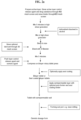
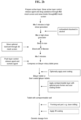
- FIG. 2a and FIG. 2b provide flowcharts of the general manufacturing processes for osmotic dosage forms according to the present disclosure.
- Tables 1-13, below, provide nonlimiting examples of the materials and their relative amounts used to produce the dosage forms described herein.
- the preparation method was as follows:
- a final immediate release coating comprising deutetrabenazine is optionally applied, using similar materials and following the processing steps as detailed above for active layer.
- Table 1 Component Amount (mg) Deutetrabenazine (micronized) 24.00 Polyethylene Oxide, NF (Polyox ® WSR N80) 123 Polyethylene Oxide, NF (FP) (Polyox ® WSR Coagulant, Fine Powder) 56.23 Hypromellose 2910 8.6 Magnesium Stearate 0.87 Sodium Chloride, USP (Powder) 21.91 Hydroxypropyl Cellulose NF (Klucel ® EXF) 3.16 FD&C Red No.
- Osmotic dosage forms containing 24mg deutetrabenazine were produced as disclosed in Example 1 and studied in a single dose pharmacokinetic study.
- the primary objective was to assess the comparative bioavailability (BA) of deutetrabenazine and deuterated ⁇ - and ⁇ -dihydrotetrabenazine (deuHTBZ) metabolites following a single administration of 24 mg, once daily (q.d.) osmotic formulation (Test) compared to a single 12 mg AUSTEDO ® tablet administered twice, 12 hours apart (b.i.d), under fasted conditions.
- BA comparative bioavailability
- Study Population and Number of Subjects The study included healthy male and female non-smoking subjects, aged 18 through 45 years. A total of 8 healthy subjects (4 per sequence) were enrolled in this study.
- AUC0-t, AUC0- ⁇ , and AUC0-24h were calculated using the trapezoidal rule.
- the Cmax, AUC0-t, AUC0- ⁇ , and AUC0-24h data was natural log-transformed prior to the statistical analysis. Comparisons of Cmax, AUC0-t, AUC0- ⁇ , and AUC0-24h between treatments (T2A vs R) was be carried out using a separate parametric analysis of variance (ANOVA) model with fixed effect terms for sequence, period, treatment group, and a random effect of subject within sequence.
- ANOVA parametric analysis of variance
- the difference between the reference formulation (R) and the test formulation (Test2A) was evaluated by constructing 90% confidence intervals for the Test/Reference ratios, based on the least-square means from the ANOVA for the log-transformed Cmax, AUC0-t, AUC0- ⁇ and AUC0-24h.
- the treatment difference and the associated 90% confidence interval estimated from the ANOVA on the log scale was back-transformed to obtain the estimated ratio of geometric means between treatment groups and the 90% confidence interval for this ratio.
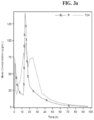
- FIG. 3a and FIG 3b show the results of the R treatment compared to Test2A treatment (mean concentration of deutetrabenazine vs. time) direct scale and log scale, respectively.
- Table 14, below, provides the specified pK parameters observed for deutetrabenazine with respect to Test2A compared to R.
- Table 14 Geometric LS Mean Geometric LS Mean Ratio (Test2A/R (%) 90% C.I. of Geometric LS Mean Ratio (Test2A/R) (%) Comparison pK Parameter Test2A R Test2A vs.
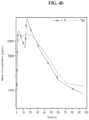
- FIG. 4a and FIG 4b show the metabolite data for the treatment using R compared to Test2A (mean concentration of total deuHTBZ vs. time), direct scale and log scale, respectively.
- Table 15, below, provides the specified pK parameters observed for total deuHTBZ for the Test2A compared to R.
- Table 15 Geometric LS Mean Geometric LS Mean Ratio (Test2A/R) (%) 90% C.I. of Geometric LS Mean Ratio (Test2A/R) (%) Comparison pK Parameter Test2A (total deuHTBZ) R (total deuHTBZ) Test2A vs.
- Test2A provided acceptable deuHTBZ plasma concentrations observed for the reference.
- the osmotic dosage forms disclosed herein are administered once daily and provide acceptable treatment effects to that of AUSTEDO ® and also have no safety concerns.
- Osmotic dosage form containing 24mg of deutetrabenazine were produced as disclosed in Example 1 and studied in an open label, randomized, multiple-dose, 2-way crossover study in healthy volunteers.
- the primary objective was to assess the bioequivalence (BE) of administration of Test2A, once daily (qd) compared to bid administration of R, under fasted or fed conditions.
- Treatment included 7 days repeated dosing of Test2A once daily versus 7 days repeated dosing of R, bid.
- Qualified models were used to predict the steady state, AUCt, C max , t max , C min , C av for deutetrabenazine and deuHTBZ concentrations.
- Table 16 provides simulation results for steady state pK parameters for deutetrabenazine with respect to Test2A compared to R as well as pK parameters for total deuHTBZ for the Test2A compared to R.
- Table 16 Analyte Comparison PK Parameter (Mean) Test2A
- Test2A has comparable pK parameters to that of R, at steady state. Therefore similar efficacy response is expected with once daily administration, having no safety concerns.
- Osmotic dosage forms containing 24mg deutetrabenazine are produced as disclosed in Example 1 and studied in an open label, randomized, two-way crossover study, to assess the comparative bioavailability of deutetrabenazine and deuHTBZ in the fed compared to the fasted state, following a single administration of 24 mg, once daily (qd) osmotic formulation.
- Treatment includes:
- Subject will receive treatments A / B with at least 6 days washout period.
- AUCt, Cmax, tmax, Cmin, Cav for deutetrabenazine and deuHTBZ will be analyzed.
Landscapes
- Health & Medical Sciences (AREA)
- Chemical & Material Sciences (AREA)
- Public Health (AREA)
- Veterinary Medicine (AREA)
- Medicinal Chemistry (AREA)
- Life Sciences & Earth Sciences (AREA)
- Animal Behavior & Ethology (AREA)
- General Health & Medical Sciences (AREA)
- Pharmacology & Pharmacy (AREA)
- Epidemiology (AREA)
- Engineering & Computer Science (AREA)
- Bioinformatics & Cheminformatics (AREA)
- Neurology (AREA)
- Neurosurgery (AREA)
- Biomedical Technology (AREA)
- General Chemical & Material Sciences (AREA)
- Chemical Kinetics & Catalysis (AREA)
- Nuclear Medicine, Radiotherapy & Molecular Imaging (AREA)
- Organic Chemistry (AREA)
- Inorganic Chemistry (AREA)
- Psychology (AREA)
- Physiology (AREA)
- Nutrition Science (AREA)
- Hospice & Palliative Care (AREA)
- Psychiatry (AREA)
- Oil, Petroleum & Natural Gas (AREA)
- Medicinal Preparation (AREA)
- Pharmaceuticals Containing Other Organic And Inorganic Compounds (AREA)
- Solid-Sorbent Or Filter-Aiding Compositions (AREA)
- Acyclic And Carbocyclic Compounds In Medicinal Compositions (AREA)
Applications Claiming Priority (5)
| Application Number | Priority Date | Filing Date | Title |
|---|---|---|---|
| US202063037369P | 2020-06-10 | 2020-06-10 | |
| US202063037953P | 2020-06-11 | 2020-06-11 | |
| US202063044451P | 2020-06-26 | 2020-06-26 | |
| PCT/US2021/036778 WO2021252741A1 (fr) | 2020-06-10 | 2021-06-10 | Formes posologiques osmotiques comprenant de la deutétrabénazine et leurs procédés d'utilisation |
| EP21737870.2A EP4153136B1 (fr) | 2020-06-10 | 2021-06-10 | Formes posologiques osmotiques comprenant de la deutétrabénazine et leurs procédés d'utilisation |
Related Parent Applications (1)
| Application Number | Title | Priority Date | Filing Date |
|---|---|---|---|
| EP21737870.2A Division EP4153136B1 (fr) | 2020-06-10 | 2021-06-10 | Formes posologiques osmotiques comprenant de la deutétrabénazine et leurs procédés d'utilisation |
Publications (2)
| Publication Number | Publication Date |
|---|---|
| EP4364738A2 true EP4364738A2 (fr) | 2024-05-08 |
| EP4364738A3 EP4364738A3 (fr) | 2024-06-19 |
Family
ID=78826343
Family Applications (2)
| Application Number | Title | Priority Date | Filing Date |
|---|---|---|---|
| EP23219522.2A Pending EP4364738A3 (fr) | 2020-06-10 | 2021-06-10 | Formes posologiques osmotiques comprenant de la deutétrabénazine et leurs procédés d'utilisation |
| EP21737870.2A Active EP4153136B1 (fr) | 2020-06-10 | 2021-06-10 | Formes posologiques osmotiques comprenant de la deutétrabénazine et leurs procédés d'utilisation |
Family Applications After (1)
| Application Number | Title | Priority Date | Filing Date |
|---|---|---|---|
| EP21737870.2A Active EP4153136B1 (fr) | 2020-06-10 | 2021-06-10 | Formes posologiques osmotiques comprenant de la deutétrabénazine et leurs procédés d'utilisation |
Country Status (27)
| Country | Link |
|---|---|
| US (3) | US11311488B2 (fr) |
| EP (2) | EP4364738A3 (fr) |
| JP (2) | JP7419571B2 (fr) |
| KR (2) | KR20240025706A (fr) |
| CN (1) | CN115916154A (fr) |
| AU (3) | AU2021288087B2 (fr) |
| BR (1) | BR112022025185B1 (fr) |
| CA (1) | CA3186425A1 (fr) |
| CL (1) | CL2022003512A1 (fr) |
| DK (1) | DK4153136T3 (fr) |
| ES (1) | ES2975960T3 (fr) |
| FI (1) | FI4153136T3 (fr) |
| HR (1) | HRP20240303T1 (fr) |
| HU (1) | HUE065723T2 (fr) |
| IL (1) | IL298629B1 (fr) |
| LT (1) | LT4153136T (fr) |
| MX (1) | MX2022015742A (fr) |
| NZ (1) | NZ795471A (fr) |
| PE (1) | PE20230852A1 (fr) |
| PL (1) | PL4153136T3 (fr) |
| PT (1) | PT4153136T (fr) |
| RS (1) | RS65328B1 (fr) |
| SI (1) | SI4153136T1 (fr) |
| SM (1) | SMT202400118T1 (fr) |
| TW (1) | TWI912326B (fr) |
| WO (1) | WO2021252741A1 (fr) |
| ZA (1) | ZA202213478B (fr) |
Families Citing this family (3)
| Publication number | Priority date | Publication date | Assignee | Title |
|---|---|---|---|---|
| US12599598B2 (en) | 2020-06-10 | 2026-04-14 | Auspex Pharmaceuticals Llc | Osmotic dosage forms comprising deutetrabenazine and methods of use thereof |
| US11311488B2 (en) | 2020-06-10 | 2022-04-26 | Auspex Pharmaceuticals, Inc. | Osmotic dosage forms comprising deutetrabenazine and methods of use thereof |
| WO2023240186A1 (fr) * | 2022-06-08 | 2023-12-14 | Auspex Pharmaceuticals, Inc. | Formes posologiques osmotiques comprenant de la deutétrabénazine et leurs procédés d'utilisation |
Citations (15)
| Publication number | Priority date | Publication date | Assignee | Title |
|---|---|---|---|---|
| US3173876A (en) | 1960-05-27 | 1965-03-16 | John C Zobrist | Cleaning methods and compositions |
| US3276586A (en) | 1963-08-30 | 1966-10-04 | Rosaen Filter Co | Indicating means for fluid filters |
| US3541006A (en) | 1968-07-03 | 1970-11-17 | Amicon Corp | Ultrafiltration process |
| US3541005A (en) | 1969-02-05 | 1970-11-17 | Amicon Corp | Continuous ultrafiltration of macromolecular solutions |
| US3546142A (en) | 1967-01-19 | 1970-12-08 | Amicon Corp | Polyelectrolyte structures |
| US3845770A (en) | 1972-06-05 | 1974-11-05 | Alza Corp | Osmatic dispensing device for releasing beneficial agent |
| US3916899A (en) | 1973-04-25 | 1975-11-04 | Alza Corp | Osmotic dispensing device with maximum and minimum sizes for the passageway |
| US4088864A (en) | 1974-11-18 | 1978-05-09 | Alza Corporation | Process for forming outlet passageways in pills using a laser |
| US4200098A (en) | 1978-10-23 | 1980-04-29 | Alza Corporation | Osmotic system with distribution zone for dispensing beneficial agent |
| US4327725A (en) | 1980-11-25 | 1982-05-04 | Alza Corporation | Osmotic device with hydrogel driving member |
| US4612008A (en) | 1983-05-11 | 1986-09-16 | Alza Corporation | Osmotic device with dual thermodynamic activity |
| US4783337A (en) | 1983-05-11 | 1988-11-08 | Alza Corporation | Osmotic system comprising plurality of members for dispensing drug |
| US5082668A (en) | 1983-05-11 | 1992-01-21 | Alza Corporation | Controlled-release system with constant pushing source |
| US8524733B2 (en) | 2008-09-18 | 2013-09-03 | Auspex Pharmaceuticals | Benzoquinoline inhibitors of vesicular monoamine transporter 2 |
| US9296739B2 (en) | 2012-09-18 | 2016-03-29 | Auspex Pharmaceuticals, Inc. | Formulations and pharmacokinetics of deuterated benzoquinoline inhibitors of vesicular monoamine transporter 2 |
Family Cites Families (13)
| Publication number | Priority date | Publication date | Assignee | Title |
|---|---|---|---|---|
| US20030161882A1 (en) * | 2002-02-01 | 2003-08-28 | Waterman Kenneth C. | Osmotic delivery system |
| EP1912622A2 (fr) * | 2005-08-04 | 2008-04-23 | Alza Corporation | Formes posologiques osmotiques comprenant des membranes semi-permeables formees de melanges polymeres presentant des caracteristiques ameliorees |
| US20120208773A1 (en) * | 2008-08-12 | 2012-08-16 | Valeant International (Barbados) Srl | Pharmaceutical compositions with tetrabenazine |
| CA2771539A1 (fr) * | 2009-08-12 | 2011-02-17 | Valeant International (Barbados) Srl | Compositions pharmaceutiques |
| US20130323309A1 (en) | 2011-02-17 | 2013-12-05 | Lupin Limited | Sustained Release Composition of Memantine |
| HRP20221106T1 (hr) * | 2015-03-06 | 2022-11-25 | Auspex Pharmaceuticals, Inc. | Postupci liječenja abnormalnih nevoljnih poremećaja pokreta |
| US10479787B2 (en) * | 2016-04-22 | 2019-11-19 | Lupin Limited | Process for preparation of tetrabenazine and deutetrabenazine |
| US20170312226A1 (en) * | 2016-04-28 | 2017-11-02 | Ascent Pharmaceuticals, Inc. | Pharmaceutical dosage forms |
| UA127052C2 (uk) * | 2017-03-15 | 2023-03-29 | Оспекс Фармасьютікалс, Інк. | Аналоги деутетрабеназину, їхнє отримання та застосування |
| US20190099377A1 (en) * | 2017-10-02 | 2019-04-04 | Powder Pharma Coating Inc. | Method for dry powder coating osmotic drug delivery system |
| DK3735228T3 (da) * | 2018-03-05 | 2022-03-14 | Amneal Complex Products Res Llc | Programmerbar farmaceutiske sammensætninger til krono-lægemiddelfrigivelse |
| SG11202100303QA (en) * | 2018-08-15 | 2021-02-25 | Neurocrine Biosciences Inc | Methods for the administration of certain vmat2 inhibitors |
| US11311488B2 (en) | 2020-06-10 | 2022-04-26 | Auspex Pharmaceuticals, Inc. | Osmotic dosage forms comprising deutetrabenazine and methods of use thereof |
-
2021
- 2021-06-10 US US17/344,271 patent/US11311488B2/en active Active
- 2021-06-10 CA CA3186425A patent/CA3186425A1/fr active Pending
- 2021-06-10 EP EP23219522.2A patent/EP4364738A3/fr active Pending
- 2021-06-10 HR HRP20240303TT patent/HRP20240303T1/hr unknown
- 2021-06-10 SI SI202130123T patent/SI4153136T1/sl unknown
- 2021-06-10 PL PL21737870.2T patent/PL4153136T3/pl unknown
- 2021-06-10 DK DK21737870.2T patent/DK4153136T3/da active
- 2021-06-10 AU AU2021288087A patent/AU2021288087B2/en active Active
- 2021-06-10 IL IL298629A patent/IL298629B1/en unknown
- 2021-06-10 ES ES21737870T patent/ES2975960T3/es active Active
- 2021-06-10 BR BR112022025185-8A patent/BR112022025185B1/pt active IP Right Grant
- 2021-06-10 TW TW110121253A patent/TWI912326B/zh active
- 2021-06-10 FI FIEP21737870.2T patent/FI4153136T3/fi active
- 2021-06-10 WO PCT/US2021/036778 patent/WO2021252741A1/fr not_active Ceased
- 2021-06-10 JP JP2022576176A patent/JP7419571B2/ja active Active
- 2021-06-10 EP EP21737870.2A patent/EP4153136B1/fr active Active
- 2021-06-10 CN CN202180042147.5A patent/CN115916154A/zh active Pending
- 2021-06-10 SM SM20240118T patent/SMT202400118T1/it unknown
- 2021-06-10 HU HUE21737870A patent/HUE065723T2/hu unknown
- 2021-06-10 PT PT217378702T patent/PT4153136T/pt unknown
- 2021-06-10 KR KR1020247005191A patent/KR20240025706A/ko active Pending
- 2021-06-10 NZ NZ795471A patent/NZ795471A/en unknown
- 2021-06-10 KR KR1020237000961A patent/KR102638424B1/ko active Active
- 2021-06-10 RS RS20240332A patent/RS65328B1/sr unknown
- 2021-06-10 LT LTEPPCT/US2021/036778T patent/LT4153136T/lt unknown
- 2021-06-10 PE PE2022002886A patent/PE20230852A1/es unknown
- 2021-06-10 MX MX2022015742A patent/MX2022015742A/es unknown
-
2022
- 2022-03-01 US US17/683,732 patent/US20230022862A1/en not_active Abandoned
- 2022-12-09 CL CL2022003512A patent/CL2022003512A1/es unknown
- 2022-12-13 ZA ZA2022/13478A patent/ZA202213478B/en unknown
-
2023
- 2023-06-27 AU AU2023204103A patent/AU2023204103B2/en active Active
-
2024
- 2024-01-10 JP JP2024001864A patent/JP7769731B2/ja active Active
- 2024-03-19 US US18/609,809 patent/US12589075B2/en active Active
-
2025
- 2025-07-15 AU AU2025205457A patent/AU2025205457A1/en active Pending
Patent Citations (15)
| Publication number | Priority date | Publication date | Assignee | Title |
|---|---|---|---|---|
| US3173876A (en) | 1960-05-27 | 1965-03-16 | John C Zobrist | Cleaning methods and compositions |
| US3276586A (en) | 1963-08-30 | 1966-10-04 | Rosaen Filter Co | Indicating means for fluid filters |
| US3546142A (en) | 1967-01-19 | 1970-12-08 | Amicon Corp | Polyelectrolyte structures |
| US3541006A (en) | 1968-07-03 | 1970-11-17 | Amicon Corp | Ultrafiltration process |
| US3541005A (en) | 1969-02-05 | 1970-11-17 | Amicon Corp | Continuous ultrafiltration of macromolecular solutions |
| US3845770A (en) | 1972-06-05 | 1974-11-05 | Alza Corp | Osmatic dispensing device for releasing beneficial agent |
| US3916899A (en) | 1973-04-25 | 1975-11-04 | Alza Corp | Osmotic dispensing device with maximum and minimum sizes for the passageway |
| US4088864A (en) | 1974-11-18 | 1978-05-09 | Alza Corporation | Process for forming outlet passageways in pills using a laser |
| US4200098A (en) | 1978-10-23 | 1980-04-29 | Alza Corporation | Osmotic system with distribution zone for dispensing beneficial agent |
| US4327725A (en) | 1980-11-25 | 1982-05-04 | Alza Corporation | Osmotic device with hydrogel driving member |
| US4612008A (en) | 1983-05-11 | 1986-09-16 | Alza Corporation | Osmotic device with dual thermodynamic activity |
| US4783337A (en) | 1983-05-11 | 1988-11-08 | Alza Corporation | Osmotic system comprising plurality of members for dispensing drug |
| US5082668A (en) | 1983-05-11 | 1992-01-21 | Alza Corporation | Controlled-release system with constant pushing source |
| US8524733B2 (en) | 2008-09-18 | 2013-09-03 | Auspex Pharmaceuticals | Benzoquinoline inhibitors of vesicular monoamine transporter 2 |
| US9296739B2 (en) | 2012-09-18 | 2016-03-29 | Auspex Pharmaceuticals, Inc. | Formulations and pharmacokinetics of deuterated benzoquinoline inhibitors of vesicular monoamine transporter 2 |
Also Published As
Similar Documents
| Publication | Publication Date | Title |
|---|---|---|
| US12589075B2 (en) | Osmotic dosage forms comprising deutetrabenazine and methods of use thereof | |
| JP4500679B2 (ja) | パリペリドンを制御送達する方法および投薬形態物 | |
| DE69524214T3 (de) | Azithromycin enthaltende arzneiverabreichungsformen mit gesteuerter wirkstoffabgabe | |
| JP2005525405A (ja) | オキシコドンを制御して補給する方法および剤型 | |
| EP2119442A1 (fr) | Composition pharmaceutique à libération entretenue de tacrolimus | |
| JP2007501248A (ja) | 増進した分散調合物による長時間にわたるトピラメートの均一送達 | |
| JP2007503389A (ja) | 長期間にわたるトピラメートの段階的送達 | |
| US12599598B2 (en) | Osmotic dosage forms comprising deutetrabenazine and methods of use thereof | |
| HK40109452A (en) | Osmotic dosage forms comprising deutetrabenazine and methods of use thereof | |
| HK40087427B (en) | Osmotic dosage forms comprising deutetrabenazine and methods of use thereof | |
| HK40087427A (en) | Osmotic dosage forms comprising deutetrabenazine and methods of use thereof | |
| EP4536181A1 (fr) | Formes posologiques osmotiques comprenant de la deutétrabénazine et leurs procédés d'utilisation | |
| EA047365B1 (ru) | Осмотические дозированные лекарственные формы, включающие деутетрабеназин, и способы их применения | |
| HK40120984A (zh) | 包含氘代丁苯那嗪的渗透剂型及其使用方法 | |
| WO2022271167A1 (fr) | Forme posologique orale de ticagrelor et son procédé de préparation |
Legal Events
| Date | Code | Title | Description |
|---|---|---|---|
| PUAI | Public reference made under article 153(3) epc to a published international application that has entered the european phase |
Free format text: ORIGINAL CODE: 0009012 |
|
| STAA | Information on the status of an ep patent application or granted ep patent |
Free format text: STATUS: THE APPLICATION HAS BEEN PUBLISHED |
|
| AC | Divisional application: reference to earlier application |
Ref document number: 4153136 Country of ref document: EP Kind code of ref document: P |
|
| AK | Designated contracting states |
Kind code of ref document: A2 Designated state(s): AL AT BE BG CH CY CZ DE DK EE ES FI FR GB GR HR HU IE IS IT LI LT LU LV MC MK MT NL NO PL PT RO RS SE SI SK SM TR |
|
| REG | Reference to a national code |
Ref country code: DE Ref legal event code: R079 Free format text: PREVIOUS MAIN CLASS: A61K0031474500 Ipc: A61K0009000000 |
|
| PUAL | Search report despatched |
Free format text: ORIGINAL CODE: 0009013 |
|
| AK | Designated contracting states |
Kind code of ref document: A3 Designated state(s): AL AT BE BG CH CY CZ DE DK EE ES FI FR GB GR HR HU IE IS IT LI LT LU LV MC MK MT NL NO PL PT RO RS SE SI SK SM TR |
|
| RIC1 | Information provided on ipc code assigned before grant |
Ipc: A61P 25/28 20060101ALI20240511BHEP Ipc: A61P 25/14 20060101ALI20240511BHEP Ipc: A61K 31/473 20060101ALI20240511BHEP Ipc: A61K 47/38 20060101ALI20240511BHEP Ipc: A61K 47/10 20170101ALI20240511BHEP Ipc: A61K 9/20 20060101ALI20240511BHEP Ipc: A61K 9/28 20060101ALI20240511BHEP Ipc: A61K 9/00 20060101AFI20240511BHEP |
|
| REG | Reference to a national code |
Ref country code: HK Ref legal event code: DE Ref document number: 40109452 Country of ref document: HK |
|
| STAA | Information on the status of an ep patent application or granted ep patent |
Free format text: STATUS: REQUEST FOR EXAMINATION WAS MADE |
|
| 17P | Request for examination filed |
Effective date: 20241218 |
|
| RAP3 | Party data changed (applicant data changed or rights of an application transferred) |
Owner name: AUSPEX PHARMACEUTICALS LLC |
|
| STAA | Information on the status of an ep patent application or granted ep patent |
Free format text: STATUS: EXAMINATION IS IN PROGRESS |
|
| 17Q | First examination report despatched |
Effective date: 20260318 |