EP4365368A1 - Tissu industriel - Google Patents
Tissu industriel Download PDFInfo
- Publication number
- EP4365368A1 EP4365368A1 EP22832474.5A EP22832474A EP4365368A1 EP 4365368 A1 EP4365368 A1 EP 4365368A1 EP 22832474 A EP22832474 A EP 22832474A EP 4365368 A1 EP4365368 A1 EP 4365368A1
- Authority
- EP
- European Patent Office
- Prior art keywords
- surface side
- binding
- warp
- binding warp
- warps
- Prior art date
- Legal status (The legal status is an assumption and is not a legal conclusion. Google has not performed a legal analysis and makes no representation as to the accuracy of the status listed.)
- Pending
Links
Images








Classifications
-
- D—TEXTILES; PAPER
- D03—WEAVING
- D03D—WOVEN FABRICS; METHODS OF WEAVING; LOOMS
- D03D13/00—Woven fabrics characterised by the special disposition of the warp or weft threads, e.g. with curved weft threads, with discontinuous warp threads, with diagonal warp or weft
- D03D13/004—Woven fabrics characterised by the special disposition of the warp or weft threads, e.g. with curved weft threads, with discontinuous warp threads, with diagonal warp or weft with weave pattern being non-standard or providing special effects
-
- D—TEXTILES; PAPER
- D21—PAPER-MAKING; PRODUCTION OF CELLULOSE
- D21F—PAPER-MAKING MACHINES; METHODS OF PRODUCING PAPER THEREON
- D21F1/00—Wet end of machines for making continuous webs of paper
- D21F1/0027—Screen-cloths
- D21F1/0036—Multi-layer screen-cloths
- D21F1/0045—Triple layer fabrics
-
- D—TEXTILES; PAPER
- D10—INDEXING SCHEME ASSOCIATED WITH SUBLASSES OF SECTION D, RELATING TO TEXTILES
- D10B—INDEXING SCHEME ASSOCIATED WITH SUBLASSES OF SECTION D, RELATING TO TEXTILES
- D10B2403/00—Details of fabric structure established in the fabric forming process
- D10B2403/01—Surface features
- D10B2403/011—Dissimilar front and back faces
Definitions
- the present invention relates to industrial fabrics used for paper machines.
- Patent Literature 1 discloses an industrial fabric that includes: an upper layer surface side fabric including upper layer surface side warps and upper layer surface side wefts; a lower layer surface side fabric including lower layer surface side warps and lower layer surface side wefts; upper layer surface side warps functioning as binding yarns; and lower layer surface side warps functioning as binding yarns.
- the upper layer surface side warps functioning as binding yarns and the lower layer surface side warps functioning as binding yarns are provided in pairs at the top and bottom.
- upper layer surface side warps serving as binding yarns and lower layer surface side warps serving as binding yarns paired at the top and bottom become a factor that reduces the surface properties of the upper surface side fabric. Therefore, as the number of pairs of upper surface side warps serving as binding yarns and lower surface side warps serving as binding yarns increases in an attempt to improve the binding strength, the surface properties of the upper surface side fabric decrease.
- a purpose of the present invention is to provide industrial fabrics that improve the surface properties of an upper surface side fabric while ensuring binding strength.
- An embodiment of the present invention relates to an industrial fabric in which an upper surface side fabric and a lower surface side fabric are bound, including: upper surface side wefts that form a portion of the upper surface side fabric; lower surface side wefts that form a portion of the lower surface side fabric; upper surface side warps that are interwoven only with the upper surface side wefts so as to form a portion of the upper surface side fabric; lower surface side warps that are interwoven only with the lower surface side wefts so as to form a portion of the lower surface side fabric; and binding warps that bind the upper surface side fabric and the lower surface side fabric.
- Binding warps have a first binding warp and a second binding warp that are arranged vertically in a pair and a third binding warp that forms knuckles passing above upper surface side wefts.
- Upper surface side warps include an upper surface side collapsing yarn that forms a pair with the third binding warp. The upper surface side collapsing yarn passes below the upper surface side wefts and collapses a part of the upper surface side obverse surface texture at a position where the third binding warp forms the knuckles on the upper surface wefts.
- the pair formed by the first binding warp and the second binding warp complement each other while the pair formed by the third binding warp and the upper surface side collapsing yarn complement each other such that the pair formed by the first binding warp and the second binding warp and the pair formed by the third binding warp and the upper surface side collapsing yarn thereby form the same weaving pattern for the upper surface side wefts in a weave repeat.
- warps are threads extending along the direction of web conveyance
- wefts are threads extending in a direction that intersects the warps, when a multi-layered fabric for papermaking constitutes a looped belt.
- the "upper surface side fabric” is a fabric located on the obverse surface side where the web is conveyed out of the two sides of a papermaking mesh when a multi-layered fabric is used as the papermaking mesh
- the "lower surface side fabric” is a fabric located mainly on the reverse surface side where a drive roller is in contact out of the two sides of a papermaking belt.
- the "obverse surface” simply means a surface on the side where the upper surface side fabric or the lower surface side fabric is exposed. While the "obverse surface” of the upper surface side fabric corresponds to the obverse surface side of a papermaking mesh, the “obverse surface” of the lower surface side fabric corresponds to the reverse surface side of the papermaking mesh.
- design diagram represents the minimum repeating unit of a textile texture and corresponds to a weave repeat of the textile.
- weave repeat is repeated from front to back and left to right to form a "textile”.
- "knuckle” refers to a part where a warp is exposed on the obverse surface after passing over or under a single or multiple wefts.
- binding warps means at least some of warps that make up the upper surface side fabric (or lower surface side fabric) and are yarns that bind the upper surface side fabric with the lower surface side fabric by the weaving of a weft of the lower surface side fabric (or the upper surface side fabric) from the reverse surface side (or the obverse surface side) with a warp that should normally be woven with only a weft of the upper surface side fabric (or the lower surface side fabric).
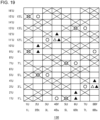
- FIG. 1 is a design diagram showing a weave repeat of an industrial fabric 10 according to the first embodiment.
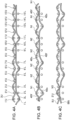
- FIG. 2 is a cross-sectional view in the warp direction (also referred to as the longitudinal direction) along warps in the design diagram shown in FIG. 1 .
- warps are represented by Arabic numerals, for example, 1, 2, 3, and so on.
- Wefts are represented by Arabic numerals with a dash, for example, 1', 2', 3', and so on.
- Upper surface side yarns are denoted by numbers with "U”
- lower surface side yarns are denoted by numbers with "L,” e.g., 1'U, 2'L, etc.
- Binding warps binding the upper surface side fabric and the lower surface side fabric are denoted by numbers with "B”
- first, second, and third binding warps are denoted as Bf, Bs, and Bt, respectively.
- ⁇ marks indicate that first binding warps are arranged below lower surface side wefts
- ⁇ marks indicate that second or third warps are arranged above upper surface side wefts
- ⁇ marks indicate that upper surface side warps or the first binding warps are arranged above the upper surface side wefts
- ⁇ marks indicate that lower surface side warps, the second binding warps, or the third binding warps are arranged below the lower surface side wefts.
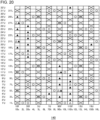
- the ⁇ marks, the A marks, the ⁇ marks, and the ⁇ marks indicate knuckles. These notations are used in the same manner in FIG. 3 and subsequent figures.
- an upper surface side fabric composed of upper surface side warps (1U, 2U, 3U, 5U, 6U, and 7U) and upper surface side wefts (1'U to 16'U) and a lower surface side fabric composed of lower surface side warps (1L, 2L, 5L, and 6L) and lower surface side wefts (1'L to 3'L, 5'L to 7'L, 9'L to 11'L, and 13'L to 15'L) are bound to each other by the first binding warps (4Bf and 8Bf), the second binding warps (4Bs and 8Bs), and the third binding warps (3Bt and 7Bt).
- the upper surface side wefts (1'U to 16'U) form a part of the upper surface side fabric.
- the lower surface side wefts (1'L to 3'L, 5'L to 7'L, 9'L to 11'L, and 13'L to 15'L) form a part of the lower surface side fabric.
- the first binding warps (4Bf and 8Bf), the second binding warps (4Bs and 8Bs), and the third binding warps (3Bt and 7Bt) bind the upper surface side fabric and the lower surface side fabric and each form a part of the upper surface side fabric and a part of the lower surface side fabric.
- the first binding warps (4Bf and 8Bf), the second binding warps (4Bs and 8Bs), and the third binding warps (3Bt and 7Bt) are simply referred to as binding warps when the binding warps are not distinguished.
- FIG. 2A shows a form in which a pair formed by the upper surface side warp 2U and the lower surface side warp 2L is interwoven with the upper and lower surface side wefts. As shown in FIG.
- the upper surface side warp 2U is interwoven with the upper surface side wefts (1'U to 16'U) above and below the upper surface side wefts (1'U to 16'U) one by one, passes above the upper surface side wefts (2'U, 4'U, 6'U,8'U, 10'U, 12'U, 14'U, and 16'U) so as to form obverse surface side knuckles, and passes below the upper surface side wefts (1'U, 3'U, 5'U, 7'U, 9'U, 11'U, 13'U, and 15'U).
- the upper surface side weft 6U is interwoven with the upper surface side wefts (1'U to 16'U) in the same manner as in the upper surface side warp 2U.
- the upper surface side warps (1U, 3U, 5U, and 7U) are alternately interwoven with the upper surface side wefts (1'U to 16'U) in the same manner as in the upper surface side warp 2U except that the interweaving position is shifted by one in the warp direction.
- the upper surface side warps (1U to 3U, 5U to 7U) have the same weaving pattern, form knuckles at constant intervals with respect to the upper surface side wefts (1'U to 16'U), and are interwoven alternately without destroying the surface texture.
- the upper surface side warps (1U, 2U, 3U, 5U, 6U, and 7U) are interwoven only with the upper surface side wefts (1'U to 16'U) so as to form a part of the upper surface side fabric.
- the lower surface side warp 2L passes below the lower surface side wefts (1'L, 6'L, and 11'L) so as to form reverse surface side knuckles, respectively, and passes above the three lower surface side wefts (2'L, 3'L, and 5'L), the three lower surface side wefts (7'L, 9'L, and 10'L), and the three lower surface side wefts (13'L, 14'L, and 15'L) between respective reverse surface side knuckles.
- the lower surface side warps (1L, 5L, and 6L) have the same weaving pattern as that of the lower surface side warp 2L and are woven passing alternately below one lower surface side weft and above three lower surface side wefts. As described, the lower surface side warps (1L, 2L, 5L, and 6L) are interwoven only with the lower surface side wefts (1'L to 3'L, 5'L to 7'L, 9'L to 11'L, and 13'L to 15'L) so as to form a part of the lower surface side fabric. Being same in the same weaving pattern means that deviations in the warp direction are allowed while the number and spacing of knuckles are the same.
- FIG. 2B shows a form in which a pair formed by the upper surface side warp 3U and the third binding warp 3Bt is interwoven with the upper and lower surface side wefts.
- the upper surface side warp 3U and the third binding warp 3Bt form a pair facing each other vertically and intersect with each other due to the binding by the third binding warp 3Bt.
- the upper surface side warp 3U passes above the upper surface side wefts (1'U, 3'U, 5'U, 7'U, 9'U, 11'U, and 13'U) so as to form obverse surface side knuckles, respectively, and passes below the upper surface side wefts (2'U, 4'U, 6'U, 8'U, 10'U, 12'U, and 14'U to 16'U).
- the third binding warp 3Bt passes below the lower surface side wefts (1'L, 6'L, and 11'L) so as to form knuckles and forms a knuckle N3 passing above the upper surface side weft 15'U.
- the third binding warp 3Bt passes below one lower surface side weft and above three lower surface side wefts alternately so as to form knuckles at constant intervals on the lower surface side fabric and are interwoven without destroying the reverse surface texture.
- the third binding warp 3Bt passes below the upper surface side wefts (1'U to 14'L, and 16'L) and passes above the upper surface side weft 15'U for binding so as to form only one knuckle N3 on the obverse surface side.
- the upper surface side warp 3U does not form a knuckle on the obverse surface side after passing below the upper surface side weft 15'U and acts as an upper surface side collapsing yarn 3U that collapses a part of the upper surface side obverse surface texture.
- the upper surface side warp 3U and the third binding warp 3Bt complement each other in the obverse surface texture of the upper surface side fabric, thereby forming the same obverse surface texture as that of the upper surface side warps (1U, 2U, 5U, and 6U) other than the upper surface side warp 3U (upper surface side collapsing yarn) and forming the same number of knuckles as the number of the upper surface side warps (1II, 2U, 5U, and 6U) other than the upper surface side collapsing yarn 3U in the upper surface side obverse surface texture. This prevents the third binding warp 3Bt from lowering the surface properties of the upper surface side fabric.
- the upper surface side warp 7U and the third binding warp 7Bt have the same weaving pattern and thus exhibit the same function.
- FIG. 2C shows a form in which a pair formed by the first binding warp 4Bf and the second binding warp 4Bs is interwoven with the upper and lower surface side wefts.
- the first binding warp 4Bf and the second binding warp 4Bs form a pair facing each other vertically and intersect with each other due to binding.
- the first binding warp 4Bf passes above the upper surface side wefts (2'U, 12'U, 14'U, and 16'U) so as to form four knuckles N1 and passes below the remaining upper surface side wefts (1'U, 3'U to 11'U, 13'U, and 15'U).
- the first binding warp 4Bf passes below the lower surface side weft 7'L so as to form a knuckle and passes above the lower surface side wefts (1'L to 6'L, and 8'L to 15'L).
- the second binding warp 4Bs passes above the upper surface side wefts (4'U, 6'U, 8'U, and 10'U) so as to form four knuckles N2 and passes below the remaining upper surface side wefts (1'U to 3'U, 5'U, 7'U, 9'U, and 11'U to 16'U).
- the second binding warp 4Bs passes below the lower surface side wefts (2'L and 13'L) so as to form knuckles, respectively, and passes above the lower surface side wefts (1'L, 3'L to 12'L, and 14'L to 15'L).
- the first binding warp 4Bf and the second binding warp 4Bs complement each other in the obverse surface texture of the upper surface side fabric, thereby forming the same obverse surface texture as that of the upper surface side warps (1U, 2U, 5U, and 6U) other than the upper surface side collapsing yarn and forming the same number of knuckles as the number of the upper surface side warps (1U, 2U, 5U, and 6U) other than the upper surface side collapsing yarn in the upper surface side obverse surface texture.
- first binding warp 4Bf and the second binding warp 4Bs complement each other in the reverse surface texture of the lower surface side fabric, thereby forming knuckles at constant intervals on the lower surface side fabric and being interwoven without destroying the reverse surface texture.
- the intersecting position of the first binding warp 8Bf and the second binding warp 8Bs is shifted in the warp direction from that of the first binding warp 4Bf and the second binding warp 4Bs, the first binding warp 8Bf and the second binding warp 8Bs have the same weaving pattern and thus exhibit the same function.
- the pair formed by the first binding warp 4Bf and the second binding warp 4Bs is adjacent to the pair formed by the third binding warp 3Bt and the upper surface side collapsing yarn 3U. This allows the binding of the upper surface side fabric and the lower surface side fabric to be strong. Since the pair formed by the first and second binding warps 8Bf and 8Bs and the pair formed by the third binding warp 7Bt and the upper surface side collapsing yarn 7U have the same relationship as the pair formed by the first and second binding warps 4Bf and 4Bs and the pair formed by the third binding warp 3Bt and the upper surface side collapsing yarn 3U, the explanations thereof are omitted.
- the pair formed by the first binding warp 4Bf and the second binding warp 4Bs complement each other while the pair formed by the third binding warp 3Bt and the upper surface side collapsing yarn 3U complement each other.
- the pair formed by the first binding warp 4Bf and the second binding warp 4Bs and the pair formed by the third binding warp 3Bt and the upper surface side collapsing yarn 3U form the same weaving pattern for the upper surface side wefts (1'U to 16'U).
- the pair formed by the first binding warp 4Bf and second binding warp 4Bs forms obverse surface texture in which knuckles are formed for every other upper surface side weft (1'U to 16'U) on the obverse surface side.
- the pair formed by the third binding warp 3Bt and the upper surface side collapsing yarn 3U also forms obverse surface texture in which knuckles are formed for every other upper surface side weft (1'U to 16'U) on the obverse surface side.
- the pair formed by the first binding warp 4Bf and the second binding warp 4Bs and the pair formed by the third binding warp 3Bt and the upper surface side collapsing yarn 3U form common obverse surface texture, thereby suppressing a decrease in the surface properties of the upper surface side fabric caused due to binding.
- the upper surface side collapsing yarn 3U is arranged below the upper surface side weft 15'U at the position of the knuckle N3 formed by the third binding warp 3Bt passing above the upper surface side weft 15'U.
- the number of knuckles N3 formed by the third binding warp 3Bt passing above the upper surface side weft 15'U is less than the number of knuckles N1 formed by the first binding warp 4Bf passing above the upper surface side weft.
- the number of the knuckles N3 is less than the number of the knuckles N2. Thereby, a decrease in the surface properties can be suppressed in the row of the third binding warp 3Bt.
- the number of all the warps (1U to 3U, 4Bf, 5U to 7U, 8Bf, 1L to 2L, 3Bt, 4Bs, 5L to 6L, 7Bt, and 8Bs) forming the weave repeat is a multiple of four. This works for various structures such as plain weave, twill weave, 2/2 weave where threads alternately pass above and below two wefts, 4-shaft weave, 8-shaft weave, and 16-shaft weave.
- the number of the first binding warps (4Bf and 8Bf), the second binding warps (4Bs and 8Bs), and the third binding warps (3Bt and 7Bt) combined is less than half the number of all the warps (1U to 3U, 4Bf, 5U to 7U, 8Bf, 1L to 2L, 3Bt, 4Bs, 5L to 6L, 7Bt, and 8Bs).
- the number of binding yarns can be reduced such that a decrease in the air permeability and the surface properties can be suppressed.
- the third binding warp 3Bt and the upper surface side collapsing yarn 3U complement each other in the weave repeat such that the number and spacing of knuckles formed on the upper surface side wefts are the same as the number and spacing of knuckles formed by the upper surface side warps (1U, 2U, 5U, and 6U) other than the upper surface side collapsing yarn 3U on the upper surface side wefts. This allows for suppression of a decrease in the surface properties of the upper surface side fabric.
- the first binding warp 4Bf and the second binding warp 4Bs complement each other in the weave repeat such that the number of knuckles formed on the upper surface side wefts (N2 and N3) is the same as the number of knuckles formed by the upper surface side warps (1U, 2U, 5U, and 6U) other than the upper surface side collapsing yarn 3U on the upper surface side wefts. This allows for suppression of a decrease in the surface properties of the upper surface side fabric.
- FIG. 3 is a design diagram showing a weave repeat of an industrial fabric 20 according to the second embodiment.
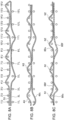
- FIG. 4 is a cross-sectional view in the warp direction along warps in the design diagram shown in FIG. 3 .
- an upper surface side fabric composed of upper surface side warps (1U to 3U, and 5U to 8U) and upper surface side wefts (1'U to 16'U) and a lower surface side fabric composed of lower surface side warps (1L to 3L and 5L to 7L) and lower surface side wefts (1'L to 3'L, 5'L to 7'L, 9'L to 11'L, and 13'L to 15'L) are bound to each other by the first binding warp 4Bf, the second binding warp 4Bs, and the third binding warp 8Bt.
- the upper surface side wefts (1'U to 16'U) form a part of the upper surface side fabric.
- the lower surface side wefts (1'L to 3'L, 5'L to 7'L, 9'L to 11'L, and 13'L to 15'L) form a part of the lower surface side fabric.
- the first binding warp 4Bf, the second binding warp 4Bs, and the third binding warp 8Bt bind the upper surface side fabric and the lower surface side fabric and each form a part of the upper surface side fabric and a part of the lower surface side fabric.
- FIG. 4A shows a form in which a pair formed by the upper surface side warp 3U and the lower surface side warp 3L is interwoven with the upper and lower surface side wefts.
- the upper surface side wefts and the lower surface side wefts shown in FIGS. 4A to 4C are arranged in the same manner. As shown in FIG.
- the upper surface side warp 3U is interwoven with the upper surface side wefts (1'U to 16'U) above and below the upper surface side wefts one by one, passes above the upper surface side wefts (1'U, 3'U, 5'U, 7'U, 9'U, 11'U, 13'U, and 15'U) so as to form obverse surface side knuckles, and passes below the upper surface side wefts (2'U, 4'U, 6'U, 8'U, 10'U, 12'U, 14'U, and 16'U).
- the upper surface side weft 6U is interwoven with the upper surface side wefts (1'U to 16'U) in the same manner as in the upper surface side warp 2U.
- the upper surface side warps (1U, 3U, 5U, 7U) are alternately interwoven with the upper surface side wefts (1'U to 16'U) in the same manner as in the upper surface side warp 2U except that the interweaving position is shifted by one in the warp direction.
- the upper surface side warps (1U to 3U, 5U to 7U) have the same weaving pattern, form knuckles at constant intervals with respect to the upper surface side wefts (1'U to 16'U), and are interwoven alternately without destroying the obverse side surface texture.
- the upper surface side warps (1U to 3U, 5U to 7U) are interwoven only with the upper surface side wefts (1'U to 16'U) so as to form a part of the upper surface side fabric.
- the lower surface side warp 3L passes below the lower surface side wefts (1'L, 6'L, and 11'L) so as to form reverse surface side knuckles, respectively, and passes above the three lower surface side wefts (2'L, 3'L, and 5'L), the three lower surface side wefts (7'L, 9'L, and 10'L), and the three lower surface side wefts (13'L, 14'L, and 15'L) between respective reverse surface side knuckles.
- the lower surface side warps (1L to 2L and 5L to 7L) have the same weaving pattern as that of the lower surface side warp 3L and are woven passing alternately below one lower surface side weft and above three lower surface side wefts. As described, the lower surface side warps (1L to 3L and 5L to 7L) are interwoven only with the lower surface side wefts (1'L to 3'L, 5'L to 7'L, 9'L to 11'L, and 13'L to 15'L) so as to form a part of the lower surface side fabric.
- FIG. 4B shows a form in which a pair formed by the first binding warp 4Bf and the second binding warp 4Bs is interwoven with the upper and lower surface side wefts.
- the first binding warp 4Bf and the second binding warp 4Bs form a pair facing each other vertically and intersect with each other due to binding.
- the first binding warp 4Bf passes above the upper surface side wefts (2'U, 12'U, 14'U, and 16'U) so as to form four knuckles N1 and passes below the remaining upper surface side wefts (1'U, 3'U to 11'U, 13'U, and 15'U).
- the first binding warp 4Bf passes below the lower surface side weft 7'L so as to form a knuckle and passes above the lower surface side wefts (1'L to 6'L and 8'L to 15'L).
- the second binding warp 4Bs passes above the upper surface side wefts (4'U, 6'U, 8'U, and 10'U) so as to form four knuckles N2 and passes below the remaining upper surface side wefts (1'U to 3'U, 5'U, 7'U, 9'U, and 11'U to 16'U).
- the second binding warp 4Bs passes below the lower surface side wefts (2'L and 13'L) so as to form knuckles, respectively, and passes above the lower surface side wefts (1'L, 3'L to 12'L, and 14'L to 15'L).
- the first binding warp 4Bf and the second binding warp 4Bs complement each other in the obverse surface texture of the upper surface side fabric, thereby forming the same obverse surface texture as that of the upper surface side warps (1U to 3U and 5U to 7U) and forming the same number of knuckles as the number of the upper surface side warps (1U to 3U and 5U to 7U) in the upper surface side obverse surface texture.
- the first binding warp 4Bf and the second binding warp 4Bs complement each other in the reverse surface texture of the lower surface side fabric, thereby forming knuckles at constant intervals on the lower surface side fabric and being interwoven without destroying the reverse surface texture.
- FIG. 4C shows a form in which a pair formed by the upper surface side warp 8U and the third binding warp 8Bt is interwoven with the upper and lower surface side wefts.
- the upper surface side warp 8U and the third binding warp 8Bt form a pair facing each other vertically and intersect with each other due to the binding by the third binding warp 8Bt.
- the upper surface side warp 8U passes above the upper surface side wefts (4'U, 6'U, 8'U, 10'U, 12'U, 14'U, and 16'U) so as to form obverse surface side knuckles, respectively, and passes below the upper surface side wefts (1'U, 2'U, 3'U, 5'U, 7'U, 9'U, 11'U, and 13'U to 15'U).
- the third binding warp 8Bt forms a knuckle N3 that passes above the upper surface side weft 2'U and passes below the lower surface side wefts (5'L, 10'L, and 15'L) so as to form knuckles.
- the third binding warp 8Bt passes below one lower surface side weft and above three lower surface side wefts alternately so as to form knuckles at constant intervals on the lower surface side fabric and are interwoven without destroying the reverse surface texture.
- the third binding warp 8Bt passes below the upper surface side wefts (1'U and 3'U to 16'U) and passes above the upper surface side weft 2'U for binding so as to form only one knuckle N3 on the obverse surface side.
- the upper surface side warp 8U does not form a knuckle on the obverse surface side after passing below the upper surface side weft 2'U and acts as an upper surface side collapsing yarn 8U that collapses a part of the upper surface side obverse surface texture.
- the upper surface side warp 8U and the third binding warp 8Bt complement each other in the obverse surface texture of the upper surface side fabric, thereby forming the same obverse surface texture as that of the upper surface side warps (1U to 3U and 5U to 7U) other than the upper surface side warp 8U (upper surface side collapsing yarn) and forming the same number of knuckles as the number of the upper surface side warps (1U to 3U and 5U to 7U) other than the upper surface side collapsing yarn 8U in the upper surface side obverse surface texture. This prevents the third binding warp 8Bt from lowering the surface properties of the upper surface side fabric.
- the upper surface side collapsing yarn 8U is arranged below the upper surface side weft 2'U at the position of the knuckle N3 formed by the third binding warp 8Bt.
- the pulling-in of the upper surface side weft 2'U due to the binding of the third binding warp 8Bt can be suppressed by the upper surface side collapsing yarn 8U. This allows for suppression of a decrease in the surface properties of the upper surface side fabric.
- the pair formed by the first binding warp 4Bf and the second binding warp 4Bs complement each other while the pair formed by the third binding warp 8Bt and the upper surface side collapsing yarn 8U complement each other.
- the pair formed by the first binding warp 4Bf and the second binding warp 4Bs and the pair formed by the third binding warp 8Bt and the upper surface side collapsing yarn 8U form the same weaving pattern for the upper surface side wefts (1'U to 16'U).
- Having the same weaving pattern means that knuckles are arranged at the same intervals, and those with deviations in the warp direction are also included.
- the pair formed by the first binding warp 4Bf and second binding warp 4Bs forms obverse surface texture in which knuckles are formed for every other upper surface side weft (1'U to 16'U) on the obverse surface side.
- the pair formed by the third binding warp 3Bt and the upper surface side collapsing yarn 3U also forms obverse surface texture in which knuckles are formed for every other upper surface side weft (1'U to 16'U) on the obverse surface side.
- the pair formed by the first binding warp 4Bf and the second binding warp 4Bs and the pair formed by the third binding warp 8Bt and the upper surface side collapsing yarn 8U form common obverse surface texture, thereby suppressing a decrease in the surface properties of the upper surface side fabric caused due to binding.
- the pair formed by the first binding warp 4Bf and the second binding warp 4Bs is not adjacent to the pair formed by the third binding warp 8Bt and the upper surface side collapsing yarn 8U. Thereby, it is possible to disperse the binding positions that cause a decrease in the surface properties and to suppress the occurrence of marks on paper produced by the industrial fabric 20 compared to a case where binding positions are closely packed.
- the number of the first binding warps 4Bf, the second binding warp 4Bs, and the third binding warp 8Bt combined is less than half the number of all the warps (1U to 3U, 4Bf, 5U to 8U, 1L to 3L, 4Bs, 5L to 7L, and 8Bt).
- the number of binding yarns can be reduced such that a decrease in the air permeability and the surface properties can be suppressed.
- the number of all the warps (1U to 3U, 4Bf, 5U to 8U, 1L to 3L, 4Bs, 5L to 7L, and 8Bt) forming the weave repeat is a multiple of four. This works for various structures such as plain weave, twill weave, 2/2 weave where threads alternately pass above and below two wefts, 4-shaft weave, 8-shaft weave, and 16-shaft weave.
- FIG. 5 is a design diagram showing a weave repeat of an industrial fabric 30 according to the third embodiment.
- FIG. 6 is a cross-sectional view in the warp direction along warps in the design diagram shown in FIG. 5 .
- an upper surface side fabric formed including upper surface side warps (1U, 2U, 4U, 5U, 6U, and 8U) and upper surface side wefts (1'U to 16'U) and a lower surface side fabric composed of lower surface side warps (1L, 2L, 5L, and 6L) and lower surface side wefts (1'L to 3'L, 5'L to 7'L, 9'L to 11'L, 13'L, and 15'L) are bound to each other by the first binding warps (3Bf and 7Bf), the second binding warps (3Bs and 7Bs), and the third binding warps (4Bt and 8Bt).
- the upper surface side wefts (1'U to 16'U) form a part of the upper surface side fabric.
- the lower surface side wefts (1'L, 3'L, 5'L, 7'L, 9'L, 11'L, 13'L, and 15'L) form a part of the lower surface side fabric.
- the first binding warps (3Bf and 7Bf), the second binding warps (3Bs and 7Bs), and the third binding warps (4Bt and 8Bt) bind the upper surface side fabric and the lower surface side fabric and each form a part of the upper surface side fabric and a part of the lower surface side fabric.
- FIG. 6A shows a form in which a pair formed by the upper surface side warp 2U and the lower surface side warp 2L is interwoven with the upper and lower surface side wefts. As shown in FIG.
- the upper surface side warp 2U is interwoven with the upper surface side weft (1'U to 16'U) alternately in a ratio of one weft above and three wefts below the upper surface side warp 2U, passes above the upper surface side wefts (3'U, 7'U, 11'U, and 15'U) so as to form obverse surface side knuckles, and passes below the upper surface side wefts (1'U, 2'U, 4'U to 6'U, 8'U to 10'U, 12'U to 14'U, and 16'U).
- the other upper surface side warps (1U, 3U to 6U, and 7U) have the same weaving pattern as that of the upper surface side warp 2U, interwoven with the upper surface side weft (1'U to 16'U) alternately in a ratio of one weft above and three wefts below the upper surface side warps, and are interwoven without destroying the obverse side surface texture.
- the upper surface side warps (1U, 2U, 4U to 6U, and 8U) are interwoven only with the upper surface side wefts (1'U to 16'U) so as to form a part of the upper surface side fabric.
- the lower surface side warp 2L passes below the lower surface side wefts (5'L and 15'L) so as to form reverse surface side knuckles, respectively, and passes above the two lower surface side wefts (1'L and 3'L) and the four lower surface side wefts (7'L, 9'L, 11'L, and 13'L) between respective reverse surface side knuckles.
- the other lower surface side warps (1L, 5L, and 6L) have the same weaving pattern as that of the lower surface side warp 2L, each form two reverse surface side knuckles, and are woven passing above two lower surface side wefts and four lower surface side wefts between the reverse surface side knuckles.
- the lower surface side warps (1L, 2L, 5L, and 6L) are interwoven only with the lower surface side wefts (1'L, 3'L, 5'L, 7'L, 9'L, 11'L, 13'L, and 15'L) so as to form a part of the lower surface side fabric.
- FIG. 6B shows a form in which a pair formed by the first binding warp 3Bf and the second binding warp 3Bs is interwoven with the upper and lower surface side wefts.
- the first binding warp 3Bf and the second binding warp 3Bs form a pair facing each other vertically and intersect with each other due to binding.
- the first binding warp 3Bf passes above the upper surface side wefts (8'U and 12'U) so as to form two knuckles N1 and passes below the remaining upper surface side wefts (1'U to 7'U, 9'U to 11'U, and 13'U to 16'U).
- the first binding warp 3Bf passes below the lower surface side weft 5'L so as to form a knuckle and passes above the lower surface side wefts (1'L, 3'L, 7'L, 9'L, 11'L, 13'L, and 15'L).
- the second binding warp 3Bs passes above the upper surface side wefts (4'U and 16'U) so as to form two knuckles N2 and passes below the remaining upper surface side wefts (1'U to 3'U, and 5'U to 15'U).
- the second binding warp 3Bs passes below the lower surface side weft 11'L so as to form a knuckle and passes above the lower surface side wefts (1'L, 3'L, 5'L, 7'L, 9'L, 13'L, and 15'L).
- the first binding warp 3Bf and the second binding warp 3Bs complement each other in the obverse surface texture of the upper surface side fabric, thereby forming knuckles (N1 and N2) at constant intervals on the upper surface side fabric and being interwoven without destroying the obverse surface texture. Further, the first binding warp 3Bf and the second binding warp 3Bs complement each other in the reverse surface texture of the lower surface side fabric, thereby forming knuckles at constant intervals on the lower surface side fabric and being interwoven without destroying the reverse surface texture.
- FIG. 6C shows a form in which a pair formed by the upper surface side warp 4U and the third binding warp 4Bt is interwoven with the upper and lower surface side wefts.
- the upper surface side warp 4U and the third binding warp 4Bt form a pair facing each other vertically and intersect with each other due to the binding by the third binding warp 4Bt.
- the upper surface side warp 4U passes above the upper surface side wefts (2'U, 10'U, and 14'U) so as to form obverse surface side knuckles, respectively, and passes below the upper surface side wefts (1'U, 3'U to 9'U, 11'U to 13'U, 15'U, and 16'U).
- the third binding warp 4Bt passes below the lower surface side wefts (1'L and 11'L) so as to form reverse surface side knuckles and forms a knuckle N3 passing above the upper surface side weft 6'U.
- the third binding warp 4Bt passes above four lower surface side wefts (3'L, 5'L, 7'L, and 9'L) between the respective reverse surface side knuckles and above two lower surface side wefts (13'L and 15'L).
- the third binding warp 4Bt is interwoven with the lower surface side fabric in the same weaving pattern as that of the lower surface side warps (1L, 2L, 5L, and 6L) and is interwoven without destroying the reverse surface texture.
- the upper surface side warp 4U does not form a knuckle on the obverse surface side after passing below the upper surface side weft 6'U and acts as an upper surface side collapsing yarn 4U that collapses a part of the upper surface side obverse surface texture.
- the pair formed by the upper surface side warp 8U and the third binding warp 8Bt also has the same weaving pattern as that of the upper surface side warp 4U and the third binding warp 4Bt and thus exhibit the same function. Therefore, an explanation will be given mainly of the upper surface side warp 4U and the third binding warp 4Bt.
- the upper surface side warp 4U and the third binding warp 4Bt complement each other in the obverse surface texture of the upper surface side fabric, thereby forming the same obverse surface texture as that of the upper surface side warps (1U, 2U, 5U, and 6U) other than the upper surface side collapsing yarn (upper surface side warps 4U and 8U) and forming the same number of knuckles arranged at the same intervals as those of the upper surface side warps (1U, 2U, 5U, and 6U) other than the upper surface side collapsing yarn (upper surface side warps 4U and 8U) in the upper surface side obverse surface texture.
- the pair formed by the first binding warps (3Bf and 7Bf) and the second binding warps (3Bs and 7Bs) complement each other while the pair formed by the third binding warps (4Bt and 8Bt) and the upper surface side collapsing yarns (4U and 8U) complement each other.
- the pair formed by the first binding warps (3Bf and 7Bf) and the second binding warps (3Bs and 7Bs) and the pair formed by the third binding warps (4Bt and 8Bt) and the upper surface side collapsing yarns (4U and 8U) form the same obverse surface texture for the upper surface side wefts (1'U to 16'U).
- the pair formed by the first binding warps (3Bf and 7Bf) and the second binding warps (3Bs and 7Bs) forms obverse surface texture in which knuckles are each formed for every three upper surface side wefts (1'U to 16'U) skipped on the obverse surface side.
- the pair formed by the third binding warps (4Bt and 8Bt) and the upper surface side collapsing yarns (4U and 8U) also forms obverse surface texture in which knuckles are each formed for every three upper surface side wefts (1'U to 16'U) skipped on the obverse surface side.
- the pair formed by the first binding warps (3Bf and 7Bf) and the second binding warps (3Bs and 7Bs) and the pair formed by the third binding warps (4Bt and 8Bt) and the upper surface side collapsing yarns (4U and 8U) form common obverse surface texture on the obverse surface side, thereby suppressing a decrease in the surface properties of the upper surface side fabric caused due to binding.
- the pair formed by the first binding warps (3Bf and 7Bf) and the second binding warps (3Bs and 7Bs) is adjacent to the pair formed by the third binding warps (4Bt and 8Bt) and the upper surface side collapsing yarns (4U and 8U). This causes the bound parts to be placed close to each other such that the upper and lower surface side fabrics are firmly bound.
- the number of all the warps forming the weave repeat is a multiple of four. This works for various structures such as plain weave, twill weave, 2/2 weave where threads alternately pass above and below two wefts, 4-shaft weave, 8-shaft weave, and 16-shaft weave.
- the number of the first binding warps (3Bf and 7Bf), the second binding warps (3Bs and 7Bs), and the third binding warps (4Bt and 8Bt) combined is less than half the number of all the warps. Thereby, the number of binding yarns can be reduced such that a decrease in the air permeability and the surface properties can be suppressed.
- FIG. 7 is a design diagram showing a weave repeat of an industrial fabric 40 according to the fourth embodiment.
- FIG. 8 is a cross-sectional view in the warp direction along warps in the design diagram shown in FIG. 7 .
- an upper surface side fabric formed including upper surface side warps (1U to 7U) and upper surface side wefts (1'U to 16'U) and a lower surface side fabric composed of lower surface side warps (1L to 3, 5L to 7L) and lower surface side wefts (1'L, 3'L, 5'L, 7'L, 9'L,11'L, 13'L, and 15'L) are bound to each other by the first binding warp 8Bf, the second binding warp 8Bs, and the third binding warp 4Bt.
- the upper surface side wefts (1'U to 16'U) form a part of the upper surface side fabric.
- the lower surface side wefts (1'L, 3'L, 5'L, 7'L, 9'L, 11'L, 13'L, and 15'L) form a part of the lower surface side fabric.
- the first binding warp 8Bf, the second binding warp 8Bs, and the third binding warp 4Bt bind the upper surface side fabric and the lower surface side fabric and each form a part of the upper surface side fabric and a part of the lower surface side fabric.
- FIG. 8A shows a form in which a pair formed by the upper surface side warp 3U and the lower surface side warp 3L is interwoven with the upper and lower surface side wefts. As shown in FIG.
- the upper surface side warp 3U is interwoven with the upper surface side weft (1'U to 16'U) alternately in a ratio of one weft above and three wefts below the upper surface side warp 3U, passes above the upper surface side wefts (4'U, 8'U, 12'U, and 16'U) so as to form obverse surface side knuckles, and passes below the upper surface side wefts (1'U to 3'U, 5'U to 7'U, 9'U to 11'U, and 13'U to 15'U).
- the other upper surface side warps (1U, 2U, and 4U to 7U) have the same weaving pattern as that of the upper surface side warp 3U, interwoven with the upper surface side weft (1'U to 16'U) alternately in a ratio of one weft above and three wefts below the upper surface side warps, and are interwoven without destroying the obverse side surface texture.
- the upper surface side warps (1U to 7U) are interwoven only with the upper surface side wefts (1'U to 16'U) so as to form a part of the upper surface side fabric.
- the lower surface side warp 3L passes below the lower surface side wefts (5'L and 11'L) so as to form reverse surface side knuckles, respectively, and passes above the two lower surface side wefts (7'L and 9'L) and the four lower surface side wefts (1'L, 3'L, 13'L, and 15'L) between the respective reverse surface side knuckles.
- the other lower surface side warps (1L, 2L, and 5L to 7L) have the same weaving pattern as that of the lower surface side warp 3L, each form two reverse surface side knuckles, and are woven passing above two lower surface side wefts and four lower surface side wefts between the reverse surface side knuckles.
- the lower surface side warps (1L to 3L and 5L to 7L) are interwoven only with the lower surface side wefts (1'L, 3'L, 5'L, 7'L, 9'L, 11'L, 13'L, and 15'L) so as to form a part of the lower surface side fabric.
- FIG. 8B shows a form in which a pair formed by the upper surface side warp 4U and the third binding warp 4Bt is interwoven with the upper and lower surface side wefts.
- the upper surface side warp 4U and the third binding warp 4Bt form a pair facing each other vertically and intersect with each other due to the binding by the third binding warp 4Bt.
- the upper surface side warp 4U passes above the upper surface side wefts (2'U, 10'U, and 14'U) so as to form obverse surface side knuckles, respectively, and passes below the upper surface side wefts (1'U, 3'U to 9'U, 11'U to 13'U, 15'U, and 16'U).
- the third binding warp 4Bt passes below the lower surface side wefts (1'L and 11'L) so as to form reverse surface side knuckles and forms a knuckle N3 passing above the upper surface side weft 6'U.
- the third binding warp 4Bt passes above the four lower surface side wefts (3'L, 5'L, 7'L, and 9'L) between the respective reverse surface side knuckles and above the two lower surface side wefts (13'L and 15'L).
- the third binding warp 4Bt is interwoven with the lower surface side fabric in the same weaving pattern as that of the lower surface side warps (1L to 3L and 5L to 7L) and is interwoven without destroying the reverse surface texture.
- the upper surface side warp 4U does not form a knuckle on the obverse surface side after passing below the upper surface side weft 6'U and acts as an upper surface side collapsing yarn 4U that collapses a part of the upper surface side obverse surface texture.
- the upper surface side warp 4U and the third binding warp 4Bt complement each other in the obverse surface texture of the upper surface side fabric, thereby forming the same obverse surface texture as that of the upper surface side warps (1U to 3U and 5U to 7U) other than the upper surface side collapsing yarn (upper surface side warp 4U) and forming the same number of knuckles arranged at the same intervals as those of the upper surface side warps (1U to 3U and 5U to 7U) other than the upper surface side collapsing yarn (upper surface side warp 4U) in the upper surface side obverse surface texture. This prevents the third binding warp 4Bt from lowering the surface properties of the upper surface side fabric.
- FIG. 8C shows a form in which a pair formed by the first binding warp 8Bf and the second binding warp 8Bs is interwoven with the upper and lower surface side wefts.
- the first binding warp 8Bf and the second binding warp 8Bs form a pair facing each other vertically and intersect with each other due to binding.
- the first binding warp 8Bf passes above the upper surface side wefts (2'U and 6'U) so as to form two knuckles N1 and passes below the remaining upper surface side wefts (1'U, 3'U to 5'U, and 7'U to 16'U).
- the first binding warp 8Bf passes below the lower surface side weft 9'L so as to form a knuckle and passes above the remaining lower surface side wefts (1'L, 3'L, 5'L, 7'L, 11'L, 13'L, and 15'L).
- the second binding warp 8Bs passes above the upper surface side wefts (10'U and 14'U) so as to form two knuckles N2 and passes below the remaining upper surface side wefts (1'U to 9'U, 11'U to 13'U, 15'U, and 16'U).
- the second binding warp 8Bs passes below the lower surface side weft (3'L) so as to form a knuckle and passes above the remaining lower surface side wefts (1'L, 5'L, 7'L, 9'L, 11'L, 13'L, and 15'L).
- the first binding warp 8Bf and the second binding warp 8Bs complement each other in the obverse surface texture of the upper surface side fabric, thereby forming the same obverse surface texture as that of the upper surface side warps (1U to 3U and 5U to 7U) and forming the same number of knuckles arranged at the same intervals as those of the upper surface side warps (1U to 3U and 5U to 7U) in the upper surface side obverse surface texture.
- the first binding warp 8Bf and the second binding warp 8Bs complement each other in the reverse surface texture of the lower surface side fabric, thereby forming knuckles at constant intervals on the lower surface side fabric and being interwoven without destroying the reverse surface texture.
- the pair formed by the first binding warp 8Bf and the second binding warp 8Bs complement each other while the pair formed by the third binding warp 4Bt and the upper surface side collapsing yarn 4U complement each other.
- the pair formed by the first binding warp 8Bf and the second binding warp 8Bs and the pair formed by the third binding warp 4Bt and the upper surface side collapsing yarn 4U form the same obverse surface texture for the upper surface side wefts (1'U to 16'U).
- the pair formed by the first binding warp 8Bf and second binding warp 8Bs forms obverse surface texture in which knuckles are each formed for every three upper surface side wefts (1'U to 16'U) skipped on the obverse surface side.
- the pair formed by the third binding warp 4Bt and the upper surface side collapsing yarn 4U also forms obverse surface texture in which knuckles are each formed for every three upper surface side wefts (1'U to 16'U) skipped on the obverse surface side.
- the pair formed by the first binding warp 8Bf and the second binding warp 8Bs and the pair formed by the third binding warp 4Bt and the upper surface side collapsing yarn 4U form common obverse surface texture on the obverse surface side, thereby suppressing a decrease in the surface properties of the upper surface side fabric caused due to binding.
- the pair formed by the first binding warp 8Bf and the second binding warp 8Bs is not adjacent to the pair formed by the third binding warp 4Bt and the upper surface side collapsing yarn 4U.
- the number of the first binding warp 8Bf, the second binding warp 8Bs, and the third binding warp 4Bt combined is less than half the number of all the warps.
- the number of all the warps forming the weave repeat is a multiple of four.
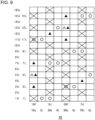
- FIG. 9 is a design diagram showing a weave repeat of an industrial fabric 50 according to the fifth embodiment.
- FIG. 10 is a cross-sectional view in the warp direction along warps in the design diagram shown in FIG. 9 .
- an upper surface side fabric formed including upper surface side warps (3U and 78U) and upper surface side wefts (1'U to 16'U) and a lower surface side fabric composed of lower surface side warps (2L, 4L, 6L, and 8L) and lower surface side wefts (1'L, 3'L, 5'L, 7'L, 9'L, 11'L, 13'L, and 15'L) are bound to each other by the first binding warps (1Bf and 5Bf), the second binding warps (1Bs and 5Bs), and the third binding warps (3Bt and 7Bt).
- the upper surface side wefts (1'U to 16'U) form a part of the upper surface side fabric.
- the lower surface side wefts (1'L, 3'L, 5'L, 7'L, 9'L, 11'L, 13'L, and 15'L) form a part of the lower surface side fabric.
- the first binding warps (1Bf and 5Bf), the second binding warps (1Bs and 5Bs), and the third binding warps (3Bt and 7Bt) bind the upper surface side fabric and the lower surface side fabric and each form a part of the upper surface side fabric and a part of the lower surface side fabric.
- FIG. 10A shows a form in which a pair formed by the first binding warp 1 Bf and the second binding warp 1Bs is interwoven with the upper and lower surface side wefts.
- the upper surface side wefts and the lower surface side wefts shown in FIGS. 10A to 10C are arranged in the same manner.
- the first binding warp 1Bf and the second binding warp 1Bs form a pair facing each other vertically and intersect with each other due to binding.
- the first binding warp 1Bf passes above the upper surface side wefts (1'U, 9'U, 11'U, 13'U, and 15'U) so as to form five knuckles N1 and passes below the remaining upper surface side wefts (2'U to 8'U, 10'U, 12'U, 14'U, and 16'U).
- the first binding warp 1Bf passes below the lower surface side weft 5'L so as to form a knuckle and passes above the lower surface side wefts (1'L, 3'L, 7'L, 9'L, 11'L, 13'L, and 15'L).
- the second binding warp 1Bs passes above the upper surface side wefts (3'U, 5'U, and 7'U) so as to form three knuckles N2 and passes below the remaining upper surface side wefts (1'U, 2'U, 4'U, 6'U, and 8'U to 16'U).
- the second binding warp 1Bs passes below the lower surface side weft 11'L so as to form a knuckle and passes above the lower surface side wefts (1'L, 3'L, 5'L, 7'L, 9'L, 13'L, and 15'L).
- the pair formed by the first binding warp 1Bf and the second binding warp 1Bs complement each other in the obverse surface texture of the upper surface side fabric, thereby becoming interwoven alternately one by one with the upper surface side wefts and being interwoven without destroying the obverse surface texture.
- the first binding warp 1Bf and the second binding warp 1Bs complement each other in the reverse surface texture of the lower surface side fabric, thereby forming knuckles at constant intervals on the lower surface side fabric and being interwoven without destroying the reverse surface texture.
- the binding position of the first binding warp 5Bf and the second binding warp 5Bs is shifted in the warp direction from that of the first binding warp 1 Bf and the second binding warp 1Bs, the first binding warp 5Bf and the second binding warp 5Bs have the same weave pattern and thus exhibit the same function.
- FIG. 10B shows a form in which the lower surface side warp 2L is interwoven with the lower surface side wefts.
- the lower surface side warp 2L passes below the lower surface side wefts (1'L and 11'L) so as to form reverse surface side knuckles, respectively, and passes above the four lower surface side wefts (3'L, 5'L, 7'L, and 9'L) and the two lower surface side wefts (13'L and 15'L) between the respective reverse surface side knuckles.
- the lower surface side warps (4L, 6L, and 8L) have the same weaving pattern as that of the lower surface side warp 2L, form two reverse surface side knuckles, and pass above four lower surface side wefts and two lower surface side wefts between the reverse surface side knuckles.
- the lower surface side warps (2L, 4L, 6L, and 8L) are interwoven only with the lower surface side wefts (1'L, 3'L, 5'L, 7'L, 9'L, 11'L, 13'L, and 15'L) so as to form a part of the lower surface side fabric.
- FIG. 10C shows a form in which a pair formed by the upper surface side warp 3U and the third binding warp 3Bt is interwoven with the upper and lower surface side wefts.
- the upper surface side warp 3U and the third binding warp 3Bt form a pair facing each other vertically and intersect with each other due to the binding by the third binding warp 3Bt.
- the upper surface side warp 3U passes above the upper surface side wefts (2'U, 4'U, 6'U, 8'U, 10'U, 14'U, and 16'U) so as to form obverse surface side knuckles, respectively, and passes below the upper surface side wefts (1'U, 3'U, 5'U, 7'U, 9'U, 11'U to 13'U, and 15'U).
- the third binding warp 3Bt passes below the lower surface side wefts (1'L and 7'L) so as to form knuckles and forms a knuckle N3 passing above the upper surface side weft 12'U.
- the third binding warp 3Bt passes above the two lower surface side wefts (3'L and 5'L) and the four lower surface side wefts (9'L, 11'L, 13'L, and 15'L) between the respective reverse surface side knuckles of the lower surface side wefts (1'L and 7'L).
- the third binding warp 3Bt is interwoven with the lower surface side fabric in the same weaving pattern as that of the lower surface side warps (2L, 4L, 6L, and 8L) and is interwoven without destroying the reverse surface texture.
- the third binding warp 3Bt passes below the upper surface side wefts (1'U to 11'L and 13'U to 16'L) and passes above the upper surface side weft 12'U for binding so as to form only one knuckle N3 on the obverse surface side.
- the upper surface side warp 3U does not form a knuckle on the obverse surface side after passing below the upper surface side weft 12'U and acts as an upper surface side collapsing yarn 3U that collapses a part of the upper surface side obverse surface texture.
- the upper surface side warp 3U and the third binding warp 3Bt complement each other in the obverse surface texture of the upper surface side fabric, thereby forming knuckles at constant intervals on the obverse structure of the upper surface side fabric. This prevents the third binding warp 3Bt from lowering the surface properties of the upper surface side fabric. Further, by using the pair formed by the upper surface side collapsing yarn 3U, which is interwoven only with the upper surface side wefts, and the third binding warp 3Bt for the binding, a decrease in the surface properties can be suppressed compared to when binding warps are vertically provided.
- the upper surface side warp 7U and the third binding warp 7Bt have the same weave pattern and thus exhibit the same function.
- the pair formed by the first binding warps (1Bf and 5Bf) and the second binding warps (1 Bs and 5Bs) complement each other while the pair formed by the third binding warps (3Bt and 7Bt) and the upper surface side collapsing yarns (3U and 7U) complement each other.
- the pair formed by the first binding warps (1 Bf and 5Bf) and the second binding warps (1Bs and 5Bs) and the pair formed by the third binding warps (3Bt and 7Bt) and the upper surface side collapsing yarns (3U and 7U) form the same obverse surface texture for the upper surface side wefts (1'U to 16'U).
- the pair formed by the first binding warps (1Bf and 5Bf) and the second binding warps (1Bs and 5Bs) forms an obverse surface texture in which knuckles are formed for every other upper surface side weft (1'U to 16'U) on the obverse surface side.
- the pair formed by the third binding warps (3Bt and 7Bt) and the upper surface side collapsing yarns (3U and 7U) also forms an obverse surface texture in which knuckles are formed for every other upper surface side weft (1'U to 16'U) on the obverse surface side.
- the pair formed by the first binding warps (1Bf and 5Bf) and the second binding warps (1Bs and 5Bs) and the pair formed by the third binding warps (3Bt and 7Bt) and the upper surface side collapsing yarns (3U and 7U) form common obverse surface texture on the obverse surface side, thereby suppressing a decrease in the surface properties of the upper surface side fabric caused due to binding.
- the pair formed by the first binding warps (1Bf and 5Bf) and the second binding warps (1 Bs and 5Bs) is adjacent to the pair formed by the third binding warps (3Bt and 7Bt) and the upper surface side collapsing yarns (3U and 7U).
- the number of all the warps forming the weave repeat is a multiple of four.
- the number of the first binding warps (1Bf and 5Bf), the second binding warps (1Bs and 5Bs), and the third binding warps (3Bt and 7Bt) combined is half the number of all the warps (1 Bf, 1Bs, 2L, 3U, 3Bt, 4L, 5Bf, 5Bs, 6L, 7U, 7Bt, and 8L) or more.
- the binding force can be strengthened to suppress internal friction between the upper surface side fabric and the lower surface side fabric.
- the number (five) of knuckles formed by the first binding warp 1Bf in the upper surface side fabric is different from the number (three) of knuckles formed by the second binding warp 1Bs in the upper surface side fabric.
- the texture of the upper side binding yarn and the texture of the lower side binding yarn are different from each other.
- the intersection of the two binding yarns tends to have (i) decreased dewaterability and (ii) locally increased draw-in of the upper surface side weft. Therefore, when the intersections are regularly aligned, marks (weft marks, regular diagonal marks) are more likely to occur in those areas.
- the binding yarns have the same texture, the above defects are likely to be caused due to the occurrence of the regularity. Therefore, making the two binding yarns to have different texture as in the industrial fabric 50 reduces the regularity in the alignment of the intersection of the two binding yarns. As a result, the occurrence of marks is suppressed.
- the warps interwoven into the upper side fabric is composed only of the pair formed by the first binding warps (1Bf and 5Bf) and the second binding warps (1Bs and 5Bs) and the pair formed by the third binding warps (3Bt and 7Bt) and the upper surface side collapsing yarns (3U and 7U), each of which is composed of warp rows that are bound together.
- the binding force between the upper and lower surface side fabrics can be increased, and internal wear can be suppressed.
- FIG. 11 is a design diagram showing a weave repeat of an industrial fabric 60 according to the sixth embodiment.
- FIG. 12 is a cross-sectional view in the warp direction along warps in the design diagram shown in FIG. 11 .
- an upper surface side fabric formed including upper surface side warps (3U, 5U, and 7U) and upper surface side wefts (1'U to 16'U) and a lower surface side fabric composed of lower surface side warps (2L to 4L and 6L to 8L) and lower surface side wefts (1'L, 3'L, 5'L, 7'L, 9'L, 11'L, 13'L, and 15'L) are bound to each other by the first binding warp 1Bf, the second binding warp 1Bs, and the third binding warp 5Bt.
- the upper surface side wefts (1'U to 16'U) form a part of the upper surface side fabric.
- the lower surface side wefts (1'L, 3'L, 5'L, 7'L, 9'L, 11'L, 13'L, and 15'L) form a part of the lower surface side fabric.
- the first binding warp 1Bf, the second binding warp 1Bs, and the third binding warp 5Bt bind the upper surface side fabric and the lower surface side fabric and each form a part of the upper surface side fabric and a part of the lower surface side fabric.
- FIG. 12A shows a form in which a pair formed by the first binding warp 1Bf and the second binding warp 1Bs is interwoven with the upper and lower surface side wefts.
- the upper surface side wefts and the lower surface side wefts shown in FIGS. 2A to 2D are arranged in the same manner.
- the first binding warp 1Bf and the second binding warp 1Bs form a pair facing each other vertically and intersect with each other due to binding.
- the first binding warp 1Bf passes above the upper surface side wefts (1'U, 9'U, 11'U, 13'U, and 15'U) so as to form five knuckles N1 and passes below the remaining upper surface side wefts (2'U to 8'U, 10'U, 12'U, 14'U, and 16'U).
- the first binding warp 1Bf passes below the lower surface side weft 5'L so as to form a knuckle and passes above the lower surface side wefts (1'L, 3'L, 7'L, 9'L, 11'L, 13'L, and 15'L).
- the second binding warp 1Bs passes above the upper surface side wefts (3'U, 5'U, and 7'U) so as to form three knuckles N2 and passes below the remaining upper surface side wefts (1'U, 2'U, 4'U, 6'U, and 8'U to 16'U).
- the second binding warp 1Bs passes below the lower surface side weft 11'L so as to form a knuckle and passes above the lower surface side wefts (1'L, 3'L, 5'L, 7'L, 9'L, 13'L, and 15'L).
- the pair formed by the first binding warp 1Bf and the second binding warp 1Bs complement each other in the obverse surface texture of the upper surface side fabric, thereby becoming interwoven alternately one by one with the upper surface side wefts and being interwoven without destroying the obverse surface texture.
- the first binding warp 1Bf and the second binding warp 1Bs complement each other in the reverse surface texture of the lower surface side fabric, thereby forming knuckles at constant intervals on the lower surface side fabric and being interwoven without destroying the reverse surface texture.
- FIG. 12B shows a form in which the lower surface side warp 2L is interwoven with the lower surface side wefts.
- the lower surface side warp 2L passes below the lower surface side wefts (1'L and 11'L) so as to form reverse surface side knuckles, respectively, and passes above the four lower surface side wefts (3'L, 5'L, 7'L, and 9'L) and the two lower surface side wefts (13'L and 15'L) between the respective reverse surface side knuckles.
- the lower surface side warps (4L, 6L, and 8L) have the same weaving pattern as that of the lower surface side warp 2L, form two reverse surface side knuckles, and pass above four lower surface side wefts and two lower surface side wefts between the reverse surface side knuckles.
- the lower surface side warps (2L, 4L, 6L, 8L) are interwoven only with the lower surface side wefts (1'L, 3'L, 5'L, 7'L, 9'L, 11'L, 13'L, and 15'L) so as to form a part of the lower surface side fabric.
- FIG. 12C shows a form in which a pair formed by the upper surface side warp 3U and the lower surface side warp 3L is interwoven with the upper and lower surface side wefts.
- the upper surface side warp 3U is woven alternately above and below the upper surface side wefts (1'U to 16'U) one by one, passes above the upper surface side wefts (2'U, 4'U, 6'U, 8'U, 10'U, 12'U, 14'U, and 16'U) so as to form obverse surface side knuckles, and passes below the upper surface side wefts (1'U, 3'U, 5'U, 7'U, 9'U, 11'U, 13'U, and 15'U).
- Another upper surface side warp 7U has the same weaving pattern as that of the upper surface side warp 3U, interwoven with the upper surface side weft (1'U to 16'U) above and below the upper surface side warps one by one, and is interwoven without destroying the obverse surface texture.
- the upper surface side warps (3U and 7U) are interwoven only with the upper surface side wefts (1'U to 16'U) so as to form a part of the upper surface side fabric.
- the lower surface side warp 3L passes below the lower surface side wefts (1'L and 7'L) so as to form reverse surface side knuckles, respectively, and passes above the two lower surface side wefts (3'L and 5'L) and the four lower surface side wefts (9'L, 11'L, 13'L, and 15'L) between the respective reverse surface side knuckles.
- Another lower surface side warp 7L also has the same weaving pattern as that of the lower surface side warp 3L, forms two reverse surface side knuckles, and is woven passing above two lower surface side wefts and four lower surface side wefts between the reverse surface side knuckles.
- the lower surface side warps (3L and 7L) are interwoven only with the lower surface side wefts (1'L, 3'L, 5'L, 7'L, 9'L, 11'L, 13'L, and 15'L) so as to form a part of the lower surface side fabric.
- FIG. 12D shows a form in which a pair formed by the upper surface side warp 5U and the third binding warp 5Bt is interwoven with the upper and lower surface side wefts.
- the upper surface side warp 5U and the third binding warp 5Bt form a pair facing each other vertically and intersect with each other due to the binding by the third binding warp 5Bt.
- the upper surface side warp 5U passes above the upper surface side wefts (1'U, 3'U, 5'U, 7'U, 11'U, 13'U, and 15'U) so as to form obverse surface side knuckles, respectively, and passes below the upper surface side wefts (2'U, 4'U, 6'U, 8'U to 10'U, 12'U, 14'U, and 16'U).
- the third binding warp 5Bt passes below the lower surface side wefts (3'L and 13'L) so as to form knuckles and forms a knuckle N3 passing above the upper surface side weft 9'U.
- the third binding warp 5Bt passes above the two lower surface side wefts (1'L and 15'L) and the four lower surface side wefts (5'L, 7'L, 9'L, and 11'L) between the respective reverse surface side knuckles of the lower surface side wefts (3'L and 13'L).
- the third binding warp 5Bt is interwoven with the lower surface side fabric in the same weaving pattern as that of the lower surface side warps (2L to 4L and 6L to 8L) and is interwoven without destroying the reverse surface texture.
- the third binding warp 5Bt passes below the upper surface side wefts (1'U to 8'L and 10'U to 16'L) and passes above the upper surface side weft 9'U for binding so as to form only one knuckle N3 on the obverse surface side.
- the upper surface side warp 5U does not form a knuckle on the obverse surface side after passing below the upper surface side weft 9'U and acts as an upper surface side collapsing yarn 5U that collapses a part of the upper surface side obverse surface texture.
- the upper surfaced side warp 5U and the third binding warp 5Bt complement each other in the obverse surface texture of the upper surface side fabric, thereby forming knuckles at constant intervals on the obverse structure of the upper surface side fabric. This prevents the third binding warp 5Bt from lowering the surface properties of the upper surface side fabric. Further, by using the pair formed by the upper surface side collapsing yarn 5U, which is interwoven only with the upper surface side wefts, and the third binding warp 5Bt for the binding, a decrease in the surface properties can be suppressed compared to when binding warps are vertically provided.
- the pair formed by the first binding warp 1Bf and the second binding warp 1Bs complement each other while the pair formed by the third binding warp 5Bt and the upper surface side collapsing yarn 5U complement each other.
- the pair formed by the first binding warp 1Bf and the second binding warp 1Bs and the pair formed by the third binding warp 5Bt and the upper surface side collapsing yarn 5U form the same obverse surface texture for the upper surface side wefts (1'U to 16'U).
- the pair formed by the first binding warp 1Bf and second binding warp 1Bs forms obverse surface texture in which knuckles are formed for every other upper surface side weft (1'U to 16'U) on the obverse surface side.
- the pair formed by the third binding warp 5Bt and the upper surface side collapsing yarn 5U also forms obverse surface texture in which knuckles are formed for every other upper surface side weft (1'U to 16'U) on the obverse surface side.
- the pair formed by the first binding warp 1Bf and the second binding warp 1Bs and the pair formed by the third binding warp 5Bt and the upper surface side collapsing yarn 5U form common obverse surface texture on the obverse surface side, thereby suppressing a decrease in the surface properties of the upper surface side fabric caused due to binding.
- the pair formed by the first binding warp 1Bf and the second binding warp 1Bs is not adjacent to the pair formed by the third binding warp 5Bt and the upper surface side collapsing yarn 5U.
- the number of all the warps forming the weave repeat is a multiple of four. In the weave repeat, the number of the first binding warp 1Bf, the second binding warp 1Bs, and the third binding warp 5Bt combined is less than half the number of all the warps.
- FIG. 13 is a design diagram showing a weave repeat of an industrial fabric 70 according to the seventh embodiment.
- the number of knuckles formed by the third binding warp 3Bt on the obverse surface side of the upper surface fabric is larger than that of the industrial fabric 50 shown in FIG. 9 , and the third binding warp 3Bt forms two knuckles on the obverse surface side.
- FIG. 14 is a design diagram showing a weave repeat of an industrial fabric 80 according to the eighth embodiment.
- the industrial fabric 80 according to the eighth embodiment has fewer upper surface side wefts forming a weave repeat, and the arrangement of the lower surface side wefts is different.
- the industrial fabric 80 is formed using twelve upper surface side wefts, and the lower surface side wefts are arranged such that one upper surface side weft is skipped for every two consecutive upper surface side wefts.
- the ratio of the upper surface side wefts and the lower surface side wefts is 3:2, which can suppress the occurrence of curls at the widthwise (weft direction) ends of the industrial fabric 80 and improve abrasion resistance.
- FIG. 15 is a design diagram showing a weave repeat of an industrial fabric 90 according to the ninth embodiment.
- the industrial fabric 90 according to the ninth embodiment is different in that the industrial fabric 90 has a larger number of shafts and more upper surface side wefts forming a weave repeat.
- the industrial fabric 90 according to the ninth embodiment is formed using 16 rows of warps and 32 upper surface side wefts. By increasing the number of weft shafts, it is possible to disperse the bound parts so as to suppress the occurrence of marks and improve the smoothness of the surface and the uniformity of dewatering.
- FIG. 16 is a design diagram showing a weave repeat of an industrial fabric 100 according to the tenth embodiment.
- the number of knuckles formed by the third binding warps (3Bt, 7Bt, 11Bt, and 15Bt) on the obverse surface side of the upper surface fabric is larger than that of the industrial fabric 90 shown in FIG. 15 , and the third binding warps each form two knuckles on the obverse surface side.
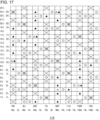
- FIG. 17 is a design diagram showing a weave repeat of an industrial fabric 110 according to the eleventh embodiment.
- the industrial fabric 110 according to the eleventh embodiment is different in that the industrial fabric 110 has a larger number of shafts and more upper surface side wefts forming a weave repeat.
- the industrial fabric 110 according to the eleventh embodiment is formed using 16 rows of warps and 24 upper surface side wefts.
- FIG. 18 is a design diagram showing a weave repeat of an industrial fabric 120 according to the twelfth embodiment.
- the number of knuckles formed by the third binding warps (3Bt, 7Bt, 11Bt, and 15Bt) on the obverse surface side of the upper surface fabric is larger than that of the industrial fabric 110 shown in FIG. 17 , and the third binding warps each form two knuckles on the obverse surface side.
- FIG. 19 is a design diagram showing a weave repeat of an industrial fabric 130 according to the thirteenth embodiment.
- the industrial fabric 130 according to the thirteenth embodiment is different in that a pair formed by a first binding warp and a second binding warp is not adjacent to a pair formed by a third binding warp and an upper surface side collapsing yarn. This allows the bound parts to be dispersed so as to suppress the occurrence of marks.
- a pair formed by a first binding warp and a second binding warp and a pair formed by a third binding warp and an upper surface side collapsing yarn each form knuckles passing above two consecutive upper surface side wefts and form the same weaving pattern.
- the upper surface side warps have a weaving pattern of being interwoven with the upper surface side wefts above and below the upper surface side warps one by one, the pair formed by the first binding warp and the second binding warp is different in the weaving pattern from the pair formed by the third binding warp and the upper surface side collapsing yarn.
- FIG. 20 is a design diagram showing a weave repeat of an industrial fabric 140 according to the fourteenth embodiment.
- the industrial fabric 140 according to the fourteenth embodiment is different in that one pair formed by a first binding warp and a second binding warp is arranged with a lower surface side warp interposed therebetween and in that the industrial fabric 140 includes a pair of an upper surface side warp and a lower surface side warp that are not binding warps.
- the pair formed by the first binding warp and the second binding warp seems to be adjacent to each other since the pair formed by a first binding warp and a second binding warp is arranged with a lower surface side warp interposed therebetween.
- FIG. 21 is a design diagram showing a weave repeat of an industrial fabric 150 according to the fifteenth embodiment.
- the industrial fabric 150 according to the fifteenth embodiment is different in that one pair formed by a first binding warp and a second binding warp is arranged with a lower surface side warp interposed therebetween and in that a pair of an upper surface side collapsing yarn and a third binding warp is arranged with a lower surface side warp interposed therebetween.
- the pair formed by the first binding warp and the second binding warp seems to be adjacent to each other, and the pair formed by the upper surface side collapsing yarn and the third binding warp seems to be adjacent to each other.
- an industrial fabric according to each of the above embodiments may be subjected to the following processing.
- the obverse surface side of the industrial fabric may be polished in the range of 0.02 to 0.05 mm.
- the obverse surface side may be polished by 0.02 mm or 0.03 mm.
- the range of 5 mm to 30 mm, particularly the range of 5 mm, 10 mm, or 20 mm, from the ends of the mesh may be coated with a polyurethane resin for reinforcement.
- the coating of the mesh ends may be coated on one or both sides.
- the resin may be hot melt polyurethane.
- the mesh may be coated in the range of 20 mm to 500 mm, particularly 25, 50, 75, 100, 150, 250, 300, 350, or 400 mm, from the mesh end with three to sixteen, particularly three, four, seven, eight, ten, twelve, fifteen, or sixteen, strips of resin of a width of about 7 mm over the entire length.
- the plurality of above-mentioned strips of polyurethane resin may be applied to both ends of the mesh or only to one side.
- the resin may be hot melt polyurethane.
- the entire mesh may be coated with resin in order to improve the antifouling performance.
- the mesh In order to allow for the trimming of the paper making width near the mesh end, the mesh may be coated in the range of 10 mm to 500 mm, particularly 10, 15, 20, 25, 30, 40, 50, 75, 100, 150, 200, 250, 300, 350, or 400 mm, from the mesh end with one strip of resin of a width of about 3, 5, 7, 10, 15, or 20 mm over the entire length.
- the above-mentioned resin may be applied to both ends of the mesh or only to one side.
- the resin may be polyurethane and may be hot melt.
- the mesh may have lines of about 25 mm or 50 mm in width across the entire width so that the line bending of the mesh can be seen during use.
- the warp diameter is preferably 0.10 mm to 1.0 mm, more preferably 0.1 mm to 0.5 mm, and particularly preferably 0.11 mm to 0.35 mm, where the warp includes an upper surface side warp, a lower surface side warp, a first binding warp, a second binding warp, and a third binding warp.
- the weft diameter is preferably 0.10 mm to 1.0 mm, more preferably 0.12 mm to 0.6 mm, and particularly preferably 0.12 mm to 0.55 mm.
- the upper surface side wefts may be formed using only PET wires, only polyamide wires, or PET wires and polyamide wires that are alternately interwoven or may be formed using two consecutive PET wires and two consecutive polyamide wires that are alternately interwoven.
- the upper surface side wefts may be formed using only PET wires, only polyamide wires, or PET wires and polyamide wires that are alternately interwoven, may be formed using two consecutive PET wires and two consecutive polyamide wires that are alternately interwoven, or may be formed using PET wires and polyamide wires in the ratio of 1: 2 or 1: 3.
- low-friction yarns may be woven with the lower surface side wefts.
- the ratio of the number of upper surface side wefts to the number of lower surface side wefts may be 1:1, 2:1, 3:1, 4:1, 3:2, 4:3, 5:2, 5:3, or 5:4.
- the air permeability is preferably 100 cm 3 /cm 2 /s to 600 cm 3 /cm 2 /s and more preferably 120 cm 3 /cm 2 /s to 300 cm 3 /cm 2 /s.
- the mesh thickness is preferably 0.3 mm to 3.0 mm, more preferably 0.5 mm to 2.5 mm, and particularly preferably 0.5 mm to 1.0 mm.
- the usage applications include mainly usage as a papermaking or nonwoven fabric belt and may include particularly usage as a papermaking dewatering belt or a spunbond nonwoven fabric conveying belt.
- the cross-sectional shape of the warps and wefts according to each of the above-mentioned embodiments is not limited to a circular shape, and yarns having a quadrangular shape, a star shape, etc., and yarns having an elliptical shape, a hollow shape, a sheath-core structure shape, etc., can be used.
- the cross-sectional shape of the lower warps have a square shape, a rectangular shape, or an elliptical shape, the cross-sectional area of the yarns can be increased, and elongation resistance and rigidity can thus be improved.
- the yarn material can be freely selected as long as the yarn satisfies the desired characteristics, and polyethylene terephthalate, polyester, polyamide, polyphenylene sulfide, polyvinylidene fluoride, polypropylene, aramid, polyether ether ketone, polyethylene naphthalate, polytetrafluoroethylene, cotton, wool, metals, thermoplastic polyurethane, thermoplastic elastomers, etc., can be used.
- yarns prepared from a copolymer and yarns prepared by blending or adding various substances to such a material may be used according to the purpose.
- polyester monofilaments having rigidity and excellent dimensional stability are preferably used as yarns constituting industrial fabrics.
- the number of warp shafts is preferably 4, 8, 12, 16, 20, 24, 28, 32, or 36. Further, the number of weft shafts is preferably 8, 12, 16, 20, 24, 28, 32, 36, 40, 44, or 48.
- the present invention relates to industrial fabrics used for paper machines.
Landscapes
- Engineering & Computer Science (AREA)
- Textile Engineering (AREA)
- Woven Fabrics (AREA)
- Paper (AREA)
Applications Claiming Priority (2)
| Application Number | Priority Date | Filing Date | Title |
|---|---|---|---|
| JP2021110973A JP7515442B2 (ja) | 2021-07-02 | 2021-07-02 | 工業用織物 |
| PCT/JP2022/011458 WO2023276311A1 (fr) | 2021-07-02 | 2022-03-15 | Tissu industriel |
Publications (2)
| Publication Number | Publication Date |
|---|---|
| EP4365368A1 true EP4365368A1 (fr) | 2024-05-08 |
| EP4365368A4 EP4365368A4 (fr) | 2024-09-11 |
Family
ID=84691128
Family Applications (1)
| Application Number | Title | Priority Date | Filing Date |
|---|---|---|---|
| EP22832474.5A Pending EP4365368A4 (fr) | 2021-07-02 | 2022-03-15 | Tissu industriel |
Country Status (6)
| Country | Link |
|---|---|
| US (2) | US12312716B2 (fr) |
| EP (1) | EP4365368A4 (fr) |
| JP (1) | JP7515442B2 (fr) |
| CN (2) | CN117413101B (fr) |
| CA (1) | CA3224260A1 (fr) |
| WO (1) | WO2023276311A1 (fr) |
Families Citing this family (3)
| Publication number | Priority date | Publication date | Assignee | Title |
|---|---|---|---|---|
| WO2020226093A1 (fr) * | 2019-05-08 | 2020-11-12 | 東京エレクトロン株式会社 | Dispositif, système et procédé de liaison |
| TWI874401B (zh) * | 2019-05-22 | 2025-03-01 | 加拿大商弗瑞爾公司 | 用於傳送設置之對準方法 |
| JP7515442B2 (ja) * | 2021-07-02 | 2024-07-12 | 日本フイルコン株式会社 | 工業用織物 |
Family Cites Families (22)
| Publication number | Priority date | Publication date | Assignee | Title |
|---|---|---|---|---|
| US5454405A (en) * | 1994-06-02 | 1995-10-03 | Albany International Corp. | Triple layer papermaking fabric including top and bottom weft yarns interwoven with a warp yarn system |
| JP4283403B2 (ja) | 1999-11-30 | 2009-06-24 | 日本フイルコン株式会社 | 製紙用二層織物 |
| JP3925915B2 (ja) | 2002-05-24 | 2007-06-06 | 日本フイルコン株式会社 | 工業用二層織物 |
| US7243687B2 (en) * | 2004-06-07 | 2007-07-17 | Weavexx Corporation | Papermaker's forming fabric with twice as many bottom MD yarns as top MD yarns |
| JP4481765B2 (ja) * | 2004-08-23 | 2010-06-16 | 日本フイルコン株式会社 | 工業用二層織物 |
| JP4762513B2 (ja) * | 2004-08-23 | 2011-08-31 | 日本フイルコン株式会社 | 工業用二層織物 |
| JP4762529B2 (ja) * | 2004-11-17 | 2011-08-31 | 日本フイルコン株式会社 | 工業用二層織物 |
| JP4440085B2 (ja) * | 2004-11-26 | 2010-03-24 | 日本フイルコン株式会社 | 工業用二層織物 |
| NO338649B1 (no) * | 2005-05-19 | 2016-09-26 | Nippon Filcon Kk | Industriell tolagsstruktur |
| JP2006322109A (ja) * | 2005-05-19 | 2006-11-30 | Nippon Filcon Co Ltd | 工業用二層織物 |
| JP4573168B2 (ja) * | 2005-05-26 | 2010-11-04 | 日本フイルコン株式会社 | 工業用二層織物 |
| JP4819477B2 (ja) * | 2005-10-31 | 2011-11-24 | 日本フイルコン株式会社 | 工業用二層織物 |
| JP4743780B2 (ja) | 2006-08-29 | 2011-08-10 | 日本フイルコン株式会社 | 工業用二層織物 |
| JP4841410B2 (ja) * | 2006-11-30 | 2011-12-21 | 日本フイルコン株式会社 | 縦溝が形成された工業用二層織物 |
| JP5306788B2 (ja) | 2008-11-29 | 2013-10-02 | 日本フイルコン株式会社 | 工業用二層織物 |
| JP6280325B2 (ja) * | 2013-07-12 | 2018-02-14 | 日本フイルコン株式会社 | 工業用二層織物 |
| WO2015132867A1 (fr) * | 2014-03-04 | 2015-09-11 | 日本フイルコン株式会社 | Tissu double couche industriel |
| JP6755097B2 (ja) | 2016-01-22 | 2020-09-16 | 日本フイルコン株式会社 | 工業用織物 |
| JP6822782B2 (ja) * | 2016-04-28 | 2021-01-27 | 日本フイルコン株式会社 | 不織布用二層織物 |
| JP7199820B2 (ja) * | 2018-03-30 | 2023-01-06 | 日本フイルコン株式会社 | 工業用二層織物 |
| JP7000272B2 (ja) * | 2018-07-31 | 2022-01-19 | 日本フイルコン株式会社 | 工業用二層織物 |
| JP7515442B2 (ja) * | 2021-07-02 | 2024-07-12 | 日本フイルコン株式会社 | 工業用織物 |
-
2021
- 2021-07-02 JP JP2021110973A patent/JP7515442B2/ja active Active
-
2022
- 2022-03-15 CN CN202280039608.8A patent/CN117413101B/zh active Active
- 2022-03-15 CN CN202511993101.8A patent/CN121802704A/zh active Pending
- 2022-03-15 EP EP22832474.5A patent/EP4365368A4/fr active Pending
- 2022-03-15 CA CA3224260A patent/CA3224260A1/fr active Pending
- 2022-03-15 WO PCT/JP2022/011458 patent/WO2023276311A1/fr not_active Ceased
-
2023
- 2023-12-28 US US18/399,620 patent/US12312716B2/en active Active
-
2025
- 2025-04-28 US US19/192,227 patent/US20250257503A1/en active Pending
Also Published As
| Publication number | Publication date |
|---|---|
| CA3224260A1 (fr) | 2023-01-05 |
| CN117413101A (zh) | 2024-01-16 |
| EP4365368A4 (fr) | 2024-09-11 |
| US20240175172A1 (en) | 2024-05-30 |
| US20250257503A1 (en) | 2025-08-14 |
| US12312716B2 (en) | 2025-05-27 |
| WO2023276311A1 (fr) | 2023-01-05 |
| JP7515442B2 (ja) | 2024-07-12 |
| CN121802704A (zh) | 2026-04-07 |
| JP2023007865A (ja) | 2023-01-19 |
| CN117413101B (zh) | 2026-01-13 |
Similar Documents
| Publication | Publication Date | Title |
|---|---|---|
| US12312716B2 (en) | Industrial fabric | |
| EP1659212B1 (fr) | Tissu technique à deux couches | |
| JP2003013382A (ja) | 工業用多層織物 | |
| US20250320639A1 (en) | Industrial fabric | |
| JP4440085B2 (ja) | 工業用二層織物 | |
| JP4563260B2 (ja) | 工業用二層織物 | |
| EP2192215B1 (fr) | Structure industrielle à deux couches | |
| JP4481765B2 (ja) | 工業用二層織物 | |
| JP2007119965A (ja) | 工業用二層織物 | |
| EP3779036B1 (fr) | Tissu industriel à deux couches | |
| JP3235379U (ja) | 工業用織物 | |
| JP4739903B2 (ja) | 工業用二層織物 | |
| US20250283256A1 (en) | Industrial fabric | |
| EP4488442A1 (fr) | Tissu tissé industriel | |
| US20250389063A1 (en) | Industrial fabric | |
| JP2023101974A (ja) | 工業用織物 | |
| JP2023101976A (ja) | 工業用織物 |
Legal Events
| Date | Code | Title | Description |
|---|---|---|---|
| STAA | Information on the status of an ep patent application or granted ep patent |
Free format text: STATUS: THE INTERNATIONAL PUBLICATION HAS BEEN MADE |
|
| PUAI | Public reference made under article 153(3) epc to a published international application that has entered the european phase |
Free format text: ORIGINAL CODE: 0009012 |
|
| STAA | Information on the status of an ep patent application or granted ep patent |
Free format text: STATUS: REQUEST FOR EXAMINATION WAS MADE |
|
| 17P | Request for examination filed |
Effective date: 20240108 |
|
| AK | Designated contracting states |
Kind code of ref document: A1 Designated state(s): AL AT BE BG CH CY CZ DE DK EE ES FI FR GB GR HR HU IE IS IT LI LT LU LV MC MK MT NL NO PL PT RO RS SE SI SK SM TR |
|
| REG | Reference to a national code |
Ref country code: DE Ref legal event code: R079 Free format text: PREVIOUS MAIN CLASS: D21F0001100000 Ipc: D21F0001000000 |
|
| A4 | Supplementary search report drawn up and despatched |
Effective date: 20240812 |
|
| RIC1 | Information provided on ipc code assigned before grant |
Ipc: D21F 1/00 20060101AFI20240806BHEP |
|
| DAV | Request for validation of the european patent (deleted) | ||
| DAX | Request for extension of the european patent (deleted) | ||
| STAA | Information on the status of an ep patent application or granted ep patent |
Free format text: STATUS: EXAMINATION IS IN PROGRESS |
|
| 17Q | First examination report despatched |
Effective date: 20251223 |