EP4366070A2 - Batterie secondaire avec ensemble d'électrode soudé - Google Patents
Batterie secondaire avec ensemble d'électrode soudé Download PDFInfo
- Publication number
- EP4366070A2 EP4366070A2 EP23207261.1A EP23207261A EP4366070A2 EP 4366070 A2 EP4366070 A2 EP 4366070A2 EP 23207261 A EP23207261 A EP 23207261A EP 4366070 A2 EP4366070 A2 EP 4366070A2
- Authority
- EP
- European Patent Office
- Prior art keywords
- base tab
- plate
- secondary battery
- case
- collector
- Prior art date
- Legal status (The legal status is an assumption and is not a legal conclusion. Google has not performed a legal analysis and makes no representation as to the accuracy of the status listed.)
- Pending
Links
Images



Classifications
-
- H—ELECTRICITY
- H01—ELECTRIC ELEMENTS
- H01M—PROCESSES OR MEANS, e.g. BATTERIES, FOR THE DIRECT CONVERSION OF CHEMICAL ENERGY INTO ELECTRICAL ENERGY
- H01M50/00—Constructional details or processes of manufacture of the non-active parts of electrochemical cells other than fuel cells, e.g. hybrid cells
- H01M50/50—Current conducting connections for cells or batteries
- H01M50/531—Electrode connections inside a battery casing
- H01M50/536—Electrode connections inside a battery casing characterised by the method of fixing the leads to the electrodes, e.g. by welding
-
- H—ELECTRICITY
- H01—ELECTRIC ELEMENTS
- H01M—PROCESSES OR MEANS, e.g. BATTERIES, FOR THE DIRECT CONVERSION OF CHEMICAL ENERGY INTO ELECTRICAL ENERGY
- H01M50/00—Constructional details or processes of manufacture of the non-active parts of electrochemical cells other than fuel cells, e.g. hybrid cells
- H01M50/10—Primary casings; Jackets or wrappings
- H01M50/102—Primary casings; Jackets or wrappings characterised by their shape or physical structure
- H01M50/103—Primary casings; Jackets or wrappings characterised by their shape or physical structure prismatic or rectangular
-
- H—ELECTRICITY
- H01—ELECTRIC ELEMENTS
- H01M—PROCESSES OR MEANS, e.g. BATTERIES, FOR THE DIRECT CONVERSION OF CHEMICAL ENERGY INTO ELECTRICAL ENERGY
- H01M50/00—Constructional details or processes of manufacture of the non-active parts of electrochemical cells other than fuel cells, e.g. hybrid cells
- H01M50/10—Primary casings; Jackets or wrappings
- H01M50/147—Lids or covers
- H01M50/148—Lids or covers characterised by their shape
- H01M50/15—Lids or covers characterised by their shape for prismatic or rectangular cells
-
- H—ELECTRICITY
- H01—ELECTRIC ELEMENTS
- H01M—PROCESSES OR MEANS, e.g. BATTERIES, FOR THE DIRECT CONVERSION OF CHEMICAL ENERGY INTO ELECTRICAL ENERGY
- H01M50/00—Constructional details or processes of manufacture of the non-active parts of electrochemical cells other than fuel cells, e.g. hybrid cells
- H01M50/10—Primary casings; Jackets or wrappings
- H01M50/172—Arrangements of electric connectors penetrating the casing
-
- H—ELECTRICITY
- H01—ELECTRIC ELEMENTS
- H01M—PROCESSES OR MEANS, e.g. BATTERIES, FOR THE DIRECT CONVERSION OF CHEMICAL ENERGY INTO ELECTRICAL ENERGY
- H01M50/00—Constructional details or processes of manufacture of the non-active parts of electrochemical cells other than fuel cells, e.g. hybrid cells
- H01M50/50—Current conducting connections for cells or batteries
- H01M50/528—Fixed electrical connections, i.e. not intended for disconnection
-
- H—ELECTRICITY
- H01—ELECTRIC ELEMENTS
- H01M—PROCESSES OR MEANS, e.g. BATTERIES, FOR THE DIRECT CONVERSION OF CHEMICAL ENERGY INTO ELECTRICAL ENERGY
- H01M50/00—Constructional details or processes of manufacture of the non-active parts of electrochemical cells other than fuel cells, e.g. hybrid cells
- H01M50/50—Current conducting connections for cells or batteries
- H01M50/531—Electrode connections inside a battery casing
-
- H—ELECTRICITY
- H01—ELECTRIC ELEMENTS
- H01M—PROCESSES OR MEANS, e.g. BATTERIES, FOR THE DIRECT CONVERSION OF CHEMICAL ENERGY INTO ELECTRICAL ENERGY
- H01M50/00—Constructional details or processes of manufacture of the non-active parts of electrochemical cells other than fuel cells, e.g. hybrid cells
- H01M50/50—Current conducting connections for cells or batteries
- H01M50/531—Electrode connections inside a battery casing
- H01M50/533—Electrode connections inside a battery casing characterised by the shape of the leads or tabs
-
- H—ELECTRICITY
- H01—ELECTRIC ELEMENTS
- H01M—PROCESSES OR MEANS, e.g. BATTERIES, FOR THE DIRECT CONVERSION OF CHEMICAL ENERGY INTO ELECTRICAL ENERGY
- H01M50/00—Constructional details or processes of manufacture of the non-active parts of electrochemical cells other than fuel cells, e.g. hybrid cells
- H01M50/50—Current conducting connections for cells or batteries
- H01M50/531—Electrode connections inside a battery casing
- H01M50/538—Connection of several leads or tabs of wound or folded electrode stacks
-
- H—ELECTRICITY
- H01—ELECTRIC ELEMENTS
- H01M—PROCESSES OR MEANS, e.g. BATTERIES, FOR THE DIRECT CONVERSION OF CHEMICAL ENERGY INTO ELECTRICAL ENERGY
- H01M50/00—Constructional details or processes of manufacture of the non-active parts of electrochemical cells other than fuel cells, e.g. hybrid cells
- H01M50/50—Current conducting connections for cells or batteries
- H01M50/531—Electrode connections inside a battery casing
- H01M50/54—Connection of several leads or tabs of plate-like electrode stacks, e.g. electrode pole straps or bridges
-
- H—ELECTRICITY
- H01—ELECTRIC ELEMENTS
- H01M—PROCESSES OR MEANS, e.g. BATTERIES, FOR THE DIRECT CONVERSION OF CHEMICAL ENERGY INTO ELECTRICAL ENERGY
- H01M50/00—Constructional details or processes of manufacture of the non-active parts of electrochemical cells other than fuel cells, e.g. hybrid cells
- H01M50/50—Current conducting connections for cells or batteries
- H01M50/543—Terminals
- H01M50/564—Terminals characterised by their manufacturing process
- H01M50/566—Terminals characterised by their manufacturing process by welding, soldering or brazing
-
- Y—GENERAL TAGGING OF NEW TECHNOLOGICAL DEVELOPMENTS; GENERAL TAGGING OF CROSS-SECTIONAL TECHNOLOGIES SPANNING OVER SEVERAL SECTIONS OF THE IPC; TECHNICAL SUBJECTS COVERED BY FORMER USPC CROSS-REFERENCE ART COLLECTIONS [XRACs] AND DIGESTS
- Y02—TECHNOLOGIES OR APPLICATIONS FOR MITIGATION OR ADAPTATION AGAINST CLIMATE CHANGE
- Y02E—REDUCTION OF GREENHOUSE GAS [GHG] EMISSIONS, RELATED TO ENERGY GENERATION, TRANSMISSION OR DISTRIBUTION
- Y02E60/00—Enabling technologies; Technologies with a potential or indirect contribution to GHG emissions mitigation
- Y02E60/10—Energy storage using batteries
Definitions
- aspects of some embodiments relate to a secondary battery having a relatively improved welding structure of an electrode assembly.
- a secondary battery may include an electrode assembly in which a separator is located between a positive electrode plate and a negative electrode plate, and then, the separator, the positive electrode plate, and the negative electrode plate may be stacked or wound.
- a case may be utilized to house or accommodate the electrode assembly together with an electrolyte, and a cap assembly may be utilized to seal the case.
- non-coating portion tabs base tabs
- the non-coating portion tabs may be gathered to one side and then bent upward so that the non-coating portion tabs and a collector are welded to each other.
- aspects of some embodiments of the present invention provide a secondary battery having an improved welding structure of an electrode assembly.
- a secondary battery includes: a rectangular case; an electrode assembly accommodated in the case and including a first electrode plate on which a first base tab is at one end in a longitudinal direction of the case, a second electrode plate on which a second base tab is at the other end in the longitudinal direction of the case, and a separator between the first electrode plate and the second electrode plate; and a cap assembly being coupled to the case, and comprising a pair of collectors electrically connected to the first base tab and the second base tab, respectively, wherein the first base tab and the second base tab are laser welded to the pair of collectors, respectively.
- the first base tab and the second base tab may be bent in one direction to be in surface contact with the pair of collectors, respectively.
- the first base tab and the second base tab may be welded to back beads on rear surfaces of the pair of collectors by the laser welding, respectively.
- the back beads may protrude toward the first base tab and the second base tab, respectively.
- a laser output range of the laser welding may be in a range of about 550 W to about 630 W.
- a direction in which the laser welding may be performed is parallel to a metal processing grain of each of the first base tab and the second base tab.
- the direction of the metal processing grain may be formed by rolling process.
- the pair of collectors may include a first collector member and a second collector member.
- the first collector member may include a first collector electrically connected to a first terminal part, a connection plate electrically connected to the first collector, and a sub plate electrically connected to the connection plate and the first base tab.
- the second collector member may have the same configuration as the first collector member, but may be arranged to be symmetrical to the first collector member and electrically connected to the second electrode plate.
- one end of the sub plate may in contact with and welded to a portion of the connection plate.
- the sub plate may comprise a first connection part at which the sub plate is connected to the connection plate and a second connection part at which the sub plate is connected to the first base tab.
- each of the first connection part and the second connection part may be bent at an angle.
- the second connection part may be arranged so that an inner surface of the second connection part is bent from the first connection part toward the electrode assembly and located on the same plane as an inner surface of the connection plate.
- the inner surface of the second connection part may be connected to the first base tab by laser welding.
- a plurality of concave welding grooves may be defined or omitted on an outer surface of the second connection part.
- the collector and the base tab are welded to each other in a state of the surface contact, a wide and even melting area may be secured to improve weldability. Therefore, even electrode plate reactivity may be secured through heat generation with a wide current path.
- Embodiments of the present invention may, however, be embodied in many different forms and should not be construed as being limited to the embodiments set forth herein. Rather, these embodiments are provided so that this disclosure will be thorough and complete, and will fully convey the scope of the present invention to those skilled in the art.
- first As used herein, terms such as "first,” “second,” etc. are used to describe various members, components, areas, layers, and/or portions. However, it is obvious that the members, components, areas, layers, and/or portions should not be defined by these terms. The terms do not mean a particular order, up and down, or superiority, and are used only for distinguishing one member, component, area, layer, or portion from another member, component, area, layer, or portion. Thus, a first member, component, area, layer, or portion which will be described may also refer to a second member, component, area, layer, or portion, without departing from the teaching of the present invention.
- FIG. 1 illustrates a perspective view of a secondary battery according to some embodiments.
- FIG. 2 illustrates an exploded perspective view of a cap assembly of FIG. 1 .
- FIG. 3 illustrates a perspective view of an electrode assembly and a partial collection structure of FIG. 1 .
- a secondary battery 10 of the present invention may include an electrode assembly 100, a case 200 accommodating or housing the electrode assembly 100, and a cap assembly 300 coupled to (and, for example, sealing or enclosing the electrode assembly 100 within) the case 200.
- the electrode assembly 100 may be provided by winding a unit stack constituted by a first electrode plate (see reference numeral 110 of FIG. 6 ) and a second electrode plate (see reference numeral 120 of FIG. 6 ), each of which has a thin plate shape or a film shape, and a separator (see reference numeral 130 of FIG. 6 ) located between the first and second electrode plates or by stacking a plurality of unit stacks.
- a winding shaft may be arranged in a horizontal direction parallel (or substantially parallel) to a longitudinal direction of the cap assembly 300 or a vertical direction perpendicular (or substantially perpendicular) to the longitudinal direction of the cap assembly 300.
- the first electrode plate may be a negative electrode
- the second electrode plate may be a positive electrode
- the first electrode plate may be a positive electrode
- the second electrode plate may be a negative electrode
- the first electrode plate may be provided by applying a first electrode active material such as graphite or carbon to a first electrode collector made of metal foil such as copper, a copper alloy, nickel, or a nickel alloy.
- a first electrode active material such as graphite or carbon
- a first base tab (or a first non-coating portion (see reference numeral 112 of FIG. 6 )) on which the first electrode active material is not applied may be located on the first electrode plate.
- the plurality of first base tabs may be bent to one side and welded to the collector (this will be described in more detail later).
- the collector may be electrically connected to the cap assembly 300.
- the second electrode plate may be provided by applying a second electrode active material such as transition metal oxide to a second electrode collector made of metal foil such as aluminum or an aluminum alloy.
- a second base tab (or second non-coating portion), which is an area on which the second electrode active material is not applied, may be located on the second electrode plate.
- the plurality of second base tabs may be bent to one side and welded to the collector.
- the collector may be electrically connected to the cap assembly 300.
- the separator may be located between the first electrode plate and the second electrode plate to prevent or reduce instances of a short circuit and enable movement of lithium ions.
- the separator 130 may be made of polyethylene, polypropylene, or a composite film of polyethylene and polypropylene.
- embodiments according to the present invention are not limited to the above materials.
- the electrode assembly 100 having the above-described structure may be accommodated or housed in the case 200 together with an electrolyte.
- the electrolyte may include an organic solvent such as ethylene carbonate (EC), propylene carbonate (PC), diethyl carbonate (DEC), ethylmethyl carbonate (EMC), or dimethyl carbonate (DMC), and lithium salt such as LiPF6 or LiBF4.
- the electrolyte may be a liquid, or gel. In some embodiments, if an inorganic-based solid electrolyte is used, the electrolyte may be omitted.
- the case 200 may have a substantially rectangular parallelepiped box shape. An upper portion of the case 200 in a vertical direction may be opened, and an accommodation space may be defined in the case 200.
- the electrode assembly 100 and the electrolyte may be accommodated inside the case 200 through the opened upper portion of the case 200. Some components of the cap assembly 300 may be exposed to the outside of the case 200, and some components may be accommodated in the case 200.
- the case 200 may be constituted by a rectangular bottom surface 210 and four side surfaces connected to the bottom surface 210. In the side surfaces, a surface having a relatively large area may be defined as a long-side portion 220, and a surface having a relatively small area may be defined as a short-side portion 230.
- the electrode assembly 100 may be arranged so that a plate surface faces the long-side portion 220.
- the cap assembly 300 may be coupled to the case 200 and electrically connected to the electrode assembly 100.
- an insulating film for insulation with the collector may be coupled or attached to the short-side portion 230 of the case 200.
- the cap assembly 300 may include a cap plate 310 coupled to the case 200, a plurality of insulating members 320, a first collector member 330, a second collector member 340, a first terminal part 350, and the second terminal part 360 (hereinafter, only components related to the welding structure according to some embodiments of the present invention will be described in more detail).
- the cap plate 310 may have a substantially rectangular plate shape and may be made of the same material as the case 200.
- a terminal hole 312 for coupling with each of the first terminal part 350 and the second terminal part 360, a groove, a liquid injection hole, and a vent hole 314 for coupling with a vent 316 may be defined in the cap plate 310.
- the insulating member 320 may include an insulating plate 322, a pair of lower insulating parts 324, a pair of pin insulating parts 326, and an upper insulating part 328. All of the insulating members may be made of an insulating material.
- the first collector member 330 may serve to electrically connect the first electrode plate 110, which is a negative electrode plate, to the first terminal part 350.
- the first collector member 330 may include a first collector 332 electrically connected to the first terminal part 350, a connection plate 334 electrically connected to the first collector 332, and a sub plate 336 electrically connected to the connection plate 334 and the first base tab 112 (see FIG. 6 ).
- the sub plate 336 may be made of a conductive material having a predetermined width and length and may have a substantially plate shape. One end (upper end) of the sub plate 336 may be in contact with and welded to a lower portion of the connection plate 334.
- the first base tab 112 may be connected to the inner surface.
- a portion at which the sub plate 336 is connected to the connection plate 334 may be defined as a first connection part 336a, and a portion connected to the first base tab 112 may be defined as a second connection part 336b.
- each of the first connection part 336a and the second connection part 336b may be bent at an angle (e.g., a set or predetermined angle).
- the second connection part 336b may be arranged so that the inner surface thereof is bent from the first connection part 336a toward the electrode assembly 100 and located on the same plane as the inner surface of the connection plate 334.
- the inner surface of the second connection part 336b may be arranged to enter toward the electrode assembly 100 more than the inner surface of the connection plate 334.
- the inner surface of the second connection part 336b may be connected to the first base tab 112 by laser welding (this will be described in more detail later).
- a plurality of concave welding grooves 336c may be defined on the outer surface of the second connection part 336b or omitted.
- the relatively thick first collector 332 is provided along a plane, and a thickness of each of the connection plate 334 and the sub plate 336 is thin, a space in which the electrode assembly 100 increase in size may be secured.
- the second collector member 340 may have the same configuration as the first collector member 330, but is arranged to be symmetrical to the first collector member 330 and electrically connected to the second electrode plate 120. Some extraneous or repetitive details of the second collector member 340 may be omitted for convenience of description.
- the first terminal part 350 may include a first terminal pin 352 and a first terminal plate 354.
- the first terminal part 350 may further include a fixing plate for fixing the first terminal pin 352 as needed or desired.
- the first terminal pin 352 may have a substantially cylindrical shape and be electrically connected to the first electrode plate 110 of the electrode assembly 100 by being electrically connected to the first collector 332.
- the second terminal part 360 may include a second terminal pin 362, a second terminal plate 364, a conductive plate 366, and a fixing plate.
- the second terminal pin 362, the second terminal plate 364, and the fixing plate may have the same configuration as those of the first terminal part 350 and be arranged to be symmetrical to those of the first terminal part 350.
- the conductive plate 366 may electrically connect the second terminal plate 364 electrically connected to the second terminal pin 362 to the cap plate 310.
- the cap plate 310 may be electrically connected to the second electrode plate 120 because of being connected to the second collector member 340 through the second terminal part 360.
- the cap plate 310 may have the same positive polarity as the second collector member 340, and the case 200 welded to the cap plate 310 may also have a positive polarity.
- the collector member may be a collectively called term for the collector, the connection plate, and the sub plate, but the sub plate substantially welded to the base tab may be also defined as the collector for convenience.
- the secondary battery according to the present invention may have a different form (some repetitive detailed description of the same configuration as in the above-described embodiments may be omitted).
- FIG. 4 illustrates a perspective view of a secondary battery according to other embodiments.
- FIG. 5 illustrates an exploded perspective view of the secondary battery of FIG. 4 .
- a secondary battery 10' may include an electrode assembly 100', a rectangular case 300', and a pair of cap assemblies 500' and 600'.
- the case 300' may have a rectangular parallelepiped shape and may have a shape of which both ends in a longitudinal direction are opened.
- the electrode assembly 100' may be provided to be wound or stacked in a rectangular parallelepiped shape corresponding to the shape of the case 300'.
- the electrode assembly 100' may be provided with a first base tab 120' electrically connected to a negative electrode plate and a second base tab 140' electrically connected to a positive electrode plate at both ends in the longitudinal direction of the case 300' corresponding to short-side portions.
- the first base tab 120' and the second base tab 140' may be electrically connected to a first terminal part 520' and a second terminal part 620' by collectors, respectively.
- the collector may be provided as a thin metal plate and be electrically connected to each of the first terminal part 520' and the second terminal part 620'.
- Each of the collectors may be made of the same material as each of the first terminal part 520' and the second terminal part 620'.
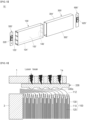
- FIG. 6 illustrates a welding method based on a first base tab of a first electrode plate, but the same welding method may also be applied to a second base tab of a second electrode plate and the secondary battery according to the embodiments of FIG. 5 ).
- FIG. 6 illustrates a cross-sectional view of a method for welding an electrode assembly according to some embodiments.
- FIG. 7 illustrates a graph of a laser output applied to the welding method according to some embodiments.
- FIG. 8 illustrates a view of an example of a shape of a back bead formed by the welding method of FIG. 6 according to some embodiments.
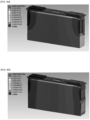
- FIG. 9a illustrates a view of a heat generation state of the electrode assembly before the welding method according to some embodiments is applied.
- FIG. 9b illustrates a view of a heat generation state of the electrode assembly after the welding method according to some embodiments is applied.
- welding between an electrode assembly 100 and a sub plate 336 serving as a collector may be performed by laser welding.
- a first base tab 112 of the first electrode plate 110 may not be bent and placed on a sub plate 336, but be pushed in one direction and bent in a streamlined shape, and then the sub plate 336 may be bent and placed on the first base tab 112.
- a pressing jig 1 for laser welding may be located on an upper portion of the sub plate 336, and a fixing jig 3 for supporting the electrode assembly 100 may be located at a side in a direction in which the first base tab 112 is bent.
- a plurality of welding holes 1a through which laser beam passes may be formed in the pressing jig 1.
- the sub plate 336 may be maintained in the state, in which the sub plate 336 is placed on the bent first base tab 112, by the pressing jig 1. Because the first base tab 112 is in contact with the sub plate 336 in the bent state, the first base tab 112 and the sub plate 336 may be in surface contact with each other. In this state, if the laser beam is emitted through the welding holes 1a, the first base tab 112 may be welded while a rear surface of the sub plate 336 is partially melted to form a back bead 336a.
- the surface of the sub plate 336 may be melted to perform welding at a contact portion between the back bead 336a and the first base tab 112.
- the back bead 336a may protrude toward the first base tab 112.
- the number and intervals of back beads 336a may be adjusted by adjusting the number and intervals of welding holes 1a formed in the pressing jig 1. Because the back bead 336a and the first base tab 112 are welded to each other in this manner, the separator 130 may be located below the protruding back bead 336a to minimize transfer of welding heat. Therefore, damage to the separator 130 due to the welding heat may be prevented or reduced, which may further prevent or reduce instances of an internal short circuit occurring.
- an output of a laser it may be difficult to secure sufficient welding tensile strength if the output is about 510 W or less, and the separator may be melted if the output is about 670 W or more.
- An appropriate output of the laser at which the separator is not melted while ensuring proper welding tensile strength may be about 510 W to about 670 W, preferably be about 550 W to about 630 W.
- a commonly used IR welding source may enable securing a deep welding depth in a key hole manner, but according to some embodiments, it may enable securing a wide and even melting area.
- a CW green welding source may be applied to secure the uniformly wide and even melting area, thereby forming the back bead.
- the laser using the CW Green welding source may be emitted in an appropriate output range to form the back bead 336a having the shape referring to FIG. 6 during the welding.
- FIG. 9a In the case of a structure in which the base tab is bent and welded onto the collector, referring to FIG. 9a , it may be seen that current is concentrated near the base tab and is nonuniform in terms of heating resistance and deterioration.
- the entire side surface of the electrode assembly (first base tab and second base tab) may be connected to the collector. Therefore, if compared to the structure according to the related art, it may be seen that, because a current path is wider, heat is dispersed, and thus, relatively even electrode plate reactivity is realized.
- the method for welding the electrode assembly is changed from general ultrasonic welding to the laser welding, space utilization inside the secondary battery may be relatively improved, and welding strength may also be relatively improved.
- a dV defect rate due to an inflow of foreign substances may be greatly reduced.
- the collector and the base tab are welded to each other in a state of the surface contact, the wide and even melting area may be secured to improve the weldability. Therefore, the even electrode plate reactivity may be secured through the heat generation with the wide current path.
Landscapes
- Chemical & Material Sciences (AREA)
- Chemical Kinetics & Catalysis (AREA)
- Electrochemistry (AREA)
- General Chemical & Material Sciences (AREA)
- Engineering & Computer Science (AREA)
- Manufacturing & Machinery (AREA)
- Connection Of Batteries Or Terminals (AREA)
- Sealing Battery Cases Or Jackets (AREA)
Applications Claiming Priority (1)
| Application Number | Priority Date | Filing Date | Title |
|---|---|---|---|
| KR1020220145044A KR20240063429A (ko) | 2022-11-03 | 2022-11-03 | 이차전지 |
Publications (2)
| Publication Number | Publication Date |
|---|---|
| EP4366070A2 true EP4366070A2 (fr) | 2024-05-08 |
| EP4366070A3 EP4366070A3 (fr) | 2024-07-24 |
Family
ID=88647512
Family Applications (1)
| Application Number | Title | Priority Date | Filing Date |
|---|---|---|---|
| EP23207261.1A Pending EP4366070A3 (fr) | 2022-11-03 | 2023-11-01 | Batterie secondaire avec ensemble d'électrode soudé |
Country Status (4)
| Country | Link |
|---|---|
| US (1) | US20240154259A1 (fr) |
| EP (1) | EP4366070A3 (fr) |
| KR (1) | KR20240063429A (fr) |
| CN (1) | CN117996302A (fr) |
Cited By (1)
| Publication number | Priority date | Publication date | Assignee | Title |
|---|---|---|---|---|
| EP4683099A1 (fr) * | 2024-07-15 | 2026-01-21 | Samsung Sdi Co., Ltd. | Batterie secondaire, procédé de fabrication de batterie secondaire et bloc-batterie |
Families Citing this family (2)
| Publication number | Priority date | Publication date | Assignee | Title |
|---|---|---|---|---|
| KR20250169692A (ko) * | 2024-05-27 | 2025-12-04 | 삼성에스디아이 주식회사 | 이차 전지 |
| SE2430433A1 (en) * | 2024-08-30 | 2026-03-01 | Northvolt Ab | A battery cell |
Family Cites Families (6)
| Publication number | Priority date | Publication date | Assignee | Title |
|---|---|---|---|---|
| JP4434418B2 (ja) * | 2000-03-24 | 2010-03-17 | パナソニック株式会社 | 角型電池 |
| JP2002075319A (ja) * | 2000-08-31 | 2002-03-15 | Yuasa Corp | 密閉形電池 |
| JP4514434B2 (ja) * | 2003-11-06 | 2010-07-28 | 三洋電機株式会社 | 二次電池 |
| KR102629053B1 (ko) * | 2016-08-08 | 2024-01-23 | 삼성에스디아이 주식회사 | 집전부재를 갖는 이차 전지 |
| CN110326133A (zh) * | 2017-02-27 | 2019-10-11 | 三洋电机株式会社 | 方形二次电池以及其制造方法 |
| KR102819179B1 (ko) * | 2019-09-30 | 2025-06-11 | 삼성에스디아이 주식회사 | 이차전지 |
-
2022
- 2022-11-03 KR KR1020220145044A patent/KR20240063429A/ko active Pending
-
2023
- 2023-09-26 US US18/475,106 patent/US20240154259A1/en active Pending
- 2023-11-01 EP EP23207261.1A patent/EP4366070A3/fr active Pending
- 2023-11-03 CN CN202311454777.0A patent/CN117996302A/zh active Pending
Cited By (1)
| Publication number | Priority date | Publication date | Assignee | Title |
|---|---|---|---|---|
| EP4683099A1 (fr) * | 2024-07-15 | 2026-01-21 | Samsung Sdi Co., Ltd. | Batterie secondaire, procédé de fabrication de batterie secondaire et bloc-batterie |
Also Published As
| Publication number | Publication date |
|---|---|
| EP4366070A3 (fr) | 2024-07-24 |
| KR20240063429A (ko) | 2024-05-10 |
| US20240154259A1 (en) | 2024-05-09 |
| CN117996302A (zh) | 2024-05-07 |
Similar Documents
| Publication | Publication Date | Title |
|---|---|---|
| EP4366070A2 (fr) | Batterie secondaire avec ensemble d'électrode soudé | |
| US9601744B2 (en) | Secondary battery | |
| KR20160042243A (ko) | 이차 전지 및 그 제조 방법 | |
| EP4375004B1 (fr) | Batterie secondaire et procédé de fabrication de cette batterie secondaire | |
| US20060204841A1 (en) | Battery and method of manufacturing same | |
| KR20230089196A (ko) | 이차 전지 | |
| KR20170109968A (ko) | 이차 전지 | |
| US20260100488A1 (en) | Secondary battery | |
| KR100612236B1 (ko) | 이차 전지와 이에 사용되는 전극 조립체 | |
| EP4593165A1 (fr) | Batterie secondaire cylindrique | |
| KR20210076770A (ko) | 이차 전지용 전지 케이스 및 파우치 형 이차 전지 | |
| KR20230049795A (ko) | 이차 전지 | |
| EP4213280A1 (fr) | Batterie secondaire | |
| US20250192388A1 (en) | Secondary battery | |
| US7794872B2 (en) | Secondary battery | |
| US20240413378A1 (en) | Method of manufacturing secondary battery | |
| US20240162524A1 (en) | Secondary battery | |
| US20250007122A1 (en) | Secondary battery and battery module including the same | |
| US20260051633A1 (en) | Secondary Battery and Manufacturing Method Thereof | |
| US20250105408A1 (en) | Secondary battery | |
| US20260112788A1 (en) | Current collector, battery cell including the same, and method of manufacturing the same | |
| US20260038844A1 (en) | Current collecting plate and battery cell comprising the same | |
| US20250070408A1 (en) | Secondary battery | |
| US20250070339A1 (en) | Secondary battery | |
| US20240413446A1 (en) | Secondary battery and method of manufacturing secondary battery |
Legal Events
| Date | Code | Title | Description |
|---|---|---|---|
| PUAI | Public reference made under article 153(3) epc to a published international application that has entered the european phase |
Free format text: ORIGINAL CODE: 0009012 |
|
| STAA | Information on the status of an ep patent application or granted ep patent |
Free format text: STATUS: REQUEST FOR EXAMINATION WAS MADE |
|
| 17P | Request for examination filed |
Effective date: 20231101 |
|
| AK | Designated contracting states |
Kind code of ref document: A2 Designated state(s): AL AT BE BG CH CY CZ DE DK EE ES FI FR GB GR HR HU IE IS IT LI LT LU LV MC ME MK MT NL NO PL PT RO RS SE SI SK SM TR |
|
| PUAL | Search report despatched |
Free format text: ORIGINAL CODE: 0009013 |
|
| AK | Designated contracting states |
Kind code of ref document: A3 Designated state(s): AL AT BE BG CH CY CZ DE DK EE ES FI FR GB GR HR HU IE IS IT LI LT LU LV MC ME MK MT NL NO PL PT RO RS SE SI SK SM TR |
|
| RIC1 | Information provided on ipc code assigned before grant |
Ipc: H01M 50/566 20210101ALI20240620BHEP Ipc: H01M 50/538 20210101ALI20240620BHEP Ipc: H01M 50/536 20210101AFI20240620BHEP |