EP4366148A1 - Umrichter - Google Patents
Umrichter Download PDFInfo
- Publication number
- EP4366148A1 EP4366148A1 EP22833539.4A EP22833539A EP4366148A1 EP 4366148 A1 EP4366148 A1 EP 4366148A1 EP 22833539 A EP22833539 A EP 22833539A EP 4366148 A1 EP4366148 A1 EP 4366148A1
- Authority
- EP
- European Patent Office
- Prior art keywords
- converter
- voltage
- terminal
- input
- switching element
- Prior art date
- Legal status (The legal status is an assumption and is not a legal conclusion. Google has not performed a legal analysis and makes no representation as to the accuracy of the status listed.)
- Pending
Links
Images



Classifications
-
- H—ELECTRICITY
- H02—GENERATION; CONVERSION OR DISTRIBUTION OF ELECTRIC POWER
- H02M—APPARATUS FOR CONVERSION BETWEEN AC AND AC, BETWEEN AC AND DC, OR BETWEEN DC AND DC, AND FOR USE WITH MAINS OR SIMILAR POWER SUPPLY SYSTEMS; CONVERSION OF DC OR AC INPUT POWER INTO SURGE OUTPUT POWER; CONTROL OR REGULATION THEREOF
- H02M3/00—Conversion of DC power input into DC power output
- H02M3/02—Conversion of DC power input into DC power output without intermediate conversion into AC
- H02M3/04—Conversion of DC power input into DC power output without intermediate conversion into AC by static converters
- H02M3/10—Conversion of DC power input into DC power output without intermediate conversion into AC by static converters using discharge tubes with control electrode or semiconductor devices with control electrode
- H02M3/145—Conversion of DC power input into DC power output without intermediate conversion into AC by static converters using discharge tubes with control electrode or semiconductor devices with control electrode using devices of a triode or transistor type requiring continuous application of a control signal
- H02M3/155—Conversion of DC power input into DC power output without intermediate conversion into AC by static converters using discharge tubes with control electrode or semiconductor devices with control electrode using devices of a triode or transistor type requiring continuous application of a control signal using semiconductor devices only
- H02M3/156—Conversion of DC power input into DC power output without intermediate conversion into AC by static converters using discharge tubes with control electrode or semiconductor devices with control electrode using devices of a triode or transistor type requiring continuous application of a control signal using semiconductor devices only with automatic control of output voltage or current, e.g. switching regulators
- H02M3/158—Conversion of DC power input into DC power output without intermediate conversion into AC by static converters using discharge tubes with control electrode or semiconductor devices with control electrode using devices of a triode or transistor type requiring continuous application of a control signal using semiconductor devices only with automatic control of output voltage or current, e.g. switching regulators including plural semiconductor devices as final control devices for a single load
- H02M3/1584—Conversion of DC power input into DC power output without intermediate conversion into AC by static converters using discharge tubes with control electrode or semiconductor devices with control electrode using devices of a triode or transistor type requiring continuous application of a control signal using semiconductor devices only with automatic control of output voltage or current, e.g. switching regulators including plural semiconductor devices as final control devices for a single load with a plurality of power processing stages connected in parallel
-
- B—PERFORMING OPERATIONS; TRANSPORTING
- B60—VEHICLES IN GENERAL
- B60L—PROPULSION OF ELECTRICALLY-PROPELLED VEHICLES; SUPPLYING ELECTRIC POWER FOR AUXILIARY EQUIPMENT OF ELECTRICALLY-PROPELLED VEHICLES; ELECTRODYNAMIC BRAKE SYSTEMS FOR VEHICLES IN GENERAL; MAGNETIC SUSPENSION OR LEVITATION FOR VEHICLES; MONITORING OPERATING VARIABLES OF ELECTRICALLY-PROPELLED VEHICLES; ELECTRIC SAFETY DEVICES FOR ELECTRICALLY-PROPELLED VEHICLES
- B60L53/00—Methods of charging batteries, specially adapted for electric vehicles; Charging stations or on-board charging equipment therefor; Exchange of energy storage elements in electric vehicles
- B60L53/20—Methods of charging batteries, specially adapted for electric vehicles; Charging stations or on-board charging equipment therefor; Exchange of energy storage elements in electric vehicles characterised by converters located in the vehicle
-
- B—PERFORMING OPERATIONS; TRANSPORTING
- B60—VEHICLES IN GENERAL
- B60L—PROPULSION OF ELECTRICALLY-PROPELLED VEHICLES; SUPPLYING ELECTRIC POWER FOR AUXILIARY EQUIPMENT OF ELECTRICALLY-PROPELLED VEHICLES; ELECTRODYNAMIC BRAKE SYSTEMS FOR VEHICLES IN GENERAL; MAGNETIC SUSPENSION OR LEVITATION FOR VEHICLES; MONITORING OPERATING VARIABLES OF ELECTRICALLY-PROPELLED VEHICLES; ELECTRIC SAFETY DEVICES FOR ELECTRICALLY-PROPELLED VEHICLES
- B60L53/00—Methods of charging batteries, specially adapted for electric vehicles; Charging stations or on-board charging equipment therefor; Exchange of energy storage elements in electric vehicles
- B60L53/20—Methods of charging batteries, specially adapted for electric vehicles; Charging stations or on-board charging equipment therefor; Exchange of energy storage elements in electric vehicles characterised by converters located in the vehicle
- B60L53/22—Constructional details or arrangements of charging converters specially adapted for charging electric vehicles
-
- H—ELECTRICITY
- H02—GENERATION; CONVERSION OR DISTRIBUTION OF ELECTRIC POWER
- H02M—APPARATUS FOR CONVERSION BETWEEN AC AND AC, BETWEEN AC AND DC, OR BETWEEN DC AND DC, AND FOR USE WITH MAINS OR SIMILAR POWER SUPPLY SYSTEMS; CONVERSION OF DC OR AC INPUT POWER INTO SURGE OUTPUT POWER; CONTROL OR REGULATION THEREOF
- H02M1/00—Details of apparatus for conversion
- H02M1/0067—Converter structures employing plural converter units, other than for parallel operation of the units on a single load
- H02M1/0074—Plural converter units whose inputs are connected in series
-
- H—ELECTRICITY
- H02—GENERATION; CONVERSION OR DISTRIBUTION OF ELECTRIC POWER
- H02M—APPARATUS FOR CONVERSION BETWEEN AC AND AC, BETWEEN AC AND DC, OR BETWEEN DC AND DC, AND FOR USE WITH MAINS OR SIMILAR POWER SUPPLY SYSTEMS; CONVERSION OF DC OR AC INPUT POWER INTO SURGE OUTPUT POWER; CONTROL OR REGULATION THEREOF
- H02M1/00—Details of apparatus for conversion
- H02M1/0083—Converters characterised by their input or output configuration
-
- H—ELECTRICITY
- H02—GENERATION; CONVERSION OR DISTRIBUTION OF ELECTRIC POWER
- H02M—APPARATUS FOR CONVERSION BETWEEN AC AND AC, BETWEEN AC AND DC, OR BETWEEN DC AND DC, AND FOR USE WITH MAINS OR SIMILAR POWER SUPPLY SYSTEMS; CONVERSION OF DC OR AC INPUT POWER INTO SURGE OUTPUT POWER; CONTROL OR REGULATION THEREOF
- H02M1/00—Details of apparatus for conversion
- H02M1/10—Arrangements incorporating converting means for enabling loads to be operated at will from different kinds of power supplies, e.g. from AC or DC
-
- H—ELECTRICITY
- H02—GENERATION; CONVERSION OR DISTRIBUTION OF ELECTRIC POWER
- H02M—APPARATUS FOR CONVERSION BETWEEN AC AND AC, BETWEEN AC AND DC, OR BETWEEN DC AND DC, AND FOR USE WITH MAINS OR SIMILAR POWER SUPPLY SYSTEMS; CONVERSION OF DC OR AC INPUT POWER INTO SURGE OUTPUT POWER; CONTROL OR REGULATION THEREOF
- H02M3/00—Conversion of DC power input into DC power output
- H02M3/22—Conversion of DC power input into DC power output with intermediate conversion into AC
- H02M3/24—Conversion of DC power input into DC power output with intermediate conversion into AC by static converters
- H02M3/28—Conversion of DC power input into DC power output with intermediate conversion into AC by static converters using discharge tubes with control electrode or semiconductor devices with control electrode to produce the intermediate AC
- H02M3/285—Single converters with a plurality of output stages connected in parallel
-
- B—PERFORMING OPERATIONS; TRANSPORTING
- B60—VEHICLES IN GENERAL
- B60L—PROPULSION OF ELECTRICALLY-PROPELLED VEHICLES; SUPPLYING ELECTRIC POWER FOR AUXILIARY EQUIPMENT OF ELECTRICALLY-PROPELLED VEHICLES; ELECTRODYNAMIC BRAKE SYSTEMS FOR VEHICLES IN GENERAL; MAGNETIC SUSPENSION OR LEVITATION FOR VEHICLES; MONITORING OPERATING VARIABLES OF ELECTRICALLY-PROPELLED VEHICLES; ELECTRIC SAFETY DEVICES FOR ELECTRICALLY-PROPELLED VEHICLES
- B60L2210/00—Converter types
- B60L2210/10—DC to DC converters
-
- B—PERFORMING OPERATIONS; TRANSPORTING
- B60—VEHICLES IN GENERAL
- B60Y—INDEXING SCHEME RELATING TO ASPECTS CROSS-CUTTING VEHICLE TECHNOLOGY
- B60Y2200/00—Type of vehicle
- B60Y2200/90—Vehicles comprising electric prime movers
- B60Y2200/91—Electric vehicles
-
- H—ELECTRICITY
- H02—GENERATION; CONVERSION OR DISTRIBUTION OF ELECTRIC POWER
- H02M—APPARATUS FOR CONVERSION BETWEEN AC AND AC, BETWEEN AC AND DC, OR BETWEEN DC AND DC, AND FOR USE WITH MAINS OR SIMILAR POWER SUPPLY SYSTEMS; CONVERSION OF DC OR AC INPUT POWER INTO SURGE OUTPUT POWER; CONTROL OR REGULATION THEREOF
- H02M1/00—Details of apparatus for conversion
- H02M1/0067—Converter structures employing plural converter units, other than for parallel operation of the units on a single load
- H02M1/007—Plural converter units in cascade
-
- H—ELECTRICITY
- H02—GENERATION; CONVERSION OR DISTRIBUTION OF ELECTRIC POWER
- H02M—APPARATUS FOR CONVERSION BETWEEN AC AND AC, BETWEEN AC AND DC, OR BETWEEN DC AND DC, AND FOR USE WITH MAINS OR SIMILAR POWER SUPPLY SYSTEMS; CONVERSION OF DC OR AC INPUT POWER INTO SURGE OUTPUT POWER; CONTROL OR REGULATION THEREOF
- H02M1/00—Details of apparatus for conversion
- H02M1/42—Circuits or arrangements for compensating for or adjusting power factor in converters or inverters
- H02M1/4208—Arrangements for improving power factor of AC input
-
- Y—GENERAL TAGGING OF NEW TECHNOLOGICAL DEVELOPMENTS; GENERAL TAGGING OF CROSS-SECTIONAL TECHNOLOGIES SPANNING OVER SEVERAL SECTIONS OF THE IPC; TECHNICAL SUBJECTS COVERED BY FORMER USPC CROSS-REFERENCE ART COLLECTIONS [XRACs] AND DIGESTS
- Y02—TECHNOLOGIES OR APPLICATIONS FOR MITIGATION OR ADAPTATION AGAINST CLIMATE CHANGE
- Y02B—CLIMATE CHANGE MITIGATION TECHNOLOGIES RELATED TO BUILDINGS, e.g. HOUSING, HOUSE APPLIANCES OR RELATED END-USER APPLICATIONS
- Y02B70/00—Technologies for an efficient end-user side electric power management and consumption
- Y02B70/10—Technologies improving the efficiency by using switched-mode power supplies [SMPS], i.e. efficient power electronics conversion e.g. power factor correction or reduction of losses in power supplies or efficient standby modes
Definitions
- the present invention relates to a converter, and more specifically, to a converter and power module that can be used for a wide range of input voltages with a single converter.
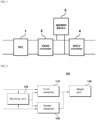
- the power module being applied to the vehicle must convert external power source to a voltage suitable for charging the battery.
- the alternating current input is converted into a direct current through a power factor corrector (PFC) that receives the alternating current input, and it is converted into a voltage suitable for charging the battery 3 through the HV/HV converter 2 to charge the battery 3.
- PFC power factor corrector
- the power stored in the battery 3 is provided to the vehicle, and at this time, it is converted to a low voltage suitable for providing to devices within the vehicle through the HV/LV converter 4.
- the capacity of the battery 3 is used by connecting it to 400 V or 800 V, but there is a problem in that high-efficiency operation is not possible when operating 400 V to 800 V battery voltage range with a single converter, and it is difficult to cover the entire range when designing magnetic elements.
- the technical problem to be solved by the present invention is to provide a converter and power module compatible with a wide range of input voltages with a single converter.
- a converter comprises: a first converter and a second converter that convert the input voltage into a first level voltage; a switching unit that connects the first converter and the second converter in series or in parallel; and an output unit to which the output terminal of the first converter and the output terminal of the second converter are connected in parallel.
- the switching unit may comprise: a first switching element being disposed between the (-) terminal of the first converter and the (-) terminal of the second converter; a second switching element being disposed between the (+) terminal of the first converter and the (+) terminal of the second converter; and a third switching element being disposed between the (-) terminal of the first converter and the (+) terminal of the second converter.
- the first switching element and the second switching element are in an on state and the third switching element is in an off state; and when the input voltage being applied to the converter is a second value, the first switching element and the second switching element are in an off state and the third switching element may be in an on state.
- control unit that controls the switching unit according to the magnitude of the input voltage being applied to the converter.
- control unit controls the switching unit so that the first converter and the second converter are connected in parallel when the magnitude of the input voltage is a first value, and may control the switching unit so that the first converter and the second converter are connected in series when the magnitude of the input voltage is a second value.
- the first value may be smaller than the second value.
- first converter and the second converter may have the same specifications.
- the power module comprises: a power factor correction unit that converts an alternating current input into a direct current; a third converter and a fourth converter that convert the output voltage of the power factor correction unit into a second level voltage; a first converter and a second converter that convert the input voltage into a first level voltage; a first switching unit that connects the third converter and the fourth converter in series or in parallel; a second switching unit that connects the first converter and the second converter in series or in parallel; and an output unit where the output terminal of the first converter and the output terminal of the second converter are connected in parallel, wherein the output terminal of the third converter is connected to the input terminal of the first converter, and wherein the output terminal of the fourth converter is connected to the input terminal of the second converter.
- it may include a battery input/output terminal being connected between the output terminal of the third converter and the input terminal of the first converter, and between the output terminal of the fourth converter and the input terminal of the second converter.
- first converter and the second converter may receive the output voltage of the third converter and the output voltage of the fourth converter, respectively, or may receive a battery voltage from the battery input/output terminal.
- the first converter and the second converter are connected in parallel; and when the voltage of the battery being connected to the battery input/output terminal is a second value, the first converter and the second converter may be connected in series.
- the first switching unit may include: a fourth switching element being disposed between the (-) terminal of the third converter and the (-) terminal of the fourth converter; a fifth switching element being disposed between the (+) terminal of the third converter and the (+) terminal of the fourth converter; and a sixth switching element being disposed between the (-) terminal of the third converter and the (+) terminal of the fourth converter.
- the fourth switching element and the fifth switching element are in an on state and the sixth switching element is in an off state; and when the alternating current voltage being inputted to the power factor correction unit is three-phase, the fourth switching element and the fifth switching element are in an off state and the sixth switching element may be in an on state.
- the switching unit may comprises: a first switching element being disposed between the (-) terminal of the first converter and the (-) terminal of the second converter; a second switching element being disposed between the (+) terminal of the first converter and the (+) terminal of the second converter; and a third switching element being disposed between the (-) terminal of the first converter and the (+) terminal of the second converter.
- the second level may be larger than the first level.
- the singular form may include the plural form unless specifically stated in the phrase, and when described as "at least one (or more than one) of A and B and C", it may include one or more of all combinations that can be combined with A, B, and C.
- first, second, A, B, (a), and (b) may be used. These terms are merely intended to distinguish the components from other components, and the terms do not limit the nature, order or sequence of the components.
- a component when a component is described as being 'connected', 'coupled' or 'interconnected' to another component, the component is not only directly connected, coupled or interconnected to the other component, but may also include cases of being 'connected', 'coupled', or 'interconnected' due that another component between that other components.
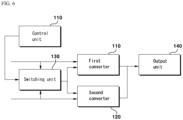
- FIG. 2 is a block diagram of a converter according to an embodiment of the present invention.
- the converter 100 consists of a first converter 110 , a second converter 120 , a switching unit 130 , and an output unit 140 , and may further include a control unit 150 or a converter other than the first converter 110 and the second converter 120 .
- the converter 100 according to an embodiment of the present invention may be a converter 100 being mounted on a vehicle, and it may receive power from a battery or external power source and convert it into a voltage level of power source to be provided to devices inside a vehicle. Or, it can be applied to various devices with a wide range of input voltage.
- the first converter 110 and the second converter 120 convert voltages being inputted into a voltage of a first level.
- the first converter 110 and the second converter 120 are connected in series or in parallel depending on the connection state of the switching unit 130 ; and the converters convert input voltages into a first level voltage.
- the first converter 110 and the second converter 120 may be DC-DC converters or other types of converters such as DC-AC converters.
- the first level voltage may be the voltage required for the load being connected to the output unit 140 .
- the devices use 12 V as the rated voltage, and the first level voltage may be 12 V.
- the first level voltage may be a fixed value or a variable value.
- the size of the battery or external power voltage may be a voltage higher than the first level voltage
- the first converter 110 and the second converter 120 may be HV/LV converters that convert a high voltage to a low voltage.
- the input voltage being inputted to the converter may be 400 V or 800 V
- the output voltage may be 12 V
- the first converter 110 and the second converter 120 may be 400 - 12 HV/LV converters.
- the first converter 110 and the second converter 120 may be an HV-HV converter, an LV-LV converter, or an LV-HV converter.
- the first converter 110 and the second converter 120 may be converters having the same specifications.
- identical specifications mean that there is a difference in specifications within an error range or a critical range, and it is natural that it does not mean complete identicalness. They may have the same specifications in terms of rated voltage, voltage transformation ratio, power, etc.
- the first converter 110 and the second converter 120 may have a voltage transformation ratio that converts a voltage in the range of 380 V to 400 V to 12 V, and may be a converter with a power of 5 KW. Additionally, it is natural that the first converter 110 and the second converter 120 may be converters having different specifications.
- the switching unit 130 connects the first converter 110 and the second converter 120 in series or in parallel.
- the switching unit 130 may perform a switching operation so that the first converter 110 and the second converter 120 are connected in series or in parallel.
- the switching unit 130 is connected to the input terminal of the first converter 110 and the input terminal of the second converter 120 , and here, the positions in series or in parallel mean the input terminal of the first converter 110 and the input terminal of the second converter 120 .
- serial or parallel connection refers to the input terminal of each converter.
- the input voltage is divided to be inputted to each converter, and when connected in parallel, the input voltage is equally inputted to each converter.
- the switching unit 130 operates according to the input voltage being inputted to the converter to connect the first converter 110 and the second converter 120 in series or in parallel.
- the first converter 110 and the second converter 120 are connected in parallel to convert the input voltage, respectively, and when the input voltage is greater than the rated voltage range of each converter, the first converter 110 and the second converter 120 may be connected in series to distribute and convert the input voltage.
- each converter can be designed to convert a lower input voltage among different types of input voltage, or a converter with a corresponding rated voltage can be used.
- the input voltage can be converted through voltage distribution. That is, by connecting the first converter 110 and the second converter 120 in series or in parallel, it becomes possible to be used for multiple types or a wide range of input voltages.
- the input voltage is 400 V or 800 V
- each converter may be a converter that converts 400 V to 12 V.
- the first converter 110 and the second converter 120 are connected in parallel, and when the input voltage is 800 V, the first converter 110 and the second converter 120 are connected in series.
- the voltage being inputted to each converter becomes 400 V due to the voltage distribution. In other words, even if the input voltage is different, each converter only needs to convert 400 V to 12 V, which can increase efficiency.
- the output terminal of the first converter 110 and the output terminal of the second converter 120 are connected in parallel.
- the output unit 140 can be connected to a load, the output terminal of the first converter 110 and the output terminal of the second converter 120 are connected in parallel, and the voltage being changed and outputted from each converter is outputted.
- Devices inside the vehicle or a battery may be connected to the output unit 140 to provide a 12 V voltage being converted and outputted from the first converter 110 and the second converter 120 .
- the output unit 140 may include a plurality of switches, and the output terminal of the first converter 110 and the output terminal of the second converter 120 may be connected in parallel or in series. Depending on the voltage required for the load being connected to the output unit 140 , the output terminal of each converter can be connected in series or in parallel to output a variety of voltage ranges.
- the switching unit 130 may include one or more switching elements.
- the switching element may be a physical switching element, such as a relay, or a semiconductor switching element, such as a transistor or an FET.
- various switching elements may be included.
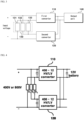
- the switching unit 130 may include: a first switching element 131 , a second switching element 132 , and a third switching element 133 .
- each switching element may be disposed as shown in FIG. 3 .
- the first switching element 131 is disposed between the (-) terminal of the first converter 110 and the (-) terminal of the second converter 120
- the second switching element 132 is disposed between the (+) terminal of the first converter 110 and the (+) terminal of the second converter 120
- the third switching element 133 may be disposed between the (-) terminal of the first converter 110 and the (+) terminal of the second converter 120 .
- the first switching element 131 and the second switching element 132 When the first switching element 131 and the second switching element 132 are on and the third switching element 133 is off, the first converter 110 and the second converter 120 are connected in parallel; when the first switching element 131 and the second switching element 132 are off and the third switching element 133 is on, the first converter 110 and the second converter 120 are connected in series; and the first to third switching elements 131 to 133 may operate depending on the magnitude of the input voltage being applied to the converter.
- a first value may be a voltage smaller than the second value.
- the first value and the second value may be different types of input voltages and may be a voltage corresponding to input ranges having different ranges. Or, based on a reference value that is preset or set according to the rated voltage of each converter, the first value may be a voltage below the reference value, and the second value may be a voltage greater than the reference value.
- the input voltage is 400 V or 800 V
- the first converter 110 and the second converter 120 are 400 - 12 HV/LV converters
- the switching unit 130 includes S1 to S3
- the 12 V being outputted from each converter can be provided by a battery.
- the converter is connected to a 400 V battery or an 800 V battery and can receive 400 V or 800 V input, respectively. Or, it is connected to an 800 V battery, and the output voltage of the battery can be 400 V or 800 V, or 400 V or 800 V can be inputted from an external power source.
- S1 to S3 being included in the switching unit 130 operate to connect the first converter 110 and the second converter 120 in series or in parallel.
- S1 , the first switching element 131 , and S2 , the second switching element 132 are turned on, and S3 , the third switching element 133 , is turned off.
- the first converter 110 and the second converter 120 are connected in parallel.
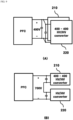
- the first converter 110 and the second converter 120 are connected in parallel as shown in FIG. 5(A) , and each converter converts the 400 V input voltage to 12 V and outputs it.
- the first converter 110 and the second converter 120 are connected in series. At this time, the first converter 110 and the second converter 120 are connected in series as shown in FIG. 5(B) , the input voltage of 800 V is divided and 400 V is inputted to each converter. Each converter converts the 400 V input voltage to 12 V and outputs it.
- the first converter 110 and the second converter 120 are optimally designed with the same specifications and can be applied without design changes.
- a converter with the same specifications it is possible to use a separate converter according to the range of input voltage or apply it to a wide range, without reducing the efficiency of the converter, and converting to high efficiency and size becomes possible. Therefore, efficiency degrading can be solved by using a different converter depending on the size of the input voltage or by designing the operating range of the converter to be wide in order to convert the entire range of voltage.
- an additional converter is included in addition to the first converter 110 and the second converter 120 , but by changing the connection status of each converter depending on the input voltage, it can be used for a wider range of input voltages. Or, the specifications of the first converter 110 and the second converter 120 may be increased, and the degree of freedom in design can be increased by switching the connection states of the converters.
- the control unit 150 may include a control unit 150 that controls the switching unit 130 according to the magnitude of the input voltage being applied to the converter.
- the control unit 150 senses the input voltage, or receives the input voltage sensed by a sensing unit (not shown) that senses the input voltage, and controls the switching unit 130 so that the connection states of the first converter 110 and the second converter 120 can be controlled differently so as to be suitable for each input voltage.
- the control unit 150 may be a gate driver that provides the gate voltage of each switching element, and may control the switching elements through pulse width modulation (PWM).
- PWM pulse width modulation
- the switching element is another type of switching element such as a relay, the switching unit 130 can be controlled by applying a signal to operate the corresponding switching element.
- the control unit 150 controls the switching unit 130 to connect the first converter 110 and the second converter 120 in parallel when the magnitude of the input voltage is a first value, and may control the switching unit 130 so that the first converter 110 and the second converter 120 are connected in series when the magnitude of the input voltage is a second value.
- a first value may be smaller than a second value.
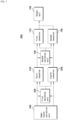
- FIG. 7 is a block diagram of a power module according to an embodiment of the present invention.
- the power module 200 includes a power factor correction unit 240 , a first converter 110 , a second converter 120 , a third converter 210 , a fourth converter 220 , a first switching unit 230 , a second switching unit 130 , and an output unit 140 , and may include an input unit (not shown), a control unit (not shown), and the like.
- the power module 200 according to an embodiment of the present invention may include the vehicle's on board charger (OBC) and DC-DC converter as a power module being applied to electric vehicles that receives external power to charge the battery, and provides the battery or external power to devices inside the vehicle.
- OBC on board charger
- DC-DC converter DC-DC converter
- the power factor correction unit 240 converts an alternating current input into a direct current.
- the power factor correction unit 240 receives an alternating current input, corrects the power factor, and converts it to a direct current.
- the power factor correction unit 240 may be a power factor correction (PFC). It can operate in a single method or an interleaved method. AC power can be received through input parts such as the power port. Depending on the type of external power source being connected, either single-phase AC power or three-phase AC power can be inputted. When single-phase AC power is inputted, it is converted to DC power with a voltage of 380 to 400 V, and when three-phase AC power is inputted, it is converted to DC power with a voltage of 650 to 800 V.
- PFC power factor correction
- the third converter 210 and the fourth converter 220 convert the output voltage of the power factor correction unit 240 into a second level voltage.
- the third converter 210 and the fourth converter 220 convert the voltage of a direct current power source being outputted from the power factor correction unit 240 into a second level voltage.
- the third converter 210 and the fourth converter 220 may be DC-DC converters, and the second level voltage may be a voltage suitable for the battery being connected to the rear end or the first converter 110 and the second converter 120.
- the second level voltage may be a fixed value or a variable value. When the second level voltage is a variable value, it may be a value variable to one of a plurality of types of voltage values or may be a value that is variable within a continuous range.
- the third converter 210 and the fourth converter 220 convert the output voltage of the power factor correction unit 240 to a second level voltage that is suitable for the battery or the first converter 110 and the second converter 120 being connected to the rear end.
- the output voltage of the power factor correction unit 240 may be higher or lower than the voltage of the second level, and may be the same voltage within the error range; and the third converter 210 and the fourth converter 220 may be HV/HV converters that convert a high voltage to a high voltage.
- HV may be a relative meaning which means that it is a higher voltage than the voltage being outputted by the first converter 110 and the second converter 120 .
- the output voltage of the power factor correction unit 240 may be 400 V or 700 V
- the voltage being outputted through the third converter 210 and the fourth converter 220 is 400 V to 800 V
- the third converter 210 and the fourth converter 220 may be 400 - 400 HV/HV converters.
- the third converter 210 and the fourth converter 220 may be an HV-HV converter, an LV-LV converter, or an LV-HV converter.
- the output voltage of the power factor correction unit 240 , 400 V or 700 V represents a representative value and may be a voltage with a certain range.
- the third converter 210 and the fourth converter 220 may be converters having the same specifications.
- identical specifications mean that there is a difference in specifications within an error range or critical range, and it is natural that it does not mean complete identicalness. They can have the same specifications in terms of rated voltage, voltage transformation ratio, power, and the like.
- the third converter 210 and the fourth converter 220 may have a voltage transformation ratio that converts a voltage in the range of 380 V to 400 V to 400 V, and may be a converter with a power of 5 KW.
- the third converter 210 and the fourth converter 220 may be converters with different specifications.
- an additional converter being connected in series or in parallel with the third converter 210 and the fourth converter 220 may be further included.
- the first switching unit 230 connects the third converter 210 and the fourth converter 220 in series or in parallel.
- the first switching unit 230 may perform a switching operation so that the third converter 210 and the fourth converter 220 are connected in series or in parallel.
- the first switching unit 230 is connected to the input terminal of the third converter 210 and the input terminal of the fourth converter 220 , and here, the positions in series or parallel mean the input terminal of the third converter 210 and the input terminal of the fourth converter 220 .
- serial or parallel connection refers to the input terminal of each converter.
- the first switching unit 230 operates according to the input voltage being inputted to the converter to connect the third converter 210 and the fourth converter 220 in series or in parallel.
- the third converter 210 and the fourth converter 220 are connected in parallel to convert the output voltage of the power factor correction unit 240 ; and when the output voltage of the power factor correction unit 240 is greater than the rated voltage range of each converter, the third converter 210 and the fourth converter 220 can be connected in series to distribute and convert the output voltage of the power factor correction unit 240 .
- a conversion operation is possible even if a voltage greater than the rated voltage of each converter is outputted from the power factor correction unit 240 and it can be designed so that the conversion is performed in a high efficiency range rather than a wide range of rated voltage.
- each converter may be designed to convert a lower input voltage among different types of input voltage, or a converter with a corresponding rated voltage may be used; and when the output voltage of the power factor correction unit 240 that is greater than the rated voltage for which each converter is designed is inputted, the output voltage of the power factor correction unit 240 can be converted through voltage distribution. That is, by connecting the third converter 210 and the fourth converter 220 in series or in parallel, it is possible to be used for multiple types or a wide range of output voltages of the power factor correction unit 240.
- the output voltage of the power factor correction unit 240 may be 400 V or 700 V, and each converter may be a converter that converts 400 V to 400 V.
- the third converter 210 and the fourth converter 220 are connected in parallel, and when the output voltage of the power factor correction unit 240 is 700 V, the third converter 210 and the fourth converter 220 are connected in series.
- the voltage being inputted to each converter is 350 to 400 V due to voltage distribution. In other words, even if the output voltage of the power factor correction unit 240 is different, each converter only needs to convert 400 V to 12 V, which can increase efficiency.
- the first converter 110 and the second converter 120 convert the input voltage into a first level voltage.
- the second level may be a voltage greater than the first level.
- the second level may be 400 V and the first level may be 12 V. Of course, this may vary depending on the input voltage and output voltage of the device to which the power module 200 is applied.
- the second switching unit 130 connects the first converter 110 and the second converter 120 in series or in parallel.
- the output unit 140 includes an output unit in which the output terminal of the first converter 110 and the output terminal of the second converter 120 are connected in parallel.
- a detailed description of the first converter 110 , the second converter 120 , and the output unit 140 corresponds to the first converter 110 , the second converter 120 , and the output unit 140 being included in the converter 100 of FIGS. 1 to 6 , hereafter, overlapping explanations will be omitted.
- the output terminal of the third converter 210 is connected to the input terminal of the first converter 110
- the output terminal of the fourth converter 220 is connected to the input terminal of the second converter 120 . Therefore, the third converter 210 and the first converter 110 can be viewed as operating as one converter, and the fourth converter 220 and the second converter 120 can be seen as operating as one converter. That is, when the first converter 110 and the second converter 120 are connected in series or in parallel by the operation of the second switching unit 130, the output terminal of the third converter 210 and the output terminal of the fourth converter 220 are also connected in series or in parallel accordingly.
- the second switching unit 130 When the battery, which will be described later, is connected, the second switching unit 130 operates according to the voltage of the battery, but when the battery is not connected, it may operate according to the operation of the first switching unit 230 .
- the first switching unit 230 and the second switching unit 130 may operate in the same manner.
- the first switching unit 230 connects the third converter 210 and the fourth converter 220 in series
- the second switching unit 130 connects the first converter 110 and the second converter 120 in series
- the first switching unit 230 connects the third converter 210 and the fourth converter 220 in parallel
- the second switching unit 130 may connect the first converter 110 and the second converter 120 in parallel. Since the first switching unit 230 operates according to the output voltage being outputted by the power factor correction unit 240 , the second switching unit 130 may also operate according to the output voltage being outputted by the power factor correction unit 240 .
- the first switching unit 230 When the AC power being applied to the power factor correction unit 240 is single-phase, the first switching unit 230 connects the third converter 210 and the fourth converter 220 in parallel, and the second switching unit 130 may connect the first converter 110 and the second converter 120 in parallel; and when the AC power being supplied to the power factor correction unit 240 is 3-phase, the first switching unit 230 connects the third converter 210 and the fourth converter 220 in series, and the second switching unit 130 may connect the first converter 110 and the second converter 120 in series.
- the first switching unit 230 operates according to the output voltage being outputted from the power factor correction unit 240 , but the second switching unit 130 may operate differently from the first switching unit 230.
- the second switching unit 130 may connect the third converter 210 and the fourth converter 220 in parallel. At this time, the output terminal of the third converter 210 and the output terminal of the fourth converter 220 are connected in parallel.
- the second switching unit 130 may connect the third converter 210 and the fourth converter 220 in series. At this time, the output terminal of the third converter 210 and the output terminal of the fourth converter 220 are connected in series.
- a battery input/output terminal being connected between the output terminal of the third converter 210 and the input terminal of the first converter 110 and between the output terminal of the fourth converter 220 and the input terminal of the second converter 120 may be included.
- the output voltages of the third converter 210 and the fourth converter 220 can charge the battery through the battery input/output terminal being connected to the rear end. Electric vehicles charge their batteries with an external power source, and the external power source may charge the battery through the power factor correction unit 240 , the third converter 210 , and the fourth converter 220 by being converted to a voltage suitable for charging the battery.
- the second switching unit 130 may connect the output terminal of the third converter 210 and the output terminal of the fourth converter 220 in series or in parallel.
- the third converter 210 and the fourth converter 220 are connected in series or in parallel and output a second level voltage.
- the second switching unit 130 connects the output terminal of the third converter 210 and the output terminal of the fourth converter 220 in parallel; and when the capacity of the battery is a second value, the second switching unit 130 may connect the output terminal of the third converter 210 and the output terminal of the fourth converter 220 in series.
- the first value may be a voltage smaller than the second value
- the second value may be a value greater than the second level voltage above the error range.
- the second switching unit 130 connects the output terminal of the third converter 210 and the output terminal of the fourth converter 220 in parallel, and may charge the battery by transmitting the voltage being outputted from the third converter 210 and the fourth converter 220 in parallel to the battery.
- the second switching unit 130 connects the output terminal of the third converter 210 and the output terminal of the fourth converter 220 in series, and may charge the battery by transmitting the sum of the voltages being outputted from the third converter 210 and the fourth converter 220 to the battery.
- the first converter 110 and the second converter 120 may receive the output voltage of the third converter 210 and the output voltage of the fourth converter 220 , respectively, or may receive the battery voltage from the battery input/output terminal.
- the output voltage of the third converter 210 and the output voltage of the fourth converter 220 are respectively received and converted, and the converted voltage can be provided to the load from the output unit 140.
- the first converter 110 and the second converter 120 respectively receive the battery voltage and convert it, and may provide the converted voltage to the load from the output unit 140.
- the first converter 110 and the second converter 120 are connected in parallel; and when the voltage of the battery being connected to the battery input/output terminal is a second value, the first converter 110 and the second converter 120 are connected in series.
- the battery voltage is inputted to the first converter 110 and the second converter 120.
- the first converter 110 and the second converter 120 are connected in series or in parallel corresponding to the operations of the first converter 110 and the second converter 120 of FIGS. 1 to 6 .
- the connection state of the output terminal of the third converter 210 , the input terminal of the first converter 110 , the output terminal of the fourth converter 220 , and the input terminal of the second converter 120 is determined depending on the capacity of the battery being connected to the battery input/output terminal.
- the power module 200 may be implemented as shown in FIG. 8 .
- the power factor correction unit 240 is implemented as a PFC and receives single-phase or three-phase alternating current and converts it into a direct current, and according to the DC link voltage, which is the output voltage of the power factor correction unit 240 , the first switching unit 230 connects the third converter 210 and the fourth converter 220 in series or in parallel.
- a battery may be respectively connected across the third converter 210 , the fourth converter 220 , the first converter 110 , and the second converter 120 ; and the second switching unit 130 connects the first converter 110 and the second converter 120 in series or in parallel depending on the capacity of the battery.
- the output terminal of the third converter 210 is connected to the input terminal of the first converter 110
- the output terminal of the fourth converter 220 is connected to the input terminal of the second converter 120
- the output terminal of the third converter 210 and the output terminal of the fourth converter 220 are also connected in series or in parallel by the operation of the second switching unit 130.
- the output terminals of the first converter 110 and the second converter 120 are connected in parallel and provided as a load connected to the output unit 140.
- the first switching unit 230 may include one or more switching elements and may include fourth to sixth switching elements.
- the operation of the fourth to sixth switching elements connecting the third converter 210 and the fourth converter 220 in series or in parallel corresponds to the operation in which the first to third switching elements 131 to 133 of FIGS. 1 to 6 connect the first converter 110 and the second converter 120 in series or in parallel.
- the first switching unit 230 may comprise: a fourth switching element being disposed between the (-) terminal of the third converter 210 and the (-) terminal of the fourth converter 220 ; a fifth switching element being disposed between the (+) terminal of the third converter 210 and the (+) terminal of the fourth converter 220 ; and a sixth switching element being disposed between the (-) terminal of the third converter 210 and the (+) terminal of the fourth converter 220 .
- the fourth to sixth switching elements may be relays or semiconductor switching elements, and may be disposed as S4 to S6 in FIG. 8 .
- the fourth switching element S4 and the fifth switching element S5 are in an on state and the sixth switching element S6 is in an off state; and when the alternating current voltage being inputted to the power factor correction unit 240 is three-phase, the fourth switching element S4 and the fifth switching element S5 may be in an off state and the sixth switching element S6 may be in an on state.
- the output voltage being outputted from the power factor correction unit 240 may be 400 V, as shown in FIG. 9(A) , and at this time, the fourth switching element S4 and the fifth switching element S5 are turned on and the sixth switching element S6 is turned off so that the third converter 210 and the fourth converter 220 are connected in parallel.
- the third converter 210 and fourth converter 220 may be 400 - 400 HV/HV converters, and each of them respectively receives 400 V in parallel to charge the battery or change it to 400 V corresponding to the input voltage of the first converter 110 and the second converter 120.
- the output voltage being outputted from the power factor correction unit 240 may be 700 V, as shown in FIG. 9(B) , and at this time, the fourth switching element S4 and the fifth switching element S5 are turned off and the sixth switching element S6 is turned on so that the third converter 210 and fourth converter 220 are connected in series.
- the third converter 210 and fourth converter 220 may be 400 - 400 HV/HV converters, the output voltage of 700 V is voltage divided, and each of the third converter 210 and the fourth converter 220 respectively receives 350 V to charge the battery or may convert it to 400 V corresponding to the input voltage of the first converter 110 and the second converter 120.
- the front end of the converter can include a capacitor to reduce or eliminate ripple.
- the capacitor may be an electrolytic capacitor.
- the capacity of the electrolytic capacitor increases proportionally according to the magnitude of the voltage being inputted to the converter. Since the power module or converter according to an embodiment of the present invention uses a single converter with a small capacity compared to the input voltage, the size of the voltage being inputted to each converter becomes smaller compared to converters that must cover the entire range without changing the connection status, so the capacity of the electrolytic capacitor can be reduced.
- the second switching unit 130 may comprise: a first switching element 131 being disposed between the (-) terminal of the first converter 110 and the (-) terminal of the second converter 120 ; a second switching element 132 being disposed between the (+) terminal of the first converter 110 and the (+) terminal of the second converter 120 ; and a third switching element 133 being disposed between the (-) terminal of the first converter 110 and the (+) terminal of the second converter 120 .
- the detailed description of the first to third switching elements corresponds to the first to third switching elements 131 to 133 of the converter of FIGS. 1 to 6 .
- S1 to S3 included in the second switching unit 130 operate to connect the first converter 110 and the second converter 120 in series or in parallel. Accordingly, the output terminal of the third converter 210 and the output terminal of the fourth converter 220 are also connected in series or in parallel.
- devices with low specifications can be used because they can be used in combined ways.
- the voltage being inputted to each converter is about 400 V, so a 650 V semiconductor device can be used.
- it only needs to withstand low voltages, so rather than semiconductor devices that can operate at high voltages but have poor performance, high-performance devices such as GAN that operates at low voltages but have high efficiency can be used, thereby increasing the design freedom by considering efficiency and cost.
Landscapes
- Engineering & Computer Science (AREA)
- Power Engineering (AREA)
- Transportation (AREA)
- Mechanical Engineering (AREA)
- Dc-Dc Converters (AREA)
Applications Claiming Priority (2)
| Application Number | Priority Date | Filing Date | Title |
|---|---|---|---|
| KR1020210084086A KR20230001338A (ko) | 2021-06-28 | 2021-06-28 | 컨버터 |
| PCT/KR2022/009129 WO2023277483A1 (ko) | 2021-06-28 | 2022-06-27 | 컨버터 |
Publications (2)
| Publication Number | Publication Date |
|---|---|
| EP4366148A1 true EP4366148A1 (de) | 2024-05-08 |
| EP4366148A4 EP4366148A4 (de) | 2025-06-18 |
Family
ID=84692910
Family Applications (1)
| Application Number | Title | Priority Date | Filing Date |
|---|---|---|---|
| EP22833539.4A Pending EP4366148A4 (de) | 2021-06-28 | 2022-06-27 | Umrichter |
Country Status (6)
| Country | Link |
|---|---|
| US (1) | US12620885B2 (de) |
| EP (1) | EP4366148A4 (de) |
| JP (1) | JP2024522864A (de) |
| KR (1) | KR20230001338A (de) |
| CN (1) | CN117652088A (de) |
| WO (1) | WO2023277483A1 (de) |
Family Cites Families (7)
| Publication number | Priority date | Publication date | Assignee | Title |
|---|---|---|---|---|
| CN101399499A (zh) | 2007-09-26 | 2009-04-01 | 力博特公司 | 一种宽输入电压范围的电源模块 |
| JP2009261230A (ja) * | 2008-03-25 | 2009-11-05 | Tokyo Electric Power Co Inc:The | 電気自動車用充電システム |
| US8227939B2 (en) * | 2009-06-11 | 2012-07-24 | Raytheon Company | Reconfigurable multi-cell power converter |
| DE102018210579A1 (de) * | 2018-06-28 | 2020-01-02 | Continental Automotive Gmbh | Fahrzeugseitige Ladeschaltung |
| DE102018212523B4 (de) | 2018-07-26 | 2021-07-08 | Vitesco Technologies GmbH | Fahrzeugseitige Ladeschaltung |
| US20220231537A1 (en) * | 2019-05-10 | 2022-07-21 | Autonetworks Technologies, Ltd. | Conversion device, conversion system, switching device, vehicle including the same, and control method |
| CN110429671B (zh) | 2019-06-21 | 2020-12-08 | 北京航空航天大学 | 一种电动汽车高适应性充电系统及方法 |
-
2021
- 2021-06-28 KR KR1020210084086A patent/KR20230001338A/ko active Pending
-
2022
- 2022-06-27 EP EP22833539.4A patent/EP4366148A4/de active Pending
- 2022-06-27 WO PCT/KR2022/009129 patent/WO2023277483A1/ko not_active Ceased
- 2022-06-27 US US18/575,057 patent/US12620885B2/en active Active
- 2022-06-27 JP JP2023579244A patent/JP2024522864A/ja active Pending
- 2022-06-27 CN CN202280046307.8A patent/CN117652088A/zh active Pending
Also Published As
| Publication number | Publication date |
|---|---|
| JP2024522864A (ja) | 2024-06-21 |
| WO2023277483A1 (ko) | 2023-01-05 |
| KR20230001338A (ko) | 2023-01-04 |
| US12620885B2 (en) | 2026-05-05 |
| EP4366148A4 (de) | 2025-06-18 |
| US20240339919A1 (en) | 2024-10-10 |
| CN117652088A (zh) | 2024-03-05 |
Similar Documents
| Publication | Publication Date | Title |
|---|---|---|
| CN102577063B (zh) | Dc/dc变换器电路和电池系统 | |
| US20230318468A1 (en) | Dc/dc converter for battery chargers, and method of controlling such a dc/dc converter at very light load conditions | |
| CN116615849A (zh) | 电力转换装置 | |
| JPWO2008102552A1 (ja) | 電力変換装置 | |
| CN112224057B (zh) | 一种车辆及其能量转换装置与动力系统 | |
| KR101865246B1 (ko) | 전기자동차용 충방전 장치 | |
| US10651762B2 (en) | MIMO converter | |
| KR20210084758A (ko) | 차량용 배터리 시스템 및 그것의 동작 방법 | |
| CN112714992A (zh) | 用于车辆侧电能存储器的充电电路 | |
| JP6944058B2 (ja) | Dc/dcコンバータを備える車両充電器 | |
| CN111602329A (zh) | 变流器部件和这种变流器部件的半导体模块 | |
| WO2022157350A1 (en) | Bi-directional power converter | |
| CN116691360A (zh) | 用于机动车的牵引网络 | |
| CN112703654B (zh) | 用于车辆侧电蓄能器的充电电路 | |
| CN103296910B (zh) | 储能装置的直流电压截取装置和由储能装置生成直流电压的方法 | |
| US12620885B2 (en) | Converter | |
| US20240120799A1 (en) | Multi-part inverter for electrical machine with multiple winding systems | |
| US12401217B2 (en) | Vehicle power conversion system and method | |
| US20200287474A1 (en) | Power supply and power system | |
| CN103296900B (zh) | 储能装置的直流电压截取装置和由储能装置生成直流电压的方法 | |
| KR102478188B1 (ko) | 차량용 인버터 시스템 및 그 제어 방법 | |
| CN118046769A (zh) | 充电系统及其控制方法、车载充电设备、车辆 | |
| CN112243565A (zh) | 用于电动车辆的四臂npc转换器以及包括这种转换器的双向充电器 | |
| JP2020533945A (ja) | Dc/dcコンバータを備える車両充電器 | |
| US20260116194A1 (en) | Electric power supply system for a vehicle |
Legal Events
| Date | Code | Title | Description |
|---|---|---|---|
| STAA | Information on the status of an ep patent application or granted ep patent |
Free format text: STATUS: THE INTERNATIONAL PUBLICATION HAS BEEN MADE |
|
| PUAI | Public reference made under article 153(3) epc to a published international application that has entered the european phase |
Free format text: ORIGINAL CODE: 0009012 |
|
| STAA | Information on the status of an ep patent application or granted ep patent |
Free format text: STATUS: REQUEST FOR EXAMINATION WAS MADE |
|
| 17P | Request for examination filed |
Effective date: 20231219 |
|
| AK | Designated contracting states |
Kind code of ref document: A1 Designated state(s): AL AT BE BG CH CY CZ DE DK EE ES FI FR GB GR HR HU IE IS IT LI LT LU LV MC MK MT NL NO PL PT RO RS SE SI SK SM TR |
|
| DAV | Request for validation of the european patent (deleted) | ||
| DAX | Request for extension of the european patent (deleted) | ||
| REG | Reference to a national code |
Ref country code: DE Ref legal event code: R079 Free format text: PREVIOUS MAIN CLASS: H02M0003158000 Ipc: H02M0001000000 |
|
| A4 | Supplementary search report drawn up and despatched |
Effective date: 20250520 |
|
| RIC1 | Information provided on ipc code assigned before grant |
Ipc: H02M 1/42 20070101ALN20250514BHEP Ipc: H02M 3/28 20060101ALI20250514BHEP Ipc: H02M 1/10 20060101ALI20250514BHEP Ipc: H02M 1/00 20060101AFI20250514BHEP |