EP4369450A2 - Séparateur pour batterie au lithium rechargeable et batterie au lithium rechargeable le comprenant - Google Patents
Séparateur pour batterie au lithium rechargeable et batterie au lithium rechargeable le comprenant Download PDFInfo
- Publication number
- EP4369450A2 EP4369450A2 EP23201845.7A EP23201845A EP4369450A2 EP 4369450 A2 EP4369450 A2 EP 4369450A2 EP 23201845 A EP23201845 A EP 23201845A EP 4369450 A2 EP4369450 A2 EP 4369450A2
- Authority
- EP
- European Patent Office
- Prior art keywords
- separator
- lithium battery
- rechargeable lithium
- adhesive
- adhesive layer
- Prior art date
- Legal status (The legal status is an assumption and is not a legal conclusion. Google has not performed a legal analysis and makes no representation as to the accuracy of the status listed.)
- Pending
Links
Images


Classifications
-
- H—ELECTRICITY
- H01—ELECTRIC ELEMENTS
- H01M—PROCESSES OR MEANS, e.g. BATTERIES, FOR THE DIRECT CONVERSION OF CHEMICAL ENERGY INTO ELECTRICAL ENERGY
- H01M50/00—Constructional details or processes of manufacture of the non-active parts of electrochemical cells other than fuel cells, e.g. hybrid cells
- H01M50/40—Separators; Membranes; Diaphragms; Spacing elements inside cells
- H01M50/409—Separators, membranes or diaphragms characterised by the material
- H01M50/431—Inorganic material
- H01M50/434—Ceramics
-
- H—ELECTRICITY
- H01—ELECTRIC ELEMENTS
- H01M—PROCESSES OR MEANS, e.g. BATTERIES, FOR THE DIRECT CONVERSION OF CHEMICAL ENERGY INTO ELECTRICAL ENERGY
- H01M50/00—Constructional details or processes of manufacture of the non-active parts of electrochemical cells other than fuel cells, e.g. hybrid cells
- H01M50/40—Separators; Membranes; Diaphragms; Spacing elements inside cells
- H01M50/409—Separators, membranes or diaphragms characterised by the material
- H01M50/449—Separators, membranes or diaphragms characterised by the material having a layered structure
-
- C—CHEMISTRY; METALLURGY
- C08—ORGANIC MACROMOLECULAR COMPOUNDS; THEIR PREPARATION OR CHEMICAL WORKING-UP; COMPOSITIONS BASED THEREON
- C08K—Use of inorganic or non-macromolecular organic substances as compounding ingredients
- C08K3/00—Use of inorganic substances as compounding ingredients
- C08K3/18—Oxygen-containing compounds, e.g. metal carbonyls
- C08K3/20—Oxides; Hydroxides
- C08K3/22—Oxides; Hydroxides of metals
-
- C—CHEMISTRY; METALLURGY
- C08—ORGANIC MACROMOLECULAR COMPOUNDS; THEIR PREPARATION OR CHEMICAL WORKING-UP; COMPOSITIONS BASED THEREON
- C08L—COMPOSITIONS OF MACROMOLECULAR COMPOUNDS
- C08L27/00—Compositions of homopolymers or copolymers of compounds having one or more unsaturated aliphatic radicals, each having only one carbon-to-carbon double bond, and at least one being terminated by a halogen; Compositions of derivatives of such polymers
- C08L27/02—Compositions of homopolymers or copolymers of compounds having one or more unsaturated aliphatic radicals, each having only one carbon-to-carbon double bond, and at least one being terminated by a halogen; Compositions of derivatives of such polymers not modified by chemical after-treatment
- C08L27/12—Compositions of homopolymers or copolymers of compounds having one or more unsaturated aliphatic radicals, each having only one carbon-to-carbon double bond, and at least one being terminated by a halogen; Compositions of derivatives of such polymers not modified by chemical after-treatment containing fluorine atoms
- C08L27/16—Homopolymers or copolymers or vinylidene fluoride
-
- C—CHEMISTRY; METALLURGY
- C08—ORGANIC MACROMOLECULAR COMPOUNDS; THEIR PREPARATION OR CHEMICAL WORKING-UP; COMPOSITIONS BASED THEREON
- C08L—COMPOSITIONS OF MACROMOLECULAR COMPOUNDS
- C08L33/00—Compositions of homopolymers or copolymers of compounds having one or more unsaturated aliphatic radicals, each having only one carbon-to-carbon double bond, and only one being terminated by only one carboxyl radical, or of salts, anhydrides, esters, amides, imides or nitriles thereof; Compositions of derivatives of such polymers
- C08L33/04—Homopolymers or copolymers of esters
- C08L33/06—Homopolymers or copolymers of esters of esters containing only carbon, hydrogen and oxygen, which oxygen atoms are present only as part of the carboxyl radical
-
- C—CHEMISTRY; METALLURGY
- C09—DYES; PAINTS; POLISHES; NATURAL RESINS; ADHESIVES; COMPOSITIONS NOT OTHERWISE PROVIDED FOR; APPLICATIONS OF MATERIALS NOT OTHERWISE PROVIDED FOR
- C09J—ADHESIVES; NON-MECHANICAL ASPECTS OF ADHESIVE PROCESSES IN GENERAL; ADHESIVE PROCESSES NOT PROVIDED FOR ELSEWHERE; USE OF MATERIALS AS ADHESIVES
- C09J11/00—Features of adhesives not provided for in group C09J9/00, e.g. additives
- C09J11/08—Macromolecular additives
-
- C—CHEMISTRY; METALLURGY
- C09—DYES; PAINTS; POLISHES; NATURAL RESINS; ADHESIVES; COMPOSITIONS NOT OTHERWISE PROVIDED FOR; APPLICATIONS OF MATERIALS NOT OTHERWISE PROVIDED FOR
- C09J—ADHESIVES; NON-MECHANICAL ASPECTS OF ADHESIVE PROCESSES IN GENERAL; ADHESIVE PROCESSES NOT PROVIDED FOR ELSEWHERE; USE OF MATERIALS AS ADHESIVES
- C09J127/00—Adhesives based on homopolymers or copolymers of compounds having one or more unsaturated aliphatic radicals, each having only one carbon-to-carbon double bond, and at least one being terminated by a halogen; Adhesives based on derivatives of such polymers
- C09J127/02—Adhesives based on homopolymers or copolymers of compounds having one or more unsaturated aliphatic radicals, each having only one carbon-to-carbon double bond, and at least one being terminated by a halogen; Adhesives based on derivatives of such polymers not modified by chemical after-treatment
- C09J127/12—Adhesives based on homopolymers or copolymers of compounds having one or more unsaturated aliphatic radicals, each having only one carbon-to-carbon double bond, and at least one being terminated by a halogen; Adhesives based on derivatives of such polymers not modified by chemical after-treatment containing fluorine atoms
- C09J127/16—Homopolymers or copolymers of vinylidene fluoride
-
- C—CHEMISTRY; METALLURGY
- C09—DYES; PAINTS; POLISHES; NATURAL RESINS; ADHESIVES; COMPOSITIONS NOT OTHERWISE PROVIDED FOR; APPLICATIONS OF MATERIALS NOT OTHERWISE PROVIDED FOR
- C09J—ADHESIVES; NON-MECHANICAL ASPECTS OF ADHESIVE PROCESSES IN GENERAL; ADHESIVE PROCESSES NOT PROVIDED FOR ELSEWHERE; USE OF MATERIALS AS ADHESIVES
- C09J133/00—Adhesives based on homopolymers or copolymers of compounds having one or more unsaturated aliphatic radicals, each having only one carbon-to-carbon double bond, and at least one being terminated by only one carboxyl radical, or of salts, anhydrides, esters, amides, imides, or nitriles thereof; Adhesives based on derivatives of such polymers
- C09J133/04—Homopolymers or copolymers of esters
- C09J133/06—Homopolymers or copolymers of esters of esters containing only carbon, hydrogen and oxygen, the oxygen atom being present only as part of the carboxyl radical
-
- C—CHEMISTRY; METALLURGY
- C09—DYES; PAINTS; POLISHES; NATURAL RESINS; ADHESIVES; COMPOSITIONS NOT OTHERWISE PROVIDED FOR; APPLICATIONS OF MATERIALS NOT OTHERWISE PROVIDED FOR
- C09J—ADHESIVES; NON-MECHANICAL ASPECTS OF ADHESIVE PROCESSES IN GENERAL; ADHESIVE PROCESSES NOT PROVIDED FOR ELSEWHERE; USE OF MATERIALS AS ADHESIVES
- C09J7/00—Adhesives in the form of films or foils
- C09J7/30—Adhesives in the form of films or foils characterised by the adhesive composition
- C09J7/38—Pressure-sensitive adhesives [PSA]
-
- C—CHEMISTRY; METALLURGY
- C09—DYES; PAINTS; POLISHES; NATURAL RESINS; ADHESIVES; COMPOSITIONS NOT OTHERWISE PROVIDED FOR; APPLICATIONS OF MATERIALS NOT OTHERWISE PROVIDED FOR
- C09J—ADHESIVES; NON-MECHANICAL ASPECTS OF ADHESIVE PROCESSES IN GENERAL; ADHESIVE PROCESSES NOT PROVIDED FOR ELSEWHERE; USE OF MATERIALS AS ADHESIVES
- C09J7/00—Adhesives in the form of films or foils
- C09J7/50—Adhesives in the form of films or foils characterised by a primer layer between the carrier and the adhesive
-
- H—ELECTRICITY
- H01—ELECTRIC ELEMENTS
- H01M—PROCESSES OR MEANS, e.g. BATTERIES, FOR THE DIRECT CONVERSION OF CHEMICAL ENERGY INTO ELECTRICAL ENERGY
- H01M10/00—Secondary cells; Manufacture thereof
- H01M10/05—Accumulators with non-aqueous electrolyte
- H01M10/052—Li-accumulators
-
- H—ELECTRICITY
- H01—ELECTRIC ELEMENTS
- H01M—PROCESSES OR MEANS, e.g. BATTERIES, FOR THE DIRECT CONVERSION OF CHEMICAL ENERGY INTO ELECTRICAL ENERGY
- H01M10/00—Secondary cells; Manufacture thereof
- H01M10/05—Accumulators with non-aqueous electrolyte
- H01M10/058—Construction or manufacture
- H01M10/0587—Construction or manufacture of accumulators having only wound construction elements, i.e. wound positive electrodes, wound negative electrodes and wound separators
-
- H—ELECTRICITY
- H01—ELECTRIC ELEMENTS
- H01M—PROCESSES OR MEANS, e.g. BATTERIES, FOR THE DIRECT CONVERSION OF CHEMICAL ENERGY INTO ELECTRICAL ENERGY
- H01M50/00—Constructional details or processes of manufacture of the non-active parts of electrochemical cells other than fuel cells, e.g. hybrid cells
- H01M50/40—Separators; Membranes; Diaphragms; Spacing elements inside cells
- H01M50/409—Separators, membranes or diaphragms characterised by the material
- H01M50/411—Organic material
- H01M50/414—Synthetic resins, e.g. thermoplastics or thermosetting resins
- H01M50/417—Polyolefins
-
- H—ELECTRICITY
- H01—ELECTRIC ELEMENTS
- H01M—PROCESSES OR MEANS, e.g. BATTERIES, FOR THE DIRECT CONVERSION OF CHEMICAL ENERGY INTO ELECTRICAL ENERGY
- H01M50/00—Constructional details or processes of manufacture of the non-active parts of electrochemical cells other than fuel cells, e.g. hybrid cells
- H01M50/40—Separators; Membranes; Diaphragms; Spacing elements inside cells
- H01M50/409—Separators, membranes or diaphragms characterised by the material
- H01M50/411—Organic material
- H01M50/414—Synthetic resins, e.g. thermoplastics or thermosetting resins
- H01M50/42—Acrylic resins
-
- H—ELECTRICITY
- H01—ELECTRIC ELEMENTS
- H01M—PROCESSES OR MEANS, e.g. BATTERIES, FOR THE DIRECT CONVERSION OF CHEMICAL ENERGY INTO ELECTRICAL ENERGY
- H01M50/00—Constructional details or processes of manufacture of the non-active parts of electrochemical cells other than fuel cells, e.g. hybrid cells
- H01M50/40—Separators; Membranes; Diaphragms; Spacing elements inside cells
- H01M50/409—Separators, membranes or diaphragms characterised by the material
- H01M50/411—Organic material
- H01M50/414—Synthetic resins, e.g. thermoplastics or thermosetting resins
- H01M50/423—Polyamide resins
-
- H—ELECTRICITY
- H01—ELECTRIC ELEMENTS
- H01M—PROCESSES OR MEANS, e.g. BATTERIES, FOR THE DIRECT CONVERSION OF CHEMICAL ENERGY INTO ELECTRICAL ENERGY
- H01M50/00—Constructional details or processes of manufacture of the non-active parts of electrochemical cells other than fuel cells, e.g. hybrid cells
- H01M50/40—Separators; Membranes; Diaphragms; Spacing elements inside cells
- H01M50/409—Separators, membranes or diaphragms characterised by the material
- H01M50/411—Organic material
- H01M50/414—Synthetic resins, e.g. thermoplastics or thermosetting resins
- H01M50/426—Fluorocarbon polymers
-
- H—ELECTRICITY
- H01—ELECTRIC ELEMENTS
- H01M—PROCESSES OR MEANS, e.g. BATTERIES, FOR THE DIRECT CONVERSION OF CHEMICAL ENERGY INTO ELECTRICAL ENERGY
- H01M50/00—Constructional details or processes of manufacture of the non-active parts of electrochemical cells other than fuel cells, e.g. hybrid cells
- H01M50/40—Separators; Membranes; Diaphragms; Spacing elements inside cells
- H01M50/409—Separators, membranes or diaphragms characterised by the material
- H01M50/44—Fibrous material
-
- H—ELECTRICITY
- H01—ELECTRIC ELEMENTS
- H01M—PROCESSES OR MEANS, e.g. BATTERIES, FOR THE DIRECT CONVERSION OF CHEMICAL ENERGY INTO ELECTRICAL ENERGY
- H01M50/00—Constructional details or processes of manufacture of the non-active parts of electrochemical cells other than fuel cells, e.g. hybrid cells
- H01M50/40—Separators; Membranes; Diaphragms; Spacing elements inside cells
- H01M50/409—Separators, membranes or diaphragms characterised by the material
- H01M50/443—Particulate material
-
- H—ELECTRICITY
- H01—ELECTRIC ELEMENTS
- H01M—PROCESSES OR MEANS, e.g. BATTERIES, FOR THE DIRECT CONVERSION OF CHEMICAL ENERGY INTO ELECTRICAL ENERGY
- H01M50/00—Constructional details or processes of manufacture of the non-active parts of electrochemical cells other than fuel cells, e.g. hybrid cells
- H01M50/40—Separators; Membranes; Diaphragms; Spacing elements inside cells
- H01M50/409—Separators, membranes or diaphragms characterised by the material
- H01M50/446—Composite material consisting of a mixture of organic and inorganic materials
-
- H—ELECTRICITY
- H01—ELECTRIC ELEMENTS
- H01M—PROCESSES OR MEANS, e.g. BATTERIES, FOR THE DIRECT CONVERSION OF CHEMICAL ENERGY INTO ELECTRICAL ENERGY
- H01M50/00—Constructional details or processes of manufacture of the non-active parts of electrochemical cells other than fuel cells, e.g. hybrid cells
- H01M50/40—Separators; Membranes; Diaphragms; Spacing elements inside cells
- H01M50/409—Separators, membranes or diaphragms characterised by the material
- H01M50/449—Separators, membranes or diaphragms characterised by the material having a layered structure
- H01M50/451—Separators, membranes or diaphragms characterised by the material having a layered structure comprising layers of only organic material and layers containing inorganic material
-
- H—ELECTRICITY
- H01—ELECTRIC ELEMENTS
- H01M—PROCESSES OR MEANS, e.g. BATTERIES, FOR THE DIRECT CONVERSION OF CHEMICAL ENERGY INTO ELECTRICAL ENERGY
- H01M50/00—Constructional details or processes of manufacture of the non-active parts of electrochemical cells other than fuel cells, e.g. hybrid cells
- H01M50/40—Separators; Membranes; Diaphragms; Spacing elements inside cells
- H01M50/409—Separators, membranes or diaphragms characterised by the material
- H01M50/449—Separators, membranes or diaphragms characterised by the material having a layered structure
- H01M50/457—Separators, membranes or diaphragms characterised by the material having a layered structure comprising three or more layers
-
- C—CHEMISTRY; METALLURGY
- C09—DYES; PAINTS; POLISHES; NATURAL RESINS; ADHESIVES; COMPOSITIONS NOT OTHERWISE PROVIDED FOR; APPLICATIONS OF MATERIALS NOT OTHERWISE PROVIDED FOR
- C09J—ADHESIVES; NON-MECHANICAL ASPECTS OF ADHESIVE PROCESSES IN GENERAL; ADHESIVE PROCESSES NOT PROVIDED FOR ELSEWHERE; USE OF MATERIALS AS ADHESIVES
- C09J2400/00—Presence of inorganic and organic materials
- C09J2400/10—Presence of inorganic materials
- C09J2400/12—Ceramic
-
- Y—GENERAL TAGGING OF NEW TECHNOLOGICAL DEVELOPMENTS; GENERAL TAGGING OF CROSS-SECTIONAL TECHNOLOGIES SPANNING OVER SEVERAL SECTIONS OF THE IPC; TECHNICAL SUBJECTS COVERED BY FORMER USPC CROSS-REFERENCE ART COLLECTIONS [XRACs] AND DIGESTS
- Y02—TECHNOLOGIES OR APPLICATIONS FOR MITIGATION OR ADAPTATION AGAINST CLIMATE CHANGE
- Y02E—REDUCTION OF GREENHOUSE GAS [GHG] EMISSIONS, RELATED TO ENERGY GENERATION, TRANSMISSION OR DISTRIBUTION
- Y02E60/00—Enabling technologies; Technologies with a potential or indirect contribution to GHG emissions mitigation
- Y02E60/10—Energy storage using batteries
Definitions
- a separator for a rechargeable lithium battery and a rechargeable lithium battery including the same are disclosed.
- a separator which is an element constituting the rechargeable lithium battery, enables charging and discharging the rechargeable lithium battery by continuously maintaining ionic conductivity, while separating positive and negative electrodes each other.
- a separator for a rechargeable lithium battery having excellent thermal stability, structural stability, adhesion, air permeability, and the like is provided.
- a separator for a rechargeable lithium battery includes a heat resistant layer and an adhesive layer which are sequentially formed on at least one surface of a substrate, wherein the heat resistant layer includes a ceramic, the adhesive layer includes an adhesive binder and an organic filler, and the adhesive binder includes a polymer having an interpenetrating polymer network (IPN) structure.
- IPN interpenetrating polymer network
- Another embodiment provides a rechargeable lithium battery including the separator for a rechargeable lithium battery.
- the separator for a rechargeable lithium battery according to an embodiment exhibits excellent thermal stability, structural stability, adhesion, air permeability, etc., and contributes to the stable operation of a rechargeable lithium battery.
- Combination thereof means a mixture, laminate, composite, copolymer, alloy, blend, reaction product, and the like of the constituents.
- Layer herein includes not only a shape formed on the whole surface when viewed from a plan view, but also a shape formed on a partial surface.
- Particle diameter or “average particle diameter” may be measured by a method well known to those skilled in the art, for example, may be measured by a particle size analyzer, or may be measured by a transmission electron micrograph or a scanning electron micrograph. Alternatively, it is possible to obtain an average particle diameter value by measuring using a dynamic light scattering method, performing data analysis, counting the number of particles for each particle size range, and calculating from this. Unless otherwise defined, the average particle diameter may mean the diameter (D50) of particles having a cumulative volume of 50 volume% in the particle size distribution. For example, the average particle diameter (D50) of the particles may be measured by laser diffraction (LD). The method may be performed according to ISO 13320:2020. According to the IUPAC definition, the equivalent diameter of a non-spherical particle is equal to a diameter of a spherical particle that exhibits identical properties to that of the investigated non-spherical particle.
- Thickness may be measured through a thickness measuring device or a photograph taken with an optical microscope such as a scanning electron microscope.
- a separator for a rechargeable lithium battery includes a heat resistant layer and an adhesive layer which are (in this order) sequentially formed on at least one surface of a substrate, wherein the heat resistant layer includes a ceramic, the adhesive layer includes an adhesive binder and an organic filler, and the adhesive binder includes a polymer having an interpenetrating polymer network (IPN) structure.
- IPN interpenetrating polymer network
- the separator for a rechargeable lithium battery according to an embodiment can simultaneously exhibit excellent adhesive strength and air permeability through the adhesive layer while securing thermal stability and structural stability through the heat resistant layer.
- the heat resistant layer includes a ceramic, and the ceramic corresponds to a material having excellent heat resistance and durability.
- the separator for a rechargeable lithium battery according to an embodiment can secure thermal stability and structural stability through the heat resistant layer.
- the adhesive layer includes an adhesive binder and an organic filler.
- the adhesive binder includes a polymer having an interpenetrating polymer network (IPN) structure, wherein the polymer of the interpenetrating polymer network structure means that two types of polymers are entangled in a network form, and at least one polymer has a network structure.
- IPN interpenetrating polymer network
- an interpenetrating polymer network is a polymer comprising two or more networks which are at least partially interlaced on a molecular scale but not covalently bonded to each other and cannot be separated unless chemical bonds are broken (IUPAC).
- the adhesive binder is a polymer comprising two or more networks, which can be envisioned to be entangled in such a way that they are concatenated and cannot be pulled apart, but not bonded to each other by any chemical bond.
- the polymer having the interpenetrating polymer network structure may enhance adhesive strength through a heat press process, in comparison to an adhesive binder of a non-IPN structure such as a linear polymer.
- the organic filler is a material having a high melting temperature (Tm), and shapes of the particles is maintained even after the heat press process, thereby contributing to securing air permeability after heat press of the separator. Accordingly, the separator for a rechargeable lithium battery according to an embodiment may simultaneously exhibit excellent adhesive strength and air permeability through the adhesive layer.
- the adhesive binder may be one in which an acrylate-based crosslinked polymer and a vinylidene fluoride-based crosslinked polymer form an interpenetrating polymer network.
- the two crosslinked polymers forming the interpenetrating polymer network may impart excellent adhesive strength to the separator for a rechargeable lithium battery according to an embodiment.
- the acrylate-based crosslinked polymer and the vinylidene fluoride-based crosslinked polymer each have a network structure, and they may be entangled in a network form.
- the acrylate-based crosslinked polymer may be a crosslinked polymer selected from polymethacrylate, polyethylacrylate, polypropylacrylate, and polybutylacrylate.
- the vinylidene fluoride-based crosslinked polymer may be a crosslinked polymer selected from a homopolymer including a structural unit derived from a vinylidene fluoride monomer alone and a copolymer of a structural unit derived from vinylidene fluoride and a structural unit derived from other monomers.
- the copolymer may include a vinylidene fluoride-derived structural unit and at least one of structural units derived from chlorotrifluoroethylene, trifluoroethylene, hexafluoropropylene, ethylene tetrafluoride, and ethylene monomers, but it is not limited thereto.
- the copolymer may be a polyvinylidene fluoride-hexafluoropropylene (PVdF-HFP) copolymer including a structural unit derived from a vinylidene fluoride monomer and a structural unit derived from a hexafluoropropylene monomer.
- PVdF-HFP polyvinylidene fluoride-hexafluoropropylene
- a weight ratio of the acrylate-based crosslinked polymer and the vinylidene fluoride-based crosslinked polymer in the adhesive binder may be 8:2 to 1:9. Within the above range, excellent adhesive strength may be maintained even after heat press of the separator for a rechargeable lithium battery according to an embodiment.
- a weight ratio of the acrylate-based crosslinked polymer and the vinylidene fluoride-based crosslinked polymer may be adjusted.
- the weight ratio of the acrylate-based crosslinked polymer and the vinylidene fluoride-based crosslinked polymer in the adhesive binder may be 8:2 to 1:9, 7:3 to 2:8, or 6:4 to 2:8, or 5:5 to 3:7.
- the adhesive binder may have a weight average molecular weight of greater than or equal to 100,000 g/mol. Within the above range, excellent adhesive strength may be maintained even after heat press of the separator for a rechargeable lithium battery according to an embodiment.
- the weight average molecular weight of the adhesive binder decreases within the above range, it may be electrochemically unstable. Considering this relationship, the weight average molecular weight of the adhesive binder may be adjusted. For example, the weight average molecular weight of the adhesive binder may be greater than or equal to 100,000 g/mol, greater than or equal to 200,000 g/mol, or greater than or equal to 300,000 g/mol.
- the upper limit is not limited thereto, but it may be less than or equal to 1,500,000 g/mol, which is the upper limit of the weight average molecular weight of commercially available adhesive binders.
- the weight average molecular weight may be an average molecular weight in terms of polystyrene measured using gel permeation chromatography.
- the organic filler may be a particle-type filler including a vinylidene fluoride-based polymer.
- the organic filler is a material with a high melting point (Tm) of 100 to 200 °C, and the shape of the particles may be maintained even after the heat press process, thereby contributing to securing air permeability after heat press of the separator.
- Tm high melting point
- the organic filler may have a melting point of greater than or equal to 100 °C, greater than or equal to 120 °C, or greater than or equal to 130 °C, and less than or equal to 200 °C, less than or equal to 180 °C, or less than or equal to 170 °C.
- the organic filler is a particle-type filler, and may be disposed in the network structure of the polymer having the interpenetrating polymer network structure to enhance air permeability.
- the organic filler that is a vinylidene fluoride-based polymer can exhibit excellent adhesive strength.
- the organic filler may have a D50 particle diameter of 50 nm to 1,000 nm. For example, within the above range, excellent air permeability may be imparted to the separator for a rechargeable lithium battery according to an embodiment.
- the D50 particle diameter of the organic filler increases, a thickness of the adhesive layer increases and the adhesive function may be rather deteriorated. Considering this trade-off relationship, the D50 particle diameter of the organic filler may be adjusted.
- the organic filler may have a D50 particle size of greater than or equal to 50 nm, greater than or equal to 100 nm, greater than or equal to 150 nm, or greater than or equal to 200 nm, and less than or equal to 1,000 nm, less than or equal to 800 nm, less than or equal to 600 nm, less than or equal to 400 nm, or less than or equal to 300 nm.
- the organic filler may have a weight average molecular weight of greater than or equal to 100,000 g/mol. Within the above range, excellent air permeability may be imparted to the separator for a rechargeable lithium battery according to an embodiment.
- the weight average molecular weight of the organic filler may be electrochemically unstable. Considering this relationship, the weight average molecular weight of the organic filler may be adjusted. For example, the weight average molecular weight of the organic filler may be greater than or equal to 100,000 g/mol, greater than or equal to 200,000 g/mol, or greater than or equal to 300,000 g/mol.
- the upper limit is not limited thereto, but may be 1,500,000 g / mol or less, which is the upper limit of the weight average molecular weight of commercially available organic fillers.
- a weight ratio of the adhesive binder and the organic filler in the adhesive layer may be 5:95 to 85:15. Within this range, there is a synergistic effect in enhancing air permeability through the organic filler while exhibiting excellent adhesive strength due to the adhesive binder.
- the air permeability of the separator may increase, thereby increasing the internal resistance of the battery, and as the content of the adhesive binder decreases, adhesive ability of the adhesive layer may decrease.
- the weight ratio of the adhesive binder and the organic filler may be adjusted.
- the weight ratio of the adhesive binder and the organic filler in the adhesive layer may be 5:95 to 85:15, 15:85 to 85:15, 20:80 to 80:20 (1:4 to 4:1).
- a loading amount of the adhesive layer may be 0.1 g/m 2 to 1.0 g/m 2 per one surface of the substrate. Within this range, thermal stability, structural stability, etc. may be improved while exhibiting excellent adhesive strength.
- the loading amount of the adhesive layer increases within the above range, the air permeability of the separator may increase and thus the internal resistance of the battery may increase, and as the loading amount of the adhesive layer decreases, adhesive ability of the adhesive layer may decrease. Considering this trade-off relationship, the loading amount of the adhesive layer may be adjusted.
- the loading amount of the adhesive layer is greater than or equal to 0.1 g/m 2 , greater than or equal to 0.2 g/m 2 , or greater than or equal to 0.3 g/m 2 , and less than or equal to 1.0 g/m 2 , less than or equal to 8.0 g/m 2 , or less than or equal to 7.0 g/m 2 per one surface of the substrate.
- the ceramic may be selected from boehmite, Al 2 O 3 , B 2 O 3 , Ga 2 O 3 , TiO 2 , SnO 2 , CeO 2 , MgO, NiO, CaO, GaO, ZnO, ZrO 2 , Y 2 O 3 , SrTiOs, BaTiOs, Mg(OH) 2 , and a combination thereof.
- the ceramic may have a D50 particle diameter of 1 nm to 2000 nm, for example, 100 nm to 1000 nm, or 100 nm to 700 nm. In addition, it is also possible to mix and use two or more types of ceramics having different particle sizes. If the D50 particle diameter of the ceramic is within the above range, it can be uniformly coated on the substrate when forming the heat resistant layer, can suppress short circuit between the positive electrode and the negative electrode, and also minimize a resistance of lithium ions to secure the performance of the rechargeable lithium battery.
- the heat resistant layer may further include at least one binder for the heat resistant layer selected from polyvinylidene fluoride (PVdF), a styrene-butadiene rubber (SBR), carboxymethylcellulose (CMC), a polyvinylidene fluoride-hexafluoropropylene (PVdF-HFP) copolymer, ethylene vinyl acetate (EVA), hydroxyethyl cellulose (HEC), polyvinyl alcohol (PVA), polyvinyl butyral (PVB), an ethylene-acrylic acid copolymer, acrylonitrile, a vinyl acetate derivative, polyethylene glycol, and an acrylic rubber, for adhesion between the ceramic particles and adhesion between the ceramic particles and the substrate.
- PVdF polyvinylidene fluoride
- SBR styrene-butadiene rubber
- CMC carboxymethylcellulose
- PVdF-HFP polyvinylidene fluoride-hexaflu
- the acrylic rubber may be a copolymer including repeating units derived from acrylamide and repeating units derived from 2-acrylamido-2-methylpropanesulfonic acid, but is not limited thereto.
- a weight ratio of the ceramic and the binder in the heat resistant layer may be 50:1 to 10:1. Within the above range, an effect of heat resistance and durability of the ceramic may be sufficiently exhibited while securing adhesive strength between the ceramic particles and adhesive strength between the ceramic particles and the substrate.
- the air permeability of the separator may increase, thereby increasing the internal resistance of the battery.
- the heat resistant layer may also be detached. Considering this trade-off relationship, the weight ratio of the ceramic and the binder in the heat resistant layer may be adjusted.
- the heat resistance layer may have a thickness of 0.5 ⁇ m to 20 ⁇ m, for example, 1 ⁇ m to 10 ⁇ m or 1 ⁇ m to 5 ⁇ m. If the thickness of the heat resistant layer is within the above range, heat resistance is improved, suppressing internal short circuit of the battery, securing a stable separator, and suppressing an increase in internal resistance of the battery.
- the substrate may include polyolefin, polyester, polytetrafluoroethylene (PTFE), polyacetal, polyamide, polyimide, polycarbonate, polyetheretherketone, polyaryletherketone, polyetherimide, polyamideimide, polybenzimidazole, polyethersulfone, polyphenylene oxide, a cyclic olefin copolymer, polyphenylene sulfide, polyethylene naphthalene, a glass fiber, or a combination thereof, but is not limited thereto.
- PTFE polytetrafluoroethylene
- polystyrene resin examples include polyethylene and polypropylene
- polyester examples include polyethylene terephthalate and polybutylene terephthalate.
- the substrate may be a non-woven fabric or a porous substrate in the form of a woven fabric, and may have a single film or multi-layer structure.
- the substrate may include a polyethylene single film, a polypropylene single film, a polyethylene/polypropylene double film, a polypropylene/polyethylene/polypropylene triple film, a polyethylene/polypropylene/polyethylene triple film, and the like.
- the substrate may have a thickness of 1 to 40 ⁇ m, for example, 1 to 30 ⁇ m, 1 to 20 ⁇ m, 5 to 15 ⁇ m, or 5 to 10 ⁇ m. If the thickness of the substrate is within the above range, a short circuit between the positive electrode and the negative electrode can be prevented without increasing the internal resistance of the battery.
- the separator of an embodiment includes a substrate; and a heat resistance layer and an adhesive layer sequentially formed on 'at least one surface' of the substrate.
- the heat resistant layer may be disposed directly on the substrate.
- the adhesive layer may be directly disposed on the heat resistant layer.
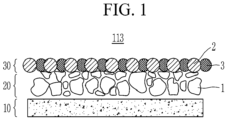
- the separator of an embodiment may include a substrate 10; and a heat resistant layer 20 and an adhesive layer 30 sequentially formed on the first surface of the substrate 10.
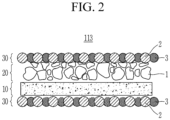
- the separator for a rechargeable lithium battery may include the substrate 10; the heat resistant layer 20 and the adhesive layer 30 sequentially formed on the first surface of the substrate 10; and a second adhesive layer 30 formed on the second surface of the substrate 10.
- the separator for a rechargeable lithium battery may include the substrate 10; a second heat resistant layer 20 and a third adhesive layer 30 sequentially formed on the first surface of the substrate 10; and a third heat resistant layer 20 and a fourth adhesive layer 30 formed on the second surface of the substrate 10.
- the heat resistant layer and the first to third heat resistant layers respectively include a ceramic 1
- the first to fourth adhesive layers respectively include an adhesive binder 2 and an organic filler 3, wherein the adhesive binder includes a polymer having an interpenetrating polymer network (IPN) structure.
- IPN interpenetrating polymer network
- Another embodiment provides a rechargeable lithium battery including the aforementioned separator for a rechargeable lithium battery of an embodiment.
- the aforementioned separator for a rechargeable lithium battery of an embodiment exhibits excellent thermal stability, structural stability, adhesive strength, air permeability, etc., and contributes to the stable operation of a rechargeable lithium battery.
- FIG. 3 is an exploded perspective view of a rechargeable lithium battery according to an embodiment.
- a rechargeable lithium battery 100 includes a battery cell including a negative electrode 112, a positive electrode 114 facing the negative electrode 112, a separator 113 disposed between the negative electrode 112 and the positive electrode 114, and an electrolyte solution (not shown) immersed in the negative electrode 112, positive electrode 114 and separator 113, a battery case 120 housing the battery cell, and a sealing member 140 sealing the battery case 120.
- the positive electrode 114 includes a positive electrode current collector and a positive electrode active material layer formed on the positive electrode current collector.
- the positive electrode active material layer includes a positive electrode active material, a positive electrode binder, and optionally a conductive material.
- the positive electrode current collector may use aluminum, nickel, and the like, but is not limited thereto.
- the positive electrode active material may use a compound capable of intercalating and deintercalating lithium.
- a composite oxide or a composite phosphate of a metal selected from cobalt, manganese, nickel, aluminum, iron, or a combination thereof and lithium may be used.
- the positive electrode active material may be a lithium cobalt oxide, a lithium nickel oxide, a lithium manganese oxide, a lithium nickel cobalt manganese oxide, a lithium nickel cobalt aluminum oxide, a lithium iron phosphate, or a combination thereof.
- the binder improves binding properties of positive electrode active material particles with one another and with a current collector
- specific examples may be polyvinyl alcohol, carboxylmethyl cellulose, hydroxypropyl cellulose, diacetyl cellulose, polyvinylchloride, carboxylated polyvinylchloride, polyvinylfluoride, an ethylene oxide-containing polymer, polyvinylpyrrolidone, polyurethane, polytetrafluoroethylene, polyvinylidene fluoride, polyethylene, polypropylene, a styrene-butadiene rubber, an acrylated styrene-butadiene rubber, an epoxy resin, nylon, and the like, but are not limited thereto. These may be used alone or as a mixture of two or more.
- the conductive material improves conductivity of an electrode and examples thereof may be natural graphite, artificial graphite, carbon black, a carbon fiber, a metal powder, a metal fiber, and the like, but are not limited thereto. These may be used alone or as a mixture of two or more.
- the metal powder and the metal fiber may use a metal of copper, nickel, aluminum, silver, and the like.
- the negative electrode 112 includes a negative electrode current collector and a negative electrode active material layer formed on the negative electrode current collector.
- the negative electrode current collector may use copper, gold, nickel, a copper alloy, and the like, but is not limited thereto.
- the negative electrode active material layer may include a negative electrode active material, a negative electrode binder, and optionally a conductive material.
- the negative electrode active material may be a material that reversibly intercalates/deintercalates lithium ions, a lithium metal, a lithium metal alloy, a material capable of doping and dedoping lithium, a transition metal oxide, or a combination thereof.
- the material that reversibly intercalates/deintercalates lithium ions may be a carbon material which is any generally-used carbon-based negative electrode active material, and examples thereof may be crystalline carbon, amorphous carbon, or a combination thereof.
- the crystalline carbon may be graphite such as irregular, sheet-shape, flake, spherical shape or fiber-shaped natural graphite or artificial graphite.
- the amorphous carbon may be soft carbon or hard carbon, a mesophase pitch carbonized product, calcined coke, and the like.
- the lithium metal alloy may be an alloy of lithium and a metal selected from Na, K, Rb, Cs, Fr, Be, Mg, Ca, Sr, Si, Sb, Pb, In, Zn, Ba, Ra, Ge, Al, and Sn.
- the material capable of doping and dedoping lithium may be Si, SiO x (0 ⁇ x ⁇ 2), a Si-C composite, a Si-Y alloy, Sn, SnO 2 , a Sn-C composite, a Sn-Y alloy, and the like, and at least one of these may be mixed with SiO 2 .
- the element Y may be selected from Mg, Ca, Sr, Ba, Ra, Sc, Y, Ti, Zr, Hf, Rf, V, Nb, Ta, Db, Cr, Mo, W, Sg, Tc, Re, Bh, Fe, Pb, Ru, Os, Hs, Rh, Ir, Pd, Pt, Cu, Ag, Au, Zn, Cd, B, Al, Ga, Sn, In, Tl, Ge, P, As, Sb, Bi, S, Se, Te, Po, and a combination thereof.
- the transition metal oxide may be vanadium oxide, lithium vanadium oxide, and the like.
- the binder and the conductive material used in the negative electrode 112 may be the same as the binder and the conductive material of the aforementioned positive electrode 114.
- the positive electrode 114 and the negative electrode 112 may be manufactured by mixing each active material composition including each active material and a binder, and optionally a conductive material in a solvent, and coating the active material composition on each current collector.
- the solvent may be N-methylpyrrolidone, and the like, but is not limited thereto.
- the electrode manufacturing method is well known, and thus is not described in detail in the present specification.
- the electrolyte solution includes an organic solvent a lithium salt.
- the organic solvent serves as a medium for transmitting ions taking part in the electrochemical reaction of a battery.
- the organic solvent may be a carbonate-based solvent, an ester-based solvent, an ether-based solvent, a ketone-based solvent, an alcohol-based solvent, and an aprotic solvent.
- the carbonate-based solvent may be dimethyl carbonate, diethyl carbonate, dipropyl carbonate, methylpropyl carbonate, ethylpropyl carbonate, methylethyl carbonate, ethylene carbonate, propylene carbonate, butylene carbonate, and the like
- the ester-based solvent may be methyl acetate, ethyl acetate, n-propyl acetate, 1,1-dimethylethyl acetate, methylpropionate, ethylpropionate, ⁇ -butyrolactone, decanolide, valerolactone, mevalonolactone, caprolactone, and the like.
- the ether-based solvent may be dibutyl ether, tetraglyme, diglyme, dimethoxyethane, 2-methyltetrahydrofuran, tetrahydrofuran, and the like, and the ketone-based solvent may be cyclohexanone, and the like.
- the alcohol-based solvent may be ethanol, isopropyl alcohol, and the like
- the aprotic solvent may be nitriles such as R-CN (R is a C2 to C20 linear, branched, or cyclic hydrocarbon group, a double bond, an aromatic ring, or an ether bond), and the like, amides such as dimethyl formamide, dioxolanes such as 1,3-dioxolane, sulfolanes, and the like.
- the organic solvent may be used alone or in a mixture of two or more, and if the organic solvent is used in a mixture of two or more, the mixture ratio may be controlled in accordance with a desirable cell performance.
- the lithium salt is dissolved in an organic solvent, supplies lithium ions in a battery, basically operates the rechargeable lithium battery, and improves lithium ion transportation between positive and negative electrodes therein.
- the lithium salt may include LiPF 6 , LiBF 4 , LiSbF 6 , LiAsF 6 , LiN(SO 3 C 2 F 5 ) 2 , LiN(CF 3 SO 2 ) 2 , LiC 4 F 9 SO 3 , LiClO 4 , LiAlO 2 , LiAlCl 4 , LiN(C x F 2x+1 SO 2 )(C y F 2y+1 SO 2 ) (x and y are natural numbers), LiCl, Lil, LiB(C 2 O 4 ) 2 , or a combination thereof, but are not limited thereto.
- the lithium salt may be used in a concentration ranging from 0.1 M to 2.0 M. If the lithium salt is included within the above concentration range, an electrolyte may have excellent performance and lithium ion mobility due to optimal conductivity and viscosity of the electrolyte solution.
- reaction solution in the flask was reacted for 12 hours, while controlling its temperature to be stable within a range of 65 °C to 70 °C.
- reaction solution was cooled to room temperature and treated with a 25% ammonia aqueous solution to adjust pH into 7 to 8. Then, the reaction solution (reaction product) was taken by about 10 mL to measure a non-volatile component, which was 9.5% (theoretical value: 10%).
- the non-volatile component was poly(acrylic acid-co-acrylamide-co-2-acrylamido-2-methylpropanesulfonic acid) sodium salt having an acrylic acid-derived repeating unit, an acrylamide-derived repeating unit, and a 2-acrylamido-2-methylpropanesulfonic acid-derived repeating unit in a mole ratio of 10:85:5, which was obtained as a binder (acrylic rubber) for a heat resistant layer.
- Boehmite having a D50 particle diameter of 300 nm (manufacturer: NabalTec AG) was pulverized with a bead mill for 2 hours, and water was added thereto, preparing Boehmite dispersion (Boehmite content: 40 wt%).
- the binder for a heat resistant layer according to Preparation Example 1 was mixed with the Boehmite dispersion to have 95 wt% of the Boehmite content in the mixed solution, and water was added thereto to adjust a total solid (the binder for a heat resistant layer and Boehmite) into 5 wt%, preparing a heat resistant layer composition.
- Boehmite and the binder for a heat resistant layer had a weight ratio of 30:1 based on the solid content.
- a polymer (product name: LBG4330LX, manufacturer: Arkema) including an acrylate-based crosslinked polymer and a vinylidene fluoride-based crosslinked polymer in a weight ratio of 3:7 and having a total weight average molecular weight of 500,000 g/mol was used as an adhesive binder having an IPN structure.
- polyvinylidene fluoride particles (product name: Solef latex 2062, manufacturer: Solvay S.A.) having a D50 particle diameter of 250 nm and a weight average molecular weight of 500,000 g/mol were used.
- the weight average molecular weights of the adhesive binder having an IPN structure and the organic filler were an average molecular weight in terms of polystyrene, which was measured by using gel permeation chromatography.
- a weight average molecular weight mentioned below was measured in the same manner as above and thus will not be further mentioned.
- the adhesive binder having an IPN structure and the organic filler were mixed in a weight ratio of 1:1, and polyvinyl alcohol (PVA, manufacturer: Sumitomo Corp.) was added thereto, preparing a composition for an adhesive layer.
- polyvinyl alcohol PVA, manufacturer: Sumitomo Corp.
- the polyvinyl alcohol was added in an amount of 2 wt% based on a total amount of the composition for an adhesive layer.
- a composition for an adhesive layer according to Preparation Example 4 was prepared in the same manner as in Preparation Example 3 except that the adhesive binder having an IPN structure and the organic filler were mixed in a weight ratio of 2:1.
- a composition for an adhesive layer according to Preparation Example 5 was prepared in the same manner as in Preparation Example 3 except that the adhesive binder having an IPN structure and the organic filler were mixed in a weight ratio of 1:3.
- a composition for an adhesive layer according to Preparation Example 6 was prepared in the same manner as in Preparation Example 3 except that the adhesive binder having an IPN structure and the organic filler were mixed in a weight ratio of 2:1.
- a composition for an adhesive layer according to Preparation Example 7 was prepared in the same manner as in Preparation Example 3 except that the adhesive binder having an IPN structure and the organic filler were mixed in a weight ratio of 1:2.
- Polyacrylate a linear polymer having a weight average molecular weight of 500,000 g/mol, was prepared as an adhesive binder having a non-IPN structure.
- a composition for an adhesive layer according to Preparation Comparative Example 1 was prepared in the same manner as in Preparation Example 3 except that the linear polymer, polyacrylate, was used.
- Polyacrylate a linear polymer having a weight average molecular weight of 500,000 g/mol, was prepared as an adhesive binder having a non-IPN structure,.
- a composition for an adhesive layer according to Preparation Comparative Example 2 was prepared in the same manner as in Preparation Example 5 except that the linear polymer, polyacrylate, was used.
- PVdF-HFP poly vinylidene fluoride-co-hexafluoropropylene copolymer, a linear polymer having a weight average molecular weight of 500,000 g/mol, was prepared as an adhesive binder having a non-IPN structure.
- a composition for an adhesive layer according to Preparation Comparative Example 3 was prepared in the same manner as in Preparation Example 3 except that the linear polymer, PVdF-HFP, was used.
- PVdF-HFP poly vinylidene fluoride-co-hexafluoropropylene copolymer, a linear polymer having a weight average molecular weight of 500,000 g/mol, was prepared as an adhesive binder having a non-IPN structure.
- a composition for an adhesive layer according to Preparation Comparative Example 4 was prepared in the same manner as in Preparation Example 5 except that the linear polymer, PVdF-HFP, was used.
- a vinylidene fluoride-acryl copolymer having a weight average molecular weight of about 1,100,000 g/mol and including acrylic acid (AA) within 1 wt% was prepared as an adhesive binder having a non-IPN structure.
- a composition for an adhesive layer according to Preparation Comparative Example 5 was prepared in the same manner as in Preparation Example 5 except that the vinylidene fluoride-acryl copolymer was used.
- the composition for a heat resistant layer according to Preparation Example 2 was coated on the first surface of a 5.5 ⁇ m-thick polyethylene single film substrate in a Gravure coating method.
- the coated substrate was dried at 70 °C and a wind speed of 15 m/sec for 10 seconds, obtaining the substrate coated with a 2 ⁇ m-thick heat resistant layer on one side.
- composition for an adhesive layer according to Preparation Example 3 was coated on the heat resistant layer only on the first surface of the substrate single-side coated with the heat resistant layer in the Gravure coating method, and on the second surface, the composition for an adhesive layer according to Preparation Example 3 was also coated in the Gravure coating method.
- the coated substrate was dried at 70 °C and a wind speed of 15 m/sec for 10 seconds, obtaining a separator having a structure of [adhesive layer/substrate/heat resistant layer/adhesive layer] shown in FIG. 2 .
- a loading amount of the adhesive layer disposed on both surfaces of the substrate was 0.5 g/m 2 on each surface and 1.0 g/m 2 in total on both surfaces.
- a separator and a rechargeable lithium battery cell according to Example 2 were manufactured in the same manner as in Example 1 except that the composition for an adhesive layer of Preparation Example 4 was used instead of the composition for an adhesive layer of Preparation Example 3.
- a separator and a rechargeable lithium battery cell according to Example 3 were manufactured in the same manner as in Example 1 except that the composition for an adhesive layer of Preparation Example 5 was used instead of the composition for an adhesive layer of Preparation Example 3.
- a separator and a rechargeable lithium battery cell according to Example 4 were manufactured in the same manner as in Example 1 except that the composition for an adhesive layer of Preparation Example 6 was used instead of the composition for an adhesive layer of Preparation Example 3.
- a separator and a rechargeable lithium battery cell according to Example 5 were manufactured in the same manner as in Example 1 except that the composition for an adhesive layer of Preparation Example 7 was used instead of the composition for an adhesive layer of Preparation Example 3.
- a separator and a rechargeable lithium battery cell according to Comparative Example 1 were manufactured in the same manner as in Example 1 except that the composition for an adhesive layer of Preparation Comparative Example 1 was used instead of the composition for an adhesive layer of Preparation Example 3.
- a separator and a rechargeable lithium battery cell according to Comparative Example 2 were manufactured in the same manner as in Example 1 except that the composition for an adhesive layer of Preparation Comparative Example 2 was used instead of the composition for an adhesive layer of Preparation Example 3.
- a separator and a rechargeable lithium battery cell according to Comparative Example 3 were manufactured in the same manner as in Example 1 except that the composition for an adhesive layer of Preparation Comparative Example 3 was used instead of the composition for an adhesive layer of Preparation Example 3.
- a separator and a rechargeable lithium battery cell according to Comparative Example 4 were manufactured in the same manner as in Example 1 except that the composition for an adhesive layer of Preparation Comparative Example 4 was used instead of the composition for an adhesive layer of Preparation Example 3.
- a substrate was coated with an adhesive layer on both sides without forming the heat resistant layer on one side.
- a separator and a rechargeable lithium battery cell according to Comparative Example 5 were manufactured in the same manner as in Example 1 except for the above.
- a separator and a rechargeable lithium battery cell according to Comparative Example 6 were manufactured in the same manner as in Example 1 except that the composition for an adhesive layer of Preparation Comparative Example 5 was used instead of the composition for an adhesive layer of Preparation Example 3.
- Each of the separators for a rechargeable lithium battery of the examples and the comparative examples was measured with respect to air permeability immediately after the manufacturing.
- Each of the separators for a rechargeable lithium battery according to the examples and the comparative examples was cut into a size of 10 cm ⁇ 10 cm, preparing a sample for measuring thermal shrinkage rate. After drawing a 5 cm ⁇ 5 cm quadrangle on the surface of the sample for measuring thermal shrinkage, the sample was inserted between papers or alumina powders, left in an oven at 150 °C for 1 hour, and taken out therefrom to measure sides of the quadrangle and calculate each shrinkage in a horizontal direction (MD) and a vertical direction (TD), and the results are shown in Table 1.
- LiCoO 2 , polyvinylidene fluoride, and carbon black in a weight ratio of 96:2:2 were added to an N-methylpyrrolidone solvent, preparing slurry.
- the slurry was coated on an aluminum thin film and then, dried and rolled, manufacturing a positive electrode.
- Each of the separators for a rechargeable lithium battery according to the examples and the comparative examples was cut into a width of 25 mm and a length of 80 mm, and a polyethylene non-woven fabric was also cut into the same size.
- the positive electrode was cut into a width of 30 mm and a length of 80 mm and disposed on one side of each of the separators, while on the other side thereof, the polyethylene non-woven fabric and the positive electrode were disposed, manufacturing a unit cell.
- the unit cell was provided with an electrolyte solution.
- the electrolyte solution was prepared by dissolving 1 M LiBF 4 in propylenecarbonate (PC).
- the corresponding unit cell was experimented with respect to adhesion at about 80 °C for 1 hour under 300 kgf/cm. Subsequently, the unit cell was disassembled to separate the separator about 10 to 20 mm apart from a negative electrode plate, and after fixing the separator into an upper grip and the negative electrode plate into a lower grip with a grip interval of 20 mm, the separator was pulled and peeled from the negative electrode plate in a 180 ° direction. The peeling was performed at 20 mm/min, and after three times measuring a force required to peel the separator 40 mm from the peeling start, an average thereof was calculated. The results are shown in Table 1.
- Each separator for a rechargeable lithium battery according to the examples and the comparative examples was cut into a size of 5 cm X 5 cm, and a polyethylene non-woven fabric, an aluminum substrate, and a positive electrode were also cut into the same size. On both sides of the separator, the polyethylene non-woven fabrics were arranged to manufacture a unit cell, and the unit cell was measured with respect to air permeability. Each unit cell was manufactured by three in total. (b) Each unit cell, of which the air permeability was measured according to the (a), the aluminum substrate and the positive electrode were arranged on both sides and then, provided with an electrolyte solution. The electrolyte solution was prepared by dissolving 1 M LiBF4 in propylene carbonate (PC).
- PC propylene carbonate
- the corresponding cell was experimented with respect to adhesion at about 80 °C for 1 hour under 300 kgf/cm. Subsequently, the cell was disassembled to remove the aluminum substrate and the positive electrode, washed with dimethylcarbonate (DMC) for 20 seconds to remove the lithium salt, and after drying the solvent, measured with respect to air permeability.
- DMC dimethylcarbonate
- An air permeability meter (Model: EG01-55-1MR, Maker: Asahi Seiko Co., Ltd.) was used to measure time (sec) required for 100 cc of air to pass each of the samples for measuring air permeability under a constant pressure (0.05 MPa).
- the air permeability of the three-unit cells were averaged to obtain a change before/after the heat press, and the results are shown in Table1.
- the separators of the examples did not only exhibit air permeability immediately after the manufacturing within an appropriate range and as well as a low thermal shrinkage but also maintained high electrode adhesive strength after the heat press under an electrolyte solution and high air permeability within an appropriate range.
- the separators of the comparative examples in which a heat resistant layer and an adhesive layer were sequentially formed on the first surface of a substrate, exhibited at least one deteriorated characteristic among the aforementioned characteristics as a result of applying an adhesive binder having a non-IPN structure to the adhesive layer.
- the separators of Comparative Examples 1 and 2 in which polyacrylate having a linear structure as an adhesive binder with a non-IPN structure was applied to the adhesive layer, compared with the separators of Examples 1 and 3 in which an adhesive binder with an IPN structure in the same amount was applied, exhibited significantly deteriorated air permeability after the heat press under an electrolyte solution as well as low air permeability immediately after the manufacturing.
- the separators of Comparative Examples 3 and 4 in which PVdF-HFP with a linear structure was applied as an adhesive binder with a non-IPN structure, compared with the separators of Examples 1 and 3, in which an adhesive binder with an IPN structure in the same amount was applied, exhibited significantly deteriorated adhesive strength with a negative electrode under an electrolyte solution after the heat press.
- the separator of Comparative Example 5 in which the same adhesive layer as Example 1 was formed without a heat resistant layer, compared with the separator of Example 1, exhibited significantly deteriorated heat resistance.
- a heat resistant layer including a ceramic was formed on a substrate of a separator to secure thermal stability and structure stability, and an adhesive layer including an adhesive binder with an IPN structure was formed thereon to secure adhesive strength with both electrodes (particularly, negative electrode), wherein an organic filler as an additional component of the adhesive layer was important to use to secure appropriate air permeability after the heat press.
Landscapes
- Chemical & Material Sciences (AREA)
- Chemical Kinetics & Catalysis (AREA)
- Electrochemistry (AREA)
- General Chemical & Material Sciences (AREA)
- Organic Chemistry (AREA)
- Engineering & Computer Science (AREA)
- Inorganic Chemistry (AREA)
- Manufacturing & Machinery (AREA)
- Ceramic Engineering (AREA)
- Health & Medical Sciences (AREA)
- Medicinal Chemistry (AREA)
- Polymers & Plastics (AREA)
- Composite Materials (AREA)
- Materials Engineering (AREA)
- Cell Separators (AREA)
Applications Claiming Priority (1)
| Application Number | Priority Date | Filing Date | Title |
|---|---|---|---|
| KR1020220149821A KR20240068937A (ko) | 2022-11-10 | 2022-11-10 | 리튬 이차 전지용 분리막 및 이를 포함하는 리튬 이차 전지 |
Publications (2)
| Publication Number | Publication Date |
|---|---|
| EP4369450A2 true EP4369450A2 (fr) | 2024-05-15 |
| EP4369450A3 EP4369450A3 (fr) | 2024-10-02 |
Family
ID=88290499
Family Applications (1)
| Application Number | Title | Priority Date | Filing Date |
|---|---|---|---|
| EP23201845.7A Pending EP4369450A3 (fr) | 2022-11-10 | 2023-10-05 | Séparateur pour batterie au lithium rechargeable et batterie au lithium rechargeable le comprenant |
Country Status (5)
| Country | Link |
|---|---|
| US (1) | US20250141045A1 (fr) |
| EP (1) | EP4369450A3 (fr) |
| KR (1) | KR20240068937A (fr) |
| CN (1) | CN118891778A (fr) |
| WO (1) | WO2024101617A1 (fr) |
Family Cites Families (8)
| Publication number | Priority date | Publication date | Assignee | Title |
|---|---|---|---|---|
| WO2013058119A1 (fr) * | 2011-10-18 | 2013-04-25 | Jsr株式会社 | Film protecteur et composition pour sa préparation, bouillie et dispositif de stockage électrique |
| KR101662638B1 (ko) * | 2012-10-22 | 2016-10-05 | 주식회사 엘지화학 | 바인더층을 갖는 분리막, 상기 분리막을 포함하는 전기화학소자, 및 상기 분리막의 제조방법 |
| JP6678389B2 (ja) * | 2014-12-26 | 2020-04-08 | 三星エスディアイ株式会社Samsung SDI Co., Ltd. | 二次電池用バインダ、二次電池用セパレータ、及び二次電池 |
| KR102181313B1 (ko) * | 2015-04-02 | 2020-11-26 | 주식회사 엘지화학 | 리튬 이차전지용 세퍼레이터 및 그의 제조방법 |
| KR102005869B1 (ko) * | 2016-06-30 | 2019-07-31 | 삼성에스디아이 주식회사 | 이차 전지용 분리막 및 이를 포함하는 리튬 이차 전지 |
| KR102279515B1 (ko) * | 2018-09-03 | 2021-07-20 | 삼성에스디아이 주식회사 | 리튬 이차 전지용 분리막 및 이를 포함하는 리튬 이차 전지 |
| CN114178159B (zh) * | 2020-09-14 | 2023-02-21 | 上海恩捷新材料科技有限公司 | 一种电池隔膜及其涂布工艺、涂布系统和电池 |
| CN114085325B (zh) * | 2021-10-29 | 2023-03-21 | 西安交通大学 | 一种导离子半互穿网络聚合物及其制备方法和应用 |
-
2022
- 2022-11-10 KR KR1020220149821A patent/KR20240068937A/ko active Pending
-
2023
- 2023-08-30 US US18/835,485 patent/US20250141045A1/en active Pending
- 2023-08-30 WO PCT/KR2023/012868 patent/WO2024101617A1/fr not_active Ceased
- 2023-08-30 CN CN202380022892.2A patent/CN118891778A/zh active Pending
- 2023-10-05 EP EP23201845.7A patent/EP4369450A3/fr active Pending
Also Published As
| Publication number | Publication date |
|---|---|
| CN118891778A (zh) | 2024-11-01 |
| EP4369450A3 (fr) | 2024-10-02 |
| WO2024101617A1 (fr) | 2024-05-16 |
| KR20240068937A (ko) | 2024-05-20 |
| US20250141045A1 (en) | 2025-05-01 |
Similar Documents
| Publication | Publication Date | Title |
|---|---|---|
| KR102416526B1 (ko) | 리튬 이차 전지용 분리막 및 이를 포함하는 리튬 이차 전지 | |
| EP3902027B1 (fr) | Séparateur pour accumulateur au lithium, et accumulateur au lithium le comprenant | |
| KR102306447B1 (ko) | 리튬 이차 전지용 분리막 및 이를 포함하는 리튬 이차 전지 | |
| KR102335020B1 (ko) | 리튬 이차 전지용 분리막 및 이를 포함하는 리튬 이차 전지 | |
| EP3792995A1 (fr) | Séparateur pour batterie secondaire au lithium, son procédé de fabrication, et batterie secondaire au lithium le comprenant | |
| EP3902028A1 (fr) | Séparateur pour batterie secondaire au lithium et batterie secondaire au lithium le comprenant | |
| KR102229625B1 (ko) | 이차 전지용 분리막 및 이를 포함하는 리튬 이차 전지 | |
| KR102342669B1 (ko) | 리튬 이차 전지용 분리막 및 이를 포함하는 리튬 이차 전지 | |
| KR102229626B1 (ko) | 이차 전지용 분리막 및 이를 포함하는 리튬 이차 전지 | |
| KR102489609B1 (ko) | 리튬 이차 전지용 분리막 및 이를 포함하는 리튬 이차 전지 | |
| EP4394974A1 (fr) | Séparateur pour batterie au lithium rechargeable et batterie au lithium rechargeable le comprenant | |
| EP4369450A2 (fr) | Séparateur pour batterie au lithium rechargeable et batterie au lithium rechargeable le comprenant | |
| KR102598262B1 (ko) | 리튬 이차 전지용 분리막 및 이를 포함하는 리튬 이차 전지 | |
| EP4383439A1 (fr) | Séparateur pour batterie au lithium rechargeable et batterie au lithium rechargeable le comprenant | |
| EP4386964A1 (fr) | Séparateur pour batterie au lithium rechargeable et batterie au lithium rechargeable le comprenant | |
| KR102407048B1 (ko) | 이차 전지용 분리막 및 이를 포함하는 리튬 이차 전지 | |
| KR20200079730A (ko) | 리튬 이차 전지용 분리막 및 이를 포함하는 리튬 이차 전지 |
Legal Events
| Date | Code | Title | Description |
|---|---|---|---|
| PUAI | Public reference made under article 153(3) epc to a published international application that has entered the european phase |
Free format text: ORIGINAL CODE: 0009012 |
|
| STAA | Information on the status of an ep patent application or granted ep patent |
Free format text: STATUS: REQUEST FOR EXAMINATION WAS MADE |
|
| 17P | Request for examination filed |
Effective date: 20231005 |
|
| AK | Designated contracting states |
Kind code of ref document: A2 Designated state(s): AL AT BE BG CH CY CZ DE DK EE ES FI FR GB GR HR HU IE IS IT LI LT LU LV MC ME MK MT NL NO PL PT RO RS SE SI SK SM TR |
|
| PUAL | Search report despatched |
Free format text: ORIGINAL CODE: 0009013 |
|
| AK | Designated contracting states |
Kind code of ref document: A3 Designated state(s): AL AT BE BG CH CY CZ DE DK EE ES FI FR GB GR HR HU IE IS IT LI LT LU LV MC ME MK MT NL NO PL PT RO RS SE SI SK SM TR |
|
| RIC1 | Information provided on ipc code assigned before grant |
Ipc: H01M 50/457 20210101ALI20240826BHEP Ipc: H01M 50/451 20210101ALI20240826BHEP Ipc: H01M 50/446 20210101ALI20240826BHEP Ipc: H01M 50/443 20210101ALI20240826BHEP Ipc: H01M 50/434 20210101ALI20240826BHEP Ipc: H01M 50/426 20210101ALI20240826BHEP Ipc: H01M 50/423 20210101ALI20240826BHEP Ipc: H01M 50/42 20210101ALI20240826BHEP Ipc: H01M 50/417 20210101ALI20240826BHEP Ipc: H01M 10/052 20100101AFI20240826BHEP |