EP4371941A1 - Méthode de fabrication de gypse à l'aide de biosoufre et d'une réaction d'oxydation et utilisations de gypse - Google Patents
Méthode de fabrication de gypse à l'aide de biosoufre et d'une réaction d'oxydation et utilisations de gypse Download PDFInfo
- Publication number
- EP4371941A1 EP4371941A1 EP22938739.4A EP22938739A EP4371941A1 EP 4371941 A1 EP4371941 A1 EP 4371941A1 EP 22938739 A EP22938739 A EP 22938739A EP 4371941 A1 EP4371941 A1 EP 4371941A1
- Authority
- EP
- European Patent Office
- Prior art keywords
- gypsum
- weight
- manufacturing
- biosulfur
- minutes
- Prior art date
- Legal status (The legal status is an assumption and is not a legal conclusion. Google has not performed a legal analysis and makes no representation as to the accuracy of the status listed.)
- Withdrawn
Links
Images

Classifications
-
- C—CHEMISTRY; METALLURGY
- C01—INORGANIC CHEMISTRY
- C01F—COMPOUNDS OF THE METALS BERYLLIUM, MAGNESIUM, ALUMINIUM, CALCIUM, STRONTIUM, BARIUM, RADIUM, THORIUM, OR OF THE RARE-EARTH METALS
- C01F11/00—Compounds of calcium, strontium, or barium
- C01F11/46—Sulfates
-
- C—CHEMISTRY; METALLURGY
- C04—CEMENTS; CONCRETE; ARTIFICIAL STONE; CERAMICS; REFRACTORIES
- C04B—LIME, MAGNESIA; SLAG; CEMENTS; COMPOSITIONS THEREOF, e.g. MORTARS, CONCRETE OR LIKE BUILDING MATERIALS; ARTIFICIAL STONE; CERAMICS; REFRACTORIES; TREATMENT OF NATURAL STONE
- C04B28/00—Compositions of mortars, concrete or artificial stone, containing inorganic binders or the reaction product of an inorganic and an organic binder, e.g. polycarboxylate cements
- C04B28/02—Compositions of mortars, concrete or artificial stone, containing inorganic binders or the reaction product of an inorganic and an organic binder, e.g. polycarboxylate cements containing hydraulic cements other than calcium sulfates
- C04B28/08—Slag cements
-
- C—CHEMISTRY; METALLURGY
- C04—CEMENTS; CONCRETE; ARTIFICIAL STONE; CERAMICS; REFRACTORIES
- C04B—LIME, MAGNESIA; SLAG; CEMENTS; COMPOSITIONS THEREOF, e.g. MORTARS, CONCRETE OR LIKE BUILDING MATERIALS; ARTIFICIAL STONE; CERAMICS; REFRACTORIES; TREATMENT OF NATURAL STONE
- C04B28/00—Compositions of mortars, concrete or artificial stone, containing inorganic binders or the reaction product of an inorganic and an organic binder, e.g. polycarboxylate cements
- C04B28/14—Compositions of mortars, concrete or artificial stone, containing inorganic binders or the reaction product of an inorganic and an organic binder, e.g. polycarboxylate cements containing calcium sulfate cements
-
- C—CHEMISTRY; METALLURGY
- C04—CEMENTS; CONCRETE; ARTIFICIAL STONE; CERAMICS; REFRACTORIES
- C04B—LIME, MAGNESIA; SLAG; CEMENTS; COMPOSITIONS THEREOF, e.g. MORTARS, CONCRETE OR LIKE BUILDING MATERIALS; ARTIFICIAL STONE; CERAMICS; REFRACTORIES; TREATMENT OF NATURAL STONE
- C04B7/00—Hydraulic cements
- C04B7/14—Cements containing slag
- C04B7/147—Metallurgical slag
- C04B7/153—Mixtures thereof with other inorganic cementitious materials or other activators
- C04B7/21—Mixtures thereof with other inorganic cementitious materials or other activators with calcium sulfate containing activators
Definitions
- the present invention relates to a method for manufacturing gypsum using an oxidation reaction with biosulfur and uses of the gypsum, and more particularly, to a method for manufacturing gypsum containing a high content of one or more of hemihydrate gypsum, dihydrate gypsum and anhydrous gypsum using an oxidation reaction with biosulfur, and its use.
- Gypsum can be broadly divided into natural gypsum, which is naturally produced, and artificially manufactured gypsum. Most natural gypsum is primarily formed through the evaporation of seawater, resulting in the initial precipitation of CaCO 3 as limestone. Subsequently, this precipitate is deposited in layers and transforms into gypsum. In Korea, there is no natural gypsum, so it is imported and used mainly from countries like Thailand.
- Gypsum is a sulfate mineral whose main ingredient is calcium sulfate (CaSO4), and exists in the form of anhydrous gypsum (CaSO 4 ), dihydrate gypsum (CaSO 4 ⁇ 2H 2 O), and/or hemihydrate gypsum (CaSO 4 ⁇ 1/2H 2 O).
- Gypsum plays a role in delaying the hydration of components that hydrate quickly, such as 3CaO-Al 2 O 3 , among cement components, and in providing expansion properties to cement.
- gypsum is often used as a grinding agent for solidified quenching slag in the process of manufacturing slag cement. The gypsum used in this process facilitates the grinding of the solidified quenching slag, improves the activity of blast furnace ash slag fine powder contained in slag cement, and reduces shrinkage.
- the present inventors continued their research to meet the needs of the prior art, and as a result, confirmed that when gypsum is manufactured under certain conditions using biosulfur and an oxidation reaction, the use of sulfuric acid can be minimized, making it environmentally friendly, and high quality gypsum having a content of more than 70% by weight of hemihydrate gypsum, dihydrate gypsum, and/or anhydrous gypsum can be obtained, thus completing the present invention.
- Another object of the present invention is to provide gypsum containing at least 70% by weight of hemihydrate gypsum, dihydrate gypsum, and/or anhydrous gypsum manufactured by the above method.
- Another object of the present invention is to provide a composition for a gypsum board comprising said gypsum.
- Another object of the present invention is to provide an aid for grinding blast furnace slag comprising said gypsum.
- Another object of the present invention is to provide an admixture for cement comprising said gypsum.
- Another object of the present invention is to provide a slag cement comprising said gypsum.
- Another object of the present invention is to provide a concrete composition comprising said slag cement.
- the present invention provides a method for manufacturing gypsum comprising the steps of:
- gypsum means containing at least 70 % by weight, preferably at least 80 % by weight, most preferably at least 85% by weight of one or more selected from the group consisting of hemihydrate gypsum, dihydrate gypsum, and anhydrous gypsum.
- biosulfur refers to an aqueous suspension containing sulfur (S) produced through a biological sulfur conversion process. Compared to chemically produced sulfur, biosulfur is hydrophilic and is a stable aqueous suspension of sulfur with a particle size of 10 ⁇ m or less. In addition, biosulfur is virtually non-toxic and can be used without the legislation required for chemically produced sulfur.
- Biosulfur is a by-product produced in the hydrogen sulfide (H2S) treatment process using sulfur-oxidizing microorganisms.
- lime may include limestone, slaked lime, quicklime, waste limestone, limestone sludge, and slaked lime sludge containing at least 40 % by weight of calcium oxide (CaO).
- the sulfur (S) in biosulfur reacts with Ca in lime to produce CaS (calcium-sulfur) compounds.
- biosulfur is used having a sulfur content of at least 40 % by weight, preferably at least 70 % by weight. If the content of sulfur in the biosulfur is less than 40 % by weight, the production of CaS compounds is poor, resulting in a lower yield of gypsum.
- lime containing more than 40% by weight of CaO calcium oxide
- the calcium oxide component is less than 40% by weight, the production of CaS compounds is not complete, which ultimately lowers the production yield of gypsum, making it uneconomical.
- the calcium oxide component is 45% by weight or more.
- mixing is carried out at a temperature of 90 to 150 °C. If the temperature is less than 90 °C, the sulfur contained in the biosulfur is not dissolved, and if the temperature is above 150 °C, it is not economical. Preferably, the temperature is between 100 and 120 °C.
- mixing is performed at 100 to 300 rpm for 30 minutes to 6 hours. If mixing at less than 100 rpm, CaS compounds cannot be sufficiently produced due to the formation of precipitates. If mixing at more than 300 rpm is economically undesirable. Preferably, 150 to 200 rpm is appropriate. If the mixing time is less than 30 minutes, sufficient CaS compounds cannot be produced. Mixing more than 6 hours is economically undesirable. A mixing time of 2 to 5 hours is preferred.
- step i) while stirring the mixture from step i) at 30 rpm or more, the mixture is subjected to an oxidation reaction for 30 minutes to 2 hours by adding 50 to 150 parts by weight of a 5-15% sulfuric acid solution to 100 parts by weight of said mixture, while maintaining a pH in the range of 2 to 5.
- the CaS compounds are oxidized by sulfuric acid to produce gypsum containing a large amount of hemihydrate.
- a 5-15% sulfuric acid solution it is preferable to use a 5-15% sulfuric acid solution.
- a sulfuric acid solution concentration of less than 5% results in a less efficient oxidation reaction, and a concentration of more than 15% is undesirable in the manufacturing environment.
- a 5-15% sulfuric acid solution is used in an amount of 50 to 150 parts by weight. If it is less than 50 parts by weight, the oxidation reaction is weak and the production yield of hemihydrate gypsum is low, and if it exceeds 150 parts by weight, it is economically undesirable. Preferably, 80 to 120 parts by weight of the 5-15% sulfuric acid solution is used.
- the pH is maintained in the range of 2 to 5. If the pH is less than 2, it may cause a decrease in the production of gypsum (hemihydrate gypsum) due to too strong acidity, and if the pH is more than 5, gypsum cannot be produced.
- the pH is in the range of 3 to 4.
- mixing is performed for 30 minutes to 2 hours. If it is less than 30 minutes, sufficient oxidation reaction does not proceed, which reduces the production of gypsum (hemihydrate gypsum), and if it exceeds 2 hours, it is economically undesirable. Preferably, mixing is performed for 1 hour to 1 hour and 30 minutes.
- gypsum containing a large amount of anhydrous gypsum is produced by adding 20 to 100 parts by weight of a 5-15% sulfuric acid solution to 100 parts by weight of the reaction product (hemihydrate gypsum) from step ii) above and mixing for 30 minutes to 2 hours while stirring at 30 rpm or more.
- reaction product from step ii) is dried at 90 to 120 °C for at least 30 minutes to obtain gypsum.
- drying is carried out at a temperature of 90 to 120 °C for 30 minutes or more. If the temperature is less than 90 °C, the produced gypsum has a lot of moisture and is difficult to use, and if the temperature exceeds 120 °C, it is economically undesirable.
- the drying temperature is 95 to 110 °C, and the drying time is preferably 30 minutes or more.
- the reaction product may be filtered to remove moisture and/or washed with water to remove any remaining sulfuric acid.
- Filtration and washing can be performed by conventional methods in gypsum manufacture.
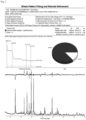
- the manufacturing method according to the present invention is environmentally friendly by minimizing the use of sulfuric acid and can produce a high-quality gypsum containing at least 70% by weight of hemihydrate gypsum, dihydrate gypsum, and/or anhydrous gypsum ( FIG. 2 ).
- gypsum containing at least 70% by weight of hemihydrate gypsum, dihydrate gypsum, and/or anhydrous gypsum manufactured by the above method.
- composition for a gypsum board comprising said gypsum is provided.
- an aid for grinding blast furnace slag comprising said gypsum.
- the aid according to the present invention may be used in an amount of about 2 to 3 % by weight of blast furnace slag.
- an admixture for cement comprising said gypsum.
- the admixture according to the present invention may be used at about 5 to 8% by weight of cement.
- a slag cement comprising said gypsum.
- a concrete composition comprising said slag cement.
- the manufacturing method according to the present invention is environmentally friendly by minimizing the use of sulfuric acid and produces high-quality gypsum containing more than 70% by weight of hemihydrate gypsum, dihydrate gypsum, and/or anhydrous gypsum.
- the manufacturing method according to the present invention utilizes biosulfur generated as a by-product of biogas to solve environmental problems and at the same time has the effect of recycling waste resources.
- the gypsum produced by the manufacturing method of the present invention has a high content of anhydrous gypsum, hemihydrate gypsum, and/or dihydrate gypsum, and does not contain environmental pollutants such as heavy metal ions due to the use of biosulfur. Therefore it can be used as gypsum for gypsum board, aid for blast furnace slag grinding, admixture for cement, gypsum for slag cement, etc.
- the gypsum according to the present invention is gypsum containing a high content of anhydrous gypsum, hemihydrate gypsum, and/or dihydrate gypsum, so it can be used in a small amount, so it has an excellent economic value-added effect and can replace natural gypsum.
- Example 1 Gypsum manufacture using biosulfur and oxidation reaction
- reaction product was compressively filtered using a filter press to remove moisture, washed with water, and dried at 105 °C for 60 min to obtain gypsum.
- a photograph of the resulting gypsum is shown in FIG. 1 .
- the gypsum prepared in Example 1 was analyzed for the amounts of components such as gypsum using an X-ray quantitative component analysis device (Rigaku, D/Max-2500V), and the results are shown in FIG. 2 .
- the gypsum manufactured according to the present invention contains 85.6% by weight of hemihydrate gypsum (CaSO 4 .1/2H 2 O).
Landscapes
- Chemical & Material Sciences (AREA)
- Engineering & Computer Science (AREA)
- Ceramic Engineering (AREA)
- Organic Chemistry (AREA)
- Inorganic Chemistry (AREA)
- Materials Engineering (AREA)
- Structural Engineering (AREA)
- Chemical Kinetics & Catalysis (AREA)
- Life Sciences & Earth Sciences (AREA)
- Geology (AREA)
- Compounds Of Alkaline-Earth Elements, Aluminum Or Rare-Earth Metals (AREA)
Applications Claiming Priority (2)
| Application Number | Priority Date | Filing Date | Title |
|---|---|---|---|
| KR1020220124824A KR102530614B1 (ko) | 2022-09-30 | 2022-09-30 | 바이오황과 산화반응을 이용한 석고 제조방법 및 그 이용 |
| PCT/KR2022/015544 WO2024071503A1 (fr) | 2022-09-30 | 2022-10-14 | Méthode de fabrication de gypse à l'aide de biosoufre et d'une réaction d'oxydation et utilisations de gypse |
Publications (2)
| Publication Number | Publication Date |
|---|---|
| EP4371941A1 true EP4371941A1 (fr) | 2024-05-22 |
| EP4371941A4 EP4371941A4 (fr) | 2025-03-19 |
Family
ID=86546578
Family Applications (1)
| Application Number | Title | Priority Date | Filing Date |
|---|---|---|---|
| EP22938739.4A Withdrawn EP4371941A4 (fr) | 2022-09-30 | 2022-10-14 | Méthode de fabrication de gypse à l'aide de biosoufre et d'une réaction d'oxydation et utilisations de gypse |
Country Status (3)
| Country | Link |
|---|---|
| EP (1) | EP4371941A4 (fr) |
| KR (1) | KR102530614B1 (fr) |
| WO (1) | WO2024071503A1 (fr) |
Family Cites Families (9)
| Publication number | Priority date | Publication date | Assignee | Title |
|---|---|---|---|---|
| US4520002A (en) * | 1984-01-20 | 1985-05-28 | Merichem Company | Method for preparing elemental sulfur as a diffusion-resistant gas and methods for its use in making lime, sulfur dioxide and sulfuric acid from waste gypsum |
| KR100406392B1 (ko) | 1998-12-11 | 2004-02-14 | 주식회사 포스코 | 제철소의부산물을이용한폐황산의중화처리및이중화처리과정에서발생하는침전물을석고로제조하는방법 |
| SG86468A1 (en) * | 2000-05-12 | 2002-02-19 | Yoshino Gypsum Co | Production process of high-purity gypsum |
| KR101721169B1 (ko) * | 2015-11-03 | 2017-03-29 | 현대오일뱅크 주식회사 | 탈황 부산물을 원료로 하는 석회유황합제 및 무수석고 제조방법 |
| KR102038327B1 (ko) * | 2018-03-26 | 2019-10-30 | 신유근 | 황산폐수를 이용한 시멘트용 중화석고 제조방법 |
| KR101962240B1 (ko) * | 2018-05-30 | 2019-07-19 | 주식회사 케이스트 | 제강슬래그 또는 산화칼슘을 함유한 산업부산물을 주원료로 알칼리중화제를 제조하고 폐산을 건식법으로 중화하여 so3 함량 38%(중량기준) 이상의 화학석고를 제조하는 방법 |
| AU2020330562B2 (en) * | 2019-08-13 | 2026-01-08 | Brimstone Energy Inc. | Process to make calcium oxide or ordinary portland cement from calcium bearing rocks and minerals |
| KR102213892B1 (ko) * | 2019-12-12 | 2021-02-09 | 수도권매립지관리공사 | 매립가스 유래 바이오 황을 포함하는 유황콘크리트의 제조방법 및 이에 의해 제조되는 유황콘크리트 조성물 |
| JP7406994B2 (ja) * | 2020-01-08 | 2023-12-28 | Ube三菱セメント株式会社 | セメント組成物の製造方法 |
-
2022
- 2022-09-30 KR KR1020220124824A patent/KR102530614B1/ko active Active
- 2022-10-14 EP EP22938739.4A patent/EP4371941A4/fr not_active Withdrawn
- 2022-10-14 WO PCT/KR2022/015544 patent/WO2024071503A1/fr not_active Ceased
Also Published As
| Publication number | Publication date |
|---|---|
| EP4371941A4 (fr) | 2025-03-19 |
| KR102530614B1 (ko) | 2023-05-19 |
| WO2024071503A1 (fr) | 2024-04-04 |
| KR102530614B9 (ko) | 2023-11-13 |
Similar Documents
| Publication | Publication Date | Title |
|---|---|---|
| Shu et al. | Simultaneous stabilization/solidification of Mn2+ and NH4+-N from electrolytic manganese residue using MgO and different phosphate resource | |
| CN101962239B (zh) | 一种钛白废水的净化方法 | |
| AU736759B2 (en) | Disposal of arsenic from sulfur dioxide-containing solutions | |
| Aubé et al. | Comparison of AMD treatment processes and their impact on sludge characteristics | |
| Chimenos et al. | Optimization of phosphate removal in anodizing aluminium wastewater | |
| CN113149263A (zh) | 一种钠基脱硫灰资源化利用处理酸性废水的方法 | |
| CN114804177A (zh) | 一种工业固废电解锰渣矿化co2资源化利用的方法 | |
| KR100406392B1 (ko) | 제철소의부산물을이용한폐황산의중화처리및이중화처리과정에서발생하는침전물을석고로제조하는방법 | |
| Shu et al. | Cooperative removal of Mn2+, NH4+− N, PO43−− P and F− from electrolytic manganese residue leachate and phosphogypsum leachate | |
| CA2874325A1 (fr) | Traitement de cendre volante et de lixiviat de cendre volante | |
| CN110562933B (zh) | 一种工业副产石膏钙硫快速分离的方法 | |
| CN113174490B (zh) | 一种硫酸镍生产过程产生的除杂渣的资源化处置方法 | |
| KR102530614B1 (ko) | 바이오황과 산화반응을 이용한 석고 제조방법 및 그 이용 | |
| WO2007021646A2 (fr) | Traitement de chaux vive a teneur elevee en sulfate | |
| KR102452142B1 (ko) | 바이오황을 이용한 석고 제조방법 및 그 이용 | |
| JP5135552B2 (ja) | 水域投入用製鋼スラグの製造方法 | |
| CZ297704B6 (cs) | Zpusob zpracování prumyslových odpadních vod | |
| TW202039361A (zh) | 氫氧基磷灰石及其製備方法 | |
| CN114163012A (zh) | 一种废水中的硫酸盐的处理方法 | |
| DE3815948A1 (de) | Verfahren zur chromausfaellung aus gerbereiabwaessern | |
| Mansor et al. | Optimization of Calcium Oxide Extraction from Carbide Lime via Acid Leaching: A Response Surface Methodology Analysis | |
| CN113603128A (zh) | 工业副产石膏制备多种硫酸钙粉体的方法以及硫酸钙粉体 | |
| US4237025A (en) | Product comprising lime or limestone and Graham's salt or Mx Pn O.sub.(3N+1) | |
| KR102560657B1 (ko) | 스테인리스스틸 소둔산세 폐황산 다단 중화처리의 슬러지 재활용 방법 | |
| JP6885094B2 (ja) | 硫黄含有スラグの脱硫方法及び硫黄含有スラグを利用した土木建設材の製造方法並びにスラグ施工体の製造方法 |
Legal Events
| Date | Code | Title | Description |
|---|---|---|---|
| STAA | Information on the status of an ep patent application or granted ep patent |
Free format text: STATUS: UNKNOWN |
|
| STAA | Information on the status of an ep patent application or granted ep patent |
Free format text: STATUS: THE INTERNATIONAL PUBLICATION HAS BEEN MADE |
|
| PUAI | Public reference made under article 153(3) epc to a published international application that has entered the european phase |
Free format text: ORIGINAL CODE: 0009012 |
|
| STAA | Information on the status of an ep patent application or granted ep patent |
Free format text: STATUS: REQUEST FOR EXAMINATION WAS MADE |
|
| 17P | Request for examination filed |
Effective date: 20231102 |
|
| AK | Designated contracting states |
Kind code of ref document: A1 Designated state(s): AL AT BE BG CH CY CZ DE DK EE ES FI FR GB GR HR HU IE IS IT LI LT LU LV MC ME MK MT NL NO PL PT RO RS SE SI SK SM TR |
|
| RAP3 | Party data changed (applicant data changed or rights of an application transferred) |
Owner name: ECOBIO HOLDINGS CO., LTD. |
|
| A4 | Supplementary search report drawn up and despatched |
Effective date: 20250217 |
|
| RIC1 | Information provided on ipc code assigned before grant |
Ipc: C04B 28/08 20060101ALI20250211BHEP Ipc: C04B 28/14 20060101ALI20250211BHEP Ipc: C01F 11/46 20060101AFI20250211BHEP |
|
| STAA | Information on the status of an ep patent application or granted ep patent |
Free format text: STATUS: THE APPLICATION IS DEEMED TO BE WITHDRAWN |
|
| DAV | Request for validation of the european patent (deleted) | ||
| DAX | Request for extension of the european patent (deleted) | ||
| 18D | Application deemed to be withdrawn |
Effective date: 20250909 |