EP4372143A1 - Verfahren zur herstellung eines antiviralen gewebes und damit hergestelltes antivirales gewebe - Google Patents
Verfahren zur herstellung eines antiviralen gewebes und damit hergestelltes antivirales gewebe Download PDFInfo
- Publication number
- EP4372143A1 EP4372143A1 EP22822252.7A EP22822252A EP4372143A1 EP 4372143 A1 EP4372143 A1 EP 4372143A1 EP 22822252 A EP22822252 A EP 22822252A EP 4372143 A1 EP4372143 A1 EP 4372143A1
- Authority
- EP
- European Patent Office
- Prior art keywords
- fabric
- metal layer
- forming
- plasma sputtering
- antiviral
- Prior art date
- Legal status (The legal status is an assumption and is not a legal conclusion. Google has not performed a legal analysis and makes no representation as to the accuracy of the status listed.)
- Pending
Links
Images

Classifications
-
- C—CHEMISTRY; METALLURGY
- C23—COATING METALLIC MATERIAL; COATING MATERIAL WITH METALLIC MATERIAL; CHEMICAL SURFACE TREATMENT; DIFFUSION TREATMENT OF METALLIC MATERIAL; COATING BY VACUUM EVAPORATION, BY SPUTTERING, BY ION IMPLANTATION OR BY CHEMICAL VAPOUR DEPOSITION, IN GENERAL; INHIBITING CORROSION OF METALLIC MATERIAL OR INCRUSTATION IN GENERAL
- C23C—COATING METALLIC MATERIAL; COATING MATERIAL WITH METALLIC MATERIAL; SURFACE TREATMENT OF METALLIC MATERIAL BY DIFFUSION INTO THE SURFACE, BY CHEMICAL CONVERSION OR SUBSTITUTION; COATING BY VACUUM EVAPORATION, BY SPUTTERING, BY ION IMPLANTATION OR BY CHEMICAL VAPOUR DEPOSITION, IN GENERAL
- C23C14/00—Coating by vacuum evaporation, by sputtering or by ion implantation of the coating forming material
- C23C14/06—Coating by vacuum evaporation, by sputtering or by ion implantation of the coating forming material characterised by the coating material
- C23C14/14—Metallic material, boron or silicon
- C23C14/20—Metallic material, boron or silicon on organic substrates
- C23C14/205—Metallic material, boron or silicon on organic substrates by cathodic sputtering
-
- C—CHEMISTRY; METALLURGY
- C23—COATING METALLIC MATERIAL; COATING MATERIAL WITH METALLIC MATERIAL; CHEMICAL SURFACE TREATMENT; DIFFUSION TREATMENT OF METALLIC MATERIAL; COATING BY VACUUM EVAPORATION, BY SPUTTERING, BY ION IMPLANTATION OR BY CHEMICAL VAPOUR DEPOSITION, IN GENERAL; INHIBITING CORROSION OF METALLIC MATERIAL OR INCRUSTATION IN GENERAL
- C23C—COATING METALLIC MATERIAL; COATING MATERIAL WITH METALLIC MATERIAL; SURFACE TREATMENT OF METALLIC MATERIAL BY DIFFUSION INTO THE SURFACE, BY CHEMICAL CONVERSION OR SUBSTITUTION; COATING BY VACUUM EVAPORATION, BY SPUTTERING, BY ION IMPLANTATION OR BY CHEMICAL VAPOUR DEPOSITION, IN GENERAL
- C23C14/00—Coating by vacuum evaporation, by sputtering or by ion implantation of the coating forming material
- C23C14/22—Coating by vacuum evaporation, by sputtering or by ion implantation of the coating forming material characterised by the process of coating
- C23C14/34—Sputtering
-
- C—CHEMISTRY; METALLURGY
- C23—COATING METALLIC MATERIAL; COATING MATERIAL WITH METALLIC MATERIAL; CHEMICAL SURFACE TREATMENT; DIFFUSION TREATMENT OF METALLIC MATERIAL; COATING BY VACUUM EVAPORATION, BY SPUTTERING, BY ION IMPLANTATION OR BY CHEMICAL VAPOUR DEPOSITION, IN GENERAL; INHIBITING CORROSION OF METALLIC MATERIAL OR INCRUSTATION IN GENERAL
- C23C—COATING METALLIC MATERIAL; COATING MATERIAL WITH METALLIC MATERIAL; SURFACE TREATMENT OF METALLIC MATERIAL BY DIFFUSION INTO THE SURFACE, BY CHEMICAL CONVERSION OR SUBSTITUTION; COATING BY VACUUM EVAPORATION, BY SPUTTERING, BY ION IMPLANTATION OR BY CHEMICAL VAPOUR DEPOSITION, IN GENERAL
- C23C14/00—Coating by vacuum evaporation, by sputtering or by ion implantation of the coating forming material
- C23C14/22—Coating by vacuum evaporation, by sputtering or by ion implantation of the coating forming material characterised by the process of coating
- C23C14/56—Apparatus specially adapted for continuous coating; Arrangements for maintaining the vacuum, e.g. vacuum locks
- C23C14/562—Apparatus specially adapted for continuous coating; Arrangements for maintaining the vacuum, e.g. vacuum locks for coating elongated substrates
-
- D—TEXTILES; PAPER
- D06—TREATMENT OF TEXTILES OR THE LIKE; LAUNDERING; FLEXIBLE MATERIALS NOT OTHERWISE PROVIDED FOR
- D06M—TREATMENT, NOT PROVIDED FOR ELSEWHERE IN CLASS D06, OF FIBRES, THREADS, YARNS, FABRICS, FEATHERS OR FIBROUS GOODS MADE FROM SUCH MATERIALS
- D06M11/00—Treating fibres, threads, yarns, fabrics or fibrous goods made from such materials, with inorganic substances or complexes thereof; Such treatment combined with mechanical treatment, e.g. mercerising
- D06M11/83—Treating fibres, threads, yarns, fabrics or fibrous goods made from such materials, with inorganic substances or complexes thereof; Such treatment combined with mechanical treatment, e.g. mercerising with metals; with metal-generating compounds, e.g. metal carbonyls; Reduction of metal compounds on textiles
Definitions
- the present disclosure relates to a method of manufacturing an antiviral fabric and an antiviral fabric manufactured thereby.
- Viruses are infectious agents and are intermediates between living and non-living things.
- a virus requires a host for parasitism and proliferation thereof and consists of two or three parts that protect the genetic material consisting of DNA or RNA.
- the virus has a very simple structure consisting of a genetic material such as RNA or DNA and a protein coat (called capsid) surrounding the genetic material.
- the protein coat (capsid) is a collection of beaded proteins (capsomeres).
- Some viruses have a membrane consisting of lipids in addition to the protein coat.
- Cloth or fabrics which are closely related to human life, are easy for viruses to penetrate and thus function as virus carriers.
- To impart antimicrobial functions to a fabric techniques of adding antimicrobial substances to the fabric are being developed.
- existing techniques have problems in that antiviral substances are expensive, a large amount of antiviral substance is required, and antiviral substances have poor adhesion to fabrics.
- the present disclosure relates to a method of manufacturing an antiviral fabric and an antiviral fabric manufactured thereby.
- One embodiment of the present disclosure provides a method of manufacturing an antiviral fabric, the method comprising:
- One embodiment of the present disclosure provides an antiviral fabric prepared by the method, the antiviral fabric comprising: a fabric; and a metal layer having a thickness in a range of 5 nm to 900 nm and being provided on one surface or both surfaces of the fabric.
- antiviral function refers to an antibacterial function, a virus killing function, or a combination thereof.
- One embodiment of the present disclosure provides a method of manufacturing an antiviral fabric, the method comprising: pre-processing a fabric; and
- the manufacturing method provides excellent adhesion between a fabric and a metal layer.
- the metal layer has an antiviral function, the antiviral function can be imparted to a fabric.
- the metal layer serves to impart an antiviral function to a fabric.
- viruses approach metal ions in the metal layer (step 1 in FIG. 2 ) by recognizing the metal ions as hosts.
- the metal ions destroy the shell of the virus (step 2 in FIG. 2 ) and permeates into the virus through the shell (step 3 in FIG. 2 ).
- the metabolism of the virus is stopped, and DNA and RNA of the virus decompose, resulting in death of the virus (step 4 in FIG. 2 ).
- the metal layer may have a thickness in a range of 5 nm to 900 nm, a range of 5 nm to 500 nm, a range of 5 nm to 200 nm, a range of 5 nm to 100 nm, or a range of 8 nm to 20 nm.
- the metal layer has an antiviral function. However, when the metal layer is excessively thick, the physical properties of the fabric deteriorate. When the thickness of the metal layer falls within the numerical range described above, the antiviral function of the metal layer is maintained, and the physical properties of the fabric are maintained.
- the antiviral fabric manufacturing method satisfies Formula 1 shown below. T 1 / TO * 100 % ⁇ 70
- the calculated value of Formula 1 indicates the limit of a decrease in tensile strength before and after forming the metal layer by plasma sputtering on one or both surfaces of the fabric.
- the calculated value of Formula 1 may be 70 or more, 80 or more, 90 or more, or 95 or more.
- a relatively great calculated value of Formula 1 indicates that the tensile strength did not decrease but the fabric maintains high tension strength.
- the upper limit of the value is not particularly limited but may be 100%.
- the tensile strength refers to an average value of a warp tensile strength value and a weft tensile strength value.
- the antiviral fabric manufacturing method satisfies Formula 2 shown below.
- the calculated value of Formula 2 indicates an increase in virus killing rate before and after forming the metal layer by plasma sputtering on one or both surfaces of the fabric.
- the calculated value of Formula 2 may be 70 or more, 75 or more, 80 or more, or 85 or more.
- a relatively great calculated value of Formula 2 indicates that the virus killing rate remains high.
- the upper limit of the value is not particularly limited but may be 100%.
- the antiviral fabric manufacturing method satisfies Formula 3 shown below.
- the calculated value of Formula 3 indicates an average value of a decrease in tensile strength and an increase in virus killing rate before and after forming the metal layer by plasma sputtering on one or both surfaces of the fabric.
- the calculated value of Formula 1 may be 70 or more, 80 or more, 85 or more, or 90 or more.
- a relatively great calculated value of Formula 3 indicates that the tensile strength does not significantly decrease and the virus killing rate remains high.
- the upper limit of the value is not particularly limited but may be 100%.
- the metal layer may comprise: one or more materials selected from the group consisting of indium (In), titanium (Ti), tin (Sn), silicon (Si), germanium (Ge), aluminum (Al), nickel (Ni), vanadium (V), tungsten (W), tantalum (Ta), molybdenum (Mo), neodymium (Nb), iron (Fe), chromium (Cr), cobalt (Co), silver (Ag), copper (Cu), and zinc (Zn), nitrides thereof, and oxides thereof.
- the metal layer may comprise one or more materials selected from the group consisting of metals comprising silver (Ag), copper (Cu), and zinc (Zn), nitrides thereof; and oxides thereof.
- the materials are materials that have been confirmed to have a good virus killing effect.
- the step of forming the metal layer by plasma sputtering on one surface or both surfaces of the fabric may comprise: feeding the fabric into a chamber provided with a target made of the metal described above;
- the plasma sputtering may be performed using known equipment.
- the metal target may be a raw material of metal to form the metal layer on the fabric.
- a vacuum condition may be formed in the chamber before the sputtering gas is introduced into the chamber.
- the introducing of the sputtering gas into the chamber is to supply the sputtering gas.
- the sputtering gas may be an inert gas or a reactive gas such as oxygen or nitrogen.
- the plasma sputtering may be reactive sputtering.
- the sputtering gas may be argon (Ar) or helium (He).
- the plasma in the step of generating plasma in the chamber by applying a voltage between the fabric and the metal target, the plasma is generated around the metal target, and cations in a plasma discharge region are accelerated by an electric field generated between the fabric and the metal target so that the accelerated cations collide with the metal target.
- metal atoms are emitted from the metal target, and the metal atoms move and reach one surface of the fabric.
- the distance between the fabric and the metal target may be in a range of 1 cm to 30 cm, a range of 3 cm to 20 cm, or a range of 5 cm to 10 cm.
- the thickness of the metal layer required by the present disclosure can be easily obtained.
- the voltage applied per unit area of the target may be in a range of 1 kW to 100 kW, a range of 1 kW to 50 kW, a range of 2 kW to 10 kW, or a range of 3 kW to 8 kW.
- the thickness of the metal layer required by the present disclosure can be easily obtained.
- a process pressure required in the step of applying a voltage between the fabric and the metal target to generate plasma in the chamber may be in a range of 1 mTorr to 100 mTorr, preferably a range of 1 mTorr to 75 mTorr, and more preferably a range of 1 mTorr to 50 mTorr.
- the process pressure during the sputtering process is higher than the upper limit of the range, the number of plasma gas particles in the chamber increases, and the particles emitted from the target collide with the plasma gas particles and thus lose energy. Therefore, the growth rate of the island may be reduced.
- the process pressure when the process pressure is maintained at a low level, the energy loss of the island component particles due to the plasma gas particles is reduced.
- the optimum sputtering process conditions must be obtained by controlling various parameters such as the size of the deposition equipment, the distance between a sample position and the target, the type of the target, the type of gas, the flow rate of gas, and the process pressure.
- the step of forming a metal layer by plasma sputtering on one surface or both surfaces of the fabric may be performed for a duration in a range of 1 minute to 1 hour, a range of 3 minutes to 30 minutes, or a range of 3 minutes to 25 minutes.
- the range is satisfied, the durability of the fabric can be maintained, and the thickness of the metal layer required by the present disclosure can be easily obtained.
- the pre-processing of the fabric is performed to remove residual contaminants present on the fabric.
- the pre-processing of the fabric may be a method of dipping a fabric in a pre-processing solution.
- the pre-processing solution may be one or more solutions selected from the group consisting of ammonium persulfate (NH 4 ) 2 S 2 O 8 , NH 4 HSO 5 , KHSOs, hydrogen peroxide, bromate, and persulfate.
- the method may further comprise a step of maintaining the fabric under vacuum conditions at a temperature of 25°C for a duration of 1 hour to 10 hours before the step of forming the metal layer by plasma sputtering on one surface or both surfaces of the fabric.
- the duration may be in a range of 2 hours to 8 hours or a range of 4 hours to 6 hours.
- the method may further comprise a step cooling the fabric with a cooling fluid having a temperature of 60°C or lower after the step of forming the metal layer by plasma sputtering on one or both surfaces of the fabric. That is, the fabric heated during the sputtering is cooled in the cooling step.
- the cooling fluid used in the cooling step may have a temperature in a range of 25°C to 60°C or a range of 25°C to 40°C. When the numerical range is satisfied, the cooling rate may be improved.
- the step of forming the metal layer by plasma sputtering on one or both surfaces of the fabric may comprise a step of etching one or both surfaces of the fabric.
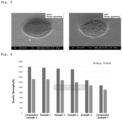
- the plasma sputtering causes the surface of the fabric to be etched, thereby changing the morphology of the surface of the fabric. Specifically, since the surface area of the fabric is increased, the surface area on which the metal atoms are deposited is increased. Photographs taken before and after plasma sputtering are shown in FIG. 3 .
- One embodiment of the present disclosure provides an antiviral fabric manufactured by the method described above, and the antiviral fabric comprises a fabric and a metal layer having a thickness of 5 nm to 900 nm and being formed on one surface or both surfaces of the fabric.
- a polyethylene terephthalate (PET) fabric was prepared.
- a plasma sputtering process was performed for 5 minutes at a power of 5 kW on one surface of the fabric, so that a copper (Cu) layer with a thickness of 10 nm was formed, resulting in an antiviral fabric.
- Cu copper
- PET polyethylene terephthalate
- An antiviral fabric was prepared in the same manner as in Example 1, except that the copper (Cu) layer was formed to have a thickness of 10 nm by performing plasma sputtering at a power of 5 kW for 10 minutes.
- PET polyethylene terephthalate
- An antiviral fabric was prepared in the same manner as in Example 1, except that a plasma sputtering process was performed for 15 minutes at a power of 5 kW on one surface of the fabric, and the copper (Cu) layer was formed to have a thickness of 10 nm.
- PET polyethylene terephthalate
- An antiviral fabric was prepared in the same manner as in Example 1, except that the copper (Cu) layer was formed to have a thickness of 500 nm by performing plasma sputtering at a power of 5 kW for 20 minutes.
- PET polyethylene terephthalate
- An antiviral fabric was prepared in the same manner as in Example 1, except that a plasma sputtering process was performed for 30 minutes at a power of 5 kW on one surface of the fabric, and the copper (Cu) layer was formed to have a thickness of 1,000 nm.
- PET polyethylene terephthalate
- the tensile strength of each of the fabrics of the examples and the comparative examples was measured.
- a universal material test machine (model: ZOOS, manufactured by Zwickroell, Germany) was used. According to ISO 13934-1, a fiber fabric with a size of 100 cm x 100 cm or larger was prepared, and 5 specimens, each with a size of 25 cm x 5 cm, were taken from the fiber fabric. The specimens were taken at positions distanced by 5 cm or more from the edge of the fiber fabric.
- the gauge length of the test machine was set to 200 mm, and the test speed was set to 200 mm/min.
- the final result value was the average value of the measurement values of the five specimens. The values are shown in FIG. 4 .
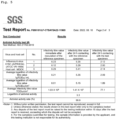
- FIG. 5 is a test report for the antiviral fabric of Example 4.
Landscapes
- Chemical & Material Sciences (AREA)
- Engineering & Computer Science (AREA)
- Chemical Kinetics & Catalysis (AREA)
- Materials Engineering (AREA)
- Mechanical Engineering (AREA)
- Metallurgy (AREA)
- Organic Chemistry (AREA)
- Textile Engineering (AREA)
- Chemical Or Physical Treatment Of Fibers (AREA)
- Physical Vapour Deposition (AREA)
- Physics & Mathematics (AREA)
- Plasma & Fusion (AREA)
Applications Claiming Priority (2)
| Application Number | Priority Date | Filing Date | Title |
|---|---|---|---|
| KR1020220122664A KR102562657B1 (ko) | 2022-09-27 | 2022-09-27 | 항바이러스 원단의 제조방법 및 이에 의해 제조된 항바이러스 원단 |
| PCT/KR2022/014752 WO2024071484A1 (ko) | 2022-09-27 | 2022-09-30 | 항바이러스 원단의 제조방법 및 이에 의해 제조된 항바이러스 원단 |
Publications (2)
| Publication Number | Publication Date |
|---|---|
| EP4372143A1 true EP4372143A1 (de) | 2024-05-22 |
| EP4372143A4 EP4372143A4 (de) | 2025-02-26 |
Family
ID=87566593
Family Applications (1)
| Application Number | Title | Priority Date | Filing Date |
|---|---|---|---|
| EP22822252.7A Pending EP4372143A4 (de) | 2022-09-27 | 2022-09-30 | Verfahren zur herstellung eines antiviralen gewebes und damit hergestelltes antivirales gewebe |
Country Status (3)
| Country | Link |
|---|---|
| EP (1) | EP4372143A4 (de) |
| KR (1) | KR102562657B1 (de) |
| WO (1) | WO2024071484A1 (de) |
Families Citing this family (1)
| Publication number | Priority date | Publication date | Assignee | Title |
|---|---|---|---|---|
| KR102882688B1 (ko) * | 2022-11-23 | 2025-11-12 | 호신섬유(주) | 항바이러스 기능이 있는 생분해 60% 발현 일회용 보호복용 직물, 이의 제조방법 및 일회용 보호복 |
Family Cites Families (8)
| Publication number | Priority date | Publication date | Assignee | Title |
|---|---|---|---|---|
| KR100591363B1 (ko) * | 2005-02-03 | 2006-06-21 | (주)씨에이치테크 | 은나노입자 코팅 섬유 제조 시스템 및 방법 |
| CN101275361A (zh) * | 2008-04-17 | 2008-10-01 | 苏州工业园区鸿锦纳米有限公司 | 纳米银无纺布及其在杀菌滤芯上的应用 |
| CN104831528B (zh) * | 2015-03-31 | 2017-10-13 | 嘉兴中科奥度新材料有限公司 | 高效空气粒子过滤无纺布复合离子镀纳米金属工艺及其制品 |
| KR101724038B1 (ko) | 2016-04-19 | 2017-04-07 | 엠텍에스티에스 주식회사 | 바이러스 차단용 라미네이트 원단 및 이의 제조 방법 그리고 이를 사용하여 제조된 의료용 보호복 |
| KR102174307B1 (ko) * | 2019-04-11 | 2020-11-04 | 주식회사 에버코트 | 투명기판의 나노 무기 도막형성 방법 |
| JP6741262B1 (ja) | 2019-12-28 | 2020-08-19 | Oatアグリオ株式会社 | 植物気孔開口促進剤 |
| KR102308519B1 (ko) * | 2020-06-17 | 2021-10-05 | (주)네오나노메딕스코리아 | 항균 또는 항바이러스 기능성 원단의 제조 방법 및 이에 의해 제조된 원단 |
| CN111826949B (zh) * | 2020-07-28 | 2021-08-03 | 深圳市菩安科技有限公司 | 一种抗菌无纺布及其制备方法 |
-
2022
- 2022-09-27 KR KR1020220122664A patent/KR102562657B1/ko active Active
- 2022-09-30 WO PCT/KR2022/014752 patent/WO2024071484A1/ko not_active Ceased
- 2022-09-30 EP EP22822252.7A patent/EP4372143A4/de active Pending
Also Published As
| Publication number | Publication date |
|---|---|
| WO2024071484A1 (ko) | 2024-04-04 |
| EP4372143A4 (de) | 2025-02-26 |
| KR102562657B1 (ko) | 2023-08-02 |
Similar Documents
| Publication | Publication Date | Title |
|---|---|---|
| US8997349B2 (en) | Manufacturing method for medical equipment for reducing platelet adhesion on a surface in contact with blood | |
| RU2608916C2 (ru) | Twip и нанодвойникованная аустенитная нержавеющая сталь и способ ее получения | |
| KR101839280B1 (ko) | 고체 고분자형 연료 전지용 세퍼레이터 및 그 제조 방법 | |
| EP4372143A1 (de) | Verfahren zur herstellung eines antiviralen gewebes und damit hergestelltes antivirales gewebe | |
| CN103717331B (zh) | 表面改性wc基超硬合金部件、硬质皮膜被覆wc基超硬合金部件以及它们的制造方法 | |
| JP2001152326A (ja) | 選定した領域に変化した透磁率を持つ高磁束スパッターターゲット | |
| JP2004339585A (ja) | Ag−Bi系合金スパッタリングターゲットおよびその製造方法 | |
| KR20060135914A (ko) | 조직화된 그레인 분말 야금 탄탈륨 스퍼터 타겟 | |
| CN114875293B (zh) | 一种Ti-Zr-Nb-Ta-Cu系高熵合金及其制备方法和在医用抗菌材料中的应用 | |
| CN111441025A (zh) | 一种耐腐蚀高熵合金薄膜、制备方法及其在海水环境下的应用 | |
| CA1324928C (en) | Corrosion-resistant and heat-resistant aluminum-based alloy thin film and process for producing the same | |
| EP4032639A1 (de) | Kupferlegierungspulver mit si-beschichtungsfilm und verfahren zu dessen herstellung | |
| KR20010053389A (ko) | PVD Al₂O₃으로 코팅된 절삭공구의 제조방법 | |
| EP1741801A2 (de) | Verfahren zum Herstellen einer amorphen Kohlenstoffschicht | |
| KR20230058502A (ko) | 마찰학적 용도의 도핑된 dlc | |
| EP2738285A1 (de) | Titan-sputtertarget | |
| KR102544467B1 (ko) | 응력부식저항성을 갖는 크롬 첨가 타이타늄 합금 및 이의 제조방법 | |
| KR20080105304A (ko) | 치과 임플란트용 합금의 질화티타늄 코팅방법 | |
| JP2006336061A (ja) | 軟磁性部材 | |
| US20180044778A1 (en) | Sputtering target having reverse bowng target geometry | |
| CN119585472A (zh) | 镀镍钢板及其制造方法 | |
| EP4205548A1 (de) | Legierung, legierungspulver und legierungsbeschichteter körper mit antimikrobieller wirkung | |
| Milić et al. | The influence of the physicochemical characteristics of the substrate surface on the deposited TiN film properties | |
| CN107475686A (zh) | 一种基于原子层沉积氧化锆抗腐蚀性陶瓷薄膜的制备方法 | |
| KR102882688B1 (ko) | 항바이러스 기능이 있는 생분해 60% 발현 일회용 보호복용 직물, 이의 제조방법 및 일회용 보호복 |
Legal Events
| Date | Code | Title | Description |
|---|---|---|---|
| STAA | Information on the status of an ep patent application or granted ep patent |
Free format text: STATUS: UNKNOWN |
|
| STAA | Information on the status of an ep patent application or granted ep patent |
Free format text: STATUS: THE INTERNATIONAL PUBLICATION HAS BEEN MADE |
|
| PUAI | Public reference made under article 153(3) epc to a published international application that has entered the european phase |
Free format text: ORIGINAL CODE: 0009012 |
|
| STAA | Information on the status of an ep patent application or granted ep patent |
Free format text: STATUS: REQUEST FOR EXAMINATION WAS MADE |
|
| 17P | Request for examination filed |
Effective date: 20221221 |
|
| AK | Designated contracting states |
Kind code of ref document: A1 Designated state(s): AL AT BE BG CH CY CZ DE DK EE ES FI FR GB GR HR HU IE IS IT LI LT LU LV MC MK MT NL NO PL PT RO RS SE SI SK SM TR |
|
| A4 | Supplementary search report drawn up and despatched |
Effective date: 20250128 |
|
| RIC1 | Information provided on ipc code assigned before grant |
Ipc: C23C 14/56 20060101ALI20250123BHEP Ipc: C23C 14/20 20060101ALI20250123BHEP Ipc: C23C 14/34 20060101ALI20250123BHEP Ipc: D06M 11/83 20060101AFI20250123BHEP |
|
| DAV | Request for validation of the european patent (deleted) | ||
| DAX | Request for extension of the european patent (deleted) |