EP4372187A1 - Optimal beschichtetes doppeldrahtzaunplatten und entsprechende verfahren - Google Patents
Optimal beschichtetes doppeldrahtzaunplatten und entsprechende verfahren Download PDFInfo
- Publication number
- EP4372187A1 EP4372187A1 EP23210505.6A EP23210505A EP4372187A1 EP 4372187 A1 EP4372187 A1 EP 4372187A1 EP 23210505 A EP23210505 A EP 23210505A EP 4372187 A1 EP4372187 A1 EP 4372187A1
- Authority
- EP
- European Patent Office
- Prior art keywords
- coating
- twin
- wire fence
- epoxy
- fence panel
- Prior art date
- Legal status (The legal status is an assumption and is not a legal conclusion. Google has not performed a legal analysis and makes no representation as to the accuracy of the status listed.)
- Pending
Links
- 238000000034 method Methods 0.000 title claims abstract description 32
- 238000000576 coating method Methods 0.000 claims abstract description 212
- 239000011248 coating agent Substances 0.000 claims abstract description 191
- 239000004593 Epoxy Substances 0.000 claims abstract description 77
- 239000011701 zinc Substances 0.000 claims abstract description 63
- 229910052725 zinc Inorganic materials 0.000 claims abstract description 63
- HCHKCACWOHOZIP-UHFFFAOYSA-N Zinc Chemical compound [Zn] HCHKCACWOHOZIP-UHFFFAOYSA-N 0.000 claims abstract description 61
- 229920000728 polyester Polymers 0.000 claims abstract description 52
- 239000000843 powder Substances 0.000 claims description 76
- 239000007921 spray Substances 0.000 claims description 48
- 238000005507 spraying Methods 0.000 claims description 27
- 238000004534 enameling Methods 0.000 claims description 9
- -1 poly(ethylene succinate) Polymers 0.000 description 25
- 229920000642 polymer Polymers 0.000 description 15
- 238000005260 corrosion Methods 0.000 description 14
- 230000007797 corrosion Effects 0.000 description 14
- 229910052751 metal Inorganic materials 0.000 description 14
- 239000002184 metal Substances 0.000 description 14
- 229920000098 polyolefin Polymers 0.000 description 13
- 239000004952 Polyamide Substances 0.000 description 12
- 229920002647 polyamide Polymers 0.000 description 12
- 238000012360 testing method Methods 0.000 description 12
- 229910045601 alloy Inorganic materials 0.000 description 11
- 239000000956 alloy Substances 0.000 description 11
- 239000010410 layer Substances 0.000 description 11
- 230000001976 improved effect Effects 0.000 description 10
- 238000005275 alloying Methods 0.000 description 9
- 229920006334 epoxy coating Polymers 0.000 description 9
- 229910052799 carbon Inorganic materials 0.000 description 8
- XEEYBQQBJWHFJM-UHFFFAOYSA-N Iron Chemical compound [Fe] XEEYBQQBJWHFJM-UHFFFAOYSA-N 0.000 description 7
- PXHVJJICTQNCMI-UHFFFAOYSA-N Nickel Chemical compound [Ni] PXHVJJICTQNCMI-UHFFFAOYSA-N 0.000 description 7
- 230000000694 effects Effects 0.000 description 6
- 239000011572 manganese Substances 0.000 description 6
- 238000005259 measurement Methods 0.000 description 6
- 239000002245 particle Substances 0.000 description 6
- OKTJSMMVPCPJKN-UHFFFAOYSA-N Carbon Chemical compound [C] OKTJSMMVPCPJKN-UHFFFAOYSA-N 0.000 description 5
- 239000011651 chromium Substances 0.000 description 5
- 238000007739 conversion coating Methods 0.000 description 5
- 239000010949 copper Substances 0.000 description 5
- 239000010955 niobium Substances 0.000 description 5
- 229910000851 Alloy steel Inorganic materials 0.000 description 4
- IJGRMHOSHXDMSA-UHFFFAOYSA-N Atomic nitrogen Chemical compound N#N IJGRMHOSHXDMSA-UHFFFAOYSA-N 0.000 description 4
- 229910000831 Steel Inorganic materials 0.000 description 4
- 150000002148 esters Chemical group 0.000 description 4
- 229920000647 polyepoxide Polymers 0.000 description 4
- 239000000047 product Substances 0.000 description 4
- 239000010959 steel Substances 0.000 description 4
- AEMRFAOFKBGASW-UHFFFAOYSA-N Glycolic acid Polymers OCC(O)=O AEMRFAOFKBGASW-UHFFFAOYSA-N 0.000 description 3
- PWHULOQIROXLJO-UHFFFAOYSA-N Manganese Chemical compound [Mn] PWHULOQIROXLJO-UHFFFAOYSA-N 0.000 description 3
- 229920000954 Polyglycolide Polymers 0.000 description 3
- 229920000331 Polyhydroxybutyrate Polymers 0.000 description 3
- 239000004721 Polyphenylene oxide Substances 0.000 description 3
- 239000002253 acid Substances 0.000 description 3
- 150000008064 anhydrides Chemical class 0.000 description 3
- 150000001735 carboxylic acids Chemical class 0.000 description 3
- 229910052804 chromium Inorganic materials 0.000 description 3
- 229910052802 copper Inorganic materials 0.000 description 3
- 238000005238 degreasing Methods 0.000 description 3
- 150000002118 epoxides Chemical class 0.000 description 3
- 238000007373 indentation Methods 0.000 description 3
- 229910052742 iron Inorganic materials 0.000 description 3
- 229910052748 manganese Inorganic materials 0.000 description 3
- 239000000203 mixture Substances 0.000 description 3
- 229910052759 nickel Inorganic materials 0.000 description 3
- 229910052758 niobium Inorganic materials 0.000 description 3
- 229910052757 nitrogen Inorganic materials 0.000 description 3
- 229910052698 phosphorus Inorganic materials 0.000 description 3
- 238000005554 pickling Methods 0.000 description 3
- 229920003207 poly(ethylene-2,6-naphthalate) Polymers 0.000 description 3
- 239000005014 poly(hydroxyalkanoate) Substances 0.000 description 3
- 239000005015 poly(hydroxybutyrate) Substances 0.000 description 3
- 229920000747 poly(lactic acid) Polymers 0.000 description 3
- 229920002961 polybutylene succinate Polymers 0.000 description 3
- 239000004631 polybutylene succinate Substances 0.000 description 3
- 229920001610 polycaprolactone Polymers 0.000 description 3
- 239000004632 polycaprolactone Substances 0.000 description 3
- 229920000570 polyether Polymers 0.000 description 3
- 239000011112 polyethylene naphthalate Substances 0.000 description 3
- 229920000139 polyethylene terephthalate Polymers 0.000 description 3
- 239000005020 polyethylene terephthalate Substances 0.000 description 3
- 229920000903 polyhydroxyalkanoate Polymers 0.000 description 3
- 239000004626 polylactic acid Substances 0.000 description 3
- 150000003839 salts Chemical class 0.000 description 3
- 229910052710 silicon Inorganic materials 0.000 description 3
- 239000000126 substance Substances 0.000 description 3
- 229910052717 sulfur Inorganic materials 0.000 description 3
- 229910052718 tin Inorganic materials 0.000 description 3
- VYZAMTAEIAYCRO-UHFFFAOYSA-N Chromium Chemical compound [Cr] VYZAMTAEIAYCRO-UHFFFAOYSA-N 0.000 description 2
- RYGMFSIKBFXOCR-UHFFFAOYSA-N Copper Chemical compound [Cu] RYGMFSIKBFXOCR-UHFFFAOYSA-N 0.000 description 2
- VGGSQFUCUMXWEO-UHFFFAOYSA-N Ethene Chemical compound C=C VGGSQFUCUMXWEO-UHFFFAOYSA-N 0.000 description 2
- 239000005977 Ethylene Substances 0.000 description 2
- OAICVXFJPJFONN-UHFFFAOYSA-N Phosphorus Chemical compound [P] OAICVXFJPJFONN-UHFFFAOYSA-N 0.000 description 2
- XUIMIQQOPSSXEZ-UHFFFAOYSA-N Silicon Chemical compound [Si] XUIMIQQOPSSXEZ-UHFFFAOYSA-N 0.000 description 2
- NINIDFKCEFEMDL-UHFFFAOYSA-N Sulfur Chemical compound [S] NINIDFKCEFEMDL-UHFFFAOYSA-N 0.000 description 2
- KKEYFWRCBNTPAC-UHFFFAOYSA-N Terephthalic acid Chemical compound OC(=O)C1=CC=C(C(O)=O)C=C1 KKEYFWRCBNTPAC-UHFFFAOYSA-N 0.000 description 2
- ATJFFYVFTNAWJD-UHFFFAOYSA-N Tin Chemical compound [Sn] ATJFFYVFTNAWJD-UHFFFAOYSA-N 0.000 description 2
- WNLRTRBMVRJNCN-UHFFFAOYSA-N adipic acid Chemical compound OC(=O)CCCCC(O)=O WNLRTRBMVRJNCN-UHFFFAOYSA-N 0.000 description 2
- 230000002411 adverse Effects 0.000 description 2
- 229910052782 aluminium Inorganic materials 0.000 description 2
- XAGFODPZIPBFFR-UHFFFAOYSA-N aluminium Chemical compound [Al] XAGFODPZIPBFFR-UHFFFAOYSA-N 0.000 description 2
- 238000004532 chromating Methods 0.000 description 2
- 229920001577 copolymer Polymers 0.000 description 2
- 230000001419 dependent effect Effects 0.000 description 2
- 150000001991 dicarboxylic acids Chemical class 0.000 description 2
- TVIDDXQYHWJXFK-UHFFFAOYSA-N dodecanedioic acid Chemical compound OC(=O)CCCCCCCCCCC(O)=O TVIDDXQYHWJXFK-UHFFFAOYSA-N 0.000 description 2
- 239000003822 epoxy resin Substances 0.000 description 2
- JBKVHLHDHHXQEQ-UHFFFAOYSA-N epsilon-caprolactam Chemical compound O=C1CCCCCN1 JBKVHLHDHHXQEQ-UHFFFAOYSA-N 0.000 description 2
- 238000005246 galvanizing Methods 0.000 description 2
- LNEPOXFFQSENCJ-UHFFFAOYSA-N haloperidol Chemical compound C1CC(O)(C=2C=CC(Cl)=CC=2)CCN1CCCC(=O)C1=CC=C(F)C=C1 LNEPOXFFQSENCJ-UHFFFAOYSA-N 0.000 description 2
- NAQMVNRVTILPCV-UHFFFAOYSA-N hexane-1,6-diamine Chemical compound NCCCCCCN NAQMVNRVTILPCV-UHFFFAOYSA-N 0.000 description 2
- QQVIHTHCMHWDBS-UHFFFAOYSA-N isophthalic acid Chemical compound OC(=O)C1=CC=CC(C(O)=O)=C1 QQVIHTHCMHWDBS-UHFFFAOYSA-N 0.000 description 2
- 238000004519 manufacturing process Methods 0.000 description 2
- GUCVJGMIXFAOAE-UHFFFAOYSA-N niobium atom Chemical compound [Nb] GUCVJGMIXFAOAE-UHFFFAOYSA-N 0.000 description 2
- BDJRBEYXGGNYIS-UHFFFAOYSA-N nonanedioic acid Chemical compound OC(=O)CCCCCCCC(O)=O BDJRBEYXGGNYIS-UHFFFAOYSA-N 0.000 description 2
- 239000011574 phosphorus Substances 0.000 description 2
- 229920000520 poly(3-hydroxybutyrate-co-3-hydroxyvalerate) Polymers 0.000 description 2
- 229920001606 poly(lactic acid-co-glycolic acid) Polymers 0.000 description 2
- 229920002463 poly(p-dioxanone) polymer Polymers 0.000 description 2
- 239000004629 polybutylene adipate terephthalate Substances 0.000 description 2
- 229920001707 polybutylene terephthalate Polymers 0.000 description 2
- 229920001123 polycyclohexylenedimethylene terephthalate Polymers 0.000 description 2
- 239000000622 polydioxanone Substances 0.000 description 2
- 229920002215 polytrimethylene terephthalate Polymers 0.000 description 2
- 238000002203 pretreatment Methods 0.000 description 2
- 239000000376 reactant Substances 0.000 description 2
- CXMXRPHRNRROMY-UHFFFAOYSA-N sebacic acid Chemical compound OC(=O)CCCCCCCCC(O)=O CXMXRPHRNRROMY-UHFFFAOYSA-N 0.000 description 2
- 239000010703 silicon Substances 0.000 description 2
- 238000005728 strengthening Methods 0.000 description 2
- TYFQFVWCELRYAO-UHFFFAOYSA-N suberic acid Chemical compound OC(=O)CCCCCCC(O)=O TYFQFVWCELRYAO-UHFFFAOYSA-N 0.000 description 2
- 239000011593 sulfur Substances 0.000 description 2
- ARCGXLSVLAOJQL-UHFFFAOYSA-N trimellitic acid Chemical compound OC(=O)C1=CC=C(C(O)=O)C(C(O)=O)=C1 ARCGXLSVLAOJQL-UHFFFAOYSA-N 0.000 description 2
- VXNZUUAINFGPBY-UHFFFAOYSA-N 1-Butene Chemical group CCC=C VXNZUUAINFGPBY-UHFFFAOYSA-N 0.000 description 1
- GUOSQNAUYHMCRU-UHFFFAOYSA-N 11-Aminoundecanoic acid Chemical compound NCCCCCCCCCCC(O)=O GUOSQNAUYHMCRU-UHFFFAOYSA-N 0.000 description 1
- PBLZLIFKVPJDCO-UHFFFAOYSA-N 12-aminododecanoic acid Chemical compound NCCCCCCCCCCCC(O)=O PBLZLIFKVPJDCO-UHFFFAOYSA-N 0.000 description 1
- SLXKOJJOQWFEFD-UHFFFAOYSA-N 6-aminohexanoic acid Chemical compound NCCCCCC(O)=O SLXKOJJOQWFEFD-UHFFFAOYSA-N 0.000 description 1
- XDOLZJYETYVRKV-UHFFFAOYSA-N 7-Aminoheptanoic acid Chemical compound NCCCCCCC(O)=O XDOLZJYETYVRKV-UHFFFAOYSA-N 0.000 description 1
- RWSOTUBLDIXVET-UHFFFAOYSA-N Dihydrogen sulfide Chemical class S RWSOTUBLDIXVET-UHFFFAOYSA-N 0.000 description 1
- 229910000677 High-carbon steel Inorganic materials 0.000 description 1
- JHWNWJKBPDFINM-UHFFFAOYSA-N Laurolactam Chemical compound O=C1CCCCCCCCCCCN1 JHWNWJKBPDFINM-UHFFFAOYSA-N 0.000 description 1
- 229910001209 Low-carbon steel Inorganic materials 0.000 description 1
- 239000004698 Polyethylene Substances 0.000 description 1
- 239000004743 Polypropylene Substances 0.000 description 1
- 150000008065 acid anhydrides Chemical class 0.000 description 1
- 150000007513 acids Chemical class 0.000 description 1
- 235000011037 adipic acid Nutrition 0.000 description 1
- 239000001361 adipic acid Substances 0.000 description 1
- 150000001298 alcohols Chemical class 0.000 description 1
- 150000001336 alkenes Chemical group 0.000 description 1
- 150000001412 amines Chemical class 0.000 description 1
- 150000001413 amino acids Chemical class 0.000 description 1
- 229960002684 aminocaproic acid Drugs 0.000 description 1
- CJYXCQLOZNIMFP-UHFFFAOYSA-N azocan-2-one Chemical compound O=C1CCCCCCN1 CJYXCQLOZNIMFP-UHFFFAOYSA-N 0.000 description 1
- 230000015572 biosynthetic process Effects 0.000 description 1
- NEPKLUNSRVEBIX-UHFFFAOYSA-N bis(oxiran-2-ylmethyl) benzene-1,4-dicarboxylate Chemical compound C=1C=C(C(=O)OCC2OC2)C=CC=1C(=O)OCC1CO1 NEPKLUNSRVEBIX-UHFFFAOYSA-N 0.000 description 1
- IISBACLAFKSPIT-UHFFFAOYSA-N bisphenol A Chemical compound C=1C=C(O)C=CC=1C(C)(C)C1=CC=C(O)C=C1 IISBACLAFKSPIT-UHFFFAOYSA-N 0.000 description 1
- 238000007664 blowing Methods 0.000 description 1
- 230000003197 catalytic effect Effects 0.000 description 1
- 239000013043 chemical agent Substances 0.000 description 1
- 238000006243 chemical reaction Methods 0.000 description 1
- 239000003795 chemical substances by application Substances 0.000 description 1
- 238000005352 clarification Methods 0.000 description 1
- 239000011247 coating layer Substances 0.000 description 1
- 239000007859 condensation product Substances 0.000 description 1
- 239000000356 contaminant Substances 0.000 description 1
- 238000004132 cross linking Methods 0.000 description 1
- 230000008021 deposition Effects 0.000 description 1
- 150000004985 diamines Chemical class 0.000 description 1
- GYZLOYUZLJXAJU-UHFFFAOYSA-N diglycidyl ether Chemical compound C1OC1COCC1CO1 GYZLOYUZLJXAJU-UHFFFAOYSA-N 0.000 description 1
- QFTYSVGGYOXFRQ-UHFFFAOYSA-N dodecane-1,12-diamine Chemical compound NCCCCCCCCCCCCN QFTYSVGGYOXFRQ-UHFFFAOYSA-N 0.000 description 1
- 229920001038 ethylene copolymer Polymers 0.000 description 1
- 238000002474 experimental method Methods 0.000 description 1
- 150000002222 fluorine compounds Chemical class 0.000 description 1
- VOZRXNHHFUQHIL-UHFFFAOYSA-N glycidyl methacrylate Chemical compound CC(=C)C(=O)OCC1CO1 VOZRXNHHFUQHIL-UHFFFAOYSA-N 0.000 description 1
- 230000005484 gravity Effects 0.000 description 1
- 230000001788 irregular Effects 0.000 description 1
- 150000003951 lactams Chemical class 0.000 description 1
- FPYJFEHAWHCUMM-UHFFFAOYSA-N maleic anhydride Chemical compound O=C1OC(=O)C=C1 FPYJFEHAWHCUMM-UHFFFAOYSA-N 0.000 description 1
- 150000002739 metals Chemical class 0.000 description 1
- 238000012986 modification Methods 0.000 description 1
- 230000004048 modification Effects 0.000 description 1
- 239000000178 monomer Substances 0.000 description 1
- ZETYUTMSJWMKNQ-UHFFFAOYSA-N n,n',n'-trimethylhexane-1,6-diamine Chemical compound CNCCCCCCN(C)C ZETYUTMSJWMKNQ-UHFFFAOYSA-N 0.000 description 1
- 239000012811 non-conductive material Substances 0.000 description 1
- 150000002989 phenols Chemical class 0.000 description 1
- 238000006068 polycondensation reaction Methods 0.000 description 1
- 229920001225 polyester resin Polymers 0.000 description 1
- 239000004645 polyester resin Substances 0.000 description 1
- 229920000573 polyethylene Polymers 0.000 description 1
- 239000004848 polyfunctional curative Substances 0.000 description 1
- 238000006116 polymerization reaction Methods 0.000 description 1
- 229920001155 polypropylene Polymers 0.000 description 1
- 238000012545 processing Methods 0.000 description 1
- 239000011253 protective coating Substances 0.000 description 1
- 239000011241 protective layer Substances 0.000 description 1
- 239000010731 rolling oil Substances 0.000 description 1
- 229920006395 saturated elastomer Polymers 0.000 description 1
- 239000010935 stainless steel Substances 0.000 description 1
- 229910001220 stainless steel Inorganic materials 0.000 description 1
- 230000003068 static effect Effects 0.000 description 1
- 239000000758 substrate Substances 0.000 description 1
- 150000003573 thiols Chemical class 0.000 description 1
- 229920001567 vinyl ester resin Polymers 0.000 description 1
- 125000000391 vinyl group Chemical group [H]C([*])=C([H])[H] 0.000 description 1
- 238000005303 weighing Methods 0.000 description 1
- 150000003751 zinc Chemical class 0.000 description 1
- 239000004711 α-olefin Substances 0.000 description 1
Images
Classifications
-
- B—PERFORMING OPERATIONS; TRANSPORTING
- B05—SPRAYING OR ATOMISING IN GENERAL; APPLYING FLUENT MATERIALS TO SURFACES, IN GENERAL
- B05D—PROCESSES FOR APPLYING FLUENT MATERIALS TO SURFACES, IN GENERAL
- B05D7/00—Processes, other than flocking, specially adapted for applying liquids or other fluent materials to particular surfaces or for applying particular liquids or other fluent materials
- B05D7/14—Processes, other than flocking, specially adapted for applying liquids or other fluent materials to particular surfaces or for applying particular liquids or other fluent materials to metal, e.g. car bodies
-
- B—PERFORMING OPERATIONS; TRANSPORTING
- B05—SPRAYING OR ATOMISING IN GENERAL; APPLYING FLUENT MATERIALS TO SURFACES, IN GENERAL
- B05D—PROCESSES FOR APPLYING FLUENT MATERIALS TO SURFACES, IN GENERAL
- B05D7/00—Processes, other than flocking, specially adapted for applying liquids or other fluent materials to particular surfaces or for applying particular liquids or other fluent materials
- B05D7/20—Processes, other than flocking, specially adapted for applying liquids or other fluent materials to particular surfaces or for applying particular liquids or other fluent materials to wires
-
- B—PERFORMING OPERATIONS; TRANSPORTING
- B05—SPRAYING OR ATOMISING IN GENERAL; APPLYING FLUENT MATERIALS TO SURFACES, IN GENERAL
- B05D—PROCESSES FOR APPLYING FLUENT MATERIALS TO SURFACES, IN GENERAL
- B05D7/00—Processes, other than flocking, specially adapted for applying liquids or other fluent materials to particular surfaces or for applying particular liquids or other fluent materials
- B05D7/50—Multilayers
- B05D7/52—Two layers
- B05D7/54—No clear coat specified
-
- E—FIXED CONSTRUCTIONS
- E04—BUILDING
- E04H—BUILDINGS OR LIKE STRUCTURES FOR PARTICULAR PURPOSES; SWIMMING OR SPLASH BATHS OR POOLS; MASTS; FENCING; TENTS OR CANOPIES, IN GENERAL
- E04H17/00—Fencing, e.g. fences, enclosures, corrals
- E04H17/14—Fences constructed of rigid elements, e.g. with additional wire fillings or with posts
- E04H17/16—Fences constructed of rigid elements, e.g. with additional wire fillings or with posts using prefabricated panel-like elements, e.g. wired frames
- E04H17/161—Fences constructed of rigid elements, e.g. with additional wire fillings or with posts using prefabricated panel-like elements, e.g. wired frames using wire panels
-
- B—PERFORMING OPERATIONS; TRANSPORTING
- B05—SPRAYING OR ATOMISING IN GENERAL; APPLYING FLUENT MATERIALS TO SURFACES, IN GENERAL
- B05D—PROCESSES FOR APPLYING FLUENT MATERIALS TO SURFACES, IN GENERAL
- B05D1/00—Processes for applying liquids or other fluent materials
- B05D1/02—Processes for applying liquids or other fluent materials performed by spraying
- B05D1/04—Processes for applying liquids or other fluent materials performed by spraying involving the use of an electrostatic field
- B05D1/06—Applying particulate materials
-
- B—PERFORMING OPERATIONS; TRANSPORTING
- B05—SPRAYING OR ATOMISING IN GENERAL; APPLYING FLUENT MATERIALS TO SURFACES, IN GENERAL
- B05D—PROCESSES FOR APPLYING FLUENT MATERIALS TO SURFACES, IN GENERAL
- B05D2252/00—Sheets
-
- B—PERFORMING OPERATIONS; TRANSPORTING
- B05—SPRAYING OR ATOMISING IN GENERAL; APPLYING FLUENT MATERIALS TO SURFACES, IN GENERAL
- B05D—PROCESSES FOR APPLYING FLUENT MATERIALS TO SURFACES, IN GENERAL
- B05D2451/00—Type of carrier, type of coating (Multilayers)
-
- B—PERFORMING OPERATIONS; TRANSPORTING
- B05—SPRAYING OR ATOMISING IN GENERAL; APPLYING FLUENT MATERIALS TO SURFACES, IN GENERAL
- B05D—PROCESSES FOR APPLYING FLUENT MATERIALS TO SURFACES, IN GENERAL
- B05D2504/00—Epoxy polymers
-
- B—PERFORMING OPERATIONS; TRANSPORTING
- B05—SPRAYING OR ATOMISING IN GENERAL; APPLYING FLUENT MATERIALS TO SURFACES, IN GENERAL
- B05D—PROCESSES FOR APPLYING FLUENT MATERIALS TO SURFACES, IN GENERAL
- B05D2508/00—Polyesters
-
- B—PERFORMING OPERATIONS; TRANSPORTING
- B05—SPRAYING OR ATOMISING IN GENERAL; APPLYING FLUENT MATERIALS TO SURFACES, IN GENERAL
- B05D—PROCESSES FOR APPLYING FLUENT MATERIALS TO SURFACES, IN GENERAL
- B05D2601/00—Inorganic fillers
- B05D2601/20—Inorganic fillers used for non-pigmentation effect
- B05D2601/28—Metals
-
- B—PERFORMING OPERATIONS; TRANSPORTING
- B05—SPRAYING OR ATOMISING IN GENERAL; APPLYING FLUENT MATERIALS TO SURFACES, IN GENERAL
- B05D—PROCESSES FOR APPLYING FLUENT MATERIALS TO SURFACES, IN GENERAL
- B05D3/00—Pretreatment of surfaces to which liquids or other fluent materials are to be applied; After-treatment of applied coatings, e.g. intermediate treating of an applied coating preparatory to subsequent applications of liquids or other fluent materials
- B05D3/04—Pretreatment of surfaces to which liquids or other fluent materials are to be applied; After-treatment of applied coatings, e.g. intermediate treating of an applied coating preparatory to subsequent applications of liquids or other fluent materials by exposure to gases
- B05D3/0406—Pretreatment of surfaces to which liquids or other fluent materials are to be applied; After-treatment of applied coatings, e.g. intermediate treating of an applied coating preparatory to subsequent applications of liquids or other fluent materials by exposure to gases the gas being air
Definitions
- the invention relates to an optimally coated twin-wire fence panel.
- the invention relates to a method for optimally coating a twin-wire fence panel.
- An alternative to hot-dip galvanizing twin-wire fencing panels is to use a two-layer powder coating.
- the advantages of this alternative are the avoidance of skin formation, irregularities and sharp protruding parts.
- a problem with this two-layer powder coating system is that the application of the first coating causes poor contact with the metal surface of the twin-wire fence panel, so that grounding is no longer possible.
- this grounding is necessary to be able to deposit a second coating on the first coating.
- the second coating does not adhere or adheres poorly to the twin-wire fence panel, resulting in an insufficient and/or non-uniform coating.
- This in turn leads to various weak points on the twin-wire fence panel, where corrosion thus has free rein.
- This problem mainly occurs with epoxy coatings, as epoxy has a strong insulating effect, which adversely affects the conductive contact.
- the present invention aims to find a solution for at least some of the above problems.
- the invention relates to a coated twin-wire fence panel according to claim 1. Preferred embodiments are presented in the dependent claims.
- the twin-wire fence panel according to the invention is advantageous because it concerns an ungalvanized (not hot-dip galvanized) twin-wire fence panel to which a double coating has been applied in an efficient manner.
- Each point on the twin-wire fence panel is provided with at least one coating and there are no so-called support points or bearing points that do not contain a coating.
- the inventors have unexpectedly found that adding zinc to the epoxy provides an improved twin-wire fence panel in terms of coating uniformity.
- a twin-wire fence panel according to the invention is thus provided with two coatings, each with an improved uniformity in coating thickness, resulting in an improved uniformity in the coating thickness of the total coating.
- the inventors also found that adding zinc to the epoxy had a strengthening effect on the corrosion resistance of the ungalvanized twin-wire fence panel.
- the inventors found that within the range of the zinc content as described in claim 1, a powder coating is obtained that can be processed as a powder coating, but also gives the coating a sufficiently high conductivity so that grounding of the twin-wire fence panel is possible for applying a subsequent coating. Moreover, it appears that within this range an improved corrosion resistance is still imparted to the ungalvanized twin-wire fence panel.
- the invention in a second aspect, relates to a method for coating one or more twin-wire fence panels according to claim 7. Preferred embodiments are presented in the dependent claims.
- the method allows, on the one hand, to provide two coatings on an ungalvanized twin-wire fence panel by using a zinc-containing epoxy, so that grounding of the twin-wire fence panel remains possible for applying the second coating. Moreover, the method is advantageous because the method ensures a uniform coating thickness in the obtained twin-wire fence panel.
- the inventors unexpectedly found that applying a zinc epoxy as first coating resulted in a significantly better conductivity on the surface of the twin-wire fence panel, as a result of which the second coating showed a significantly better and more uniform adhesion, resulting in an improved twin-wire fence panel.
- an object of the invention to provide a method that avoids the occurrence of sparks in the event of poor grounding, and in which a twin-wire fence panel can simultaneously be obtained with a double coating that is as uniform as possible, so that both the protection of the metal and the aesthetic appearance is optimized.
- the invention relates to an optimally coated twin-wire fence panel.
- ungalvanized twin-wire fence panel refers to a twin-wire fence panel that has not been subjected to a hot-dip galvanizing step during its production process.
- epoxy and polyepoxide are synonyms and refer to a class of epoxy polymers with application in coatings, such as epoxy resins.
- Epoxy resins can react with themselves (become crosslinked) through catalytic homopolymerization, or with a wide variety of co-reactants, including polyfunctional amines, acids (and acid anhydrides), phenols, alcohols, and thiols (commonly referred to as mercaptans). These co-reactants are often referred to as hardeners or curatives, and the cross-linking reaction is commonly referred to as curing. It should be clear that if a twin-wire fence panel has a coating comprising epoxy, this is a cured epoxy coating.
- the epoxy is advantageous as a first coating because it already has inherent corrosion resistance.
- zinc epoxy refers to an epoxy containing zinc, for example in a minimum amount of 0.1 m%.
- powder coating refers to the electrostatic process whereby powder is applied to metal with a spraying means.
- polyester and “polyester resin” as used herein are synonyms and refer to a class of polymers containing an ester functional group in each repeating unit of their main chain.
- Possible polyesters are: polyether polyesters, poly(3-hydroxybutyrate-co-3-hydroxyvalerate), poly(lactic acid-co-glycolic acid), poly(ethylene succinate), polybutylene adipate terephthalate, polybutylene succinate, polybutylene terephthalate, polycaprolactone, polycyclohexylenedimethylene terephthalate, polydioxanone, polyethylene naphthalate, polyethylene terephthalate, polyglycolide, polyhydroxyalkanoates, polyhydroxybutyrate, polylactic acid, polytrimethylene terephthalate.
- percent by weight refers to the relative weight of a component based on the total weight of the entire referenced product.
- double wire fence panel and “twin-wire fence panel”, as used in the text, refers to a fence panel, wherein parallel vertical bars (wires) are welded to horizontal bars (wires), and wherein the vertical bars are welded at the same height between two horizontal bars (a pair).
- coating in the current context refers to a substance or a mixture of substances for covering a substrate, such as a metal surface or other coating, with the aim of protecting the surface, making it more beautiful or making it safer.
- a substrate such as a metal surface or other coating
- Several coatings can be applied or present on the same metal surface, in which case we can speak of a first and a second coating.
- Each coating can be applied in one or more layers, herein referred to as “coating sublayers.”
- a single coating step thus covers the application of a single coating, wherein one or more coating sublayers are deposited on the surface.
- vertical wires refer to the wires or bars that, in a working form (installed condition) of the twin-wire fence panel, are positioned substantially vertically relative to the surface on which the fencing is positioned upright.
- the vertical wires therefore correspond to the height of the twin-wire fence panel.
- the horizontal wires and vertical wires are thus positioned perpendicular to each other.
- both the horizontal wires and the vertical wires lie substantially in a plane parallel to the ground surface, still positioned perpendicular to each other.
- the unit “mu” is synonymous with “ ⁇ m” and “micron” and refers to the unit of length micrometer from the SI system.
- a means one or more than one segment.
- Quoting numerical ranges by endpoints includes all integers, fractions and/or real numbers between the endpoints, these endpoints included.
- the invention relates to a coated twin-wire fence panel.
- a twin-wire fence panel according to the invention preferably has between 50 and 55, preferably 51, vertical wires and between 1 and 20 pairs of horizontal wires.
- the vertical wires have a length between 500 and 2500 mm, preferably the vertical wires have a length selected from the list: 630, 830, 1030, 1230, 1430, 1630, 1830, 2030, 2230, 2430 mm. It will be apparent to a person skilled in the art that the length of the vertical wires corresponds to the height of a twin-wire fence panel.
- the horizontal wires have a length between 2000 and 3000 mm; preferably between 2400 and 2600, even more preferably between 2500 and 2550 mm, most preferably 2508 or 2510 mm. It will be apparent to a person skilled in the art that the length of the horizontal wires corresponds to the length of a twin-wire fence panel.
- the distance between two adjacent vertical wires is 40-60 mm c.t.c., more preferably between 45 and 55 mm, even more preferably between 49 and 51, most preferably about 50 mm.
- the distance between the adjacent horizontal wires is 100-300 mm c.t.c., preferably 150-250 mm, more preferably 180-220 mm, most preferably about 200 mm.
- c.t.c center to center refers to a distance between the center (the heart) of a circular cross-section of one wire and the center (the heart) of a circular cross-section of another wire.
- the twin-wire fence panel is manufactured from unalloyed steel, low-alloy steel or high-alloy steel.
- the twin-wire fence panel can be made from high or low carbon steel.
- Unalloyed steel contains a maximum of 1.5% of alloying elements (excluding carbon (C)). Unalloyed steel has a carbon percentage of 0.5% to 2%. Low-alloy steel contains between 1.5 and 5% alloying elements (excluding carbon). High-alloy steel contains more than 5% of alloying elements.
- the twin-wire fence panel is preferably manufactured from unalloyed steel.
- alloying elements refers to the elements that are present in the alloy in addition to iron and carbon.
- the twin-wire fence panel is manufactured from an alloy comprising iron (Fe), carbon (C) and alloying elements.
- the alloy comprises a maximum of 1.5% alloying elements, more preferably a maximum of 1.4%, even more preferably a maximum of 1.3%, even more preferably a maximum of 1.2%, most preferably a maximum of 1.1%.
- the alloy comprises at least 0.5% alloying elements, more preferably at least 0.6%, even more preferably at least 0.7%, even more preferably at least 0.8%, even more preferably at least 0.9%, most preferably at least 1%.
- the alloy comprises between 0.5 and 1.5% alloying elements, preferably between 0.6 and 1.5%, more preferably between 0.7 and 1.4%, even more preferably between 0.8 and 1.3%, even more preferably between 0.9 and 1.2%, most preferably between 1 and 1.1%.
- the alloy comprises a maximum of 0.1% C, more preferably a maximum of 0.09%, even more preferably a maximum of 0.085%, even more preferably a maximum of 0.08%, most preferably a maximum of 0.075%.
- the alloy comprises at least 0.025% C, more preferably at least 0.03%, even more preferably at least 0.035%, even more preferably at least 0.04%, most preferably at least 0.045%.
- the alloy comprises between 0.02 and 0.1% C, preferably between 0.025 and 0.09%, more preferably between 0.035 and 0.085%, even more preferably between 0.04 and 0.08%, most preferably between 0.045 and 0.075%.
- the alloy comprises alloying elements selected from the list of: manganese (Mn), silicon (Si), sulfur (S), phosphorus (P), nitrogen (N), copper (Cu), chromium (Cr), nickel (Ni), niobium (Nb), tin (Sn), aluminum (Al) or any combination thereof.
- the alloy comprises manganese (Mn), silicon (Si), sulfur (S), phosphorus (P), nitrogen (N), copper (Cu), and optionally chromium (Cr), nickel (Ni), niobium (Nb), tin (Sn), aluminum (Al).
- the alloy comprises Mn in an amount between 0.3 and 0.5%, more preferably between 0.35 and 0.45%, Si in an amount between 0.05 and 0.25%, more preferably between 0.1 and 0.2%, S in an amount between 0.01 and 0.045%, more preferably between 0.015 and 0.04%, P in an amount between 0.005 and 0.03%, more preferably between 0.005 and 0.025%, Cu in an amount between 0.2 and 0.4%, more preferably between 0.25 and 0.35%, N in an amount between 0.005 and 0.02%, more preferably between 0.005 and 0.015%, and Cr in an amount of up to 0.15%, more preferably up to 0.1%, Ni in an amount up to 0.15%, more preferably up to 0.1%, and Nb in an amount up to 0.005%, more preferably up to 0.002%, Sn in an amount up to 0.05%, more preferably up to 0.03%, and/or Al in an amount up to 0.005%, more preferably up to 0.003%.
- the twin-wire fence panel is provided with one or more coatings, preferably the twin-wire fence panel is provided with two coatings.
- At least one coating comprises an epoxy, preferably one coating comprises an epoxy.
- Epoxy has a number of advantages over polyester, such as creating a liquid-tight protective layer.
- the adhesion and mechanical strength of epoxy is also many times greater than that of a polyester.
- epoxy is also resistant to a large number of chemicals.
- At least one coating comprises a polymer selected from the list of: a polyamide, a polyolefin, a polyester, or a combination thereof, preferably a polyester, preferably one coating comprises a polymer selected from the list of: a polyamide, a polyolefin, a polyester, or a combination thereof, preferably a polyester.
- Polyamides are condensation products of one or more amino acids, such as aminocaproic acid, amino-7-heptanoic acid, amino-11-undecanoic acid and amino-12-dodecanoic acid, or of one or more lactams, such as caprolactam, oenantholactam and lauryllactam, or of one or more salts or mixtures of diamines such as hexamethylenediamine, dodecamethylenediamine, metaxylenediamine, bis-p aminocyclohexylmethane and trimethylhexamethylenediamine with diacids such as isophthalic acid, terephthalic acid, adipic acid, azelaic acid, suberic acid, sebacic acid and dodecanedioic acid or mixtures of all these monomers, which lead to copolyamides.
- amino acids such as aminocaproic acid, amino-7-heptanoic acid, amino-11-undecanoic acid and amino-12-d
- Polyolefins are understood to mean polymers containing olefin units, such as, for example, ethylene, propylene, butene-1 units. Examples of polyolefins are:
- Polyesters can be chosen from the list of: poly(3-hydroxybutyrate-co-3-hydroxyvalerate), poly(lactic acid-co-glycolic acid), poly(ethylene succinate), polybutylene adipate terephthalate, polybutylene succinate, polybutylene terephthalate, polycaprolactone, polycyclohexylenedimethylene terephthalate, polydioxanone, polyethylene naphthalate, polyethylene terephthalate, polyglycolide, polyhydroxyalkanoates, polyhydroxybutyrate, polylactic acid, polytrimethylene terephthalate.
- At least one coating comprises a polyester, preferably at least one coating comprises a polyester selected from the list of: polybutylene succinate, polybutylene terephthalic acid, polycaprolactone, polyethylene naphthalate, polyethylene terephthalate, polyglycolide, polyhydroxyalkanoates, polyhydroxybutyrate, polylactic acid.
- the polyester is a polyether polyester.
- the twin-wire fence panel is provided with two or more coatings, preferably two coatings, wherein the two or more coatings comprise:
- the epoxy is a zinc epoxy.
- the inventors have unexpectedly found that adding zinc to the epoxy provides better grounding and consequently an improved twin-wire fence panel in terms of coating uniformity.
- a twin-wire fence panel according to the invention is thus provided with two coatings, each with an improved uniformity in coating thickness, resulting in an improved uniformity in the coating thickness of the total coating.
- the addition of zinc to the epoxy also has an improved effect on corrosion resistance.
- the epoxy can be any metal epoxy such as iron epoxy for example.
- the zinc epoxy has a zinc content of at least 0.01 m%, preferably at least 0.05 m%, more preferably at least 0.1 m%, even more preferably at least 0.5 m%, and even more preferably at least 1 m%.
- a minimum zinc content is necessary to achieve sufficient conductivity, and thus to optimally apply a second coating and to obtain an optimally coated twin-wire fence panel.
- the zinc epoxy has a zinc content of at most 50 m%, preferably at most 45 m%, more preferably at most 40 m%, even more preferably at most 35 m%, and even more at preferably at most 30 m%.
- the specific weight of the zinc epoxy increases with the amount of zinc present in the epoxy.
- the inventors have discovered experimentally that with a zinc content of 50 m% (1.41 g/cm 3 ) the powder is already "too heavy". This has not only proven to adversely affect the processing of the powder (obtaining the powder cloud), but also the durability of the pumps, pipes and spray agents of the spray booth, as they become clogged.
- the powder is processable with a zinc content of maximum 30 m%, and is even more processable with a zinc content of maximum 25 m% or even 20 m%.
- the zinc epoxy comprises a zinc content of between 0.01 and 50 m%, preferably between 0.05 and 45 m%, more preferably between 0.1 and 40 m%, even more preferably between 0.5 and 35 m%, and even more preferably between 1.0 and 30 m%, , even more preferably between 1.0 and 25 m%, and most preferably between 1.0 and 20 m%.
- the coating comprising an epoxy has a coating thickness of at least 40 mu, preferably at least 45 mu, more preferably at least 50 mu.
- This coating thickness is the minimum required to obtain sufficient coverage of the twin-wire fence panel, so that a second coating layer can be applied.
- the coating comprising an epoxy has a coating thickness of at most 180 mu, preferably at most 170 mu, more preferably at most 160 mu, even more preferably at most 150 mu, even more preferably at most 140 mu, even more preferably at most 130 mu, even more preferably at most 120 mu, even more preferably at most 110 mu, and most preferably at most 100 mu.
- the coating comprising an epoxy has a coating thickness of between 40 and 180 mu, preferably between 45 and 170 mu, more preferably between 50 and 160 mu, even more preferably between 50 and 150 mu, even more preferably between 50 and 140 mu, even more preferably between 50 and 130 mu, even more preferably between 50 and 120 mu, even more preferably between 50 and 110 mu, even more preferably between 50 and 100 mu.
- the coating comprising a polymer selected from the list of: a polyamide, a polyolefin, a polyester, or a combination thereof, preferably a polyester, has a coating thickness of at least 30 mu, preferably at least 35 mu, more preferably at least 40 mu.
- This coating thickness is the minimum required to obtain sufficient coverage of the twin-wire fence panel, so that an aesthetic advantage is obtained.
- the coating comprising a polymer selected from the list of: a polyamide, a polyolefin, a polyester, or a combination thereof, preferably a polyester, has a coating thickness of at most 120 mu, preferably at most 100 mu, and most preferably at most 90 mu.
- the coating comprising a polymer selected from the list of: a polyamide, a polyolefin, a polyester, or a combination thereof, preferably a polyester, has a coating thickness of between 30 and 120 mu, preferably between 35 and 120 mu, more preferably between 40 and 120 mu, even more preferably between 40 and 100 mu, even more preferably between 40 and 90 mu.
- the coating thickness of the coating comprising an epoxy and the coating thickness of the coating comprising a polymer selected from the list of: a polyamide, a polyolefin, a polyester, or a combination thereof, preferably a polyester are in proportion according to a ratio between 0.3 and 6, preferably between 0.35 and 5, more preferably between 0.4 and 4, even more preferably between 0.45 and 3, most preferably between 0.5 and 2.5.
- the inventors unexpectedly found that the combination of the coatings in this thickness ratio results in an optimally coated twin-wire fence panel that can function as an alternative to hot-dip galvanized twin-wire fence panels.
- the inventors unexpectedly found that the combination of a zinc epoxy and a polyester coating leads to improved corrosion resistance compared to other two-layer coating systems for ungalvanized fence panels.
- the hardness of the coating comprising epoxy is at least 75 Buchholz resistance units (BH), preferably at least 80 BH, more preferably at least 85 BH, even more preferably at least 90 BH, even more preferably at least 95 BH, and most preferably a minimum of 100 BH.
- BH Buchholz resistance units
- the hardness can be measured by means of Buchholz hardness testers as known in the art.
- a Buchholz hardness tester preferably consists of a beveled disc indentation tool mounted in a stainless steel block and exerting a constant pressure of 500g. The meter is placed on the coating for 30 seconds and removed again after those 30 seconds. The length of the resulting indentation of the coating is measured with the scale reading microscope. The result is expressed in Buchholz indentation resistance units using the scale provided.
- the hardness of the coating comprising a polymer selected from the list of: a polyamide, a polyolefin, a polyester, or a combination thereof, preferably a polyester, is between 60 and 120 Buchholz resistance units (BH), preferably between 65 and 115 BH, more preferably between 70 and 110 BH, even more preferably between 75 and 105 BH, even more preferably between 80 and 100 BH, and most preferably between 85 and 95 BH.
- BH Buchholz resistance units
- the hardness is advantageous for imparting robustness to the non-hot-dip galvanized twin-wire fence panel.
- the invention in a second aspect, relates to a method for coating one or more twin-wire fence panels.
- the method comprises the steps of:
- the coating is applied by means of powder coating.
- the coating step is discussed below. It should be understood that the coating step describes both the application of the coating in step i and step ii. For example, when two coatings are applied, the coating step is performed twice.
- a powder coating is applied to a metal surface by applying a charge to the powder, after which the powder is preferably sprayed onto the metal surface by means of a spraying means.
- the charge is applied to the powder by an electrode where a discharge takes place (the corona principle), or by friction along a non-conductive material (the tribo principle), preferably the charge is applied by means of the tribo principle by a tribo-charging system.
- the tribo principle is advantageous because the effect of a Faraday cage can be avoided.
- the coatings are applied by means of powder coating, preferably triboelectric powder coating.
- twin-wire fence panels Prior to powder coating, the twin-wire fence panels must be grounded, i.e. connected to a zero potential. This grounding is important to ensure the deposition of the powder on the metal surface, as this allows the static charge on the powder to dissipate.
- twin-wire fence panels are therefore pre-treated prior to coating.
- the pre-treatment preferably comprises one or more steps from the list of: degreasing, rinsing, demi-rinsing, pickling, fluxing, demi-fogging, conversion coating, such as phosphating, zirconizing, chromating, passivating, iron phosphating, zinc phosphating, manganese phosphating, stove-enameling, or a combination of these.
- the twin-wire fence panels are pre-treated by means of the steps of: alkaline degreasing, acid pickling, conversion coating, stove-enameling, or a combination of these.
- the twin-wire fence panels are pre-treated by means of the steps of: alkaline degreasing, acid pickling, conversion coating, and stove-enameling.
- the conversion coating is preferably a combination of chromating, passivating or zirconizing, preferably in combination with fluorides.
- the twin-wire fence panels are preferably provided with a conversion coating or adhesion layer that has been formed on the metal surface by the action of a chemical agent, such as a polymer.
- the twin-wire fence panels are coated in a substantially horizontal position. In a further preferred embodiment, the twin-wire fence panels are positioned for this purpose on four or more support points.
- the support points are defined as positions on the twin-wire fence panels that make contact with a support means.
- the twin-wire fence panel is preferably provided with a zero potential via these support points, i.e. the twin-wire fence panel is grounded via these support points.
- a set of support points is a set of positions on the twin-wire fence panel that contact a support means.
- twin-wire fence panels are positioned in step (i) and step (ii) on the same set of support points.
- the twin-wire fence panels are positioned in step (i) on a first set of support points, and in step (ii) positioned on a second set of support points, wherein the first set of support points and the second set of support points are different, i.e. do not have any support point in common.
- the zinc epoxy coating is advantageous here because the zinc particles ensure that grounding on the new support points is still possible by increasing the conductivity of the epoxy.
- a coating is applied to the twin-wire fence panels in one or more spray booths comprising spraying means.
- twin-wire fence panels are supplied substantially horizontally in a spray booth.
- powder and therefore powder particles are sprayed onto the twin-wire fence panels in each spray booth by means of spraying means.
- the powder hereby adheres to the twin-wire fence panels through electrostatic forces.
- the powder particles are transported by an air stream to the spraying means. They receive an electrostatic charge and thus adhere to the grounded twin-wire fence panels through electrostatic forces.
- the spraying means sprays the powder in an upward vertical direction, i.e. the opposite direction of gravity, preferably perpendicular to the horizontal plane. In this process, the powder is atomized into a powder cloud, causing the double-wire fence panels to move.
- the spraying means are preferably spray guns, more preferably the spraying means are triboelectric powder coating guns.
- the tribo-gun contains a friction system through which powder is guided and that comes out of the gun positively charged.
- the spraying means spray the powder onto the twin-wire fence panels at a spraying speed of 2-8 m/min, preferably 3-7 m/min, more preferably 4-6 m/min.
- the application of the coating comprising epoxy (step i) and the application of the coating comprising a polymer selected from the list of: a polyamide, a polyolefin, a polyester, or a combination thereof, preferably a polyester (step ii), is done in two layers, such that each coating comprises two coating sublayers.
- the twin-wire fence panels are supplied substantially horizontally into two sequential spray booths, so that a second spray booth is positioned downstream of a first spray booth, whereby one coating sublayer is deposited on the twin-wire fence panels in each spray booth.
- Feeding preferably takes place by means of guide means which guide the twin-wire fence panels substantially horizontally through the first and then through the second spray booth.
- the guide means preferably make a minimum number of contact points, i.e. support points, with the twin-wire fence panels or have a minimum contact surface with the twin-wire fence panels. This is because the contact points ensure that the twin-wire fence panels cannot be covered with powder in those areas. Therefore, the guide means can for instance comprise two narrow guide means, such as conveyor belts, which support two opposite sides of a twin-wire fence panel.
- the use of two spray booths ensures that the layer thickness can be better controlled.
- the spraying means also have to process less powder per time unit, so that the spraying means last longer.
- the guide means are suitable for advancing the twin-wire fence panels through the spray booths at a constant speed between 1 and 10 m/min, preferably between 5 and 7.5 m/min.
- the powder of the first coating sublayer adhered to the vertical wires is blown away by means of air lances.
- the air lances are preferably only aimed at the vertical wires.
- the powder is blown off all vertical wires simultaneously.
- the powder is blown off the vertical wires one by one.
- the preferred embodiment is advantageous because the powder adhered to the vertical wires is blown away by means of air lances after the application of the first coating sublayer, preferably after the first spray booth, so that a more uniform and thinner layer is obtained after spraying the second coating sublayer, preferably after spraying the coating sublayer in the second spray booth.
- a substantially equal coating thickness is hereby obtained on the vertical and horizontal wires.
- approximately all powder on the vertical wires is blown away, so that the thickness of the coating sublayer present on the vertical wires after blowing is at most 5 mu, preferably at most 4 mu, more preferably at most 3 mu, even more preferably up to 2 mu, even more preferably up to 1 mu, most preferably up to 0.1 mu, or about 0 mu.
- the air blown out of the air lances has a pressure between 1 and 2 bar, preferably between 1 and 1.25 bar, more preferably about 1 bar.
- the air is blown out of the air lances at a flow rate of between 100 and 600 m 3 /hour, preferably between 200 and 500 m 3 /hour, more preferably between 300 and 400 m 3 /hour.
- the ratio of the coating thickness on the vertical wires to the coating thickness on the horizontal wires is at most 2.2/1, preferably at most 2/1, more preferably at most 1.8/1, even more preferably at most 1.6/1, even more preferably at most 1.4/1, even more preferably at most 1.2/1, most preferably at most 1.1/1.
- the ratio of the coating thickness on the vertical wires to the coating thickness on the horizontal wires is at least 1/2.2, preferably at least 1/2, more preferably at least 1/1.8, even more preferably at least 1/1.6, even more preferably at least 1/1.4, even more preferably at least 1/1.2, most preferably at least 1/1.1.
- the ratio of the coating thickness on the vertical wires to the coating thickness on the horizontal wires is between 2.2/1 and 1/2.2, preferably between 2/1 and 1/2, more preferably between 1.8/1 and 1/1.8, even more preferably between 1.6/1 and 1/1.6, even more preferably between 1.4/1 and 1/1.4, even more preferably between 1.2/1 and 1/1.2, most preferably between 1.1/1 and 1/1.1.
- twin-wire fence panels are stove-enameled following the application of the coating sublayers.
- a plurality of parallel stacked horizontally positioned twin-wire fence panels are stove-enameled simultaneously.
- the stove-enameling of the twin-wire fence panels continues in one or more ovens, preferably one oven.
- the twin-wire fence panels have a residence time between 15 and 30 minutes, preferably between 20 and 28 minutes per oven.
- the one or more ovens preferably one oven, operate at an air temperature between 160 and 240°C, preferably between 180 and 220°C.
- the twin-wire fence panels are visually checked after stove-enameling, by one or more operators and/or checked on the basis of a layer thickness gauge or by weighing.
- a coating is applied by means of the steps of:
- step (a) before the one or more twin-wire fence panels are fed into the second spray booth, the powder adhered to the vertical wires is blown away by means of air lances.
- the method comprises the steps of:
- the coatings according to the present invention are applied as a powder on the metal surface.
- the powder comprises one or more components that form a protective coating on the object when heated.
- the D50 particle size of the coating comprising a polymer selected from the list of: a polyamide, a polyolefin, a polyester, or a combination thereof, preferably a polyester is between 1 and 100 ⁇ m, preferably between 10 and 90 ⁇ m, more preferably between 20 and 80 ⁇ m, even more preferably between 30 and 70 ⁇ m, even more preferably between 40 and 60 ⁇ m, most preferably between 45 and 55 ⁇ m.
- the D50 particle size of the coating comprising an epoxy is between 1 and 70 ⁇ m, preferably between 10 and 60 ⁇ m, more preferably between 20 and 50 ⁇ m, most preferably between 30 and 40 ⁇ m.
- the method is suitable for producing twin-wire fence panels according to the first aspect.
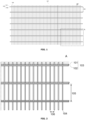
- Example 1 concerns a twin-wire fence panel, as shown in Figure 1 and Figure 2 , which can be coated according to the method of the first aspect.
- a twin-wire fence panel (108) consists of parallel vertical wires (104) welded to horizontal wires (101, 102) with the vertical wires welded at any height between two horizontal wires (101, 102) forming a double pair (103).
- the distance between two adjacent vertical wires (106) is about 50 mm c.t.c.
- the distance between the adjacent horizontal wires (105) is about 200 mm c.t.c.
- the names of the wires in the twin-wire fence panel namely "horizontal wires” and “vertical wires,” are relative terms.
- the terms “horizontal wires” and “cross wires” refer to the wires or bars which, in a working form (installed condition) of the twin-wire fence panel, are positioned substantially horizontally with respect to the surface on which the fencing is positioned upright. The horizontal wires therefore correspond to the length of the twin-wire fence panel.
- the terms “vertical wires” and “longitudinal wires” refer to the wires or bars that, in a working form (installed condition) of the twin-wire fence panel, are positioned substantially vertically relative to the surface on which the fencing is positioned upright. The vertical wires therefore correspond to the height of the twin-wire fence panel.
- the horizontal wires and vertical wires are thus positioned perpendicular to each other.
- both the horizontal wires and the vertical wires lie substantially in a plane parallel to the ground surface, still positioned perpendicular to each other.
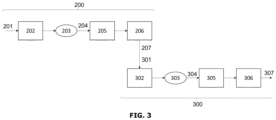
- Example 2 concerns an embodiment of the method according to the second aspect.
- the zinc epoxy comprises an epoxy obtained after polymerization of diglycidyl ether and bisphenol A.
- the twin-wire fence panels are grounded, i.e. connected to a zero potential.
- the guns spray the zinc epoxy powder at a spraying speed of 4-6 m/min onto the twin-wire fence panels.
- the twin-wire fence panels remain in the first spray booth for between 20 and 28 seconds.
- the zinc epoxy powder adhered to the vertical wires is blown away (203) so that a maximum of 1 mu, and preferably about 0 mu, of epoxy powder is present on the vertical wires.
- the twin-wire fence panels are passed through (204) to a second spray booth (205).
- the triboelectric powder coating guns spray the powder with a spraying speed of 4-6 m/min onto the twin-wire fence panels.
- the twin-wire fence panels remain in the second spray booth (205) for between 20 and 28 seconds.
- the twin-wire fence panels are then stove-enameled in an oven to harden the coating (206).
- Zinc epoxy coated ungalvanized twin-wire fence panels are obtained (207) comprising horizontal wires with a zinc epoxy coating with a thickness of approximately 70 mu and vertical wires with a zinc epoxy coating with a thickness of approximately 70 mu.
- the polyester is a polyether polyester, such as obtained after polycondensation of terephthalic acid diglycidyl ester and trimellitic acid triglycidyl ester.
- the twin-wire fence panels are grounded, i.e. connected to a zero potential.
- the guns spray the polyester powder at a spraying speed of 4-6 m/min onto the twin-wire fence panels.
- the twin-wire fence panels remain in the first spray booth for between 20 and 28 seconds.
- the polyester powder adhered to the vertical wires is blown away (303) so that a maximum of 1 mu of polyester powder is present on the vertical wires.
- the twin-wire fence panels are passed through (304) to a second spray booth (305).
- the triboelectric powder coating guns spray the polyester powder with a spraying speed of 4-6 m/min onto the twin-wire fence panels.
- the twin-wire fence panels remain in the second spray booth (305) for between 20 and 28 seconds.
- the twin-wire fence panels are then stove-enameled in an oven to harden the coating (306).
- a zinc epoxy+polyester coated ungalvanized twin-wire fence panel comprising horizontal wires with a zinc epoxy coating with a thickness of approximately 70 mu and a polyester coating with a thickness of approximately 50 mu and vertical wires with a zinc epoxy coating with a thickness of about 70 mu and a polyester coating with a thickness of about 50 mu.
- Example 3 concerns an embodiment of the method according to the second aspect, as described in Example 2.
- the position of the support points is changed between the two coating steps.
- the zinc epoxy coating is advantageous here because the zinc particles ensure that grounding on the new support points is still possible by increasing the conductivity of the epoxy.
- the method according to the invention also avoids the problem of "sparking" in case of poor conductivity by the use of this zinc epoxy.
- the present invention should not be construed as being limited to the embodiments described above and certain modifications or changes may be added to the examples described without having to re-evaluate the appended claims.
- the present invention has been described with reference to a twin-wire fence panel with seven pairs of horizontal wires, but it should be understood that the invention can be applied to e.g. a twin-wire fence panel with 7 pairs of horizontal wires or 1, 2, 3, 4, 5, 6, 8, 9, 10, 11, 12, 13, 14, 15, 16, 17, 18, 19, 20 pairs of horizontal wires.
- test plates were coated with a layer thickness of 45-50 ⁇ m, and the resistance was measured with a test voltage of 5000 V over two measuring points on the test plate located 15 mm apart.
- Table 1 This shows that the electrical resistance in an epoxy coated test plate is much higher than the electrical resistance in a zinc epoxy coated test plate. It is clear that adding zinc to the epoxy ensures that the electrical current is less obstructed and thus the conductivity is increased.
- TABLE 1 Example Resistance measurement in T ⁇ 4 15.00 (maximum value of the measuring device) 5 15.00 (maximum value of the measuring device) 6 11.82 7 14.41 8 5.60 9 7.36 10 3.11 11 3.70
- test plates were provided with a coating with a layer thickness of 45-50 ⁇ m, and the resistance was measured with a measuring voltage of 5000 V across two measuring points on the test plate located 15 mm apart.
- Table 2 This shows that the electrical resistance in an epoxy-coated test plate is much higher than the electrical resistance in a zinc-epoxy coated test plate.
- the advantageous lower limit is 1 m% because it has been shown that a resistance ⁇ 10 T ⁇ is required to obtain sufficient grounding of the panel.
- Example 17-23 Sparking during the coating process
- Examples 17 to 23 concern experiments regarding how many panels show "sparks" during the coating process, performed with zinc epoxies with different percentages of zinc. This sparking thus occurs if the grounding is not sufficient.
Landscapes
- Engineering & Computer Science (AREA)
- Life Sciences & Earth Sciences (AREA)
- Wood Science & Technology (AREA)
- Architecture (AREA)
- Civil Engineering (AREA)
- Structural Engineering (AREA)
- Fencing (AREA)
Applications Claiming Priority (1)
| Application Number | Priority Date | Filing Date | Title |
|---|---|---|---|
| BE20225932A BE1031089B1 (nl) | 2022-08-22 | 2022-11-18 | Een optimaal gecoat dubbeldraadhekwerkpaneel en werkwijze daartoe |
Publications (1)
| Publication Number | Publication Date |
|---|---|
| EP4372187A1 true EP4372187A1 (de) | 2024-05-22 |
Family
ID=88839422
Family Applications (1)
| Application Number | Title | Priority Date | Filing Date |
|---|---|---|---|
| EP23210505.6A Pending EP4372187A1 (de) | 2022-11-18 | 2023-11-17 | Optimal beschichtetes doppeldrahtzaunplatten und entsprechende verfahren |
Country Status (1)
| Country | Link |
|---|---|
| EP (1) | EP4372187A1 (de) |
Cited By (1)
| Publication number | Priority date | Publication date | Assignee | Title |
|---|---|---|---|---|
| CN120550992A (zh) * | 2025-07-30 | 2025-08-29 | 英凯模金属网有限公司 | 一种多辊梯次差速同步式环氧树脂网喷涂生产线 |
Citations (7)
| Publication number | Priority date | Publication date | Assignee | Title |
|---|---|---|---|---|
| GB1239952A (en) * | 1968-04-30 | 1971-07-21 | Ici Ltd | Coating process |
| GB1239951A (en) * | 1968-04-30 | 1971-07-21 | Ici Ltd | Coating process |
| GB2263423A (en) * | 1992-01-14 | 1993-07-28 | Plasgalv Limited | Manufacturing welded metal fence. |
| CN105817839A (zh) * | 2016-04-21 | 2016-08-03 | 滁州博昊门业制造有限公司 | 一种锌钢护栏的生产工艺流程 |
| CN108097563A (zh) * | 2017-12-18 | 2018-06-01 | 重庆黎帆装饰工程有限公司 | 耐腐蚀护栏的生产工艺 |
| CN111992475A (zh) * | 2020-07-07 | 2020-11-27 | 中电建路桥集团有限公司 | 表面覆有环氧锌基聚酯复合涂层护栏的制备方法 |
| CN113042341A (zh) * | 2021-03-01 | 2021-06-29 | 安徽壹叁高分子材料有限公司 | 一种高防腐高耐候燃气专用管道多层粉末涂料涂覆工艺 |
-
2023
- 2023-11-17 EP EP23210505.6A patent/EP4372187A1/de active Pending
Patent Citations (7)
| Publication number | Priority date | Publication date | Assignee | Title |
|---|---|---|---|---|
| GB1239952A (en) * | 1968-04-30 | 1971-07-21 | Ici Ltd | Coating process |
| GB1239951A (en) * | 1968-04-30 | 1971-07-21 | Ici Ltd | Coating process |
| GB2263423A (en) * | 1992-01-14 | 1993-07-28 | Plasgalv Limited | Manufacturing welded metal fence. |
| CN105817839A (zh) * | 2016-04-21 | 2016-08-03 | 滁州博昊门业制造有限公司 | 一种锌钢护栏的生产工艺流程 |
| CN108097563A (zh) * | 2017-12-18 | 2018-06-01 | 重庆黎帆装饰工程有限公司 | 耐腐蚀护栏的生产工艺 |
| CN111992475A (zh) * | 2020-07-07 | 2020-11-27 | 中电建路桥集团有限公司 | 表面覆有环氧锌基聚酯复合涂层护栏的制备方法 |
| CN113042341A (zh) * | 2021-03-01 | 2021-06-29 | 安徽壹叁高分子材料有限公司 | 一种高防腐高耐候燃气专用管道多层粉末涂料涂覆工艺 |
Non-Patent Citations (1)
| Title |
|---|
| ISO: "international standard ISO 2815:1973", 15 December 1973 (1973-12-15), pages 1 - 8, XP093140470, Retrieved from the Internet <URL:https://cdn.standards.iteh.ai/samples/7812/cb9a13dd143a4199966331c07abe1ad1/ISO-2815-1973.pdf> [retrieved on 20240312] * |
Cited By (1)
| Publication number | Priority date | Publication date | Assignee | Title |
|---|---|---|---|---|
| CN120550992A (zh) * | 2025-07-30 | 2025-08-29 | 英凯模金属网有限公司 | 一种多辊梯次差速同步式环氧树脂网喷涂生产线 |
Similar Documents
| Publication | Publication Date | Title |
|---|---|---|
| US6528125B1 (en) | Corrosion resistant powder coated metal tube and process for making the same | |
| EP0275083B1 (de) | Verfahren zur Ausbildung einer Metall-Spritzbeschichtung | |
| JP6656923B2 (ja) | 基材の金属表面の被覆法およびこの方法により被覆された物品 | |
| EP4372187A1 (de) | Optimal beschichtetes doppeldrahtzaunplatten und entsprechende verfahren | |
| CA2138257A1 (en) | Light-gage composite-coated flat-rolled steel manufacture and product | |
| EP1350822B1 (de) | Mit organischem Material beschichtetes Stahlblech das guten Rostschutz hat, gute rostverhindernde Leistung und seine Verwendung für Metalle | |
| JP4094707B2 (ja) | プレコート用塗料組成物及びプレコート鋼板 | |
| EP0119608B1 (de) | Zusammengestellter Überzug für verlängerten Korrosionsschutz | |
| JP2003083376A (ja) | 板ばね及びその製造方法 | |
| BE1031089B1 (nl) | Een optimaal gecoat dubbeldraadhekwerkpaneel en werkwijze daartoe | |
| JP2834686B2 (ja) | 耐クロム溶出性および加工後耐食性に優れた有機複合被覆鋼板 | |
| JP2000177053A (ja) | 被覆金属板 | |
| JP2004099808A (ja) | 粉体塗料組成物、塗装方法、自動車用鋼材 | |
| EP0136870A1 (de) | Verfahren zur Herstellung verbesserter metallhältiger organischer Überzüge und danach hergestelltes Produkt | |
| CN114207234A (zh) | 经涂覆的柱 | |
| US20080187743A1 (en) | Resin-Coated Metal Sheet | |
| EP0328304A1 (de) | Verfahren und Vorrichtung zum Überziehen von Maschendraht | |
| US6835428B1 (en) | Plastic powder filled epoxy paint for tubing | |
| CA3034748C (en) | Use of an adhesion promoter obtainable as the reaction product of a di- or polyamine with .alpha.,.beta.-unsaturated carboxylic acid derivatives for metal surface treatment | |
| JPH08267655A (ja) | 耐食性、耐指紋性に優れた塗装鋼板 | |
| JPH0120057B2 (de) | ||
| Gross | RINSEWATER RECYCLING SE’RVICE | |
| JPH0474872A (ja) | 耐食性に優れた有機複合被覆鋼板 | |
| WO2001054824A1 (en) | Epoxy/polyamide mix for coating metal tubing | |
| JPH09241859A (ja) | 耐クロム溶出性および耐ブリスター性に優れた有機複合被覆鋼板 |
Legal Events
| Date | Code | Title | Description |
|---|---|---|---|
| PUAI | Public reference made under article 153(3) epc to a published international application that has entered the european phase |
Free format text: ORIGINAL CODE: 0009012 |
|
| STAA | Information on the status of an ep patent application or granted ep patent |
Free format text: STATUS: THE APPLICATION HAS BEEN PUBLISHED |
|
| AK | Designated contracting states |
Kind code of ref document: A1 Designated state(s): AL AT BE BG CH CY CZ DE DK EE ES FI FR GB GR HR HU IE IS IT LI LT LU LV MC ME MK MT NL NO PL PT RO RS SE SI SK SM TR |
|
| STAA | Information on the status of an ep patent application or granted ep patent |
Free format text: STATUS: REQUEST FOR EXAMINATION WAS MADE |
|
| 17P | Request for examination filed |
Effective date: 20241004 |
|
| RBV | Designated contracting states (corrected) |
Designated state(s): AL AT BE BG CH CY CZ DE DK EE ES FI FR GB GR HR HU IE IS IT LI LT LU LV MC ME MK MT NL NO PL PT RO RS SE SI SK SM TR |