EP4374800A2 - Verfahren zur herstellung einer mikronadelplattform - Google Patents
Verfahren zur herstellung einer mikronadelplattform Download PDFInfo
- Publication number
- EP4374800A2 EP4374800A2 EP24161949.3A EP24161949A EP4374800A2 EP 4374800 A2 EP4374800 A2 EP 4374800A2 EP 24161949 A EP24161949 A EP 24161949A EP 4374800 A2 EP4374800 A2 EP 4374800A2
- Authority
- EP
- European Patent Office
- Prior art keywords
- microneedles
- therapeutic agent
- release
- drug delivery
- delivery system
- Prior art date
- Legal status (The legal status is an assumption and is not a legal conclusion. Google has not performed a legal analysis and makes no representation as to the accuracy of the status listed.)
- Pending
Links
- 238000004519 manufacturing process Methods 0.000 title abstract description 16
- 239000003814 drug Substances 0.000 claims abstract description 77
- 229960005486 vaccine Drugs 0.000 claims abstract description 31
- 238000012377 drug delivery Methods 0.000 claims abstract description 18
- 229920002988 biodegradable polymer Polymers 0.000 claims abstract description 8
- 239000004621 biodegradable polymer Substances 0.000 claims abstract description 8
- 230000000541 pulsatile effect Effects 0.000 claims abstract description 8
- 229940124597 therapeutic agent Drugs 0.000 claims description 36
- 229920001606 poly(lactic acid-co-glycolic acid) Polymers 0.000 claims description 13
- 229920000036 polyvinylpyrrolidone Polymers 0.000 claims description 10
- 235000013855 polyvinylpyrrolidone Nutrition 0.000 claims description 10
- 229920002451 polyvinyl alcohol Polymers 0.000 claims description 7
- 239000004372 Polyvinyl alcohol Substances 0.000 claims description 6
- 239000000758 substrate Substances 0.000 claims description 5
- 238000004891 communication Methods 0.000 claims description 4
- 229920003088 hydroxypropyl methyl cellulose Polymers 0.000 claims description 4
- NOESYZHRGYRDHS-UHFFFAOYSA-N insulin Chemical compound N1C(=O)C(NC(=O)C(CCC(N)=O)NC(=O)C(CCC(O)=O)NC(=O)C(C(C)C)NC(=O)C(NC(=O)CN)C(C)CC)CSSCC(C(NC(CO)C(=O)NC(CC(C)C)C(=O)NC(CC=2C=CC(O)=CC=2)C(=O)NC(CCC(N)=O)C(=O)NC(CC(C)C)C(=O)NC(CCC(O)=O)C(=O)NC(CC(N)=O)C(=O)NC(CC=2C=CC(O)=CC=2)C(=O)NC(CSSCC(NC(=O)C(C(C)C)NC(=O)C(CC(C)C)NC(=O)C(CC=2C=CC(O)=CC=2)NC(=O)C(CC(C)C)NC(=O)C(C)NC(=O)C(CCC(O)=O)NC(=O)C(C(C)C)NC(=O)C(CC(C)C)NC(=O)C(CC=2NC=NC=2)NC(=O)C(CO)NC(=O)CNC2=O)C(=O)NCC(=O)NC(CCC(O)=O)C(=O)NC(CCCNC(N)=N)C(=O)NCC(=O)NC(CC=3C=CC=CC=3)C(=O)NC(CC=3C=CC=CC=3)C(=O)NC(CC=3C=CC(O)=CC=3)C(=O)NC(C(C)O)C(=O)N3C(CCC3)C(=O)NC(CCCCN)C(=O)NC(C)C(O)=O)C(=O)NC(CC(N)=O)C(O)=O)=O)NC(=O)C(C(C)CC)NC(=O)C(CO)NC(=O)C(C(C)O)NC(=O)C1CSSCC2NC(=O)C(CC(C)C)NC(=O)C(NC(=O)C(CCC(N)=O)NC(=O)C(CC(N)=O)NC(=O)C(NC(=O)C(N)CC=1C=CC=CC=1)C(C)C)CC1=CN=CN1 NOESYZHRGYRDHS-UHFFFAOYSA-N 0.000 claims description 4
- 229920001223 polyethylene glycol Polymers 0.000 claims description 4
- VOJUXHHACRXLTD-UHFFFAOYSA-N 1,4-dihydroxy-2-naphthoic acid Chemical compound C1=CC=CC2=C(O)C(C(=O)O)=CC(O)=C21 VOJUXHHACRXLTD-UHFFFAOYSA-N 0.000 claims description 3
- 102000018997 Growth Hormone Human genes 0.000 claims description 3
- 108010051696 Growth Hormone Proteins 0.000 claims description 3
- 239000002202 Polyethylene glycol Substances 0.000 claims description 3
- 239000000122 growth hormone Substances 0.000 claims description 3
- 239000001267 polyvinylpyrrolidone Substances 0.000 claims description 3
- 102000004877 Insulin Human genes 0.000 claims description 2
- 108090001061 Insulin Proteins 0.000 claims description 2
- 239000002253 acid Substances 0.000 claims description 2
- 229940125396 insulin Drugs 0.000 claims description 2
- JJTUDXZGHPGLLC-UHFFFAOYSA-N lactide Chemical compound CC1OC(=O)C(C)OC1=O JJTUDXZGHPGLLC-UHFFFAOYSA-N 0.000 claims description 2
- 239000000203 mixture Substances 0.000 claims description 2
- 206010020751 Hypersensitivity Diseases 0.000 claims 1
- 239000012190 activator Substances 0.000 claims 1
- 208000026935 allergic disease Diseases 0.000 claims 1
- 230000007815 allergy Effects 0.000 claims 1
- 208000024891 symptom Diseases 0.000 claims 1
- 229940079593 drug Drugs 0.000 abstract description 39
- 239000011258 core-shell material Substances 0.000 abstract description 21
- 238000002347 injection Methods 0.000 abstract description 17
- 239000007924 injection Substances 0.000 abstract description 17
- 238000000034 method Methods 0.000 description 35
- 230000008569 process Effects 0.000 description 21
- 210000003491 skin Anatomy 0.000 description 21
- 239000004205 dimethyl polysiloxane Substances 0.000 description 16
- 235000013870 dimethyl polysiloxane Nutrition 0.000 description 16
- 229920000435 poly(dimethylsiloxane) Polymers 0.000 description 16
- CXQXSVUQTKDNFP-UHFFFAOYSA-N octamethyltrisiloxane Chemical compound C[Si](C)(C)O[Si](C)(C)O[Si](C)(C)C CXQXSVUQTKDNFP-UHFFFAOYSA-N 0.000 description 15
- 238000004987 plasma desorption mass spectroscopy Methods 0.000 description 15
- 239000000463 material Substances 0.000 description 11
- 229920000642 polymer Polymers 0.000 description 11
- 238000009987 spinning Methods 0.000 description 9
- IAZDPXIOMUYVGZ-UHFFFAOYSA-N Dimethylsulphoxide Chemical compound CS(C)=O IAZDPXIOMUYVGZ-UHFFFAOYSA-N 0.000 description 8
- CSCPPACGZOOCGX-UHFFFAOYSA-N Acetone Chemical compound CC(C)=O CSCPPACGZOOCGX-UHFFFAOYSA-N 0.000 description 7
- 229920001296 polysiloxane Polymers 0.000 description 6
- 239000000243 solution Substances 0.000 description 6
- 239000002904 solvent Substances 0.000 description 6
- 238000013459 approach Methods 0.000 description 5
- 238000003491 array Methods 0.000 description 5
- 230000008901 benefit Effects 0.000 description 5
- 238000005516 engineering process Methods 0.000 description 5
- XLYOFNOQVPJJNP-UHFFFAOYSA-N water Substances O XLYOFNOQVPJJNP-UHFFFAOYSA-N 0.000 description 5
- -1 Polydimethylsiloxane Polymers 0.000 description 4
- 230000000694 effects Effects 0.000 description 4
- 238000002649 immunization Methods 0.000 description 4
- 230000003053 immunization Effects 0.000 description 4
- 238000003780 insertion Methods 0.000 description 4
- 230000037431 insertion Effects 0.000 description 4
- 238000005459 micromachining Methods 0.000 description 4
- 238000000206 photolithography Methods 0.000 description 4
- LFQSCWFLJHTTHZ-UHFFFAOYSA-N Ethanol Chemical compound CCO LFQSCWFLJHTTHZ-UHFFFAOYSA-N 0.000 description 3
- OKKJLVBELUTLKV-UHFFFAOYSA-N Methanol Chemical compound OC OKKJLVBELUTLKV-UHFFFAOYSA-N 0.000 description 3
- 238000005266 casting Methods 0.000 description 3
- 238000000748 compression moulding Methods 0.000 description 3
- 229920001577 copolymer Polymers 0.000 description 3
- 230000002500 effect on skin Effects 0.000 description 3
- 238000005429 filling process Methods 0.000 description 3
- 230000002209 hydrophobic effect Effects 0.000 description 3
- 238000000465 moulding Methods 0.000 description 3
- 229920006254 polymer film Polymers 0.000 description 3
- 238000010146 3D printing Methods 0.000 description 2
- 241000699670 Mus sp. Species 0.000 description 2
- 239000004809 Teflon Substances 0.000 description 2
- 229920006362 Teflon® Polymers 0.000 description 2
- 239000000853 adhesive Substances 0.000 description 2
- 230000001070 adhesive effect Effects 0.000 description 2
- 230000000172 allergic effect Effects 0.000 description 2
- 208000010668 atopic eczema Diseases 0.000 description 2
- 239000000969 carrier Substances 0.000 description 2
- 238000007906 compression Methods 0.000 description 2
- 230000006835 compression Effects 0.000 description 2
- 230000002498 deadly effect Effects 0.000 description 2
- 230000002708 enhancing effect Effects 0.000 description 2
- 230000009477 glass transition Effects 0.000 description 2
- 239000007943 implant Substances 0.000 description 2
- 238000001053 micromoulding Methods 0.000 description 2
- 239000002245 particle Substances 0.000 description 2
- 229920001343 polytetrafluoroethylene Polymers 0.000 description 2
- 239000004810 polytetrafluoroethylene Substances 0.000 description 2
- 239000001044 red dye Substances 0.000 description 2
- 238000007789 sealing Methods 0.000 description 2
- 239000007787 solid Substances 0.000 description 2
- 239000000725 suspension Substances 0.000 description 2
- 238000013268 sustained release Methods 0.000 description 2
- 229920003169 water-soluble polymer Polymers 0.000 description 2
- 208000035473 Communicable disease Diseases 0.000 description 1
- 206010061218 Inflammation Diseases 0.000 description 1
- 229940124950 Prevnar 13 Drugs 0.000 description 1
- 241000283984 Rodentia Species 0.000 description 1
- 206010040880 Skin irritation Diseases 0.000 description 1
- 239000000427 antigen Substances 0.000 description 1
- 210000000612 antigen-presenting cell Anatomy 0.000 description 1
- 102000036639 antigens Human genes 0.000 description 1
- 108091007433 antigens Proteins 0.000 description 1
- QVGXLLKOCUKJST-UHFFFAOYSA-N atomic oxygen Chemical compound [O] QVGXLLKOCUKJST-UHFFFAOYSA-N 0.000 description 1
- 229920013641 bioerodible polymer Polymers 0.000 description 1
- 230000015556 catabolic process Effects 0.000 description 1
- 238000005119 centrifugation Methods 0.000 description 1
- 229920000891 common polymer Polymers 0.000 description 1
- 238000010276 construction Methods 0.000 description 1
- 239000000599 controlled substance Substances 0.000 description 1
- 229940028617 conventional vaccine Drugs 0.000 description 1
- 238000006731 degradation reaction Methods 0.000 description 1
- 230000003111 delayed effect Effects 0.000 description 1
- 210000004207 dermis Anatomy 0.000 description 1
- 238000013461 design Methods 0.000 description 1
- 238000010586 diagram Methods 0.000 description 1
- 201000010099 disease Diseases 0.000 description 1
- 208000037265 diseases, disorders, signs and symptoms Diseases 0.000 description 1
- 239000003937 drug carrier Substances 0.000 description 1
- 229920001971 elastomer Polymers 0.000 description 1
- 239000000806 elastomer Substances 0.000 description 1
- 238000009472 formulation Methods 0.000 description 1
- 238000004108 freeze drying Methods 0.000 description 1
- 239000011521 glass Substances 0.000 description 1
- 231100001261 hazardous Toxicity 0.000 description 1
- 238000010438 heat treatment Methods 0.000 description 1
- 235000010979 hydroxypropyl methyl cellulose Nutrition 0.000 description 1
- 239000012729 immediate-release (IR) formulation Substances 0.000 description 1
- 210000002865 immune cell Anatomy 0.000 description 1
- 230000028993 immune response Effects 0.000 description 1
- 238000002513 implantation Methods 0.000 description 1
- 239000012535 impurity Substances 0.000 description 1
- 208000015181 infectious disease Diseases 0.000 description 1
- 230000004054 inflammatory process Effects 0.000 description 1
- 230000010354 integration Effects 0.000 description 1
- 238000010255 intramuscular injection Methods 0.000 description 1
- 239000007927 intramuscular injection Substances 0.000 description 1
- 238000001459 lithography Methods 0.000 description 1
- 230000007774 longterm Effects 0.000 description 1
- 238000002844 melting Methods 0.000 description 1
- 230000008018 melting Effects 0.000 description 1
- 239000002184 metal Substances 0.000 description 1
- 239000011859 microparticle Substances 0.000 description 1
- 238000001682 microtransfer moulding Methods 0.000 description 1
- 239000002105 nanoparticle Substances 0.000 description 1
- 230000003287 optical effect Effects 0.000 description 1
- 239000003960 organic solvent Substances 0.000 description 1
- 239000001301 oxygen Substances 0.000 description 1
- 229910052760 oxygen Inorganic materials 0.000 description 1
- 239000002952 polymeric resin Substances 0.000 description 1
- 230000003252 repetitive effect Effects 0.000 description 1
- 230000010076 replication Effects 0.000 description 1
- 230000036556 skin irritation Effects 0.000 description 1
- 231100000475 skin irritation Toxicity 0.000 description 1
- 238000003892 spreading Methods 0.000 description 1
- 230000007480 spreading Effects 0.000 description 1
- 238000003860 storage Methods 0.000 description 1
- 230000003075 superhydrophobic effect Effects 0.000 description 1
- 238000004381 surface treatment Methods 0.000 description 1
- 239000012730 sustained-release form Substances 0.000 description 1
- 238000003786 synthesis reaction Methods 0.000 description 1
- 229920003002 synthetic resin Polymers 0.000 description 1
- 239000003826 tablet Substances 0.000 description 1
- 230000037317 transdermal delivery Effects 0.000 description 1
- 238000012546 transfer Methods 0.000 description 1
- 238000002255 vaccination Methods 0.000 description 1
- 230000003612 virological effect Effects 0.000 description 1
- 238000012800 visualization Methods 0.000 description 1
- 239000002699 waste material Substances 0.000 description 1
Images


Classifications
-
- A—HUMAN NECESSITIES
- A61—MEDICAL OR VETERINARY SCIENCE; HYGIENE
- A61M—DEVICES FOR INTRODUCING MEDIA INTO, OR ONTO, THE BODY; DEVICES FOR TRANSDUCING BODY MEDIA OR FOR TAKING MEDIA FROM THE BODY; DEVICES FOR PRODUCING OR ENDING SLEEP OR STUPOR
- A61M37/00—Other apparatus for introducing media into the body; Percutany, i.e. introducing medicines into the body by diffusion through the skin
- A61M37/0015—Other apparatus for introducing media into the body; Percutany, i.e. introducing medicines into the body by diffusion through the skin by using microneedles
-
- A—HUMAN NECESSITIES
- A61—MEDICAL OR VETERINARY SCIENCE; HYGIENE
- A61B—DIAGNOSIS; SURGERY; IDENTIFICATION
- A61B17/00—Surgical instruments, devices or methods
- A61B17/20—Surgical instruments, devices or methods for vaccinating or cleaning the skin previous to the vaccination
- A61B17/205—Vaccinating by means of needles or other puncturing devices
-
- A—HUMAN NECESSITIES
- A61—MEDICAL OR VETERINARY SCIENCE; HYGIENE
- A61D—VETERINARY INSTRUMENTS, IMPLEMENTS, TOOLS, OR METHODS
- A61D7/00—Devices or methods for introducing solid, liquid, or gaseous remedies or other materials into or onto the bodies of animals
-
- B—PERFORMING OPERATIONS; TRANSPORTING
- B29—WORKING OF PLASTICS; WORKING OF SUBSTANCES IN A PLASTIC STATE IN GENERAL
- B29C—SHAPING OR JOINING OF PLASTICS; SHAPING OF MATERIAL IN A PLASTIC STATE, NOT OTHERWISE PROVIDED FOR; AFTER-TREATMENT OF THE SHAPED PRODUCTS, e.g. REPAIRING
- B29C39/00—Shaping by casting, i.e. introducing the moulding material into a mould or between confining surfaces without significant moulding pressure; Apparatus therefor
- B29C39/003—Shaping by casting, i.e. introducing the moulding material into a mould or between confining surfaces without significant moulding pressure; Apparatus therefor characterised by the choice of material
- B29C39/006—Monomers or prepolymers
-
- B—PERFORMING OPERATIONS; TRANSPORTING
- B29—WORKING OF PLASTICS; WORKING OF SUBSTANCES IN A PLASTIC STATE IN GENERAL
- B29C—SHAPING OR JOINING OF PLASTICS; SHAPING OF MATERIAL IN A PLASTIC STATE, NOT OTHERWISE PROVIDED FOR; AFTER-TREATMENT OF THE SHAPED PRODUCTS, e.g. REPAIRING
- B29C39/00—Shaping by casting, i.e. introducing the moulding material into a mould or between confining surfaces without significant moulding pressure; Apparatus therefor
- B29C39/02—Shaping by casting, i.e. introducing the moulding material into a mould or between confining surfaces without significant moulding pressure; Apparatus therefor for making articles of definite length, i.e. discrete articles
- B29C39/026—Shaping by casting, i.e. introducing the moulding material into a mould or between confining surfaces without significant moulding pressure; Apparatus therefor for making articles of definite length, i.e. discrete articles characterised by the shape of the surface
-
- B—PERFORMING OPERATIONS; TRANSPORTING
- B29—WORKING OF PLASTICS; WORKING OF SUBSTANCES IN A PLASTIC STATE IN GENERAL
- B29C—SHAPING OR JOINING OF PLASTICS; SHAPING OF MATERIAL IN A PLASTIC STATE, NOT OTHERWISE PROVIDED FOR; AFTER-TREATMENT OF THE SHAPED PRODUCTS, e.g. REPAIRING
- B29C39/00—Shaping by casting, i.e. introducing the moulding material into a mould or between confining surfaces without significant moulding pressure; Apparatus therefor
- B29C39/02—Shaping by casting, i.e. introducing the moulding material into a mould or between confining surfaces without significant moulding pressure; Apparatus therefor for making articles of definite length, i.e. discrete articles
- B29C39/10—Shaping by casting, i.e. introducing the moulding material into a mould or between confining surfaces without significant moulding pressure; Apparatus therefor for making articles of definite length, i.e. discrete articles incorporating preformed parts or layers, e.g. casting around inserts or for coating articles
-
- B—PERFORMING OPERATIONS; TRANSPORTING
- B29—WORKING OF PLASTICS; WORKING OF SUBSTANCES IN A PLASTIC STATE IN GENERAL
- B29C—SHAPING OR JOINING OF PLASTICS; SHAPING OF MATERIAL IN A PLASTIC STATE, NOT OTHERWISE PROVIDED FOR; AFTER-TREATMENT OF THE SHAPED PRODUCTS, e.g. REPAIRING
- B29C41/00—Shaping by coating a mould, core or other substrate, i.e. by depositing material and stripping-off the shaped article; Apparatus therefor
- B29C41/003—Shaping by coating a mould, core or other substrate, i.e. by depositing material and stripping-off the shaped article; Apparatus therefor characterised by the choice of material
-
- B—PERFORMING OPERATIONS; TRANSPORTING
- B29—WORKING OF PLASTICS; WORKING OF SUBSTANCES IN A PLASTIC STATE IN GENERAL
- B29C—SHAPING OR JOINING OF PLASTICS; SHAPING OF MATERIAL IN A PLASTIC STATE, NOT OTHERWISE PROVIDED FOR; AFTER-TREATMENT OF THE SHAPED PRODUCTS, e.g. REPAIRING
- B29C43/00—Compression moulding, i.e. applying external pressure to flow the moulding material; Apparatus therefor
- B29C43/003—Compression moulding, i.e. applying external pressure to flow the moulding material; Apparatus therefor characterised by the choice of material
-
- B—PERFORMING OPERATIONS; TRANSPORTING
- B29—WORKING OF PLASTICS; WORKING OF SUBSTANCES IN A PLASTIC STATE IN GENERAL
- B29C—SHAPING OR JOINING OF PLASTICS; SHAPING OF MATERIAL IN A PLASTIC STATE, NOT OTHERWISE PROVIDED FOR; AFTER-TREATMENT OF THE SHAPED PRODUCTS, e.g. REPAIRING
- B29C43/00—Compression moulding, i.e. applying external pressure to flow the moulding material; Apparatus therefor
- B29C43/02—Compression moulding, i.e. applying external pressure to flow the moulding material; Apparatus therefor of articles of definite length, i.e. discrete articles
-
- B—PERFORMING OPERATIONS; TRANSPORTING
- B29—WORKING OF PLASTICS; WORKING OF SUBSTANCES IN A PLASTIC STATE IN GENERAL
- B29C—SHAPING OR JOINING OF PLASTICS; SHAPING OF MATERIAL IN A PLASTIC STATE, NOT OTHERWISE PROVIDED FOR; AFTER-TREATMENT OF THE SHAPED PRODUCTS, e.g. REPAIRING
- B29C43/00—Compression moulding, i.e. applying external pressure to flow the moulding material; Apparatus therefor
- B29C43/02—Compression moulding, i.e. applying external pressure to flow the moulding material; Apparatus therefor of articles of definite length, i.e. discrete articles
- B29C43/021—Compression moulding, i.e. applying external pressure to flow the moulding material; Apparatus therefor of articles of definite length, i.e. discrete articles characterised by the shape of the surface
-
- B—PERFORMING OPERATIONS; TRANSPORTING
- B29—WORKING OF PLASTICS; WORKING OF SUBSTANCES IN A PLASTIC STATE IN GENERAL
- B29C—SHAPING OR JOINING OF PLASTICS; SHAPING OF MATERIAL IN A PLASTIC STATE, NOT OTHERWISE PROVIDED FOR; AFTER-TREATMENT OF THE SHAPED PRODUCTS, e.g. REPAIRING
- B29C43/00—Compression moulding, i.e. applying external pressure to flow the moulding material; Apparatus therefor
- B29C43/32—Component parts, details or accessories; Auxiliary operations
-
- B—PERFORMING OPERATIONS; TRANSPORTING
- B29—WORKING OF PLASTICS; WORKING OF SUBSTANCES IN A PLASTIC STATE IN GENERAL
- B29C—SHAPING OR JOINING OF PLASTICS; SHAPING OF MATERIAL IN A PLASTIC STATE, NOT OTHERWISE PROVIDED FOR; AFTER-TREATMENT OF THE SHAPED PRODUCTS, e.g. REPAIRING
- B29C65/00—Joining or sealing of preformed parts, e.g. welding of plastics materials; Apparatus therefor
- B29C65/02—Joining or sealing of preformed parts, e.g. welding of plastics materials; Apparatus therefor by heating, with or without pressure
-
- A—HUMAN NECESSITIES
- A61—MEDICAL OR VETERINARY SCIENCE; HYGIENE
- A61M—DEVICES FOR INTRODUCING MEDIA INTO, OR ONTO, THE BODY; DEVICES FOR TRANSDUCING BODY MEDIA OR FOR TAKING MEDIA FROM THE BODY; DEVICES FOR PRODUCING OR ENDING SLEEP OR STUPOR
- A61M37/00—Other apparatus for introducing media into the body; Percutany, i.e. introducing medicines into the body by diffusion through the skin
- A61M37/0015—Other apparatus for introducing media into the body; Percutany, i.e. introducing medicines into the body by diffusion through the skin by using microneedles
- A61M2037/0023—Drug applicators using microneedles
-
- A—HUMAN NECESSITIES
- A61—MEDICAL OR VETERINARY SCIENCE; HYGIENE
- A61M—DEVICES FOR INTRODUCING MEDIA INTO, OR ONTO, THE BODY; DEVICES FOR TRANSDUCING BODY MEDIA OR FOR TAKING MEDIA FROM THE BODY; DEVICES FOR PRODUCING OR ENDING SLEEP OR STUPOR
- A61M37/00—Other apparatus for introducing media into the body; Percutany, i.e. introducing medicines into the body by diffusion through the skin
- A61M37/0015—Other apparatus for introducing media into the body; Percutany, i.e. introducing medicines into the body by diffusion through the skin by using microneedles
- A61M2037/003—Other apparatus for introducing media into the body; Percutany, i.e. introducing medicines into the body by diffusion through the skin by using microneedles having a lumen
-
- A—HUMAN NECESSITIES
- A61—MEDICAL OR VETERINARY SCIENCE; HYGIENE
- A61M—DEVICES FOR INTRODUCING MEDIA INTO, OR ONTO, THE BODY; DEVICES FOR TRANSDUCING BODY MEDIA OR FOR TAKING MEDIA FROM THE BODY; DEVICES FOR PRODUCING OR ENDING SLEEP OR STUPOR
- A61M37/00—Other apparatus for introducing media into the body; Percutany, i.e. introducing medicines into the body by diffusion through the skin
- A61M37/0015—Other apparatus for introducing media into the body; Percutany, i.e. introducing medicines into the body by diffusion through the skin by using microneedles
- A61M2037/0046—Solid microneedles
-
- A—HUMAN NECESSITIES
- A61—MEDICAL OR VETERINARY SCIENCE; HYGIENE
- A61M—DEVICES FOR INTRODUCING MEDIA INTO, OR ONTO, THE BODY; DEVICES FOR TRANSDUCING BODY MEDIA OR FOR TAKING MEDIA FROM THE BODY; DEVICES FOR PRODUCING OR ENDING SLEEP OR STUPOR
- A61M37/00—Other apparatus for introducing media into the body; Percutany, i.e. introducing medicines into the body by diffusion through the skin
- A61M37/0015—Other apparatus for introducing media into the body; Percutany, i.e. introducing medicines into the body by diffusion through the skin by using microneedles
- A61M2037/0053—Methods for producing microneedles
-
- A—HUMAN NECESSITIES
- A61—MEDICAL OR VETERINARY SCIENCE; HYGIENE
- A61M—DEVICES FOR INTRODUCING MEDIA INTO, OR ONTO, THE BODY; DEVICES FOR TRANSDUCING BODY MEDIA OR FOR TAKING MEDIA FROM THE BODY; DEVICES FOR PRODUCING OR ENDING SLEEP OR STUPOR
- A61M37/00—Other apparatus for introducing media into the body; Percutany, i.e. introducing medicines into the body by diffusion through the skin
- A61M37/0015—Other apparatus for introducing media into the body; Percutany, i.e. introducing medicines into the body by diffusion through the skin by using microneedles
- A61M2037/0061—Methods for using microneedles
Definitions
- Injections in conventional administration of vaccines are problematic.
- Microneedle patches have been explored and shown to exhibit advantages in transdermal delivery, however there have not been any reports on the use of this approach for single-administered multi-pulse delivery.
- current microneedles in which therapeutic agents are incorporated into the polymeric carriers only allow immediate or sustained releases.
- Another system like hollow microneedles even though provides a micro-infusing system, it requires an external drug reservoir on the skin or portable devices.
- SEAL StampED Assembly of polymer Layers
- SEAL relies on a laborious manual process to remove scum/residual layers of polymer after molding steps and a slow process to fill drugs into polymeric carriers in serial (i.e., one by one). This filling struggles with instability of off-target jetting and severely suffers from the coffee-ring effect which results in drugs being deposited more on the edges of the drug micro-cores preventing a maximal loading efficiency (see FIG. 1 ).
- SEAL has been shown to create different polymeric layers.
- the method results in a thick scum residual layer, requiring a manual, inconsistent and slow removal process (with scotch-tape and oxygen plasma).
- PRINT so-called PRINT technology
- Wong, D. H.; Byrne, J. D.; Chen, K; Bowerman, C.; DeSimone, J. M. Future of the particle replication in nonwetting templates (PRINT) technology.
- PRINT nonwetting templates
- Angewandte Chemie International Edition 2013, 52, (26), 6580-6589 researchers have shown that synthetic super-hydrophobic Teflon-like polymer can be employed to mold micro/nano particles without creating a scum layer.
- the polymer source is very limited and too costly while chemical synthesis is still required to obtain the final polymer resin.
- the core-shell microneedle system provides a pulsatile drug delivery system which is programmed to release drugs/vaccines at predictable times using biodegradable polymers and with controllable dosages. This is the first microneedle system which would be fully embedded into the skin and then release drugs/vaccines as sharp bursts in a timely manner, similar to multiple bolus injections.
- the fully-embedded coreshell microneedle is significantly less invasive compared to hypodermal/intramuscular injection of SEAL-particles.
- the previous drug filling process is not only slow, laborious, and requires an expensive filling device but also struggles with instability of off-target jetting and severely suffers from the coffee-ring effect which results in drugs to be deposited more on the edges of the drug micro-cores, preventing a maximal loading efficiency ( Fig. 1 ). Meanwhile, the new drug-loading and scum removing method do not suffer from such disadvantages and at the same time offer a high scalability
- microneedle patches have been explored and shown to exhibit advantages in delivering and enhancing vaccine efficacy, there have not been any reports on the use of this approach for single-administered multi-pulse vaccine delivery.
- novel core-shell microneedles which will be fully embedded into skin and release vaccines as sharp bursts in a predictable timely manner, similar to multiple bolus injections.
- the microneedles will not only allow for an easy, one-time self-administration of vaccine but also increase efficiency of the immunization since they target numerous antigen-presenting cells at the dermal layers. This is a tremendous benefit to solve the global problem of incomplete immunization while sparing antigen by boosting the vaccine activity.
- a new drug-loading approach which does not rely on the serial and slow filling process, is also described.
- Arrays of molded drug cones are simultaneously placed into arrays of the microneedles in a parallel and high throughput manner while at the same time, sealing the drug cores.
- This new manufacturing process creates novel core-shell microneedles which can be fully inserted inside the skin and programmed to deliver vaccines or drugs at different times, similar to multiple bolus injections. These microneedles will increase patient accessibility to the vaccine, fostering the goal of global immunization to eradicate, and prevent deadly infectious diseases. Moreover, the needles would also offer a platform technology to administer versatile drugs (e.g., growth hormone, allergic drugs, pain medicine, etc.) which require frequent injections.
- versatile drugs e.g., growth hormone, allergic drugs, pain medicine, etc.
- microneedle system can significantly enhance the efficiency of vaccine delivery by combining the concept of dermal/skin delivery and pulsatile release which has not been achieved from currently available microneedle patches.
- the disclosure describes a pulsatile drug delivery system comprising a microneedle assembly including a plurality of microneedles filled with a therapeutic agent.
- the microneedles comprise biodegradable polymers, and the microneedle assembly is configured to release the therapeutic agent at predetermined times with a predetermined amount of the therapeutic agent while the microneedle assembly remains embedded in a patient.
- the disclosure provides a method of manufacturing a microneedle assembly.
- the method comprises generating a core microneedle assembly by filling a first silicone mold including a plurality of microneedle cavities with a copolymer, spinning the first silicone mold to remove a first scum layer of the copolymer on the first silicone mold, and generating a core in each of the copolymer-filled cavities.
- the method further comprises generating a therapeutic agent assembly by filling a plurality of cavities in a second silicone mold with a therapeutic agent, spinning the second silicone mold to remove a second scum layer of the therapeutic agent, and removing the molded therapeutic agent from the second mold and transferring the molded therapeutic agent to a substrate.
- the method further comprises aligning the therapeutic agent assembly with the core microneedle assembly to thereby fill the cores in the core microneedle assembly with the therapeutic agent.
- a drug delivery system provides a one-time administration of one or more therapeutic agents of one or more dosages which are programmed to release at predictable time points. For example, degradation of the polymeric shell of the microneedles provides for release of the therapeutic agent.
- the drug delivery system can replace multiple bolus injections of many therapeutic agents, especially vaccines which require initial dose and multiple boosters.
- the drug delivery system includes coreshell microneedles that overcome the above-noted SEAL limitations in fabrication, provide a minimally invasive approach, and allows for self-administration.
- the needles pierce into the dermis layer of the skin where there is a substantial number of immune cells, thereby significantly enhancing immune response.
- Microneedles are, therefore, an appealing delivery approach to enable one-time, painless, and effective administration of vaccines to replace multiple injections in the conventional immunization process.
- the microneedles are fabricated from FDA approved materials (e.g., Poly(D,L-lactide-co-glycolide) (PLGA), poly-lactide acid (PLA)) that are commonly used for drug delivery, medical devices, etc.
- FDA approved materials e.g., Poly(D,L-lactide-co-glycolide) (PLGA), poly-lactide acid (PLA)
- the master structures for the microneedles are fabricated using a 3D laser lithography system (Nanoscribe GmbH). Inverse molds comprising silicone (Polydimethylsiloxane (“PDMS”)) are made by pouring PDMS solution over the master structure and curing at 60°C for 3 hours. A new process is employed which only relies on common PDMS molds to eliminate the scum layer.
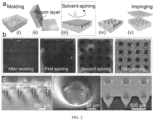
- FIG. 2 (at a) describes the fabrication process in which a needle mold of PDMS is pressed onto a hot Poly(D,L-lactide-co-glycolide) (“PLGA”) (i). The PLGA is trapped inside the cavity of the mold, which is then separated from the substrate (ii).
- PLGA Poly(D,L-lactide-co-glycolide)
- the released mold has a significant scum layer which needs to be removed to create free-standing and fully-embeddable needles.
- the PDMS mold using spin-coater
- solvent e.g., acetone, dimethyl sulfoxide (“DMSO”)
- DMSO dimethyl sulfoxide
- water to remove hydrophilic drug
- FIG. 2 (at b) shows preliminary data in removing the scum layer of molded PLGA in PDMS.
- This PLGA was molded into small slabs inside a PDMS mold.
- a thick scum layer was present after the molding process but after a few spinning steps with acetone, the scum layer was completely removed.
- microneedles with conical empty cores were created by this impinging process, as seen in FIG. 2 (at c).
- another mold is impinged onto the needle, trapped inside the PDMS mold, to create dimples or cores which are used to contain therapeutic agents.
- a PDMS stamp is used to mold the drug/vaccine of interest into conical shapes, mixed with a polymeric carrier.
- suitable polymeric solutions are selected.
- Some common polymers are Polyvinylpyrrolidone (“PVP"), Polyvinyl alcohol (“PVA”), Polyethylene glycol (“PEG”), (Hydroxypropyl)methyl cellulose (“HPMC”).
- PVP Polyvinylpyrrolidone
- PVA Polyvinyl alcohol
- PEG Polyethylene glycol
- HPMC Hydrophilpropyl
- the polymer is highly water-soluble, facilitating an immediate release of the encapsulated drugs with sharp release bursts after contact with water.
- the molding is similar to the process in FIG. 2 (at a, steps (i)-(ii)) but occurs at room/low temperatures to avoid damage to the vaccine.
- the scum layer is removed by spinning water on top of the PDMS stamp, containing the molded drug cones.
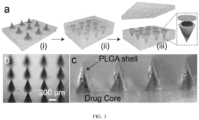
- the drug-PVP cores are then aligned and transferred on a cap-layer of PLGA, which has been molded and trapped inside another PDMS mold (see FIG. 3 (at a, (i)).
- this cap layer is aligned and pressed on the microneedle shell under a slightly-increased temperature to simultaneously load drugs and seal the microneedles, as seen in FIG. 3 (at a, (ii)-(iii)).
- concentration of drugs in PVP can be easily tailored and the volume of the molded drug-core ( FIG. 3 (at b)) can be approximated for one of the needle cores, allowing a maximal loading efficiency.
- the loading and sealing process was employed to successfully create the core-shell microneedles, as seen in FIG. 3 (at c). This process is further described with reference to FIGS. 5-6 .
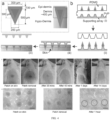
- the drug core includes a maximum diameter of 200 ⁇ m and a height of 300 ⁇ m. This is short enough to allow the drug core to be situated inside the dermal layer of skin after insertion ( FIG 4 (at a, right)).
- the arrays made of PLA can be fabricated by micro-molding, without removal of the scum layer. PVP can be used to coat these arrays and selectively removed by water to release the drug microneedles into skin after insertion ( FIG. 4 (at b, (iii)-(iv))).
- a PVP-coated PLA array is used as supporting arrays to fully implant the needles into skin.
- the microneedles can be aligned and brought into contact with the PLA supporting array and then a low heat can be applied for bonding ( FIG. 4 (at b, (i)-(ii))).
- This process is again based on the SEAL method.
- the fully-embedded microneedles are inserted into mice skin. The skin layer, after the needle insertion, could quickly heal to close up the opened wound/holes, as seen in FIG. 4 (at d).
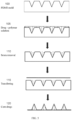
- a manufacturing process that creates the drug delivery system is illustrated.
- a non-adhesive negative mold i.e., PDMS or Teflon, Polytetrafluoroethylene-PTFE or Perfluoropolyether-PFPE
- PDMS or Teflon, Polytetrafluoroethylene-PTFE or Perfluoropolyether-PFPE is made by casting hydrophobic materials onto a master microneedles structure which is fabricated by photolithography or 3D printing or micro-machining etc. After the material is cured, it is peeled off from the master mold.
- the therapeutic agents e.g., drugs or vaccines such as Prevnar-13, HPV, IPV, insulin, growth hormone, pain medicine, allergic drugs, etc.
- suitable polymer solutions i.e., water soluble polymer Poly(vinylpyrrolidone) - PVP or Poly(vinyl alcohol) - PVA.
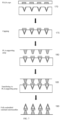
- the above filling step usually results in a residual layer on the mold (scum layer).
- This scum layer is then removed as shown in step 110 by spinning accompanied with gently dropping of a suitable solvent (e.g., water, acetone, methanol, ethanol, dimethyl sulfoxide (DMSO)) on top of the mold.
- a suitable solvent e.g., water, acetone, methanol, ethanol, dimethyl sulfoxide (DMSO)
- DMSO dimethyl sulfoxide
- the scum-free core-drugs are then transferred onto a sacrificial layer.
- the sacrificial layer can be a solid polymer film (i.e., PLGA) which is placed on top of the mold then compressed at its glass transition temperature under vacuum.
- PLGA solid polymer film
- a concentrated polymer solution can be used as the sacrificial layer by pipetting onto the mold and allowing solvent to evaporate.
- this whole structure is then delaminated onto a solid substrate, such as a glass slide, using heat-assisted micro-transfer molding.
- a solid substrate such as a glass slide
- the fabricated core-drugs are used in a later loading step.
- a process of fabricating the coreshell microneedle and drug loading is illustrated.
- a non-adhesive negative mold is made by casting hydrophobic materials (i.e., PDMS, Teflon, Polytetrafluoroethylene-PTFE, or Perfluoropolyether-PFPE) onto a master microneedles structure which is fabricated by photolithography, 3D printing, micro-machining, etc. After the material is cured, it is peeled off from the master mold.
- hydrophobic materials i.e., PDMS, Teflon, Polytetrafluoroethylene-PTFE, or Perfluoropolyether-PFPE
- a polymer film is then compression molded into the prepared mold at step 130 to form the microneedles.
- the polymer of interest such as PLGA is heat-pressed onto the mold at its melting or glass transition temperature under vacuum. The polymer fills the mold cavities at step 135.
- a positive mold which can be fabricated from polymers (e.g., PLA), metal, elastomers (PFPE), etc. is first prepared by compression molding, micro-machining, photolithography. Depending on the hydrophobicity of the materials, additional surface treatment can be applied to the mold in order to prevent adhesion in later manufacturing steps.
- polymers e.g., PLA
- PFPE elastomers
- this core structure or second mold which has smaller dimensions and the same relative spacing is aligned, using an alignment device, and then pressed into the microneedles (on the PDMS mold) which have been heated prior to this step. At an elevated temperature, the second mold will penetrate into the soft microneedles, creating dimple-like structures in the microneedles.
- the coreshell microneedles are obtained and trapped inside the first mold.
- the core-drugs are aligned using a similar device as above and loaded into the coreshell microneedles.
- the residual scum layer is then removed at step 160 using the same method as described above. Suitable solvents are dropped onto the mold while spinning at high speed. At step 165, the scum-free coreshell microneedles are entrapped inside the mold.
- caps for the coreshell microneedles are fabricated by following similar procedures of compression molding and scum removal.
- another mold for the caps is made by a similar casting of hydrophobic materials on a master structure as described above.
- a polymer film such as PLGA is compression molded into the mold under heating and vacuum at step 170. Then the scum layer is removed leaving individual caps.
- the caps trapped inside the mold are aligned and placed on top of the fabricated coreshell microneedles from FIG. 6 .
- the caps With heat-assistance, the caps are bonded with the coreshell microneedles base. The mold is then peeled off.
- step 180 the coreshell microneedles are transferred onto a supporting array.
- This array can be manufactured by several microfabrication methods like compression molding, micro-machining, or photolithography.
- the array is then coated at step 185 with a water soluble polymer (i.e., PVP, PVA). Then, it is aligned with the coreshell microneedles, contact between them is made, and sufficient heat for bonding with the PLGA caps is supplied.
- a water soluble polymer i.e., PVP, PVA
- the mold entrapping the coreshell microneedles is then peeled off at step 190 leaving a free standing coreshell microneedle assembly on the supporting array which can be fully-embedded into the skin.
- the drug delivery system may include a computer processor in electronic communication with the coreshell microneedle assembly.
- the computer processor is programmed with computer readable instructions to initiate active release of the therapeutic agent either as a one-time release or as a plurality of pre-programmed timed releases of the therapeutic agent.
- the computer processor can be in electronic communication with an actuator (e.g., piezoelectric (mechanical) pump, electromagnetic pump, or electrical pump can be integrated into the microneedle patch) to initiate the release of the therapeutic agent into the skin based on the programmed instructions.
- an actuator e.g., piezoelectric (mechanical) pump, electromagnetic pump, or electrical pump can be integrated into the microneedle patch
Landscapes
- Engineering & Computer Science (AREA)
- Health & Medical Sciences (AREA)
- Mechanical Engineering (AREA)
- Life Sciences & Earth Sciences (AREA)
- Veterinary Medicine (AREA)
- Animal Behavior & Ethology (AREA)
- General Health & Medical Sciences (AREA)
- Public Health (AREA)
- Biomedical Technology (AREA)
- Heart & Thoracic Surgery (AREA)
- Medical Informatics (AREA)
- Surgery (AREA)
- Anesthesiology (AREA)
- Hematology (AREA)
- Dermatology (AREA)
- Molecular Biology (AREA)
- Nuclear Medicine, Radiotherapy & Molecular Imaging (AREA)
- Zoology (AREA)
- Wood Science & Technology (AREA)
- Medicines Containing Antibodies Or Antigens For Use As Internal Diagnostic Agents (AREA)
- Medicinal Preparation (AREA)
- Media Introduction/Drainage Providing Device (AREA)
Applications Claiming Priority (3)
| Application Number | Priority Date | Filing Date | Title |
|---|---|---|---|
| US201862638758P | 2018-03-05 | 2018-03-05 | |
| EP19764864.5A EP3761864B1 (de) | 2018-03-05 | 2019-03-05 | Verfahren zur herstellung einer mikronadelplattform |
| PCT/US2019/020838 WO2019173402A1 (en) | 2018-03-05 | 2019-03-05 | Core-shell microneedle platform for transdermal and pulsatile drug/vaccine delivery and method of manufacturing the same |
Related Parent Applications (2)
| Application Number | Title | Priority Date | Filing Date |
|---|---|---|---|
| EP19764864.5A Division EP3761864B1 (de) | 2018-03-05 | 2019-03-05 | Verfahren zur herstellung einer mikronadelplattform |
| EP19764864.5A Division-Into EP3761864B1 (de) | 2018-03-05 | 2019-03-05 | Verfahren zur herstellung einer mikronadelplattform |
Publications (2)
| Publication Number | Publication Date |
|---|---|
| EP4374800A2 true EP4374800A2 (de) | 2024-05-29 |
| EP4374800A3 EP4374800A3 (de) | 2024-11-06 |
Family
ID=67768376
Family Applications (2)
| Application Number | Title | Priority Date | Filing Date |
|---|---|---|---|
| EP24161949.3A Pending EP4374800A3 (de) | 2018-03-05 | 2019-03-05 | Verfahren zur herstellung einer mikronadelplattform |
| EP19764864.5A Active EP3761864B1 (de) | 2018-03-05 | 2019-03-05 | Verfahren zur herstellung einer mikronadelplattform |
Family Applications After (1)
| Application Number | Title | Priority Date | Filing Date |
|---|---|---|---|
| EP19764864.5A Active EP3761864B1 (de) | 2018-03-05 | 2019-03-05 | Verfahren zur herstellung einer mikronadelplattform |
Country Status (5)
| Country | Link |
|---|---|
| US (2) | US11426570B2 (de) |
| EP (2) | EP4374800A3 (de) |
| CN (2) | CN118320289A (de) |
| RU (1) | RU2020132467A (de) |
| WO (1) | WO2019173402A1 (de) |
Families Citing this family (22)
| Publication number | Priority date | Publication date | Assignee | Title |
|---|---|---|---|---|
| EP3595515A4 (de) | 2017-03-14 | 2020-12-30 | University of Connecticut | Biologisch abbaubarer drucksensor |
| US11826495B2 (en) | 2019-03-01 | 2023-11-28 | University Of Connecticut | Biodegradable piezoelectric ultrasonic transducer system |
| CN110840396A (zh) * | 2019-10-21 | 2020-02-28 | 中国科学院化学研究所 | 气味分子的图案化微阵列及其制备方法和应用 |
| WO2021119332A1 (en) * | 2019-12-11 | 2021-06-17 | The Regents Of The University Of California | Microneedle delivery device with detachable hybrid microneedle depots for localized delivery of cells |
| US11745001B2 (en) | 2020-03-10 | 2023-09-05 | University Of Connecticut | Therapeutic bandage |
| JP2023523952A (ja) | 2020-04-28 | 2023-06-08 | ティコナ・エルエルシー | マイクロニードルアセンブリ |
| US12491290B2 (en) | 2020-06-08 | 2025-12-09 | University Of Connecticut | Biodegradable piezoelectric composite materials |
| CN114146046B (zh) * | 2020-09-07 | 2024-03-01 | 中国科学院理化技术研究所 | 具有多层结构的涂层微针、其制备方法及包含该涂层微针的微针贴片 |
| US20220096371A1 (en) * | 2020-09-28 | 2022-03-31 | University Of Connecticut | Biodegradable microneedle system with sustained release |
| CN112516070A (zh) * | 2020-12-16 | 2021-03-19 | 南开大学 | 蛋白质类抗原的单次注射疫苗及其制备方法 |
| US12357804B2 (en) | 2021-03-01 | 2025-07-15 | Deka Products Limited Partnership | Medical agent dispensing systems, methods, and apparatuses |
| CA3210642A1 (en) | 2021-03-01 | 2022-09-09 | Dean Kamen | Medical agent dispensing apparatuses, systems, and methods |
| US12161832B2 (en) | 2021-03-01 | 2024-12-10 | Deka Products Limited Partnership | Medical agent dispensing systems, methods, and apparatuses |
| US20250082236A1 (en) * | 2021-07-19 | 2025-03-13 | Carnegie Mellon University | Scalable Manufacturing of Microneedle Arrays Using Automated High-Throughput Manufacturing Systems and High-Capacity Molding |
| CN113648528A (zh) * | 2021-08-20 | 2021-11-16 | 天津大学 | 多次给药核壳微针贴片及其制备方法 |
| CN113713088A (zh) * | 2021-09-06 | 2021-11-30 | 唐颐控股(深圳)有限公司 | 一种防脱生发一体核壳微针贴片及其制备方法 |
| KR102836377B1 (ko) | 2021-12-20 | 2025-07-21 | (주)그로젠바이오 | 마이크로니들 패치 제조 방법 |
| CN119255819A (zh) * | 2022-03-25 | 2025-01-03 | 默沙东有限责任公司 | 控释疫苗制剂 |
| US20250269162A1 (en) * | 2022-05-17 | 2025-08-28 | Georgia Tech Research Corporation | Core-Shell Microneedle Patches and Methods |
| WO2024167986A2 (en) * | 2023-02-10 | 2024-08-15 | Alj Creative Works, Llc | Programmable drug-device microneedle system for the treament of diabetes, obesity, and associated conditions |
| CN116640282B (zh) * | 2023-06-16 | 2025-09-09 | 北京理工大学 | 一种生物降解性聚合物、制备方法及缓释微针贴片 |
| KR20250035949A (ko) * | 2023-09-06 | 2025-03-13 | 주식회사 주빅 | 성장호르몬 마이크로니들 제조용 점액 조성물, 이를 이용하여 제조되는 성장호르몬 마이크로니들 구조체, 상기 마이크로니들 구조체를 포함하는 마이크로니들 패치 및 마이크로어레이 |
Family Cites Families (49)
| Publication number | Priority date | Publication date | Assignee | Title |
|---|---|---|---|---|
| US6586006B2 (en) * | 1994-08-04 | 2003-07-01 | Elan Drug Delivery Limited | Solid delivery systems for controlled release of molecules incorporated therein and methods of making same |
| US5891191A (en) | 1996-04-30 | 1999-04-06 | Schneider (Usa) Inc | Cobalt-chromium-molybdenum alloy stent and stent-graft |
| US6503231B1 (en) | 1998-06-10 | 2003-01-07 | Georgia Tech Research Corporation | Microneedle device for transport of molecules across tissue |
| EP1345646A2 (de) * | 2000-12-14 | 2003-09-24 | Georgia Tech Research Corporation | Mikronadel-vorrichtungen und deren herstellung |
| EP1590034B1 (de) | 2002-10-07 | 2014-05-14 | Biovalve Technologies, Inc. | Pflaster mit mikronadelanordnung |
| US7059196B1 (en) | 2004-11-22 | 2006-06-13 | Honeywell International Inc. | Disposable wireless pressure sensor |
| US20080269666A1 (en) | 2005-05-25 | 2008-10-30 | Georgia Tech Research Corporation | Microneedles and Methods for Microinfusion |
| US20090182306A1 (en) * | 2006-07-21 | 2009-07-16 | Georgia Tech Research Corporation | Microneedle Devices and Methods of Drug Delivery or Fluid Withdrawal |
| US20120223293A1 (en) | 2007-01-05 | 2012-09-06 | Borenstein Jeffrey T | Biodegradable Electronic Devices |
| GB2446780A (en) * | 2007-02-22 | 2008-08-27 | Glide Pharmaceutical Technolog | An elongate parenteral injection body having an injection point of angle 10 to 40 degrees. |
| KR101555391B1 (ko) * | 2007-11-21 | 2015-09-23 | 가부시키가이샤 바이오세렌택 | 체표 적용 제제 및 체표 적용 제제 보유 시트 |
| US8301262B2 (en) | 2008-02-06 | 2012-10-30 | Cardiac Pacemakers, Inc. | Direct inductive/acoustic converter for implantable medical device |
| JP5584202B2 (ja) | 2008-05-21 | 2014-09-03 | セラジェクト, インコーポレイテッド | 固溶体穿孔器パッチの製造方法及びその使用 |
| WO2011115643A1 (en) | 2010-03-17 | 2011-09-22 | The Board Of Trustees Of The University Of Illinois | Implantable biomedical devices on bioresorbable substrates |
| US8911422B2 (en) * | 2010-02-24 | 2014-12-16 | Hisamitsu Pharmaceutical Co., Inc. | Micro-needle device |
| US20120027837A1 (en) * | 2010-07-27 | 2012-02-02 | Massachusetts Institute Of Technology | Multilayer coating compositions, coated substrates and methods thereof |
| EP3495015B1 (de) * | 2010-10-19 | 2022-12-07 | Trustees Of Tufts College | Mikronadeln auf seidenfibroinbasis und verfahren zur herstellung davon |
| US9089677B2 (en) * | 2011-01-25 | 2015-07-28 | The Regents Of The University Of California | Transcutaneous multimodal delivery system (TMDS) |
| US8424388B2 (en) | 2011-01-28 | 2013-04-23 | Medtronic, Inc. | Implantable capacitive pressure sensor apparatus and methods regarding same |
| CA2840731A1 (en) * | 2011-06-29 | 2013-01-03 | Allergan, Inc. | Alcaftadine for use in the treatment of urticaria |
| WO2013089867A2 (en) | 2011-12-01 | 2013-06-20 | The Board Of Trustees Of The University Of Illinois | Transient devices designed to undergo programmable transformations |
| TWI554289B (zh) * | 2012-06-29 | 2016-10-21 | 國立成功大學 | 鑲嵌式經皮藥物釋放貼片及其製造方法 |
| WO2014059269A2 (en) | 2012-10-12 | 2014-04-17 | Massachusetts Institute Of Technology | Multilayer compositions, coated devices and use thereof |
| WO2014100259A1 (en) | 2012-12-18 | 2014-06-26 | Abbott Cardiovascular Systems Inc. | Piezoelectric medical implant |
| KR102151292B1 (ko) | 2013-01-31 | 2020-09-02 | 가부시키가이샤 무라타 세이사쿠쇼 | 압전 진동체 |
| US9846091B2 (en) | 2013-03-12 | 2017-12-19 | Interlink Electronics, Inc. | Systems and methods for press force detectors |
| CA2906945A1 (en) * | 2013-03-15 | 2014-09-18 | Incube Labs, Llc | Multi-stage biodegradable drug delivery platform |
| US10292263B2 (en) | 2013-04-12 | 2019-05-14 | The Board Of Trustees Of The University Of Illinois | Biodegradable materials for multilayer transient printed circuit boards |
| CN103301563B (zh) * | 2013-06-20 | 2016-03-23 | 吴传斌 | 可溶性同轴锥多层微针、微针阵列及其制备方法 |
| WO2015033349A1 (en) | 2013-09-09 | 2015-03-12 | Nanopass Technologies Ltd. | Prefilled syringe devices employing microneedle interfaces for intradermal delivery |
| CA2933867A1 (en) | 2013-12-16 | 2015-06-25 | Massachusetts Institute Of Technology | Micromolded or 3-d printed pulsatile release vaccine formulations |
| US20150242037A1 (en) | 2014-01-13 | 2015-08-27 | Apple Inc. | Transparent force sensor with strain relief |
| CN104117137B (zh) * | 2014-07-08 | 2017-12-15 | 清华大学 | 一种胶囊式中空载药微针阵列及其制备方法 |
| US10973757B2 (en) * | 2014-10-06 | 2021-04-13 | StemProtein, LLC | Biodegardable microneedle device |
| KR102021212B1 (ko) * | 2014-10-17 | 2019-09-11 | 카오카부시키가이샤 | 미세 중공 돌기물의 제조 방법 |
| CN104338235A (zh) * | 2014-10-28 | 2015-02-11 | 清华大学 | 一种叠层式微针系统及其制备方法 |
| US20170020402A1 (en) | 2015-05-04 | 2017-01-26 | The Board Of Trustees Of The University Of Illinois | Implantable and bioresorbable sensors |
| KR101628342B1 (ko) * | 2015-06-30 | 2016-06-08 | 이승욱 | 약물 투여량 및 투여 깊이 조절이 가능한 미세바늘 구조체 및 제조방법 |
| WO2017011320A1 (en) | 2015-07-10 | 2017-01-19 | The University Of North Carolina At Chapel Hill | Rapidly dissolvable microneedles for the transdermal delivery of therapeutics |
| KR101610598B1 (ko) * | 2015-09-21 | 2016-04-07 | 비엔엘바이오테크 주식회사 | 잇몸 굴곡에 맞게 유연하며 치과용 물질 전달을 위한 마이크로 니들 및 그 제작방법 |
| HK1254944A1 (en) * | 2015-11-27 | 2019-08-02 | Labo Juversa Co., Ltd. | Microneedle and method for producing same |
| KR101747825B1 (ko) | 2015-12-22 | 2017-06-15 | 경희대학교 산학협력단 | 폴리-d-락트산 및 폴리-l-락트산의 스테레오컴플렉스 결정 구조를 포함하는 것을 특징으로 하는 압전소재 |
| KR101785930B1 (ko) | 2015-12-30 | 2017-10-16 | 주식회사 쿼드메디슨 | 수분 환경에서 변형 및 변성 억제를 위한 마이크로 니들 및 그 제작 방법 |
| WO2017150824A1 (ko) | 2016-03-03 | 2017-09-08 | 가천대학교 산학협력단 | 마이크로 니들 및 이의 제조방법 |
| KR101728526B1 (ko) * | 2016-06-23 | 2017-04-19 | 주식회사 쿼드메디슨 | 마이크로 니들 및 이의 제조방법 |
| CN106474620A (zh) * | 2016-09-22 | 2017-03-08 | 北京化工大学 | 一种药物可控释放的聚合物微针、制备方法及微针贴片 |
| CN106727273A (zh) * | 2017-03-02 | 2017-05-31 | 李成国 | 可溶性微针的制造方法 |
| WO2019143293A1 (en) * | 2018-01-16 | 2019-07-25 | Nanyang Technological University | Self-implantable micro-drug-reservoirs for localized and controlled ocular drug delivery |
| CN108606797B (zh) * | 2018-04-28 | 2022-03-15 | 京东方科技集团股份有限公司 | 一种智能贴片及其制作方法 |
-
2019
- 2019-03-05 RU RU2020132467A patent/RU2020132467A/ru not_active Application Discontinuation
- 2019-03-05 US US16/293,588 patent/US11426570B2/en active Active
- 2019-03-05 CN CN202410502111.6A patent/CN118320289A/zh active Pending
- 2019-03-05 EP EP24161949.3A patent/EP4374800A3/de active Pending
- 2019-03-05 EP EP19764864.5A patent/EP3761864B1/de active Active
- 2019-03-05 WO PCT/US2019/020838 patent/WO2019173402A1/en not_active Ceased
- 2019-03-05 CN CN201980028300.1A patent/CN112074227B/zh active Active
-
2022
- 2022-07-22 US US17/871,490 patent/US20220355089A1/en active Pending
Non-Patent Citations (2)
| Title |
|---|
| MCHUGH, K. J.NGUYEN, T. D.LINEHAN, A. RYANG, D.BEHRENS, A. M.ROSE, STOCHKA, Z.L.TZENG, S. Y.NORMAN, J. JANSELMO, A. C.: "Fabrication of fillable microparticles and other complex 3D microstructures", SCIENCE, vol. 357, no. 6356, 2017, pages 1138 - 1 142, XP055896326, DOI: 10.1126/science.aaf7447 |
| XU, J.WONG, D. H.BYRNE, J. D.CHEN, K.BOWERMAN, C.DESIMONE, J. M.: "Future of the particle replication in nonwetting templates (PRINT) technology", ANGEWANDTE CHEMIE INTERNATIONAL EDITION, vol. 52, no. 26, 2013, pages 6580 - 6589, XP055636723, DOI: 10.1002/anie.201209145 |
Also Published As
| Publication number | Publication date |
|---|---|
| EP3761864C0 (de) | 2024-05-01 |
| CN118320289A (zh) | 2024-07-12 |
| EP3761864A1 (de) | 2021-01-13 |
| CN112074227B (zh) | 2024-05-14 |
| EP3761864A4 (de) | 2022-04-20 |
| US20220355089A1 (en) | 2022-11-10 |
| EP4374800A3 (de) | 2024-11-06 |
| EP3761864B1 (de) | 2024-05-01 |
| WO2019173402A1 (en) | 2019-09-12 |
| US11426570B2 (en) | 2022-08-30 |
| CN112074227A (zh) | 2020-12-11 |
| RU2020132467A (ru) | 2022-04-05 |
| US20190269895A1 (en) | 2019-09-05 |
Similar Documents
| Publication | Publication Date | Title |
|---|---|---|
| US20220355089A1 (en) | Core-shell microneedle platform for transdermal and pulsatile drug/vaccine delivery and method of manufacturing the same | |
| JP7624030B2 (ja) | 薬物の持続放出のための分離可能なマイクロニードルアレイ | |
| CN110917176B (zh) | 一种可植入型缓释微针贴片及其制备方法 | |
| KR101747099B1 (ko) | 생체적합성 고분자를 이용한 마이크로니들의 제조방법 | |
| US10500386B2 (en) | Microneedle array manufacturing method | |
| CN104117137B (zh) | 一种胶囊式中空载药微针阵列及其制备方法 | |
| CN110870846A (zh) | 一种可快速植入型缓释微针贴片及其制备方法 | |
| KR101827739B1 (ko) | 미세방 마이크로구조체 및 이의 제조방법 | |
| CN114761054B (zh) | 利用浇铸制剂中的组分溶解度的调整来制作微针的方法 | |
| Chakraborty et al. | Novel synergistic approaches of protein delivery through physical enhancement for transdermal microneedle drug delivery: a review | |
| Naik et al. | Drug delivery through microneedles for improved permeability and efficacy: fabrication, methodology and applications | |
| US20230218875A1 (en) | Particle-attached microneedle and method of manufacturing the same | |
| Zhao et al. | Implantable microarray patch: engineering at the nano and macro scale for sustained therapeutic release via synthetic biodegradable polymers | |
| US20220023604A1 (en) | Microstructure-based Drug Injection Device and Method for Manufacturing the Same | |
| CN113648528A (zh) | 多次给药核壳微针贴片及其制备方法 | |
| EP4661842A2 (de) | Programmierbares mikronadelsystem für wirkstoffvorrichtungen zur behandlung von diabetes, adipositas und zugehörigen erkrankungen | |
| KR20180011837A (ko) | 유기용매를 포함하는 마이크로구조체용 조성물과 이를 이용한 마이크로구조체 제조방법 | |
| KR20170138291A (ko) | 유기용매를 포함하는 마이크로구조체용 조성물과 이를 이용한 마이크로구조체 제조방법 | |
| WO2024191532A2 (en) | Programmable drug-device microneedle system for the delivery and monitoring of diabetes and obesity medications | |
| WO2025054598A2 (en) | Biodegradable subcutaneous implant for delivery of therapeutics in a controlled pulsatile or sustained manner | |
| CN118510497A (zh) | 用于经皮微针贴片中长期施用的抗原的稳定化 | |
| Luo et al. | Design and Rapid Fabrication of Microneedle Patch for Targeted Drug Delivery | |
| Iswariya et al. | A REVIEW ONMICRONEEDLES |
Legal Events
| Date | Code | Title | Description |
|---|---|---|---|
| PUAI | Public reference made under article 153(3) epc to a published international application that has entered the european phase |
Free format text: ORIGINAL CODE: 0009012 |
|
| STAA | Information on the status of an ep patent application or granted ep patent |
Free format text: STATUS: THE APPLICATION HAS BEEN PUBLISHED |
|
| AC | Divisional application: reference to earlier application |
Ref document number: 3761864 Country of ref document: EP Kind code of ref document: P |
|
| AK | Designated contracting states |
Kind code of ref document: A2 Designated state(s): AL AT BE BG CH CY CZ DE DK EE ES FI FR GB GR HR HU IE IS IT LI LT LU LV MC MK MT NL NO PL PT RO RS SE SI SK SM TR |
|
| REG | Reference to a national code |
Ref country code: DE Ref legal event code: R079 Free format text: PREVIOUS MAIN CLASS: A61B0017200000 Ipc: A61B0005000000 |
|
| RIC1 | Information provided on ipc code assigned before grant |
Ipc: A61B 17/20 20060101ALI20240709BHEP Ipc: B29C 39/10 20060101ALI20240709BHEP Ipc: A61M 37/00 20060101ALI20240709BHEP Ipc: A61M 5/172 20060101ALI20240709BHEP Ipc: A61B 5/145 20060101ALI20240709BHEP Ipc: A61B 5/00 20060101AFI20240709BHEP |
|
| PUAL | Search report despatched |
Free format text: ORIGINAL CODE: 0009013 |
|
| AK | Designated contracting states |
Kind code of ref document: A3 Designated state(s): AL AT BE BG CH CY CZ DE DK EE ES FI FR GB GR HR HU IE IS IT LI LT LU LV MC MK MT NL NO PL PT RO RS SE SI SK SM TR |
|
| RIC1 | Information provided on ipc code assigned before grant |
Ipc: A61B 17/20 20060101ALI20241001BHEP Ipc: B29C 39/10 20060101ALI20241001BHEP Ipc: A61M 37/00 20060101ALI20241001BHEP Ipc: A61M 5/172 20060101ALI20241001BHEP Ipc: A61B 5/145 20060101ALI20241001BHEP Ipc: A61B 5/00 20060101AFI20241001BHEP |
|
| STAA | Information on the status of an ep patent application or granted ep patent |
Free format text: STATUS: REQUEST FOR EXAMINATION WAS MADE |
|
| 17P | Request for examination filed |
Effective date: 20241202 |
|
| RBV | Designated contracting states (corrected) |
Designated state(s): AL AT BE BG CH CY CZ DE DK EE ES FI FR GB GR HR HU IE IS IT LI LT LU LV MC MK MT NL NO PL PT RO RS SE SI SK SM TR |