EP4375559A1 - Aérateur statique et système de lubrifiant - Google Patents
Aérateur statique et système de lubrifiant Download PDFInfo
- Publication number
- EP4375559A1 EP4375559A1 EP23212714.2A EP23212714A EP4375559A1 EP 4375559 A1 EP4375559 A1 EP 4375559A1 EP 23212714 A EP23212714 A EP 23212714A EP 4375559 A1 EP4375559 A1 EP 4375559A1
- Authority
- EP
- European Patent Office
- Prior art keywords
- aerator
- sidewall
- fluid
- partition
- passage
- Prior art date
- Legal status (The legal status is an assumption and is not a legal conclusion. Google has not performed a legal analysis and makes no representation as to the accuracy of the status listed.)
- Granted
Links
Images



Classifications
-
- F—MECHANICAL ENGINEERING; LIGHTING; HEATING; WEAPONS; BLASTING
- F01—MACHINES OR ENGINES IN GENERAL; ENGINE PLANTS IN GENERAL; STEAM ENGINES
- F01D—NON-POSITIVE DISPLACEMENT MACHINES OR ENGINES, e.g. STEAM TURBINES
- F01D25/00—Component parts, details, or accessories, not provided for in, or of interest apart from, other groups
- F01D25/18—Lubricating arrangements
- F01D25/20—Lubricating arrangements using lubrication pumps
-
- F—MECHANICAL ENGINEERING; LIGHTING; HEATING; WEAPONS; BLASTING
- F16—ENGINEERING ELEMENTS AND UNITS; GENERAL MEASURES FOR PRODUCING AND MAINTAINING EFFECTIVE FUNCTIONING OF MACHINES OR INSTALLATIONS; THERMAL INSULATION IN GENERAL
- F16N—LUBRICATING
- F16N39/00—Arrangements for conditioning of lubricants in the lubricating system
- F16N39/002—Arrangements for conditioning of lubricants in the lubricating system by deaeration
-
- B—PERFORMING OPERATIONS; TRANSPORTING
- B01—PHYSICAL OR CHEMICAL PROCESSES OR APPARATUS IN GENERAL
- B01D—SEPARATION
- B01D19/00—Degasification of liquids
- B01D19/0042—Degasification of liquids modifying the liquid flow
- B01D19/0052—Degasification of liquids modifying the liquid flow in rotating vessels, vessels containing movable parts or in which centrifugal movement is caused
- B01D19/0057—Degasification of liquids modifying the liquid flow in rotating vessels, vessels containing movable parts or in which centrifugal movement is caused the centrifugal movement being caused by a vortex, e.g. using a cyclone, or by a tangential inlet
-
- F—MECHANICAL ENGINEERING; LIGHTING; HEATING; WEAPONS; BLASTING
- F05—INDEXING SCHEMES RELATING TO ENGINES OR PUMPS IN VARIOUS SUBCLASSES OF CLASSES F01-F04
- F05D—INDEXING SCHEME FOR ASPECTS RELATING TO NON-POSITIVE-DISPLACEMENT MACHINES OR ENGINES, GAS-TURBINES OR JET-PROPULSION PLANTS
- F05D2230/00—Manufacture
- F05D2230/30—Manufacture with deposition of material
-
- F—MECHANICAL ENGINEERING; LIGHTING; HEATING; WEAPONS; BLASTING
- F05—INDEXING SCHEMES RELATING TO ENGINES OR PUMPS IN VARIOUS SUBCLASSES OF CLASSES F01-F04
- F05D—INDEXING SCHEME FOR ASPECTS RELATING TO NON-POSITIVE-DISPLACEMENT MACHINES OR ENGINES, GAS-TURBINES OR JET-PROPULSION PLANTS
- F05D2260/00—Function
- F05D2260/98—Lubrication
-
- F—MECHANICAL ENGINEERING; LIGHTING; HEATING; WEAPONS; BLASTING
- F16—ENGINEERING ELEMENTS AND UNITS; GENERAL MEASURES FOR PRODUCING AND MAINTAINING EFFECTIVE FUNCTIONING OF MACHINES OR INSTALLATIONS; THERMAL INSULATION IN GENERAL
- F16N—LUBRICATING
- F16N2210/00—Applications
- F16N2210/02—Turbines
Definitions
- the application relates generally to gas turbine engines and, more particularly, to fluid systems for such engines.
- Gas turbine engines typically comprise an oil tank and an oil pump in fluid communication with an oil circuit configured to circulate oil to these components requiring lubrication. Oil circuits are not always leak proof and air that enters the circuit can mix with the oil. The resulting air-oil mixture is thus routed to the components and can affect the lubricating efficiency.
- a de-aerator is thus typically used to extract any air from the air-oil mixture before the oil is routed back through the oil circuit.
- existing de-aerators are not always able to extract all the air from the air-oil mixture.
- a de-aerator for an oil system of a gas turbine engine includes a body, a cover panel, a fluid inlet, a helical fluid passage, at least one partition, and at least one fluid outlet.
- the body extends between a first axial end and a second axial end opposite the first axial end.
- the body has at least one sidewall that extends between the first axial end and the second axial end, and a base panel connected to the at least one sidewall at the second axial end.
- the base panel and the at least one sidewall define an internal cavity of the body.
- the cover panel is connected to the body at the first axial end.
- the fluid inlet is in communication with the body at the first axial end.
- the fluid inlet has an internal flow passage configured to direct fluid tangentially into the internal cavity.
- the helical fluid passage is disposed within the internal cavity and has an entry end and an exit end. The entry end is disposed to receive fluid from the fluid inlet.
- the helical fluid passage has a plurality of circumferential turns that collectively axially descend toward the second axial end of the body. The circumferential turns each include one or more air passages disposed radially inward providing a gas path to a central region disposed radially inside of the helical fluid passage.
- the at least one partition is disposed within the internal cavity at or below the exit end of the helical fluid passage and is spaced above the base panel of the de-aerator.
- the at least one fluid outlet is disposed adjacent the base panel, and the at least one fluid outlet is configured to permit liquid passage from the internal cavity of the body to outside the body.
- a partition may be disposed within the internal cavity in a plane that is substantially perpendicular to a central axis of the de-aerator, or a partition may be disposed within the internal cavity in a plane that is canted relative to a central axis of the de-aerator.
- a partition may have an upper surface, a lower surface, a thickness extending between the upper surface and the lower surface, and a plurality of apertures extending through the partition between the upper surface and the lower surface.
- a sidewall may have an interior sidewall surface and a partition may have a circumferential edge contiguous with the interior sidewall surface.
- apertures in a partition may be arranged in a pattern concentric with the center axis.
- the at least one partition may include a first partition and a second partition axially spaced apart from one another.
- a partition may have an upper surface, a lower surface, a thickness extending between the upper surface and the lower surface, and a circumferential edge
- the sidewall may have an interior sidewall surface and at least a portion of the partition circumferential edge may be spaced apart from the interior sidewall surface thereby forming a passage between the circumferential edge and the interior sidewall surface.
- the de-aerator may include a centrally located vent tube that extends substantially parallel to a central axis of the de-aerator
- the helical fluid passage may include a helically extending panel that extends between an interior surface of a sidewall and an exterior surface of the vent tube, and an outer radial surface of the helical fluid passage may be defined by the sidewall interior surface, and an inner radial surface of the helical fluid passage may be defined by the exterior surface of the vent tube.
- the de-aerator may include a plurality of vent apertures aligned with the helical fluid passage and extending through the vent tube wall.
- the helical fluid passage may include at least one helically extending panel that extends radially inwardly from an interior surface of a sidewall to an inner radial edge, and may include an inner radial wall joined to the inner radial edge of the helically extending panel.
- the helical fluid passage may be an enclosed passage.
- the de-aerator may include a plurality of vent apertures disposed in the inner radial wall.
- the inner radial wall may extend axially a distance and may define a passage above the inner radial wall configured to permit passage of air out of the helical fluid passage and into a central region of the de-aerator.
- the at least one helically extending panel may include a first helically extending panel and a second helically extending panel, each extending radially inwardly from the sidewall interior surface, and the inner radial wall may extend between the first helically extending panel and the second helically extending panel to form an enclosed helical fluid passage.
- a fluid outlet may be disposed in the base panel.
- a fluid outlet may be disposed in a side wall.
- the de-aerator may include a fluid collection body disposed radially outside of the at least one sidewall, wherein the fluid collection body may be substantially concentric with and radially spaced apart from, an exterior surface of the at least one sidewall to form an annular cavity there between.
- the at least one sidewall, the base panel, the fluid inlet, the helical fluid passage, and the at least one partition may be a unitary structure formed using an additive manufacturing technique.
- cover panel may be part of the unitary structure.
- a lubrication system for a gas turbine engine includes a lubricant tank, a lubricant pump, a scavenge pump, and a de-aerator.
- the de-aerator includes a body, a cover panel, a fluid inlet, a helical fluid passage, at least one partition, and at least one fluid outlet.
- the body extends between a first axial end and a second axial end opposite the first axial end.
- the body has at least one sidewall that extends between the first axial end and the second axial end, and a base panel connected to the at least one sidewall at the second axial end.
- the base panel and the at least one sidewall define an internal cavity of the body.
- the cover panel is connected to the body at the first axial end.
- the fluid inlet is in communication with the body at the first axial end.
- the fluid inlet has an internal flow passage configured to direct fluid tangentially into the internal cavity.
- the helical fluid passage is disposed within the internal cavity and has an entry end and an exit end. The entry end is disposed to receive fluid from the fluid inlet.
- the helical fluid passage has a plurality of circumferential turns that collectively axially descend toward the second axial end of the body.
- the circumferential turns each include one or more air passages disposed radially inward providing a gas path to a central region disposed radially inside of the helical fluid passage.
- the at least one partition is disposed within the internal cavity at or below the exit end of the helical fluid passage and is spaced above the base panel of the de-aerator.
- the at least one fluid outlet is disposed adjacent the base panel, and the at least one fluid outlet is configured to permit liquid passage from the internal cavity of the body to outside the body.
- the lubricant tank, lubricant pump, scavenge pump, and de-aerator are in fluid communication with one another and form a lubrication circuit, such that the lubricant pump is configured to pump lubricant from the lubricant tank to one or more engine components, and the scavenge pump is configured to pump lubricant received from the one or more engine components to the de-aerator, and lubricant passing through the de-aerator is passed into the lubricant tank.
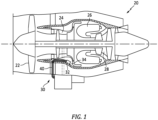
- FIGS. 1 and 2 illustrate a gas turbine engine 20 of a type preferably provided for use in subsonic flight, generally comprising in serial flow communication a fan 22 through which ambient air is propelled, a compressor section 24 for pressurizing the air, a combustor 26 in which the compressed air is mixed with fuel and ignited for generating an annular stream of hot combustion gases, and a turbine section 28 for extracting energy from the combustion gases.
- the present disclosure may be used within conventional through-flow engines, or reverse flow engines, and gas turbine engine types such as turbofan engines, turboprop engines, turboshaft engines, auxiliary power unit (APU), and the like.
- the engine 20 further comprises one or more fluid systems, such as a lubricant system 30 that circulates lubricant to both lubricate and cool components; e.g., bearings, gears (e.g., within a gearbox), and other components.
- the lubricant system 30 includes a lubricant pump 32, a lubricant tank 34, a de-aerator 36, and a scavenge pump 38 all in fluid flow communication with each other.
- the lubricant system 30 includes piping 40 that interconnects the aforesaid components.
- the de-aerator 36 may be disposed in the lubricant tank 34 and in other embodiments, the de-aerator 36 may be disposed in-line outside the lubricant tank 34. Regardless of where the de-aerator 36 is disposed, the space available for the de-aerator 36 is often limited. Even in those instances where space is not constrained, a smaller de-aerator 36 will likely be advantageously lower in weight.
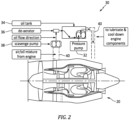
- FIG. 2 diagrammatically illustrates a lubricant system 30 circuit.
- Lubricant within the lubricant tank 34 is pumped to an elevated pressure via a mechanical pump 32 and is supplied to the engine 20 where it is specifically applied to various components for lubrication and/or cooling purposes.
- a scavenge pump 38 is employed to recover the lubricant from the engine 20.
- air is often drawn into the circuit and becomes entrained within the lubricant.
- the lubricant passes from the scavenge pump 38 into the de-aerator 36.
- the de-aerator 36 removes the entrained air and passes the de-aerated lubricant back into the lubricant tank 34 and the cycle repeats itself.
- the lubricant system 30 circuit shown in FIG. 2 is diagrammatic and the present disclosure is not limited to this diagrammatic lubricant circuit and/or the components included. In many instances, additional components such as a heat exchanger and the like may be included.
- FIG. 3 is a diagrammatic illustration of a de-aerator 36 embodiment according to the present disclosure.
- the de-aerator 36 includes a fluid inlet 42, a body 44, a helical fluid passage 46, and one or more fluid outlets 48.
- the de-aerator 36 may also include one or more of a fluid collection body 50, a vent tube 52, and one or more partitions 54.
- the de-aerator body 44 is configured to contain fluids for de-aerating and includes a cover panel 56, at least one sidewall 58, a base panel 60, and an internal cavity 62.
- the cover panel 56, sidewall 58, and base panel 60 each include an interior surface 56I, 58I, 60I and an exterior surface 56E, 58E, 60E.
- the body 44 may be described as having a center axis 64 that extends along a y-axis, and has a width that extends along an X-axis, where the X and Y axes are orthogonal axes.
- the cover panel 56 is disposed at a first axial end 66 of the body 44 and the base panel 60 is disposed at a second axial end 68 of the body 44, opposite the first axial end 66.
- the base panel 60 is connected to the sidewall 58 at the second axial end 68.
- the de-aerator body 44 is substantially cylindrically shaped having a single sidewall 58.
- the present disclosure is not, however, limited to de-aerators 36 having a cylindrical shape.
- the de-aerator body 44 may be frustoconical or may have linear side walls (e.g., rectangular, square, pentagonal, or octagonal) or may vary in diameter in some portions.
- the fluid inlet 42 is disposed adjacent the cover panel 56 at the first axial end 66.
- the fluid inlet 42 is configured to have an internal flow passage 70 that directs fluid tangentially into internal cavity 62 and into the helical fluid passage 46, at an axial position near the first axial end 66; e.g., the fluid inlet direction is predominantly circumferentially in an X-plane and may in some embodiments have an axial component (Y-axis) substantially smaller than the X-plane circumferential component.
- the fluid inlet 42 directs air-entrained fluid in a direction along the circumferential periphery of the internal cavity 62 (into the helical fluid passage 46).
- the internal flow passage 70 is not limited to any particular geometry. Examples of acceptable inlet internal flow passage 70 geometries include circular, rectangular, oval, and the like.
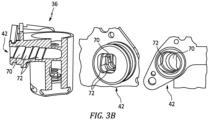
- the inlet internal flow passage 70 may include helical grooving ("swirl grooves 72") in the wall that defines the inlet internal flow passage 70 (See FIG. 3B ).
- the swirl grooves 72 are configured to impart a swirling motion to at least part of the inlet fluid flow as it is directed tangentially into the internal cavity 62 of the body 44.
- the swirl grooves 72 can be formed in several different configurations, for example, a semi-circular channel, etc.
- the swirl grooves 72 are understood to increase the residency time of the fluid passing through the de-aerator 36 and to facilitate the liberation of air from the air-entrained fluid.
- the helical fluid passage 46 is configured to contain the fluid entering the internal cavity 62 of the de-aerator 36 and direct it in a helical path between an entry end 74 (see FIG. 3A ) and an exit end 76.
- the helical fluid passage 46 including a plurality of circumferential turns between the entry and exit ends 74, 76, axially descending toward the second axial end 68 of the body 44. Each circumferential turn extends once circumferentially around the center axis 64.
- the helical fluid passage 46 may be formed independent of a vent tube 52 (not shown in FIG. 5 ).
- the helical fluid passage 46 again uses the sidewall interior surface 58I as the outer radial surface of the passage 46, and an inner radial wall 86 forms the inner radial surface of the passage 46.
- a single helically extending panel 78 forms the axially upper and lower surfaces of the passage 46 except towards the axial ends of the passage 46.
- a plurality of helically extending panels 78 form the axially upper and lower surfaces of the passage 46 (e.g., as shown in FIG. 5 ).
- vent apertures 80 may be disposed in the inner radial wall 86 of the passage 46 to permit the passage of air out of the passage 46.
- FIG. 3 illustrates a vent tube 52 disposed in a central region 84 radially inside of the helical fluid passage 46.
- the de-aerator 36 embodiment shown in FIG. 4 includes a helical fluid passage 46 with a first section 46A and a second section 46B.
- the first section 46A begins at the inlet internal flow passage (not shown in FIG. 4 ) and extends to the second section 46B.
- the second section 46B ends at the helical fluid passage exit end 76 open to the bottom of the de-aerator 36.
- the first section 46A is formed by a helically extending panel 78 that extends between the interior surface 58I of the sidewall 58 and an exterior surface 52E of a centrally disposed vent tube 52.
- the outer radial surface of the helical fluid passage 46 is the sidewall interior surface 58I
- the inner radial surface of the helical fluid passage 46 is the exterior surface 52E of the vent tube 52.
- the vent tube 52 does not extend substantially to the bottom of the de-aerator 36, but rather terminates approximately in the axial middle of the de-aerator 36.
- the second section 46A of the helical fluid passage 46 includes an inner radial wall 82 that does not fully enclose the helical fluid passage 46.
- de-aerator 36 embodiment shown in FIG. 4 is an example and is therefore non-limiting. As an alternative to the embodiment shown in FIG.
- a de-aerator 36 may not include a helical fluid passage 46 with first and second sections, but rather has a vent tube 52 that extends further toward the second axial end 68 and has a helically extending panel 78 that extends between the interior surface 58I of the sidewall 58 and an exterior surface 52E of a centrally disposed vent tube 52 as described above.
- vent apertures may be disposed in the vent tube 52 to allow air to pass from the helical fluid passage 46 into the vent tube 52.
- the helical fluid passage 46 may be formed in part by a helical groove 88 disposed in the sidewall interior surface 58I.
- the present disclosure is not limited to any particular groove 88 configuration within the sidewall interior surface 58I.
- the helical fluid passage 46 examples shown in FIGS. 3-6 are examples of how the helical fluid passage 46 may be configured and the present disclosure is not limited to these examples.
- some embodiments may include a vent tube 52 that is integral with the helical fluid passage 46, extending axially into the de-aerator 36 to the lower axial region of the de-aerator body 44.
- the vent tube 52 may extend axially through the cover panel 56 and continue outside the de-aerator 36 for venting elsewhere (e.g., see FIG. 7 ).
- the de-aerator 36 may include a central region 84 defined at least in part by the enclosed helical fluid passage 46 (e.g., see FIG. 4 ).
- the cover panel 56 may include a tube either connected to the cover panel 56 or extending through the cover panel 56 that provides an exit air passage for venting outside of the de-aerator 36.
- the de-aerator 36 includes at least one partition 54 disposed at or below the exit of the helical fluid passage 46 and spaced above the base panel 60 of the de-aerator 36.
- the partition 54 has an upper surface 54U, a lower surface 54L, a thickness 90 extending between the upper and lower surfaces 54U, 54L, and a circumferential edge 92 (e.g., see FIG. 7 ).
- the partition 54 may extend within the internal cavity 62 in a plane that is substantially perpendicular to the central axis 64. Alternatively, in some embodiments a partition 54 may extend within the internal cavity 62 in a plane that canted (i.e., not perpendicular) relative to the central axis 64.
- the circumferential edge 92 of the partition 54 may be either contiguous with, or connected to, the interior sidewall surface 58I (e.g., se FIG. 7 ); i.e., no purposeful fluid passage is disposed between the circumferential edge 92 of the partition 54 and the interior sidewall surface 58I and the partition 54 extends entirely across the internal cavity 62 from sidewall 58 to sidewall 58.
- at least a part of the circumferential edge 92 of the partition 54 may be spaced apart from the interior sidewall surface 58I to form a fluid passage between the circumferential edge 92 of the partition 54 and the interior sidewall surface 58I (see FIG. 5 ).
- fluid will exit the helical fluid passage 46 at a circumferential fluid velocity and will encounter the partition(s) 54.
- the partition(s) 54 in combination with the body sidewalls 58 are configured to slow the velocity of the fluid exiting the helical fluid passage 46, disperse the fluid, and thereby provide additional opportunity for any air entrained within the fluid to separate and enter the vent tube 52 or the central cavity for passage out of the de-aerator 36.
- the de-aerator 36 embodiments shown in FIGS. 4 , 7 , and 8 include a single partition 54 having an upper surface 54U and a lower surface 54L and a plurality of apertures 94 extending through the thickness 90 of the partition 54 between the upper and lower surfaces 54U. 54L.
- the partition 54 shown in FIGS. 4 and 8 have slot-like apertures 94 extending through the partition 54 that vary in size.
- the apertures 94 may be disposed in patterns concentric about the central axis 64 of the de-aerator 36; e.g., with a first concentric pattern disposed radially inside of a second concentric pattern.
- the partitions 54 shown in FIGS. 6, 7 , and 9 include a plurality of circular apertures 94 extending through the partition 54.
- the circular apertures 94 are all the same diameter but in some embodiments the apertures 94 may include different diameter apertures 94.
- the present disclosure is not limited to any particular partition aperture 94 configuration or any particular number of apertures 94.
- the number and configuration of the apertures 94 may be chosen based on the fluid volumetric rate through the de-aerator 36 to ensure constant fluid volumetric rate through the de-aerator 36 even under maximum flow conditions.
- the de-aerator 36 embodiments shown in FIGS. 3 , 6 , and 9 include a pair of partitions 54 configured in the manner described above.
- FIG. 5 illustrates a de-aerator 36 having a partition 54 without apertures 94.
- This partition 54 is configured so that at least a part of the circumferential edge 92 of the partition 54 is spaced apart from the interior sidewall surface 58I to form a fluid passage between the circumferential edge 92 of the partition 54 and the interior sidewall surface 58I.
- a partition 54 may include more than one aperture configuration (e.g., slots and circles), or a partition 54 may include apertures 94 and may be configured so that at least a part of the circumferential edge 92 of the partition 54 is spaced apart from the interior sidewall surface 58I to form a fluid passage there between, or a first partition 54 may have a first configuration (e.g., including apertures 94 - see FIG. 4 ) and a second partition 54 differently configured (e.g., circumferential edge passages - see FIG. 5 ), or any combination thereof.
- first configuration e.g., including apertures 94 - see FIG. 4
- a second partition 54 differently configured (e.g., circumferential edge passages - see FIG. 5 ), or any combination thereof.
- Partition 54 configurations may be chosen to create a fluid flow with decreased velocity that falls gravimetrically to the base of the de-aerator 36.
- the thickness 90 (see FIG. 8 ) of any of these partition 54 embodiments may be greater or lesser to improve fluid flow into the base of the de-aerator 36 that facilitates de-aeration.
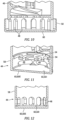
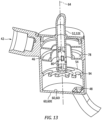
- the de-aerator 36 may include one or more fluid outlets 48 disposed in the sidewall 58 (e.g., see FIGS. 10-12 ) or one or more fluid outlets 48 disposed in the base panel 60 (e.g., see FIG. 13 ).
- the present disclosure is not limited to any particular fluid outlet geometry or positioning.
- the fluid outlets 48 shown in FIGS. 10-12 have different oval-like configurations.
- the oval-like fluid outlets 48 shown in FIGS. 10 and 12 have their long axes extending substantially parallel to the central axis 64 of the de-aerator 36, whereas the oval-like fluid outlets 48 shown in FIG. 11 have their short axes extending substantially parallel to the central axis 64 of the de-aerator 36.
- a surface of the fluid outlets 48 may be flush with the interior surface of the base panel 60 (e.g., see FIGS. 10 and 11 ). In some embodiments, the fluid outlets 48 may not be flush with the interior surface of the base panel 60 (e.g., see FIG. 12 ); i.e., spaced a distance axially up from the interior surface of the base panel 60.
- the de-aerator 36 may include a fluid collection body 50 disposed radially outside of the sidewalls 58.
- the fluid collection body 50 is generally concentric with, but radially spaced apart from, the sidewall exterior surface 58E to form an annular cavity there between; e.g., see FIGS. 3 and 6 .
- piping or other conduit means may be in communication with the fluid collection body 50 to receive de-aerated fluid therefrom.
- the cover panel 56 may be an independent element that is configured for attachment to the one or more sidewalls 58.
- the cover panel 56 diagrammatically shown in FIG. 13 is independent of the de-aerator body 44 and is configured for attachment to the de-aerator body 44.
- the vent tube 52 is integrally formed with the cover panel 56.
- a sealing element e.g., an O-ring or the like
- one or more elements of the de-aerator 36 may be produced independently of other elements and the de-aerator 36 formed as an assembly. An example of this configuration is described above where the cover panel 56 and the vent tube 52 are independent of the de-aerator body 44.
- elements of the de-aerator 36 may be formed as an integral unit / unitary structure.
- the de-aerator 36 embodiment shown in FIG. 3 has a fluid inlet 42, a body 44, a vent tube 52, a helical fluid passage 46, a base panel 60, partitions 54, and a fluid collection body 50 formed as a unitary structure. Such a structure may be formed using additive manufacturing techniques, or 3D printing techniques, or the like.
- portions of the de-aerator 36 may be formed as a unitary structure that can be assembled with other elements to produce the de-aerator 36.
Landscapes
- Engineering & Computer Science (AREA)
- General Engineering & Computer Science (AREA)
- Mechanical Engineering (AREA)
- Chemical & Material Sciences (AREA)
- Chemical Kinetics & Catalysis (AREA)
- Nozzles (AREA)
- Aeration Devices For Treatment Of Activated Polluted Sludge (AREA)
Priority Applications (1)
| Application Number | Priority Date | Filing Date | Title |
|---|---|---|---|
| EP25193860.1A EP4628182A3 (fr) | 2022-11-28 | 2023-11-28 | Aérateur statique et système de lubrifiant |
Applications Claiming Priority (1)
| Application Number | Priority Date | Filing Date | Title |
|---|---|---|---|
| US18/070,107 US12253001B2 (en) | 2022-11-28 | 2022-11-28 | Static de-aerator and lubricant system |
Related Child Applications (1)
| Application Number | Title | Priority Date | Filing Date |
|---|---|---|---|
| EP25193860.1A Division EP4628182A3 (fr) | 2022-11-28 | 2023-11-28 | Aérateur statique et système de lubrifiant |
Publications (2)
| Publication Number | Publication Date |
|---|---|
| EP4375559A1 true EP4375559A1 (fr) | 2024-05-29 |
| EP4375559B1 EP4375559B1 (fr) | 2025-08-20 |
Family
ID=88978389
Family Applications (2)
| Application Number | Title | Priority Date | Filing Date |
|---|---|---|---|
| EP25193860.1A Pending EP4628182A3 (fr) | 2022-11-28 | 2023-11-28 | Aérateur statique et système de lubrifiant |
| EP23212714.2A Active EP4375559B1 (fr) | 2022-11-28 | 2023-11-28 | Desaérateur statique et système de lubrifiant |
Family Applications Before (1)
| Application Number | Title | Priority Date | Filing Date |
|---|---|---|---|
| EP25193860.1A Pending EP4628182A3 (fr) | 2022-11-28 | 2023-11-28 | Aérateur statique et système de lubrifiant |
Country Status (3)
| Country | Link |
|---|---|
| US (2) | US12253001B2 (fr) |
| EP (2) | EP4628182A3 (fr) |
| CA (1) | CA3221197A1 (fr) |
Families Citing this family (1)
| Publication number | Priority date | Publication date | Assignee | Title |
|---|---|---|---|---|
| US20250382896A1 (en) * | 2024-06-12 | 2025-12-18 | Rtx Corporation | Hydraulically driven de-oiler for gas turbine engines |
Citations (5)
| Publication number | Priority date | Publication date | Assignee | Title |
|---|---|---|---|---|
| US2705053A (en) * | 1953-05-14 | 1955-03-29 | Doak Aircraft Co Inc | Oil degasification |
| US4559068A (en) * | 1983-08-25 | 1985-12-17 | Tetra Pak International Ab | Arrangement for the separation of particles |
| EP1887192A1 (fr) * | 2006-08-03 | 2008-02-13 | Toyota Boshoku Kabushiki Kaisha | Séparateur vapeur/liquide |
| US20090183950A1 (en) * | 2008-01-23 | 2009-07-23 | Sylvain Brouillet | Lubrication system and method, and vortex flow separator for use therewith |
| US20120234174A1 (en) * | 2011-03-14 | 2012-09-20 | Rollins Michael J | Deaerating method and assembly |
Family Cites Families (12)
| Publication number | Priority date | Publication date | Assignee | Title |
|---|---|---|---|---|
| US1565318A (en) * | 1925-04-06 | 1925-12-15 | Ernest F Fisher | Separator |
| US3349548A (en) * | 1964-01-22 | 1967-10-31 | C C Ind | Cyclone separator for separating steam from water |
| NL177187C (nl) * | 1974-01-16 | 1985-08-16 | Nederlandse Gasunie Nv | Inrichting voor het afscheiden van verontreinigingen uit gassen. |
| JP4052827B2 (ja) * | 2001-11-07 | 2008-02-27 | 本田技研工業株式会社 | 遠心式気液分離装置 |
| US8146711B2 (en) * | 2008-09-18 | 2012-04-03 | United Technologies Corporation | Reduced gulp fluid reservoir |
| US7867310B2 (en) * | 2009-01-29 | 2011-01-11 | General Electric Company | Method and apparatus for separating air and oil |
| EP3315182A1 (fr) * | 2016-10-31 | 2018-05-02 | Pratt & Whitney Canada Corp. | Séparateur par centrifugation |
| US10843113B2 (en) * | 2016-11-01 | 2020-11-24 | Ingersoll-Rand Industrial U.S., Inc. | Cyclonic oil separator for compressor oil reservoir |
| KR20190137370A (ko) | 2018-06-01 | 2019-12-11 | 성균관대학교산학협력단 | 기체-오일 분리기 |
| US11255265B2 (en) | 2019-03-04 | 2022-02-22 | Rolls-Royce Corporation | Air-oil separation system for gas turbine engine |
| US11555418B2 (en) * | 2019-06-12 | 2023-01-17 | General Electric Company | Oil supply system for a gas turbine engine |
| US11692669B2 (en) | 2019-11-22 | 2023-07-04 | Rolls-Royce Corporation | Oil tank filler cap integrated into the de-aerator |
-
2022
- 2022-11-28 US US18/070,107 patent/US12253001B2/en active Active
-
2023
- 2023-11-27 CA CA3221197A patent/CA3221197A1/fr active Pending
- 2023-11-28 EP EP25193860.1A patent/EP4628182A3/fr active Pending
- 2023-11-28 EP EP23212714.2A patent/EP4375559B1/fr active Active
-
2025
- 2025-03-17 US US19/081,818 patent/US20250277458A1/en active Pending
Patent Citations (5)
| Publication number | Priority date | Publication date | Assignee | Title |
|---|---|---|---|---|
| US2705053A (en) * | 1953-05-14 | 1955-03-29 | Doak Aircraft Co Inc | Oil degasification |
| US4559068A (en) * | 1983-08-25 | 1985-12-17 | Tetra Pak International Ab | Arrangement for the separation of particles |
| EP1887192A1 (fr) * | 2006-08-03 | 2008-02-13 | Toyota Boshoku Kabushiki Kaisha | Séparateur vapeur/liquide |
| US20090183950A1 (en) * | 2008-01-23 | 2009-07-23 | Sylvain Brouillet | Lubrication system and method, and vortex flow separator for use therewith |
| US20120234174A1 (en) * | 2011-03-14 | 2012-09-20 | Rollins Michael J | Deaerating method and assembly |
Also Published As
| Publication number | Publication date |
|---|---|
| CA3221197A1 (fr) | 2024-05-28 |
| EP4628182A3 (fr) | 2026-01-07 |
| EP4375559B1 (fr) | 2025-08-20 |
| US20240175376A1 (en) | 2024-05-30 |
| US12253001B2 (en) | 2025-03-18 |
| EP4628182A2 (fr) | 2025-10-08 |
| US20250277458A1 (en) | 2025-09-04 |
Similar Documents
| Publication | Publication Date | Title |
|---|---|---|
| US8601785B2 (en) | Oil supply system with main pump deaeration | |
| EP3168425A1 (fr) | Procédé et système de refroidissement de fluide de moteur d'aéronef | |
| CA2713802C (fr) | Systeme de lubrification a element poreux | |
| US8657931B2 (en) | Gearbox deoiler with sychnronizer | |
| US11566563B2 (en) | Oil distribution system for an engine | |
| EP2592252A2 (fr) | Déshuileur pressurisé pour boîte de vitesses | |
| EP3315182A1 (fr) | Séparateur par centrifugation | |
| US11073041B2 (en) | Jet engine | |
| US20250277458A1 (en) | Static de-aerator and lubricant system | |
| JP2009133310A (ja) | 空気−油セパレータ | |
| CA2990903C (fr) | Appareil de separation air-huile | |
| US12194401B2 (en) | Air-oil separator | |
| EP4032596A1 (fr) | Désaérateur pour moteur d'aéronef et procédé de fonctionnement associé | |
| EP3187700A2 (fr) | Procédé et système de pompe centrifuge | |
| EP4542102A1 (fr) | Désaérateur d'huile pour moteur d'aéronef | |
| US10422476B2 (en) | Deaerating assembly | |
| EP4570350A1 (fr) | Séparateur air-huile |
Legal Events
| Date | Code | Title | Description |
|---|---|---|---|
| PUAI | Public reference made under article 153(3) epc to a published international application that has entered the european phase |
Free format text: ORIGINAL CODE: 0009012 |
|
| STAA | Information on the status of an ep patent application or granted ep patent |
Free format text: STATUS: THE APPLICATION HAS BEEN PUBLISHED |
|
| AK | Designated contracting states |
Kind code of ref document: A1 Designated state(s): AL AT BE BG CH CY CZ DE DK EE ES FI FR GB GR HR HU IE IS IT LI LT LU LV MC ME MK MT NL NO PL PT RO RS SE SI SK SM TR |
|
| STAA | Information on the status of an ep patent application or granted ep patent |
Free format text: STATUS: REQUEST FOR EXAMINATION WAS MADE |
|
| 17P | Request for examination filed |
Effective date: 20241129 |
|
| RBV | Designated contracting states (corrected) |
Designated state(s): AL AT BE BG CH CY CZ DE DK EE ES FI FR GB GR HR HU IE IS IT LI LT LU LV MC ME MK MT NL NO PL PT RO RS SE SI SK SM TR |
|
| GRAP | Despatch of communication of intention to grant a patent |
Free format text: ORIGINAL CODE: EPIDOSNIGR1 |
|
| STAA | Information on the status of an ep patent application or granted ep patent |
Free format text: STATUS: GRANT OF PATENT IS INTENDED |
|
| INTG | Intention to grant announced |
Effective date: 20250311 |
|
| GRAS | Grant fee paid |
Free format text: ORIGINAL CODE: EPIDOSNIGR3 |
|
| GRAA | (expected) grant |
Free format text: ORIGINAL CODE: 0009210 |
|
| STAA | Information on the status of an ep patent application or granted ep patent |
Free format text: STATUS: THE PATENT HAS BEEN GRANTED |
|
| AK | Designated contracting states |
Kind code of ref document: B1 Designated state(s): AL AT BE BG CH CY CZ DE DK EE ES FI FR GB GR HR HU IE IS IT LI LT LU LV MC ME MK MT NL NO PL PT RO RS SE SI SK SM TR |
|
| REG | Reference to a national code |
Ref country code: GB Ref legal event code: FG4D |
|
| REG | Reference to a national code |
Ref country code: CH Ref legal event code: EP |
|
| REG | Reference to a national code |
Ref country code: IE Ref legal event code: FG4D |
|
| REG | Reference to a national code |
Ref country code: DE Ref legal event code: R096 Ref document number: 602023005888 Country of ref document: DE |
|
| REG | Reference to a national code |
Ref country code: NL Ref legal event code: MP Effective date: 20250820 |
|
| PG25 | Lapsed in a contracting state [announced via postgrant information from national office to epo] |
Ref country code: IS Free format text: LAPSE BECAUSE OF FAILURE TO SUBMIT A TRANSLATION OF THE DESCRIPTION OR TO PAY THE FEE WITHIN THE PRESCRIBED TIME-LIMIT Effective date: 20251220 |
|
| PGFP | Annual fee paid to national office [announced via postgrant information from national office to epo] |
Ref country code: DE Payment date: 20251022 Year of fee payment: 3 |
|
| PG25 | Lapsed in a contracting state [announced via postgrant information from national office to epo] |
Ref country code: NO Free format text: LAPSE BECAUSE OF FAILURE TO SUBMIT A TRANSLATION OF THE DESCRIPTION OR TO PAY THE FEE WITHIN THE PRESCRIBED TIME-LIMIT Effective date: 20251120 |
|
| REG | Reference to a national code |
Ref country code: LT Ref legal event code: MG9D |
|
| PG25 | Lapsed in a contracting state [announced via postgrant information from national office to epo] |
Ref country code: PT Free format text: LAPSE BECAUSE OF FAILURE TO SUBMIT A TRANSLATION OF THE DESCRIPTION OR TO PAY THE FEE WITHIN THE PRESCRIBED TIME-LIMIT Effective date: 20251222 |
|
| PG25 | Lapsed in a contracting state [announced via postgrant information from national office to epo] |
Ref country code: FI Free format text: LAPSE BECAUSE OF FAILURE TO SUBMIT A TRANSLATION OF THE DESCRIPTION OR TO PAY THE FEE WITHIN THE PRESCRIBED TIME-LIMIT Effective date: 20250820 |
|
| PG25 | Lapsed in a contracting state [announced via postgrant information from national office to epo] |
Ref country code: NL Free format text: LAPSE BECAUSE OF FAILURE TO SUBMIT A TRANSLATION OF THE DESCRIPTION OR TO PAY THE FEE WITHIN THE PRESCRIBED TIME-LIMIT Effective date: 20250820 Ref country code: HR Free format text: LAPSE BECAUSE OF FAILURE TO SUBMIT A TRANSLATION OF THE DESCRIPTION OR TO PAY THE FEE WITHIN THE PRESCRIBED TIME-LIMIT Effective date: 20250820 |
|
| PGFP | Annual fee paid to national office [announced via postgrant information from national office to epo] |
Ref country code: FR Payment date: 20251022 Year of fee payment: 3 |
|
| PG25 | Lapsed in a contracting state [announced via postgrant information from national office to epo] |
Ref country code: GR Free format text: LAPSE BECAUSE OF FAILURE TO SUBMIT A TRANSLATION OF THE DESCRIPTION OR TO PAY THE FEE WITHIN THE PRESCRIBED TIME-LIMIT Effective date: 20251121 |
|
| PG25 | Lapsed in a contracting state [announced via postgrant information from national office to epo] |
Ref country code: SE Free format text: LAPSE BECAUSE OF FAILURE TO SUBMIT A TRANSLATION OF THE DESCRIPTION OR TO PAY THE FEE WITHIN THE PRESCRIBED TIME-LIMIT Effective date: 20250820 |
|
| PG25 | Lapsed in a contracting state [announced via postgrant information from national office to epo] |
Ref country code: LV Free format text: LAPSE BECAUSE OF FAILURE TO SUBMIT A TRANSLATION OF THE DESCRIPTION OR TO PAY THE FEE WITHIN THE PRESCRIBED TIME-LIMIT Effective date: 20250820 |
|
| PG25 | Lapsed in a contracting state [announced via postgrant information from national office to epo] |
Ref country code: PL Free format text: LAPSE BECAUSE OF FAILURE TO SUBMIT A TRANSLATION OF THE DESCRIPTION OR TO PAY THE FEE WITHIN THE PRESCRIBED TIME-LIMIT Effective date: 20250820 Ref country code: BG Free format text: LAPSE BECAUSE OF FAILURE TO SUBMIT A TRANSLATION OF THE DESCRIPTION OR TO PAY THE FEE WITHIN THE PRESCRIBED TIME-LIMIT Effective date: 20250820 |
|
| PG25 | Lapsed in a contracting state [announced via postgrant information from national office to epo] |
Ref country code: RS Free format text: LAPSE BECAUSE OF FAILURE TO SUBMIT A TRANSLATION OF THE DESCRIPTION OR TO PAY THE FEE WITHIN THE PRESCRIBED TIME-LIMIT Effective date: 20251120 |
|
| PG25 | Lapsed in a contracting state [announced via postgrant information from national office to epo] |
Ref country code: ES Free format text: LAPSE BECAUSE OF FAILURE TO SUBMIT A TRANSLATION OF THE DESCRIPTION OR TO PAY THE FEE WITHIN THE PRESCRIBED TIME-LIMIT Effective date: 20250820 |
|
| REG | Reference to a national code |
Ref country code: AT Ref legal event code: MK05 Ref document number: 1827635 Country of ref document: AT Kind code of ref document: T Effective date: 20250820 |
|
| PG25 | Lapsed in a contracting state [announced via postgrant information from national office to epo] |
Ref country code: RO Free format text: LAPSE BECAUSE OF FAILURE TO SUBMIT A TRANSLATION OF THE DESCRIPTION OR TO PAY THE FEE WITHIN THE PRESCRIBED TIME-LIMIT Effective date: 20250820 |
|
| PG25 | Lapsed in a contracting state [announced via postgrant information from national office to epo] |
Ref country code: SM Free format text: LAPSE BECAUSE OF FAILURE TO SUBMIT A TRANSLATION OF THE DESCRIPTION OR TO PAY THE FEE WITHIN THE PRESCRIBED TIME-LIMIT Effective date: 20250820 |
|
| PG25 | Lapsed in a contracting state [announced via postgrant information from national office to epo] |
Ref country code: DK Free format text: LAPSE BECAUSE OF FAILURE TO SUBMIT A TRANSLATION OF THE DESCRIPTION OR TO PAY THE FEE WITHIN THE PRESCRIBED TIME-LIMIT Effective date: 20250820 |
|
| PG25 | Lapsed in a contracting state [announced via postgrant information from national office to epo] |
Ref country code: AT Free format text: LAPSE BECAUSE OF FAILURE TO SUBMIT A TRANSLATION OF THE DESCRIPTION OR TO PAY THE FEE WITHIN THE PRESCRIBED TIME-LIMIT Effective date: 20250820 |
|
| PG25 | Lapsed in a contracting state [announced via postgrant information from national office to epo] |
Ref country code: IT Free format text: LAPSE BECAUSE OF FAILURE TO SUBMIT A TRANSLATION OF THE DESCRIPTION OR TO PAY THE FEE WITHIN THE PRESCRIBED TIME-LIMIT Effective date: 20250820 |
|
| PG25 | Lapsed in a contracting state [announced via postgrant information from national office to epo] |
Ref country code: CZ Free format text: LAPSE BECAUSE OF FAILURE TO SUBMIT A TRANSLATION OF THE DESCRIPTION OR TO PAY THE FEE WITHIN THE PRESCRIBED TIME-LIMIT Effective date: 20250820 |
|
| PG25 | Lapsed in a contracting state [announced via postgrant information from national office to epo] |
Ref country code: SK Free format text: LAPSE BECAUSE OF FAILURE TO SUBMIT A TRANSLATION OF THE DESCRIPTION OR TO PAY THE FEE WITHIN THE PRESCRIBED TIME-LIMIT Effective date: 20250820 Ref country code: EE Free format text: LAPSE BECAUSE OF FAILURE TO SUBMIT A TRANSLATION OF THE DESCRIPTION OR TO PAY THE FEE WITHIN THE PRESCRIBED TIME-LIMIT Effective date: 20250820 |