EP4375691A1 - Appareil pour reconstruire une image par résonance magnétique sur la base d'un opérateur d'échantillonnage d'un sous-espace - Google Patents
Appareil pour reconstruire une image par résonance magnétique sur la base d'un opérateur d'échantillonnage d'un sous-espace Download PDFInfo
- Publication number
- EP4375691A1 EP4375691A1 EP22208712.4A EP22208712A EP4375691A1 EP 4375691 A1 EP4375691 A1 EP 4375691A1 EP 22208712 A EP22208712 A EP 22208712A EP 4375691 A1 EP4375691 A1 EP 4375691A1
- Authority
- EP
- European Patent Office
- Prior art keywords
- time domain
- magnetic resonance
- subspace
- domain signal
- operator
- Prior art date
- Legal status (The legal status is an assumption and is not a legal conclusion. Google has not performed a legal analysis and makes no representation as to the accuracy of the status listed.)
- Withdrawn
Links
- 238000005070 sampling Methods 0.000 title claims abstract description 169
- 230000006835 compression Effects 0.000 claims abstract description 73
- 238000007906 compression Methods 0.000 claims abstract description 73
- 238000002595 magnetic resonance imaging Methods 0.000 claims abstract description 59
- 238000000034 method Methods 0.000 claims abstract description 41
- 239000013598 vector Substances 0.000 claims abstract description 27
- 238000012545 processing Methods 0.000 claims abstract description 26
- 230000002123 temporal effect Effects 0.000 claims abstract description 23
- 230000006837 decompression Effects 0.000 claims description 22
- 238000010200 validation analysis Methods 0.000 claims description 22
- 238000004590 computer program Methods 0.000 claims description 15
- 230000001131 transforming effect Effects 0.000 claims description 3
- 230000008569 process Effects 0.000 abstract description 3
- 238000004422 calculation algorithm Methods 0.000 description 38
- 239000011159 matrix material Substances 0.000 description 13
- 238000005457 optimization Methods 0.000 description 13
- 238000005259 measurement Methods 0.000 description 8
- 230000000694 effects Effects 0.000 description 6
- 238000002156 mixing Methods 0.000 description 6
- 238000004364 calculation method Methods 0.000 description 5
- 238000013459 approach Methods 0.000 description 4
- 230000008901 benefit Effects 0.000 description 4
- 238000000354 decomposition reaction Methods 0.000 description 4
- 230000001419 dependent effect Effects 0.000 description 4
- 230000003321 amplification Effects 0.000 description 3
- 230000003993 interaction Effects 0.000 description 3
- 238000013507 mapping Methods 0.000 description 3
- 238000012544 monitoring process Methods 0.000 description 3
- 238000003199 nucleic acid amplification method Methods 0.000 description 3
- 230000003750 conditioning effect Effects 0.000 description 2
- 238000009792 diffusion process Methods 0.000 description 2
- 238000009472 formulation Methods 0.000 description 2
- 230000006870 function Effects 0.000 description 2
- 238000010801 machine learning Methods 0.000 description 2
- 230000005415 magnetization Effects 0.000 description 2
- 239000000203 mixture Substances 0.000 description 2
- 238000004445 quantitative analysis Methods 0.000 description 2
- 230000009466 transformation Effects 0.000 description 2
- 238000012800 visualization Methods 0.000 description 2
- 230000009471 action Effects 0.000 description 1
- 230000008859 change Effects 0.000 description 1
- 238000010276 construction Methods 0.000 description 1
- 238000001514 detection method Methods 0.000 description 1
- 230000014509 gene expression Effects 0.000 description 1
- 230000002068 genetic effect Effects 0.000 description 1
- 238000012880 independent component analysis Methods 0.000 description 1
- 238000002075 inversion recovery Methods 0.000 description 1
- 230000008078 mathematical effect Effects 0.000 description 1
- 238000001208 nuclear magnetic resonance pulse sequence Methods 0.000 description 1
- 230000003287 optical effect Effects 0.000 description 1
- 230000010412 perfusion Effects 0.000 description 1
- 238000001472 pulsed field gradient Methods 0.000 description 1
- 238000004451 qualitative analysis Methods 0.000 description 1
- 230000035945 sensitivity Effects 0.000 description 1
- 238000002922 simulated annealing Methods 0.000 description 1
- 238000000264 spin echo pulse sequence Methods 0.000 description 1
- 238000012546 transfer Methods 0.000 description 1
- 230000001052 transient effect Effects 0.000 description 1
- 238000004148 unit process Methods 0.000 description 1
Images
Classifications
-
- G—PHYSICS
- G01—MEASURING; TESTING
- G01R—MEASURING ELECTRIC VARIABLES; MEASURING MAGNETIC VARIABLES
- G01R33/00—Arrangements or instruments for measuring magnetic variables
- G01R33/20—Arrangements or instruments for measuring magnetic variables involving magnetic resonance
- G01R33/44—Arrangements or instruments for measuring magnetic variables involving magnetic resonance using nuclear magnetic resonance [NMR]
- G01R33/48—NMR imaging systems
- G01R33/54—Signal processing systems, e.g. using pulse sequences ; Generation or control of pulse sequences; Operator console
- G01R33/56—Image enhancement or correction, e.g. subtraction or averaging techniques, e.g. improvement of signal-to-noise ratio and resolution
- G01R33/5608—Data processing and visualization specially adapted for MR, e.g. for feature analysis and pattern recognition on the basis of measured MR data, segmentation of measured MR data, edge contour detection on the basis of measured MR data, for enhancing measured MR data in terms of signal-to-noise ratio by means of noise filtering or apodization, for enhancing measured MR data in terms of resolution by means for deblurring, windowing, zero filling, or generation of gray-scaled images, colour-coded images or images displaying vectors instead of pixels
-
- G—PHYSICS
- G01—MEASURING; TESTING
- G01R—MEASURING ELECTRIC VARIABLES; MEASURING MAGNETIC VARIABLES
- G01R33/00—Arrangements or instruments for measuring magnetic variables
- G01R33/20—Arrangements or instruments for measuring magnetic variables involving magnetic resonance
- G01R33/44—Arrangements or instruments for measuring magnetic variables involving magnetic resonance using nuclear magnetic resonance [NMR]
- G01R33/48—NMR imaging systems
- G01R33/54—Signal processing systems, e.g. using pulse sequences ; Generation or control of pulse sequences; Operator console
- G01R33/56—Image enhancement or correction, e.g. subtraction or averaging techniques, e.g. improvement of signal-to-noise ratio and resolution
- G01R33/561—Image enhancement or correction, e.g. subtraction or averaging techniques, e.g. improvement of signal-to-noise ratio and resolution by reduction of the scanning time, i.e. fast acquiring systems, e.g. using echo-planar pulse sequences
Definitions
- the invention relates to an apparatus, a method and a computer program product for reconstructing a magnetic resonance image and/or parameter map based on a magnetic resonance time domain signal acquired in a time domain magnetic resonance imaging. Further, the invention refers to a system for reconstructing a magnetic resonance image and/or parameter map utilizing the apparatus, method and/or computer program product above. Moreover, the invention refers to a sequence determination apparatus for determining an acquisition sequence for acquiring a magnetic resonance time domain signal in a time domain magnetic resonance imaging and to an acquisition sequence determined accordingly.
- Time domain magnetic resonance imaging allows to not only provided a qualitative analysis of the imaged object, but also the quantitative analysis leading, for instance, to the possibility to determine actual tissue types imaged.
- a time domain magnetic resonance imaging a huge amount of data is generated and has to be analyzed, for instance, utilizing magnetic resonance fingerprinting.
- time domain magnetic resonance imaging provides many advantages, it is computationally demanding.
- during the acquisition there is no time to spatially encode each time-point of the measurement such that a heavy spatial subsampling is generally used. This leads to an increased reconstruction complexity.
- compression algorithms have been developed that allow to reconstruct magnetic resonance images or parameter maps in a compression subspace allowing for a decrease in the usage of computational resources, in particular, storage and calculation resources.
- these compression algorithms allow for a regularization of the reconstruction problem such that also strongly undersampled measurements can be reconstructed.
- the calculations are still complex and computational resource intensive and thus difficult to use, for instance, in applications where the results have to be provided as fast as possible to a medical practitioner, e.g. in emergency situations.
- the compression can introduce noise or make, in particular, the fingerprinting algorithm that is often utilized for generating the magnetic resonance images and/or parameter maps less accurate.
- the accuracy and/or noise, if compression is utilized can strongly depend on the utilized magnetic resonance acquisition sequence, wherein it is often difficult or nearly impossible to determine or predict an optimal, i.e. less noise causing, acquisition sequence for a compression algorithm before the actual acquisition.
- magnetic resonance acquisition sequences could be determined in a context of utilizing a compression reconstruction algorithm that allow for a more accurate reconstruction of the magnetic resonance images and/or parameter maps in this context.
- an apparatus for reconstructing a magnetic resonance image and/or parameter map based on a magnetic resonance time domain signal acquired in a time domain magnetic resonance imaging comprises a) a time domain signal providing unit for providing a time domain signal acquired in time domain magnetic resonance imaging utilizing a predetermined sampling pattern in k-space and a predetermined magnetic resonance acquisition sequence, b) an operator providing unit for providing a subspace-sampling operator that provides for a given k-space location of the sampling pattern temporal subsamples of basis vectors of a compression subspace, wherein the compression subspace is utilizable for compressing the time domain signal, c) a signal processing unit for processing the time domain signal utilizing the subspace-sampling operator, and d) a reconstruction unit for reconstructing the magnetic resonance image and/or parameter map based on the processed time domain signal.
- the subspace-sampling operator is provided such that it provides for a given k-space location of the sampling pattern temporal subsamples of basis vectors of a compression subspace that can be utilized for compressing the time domain signal, and since the time domain signal is processed utilizing the subspace-sampling operator, the magnetic resonance images and/or parameter maps can be reconstructed based on the processed time domain signal utilizing compression algorithms more directly, for instance, without iteration steps and also more accurately. Moreover, since the subspace-sampling operator is directly provided, i.e.
- the subspace-sampling operator for optimizing the magnetic resonance acquisition sequence such that a magnetic resonance acquisition sequence can be determined based on the subspace-sampling operator that allows for an even more accurate reconstruction of the magnetic resonance images and/or parameter maps.
- the apparatus is configured for reconstructing a magnetic resonance image and/or a parameter map.
- the apparatus can be realized in any form of hardware and/or software provided by a general or dedicated computer system.
- the apparatus can also be realized in distributed computing, for example, can be realized as part of a computer network in which the functions of the apparatus are provided by different processors, servers or computer systems.
- a magnetic resonance image can refer to any known magnetic resonance image that is utilized in commonly known magnetic resonance imaging.
- a magnetic resonance image can refer to a T1, T2 weighted image, a gradient echo-based image, an inversion recovery-based image, a diffusion weighted image, a perfusion weighted image, etc.
- Parametric maps can in this context be a result of a quantitative analysis of a magnetic resonance signal and can refer to, for example, any kind of tissue map, but also to diffusion parameters, kinetic parameters, proton density, magnetization transfer saturation, longitudinal and effective transverse relaxation rates, etc.
- the magnetic resonance time domain signal is acquired in a time domain magnetic resonance imaging.
- a time domain magnetic resonance imaging is characterized by the possibility to resolve transient dynamics of the magnetization, in particular, the signal is not necessarily measured in a steady state as is typically the case with magnetic resonance signal measurements.
- An example for time domain magnetic resonance imaging can be found in the article " Magnetic resonance fingerprinting", D. Ma et al., Nature, Vol. 495, 187-192 (2013 ).
- the time domain signal providing unit is configured for providing a time domain signal.
- the time domain signal providing unit can refer to a storage unit or can be communicatively coupled to a storage unit, wherein the time domain signal is already stored on the storage unit and the time domain signal providing unit is configured for providing the signal stored on the storage unit.
- the time domain signal providing unit can also be a receiving unit for receiving the time domain signal, for instance, from an input unit or via an interface directly from a magnetic resonance imaging apparatus, and for providing the received time domain signal.
- the time domain signal is acquired in a time domain magnetic resonance imaging utilizing the predetermined sampling pattern in k-space and a predetermined magnetic resonance acquisition sequence. For acquiring a time domain signal, different patterns in k-space are commonly utilized and known.
- the predetermined sampling pattern can refer to any pattern in k-space. However, preferably the sampling pattern refers to a spiral or radial sampling pattern with interleaves.
- the k-space is a spatial frequency domain into which the magnetic resonance measurements can directly be mapped.
- the predetermined magnetic resonance acquisition sequence refers to a particular setting of pulse sequences and pulsed field gradients that is utilized for acquiring the time domain signal. Preferably, a balanced gradient-echo or a spoiled gradient-echo acquisition sequence is utilized. However, also spin-echo sequences can be used.
- the operator providing unit is configured for providing a subspace-sampling operator.
- the operator providing unit can be a storage unit or can be communicatively coupled with the storage unit on which the subspace-sampling operator is already stored and is then configured for providing the same.
- the operator providing unit can also be an input unit or can be communicatively coupled to an input unit for receiving the subspace-sampling operator, for instance, from a user, and is then configured for providing the received subspace-sampling operator.
- the subspace-sampling operator provides for a given k-space location of the sampling pattern temporal subsamples of basis vectors of a compression subspace.
- the subspace-sampling operator depends on the utilized predetermined sampling pattern in k-space and the compression subspace that is utilizable for compressing the time domain signal and is generally also predetermined.
- the compression subspace refers to a subspace into which a time domain signal can be compressed, for instance, by mapping the time domain signal into the compression subspace, wherein the compression subspace is defined by respective basis vectors.
- the temporal subsample of a basis vector defines for respective time points of the time domain signal associated subsamples of the basis vectors.
- the subspace-sampling operator is preferably provided such that it provides for each k-space location of the sampling pattern the respective temporal subsamples of the basis vectors.
- the subspace-sampling operator can comprise for the respective k-space locations of the different sampling patterns the respective temporal subsamples of basis vectors of the respective compression subspace.
- the subspace-sampling operator can be predetermined, in particular, before the measurement of the time domain signal based on a chosen, i.e. predetermined, sampling pattern and based on a chosen, i.e. predetermined, compression subspace.
- the providing of the subspace-sampling operator comprises generating the subspace-sampling operator as a combination of a selection operator associated with the sampling pattern in k-space and a decompression operator comprising the basis vectors of the compression subspace utilizable for compressing a signal into the compression subspace.
- the selection operator is associated with a sampling pattern in k-space, in particular, depends on the sampling pattern in k-space. For example, the selection operator provides a mapping between the sampling pattern in k-space and the measured time domain signal and thus provides a mapping for each measurement at a respective time point of the measured time domain signal into the respective point in k-space defined by the sampling pattern in k-space.
- the selection operator further indicates that all values of the k-space not belonging to the sampling pattern in k-space are set to zero.
- the decompression operator generally comprises the basis vectors of a compression subspace into which a signal can be mapped for compression.
- the decompression operator is a linear matrix that provides an orthogonal temporal basis for the compression subspace.
- the decompression operator and thus also the compression subspace are determined utilizing a singular value decomposition, for instance, of a matching dictionary utilized in a fingerprinting matching algorithm.
- a singular value decomposition for instance, of a matching dictionary utilized in a fingerprinting matching algorithm.
- other compression subspaces and thus other decompression operators based on other compression algorithms can be utilized.
- compression subspaces determined utilizing machine learning algorithms like a latent space of an auto-decoder algorithms, or utilizing independent component analysis can also be utilized.
- the combination of the selection operator and the decompression operator is preferably a matrix multiplication, in which the selection operator is applied to the decompression operator.
- the signal processing unit is configured for processing the time domain signal utilizing the subspace-sampling operator.
- the construction unit is then configured for reconstructing the magnetic resonance image and/or parameter map based on the processed time domain signal.
- the processing of the time domain signal depends on the algorithm utilized by the reconstruction unit for reconstructing the magnetic resonance image and/or parameter map based on the processed time domain signal.
- a subspace-sampling operator is in most cases directly applied to the time domain signal in order to determine the processed time domain signal.
- the processing can also comprise further processing steps, for example, for preparing the time domain signal before processing the time domain signal.
- respective known algorithms in particular, compression algorithms, can be utilized.
- a fingerprinting algorithm can be used in which the processed time domain signal is utilized for determining a matching signal which is then compared in a matching process with a library of characteristic signals, for instance, of respective tissue samples to determine a magnetic resonance image and/or parameter map.
- a library of characteristic signals for instance, of respective tissue samples to determine a magnetic resonance image and/or parameter map.
- other reconstruction algorithms like machine learning algorithms based on the processed time domain signal, iterative algorithms based on the processed time domain signal, etc. can be utilized for reconstructing the magnetic resonance image and/or parameter map.
- the processed time domain signal is an image signal, i.e.
- w can also be omitted or can be integrated as part of E.
- the processed time domain signal in this case refers to subsampled images that can be utilized for determining the magnetic resonance image and/or parameter map, for instance, by determining a fingerprint based on the processed time domain signal.
- the processing of the time domain signal is based on the pseudo-inverse of the subspace-sampling operator, wherein the pseudo-inverse of the subspace-sampling operator is determined as a Moore-Penrose pseudo-inverse.
- A is chosen such that the linear system of equations is overdetermined.
- the reconstructing of the magnetic resonance image and/or parameter map utilizes magnetic resonance fingerprinting, wherein the reconstruction of the magnetic resonance image and/or parameter map is based on the processed time domain signal that is utilized for dictionary matching.
- An example of a respective fingerprinting algorithm that can be utilized with the processed time domain signal can be found, for instance, in the article " Magnetic resonance fingerprinting", D. Ma et al., Nature, Vol. 495, 187-192 (2013 ).
- the entries of the dictionary utilized in the dictionary matching are compressed into the compression subspace.
- the apparatus further comprises an acquisition parameter validation unit configured to validate acquisition parameters for the acquisition sequence for acquiring the time domain signal with respect to a matching error based on the subspace-sampling operator.
- the subspace-sampling operator since the subspace-sampling operator depends on the decompression operator and also on the sampling pattern and can thus be predetermined based on the utilized compression algorithm, the subspace-sampling operator also allows for a prediction of a matching performance of a respective predetermined acquisition sequence.
- the validation is thus performed with respect to a matching error, for instance, represented by an error score.
- a lower matching error refers to a better image or parameter map quality.
- the acquisition parameter validation unit if further configured for determining an acquisition sequence based on the validation.
- the apparatus can further comprise a potential acquisition sequences providing unit for providing a plurality of potential acquisition sequences with respective acquisition parameters.
- the acquisition parameter validation unit can then be adapted to validate each of the plurality of potential acquisition sequences, for instance, by calculating a respective matching error score based on the subsampling operator, and can then determine the potential acquisition sequence as acquisition sequence to be utilized that comprises the lowest matching error.
- an iterative algorithm can be utilized by the acquisition parameter validation unit comprising a) providing a potential acquisition sequence, b) providing a target matching error, c) determining a matching error for the potential acquisition sequence based on the subspace-sampling operator, d) validating the potential acquisition sequence by comparing the determined matching error with the target matching error and d) based on the comparison, i) determine the potential acquisition sequence as the acquisition sequence or ii) provide a new potential acquisition sequence, for instance, by amending one or more acquisition parameters of the potential acquisition sequence.
- the determination of the matching error for a potential acquisition sequence is determined by the following algorithm by the acquisition parameter validation unit.
- a dictionary and a respective compression subspace for compressing the dictionary are determined based on the potential acquisition sequence.
- all known methods for determining a dictionary and a respective compression subspace for a predetermined acquisition sequence can be utilized.
- a sampling pattern to be utilized when acquiring the time domain signal is provided. For example, any of the above already described sampling patterns can be utilized.
- an artificial time domain signal can be generated such that for the artificial time domain signal the exact matching, i.e. the ground-truth parameters, in the dictionary is known.
- the generated dictionary can be utilized to generate an artificial processed signal based on the signals in the dictionary and the artificial processed signal can be back processed into an associated artificial time domain signal.
- a mixing operator can be used for mixing the respective artificial time domain signal to simulate the contributions of a k-space to a processed signal.
- the predetermined sampling pattern can be utilized for generating the artificial time domain signal based on the simulated mixing. Then a predetermined noise pattern can be added to the respective artificial time domain signal to receive a noisy artificial time domain signal.
- different predetermined noise patterns can be used, for example, in every determination of the matching error.
- the subsampling operator can be generated.
- the noisy artificial time domain signal can be processed such that the processed noisy artificial time domain signal can be matched utilizing the dictionary.
- the respective matching results for instance, the T1, T2, etc. values, can then be compared with the known matching from which the artificial time domain signal has been generated, i.e. with the ground-truth parameters from which the time domain signal has been generated.
- a valuation can be performed. For example, based on the comparison a respective matching error can be determined and the sequence can be validated based on the determined matching error.
- the acquisition parameters are validated based on a condition number of the subspace-sampling operator.
- the condition number of an operator determines a noise amplification during an inversion of the operator. In fact, the smaller the condition number the more robust is the reconstruction with respect to noise amplification and the better the image quality of the reconstructed image and/or parameter maps.
- the subspace-sampling operator and thus the acquisition parameters of the acquisition sequence are determined to minimize the condition number of the subspace-sampling operator. This minimization can be performed in any known optimization algorithm utilizing the condition number as minimization goal and the acquisition parameters, for example, the subsampling, of the acquisition sequence as optimizable variables. However, the condition number can also simply be utilized for selecting from a plurality of possible acquisition sequences the sequence with the lowest condition number for acquiring the respective images.
- a sequence validation apparatus for validating an acquisition sequence for acquiring a magnetic resonance time domain signal in a time domain magnetic resonance imaging
- the apparatus comprises a) an acquisition sequence providing unit for providing a potential acquisition sequence comprising respective acquisition parameters and a predetermined sampling pattern, b) an operator providing unit for providing a subspace-sampling operator that provides for a given k-space location of the predetermined sampling pattern temporal subsamples of basis vectors of a compression subspace, wherein the compression subspace is utilizable for compressing a time domain signal acquired utilizing the potential acquisition sequence, and c) an acquisition parameter validation unit for validating the acquisition parameters of the potential acquisition sequence for acquiring the time domain signal with respect to a matching error based on the subspace-sampling operator.
- the apparatus further comprises an acquisition parameter generation unit for generating an acquisition sequence based on the validation of the acquisition parameters of the potential acquisition sequence.
- a system for reconstructing a magnetic resonance image and/or parameter map based on a magnetic resonance time domain signal acquired in a time domain magnetic resonance imaging comprises a) a magnetic resonance imaging system configured for acquiring a time domain signal in time domain magnetic resonance imaging utilizing a predetermined sampling pattern in k-space and a predetermined magnetic resonance acquisition sequence, and b) an apparatus as described above and/or a sequence determination apparatus as described above.
- a computer-implemented method for reconstructing a magnetic resonance image and/or parameter map based on a magnetic resonance time domain signal acquired in a time domain magnetic resonance imaging comprises a) providing a time domain signal acquired in time domain magnetic resonance imaging utilizing a predetermined sampling pattern in k-space and a predetermined magnetic resonance acquisition sequence, b) providing a subspace-sampling operator that provides for a given k-space location of the sampling pattern temporal subsamples of basis vectors of a compression subspace, wherein the compression subspace is utilizable for compressing the time domain signal, c) processing the time domain signal utilizing the subspace-sampling operator, and d) reconstructing the magnetic resonance image and/or parameter map based on the processed time domain signal.
- an acquisition sequence for acquiring a magnetic resonance time domain signal in a time domain magnetic resonance imaging determined utilizing a sequence determination apparatus as described above and/or a sequence determination method as described above is presented.
- a computer program product for reconstructing a magnetic resonance image and/or parameter map based on a magnetic resonance time domain signal acquired in a time domain magnetic resonance imaging, wherein the computer program product causes an apparatus as described above to carry out the method as described above is presented.
- a computer program product for determining an acquisition sequence for acquiring a magnetic resonance time domain signal in a time domain magnetic resonance imaging, wherein the computer program product causes a sequence determination apparatus as described above to carry out the sequence determination method as described above is presented.
- the apparatuses as described above, the methods as described above, the system as described above, and the computer program products as described above have similar and/or identical preferred embodiments, in particular, as defined in the dependent claims.
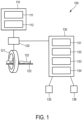
- Fig. 1 shows schematically and exemplarily a system for reconstructing a magnetic resonance image and/or parameter map based on a magnetic resonance time domain signal acquired in a time domain magnetic resonance imaging.
- the system comprises a magnetic resonance imaging system with a magnetic resonance imaging controller 120, and an apparatus 130 for reconstructing the magnetic resonance image and/or parameter map based on the magnetic resonance time domain signal acquired by the magnetic resonance imaging system.
- the system 100 can comprise a sequence determination apparatus 110 for determining an acquisition sequence for acquiring the magnetic resonance time domain signal in the time domain magnetic resonance imaging performed by the magnetic resonance imaging system.
- the sequence determination apparatus 110 comprises an operator providing unit 111 and an acquisition parameter determination unit 112.
- the operator providing unit 110 is configured for providing a subspace-sampling operator.
- the operator providing unit 111 can provide the subspace-sampling operator by accessing a storage unit on which a subspace-sampling operator is already stored or by receiving the subspace-sampling operator, for instance, via an input unit.
- the operator providing unit 111 can also be configured for generating the subspace-sampling operator and for providing the generated subspace-sampling operator.
- the operation providing unit 111 can be configured for calculating the subspace-sampling operator based on a user input indicating a respective sampling pattern of the magnetic resonance acquisition and based on information on the utilized compression, for instance, information indicative of the decompression operator.
- the such accessed, received or generated subspace-sampling operator can then be provided for further processing, for instance, to the acquisition parameter determination unit 112.
- the subspace-sampling operator provides for a given k-space location of a predetermined sampling pattern utilized in the acquisition of the time domain signal temporal subsamples of basis vectors of a compression subspace.
- the subsampling operator can be predetermined based on a given, i.e.
- the compression subspace is generally utilizable for compressing the time domain signal and can be determined, for instance, utilizing known compression algorithms, in particular, utilizing a single value decomposition.
- the subspace-sampling operator that is later utilized in the reconstruction of the magnetic resonance images and/or parameter maps can be predetermined and provided and can then also be utilized for optimizing the acquisition sequence for acquiring the time domain signal as performed by the acquisition parameter determination unit 112.
- utilizing the predetermined subspace-sampling operator for determining an acquisition sequence allows to adapt the acquisition sequence optimally to the later performed reconstruction and to optimize the interaction between the acquisition sequence utilized for acquiring the time domain signal and the reconstruction algorithm utilizing the subspace-sampling operator. Further details and examples on how the acquisition parameter determination unit 112 can determine the acquisition parameters based on the subspace-sampling operator will be provided further below.
- the sequence determination apparatus 110 is part of the system 100, the such determined acquisition sequence for acquiring the time domain signal can then be provided to the magnetic resonance imaging controlling unit 120. However, if the sequence determination apparatus 110 is omitted in the system 100, any other known suitable acquisition sequence can be utilized by the magnetic resonance imaging controlling unit 120.
- the magnetic resonance imaging controlling unit 120 controls the magnetic resonance unit 121 to acquire time domain signals from patient 122 lying on patient table 123. The such acquired time domain signals can then be provided to apparatus 130 for reconstructing a magnetic resonance image and/or a parameter map from the time domain signal.
- the apparatus 130 comprises a time domain signal providing unit 131, an operator providing unit 132, a signal processing unit 133 and a reconstruction unit 134.
- the apparatus 130 can also comprise a display unit 135, for instance, for displaying reconstructed magnetic resonance images and/or parameter maps and/or an input unit 136 that allows a user to interact with the apparatus 130, for example, by providing a mouse, a keyboard, etc.
- the time domain signal providing unit 131 can in this example be realized, for example, as an interface unit for interfacing with the magnetic resonance imaging controlling unit 120 for receiving the time domain signal from the magnetic resonance imaging controlling unit 120 and providing the same for further processing, for instance, to the signal processing unit 133.
- the time domain signal providing unit 131 can also be configured to access, for example, a storage unit or a network for receiving the time domain signal that is already stored on the storage unit or the network and for providing the respectively accessed time domain signal.
- the time domain signal providing unit can be regarded as comprising the magnetic resonance imaging controlling unit 120 and optionally also the magnetic resonance imaging unit 121 such that the time domain signal providing unit in such an embodiment is configured for directly acquiring the time domain signal and providing the acquired time domain signal.
- a time domain signal is acquired utilizing a predetermined sampling pattern in k-space and predetermined magnetic resonance acquisition sequence, in particular, a magnetic resonance acquisition sequence determined by the magnetic resonance acquisition sequence determination unit 110.
- the operator providing unit 132 can be similar to the operator providing unit 110 of the magnetic resonance acquisition sequence determination apparatus 110.
- the operator providing unit provides a subspace-sampling operator as already described above. If a magnetic resonance acquisition sequence determination apparatus 110 is present in the system 100, the operator providing unit 132 is in particular configured for providing the same subspace-sampling operator that is utilized for determining the acquisition sequence of the time domain signal. Otherwise, a respective subspace-sampling operator can be provided that is based on the respective utilized sampling pattern and the respective to be utilized compression algorithm.
- the signal processing unit 133 is then configured for processing the time domain signal utilizing the subspace-sampling operator and the reconstruction unit 134 is configured for reconstructing the magnetic resonance image and/or parameter map based on the processed time domain signal. Further details and preferred examples of the processing of the time domain signal and the reconstruction of the magnetic resonance image and/or parameter map are described below.
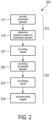
- Fig. 2 shows schematically and exemplarily a flow chart of method 200 for reconstructing a magnetic resonance image and/or a parameter map.
- the method 200 comprises steps 220 for reconstructing a magnetic resonance image and/or parameter map and optionally comprises steps 210 for firstly determining an acquisition sequence for acquiring a magnetic resonance time domain signal in a time domain magnetic resonance imaging based on which the magnetic resonance images and/or parameter maps can then be constructed. If the steps 210 are present in method 200, then in a first step 211 a subspace-sampling operator is provided in accordance with the principles described above, for instance, with respect to Fig. 1 . In a step 212, acquisition parameters for the acquisition sequence for acquiring the time domain signal can then be determined based on the subspace-sampling operator.
- the respectively determined acquisition parameters can then be provided to a magnetic resonance imaging system for acquiring the respective time domain signal, wherein these steps are not shown in Fig. 2 .
- the steps 220 then comprise in a first step 221 providing a time domain signal acquired in time domain magnetic resonance imaging utilizing a predetermined sampling pattern in k-space and, for instance, the above determined magnetic resonance acquisition sequence.
- a subspace-sampling operator is provided, wherein, if the steps 210 are present, the same subspace-sampling operator as utilized for determining the magnetic resonance acquisition sequence is provided.
- step 223 the time domain signal is processed utilizing the subspace-sampling operator and in step 224, the magnetic resonance image and/or parameter map is reconstructed based on the processed time domain signal.
- the steps 220 can be performed, for instance, by the apparatus 130 as described with respect to Fig. 1 .
- the magnetic resonance image and/or parameter map is reconstructed utilizing magnetic resonance fingerprinting.
- a performance of a dictionary matching in magnetic resonance fingerprinting is difficult to analyze comprehensively due to the complex interplay of, object-dependent, spatial subsampling artifacts with the encoding power of the sequence.
- computational runtime can be significantly reduced when using compressed matching, the choice of the dimensionality of the compression subspace remains in most cases ad-hoc. Going towards shorter acquisition sequences in order to decrease the acquisition time, degraded performance is observed. This degraded performance can often only be compensated by sophisticated reconstruction methods, which lead to a significant computational overhead and unclear convergence properties.
- Utilizing a subspace-sampling operator as described above allows to clarify the interplay of magnetic resonance acquisition sequence, acquisition schedule, e.g. number of interleaves, acquisition order, etc., optimal dimension of subspace and noise amplification for, in particular, compressed, dictionary matching.
- the utilizing of the subspace-sampling operator allows to achieve the optimal possible estimation of coefficients with respect to the chosen compression basis in closed-form.
- the noise-performance depends on the condition number of the subspace-sampling operator.
- the compression subspace and thus also its dimensionality can be optimized with respect to leading to a low compression number of the subspace-sampling operator.
- any known direct or indirect optimization algorithm can be utilized.
- the invention is based on the insight that the decompression operator in form of the subspace-sampling operator can, under reasonable assumptions, be explicitly inverted. This avoids the need for iterative methods during magnetic resonance fingerprinting reconstructions for more challenging sequences, e.g. shorter sequences.
- x ⁇ is the processed time domain signal, i.e. in this embodiment the compressed fingerprinting signal, y the time domain signal, SV the subspace-sampling operator generated by the selection operator S and the decompression operator V for each location in k-space, and E the encoding operator comprising a fast Fourier transform (FFT) operator for transforming a signal in k-space into a signal in image space and optionally a gridding operation for gridding the sampling pattern and a coil-combination operator indicative of coil characteristics of an acquisition magnetic resonance system.
- FFT fast Fourier transform
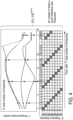
- An example of the effect of the selection operator S on the decompression operator V to form the subspace-sampling operator if shown schematically and exemplarily in Fig. 4 .
- the upper part of the schema shows a representation of an example of temporal basis vectors for the compression subspace as are represented by the decompression operator V .
- the lower part of the schema shows a representation of the selection operator for different measurements of an interleaf, i.e. for different sampling patterns.
- the arrows indicate the selection, i.e. subsampling, of the temporal basis vectors as an effect of the selection operator working on the decompression operator.
- the subspace-sampling operator provides for a given k-space location of the sampling pattern temporal subsamples of temporal basis vectors of the compression subspace.
- Fig. 4 only provides an exemplary and graphic visualization of the mathematical effects of the two operators and does not exactly represent the mathematical results, i.e. the subspace-sampling operator.
- a widely used method to accelerated convergence in iterative methods is to employ a preconditioner which approximately inverts the system matrix, SVE in this case, so that the eigenvalues are clustered around 1 as much as possible.
- a matrix M is introduced with the property MSV ⁇ Id, which leads to ⁇ M ⁇ 1 MSVE x ⁇ ⁇ y ⁇ 2 2 ⁇ ⁇ MSVE x ⁇ ⁇ My ⁇ 2 2 2
- sampling density compensation w can be omitted, if an iterative approach for solving the above problem is utilized.
- the formulation is similar to utilizing a conjugate gradient scheme for solving a SENSE problem, when the encoding operator includes a, optionally non-uniform, FFT and coil-sensitivities.
- the above formulation can also be applied with additional spatial undersampling. For example, encoding a smaller field of view in a spiral acquisition leads to fewer measured interleaves, and therefore a higher sampling rate on the time-evolution. This in turn leads to better conditioning of SV and thus also of M.
- the singular values of ( SV ) + determine the condition number of the problem, and therefore directly the noise-propagation properties. If a singular value approaches zero, this means the problem becomes ill-posed, necessitating a change in magnetic resonance acquisition sequence, acquisition scheme, e.g. use fewer interleaves, or reducing the subspace dimension at the possible cost of information loss.
- an optimization algorithm can be utilized for optimizing acquisition parameters with respect to leading to a low condition number, i.e. a minimization of the condition number can be utilized for determining an optimal acquisition sequence.
- magnetic resonance fingerprinting dictionary matching is performed. This dictionary matching is usually achieved by maximizing the inner product in coefficient space between dictionary entries ⁇ and, in particular, normalized, processed time domain signals x ⁇ .
- x ⁇ r ⁇ ⁇ argmax s ⁇ ⁇ V H s r
- the 'hat' signifies that the signals have been compressed into a low-dimensional compression subspace spanned by the basis vectors provided by the decompression operator V, wherein the decompression operator can be obtained as already described above by a single value decomposition of the complete dictionary D.
- an uncompressed fingerprinting signal x is reconstructed from the undersampled time domain signal y, using the encoding operator E H , which for spiral acquisitions consists of the gridding, FFT and coil-combination.
- the selection operator S H couples the timepoint on a magnetic resonance time domain signal with the acquired k-space position, essentially embedding the undersampled k-space by zero-filling, w performs density-compensation for non-cartesian trajectory.
- x E H S H wy
- V H operates in the time-domain whereas E H in the spatial domain, and thus the subspace-sampling operator V H S H , or equivalently SV can be introduced.
- this operator is defined per k-space location, in the case of spiral acquisitions, per interleave.
- the fingerprinting signal can be easily calculated utilizing the subspace-sampling operator without iteration and then utilized in dictionary matching.
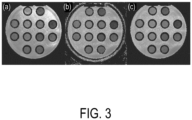
- Fig. 3 shows T2 matching results illustrating the effect of the proposed method.
- the T2 map (a) on the left is obtained using standard dictionary matching without utilizing the subspace-sampling operator.
- the T2 map (b) in the middle is reconstructed utilizing dictionary matching after a reconstruction of the fingerprinting signal utilizing the time domain signal processed with the subspace-sampling operator according to the above equation.
- T2 map (c) on the right is reconstructed utilizing an iterative approach without the subspace-sampling operator, in particular, utilizing five Conjugate-Gradient iterations for determining the fingerprinting signal.
- the noise in the background of panel (b) is due to different thresholding. Images (b) and (c) are almost identical and show a high quality and low noise.
- the subspace-sampling operator is further used for validation and optionally also determining an acquisition sequence as is described in the following.
- the acquisition sequence is validated and determined with respect to an expected matching performance, for instance, with respect to an expected matching error.
- the matching performance in particular, the matching error, is given by the accuracy and precision with which the matching can be performed and thus the parameters, like T1, T2, etc. can be determined.
- the matching error for magnetic resonance fingerprinting can depend on an encoding power of an acquisition sequence, i.e. the possibility of the sequence to measure the respective parameters, the sampling pattern, in particular, the spatial undersampling of the sampling pattern, and an intrinsic signal-to-noise ratio of the measurement and the reconstruction algorithm utilized.
- a respective potential acquisition sequence is provided.
- a dictionary D, and compressed temporal subspace V can then be computed.
- a sampling pattern in particular, a subsampling pattern, e.g. a spiral acquisition with 10 interleaves, can be chosen, for instance, via an input from a user or can also be predetermined.
- an artificial time domain signal is determined for which the matching parameters, like, T1, T2, etc. are already known as ground truth parameters.
- a random selection of fingerprinting signals s can be generated from the already generated dictionary with predetermined matching parameters.
- the fingerprint signals are non-normalized signals and provided thus correct relative amplitudes.
- a random unitary matrix M can be utilized for mixing the fingerprinting signals such that aspects of the fingerprinting signals are spatially distributed in order to simulate the mixing of the signals normally found in k-space.
- the random unitary matrix can be completely different from the encoding found in k-space. This has the advantage that a matrix can be chosen that is easy to handle computationally.
- a respective encoding matrix that represents the encoding in k-space can be utilized.
- the matrix can refer to a fast Fourier transformation, which would lead to a simulated k-space, but this would impose a certain structural interpretation, which is unnecessary for the working of the algorithm.
- a complex iid Gaussian noise can then be added to the mixed signal to simulate the noise expected in a measured time domain signal.
- the sampling pattern in particular the subsampling is added, e.g. be selecting for each interleaf / the respective measured time points.
- the noise can also be added after the application of the subsampling.
- the subspace-sampling operator can also be determined based on the decompression operator and the respective sample pattern. Then based on the determined artificial time domain signal and the subspace-sampling operator the artificial fingerprinting signal can be determined. For example, first coefficients c can be computed by applying a pseudo-inverted subsampling operator to the artificial time domain signal and then further applying the hermitian of the mixing operator M. Based on the artificial fingerprinting signal a compressed matching for the matching parameters can then be performed to get, for instance, T1, T2, etc. estimates. Based on a comparison between the known matching parameters and the estimated matching parameters evaluate errors, i.e. a matching error, can be determined. Based on this matching error an optimization can be performed.
- a minimization of the error based on acquisition sequence can be performed.
- a target matching error can be provided and the matching error can be compared with this target for finding a sequence that fulfills this target.
- the optimization landscape is very complex with many local minima.
- genetic algorithms, or gradient-descent algorithms can be utilized.
- multiple types of optimization algorithms with variable starting points are applied if an absolute minimum is to be found. However, it is expected that in most cases many minima are similar in performance, and that is does not matter to find the global minimum.
- hyperparameters for optimization that can be utilized to prime the optimization can include the number of example tissue parameter combinations to evaluate on, the size of subspace, i.e. the number of coefficients, the range of T1/T2 to optimize for relative weighting of T1/T2 errors.
- the subspace-sampling operator can also be utilized in any other reconstruction method utilizing subspaces, i.e. compression, and are influences by the specific sampling pattern, for example, T2-shuffling.
- a single unit or device may fulfill the functions of several items recited in the claims.
- the mere fact that certain measures are recited in mutually different dependent claims does not indicate that a combination of these measures cannot be used to advantage.
- Procedures like the processing of the detection signals for measuring the medical parameter, the authentication, the control of the medical monitoring system, et cetera, performed by one or several units or devices can be performed by any other number of units or devices.
- These procedures, particularly the control of the medical monitoring system in accordance with the control method carried out by the medical monitoring system controller, can be implemented as program code means of a computer program and/or as dedicated hardware.
- a computer program may be stored/distributed on a suitable medium, such as an optical storage medium or a solid-state medium, supplied together with or as part of other hardware, but may also be distributed in other forms, such as via the Internet or other wired or wireless telecommunication systems.
- a suitable medium such as an optical storage medium or a solid-state medium, supplied together with or as part of other hardware, but may also be distributed in other forms, such as via the Internet or other wired or wireless telecommunication systems.
- the invention refer to an apparatus for reconstructing a MR image and/or parameter map based on a MR time domain signal.
- a providing unit provides a time domain signal acquired in time domain MRI utilizing a sampling pattern in k-space and a magnetic resonance acquisition sequence.
- a providing unit provides a subspace-sampling operator that provides for a given k-space location of the sampling pattern temporal subsamples of basis vectors of a compression subspace. The compression subspace is utilizable for compressing the time domain signal.
- a processing unit processes the time domain signal utilizing the subspace-sampling operator.
- a reconstruction unit reconstructs the MR image and/or parameter map based on the processed time domain signal. This allows for a more accurate and less computationally resource intensive reconstruction of MR images and/or parameter maps in the context of time domain magnetic resonance imaging.
Landscapes
- Physics & Mathematics (AREA)
- Engineering & Computer Science (AREA)
- Radiology & Medical Imaging (AREA)
- Health & Medical Sciences (AREA)
- Nuclear Medicine, Radiotherapy & Molecular Imaging (AREA)
- Signal Processing (AREA)
- General Health & Medical Sciences (AREA)
- High Energy & Nuclear Physics (AREA)
- Condensed Matter Physics & Semiconductors (AREA)
- General Physics & Mathematics (AREA)
- Artificial Intelligence (AREA)
- Computer Vision & Pattern Recognition (AREA)
- Magnetic Resonance Imaging Apparatus (AREA)
Priority Applications (5)
| Application Number | Priority Date | Filing Date | Title |
|---|---|---|---|
| EP22208712.4A EP4375691A1 (fr) | 2022-11-22 | 2022-11-22 | Appareil pour reconstruire une image par résonance magnétique sur la base d'un opérateur d'échantillonnage d'un sous-espace |
| EP23801476.5A EP4623318A1 (fr) | 2022-11-22 | 2023-11-10 | Appareil de reconstruction d'une image par résonance magnétique sur la base d'un opérateur d'échantillonnage de sous-espace |
| JP2025522092A JP2025537666A (ja) | 2022-11-22 | 2023-11-10 | 磁気共鳴画像を再構成するための装置 |
| CN202380080812.9A CN120266005A (zh) | 2022-11-22 | 2023-11-10 | 用于基于子空间采集运算符来重建磁共振图像的装置 |
| PCT/EP2023/081456 WO2024110220A1 (fr) | 2022-11-22 | 2023-11-10 | Appareil de reconstruction d'une image par résonance magnétique sur la base d'un opérateur d'échantillonnage de sous-espace |
Applications Claiming Priority (1)
| Application Number | Priority Date | Filing Date | Title |
|---|---|---|---|
| EP22208712.4A EP4375691A1 (fr) | 2022-11-22 | 2022-11-22 | Appareil pour reconstruire une image par résonance magnétique sur la base d'un opérateur d'échantillonnage d'un sous-espace |
Publications (1)
| Publication Number | Publication Date |
|---|---|
| EP4375691A1 true EP4375691A1 (fr) | 2024-05-29 |
Family
ID=84360992
Family Applications (2)
| Application Number | Title | Priority Date | Filing Date |
|---|---|---|---|
| EP22208712.4A Withdrawn EP4375691A1 (fr) | 2022-11-22 | 2022-11-22 | Appareil pour reconstruire une image par résonance magnétique sur la base d'un opérateur d'échantillonnage d'un sous-espace |
| EP23801476.5A Pending EP4623318A1 (fr) | 2022-11-22 | 2023-11-10 | Appareil de reconstruction d'une image par résonance magnétique sur la base d'un opérateur d'échantillonnage de sous-espace |
Family Applications After (1)
| Application Number | Title | Priority Date | Filing Date |
|---|---|---|---|
| EP23801476.5A Pending EP4623318A1 (fr) | 2022-11-22 | 2023-11-10 | Appareil de reconstruction d'une image par résonance magnétique sur la base d'un opérateur d'échantillonnage de sous-espace |
Country Status (4)
| Country | Link |
|---|---|
| EP (2) | EP4375691A1 (fr) |
| JP (1) | JP2025537666A (fr) |
| CN (1) | CN120266005A (fr) |
| WO (1) | WO2024110220A1 (fr) |
Citations (1)
| Publication number | Priority date | Publication date | Assignee | Title |
|---|---|---|---|---|
| US20190094322A1 (en) * | 2017-09-28 | 2019-03-28 | Siemens Healthcare Gmbh | Magnetic Resonance Fingerprinting Optimization in Magnetic Resonance Imaging |
-
2022
- 2022-11-22 EP EP22208712.4A patent/EP4375691A1/fr not_active Withdrawn
-
2023
- 2023-11-10 JP JP2025522092A patent/JP2025537666A/ja active Pending
- 2023-11-10 CN CN202380080812.9A patent/CN120266005A/zh active Pending
- 2023-11-10 EP EP23801476.5A patent/EP4623318A1/fr active Pending
- 2023-11-10 WO PCT/EP2023/081456 patent/WO2024110220A1/fr not_active Ceased
Patent Citations (1)
| Publication number | Priority date | Publication date | Assignee | Title |
|---|---|---|---|---|
| US20190094322A1 (en) * | 2017-09-28 | 2019-03-28 | Siemens Healthcare Gmbh | Magnetic Resonance Fingerprinting Optimization in Magnetic Resonance Imaging |
Non-Patent Citations (5)
| Title |
|---|
| D. MA ET AL.: "Magnetic resonance fingerprinting", NATURE, vol. 495, 2013, pages 187 - 192 |
| DEBRA F. MCGIVNEY ET AL: "Magnetic resonance fingerprinting review part 2: Technique and directions", JOURNAL OF MAGNETIC RESONANCE IMAGING, 25 July 2019 (2019-07-25), US, XP055663708, ISSN: 1053-1807, DOI: 10.1002/jmri.26877 * |
| DI CUI ET AL: "Iterative MR Fingerprinting Reconstruction in a Compressed k-space", PROCEEDINGS OF THE 2021 ISMRM & SMRT ANNUAL MEETING & EXHIBITION, 15-20 MAY 2021, ISMRM, 2030 ADDISON STREET, 7TH FLOOR, BERKELEY, CA 94704 USA, no. 1549, 30 April 2021 (2021-04-30), XP040723568 * |
| JAKOB ASSLÄNDER ET AL: "Low rank alternating direction method of multipliers reconstruction for MR fingerprinting : Low Rank ADMM Reconstruction", MAGNETIC RESONANCE IN MEDICINE, vol. 79, no. 1, 5 March 2017 (2017-03-05), US, pages 83 - 96, XP055736965, ISSN: 0740-3194, DOI: 10.1002/mrm.26639 * |
| SIMON ARBERET ET AL: "GFB-MRF: A parallel spatial and Bloch manifold regularized iterative reconstruction method for MR Fingerprinting", ARXIV.ORG, CORNELL UNIVERSITY LIBRARY, 201 OLIN LIBRARY CORNELL UNIVERSITY ITHACA, NY 14853, 16 October 2020 (2020-10-16), XP081789682 * |
Also Published As
| Publication number | Publication date |
|---|---|
| WO2024110220A1 (fr) | 2024-05-30 |
| EP4623318A1 (fr) | 2025-10-01 |
| JP2025537666A (ja) | 2025-11-20 |
| CN120266005A (zh) | 2025-07-04 |
Similar Documents
| Publication | Publication Date | Title |
|---|---|---|
| Zhao et al. | Maximum likelihood reconstruction for magnetic resonance fingerprinting | |
| US10422845B2 (en) | Systems and methods for steady-state magnetic resonance fingerprinting | |
| US10261155B2 (en) | Systems and methods for acceleration magnetic resonance fingerprinting | |
| US11867786B2 (en) | Parameter map determination for time domain magnetic resonance | |
| US20140286560A1 (en) | Method for calibration-free locally low-rank encouraging reconstruction of magnetic resonance images | |
| US20150187073A1 (en) | Method, reconstruction device, and magnetic resonance apparatus for reconstructing magnetic resonance raw data | |
| CN101359040A (zh) | 用于优化成像参数的方法 | |
| US11061097B2 (en) | Data driven correction of phase depending artefacts in a magnetic resonance imaging system | |
| Lee et al. | MaxGIRF: image reconstruction incorporating concomitant field and gradient impulse response function effects | |
| US10761172B2 (en) | System and method for an eddy-current field compensation in magnetic resonance imaging | |
| EP3916417A1 (fr) | Correction d'images par résonance magnétique utilisant plusieurs configurations de système d'imagerie par résonance magnétique | |
| US20230044166A1 (en) | Accelerated time domain magnetic resonance spin tomography | |
| US11874355B2 (en) | Magnetic resonance fingerprinting method | |
| Weller et al. | Monte Carlo SURE‐based parameter selection for parallel magnetic resonance imaging reconstruction | |
| US11875509B2 (en) | System and method for determining undersampling errors for a magnetic resonance fingerprinting pulse sequence | |
| Liu et al. | Acceleration strategies for MR-STAT: achieving high-resolution reconstructions on a desktop PC within 3 minutes | |
| Liu et al. | Highly accelerated MR parametric mapping by undersampling the k-space and reducing the contrast number simultaneously with deep learning | |
| US20240164737A1 (en) | Image reconstruction incorporating maxwell fields and gradient impulse response function distortion | |
| US11231476B2 (en) | Accelerated magnetic resonance imaging acquisition using two-dimensional pulse segments as virtual receivers | |
| EP4375691A1 (fr) | Appareil pour reconstruire une image par résonance magnétique sur la base d'un opérateur d'échantillonnage d'un sous-espace | |
| Hu et al. | Efficient pulse sequence design framework for high‐dimensional MR fingerprinting scans using systematic error index | |
| US20250244430A1 (en) | Systems and methods for rf pulse design for mri pulse sequences | |
| Stanley et al. | Receiver phase alignment using fitted SVD derived sensitivities from routine prescans | |
| US12352833B2 (en) | Medical data processing apparatus, medical data processing method, and magnetic resonance imaging apparatus | |
| US20240361408A1 (en) | System and method for mr imaging using pulse sequences optimized using a systematic error index to characterize artifacts |
Legal Events
| Date | Code | Title | Description |
|---|---|---|---|
| PUAI | Public reference made under article 153(3) epc to a published international application that has entered the european phase |
Free format text: ORIGINAL CODE: 0009012 |
|
| STAA | Information on the status of an ep patent application or granted ep patent |
Free format text: STATUS: THE APPLICATION HAS BEEN PUBLISHED |
|
| AK | Designated contracting states |
Kind code of ref document: A1 Designated state(s): AL AT BE BG CH CY CZ DE DK EE ES FI FR GB GR HR HU IE IS IT LI LT LU LV MC ME MK MT NL NO PL PT RO RS SE SI SK SM TR |
|
| STAA | Information on the status of an ep patent application or granted ep patent |
Free format text: STATUS: THE APPLICATION IS DEEMED TO BE WITHDRAWN |
|
| 18D | Application deemed to be withdrawn |
Effective date: 20241130 |