EP4375709A1 - System und verfahren zur bestimmung einer route eines auf einem sportfeld bewegten objekts oder spielers - Google Patents
System und verfahren zur bestimmung einer route eines auf einem sportfeld bewegten objekts oder spielers Download PDFInfo
- Publication number
- EP4375709A1 EP4375709A1 EP23201904.2A EP23201904A EP4375709A1 EP 4375709 A1 EP4375709 A1 EP 4375709A1 EP 23201904 A EP23201904 A EP 23201904A EP 4375709 A1 EP4375709 A1 EP 4375709A1
- Authority
- EP
- European Patent Office
- Prior art keywords
- player
- ball
- electronic device
- sub
- sport field
- Prior art date
- Legal status (The legal status is an assumption and is not a legal conclusion. Google has not performed a legal analysis and makes no representation as to the accuracy of the status listed.)
- Pending
Links
- 238000000034 method Methods 0.000 title claims abstract description 34
- 230000000694 effects Effects 0.000 claims abstract description 15
- 238000005259 measurement Methods 0.000 claims description 26
- 230000033001 locomotion Effects 0.000 claims description 14
- 238000004422 calculation algorithm Methods 0.000 claims description 5
- 238000004519 manufacturing process Methods 0.000 claims description 4
- 238000012545 processing Methods 0.000 description 34
- 238000004891 communication Methods 0.000 description 6
- 230000000007 visual effect Effects 0.000 description 5
- 238000004364 calculation method Methods 0.000 description 3
- 238000012544 monitoring process Methods 0.000 description 3
- 230000004913 activation Effects 0.000 description 2
- 230000001413 cellular effect Effects 0.000 description 2
- 238000004590 computer program Methods 0.000 description 2
- 238000006073 displacement reaction Methods 0.000 description 2
- 238000011156 evaluation Methods 0.000 description 2
- 230000001133 acceleration Effects 0.000 description 1
- 230000005540 biological transmission Effects 0.000 description 1
- 238000001514 detection method Methods 0.000 description 1
- 238000010586 diagram Methods 0.000 description 1
- 230000005672 electromagnetic field Effects 0.000 description 1
- 238000005516 engineering process Methods 0.000 description 1
- 230000001681 protective effect Effects 0.000 description 1
- 238000005096 rolling process Methods 0.000 description 1
- 239000004575 stone Substances 0.000 description 1
- 238000012876 topography Methods 0.000 description 1
Images
Classifications
-
- A—HUMAN NECESSITIES
- A63—SPORTS; GAMES; AMUSEMENTS
- A63B—APPARATUS FOR PHYSICAL TRAINING, GYMNASTICS, SWIMMING, CLIMBING, OR FENCING; BALL GAMES; TRAINING EQUIPMENT
- A63B24/00—Electric or electronic controls for exercising apparatus of preceding groups; Controlling or monitoring of exercises, sportive games, training or athletic performances
- A63B24/0021—Tracking a path or terminating locations
-
- G—PHYSICS
- G01—MEASURING; TESTING
- G01S—RADIO DIRECTION-FINDING; RADIO NAVIGATION; DETERMINING DISTANCE OR VELOCITY BY USE OF RADIO WAVES; LOCATING OR PRESENCE-DETECTING BY USE OF THE REFLECTION OR RERADIATION OF RADIO WAVES; ANALOGOUS ARRANGEMENTS USING OTHER WAVES
- G01S17/00—Systems using the reflection or reradiation of electromagnetic waves other than radio waves, e.g. lidar systems
- G01S17/88—Lidar systems specially adapted for specific applications
-
- G—PHYSICS
- G01—MEASURING; TESTING
- G01S—RADIO DIRECTION-FINDING; RADIO NAVIGATION; DETERMINING DISTANCE OR VELOCITY BY USE OF RADIO WAVES; LOCATING OR PRESENCE-DETECTING BY USE OF THE REFLECTION OR RERADIATION OF RADIO WAVES; ANALOGOUS ARRANGEMENTS USING OTHER WAVES
- G01S17/00—Systems using the reflection or reradiation of electromagnetic waves other than radio waves, e.g. lidar systems
- G01S17/86—Combinations of lidar systems with systems other than lidar, radar or sonar, e.g. with direction finders
-
- A—HUMAN NECESSITIES
- A63—SPORTS; GAMES; AMUSEMENTS
- A63B—APPARATUS FOR PHYSICAL TRAINING, GYMNASTICS, SWIMMING, CLIMBING, OR FENCING; BALL GAMES; TRAINING EQUIPMENT
- A63B24/00—Electric or electronic controls for exercising apparatus of preceding groups; Controlling or monitoring of exercises, sportive games, training or athletic performances
- A63B24/0021—Tracking a path or terminating locations
- A63B2024/0025—Tracking the path or location of one or more users, e.g. players of a game
-
- A—HUMAN NECESSITIES
- A63—SPORTS; GAMES; AMUSEMENTS
- A63B—APPARATUS FOR PHYSICAL TRAINING, GYMNASTICS, SWIMMING, CLIMBING, OR FENCING; BALL GAMES; TRAINING EQUIPMENT
- A63B24/00—Electric or electronic controls for exercising apparatus of preceding groups; Controlling or monitoring of exercises, sportive games, training or athletic performances
- A63B24/0021—Tracking a path or terminating locations
- A63B2024/0028—Tracking the path of an object, e.g. a ball inside a soccer pitch
-
- A—HUMAN NECESSITIES
- A63—SPORTS; GAMES; AMUSEMENTS
- A63B—APPARATUS FOR PHYSICAL TRAINING, GYMNASTICS, SWIMMING, CLIMBING, OR FENCING; BALL GAMES; TRAINING EQUIPMENT
- A63B71/00—Games or sports accessories not covered in groups A63B1/00 - A63B69/00
- A63B71/06—Indicating or scoring devices for games or players, or for other sports activities
- A63B2071/0691—Maps, e.g. yardage maps or electronic maps
Definitions
- the present invention relates to a system and method for determining a route of an object or a player moving on a sport field.
- Embodiments of the present disclosure provide an alternative to the existing methods.
- embodiments of the present disclosure include a method for determining a route of an object or of a player moving on a sport field, this route being constituted solely of stationary positions of this object or of this player on this sport field, the method comprising:
- Embodiments of the present disclosure also include a system for determining a route of an object or of a player moving on a sport field, this route being constituted of stationary positions of this object or of this player on this sport field, the system comprising an electronic device configured for:
- Embodiments of the present disclosure also include a computer program, optionally stored on a medium, comprising instructions for causing an electronic device and/or a server to perform this method.
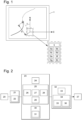
- a system 1 and a method for determining a route 6 of an object 3a or a player 3b moving on a sport field 4 is illustrated.
- a system 1 and such a method can also permit to monitor the progress of the object 3a or the player 3b, on the sport field 4.
- these system 1 and method contribute to inform visually the audience of a sport game about of the route 6 and more particularly about the last position of the object 3a or the player 3b on the sport field 4.
- Such a system 1 and method can be implemented in every sports in which the object 3a or the player 3b is brought to move on a sport field 4 by marking frequent stops.
- These sport can be in a non-limiting and/or nonexhaustive manner: the golf, the petanque or the curling, etc...
- the object 3a is a mobile object like for example a ball, a slide stone etc ...
- the frequent stops correspond in this invention to stationary positions 7 of the object 3a or of the player 3b on the sport field 4. It must be understood that the stationary position 7 means that the object 3a or the player 3b stays without moving/displacing for a period of time during the sporting activity on this sport field 4.
- the object is a moving object more specifically a mobile sports object which is obviously used in the field of sport. More precisely, this object is an ordinary object, i.e. an object that has not been modified with respect to the original object known to be used in the sport concerned. In other words, if this object is a golf ball, then it is the ball classically used in this sport and not a ball that has been modified to include, for example, an electronic device such as a tag RFID.
- This object can also be an inert object, i.e. one that has no activity (e.g. does not generate an electromagnetic field) or movement of its own (as it requires to be set in motion by the application of a force to it).
- this system 1 includes an electronic device 2 which is preferably a portable electronic device or a mobile electronic device that is to say a battery operated device designed to be carried including but not limited to equipment such as laptops, tablets computers, smart phones, smart watches and the like.
- an electronic device 2 which is preferably a portable electronic device or a mobile electronic device that is to say a battery operated device designed to be carried including but not limited to equipment such as laptops, tablets computers, smart phones, smart watches and the like.
- This electronic device 2 can be also called “movable electronic device” as it is configured to follow the object 3a or the player 3b. Indeed, this electronic device 2 can move autonomously by including a transport module which can be removable transport module. In this configuration, this device 2 can be a rolling movable electronic device like a radio-controlled car for example a miniature model car, van or buggies that can be controlled from a distance using a specialized transmitter or remote. As a variant, this device 2 can be a flying movable electronic device like a drone.
- this device 2 when this device 2 is a movable electronic device, it can also be moved by being remotely controlled by a remote control device of this system 1.
- this remote control device is connected to the device 2 and can thus control the movement of the device 2 in order to follow the displacement of the object 3a or the player 3b on the sport field 4.
- the remote control device comprised a control unit which is able to execute a specific algorithm to control the autonomous displacement of the electronic device 2.
- this remote control device comprises for controlling the movement of the electronic device 2 which can be used/manipulated by an operator. It can be noted that this operator can be located in a different place of the object 3a or the player 3b.
- Such an electronic device 2 comprises in a non-limiting and/or nonexhaustive manner:
- the processing unit 5 is connected, inter alia, to the distance measurement module 6c and the geolocation receiver 6d, the interfaces for broadcasting 6e, 6f, the communication interface 6g and the input interface 6h.
- this electronic device 2 is preferably not equipped with an image capture module, as such a module is not part of the embodiment of the invention described here especially for the implementation of a phase of measurement 26 of the distance d between the object 3a or the player 3b, and the electronic device 2 discussed in this description.
- the distance measurement module 6c comprises:
- the distance measurement module 6c is dedicated for measuring the distance between the electronic device and the object or the player. In other words, this module 6c measures this distance and transmits it to the processing unit 5 of this electronic device 2 for example to store it in an element memory of this unit 5 in order to generate a route at a later date. It is to be understood here that the electronic device 2 and more particularly the processing unit 5 is not configured to obtain this measurement in any other way. That is to say, the electronic device 2 and more particularly the processing unit 5 is not configured to obtain this distance by implementing, for example, calculations to determine (and not measure) such a distance. In this context, these calculations can be implemented, for example, when digitally processing an image including the object or player with the electronic device to determine this distance.
- the communication interface 6g of this device 2 includes communication elements for receiving and transmitting data remotely via a communication network such as the cellular telephone network, a data network of the IP type via the telephone network, or a data network of the IP type via a medium-range network, for example WI-FI or a short-range network implementing Bluetooth technology.
- a communication network such as the cellular telephone network, a data network of the IP type via the telephone network, or a data network of the IP type via a medium-range network, for example WI-FI or a short-range network implementing Bluetooth technology.
- the processing unit 5 of this electronic device 2 is able to execute a computer program also called an application or "apps". More precisely in this context, the application is an "application for positioning the ball”. This application is able to participate in the implementation of a part of the steps 20 to 37 of the method described below, when the processing unit 5 of the device 2 executes it.
- the system 1 is capable of implementing the method for determining a route 6 of the object 3a or of the player 3b moving on a sport field 4, this route 6 being constituted of stationary positions 7 of this object 3a or of this player 3b on this sport field 4.
- Such a method starts with a step of executing 20 by the processing unit 5 of the device 2, the application for positioning the object 3a or the player 3b.
- this processing unit 5 is able to implement the followings steps of the method in order to participate to the determination of this route 6 of the object 3a or the player 3b moving on the sport field 4.
- the method includes a step of arranging/positioning 21 of the electronic device 2 at a distance d of the object 3a or of the player 3b.
- the device 2 is arranged in the vicinity of this object 3a or of this player 3b, that is to say not being in contact with this object 3a or with this player 3b.
- the distance d established between the device 2 and, this object 3a or this player 3b is not null. More specifically, this distance is comprised between 1 and 10 meters. This distance d is preferably in the order of 4 meters.
- this step 21 comprises a sub-step of following 22 the object 3a or the player 3b.
- the device 2 can be carried and manipulated/controlled by an accompanying person of the player 3b or of the object 3a.
- this sub-step 22 can comprise a phase of guiding visually and/or audibly this person via the interface for broadcasting 6e a visual guidance information/message and/or the interface for broadcasting 6f an audio guidance information/message of the device 2.
- Such a phase of guiding is implemented by the processing unit 5 connected to these two interfaces 6e, 6f.
- this device 2 can follow the player 3b or the object 3a autonomously or by being controlled remotely by the operator mentioned previously.
- the method includes a step of determining 23 by the electronic device 2, geographical position X Ball , Y Ball data of the object 3a or of the player 3b during the sporting activity.
- a step 23 is implemented by the processing unit 5 of the device 2 executing the application for positioning the object 3a or the player 3b.
- This step 23 includes a sub-step of detecting 24 that the object 3a or the player 3b is in a stationary position 7. Indeed, the determination of geographical position X Ball , Y Ball data requires that the object 3a or the player 3b be in a stationary/immobile position on the sport field 4. Such a sub-step 24 is suitable to detect that this object 3a or player 3b is in a stationary position 7 after the processing unit 5 of the device 2 has determined that this object 3a or player 3b has remained immobile for a time t greater than a configurable reference time.
- this step 24 comprises a sub-step of estimating 25 characteristics of determination of the geographical position data X Ball , Y Ball of the object 3a or of the player 3b during the sporting activity.
- the device 2 more specifically its processing unit 5, is able to implement various measurement operations in order to determine the positions of the object 3a or of the player 3b. To achieve this, the device 2 performs the following phases simultaneously, or successively in any order:
- the processing unit 5 by executing this application is configured to participate in the implementation of the phase of measurement 26 of the distance d. More specifically, this phase 26 comprises:
- this processing unit 5 receives measurement data from the distance measurement module 6c. This measurement data relating to the distance d between the device 2 and, the object 3a or the player 3b, is then stored in the memory elements of the processing unit 5. It may be noted that this phase 26 is a measurement phase and not a determination or evaluation phase of the distance between the object 3a or player 3b and the electronic device 2. This is because evaluation or determination, unlike simple measurement, involves energy-intensive calculation and processing processes.
- the distance d can be a predetermined distance, or a distance already known because this distance d is for instance always the same. In this context, this distance d is already stored in the form of measurement data in the memory elements of the processing unit 5.
- this distance d can be entered from the input interface by a user of this device 2 or an operator of this device 2.
- the processing unit 5 receives a measurement data relating to this distance from the input interface.
- the processing unit 5 by executing this application is also configured to participate to implement the phase of determining 27 geographical position X Ped , Y Ped , of the device 2. More specifically, the processing unit 5 receives measurement data from the geolocation receiver of this device 2. This measurement data includes preferably information relating to geographical position of the device 2 also known as geopositioning, geotracking, geolocalization, geolocating, geolocation, or geoposition fixing. This geographical position X Ped , Y Ped yields a set of geographic coordinates such as latitude and longitude in a given map datum.
- the processing unit 5 executing this application is also configured to participate to the phase of evaluating 28 of the angle ⁇ of deviation from main direction of movement.
- This angle ⁇ is defined between a stationary position direction and the main direction of movement.
- This stationary position direction is a direction oriented towards the object 3a or the player 3b when it is in a stationary position.
- this direction is defined between the electronic device 2 and the object 3a or the player 3b.
- the main direction it relates to the dominant or general direction of the object 3a or the player 3b 3b when it is in a stationary position, this direction is defined here by the cardinal points more specifically by the four cardinal points: north, south, east, west.
- This phase 28 is implemented by the processing unit 5 receiving measurement data from one or several of the following sensors of the device 2, such as the acceleration sensor and/or the magnetic sensor and/or the G-sensor and/or the gyroscope sensor and/or the motion sensor. This measurement data relating to the angle ⁇ , is then stored in the memory elements of the processing unit 5.
- this a sub-step of estimating 25 comprises a phase of following 29 the object 3a or the player 3b.
- Such a phase 29 can be executed simultaneously to the other phases 26 to 28 of this sub-step 25.
- This phase 29 participates to the realisation of the different measuring operations in order to determine the geographical position data X Ball , Y Ball of the object 3a or of the player 3b.
- this phase 29 can comprise a sub-phase of guiding visually and/or audibly this person via the interface for broadcasting 6e a visual guidance information/message and/or the interface for broadcasting 6f an audio guidance information/message of the device 2.
- a sub-phase of guiding is implemented by the processing unit 5 connected to these two interfaces 6e, 6f.
- this device 2 can follow the player 3b or the object 3a autonomously or by being controlled remotely by the operator mentioned previously.
- the step of determining 23 includes a sub-step of calculating 30 the position data X Ball , Y Ball of the object 3a or the player 3b by the electronic device 2, more specifically by its processing unit 5.
- This sub-step 30 comprises a phase of executing 31 an algorithm of production of the position data X Ball , Y Ball based on the following data measurements stored in the memory elements of the processing unit 5, namely:
- the position data X Ball , Y Ball of the object 3a or of the player 3b here generated is stored in the memory elements of the processing unit 5.
- the method comprises then a step of generating 32 the route 6 of the object 3a or of the player 3b on/in a graphical representation of the sport field 4 based on the geographical position data X Ball , Y Ball calculated by the electronic device 2.
- this graphical representation can be a two-dimensional graphical representation or a three-dimensional graphical representation.
- This step of generating 32 comprises a sub-step of selecting 33 a geographical map data relating to the sport field 4.
- This geographical cartographic data includes all the information concerning the geographical particularities of the sport field 4, respecting the topography, the distances and the reliefs of this ground.
- the memory element of the processing unit 5 comprises a plurality of geographical map data relating to different sports fields 4. These geographical map data relating to different sports fields 4 can also be stored in a remote server to which the device 2 is able to connect in the context of this sub-step of selecting 33.
- this step 32 comprises a sub-step of creating 34 the route 6 on/in the graphical representation of the sport field 4 based on the geographical position data X Ped , Y Ped determined and these geographical map data.
- This sub-step 34 includes a phase of generating 35 by the processing unit 5 of the device 2 this graphical representation based on the geographical map data previously selected.
- the sub-step of creating 34 includes a phase of positioning 36 the stationary positions 7 on this graphical representation based on the geographical map data and the geographical position data X Ped , Y Ped previously determined.
- the processing unit 5 is able to implement these two phases 35, 36 by executing instructions for implementing a graphical program for generating the graphical representation comprising the route 6 realised by the object 3a or the player 3b based on the geographical map data and the geographical position data X Ped , Y Ped .
- the method can comprise a step of broadcasting 37 the graphical representation of the sport field 4 including this route 6 to:
- the step of generating 32 the route 6 is executed once all the geographical position data have been determined. That is to say when the sporting activity or the game is finished. As a variant, this step 32 can be executed for each determined geographic position datum. That is to say each time this geographical position data is obtained.
- the present disclosure also include a non-transitory computer-readable medium storing computer instructions configured to cause at least one processor of an electronic device to:
Landscapes
- Engineering & Computer Science (AREA)
- Physics & Mathematics (AREA)
- Radar, Positioning & Navigation (AREA)
- Remote Sensing (AREA)
- Computer Networks & Wireless Communication (AREA)
- Electromagnetism (AREA)
- General Physics & Mathematics (AREA)
- Health & Medical Sciences (AREA)
- General Health & Medical Sciences (AREA)
- Physical Education & Sports Medicine (AREA)
- Navigation (AREA)
Applications Claiming Priority (1)
| Application Number | Priority Date | Filing Date | Title |
|---|---|---|---|
| EP22209030 | 2022-11-23 |
Publications (1)
| Publication Number | Publication Date |
|---|---|
| EP4375709A1 true EP4375709A1 (de) | 2024-05-29 |
Family
ID=84361826
Family Applications (1)
| Application Number | Title | Priority Date | Filing Date |
|---|---|---|---|
| EP23201904.2A Pending EP4375709A1 (de) | 2022-11-23 | 2023-10-05 | System und verfahren zur bestimmung einer route eines auf einem sportfeld bewegten objekts oder spielers |
Country Status (2)
| Country | Link |
|---|---|
| US (1) | US20240165463A1 (de) |
| EP (1) | EP4375709A1 (de) |
Citations (5)
| Publication number | Priority date | Publication date | Assignee | Title |
|---|---|---|---|---|
| US20080207357A1 (en) * | 2007-02-09 | 2008-08-28 | Chris Savarese | Combined range and tag finder |
| US20100088023A1 (en) * | 2008-10-03 | 2010-04-08 | Adidas Ag | Program Products, Methods, and Systems for Providing Location-Aware Fitness Monitoring Services |
| US20170354858A1 (en) * | 2016-06-14 | 2017-12-14 | Garmin Switzerland Gmbh | Position-based laser range finder |
| US20190377345A1 (en) * | 2018-06-12 | 2019-12-12 | Skydio, Inc. | Fitness and sports applications for an autonomous unmanned aerial vehicle |
| US20220268932A1 (en) * | 2019-03-21 | 2022-08-25 | Forsberg Services Ltd | Improvements in and relating to targeting |
Family Cites Families (5)
| Publication number | Priority date | Publication date | Assignee | Title |
|---|---|---|---|---|
| GB2379571A (en) * | 2001-09-11 | 2003-03-12 | Eitan Feldbau | Determining the Position of Players on a Sports Field |
| US20030054905A1 (en) * | 2001-09-14 | 2003-03-20 | King Willie A. | Monitoring computer system for court and field ball games |
| US20080021651A1 (en) * | 2006-07-18 | 2008-01-24 | John Richard Seeley | Performance Assessment and Information System Based on Sports Ball Motion |
| US10159888B2 (en) * | 2015-11-10 | 2018-12-25 | ShotTracker, Inc. | Location and event tracking system for games of sport |
| WO2019191771A1 (en) * | 2018-03-30 | 2019-10-03 | Flyingtee Tech, Llc | System and method for integrating physical, moving targets into a game, sport or other activity |
-
2023
- 2023-10-05 EP EP23201904.2A patent/EP4375709A1/de active Pending
- 2023-10-31 US US18/498,265 patent/US20240165463A1/en active Pending
Patent Citations (5)
| Publication number | Priority date | Publication date | Assignee | Title |
|---|---|---|---|---|
| US20080207357A1 (en) * | 2007-02-09 | 2008-08-28 | Chris Savarese | Combined range and tag finder |
| US20100088023A1 (en) * | 2008-10-03 | 2010-04-08 | Adidas Ag | Program Products, Methods, and Systems for Providing Location-Aware Fitness Monitoring Services |
| US20170354858A1 (en) * | 2016-06-14 | 2017-12-14 | Garmin Switzerland Gmbh | Position-based laser range finder |
| US20190377345A1 (en) * | 2018-06-12 | 2019-12-12 | Skydio, Inc. | Fitness and sports applications for an autonomous unmanned aerial vehicle |
| US20220268932A1 (en) * | 2019-03-21 | 2022-08-25 | Forsberg Services Ltd | Improvements in and relating to targeting |
Also Published As
| Publication number | Publication date |
|---|---|
| US20240165463A1 (en) | 2024-05-23 |
Similar Documents
| Publication | Publication Date | Title |
|---|---|---|
| KR101728123B1 (ko) | 지구 자기장을 이용한 동시 로컬리제이션 및 매핑 | |
| US9921069B2 (en) | Map data creation device, autonomous movement system and autonomous movement control device | |
| US20220357462A1 (en) | Methods and Systems for Location Determination | |
| CN107783159B (zh) | 位置测定系统、位置测定方法以及移动机器人 | |
| CN113295174B (zh) | 一种车道级定位的方法、相关装置、设备以及存储介质 | |
| JP5929230B2 (ja) | 測位装置、測位方法及びプログラム | |
| US11029707B2 (en) | Moving object, moving object control method, moving object control system, and moving object control program | |
| EP3673689B1 (de) | Verfahren zur meldung von positionierungsdaten | |
| US20120158237A1 (en) | Unmanned apparatus and method of driving the same | |
| KR20150051747A (ko) | 차량의 위치 결정 방법 | |
| US20160109556A1 (en) | Mitigating effects of multipath during position computation | |
| JP7056787B2 (ja) | 位置情報取得装置、切替方法及びプログラム | |
| CN104931983A (zh) | 测位装置及测位方法 | |
| KR20120069510A (ko) | 무인 장치 및 그의 주행 방법 | |
| CN117320148A (zh) | 多源数据融合定位方法、系统、电子设备及存储介质 | |
| Akula et al. | Integration of infrastructure based positioning systems and inertial navigation for ubiquitous context-aware engineering applications | |
| Mousa et al. | Unmanned aerial vehicle positioning using 5G new radio technology in urban environment | |
| JP2014215086A (ja) | 慣性航法システム、移動体端末、慣性航法装置、及びプログラム | |
| KR101523147B1 (ko) | 실내 측위 장치 및 방법 | |
| JP6554679B2 (ja) | 測位システム | |
| EP4375709A1 (de) | System und verfahren zur bestimmung einer route eines auf einem sportfeld bewegten objekts oder spielers | |
| US9368032B1 (en) | System and method for locating a vehicle within a parking facility | |
| KR20140142610A (ko) | 위치 측정 장치 및 방법 | |
| EP4350378A1 (de) | Verfahren zur positionsbestimmung eines objekts in einem raum | |
| JP6528164B2 (ja) | 測位システム |
Legal Events
| Date | Code | Title | Description |
|---|---|---|---|
| PUAI | Public reference made under article 153(3) epc to a published international application that has entered the european phase |
Free format text: ORIGINAL CODE: 0009012 |
|
| STAA | Information on the status of an ep patent application or granted ep patent |
Free format text: STATUS: THE APPLICATION HAS BEEN PUBLISHED |
|
| AK | Designated contracting states |
Kind code of ref document: A1 Designated state(s): AL AT BE BG CH CY CZ DE DK EE ES FI FR GB GR HR HU IE IS IT LI LT LU LV MC ME MK MT NL NO PL PT RO RS SE SI SK SM TR |
|
| STAA | Information on the status of an ep patent application or granted ep patent |
Free format text: STATUS: REQUEST FOR EXAMINATION WAS MADE |
|
| 17P | Request for examination filed |
Effective date: 20241129 |
|
| RBV | Designated contracting states (corrected) |
Designated state(s): AL AT BE BG CH CY CZ DE DK EE ES FI FR GB GR HR HU IE IS IT LI LT LU LV MC ME MK MT NL NO PL PT RO RS SE SI SK SM TR |
|
| P01 | Opt-out of the competence of the unified patent court (upc) registered |
Free format text: CASE NUMBER: APP_9415/2025 Effective date: 20250225 |