EP4375893A1 - Procédé de fabrication d'une bande d'acier à partir d'un précurseur, où les valeurs de consigne sont définies par une seule bande d'acier et/ou par rapport à une seule installation de production - Google Patents
Procédé de fabrication d'une bande d'acier à partir d'un précurseur, où les valeurs de consigne sont définies par une seule bande d'acier et/ou par rapport à une seule installation de production Download PDFInfo
- Publication number
- EP4375893A1 EP4375893A1 EP23206836.1A EP23206836A EP4375893A1 EP 4375893 A1 EP4375893 A1 EP 4375893A1 EP 23206836 A EP23206836 A EP 23206836A EP 4375893 A1 EP4375893 A1 EP 4375893A1
- Authority
- EP
- European Patent Office
- Prior art keywords
- steel strip
- model
- rolling mill
- target values
- production
- Prior art date
- Legal status (The legal status is an assumption and is not a legal conclusion. Google has not performed a legal analysis and makes no representation as to the accuracy of the status listed.)
- Pending
Links
Images


Classifications
-
- C—CHEMISTRY; METALLURGY
- C21—METALLURGY OF IRON
- C21D—MODIFYING THE PHYSICAL STRUCTURE OF FERROUS METALS; GENERAL DEVICES FOR HEAT TREATMENT OF FERROUS OR NON-FERROUS METALS OR ALLOYS; MAKING METAL MALLEABLE, e.g. BY DECARBURISATION OR TEMPERING
- C21D7/00—Modifying the physical properties of iron or steel by deformation
- C21D7/13—Modifying the physical properties of iron or steel by deformation by hot working
-
- C—CHEMISTRY; METALLURGY
- C21—METALLURGY OF IRON
- C21D—MODIFYING THE PHYSICAL STRUCTURE OF FERROUS METALS; GENERAL DEVICES FOR HEAT TREATMENT OF FERROUS OR NON-FERROUS METALS OR ALLOYS; MAKING METAL MALLEABLE, e.g. BY DECARBURISATION OR TEMPERING
- C21D8/00—Modifying the physical properties of ferrous metals or ferrous alloys by deformation combined with, or followed by, heat treatment
- C21D8/02—Modifying the physical properties of ferrous metals or ferrous alloys by deformation combined with, or followed by, heat treatment during manufacturing of plates or strips
-
- C—CHEMISTRY; METALLURGY
- C21—METALLURGY OF IRON
- C21D—MODIFYING THE PHYSICAL STRUCTURE OF FERROUS METALS; GENERAL DEVICES FOR HEAT TREATMENT OF FERROUS OR NON-FERROUS METALS OR ALLOYS; MAKING METAL MALLEABLE, e.g. BY DECARBURISATION OR TEMPERING
- C21D8/00—Modifying the physical properties of ferrous metals or ferrous alloys by deformation combined with, or followed by, heat treatment
- C21D8/02—Modifying the physical properties of ferrous metals or ferrous alloys by deformation combined with, or followed by, heat treatment during manufacturing of plates or strips
- C21D8/0221—Modifying the physical properties of ferrous metals or ferrous alloys by deformation combined with, or followed by, heat treatment during manufacturing of plates or strips characterised by the working steps
- C21D8/0226—Hot rolling
-
- C—CHEMISTRY; METALLURGY
- C21—METALLURGY OF IRON
- C21D—MODIFYING THE PHYSICAL STRUCTURE OF FERROUS METALS; GENERAL DEVICES FOR HEAT TREATMENT OF FERROUS OR NON-FERROUS METALS OR ALLOYS; MAKING METAL MALLEABLE, e.g. BY DECARBURISATION OR TEMPERING
- C21D9/00—Heat treatment, e.g. annealing, hardening, quenching or tempering, adapted for particular articles; Furnaces therefor
- C21D9/46—Heat treatment, e.g. annealing, hardening, quenching or tempering, adapted for particular articles; Furnaces therefor for sheet metals
-
- G—PHYSICS
- G05—CONTROLLING; REGULATING
- G05B—CONTROL OR REGULATING SYSTEMS IN GENERAL; FUNCTIONAL ELEMENTS OF SUCH SYSTEMS; MONITORING OR TESTING ARRANGEMENTS FOR SUCH SYSTEMS OR ELEMENTS
- G05B19/00—Program-control systems
- G05B19/02—Program-control systems electric
- G05B19/18—Numerical control [NC], i.e. automatically operating machines, in particular machine tools, e.g. in a manufacturing environment, so as to execute positioning, movement or co-ordinated operations by means of program data in numerical form
-
- G—PHYSICS
- G06—COMPUTING OR CALCULATING; COUNTING
- G06N—COMPUTING ARRANGEMENTS BASED ON SPECIFIC COMPUTATIONAL MODELS
- G06N3/00—Computing arrangements based on biological models
- G06N3/02—Neural networks
- G06N3/04—Architecture, e.g. interconnection topology
-
- G—PHYSICS
- G06—COMPUTING OR CALCULATING; COUNTING
- G06N—COMPUTING ARRANGEMENTS BASED ON SPECIFIC COMPUTATIONAL MODELS
- G06N3/00—Computing arrangements based on biological models
- G06N3/02—Neural networks
- G06N3/08—Learning methods
-
- B—PERFORMING OPERATIONS; TRANSPORTING
- B21—MECHANICAL METAL-WORKING WITHOUT ESSENTIALLY REMOVING MATERIAL; PUNCHING METAL
- B21B—ROLLING OF METAL
- B21B37/00—Control devices or methods specially adapted for metal-rolling mills or the work produced thereby
-
- B—PERFORMING OPERATIONS; TRANSPORTING
- B21—MECHANICAL METAL-WORKING WITHOUT ESSENTIALLY REMOVING MATERIAL; PUNCHING METAL
- B21B—ROLLING OF METAL
- B21B38/00—Methods or devices for measuring, detecting or monitoring specially adapted for metal-rolling mills, e.g. position detection, inspection of the product
- B21B38/006—Methods or devices for measuring, detecting or monitoring specially adapted for metal-rolling mills, e.g. position detection, inspection of the product for measuring temperature
-
- B—PERFORMING OPERATIONS; TRANSPORTING
- B21—MECHANICAL METAL-WORKING WITHOUT ESSENTIALLY REMOVING MATERIAL; PUNCHING METAL
- B21B—ROLLING OF METAL
- B21B38/00—Methods or devices for measuring, detecting or monitoring specially adapted for metal-rolling mills, e.g. position detection, inspection of the product
- B21B38/04—Methods or devices for measuring, detecting or monitoring specially adapted for metal-rolling mills, e.g. position detection, inspection of the product for measuring thickness, width, diameter or other transverse dimensions of the product
-
- G—PHYSICS
- G06—COMPUTING OR CALCULATING; COUNTING
- G06F—ELECTRIC DIGITAL DATA PROCESSING
- G06F30/00—Computer-aided design [CAD]
- G06F30/20—Design optimisation, verification or simulation
- G06F30/27—Design optimisation, verification or simulation using machine learning, e.g. artificial intelligence, neural networks, support vector machines [SVM] or training a model
Definitions
- Method for producing a steel strip from a preliminary product in which the target values are variably specified over the length of an individual steel strip and/or over time in relation to an individual production line of a rolling mill.
- the invention relates to a method for producing a steel strip from a preliminary product in which the target values are variably specified over the length of an individual steel strip and/or over time in relation to an individual production plant of a rolling mill.
- Steel strips are manufactured from a preliminary product, such as a slab, in rolling mills with several different process steps and/or different systems. Based on a definition of target values for the steel strip, such as a geometric dimension, a coil weight or the material properties of the steel, target values for the different process steps in the rolling mill systems are determined by a specialist and/or a process control system. These target values are specified for the production of the steel strip to the system control system. During the production of the individual steel strip or a sequence of several similar steel strips, a control or regulation system monitors compliance with these specified target values of the rolling mill equipment involved in production and takes corrective action if necessary.
- target values for the steel strip such as a geometric dimension, a coil weight or the material properties of the steel
- target values for the different process steps in the rolling mill systems are determined by a specialist and/or a process control system. These target values are specified for the production of the steel strip to the system control system.
- a control or regulation system monitors compliance with these specified target values of the rolling mill equipment involved in
- the finished steel strip is checked to see whether the specified target values have been achieved. If the target values are met, the target values remain unchanged. If the target values are not met, modified target values can be specified for the rolling mill's equipment for renewed production.
- a method for process control or process regulation of a system for forming, cooling and/or heat treating metal, in particular steel or aluminum, is disclosed, wherein the system is equipped with actuators for setting certain operating parameters and the process is based on a process model.
- the method makes it possible to specifically set desired structural characteristics online and, using structure-property relationships, desired material properties. To do this, at least one current value that is meaningful for the metal structure is to be recorded online and, depending on this value, suitable process control and/or process regulation variables are to be determined for influencing the actuators to set the desired structural properties of the metal.
- a method for determining a target size of a rolling stock from an operating size of a hot rolling mill is disclosed.
- a control device for a section of a hot rolling mill is supplied with primary data for several rolling stocks and respective provisional target values for the target sizes of the respective rolling stock.
- the respective primary data describe the respective rolling stock before it is fed to the section of the hot rolling mill.
- the respective provisional target values of the target sizes describe a desired target state of the respective rolling stock after it has passed through the section of the hot rolling mill.
- At least one of the target quantities is a specific target quantity
- the control device determining a respective final target value by changing the respective provisional target value by a respective offset.
- the respective offset is determined independently of the primary data and the other special target quantities and the normal target quantities for the respective rolling stock.
- the offset is also independent of the operating values of the hot rolling mill determined for handling the respective rolling stock.
- the other target values are normal target values, whereby the control device adopts the respective provisional target value unchanged as the respective final target value.
- the offsets have several different values when considering all rolled goods as a whole.
- the control device determines operating values for the section of the hot rolling mill in such a way that the respective rolled goods reach the final setpoint values of the target values as far as possible after passing through the section of the hot rolling mill, and operates the section of the hot rolling mill when handling the respective rolled goods according to the determined operating values.
- a disadvantage of the known methods is that the individual hot strip is the smallest production unit considered and therefore the target values of the hot strip should be kept constant over the length.
- the minimum The coiler length of the hot strip mill therefore specifies the smallest producible quantity with homogeneously defined target values for the steel strip. Sections of the steel strip with other target values cannot be produced.
- transition slabs from continuous casting lead to different properties in relation to the length of the hot strip and these hot strips are then scrapped.
- the object of the invention is therefore to provide a flexible method that makes it possible to specify target values for the production of a hot strip in a rolling mill in a time- and location-flexible manner and in which target values can be adapted flexibly in time and location.
- the invention is solved with a method having the features according to claim 1 and a rolling mill having the features according to claim 9.
- the target values of the process steps assigned to the production facilities of the rolling mill are determined using the process model before and during the production of an individual steel strip, and the process model takes into account actual values (I x,y,z ) of the steel strip being produced when determining new target values during the production of an individual steel strip.
- the process model has a data-driven model, in particular a neural network or another self-learning model approach, whereby the model is trained by means of previously measured mechanical properties of the steel strip at different points of the rolling mill with different target and actual values of the rolling mill during production in order to Microstructure model for the mechanical properties, the specified target values of the steel strip, possible target values for the systems and resulting possible actual values of the production systems of the rolling mill and resulting possible actual values of the target properties (Z x,y,z ) of the steel strip belonging to the target values in the different discrete sections (A x,y,z ).
- At least one sensor is preferably designed as a soft sensor on the discrete sections (A x,y,z ).
- a soft sensor in the sense of the invention is understood to be a sensor that does not physically measure a required measured value, but calculates it from other values. This can be done, for example, using a separate process model.
- the soft sensor for determining the chemical composition of the steel strip preferably takes into account the segregation during the solidification of the preliminary product, preferably a slab or a thin slab, on the basis of a liquid steel analysis when determining the chemical composition.
- the soft sensor assigns a chemical analysis to each discrete section (A x,y,z ).
- a local chemical composition By taking segregation into account during solidification of the precursor product, a local chemical composition can be determined that is otherwise only accessible by destroying the precursor product. However, the local chemical composition influences the microstructure formation and forming properties and thus also the resulting material properties. Determining the local chemical analysis therefore improves process control.
- the chemical analysis of the precursor is preferably not constant with respect to the length. Not constant in the sense of the invention means that a larger deviation occurs between a local mean chemical analysis of a discrete section (A xyz ) and another discrete section (A xyz ) in the length direction in question, which deviation is not caused by segregation during solidification.
- the liquid steel analysis in the mold of the casting plant is not constant.
- the temporal progression of the analysis is determined by the casting speed and the residence time in the continuous casting distributor.
- the result is a preliminary product with an inhomogeneous chemical analysis in relation to the length of the preliminary product.
- Such pre-products produce an additional inhomogeneous property profile in relation to the length of the pre-product when processed constantly in a rolling mill.
- the method according to the invention also makes it possible to improve the property profile of these pre-products to such an extent that usable coils can be produced.
- the process model preferably has an optimization algorithm that optimizes the target values with regard to specified goals, in particular with regard to CO2 emissions, costs or output.
- the costs and/or environmental impact of production can be improved through additional optimization.
- At least one temperature sensor is preferably used in the process and the temperature sensor is arranged in the furnace inlet, the rolling mill inlet, the rolling mill outlet, the cooling section inlet and/or the cooling section outlet.
- Temperature sensors provide measured values that are relevant for the forming properties and the microstructure formation in the rolling mill. An appropriate measurement of these values improves the accuracy of the control or regulation in relation to the property profile.
- the physical model preferably uses a structure calculated for each discrete section (A x,y,z ) to calculate the mechanical properties.
- the structure is preferably represented by the respective structural components and grain sizes of the structural components and more preferably by taking other parameters into account in the physical model.
- Structural components are, for example, austenite, pearlite, ferrite, martensite, etc.
- Other parameters are, for example, precipitations or precipitation growth at the grain boundaries, diffusion of components.
- the physical model for calculating the mechanical properties preferably uses mechanical values of the steel strip determined by sensors in the rolling mill to optimize the calculation of the mechanical properties or the structure.
- the mechanical values can be determined by sensors in the rolling mill, for example, using strain gauges on rolling stands or based on the deflection of a strip between two rolling stands.
- mechanical measured values of a strip can be determined using a calculation model based on measured values that are not directly related to the rolling process. Suitable measured values for this can be, for example, the power consumption of a motor or hydraulic pressure fluctuations.
- the object of the invention is achieved by a rolling mill with the features of claim 9.
- the rolling mill is suitable for producing a steel strip according to one of claims 1 to 8.
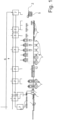
- FIG. 1 shows a rolling mill 1 according to the invention.
- the rolling mill 1 consists of a preheating furnace and an intermediate heating as heating devices 12, three roughing stands, five finishing stands as rolling stands 4, a two-stage cooling section 13 and a coiler 5. All systems have a respective control system 7 and are connected to a higher-level system control system 6. A large number of sensors 8, 9 for recording actual data are arranged along the material flow in the rolling mill 1.
- the preliminary product 3 a slab, is heated in the preheating furnace 13 to a temperature above the tapping temperature in the first roughing stand 4.
- the slab 3 is then descaled and geometrically measured using laser scanners 8.
- temperature profiles are created on the surfaces of the slab and the chemical composition is determined. These measurement data are assigned to the discrete sections (A xyz ) on the surface and the inner discrete sections of the slab are interpolated from them.
- each discrete section (A xyz ) is assigned a local chemical analysis. This is done on the basis of measurement data from the chemical analysis with the time course from the continuous casting of the slab and a solidification model, which at least takes segregations into account.
- a microstructure model can also assign a local initial structure to each discrete section.
- the strips to be produced with their average mechanical properties and average dimensions are known as target specifications.
- a self-learning process model checks whether the mechanical and geometric properties of the slab to be produced can be maintained. If this is possible, the corresponding target specifications are determined and passed on to the system controls.
- the forming forces are recorded on the rolling stands and the mechanical properties are determined at a defined point in time.
- the subsequent production process is adjusted according to these measured values.
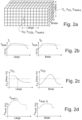
- Figure 2 represents a preliminary product, a slab, with its division into discrete sections (A xyz ).
- the temperature profiles (T L , T Q ), the carbon content on the surface (x CL , x CQ ) and an austenite content (x A ) are shown as examples.
- These different measured values can be assigned a value to each discrete section of the slab using interpolation and a microstructure model. Using this locally resolved data for the slab, it is then possible to determine target values for each discrete section for the further manufacturing process.
- cooling can be fundamentally reduced at the edges or ends of the slab.
- a possible microstructure formation can be determined for each discrete element by taking into account ZTU or ZTA diagrams. By locally adjusting cooling, comparable microstructures and thus mechanical properties can be achieved even under different initial conditions using basic chemical analysis.
- Figure 3 with the figures a) to c) show the schematic flow of the method according to the invention or the sequence of individual work steps.
- Figure 3 a) the generalized sequence of work steps is shown.
- step 1 the actual values I xyz-i for the target values S i are available for the product.
- step 2 the properties for the product are calculated taking into account the actual values I xyz-i and the target values S i .
- the calculated properties are then compared with the target values Z xyz of the product.
- An additional tolerance threshold can be taken into account in the comparison in order to avoid or reduce overshoot. If the calculated properties correspond to the target values Z xyz or are within the tolerance threshold, the target values Si do not change. Otherwise, one or more target values Si are set so that the calculated properties correspond to the target values Z xyz .
- Figure 3 b) applies the sequence of steps according to the Figure 3 a) on a manufacturing process with three temperature measuring points (12, 41, 5).
- step 1 the target values S i for the three temperature measuring points (12, 41, 5) are specified.
- target values Z xyz for the mechanical properties have been determined.
- Production begins with these specifications (step 2).
- step 2 Before reaching the first temperature measuring point 12, a first run is carried out to determine whether the properties calculated with the target values S i reach the target values Z xyz . If the target values are reached, production continues with the target values Si. Otherwise, new target values Si are specified for production in step 3.
- step 4 the product passes the first temperature measuring point and actual values I xyz are measured. Using these actual values I xyz and the target values S i for the second and third temperature measuring points (41, 5), the mechanical properties of the product are calculated again (step 5) and compared with the target values Z xyz (step 6). If the target values are not achieved, new target values S i are specified for one or both temperature measuring points (41, 5).
- step 8 the product reaches the temperature measuring point 41 and actual values I xyz are measured.
- the mechanical properties of the product are calculated (step 9) and compared with the target values Z xyz (step 10). If there is a deviation, a new setpoint is specified for the temperature measuring point 5.
- the product is finished with this specification and the actual values I xyz are determined at the temperature measuring point 5.
- all measured actual values, the production sequence with any deviations and the new setpoint values S i , the mechanical properties calculated in the process, the target values Z xyz and the mechanical properties after production has been completed are saved in a database.
- the data collected during the Figure 3 b) The data obtained is used to train a data-driven model.
- the data-driven model determines the new target values S i in the process.
- known data sets from conventional production are made available to the data-driven model.
- the data-driven model is initially trained using these data sets (step 2). Production is started using this trained model and the data set is expanded with the actual values and production data that then arise.
- the model is retrained with the initial data and the new data and the prediction accuracy is checked.
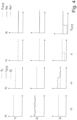
- Figure 4 shows 12 diagrams of a production with setpoint values S i , actual values l xyz , calculated mechanical properties and the target values Z xyz in the course of the process.
- Column a) corresponds to the temperature measuring point 12 and the time course corresponds to the row 1) to 3).
- Columns b) and c) correspond to the temperature measuring points 41 and 5.
- the respective calculated mechanical properties at the different points in time 1) to 3) are shown in column d).
- different target values S i are specified for the temperature measuring points.
- the mechanical properties calculated from these correspond to the target values Z xyz .
- the product passes the temperature measuring point 12 and actual values I xyz are determined for the product.
- the mechanical properties calculated using the target values S i and the actual values I xyz correspond to the target values Z xyz .
- Production continues with the existing target values S i .
- a sudden increase in temperature over time or in relation to the product length is detected in the course of the temperature measuring point 41. This means that the actual value deviates from the target value. Without further intervention or specification of new target values, this would result in a deviating mechanical property across the length of the belt.
- a new target value for the temperature measuring point 5 is specified with respect to the strip length or time-variable (diagram c)-3)), so that the calculated and actual mechanical properties correspond to the target values.
- Diagram a) shows the calculated progression of the yield strength YT over the strip length.
- the yield strength was calculated using a physical model approach known from the state of the art ( Prediction of the mechanical properties of hot-rolled low carbon steel strips in correlation to chemical compositions and rolling conditions, January 2011, Key Engineering Materials 462-463:401-406 ) .
- the sudden increase in temperature at a strip length of 175 m leads to a drop in the yield point.
- the target value for the yield point can be achieved over the strip length.
- Diagram b) shows the calculated course of the yield strength YT over the strip length, whereby the calculation was carried out using a data-driven model.
- the model was initially trained with the data according to Table 1.
- the training data includes the yield strength, the chemical analysis, the strip thickness and width, the finish rolling temperature and the coiling temperature. With the help of the data-driven model, the deviating finish rolling temperature FT was compensated by adjusting the coiling temperature CT.
Landscapes
- Engineering & Computer Science (AREA)
- Chemical & Material Sciences (AREA)
- Physics & Mathematics (AREA)
- Crystallography & Structural Chemistry (AREA)
- Mechanical Engineering (AREA)
- Materials Engineering (AREA)
- Metallurgy (AREA)
- Organic Chemistry (AREA)
- Theoretical Computer Science (AREA)
- General Physics & Mathematics (AREA)
- Thermal Sciences (AREA)
- Life Sciences & Earth Sciences (AREA)
- Evolutionary Computation (AREA)
- Health & Medical Sciences (AREA)
- Software Systems (AREA)
- Artificial Intelligence (AREA)
- Biomedical Technology (AREA)
- Biophysics (AREA)
- Computational Linguistics (AREA)
- Data Mining & Analysis (AREA)
- Mathematical Physics (AREA)
- General Health & Medical Sciences (AREA)
- Molecular Biology (AREA)
- Computing Systems (AREA)
- General Engineering & Computer Science (AREA)
- Automation & Control Theory (AREA)
- Manufacturing & Machinery (AREA)
- Human Computer Interaction (AREA)
- Control Of Metal Rolling (AREA)
Applications Claiming Priority (1)
| Application Number | Priority Date | Filing Date | Title |
|---|---|---|---|
| DE102022212627.0A DE102022212627A1 (de) | 2022-11-25 | 2022-11-25 | Verfahren zum Herstellen eines Stahlbandes aus einem Vorprodukt, bei dem die Sollwerte über die Länge eines einzelnen Stahlbandes und / oder zeitlich in Bezug auf eine einzelne Produktionsanlage einer Walzstraße variabel vorgegeben werden |
Publications (1)
| Publication Number | Publication Date |
|---|---|
| EP4375893A1 true EP4375893A1 (fr) | 2024-05-29 |
Family
ID=88600464
Family Applications (1)
| Application Number | Title | Priority Date | Filing Date |
|---|---|---|---|
| EP23206836.1A Pending EP4375893A1 (fr) | 2022-11-25 | 2023-10-30 | Procédé de fabrication d'une bande d'acier à partir d'un précurseur, où les valeurs de consigne sont définies par une seule bande d'acier et/ou par rapport à une seule installation de production |
Country Status (2)
| Country | Link |
|---|---|
| EP (1) | EP4375893A1 (fr) |
| DE (1) | DE102022212627A1 (fr) |
Citations (7)
| Publication number | Priority date | Publication date | Assignee | Title |
|---|---|---|---|---|
| WO1998018970A1 (fr) * | 1996-10-30 | 1998-05-07 | Voest-Alpine Industrieanlagenbau Gmbh | Procede pour la surveillance et la gestion de la qualite de produits lamines obtenus par laminage a chaud |
| US20020011089A1 (en) * | 1999-03-23 | 2002-01-31 | Einar Broese | Method and device for determining the rolling force in a roll stand |
| WO2004050923A1 (fr) | 2002-12-05 | 2004-06-17 | Sms Demag Aktiengesellschaft | Procede de commande ou de regulation de processus d'une installation de formage, de refroidissement et/ou de traitement thermique de metal |
| DE4416317B4 (de) * | 1993-05-17 | 2004-10-21 | Siemens Ag | Verfahren und Regeleinrichtung zur Regelung eines materialverarbeitenden Prozesses |
| EP3096896A1 (fr) | 2014-01-22 | 2016-11-30 | SMS group GmbH | Procédé de production optimisée d'alliages métalliques à base d'acier et de fer dans des unités de laminage à chaud et de fabrication de tôles fortes au moyen d'un simulateur, moniteur et/ou modèle de structure |
| WO2021160404A1 (fr) | 2020-02-11 | 2021-08-19 | Primetals Technologies Germany Gmbh | Détermination d'une sensibilité d'une variable cible d'un matériau de laminage à partir d'une variable de fonctionnement d'un laminoir à chaud |
| DE102021204174A1 (de) * | 2021-04-27 | 2022-10-27 | Sms Group Gmbh | Verbesserung der Produktqualität durch Berücksichtigung alternativer Produktauswahl |
-
2022
- 2022-11-25 DE DE102022212627.0A patent/DE102022212627A1/de active Pending
-
2023
- 2023-10-30 EP EP23206836.1A patent/EP4375893A1/fr active Pending
Patent Citations (7)
| Publication number | Priority date | Publication date | Assignee | Title |
|---|---|---|---|---|
| DE4416317B4 (de) * | 1993-05-17 | 2004-10-21 | Siemens Ag | Verfahren und Regeleinrichtung zur Regelung eines materialverarbeitenden Prozesses |
| WO1998018970A1 (fr) * | 1996-10-30 | 1998-05-07 | Voest-Alpine Industrieanlagenbau Gmbh | Procede pour la surveillance et la gestion de la qualite de produits lamines obtenus par laminage a chaud |
| US20020011089A1 (en) * | 1999-03-23 | 2002-01-31 | Einar Broese | Method and device for determining the rolling force in a roll stand |
| WO2004050923A1 (fr) | 2002-12-05 | 2004-06-17 | Sms Demag Aktiengesellschaft | Procede de commande ou de regulation de processus d'une installation de formage, de refroidissement et/ou de traitement thermique de metal |
| EP3096896A1 (fr) | 2014-01-22 | 2016-11-30 | SMS group GmbH | Procédé de production optimisée d'alliages métalliques à base d'acier et de fer dans des unités de laminage à chaud et de fabrication de tôles fortes au moyen d'un simulateur, moniteur et/ou modèle de structure |
| WO2021160404A1 (fr) | 2020-02-11 | 2021-08-19 | Primetals Technologies Germany Gmbh | Détermination d'une sensibilité d'une variable cible d'un matériau de laminage à partir d'une variable de fonctionnement d'un laminoir à chaud |
| DE102021204174A1 (de) * | 2021-04-27 | 2022-10-27 | Sms Group Gmbh | Verbesserung der Produktqualität durch Berücksichtigung alternativer Produktauswahl |
Non-Patent Citations (1)
| Title |
|---|
| "Prediction of the Mechanical Properties of Hot-Rolled Low Carbon Steel Strips in Correlation to Chemical Compositions and Rolling Conditions", KEY ENGINEERING MATERIALS, vol. 462-463, January 2011 (2011-01-01), pages 401 - 406 |
Also Published As
| Publication number | Publication date |
|---|---|
| DE102022212627A1 (de) | 2024-05-29 |
Similar Documents
| Publication | Publication Date | Title |
|---|---|---|
| EP1244816B1 (fr) | Procede et commande et/ou de reglage de la section de refroidissement d'un train a feuillards a chaud destine au laminage de bandes metalliques et dispositif associe | |
| AT414316B (de) | Verfahren und einrichtung zur steuerung einer hüttentechnischen anlage | |
| AT408623B (de) | Verfahren zur überwachung und steuerung der qualität von walzprodukten aus warmwalzprozessen | |
| EP2076824B1 (fr) | Procédé de commande et/ou régulation d'un processus industriel | |
| EP4146414B1 (fr) | Procédé de régulation en boucle ouverte ou en boucle fermée de la température d'une bande d'acier au cours d'un travail à chaud dans un laminoir à bandes à chaud | |
| DE19618995C2 (de) | Verfahren und Einrichtung zur Beeinflussung relevanter Güteparameter, insbesondere des Profils oder der Planheit eines Walzbandes | |
| DE3006544A1 (de) | Verfahren zur automatischen steuerung oder einstellung der breite einer bramme bzw. metallplatte beim warmvorwalzen derselben | |
| DE10324679A1 (de) | Steuerrechner und rechnergestützes Ermittlungsverfahren für eine Profil- und Planheitssteuerung für eine Walzstraße | |
| EP4247574A1 (fr) | Procédé de correction des propriétés d'une bande laminée à chaud ayant une composition chimique spécifique dans un laminoir à chaud | |
| WO2022229146A1 (fr) | Amélioration de la qualité de produits par prise en compte d'une sélection de produits alternatifs | |
| EP4061552B1 (fr) | Procédé, dipositif de contrôle et laminoir pour le réglage d'une température de sortie d'une bande métallique quittant un train de laminage | |
| DE102021212902A1 (de) | Verfahren zum Herstellen eines Warmbandes aus einem Feinkornstahlwerkstoff | |
| WO2022017690A1 (fr) | Installation intégrée de coulée-laminage pour la production d'une bande finie laminée à chaud à partir d'une fonte d'acier | |
| EP1481742B1 (fr) | Ordinateur de commande et procédé de détermination assistée par ordinateur pour le control de la planéité et du profile pour une cage de laminoir | |
| DE102022212627A1 (de) | Verfahren zum Herstellen eines Stahlbandes aus einem Vorprodukt, bei dem die Sollwerte über die Länge eines einzelnen Stahlbandes und / oder zeitlich in Bezug auf eine einzelne Produktionsanlage einer Walzstraße variabel vorgegeben werden | |
| EP2483004A1 (fr) | Procédé de détermination, basée sur un modèle, de valeurs théoriques pour les actionneurs symétriques et asymétriques des cages d'un laminoir à chaud à larges bandes | |
| WO2023186585A1 (fr) | Procédé de fabrication d'un produit métallique | |
| EP4594028B1 (fr) | Procédé de fonctionnement d'une installation de production de bande chaude, produit programme d'ordinateur et installation de production de bande chaude pour la fabrication d'une bande chaude | |
| EP4130895A1 (fr) | Procédé de détermination d'un paramètre de commande permettant de commander un laminoir | |
| DE102021207943A1 (de) | Verfahren zum Herstellen eines metallischen Bandes | |
| EP4433235B1 (fr) | Dispositif et procédé de production d'une bande métallique laminée | |
| EP4311606B1 (fr) | Procédé de régulation d'un train de laminage ainsi que train de laminage | |
| EP1030747B1 (fr) | Procede et installation de laminage a chaud de minces bandes d'acier | |
| DE102023211928A1 (de) | Verfahren zum Betreiben eines Walzwerks | |
| DE102024210456A1 (de) | Anlage und Verfahren zur Herstellung von gewalzten Metallbändern |
Legal Events
| Date | Code | Title | Description |
|---|---|---|---|
| PUAI | Public reference made under article 153(3) epc to a published international application that has entered the european phase |
Free format text: ORIGINAL CODE: 0009012 |
|
| STAA | Information on the status of an ep patent application or granted ep patent |
Free format text: STATUS: EXAMINATION IS IN PROGRESS |
|
| 17P | Request for examination filed |
Effective date: 20231030 |
|
| AK | Designated contracting states |
Kind code of ref document: A1 Designated state(s): AL AT BE BG CH CY CZ DE DK EE ES FI FR GB GR HR HU IE IS IT LI LT LU LV MC ME MK MT NL NO PL PT RO RS SE SI SK SM TR |
|
| RAP3 | Party data changed (applicant data changed or rights of an application transferred) |
Owner name: SMS GROUP GMBH |
|
| RBV | Designated contracting states (corrected) |
Designated state(s): AL AT BE BG CH CY CZ DE DK EE ES FI FR GB GR HR HU IE IS IT LI LT LU LV MC ME MK MT NL NO PL PT RO RS SE SI SK SM TR |