EP4375918A1 - Traitement d'images - Google Patents
Traitement d'images Download PDFInfo
- Publication number
- EP4375918A1 EP4375918A1 EP22209768.5A EP22209768A EP4375918A1 EP 4375918 A1 EP4375918 A1 EP 4375918A1 EP 22209768 A EP22209768 A EP 22209768A EP 4375918 A1 EP4375918 A1 EP 4375918A1
- Authority
- EP
- European Patent Office
- Prior art keywords
- image
- input image
- data
- input
- training
- Prior art date
- Legal status (The legal status is an assumption and is not a legal conclusion. Google has not performed a legal analysis and makes no representation as to the accuracy of the status listed.)
- Withdrawn
Links
Images




Classifications
-
- G—PHYSICS
- G06—COMPUTING OR CALCULATING; COUNTING
- G06T—IMAGE DATA PROCESSING OR GENERATION, IN GENERAL
- G06T5/00—Image enhancement or restoration
- G06T5/70—Denoising; Smoothing
-
- G—PHYSICS
- G06—COMPUTING OR CALCULATING; COUNTING
- G06T—IMAGE DATA PROCESSING OR GENERATION, IN GENERAL
- G06T3/00—Geometric image transformations in the plane of the image
- G06T3/40—Scaling of whole images or parts thereof, e.g. expanding or contracting
- G06T3/4053—Scaling of whole images or parts thereof, e.g. expanding or contracting based on super-resolution, i.e. the output image resolution being higher than the sensor resolution
-
- G—PHYSICS
- G06—COMPUTING OR CALCULATING; COUNTING
- G06T—IMAGE DATA PROCESSING OR GENERATION, IN GENERAL
- G06T5/00—Image enhancement or restoration
- G06T5/73—Deblurring; Sharpening
-
- G—PHYSICS
- G06—COMPUTING OR CALCULATING; COUNTING
- G06T—IMAGE DATA PROCESSING OR GENERATION, IN GENERAL
- G06T2207/00—Indexing scheme for image analysis or image enhancement
- G06T2207/10—Image acquisition modality
- G06T2207/10072—Tomographic images
-
- G—PHYSICS
- G06—COMPUTING OR CALCULATING; COUNTING
- G06T—IMAGE DATA PROCESSING OR GENERATION, IN GENERAL
- G06T2207/00—Indexing scheme for image analysis or image enhancement
- G06T2207/10—Image acquisition modality
- G06T2207/10132—Ultrasound image
-
- G—PHYSICS
- G06—COMPUTING OR CALCULATING; COUNTING
- G06T—IMAGE DATA PROCESSING OR GENERATION, IN GENERAL
- G06T2207/00—Indexing scheme for image analysis or image enhancement
- G06T2207/20—Special algorithmic details
- G06T2207/20048—Transform domain processing
- G06T2207/20056—Discrete and fast Fourier transform, [DFT, FFT]
-
- G—PHYSICS
- G06—COMPUTING OR CALCULATING; COUNTING
- G06T—IMAGE DATA PROCESSING OR GENERATION, IN GENERAL
- G06T2207/00—Indexing scheme for image analysis or image enhancement
- G06T2207/20—Special algorithmic details
- G06T2207/20084—Artificial neural networks [ANN]
-
- G—PHYSICS
- G06—COMPUTING OR CALCULATING; COUNTING
- G06T—IMAGE DATA PROCESSING OR GENERATION, IN GENERAL
- G06T2207/00—Indexing scheme for image analysis or image enhancement
- G06T2207/30—Subject of image; Context of image processing
- G06T2207/30004—Biomedical image processing
Definitions
- the present invention relates to the field of processing images, and in particular to processing images with machine learning algorithms.
- ML machine learning
- Artificial Intelligence/Deep Learning can be used with medical images (such a MR and CT images) for image reconstruction (e.g. resolution enhancement and/or noise removal).
- super resolution models can be used to obtain a higher resolution image that is perceivably sharper than the original input image.
- super-resolution models are typically trained in an end-to-end fashion without imposing any prior knowledge on the preservation of the original input image.
- a poorly trained model can negatively impact (i.e. corrupt) data in the original image, reducing reliability of the higher resolution image.
- denoising architectures do not have a strongly imposed safety mechanism (i.e. a process to ensure certain data is preserved or maintained).
- an image processing method comprising: extracting, from an input image, image preservation data describing data of the input image to be preserved; processing the input image with a machine learning algorithm to generate a predicted image, the machine learning algorithm being trained to predict a transformed version of the input image; and modifying the predicted image based on the image preservation data to generate an output image.
- Proposed concepts thus aim to provide schemes, solutions, concepts, designs, methods and systems pertaining to preserving data of an image that is processed using a ML-based algorithm. Such concepts may help to improve confidence in deep learning image processing (e.g. reconstruction) models.
- deep learning image processing e.g. reconstruction
- embodiments of the invention propose: extracting, from an input image, image preservation data describing data of the input image to be preserved; transforming the input image to a transformed image with a ML algorithm; and then modifying the transformed image by enforcing the preservation data on the transformed image in order to create an output image.
- a proposed concept is to implement a safety mechanism that is arranged to preserve part of the original input image data.
- image preservation data that describes data of the input image to be preserved
- the image preservation data can be leveraged to modify the transformed image (i.e. the processed version of the input image) provided by an ML algorithm.
- Such modification based on the image preservation data can blend or reintroduce the data to be preserved into the transformed image, thereby ensuring that the data to be preserved is not corrupted, modified or otherwise lost as a result of the transformation caused by the ML algorithm.
- Embodiments may be applied to any deep-learning-based image processing architecture (such as denoising models and super resolution models) to enforce that a signal in the original/input image is not disrupted, corrupted, or otherwise lost by the image processing. Since this approach is not learned, but directly enforced on the output of the deep-learning-based processing, it may provide improved confidence that the image processing architecture remains stable. This, in turn, may allow for easier regulatory approval and/or adoption of the image processing techniques.
- any deep-learning-based image processing architecture such as denoising models and super resolution models
- the proposed concept(s) may be not be limited to 2D images but may also be applied on 3D or higher dimensional images, or even on raw data.
- the image preservation data may describe spatial frequency data of the input image for a frequency range of interest. Modifying the predicted image based on the image preservation data to generate an output image may then comprise modifying spatial frequency data of the predicted image based on the spatial frequency data of the input image for the frequency range of interest.
- modifying spatial frequency data of the predicted image may comprise replacing, for the frequency range of interest, spatial frequency data of the predicted image with spatial frequency data of the input image.
- embodiments may preserve original content of the input image for one or more frequencies. For instance, unlike conventional processing algorithms, embodiments may ensure that the low frequency content of the input image is maintained. Embodiments may thus ensure improved control on the resulting output image.
- the machine learning algorithm may be trained to predict a transformed version of the input image based on a machine learning model that is configured to perform at least one of: a super-resolution reconstruction of the input image; denoising of the input image; anti-ringing of the input image; and sharpening of the input image.
- Embodiments may therefore be employed in conjunction with a wide range of ML-based image processing models/algorithms. Existing/conventional ML algorithms may therefore be leveraged to facilitate the implementation of proposed embodiments.
- the machine learning algorithm may be trained using a training algorithm configured to receive an array of training inputs and respective known outputs, wherein a training input comprises a training image, and wherein a respective known output comprises an output image obtained according to a proposed embodiment. That is, the data to be preserved may be reinserted into the network output before comparing with the training target and computing the training loss during training. In this way, the ML model may learn to provide an output which - after re-insertion of the data to be preserved - is equal to the training target. In other words, an embodiment may learn to "anticipate" that data preservation will be applied to its output, and provide an output that accommodates this.
- Previously generated output images using the proposed concept(s) may thus be learnt and leveraged to make future image predictions that automatically preserve data of interest. That is, previously obtained output images may thus be used for training the employed ML-based algorithm.
- An end-to-end training concept may therefore be proposed which helps the ML model to generate a prediction (i.e. transformed image) that, after re-inserting the data to be preserved, is as close as possible to the training target.
- embodiments may support end-to-end training concept that employs output images obtained using the proposed concept(s) for subsequent training.
- the machine learning algorithm may be trained using a training algorithm configured to receive an array of known training outputs and respective training inputs, wherein a known training output comprises a training image, and wherein a respective training input comprises a transformed or simulated (e.g. low resolution or noisy) version of the training image.
- a training algorithm configured to receive an array of known training outputs and respective training inputs, wherein a known training output comprises a training image, and wherein a respective training input comprises a transformed or simulated (e.g. low resolution or noisy) version of the training image.
- a lower resolution version of a training image may be obtained by blurring the training image in image space, and the lower resolution image may form the training input associated with the training output image.
- Some embodiments may further comprise computing a loss value based on the output image and a respective known output for the input image.
- the input image may comprise a known training input image having a respective known output image.
- An output image may firstly be generated according to a proposed embodiment, and then a loss may be calculated/computed against the respective known output image for the input image. The computed loss value may then be used for end-to-end training.
- extracting, from the input image, image preservation data may comprise extracting the k-space of the input image.
- extracting, from the input image, image preservation data may comprise splitting the input image into two or more frequency ranges.
- extracting, from the input image, image preservation data may comprise transforming the input image to the frequency domain to generate a frequency domain representation of the input image; and determining image preservation data based on the frequency domain representation of the input image.
- the input image may, for example, comprise an MRI, PET/SPECT, Sonography or CT image.
- Embodiments may be used in conjunction with a range of image, and in particular a range of medical images. Embodiments may therefore be of relevance and benefit to the field of medical image processing.
- a computer program product comprising a computer-readable storage medium having computer-readable program code embodied therewith, the computer-readable program code configured to perform all of the steps of a proposed embodiment.
- a computer system comprising: a computer program product according to proposed embodiment; and one or more processors adapted to perform a method according to a proposed concept by execution of the computer-readable program code of said computer program product.
- an image processing system comprising: a data extraction unit configured to extract, from an input image, image preservation data describing data of the input image to be preserved; a machine learning unit configured to processing the input image with a machine learning algorithm to generate a predicted image, the machine learning algorithm being trained to predict a transformed version of the input image; and a processor adapted to modify the predicted image based on the image preservation data to generate an output image.
- Part of the system may be remotely located from a user device for image processing.
- a user such as a medical professional
- Embodiments may therefore enable a user to dynamically adjust or adapt image processing using a local system (which may, for example, comprise a portable display device, such as a laptop, tablet computer, mobile phone, PDA, etc.).
- a local system which may, for example, comprise a portable display device, such as a laptop, tablet computer, mobile phone, PDA, etc.
- embodiments may provide an application for a mobile computing device, and the application may be executed and/or controlled by a user of the mobile computing device.
- the system may further include: a server device comprising the image processing system; and a client device comprising a user-interface.
- Dedicated data processing means may therefore be employed for the purpose of processing the input image with a machine learning algorithm, thus reducing processing requirements or capabilities of other components or devices of the system.
- the system may further include a client device, wherein the client device comprises a data extraction unit, machine learning algorithm, processor, and a display unit.
- client device comprises a data extraction unit, machine learning algorithm, processor, and a display unit.
- a user may have an appropriately arranged client device (such as a laptop, tablet computer, mobile phone, PDA, etc.) which processes an input image and generate a displays control signal or displaying the resulting output image.
- client device such as a laptop, tablet computer, mobile phone, PDA, etc.
- embodiments may therefore provide an image processing system, wherein real-time communication between a user and a medical imaging device is provided and can have its functionality extended or modified according to proposed concepts, for example.
- processing capabilities may therefore be distributed throughout the system in different ways according to predetermined constraints and/or availability of processing resources.
- proposed embodiments may address the issue of original input data being corrupted or lost by a ML-based processing algorithm. Images of higher quality and/or improved reliability may thus be provided by the proposed concept(s).
- inventions proposes concepts for improving ML-based image processing.
- embodiments may provide a method and/or system which may help to enforce that a signal/data in an original image is not disrupted by the ML-based processing.
- particular image data of interest or importance may be preserved so that is present in an output image of the image processing procedure.
- the proposed approach for preserving data is not learned, but directly enforced in/on an output image, it may provide improved (e.g. increased) confidence that the ML-based algorithm (such as a super-resolution network or denoising algorithm) remains stable.
- Proposed concepts may be based on a realisation that data of an input image (such as a specified frequency band in the original image) may be preserved without the normal drawbacks of applying a correction outside of the deep learning model.
- a safety mechanism in an ML-based image processing procedure which extracts, from an input image, image preservation data describing data of the input image to be preserved. After the input image is transformed by ML algorithm into a transformed image, the transformed image is modified based on the preservation data so as to create an output image comprising the data to be preserved.
- embodiments may be used in conjunction with trainable super-resolution models and trainable denoiser models which find widespread use in the field of medical image processing and analysis. Accordingly, embodiments may be used in relation to medical imaging processing, analysis and/or diagnosis.
- an end-to-end training concept may be proposed which help the ML model to generate a prediction (i.e. transformed image) that, after re-inserting the data to be preserved, is as close as possible to the training target.
- a prediction i.e. transformed image
- Such end-to-end training may ensure that the proposed safety mechanism produces images of optimal image quality.
- illustrative embodiments may be utilized in many different types of clinical, medical or subject-related imaging applications. Illustrative embodiments may, for example, be employed in medical imaging platforms as part of a clinical decision support system.
- Fig. 1 illustrates a flow diagram of a computer-implemented method 100 for image processing according to an embodiment.
- the image to be processed i.e. the input image
- the image to be processed is a MRI or CT image.
- other types of medical images, or even other types of non-medical images may be equally applicable to being processed by proposed embodiments.
- the method 100 begins with the step 110 of extracting, from the input image, image preservation data describing data of the input image to be preserved.
- the image preservation data describes spatial frequency data of the input image for a frequency range of interest.
- the step 110 of extracting image preservation data comprises the step 115 of extracting the k-space of the input image.
- step 120 the input image is provided to a neural network (NN)-based machine learning algorithm.
- the machine learning algorithm is trained to predict a transformed version of the input image.
- Neural networks are comprised of layers, each layer comprising a plurality of neurons.
- Each neuron comprises a mathematical operation.
- each neuron may comprise a different weighted combination of a single type of transformation (e.g. the same type of transformation, sigmoid etc. but with different weightings).
- the mathematical operation of each neuron is performed on the input data to produce a numerical output, and the outputs of each layer in the neural network may be fed into one or more subsequent layers. The final layer provides the output.
- CNNs convolutional neural networks
- NNNs Graph Neural Network
- RNNs recurrent neural networks
- Fig. 1 employs a CNN, because CNNs are known to be particularly advantageous for image processing.
- Methods of training a machine-learning algorithm are well known.
- such methods comprise obtaining a training dataset, comprising training input data entries and corresponding training output data entries.
- An initialized machine-learning algorithm is applied to each input data (e.g. input image) entry to generate predicted output data entries (e.g. predicted images).
- An error between the predicted output data entries and corresponding training output data entries is used to modify the machine-learning algorithm. This process can be repeated until the error converges, and the predicted output data entries are sufficiently similar (e.g. ⁇ 1%) to the training output data entries.
- This is commonly known as a supervised learning technique.
- weightings of the mathematical operation of each neuron may be modified until the error converges.
- Known methods of modifying a neural network may employ gradient descent, backpropagation algorithms and so on.
- the training input data entries for the machine learning algorithm used in method 100 correspond to example images (i.e. training images).
- the training output data entries correspond to transformed (super-resolution) versions of the training images. That is, the machine learning algorithm is trained using a training algorithm configured to receive an array of training inputs and respective known outputs, wherein a known output comprises a (e.g. high-resolution) training image, and wherein a respective training input comprises a transformed/simulated (e.g. low-resolution or blurred) version of the training image. In this way, the machine learning algorithm is trained to output a predicted super-resolution version of an input image it is provided with.
- step 130 the predicted image output by the machine learning algorithm (i.e. the predicted image generated in step 120) is modified based on the image preservation data so as to generate an output image.
- step 130 of modifying the predicted image based on the image preservation data to generate an output image comprises the step 135 of modifying spatial frequency data of the predicted image based on the spatial frequency data of the input image for the frequency range of interest.
- modifying spatial frequency data of the predicted image comprises replacing, for the frequency range of interest, spatial frequency data of the predicted image with spatial frequency data of the input image. In this way, the data of the input image to be preserved is included in the final output image.
- the step 135 of modifying the predicted image may not comprise direct replacement of spatial frequency data but may instead comprise adjusting spatial frequency data of the predicted image in other ways.
- the spatial frequency data of the predicted image may be merged or averaged with spatial frequency data of the input image.
- Alternative embodiments may thus have a smooth transition (e.g. locally weighted average) between the frequencies in the model output and the frequencies to be preserved.
- images provided by such an embodiment may be used to train the machine-learning model.
- the machine-learning model may be trained in such a way that it produces a predicted image that, after re-inserting the data to be preserved, provides an image as close as possible to the training target.
- the machine-learning algorithm is adapted to perform Super-Resolution in the image domain
- performing Super-Resolution in the image domain and then simply re-inserting the measured low-frequency information in the frequency domain may cause inconsistencies in frequency domain leading to undesired effects in the image domain.
- the proposed concept(s) may be used in conjunction with machine learning algorithms that are trained to perform other image transformations.
- the machine learning algorithm may be trained to perform denoising of the input image, anti-ringing of the input image, or sharpening of the input image.
- image preservation data may be employed by proposed embodiments.
- Such approaches may be employed in the image domain or in the frequency domain.
- the step of extracting, from the input image, image preservation data may comprise splitting the input image into two or more frequency ranges.
- the step of extracting, from the input image, image preservation data may comprise: transforming the input image to the frequency domain to generate a frequency domain representation of the input image; and determining image preservation data based on the frequency domain representation of the input image.
- Fig. 2 is a simplified block diagram illustrating a proposed image processing method that employs a safety mechanism for preserving image data within a final output image.
- an output image 220 Given an input image 210 to be processed, it is desired to obtain an output image 220 according to a prescribed loss function and training objective. This may comprise super resolution, anti-ringing or denoising, for example.
- the input image may first be pre-processed 230 according to the task at hand.
- Data of the input image 210 to be preserved (e.g. a selected frequency band) is selected and image preservation data describing the data to be preserved is extracted 240.
- the learnable modules 250 (typically implemented with a deep learning approach) receive the pre-processed image as an input and perform their trained transformation(s) (learned from training data).
- the output of the learnable modules i.e. predicted image
- the output of the learnable modules is modified 260 according to the image preservation data by replacing data (e.g. the selected frequency band) so as to generate the final output image 220.
- Fig. 2 Given an input image 210, data is selected to be preserved and extracted 240.
- the learnable modules 250 act on the input image to provide a precited image, and then the data to be preserved is replaced or merged into the predicted image to provide the final output image.
- the embodiment may avoid artifacts being introduced by replacing the data to be preserved bands.
- a machine-learning algorithm may perform: super-resolution of an image; denoising of a medical image; anti-ringing of a medical image; or sharpening of a medical image.
- a machine-learning algorithm may perform: super-resolution of an image; denoising of a medical image; anti-ringing of a medical image; or sharpening of a medical image.
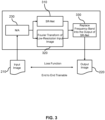
- FIG. 3 there is presented an exemplary embodiment, wherein the machine-learning algorithm is adapted to perform super resolution of a medical image.
- Fig.3 depicts a modification to the embodiment of Fig. 2 , wherein the image processing performs super resolution of an input medical image.
- the image data to be preserved is a frequency band to be preserved that corresponds to the Fourier transform of the low-resolution image.
- the super resolution is performed by a SR-Net 310.
- different architectures can be used (such as for example but not limited to those noted in a paper entitled by " Deep Learning for Single Image Super-Resolution: A Brief Review” by Yang et al.).
- the central frequency band is replaced 330 using the frequencies in the original input image.
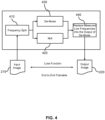
- FIG. 4 there is presented an exemplary embodiment, wherein the machine-learning algorithm is adapted to perform de-noising of a medical image.
- Fig. 4 depicts a modification to the embodiment of Fig. 2 , wherein the image processing performs de-noising of an input medical image.
- a frequency split of the input image is performed as pre-processing 410, resulting in the high frequencies of the input image which are used as input to the denoising model 430.
- the low frequency information bypasses 420 the denoising model 430 as data to be preserved.
- the extracted low frequency information is inserted to counteract potential drifts in the denoising model, thereby improving fidelity.
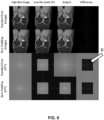
- Fig. 5 is a simple super resolution network without employing the proposed data perseveration concept(s).
- the resulting difference from the output of the model and the zero padded version of the low-resolution image shows that the model modifies the low frequencies (highlighted by the arrow labelled "A"). This is a side effect that can reduce confidence in the model.
- Fig. 6 is a super resolution network which employs the proposed data perseveration concept(s).
- the resulting k-space is consistent with the low-resolution image, as demonstrated by the difference in Fourier space between the high-resolution image and the zero padded version of the low-resolution image (highlighted by the arrow labelled "B"). That is, with the proposed data preservation approach, it is noted there is no difference in the low-frequency content between the FFT of the output and the FFT of the zero padded image, thus demonstrating that the low-frequency content is preserved.
- FIG. 7 depicts a simplified block diagram of an image processing system 600 according to an embodiment.
- the system comprises a data interface 610 that is configured to obtain an input image 605.
- the input image 605 may comprise a 2-D medical image.
- other embodiments may be configured to handle 3-D (or higher-dimensional) images or raw data.
- a data extraction unit 615 of the system 600 is configured to extract, from the input image 605, image preservation data describing data of the input image to be preserved;
- a machine learning unit 620 of the system 600 is configured to receive the input mage 605 from the data interface 610.
- the machine learning unit 620 is configured to process the input image 605 with a machine learning algorithm to generate a predicted image.
- the machine learning algorithm is trained to predict (as the predicted image) a transformed version of the input image.
- the system 600 also comprises a processor 630 that is configured to modify the predicted image based on the extracted image preservation data to generate an output image 640.
- the output image 640 is provided as an output from the system 600 and may thus be used for subsequent training of the machine learning algorithm.
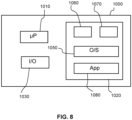
- Fig. 8 illustrates an example of a computer 1000 within which one or more parts of an embodiment may be employed.
- Various operations discussed above may utilize the capabilities of the computer 1000.
- one or more parts of an image processing system according to an embodiment may be incorporated in any element, module, application, and/or component discussed herein.
- system functional blocks can run on a single computer or may be distributed over several computers and locations (e.g. connected via internet).
- the computer 1000 includes, but is not limited to, PCs, workstations, laptops, PDAs, palm devices, servers, storages, and the like.
- the computer 1000 may include one or more processors 1010, memory 1020 and one or more I/O devices 1030 that are communicatively coupled via a local interface (not shown).
- the local interface can be, for example but not limited to, one or more buses or other wired or wireless connections, as is known in the art.
- the local interface may have additional elements, such as controllers, buffers (caches), drivers, repeaters, and receivers, to enable communications. Further, the local interface may include address, control, and/or data connections to enable appropriate communications among the aforementioned components.
- the processor 1010 is a hardware device for executing software that can be stored in the memory 1020.
- the processor 1010 can be virtually any custom made or commercially available processor, a central processing unit (CPU), a digital signal processor (DSP), or an auxiliary processor among several processors associated with the computer 1000, and the processor 1010 may be a semiconductor-based microprocessor (in the form of a microchip) or a microprocessor.
- the memory 1020 can include any one or combination of volatile memory elements (e.g., random access memory (RAM), such as dynamic random access memory (DRAM), static random access memory (SRAM), etc.) and non-volatile memory elements (e.g., ROM, erasable programmable read only memory (EPROM), electronically erasable programmable read only memory (EEPROM), programmable read only memory (PROM), tape, compact disc read only memory (CD-ROM), disk, diskette, cartridge, cassette or the like, etc.).
- RAM random access memory
- DRAM dynamic random access memory
- SRAM static random access memory
- non-volatile memory elements e.g., ROM, erasable programmable read only memory (EPROM), electronically erasable programmable read only memory (EEPROM), programmable read only memory (PROM), tape, compact disc read only memory (CD-ROM), disk, diskette, cartridge, cassette or the like, etc.
- the memory 1020 may incorporate electronic, magnetic, optical, and/or other types
- the software in the memory 1020 may include one or more separate programs, each of which comprises an ordered listing of executable instructions for implementing logical functions.
- the software in the memory 1020 includes a suitable operating system (O/S) 1050, compiler 1060, source code 1070, and one or more applications 1080 in accordance with exemplary embodiments.
- the application 1080 comprises numerous functional components for implementing the features and operations of the exemplary embodiments.
- the application 1080 of the computer 1000 may represent various applications, computational units, logic, functional units, processes, operations, virtual entities, and/or modules in accordance with exemplary embodiments, but the application 1080 is not meant to be a limitation.
- the operating system 1050 controls the execution of other computer programs, and provides scheduling, input-output control, file and data management, memory management, and communication control and related services. It is contemplated by the inventors that the application 1080 for implementing exemplary embodiments may be applicable on all commercially available operating systems.
- Application 1080 may be a source program, executable program (object code), script, or any other entity comprising a set of instructions to be performed.
- a source program then the program is usually translated via a compiler (such as the compiler 1060), assembler, interpreter, or the like, which may or may not be included within the memory 1020, so as to operate properly in connection with the O/S 1050.
- the application 1080 can be written as an object oriented programming language, which has classes of data and methods, or a procedure programming language, which has routines, subroutines, and/or functions, for example but not limited to, C, C++, C#, Pascal, BASIC, API calls, HTML, XHTML, XML, ASP scripts, JavaScript, FORTRAN, COBOL, Perl, Java, ADA, .NET, and the like.
- the I/O devices 1030 may include input devices such as, for example but not limited to, a mouse, keyboard, scanner, microphone, camera, etc. Furthermore, the I/O devices 1030 may also include output devices, for example but not limited to a printer, display, etc. Finally, the I/O devices 1030 may further include devices that communicate both inputs and outputs, for instance but not limited to, a NIC or modulator/demodulator (for accessing remote devices, other files, devices, systems, or a network), a radio frequency (RF) or other transceiver, a telephonic interface, a bridge, a router, etc. The I/O devices 1030 also include components for communicating over various networks, such as the Internet or intranet.
- a NIC or modulator/demodulator for accessing remote devices, other files, devices, systems, or a network
- RF radio frequency
- the I/O devices 1030 also include components for communicating over various networks, such as the Internet or intranet.
- the software in the memory 1020 may further include a basic input output system (BIOS) (omitted for simplicity).
- BIOS is a set of essential software routines that initialize and test hardware at start-up, start the O/S 1050, and support the transfer of data among the hardware devices.
- the BIOS is stored in some type of read-only-memory, such as ROM, PROM, EPROM, EEPROM or the like, so that the BIOS can be executed when the computer 800 is activated.
- the processor 1010 When the computer 1000 is in operation, the processor 1010 is configured to execute software stored within the memory 1020, to communicate data to and from the memory 1020, and to generally control operations of the computer 1000 pursuant to the software.
- the application 1080 and the O/S 1050 are read, in whole or in part, by the processor 1010, perhaps buffered within the processor 1010, and then executed.
- a computer readable medium may be an electronic, magnetic, optical, or other physical device or means that can contain or store a computer program for use by or in connection with a computer related system or method.
- the application 1080 can be embodied in any computer-readable medium for use by or in connection with an instruction execution system, apparatus, or device, such as a computer-based system, processorcontaining system, or other system that can fetch the instructions from the instruction execution system, apparatus, or device and execute the instructions.
- a "computer-readable medium" can be any means that can store, communicate, propagate, or transport the program for use by or in connection with the instruction execution system, apparatus, or device.
- the computer readable medium can be, for example but not limited to, an electronic, magnetic, optical, electromagnetic, infrared, or semiconductor system, apparatus, device, or propagation medium.
- Figs. 1-4 and the system of Fig. 7 may be implemented in hardware or software, or a mixture of both (for example, as firmware running on a hardware device).
- the functional steps illustrated in the process flowcharts may be performed by suitably programmed physical computing devices, such as one or more central processing units (CPUs) or graphics processing units (GPUs).
- CPUs central processing units
- GPUs graphics processing units
- Each process - and its individual component steps as illustrated in the flowcharts - may be performed by the same or different computing devices.
- a computer-readable storage medium stores a computer program comprising computer program code configured to cause one or more physical computing devices to carry out an encoding or decoding method as described above when the program is run on the one or more physical computing devices.
- Storage media may include volatile and non-volatile computer memory such as RAM, PROM, EPROM, and EEPROM, optical discs (like CD, DVD, BD), magnetic storage media (like hard discs and tapes).
- RAM random access memory
- PROM read-only memory
- EPROM erasable programmable read-only memory
- EEPROM electrically erasable programmable read-only memory
- optical discs like CD, DVD, BD
- magnetic storage media like hard discs and tapes.
- Various storage media may be fixed within a computing device or may be transportable, such that the one or more programs stored thereon can be loaded into a processor.
- the blocks shown in the block diagrams of Figs. 2-4 and 7 may be separate physical components, or logical subdivisions of single physical components, or may be all implemented in an integrated manner in one physical component.
- the functions of one block shown in the drawings may be divided between multiple components in an implementation, or the functions of multiple blocks shown in the drawings may be combined in single components in an implementation.
- Hardware components suitable for use in embodiments of the present invention include, but are not limited to, conventional microprocessors, application specific integrated circuits (ASICs), and field-programmable gate arrays (FPGAs).
- ASICs application specific integrated circuits
- FPGAs field-programmable gate arrays
- One or more blocks may be implemented as a combination of dedicated hardware to perform some functions and one or more programmed microprocessors and associated circuitry to perform other functions.
- a computer program may be stored/distributed on a suitable medium, such as an optical storage medium or a solid-state medium supplied together with or as part of other hardware, but may also be distributed in other forms, such as via the Internet or other wired or wireless telecommunication systems.
- a suitable medium such as an optical storage medium or a solid-state medium supplied together with or as part of other hardware, but may also be distributed in other forms, such as via the Internet or other wired or wireless telecommunication systems.
- each block in the flowchart or block diagrams may represent a module, segment, or portion of instructions, which comprises one or more executable instructions for implementing the specified logical function(s).
- the functions noted in the block may occur out of the order noted in the Figures.
- two blocks shown in succession may, in fact, be executed substantially concurrently, or the blocks may sometimes be executed in the reverse order, depending upon the functionality involved.
Landscapes
- Physics & Mathematics (AREA)
- General Physics & Mathematics (AREA)
- Engineering & Computer Science (AREA)
- Theoretical Computer Science (AREA)
- Image Analysis (AREA)
Priority Applications (1)
| Application Number | Priority Date | Filing Date | Title |
|---|---|---|---|
| EP22209768.5A EP4375918A1 (fr) | 2022-11-28 | 2022-11-28 | Traitement d'images |
Applications Claiming Priority (1)
| Application Number | Priority Date | Filing Date | Title |
|---|---|---|---|
| EP22209768.5A EP4375918A1 (fr) | 2022-11-28 | 2022-11-28 | Traitement d'images |
Publications (1)
| Publication Number | Publication Date |
|---|---|
| EP4375918A1 true EP4375918A1 (fr) | 2024-05-29 |
Family
ID=84364102
Family Applications (1)
| Application Number | Title | Priority Date | Filing Date |
|---|---|---|---|
| EP22209768.5A Withdrawn EP4375918A1 (fr) | 2022-11-28 | 2022-11-28 | Traitement d'images |
Country Status (1)
| Country | Link |
|---|---|
| EP (1) | EP4375918A1 (fr) |
Citations (1)
| Publication number | Priority date | Publication date | Assignee | Title |
|---|---|---|---|---|
| EP4024074A1 (fr) * | 2021-01-05 | 2022-07-06 | Siemens Healthcare GmbH | Application de la cohérence des données dans la reconstruction d'images de résonance magnétique par apprentissage profond |
-
2022
- 2022-11-28 EP EP22209768.5A patent/EP4375918A1/fr not_active Withdrawn
Patent Citations (1)
| Publication number | Priority date | Publication date | Assignee | Title |
|---|---|---|---|---|
| EP4024074A1 (fr) * | 2021-01-05 | 2022-07-06 | Siemens Healthcare GmbH | Application de la cohérence des données dans la reconstruction d'images de résonance magnétique par apprentissage profond |
Non-Patent Citations (2)
| Title |
|---|
| MIKHAIL PAPKOV ET AL: "Noise2Stack: Improving Image Restoration by Learning from Volumetric Data", ARXIV.ORG, CORNELL UNIVERSITY LIBRARY, 201 OLIN LIBRARY CORNELL UNIVERSITY ITHACA, NY 14853, 10 November 2020 (2020-11-10), XP081810710 * |
| YANG ET AL., DEEP LEARNING FOR SINGLE IMAGE SUPER-RESOLUTION: A BRIEF REVIEW |
Similar Documents
| Publication | Publication Date | Title |
|---|---|---|
| US12530876B2 (en) | Systems and methods for progressive learning for machine-learned models to optimize training speed | |
| US11604984B2 (en) | Systems and methods for machine learning based modeling | |
| CN110766769B (zh) | 一种磁共振图像重建方法、装置、设备和介质 | |
| US11755883B2 (en) | Systems and methods for machine-learned models having convolution and attention | |
| US12131446B2 (en) | Self-supervised deblurring | |
| US12283028B2 (en) | Spatio-temporal noise masks for image processing | |
| CN113256592A (zh) | 图像特征提取模型的训练方法、系统及装置 | |
| WO2022184736A1 (fr) | Traitement de données d'imagerie médicale générées par un dispositif d'imagerie médicale | |
| TW202439239A (zh) | 使用超取樣技術的方法及電子裝置 | |
| EP4009269A1 (fr) | Traitement d'images basé sur cnn | |
| CN118570114A (zh) | 一种血管图像分割方法、装置、设备和介质 | |
| EP4375918A1 (fr) | Traitement d'images | |
| US12566941B2 (en) | Extension of existing neural networks without affecting existing outputs | |
| US12475553B2 (en) | Machine learning image analysis based on explicit equipment parameters | |
| US12499554B2 (en) | Image processing | |
| US20230394296A1 (en) | Neural network inferencing efficiency with fewer parameters | |
| CN111723917B (zh) | 运算方法、装置及相关产品 | |
| CN117795532A (zh) | 在压缩域中在线训练计算机视觉任务模型 | |
| EP4581575B1 (fr) | Estimation de volumes de liquide | |
| Sun et al. | Degradation-Aware Blind Face Restoration via High-Quality VQ Codebook | |
| JP7696961B2 (ja) | 表示視野の違いに対する深層学習の頑健性 | |
| CN117218170B (zh) | 基于联合任务约束的遥感基础模型的图像处理方法及装置 | |
| CN118435234B (zh) | 用于3d图像处理的网络架构 | |
| US12412269B2 (en) | Deep learning image processing via region-wise parameter maps | |
| US20240127047A1 (en) | Deep learning image analysis with increased modularity and reduced footprint |
Legal Events
| Date | Code | Title | Description |
|---|---|---|---|
| PUAI | Public reference made under article 153(3) epc to a published international application that has entered the european phase |
Free format text: ORIGINAL CODE: 0009012 |
|
| STAA | Information on the status of an ep patent application or granted ep patent |
Free format text: STATUS: THE APPLICATION HAS BEEN PUBLISHED |
|
| AK | Designated contracting states |
Kind code of ref document: A1 Designated state(s): AL AT BE BG CH CY CZ DE DK EE ES FI FR GB GR HR HU IE IS IT LI LT LU LV MC ME MK MT NL NO PL PT RO RS SE SI SK SM TR |
|
| STAA | Information on the status of an ep patent application or granted ep patent |
Free format text: STATUS: THE APPLICATION IS DEEMED TO BE WITHDRAWN |
|
| 18D | Application deemed to be withdrawn |
Effective date: 20241130 |