EP4375939A2 - Détection de défauts à l'aide de données synthétiques et d'apprentissage automatique - Google Patents
Détection de défauts à l'aide de données synthétiques et d'apprentissage automatique Download PDFInfo
- Publication number
- EP4375939A2 EP4375939A2 EP24170589.6A EP24170589A EP4375939A2 EP 4375939 A2 EP4375939 A2 EP 4375939A2 EP 24170589 A EP24170589 A EP 24170589A EP 4375939 A2 EP4375939 A2 EP 4375939A2
- Authority
- EP
- European Patent Office
- Prior art keywords
- model
- images
- image
- quality control
- trained model
- Prior art date
- Legal status (The legal status is an assumption and is not a legal conclusion. Google has not performed a legal analysis and makes no representation as to the accuracy of the status listed.)
- Pending
Links
Images





Classifications
-
- G—PHYSICS
- G01—MEASURING; TESTING
- G01N—INVESTIGATING OR ANALYSING MATERIALS BY DETERMINING THEIR CHEMICAL OR PHYSICAL PROPERTIES
- G01N21/00—Investigating or analysing materials by the use of optical means, i.e. using sub-millimetre waves, infrared, visible or ultraviolet light
- G01N21/84—Systems specially adapted for particular applications
- G01N21/88—Investigating the presence of flaws or contamination
- G01N21/8851—Scan or image signal processing specially adapted therefor, e.g. for scan signal adjustment, for detecting different kinds of defects, for compensating for structures, markings, edges
-
- G—PHYSICS
- G06—COMPUTING OR CALCULATING; COUNTING
- G06T—IMAGE DATA PROCESSING OR GENERATION, IN GENERAL
- G06T7/00—Image analysis
- G06T7/0002—Inspection of images, e.g. flaw detection
- G06T7/0004—Industrial image inspection
-
- G—PHYSICS
- G01—MEASURING; TESTING
- G01N—INVESTIGATING OR ANALYSING MATERIALS BY DETERMINING THEIR CHEMICAL OR PHYSICAL PROPERTIES
- G01N21/00—Investigating or analysing materials by the use of optical means, i.e. using sub-millimetre waves, infrared, visible or ultraviolet light
- G01N21/84—Systems specially adapted for particular applications
- G01N21/88—Investigating the presence of flaws or contamination
- G01N21/95—Investigating the presence of flaws or contamination characterised by the material or shape of the object to be examined
- G01N21/958—Inspecting transparent materials or objects, e.g. windscreens
-
- G—PHYSICS
- G06—COMPUTING OR CALCULATING; COUNTING
- G06F—ELECTRIC DIGITAL DATA PROCESSING
- G06F18/00—Pattern recognition
- G06F18/20—Analysing
- G06F18/21—Design or setup of recognition systems or techniques; Extraction of features in feature space; Blind source separation
- G06F18/214—Generating training patterns; Bootstrap methods, e.g. bagging or boosting
-
- G—PHYSICS
- G06—COMPUTING OR CALCULATING; COUNTING
- G06F—ELECTRIC DIGITAL DATA PROCESSING
- G06F18/00—Pattern recognition
- G06F18/20—Analysing
- G06F18/21—Design or setup of recognition systems or techniques; Extraction of features in feature space; Blind source separation
- G06F18/217—Validation; Performance evaluation; Active pattern learning techniques
-
- G—PHYSICS
- G06—COMPUTING OR CALCULATING; COUNTING
- G06N—COMPUTING ARRANGEMENTS BASED ON SPECIFIC COMPUTATIONAL MODELS
- G06N20/00—Machine learning
-
- G—PHYSICS
- G06—COMPUTING OR CALCULATING; COUNTING
- G06N—COMPUTING ARRANGEMENTS BASED ON SPECIFIC COMPUTATIONAL MODELS
- G06N3/00—Computing arrangements based on biological models
- G06N3/02—Neural networks
- G06N3/04—Architecture, e.g. interconnection topology
-
- G—PHYSICS
- G06—COMPUTING OR CALCULATING; COUNTING
- G06T—IMAGE DATA PROCESSING OR GENERATION, IN GENERAL
- G06T11/00—Two-dimensional [2D] image generation
-
- G—PHYSICS
- G06—COMPUTING OR CALCULATING; COUNTING
- G06T—IMAGE DATA PROCESSING OR GENERATION, IN GENERAL
- G06T7/00—Image analysis
- G06T7/30—Determination of transform parameters for the alignment of images, i.e. image registration
-
- G—PHYSICS
- G01—MEASURING; TESTING
- G01N—INVESTIGATING OR ANALYSING MATERIALS BY DETERMINING THEIR CHEMICAL OR PHYSICAL PROPERTIES
- G01N21/00—Investigating or analysing materials by the use of optical means, i.e. using sub-millimetre waves, infrared, visible or ultraviolet light
- G01N21/84—Systems specially adapted for particular applications
- G01N21/88—Investigating the presence of flaws or contamination
- G01N21/8851—Scan or image signal processing specially adapted therefor, e.g. for scan signal adjustment, for detecting different kinds of defects, for compensating for structures, markings, edges
- G01N2021/8854—Grading and classifying of flaws
- G01N2021/8858—Flaw counting
-
- G—PHYSICS
- G01—MEASURING; TESTING
- G01N—INVESTIGATING OR ANALYSING MATERIALS BY DETERMINING THEIR CHEMICAL OR PHYSICAL PROPERTIES
- G01N21/00—Investigating or analysing materials by the use of optical means, i.e. using sub-millimetre waves, infrared, visible or ultraviolet light
- G01N21/84—Systems specially adapted for particular applications
- G01N21/88—Investigating the presence of flaws or contamination
- G01N21/8851—Scan or image signal processing specially adapted therefor, e.g. for scan signal adjustment, for detecting different kinds of defects, for compensating for structures, markings, edges
- G01N2021/8883—Scan or image signal processing specially adapted therefor, e.g. for scan signal adjustment, for detecting different kinds of defects, for compensating for structures, markings, edges involving the calculation of gauges, generating models
-
- G—PHYSICS
- G01—MEASURING; TESTING
- G01N—INVESTIGATING OR ANALYSING MATERIALS BY DETERMINING THEIR CHEMICAL OR PHYSICAL PROPERTIES
- G01N21/00—Investigating or analysing materials by the use of optical means, i.e. using sub-millimetre waves, infrared, visible or ultraviolet light
- G01N21/84—Systems specially adapted for particular applications
- G01N21/88—Investigating the presence of flaws or contamination
- G01N21/8851—Scan or image signal processing specially adapted therefor, e.g. for scan signal adjustment, for detecting different kinds of defects, for compensating for structures, markings, edges
- G01N2021/8887—Scan or image signal processing specially adapted therefor, e.g. for scan signal adjustment, for detecting different kinds of defects, for compensating for structures, markings, edges based on image processing techniques
-
- G—PHYSICS
- G01—MEASURING; TESTING
- G01N—INVESTIGATING OR ANALYSING MATERIALS BY DETERMINING THEIR CHEMICAL OR PHYSICAL PROPERTIES
- G01N21/00—Investigating or analysing materials by the use of optical means, i.e. using sub-millimetre waves, infrared, visible or ultraviolet light
- G01N21/84—Systems specially adapted for particular applications
- G01N21/88—Investigating the presence of flaws or contamination
- G01N21/95—Investigating the presence of flaws or contamination characterised by the material or shape of the object to be examined
- G01N21/958—Inspecting transparent materials or objects, e.g. windscreens
- G01N2021/9583—Lenses
-
- G—PHYSICS
- G01—MEASURING; TESTING
- G01N—INVESTIGATING OR ANALYSING MATERIALS BY DETERMINING THEIR CHEMICAL OR PHYSICAL PROPERTIES
- G01N2201/00—Features of devices classified in G01N21/00
- G01N2201/12—Circuits of general importance; Signal processing
- G01N2201/129—Using chemometrical methods
- G01N2201/1296—Using chemometrical methods using neural networks
-
- G—PHYSICS
- G06—COMPUTING OR CALCULATING; COUNTING
- G06T—IMAGE DATA PROCESSING OR GENERATION, IN GENERAL
- G06T2207/00—Indexing scheme for image analysis or image enhancement
- G06T2207/20—Special algorithmic details
- G06T2207/20081—Training; Learning
-
- G—PHYSICS
- G06—COMPUTING OR CALCULATING; COUNTING
- G06T—IMAGE DATA PROCESSING OR GENERATION, IN GENERAL
- G06T2207/00—Indexing scheme for image analysis or image enhancement
- G06T2207/20—Special algorithmic details
- G06T2207/20084—Artificial neural networks [ANN]
-
- G—PHYSICS
- G06—COMPUTING OR CALCULATING; COUNTING
- G06T—IMAGE DATA PROCESSING OR GENERATION, IN GENERAL
- G06T2207/00—Indexing scheme for image analysis or image enhancement
- G06T2207/30—Subject of image; Context of image processing
- G06T2207/30108—Industrial image inspection
Definitions
- Quality control for contact lenses may rely on inspection and detection techniques. However, improvements are needed.
- the method comprises receiving a first data set and a second set of data.
- the first dataset comprises a plurality of images of a contact lens package having physically implanted foreign matter disposed therein.
- the second dataset comprises a plurality of images of a contact lens package having digitally implanted foreign matter.
- the method further comprises training one or more quality control models on at least a training subset of the first data set and the second data set.
- the one or more quality control models are configured to detect the existence of foreign matter.
- the models may be tested on at least a subset of the first data set and the second data set. The training and testing of the quality control models my be repeated until a predetermined performance threhold may be met.
- the quality control model constitutes a validated model.
- the method further comprises capturing an image of a contact lens package and analyzing that image based on the validated model or models. Based on this analysis, the method will output a quality control metric indicative of an accept or reject condition of the package.
- the system comprises a sensor for capturing image data of a contact lens package.
- the system further comprises a computing device in communication with the sensor and configured to receive a first set of data and a second set of data.
- the first data set comprises a plurality of images of a contact lens package having physically implanted foreign matter.
- the second data set comprises a plurality of images of a contact lens package having digitally implanted foreign matter.
- the computing device further may comprise a quality control model.
- the quality control model may be trained on at least a training subset of the first data set and the second data set.
- the one or more quality control models are configured to detect the existence of foreign matter.
- the models may be tested on at least a subset of the first data set and the second data set.
- the training and testing of the quality control models my be repeated until a predetermined performance threhold may be met.
- the quality control model constitutes a validated model.
- the system further comprises capturing an image of a contact lens package by the sensor and analyzing that image based on the validated model or models. Based on this analysis, the system will output a quality control metric indicative of an accept or reject condition of the package.
- the system may further comprise a conveying mechanism configured to deliver the package within a field of view of the sensor.
- This disclosure describes a method for quality control of contact lens packages.
- the method comprises receiving a first data set and a second set of data.
- the first dataset comprises a plurality of images of a contact lens package having physically implanted defects disposed therein.
- the second dataset comprises a plurality of images of a contact lens package having digitally implanted defects.
- the method further comprises training one or more quality control models on at least a training subset of the first data set and the second data set.
- the one or more quality control models are configured to detect the existence of defects. After the model or models have been trained, the models may be tested on at least a subset of the first data set and the second data set. The training and testing of the quality control models my be repeated until a predetermined performance threhold may be met.
- the quality control model constitutes a validated model.
- the method further comprises capturing an image of a contact lens package and analyzing that image based on the validated model or models. Based on this analysis, the method will output a quality control metric indicative of an accept or reject condition of the package.
- a defect may comprise one or more of foreign matter, an edge defect, or a hole.
- the system comprises a sensor for capturing image data of a contact lens package.
- the system further comprises a computing device in communication with the sensor and configured to receive a first set of data and a second set of data.
- the first data set comprises a plurality of images of a contact lens package having physically implanted defects.
- the second data set comprises a plurality of images of a contact lens package having digitally implanted defects.
- the computing device further may comprise a quality control model.
- the quality control model may be trained on at least a training subset of the first data set and the second data set.
- the one or more quality control models are configured to detect the existence of defects.
- the models may be tested on at least a subset of the first data set and the second data set.
- the training and testing of the quality control models my be repeated until a predetermined performance threhold may be met.
- the quality control model constitutes a validated model.
- the system further comprises capturing an image of a contact lens package by the sensor and analyzing that image based on the validated model or models. Based on this analysis, the system will output a quality control metric indicative of an accept or reject condition of the package.
- the system may further comprise a conveying mechanism configured to deliver the package within a field of view of the sensor.
- a defect may comprise one or more of foreign matter, an edge defect, or a hole.
- the method comprises generating a data set.
- the data set comprises a plurality of augmented images of a contact lens package having digitally implanted foreign matter.
- the digitally implanted foreign matter in the plurality of augmented images has characteristics different from other implanted foreign matter. These characteristics comprise morphology, size, location, opacity, and the quantity of foreign matter.
- the method further comprises training one or more quality control models on at least a training subset of the data set.
- the one or more quality control models are configured to detect the existence of foreign matter.
- the method further comprises testing the trained one or more quality control models on at least a validation subset of the data set.
- the method further comprises captuing an image data of a contact lens package.
- the method further comprises analyzing, based on the trained and tested one or more quality control models, the image data and causing, based on the analyzing, output of a quality control metric indicative of at least an accept or reject condition of the package.
- the system comprises a sensor for capturing image data of a contact lens package.
- the system further comprises a computing device in communication with the sensor and configured to receive image data and to analyze the image data based on one or more quality control models.
- the system further comprises generating a data set.
- the data set comprises a plurality of augmented images of a contact lens package having digitally implanted foreign matter.
- the digitally implanted foreign matter in the plurality of augmented images has characteristics different from other implanted foreign matter. These characteristics comprise morphology, size, location, opacity, and the quantity of foreign matter.
- the system further comprises training one or more quality control models on at least a training subset of the data set.
- the one or more quality control models are configured to detect the existence of foreign matter.
- the system further comprises testing the trained one or more quality control models on at least a validation subset of the data set.
- the system further comprises analyzing, based on one or more of the quality control models, the image data and causing, based on the analyzing, output of a quality control metric indicative of at least an accept or reject condition of the package.
- the method comprises generating a data set.
- the data set comprises a plurality of augmented images of a contact lens package having digitally implanted defects.
- the digitally implanted defects in the plurality of augmented images have characteristics different from other implanted defects. These characteristics comprise morphology, size, location, opacity, and the quantity of the defects.
- the method further comprises training one or more quality control models on at least a training subset of the data set.
- the one or more quality control models are configured to detect the existence of defects.
- the method further comprises testing the trained one or more quality control models on at least a validation subset of the data set.
- the method further comprises captuing an image data of a contact lens package.
- the method further comprises analyzing, based on the trained and tested one or more quality control models, the image data and causing, based on the analyzing, output of a quality control metric indicative of at least an accept or reject condition of the package.
- Defects may comprise foreign matter, edge defects, and holes.
- the system comprises a sensor for capturing image data of a contact lens package.
- the system further comprises a computing device in communication with the sensor and configured to receive image data and to analyze the image data based on one or more quality control models.
- the computering device further operates on a generated a data set.
- the data set comprises a plurality of augmented images of a contact lens package having digitally implanted defects.
- the digitally implanted defects in the plurality of augmented images have characteristics different from other implanted defects . These characteristics comprise morphology, size, location, opacity, and the quantity of defects.
- the system further comprises training one or more quality control models on at least a training subset of the data set.
- the one or more quality control models are configured to detect the existence of foreign matter.
- the system further comprises testing the trained one or more quality control models on at least a validation subset of the data set.
- the system further comprises analyzing, based on one or more of the quality control models, the image data and causing, based on the analyzing, output of a quality control metric indicative of at least an accept or reject condition of the package.
- Defects may comprise foreign matter, edge defects, and holes.
- the present disclosure relates to the use of synthetic, hybrid, or augmented data in training of machine learning algorithms for the detection of foreign matter, holes, and edge defects in lenses and lens packages.
- Lens packages require quality control to ensure that no foreign matter intrudes into the package.
- the packages also require inspection to identify holes in the package or the lens, as well as edge defects in the lens.
- the foreign matter may damage the lens or contaminate the lens, both of which are detrimental to satisying the customer's needs.
- the packages may be inspected at any stage of the process including before and after the packages are sealed.
- Foreign matter detection/containment may be used to reduce the amount of foreign matter or defects in contact lenses or packaging being shipped to customers.
- Gross foreign matter is identified as having at least one dimension greater than approximately 647 microns (approximately 25 thousandths of an inch (25 mils)). Approximately means within ⁇ 10%, or within ⁇ 5%.
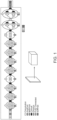
- FIGS. 1-3c illustrate an example of a Convolutional Neural Network image classification system.
- FIG. 1 illustrates the CNN Inception V3 with an input of a color image of 299 X 299 pixels with a depth of 3 colors. The output is a classification which is 8 X 8 with a depth of 2048.
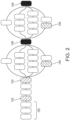
- FIG. 2 illustrates the first several layers of the network. The first three layers of this network include three convolutional layers 102 followed by a maxpooling layer 104. At various stages in the network average pooling layers 106 are implayed as are concatenation layers 108. Most of the layers in this network are convolution layers 102, but only the first three are labelled as such to avoid confusion in labelling.
- FIG. 3a shows the last several layers of this network. The last layers include mostly convolution layers 102 (again a single one is labelled to avoid confusion), average pooling layers 106, concatenation layers 108, a dropout layer 110, a fully connected layer 112, and a softmax layer 114
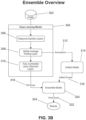
- FIG. 3b illustrates an overview of the ensemble for how the method works.
- An image 302 is sent into the deep learning model 304.
- the deep learning model 304 there may be a feature extraction layer 306, a global average pooling layer 308, and a fully connected layer 310 (also known as a decision layer).
- the deep learning model may output an activation 312 and a FM (foreign matter) score 318.
- the activations 312 may be in the inputs to an artifact model 314, which may output an artifact score 316.
- the FM score 318 and the artifact score 316 may be inputs to an ensemble model 320.
- the ensemble model 320 may output a final score 322 which will produce a result 324.
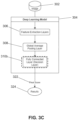
- FIG. 3c illustrates removal of the separate artifact model 314 and the ensemble model 320.
- a retrained fully connected layer 310b at the end of the deep learning model 304 will enable the final score 322 and the results 324 to be the same as with the old fully connected layer 310, the artifact model 304 and the ensemble model 320. Because no new information is being added by the artifact model 314 that was not already originally present in the deep learning model 304, the deep learning model 304 can have the original fully connected layer 310 be re-trained as a new fully connected layer 310b. Re-training may comprise varying the weights of the components to determine the final score 322 and results 324 directly.
- the outputs from the previous method including the artifact model 314 and the ensemble model 320 may be incorporated as an initial re-training step.
- Other methods of re-training may also be used, as are well known to those skilled in the art of machine learning.
- the old fully connected layer 310 must be re-trained as the new fully connected layer 310b to tune the decision boundaries of the deep learning model without adjusting any of the feature extraction parameters. Re-training the fully connected layer 310 thus removes the requirement to have these other models and effectively internalizes their results. Note that the FM score 318 and the artifact score 316, as interim calculations, are no longer are needed and so are removed from the flow of calculations.
- a machine learning algorithm such as a convolutional neural network (CNN) may be useful in the classification of images into various categories. As shown in the example in FIGS 1-4 , these networks contain many layers. The network designed may require more of fewer of certain layers and more of fewer of other layers, depending on the precise application.
- AlexNet and Inception Net V3 are example CNNs which receive as input images of various objects (e.g. a ship, a leopard, a cherry, etc) and output the classification to which the image may belong. As an example, in order to correctly identify or classify such an image, the CNN may first be trained using other images with known classifications.
- Images with foreign matter may be identified manually (by human identification).
- Packages containing foreign matter may also be created or seeded and fed into the system for identification; however, such tests require more human effort and time and reduce the capacity of the system to produce defect-free product for customers.
- Even the manually created defective packages may also not mimic properly the types of defects which are introduced, making the task even more difficult.
- synthetic data or augmented data may created to help train the ML model for identification or classification of lens packages with real FM.
- FIGS. 4-5 illustrate training and testing a CNN.
- an existing image database 402 of packages contains images of good packages and also images of bad packages - those with FM, edge defects, holes, and the like.
- the existing image database 402 contains many more images of good lens packages than bad ones.
- Augmented images 404 are created from the existing image database 402. The process of creating these augmented images 404 is explained in further detail below and in FIGS. 12-16 .
- the existing image database 402 and the augmented images 404 are combined to form a full image set 406.
- the full image set 406 may be split into two sets of data: a set of training data 408 and a set of testing data 410.
- the training data 408 is fed into the untrained model 412 (for instance, the Inception V3 CNN described above) to create a trained model 414.
- the trained model adjusts the model weighting parameters in the various layers as necessary to obtain the known-correct result for as many images as possible.
- the testing data 410 are then fed into the trained model 414 to created a validated model 416.
- the validated model 416 will produce classifications of the testing data 410 for comparison with the known classifications of the testing data 410. If the validated model 416 produces the desired output, in terms of meeting or exceeding a threshold, then the validated model 416 is then ready for use in a production setting. If the validated model 416 does not meet the threshold, then the hyperparameters of the model may be changed or another model may be chosen until a model is found which meets the threshold for acceptable validation. Other techniques may be used.
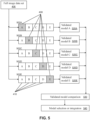
- FIG. 5 illustrates the concept of cross-validation, which is another method for producing a validated model 416, also known as a tested model.
- cross-validation the full image data set 406 is split into several groups. In the example depicted in FIG. 5 the full image data set 406 is split into five groups, labelled A, B, C, D, and E. For each iteration of the cross-validation testing, one of the groups is the training data 408. The remaining groups are the testing or validation data 410.
- the training data 408 is labelled in each iteration of the cross-validation, but only a single set of testing data 410 is labelled in FIG. 5 - the ones for iteration 502E.
- Each of these iterations 502 is labelled based on which group is the training data 408. Thus iteration 502A has training data 408 group A and iteration 502B has training data 408 group B, etc..
- Each of these iterations produces a validated model 520A, 520B, 520C, 520D, and 520E in the figure.
- These models are compared 530 and one model is selected or the models are integrated 540 to create the model used for subsequent identification of the lens packages with FM or defects.
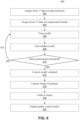
- FIG. 6 illustrates a method for outputting a quality control metric for lens packages 600.
- images of real lens packages are gathered to form a first data set.
- images are created by digitally implanting defects or FM in images of real lens packages to create a second data set.
- augmented images are created to increase the number of less commonly occuring images of FM, edge defects, and holes.
- the model is trained using a training data set 408.
- the model is validated using a testing or validation data set 410. Cross-validation ( FIG. 2 ) may also be used.
- the model results are compared with a performance threshold.
- the model may be sent back to be tuned and re-trained 606 and re-tested 608.
- hyperparameters of the existing model may be modified and the new model trained.
- an alternative model may be chosen at this stage. The process of tuning a model 612, training a model 606, and testing a model 608-may be repeated until a model meets a performance threshold.
- the model has been validated 614.
- an image of a package is captured.
- the validated model analyzes the image.
- a quality control metric is output from the model.
- a quality control metric of the model may comprise "pass" or "no foreign matter detected" or "foreign matter detected.”
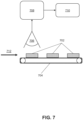
- FIG. 7 illustrates a system integrated as part of a production line.
- Lens pacakges 702 may rest on a conveyor belt 704, which moves them along a direction of motion 712.
- the packages are brought into the field of view of a sensor 706.
- the sensor 706 takes an image of the package 702.
- a computer 708 is configured to receive an image from the sensor 706.
- the computer 708 is further configured to analyze the image using a trained model.
- the computer 708 then outputs a quality control metric 710.
- the lens package may be moved out of the sensor 706 field of view for further processing which may be influenced by the quality control metric 710.
- the quality control metric output for a particular package 702 is "contains foreign matter” then that package 702 may be isolated at the next step.
- the quality control metric output for a particular package 702 is "defect free" then that package 702 may continue down the production line for shipment.
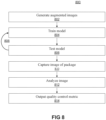
- FIG. 8 illustrates a process flow 800.
- augmented images are generated.
- a model is trained.
- the model is tested.
- the model may be tuned, re-trained 804, and re-tested 806. This tuning, re-training, and re-testing may occur several times, as needed, or a new model may be selected followed by initial training 804 and testing 806.
- an image of a package is captured.
- the image is analyzed and at step 814, a quality control metric is output.
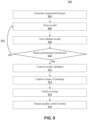
- FIG. 9 illustrates a proces flow 900.
- augmented images may be generated.
- a model may be trained.
- a model may be tested or validated.
- the model may be evaluated to meet a performance threshold. If the model does not meet the performance threshold, then at step 910 the model may be tuned and go back to step 904 training. Alternatively a new model may be selected. Alternatively the model's hyperparameters may be modified or tuned. The tuning, testing, and validating steps may be iterated many times before the model meets the performance threshold.
- An example of a performance threshold may be identifying FM intrusion with greater than 95% accuracy. Further details of an example performance threshold is discussed further below.
- a validated control model At step 914, an image of a package is captured. At step 916, the image is analyzed by the validated model. At step 918, a quality control metric is ouput based on the analysis of the validated model.
- a performance threshold may comprise the area under the received characteristic curve (AUC) or by the receiver operating characteristic (ROC) curve itself.
- the ROC is a plot of the true positive rate as a function of the false positive rate.
- the AUC is an integral of the ROC curve.
- An alternative performance threshold may require a certain percentage of true positive identifications, or a certain percentage of true negative identifications. Similarly other possible performance thresholds may be imagined.
- Another alternative threshold is to incorporate all four options of true positive (FM or defect present), true negative (no FM or defect present), false positive (FM/defect incorrectly identified as present), and false negative (FM/defect incorrectly identified as not present). If more classifications are included in the model training (e.g.
- a performance threshold becomes available as well.
- identifcation of more defects e.g. edge defect vs. hole
- Other performance thresholds may also be employed, such as achieving a FM true positive rate above a certain percentage (e.g. 99.9%) or low false negative rate (e.g. below 1%).
- the true positive rate must be greater than a certain valie when the false positive rate is above another value (e.g. true positive must be > 0.95 when false positive is > 0.5).
- Other options for a performance threshold such as the Brier score may also be used.
- Inception V3 is used as the CNN (an existing research convolutional neural network).
- This CNN has an input image size up to 299 pixels by 299 pixels in size (and with 3 colors). For a 15 mm diameter contact lens, this resolution means that a single pixel corresponds to roughly a 60-70 ⁇ m wide region in the package.
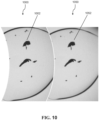
- FIGS 10 and 11 show images taken at a lower resolution (299x299 pixels) and at a higher resolution (1000x1000 pixels or 2000x2000 pixels).
- a low resolution image 1050 is compared with the same lens package with a high resolution image 1000.
- One piece of foreign matter is shown in low resolution 1052 and in high reolution 1002.
- FIG. 11 a close up of the foreign matter is shown again in low resolution 1052 and in high resolution 1002.
- each pixel in the low resolution image 1050 represents 60-70 ⁇ m.
- the FM shown in FIG. 11 is approximately 20 pixels at its greatest dimension or 1200-1400 ⁇ m.
- the higher resolution image 1002 shows the foreign matter in much greater detail.
- the resolution increased to 1000 pixels by 1000 pixels the resolved size per pixel improved to ⁇ 20 ⁇ m/pixel.
- the resolution increased to 2000 pixels by 2000 pixels the resolved size per pixel improved to 10 ⁇ m per pixel.
- Any categorization model must trade off the size of the inputs with the computer resources involved and also the number of parameters to be optimized and the risks of overfitting. In some circumstances decreasing image resolution may improve model performance, but in other circumstances it may eliminate information useful for classification. In general there is a trade-off when CNNs use graphic processing units (GPUs) because GPUs may have memory limitations so that higher image resolutions reduce the maximum batch size the GPU can process. Larger batch size may improve calculation of the gradient with respect to the loss function. In the tests run for this application (classifying lens package images for presence of foreign matter, defects, or holes), the increase in resolution improved model performance significantly.
- GPUs graphic processing units
- Such methods include partial cropping and shifted the cropped image around or rotating it.
- the image of a defect may be shifted around or rotated anywhere within the frame.
- the image may be cropped at 50% of the fullly available image area, and then shifted a random number of pixels up or down or random ⁇ x and and random ⁇ y and also rotated by some random angle ⁇ , before being pasted into a blank backgrond or onto another image.
- the other image may be a known good (defect-free or FM-free) image.
- Other image manipulation techniques may include creating mirror images of known data-flipping horizontally or vertically-or rotating the images from no rotation to any rotation.
- the methods may also include regions distorted by other means, such as localized distortions of defects.
- these augmentations may include geometric transformations, random erasures within the original image, and mixing images together.
- These methods may also be known as hybrid (mixing known good imges with known FM-containing images or known defect-containing images) images, augmented images, or synthetic images.
- the method may include augmenting or editing a known good image to include or add pixels with different colors (for color images (e.g. RGB, CIEL*a*b* or other color space schemes) or different grayscale brightnesses, as the case may be) in a form similar to a known FM intrusion in a lens package or the known presence of a hole or edge defect.
- Other color transformations and filters may be employed as part of the data augmentation.
- Yet other techniques include adding noise to the image, such as Gaussian noise or salt and pepper noise to random pixels within the image.
- Yet another technique may comprise enhancing contrast within an image or subtracting an image's mean intensity from each pixel within the image.
- the resulting model may be invariant to translation, rotation, viewpoint, size, of a defect and also invariant to illumnation conditions. While a machine implementing this method may be able to control several of these variables (e.g. illumination and orientation or viewpoint), others (size, rotation, and location of the defect) are not under the user's direct control.
- these variables e.g. illumination and orientation or viewpoint
- others size, rotation, and location of the defect
- FIG. 14 illustrates some physically implanted FM into lens pacakges.
- the lens package contains a lens 1302.
- the package also may contain liquid to maintain a sterile environment for the lens. This liquid may appear in the image as a line 1304. There may be a bubble 1308 in the liquid contained within the package.
- Fully opaque foreign matter 1306 may appear in the image. Partially opaque or outlined foreign matter may also be present. In addition small dots may appear in the image, but they may be below a size threshold (e.g. 150 ⁇ m) and may not therefore be considered FM.
- a size threshold e.g. 150 ⁇ m
- FIG. 13 illustrates augmented images.
- An image without FM is taken and pixels are modified to create an image similar to FM.
- These augmented images may include digitally implanted foreign matter 1402 in different locations or of different sizes in an image taken which previously contained no foreign matter.
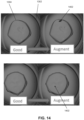
- FIG. 14 and FIG. 15 further illustrate the creation of augmented data.
- An example of physical creation of FM in images was done to create training data by placing various types of FM in lens packages. For instance items such as excess lens material, plastic, and other small items were placed inside packages and fed into the processing stream. Images were taken of these FM-seeded items and manually identified as containing FM (see e.g., FIG. 13 ). A large number (e.g. 1000 or more) of such images were thereby obtained in one test to train the model (e.g. a CNN) to identify FM. Based on these known FM including images new, along with known images without FM, augmented images were created. These images are called augmented images (digitally augmented) or synthetic or in some cases hybrid images.
- a fully synthetic image - one created without using any known good or known bad image at all- may also be used for the purpose of creating a useful training data set.
- a hybrid image may take a known good image and copy a known FM portion of another image, and place the known FM portion into the image using standard editing tools from digital photography. Thus hybrid images may be created by merging portions of FM-free and FM-containing images.
- Another hybrid image may comprise taking a known good image and digitally adding synthetic FM to it.
- FIG. 15 on the left hand side are two images labelled "Good” which contain no FM. They do contain a lens 1302 and some liquid 1304 to protect the lense.
- On the right hand side labelled “Augment” pixels were modified (e.g. digitally implanted) to create the appearance of foreign matter.
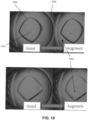
- FIG. 16 Further examples are shown in FIG. 16 .
- small foreign matter 1310 was already present in the original "good” image and remains in the augmented image. This small FM may not be large enough to trigger a rejection.
- digital foreign matter 1402 has been added to these images.
- hybrid or synthetic images FM of all shapes and sizes using these or related techniques.
- the images may be edited directly to create black portions similar in size and shape (or not) to known FM.
- This technique may also be described as digitally implanting FM into an image. It is much quicker and cheaper to create these augmented images of FM in a lens package than it is to create actual FM contaminated lens packages. The number of such images which can be created is also vastly greater. In one experimental training data set over 10,000 such FM-containing images were created and including in the training & testing data sets.
- pre-processing of the images may take place prior to analyzing the image with the model.
- Pre-processing of the image may comprise identifying the specific region of interest, enhancing contrast, adding or subtracting other images taken, and the like.
- a convolutional neural network may be designed or modified and implemented for identification of packages to be rejected.
- Packages may be sealed or unsealed and may contain a lens or may be empty.
- the packages may contain liquid or no liquid in addition to containing a lens or no lens.
- One example platform is the Matlab package, though others exist, such as Scripte & Python.
- An existing module be modified to slice original images to smaller sizes with only the regions of interest (ROIs) appropriately sized to feed into the CNN. These images were then defined by a region of interest (ROI) of, for instance 299 by 299 pixels (monochrome) defined by the packages themselves so that each ROI fed into the CNN has the appropriate number of pixels for processing.
- ROI region of interest
- An exemplary CNN such as Inception V3 may comprise 48 total layers with a mixture of convolutional layers, max pooling layers and fully connected layers.
- a ReLU rectifying linear unit
- a filter of size of, for instance, 3X3 may be used with a stride of 1, 2, or larger numbers.
- Layers may use a pad around the edge and corners of the image to enhance processing of the image.
- the various layers of the network e.g. convolutional layers, max pooling layers, softmax, dropout, fully connected layers, and the like
- Multi-tasking is the ability of an operating system to execute more than one executable at the same time.
- Each executable is running in its own address space, meaning that the executables have no way to share any of their memory.
- the programs have no way to exchange any information except through the operating system (or by reading files stored on the file system).
- Multi-process computing is similar to multi-tasking computing, as the terms task and process are often used interchangeably, although some operating systems make a distinction between the two.
- the present invention may be or comprise a system, a method, and/or a computer program product at any possible technical detail level of integration.
- the computer program product may include a computer readable storage medium (or media) having computer readable program instructions thereon for causing a processor to carry out aspects of the present invention.
- the computer readable storage medium can be a tangible device that can retain and store instructions for use by an instruction execution device.
- the computer readable storage medium may be, for example, but is not limited to, an electronic storage device, a magnetic storage device, an optical storage device, an electromagnetic storage device, a semiconductor storage device, or any suitable combination of the foregoing.
- a non-exhaustive list of more specific examples of the computer readable storage medium includes the following: a portable computer diskette, a hard disk, a random access memory (RAM), a read-only memory (ROM), an erasable programmable read-only memory (EPROM or Flash memory), a static random access memory (SRAM), a portable compact disc read-only memory (CD-ROM), a digital versatile disk (DVD), a memory stick, a floppy disk, a mechanically encoded device such as punch-cards or raised structures in a groove having instructions recorded thereon, and any suitable combination of the foregoing.
- a computer readable storage medium is not to be construed as being transitory signals per se, such as radio waves or other freely propagating electromagnetic waves, electromagnetic waves propagating through a waveguide or other transmission media (for example, light pulses passing through a fiber-optic cable), or electrical signals transmitted through a wire.
- Computer readable program instructions described herein can be downloaded to respective computing/processing devices from a computer readable storage medium or to an external computer or external storage device via a network, for example, the Internet, a local area network, a wide area network and/or a wireless network.
- the network may comprise copper transmission cables, optical transmission fibers, wireless transmission, routers, firewalls, switches, gateway computers, and/or edge servers.
- a network adapter card or network interface in each computing/processing device receives computer readable program instructions from the network and forwards the computer readable program instructions for storage in a computer readable storage medium within the respective computing/processing device.
- Computer readable program instructions for carrying out operations of the present invention may be assembler instructions, instruction-set-architecture (ISA) instructions, machine instructions, machine dependent instructions, microcode, firmware instructions, state-setting data, configuration data for integrated circuitry, or either source code or object code written in any combination of one or more programming languages, including an object oriented programming language such as Smalltalk, C++, or the like, and procedural programming languages, such as the "C" programming language or similar programming languages.
- the computer readable program instructions may execute entirely on the user's computer, partly on the user's computer, as a stand-alone software package, partly on the user's computer and partly on a remote computer or entirely on the remote computer or server.
- the remote computer may be connected to the user's computer through any type of network, including a local area network (LAN) or a wide area network (WAN), or the connection may be made to an external computer (for example, through the Internet using an Internet Service Provider).
- LAN local area network
- WAN wide area network
- Internet Service Provider an Internet Service Provider
- electronic circuitry including, for example, programmable logic circuitry, field-programmable gate arrays (FPGA), or programmable logic arrays (PLA) may execute the computer readable program instructions by utilizing state information of the computer readable program instructions to personalize the electronic circuitry, in order to perform aspects of the present invention.
- FPGA field-programmable gate arrays
- PLA programmable logic arrays
- These computer readable program instructions may also be stored in a computer readable storage medium that can direct a computer, a programmable data processing apparatus, and/or other devices to function in a particular manner, such that the computer readable storage medium having instructions stored therein comprises an article of manufacture including instructions which implement aspects of the function/act specified in the flowchart and/or block diagram block or blocks.
- the computer readable program instructions may also be loaded onto a computer, other programmable data processing apparatus, or other device to cause a series of operational steps to be performed on the computer, other programmable apparatus or other device to produce a computer implemented process, such that the instructions which execute on the computer, other programmable apparatus, or other device implement the functions/acts specified in the flowchart and/or block diagram block or blocks.
- each block in the flowchart or block diagrams may represent a module, segment, or portion of instructions, which comprises one or more executable instructions for implementing the specified logical function(s).
Landscapes
- Engineering & Computer Science (AREA)
- Theoretical Computer Science (AREA)
- Physics & Mathematics (AREA)
- General Physics & Mathematics (AREA)
- Computer Vision & Pattern Recognition (AREA)
- Data Mining & Analysis (AREA)
- Life Sciences & Earth Sciences (AREA)
- Evolutionary Computation (AREA)
- Artificial Intelligence (AREA)
- General Engineering & Computer Science (AREA)
- Health & Medical Sciences (AREA)
- Software Systems (AREA)
- General Health & Medical Sciences (AREA)
- Quality & Reliability (AREA)
- Bioinformatics & Cheminformatics (AREA)
- Bioinformatics & Computational Biology (AREA)
- Evolutionary Biology (AREA)
- Computing Systems (AREA)
- Mathematical Physics (AREA)
- Chemical & Material Sciences (AREA)
- Pathology (AREA)
- Analytical Chemistry (AREA)
- Biochemistry (AREA)
- Immunology (AREA)
- Computational Linguistics (AREA)
- Biophysics (AREA)
- Molecular Biology (AREA)
- Biomedical Technology (AREA)
- Signal Processing (AREA)
- Medical Informatics (AREA)
- Image Analysis (AREA)
- Eyeglasses (AREA)
- Investigating Materials By The Use Of Optical Means Adapted For Particular Applications (AREA)
Applications Claiming Priority (2)
| Application Number | Priority Date | Filing Date | Title |
|---|---|---|---|
| US17/505,181 US12014480B2 (en) | 2021-10-19 | 2021-10-19 | Defect detection using synthetic data and machine learning |
| EP22202121.4A EP4170587B1 (fr) | 2021-10-19 | 2022-10-18 | Détection de défauts à l'aide de données synthétiques et d'apprentissage automatique |
Related Parent Applications (1)
| Application Number | Title | Priority Date | Filing Date |
|---|---|---|---|
| EP22202121.4A Division EP4170587B1 (fr) | 2021-10-19 | 2022-10-18 | Détection de défauts à l'aide de données synthétiques et d'apprentissage automatique |
Publications (2)
| Publication Number | Publication Date |
|---|---|
| EP4375939A2 true EP4375939A2 (fr) | 2024-05-29 |
| EP4375939A3 EP4375939A3 (fr) | 2024-08-21 |
Family
ID=83902932
Family Applications (2)
| Application Number | Title | Priority Date | Filing Date |
|---|---|---|---|
| EP24170589.6A Pending EP4375939A3 (fr) | 2021-10-19 | 2022-10-18 | Détection de défauts à l'aide de données synthétiques et d'apprentissage automatique |
| EP22202121.4A Active EP4170587B1 (fr) | 2021-10-19 | 2022-10-18 | Détection de défauts à l'aide de données synthétiques et d'apprentissage automatique |
Family Applications After (1)
| Application Number | Title | Priority Date | Filing Date |
|---|---|---|---|
| EP22202121.4A Active EP4170587B1 (fr) | 2021-10-19 | 2022-10-18 | Détection de défauts à l'aide de données synthétiques et d'apprentissage automatique |
Country Status (6)
| Country | Link |
|---|---|
| US (2) | US12014480B2 (fr) |
| EP (2) | EP4375939A3 (fr) |
| JP (1) | JP2023061387A (fr) |
| KR (1) | KR20230055991A (fr) |
| CN (1) | CN116012284A (fr) |
| HU (1) | HUE066185T2 (fr) |
Families Citing this family (8)
| Publication number | Priority date | Publication date | Assignee | Title |
|---|---|---|---|---|
| EP4361853B1 (fr) * | 2022-09-06 | 2025-06-25 | Contemporary Amperex Technology (Hong Kong) Limited | Procédé de détection, appareil de détection et support de stockage |
| CN117197550A (zh) * | 2023-08-29 | 2023-12-08 | 合肥市商巨智能装备有限公司 | 基于图像立方体与深度学习的vr镜片缺陷检测方法及系统 |
| CN117095010B (zh) * | 2023-10-20 | 2023-12-19 | 中诚华隆计算机技术有限公司 | 一种Chiplet数据通信传输真伪验证方法及系统 |
| KR102763928B1 (ko) * | 2023-11-29 | 2025-02-07 | 주식회사 제이씨케이메디칼 | 인공지능을 이용한 컬러콘택트렌즈 디자인 시스템 및 그 방법 |
| CN118212196B (zh) * | 2024-03-18 | 2024-09-03 | 四川数聚智造科技有限公司 | 一种基于图像修复的工业缺陷检测方法 |
| DE102024109712A1 (de) * | 2024-04-08 | 2025-10-09 | Dmg Mori Additive Gmbh | Verfahren und Vorrichtung zur Defekterfassung bei der additiven Fertigung |
| KR20250164892A (ko) * | 2024-05-17 | 2025-11-25 | 충북대학교 산학협력단 | 인공지능을 이용한 콘택트렌즈 중심점 이탈 거리 측정 장치 및 방법 |
| CN120894356B (zh) * | 2025-09-28 | 2025-12-23 | 杭州明日软包装有限公司 | 包装袋智慧生产管理方法及系统 |
Citations (1)
| Publication number | Priority date | Publication date | Assignee | Title |
|---|---|---|---|---|
| US20120327396A1 (en) * | 2011-06-03 | 2012-12-27 | Sites Peter W | Multiple radiation inspection of ophthalmic lenses |
Family Cites Families (9)
| Publication number | Priority date | Publication date | Assignee | Title |
|---|---|---|---|---|
| US5578331A (en) * | 1994-06-10 | 1996-11-26 | Vision Products, Inc. | Automated apparatus for preparing contact lenses for inspection and packaging |
| US5995213A (en) * | 1995-01-17 | 1999-11-30 | Johnson & Johnson Vision Products, Inc. | Lens inspection system |
| US6765661B2 (en) * | 2001-03-09 | 2004-07-20 | Novartis Ag | Lens inspection |
| CA2444517C (fr) * | 2002-02-21 | 2011-01-11 | Johnson & Johnson Vision Care, Inc. | Procede et systeme d'inspection de dispositifs optiques |
| US7990531B2 (en) * | 2008-06-05 | 2011-08-02 | Coopervision International Holding Company, Lp | Multi-imaging automated inspection methods and systems for wet ophthalmic lenses |
| CN109685756A (zh) * | 2017-10-16 | 2019-04-26 | 乐达创意科技有限公司 | 影像特征自动辨识装置、系统及方法 |
| KR102579904B1 (ko) * | 2018-01-31 | 2023-09-19 | 삼성전자주식회사 | 비전 검사 관리 방법 및 비전 검사 시스템 |
| CN113361487B (zh) * | 2021-07-09 | 2024-09-06 | 无锡时代天使医疗器械科技有限公司 | 异物检测方法、装置、设备及计算机可读存储介质 |
| US12517006B2 (en) * | 2021-08-10 | 2026-01-06 | Johnson & Johnson Vision Care, Inc. | Quality control for sealed lens packages |
-
2021
- 2021-10-19 US US17/505,181 patent/US12014480B2/en active Active
-
2022
- 2022-10-18 JP JP2022166772A patent/JP2023061387A/ja active Pending
- 2022-10-18 HU HUE22202121A patent/HUE066185T2/hu unknown
- 2022-10-18 EP EP24170589.6A patent/EP4375939A3/fr active Pending
- 2022-10-18 EP EP22202121.4A patent/EP4170587B1/fr active Active
- 2022-10-19 CN CN202211278688.0A patent/CN116012284A/zh active Pending
- 2022-10-19 KR KR1020220134685A patent/KR20230055991A/ko active Pending
-
2024
- 2024-04-10 US US18/631,650 patent/US12340498B2/en active Active
Patent Citations (1)
| Publication number | Priority date | Publication date | Assignee | Title |
|---|---|---|---|---|
| US20120327396A1 (en) * | 2011-06-03 | 2012-12-27 | Sites Peter W | Multiple radiation inspection of ophthalmic lenses |
Non-Patent Citations (3)
| Title |
|---|
| KHOSLA CHERRY ET AL: "Enhancing Performance of Deep Learning Models with different Data Augmentation Techniques: A Survey", 2020 INTERNATIONAL CONFERENCE ON INTELLIGENT ENGINEERING AND MANAGEMENT (ICIEM), IEEE, 17 June 2020 (2020-06-17), pages 79 - 85, XP033801921, [retrieved on 20200805], DOI: 10.1109/ICIEM48762.2020.9160048 * |
| LIN DONGYUN ET AL: "Few-Shot Defect Segmentation Leveraging Abundant Defect-Free Training Samples Through Normal Background Regularization And Crop-And-Paste Operation", 2021 IEEE INTERNATIONAL CONFERENCE ON MULTIMEDIA AND EXPO (ICME), IEEE, 5 July 2021 (2021-07-05), pages 1 - 6, XP034125159, [retrieved on 20210609], DOI: 10.1109/ICME51207.2021.9428468 * |
| ZHANG HAODONG ET AL: "Weld Defect Detection Based on Deep Learning Method", 2019 IEEE 15TH INTERNATIONAL CONFERENCE ON AUTOMATION SCIENCE AND ENGINEERING (CASE), IEEE, 22 August 2019 (2019-08-22), pages 1574 - 1579, XP033618366, [retrieved on 20190917], DOI: 10.1109/COASE.2019.8842998 * |
Also Published As
| Publication number | Publication date |
|---|---|
| CN116012284A (zh) | 2023-04-25 |
| KR20230055991A (ko) | 2023-04-26 |
| US20240257332A1 (en) | 2024-08-01 |
| US20230122214A1 (en) | 2023-04-20 |
| US12340498B2 (en) | 2025-06-24 |
| EP4170587C0 (fr) | 2024-04-17 |
| EP4170587B1 (fr) | 2024-04-17 |
| JP2023061387A (ja) | 2023-05-01 |
| EP4375939A3 (fr) | 2024-08-21 |
| US12014480B2 (en) | 2024-06-18 |
| EP4170587A1 (fr) | 2023-04-26 |
| HUE066185T2 (hu) | 2024-07-28 |
Similar Documents
| Publication | Publication Date | Title |
|---|---|---|
| EP4170587B1 (fr) | Détection de défauts à l'aide de données synthétiques et d'apprentissage automatique | |
| EP3915042B1 (fr) | Procédé d'imagerie de flanc de pneu | |
| US11699224B2 (en) | Neural network training device, system and method | |
| US20210133989A1 (en) | BBP Assisted Defect Detection Flow for SEM Images | |
| US10922807B2 (en) | Wafer manufacturing system, device and method | |
| CN110914831A (zh) | 用于分析图像的方法和设备 | |
| US20230044794A1 (en) | Neural network training device, system and method | |
| KR102325347B1 (ko) | 머신러닝 기반 결함 분류 장치 및 방법 | |
| KR102158967B1 (ko) | 영상 분석 장치, 영상 분석 방법 및 기록 매체 | |
| Sema et al. | Automatic detection and classification of mango disease using convolutional neural network and histogram oriented gradients | |
| Jameel et al. | Gait recognition based on deep learning | |
| HK40111339A (en) | Defect detection using synthetic data and machine learning | |
| HK40090406A (en) | Defect detection using synthetic data and machine learning | |
| HK40090406B (en) | Defect detection using synthetic data and machine learning | |
| Peng et al. | Contamination classification for pellet quality inspection using deep learning | |
| Thuan | Inspection of mixed-type wafer defects from single-defect data via adaptive synthesis and self-attention CNN | |
| US12228528B2 (en) | Food product monitoring solution | |
| Kalai Selvi et al. | An industrial inspection approach for weld defects using machine learning algorithm | |
| Saxena et al. | Detection of diabetic retinopathy using deep learning | |
| US20250342580A1 (en) | Method of generating training data for training a machine learning model for visual inspection of products | |
| Aguiar et al. | Identification of External Defects on Fruits Using Deep Learning | |
| Duong et al. | Abnormal Plums Detection Using Unsupervised Learning | |
| CN121437364A (zh) | 基于工业视觉的五金冲压检测方法及系统 | |
| HK40030560A (en) | Tyre sidewall imaging method | |
| HK40064418A (en) | Tyre sidewall imaging method |
Legal Events
| Date | Code | Title | Description |
|---|---|---|---|
| PUAI | Public reference made under article 153(3) epc to a published international application that has entered the european phase |
Free format text: ORIGINAL CODE: 0009012 |
|
| STAA | Information on the status of an ep patent application or granted ep patent |
Free format text: STATUS: THE APPLICATION HAS BEEN PUBLISHED |
|
| AC | Divisional application: reference to earlier application |
Ref document number: 4170587 Country of ref document: EP Kind code of ref document: P |
|
| AK | Designated contracting states |
Kind code of ref document: A2 Designated state(s): AL AT BE BG CH CY CZ DE DK EE ES FI FR GB GR HR HU IE IS IT LI LT LU LV MC ME MK MT NL NO PL PT RO RS SE SI SK SM TR |
|
| REG | Reference to a national code |
Ref country code: DE Ref legal event code: R079 Free format text: PREVIOUS MAIN CLASS: G06T0011000000 Ipc: G06T0007000000 |
|
| PUAL | Search report despatched |
Free format text: ORIGINAL CODE: 0009013 |
|
| AK | Designated contracting states |
Kind code of ref document: A3 Designated state(s): AL AT BE BG CH CY CZ DE DK EE ES FI FR GB GR HR HU IE IS IT LI LT LU LV MC ME MK MT NL NO PL PT RO RS SE SI SK SM TR |
|
| RIC1 | Information provided on ipc code assigned before grant |
Ipc: G06T 11/00 20060101ALI20240717BHEP Ipc: G06T 7/00 20170101AFI20240717BHEP |
|
| REG | Reference to a national code |
Ref country code: HK Ref legal event code: DE Ref document number: 40111339 Country of ref document: HK |
|
| STAA | Information on the status of an ep patent application or granted ep patent |
Free format text: STATUS: REQUEST FOR EXAMINATION WAS MADE |
|
| 17P | Request for examination filed |
Effective date: 20250123 |
|
| STAA | Information on the status of an ep patent application or granted ep patent |
Free format text: STATUS: EXAMINATION IS IN PROGRESS |
|
| 17Q | First examination report despatched |
Effective date: 20260226 |