EP4376202A1 - Membrane poreuse en polyoléfine et son procédé de préparation, séparateur de batterie et dispositif électrochimique - Google Patents
Membrane poreuse en polyoléfine et son procédé de préparation, séparateur de batterie et dispositif électrochimique Download PDFInfo
- Publication number
- EP4376202A1 EP4376202A1 EP23744028.4A EP23744028A EP4376202A1 EP 4376202 A1 EP4376202 A1 EP 4376202A1 EP 23744028 A EP23744028 A EP 23744028A EP 4376202 A1 EP4376202 A1 EP 4376202A1
- Authority
- EP
- European Patent Office
- Prior art keywords
- fiber
- stretching
- ratio
- porous film
- polyolefin porous
- Prior art date
- Legal status (The legal status is an assumption and is not a legal conclusion. Google has not performed a legal analysis and makes no representation as to the accuracy of the status listed.)
- Pending
Links
Images


Classifications
-
- H—ELECTRICITY
- H01—ELECTRIC ELEMENTS
- H01M—PROCESSES OR MEANS, e.g. BATTERIES, FOR THE DIRECT CONVERSION OF CHEMICAL ENERGY INTO ELECTRICAL ENERGY
- H01M50/00—Constructional details or processes of manufacture of the non-active parts of electrochemical cells other than fuel cells, e.g. hybrid cells
- H01M50/40—Separators; Membranes; Diaphragms; Spacing elements inside cells
- H01M50/409—Separators, membranes or diaphragms characterised by the material
- H01M50/411—Organic material
- H01M50/414—Synthetic resins, e.g. thermoplastics or thermosetting resins
- H01M50/417—Polyolefins
-
- B—PERFORMING OPERATIONS; TRANSPORTING
- B29—WORKING OF PLASTICS; WORKING OF SUBSTANCES IN A PLASTIC STATE IN GENERAL
- B29C—SHAPING OR JOINING OF PLASTICS; SHAPING OF MATERIAL IN A PLASTIC STATE, NOT OTHERWISE PROVIDED FOR; AFTER-TREATMENT OF THE SHAPED PRODUCTS, e.g. REPAIRING
- B29C48/00—Extrusion moulding, i.e. expressing the moulding material through a die or nozzle which imparts the desired form; Apparatus therefor
- B29C48/001—Combinations of extrusion moulding with other shaping operations
- B29C48/0018—Combinations of extrusion moulding with other shaping operations combined with shaping by orienting, stretching or shrinking, e.g. film blowing
-
- C—CHEMISTRY; METALLURGY
- C08—ORGANIC MACROMOLECULAR COMPOUNDS; THEIR PREPARATION OR CHEMICAL WORKING-UP; COMPOSITIONS BASED THEREON
- C08J—WORKING-UP; GENERAL PROCESSES OF COMPOUNDING; AFTER-TREATMENT NOT COVERED BY SUBCLASSES C08B, C08C, C08F, C08G or C08H
- C08J5/00—Manufacture of articles or shaped materials containing macromolecular substances
- C08J5/18—Manufacture of films or sheets
-
- C—CHEMISTRY; METALLURGY
- C08—ORGANIC MACROMOLECULAR COMPOUNDS; THEIR PREPARATION OR CHEMICAL WORKING-UP; COMPOSITIONS BASED THEREON
- C08J—WORKING-UP; GENERAL PROCESSES OF COMPOUNDING; AFTER-TREATMENT NOT COVERED BY SUBCLASSES C08B, C08C, C08F, C08G or C08H
- C08J9/00—Working-up of macromolecular substances to porous or cellular articles or materials; After-treatment thereof
- C08J9/28—Working-up of macromolecular substances to porous or cellular articles or materials; After-treatment thereof by elimination of a liquid phase from a macromolecular composition or article, e.g. drying of coagulum
-
- H—ELECTRICITY
- H01—ELECTRIC ELEMENTS
- H01M—PROCESSES OR MEANS, e.g. BATTERIES, FOR THE DIRECT CONVERSION OF CHEMICAL ENERGY INTO ELECTRICAL ENERGY
- H01M10/00—Secondary cells; Manufacture thereof
- H01M10/05—Accumulators with non-aqueous electrolyte
- H01M10/052—Li-accumulators
- H01M10/0525—Rocking-chair batteries, i.e. batteries with lithium insertion or intercalation in both electrodes; Lithium-ion batteries
-
- H—ELECTRICITY
- H01—ELECTRIC ELEMENTS
- H01M—PROCESSES OR MEANS, e.g. BATTERIES, FOR THE DIRECT CONVERSION OF CHEMICAL ENERGY INTO ELECTRICAL ENERGY
- H01M50/00—Constructional details or processes of manufacture of the non-active parts of electrochemical cells other than fuel cells, e.g. hybrid cells
- H01M50/40—Separators; Membranes; Diaphragms; Spacing elements inside cells
- H01M50/403—Manufacturing processes of separators, membranes or diaphragms
-
- H—ELECTRICITY
- H01—ELECTRIC ELEMENTS
- H01M—PROCESSES OR MEANS, e.g. BATTERIES, FOR THE DIRECT CONVERSION OF CHEMICAL ENERGY INTO ELECTRICAL ENERGY
- H01M50/00—Constructional details or processes of manufacture of the non-active parts of electrochemical cells other than fuel cells, e.g. hybrid cells
- H01M50/40—Separators; Membranes; Diaphragms; Spacing elements inside cells
- H01M50/489—Separators, membranes, diaphragms or spacing elements inside the cells, characterised by their physical properties, e.g. swelling degree, hydrophilicity or shut down properties
-
- H—ELECTRICITY
- H01—ELECTRIC ELEMENTS
- H01M—PROCESSES OR MEANS, e.g. BATTERIES, FOR THE DIRECT CONVERSION OF CHEMICAL ENERGY INTO ELECTRICAL ENERGY
- H01M50/00—Constructional details or processes of manufacture of the non-active parts of electrochemical cells other than fuel cells, e.g. hybrid cells
- H01M50/40—Separators; Membranes; Diaphragms; Spacing elements inside cells
- H01M50/489—Separators, membranes, diaphragms or spacing elements inside the cells, characterised by their physical properties, e.g. swelling degree, hydrophilicity or shut down properties
- H01M50/494—Tensile strength
-
- C—CHEMISTRY; METALLURGY
- C08—ORGANIC MACROMOLECULAR COMPOUNDS; THEIR PREPARATION OR CHEMICAL WORKING-UP; COMPOSITIONS BASED THEREON
- C08J—WORKING-UP; GENERAL PROCESSES OF COMPOUNDING; AFTER-TREATMENT NOT COVERED BY SUBCLASSES C08B, C08C, C08F, C08G or C08H
- C08J2323/00—Characterised by the use of homopolymers or copolymers of unsaturated aliphatic hydrocarbons having only one carbon-to-carbon double bond; Derivatives of such polymers
- C08J2323/02—Characterised by the use of homopolymers or copolymers of unsaturated aliphatic hydrocarbons having only one carbon-to-carbon double bond; Derivatives of such polymers not modified by chemical after treatment
- C08J2323/04—Homopolymers or copolymers of ethene
- C08J2323/06—Polyethene
-
- C—CHEMISTRY; METALLURGY
- C08—ORGANIC MACROMOLECULAR COMPOUNDS; THEIR PREPARATION OR CHEMICAL WORKING-UP; COMPOSITIONS BASED THEREON
- C08J—WORKING-UP; GENERAL PROCESSES OF COMPOUNDING; AFTER-TREATMENT NOT COVERED BY SUBCLASSES C08B, C08C, C08F, C08G or C08H
- C08J2323/00—Characterised by the use of homopolymers or copolymers of unsaturated aliphatic hydrocarbons having only one carbon-to-carbon double bond; Derivatives of such polymers
- C08J2323/02—Characterised by the use of homopolymers or copolymers of unsaturated aliphatic hydrocarbons having only one carbon-to-carbon double bond; Derivatives of such polymers not modified by chemical after treatment
- C08J2323/10—Homopolymers or copolymers of propene
- C08J2323/12—Polypropene
Definitions
- the present disclosure relates to the technical field of separators for electrochemical devices, in particular to a polyolefin porous film and a preparation method therefor, a battery separator, and an electrochemical device.
- a separator mainly serves to insulate a positive electrode and a negative electrode, prevent a short circuit, and at the same time ensure certain electrolyte wettability and liquid retention, and provide a channel for lithium ion transport. Separator properties directly determine the interfacial performance and internal resistance of the battery, which in turn affects the charge-discharge performance and cycling performance of the battery.
- a separator for a lithium ion battery in the prior art is mainly based on a polyolefin porous separator, which is a three-dimensional structure containing a large number of small through micropores inside, and having polyolefin as a skeleton to support a large number of micropores, and its preparation methods are mainly divided into dry stretching and wet stretching.
- a dry method is a method of forming micropores by forming a polyolefin film, and then stretching the film at a low temperature, wherein the stretching causes microcracks between thin sheets which are crystalline portions of the polyolefin.
- a wet method is a method in which polyolefin-based resin and a diluent are mixed at a high temperature at which the polyolefin-based resin is melted to form a single phase, the polyolefin and the diluent are subjected to phase separation during cooling, and then the diluent is extracted to form pores therein.
- the wet method imparts mechanical strength and transparency through the stretching/extraction process after the phase separation treatment, and by stretching polyethylene blank sheets that have been formed into a sheet form, and adjusting the stretching conditions such as the speed, ratio, and temperature, an amorphous portion of the crystal structure is elongated, and micropores are formed between the sheet-like layers while forming microfibers.
- the wet method has the advantages of a small film thickness, a uniform pore size, and excellent physical properties.
- a literature with a publication number of JP2005056851A proposes a microporous film of a laminated film, in order to reduce the thermal shrinking rate in a transverse direction (TD) (a direction perpendicular to a machine, a width direction) of a separator, a preparation method thereof does not perform stretching in the TD, so it can be said that there is no shrinkage in the TD at all; however, only a single axis in a machine direction (MD) (a machine direction, a length direction) is used to form pores, thereby forming the microporous film with extreme anisotropy with insufficient strength in the TD; therefore, in the tests such as a battery crush test and a battery collision test, it may be easy to crack in one direction or the like.
- MD machine direction
- MD machine direction, a length direction
- a literature with a publication number of JP2014141644A describes a bidirectionally oriented porous polypropylene film with a ratio of the tensile strength in the MD to the tensile strength in the TD being 0.9 or more and less than 1.5.
- the polypropylene film is prepared by a dry method, the air resistance is low, and the elongation at break and toughness need to be further improved.
- Chinese patent No. CN107250234B discloses a polyolefin microporous film with polypropylene as a main component, a ratio of the tensile strength in the MD to the tensile strength in the TD being 0.4 or more and 2.0 or less, and a ratio of an elongation at break in the MD to an elongation at break in the TD being 0.6 or more and 1.7 or less.
- An object of the present disclosure is to provide a polyolefin porous film, which can provide a battery having excellent battery safety, and improve the stability of battery production in the case of being used as a battery separator.
- An object of the present disclosure is also to provide a preparation method for the above polyolefin porous film, by controlling and reducing the difference in orientation during stretching of a separator, and controlling the forming temperature, a polyolefin porous film with uniform orientation of a microscopic fiber structure and thus small difference in macroscopic two-directional mechanical properties can be obtained.
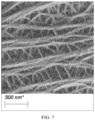
- the polyolefin porous film provided by the present disclosure is prepared by wet stretching, and has a network fiber structure; wherein when observed in a 20,000 ⁇ SEM image, the polyolefin porous film has the following characteristics:
- the polyolefin porous film provided is prepared by wet stretching, and has a network fiber structure; wherein when observed in a 20,000 ⁇ SEM image, the polyolefin porous film has the following characteristics:
- the polyolefin microporous film further has the following characteristics; optionally, if a ratio of the tensile strength in the MD to the tensile strength in the TD is a MD/TD tensile strength ratio, 0.8 ⁇ the MD/TD tensile strength ratio ⁇ 1.2.
- a ratio of an elongation at break in the MD to an elongation at break in the TD is a MD/TD elongation at break ratio
- the polyolefin porous film has a film thickness of 1-30 ⁇ m.
- the present disclosure also provides a preparation method for the polyolefin porous film as described above, including the following steps of:
- the stretching ratio in the MD and the stretching ratio in the TD are both 5 times or more.
- the polyolefin has a viscosity average molecular weight of 0.2 million to 5 million.
- the pore-forming agent is one or more selected from white oil, paraffin oil, and polyethylene glycol.
- the additive in the step 1 includes an antioxidant, wherein the antioxidant is one or more selected from an amine, a sulfur-containing compound, a nitrogen-containing compound, a phosphorus-containing compound, and an organic metal salt.
- the antioxidant is one or more selected from an amine, a sulfur-containing compound, a nitrogen-containing compound, a phosphorus-containing compound, and an organic metal salt.
- the present disclosure also provides a battery separator, including the polyolefin porous film as described above.
- the present disclosure also provides an electrochemical device, including the polyolefin porous film as described above or the battery separator as described above as an element for separating a positive electrode from a negative electrode.
- the polyolefin porous film of the present disclosure can achieve consistency of the mechanical properties as a separator in a battery, thereby improving the stability of the separator in battery production and the safety of battery applications.
- the present discloser finds that the uniformity of a fiber structure in a polyolefin porous film is an important guarantee for the performance of a separator, and the microscopic fiber structure characteristics determine the macroscopic properties of the polyolefin porous film as a battery separator, wherein the degree of uniformity of distribution and orientation of the fibers determines the uniformity of mechanical properties of the separator, and when the polyolefin porous film has the following characteristics, excellent uniformity of mechanical properties in all directions can be obtained, thereby having higher safety in battery applications.
- the polyolefin porous film When observed in a 20,000 ⁇ SEM image, the polyolefin porous film has the following characteristics:
- the polyolefin porous film provided is prepared by wet stretching, and has a network fiber structure; and when observed in a 20,000 ⁇ SEM image, the polyolefin porous film has the following characteristics:
- the polyolefin resin used as a raw material may use, for example, polyethylene, polypropylene and the like.
- polyethylene there are no specific restrictions, various polyethylenes can be used, for example, ultra-high molecular weight polyethylene (UHMwPE), high-density polyethylene (HDPE), medium-density polyethylene, branched low-density polyethylene, linear low-density polyethylene, and the like can be used.
- UHMwPE ultra-high molecular weight polyethylene
- HDPE high-density polyethylene
- medium-density polyethylene medium-density polyethylene
- branched low-density polyethylene branched low-density polyethylene
- linear low-density polyethylene linear low-density polyethylene
- polyethylene may be a homopolymer of ethylene or a copolymer of ethylene and other alpha-olefins.
- ⁇ -olefin propylene, 1-butene, 1-hexene, 1-pentene, 4-methyl-1-pentene, octene, vinyl acetate, methyl methacrylate, styrene and the like can be enumerated.
- the polyolefin porous film refers to a microporous film having polyolefin resin as a main component, for example, a microporous film in which the polyolefin resin accounts for 90% or more by mass of the total amount of the microporous film.
- the physical properties of the polyolefin porous film of this embodiment will be described.
- a ratio of the tensile strength in the MD to the tensile strength in the TD, i.e., a MD/TD tensile strength ratio, of the polyolefin porous film of the present disclosure is optionally 0.8 or more and 1.2 or less.
- the tensile strength ratio is in the above range, it can bear the forces more uniformly when facing impacts from all directions, and therefore, the impact resistance is improved when the polyolefin porous film is applied to a battery as a separator, the separator is more stable, and separator rupture and short circuit can be inhibited.
- the MD/TD tensile strength ratio is close to 1.
- the film has excellent toughness and will not crack in a specific direction, and enlargement of through holes can be avoided even if foreign matters penetrate the microporous film.
- the tensile strength in the MD is too high, tearing in the MD sometimes occurs.
- the tensile strength in the TD is too high, tearing in the TD sometimes occurs or bonding of an adhesive portion of an electrode contact is detached to become easily short-circuited.
- a ratio of an elongation at break in the MD to an elongation at break in the TD, i.e., a MD/TD elongation at break ratio, of the polyolefin porous film of the present disclosure is optionally 0.8 or more and 1.2 or less.
- the elongation at break ratio is in the above range, it can bear the forces more uniformly when facing impacts from all directions, and therefore, the impact resistance is improved when the polyolefin porous film is applied to a battery as a separator, the separator is more stable, and separator rupture and short circuit can be inhibited.
- the MD/TD elongation at break ratio is close to 1.
- the film has excellent toughness and will not crack in a specific direction, and the enlargement of through holes can be avoided even if foreign matters penetrate the microporous film.
- the film thickness of the polyolefin porous film there is no particular limitation on the film thickness of the polyolefin porous film.
- the polyolefin porous film of the present disclosure has a thickness of 2 ⁇ m or more, optionally 5 ⁇ m or more.
- the microporous film has a thickness of 50 ⁇ m or less, optionally 30 ⁇ m or less.
- the polyolefin porous film of the present disclosure has a tensile strength of 150 MPa or more, optionally 200 MPa or more in both the MD and the TD. If the tensile strength is weak, the windability of the battery will be deteriorated or a short circuit is easily generated due to a battery collision test performed from the outside, foreign matters in the battery, or the like.
- an upper limit of the tensile strength in the MD and the TD is not particularly limited, and from practical production experience, the upper limit of the tensile strength in the MD and the TD is optionally 700 MPa or less, optionally 600 MPa or less, optionally 550 MPa or less.
- the polyolefin porous film of the present disclosure optionally has an elongation at break of 90% or more in the MD and an elongation at break of 90% or more in the TD, respectively.
- the elongation at break is in the above range, its flexibility is utilized to inhibit the occurrence of rupture and short-circuiting of the separator upon impact in the battery.
- an upper limit of the elongation at break in the MD and the TD is not particularly limited, for example, 400% or less, optionally 300% or less, optionally 200% or less.
- the separator is not elongated to be deformed when an electrode is wound, and the windability is good.
- the elongation at break in the MD and the elongation at break in the TD are optionally 10-200%, respectively, optionally 10-150%, optionally 10-120%.
- the microporous film having the elongation at break in the MD and the elongation at break in the TD in the above range is not only good in battery windability, but also is not likely to cause deformation in a battery collision test or the like.
- the polyolefin porous film also needs to be excellent in heat shrinkage characteristics at a high temperature as a separator, such as showing excellent results in a high-temperature storage test, a high-temperature cycle test, a baking test, and the like in a state of being made into a battery.
- the thermal shrinkage rate in the MD is less than 5%, and the thermal shrinkage rate in the TD is less than 6.5%, optionally, the thermal shrinkage rate in the MD is 4% or less, and the thermal shrinkage rate in the TD is 4% or less, optionally, the thermal shrinkage rate in the MD is 3% or less, and the thermal shrinkage rate in the TD is 2.5% or less, and optionally, the thermal shrinkage rate in the MD is 1% or less, and the thermal shrinkage rate in the TD is 1% or less.
- the microporous film When the thermal shrinkage rate is greater than the above-mentioned optional range, the microporous film easily shrinks in the width direction in a battery drying process, a battery high-temperature cycle test, a battery high-temperature preservation test, or the like, and the microporous film is not preferred.
- the polyolefin porous film of the present disclosure is prepared by wet stretching, and a preparation method therefor includes: (1) by using one or more polyolefin resin materials above as main raw materials, mixing the above raw materials with a pore-forming agent and an antioxidant, and performing die extrusion on the mixture to prepare a cast sheet; (2) biaxially stretching the cast sheet to prepare an oil film; and (3) performing extraction on the oil film, and then performing heat setting treatment.
- the control of the temperature and the ratio of the stretching ratios of the cast sheet during stretching is one of the key factors for obtaining a polyolefin porous film having the above-mentioned characteristics; a temperature field and a stretching field need to be controlled during biaxial stretching, the temperature of the cast sheet itself shall not exceed 140°C, and a temperature difference between different points of a temperature field in a stretching area is less than 0.5°C, it is necessary that the ratio of the stretching ratio in the MD to the stretching ratio in the TD is 0.9 or more and 1.1 or less, and when an actual ratio of the stretching ratios is in the above range, the balance of the tensile strength or elongation at break of the obtained polyolefin porous film in the MD and the TD becomes good, and the film strength can be further improved, and the impact resistance can be improved.
- the stretching ratio in the MD and the stretching ratio in the TD are an actual stretching ratio in the MD and an actual stretching ratio in the TD of the separator.
- a stretching ratio in the MD and a stretching ratio in the TD can be obtained directly from actual settings of equipment, or can be obtained in the following manner: a synchronous stretching ratio in the MD is equal to a ratio of a rate of the oil film prepared after synchronous stretching in the MD to a running rate of the sheet before entering the stretching; and a synchronous stretching ratio in the TD is equal to a ratio of a width of the oil film prepared after synchronous stretching in the TD to a width of a TD stretched region of the sheet before entering the stretching, and attention should be paid to deducting a width of a clamping part of a clamp.
- an asynchronous stretching ratio in the MD can be obtained directly from actual settings of equipment, or can be obtained from a ratio of a rate of the sheet after stretching in the MD and before entering stretching in the TD to a rate before stretching; and an asynchronous stretching ratio in the TD is a ratio of an actual width of the oil film after stretching in the TD is finished to an actual width of a gel sheet before stretching in the MD.
- the types and proportions of the polyolefin, the pore-forming agent and the antioxidant, a method of mixing and extrusion, the types and use or not of an extractant, a process of mild heat setting, and the like are not particularly limited.
- the polyolefin resin used as a raw material may use, for example, polyethylene, polypropylene and the like.
- polyethylene there are no specific restrictions, various polyethylenes can be used, for example, ultra-high molecular weight polyethylene (UHMWPE), high-density polyethylene (HDPE), medium-density polyethylene, branched low-density polyethylene, linear low-density polyethylene, and the like can be used.
- UHMWPE ultra-high molecular weight polyethylene
- HDPE high-density polyethylene
- polyethylene may be a homopolymer of ethylene or a copolymer of ethylene and other alpha-olefins.
- ⁇ -olefin propylene, 1-butene, 1-hexene, 1-pentene, 4-methyl-1-pentene, octene, vinyl acetate, methyl methacrylate, styrene and the like can be enumerated.
- the viscosity average molecular weight of the polyolefin resin is 200,000 or more and 5 million or less; and when the viscosity average molecular weight of the polyolefin resin is in the above range, the film-making property becomes good.
- a film-forming material may contain a polymer of other resin components besides the polyolefin material as required, for example, high-temperature-resistant resin such as polypropylene, polyimide, polyamide, fluorine resin, and the like may be used. Wherein a mass percentage of the polyolefin in the mixture is greater than or equal to 15%, and a mass percentage of the high-temperature-resistant resin in the mixture is less than 10%.
- the pore-forming agent can be a liquid hydrocarbon mixture such as white oil, an organic acid ester such as dioctyl phthalate (DOP), an inorganic acid ester such as trioctyl phosphate (TOP), an organic compound capable of forming a homogeneous solution with the polyolefin resin, or a mixture of the above pore-forming agents, or the like.
- DOP dioctyl phthalate
- TOP trioctyl phosphate
- organic compound capable of forming a homogeneous solution with the polyolefin resin or a mixture of the above pore-forming agents, or the like.
- the antioxidant can use only one main antioxidant or a combination of a plurality of antioxidants.
- the addition of the antioxidant can slow down the aging degradation of the polymer and the pore-forming agent during shear processing, as well as effectively improve the color, flatness, and strength of the film surface.
- the stretching temperature is higher than a softening point (Tcd) of a mixture formed by sufficiently melting the polyolefin resin and the pore-forming agent, and is lower than a melting point of the polyolefin resin.
- Tcd softening point
- the melting point of the polyolefin resin here refers to a melting point of the polyolefin resin in a gel-like sheet.
- the stretching temperature is the softening point (Tcd) or above, the polyolefin resin in the gel-like sheet can be sufficiently softened to lower the stretching tension, and therefore, the film-making property becomes good, separator rupture during stretching can be inhibited, and stretching can be performed at a high ratio.
- the stretching temperature may be set to be, for example, 50°C or more and 140°C or less, optionally 60°C or more and 130°C or less.
- the stretching temperature refers to the temperature of the gel sheet.
- a polyolefin porous film with uniform orientation of a microscopic fiber structure and thus small difference in macroscopic two-directional mechanical properties can be obtained, and in the case of being used as a separator for batteries, the stability of the separator in battery production and the safety of battery application can be improved.
- the gel was extruded by using a T-die with the melt extrusion temperature controlled at 220°C or below, then rapidly cooled on a thermostated metal double crusher with a surface temperature of 15°C, and rolled into a sheet with a sheet thickness of 1.5 mm.
- the sheet i.e. a cast sheet
- Rapid stretching was performed at 120°C at a rate of 40 m/min, wherein stretching was performed at a ratio of 6.5 in both the MD and the TD.
- the uniformity of a temperature field needed to be controlled during stretching, and a temperature difference between different points of the temperature field in a stretching area was less than 0.3°C, and an oil film was prepared after stretching.
- the oil film was drawn into dichloromethane for extraction to extract the paraffin oil from the oil film.
- Residual dichloromethane in a separator was then carried out by hot air at a constant temperature of 40°C, and since a small amount of shrinkage occurred in the TD under the action of drawing in the MD during the extraction and drying process, the shrinkage being 15%, heat setting and expansion were carried out at 131°C to achieve a ratio of the original stretching ratio in the MD to the original stretching ratio in the TD to finally obtain a polyolefin porous film having a uniform fiber structure orientation.
- the gel was extruded by using a T-die with the melt extrusion temperature controlled at 220°C or below, then rapidly cooled on a thermostated metal double crusher with a surface temperature of 15°C, and rolled into a sheet with a sheet thickness of 1.5 mm.
- the sheet i.e. a cast sheet
- Rapid stretching was performed at 117°C at a rate of 40 m/min, wherein stretching was performed at a ratio of 7.5 in the MD, and stretching was performed at a ratio of 7.2 in the TD.
- the uniformity of a temperature field needed to be controlled during stretching, and a temperature difference between different points of the temperature field in a stretching area is less than 0.3°C, and an oil film was prepared after stretching.
- the oil film was drawn into dichloromethane for extraction to extract the paraffin oil from the oil film.
- Residual dichloromethane in a separator was then carried out by hot air at a constant temperature of 40°C, and since a small amount of shrinkage occurred in the TD under the action of drawing in the MD during the extraction and drying process, the shrinkage being 18%, heat setting and expansion were carried out at 131°C to achieve a ratio of the original stretching ratio in the MD to the original stretching ratio in the TD to finally obtain a polyolefin porous film having a uniform fiber structure orientation.
- ultra-high molecular weight polyethylene powder GUR2122, Ticona Celanese
- 5 parts by weight of high-density polyethylene powder GUR4116, Ticona Celanese
- paraffin oil 60#, Zhejiang Zhengxin
- 0.3 part by weight of an antioxidant Irg1010 (Ciba Specialty Chemicals BASF)
- 0.1 part by weight of an antioxidant P168 (manufactured by Ciba Specialty Chemicals Co., Ltd.) were added relative to 100 parts by weight of the high molecular weight polyethylene and the paraffin oil in total, and they were mixed in sequence.
- the ultra-high molecular weight polyethylene material after being mixed with an auxiliary was fed into a twin-screw extruder together with the paraffin oil for mixing to finally prepare a mixture melt gel.
- the gel was extruded by using a T-die with the melt extrusion temperature controlled at 220°C or below, then rapidly cooled on a thermostated metal double crusher with a surface temperature of 15°C, and rolled into a sheet with a sheet thickness of 1.5 mm.
- the sheet i.e. a cast sheet
- Rapid stretching was performed at 122°C at a rate of 40 m/min, wherein stretching was performed at a ratio of 7.2 in the MD, and stretching was performed at a ratio of 7.1 in the TD.
- the uniformity of a temperature field needed to be controlled during stretching, and a temperature difference between different points of the temperature field in a stretching area was less than 0.3°C, and an oil film was prepared after stretching.
- the oil film was drawn into dichloromethane for extraction to extract the paraffin oil from the oil film.
- Residual dichloromethane in a separator was then carried out by hot air at a constant temperature of 40°C, and since a small amount of shrinkage occurred in the TD under the action of drawing in the MD during the extraction and drying process, the shrinkage being 20%, heat setting and expansion were carried out at 131°C to achieve a ratio of the original stretching ratio in the MD to the original stretching ratio in the TD to finally obtain a polyolefin porous film having a uniform fiber structure orientation.
- ultra-high molecular weight polyethylene powder GUR2122, Ticona Celanese
- 10 parts by weight of high-density polyethylene powder VH200U, KPIC
- 5 parts by weight of polyethylene powder VH035, KPIC
- paraffin oil 60#, Zhejiang Zhengxin
- 0.3 part by weight of an antioxidant Irg1010 (Ciba Specialty Chemicals BASF)
- 0.1 part by weight of an antioxidant P168 (manufactured by Ciba Specialty Chemicals Co., Ltd.) were added relative to 100 parts by weight of the high molecular weight polyethylene and the paraffin oil in total, and they were mixed in sequence.
- the ultra-high molecular weight polyethylene material after being mixed with an auxiliary was fed into a twin-screw extruder together with the paraffin oil for mixing to finally prepare a mixture melt gel.
- the gel was extruded by using a T-die with the melt extrusion temperature controlled at 220°C or below, then rapidly cooled on a thermostated metal double crusher with a surface temperature of 15°C, and rolled into a sheet with a sheet thickness of 1.5 mm.
- the sheet i.e. a cast sheet
- Rapid stretching was performed at 117°C at a rate of 40 m/min, wherein stretching was performed at a ratio of 6.8 in the MD, and stretching was performed at a ratio of 6.8 in the TD.
- the uniformity of a temperature field needed to be controlled during stretching, and a temperature difference between different points of the temperature field in a stretching area was less than 0.3°C, and an oil film was prepared after stretching.
- the oil film was drawn into dichloromethane for extraction to extract the paraffin oil from the oil film.
- Residual dichloromethane in a separator was then carried out by hot air at a constant temperature of 40°C, and since a small amount of shrinkage occurred in the TD under the action of drawing in the MD during the extraction and drying process, the shrinkage being 21%, heat setting and expansion were carried out at 131°C to achieve a ratio of the original stretching ratio in the MD to the original stretching ratio in the TD to finally obtain a polyolefin porous film having a uniform fiber structure orientation.
- ultra-high molecular weight polyethylene powder GUR2122, Ticona Celanese
- 10 parts by weight of high-density polyethylene powder VH200U, KPIC
- 5 parts by weight of polyethylene powder VH035, KPIC
- paraffin oil 60#, Zhejiang Zhengxin
- 0.3 part by weight of an antioxidant Irg1010 (Ciba Specialty Chemicals BASF)
- 0.1 part by weight of an antioxidant P168 (manufactured by Ciba Specialty Chemicals Co., Ltd.) were added relative to 100 parts by weight of the high molecular weight polyethylene and the paraffin oil in total, and they were mixed in sequence.
- the ultra-high molecular weight polyethylene material after being mixed with an auxiliary was fed into a twin-screw extruder together with the paraffin oil for mixing to finally prepare a mixture melt gel.
- the gel was extruded by using a T-die with the melt extrusion temperature controlled at 220°C or below, then rapidly cooled on a thermostated metal double crusher with a surface temperature of 15°C, and rolled into a sheet with a sheet thickness of 1.5 mm.
- the sheet i.e. a cast sheet
- Rapid stretching was performed at 116°C at a rate of 40 m/min, wherein stretching was performed at a ratio of 8 in the MD, and stretching was performed at a ratio of 8 in the TD.
- the uniformity of a temperature field needed to be controlled during stretching, and a temperature difference between different points of the temperature field in a stretching area was less than 0.3°C, and an oil film was prepared after stretching.
- the oil film was drawn into dichloromethane for extraction to extract the paraffin oil from the oil film.
- Residual dichloromethane in a separator was then carried out by hot air at a constant temperature of 40°C, and since a small amount of shrinkage occurred in the TD under the action of drawing in the MD during the extraction and drying process, the shrinkage being 21%, heat setting and expansion were carried out at 131°C to achieve a ratio of the original stretching ratio in the MD to the original stretching ratio in the TD to finally obtain a polyolefin porous film having a uniform fiber structure orientation.
- ultra-high molecular weight polyethylene powder GUR2122, Ticona Celanese
- 10 parts by weight of high-density polyethylene powder VH200U, KPIC
- 5 parts by weight of polyethylene powder VH035, KPIC
- paraffin oil 60#, Zhejiang Zhengxin
- 0.3 part by weight of an antioxidant Irg1010 (Ciba Specialty Chemicals BASF)
- 0.1 part by weight of an antioxidant P168 (manufactured by Ciba Specialty Chemicals Co., Ltd.) were added relative to 100 parts by weight of the high molecular weight polyethylene and the paraffin oil in total, and they were mixed in sequence.
- the ultra-high molecular weight polyethylene material after being mixed with an auxiliary was fed into a twin-screw extruder together with the paraffin oil for mixing to finally prepare a mixture melt gel.
- the gel was extruded by using a T-die with the melt extrusion temperature controlled at 220°C or below, then rapidly cooled on a thermostated metal double crusher with a surface temperature of 15°C, and rolled into a sheet with a sheet thickness of 1.5 mm.
- the sheet i.e. a cast sheet
- Rapid stretching was performed at 115°C at a rate of 40 m/min, wherein stretching was performed at a ratio of 10 in the MD, and stretching was performed at a ratio of 10 in the TD.
- the uniformity of a temperature field needed to be controlled during stretching, and a temperature difference between different points of the temperature field in a stretching area was less than 0.3°C, and an oil film was prepared after stretching.
- the oil film was drawn into dichloromethane for extraction to extract the paraffin oil from the oil film.
- Residual dichloromethane in a separator was then carried out by hot air at a constant temperature of 40°C, and since a small amount of shrinkage occurred in the TD under the action of drawing in the MD during the extraction and drying process, the shrinkage being 21%, heat setting and expansion were carried out at 131°C to achieve a ratio of the original stretching ratio in the MD to the original stretching ratio in the TD to finally obtain a polyolefin porous film having a uniform fiber structure orientation.
- ultra-high molecular weight polyethylene powder GUR2122, Ticona Celanese
- 10 parts by weight of high-density polyethylene powder VH200U, KPIC
- 5 parts by weight of polyethylene powder VH035, KPIC
- paraffin oil 60#, Zhejiang Zhengxin
- 0.3 part by weight of an antioxidant Irg1010 (Ciba Specialty Chemicals BASF)
- 0.1 part by weight of an antioxidant P168 (manufactured by Ciba Specialty Chemicals Co., Ltd.) were added relative to 100 parts by weight of the high molecular weight polyethylene and the paraffin oil in total, and they were mixed in sequence.
- the ultra-high molecular weight polyethylene material after being mixed with an auxiliary was fed into a twin-screw extruder together with the paraffin oil for mixing to finally prepare a mixture melt gel.
- the gel was extruded by using a T-die with the melt extrusion temperature controlled at 220°C or below, then rapidly cooled on a thermostated metal double crusher with a surface temperature of 15°C, and rolled into a sheet with a sheet thickness of 1.5 mm.
- the sheet i.e. a cast sheet
- Rapid stretching was performed at 115°C at a rate of 40 m/min, wherein stretching was performed at a ratio of 10 in the MD, and stretching was performed at a ratio of 11 in the TD.
- the uniformity of a temperature field needed to be controlled during stretching, and a temperature difference between different points of the temperature field in a stretching area was less than 0.3°C, and an oil film was prepared after stretching.
- the oil film was drawn into dichloromethane for extraction to extract the paraffin oil from the oil film.
- Residual dichloromethane in a separator was then carried out by hot air at a constant temperature of 40°C, and since a small amount of shrinkage occurred in the TD under the action of drawing in the MD during the extraction and drying process, the shrinkage being 21%, heat setting and expansion were carried out at 131°C to achieve a ratio of the original stretching ratio in the MD to the original stretching ratio in the TD to finally obtain a polyolefin porous film having a uniform fiber structure orientation.
- ultra-high molecular weight polyethylene powder GUR2122, Ticona Celanese
- 10 parts by weight of high-density polyethylene powder VH200U, KPIC
- 5 parts by weight of polyethylene powder VH035, KPIC
- paraffin oil 60#, Zhejiang Zhengxin
- 0.3 part by weight of an antioxidant Irg1010 (Ciba Specialty Chemicals BASF)
- 0.1 part by weight of an antioxidant P168 (manufactured by Ciba Specialty Chemicals Co., Ltd.) were added relative to 100 parts by weight of the high molecular weight polyethylene and the paraffin oil in total, and they were mixed in sequence.
- the ultra-high molecular weight polyethylene material after being mixed with an auxiliary was fed into a twin-screw extruder together with the paraffin oil for mixing to finally prepare a mixture melt gel.
- the gel was extruded by using a T-die with the melt extrusion temperature controlled at 220°C or below, then rapidly cooled on a thermostated metal double crusher with a surface temperature of 15°C, and rolled into a sheet with a sheet thickness of 1.5 mm.
- the sheet i.e. a cast sheet
- Rapid stretching was performed at 115°C at a rate of 40 m/min, wherein stretching was performed at a ratio of 10 in the MD, and stretching was performed at a ratio of 9.1 in the TD.
- the uniformity of a temperature field needed to be controlled during stretching, and a temperature difference between different points of the temperature field in a stretching area was less than 0.3°C, and an oil film was prepared after stretching.
- the oil film was drawn into dichloromethane for extraction to extract the paraffin oil from the oil film.
- Residual dichloromethane in a separator was then carried out by hot air at a constant temperature of 40°C, and since a small amount of shrinkage occurred in the TD under the action of drawing in the MD during the extraction and drying process, the shrinkage being 21%, heat setting and expansion were carried out at 131°C to achieve a ratio of the original stretching ratio in the MD to the original stretching ratio in the TD to finally obtain a polyolefin porous film having a uniform fiber structure orientation.
- ultra-high molecular weight polyethylene powder VH200U, LPIC
- 5 parts by weight of high-density polyethylene powder VH035, KPIC
- paraffin oil 60#, Zhejiang Zhengxin
- 0.3 part by weight of an antioxidant Irg1010 (Ciba Specialty Chemicals BASF)
- 0.1 part by weight of an antioxidant P168 (manufactured by Ciba Specialty Chemicals Co., Ltd.) were added relative to 100 parts by weight of the high molecular weight polyethylene and the paraffin oil in total, and they were mixed in sequence.
- the ultra-high molecular weight polyethylene material after being mixed with an auxiliary was fed into a twin-screw extruder together with the paraffin oil for mixing to finally prepare a mixture melt gel.
- the gel was extruded by using a T-die with the melt extrusion temperature controlled at 220°C or below, then rapidly cooled on a thermostated metal double crusher with a surface temperature of 15°C, and rolled into a sheet with a sheet thickness of 1.5 mm.
- the sheet i.e. a cast sheet
- the cast sheet was stretched in the MD at 90°C, wherein a stretching ratio in the MD was 9; and rapid stretching in the TD was then carried out at 119°C at a rate of 60 m/min with a stretching ratio in the TD of 8.3 (a ratio of an outlet width to an original width of the cast sheet was 8.2).
- the uniformity of a temperature field needed to be controlled during stretching, and a temperature difference between different points of the temperature field in a stretching area was less than 0.3°C, and an oil film was prepared after stretching was finished.
- the oil film was drawn into dichloromethane for extraction to extract the paraffin oil from the oil film.
- Residual dichloromethane in a separator was then carried out by hot air at a constant temperature of 40°C, and since a small amount of shrinkage occurred in the TD under the action of MD drawing during the extraction and drying process, the shrinkage being 22%, heat setting and expansion were carried out at 131°C to achieve a ratio of the original stretching ratio in the MD to the original stretching ratio in the TD to finally obtain a polyolefin porous film having a uniform fiber structure orientation.
- the gel was extruded by using a T-die with the melt extrusion temperature controlled at 220°C or below, then rapidly cooled on a thermostated metal double crusher with a surface temperature of 15°C, and rolled into a sheet with a sheet thickness of 1.5 mm.
- the sheet i.e. a cast sheet
- Rapid stretching was performed at 117°C at a rate of 40 m/min, wherein stretching was performed at a ratio of 7.9 in the MD, and stretching was performed at a ratio of 6.5 in the TD.
- the uniformity of a temperature field needed to be controlled during stretching, and a temperature difference between different points of the temperature field in a stretching area was less than 0.3°C, and an oil film was prepared after stretching.
- the oil film was drawn into dichloromethane for extraction to extract the paraffin oil from the oil film.
- Residual dichloromethane in a separator was then carried out by hot air at a constant temperature of 40°C, and since a small amount of shrinkage occurred in the TD under the action of drawing in the MD during the extraction and drying process, the shrinkage being 18%, heat setting and expansion were carried out at 131°C to achieve a ratio of the original stretching ratio in the MD to the original stretching ratio in the TD to finally obtain a polyolefin porous film.
- ultra-high molecular weight polyethylene powder GUR2122, Ticona Celanese
- 10 parts by weight of high-density polyethylene powder VH200U, KPIC
- 5 parts by weight of polyethylene powder VH035, KPIC
- paraffin oil 60#, Zhejiang Zhengxin
- 0.3 part by weight of an antioxidant Irg1010 (Ciba Specialty Chemicals BASF)
- 0.1 part by weight of an antioxidant P168 (manufactured by Ciba Specialty Chemicals Co., Ltd.) were added relative to 100 parts by weight of the high molecular weight polyethylene and the paraffin oil in total, and they were mixed in sequence.
- the ultra-high molecular weight polyethylene material after being mixed with an auxiliary was fed into a twin-screw extruder together with the paraffin oil for mixing to finally prepare a mixture melt gel.
- the gel was extruded by using a T-die with the melt extrusion temperature controlled at 220°C or below, then rapidly cooled on a thermostated metal double crusher with a surface temperature of 15°C, and rolled into a sheet with a sheet thickness of 1.5 mm.
- the sheet i.e. a cast sheet
- Rapid stretching was performed at 116°C at a rate of 40 m/min, wherein stretching was performed at a ratio of 7.1 in the MD, and stretching was performed at a ratio of 5.4 in the TD.
- the uniformity of a temperature field needed to be controlled during stretching, and a temperature difference between different points of the temperature field in a stretching area was less than 0.3°C, and an oil film was prepared after stretching.
- the oil film was drawn into dichloromethane for extraction to extract the paraffin oil from the oil film.
- Residual dichloromethane in a separator was then carried out by hot air at a constant temperature of 40°C, and since a small amount of shrinkage occurred in the TD under the action of drawing in the MD during the extraction and drying process, the shrinkage being 21%, heat setting and expansion were carried out at 131°C to achieve a ratio of the original stretching ratio in the MD to the original stretching ratio in the TD to finally obtain a polyolefin porous film.
- the thickness of the polyolefin porous films obtained in the examples was tested with a tenthousandth micrometer.
- fibers taken are fibers on the outermost surface of the polyolefin porous film
- N is the number of fibers on the outermost surface in the observation area
- each fiber is identified by n (n is a natural number)
- the length of a fiber taken refers to a length of a segment with a same thickness that has a same extension direction on a same fiber, when the thickness of the same fiber changes, it is not counted as a length, and a difference needs to be corrected timely
- the segment with the same thickness means that a width of the thickest portion in the segment is increased within 5% compared with a width of the thinnest portion
- the fiber diameter is an average of a width of the widest portion and the width of the thinnest portion of the segment with the same thickness
- the angle between the fiber and the MD or the TD is an angle between the extension direction of the segment with the same thickness and the MD or the TD.
- a test was carried out according to the requirements of GB 1040.3-2006, and samples were prepared by cutting, and were type 2 samples.
- the samples were in the form of elongated strips of 200 mm in length and 25 mm in width, a distance between clamps was (100 ⁇ 5) mm, and a test speed was (250 ⁇ 10) mm/min.
- a test was carried out according to the requirements of GB 1040.3-2006, and samples were prepared by cutting, and were type 2 samples.
- the samples were in the form of elongated strips f 200 mm in length and 25 mm in width, a distance between clamps was (100 ⁇ 5) mm, and a test speed was (250 ⁇ 10) mm/min.
- thermal shrinkage rate in the MD (%) (a length in the MD before heating-a length in the MD after heating) ⁇ the length in the MD before heating ⁇ 100
- Thermal shrinkage rate in the TD (%) (a length in the TD before heating-a length in the TD after heating) ⁇ the length in the TD before heating ⁇ 100
- Table 1 Related performance parameter indexes of polyolefin porous films in Examples 1-9 Serial number Features Exam ple 1 Exa mpl e 2 Exam ple 3 Exam ple 4 Exam ple 5 Exam ple 6 Exa mpl e 7 Exa mpl e 8 Exa mpl e 9 1 Thickness ( ⁇ m) 9.7 8.7 9.9 9 7 6 5.3 6.5 7.2 2 Air permeability (see/100 cc) 238 213 134 252 190 130 98 145 180 3 Tensile strength in the MD (MPa) 188 293 239 384 465 530 521 528 485 4 Tensile strength in the TD (MPa) 169 253 217 375 460 515 539 479 465 5 MD/TD tensile strength ratio 1.11 1.16 1.1 1.02 1.01 1.03 0.97 1.10 1.04 6 Elongation at break in the MD (%) 77
- Tables 1 and 2 are the related performance indexes of the polyolefin porous films in Examples 1-9, and the polyolefin porous films in Comparative examples 1-2, respectively, it can be seen that when the fiber orientation result R_MD in the MD satisfies (R_MD) 2 ⁇ 0.8, and the fiber orientation result R_TD in the TD satisfies (R_TD) 2 ⁇ 0.8 in the polyolefin porous film, the separator can obtain excellent uniformity of mechanical properties in all directions, thereby having higher safety in battery applications.
Landscapes
- Chemical & Material Sciences (AREA)
- Chemical Kinetics & Catalysis (AREA)
- Engineering & Computer Science (AREA)
- Electrochemistry (AREA)
- General Chemical & Material Sciences (AREA)
- Manufacturing & Machinery (AREA)
- Materials Engineering (AREA)
- Health & Medical Sciences (AREA)
- Medicinal Chemistry (AREA)
- Polymers & Plastics (AREA)
- Organic Chemistry (AREA)
- Mechanical Engineering (AREA)
- Cell Separators (AREA)
- Manufacture Of Porous Articles, And Recovery And Treatment Of Waste Products (AREA)
- Electric Double-Layer Capacitors Or The Like (AREA)
Applications Claiming Priority (3)
| Application Number | Priority Date | Filing Date | Title |
|---|---|---|---|
| CN202211244275.0A CN115312973B (zh) | 2022-10-12 | 2022-10-12 | 一种聚烯烃多孔膜及其制备方法、电池隔膜、电化学装置 |
| CN2022128427 | 2022-10-28 | ||
| PCT/CN2023/090556 WO2024077927A1 (fr) | 2022-10-12 | 2023-04-25 | Membrane poreuse en polyoléfine et son procédé de préparation, séparateur de batterie et dispositif électrochimique |
Publications (2)
| Publication Number | Publication Date |
|---|---|
| EP4376202A1 true EP4376202A1 (fr) | 2024-05-29 |
| EP4376202A4 EP4376202A4 (fr) | 2025-04-16 |
Family
ID=90668656
Family Applications (1)
| Application Number | Title | Priority Date | Filing Date |
|---|---|---|---|
| EP23744028.4A Pending EP4376202A4 (fr) | 2022-10-12 | 2023-04-25 | Membrane poreuse en polyoléfine et son procédé de préparation, séparateur de batterie et dispositif électrochimique |
Country Status (4)
| Country | Link |
|---|---|
| US (1) | US20250079631A1 (fr) |
| EP (1) | EP4376202A4 (fr) |
| JP (1) | JP2024542897A (fr) |
| WO (1) | WO2024077927A1 (fr) |
Family Cites Families (10)
| Publication number | Priority date | Publication date | Assignee | Title |
|---|---|---|---|---|
| KR100591061B1 (ko) * | 1998-10-01 | 2006-06-19 | 토넨 케미칼 코퍼레이션 | 폴리올레핀 미세다공성막 및 그것의 제조방법 |
| WO2000049074A1 (fr) * | 1999-02-19 | 2000-08-24 | Tonen Chemical Corporation | Film microporeux polyolefinique et son procede de preparation |
| US20050031943A1 (en) | 2003-08-07 | 2005-02-10 | Call Ronald W. | Battery separator and method of making same |
| US7981536B2 (en) * | 2006-08-31 | 2011-07-19 | Toray Tonen Specialty Separator Godo Kaisha | Microporous membrane, battery separator and battery |
| JP2014141644A (ja) | 2012-12-26 | 2014-08-07 | Toray Ind Inc | 二軸配向多孔性ポリプロピレンフィルム、蓄電デバイス用セパレータフィルムおよび蓄電デバイス |
| WO2016104792A1 (fr) | 2014-12-26 | 2016-06-30 | 東レバッテリーセパレータフィルム株式会社 | Membrane microporeuse en polyoléfine, son procédé de production, et séparateur de batterie |
| JP6665966B2 (ja) * | 2017-03-31 | 2020-03-13 | 東レ株式会社 | ポリオレフィン微多孔膜、非水電解液系二次電池用セパレータ、及び非水電解液系二次電池 |
| KR20210106274A (ko) * | 2020-02-20 | 2021-08-30 | 주식회사 엘지화학 | 개선된 내압축성을 갖는 리튬이차전지용 분리막 및 상기 분리막을 포함하는 리튬이차전지 |
| CN113488740A (zh) * | 2021-06-23 | 2021-10-08 | 苏州捷力新能源材料有限公司 | 一种锂电池隔膜及其制备方法 |
| CN115312973B (zh) * | 2022-10-12 | 2023-01-31 | 中材锂膜有限公司 | 一种聚烯烃多孔膜及其制备方法、电池隔膜、电化学装置 |
-
2023
- 2023-04-25 US US18/279,215 patent/US20250079631A1/en active Pending
- 2023-04-25 JP JP2023544439A patent/JP2024542897A/ja active Pending
- 2023-04-25 WO PCT/CN2023/090556 patent/WO2024077927A1/fr not_active Ceased
- 2023-04-25 EP EP23744028.4A patent/EP4376202A4/fr active Pending
Also Published As
| Publication number | Publication date |
|---|---|
| WO2024077927A1 (fr) | 2024-04-18 |
| US20250079631A1 (en) | 2025-03-06 |
| EP4376202A4 (fr) | 2025-04-16 |
| JP2024542897A (ja) | 2024-11-19 |
Similar Documents
| Publication | Publication Date | Title |
|---|---|---|
| US8048936B2 (en) | Microporous polyolefin film possessing good mechanical properties and thermal stability | |
| KR101477176B1 (ko) | 폴리올레핀 미세 다공막, 그 제조 방법, 전지용 세퍼레이터 및 전지 | |
| US8262973B2 (en) | Microporous polyolefin film with improved meltdown property and preparing method thereof | |
| US8597775B2 (en) | Microporous polyolefin multi layer film | |
| CN105246693B (zh) | 聚烯烃多层微多孔膜及其制造方法 | |
| KR101716249B1 (ko) | 폴리올레핀 미세 다공막 및 이의 제조 방법 | |
| CN111902470B (zh) | 聚烯烃微多孔膜 | |
| KR20120002977A (ko) | 미세다공막, 이러한 막의 제조 방법 및 사용 방법 | |
| JP5807388B2 (ja) | 多孔性ポリプロピレンフィルム | |
| JP7283080B2 (ja) | ポリオレフィン製微多孔膜、電池用セパレータおよび二次電池 | |
| JPWO2010008003A1 (ja) | 蓄電デバイス用セパレータ | |
| CN104024316A (zh) | 聚烯烃微多孔膜及其制造方法 | |
| CN105246957A (zh) | 聚烯烃微多孔膜及其制造方法 | |
| JP2010265414A (ja) | 微多孔性フィルム及びその製造方法並びに電池用セパレータ | |
| US20210005860A1 (en) | Polyolefin microporous film | |
| US20060228540A1 (en) | Microporous polyethylene film having excellent physical properties, productivity, and quality consistency, and method of producing same | |
| CN115312973B (zh) | 一种聚烯烃多孔膜及其制备方法、电池隔膜、电化学装置 | |
| CN113964448A (zh) | 隔膜及其制造方法、电池、电子设备、移动装置 | |
| EP3594279A1 (fr) | Membrane microporeuse de polyoléfine | |
| CN105246692A (zh) | 聚烯烃多层微多孔膜及其制造方法 | |
| JP2001081221A (ja) | ポリオレフィン製微多孔膜 | |
| JP5731762B2 (ja) | 微多孔性フィルム及びその製造方法並びに電池用セパレータ | |
| JP2019102126A (ja) | 電池用セパレータ及び非水電解液二次電池 | |
| JP6034635B2 (ja) | 微多孔性フィルム及び電池用セパレータ | |
| EP4376202A1 (fr) | Membrane poreuse en polyoléfine et son procédé de préparation, séparateur de batterie et dispositif électrochimique |
Legal Events
| Date | Code | Title | Description |
|---|---|---|---|
| STAA | Information on the status of an ep patent application or granted ep patent |
Free format text: STATUS: UNKNOWN |
|
| STAA | Information on the status of an ep patent application or granted ep patent |
Free format text: STATUS: THE INTERNATIONAL PUBLICATION HAS BEEN MADE |
|
| PUAI | Public reference made under article 153(3) epc to a published international application that has entered the european phase |
Free format text: ORIGINAL CODE: 0009012 |
|
| STAA | Information on the status of an ep patent application or granted ep patent |
Free format text: STATUS: REQUEST FOR EXAMINATION WAS MADE |
|
| 17P | Request for examination filed |
Effective date: 20230731 |
|
| AK | Designated contracting states |
Kind code of ref document: A1 Designated state(s): AL AT BE BG CH CY CZ DE DK EE ES FI FR GB GR HR HU IE IS IT LI LT LU LV MC ME MK MT NL NO PL PT RO RS SE SI SK SM TR |
|
| RIN1 | Information on inventor provided before grant (corrected) |
Inventor name: ZHANG, XUJIE Inventor name: MENG, XIANGGAN Inventor name: WU, QIYANG Inventor name: MA, YUAN Inventor name: XUE, YUNQING Inventor name: DONG, QIUCHUN Inventor name: ZHENG, LEI Inventor name: LIU, ZHIGANG Inventor name: JIA, GUOZHONG Inventor name: XUE, SHAN Inventor name: LIU, GAOJUN Inventor name: BAI, YAOZONG |
|
| REG | Reference to a national code |
Ref country code: DE Ref legal event code: R079 Free format text: PREVIOUS MAIN CLASS: H01M0050417000 Ipc: H01M0050489000 |
|
| A4 | Supplementary search report drawn up and despatched |
Effective date: 20250319 |
|
| RIC1 | Information provided on ipc code assigned before grant |
Ipc: H01M 10/0525 20100101ALI20250313BHEP Ipc: H01M 50/403 20210101ALI20250313BHEP Ipc: H01M 50/417 20210101ALI20250313BHEP Ipc: H01M 50/489 20210101AFI20250313BHEP |
|
| DAV | Request for validation of the european patent (deleted) | ||
| DAX | Request for extension of the european patent (deleted) |