EP4379068B1 - Iridoid- oder seco-iridoidderivate und ihre verwendung in einem gerbverfahren - Google Patents
Iridoid- oder seco-iridoidderivate und ihre verwendung in einem gerbverfahren Download PDFInfo
- Publication number
- EP4379068B1 EP4379068B1 EP22306770.3A EP22306770A EP4379068B1 EP 4379068 B1 EP4379068 B1 EP 4379068B1 EP 22306770 A EP22306770 A EP 22306770A EP 4379068 B1 EP4379068 B1 EP 4379068B1
- Authority
- EP
- European Patent Office
- Prior art keywords
- aliphatic group
- hydrogen
- compound
- formula
- hydrogen atom
- Prior art date
- Legal status (The legal status is an assumption and is not a legal conclusion. Google has not performed a legal analysis and makes no representation as to the accuracy of the status listed.)
- Active
Links
Images

Classifications
-
- C—CHEMISTRY; METALLURGY
- C14—SKINS; HIDES; PELTS; LEATHER
- C14C—CHEMICAL TREATMENT OF HIDES, SKINS OR LEATHER, e.g. TANNING, IMPREGNATING, FINISHING; APPARATUS THEREFOR; COMPOSITIONS FOR TANNING
- C14C3/00—Tanning; Compositions for tanning
- C14C3/02—Chemical tanning
- C14C3/08—Chemical tanning by organic agents
Definitions
- the present invention relates to the field of tanning. More particularly, the present invention relates to particular iridoid or seco-iridoid derivatives, and their use in a tanning process. It also relates to a process for cross-linking collagen using such derivatives.
- the invention is set out in the appended set of claims.
- Natural tannins have long been used in processes for tanning skin and stabilizing collagen.
- Tanning mixtures are mainly composed of polyphenolic tannins, which are divided into two classes: condensed tannins and hydrolysable tannins.
- the effectiveness of tanning is usually reflected by its ability to stabilize collagen, namely to limit collagen denaturation and impart good resistance to enzymatic hydrolysis.
- Collagen stabilization can be assessed by measuring the increase in shrinkage temperature, which is correlated to the collagen denaturation temperature.
- the polyphenolic tannins give rise to a shrinkage temperature around 75-85°C.
- Other parameters can also be considered for assessing the effectiveness of tanning, such as the mechanical resistance of the hide and its sensory parameters, such as hide filling and suppleness.
- genipin can be obtained from geniposide which is extracted from the fruit of Gardenia jasminoides or Genipa americana. Genipin allows to stabilize the collagen and to reach shrinkage temperatures of 80°C ( Zhang et al., JALCA, 2011, 106, 121 ). Genipin has also been used in combination with an aluminum-based tanning ( Ding et al., JALCA, 2008, 103, 377 ), which resulted in a soft and full leather having a shrinkage temperature of 92°C. Genipin has also been used to cross-link gelatin ( Taylor et al., JALCA, 2009, 104, 79 ). Genipin is readily available in large quantities due to its use as a food coloring agent.
- WO2009/065915 describes a tanning method using aglycone derivatives of iridoids and seco-iridoids, different from genipin.
- Such derivatives can be extracted from olive leaves and are hydrolyzed to give aglycone forms of oleuropein.
- the mixture obtained by extraction of the leaves in the presence of endogenous enzyme or by the use of acid is not purified and also comprises polyphenolic compounds and compounds derived from hydrolyzed oleuropein, such as (4E)-4-formyl-3-(-1-formyl-2-methoxy-2-oxoethyl)hex-4-enoic acid.
- Document US 2017/080040-A1 discloses a decoction of olive leaves which can be used in the treatment of tanning hides and which comprises an aqueous composition containing at least from about 500 mg/L to about 3,000 mg/L of oleuropein, from about 100 mg/L to about 300 mg/L of hydroxytyrosol, from about 90 mg/L to about 280 mg/L of tyrosol, from about 400 mg/L to about 1,800 mg/L of elenolic acid.
- iridoid or seco-iridoid compounds with a particular acyclic acetal group.
- These protected iridoid or seco-iridoid derivatives can advantageously be obtained starting from the corresponding glycoside forms, by successively subjecting the latter to an oxidation and a reduction.
- This acetal protecting group can be easily removed before and/or during a tanning process, typically using acidic conditions, thereby releasing the active aglycone form.
- the present invention relates to the use of a compound of formula (I), in a tanning process: wherein:
- X is a moiety of aucubin, catalpol, harpagide, ajugol, geniposide, loganin, loganic acid, antirrhinoside, linarioside, feretoside, geniposidic acid, gardenoside, apodanthoside, desacetylasperulosidic acid, scandoside, methoxycinnamoyl scandoside methyl ester, demethyloleuropein, ligustroside, ligustrosidic acid, ligustaloside A, ligustaloside B, nuzhenide, horroxyloganin, oleuropein (or equivalently "oleuropeoside”), hydroxyframoside A, hydroxyframoside B, sweroside, swertiamarin, gentiopicroside, amarogentin, or morroniside, preferably geniposide or gentiopicroside.
- said compound of formula (I) is a compound of formula (I-2): wherein:
- said compound is represented by the following formula (I-1): wherein:
- R 2 is a C 1 -C 12 aliphatic group, preferably a C 1 -C 6 alkyl.
- R 4 is -C(O)-CH 2 -R 5 or -CH(OH)-CH 2 -R 5 ', where R 5 and R 5 ' are each independently a hydrogen atom, -OH, or -O-C(O)-(C 1 -C 12 aliphatic group), preferably a hydrogen atom, -OH or -O-C(O)-(C 1 -C 6 alkyl).
- R 3 and R 4 form together a chain of formula (II) as defined herein wherein:
- each of Y 1 , Y 2 , and Y 3 is independently a hydrogen, -C(O)-phenyl, or -C(O)-(C 1 -C 6 alkyl), preferably a hydrogen or -C(O)-CH 3 , more preferably a hydrogen.
- a use according to the invention is a use for tanning a hide or a skin.
- a use according to the invention is a use in a method for manufacturing a leather or a leather substitute.
- a use according to the invention is a use for tanning a collagen-containing material.
- the present invention also relates to a compound as defined herein per se , with the proviso that said compound is not one of the following compounds:
- Another object of the present invention is a process for cross-linking collagen in a material comprising a step of contacting said material with a compound as defined herein.
- Said material may in particular be a hide or a skin.
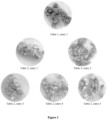
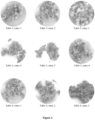
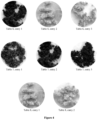
- Figures 1 , 2 , 3 and 4 Images of materials obtained after tanning of a collagen powder using compounds of the invention under various tanning conditions.
- C x -C y in which x and y are integers, as used in the present disclosure, means that the corresponding chemical group comprises from x to y carbon atoms. If, for example, the expression C 1 -C 6 is used, it means that the corresponding chemical group may comprise from 1 to 6 carbon atoms, especially 1, 2, 3, 4, 5 or 6 carbon atoms. If, for example, the expression C 2 -C 5 is used, it means that the corresponding chemical group may comprise from 2 to 5 carbon atoms, especially 2, 3, 4, or 5 carbon atoms.
- aliphatic refers to a saturated or unsaturated, cyclic or acyclic (preferably acyclic), linear or branched hydrocarbon chain.
- C 1 -C 12 aliphatic refers to an aliphatic having 1 to 12 carbon atoms.
- the aliphatic may be an alkyl, an alkenyl, or an alkynyl.
- alkyl refers to a saturated, linear or branched hydrocarbon chain.
- C 1 -C 6 alkyl refers to an alkyl having 1 to 6 carbon atoms. Examples of alkyl (or C 1 -C 6 alkyl) include, for instance, methyl, ethyl, propyl, isopropyl, butyl, isobutyl, tert -butyl, pentyl, or hexyl.
- alkenyl refers to an unsaturated, linear or branched hydrocarbon chain, having at least one carbon-carbon double bond.
- C 2 -C 6 alkenyl refers to an alkenyl having 2 to 6 carbon atoms. Examples of alkenyl (or C 2 -C 6 alkenyl) include for instance, ethenyl, propenyl, butenyl, pentenyl, or hexenyl.
- alkynyl refers to an unsaturated, linear or branched hydrocarbon chain, having at least one carbon-carbon triple bond.
- C 2 -C 6 alkynyl refers to an alkynyl having 2 to 6 carbon atoms. Examples of alkynyl (or C 2 -C 6 alkynyl) include, for instance, ethynyl, propynyl, butynyl, pentynyl, or hexynyl.
- alkoxy refers to a -O-(alkyl) group, where alkyl is as defined above.
- C 1 -C 6 alkoxy refers to an alkoxy having 1 to 6 carbon atoms. Examples of alkoxy (or C 1 -C 6 alkoxy) include, for instance, methoxy, ethoxy, propoxy, isopropoxy, butoxy, isobutoxy, tert- butoxy, pentoxy, or hexyloxy.
- aryl refers to a mono- or bi-cyclic aromatic hydrocarbon having from 6 to 12 carbon atoms.
- aryl includes phenyl, biphenyl, or naphthyl.
- the aryl is a phenyl.
- halogen refers to a fluorine atom, a chlorine atom, bromine atom, or iodine atom.
- the symbol means a single or double bond.
- the "salts" of the compounds as defined herein include usual salts formed from inorganic or organic acids or bases as well as quaternary ammonium salts. More specific examples of suitable acid salts include hydrochloric, hydrobromic, sulfuric, phosphoric, nitric, perchloric, fumaric, acetic, propionic, succinic, glycolic, formic, lactic, maleic, tartaric, citric, palmoic, malonic, hydroxymaleic, phenylacetic, glutamic, benzoic, salicylic, fumaric, toluenesulfonic, methanesulfonic, naphthalene-2-sulfonic, benzenesulfonic hydroxynaphthoic, hydroiodic, malic, steroic, tannic etc. More specific examples of suitable basic salts include sodium, lithium, potassium, magnesium, aluminum, calcium, zinc salts.
- the present invention relates to the use of a compound of formula (I), in a tanning process: wherein:
- each of Y 1 , Y 2 , and Y 3 is independently a hydrogen, -C(O)-phenyl, or -C(O)-(C 1 -C 6 alkyl), preferably a hydrogen or -C(O)-(C 1 -C 6 alkyl), more preferably a hydrogen or -C(O)-CH 3 , even more preferably a hydrogen.
- a “dihydropyranyl-oxy” moiety can typically be represented as follows (said moiety being optionally substituted at any position):
- an “iridoid” refers to a compound comprising a dihydropyranyl-oxy moiety, fused with a cyclopentyl, cyclopentenyl, or tetrahydropyranyl moiety. More particularly, the iridoid may comprise one of the following ring structures (each ring structure, including the oxy of the dihydropyranyl-oxy, being optionally substituted at any position):
- a "seco-iridoid” refers to a compound comprising a dihydropyranyl-oxy moiety substituted by at least two hydrocarbon chains having each independently at least two carbons. More particularly, the seco-iridoid may comprise one of the following ring structures (each ring structure, including the at least two hydrocarbon chains and the oxy of the dihydropyranyl-oxy, being optionally substituted at any position):
- the iridoids or seco-iridoids are usually in a glycoside form (i.e. the oxy of the dihydropyranyloxy being in the form of a glucosyl group) or aglycone form (i.e. the oxy of the dihydropyranyl-oxy being in the form of a hydroxy group).
- a "moiety of an iridoid, a seco-iridoid or a derivative thereof” refers to an iridoid, a seco-iridoid or a derivative thereof, deprived of an atom or a group of atoms, while preserving the backbone of said iridoid, seco-iridoid or derivative thereof.
- a "moiety of an iridoid, a seco-iridoid or a derivative thereof” refers to:
- a compound of formula (I) typically refers to the corresponding iridoid (or seco-iridoid or derivative thereof) wherein the glucosyl is formally replaced with the following moiety: wherein Y 1 , Y 2 , Y 3 are as defined herein.
- a compound of formula (I) typically refers to the corresponding iridoid (or seco-iridoid or derivative thereof) wherein the hydroxy is formally replaced with the following moiety: wherein Y 1 , Y 2 , Y 3 are as defined herein.
- X is a moiety of aucubin, catalpol, harpagide, ajugol, geniposide, loganin, loganic acid, antirrhinoside, linarioside, feretoside, geniposidic acid, gardenoside, apodanthoside, desacetylasperulosidic acid, scandoside, methoxycinnamoyl scandoside methyl ester, demethyloleuropein, ligustroside, ligustrosidic acid, ligustaloside A, ligustaloside B, nuzhenide, horroxyloganin, oleuropein (or equivalently "oleuropeoside”), hydroxyframoside A, hydroxyframoside B, sweroside, swertiamarin, gentiopicroside, amarogentin, and morroniside.
- X is a moiety of geniposide (or the aglycone form thereof, genipin) or a moiety of gentiopicroside (or the aglycone form thereof).
- the compound of formula (I) can typically be represented as follows: wherein Y 1 , Y 2 , Y 3 are as defined herein (preferably, hydrogens).
- the compound of formula (I) can typically be represented as follows: wherein Y 1 , Y 2 , Y 3 are as defined herein (preferably, hydrogens).
- the compound of formula (I) is a compound of formula (I-2): wherein:
- a preferred C 1 -C 12 aliphatic group is a C 1 -C 6 alkyl or a C 2 -C 6 alkenyl. It is understood that this applies to C 1 -C 12 aliphatic group as such, but can also apply to any group mentioned above comprising C 1 -C 12 aliphatic group, such as -C(O)O-(C 1 -C 12 aliphatic group).
- said aliphatic groups are each independently optionally substituted by one or more hydroxy (preferably one or two), aryl (preferably a phenyl) or glycosyl derivative, said aryl being optionally substituted by one or more hydroxy or (C 1 -C 6 )alkoxy. It is understood that this applies to aliphatic group as such, but also applies to any group mentioned above comprising aliphatic group, such as -C(O)O-(C 1 -C 12 aliphatic group).
- An example of C 2 -C 12 aliphatic group substituted by a hydroxy is -CH 2 -CH 2 -OH.
- each of Y 1 , Y 2 , and Y 3 is independently a hydrogen, -C(O)-phenyl, or - C(O)-(C 1 -C 6 alkyl), preferably a hydrogen or -C(O)-(C 1 -C 6 alkyl), more preferably a hydrogen or -C(O)-CH 3 , even more preferably a hydrogen.
- R 10 is a hydrogen, -C(O)OH, or -C(O)-O-(C 1 -C 6 alkyl), wherein said C 1 -C 6 alkyl is optionally substituted by a phenyl substituted one or two hydroxy.
- R 11 ' is a hydrogen
- R 12 ' is a hydrogen
- R 11 and R 12 form together a chain of formula (II-2) as defined above, wherein each of R 13 , R 14 , R 15 , and R 16 is independently a hydrogen, a halogen (such as a chlorine), -OH, or a C 1 -C 12 aliphatic group (preferably a C 1 -C 6 alkyl, such as a methyl) optionally substituted by a hydroxy, or R 14 and R 15 form together a -O- group.
- a halogen such as a chlorine
- -OH a C 1 -C 12 aliphatic group
- R 14 and R 15 form together a -O- group.
- R 11 and R 12 form together a chain of formula (II-2), it is preferred that at least two of R 13 , R 14 , R 15 , and R 16 are not hydrogens.
- R 11 and R 12 form together a chain of formula (II-3) as defined above, wherein R 17 and R 18 are hydrogens and R 19 is -CH 2 -O-C(O)-CH 3 .
- the compound of formula (I-2) may for instance be the following compound: wherein Y 1 , Y 2 , and Y 3 are as defined herein (preferably -C(O)CH 3 ).
- R 11 and R 12 form together a chain of formula (II-4) as defined above, wherein each of R 20 , R 21 , R 22 , and R 23 , is independently a hydrogen, -OH, -C(O)OH, or a hydroxy-(C 1 -C 12 aliphatic group), preferably hydrogen, -OH, -C(O)OH, or hydroxy(C 1 -C 6 alkyl) such as hydroxymethyl.
- R 20 and R 21 are hydrogens and, one or both of R 22 and R 23 are not hydrogens.
- R 11 and R 12 form together a chain of formula (II-5) as defined above, wherein each of R 24 , R 25 , or R 26 is independently a hydrogen, -OH, or a C 1 -C 12 aliphatic group (such as a C 1 -C 6 alkyl, typically a methyl), or a hydroxy-(C 1 -C 12 aliphatic group).
- R 11 and R 12 form together a chain of formula (II-5), it is preferred that at least two of R 24 , R 25 , or R 26 are not hydrogens.
- R 10 and R 11 form together a chain of formula (II-6) as defined above.
- R 12 ' is a hydrogen and R 12 is not a hydrogen (preferably R 12 is a C 2 -C 12 aliphatic group, more preferably a C 2 -C 6 alkenyl such as an ethenyl).
- the compound of formula (I-2) is such that:
- a particular glycosyl derivative is represented as follows:
- a compound as defined herein is represented by the following formula (I-1): wherein:
- stereoisomer refers to compounds which have identical molecular formulae as identified herein but which differ in the layout of their atoms in space. Stereoisomers which are not mirror images of each other, are designated as “diastereoisomers”, and stereoisomers which are non-superposable mirror images of each other are designated as "enantiomers” or “optical isomers”. “Stereoisomers” refer to racemates, enantiomers and diastereoisomers.
- the compound of formula (I-1) as defined herein can be a compound of formula (III), a compound of formula (IV), or a mixture thereof: wherein, in formulae (III) and (IV):
- the compound of formula (I-1) is a compound of formula (III) or a mixture of a compound of formula (III) and a compound of formula (IV). More preferably, a compound as defined herein is a compound of formula (III).
- each of Y 1 , Y 2 , and Y 3 is independently a hydrogen, -C(O)-phenyl, or -C(O)-(C 1 -C 6 alkyl), preferably a hydrogen or -C(O)-(C 1 -C 6 alkyl), more preferably a hydrogen or -C(O)-CH 3 , even more preferably a hydrogen.
- R 2 is a hydrogen atom or a C 1 -C 12 aliphatic group. More particularly, R 2 may be a hydrogen atom or a C 1 -C 6 alkyl group.
- R 2 is a C 1 -C 12 aliphatic group, more preferably a C 1 -C 6 alkyl, such as a methyl.
- the compound of formula (I-1) is such that:
- R 4 is -C(O)-CH 2 -R 5 or -CH(OH)-CH 2 -R 5 ', where R 5 and R 5 ' are each independently a hydrogen atom, -OH, or -O-C(O)-(C 1 -C 12 aliphatic group), preferably a hydrogen atom, -OH or -O-C(O)-(C 1 -C 6 alkyl).
- R 4 is -C(O)-CH 2 -R 5 , where R 5 is as defined herein.
- R 5 is a hydrogen atom, a C 1 -C 6 alkyl group, -OH, or -O-C(O)-(C 1 -C 6 alkyl group).
- R 5 is a hydrogen atom or -O-C(O)-(C 1 -C 12 aliphatic group), more preferably a hydrogen atom or -O-C(O)-(C 1 -C 6 alkyl), even more preferably, a hydrogen atom or -O-C(O)-CH 3 .
- R 4 is -CH(OH)-CH 2 -R 5 ', where R 5 ' is as defined herein.
- R 5 ' is a hydrogen atom, -OH, or -O-C(O)-(C 1 -C 6 alkyl group), more preferably a hydrogen atom, -OH, or -O-C(O)-CH 3 .
- the compound of formula (I-1) is such that:
- R 3 can be -CH 2 -C(O)H and R 4 can be -C(O)-CH 2 -R 5 , where R 5 is a hydrogen atom or -O-C(O)-(C 1 -C 6 alkyl) (such as -O-C(O)-CH 3 ).
- R 3 can be -CH 2 -CH 2 -OH and R 4 can be -CH(OH)-CH 2 -R 5 ', where R 5 ' is a hydrogen atom, -OH, or -O-C(O)-(C 1 -C 6 alkyl group) (such as -O-C(O)-CH 3 ).
- the compound of formula (I-1) is such that:
- R 3 and R 4 form together a chain of formula (II) as defined herein.
- the compound of formula (I-1) can be represented as follows: wherein Y 1 , Y 2 , Y 3 , R 2 , R 6 , R 7 , R 8 , and R 9 are as defined herein.
- stereochemistry of the compound of formula (I-II) may be as follow: wherein Y 1 , Y 2 , Y 3 , R 2 , R 6 , R 7 , R 8 , and R 9 are as defined herein.
- a compound as defined herein is a compound of formula (III-II) or a mixture (in particular, a racemic mixture) of a compound of formula (III-II) and a compound of formula (IV-II). More preferably, a compound as defined herein is a compound of formula (III-II).
- each stereogenic center that is not defined encompasses both (R) and (S) configurations.
- R 6 , R 7 , and R 8 are each independently a hydrogen atom, -OH, or - O-C(O)-(C 1 -C 6 alkyl group) and R 9 is a hydrogen atom or -CH 2 -R 9 ' , where R 9 ' is a hydrogen atom, -OH, or -O-C(O)-( C 1 -C 6 alkyl group).
- At least two among R 7 , R 8 , and R 9 are not hydrogen atoms.
- R 6 is hydrogen
- R 7 is hydrogen, -OH or -O-C(O)-(C 1 -C 6 alkyl), for instance hydrogen, -OH or -O-C(O)-CH 3 .
- R 7 is -OH or -O-C(O)-(C 1 -C 12 aliphatic group).
- R 7 is -OH or -O-C(O)-(C 1 -C 6 alkyl), more preferably -OH or -O-C(O)-CH 3 .
- R 7 is -O-C(O)-(C 1 -C 12 aliphatic group), for instance -C(O)-CH 3 .
- R 8 is hydrogen or -OH.
- R 8 is -OH.
- R 9 is a hydrogen atom.
- R 9 is -CH 2 -R 9 '.
- R 9 ' is a hydrogen atom, -OH, or -O-C(O)-(C 1 -C 6 alkyl), preferably a hydrogen atom, -OH or -O-C(O)-CH 3 .
- R 9 ' is a hydrogen atom or -O-C(O)-(C 1 -C 12 aliphatic group).
- R 9 ' is a hydrogen atom or -O-C(O)-(C 1 -C 6 alkyl), more preferably a hydrogen atom or -O-C(O)-CH 3 .
- R 9 ' is -O-C(O)-(C 1 -C 12 aliphatic group), for instance -C(O)-CH 3 .
- the compound of formula (I-1) (or of formula (I-II)) is such that R 3 and R 4 form together a chain of formula (II) wherein:
- the compound of formula (I-1) (or of formula (I-II)) is such that:
- the compound of formula (I-1) is such that R 3 and R 4 form together a chain of formula (II) (in particular, is a compound of formula (I-II)) wherein:
- the compound of formula (I-1) (or of formula (I-II)) is such that:
- the compound of formula (I-1) is chosen among the following compounds: wherein Y 1 , Y 2 , and Y 3 are as defined herein.
- the compound of formula (I-1) may be one of the following compounds:
- the compounds as defined herein can be prepared by any suitable technique known to the skilled artisan.
- the compounds as defined herein can be prepared as detailed in the examples. More specifically, such compounds may be prepared by contacting an iridoid or a seco-iridoid in its glycoside form, successively with sodium metaperiodate followed by sodium borohydride in water. Subsequent classical steps, such as hydroxylation, oxidation, reduction, or acylation can be carried out to functionalize or insert particular substituents on the iridoid or seco-iridoid.
- the compounds as defined herein are particularly suitable for use in a tanning process, as tanning or pre-tanning agents.
- a compound as defined herein can be activated, typically by contacting with an acid, such as hydrochloric acid, hydrobromic acid, hydroiodic acid, sulfuric acid, nitric acid, phosphoric acid, formic acid, acetic acid, trifluoroacetic acid, methanesulfonic acid, benzenesulfonic acid or p -toluenesulfonic acid (preferably hydrochloric acid), before and/during the tanning process.
- a compound as defined herein may be contacted with said acid at room temperature, preferably for a duration comprised between 30 min and 48 hours.
- room temperature refers to a temperature comprised between 15 °C and 40 °C, preferably between 20 °C and 30 °C.
- pre-tanning refers to a particular step of a tanning process, which is a preliminary step where a first tanning agent (i.e. "pre-tanning agent”) is contacted with the collagen-containing material, e.g. the hide, before being contacted with a second tanning agent (i.e. "tanning agent").
- pre-tanning agent a first tanning agent
- the pre-tanning also enables the shaving of the leather before the second tanning agent is applied.
- a compound as defined herein may be used as a tanning agent in a tanning process not comprising a pre-tanning step.
- the tanning process may in particular be a process for tanning a collagen-containing material, and more particularly for tanning a hide or a skin.
- said collagen-containing material or said hide or skin, is treated (typically, contacted) with one or more compounds as defined herein, or a composition comprising the same.
- collagen refers to naturally occurring collagens or modified collagens.
- collagen as used herein also refers to collagens prepared using recombinant techniques.
- the term collagen includes collagen, collagen fragments, collagen dispersion obtained from hide grinding and various purification steps (e.g. enzymatic or acidic hydrolysis), collagen fibers obtained through precipitation of dispersed or soluble collagen (e.g. salt, brine or ammoniac precipitation), collagen-like proteins, triple helical collagen, alpha chains, monomers, gelatin, trimers and combinations thereof.
- Recombinant expression of collagen and collagen-like proteins is known in the art (see in particular EP 1,232,182 ; US 6,428,978 ; US 8,188,230 ).
- a recombinant collagen can also comprise a modified collagen or truncated collagen having an amino acid sequence at least 70, 80, 90, 95, 96, 97, 98, or 99% identical or similar to a native collagen amino acid sequence.
- the collagen fragment can be a 50 kDa portion of a native collagen.
- the collagen-containing material refers to a material comprising or consisting of collagen.
- the collagen-containing material may be from any origin, in particular from an animal (e.g. goat, bovine such as calf, cow or cattle, ovine such as sheep or lamb, reptile such as crocodile or lizard, or fish such as trout or salmon).
- said collagen-containing material is a hide or a skin.
- the hide or skin may be from any animal, (e.g. goat, bovine such as calf, cow or cattle, ovine such as sheep or lamb, reptile such as crocodile or lizard, or fish such as trout or salmon).
- the treating or contacting step may be carried out under classical conditions known to the skilled artisan.
- the collagen-containing material in particular, said hide or skin
- the collagen-containing material may be contacted with said one or more compounds as defined herein in an aqueous solution, optionally comprising further auxiliary agents such as, proteins, peptides, protein hydrosylates, polyamines, pH buffer, sodium chloride, sodium sulfate, sodium citrate, ammonium chloride, naphthalene sulfonic polymer, preservatives, or slippery agent.
- the concentration of compound(s) as defined herein in the aqueous solution is typically comprised between 0.1 wt% and 40 wt%, preferably between 0.5% and 25%.
- the pH of the aqueous solution may be within a range from 1 to 15, preferably from 7 to 11. Said pH may be adjusted by using a buffer, such as a carbonate or phosphate buffer.
- the treating or contacting step may be carried out at a temperature comprised between 4 °C and 70 °C, preferably between 20 °C and 50 °C, more preferably between 30 °C and 40 °C.
- the treating or contacting step may be carried out for a duration comprised between 1 hour and 90 hours, preferably between 15 hours and 50 hours.
- the compound(s) as defined herein may be used in a tanning process in combination with other tanning agents, such as mineral, vegetal, organic or enzymatic tanning agents (e.g. polyphenolic extract for various vegetable, mainly gallnut, quebracho, oak, metal salt of chromium, iron, zirconium, titanium, aluminum, mainly with chloride and sulfate as counter ion, and synthetics chemicals like formol, glutaraldehyde, oxazolidine, zeolite, formol phenol (and derivate like cresol, phenol sulfonic acids) condensate, formol bisphenol (A, B, S and F) condensate, formol melamine condensate, and a mixture thereof).
- the tanning step can be carried out in a tanning drum, a reactor or any other adapted device.
- a compound as defined herein is contacted with an acid, such as hydrochloric acid, hydrobromic acid, hydroiodic acid, sulfuric acid, nitric acid, phosphoric acid, formic acid, acetic acid, trifluoroacetic acid, methanesulfonic acid, benzenesulfonic acid or p- toluenesulfonic acid (preferably hydrochloric acid), before and/or during the contacting with the collagen-containing material.
- Said acid is typically used in the form of an acid aqueous solution.
- a process for tanning a collagen-containing material using a compound as defined herein can comprise:
- Steps i), ii), and iii) can be carried out successively or simultaneously. Steps i), ii), and iii) can be carried out in any order, for instance in any one of the following orders:
- a stabilizing salt may be added during the tanning process, for instance in the above steps (ii) or (iii), in order to prevent the degradation of the collagen-containing material which may occur under strong acid or basic conditions.
- stabilizing salt include, but are not limited to, cation sulfates, cation hydrogen sulfates, cation naphthalene sulfonates, cation chloride, cation phosphate, cation citrate, cation succinate, cation tartrate, cation formate, cation acetate, cation propionate, cation sulfamate, or a mixture thereof, wherein the cation is preferably selected from the group consisting of sodium, potassium, calcium and magnesium.
- a process for tanning a collagen-containing material using a compound as defined herein comprises:
- Steps i'), ii'), and iii') can be carried out successively or simultaneously. Steps i'), ii'), and iii') can be carried out in any order, after step o'), for instance in any one of the following orders:
- said iridoid, seco-iridoid, or derivative thereof is preferably chosen from aucubin, harpagide, catalpol, ajugol, geniposide, loganin, loganic acid, antirrhinoside, linarioside, feretoside, geniposidic acid, gardenoside, apodanthoside, desacetylasperulosidic acid, scandoside, methoxycinnamoyl scandoside methyl ester, demethyloleuropein, ligustroside, ligustrosidic acid, ligustaloside A, ligustaloside B, nuzhenide, horroxyloganin, oleuropein, hydroxyframoside A, hydroxyframoside B, sweroside, swertiamarin, gentiopicroside, amarogentin, and morroniside, preferably geniposide or gentiopi
- the shrinkage temperature may in particular be suitable to shave leather and to prepare the step of tanning (i.e. the step subsequent to the pre-tanning, if present in the tanning process).
- the high-quality grain and leather surface may in particular be suitable for aniline finishing, and be characterized by a very low shrinking of the grain.
- a “leather substitute” refers typically to a material having similar properties as leather, and obtained by a tanning process applied to a substitute of an animal skin or hide. Said leather or leather substitute can be used in the fashion, accessories, household's appliances and other furniture industries, and especially for manufacturing bags, shoes, watch straps, belts or wallets.
- Another object of the present invention is a compound as defined herein (e.g. compounds of formula (I), (I-2) or (I-1)) per se, with the proviso that said compound is not one of the following compounds (including any stereoisomer thereof):
- said compound per se is a compound of formula (I) as defined herein, with the proviso that X is not a moiety of geniposide or loganin (or the aglycone form thereof).
- R f 0.33 (SiO 2 , cyclohexane/AcOEt 65/35).
- Potassium carbonate (680 g, 4.9 mmol, 3 eq), potassium ferricyanide (III) (2.7 g, 8.2 mmol, 5 eq), potassium osmate(VI) dihydrate (0.024 g, 0.06 mmol, 0.04 eq), and quinuclidine (0.015 g, 0.13 mmol, 0.08 eq) were suspended in THF/ H 2 O (2/1, 12 mL). After 5 min of stirring, a solution of 1 (866 g, 1.6 mmol) in THF (4 mL) was added to the reaction mixture. The dark suspension was vigorously stirred at room temperature overnight and sodium sulfite (1 g, 8.2 mmol, 5 eq) was introduced.
- R f 0.25 (SiO 2 , cyclohexane/AcOEt 1/3).
Landscapes
- Chemical & Material Sciences (AREA)
- Chemical Kinetics & Catalysis (AREA)
- General Chemical & Material Sciences (AREA)
- Organic Chemistry (AREA)
- Saccharide Compounds (AREA)
- Pharmaceuticals Containing Other Organic And Inorganic Compounds (AREA)
Claims (14)
- Verwendung einer Verbindung der Formel (I), in einem Gerbverfahren:
 - X ein Rest eines Iridoids, eines Seco-Iridoids oder eines Derivats davon ist, und- Y1, Y2 und Y3 jeweils unabhängig ein Wasserstoff, -C(O)-Aryl oder -C(O)-(C1-C12 aliphatische Gruppe) ist,oder ein Salz davon.
- Verwendung nach Anspruch 1, wobei X ein Rest von Aucubin, Harpagid, Catalpol, Ajugol, Geniposid, Loganin, Logansäure, Antirrhinosid, Linariosid, Feretosid, Geniposidische Säure, Gardenosid, Apodanthosid, Desacetylasperulosidsäure, Scandosid, Methoxyzimtsäure-Scandosid-Methylester, Demethyloleuropein, Ligustrosid, Ligustrosidensäure, Ligustalosid A, Ligustalosid B, Nuzhenid, Secologanin, Secoxyloganin, Oleuropein, Hydroxyframosid A, Hydroxyframosid B, Swerosid, Swertiamarin, Gentiopicrosid, Amarogentin oder Morronisid, vorzugsweise Geniposid oder Gentiopicrosid ist.
- Verwendung nach Anspruch 1, wobei die Verbindung durch die folgende Formel (I-2) repräsentiert wird:
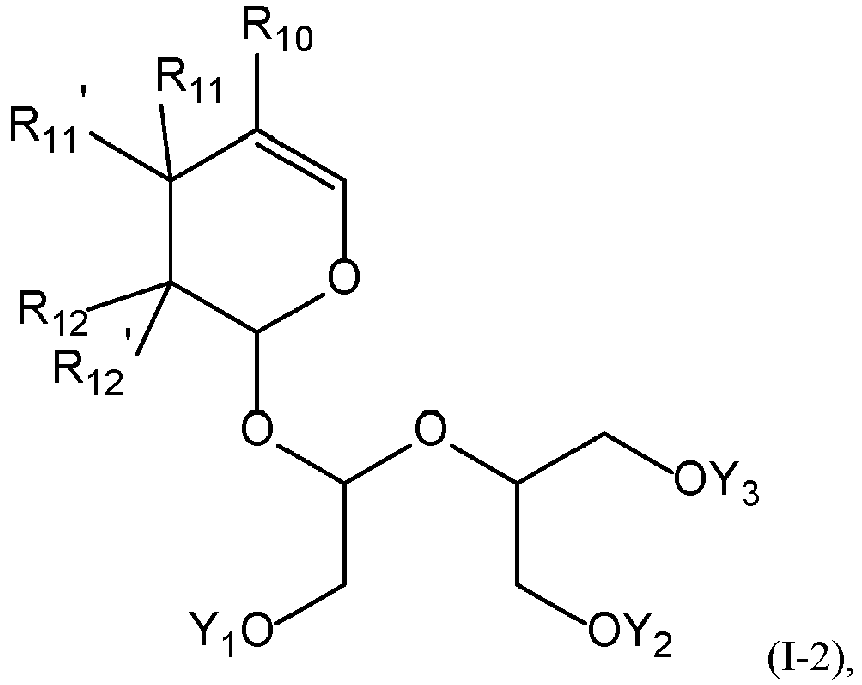 - Y1, Y2 und Y3 jeweils unabhängig ein Wasserstoff, -C(O)-Aryl oder -C(O)-(C1-C12 aliphatische Gruppe) ist,- R10 ein Wasserstoff, -C(O)OH oder -C(O)-O-(C1-C12 aliphatische Gruppe) ist,- R11 eine C2-C12 aliphatische Gruppe, -CH2-C(O)H, -CH2-C(O)OH oder -CH2-C(O)-O-(C1-C12 aliphatische Gruppe) ist,- R11' ein Wasserstoff oder -OH ist,- R12 -CH2-C(O)H, eine C2-C12 aliphatische Gruppe, -C(O)-CH2-R5 oder -CH(OH)-CH2-R5' ist, wobei R5 und R5' jeweils unabhängig ein Wasserstoffatom, eine C1-C12 aliphatische Gruppe, -OH oder -O-C(O)-(C1-C12 aliphatische Gruppe) sind,- R12' ein Wasserstoff oder -OH ist,oder R11 und R12 zusammen eine der Ketten der Formel (II-2), (II-3), (II-4) oder (II-5) bilden:
 wobei jedes R13, R14, R15, R16, R17, R18, R19, R20, R21, R22, R23, R24, R25 oder R26 unabhängig ein Wasserstoff, ein Halogen, -OH, -C(O)OH, -C(O)O-(C1-C12 aliphatische Gruppe), -O-C(O)-(C1-C12 aliphatische Gruppe), eine C1-C12 aliphatische Gruppe, eine Hydroxy-(C1-C12 aliphatische Gruppe) oder -CH2-R9' ist, wobei R9' ein Wasserstoffatom, -OH, oder -O-C(O)-(C1-C12 aliphatische Gruppe) ist,oder R14 und R15 zusammen eine -O-Gruppe bilden,oder R10 und R11 zusammen eine Kette der Formel (II-6) bilden:
 oder R12 und R12' zusammen eine Gruppe der Formel R27-CH= bilden, wobei R27 eine C1-C12 aliphatische Gruppe, -C(O)OH, oder -C(O)O-(C1-C12 aliphatische Gruppe) ist,wobei die aliphatischen Gruppen jeweils unabhängig optional durch ein oder mehrere Hydroxy, Aryl, oder ein Glykosylderivat substituiert sind, wobei das Aryl optional durch ein oder mehrere Hydroxy oder (C1-C6) Alkoxy substituiert ist,oder ein Salz davon.
- Verwendung nach Anspruch 3, wobei die Verbindung durch die folgende Formel (I-1) repräsentiert wird:
 - Y1, Y2 und Y3 jeweils unabhängig ein Wasserstoff, -C(O)-Aryl, oder -C(O)-(C1-C12 aliphatische Gruppe) ist,- R2 ein Wasserstoffatom oder eine (C1-C12 aliphatischer Gruppe) ist,- R3 -CH2-C(O)H oder -CH2-CH2-OH ist,- R4 -C(O)-CH2-R5, oder -CH(OH)-CH2-R5' ist, wobei R5 und R5' jeweils unabhängig ein Wasserstoffatom, eine C1-C12 aliphatische Gruppe, -OH oder -O-C(O)-(C1-C12 aliphatische Gruppe) sind,oder R3 und R4 zusammen die folgende Kette der Formel (II) bilden:
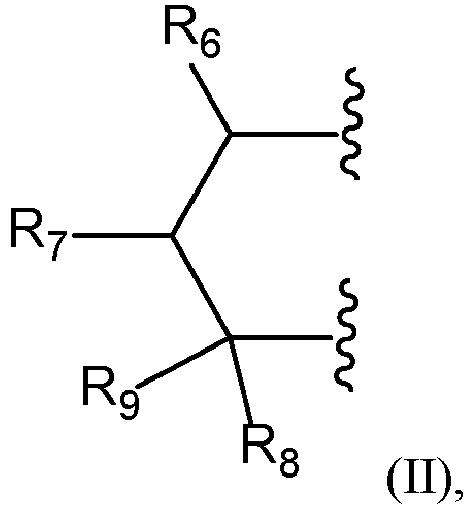 wobei R6, R7 und R8 jeweils unabhängig ein Wasserstoffatom, -OH oder -O-C(O)-(C1-C12 aliphatische Gruppe) sind und R9 ein Wasserstoffatom oder -CH2-R9' ist, wobei R9'ein Wasserstoffatom, -OH oder -O-C(O)-(C1-C12 aliphatische Gruppe) ist,oder ein Salz davon.
- Verwendung nach Anspruch 4, wobei R2 eine C1-C12 aliphatische Gruppe ist, bevorzugt ein C1-C6 Alkyl.
- Verwendung nach Anspruch 4 oder 5, wobei R4 -C(O)-CH2-R5 oder -CH(OH)-CH2-R5' ist, wobei R5 und R5' jeweils unabhängig ein Wasserstoffatom, -OH oder -O-C(O)-(C1-C12 aliphatische Gruppe) sind, bevorzugt ein Wasserstoffatom, -OH oder -O-C(O)-(C1-C6 Alkyl).
- Verwendung nach einem der Ansprüche 4 bis 6, wobei R3 und R4 zusammen die folgende Kette der Formel (II) bilden, wobei:- R6 Wasserstoff ist und/oder- R7 -OH oder -O-C(O)-(C1-C12 aliphatische Gruppe), bevorzugt -OH oder -O-C(O)-(C1-C6 Alkyl) ist und/oder- R8 -OH ist und/oder- R9 ein Wasserstoffatom oder -CH2-R9' ist wobei R9' ein Wasserstoffatom oder -O-C(O)-(C1-C6 Alkyl) ist.
- Verwendung nach einem der Ansprüche 1 bis 7, wobei jedes Y1, Y2 und Y3 unabhängig ein Wasserstoff, -C(O)-Phenyl, oder -C(O)-(C1-C6 Alkyl), bevorzugt ein Wasserstoff oder -C(O)-CH3, bevorzugter ein Wasserstoff ist.
- Verwendung nach einem der Ansprüche 1 bis 8, zur Gerbung eines Fells oder einer Haut.
- Verwendung nach einem der Ansprüche 1 bis 8 zur Gerbung eines Kollagenenthaltenden Materials.
- Ein Verfahren zur Herstellung eines Leders oder eines Lederersatzstoffs, wobei das Verfahren die Verwendung nach einem der Ansprüche 1 bis 8 umfasst.
- Eine nach einem der Ansprüche 1 bis 8 definierte Verbindung mit der Bedingung, dass die Verbindung nicht eine der folgenden Verbindungen ist:

- Ein Verfahren zur Quervernetzung von Kollagen in einem Material umfassend einen Schritt des in Kontaktbringen des Materials mit einer nach einem der Ansprüche 1 bis 8 und 12 definierten Verbindung.
- Das Verfahren nach Anspruch 13, wobei das Material ein Fell oder eine Haut ist.
Priority Applications (2)
| Application Number | Priority Date | Filing Date | Title |
|---|---|---|---|
| ES22306770T ES3039342T3 (en) | 2022-12-01 | 2022-12-01 | Iridoid or seco-iridoid derivatives and their use in a tanning process |
| EP22306770.3A EP4379068B1 (de) | 2022-12-01 | 2022-12-01 | Iridoid- oder seco-iridoidderivate und ihre verwendung in einem gerbverfahren |
Applications Claiming Priority (1)
| Application Number | Priority Date | Filing Date | Title |
|---|---|---|---|
| EP22306770.3A EP4379068B1 (de) | 2022-12-01 | 2022-12-01 | Iridoid- oder seco-iridoidderivate und ihre verwendung in einem gerbverfahren |
Publications (2)
| Publication Number | Publication Date |
|---|---|
| EP4379068A1 EP4379068A1 (de) | 2024-06-05 |
| EP4379068B1 true EP4379068B1 (de) | 2025-06-04 |
Family
ID=84537488
Family Applications (1)
| Application Number | Title | Priority Date | Filing Date |
|---|---|---|---|
| EP22306770.3A Active EP4379068B1 (de) | 2022-12-01 | 2022-12-01 | Iridoid- oder seco-iridoidderivate und ihre verwendung in einem gerbverfahren |
Country Status (2)
| Country | Link |
|---|---|
| EP (1) | EP4379068B1 (de) |
| ES (1) | ES3039342T3 (de) |
Family Cites Families (10)
| Publication number | Priority date | Publication date | Assignee | Title |
|---|---|---|---|---|
| US6150081A (en) | 1997-12-24 | 2000-11-21 | Fuji Photo Film B.V. | Silver halide emulsions with recombinant collagen suitable for photographic application and also the preparation thereof |
| US6428978B1 (en) | 1998-05-08 | 2002-08-06 | Cohesion Technologies, Inc. | Methods for the production of gelatin and full-length triple helical collagen in recombinant cells |
| EP1232182B1 (de) | 1999-11-12 | 2007-10-03 | Fibrogen, Inc. | Rinder-kollagen und verfahren zur herstelling rekombinantes gelatin |
| EP2062985A1 (de) | 2007-11-23 | 2009-05-27 | N-Zyme BioTec GmbH | Mittel und Verfahren zur Gerbung von Häuten und Fellen |
| CN102925508A (zh) * | 2011-08-10 | 2013-02-13 | 浙江毕尔锐思生物技术股份有限公司 | 一种制备环烯醚萜甙元的方法 |
| WO2015173705A1 (en) * | 2014-05-15 | 2015-11-19 | Pesle Livio | Decoction of olive leaves |
| IT201600081688A1 (it) * | 2016-08-03 | 2018-02-03 | Tannow S R L | Impiego di acque di vegetazione olearia nell'industria conciaria |
| CA3008850A1 (en) | 2017-06-29 | 2018-12-29 | Modern Meadow, Inc. | Yeast strains and methods for producing collagen |
| CA3012006A1 (en) | 2017-07-31 | 2019-01-31 | Modern Meadow, Inc. | Yeast strains and methods for controlling hydroxylation of recombinant collagen |
| US11028146B2 (en) | 2017-09-22 | 2021-06-08 | Modern Meadow, Inc. | Recombinant yeast strains |
-
2022
- 2022-12-01 EP EP22306770.3A patent/EP4379068B1/de active Active
- 2022-12-01 ES ES22306770T patent/ES3039342T3/es active Active
Also Published As
| Publication number | Publication date |
|---|---|
| ES3039342T3 (en) | 2025-10-20 |
| EP4379068A1 (de) | 2024-06-05 |
Similar Documents
| Publication | Publication Date | Title |
|---|---|---|
| DE68906301T2 (de) | Porphyrine und Arzneimittel zur Krebsbehandlung. | |
| KR101415399B1 (ko) | 스킨 및 펠트를 무두질하기 위한 약품 및 방법 | |
| EP4379068A1 (de) | Iridoid- oder seco-iridoidderivate und ihre verwendung in einem gerbverfahren | |
| DE19737327A1 (de) | Hydroxyzimtsäureamide hydroxysubstituierter aromatischer Amine | |
| EP1801099B1 (de) | Dithiolmischungen zum Entfernen von Hornsubstanzen aus Häuten | |
| DE2808111A1 (de) | Neue dipeptidderivate und deren verwendung zur messung der enzymatischen aktivitaet | |
| EP4379067B1 (de) | Iridoidderivate und ihre verwendung in einem gerbverfahren | |
| DK159787B (da) | Fremgangsmaade til fremstilling af 3',4'-dideoxykanamycin b | |
| EP3404033A1 (de) | C-glucoside-derivat mit kondensiertem phenylring oder pharmazeutisch unbedenklichem salz davon, verfahren zur herstellung davon und pharmazeutische zusammensetzung damit | |
| CN114479061A (zh) | 一种聚醚胺氯三嗪遥爪聚合物鞣剂、制备方法及应用 | |
| CN101835909B (zh) | 生产皮革的方法 | |
| EP0008032B1 (de) | Kondensationsprodukte aus Terphenylsulfonsäuren, Naphthalinsulfonsäuren, Bis-(4-hydroxyphenyl)-sulfon und Formaldehyd und ihre Verwendung als Gerbstoffe | |
| ES2906793T3 (es) | Composición y procedimiento para el curtido basado en un acetal de un tanino aldehídico | |
| DK157081B (da) | Analogifremgangsmaade til fremstilling af 3-oe(s)-1'-phenylethylaminoaapropylaminobleomycin eller ugiftige salte deraf | |
| EP0554216B1 (de) | Verfahren zum Pickeln und Vorgerben von Hautblössen | |
| DK166384B (da) | Analogifremgangsmaade til fremstilling af (-)-15-deoxyspergualing og farmaceutisk acceptable syreadditionsssalte heraf samt mellemprodukt | |
| US1198040A (en) | Impregnated wood and process of making the same. | |
| KR102400270B1 (ko) | 케라틴의 산업적 제조 방법 | |
| FI72314B (fi) | Foerfarande foer racemisering av optiskt aktivt s-(karboximetyl)-cystein | |
| DE19651040C2 (de) | Verfahren zur Herstellung von 2-Amino-5-alkyl-phenolen | |
| US2733977A (en) | Process of tanning with salt of ampho- | |
| WO2010043680A1 (de) | Verfahren zur herstellung von leder | |
| IE902161L (en) | Sulphinyl derivatives | |
| US3404151A (en) | Novel hydroxyl amine triazine compounds and process for producing the same | |
| DE10353746A1 (de) | Verfahren zum Entfernen von Hornsubstanzen aus Häuten toter Tiere |
Legal Events
| Date | Code | Title | Description |
|---|---|---|---|
| PUAI | Public reference made under article 153(3) epc to a published international application that has entered the european phase |
Free format text: ORIGINAL CODE: 0009012 |
|
| STAA | Information on the status of an ep patent application or granted ep patent |
Free format text: STATUS: THE APPLICATION HAS BEEN PUBLISHED |
|
| AK | Designated contracting states |
Kind code of ref document: A1 Designated state(s): AL AT BE BG CH CY CZ DE DK EE ES FI FR GB GR HR HU IE IS IT LI LT LU LV MC ME MK MT NL NO PL PT RO RS SE SI SK SM TR |
|
| STAA | Information on the status of an ep patent application or granted ep patent |
Free format text: STATUS: REQUEST FOR EXAMINATION WAS MADE |
|
| 17P | Request for examination filed |
Effective date: 20241202 |
|
| RBV | Designated contracting states (corrected) |
Designated state(s): AL AT BE BG CH CY CZ DE DK EE ES FI FR GB GR HR HU IE IS IT LI LT LU LV MC ME MK MT NL NO PL PT RO RS SE SI SK SM TR |
|
| GRAP | Despatch of communication of intention to grant a patent |
Free format text: ORIGINAL CODE: EPIDOSNIGR1 |
|
| STAA | Information on the status of an ep patent application or granted ep patent |
Free format text: STATUS: GRANT OF PATENT IS INTENDED |
|
| RIC1 | Information provided on ipc code assigned before grant |
Ipc: C14C 3/08 20060101AFI20241219BHEP |
|
| INTG | Intention to grant announced |
Effective date: 20250117 |
|
| RAP3 | Party data changed (applicant data changed or rights of an application transferred) |
Owner name: HERMES SELLIER Owner name: UNIVERSITE DE ROUEN NORMANDIE Owner name: CENTRE NATIONAL DE LA RECHERCHE SCIENTIFIQUE Owner name: INSTITUT NATIONAL DES SCIENCES APPLIQUEES DE ROUEN |
|
| GRAS | Grant fee paid |
Free format text: ORIGINAL CODE: EPIDOSNIGR3 |
|
| GRAA | (expected) grant |
Free format text: ORIGINAL CODE: 0009210 |
|
| STAA | Information on the status of an ep patent application or granted ep patent |
Free format text: STATUS: THE PATENT HAS BEEN GRANTED |
|
| AK | Designated contracting states |
Kind code of ref document: B1 Designated state(s): AL AT BE BG CH CY CZ DE DK EE ES FI FR GB GR HR HU IE IS IT LI LT LU LV MC ME MK MT NL NO PL PT RO RS SE SI SK SM TR |
|
| REG | Reference to a national code |
Ref country code: GB Ref legal event code: FG4D |
|
| REG | Reference to a national code |
Ref country code: CH Ref legal event code: EP |
|
| REG | Reference to a national code |
Ref country code: DE Ref legal event code: R096 Ref document number: 602022015459 Country of ref document: DE |
|
| REG | Reference to a national code |
Ref country code: IE Ref legal event code: FG4D |
|
| REG | Reference to a national code |
Ref country code: NL Ref legal event code: MP Effective date: 20250604 |
|
| PG25 | Lapsed in a contracting state [announced via postgrant information from national office to epo] |
Ref country code: FI Free format text: LAPSE BECAUSE OF FAILURE TO SUBMIT A TRANSLATION OF THE DESCRIPTION OR TO PAY THE FEE WITHIN THE PRESCRIBED TIME-LIMIT Effective date: 20250604 |
|
| REG | Reference to a national code |
Ref country code: LT Ref legal event code: MG9D |
|
| PG25 | Lapsed in a contracting state [announced via postgrant information from national office to epo] |
Ref country code: NO Free format text: LAPSE BECAUSE OF FAILURE TO SUBMIT A TRANSLATION OF THE DESCRIPTION OR TO PAY THE FEE WITHIN THE PRESCRIBED TIME-LIMIT Effective date: 20250904 Ref country code: GR Free format text: LAPSE BECAUSE OF FAILURE TO SUBMIT A TRANSLATION OF THE DESCRIPTION OR TO PAY THE FEE WITHIN THE PRESCRIBED TIME-LIMIT Effective date: 20250905 |
|
| PG25 | Lapsed in a contracting state [announced via postgrant information from national office to epo] |
Ref country code: PL Free format text: LAPSE BECAUSE OF FAILURE TO SUBMIT A TRANSLATION OF THE DESCRIPTION OR TO PAY THE FEE WITHIN THE PRESCRIBED TIME-LIMIT Effective date: 20250604 |
|
| PG25 | Lapsed in a contracting state [announced via postgrant information from national office to epo] |
Ref country code: BG Free format text: LAPSE BECAUSE OF FAILURE TO SUBMIT A TRANSLATION OF THE DESCRIPTION OR TO PAY THE FEE WITHIN THE PRESCRIBED TIME-LIMIT Effective date: 20250604 |
|
| PG25 | Lapsed in a contracting state [announced via postgrant information from national office to epo] |
Ref country code: HR Free format text: LAPSE BECAUSE OF FAILURE TO SUBMIT A TRANSLATION OF THE DESCRIPTION OR TO PAY THE FEE WITHIN THE PRESCRIBED TIME-LIMIT Effective date: 20250604 |
|
| REG | Reference to a national code |
Ref country code: ES Ref legal event code: FG2A Ref document number: 3039342 Country of ref document: ES Kind code of ref document: T3 Effective date: 20251020 |
|
| PG25 | Lapsed in a contracting state [announced via postgrant information from national office to epo] |
Ref country code: RS Free format text: LAPSE BECAUSE OF FAILURE TO SUBMIT A TRANSLATION OF THE DESCRIPTION OR TO PAY THE FEE WITHIN THE PRESCRIBED TIME-LIMIT Effective date: 20250904 |
|
| PG25 | Lapsed in a contracting state [announced via postgrant information from national office to epo] |
Ref country code: LV Free format text: LAPSE BECAUSE OF FAILURE TO SUBMIT A TRANSLATION OF THE DESCRIPTION OR TO PAY THE FEE WITHIN THE PRESCRIBED TIME-LIMIT Effective date: 20250604 |
|
| PG25 | Lapsed in a contracting state [announced via postgrant information from national office to epo] |
Ref country code: NL Free format text: LAPSE BECAUSE OF FAILURE TO SUBMIT A TRANSLATION OF THE DESCRIPTION OR TO PAY THE FEE WITHIN THE PRESCRIBED TIME-LIMIT Effective date: 20250604 |
|
| PG25 | Lapsed in a contracting state [announced via postgrant information from national office to epo] |
Ref country code: PT Free format text: LAPSE BECAUSE OF FAILURE TO SUBMIT A TRANSLATION OF THE DESCRIPTION OR TO PAY THE FEE WITHIN THE PRESCRIBED TIME-LIMIT Effective date: 20251006 |
|
| REG | Reference to a national code |
Ref country code: AT Ref legal event code: MK05 Ref document number: 1800379 Country of ref document: AT Kind code of ref document: T Effective date: 20250604 |
|
| PG25 | Lapsed in a contracting state [announced via postgrant information from national office to epo] |
Ref country code: IS Free format text: LAPSE BECAUSE OF FAILURE TO SUBMIT A TRANSLATION OF THE DESCRIPTION OR TO PAY THE FEE WITHIN THE PRESCRIBED TIME-LIMIT Effective date: 20251004 |
|
| PG25 | Lapsed in a contracting state [announced via postgrant information from national office to epo] |
Ref country code: AT Free format text: LAPSE BECAUSE OF FAILURE TO SUBMIT A TRANSLATION OF THE DESCRIPTION OR TO PAY THE FEE WITHIN THE PRESCRIBED TIME-LIMIT Effective date: 20250604 Ref country code: SM Free format text: LAPSE BECAUSE OF FAILURE TO SUBMIT A TRANSLATION OF THE DESCRIPTION OR TO PAY THE FEE WITHIN THE PRESCRIBED TIME-LIMIT Effective date: 20250604 |
|
| PGFP | Annual fee paid to national office [announced via postgrant information from national office to epo] |
Ref country code: FR Payment date: 20251215 Year of fee payment: 4 |
|
| PG25 | Lapsed in a contracting state [announced via postgrant information from national office to epo] |
Ref country code: CZ Free format text: LAPSE BECAUSE OF FAILURE TO SUBMIT A TRANSLATION OF THE DESCRIPTION OR TO PAY THE FEE WITHIN THE PRESCRIBED TIME-LIMIT Effective date: 20250604 |
|
| PG25 | Lapsed in a contracting state [announced via postgrant information from national office to epo] |
Ref country code: EE Free format text: LAPSE BECAUSE OF FAILURE TO SUBMIT A TRANSLATION OF THE DESCRIPTION OR TO PAY THE FEE WITHIN THE PRESCRIBED TIME-LIMIT Effective date: 20250604 |
|
| PG25 | Lapsed in a contracting state [announced via postgrant information from national office to epo] |
Ref country code: SK Free format text: LAPSE BECAUSE OF FAILURE TO SUBMIT A TRANSLATION OF THE DESCRIPTION OR TO PAY THE FEE WITHIN THE PRESCRIBED TIME-LIMIT Effective date: 20250604 |
|
| REG | Reference to a national code |
Ref country code: DE Ref legal event code: R097 Ref document number: 602022015459 Country of ref document: DE |
|
| PG25 | Lapsed in a contracting state [announced via postgrant information from national office to epo] |
Ref country code: RO Free format text: LAPSE BECAUSE OF FAILURE TO SUBMIT A TRANSLATION OF THE DESCRIPTION OR TO PAY THE FEE WITHIN THE PRESCRIBED TIME-LIMIT Effective date: 20250604 |
|
| PGFP | Annual fee paid to national office [announced via postgrant information from national office to epo] |
Ref country code: ES Payment date: 20260122 Year of fee payment: 4 |
|
| PLBE | No opposition filed within time limit |
Free format text: ORIGINAL CODE: 0009261 |
|
| STAA | Information on the status of an ep patent application or granted ep patent |
Free format text: STATUS: NO OPPOSITION FILED WITHIN TIME LIMIT |
|
| PG25 | Lapsed in a contracting state [announced via postgrant information from national office to epo] |
Ref country code: DK Free format text: LAPSE BECAUSE OF FAILURE TO SUBMIT A TRANSLATION OF THE DESCRIPTION OR TO PAY THE FEE WITHIN THE PRESCRIBED TIME-LIMIT Effective date: 20250604 |
|
| PGFP | Annual fee paid to national office [announced via postgrant information from national office to epo] |
Ref country code: IT Payment date: 20251231 Year of fee payment: 4 |
|
| REG | Reference to a national code |
Ref country code: CH Ref legal event code: L10 Free format text: ST27 STATUS EVENT CODE: U-0-0-L10-L00 (AS PROVIDED BY THE NATIONAL OFFICE) Effective date: 20260416 |
|
| 26N | No opposition filed |
Effective date: 20260305 |
|
| PG25 | Lapsed in a contracting state [announced via postgrant information from national office to epo] |
Ref country code: LT Free format text: LAPSE BECAUSE OF FAILURE TO SUBMIT A TRANSLATION OF THE DESCRIPTION OR TO PAY THE FEE WITHIN THE PRESCRIBED TIME-LIMIT Effective date: 20250604 |
|
| PG25 | Lapsed in a contracting state [announced via postgrant information from national office to epo] |
Ref country code: MC Free format text: LAPSE BECAUSE OF FAILURE TO SUBMIT A TRANSLATION OF THE DESCRIPTION OR TO PAY THE FEE WITHIN THE PRESCRIBED TIME-LIMIT Effective date: 20250604 |
|
| REG | Reference to a national code |
Ref country code: CH Ref legal event code: H13 Free format text: ST27 STATUS EVENT CODE: U-0-0-H10-H13 (AS PROVIDED BY THE NATIONAL OFFICE) Effective date: 20260723 |
|
| PG25 | Lapsed in a contracting state [announced via postgrant information from national office to epo] |
Ref country code: SE Free format text: LAPSE BECAUSE OF FAILURE TO SUBMIT A TRANSLATION OF THE DESCRIPTION OR TO PAY THE FEE WITHIN THE PRESCRIBED TIME-LIMIT Effective date: 20250604 |