EP4380136A1 - Kameravorrichtung und elektronische vorrichtung mit kameravorrichtung - Google Patents
Kameravorrichtung und elektronische vorrichtung mit kameravorrichtung Download PDFInfo
- Publication number
- EP4380136A1 EP4380136A1 EP22853537.3A EP22853537A EP4380136A1 EP 4380136 A1 EP4380136 A1 EP 4380136A1 EP 22853537 A EP22853537 A EP 22853537A EP 4380136 A1 EP4380136 A1 EP 4380136A1
- Authority
- EP
- European Patent Office
- Prior art keywords
- electronic device
- metal portion
- camera
- various embodiments
- metal
- Prior art date
- Legal status (The legal status is an assumption and is not a legal conclusion. Google has not performed a legal analysis and makes no representation as to the accuracy of the status listed.)
- Pending
Links
Images






Classifications
-
- H—ELECTRICITY
- H04—ELECTRIC COMMUNICATION TECHNIQUE
- H04N—PICTORIAL COMMUNICATION, e.g. TELEVISION
- H04N23/00—Cameras or camera modules comprising electronic image sensors; Control thereof
- H04N23/50—Constructional details
- H04N23/52—Elements optimising image sensor operation, e.g. for electromagnetic interference [EMI] protection or temperature control by heat transfer or cooling elements
-
- G—PHYSICS
- G03—PHOTOGRAPHY; CINEMATOGRAPHY; ANALOGOUS TECHNIQUES USING WAVES OTHER THAN OPTICAL WAVES; ELECTROGRAPHY; HOLOGRAPHY
- G03B—APPARATUS OR ARRANGEMENTS FOR TAKING PHOTOGRAPHS OR FOR PROJECTING OR VIEWING THEM; APPARATUS OR ARRANGEMENTS EMPLOYING ANALOGOUS TECHNIQUES USING WAVES OTHER THAN OPTICAL WAVES; ACCESSORIES THEREFOR
- G03B17/00—Details of cameras or camera bodies; Accessories therefor
- G03B17/02—Bodies
- G03B17/08—Waterproof bodies or housings
-
- G—PHYSICS
- G03—PHOTOGRAPHY; CINEMATOGRAPHY; ANALOGOUS TECHNIQUES USING WAVES OTHER THAN OPTICAL WAVES; ELECTROGRAPHY; HOLOGRAPHY
- G03B—APPARATUS OR ARRANGEMENTS FOR TAKING PHOTOGRAPHS OR FOR PROJECTING OR VIEWING THEM; APPARATUS OR ARRANGEMENTS EMPLOYING ANALOGOUS TECHNIQUES USING WAVES OTHER THAN OPTICAL WAVES; ACCESSORIES THEREFOR
- G03B30/00—Camera modules comprising integrated lens units and imaging units, specially adapted for being embedded in other devices, e.g. mobile phones or vehicles
-
- H—ELECTRICITY
- H04—ELECTRIC COMMUNICATION TECHNIQUE
- H04M—TELEPHONIC COMMUNICATION
- H04M1/00—Substation equipment, e.g. for use by subscribers
- H04M1/02—Constructional features of telephone sets
- H04M1/0202—Portable telephone sets, e.g. cordless phones, mobile phones or bar type handsets
- H04M1/026—Details of the structure or mounting of specific components
- H04M1/0264—Details of the structure or mounting of specific components for a camera module assembly
-
- H—ELECTRICITY
- H04—ELECTRIC COMMUNICATION TECHNIQUE
- H04N—PICTORIAL COMMUNICATION, e.g. TELEVISION
- H04N23/00—Cameras or camera modules comprising electronic image sensors; Control thereof
- H04N23/50—Constructional details
-
- H—ELECTRICITY
- H04—ELECTRIC COMMUNICATION TECHNIQUE
- H04N—PICTORIAL COMMUNICATION, e.g. TELEVISION
- H04N23/00—Cameras or camera modules comprising electronic image sensors; Control thereof
- H04N23/57—Mechanical or electrical details of cameras or camera modules specially adapted for being embedded in other devices
-
- H—ELECTRICITY
- H05—ELECTRIC TECHNIQUES NOT OTHERWISE PROVIDED FOR
- H05F—STATIC ELECTRICITY; NATURALLY-OCCURRING ELECTRICITY
- H05F3/00—Carrying-off electrostatic charges
-
- H—ELECTRICITY
- H04—ELECTRIC COMMUNICATION TECHNIQUE
- H04M—TELEPHONIC COMMUNICATION
- H04M1/00—Substation equipment, e.g. for use by subscribers
- H04M1/02—Constructional features of telephone sets
- H04M1/0202—Portable telephone sets, e.g. cordless phones, mobile phones or bar type handsets
- H04M1/026—Details of the structure or mounting of specific components
- H04M1/0277—Details of the structure or mounting of specific components for a printed circuit board assembly
-
- H—ELECTRICITY
- H04—ELECTRIC COMMUNICATION TECHNIQUE
- H04M—TELEPHONIC COMMUNICATION
- H04M1/00—Substation equipment, e.g. for use by subscribers
- H04M1/02—Constructional features of telephone sets
- H04M1/0202—Portable telephone sets, e.g. cordless phones, mobile phones or bar type handsets
- H04M1/0279—Improving the user comfort or ergonomics
- H04M1/0283—Improving the user comfort or ergonomics for providing a decorative aspect, e.g. customization of casings, exchangeable faceplate
-
- H—ELECTRICITY
- H04—ELECTRIC COMMUNICATION TECHNIQUE
- H04N—PICTORIAL COMMUNICATION, e.g. TELEVISION
- H04N23/00—Cameras or camera modules comprising electronic image sensors; Control thereof
- H04N23/50—Constructional details
- H04N23/51—Housings
-
- H—ELECTRICITY
- H05—ELECTRIC TECHNIQUES NOT OTHERWISE PROVIDED FOR
- H05F—STATIC ELECTRICITY; NATURALLY-OCCURRING ELECTRICITY
- H05F1/00—Preventing the formation of electrostatic charges
- H05F1/02—Preventing the formation of electrostatic charges by surface treatment
Definitions
- Various embodiments of the disclosure relate to a camera device capable of discharging static electricity and an electronic device including the same.
- An electronic device may refer to any device that performs a specific function according to a loaded program, such as a home appliance, an electronic notebook, a portable multimedia player, a mobile communication terminal, a tablet PC, a video/audio device, a desktop/laptop computer, a car navigator, and so on.
- these electronic devices may output stored information as sound or an image.
- a single electronic device such as a mobile communication terminal, may be equipped with a variety of functions.
- an entertainment function such as games
- a multimedia function such as music and video playback
- a communication and security function for mobile banking and functions such as scheduling or an electronic wallet are integrated into one electronic device.
- Various modules are arranged in the electronic device, which is commercialized with a camera lens assembly (hereinafter, referred to as a ⁇ camera module' or a ⁇ camera device') capable of taking pictures, videos, and so on disposed therein.
- a camera lens assembly hereinafter, referred to as a ⁇ camera module' or a ⁇ camera device'
- a camera device may be disposed inside a portable or miniaturized electronic device, at least partially exposed from a surface of the electronic device.
- the camera device should have an open structure on the surface of the electronic device.
- the camera device may be disposed together with a metallic deco to provide a sense of sophistication or diversify design.
- the metal deco may be fixed around the periphery of the camera device and located between the camera device and an arrangement surface of the electronic device.
- the static electricity When static electricity is generated from the outside of the electronic device, the static electricity may be introduced into the camera device through the metal deco, and thus cause the camera device to break or malfunction. Moreover, the static electricity may affect other modules disposed in the electronic device, thereby causing various errors such as malfunction as well as damage or breakage.
- Various embodiments of the disclosure are intended to provide an electronic device including a camera device that secures an inflow path allowing static electricity to move toward a discharge module, when the static electricity is introduced into a camera module through a metal deco.
- An electronic device includes: a housing including an opening; a printed circuit board (PCB) disposed inside the housing; and a camera deco part disposed inside the opening and covering a camera assembly.
- the camera deco part includes: a first metal portion including a first surface at least partially exposed to an outside of the electronic device and having an oxide coating layer formed thereon and a second surface having no oxide coating layer formed thereon; a second metal portion including a third surface at least partially exposed to the outside of the electronic device and having an oxide coating layer formed thereon and a fourth surface having no oxide coating layer formed thereon, and facing the PCB; and an adhesive portion located between the second surface of the first metal portion and the fourth surface of the second metal portion, and including at least one recess.
- a camera deco part covering a camera assembly includes: a first metal portion including a first surface at least partially exposed to an outside of an electronic device and having an oxide coating layer formed thereon and a second surface having no oxide coating layer formed thereon; a second metal portion including a third surface at least partially exposed to the outside of the electronic device and having an oxide coating layer formed thereon and a fourth surface having no oxide coating layer formed thereon, and facing a PCB; and an adhesive portion located between the second surface of the first metal portion and the fourth surface of the second metal portion, and including at least one recess.
- a camera deco part covering a camera assembly may include a plurality of metal portions, for design differentiation. Static electricity from the outside of an electronic device may travel through a surface of a first metal portion, on which an oxide coating film is not formed, and be effectively transferred to a printed circuit board disposed inside the electronic device without being blocked by the oxide coating film.
- Static electricity from the outside of the electronic device may be effectively transferred to the printed circuit board disposed inside the electronic device without being blocked by an oxide coating layer, by a surface of a second metal portion, on which an oxide coating layer is not formed.
- an adhesive portion includes at least one recess, and the width of at least a portion of the adhesive portion is reduced by a recess portion, the width of a portion in which metal portions face each other without contacting the adhesive portion may be increased.
- the static electricity when static electricity from the outside of the electronic device is introduced into a camera module through metal portions, the static electricity may be transferred to the printed circuit board through a surface of a metal portion, on which an oxide coating layer is not formed, a surface of another metal portion, on which an oxide coating layer is not formed, and a conductive sponge.
- a conduction path of static electricity is widened, it is possible to reduce the chance of static electricity entering the electronic device through the camera module and causing damage to the camera device, or even affecting and damaging other modules disposed in the electronic device.
- FIG. 1 is a block diagram illustrating an electronic device 101 in a network environment 100 according to various embodiments.
- the electronic device 101 in the network environment 100 may communicate with an electronic device 102 via a first network 198 (e.g., a short-range wireless communication network), or at least one of an electronic device 104 or a server 108 via a second network 199 (e.g., a long-range wireless communication network).
- the electronic device 101 may communicate with the electronic device 104 via the server 108.
- the electronic device 101 may include a processor 120, memory 130, an input module 150, a sound output module 155, a display module 160, an audio module 170, a sensor module 176, an interface 177, a connecting terminal 178, a haptic module 179, a camera module 180, a power management module 188, a battery 189, a communication module 190, a subscriber identification module (SIM) 196, or an antenna module 197.
- at least one of the components e.g., the connecting terminal 178) may be omitted from the electronic device 101, or one or more other components may be added in the electronic device 101.
- some of the components e.g., the sensor module 176, the camera module 180, or the antenna module 197) may be implemented as a single component (e.g., the display module 160).
- the processor 120 may execute, for example, software (e.g., a program 140) to control at least one other component (e.g., a hardware or software component) of the electronic device 101 coupled with the processor 120, and may perform various data processing or computation.
- the processor 120 may store a command or data received from another component (e.g., the sensor module 176 or the communication module 190) in volatile memory 132, process the command or the data stored in the volatile memory 132, and store resulting data in non-volatile memory 134.
- the processor 120 may include a main processor 121 (e.g., a central processing unit (CPU) or an application processor (AP)), or an auxiliary processor 123 (e.g., a graphics processing unit (GPU), a neural processing unit (NPU), an image signal processor (ISP), a sensor hub processor, or a communication processor (CP)) that is operable independently from, or in conjunction with, the main processor 121.
- a main processor 121 e.g., a central processing unit (CPU) or an application processor (AP)
- auxiliary processor 123 e.g., a graphics processing unit (GPU), a neural processing unit (NPU), an image signal processor (ISP), a sensor hub processor, or a communication processor (CP)
- the main processor 121 may be adapted to consume less power than the main processor 121, or to be specific to a specified function.
- the auxiliary processor 123 may be implemented as separate from, or as part of the main processor 121.
- the auxiliary processor 123 may control at least some of functions or states related to at least one component (e.g., the display module 160, the sensor module 176, or the communication module 190) among the components of the electronic device 101, instead of the main processor 121 while the main processor 121 is in an inactive (e.g., sleep) state, or together with the main processor 121 while the main processor 121 is in an active state (e.g., executing an application).
- the auxiliary processor 123 e.g., an image signal processor or a communication processor
- the auxiliary processor 123 may include a hardware structure specified for artificial intelligence model processing.
- An artificial intelligence model may be generated by machine learning. Such learning may be performed, e.g., by the electronic device 101 where the artificial intelligence is performed or via a separate server (e.g., the server 108). Learning algorithms may include, but are not limited to, e.g., supervised learning, unsupervised learning, semi-supervised learning, or reinforcement learning.
- the artificial intelligence model may include a plurality of artificial neural network layers.
- the artificial neural network may be a deep neural network (DNN), a convolutional neural network (CNN), a recurrent neural network (RNN), a restricted boltzmann machine (RBM), a deep belief network (DBN), a bidirectional recurrent deep neural network (BRDNN), deep Q-network or a combination of two or more thereof but is not limited thereto.
- the artificial intelligence model may, additionally or alternatively, include a software structure other than the hardware structure.
- the memory 130 may store various data used by at least one component (e.g., the processor 120 or the sensor module 176) of the electronic device 101.
- the various data may include, for example, software (e.g., the program 140) and input data or output data for a command related thereto.
- the memory 130 may include the volatile memory 132 or the non-volatile memory 134.
- the program 140 may be stored in the memory 130 as software, and may include, for example, an operating system (OS) 142, middleware 144, or an application 146.
- OS operating system
- middleware middleware
- application application
- the input module 150 may receive a command or data to be used by another component (e.g., the processor 120) of the electronic device 101, from the outside (e.g., a user) of the electronic device 101.
- the input module 150 may include, for example, a microphone, a mouse, a keyboard, a key (e.g., a button), or a digital pen (e.g., a stylus pen).
- the sound output module 155 may output sound signals to the outside of the electronic device 101.
- the sound output module 155 may include, for example, a speaker or a receiver.
- the speaker may be used for general purposes, such as playing multimedia or playing record.
- the receiver may be used for receiving incoming calls. According to an embodiment, the receiver may be implemented as separate from, or as part of the speaker.
- the display module 160 may visually provide information to the outside (e.g., a user) of the electronic device 101.
- the display module 160 may include, for example, a display, a hologram device, or a projector and control circuitry to control a corresponding one of the display, hologram device, and projector.
- the display module 160 may include a touch sensor adapted to detect a touch, or a pressure sensor adapted to measure the intensity of force incurred by the touch.
- the audio module 170 may convert a sound into an electrical signal and vice versa. According to an embodiment, the audio module 170 may obtain the sound via the input module 150, or output the sound via the sound output module 155 or a headphone of an external electronic device (e.g., an electronic device 102) directly (e.g., wiredly) or wirelessly coupled with the electronic device 101.
- an external electronic device e.g., an electronic device 102
- directly e.g., wiredly
- wirelessly e.g., wirelessly
- the sensor module 176 may detect an operational state (e.g., power or temperature) of the electronic device 101 or an environmental state (e.g., a state of a user) external to the electronic device 101, and then generate an electrical signal or data value corresponding to the detected state.
- the sensor module 176 may include, for example, a gesture sensor, a gyro sensor, an atmospheric pressure sensor, a magnetic sensor, an acceleration sensor, a grip sensor, a proximity sensor, a color sensor, an infrared (IR) sensor, a biometric sensor, a temperature sensor, a humidity sensor, or an illuminance sensor.
- the interface 177 may support one or more specified protocols to be used for the electronic device 101 to be coupled with the external electronic device (e.g., the electronic device 102) directly (e.g., wiredly) or wirelessly.
- the interface 177 may include, for example, a high definition multimedia interface (HDMI), a universal serial bus (USB) interface, a secure digital (SD) card interface, or an audio interface.
- HDMI high definition multimedia interface
- USB universal serial bus
- SD secure digital
- a connecting terminal 178 may include a connector via which the electronic device 101 may be physically connected with the external electronic device (e.g., the electronic device 102).
- the connecting terminal 178 may include, for example, a HDMI connector, a USB connector, a SD card connector, or an audio connector (e.g., a headphone connector).
- the haptic module 179 may convert an electrical signal into a mechanical stimulus (e.g., a vibration or a movement) or electrical stimulus which may be recognized by a user via his tactile sensation or kinesthetic sensation.
- the haptic module 179 may include, for example, a motor, a piezoelectric element, or an electric stimulator.
- the camera module 180 may capture a still image or moving images.
- the camera module 180 may include one or more lenses, image sensors, image signal processors, or flashes.
- the power management module 188 may manage power supplied to the electronic device 101.
- the power management module 188 may be implemented as at least part of, for example, a power management integrated circuit (PMIC).
- PMIC power management integrated circuit
- the battery 189 may supply power to at least one component of the electronic device 101.
- the battery 189 may include, for example, a primary cell which is not rechargeable, a secondary cell which is rechargeable, or a fuel cell.
- the communication module 190 may support establishing a direct (e.g., wired) communication channel or a wireless communication channel between the electronic device 101 and the external electronic device (e.g., the electronic device 102, the electronic device 104, or the server 108) and performing communication via the established communication channel.
- the communication module 190 may include one or more communication processors that are operable independently from the processor 120 (e.g., the application processor (AP)) and supports a direct (e.g., wired) communication or a wireless communication.
- AP application processor
- the communication module 190 may include a wireless communication module 192 (e.g., a cellular communication module, a short-range wireless communication module, or a global navigation satellite system (GNSS) communication module) or a wired communication module 194 (e.g., a local area network (LAN) communication module or a power line communication (PLC) module).
- a wireless communication module 192 e.g., a cellular communication module, a short-range wireless communication module, or a global navigation satellite system (GNSS) communication module
- GNSS global navigation satellite system
- wired communication module 194 e.g., a local area network (LAN) communication module or a power line communication (PLC) module.
- LAN local area network
- PLC power line communication
- a corresponding one of these communication modules may communicate with the external electronic device via the first network 198 (e.g., a short-range communication network, such as Bluetooth TM , wireless-fidelity (Wi-Fi) direct, or infrared data association (IrDA)) or the second network 199 (e.g., a long-range communication network, such as a legacy cellular network, a 5G network, a next-generation communication network, the Internet, or a computer network (e.g., LAN or wide area network (WAN)).
- first network 198 e.g., a short-range communication network, such as Bluetooth TM , wireless-fidelity (Wi-Fi) direct, or infrared data association (IrDA)
- the second network 199 e.g., a long-range communication network, such as a legacy cellular network, a 5G network, a next-generation communication network, the Internet, or a computer network (e.g., LAN or wide area network (WAN)).
- the wireless communication module 192 may identify and authenticate the electronic device 101 in a communication network, such as the first network 198 or the second network 199, using subscriber information (e.g., international mobile subscriber identity (IMSI)) stored in the subscriber identification module 196.
- subscriber information e.g., international mobile subscriber identity (IMSI)
- the wireless communication module 192 may support a 5G network, after a 4G network, and next-generation communication technology, e.g., new radio (NR) access technology.
- the NR access technology may support enhanced mobile broadband (eMBB), massive machine type communications (mMTC), or ultra-reliable and low-latency communications (URLLC).
- eMBB enhanced mobile broadband
- mMTC massive machine type communications
- URLLC ultra-reliable and low-latency communications
- the wireless communication module 192 may support a high-frequency band (e.g., the mmWave band) to achieve, e.g., a high data transmission rate.
- the wireless communication module 192 may support various technologies for securing performance on a high-frequency band, such as, e.g., beamforming, massive multiple-input and multiple-output (massive MIMO), full dimensional MIMO (FD-MIMO), array antenna, analog beam-forming, or large scale antenna.
- the wireless communication module 192 may support various requirements specified in the electronic device 101, an external electronic device (e.g., the electronic device 104), or a network system (e.g., the second network 199).
- the wireless communication module 192 may support a peak data rate (e.g., 20Gbps or more) for implementing eMBB, loss coverage (e.g., 164dB or less) for implementing mMTC, or U-plane latency (e.g., 0.5ms or less for each of downlink (DL) and uplink (UL), or a round trip of 1ms or less) for implementing URLLC.
- a peak data rate e.g., 20Gbps or more
- loss coverage e.g., 164dB or less
- U-plane latency e.g., 0.5ms or less for each of downlink (DL) and uplink (UL), or a round trip of 1ms or less
- the antenna module 197 may transmit or receive a signal or power to or from the outside (e.g., the external electronic device) of the electronic device 101.
- the antenna module 197 may include an antenna including a radiating element composed of a conductive material or a conductive pattern formed in or on a substrate (e.g., a printed circuit board (PCB)).
- the antenna module 197 may include a plurality of antennas (e.g., array antennas). In such a case, at least one antenna appropriate for a communication scheme used in the communication network, such as the first network 198 or the second network 199, may be selected, for example, by the communication module 190 (e.g., the wireless communication module 192) from the plurality of antennas.
- the signal or the power may then be transmitted or received between the communication module 190 and the external electronic device via the selected at least one antenna.
- another component e.g., a radio frequency integrated circuit (RFIC)
- RFIC radio frequency integrated circuit
- the antenna module 197 may form an mmWave antenna module.
- the mmWave antenna module may include a printed circuit board, a RFIC disposed on a first surface (e.g., the bottom surface) of the printed circuit board, or adjacent to the first surface and capable of supporting a designated high-frequency band (e.g., the mmWave band), and a plurality of antennas (e.g., array antennas) disposed on a second surface (e.g., the top or a side surface) of the printed circuit board, or adjacent to the second surface and capable of transmitting or receiving signals of the designated high-frequency band.
- a RFIC disposed on a first surface (e.g., the bottom surface) of the printed circuit board, or adjacent to the first surface and capable of supporting a designated high-frequency band (e.g., the mmWave band)
- a plurality of antennas e.g., array antennas
- At least some of the above-described components may be coupled mutually and communicate signals (e.g., commands or data) therebetween via an inter-peripheral communication scheme (e.g., a bus, general purpose input and output (GPIO), serial peripheral interface (SPI), or mobile industry processor interface (MIPI)).
- an inter-peripheral communication scheme e.g., a bus, general purpose input and output (GPIO), serial peripheral interface (SPI), or mobile industry processor interface (MIPI)
- commands or data may be transmitted or received between the electronic device 101 and the external electronic device 104 via the server 108 coupled with the second network 199.
- Each of the electronic devices 102 or 104 may be a device of a same type as, or a different type, from the electronic device 101.
- all or some of operations to be executed at the electronic device 101 may be executed at one or more of the external electronic devices 102, 104, or 108. For example, if the electronic device 101 should perform a function or a service automatically, or in response to a request from a user or another device, the electronic device 101, instead of, or in addition to, executing the function or the service, may request the one or more external electronic devices to perform at least part of the function or the service.
- the one or more external electronic devices receiving the request may perform the at least part of the function or the service requested, or an additional function or an additional service related to the request, and transfer an outcome of the performing to the electronic device 101.
- the electronic device 101 may provide the outcome, with or without further processing of the outcome, as at least part of a reply to the request.
- a cloud computing, distributed computing, mobile edge computing (MEC), or client-server computing technology may be used, for example.
- the electronic device 101 may provide ultra low-latency services using, e.g., distributed computing or mobile edge computing.
- the external electronic device 104 may include an internet-of-things (IoT) device.
- the server 108 may be an intelligent server using machine learning and/or a neural network.
- the external electronic device 104 or the server 108 may be included in the second network 199.
- the electronic device 101 may be applied to intelligent services (e.g., smart home, smart city, smart car, or healthcare) based on 5G communication technology or IoT-related technology.
- the electronic device may be one of various types of electronic devices.
- the electronic devices may include, for example, a portable communication device (e.g., a smartphone), a computer device, a portable multimedia device, a portable medical device, a camera, a wearable device, or a home appliance. According to an embodiment of the disclosure, the electronic devices are not limited to those described above.
- each of such phrases as “A or B”, “at least one of A and B”, “at least one of A or B”, “A, B, or C”, “at least one of A, B, and C”, and “at least one of A, B, or C”, may include any one of, or all possible combinations of the items enumerated together in a corresponding one of the phrases.
- such terms as “1 st “ and “2 nd “, or “first” and “second” may be used to simply distinguish a corresponding component from another, and does not limit the components in other aspect (e.g., importance or order).
- an element e.g., a first element
- the element may be coupled with the other element directly (e.g., wiredly), wirelessly, or via a third element.
- module may include a unit implemented in hardware, software, or firmware, and may interchangeably be used with other terms, for example, logic, logic block, part, or circuitry.
- a module may be a single integral component, or a minimum unit or part thereof, adapted to perform one or more functions.
- the module may be implemented in a form of an application-specific integrated circuit (ASIC).
- ASIC application-specific integrated circuit
- Various embodiments as set forth herein may be implemented as software (e.g., a program) including one or more instructions that are stored in a storage medium (e.g., internal memory or external memory) that is readable by a machine (e.g., an electronic device).
- a processor e.g., a processor
- the machine may invoke at least one of the one or more instructions stored in the storage medium, and execute it, with or without using one or more other components under the control of the processor. This allows the machine to be operated to perform at least one function according to the at least one instruction invoked.
- the one or more instructions may include a code generated by a complier or a code executable by an interpreter.
- the machine-readable storage medium may be provided in the form of a non-transitory storage medium.
- non-transitory simply means that the storage medium is a tangible device, and does not include a signal (e.g., an electromagnetic wave), but this term does not differentiate between where data is semi-permanently stored in the storage medium and where the data is temporarily stored in the storage medium.
- a method may be included and provided in a computer program product.
- the computer program product may be traded as a product between a seller and a buyer.
- the computer program product may be distributed in the form of a machine-readable storage medium (e.g., compact disc read only memory (CD-ROM)), or be distributed (e.g., downloaded or uploaded) online via an application store (e.g., PlayStore TM ), or between two user devices (e.g., smart phones) directly. If distributed online, at least part of the computer program product may be temporarily generated or at least temporarily stored in the machine-readable storage medium, such as memory of the manufacturer's server, a server of the application store, or a relay server.
- CD-ROM compact disc read only memory
- an application store e.g., PlayStore TM
- two user devices e.g., smart phones
- each component e.g., a module or a program of the above-described components may include a single entity or multiple entities, and some of the multiple entities may be separately disposed in different components. According to various embodiments, one or more of the above-described components may be omitted, or one or more other components may be added. Alternatively or additionally, a plurality of components (e.g., modules or programs) may be integrated into a single component. In such a case, according to various embodiments, the integrated component may still perform one or more functions of each of the plurality of components in the same or similar manner as they are performed by a corresponding one of the plurality of components before the integration.
- operations performed by the module, the program, or another component may be carried out sequentially, in parallel, repeatedly, or heuristically, or one or more of the operations may be executed in a different order or omitted, or one or more other operations may be added.
- FIG. 2 is a front perspective view illustrating an electronic device according to various embodiments of the disclosure.
- FIG. 3 is a rear perspective view illustrating an electronic device according to various embodiments of the disclosure.
- 'Z' may refer to a thickness direction of the electronic device 101. Further, in an embodiment of the disclosure, '+Z' may refer to an upward direction of the electronic device, and '-Z' may refer to a downward direction of the electronic device.
- the electronic device 101 may include a housing 210 which includes a front surface 210A, a rear surface 210B, and side surfaces 210C surrounding a space between the front surface 210A and the rear surface 210B.
- the housing 210 may refer to a structure that forms a portion of the front surface 210A of FIG. 2 , the rear surface 210B of FIG. 2 , and the side surfaces 210C.
- at least a portion of the front surface 210A may be formed by a front plate 202 (e.g., a glass plate, polymer plate, or cover glass including various coating layers) at least a portion of which is substantially transparent.
- the front plate 202 may be formed of 2-dimension (2D) glass or 2.5-dimension (2.5D) glass.
- the rear surface 210B may be formed by a rear plate 211.
- the rear plate 211 may be formed of, for example, glass, ceramic, a polymer, a metal (e.g., aluminum, stainless steel (STS), or magnesium), or a combination of at least two of these materials.
- the side surfaces 210C may be coupled with the front plate 202 and the rear plate 211 and formed by a side bezel structure (or ⁇ side member') 218 including a metal and/or a polymer.
- the rear plate 211 and the side bezel structure 218 may be integrally formed and include the same material (e.g., glass, a metallic material such as aluminum, or ceramic).
- the front plate 202 may include two first edge regions 210D, which are bent and extend seamlessly from the front surface 210A toward the rear plate 211, at both long edge ends thereof.
- the rear plate 211 may include two second edge regions 210E, which are bent and extend seamlessly from the rear surface 210B toward the front plate 202, at both long edge ends thereof.
- the front plate 202 (or the rear plate 211) may include only one of the first edge regions 210D (or the second edge regions 210E). In another embodiment, some of the first edge regions 210D or the second edge regions 210E may not be included.
- the side bezel structure 218 may have a first thickness (or width) on a side surface that does not include any of the above first edge regions 210D or second edge regions 210E, and a second thickness less than the first thickness on a side surface that includes any of the above first edge regions 210D or second edge regions 210E.
- the electronic device 101 may include at least one of a display 201, audio modules 203, 207, and 214 (e.g., the audio module 170 of FIG. 1 ), a sensor module (e.g., the sensor module 176 of FIG. 1 ), camera modules 205 and 212 (e.g., the camera module 180 of FIG. 1 ), key input devices 217 (e.g., the input module 150 of FIG. 1 ), or connector holes 208 and 209 (e.g., the connecting terminal 178 of FIG. 1 ).
- the electronic device 101 may not be provided with at least one (e.g., the connector hole 209) of the components or may additionally include other components.
- the display 201 may be visually exposed, for example, through a substantial portion of the front plate 202.
- at least a portion of the display 201 may be exposed through the front plate 202 forming the front surface 210A and the first edge regions 210D.
- a corner of the display 201 may be formed substantially in the same shape as that of an adjacent peripheral portion of the front plate 202.
- a gap between the periphery of the display 201 and the periphery of the front plate 202 may be substantially equal to increase the visually exposed area of the display 201.
- a surface (or the front plate 202) of the housing 210 may include a view area formed by visual exposure of the display 201.
- the view area may include the front surface 210A and the first edge regions 210D.
- a recess or an opening may be formed in a portion of the view area (e.g., the front surface 210A and the first edge regions 210D) of the display 201, and at least one of the audio module 214, a sensor module (not shown), a light emitting element (not shown), or the camera module 205, which is aligned with the recess or the opening, may be included.
- at least one of the audio module 214, a sensor module (not shown), the camera module 205, a fingerprint sensor (not shown), or a light emitting element (not shown) may be included on the rear surface of the view area of the display 201.
- the display 201 may be incorporated with or disposed adjacent to a touch sensing circuit, a pressure sensor capable of measuring the intensity (pressure) of a touch, and/or a digitizer that detects a magnetic field-based stylus pen.
- a touch sensing circuit capable of measuring the intensity (pressure) of a touch
- a digitizer capable of measuring the intensity (pressure) of a touch
- at least some of the key input devices 317 may be disposed in the first edge regions 210D and/or the second edge regions 210E.
- the audio modules 203, 207, and 214 may include, for example, a microphone hole 203 and speaker holes 207 and 214.
- a microphone for obtaining an external sound may be disposed in the microphone hole 203, and in a certain embodiment, a plurality of microphones may be disposed to detect the direction of a sound.
- the speaker holes 207 and 214 may include an external speaker hole 207 and a receiver hole 214 for calls.
- the speaker holes 207 and 214 and the microphone hole 203 may be implemented as a single hole, or a speaker (e.g., a piezo speaker) may be included without the speaker holes 207 and 214.
- the audio modules 203, 207, and 214 are not limited to the above structure, and may be subject to various design modifications, such as mounting only some audio modules or adding new audio modules depending on the structure of the electronic device 101.
- the sensor module may generate an electrical signal or data value corresponding to an internal operating state of the electronic device 101 or an external environmental state.
- the sensor module may include, for example, a first sensor module (e.g., a proximity sensor) and/or a second sensor module (e.g., a fingerprint sensor), disposed on the front surface 210A, and/or a third sensor module (e.g., a heart rate monitor (HRM) sensor) and/or a fourth sensor module (e.g., a fingerprint sensor), disposed on the rear surface 210B of the housing 210.
- a first sensor module e.g., a proximity sensor
- a second sensor module e.g., a fingerprint sensor
- HRM heart rate monitor
- a fourth sensor module e.g., a fingerprint sensor
- the fingerprint sensor may be disposed on the rear surface 210B as well as on the front surface 210A (e.g., the display 201) of the housing 210.
- the electronic device 101 may further include a sensor module which is not shown, for example, at least one of a gesture sensor, a gyro sensor, a barometric pressure sensor, a magnetic sensor, an acceleration sensor, a grip sensor, a color sensor, an infrared (IR) sensor, a biometric sensor, a temperature sensor, a humidity sensor, or an illuminance sensor.
- the sensor module is not limited to the above structure, and may be subject to various design modifications, such as mounting only some sensor modules or adding new sensor modules depending on the structure of the electronic device 101.
- the camera modules 205 and 212 may include a front camera module 205 disposed on the front surface 210A of the electronic device 101, and a rear camera module 212 and/or a flash (not shown) disposed on the rear surface 210B of the electronic device 101.
- the camera modules 205 and 212 may include one or more lenses, an image sensor, and/or an image signal processor.
- the flash may include, for example, a light emitting diode (LED) or a xenon lamp.
- two or more lenses (an IR camera, a wide-angle lens, and a telephoto lens) and image sensors may be arranged on one surface of the electronic device 101.
- the camera modules 205 and 212 are not limited to the above structure, and may be subject various design modifications, such as mounting only some camera modules or adding new camera modules depending on the structure of the electronic device 101.
- the electronic device 101 may include a plurality of camera modules (e.g., a dual camera or a triple camera), each with a different attribute (e.g., field of view) or function.
- the electronic device 101 may include a plurality of camera modules 205 and 212 including lenses with different angles of view, and control to change the angles of view of the camera modules 205 and 212 based on a user selection.
- at least one of the plurality of camera modules 205 and 212 may be a wide-angle camera, and at least another thereof may be a telephoto camera.
- at least one of the plurality of camera modules 205 and 212 may be a front camera, and at least another thereof may be a rear camera.
- the plurality of camera modules 205 and 212 may include at least one of a wide-angle camera, a telephoto camera, or an IR camera (e.g., a time of flight (TOF) camera or a structured light camera).
- the IR camera may operate as at least a portion of a sensor module.
- the TOF camera may operate as at least a portion of a sensor module for detecting a distance to a subject.
- the key input devices 217 may be arranged on the side surfaces 210C of the housing 210.
- the electronic device 101 may not include some or any of the key input devices 217, and the key input devices 217 which are not included may be implemented in other forms such as soft keys on the display 201.
- the key input devices may include a sensor module 216 disposed on the rear surface 210B of the housing 210.
- the light emitting element may be disposed, for example, on the front surface 210A of the housing 210.
- the light emitting element (not shown) may provide, for example, state information about the electronic device 101 in the form of light.
- the light emitting element (not shown) may provide, for example, a light source interworking with an operation of the camera module 205.
- the light emitting element (not shown) may include, for example, an LED, an IR LED, and a xenon lamp.
- the connector holes 208 and 209 may include a first connector hole 208 capable of accommodating a connector (e.g., a universal serial bus (USB) connector) for transmitting and receiving power and/or data to and from an external electronic device and/or a second connector hole (e.g., an earphone jack) 209 capable of accommodating a connector for transmitting and receiving an audio signal to and from an external electronic device.
- a connector e.g., a universal serial bus (USB) connector
- USB universal serial bus
- some camera module 205 of the camera modules 205 and 212, and/or some of the sensor modules may be disposed to be visually exposed to the outside through at least a portion of the display 201.
- the camera module 205 may include a punch hole camera disposed inside a hole or recess formed on the rear surface of the display 201.
- the camera module 212 may be disposed inside the housing 210 such that a lens is visually exposed from the rear surface 210B of the electronic device 101.
- the camera module 212 may be disposed on a PCB (e.g., a PCB 240 of FIG. 4 ).
- the camera module 205 and/or a sensor module may be disposed to be in contact with an external environment through a transparent region from an internal space of the electronic device 101 to the front plate 202 of the display 201. Additionally, some sensor module 204 may be disposed to execute its function without being visually exposed from the internal space of the electronic device through the front plate 202.
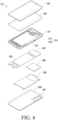
- FIG. 4 is an exploded perspective view illustrating an electronic device according to various embodiments of the disclosure.
- the electronic device 101 may include a support bracket 270, a front plate 220 (e.g., the front plate 202 of FIG. 2 ), a display 230 (e.g., the display 201 of FIG. 2 ), the PCB 240 (e.g., a PCB, a flexible PCB (FPCB), or a rigid flexible PCB (RFPCB)), a battery 250 (e.g., the battery 189 of FIG. 1 ), a second support member 260 (e.g., a rear case), an antenna 290 (e.g., the antenna module 197 of FIG.
- a support bracket 270 e.g., a front plate 220 (e.g., the front plate 202 of FIG. 2 ), a display 230 (e.g., the display 201 of FIG. 2 ), the PCB 240 (e.g., a PCB, a flexible PCB (FPCB), or a rigid flexible PCB (RFPCB)), a battery 250 (
- the support bracket 270 of the electronic device 101 may include a side bezel structure 271 (e.g., the side bezel structure 218 of FIG. 2 ) and a first support member 272.
- the electronic device 101 may not be provided with at least one (e.g., the first support member 272 or the second support member 260) of the components or may additionally include other components. At least one of the components of the electronic device 101 may be the same as or similar to at least one of the components of the electronic device 101 of FIG. 2 or FIG. 3 , and a redundant description will be avoided herein.
- the first support member 272 may be disposed inside the electronic device 101 and connected to the side bezel structure 271, or may be integrally formed with the side bezel structure 271.
- the first support member 272 may be formed of, for example, a metallic material and/or a non-metallic (e.g., polymer) material.
- the first support member 272 may have one surface coupled with the display 230 and the other surface coupled with the PCB 240.
- a processor, memory, and/or an interface may be mounted on the PCB 240.
- the processor may include at least one of, for example, a central processing unit, an application processor, a graphics processing unit, an image signal processor, a sensor hub processor, or a communication processor.
- the PCB 240 may include a flexible printed circuit board type radio frequency cable (FRC).
- FRC radio frequency cable
- the PCB 240 may be disposed on at least a portion of the first support member 272 and electrically coupled to an antenna module (e.g., the antenna module 197 of FIG. 1 ) and a communication module (e.g., the communication module 190 of FIG. 1 ).
- the memory may include, for example, volatile memory or non-volatile memory.
- the interface may include, for example, a high definition multimedia interface (HDMI), a USB interface, a secure digital (SD) card interface, and/or an audio interface.
- HDMI high definition multimedia interface
- USB USB interface
- SD secure digital
- audio audio interface
- the interface may electrically or physically connect the electronic device 101 to an external electronic device, for example, and include a USB connector, an SD card/multimedia card (MMC) connector, or an audio connector.
- MMC multimedia card
- the battery 250 which is a device for supplying power to at least one component of the electronic device 101, may include, for example, a nonrechargeable primary cell, a rechargeable secondary cell, or a fuel cell. At least a portion of the battery 250 may be disposed substantially on the same plane with the PCB 240, for example. The battery 250 may be disposed integrally inside the electronic device 101 or detachably from the electronic device 101.
- the second support member 260 (e.g., the rear case) may be disposed between the PCB 240 and the antenna 290.
- the second support member 260 may include one surface coupled with at least one of the PCB 240 or the battery 250 and the other surface coupled with the antenna 290.
- the antenna 290 may be disposed between the rear plate 280 and the battery 250.
- the antenna 290 may include, for example, a near field communication (NFC) antenna, a wireless charging antenna, and/or a magnetic secure transmission (MST) antenna.
- the antenna 290 may, for example, perform short-range communication with an external device or wirelessly transmit and receive power for charging to and from an external device.
- an antenna structure may be formed by a portion or combination of the side bezel structure 271 and/or the first support member 272.
- the rear plate 280 may form at least a portion of the rear surface (e.g., the rear surface 210B of FIG. 3 ) of the electronic device 101.
- the rear plate 280 may include an opening 281 for disposing a camera therein. The opening may be formed at a position where a camera module (e.g., the camera module 212 of FIG. 3 ) is disposed.
- FIG. 5 is a front view and side view illustrating the electronic device 101 including a camera deco part 300 according to various embodiments of the disclosure.
- FIG. 6 is a rear view illustrating the electronic device 101 including the camera deco part 300 and an enlarged view illustrating the camera deco part 300 according to various embodiments of the disclosure.
- FIG. 7 is a rear exploded perspective view illustrating the electronic device 101 including the camera deco part 300 according to various embodiments of the disclosure.
- FIG. 8 is an exploded perspective view illustrating the camera deco part 300 included in the electronic device 101 according to various embodiments of the disclosure.
- the electronic device 101 may include a camera assembly 440, a PCB 430, a conductive sponge 420, a second support member 410, the camera deco part 300, a second adhesive portion 450, and a camera window 460.
- the camera deco part 300 may include a first metal portion 310, a second metal portion 320, and a first adhesive portion 330.
- the configurations of the PCB 430, the second support member 410, and the camera deco part 300 of FIGS. 5 , 6 , 7 , and 8 may be partially or wholly identical to those of the PCB 240, the second support member 260, and the rear camera module 212 of FIG. 4 .
- 'Z' may refer to the thickness direction of the electronic device 101. Further, in an embodiment of the disclosure, '+Z' may refer to the upward direction of the electronic device, and '-Z' may refer to the downward direction of the electronic device.
- the camera deco part 300 covering the camera assembly 440 may include a metal portion (e.g., the first metal portion 310 and the second metal portion 320 of FIG. 6 ). Because the metal portion is located inside an opening of a rear plate (e.g., the rear plate 280 of FIG. 4 ), the metal portion may be formed to be as large as or smaller than the opening. The metal portion may be exposed to the outside of the electronic device.
- the metal portion may include a plurality of camera openings (not shown) for exposing a camera lens of the camera assembly 440 to the outside.
- the metal portion may include three camera openings.
- the metal portion may be formed with a portion surrounding the plurality of camera openings (not shown) projecting in the upward direction of the electronic device.
- the camera assembly 440 disposed in the downward direction of the camera deco part 300 may be protected.
- the size and shape of the metal portion and the number and shape of the plurality of openings are not limited to the above embodiment, and may be subject to various design modifications depending on the sizes or arrangement relationship of surrounding structures.
- the camera deco part 300 covering the camera assembly 440 may include a plurality of metal portions, for design differentiation.
- the camera deco part 300 may include the first metal portion 310 and the second metal portion 320.
- the second metal portion 320 may be disposed to face the top of the camera assembly 440 and correspond to a plurality of camera lenses forming the camera assembly 440.
- the second metal portion 320 may include a plurality of openings corresponding to the sizes of the plurality of camera lenses forming the camera assembly 440 and have a shape completely enclosing the plurality of camera lenses.
- the second metal portion 320 may be recessed in the downward direction (a -Z direction) to correspond to the size and shape of the first metal portion 310 and/or the first adhesive portion 330, such that the second metal portion 320 is aligned at a position corresponding to the first metal portion 310 and/or the first adhesive portion 330.
- the first metal portion 310 may be disposed to face the top of the second metal portion 320.
- the first metal portion 310 may be in the form of a plurality of rings including openings corresponding to the sizes of the plurality of camera lenses.
- the bottom surface of the second metal portion 320 may be in contact with the conductive sponge 420, and the conductive sponge 420 may be in contact with the top surface of the PCB 430.
- the conductive sponge 420 may be disposed between the second metal portion 320 and the PCB 430 in contact with the second metal portion 320 and the PCB 430. Accordingly, when static electricity from the outside of the electronic device 101 is introduced into a camera module via the metal portions, the static electricity may be transferred to the PCB 430 via the second metal portion 320 and the conductive sponge 420. Accordingly, damage to the camera device and further effects on and damage to other modules disposed in the electronic device caused by static electricity introduced into the electronic device 101 through the camera module may be reduced.
- electrical connection between the second metal portion 320 and the PCB 430 may be accomplished through a conductor such as a c-clip or a conductive rubber as well as a conductive sponge.
- the camera deco part 300 may include the first adhesive portion 330 which is located between the first metal portion 310 and the second metal portion 320 and attaches the first metal portion 310 and the second metal portion 320 to each other.
- the first adhesive portion 330 may be in the form of a plurality of rings including openings corresponding to the sizes of the plurality of camera lenses.
- the first adhesive portion 330 may be similar in size and shape to the first metal portion 310, or may be smaller in size than the first metal portion 310.
- the first adhesive portion 330 may be waterproof.
- the first adhesive portion 330 may be non-conductive. Therefore, when static electricity from the outside of the electronic device 101 is introduced into the camera deco part 300, the static electricity may not travel through the first adhesive portion 330.
- the thickness of the first adhesive portion 330 may be set in consideration of prevention of degradation of electrostatic discharge (ESD) performance and slimming of the electronic device.
- the thickness of the first adhesive portion 330 may be approximately 0.5mm or less.
- the camera window 460 may be disposed to face the top of the first metal portion 310 to protect the camera lenses.
- the electronic device 101 may include the second adhesive portion 450 between the camera window 460 and the first metal portion 310 to attach the camera window 460 and the first metal portion 310.
- the second adhesive portion 450 may be waterproof.
- the second adhesive portion 450 may be non-conductive.
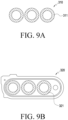
- FIG. 9A is a diagram illustrating the bottom surface and an oxide coating layer-free portion of the first metal portion 310 according to various embodiments of the disclosure.
- FIG. 9B is a diagram illustrating the bottom surface and an oxide coating layer-free portion of the second metal portion 320 according to various embodiments of the disclosure.
- the camera deco part 300 may include the first metal portion 310 and the second metal portion 320.
- the configurations of the first metal portion 310 and the second metal portion 320 of FIGS. 9A and 9B may be partially or wholly identical to those of the first metal portion 310 and the second metal portion 320 of FIGS. 5 , 6 , 7 , and 8 .
- the first metal portion 310 may include a first surface (not shown) on which an oxide coating layer is formed, and a second surface 311 on which an oxide coating layer is not formed.
- the second surface 311 on which the oxide coating layer is not formed may be a hatched portion.
- the second surface 311 may be a portion obtained by forming an oxide coating layer by anodizing and then peeling off at least a portion of a portion where the oxide coating layer is formed to form a conduction structure in consideration of ESD. This is because static electricity from the outside of the electronic device 101 should be transmitted to the PCB 430 disposed inside the electronic device 101 without being blocked by the oxide coating layer formed on the first metal portion 310.
- the oxide coating layer may be peeled off using equipment such as a laser.
- the first surface on which the oxide coating layer is formed may be the top surface (e.g., in the +Z direction of FIG. 8 ) of the first metal portion 310, which may be exposed to the outside of the electronic device, and the second surface 311 on which the oxide coating layer is not formed may be the bottom surface (e.g., in the -Z direction of FIG. 8 ) of the first metal portion 310, which faces the second metal portion 320.
- the second metal portion 320 may include a third surface (not shown) on which an oxide coating layer is formed, and a fourth surface 321 on which an oxide coating layer is not formed.
- the fourth surface 321 of the second metal part 320, on which the oxide coating layer is not formed, may be a hatched portion in FIG. 9B .
- the fourth surface 321 may be a portion obtained by forming an oxide coating lager by anodizing and then peeling off at least a portion of a portion where the oxide coating layer is formed to form a conduction structure in consideration of ESD. This is because static electricity from the outside of the electronic device 101 should be transmitted to the PCB 430 disposed inside the electronic device 101 without being blocked by the oxide coating layer formed on the second metal portion 320.
- the oxide coating layer may be peeled off using equipment such as a laser.
- the fourth surface 321 without the oxide coating layer formed thereon may be at least a portion of the top surface (e.g., in the +Z direction of FIG. 8 ) of the second metal portion 320, which faces the first metal portion 310.
- the fourth surface 321 without the oxide coating layer formed thereon may be a recess 331 formed in the downward direction (e.g., the -Z direction of FIG. 8 ) in a shape corresponding to the first metal portion 310 and/or the first adhesive portion 330.
- the third surface with the oxide coating layer formed thereon may be any portion other than the fourth surface 321 facing the first metal portion 310.
- the static electricity when static electricity from the outside of the electronic device 101 is introduced into the camera module through the metal portions, the static electricity may be transferred to the PCB 430 through the first metal portion 310, the second metal portion 320, and the conductive sponge 420.
- the static electricity may migrate through a portion not in contact with the first adhesive portion 330 on the second surface 311 of the first metal portion 310 and a portion not in contact with the first adhesive portion 330 on the fourth surface 321 of the second metal portion 320. Accordingly, damage to the camera device and further effects on and damage to other modules disposed in the electronic device caused by static electricity introduced into the electronic device 101 through the camera module may be reduced.
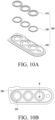
- FIG. 10A is an exploded perspective view illustrating the camera deco part 300 according to various embodiments of the disclosure.
- FIG. 10B is a front view illustrating the camera deco part 300 according to various embodiments of the disclosure.
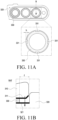
- FIG. 11A is a front view illustrating the adhesive portion 330 including at least one recess 331, and the second metal portion 320 in combination, and an enlarged view illustrating the adhesive portion 330 according to an embodiment of the disclosure.
- FIG. 11B is a cross-sectional view illustrating the camera deco part 300 of FIG. 10B , taken along line B-B' according to an embodiment of the disclosure.
- FIG. 12A is a front view illustrating the adhesive portion 330 including at least one recess 332 according to another embodiment of the disclosure.
- FIG. 12B is a front view illustrating the adhesive portion 330 including at least one recess 333 according to another embodiment of the disclosure.
- the recesses 331, 332, and 333 may include, for example, recesses and/or openings.
- the camera deco part 300 may include the first metal portion 310, the second metal portion 320, and the adhesive portion 330.
- the configurations of the first metal portion 310, the second metal portion 320, and the adhesive portion 330 of FIGS. 10A, 10B , 11A, and 11B , and FIGS. 12A and 12B may be partially or wholly identical to those of the first metal portion 310, the second metal portion 320, and the adhesive portion 330 of FIGS. 9A and 9B .
- the adhesive portion 330 may include at least one recess 331.
- the adhesive portion 330 may include four recesses 331.
- the recess 331 may be a portion cut inwardly from the outer periphery of the ring-shaped adhesive portion 330.
- the recess 332 may be a portion cut outwardly from the inner periphery of the ring-shaped adhesive portion 330.
- the cut-out portion may be in the shape of "D".
- the recess 333 may be a plurality of openings formed in the ring-shaped adhesive portion 330.
- the width of a portion where the first metal portion 310 and the second metal portion 320 face each other without contacting the first adhesive portion 330 may be increased by decreasing the width of at least a portion of the adhesive portion 330.
- the cut shape of the recess 331 is not limited to the above embodiment, and may be subject to various design modifications depending on the size or arrangement relationship of external structures.
- the distance between a side surface of the adhesive portion 330 and an inner side surface of the second metal portion 320, which faces the adhesive portion 330 may be, for example, approximately 0.2mm.
- an area over which the first metal portion 310 and the second metal portion 320 are in contact without the adhesive portion 330 may be, for example, approximately 7.51mm 2 .
- the distance h between an outer side surface of the recessed portion and an inner side surface of the second metal portion 320 may be, for example, approximately 0.5mm to 0.7mm.
- the distance h between the outer side surface of the recessed portion and the inner side surface of the second metal portion 320 may be, for example, approximately 0.6mm.
- an area over which the first metal portion 310 and the second metal portion 320 may be in contact may be, for example, approximately 13.11mm 2 .
- the area over which the first metal portion 310 and the second metal portion 320 may contact without the adhesive portion 330 may be approximately doubled by forming the recess 331.
- the width of the recessed portion of the adhesive portion 330 including the recess 331 is not limited to the above embodiment, and may be subject to various design modifications. However, the width of the recessed adhesive portion 330 should be at least 1mm in order to maintain adhesion.
- contact between the first metal portion 310 and the second metal portion 320 may mean that the first metal portion 310 and the second metal portion 320 are physically connected, or electrically coupled without being physically connected.
- contact between the first metal portion 310 and the second metal portion 320 may mean that static electricity flows between the first metal portion 310 and the second metal portion 320.
- FIG. 13A is a rear perspective view illustrating a portion of the camera deco part 300 including a rib 340, according to another embodiment of the disclosure.
- FIG. 13B is a rear perspective view illustrating a portion of the camera deco part 300 further including the first adhesive portion 330 in addition to FIG. 13A according to another embodiment of the disclosure.
- FIG. 13B is a cross-sectional view illustrating the camera deco part 300 including the rib 340 according to another embodiment of the disclosure.
- the camera deco part 300 may include the first metal portion 310, the second metal portion 320, the adhesive portion 330, and the rib 340.
- the configurations of the first metal portion 310, the second metal portion 320, and the adhesive portion 330 of FIGS. 13A, 13B, and 13C may be partially or wholly identical to those of the first metal portion 310, the second metal portion 320, and the adhesive portion 330 of FIGS. 9A and 9B .
- the camera deco part 300 may further include the rib 340 to provide an ESD conduction path between the first metal portion 310 and the second metal portion 320.
- the rib 340 may be in the shape of a ring with an outer diameter equal to that of the first metal portion 310 and a width smaller than that of the first metal portion 310.
- the inner diameter of the rib may be greater than the outer diameter of the adhesive portion 330.
- the first metal portion 310 may contact the first adhesive portion 330 smaller than the first metal portion 310, and the rib 340 may contact a portion that does not contact the first adhesive portion 330 on the rear surface of the first metal portion 310.
- the rib 340 may be a conductor.
- the rib 340 may be integrally formed with the first metal portion 310 and/or the second metal portion 320.
- the rib 340 may be integrally formed with the first metal portion 310.
- the rib 340 may be integrally formed with the second metal portion 320.
- the rib 340 may be formed independently of the first metal portion 310 or the second metal portion 320.
- a path for conduction of static electricity may be secured through direct contact between the first metal portion 310 and the second metal portion 320.
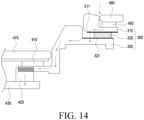
- FIG. 14 is a cross-sectional view illustrating the electronic device 101 including the camera deco part 300 of FIG. 2 , taken along line A-A' according to various embodiments of the disclosure.
- the electronic device 101 may include the PCB 430, the conductive sponge 420, the second support member 410, the camera deco part 300, the second adhesive portion 450, and the camera window 460.
- the camera deco part 300 may include the first metal portion 310, the second metal portion 320, and the first adhesive portion 330.
- the configurations of the PCB 430, the conductive sponge 420, the second support member 410, the camera deco part 300, the second adhesive portion 450, and the camera window 460 of FIG. 12 may be partially or wholly identical to those of the PCB 430, the conductive sponge 420, the second support member 410, the camera deco part 300, the second adhesive portion 450, and the camera window 460 of FIG. 7 .
- the camera deco part 300 includes a single metal portion in a typical electronic device, it may include a plurality of metal portions (e.g., the first metal portion 310 and the second metal portion 320) for design differentiation in the disclosure.
- the remaining static electricity unable to migrate to the second metal portion 320 may not be able to migrate to the PCB 430, thereby causing damage to the camera device or further affecting and damaging other modules disposed in the electronic device.
- the static electricity when static electricity from the outside of the electronic device 101 is introduced into the camera module through the metal portions, the static electricity may travel through a portion not in contact with the first adhesive portion 330 on the second surface 311 of the first metal portion 310 without an oxide coating layer formed thereon.
- the static electricity may be introduced through a portion not in contact with the first adhesive portion 330 on the fourth surface 321 of the second metal portion 320 without an oxide coating layer formed thereon.
- the static electricity may be transferred from the second metal portion 320 to the PCB 430 via the conductive sponge 420 that contacts the second metal portion 320.
- An electronic device (e.g., the electronic device 101 of FIG. 1 ) may include: a housing (e.g., the housing 210 of FIG. 2 ) including an opening; a PCB (e.g., the PCB 430 of FIG. 7 ) disposed inside the housing; and a camera deco part (e.g., the camera deco part 300 of FIG. 7 ) disposed inside the opening and covering a camera assembly.
- the camera deco part may include: a first metal portion (e.g., the first metal portion 310 of FIG. 7 ) including a first surface at least partially exposed to an outside of the electronic device and including an oxide coating layer and a second surface (e.g., the second surface 311 of FIG.
- a second metal portion e.g., the second metal portion 320 of FIG. 7
- a fourth surface e.g., the fourth surface 321 of FIG. 9B
- a first adhesive portion e.g., the first adhesive portion 330 of FIG. 7 located between the second surface of the first metal portion and the fourth surface of the second metal portion, and including at least one recess.
- the second surface may be a bottom surface of the first metal portion, and the fourth surface may include at least a portion of a top surface of the second metal portion.
- At least a portion of the second surface and the fourth surface is in contact with the first adhesive portion.
- the static electricity when static electricity from the outside of the electronic device is introduced into the camera deco part through the first metal portion, the static electricity is transferred from a portion of the second surface of the first metal portion, which is not in contact with the first adhesive portion to a portion of the fourth surface of the second metal portion, which is not in contact with the first adhesive portion.
- the first adhesive portion may include a waterproof material.
- the first adhesive portion may be in the form of a plurality of rings including openings corresponding to a plurality of camera lenses forming the camera assembly.
- the recess (e.g., the recess 331 of FIG. 11A ) may be formed to be concave inwardly from at least a portion of an outer periphery of the first adhesive portion.
- the recess (e.g., the recess 332 of FIG. 12 ) may be formed to be concave outwardly from at least a portion of an inner periphery of the first adhesive portion.
- the electronic device may further include a conductive sponge (e.g., the conductive sponge 420 of FIG. 7 ), and the conductive sponge may be disposed between the second metal portion and the PCB.
- a conductive sponge e.g., the conductive sponge 420 of FIG. 7
- the static electricity when static electricity from the outside of the electronic device is introduced into the camera deco part through the first metal portion, the static electricity may be transferred to the PCB through the first metal portion, the second metal portion, and the conductive sponge.
- the electronic device may further include a rib (e.g., the rib 340 of FIG. 13A ) located between the first metal portion and the adhesive portion.
- a rib e.g., the rib 340 of FIG. 13A
- the electronic device may further include: a camera window facing a top of the first metal portion; and a second adhesive portion located between the camera window and the first metal portion.
- a camera deco part covering a camera assembly in an electronic device may include: a first metal portion including a first surface at least partially exposed to an outside of the electronic device and and including an oxide coating layer and a second surface including no oxide coating layer; a second metal portion including a third surface at least partially exposed to the outside of the electronic device and including an oxide coating layer and a fourth surface including no oxide coating layer, and facing a PCB; and a first adhesive portion located between the second surface of the first metal portion and the fourth surface of the second metal portion, and including at least one recess.
- the second surface may be a bottom surface of the first metal portion, and the fourth surface may include at least a portion of a top surface of the second metal portion.
- At least a portion of the second surface and the fourth surface is in contact with the first adhesive portion.
- the static electricity when static electricity from the outside of the electronic device is introduced into the camera deco part through the first metal portion, the static electricity may be transferred from a portion not in contact with the first adhesive portion on the second surface of the first metal portion to a portion not in contact with the first adhesive portion on the fourth surface of the second metal portion.
- the first adhesive portion may include a waterproof material.
- the first adhesive portion may be in the form of a plurality of rings including openings corresponding to a plurality of camera lenses forming the camera assembly.
- the recess may be formed to be concave inwardly from at least a portion of an outer periphery of the first adhesive portion.
- the recess may be formed to be concave outwardly from at least a portion of an inner periphery of the first adhesive portion.
- the electronic device 101 including the camera deco part 300 is not limited by the foregoing embodiments and drawings, and it will be apparent to those skilled in the art that many replacements, variations, and modifications can be made inside the technical scope of the disclosure.
Landscapes
- Engineering & Computer Science (AREA)
- Signal Processing (AREA)
- Multimedia (AREA)
- Physics & Mathematics (AREA)
- General Physics & Mathematics (AREA)
- Electromagnetism (AREA)
- Studio Devices (AREA)
Applications Claiming Priority (3)
| Application Number | Priority Date | Filing Date | Title |
|---|---|---|---|
| KR20210103175 | 2021-08-05 | ||
| KR1020210153683A KR20230021552A (ko) | 2021-08-05 | 2021-11-10 | 카메라 장치 및 카메라 장치를 포함하는 전자 장치 |
| PCT/KR2022/011651 WO2023014162A1 (ko) | 2021-08-05 | 2022-08-05 | 카메라 장치 및 카메라 장치를 포함하는 전자 장치 |
Publications (2)
| Publication Number | Publication Date |
|---|---|
| EP4380136A1 true EP4380136A1 (de) | 2024-06-05 |
| EP4380136A4 EP4380136A4 (de) | 2024-11-13 |
Family
ID=85154643
Family Applications (1)
| Application Number | Title | Priority Date | Filing Date |
|---|---|---|---|
| EP22853537.3A Pending EP4380136A4 (de) | 2021-08-05 | 2022-08-05 | Kameravorrichtung und elektronische vorrichtung mit kameravorrichtung |
Country Status (3)
| Country | Link |
|---|---|
| US (1) | US12495194B2 (de) |
| EP (1) | EP4380136A4 (de) |
| WO (1) | WO2023014162A1 (de) |
Family Cites Families (21)
| Publication number | Priority date | Publication date | Assignee | Title |
|---|---|---|---|---|
| KR100966700B1 (ko) | 2003-08-23 | 2010-06-29 | 엘지전자 주식회사 | 휴대용 단말기의 카메라 렌즈 윈도우에 가하여지는 esd방전장치 |
| KR20070016329A (ko) * | 2005-08-03 | 2007-02-08 | 삼성전자주식회사 | 휴대용 단말기의 정전기 방전을 위한 엘씨디 모듈 고정구조 |
| AU2006338593B2 (en) | 2006-02-24 | 2012-02-02 | Opsec Security Group Inc. | Method of reducing electro-static discharge (ESD) from conductors on insulators |
| CN101267719A (zh) * | 2007-03-14 | 2008-09-17 | 鸿富锦精密工业(深圳)有限公司 | 便携式电子装置壳体 |
| CN101997942A (zh) | 2009-08-25 | 2011-03-30 | 深圳富泰宏精密工业有限公司 | 视窗及应用该视窗的便携式电子装置 |
| JPWO2014049896A1 (ja) * | 2012-09-26 | 2016-08-22 | パナソニックIpマネジメント株式会社 | 撮像装置 |
| KR102064596B1 (ko) | 2013-03-11 | 2020-02-11 | 삼성전자 주식회사 | 카메라 모듈을 포함하는 전자장치 |
| KR102045460B1 (ko) | 2013-05-23 | 2019-11-15 | 엘지전자 주식회사 | 이동 단말기 |
| JP6554886B2 (ja) | 2014-04-25 | 2019-08-07 | 東洋製罐グループホールディングス株式会社 | 表面に液膜を有する構造体 |
| KR102207162B1 (ko) * | 2014-06-11 | 2021-01-25 | 삼성전자주식회사 | 카메라 장치 및 카메라 장치를 구비한 전자 장치 |
| KR102238544B1 (ko) | 2014-12-08 | 2021-04-09 | 삼성전자주식회사 | 정전기 방전 보호 장치 및 이를 포함하는 전자 장치 |
| CN207070127U (zh) * | 2017-08-28 | 2018-03-02 | 广东欧珀移动通信有限公司 | 装饰组件、壳体组件和移动终端 |
| CN107454295A (zh) * | 2017-08-31 | 2017-12-08 | 广东欧珀移动通信有限公司 | 摄像头组件和移动终端 |
| US10425561B2 (en) | 2017-09-08 | 2019-09-24 | Apple Inc. | Portable electronic device |
| CN107682478B (zh) * | 2017-09-26 | 2020-07-17 | Oppo广东移动通信有限公司 | 盖板、摄像头组件及终端 |
| KR102367486B1 (ko) | 2017-11-09 | 2022-02-25 | 엘지디스플레이 주식회사 | 디스플레이 장치 |
| CN108881681B (zh) * | 2018-06-28 | 2021-04-06 | Oppo广东移动通信有限公司 | 电子装置 |
| KR102709039B1 (ko) * | 2019-11-12 | 2024-09-25 | 삼성전자 주식회사 | 마이크로폰을 포함하는 전자 장치 |
| KR102751607B1 (ko) | 2019-11-19 | 2025-01-10 | 삼성전자주식회사 | 접속 부재를 포함하는 전자 장치 |
| KR102832664B1 (ko) | 2020-06-16 | 2025-07-11 | 삼성전자주식회사 | 카메라를 포함하는 전자 장치 |
| CN112929547A (zh) * | 2021-03-15 | 2021-06-08 | 闻泰通讯股份有限公司 | 摄像头模组以及电子设备 |
-
2022
- 2022-08-05 WO PCT/KR2022/011651 patent/WO2023014162A1/ko not_active Ceased
- 2022-08-05 EP EP22853537.3A patent/EP4380136A4/de active Pending
-
2024
- 2024-02-02 US US18/431,179 patent/US12495194B2/en active Active
Also Published As
| Publication number | Publication date |
|---|---|
| WO2023014162A1 (ko) | 2023-02-09 |
| US20240172353A1 (en) | 2024-05-23 |
| EP4380136A4 (de) | 2024-11-13 |
| US12495194B2 (en) | 2025-12-09 |
Similar Documents
| Publication | Publication Date | Title |
|---|---|---|
| KR102883209B1 (ko) | 카메라 모듈의 접점 구조 및 이를 포함하는 전자 장치 | |
| US12449859B2 (en) | Housing having recess structure and electronic device including same | |
| US20250261352A1 (en) | Contact structure of camera module and electronic device comprising same | |
| US20250274645A1 (en) | Electronic device including camera module | |
| EP4209862A1 (de) | Mikrofonstruktur und elektronische vorrichtung mit der mikrofonstruktur | |
| EP4380136A1 (de) | Kameravorrichtung und elektronische vorrichtung mit kameravorrichtung | |
| KR102918429B1 (ko) | 전기적 스트레스를 제거하는 구조를 포함하는 전자 장치 및 인쇄 회로 기판 | |
| KR20240016849A (ko) | 접지 구조를 포함하는 커넥터 및 이를 포함하는 전자 장치 | |
| AU2021417559A9 (en) | Electronic device comprising microphone module | |
| US20250185183A1 (en) | Electronic device including electrostatic discharge path | |
| EP4345573B1 (de) | Elektronische vorrichtung mit lautsprecher | |
| US20240422911A1 (en) | Electronic device including supporting structure for printed circuit board | |
| EP4492761B1 (de) | Elektronische vorrichtung mit struktur zur reduzierung des einflusses von fremdstoffen | |
| EP4598293A1 (de) | Elektronische vorrichtung mit abschirmdose | |
| EP4561109A1 (de) | Elektronische vorrichtung mit isolationsstruktur für lautsprecher | |
| US12035462B2 (en) | Electronic device and printed circuit board including structure for removing electrical stress | |
| US20250338396A1 (en) | Electronic device comprising flexible printed circuit board | |
| US20250220808A1 (en) | Flexible printed circuit board including layer with roughness and electronic device including same | |
| KR102896048B1 (ko) | 전자 장치 및 전자 장치에서 카드 타입 기압 센서 이용 방법 | |
| KR20230021552A (ko) | 카메라 장치 및 카메라 장치를 포함하는 전자 장치 | |
| EP4733883A1 (de) | Elektronische vorrichtung mit haftelement und batterie | |
| EP4572546A1 (de) | Elektronische vorrichtung mit wasserdichter struktur | |
| CN117813831A (zh) | 相机装置和包括相机装置的电子装置 | |
| KR20250021928A (ko) | 카메라를 포함하는 전자 장치 및 그 제조 방법 | |
| KR20230028962A (ko) | 카메라 모듈 및 이를 포함하는 전자 장치 |
Legal Events
| Date | Code | Title | Description |
|---|---|---|---|
| STAA | Information on the status of an ep patent application or granted ep patent |
Free format text: STATUS: THE INTERNATIONAL PUBLICATION HAS BEEN MADE |
|
| PUAI | Public reference made under article 153(3) epc to a published international application that has entered the european phase |
Free format text: ORIGINAL CODE: 0009012 |
|
| STAA | Information on the status of an ep patent application or granted ep patent |
Free format text: STATUS: REQUEST FOR EXAMINATION WAS MADE |
|
| 17P | Request for examination filed |
Effective date: 20240301 |
|
| AK | Designated contracting states |
Kind code of ref document: A1 Designated state(s): AL AT BE BG CH CY CZ DE DK EE ES FI FR GB GR HR HU IE IS IT LI LT LU LV MC MK MT NL NO PL PT RO RS SE SI SK SM TR |
|
| A4 | Supplementary search report drawn up and despatched |
Effective date: 20241010 |
|
| DAV | Request for validation of the european patent (deleted) | ||
| DAX | Request for extension of the european patent (deleted) | ||
| RIC1 | Information provided on ipc code assigned before grant |
Ipc: H04N 23/57 20230101ALI20241004BHEP Ipc: H04N 23/50 20230101ALI20241004BHEP Ipc: G03B 30/00 20210101ALI20241004BHEP Ipc: G03B 17/08 20210101ALI20241004BHEP Ipc: H04N 23/00 20230101ALI20241004BHEP Ipc: H04M 1/02 20060101AFI20241004BHEP |
|
| STAA | Information on the status of an ep patent application or granted ep patent |
Free format text: STATUS: EXAMINATION IS IN PROGRESS |
|
| 17Q | First examination report despatched |
Effective date: 20251112 |