EP4382386A1 - Procédé d'estimation de paramètres de masse et de charge de route d'un véhicule - Google Patents
Procédé d'estimation de paramètres de masse et de charge de route d'un véhicule Download PDFInfo
- Publication number
- EP4382386A1 EP4382386A1 EP22306789.3A EP22306789A EP4382386A1 EP 4382386 A1 EP4382386 A1 EP 4382386A1 EP 22306789 A EP22306789 A EP 22306789A EP 4382386 A1 EP4382386 A1 EP 4382386A1
- Authority
- EP
- European Patent Office
- Prior art keywords
- vehicle
- mass
- variables
- predicted
- drag
- Prior art date
- Legal status (The legal status is an assumption and is not a legal conclusion. Google has not performed a legal analysis and makes no representation as to the accuracy of the status listed.)
- Withdrawn
Links
Images

Classifications
-
- B—PERFORMING OPERATIONS; TRANSPORTING
- B60—VEHICLES IN GENERAL
- B60T—VEHICLE BRAKE CONTROL SYSTEMS OR PARTS THEREOF; BRAKE CONTROL SYSTEMS OR PARTS THEREOF, IN GENERAL; ARRANGEMENT OF BRAKING ELEMENTS ON VEHICLES IN GENERAL; PORTABLE DEVICES FOR PREVENTING UNWANTED MOVEMENT OF VEHICLES; VEHICLE MODIFICATIONS TO FACILITATE COOLING OF BRAKES
- B60T8/00—Arrangements for adjusting wheel-braking force to meet varying vehicular or ground-surface conditions, e.g. limiting or varying distribution of braking force
- B60T8/17—Using electrical or electronic regulation means to control braking
- B60T8/172—Determining control parameters used in the regulation, e.g. by calculations involving measured or detected parameters
-
- B—PERFORMING OPERATIONS; TRANSPORTING
- B60—VEHICLES IN GENERAL
- B60W—CONJOINT CONTROL OF VEHICLE SUB-UNITS OF DIFFERENT TYPE OR DIFFERENT FUNCTION; CONTROL SYSTEMS SPECIALLY ADAPTED FOR HYBRID VEHICLES; ROAD VEHICLE DRIVE CONTROL SYSTEMS FOR PURPOSES NOT RELATED TO THE CONTROL OF A PARTICULAR SUB-UNIT
- B60W40/00—Estimation or calculation of non-directly measurable driving parameters for road vehicle drive control systems not related to the control of a particular sub unit, e.g. by using mathematical models
- B60W40/02—Estimation or calculation of non-directly measurable driving parameters for road vehicle drive control systems not related to the control of a particular sub unit, e.g. by using mathematical models related to ambient conditions
- B60W40/06—Road conditions
- B60W40/076—Slope angle of the road
-
- B—PERFORMING OPERATIONS; TRANSPORTING
- B60—VEHICLES IN GENERAL
- B60W—CONJOINT CONTROL OF VEHICLE SUB-UNITS OF DIFFERENT TYPE OR DIFFERENT FUNCTION; CONTROL SYSTEMS SPECIALLY ADAPTED FOR HYBRID VEHICLES; ROAD VEHICLE DRIVE CONTROL SYSTEMS FOR PURPOSES NOT RELATED TO THE CONTROL OF A PARTICULAR SUB-UNIT
- B60W40/00—Estimation or calculation of non-directly measurable driving parameters for road vehicle drive control systems not related to the control of a particular sub unit, e.g. by using mathematical models
- B60W40/10—Estimation or calculation of non-directly measurable driving parameters for road vehicle drive control systems not related to the control of a particular sub unit, e.g. by using mathematical models related to vehicle motion
- B60W40/1005—Driving resistance
-
- B—PERFORMING OPERATIONS; TRANSPORTING
- B60—VEHICLES IN GENERAL
- B60W—CONJOINT CONTROL OF VEHICLE SUB-UNITS OF DIFFERENT TYPE OR DIFFERENT FUNCTION; CONTROL SYSTEMS SPECIALLY ADAPTED FOR HYBRID VEHICLES; ROAD VEHICLE DRIVE CONTROL SYSTEMS FOR PURPOSES NOT RELATED TO THE CONTROL OF A PARTICULAR SUB-UNIT
- B60W40/00—Estimation or calculation of non-directly measurable driving parameters for road vehicle drive control systems not related to the control of a particular sub unit, e.g. by using mathematical models
- B60W40/12—Estimation or calculation of non-directly measurable driving parameters for road vehicle drive control systems not related to the control of a particular sub unit, e.g. by using mathematical models related to parameters of the vehicle itself, e.g. tyre models
- B60W40/13—Load or weight
-
- B—PERFORMING OPERATIONS; TRANSPORTING
- B60—VEHICLES IN GENERAL
- B60T—VEHICLE BRAKE CONTROL SYSTEMS OR PARTS THEREOF; BRAKE CONTROL SYSTEMS OR PARTS THEREOF, IN GENERAL; ARRANGEMENT OF BRAKING ELEMENTS ON VEHICLES IN GENERAL; PORTABLE DEVICES FOR PREVENTING UNWANTED MOVEMENT OF VEHICLES; VEHICLE MODIFICATIONS TO FACILITATE COOLING OF BRAKES
- B60T2250/00—Monitoring, detecting, estimating vehicle conditions
- B60T2250/02—Vehicle mass
-
- B—PERFORMING OPERATIONS; TRANSPORTING
- B60—VEHICLES IN GENERAL
- B60W—CONJOINT CONTROL OF VEHICLE SUB-UNITS OF DIFFERENT TYPE OR DIFFERENT FUNCTION; CONTROL SYSTEMS SPECIALLY ADAPTED FOR HYBRID VEHICLES; ROAD VEHICLE DRIVE CONTROL SYSTEMS FOR PURPOSES NOT RELATED TO THE CONTROL OF A PARTICULAR SUB-UNIT
- B60W50/00—Details of control systems for road vehicle drive control not related to the control of a particular sub-unit, e.g. process diagnostic or vehicle driver interfaces
- B60W2050/0001—Details of the control system
- B60W2050/0019—Control system elements or transfer functions
- B60W2050/0028—Mathematical models, e.g. for simulation
- B60W2050/0031—Mathematical model of the vehicle
Definitions
- the invention relates to the field of automotive industry.
- the invention relates to a computer-implemented method for estimating mass and road load parameters of a vehicle.
- HEV Hybrid Electric vehicles
- PHEV Plug-in-hybrid vehicles
- BEV Battery electric vehicles
- FCEV Fuel cell electric vehicle
- the knowledge of a vehicle mass and of road load during a trip may improve the ability of powertrains logic to account for vehicle drivability behavior (e.g. for Cruise control) or to correctly estimate the driving range of the vehicle in order to assist the driver as early as possible in planning his trip and determining the most adequate location to recharge the battery of the vehicle.
- vehicle drivability behavior e.g. for Cruise control
- estimation of vehicle mass and road load can be achieved through different means. For example, it can be achieved by using rule-based logic and state-flow based decision, by using physical or surrogate models, by using mixed model and statistic inference based approaches (e.g. Kalman filter, Bayesian inference), or by using Machine Learning and system identification methods.
- rule-based logic and state-flow based decision by using physical or surrogate models, by using mixed model and statistic inference based approaches (e.g. Kalman filter, Bayesian inference), or by using Machine Learning and system identification methods.
- EKF Extended Kalman filter
- an implementation of EKF for estimating mass and road load is based on predicting a vehicle speed by means of a dynamical model, and then comparing the prediction to a measured speed of the vehicle. Based on the error between predicted and measured speed, the unknown mass and road load can be updated and corrected in the dynamical model.
- EKF-based methods provide estimates of the mass and road load that cannot be efficiently used to predict the behavior of a vehicle in a mid-term or long-term horizon. Most importantly, the estimates cannot be used to accurately predict future energy consumption of a vehicle.
- the present disclosure relates to a method for estimating mass and road load of a vehicle solving some of the problems of the existing art.
- a computer-implemented method for estimating mass and/or road load parameters of a vehicle during a vehicle trip based on an iterative estimator comprises steps of:
- mass and road load parameters are referred to hereinafter as MRL parameters. Further, such method is referred to hereinafter as the MRL estimator method.
- a vehicle trip may refer to a journey of a vehicle from a first location to a second location or, equivalently, to a vehicle round trip between two locations.
- the MRL parameters of a vehicle comprise a mass parameter and road load parameters, such mass parameter and road load parameters being related to forces exerted on the vehicle that enter a road load equation of the vehicle.
- the mass parameter is a mass term entering an equation describing a road grade force exerted by the road on wheels of the vehicle.
- road load parameters of a vehicle refer to a set of parameters comprising an aerodynamic drag coefficient (drag coefficient) of the vehicle and a rolling resistance coefficient (roll coefficient) of the vehicle.
- drag coefficient enters an equation describing the aerodynamic drag force of the air surrounding the vehicle on the vehicle.
- roll coefficient enters an equation describing the rolling resistance force resisting the motion of the vehicle.
- the mass and road load parameters may comprise a mass parameter, a drag coefficient, and a roll coefficient, that are related to a road grade force, an aerodynamic drag force, and a rolling resistance force, respectively.
- an EKF estimator is used to estimate iteratively state variables comprising the MRL parameters.
- a prediction of the state variables is made based on various state variables at a previous time and the prediction is then compared to actual data measured on the vehicle.
- a predicted output error resulting from a difference between the predicted state variables and the actual data is used, as a feedback signal, to correct the prediction in view of subsequent predictions.
- the correction of the state variables is based on generic EKF equations that use statistical covariance of the predicted state variables and is known to the skilled person, see for example [REF2].
- the proposed MRL estimator method proposes to compute an error based on both a speed of a vehicle and an energy consumption of the vehicle in order to correct state variables of an EKF estimator. This provides an improved accuracy of prediction of mass and road load parameters.
- a reason for the improved accuracy is as follows. It is generally possible to find different combinations of mass and road load parameters that provide the same short-term impact on vehicle acceleration and vehicle speed. Therefore, EKF-based methods of the prior art that rely only on measured vehicle speed to correct predicted mass and road load parameters can infer incorrect mass and road load parameters. For example, when driving at high speed only, impact of rolling resistance is much smaller than that of aerodynamic drag, therefore, the EKF-based methods of the prior art can lead to incorrect estimation of the roll coefficient.
- the input variables comprise an angular velocity of at least one wheel of the vehicle and a traction torque of the at least one wheel, and wherein the actual energy consumption of the vehicle is calculated based on previous measurements of such angular velocity and such traction torque.
- Such previous measurements may be measurements obtained throughout the vehicle trip since the start of the trip.
- such calculation provides a virtual measure of the energy consumption of the vehicle without requiring an actual energy sensor. Therefore, the method acts as if the energy is measured with a virtual energy sensor. In particular, it is possible to evaluate the energy consumption since the start of the vehicle trip using previously measured values without requiring direct energy measurements that would be difficult to achieve.
- the state variables further comprise mass and road load energy terms representative of relative energy contributions of the forces related to the mass and road load parameters to energy consumption of the vehicle.
- the mass and road load energy terms are calculated, at each iteration, based on at least one input variable measured since the start of the trip and a time elapsed since the start of the trip.
- such calculation allows for taking into account the contributions of the mass and road load parameters to vehicle energy consumption throughout the entire trip duration since the start of the trip, and not only from the latest iteration of the MRL estimator method.
- the mass and road load energy terms comprise a rolling resistance energy term representative of a rolling resistance exerted by the road on the vehicle, and wherein a predicted rolling resistance energy term is calculated based on the speed of the vehicle measured at previous times and a time elapsed since the start of the trip.
- the predicted rolling resistance energy is calculated from parameters of the vehicle that can be measured such as the speed, which improves the accuracy of the prediction.
- the speed of the vehicle is an actual speed of the vehicle measured at the previous times.
- the mass and road load energy terms comprise a drag energy term representative of an aerodynamic drag force exerted by surroundings of the vehicle on the vehicle, and wherein a predicted drag energy term is calculated based on a cubic speed of the vehicle measured at previous times and a time elapsed since the start of the trip.
- the predicted drag energy is calculated from parameters of the vehicle that can be measured such as the speed, which improves the accuracy of the prediction.
- the speed of the vehicle is an actual speed of the vehicle measured at the previous times.
- the mass and road load energy terms comprise a mass energy term representative of a road grade force exerted by a gravitational field on the vehicle, and wherein a predicted mass energy term is calculated based on a square speed of the vehicle and a road slope angle measured at previous times and a time elapsed since the start of the trip.
- the predicted mass energy is calculated from parameters of the vehicle that can be measured such as the speed and the road slope angle, which improves the accuracy of the prediction.
- the speed of the vehicle is an actual speed of the vehicle measured at the previous times.
- the predicted energy consumption of the vehicle is calculated as a linear combination of predicted mass and road load energy terms weighted by corresponding predicted mass and road load parameters.
- the method further comprises a step of setting initial mass and road load parameters to predetermined initial values, for example production values.
- the method further comprises a step of, before proceeding to the step of measuring input variables, setting mass and road load energy terms to predetermined initial values, for example equal to zero.
- the method further comprises a step of determining if a trip of the vehicle is ongoing and, if it is determined that a trip of the vehicle is ongoing, proceeding to a further iteration of the method.
- the state variables may be corrected using data from actual measurements of parameters of the vehicle.
- the predicted contributions of mass and road load parameters to energy consumption since the start of the trip may be compared to actual energy consumption since the start of the trip that is calculated from measured input variables.
- the MRL estimator method according to the present disclosure thereby provides an accurate estimation of the mass and road load parameters that improves over the existing art.
- the method further comprises a step of using the state variables to control the vehicle, wherein controlling the vehicle comprises adjusting actuators of the vehicle to minimize fuel and/or energy consumption in view of a predetermined trip.
- the method further comprises a step of using the state variables to transmit a warning message to a user of the vehicle, the warning message comprising, for example, information on required maintenance and/or an over-loaded situation of the vehicle.
- the user of the vehicle may be, for example, the driver of the vehicle or a non-driving passenger of the vehicle, or a person remotely monitoring the behavior of the vehicle.
- the method further comprises a step of using the state variables to estimate a remaining driving range of the vehicle and transmit information regarding the remaining driving range to a user of the vehicle.
- the predicted state variables are calculated based on an equation of longitudinal dynamics of the vehicle.
- the input variables comprise a torque of a wheel of the vehicle and/or road slope angle.
- such input variables can be precisely measured with sensors that are generally available.
- the road slope angle is derived from a measurement of a road grade percentage based on an accelerometer sensor and/or a Global Navigation Satellite System.
- the present disclosure is further related to a computer program including instructions for executing the steps of the above method for estimating mass and road load parameters when said program is executed by a computer.
- This program can use any programming language and take the form of source code, object code or a code intermediate between source code and object code, such as a partially compiled form, or any other desirable form.
- the present disclosure is further related to a recording medium readable by a computer and having recorded thereon a computer program including instructions for executing the steps of the above described method.
- the recording medium can be any entity or device capable of storing the program.
- the medium can include storage means such as a ROM, for example a CD ROM or a microelectronic circuit ROM, or magnetic storage means, for example a diskette (floppy disk) or a hard disk.
- the recording medium can be an integrated circuit in which the program is incorporated, the circuit being adapted to execute the method in question or to be used in its execution.
- the present description mainly describes a computer-implemented method for estimating the MRL parameters of a vehicle
- the present disclosure relates, at least equivalently, to a system configured to implement steps of such methods.
- Such system may be, for example, an electronic control unit (ECU) of a vehicle.
- ECU electronice control unit
- Such methods have been developed in order to provide accurate estimation of the mass and road load parameters of a vehicle during a vehicle trip.
- estimation may be used to estimate the driving range of a vehicle and/or to assist a driver of the vehicle in planning his trip.
- augmented Kalman filtering refers to a modified implementation of an extended Kalman filtering applied to estimation of mass and road load parameters wherein energy consumption is predicted and compared with an actual value of energy consumption in order to calculate an error signal that is used, as a feedback signal, to update the Kalman estimator, i.e. state variables describing a state of the vehicle.
- the state variables that are updated at each iteration of the Kalman estimator comprise MRL relative energy contributions of the MRL forces to the overall energy consumption of the vehicle.
- the augmented Kalman filtering process aims at iteratively estimating state variables, x , comprising MRL parameters ( m , A roll , C drag ), based on input variables, u , that can be measured, for example, by sensors of a vehicle.
- MRL parameters may comprise a roll coefficient, A roll , expressed in Newton (N), and a drag coefficient, C drag , expressed in N.s 2 /m 2 .
- the process comprises two phases: a prediction phase and a correction phase.
- a prediction phase input variables are measured and state variables are estimated from the measured input variables.
- predicted output variables, y are calculated from the state variables.
- the estimation of the state variables may be made, for example, from longitudinal dynamics of the vehicle (see Equation 1 hereafter).
- a covariance matrix describing the covariance between the state variables is also predicted using generic extended Kalman filtering prediction equations; see for example [REF2].
- actual output variables may also be measured from "virtual" sensors, which means that they are not measured directly, but derived from measurements of sensors detecting other quantities.
- the input variables which generally depend on time, comprise a wheel torque T wheel , expressed in Newtons, and a road slope angle, ⁇ , expressed in radians.
- the input variables may be measured and/or determined based on measured parameters.
- the input variables may also comprise a measured speed of the vehicle or a measured angular velocity of a wheel of the vehicle.
- a measured speed of the vehicle or a measured angular velocity of a wheel of the vehicle.
- Such measured speed or angular velocity can be used, for example, to calculate the overall energy consumption of the vehicle, see Equation 2 discussed hereafter.
- the state variables which generally depend on time, comprise the speed of the vehicle, v , and the MRL parameters, i.e. the mass of the vehicle, m , the roll coefficient, A roll , and the drag coefficient, C drag .
- the state variables may also comprise additional terms representative of relative energy contributions of the MRL forces to the energy consumption of the vehicle.
- the additional terms are referred to as MRL energy terms in the present description. Such MRL energy terms are multiplying factors and are not homogeneous to energies.
- the MRL energy terms may comprise, for example, the roll energy term, ⁇ roll , the drag energy term, ⁇ drag , and the mass energy term, ⁇ mass .
- Such terms may be expressed in Joule per Newton (J/N), in J.m 2 /(N.s 2 ), and in Joule per kilogram (J/kg), respectively.
- E veh ⁇ T wheel R dyn . v sns dt
- An advantage of such formulation is that the wheel torque and the speed of the vehicle can be measured at any time during a vehicle trip, and that the wheel radius is generally known, therefore it is possible to precisely calculate the energy consumption from measured parameters at any time during a vehicle trip.
- the speed is the actual speed, v sns , of the vehicle, as measured for example by a sensor, and not the predicted speed among the state variables. This allows for a particularly accurate estimation of energy consumption throughout the entire vehicle trip, in particular since the start of the trip.
- the road load force and the road grade force may generally be expressed as follows in terms of the roll coefficient, A roll , the drag coefficient, C drag , and the speed of the vehicle, v , respectively.
- F rld A roll + C drag . v 2
- F grd m . g . sin ⁇
- g the gravitational acceleration constant
- ⁇ the road slope angle
- ⁇ tan ⁇ 1 G / 100
- the road grade, G is the percentage of inclination of a road, i.e. a percentage ratio of rise to run on a road. Equation 3 is generally known as a road load equation.
- Equation 6 may be obtained after integration by parts of the last term in order to avoid computation of the derivative of the measured speed, v sns , which can introduce noise in the calculation.
- the energy consumption of the vehicle can therefore be advantageously expressed as a linear combination of relative energy contributions of the MRL parameters to the overall energy consumption, weighted by the MRL parameters, as follows.
- E A roll . ⁇ roll + C drag . ⁇ drag + m . ⁇ mass
- MRL relative energy contributions i.e. MRL energy terms
- ⁇ roll ⁇ 0 ⁇ v sns dt
- drag ⁇ 0 ⁇ v sns 3 dt
- mass 1 2 v sns 2 + ⁇ 0 ⁇ g . sin ⁇ . v sns dt
- Equation 8-10 The decomposition of the energy consumption of the vehicle in terms of MRL energy terms provides a way to account independently for the impact of the MRL parameters on the energy consumption. Further, in Equations 8-10, the integrals are calculated over the time, ⁇ , elapsed since the start of the trip. This allows for accounting for the contributions of MRL parameters to vehicle energy consumption throughout the entire trip duration since the start of the trip, and not only from the latest iteration of the MRL estimator method according to the present disclosure.
- the MRL energy terms may be calculated based on the speed of the vehicle, and/or the acceleration of the vehicle, and/or the road slope.
- the methods and systems to estimate the mass and road load parameters provide accurate estimation of future vehicle energy consumption.
- the MRL energy terms may be included in the state variables of the extended Kalman filtering process. As the MRL energy terms account for the past energy consumption due to each of the MRL parameters, the MRL parameters may be corrected based on knowledge of the actual energy consumption of the vehicle and of the actual speed of the vehicle.
- the predicted output variables, y may be calculated from the state variables, x.
- the predicted output speed is known as the speed is already in the state variables (i.e. the speed in the output vector, y, is the same speed that the speed in the state vector, x).
- the predicted output overall energy consumption of the vehicle, E may be calculated as a linear combination of the MRL energy terms weighed by respective MRL parameters (see Equation 7).
- the actual variables comprise the actual speed of the vehicle, v sns , and the actual energy consumption of the vehicle, E virt-sns .
- the actual speed of the vehicle may be measured from a vehicle speed sensor.
- the inventors observed that the actual overall energy consumption of the vehicle may advantageously be calculated from other measured parameters of the vehicle (see Equation 2), as if measured by a "virtual sensor".
- the actual speed of the vehicle, v sns may be calculated in terms of a measured angular velocity of a wheel, ⁇ wheel , and a dynamic radius of the same wheel, R dyn , as follows.
- v ⁇ wheel .
- R dyn a dynamic radius of the same wheel
- the state variables of the MRL estimator method comprise the MRL energy terms. Each of these terms may therefore be updated at each iteration step by using values measured directly with sensors and/or derived from such measurements.
- an Extended Kalman Filtering formulation may be used, approximating a covariance matrix of the non-linear system with a Jacobian of the function characterizing the update of the state variables and the function characterizing the update of the output variables.
- the algorithms used in the Extended Kalman Filtering formulation are iterative and therefore, generally only require keeping track of the input variables, the state variables estimates and the covariance matrix allowing for a real-time implementation of the prediction and correction phases. See for example [REF2] for reference on the equations used in an implementation of a generic Extended Kalman filtering process.
- the state variables at an iteration step, k may be expressed as a state space vector, x k , defined as follows.
- x k v k m k A roll , k C grag , k ⁇ roll , k ⁇ drag , k ⁇ mass , k
- the input variables at an iteration step, k may be expressed as an input vector, u k , defined as follows.
- u k T wheel , k ⁇ k
- a predicted output vector at an iteration step, k may be calculated from the state space vector at the iteration step, k , as follows.
- the vehicle speed may be estimated from longitudinal dynamics of the vehicle (Equation 1) and the energy consumption of the vehicle may be estimated from a linear combination of MRL energy terms (Equation 7).
- the methods and systems according to the present description make it possible to predict the overall energy consumption of the vehicle from knowledge of the MRL energy terms, the MRL parameters, the vehicle speed and the road slope angle, see Equations 7-10 and Equation 15.
- the estimated output variables are compared with actual values of parameters of the vehicle corresponding to the state variables.
- actual values may be measured or derived from sensors on the vehicle.
- the state variables are then updated based on errors between the predicted output variables and the actual values of the output variables.
- the predicted speed of the vehicle may by compared with the speed measured with a speed sensor on the vehicle, and the predicted overall energy consumption may be compared to a value of the energy consumption derived from values of the vehicle speed the traction torque of a wheel, and the radius of such wheel integrated over previous time.
- state variables at an iteration step k + 1 may be calculated from state variables at a previous iteration step, k, and from input variables at the same previous iteration step by the following as follows.
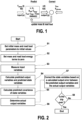
- the method according to the present disclosure may comprise several processing steps (S1, S2, S3, S4, S5, S6, S7, S8). Such steps are performed after the method for estimating MRL parameters is started, for example, when starting a vehicle trip.
- the MRL parameters ( m , A roll , C drag ) are initialized to initial values on which the further steps are based.
- Such initial values may comprise, for example, nominal specifications or production values of the vehicle considering at least one person in the vehicle, for example a driver.
- MRL energy terms are initialized to initial values.
- the initial values are chosen equal to zero.
- input variables are measured and/or derived from measurements of parameters of the vehicle.
- input variables may comprise wheel torque T wheel and road slope angle ⁇ .
- the wheel torque, T wheel may be measured by a control unit of a vehicle, for example an electrical control unit (ECU) of a vehicle.
- the way of measuring the wheel torque may depend on a powertrain type of the vehicle.
- a road slope angle may be estimated from coordinates and elevation measured by a Global Navigation Satellite System (GNSS) and/or an adequate vehicle sensor, for example an accelerometer.
- GNSS Global Navigation Satellite System
- step S4 new state variables are predicted based on previous state variables and on previous input variables.
- the new state variables may be state variables at a predetermined time T + ⁇ T , corresponding to an iteration step k + 1 , that are predicted based on previous state variables and previous input variables at a predetermined time T, corresponding to the previous iteration step k.
- a new vehicle speed and new MRL energy terms are predicted.
- the predicted vehicle speed may be calculated from longitudinal dynamics of the vehicle (see e.g. Equation 1) and the predicted MRL energy terms may be calculated from integral terms related to previously measured input variables (see Equations 8-10).
- output variables of the system are calculated based on previous state variables.
- the output state variables may comprise the predicted speed of the vehicle (which is already calculated because it is comprised in the state variables) and the predicted energy consumption of the vehicle.
- the predicted energy consumption of the vehicle may advantageously be calculated as a linear combination of predicted MRL relative energy contributions weighted by the corresponding predicted MRL parameters (see Equation 7).
- step S5 a new state covariance matrix P is predicted based on previous state variables.
- the prediction of the covariance matrix may be performed according to generic Kalman filter equations that are well known to the skilled person, in particular Extended Kalman filtering equations (see, e.g., [REF2]).
- step S6 actual output variables are measured and/or derived from measurements.
- the actual output variables may comprise an actual vehicle speed, v sns , and an actual overall energy consumption, E virt-sns .
- the actual vehicle speed may be derived from a measurement of the angular velocity of a wheel of the vehicle and from a known radius of such wheel.
- the actual overall energy consumption of the vehicle may be derived from a measurement of a wheel torque, a vehicle speed and from a known radius of such wheel (see Equation 2).
- the actual energy consumption of the vehicle is not measured directly from a sensor but calculated indirectly based, for example, on measurements of a torque and a speed, such actual energy consumption may be referred to as a virtual energy consumption measured by a virtual energy sensor.
- step S7 the state variables and the covariance matrix are updated based on a predicted output error between the predicted output variables and the actual output variables.
- the updating of the state variables and covariance matrix may be performed with generic extended Kalman filtering equations known from the skilled person, in particular extended Kalman filtering equations (see, e.g., [REF2]).
- step S8 it is determined if the trip of the vehicle is over or is still ongoing (i.e. not over). If it is determined that the trip is over, then the process is terminated. If it is determined that the trip is ongoing, it is proceeded to a further iteration of the method, for example starting with step S3, using the updated state variables obtained from step S7. As long as it is determined that the trip is ongoing, the steps S3 to S8 are processed again iteratively, until it is determined that the trip is not ongoing.
- the entire trip consumption predicted with the MRL estimator method according to the present disclosure ( FIG. 3A ) is improved compared to the entire trip consumption predicted with the methods of the prior art ( FIG. 3B ).
- the use of the virtual energy consumption in addition to the vehicle speed to correct the state variables in the Kalman filtering process improves the accuracy of the prediction of the state variables compared to a process in which only the vehicle speed is used.
- the methods and systems according to the present description provide an improved estimation of MRL parameters that can be useful for a variety of applications, such as:
Landscapes
- Engineering & Computer Science (AREA)
- Transportation (AREA)
- Mechanical Engineering (AREA)
- Physics & Mathematics (AREA)
- Automation & Control Theory (AREA)
- Mathematical Physics (AREA)
- Control Of Driving Devices And Active Controlling Of Vehicle (AREA)
Priority Applications (1)
| Application Number | Priority Date | Filing Date | Title |
|---|---|---|---|
| EP22306789.3A EP4382386A1 (fr) | 2022-12-05 | 2022-12-05 | Procédé d'estimation de paramètres de masse et de charge de route d'un véhicule |
Applications Claiming Priority (1)
| Application Number | Priority Date | Filing Date | Title |
|---|---|---|---|
| EP22306789.3A EP4382386A1 (fr) | 2022-12-05 | 2022-12-05 | Procédé d'estimation de paramètres de masse et de charge de route d'un véhicule |
Publications (1)
| Publication Number | Publication Date |
|---|---|
| EP4382386A1 true EP4382386A1 (fr) | 2024-06-12 |
Family
ID=84767248
Family Applications (1)
| Application Number | Title | Priority Date | Filing Date |
|---|---|---|---|
| EP22306789.3A Withdrawn EP4382386A1 (fr) | 2022-12-05 | 2022-12-05 | Procédé d'estimation de paramètres de masse et de charge de route d'un véhicule |
Country Status (1)
| Country | Link |
|---|---|
| EP (1) | EP4382386A1 (fr) |
Citations (3)
| Publication number | Priority date | Publication date | Assignee | Title |
|---|---|---|---|---|
| US5434780A (en) * | 1992-09-08 | 1995-07-18 | Hitachi, Ltd. | Automatic transmission control system with variable lockup timing |
| WO2003016837A1 (fr) * | 2001-08-17 | 2003-02-27 | Volvo Lastvagnar Ab | Procede d'estimation de la masse d'un vehicule entraine sur une route a pente variable et procede d'estimation de la pente de la route |
| WO2015004639A2 (fr) * | 2013-07-11 | 2015-01-15 | C.R.F Societa' Consortile Per Azioni | Estimation de la masse d'un véhicule et de l'inclinaison d'une route |
-
2022
- 2022-12-05 EP EP22306789.3A patent/EP4382386A1/fr not_active Withdrawn
Patent Citations (3)
| Publication number | Priority date | Publication date | Assignee | Title |
|---|---|---|---|---|
| US5434780A (en) * | 1992-09-08 | 1995-07-18 | Hitachi, Ltd. | Automatic transmission control system with variable lockup timing |
| WO2003016837A1 (fr) * | 2001-08-17 | 2003-02-27 | Volvo Lastvagnar Ab | Procede d'estimation de la masse d'un vehicule entraine sur une route a pente variable et procede d'estimation de la pente de la route |
| WO2015004639A2 (fr) * | 2013-07-11 | 2015-01-15 | C.R.F Societa' Consortile Per Azioni | Estimation de la masse d'un véhicule et de l'inclinaison d'une route |
Non-Patent Citations (4)
| Title |
|---|
| EL GAOUTI, YOUSSEFCOLIN, GUILLAUMETHIAM, B. ET AL.: "Online vehicle aerodynamic drag observer with Kalman filters", IFAC-PAPERSONLINE, vol. 54, no. 2, 2021, pages 51 - 56 |
| LINGMAN, PETERSCHMIDTBAUER, BENGT: "Road slope and vehicle mass estimation using Kalman filtering", VEHICLE SYSTEM DYNAMICS, vol. 37, 2002, pages 12 - 23, XP009177346, DOI: 10.1080/00423114.2002.11666217 |
| REINA, GIULIOPAIANO, MATILDEBLANCO-CLARACO, JOSE-LUIS: "Vehicle parameter estimation using a model-based estimator", MECHANICAL SYSTEMS AND SIGNAL PROCESSING, vol. 87, 2017, pages 227 - 241, XP029824564, DOI: 10.1016/j.ymssp.2016.06.038 |
| WINSTEAD, VINCENTKOLMANOVSKY, ILYA V: "Proceedings of 2005 IEEE Conference on Control Applications, 2005", 2005, IEEE, article "Estimation of road grade and vehicle mass via model predictive control", pages: 1588 - 1593 |
Similar Documents
| Publication | Publication Date | Title |
|---|---|---|
| Winstead et al. | Estimation of road grade and vehicle mass via model predictive control | |
| EP4257376B1 (fr) | Système et procédé de modélisation et de rétroaction de performance de pneu de véhicule | |
| EP2956343B1 (fr) | Estimation simultanée d'au moins une masse et une résistance au roulement | |
| EP3019379B1 (fr) | Unité de commande pour véhicule automobile pour estimer l'inclinaison d'une route et la masse du véhicule, véhicule avec une telle unité et produit logiciel correspondant | |
| CN103402847B (zh) | 用于确定车辆的行驶阻力的方法 | |
| US12296833B2 (en) | System and method for providing an indication of driving performance | |
| US8872645B2 (en) | Method for road grade estimation for enhancing the fuel economy index calculation | |
| EP4051550B1 (fr) | Capteur virtuel de pneumatique en régime temps réel | |
| JP2024529003A (ja) | 規定のルートに沿った車両の移動に関する車両のエネルギー消費量を予測するための、およびルート設定のための方法およびシステム | |
| US20040020695A1 (en) | Apparatus and a method for determining hybrid-electric vehicle performance | |
| Beckers et al. | Combined rolling resistance and road grade estimation based on EV powertrain data | |
| US20100100360A1 (en) | Model-based road surface condition identification | |
| US20240159609A1 (en) | Method and system for estimating vehicle traction torque using a dual extended kalman filter | |
| Alonso et al. | Toward a methodology to assess safety of a vehicle | |
| Schaefers et al. | Efficient determination of driving resistance through system identification based on driving route information and weather data | |
| Lee et al. | Development of collision avoidance system integrated with real-time tire-road friction coefficient estimator | |
| EP4382386A1 (fr) | Procédé d'estimation de paramètres de masse et de charge de route d'un véhicule | |
| EP4223608A1 (fr) | Double procédé ekf d'estimation de coefficients de poids et de charge routière d'un véhicule | |
| JP7595494B2 (ja) | 摩耗量推定システム、演算モデル生成システムおよび摩耗量推定方法 | |
| EP4187215B1 (fr) | Systèmes et procédés pour déterminer un poids estimé d'un véhicule | |
| Beckers et al. | A microscopic energy consumption prediction tool for fully electric delivery vans | |
| Lampe et al. | Active excitations for maximum friction coefficient estimation | |
| JP2019112989A (ja) | 車両の燃費推定装置 | |
| US20210148457A1 (en) | Gear stage choosing apparatus, gear stage choosing method, and simulation apparatus | |
| EP4516612B1 (fr) | Manipulation d'une configuration d'essieu d'un véhicule |
Legal Events
| Date | Code | Title | Description |
|---|---|---|---|
| PUAI | Public reference made under article 153(3) epc to a published international application that has entered the european phase |
Free format text: ORIGINAL CODE: 0009012 |
|
| STAA | Information on the status of an ep patent application or granted ep patent |
Free format text: STATUS: REQUEST FOR EXAMINATION WAS MADE |
|
| 17P | Request for examination filed |
Effective date: 20221205 |
|
| AK | Designated contracting states |
Kind code of ref document: A1 Designated state(s): AL AT BE BG CH CY CZ DE DK EE ES FI FR GB GR HR HU IE IS IT LI LT LU LV MC ME MK MT NL NO PL PT RO RS SE SI SK SM TR |
|
| STAA | Information on the status of an ep patent application or granted ep patent |
Free format text: STATUS: THE APPLICATION IS DEEMED TO BE WITHDRAWN |
|
| 18D | Application deemed to be withdrawn |
Effective date: 20241213 |